Journal of Materials
Chemistry
►
PAPER
This journal is © The Royal Society of Chemistry [year] [journal], [year], [vol], 00–00 | 1
Modelling human embryoid body cell adhesion to a combinatorial
library of polymer surfaces
V. Chandana Epa,
aJing Yang,
eYing Mei,
b.c.dAndrew L. Hook, Robert Langer,
b,c,deDaniel G. Anderson
b,c,d
, Martyn Davies,
eMorgan R. Alexander,
eDavid A. Winkler
f,gReceived (in XXX, XXX) Xth XXXXXXXXX 20XX, Accepted Xth XXXXXXXXX 20XX 5
DOI: 10.1039/b000000x
Designing materials to control biology is an intense focus of biomaterials and regenerative medicine research. Discovering and designing materials with appropriate biological compatibility or active control of cells and tissues is being increasingly undertaken using high throughput synthesis and assessment methods. We report a relatively simple but powerful machine-learning method of generating models that link microscopic or molecular properties of polymers or other materials to their biological effects. We illustrate the potential of 10
these methods by developing the first robust, predictive, quantitative, and purely computational models of adhesion of human embryonic stem cell embryoid bodies (hEB) to the surfaces of 496-member polymers.
1. Introduction
Culture of multipotent cells such as haematopoietic stem cells (HSCs) and induced pluripotent stem cells is a major research 15
focus in regenerative medicine. Present methods to culture them and expand their population rely upon animal-derived products now increasingly under scrutiny. Much research effort is focused on designing chemically defined, serum-free, feeder-free synthetic substrates and media to support robust self-renewal of 20
pluripotent cells. Changes in cellular properties such as adhesion, morphology, motility, gene expression and differentiation are influenced by surface properties of the materials on which cells have been cultured. Important surface properties that have been identified include surface chemistry,1 surface wettability,2 25
topography,3 and elastic modulus.4 Additionally, it is clear that proteins adsorbed onto material surfaces strongly influence the biological responses to the surfaces.5, 6 High throughput methods employing large polymer libraries and rapid screening methods can play an important role in discovery of materials for culture 30
and expansion of stem cells.7 High throughput surface
characterisation has been developed that allows surface structure-property relationships to be investigated. 8-10 Working together, these techniques allow a much larger part of materials property space to be explored than has been possible in the past. However, 35
as the dimensionality of materials property space is too large to be explored by even high throughput methods, computational modelling provides an effective means of leveraging the limited and expensive experimental data into a larger portion of materials property space.
40
Consequently, high throughput synthesis and characterization technologies are complementary to computational modelling tools that analyse large data sets and provide interpretation and prediction of new, improved materials. Robust machine learning methods can extract useful information on design and 45
optimization of new materials from many types of existing data. They can identify which physical, process, and chemical properties of polymers and other materials will have the greatest influence on cell and tissue response. They can also reduce the dimensionality of complex synthesis and processing procedures 50
by identifying the subset of these parameters that have little effect on biological outcomes and may be ignored.11 Machine learning methods are simple to apply, broad in application, and particularly well suited to data from high throughput experiments.12
55
Recently Yang et al.13 reported the first relationship between surface chemistry and structure of a polymer microarray and the adhesion of partially differentiated stem cells: human embryonic stem cell embryoid bodies (hEB). The large library of materials in the microarray was characterized experimentally by 60
wettability, surface topography, surface chemistry, and indentation elastic modulus properties. These studies employed high-throughput synthesis and characterization methods to explore the polymer property space supporting stem cell growth. They identified materials that, with a fibronectin pre-treatment, 65
could support hEB adhesion. The adhesion of human stem cells is critical for cellular activities such as proliferation and differentiation. Multivariate analysis of time of flight secondary ion mass spectrometry (ToF-SIMS) data was used to identify relationships between surface chemistry and cell attachment.14 70
Yang et al.13 used these TOF-SIMS data and other experimentally-derived polymer properties to generate a model of hEB adhesion. This approach has since been applied to other cell characteristics such as pluripotency.15 Their methodology provided a general paradigm for the combinatorial development 75
of synthetic substrates for stem cell culture that has recently been extended to developing materials with reduced bacterial pathogen attachment.16
coupled with efficient mathematical descriptions of molecular properties could model and predict hEB adhesion to this large library of polymers. Our aim was to determine how well we could predict experimental hEB adhesion of the polymer library using computational descriptors alone, not using any experimental data 5
such as contact angle, TOF-SIMS spectra, or mechanical properties. Purely computational methods of modelling high throughput materials data will clearly accelerate new materials discovery by reducing the need for additional experimental measurements to characterize the microscopic, bulk, or surface 10
chemistry properties of large materials libraries.
2. Experimental
We employed partially differentiated hEB cells rather than undifferentiated human embryonic stem cells (hES) cells because fully dissociated hES cells tend to undergo cell death during 15
plating. hEB cells are substantially more robust, while maintaining high differentiation potential. The hEBs were cultured for 8 days, as described in Yang et al.13 hEBs were subsequently trypsinized and cultured on fibronectin (Fn) pre-conditioned polymer arrays for 16 hrs to test their initial 20
adhesion. Polymer arrays were washed with PBS, fixed with Accustain (Sigma) solution for 30 min, permeabilized with 1% Triton X-100 in PBS for 10 min, and then stained with Cyto 24 (Invitrogen) for 1 h. The arrays were gently washed with PBS and deionised water to remove buffer salts and air dried before 25
imaging by laser-scanning cytometry, and cell number quantification.
The polymer library was synthesized and characterized as previously described by Yang et al.13 It consisted of 496 polymers synthesized by mixing 22 monomers at various ratios, 30
for which hEB adhesion on the surface had been measured. Surface contact angle, elastic modulus of the polymers in the library, and the surface roughness were measured, and surface chemistry parameters were characterized using ToF-SIMS. These experimental measurements had been used by Yang at al. to 35
model the growth of hEB on the library polymers. However, we generated models of this biological property that employed only molecular descriptors that could be calculated from the monomer structures (no experimental measurements required).
For computational modelling we partitioned the data set into a 40
training and test set. The training set was used to generate the models and contained 80% of the data (397 polymers). The remaining 20% of the data (99 polymers) constituted an independent test set used to estimate how well the models could predict data not used to generate the model. The splitting of 45
training and test sets was achieved by using k-means cluster analysis. We generated 68 molecular descriptors (mathematical objects that capture the molecular properties of polymers) using Dragon v. 5.517 and Adriana v. 2.218 software. Descriptors were chosen to be chemically interpretable and a large number of more 50
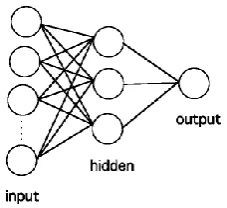
complex potential descriptors were not used. The QSPR models were generated using multiple linear regression with sparsity imposed by an expectation maximization algorithm.19 Nonlinear models used three layer neural networks with the same number of input nodes as descriptors used, a variable but small number of 55
[image:2.595.369.483.48.152.2]hidden layer nodes, and a single output node corresponding to the property (e.g. hEB adhesion) being modelled (Figure 1).
Figure 1. Structure of the neural networks. The input nodes receive the molecular descriptors, the hidden layer (2-3 nodes) does the computation,
60
and the output node generates the predicted response variable (hEB adhesion or roughness).
The logarithm of the properties being modelled was used, as is usual practice in these types of machine learning models. The complexity of the neural network models was controlled using 65
Bayesian regularization that employed either a Gaussian prior (BRANNGP)20 or a sparsity-inducing Laplacian prior (BRANNLP)21. The maximum of the Bayesian evidence for the model was used to stop training of the neural network. Both neural network methods effectively prune the number of weights 70
in the network to a number that is substantially smaller than the number of weights in a fully connected network. This reduced number of weights is called the number of effective weights, and is one of the reasons why Bayesian regularized neural networks are relatively immune to overfitting. The BRANNLP neural 75
network also prunes less relevant descriptors from the model, depending on the sparsity setting chosen. Details of the three modelling algorithms have been published previously.19-21 No outliers were removed from the models.
3. Results and discussion
80
3.1 Stem cell embryoid body adhesion models
We modelled the adhesion of hEBs to the entire 496-member polymer library in several ways. We used linear modelling methods with increasing levels of sparsity to model the EB adhesion in order to identify the molecular features most relevant 85
to the biological activity of the polymers. Optimally sparse models have the greatest ability to predict the properties of new polymers. We also used nonlinear modelling methods to generate models for EB adhesion to determine whether interactions between the relevant molecular features, or nonlinear 90
relationships between these features and the adhesion were important. We generated models of EB adhesion that employed only calculated molecular descriptors for the polymer components. The quality of prediction of the EB adhesion generated by both linear and nonlinear models was relatively 95
high.
The linear hEB adhesion model (MLR) predicted the training set with an r2 value of 0.68 (i.e. the model accounted for 68% of
the variance in the data), and a standard error of estimation (SEE) of 0.163 logEB (predicted hEB binding within a factor of ±1.5). 100
squares (PLS) model of hEB adhesion that used experimental ToF-SIMS peaks as descriptors reported by Yang et al.13 They reported a training set r2 value of 0.74 and test set r2 of 0.62 for their model (training and test partitioning were different to our study). No standard errors were reported.
5
The two nonlinear Bayesian neural network models were substantially better than the linear model at predicting training and test sets. The quality of both neural network models was similar to each other. The Bayesian neural network using a Gaussian prior (BRANNGP) with two nodes in hidden layer 10
predicted the hEB adhesion of the training set polymers with an r2 value of 0.81 (i.e. the model explained 81% of the variation in the data), and an SEE=0.108 logEB (the model could predict the EB binding to within a factor of ±1.3). The model predicted the hEB adhesion for test set polymers with an r2 value of 0.80, and an 15
SEP of 0.107 logEB (predicted EB binding within a factor of ±1.3). This model had 28 effective weights in the neural network, considerably fewer than the number of polymers in the training set and similar to the number of monomers from which the library was generated. The Bayesian neural network with sparse 20
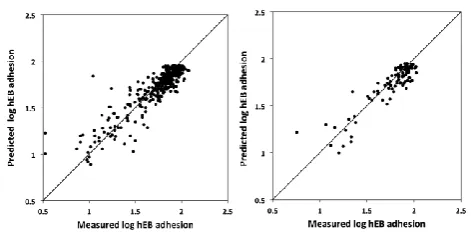
Laplacian prior (BRANNLP) also employed two nodes in the hidden layer. It predicted hEB adhesion for training set polymers with an r2 value of 0.80, and an SEE=0.113 logEB (predicted EB binding within a factor of ±1.3). This model predicted hEB adhesion of test set polymers with very similar fidelity to the 25
BRANNGP model with an r2 of 0.82, and an SEP of 0.101 logEB (predicted EB binding within a factor of ±1.3) (Figure 2). This model used twenty-three molecular descriptors. The BRANNLP method automatically prunes out the least relevant molecular descriptors and network weights. The majority of molecular 30
descriptors were pruned from the model. The twenty-three most relevant descriptors used in the model are summarized in Table 1, together with a description of the type of information these descriptors encode.
Table 1. Description of parameters used in the hEB adhesion model
35
Parameter Description
HAcc_N Number of H-bond acceptors on nitrogen
XlogP Log octanol/water partition coefficient
Dipole Molecular dipole moment
LogS Log aqueous solubility
NRotBond Number of rotatable bonds
NViolationsRo5 Number of Lipinski’s rule of 5 violations
NStereo Number of tetrahedral stereo centres
Complexity Molecular complexity parameter
RComplexity Ring complexity
Rgyr Radius of gyration
Aspheric Molecular asphericity
nCs Number of secondary C(sp3)
nCrs Number of ring secondary C(sp3)
nCar Number of aromatic C(sp2)
nR=Cp Number of terminal primary C(sp2)
nR=Cs Number of aliphatic secondary C(sp2)
nRCOOR Number of esters (aliphatic)
C-004 Number of atom-centred fragments CR4
C-006 Number of atom-centred fragments CH2RX
C-015 Number of atom-centred fragments =CH2
C-026 Number of atom-centred fragments R--CX--R
H-047 Number of H attached to C1(sp3)/CO(sp2)
O-059 Number of aliphatic ether atom-centred fragments
[image:3.595.314.550.46.162.2]
Figure 2. Predictions of the log hEB adhesion on the polymers for the training (left) and test (right) sets for the nonlinear Bayesian (BRANNLP neural net model.
40
The two neural network models had substantially higher predictive power than the PLS models using experimentally determined parameters reported by Yang et al. This suggests that there is some nonlinearity in the relationships between polymer structure and hEB adhesion, or that some of the descriptors used 45
interact with each other in the models. The similarity between the training and test set statistics also strongly suggests that all models are quite robust with no overtraining or overfitting occurring. Earlier PLS models of hEB adhesion reported by Yang et al.13 indicated that hEB adhesion correlated with ions identified 50
in the ToF-SIMS experiments corresponding to the following polymer environments: hydrocarbons, esters, cyclic structures, tertiary amines, propylene glycol, tertiary butyl)22. The most relevant descriptors used in our models are in very good agreement with these conclusions. The logP octanol/water and 55
water solubility, (XlogP, logS) and hydrocarbon indicator variable (nCs, nCrs, nCar , nR=Cp, nR=Cs) descriptors are describing molecular surface chemistry properties similar to those of the hydrocarbon ToF-SIMS peaks. The descriptor for the number of esters (nRCOOR) contains information similar to that 60
of ions assigned in the ToF-SIMS to esters from the monomer structures that correlated with hEB adhesion. The cyclic structures ToF-SIMS peak is mimicked to some extent by the molecular complexity (Complexity, RComplexity), radius of gyration (Rgyr), and molecular sphericity (Aspheric molecular) 65
descriptors. Finally the tertiary amine and propylene glycol ToF-SIMS peaks contain similar information on hydrogen bonding interactions to that of the number of hydrogen bond acceptors on nitrogen (HAcc_N) and dipole moment (Dipole).
As the polymers were pretreated with Fn, it was possible that it 70
is the presence of this protein that modulates the hEB adhesion, rather than the polymers directly. Therefore, we calculated the correlation between Fn adhesion to the polymer library and that of hEB. Surprisingly, the correlation was only 0.05, with the correlation between the log transformed values modelled below 75
being slightly higher at 0.18. This poor correlation between Fn binding and hEB adhesion suggests that the relationship between surface chemistry and properties and hEB adhesion is quite complex. Recent work by Szott and Horbett indicates that it is protein conformation, not the amount that modulates cell 80
adhesion.23 Polymers in the library are therefore influencing hEB adhesion indirectly via their effect on Fn conformation. The modelling of Fn adhesion to this polymer library will be reported elsewhere.
for experimentally measured properties in modelling hEB adhesion on polymer surfaces, we additionally generated machine-learning models of surface roughness that also employed calculated molecular descriptors solely.
5
3.2 Surface Roughness models
Although the modelling and prediction of the adhesion of hEBs on polymers was the primary focus of our work, we also constructed models of the experimentally measured surface roughness because this appeared to impact on the adhesion of 10
hEBs. It was not intuitively obvious that surface roughness could be modelled computationally, as this material property may have more to do with sample preparation than the chemical structure of monomers and polymers. However, it is likely that materials properties will have some influence on polymer surface 15
roughness. We have previously observed that certain combinations of monomer chemistries (e.g. mixed hydrophobic and hydrophilic) produce specific nanotopographies with associated changes in roughness24. In some cases this results from
phase separation prior to polymerization. 20
The statistics of the prediction of the training and test sets were similar to each other (Table 2), but compared to the hEB model, the statistical quality of the surface roughness models was lower. The moderate values for the r2 value of the non-linear models for the test sets in particular suggests that the models have some 25
degree of useful predictive power. Clearly other factors such as how the samples are prepared may indeed have a substantial impact on the surface roughness, as might be intuitively expected. The best nonlinear models account for 60% of the variance in the data, the remainder we suggest is largely due to experimental 30
factors. There were twenty-two indices with nonzero weights in the most parsimonious BRANNLP model. These corresponded to descriptors for hydrophilic properties (number of H-bond acceptors on nitrogen, dipole moment, number of primary alcohols) and hydrophobic properties (number of tetrahedral 35
stereo centres; ring complexity; first principal moment of inertia; molecular asphericity; number of secondary sp3 carbon atoms; number of total quaternary carbon atoms; number of secondary sp3 carbon atoms in a ring; number of substituted benzene carbon atoms; number of terminal primary sp2 carbon atoms; number of 40
aliphatic secondary sp2 carbon atoms; number of aliphatic ethers; number of aromatic ethers; number of atom centred fragments CR4, CH2RX, CHR2X, =CHR, R—CX—R, aliphatic-O-aliphatic,
and aliphatic-O-aliphatic/aromatic-O-aromatic/R-O-R/R-O-C=X). These descriptors were consistent with phase separation 45
playing a role in surface topography. As surface roughness had previously been identified as an important factor in hEB adhesion, the fact that it can be modelled numerically reasonably well provides an explanation as to why we can model hEB adhesion without requiring this measured polymer surface 50
property.
The relative performance of the three methods in modelling roughness is summarized in Table 2. The MLR model performs poorly compared to the neural network models.
[image:4.595.306.540.263.387.2]55
Table 2. Summary of surface roughness model statistics
Model r2train SEE r2test SEP Neffective
MLR 0.44 0.199 0.51 0.259 69
BRANNGP
(3 nodes in hidden layer)
0.66 0.134 0.63 0.212 47
BRANNLP
(2 nodes in hidden layer)
0.61 0.143 0.64 0.209 22
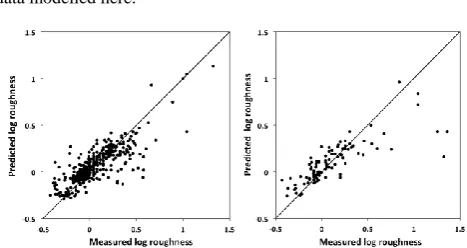
The quality of the prediction of the BRANNGP models for training and test set is illustrated in Figure 3. The models have 60
modest although statistically significant predictivity in contrast to the lack of correlation of experimental ToF-SIMS data with the polymer roughness reported by Hook et al.22 This lack of correlation may be due to artefacts in the estimation of the surface roughness reported that were subsequently removed in the 65
data modelled here.
Figure 3. Predictions of surface roughness for the training (left) and test (right) sets for the nonlinear Bayesian (BRANNGP) neural net models.
70
4. Conclusions
We found that the stem cell hEB adhesion on polymeric surfaces could be modelled well by our approach using only calculated molecular descriptors. These models provide a compact summary of a large amount of numerical data, and some interpretation of 75
the role of surface chemistry in hEB adhesion. These models allow experimental data to be leveraged into a larger portion of materials property space by predicting polymers with improved properties. In addition, surface roughness can also be modelled moderately well using molecular descriptors. This suggests that 80
surface roughness, important for hEB adhesion, may have at least a partial molecular basis, most likely phase separation. Our analysis and the descriptors that we use are amenable to systematic ‘reverse engineering’ by predicting the properties of larger virtual libraries of plausible polymer candidates and by 85
allowing chemical interpretation of the relevant polymer molecular descriptors. These robust modelling methods that require only computed materials descriptors are a valuable complement to high throughput synthesis and characterization methods. They will allow more of materials property space to be 90
Notes and references
aCSIRO Materials Science & Engineering, Parkville, Australia bKoch Institute for Integrative Cancer Research, Massachusetts Institute of Technology, Cambridge, MA
c Department of Chemical Engineering, Massachusetts Institute of
5
Technology, Cambridge, MA
d Division of Health Science Technology, Massachusetts Institute of Technology, Cambridge, MA
eUniversity of Nottingham, Nottingham, UK.
fCSIRO Materials Science & Engineering, Clayton, Australia
10
gMonash Institute of Pharmaceutical Sciences
1. A. S. Curtis, J. V. Forrester, C. McInnes and F. Lawrie, J. Cell Biol., 1983, 97, 1500-1506.
2. K. L. Menzies and L. Jones, Optom. Vis. Sci., 2010, 87, 387-399.
15
3. H. V. Unadkat, M. Hulsman, K. Cornelissen, B. J. Papenburg, R. K.
Truckenmuller, G. F. Post, M. Uetz, M. J. Reinders, D. Stamatialis, C. A. van Blitterswijk and J. de Boer, Proc. Natl. Acad. Sci. U S A, 2011, 108, 16565-16570.
4. K. G. Robinson, T. Nie, A. D. Baldwin, E. C. Yang, K. L. Kiick and
20
R. E. Akins, Jr., J. Biomed. Mater. Res. A, 2012, 100, 1356-1367.
5. Y. Mei, S. Gerecht, M. Taylor, A. J. Urquhart, S. R. Bogatyrev, S.-W. Cho, M. C. Davies, M. R. Alexander, R. S. Langer and D. G. Anderson, Adv. Mater., 2009, 21, 1-6.
25
6. C. J. Wilson, R. E. Clegg, D. I. Leavesley and M. J. Pearcy, Tissue Eng., 2005, 11, 1-18.
7. D. Anderson, S. Levenberg and R. Langer, Nature Biotech. Lett., 2004, 22, 863-866.
8. M. Taylor, A. J. Urquhart, D. G. Anderson, R. Langer, M. C. Davies
30
and M. R. Alexander, Surf. Interf. Anal., 2009, 41, 127-135. 9. A. Urquhart, M. Taylor, D. Anderson, R. Langer, M. Alexander and
M. C. Davies, Adv. Mater., 2007, 19, 2486–2491.
10. A. J. Urquhart, M. Taylor, D. G. Anderson, R. Langer, M. C. Davies and M. R. Alexander, Anal. Chem., 2008, 80, 135-142.
35
11. D. A. Winkler and F. R. Burden, Mol. Biosys., 2012, 8, 913-920. 12. T. C. Le, V. C. Epa, F. R. Burden and D. A. Winkler, Chem. Rev. ,
2012, ASAP.
13. J. Yang, Y. Mei, A. L. Hook, M. Taylor, A. J. Urquhart, S. R. Bogatyrev, R. Langer, D. G. Anderson, M. C. Davies and M.
40
R. Alexander, Biomat., 2010, 31, 8827-8838.
14. M. Taylor, A. J. Urquhart, D. G. Anderson, P. M. Williams, R. Langer, M. R. Alexander and M. C. Davies, Macromol. Rapid Comm., 2008, 15, 1298-1302.
15. Y. Mei, K. Saha, S. R. Bogatyrev, J. Yang, A. L. Hook, Z. I.
45
Kalcioglu, S. W. Cho, M. Mitalipova, N. Pyzocha, F. Rojas, K. J. Van Vliet, M. C. Davies, M. R. Alexander, R. Langer, R. Jaenisch and D. G. Anderson, Nature Mater., 2010, 9, 768-778.
16. A. L. Hook, Y. Mei, J. Yang, S. Atkinson, C.-Y. Chang, D. Irvine, R.
50
Bayston, R. Langer, D. Anderson, G., P. Williams, M. C. Davies and M. R. Alexander, in Nature Biotech., 2012. 17. A. Mauri, V. Consonni, M. Pavan and R. Todeschini, Match-Comm.
Math Co., 2006, 56, 237-248.
18. J. Gasteiger, J. Med. Chem., 2006, 49, 6429-6434.
55
19. F. R. Burden and D. A. Winkler, QSAR Comb. Sci., 2009, 28, 645-653.
20. F. R. Burden and D. A. Winkler, J. Med. Chem., 1999, 42, 3183-3187.
21. F. R. Burden and D. A. Winkler, QSAR Comb. Sci., 2009, 28,
1092-60
1097.
22. A. L. Hook, J. Yang, X. Chen, C. J. Roberts, Y. Mei, G. G. Anderson, R. Langer, M. R. Alexander and M. C. Davies, Soft Matter, 2011, 7, 7194.
23. L. M. Szott and T. A. Horbett, Curr. Opin. Chem. Biol., 2011, 15,
65
677-682.
24. A. L. Hook, J. Yang, X. Chen, C. J. Roberts, Y. Mei, D. G. Anderson, R. Langer, M. R. Alexander and M. C. Davies, Soft Matter, 2011, 7, 7194-7197.
Journal of Materials
Chemistry
►
PAPER
This journal is © The Royal Society of Chemistry [year] [journal], [year], [vol], 00–00 | 6
TOC entry
Modern, sparse machine learning methods allow accurate in silico
prediction of stem cell embryoid
5