Evidence-based Management in Practice: Opening up the Decision Process,
Decision-maker and Context
Evidence-Based Management (EBM) has been subject to a number of persuasive critiques in
recent years. Concerns have been raised that: EBM over-privileges rationality as a basis for
decision-making; ‘scientific’ evidence is insufficient and incomplete as a basis for
management practice; understanding of how EBM actually plays out in practice is limited;
and although ideas were originally taken from evidence-based medicine, individual-situated
expertise has been forgotten in the transfer. To address these concerns, we adopted an
approach of ‘opening up’ the decision process, the decision-maker and the context (Langley
et al., 1995). Our empirical investigation focuses on an EBM decision process involving an
operations management problem in a hospital emergency department in Australia. Based on
interview and archival research, we describe how an EBM decision process was enacted by a
physician manager. We identify the role of ‘fit’ between the decision-maker and the
organisational context in enabling an evidence-based process and develop insights for EBM
theory and practice.
Keywords: Evidence-based management, context, healthcare management, qualitative
Introduction
Over the past decade, there has been increasing interest in developing an evidence-based
approach to management decision-making (Pfeffer and Sutton, 2006; Rousseau, 2012;
Rousseau, 2006; Tranfield, Denyer and Smart, 2003). Observing how evidence-based
practice has enhanced patient care in medicine (Sackett, Rosenberg, Gray, Haynes and
Richardson, 1996), leading management scholars argue that decision processes within
organisations can be similarly improved by systematic analysis of ‘best available evidence’
(Pfeffer and Sutton, 2006; Rousseau, 2006). The Oxford Handbook of Evidence-Based
Management describes EBM as the “science-informed practice of management”, which
fundamentally involves “using scientific knowledge to inform the judgment of managers and
the process of decision-making in organizations” (Rousseau, 2012, p. xxiii). Advocates of
EBM see its potential to help bridge the research-practice gap in organisations through
management educators incorporating EBM in their teaching (Casio, 2007; Erez and Grant,
2014; Pfeffer and Sutton, 2007; Rousseau and McCarthy, 2007; Rynes, Bartenuk and Daft,
2001; Rynes, Giluk and Brown, 2007), contributing to the relevance of business schools
(Bennis and O'Toole, 2005; Thomas and Wilson, 2011).
Other scholars, however, are more cautious of EBM’s applicability to management
decision-making in practice and offer four particular critiques. First, EBM privileges science
and rationality as the basis for decision-making, even though what ‘counts’ as legitimate
evidence in management studies is contested (Arndt and Bigelow, 2009; Learmonth, 2006;
Tourish, 2013). Second, given the divergent nature of the management discipline in terms of
research questions and methods, Tranfield and co-authors propose “there is a need to
recognize that evidence alone is often insufficient and incomplete, only informing
decision-making by bounding available options” (Tranfield et al., 2003, p. 219). Third, authors have
(Arndt and Bigelow, 2009; Swan et al., 2012) and offers limited insight into the nuances of
how EBM plays out as a decision process in practice in different organisational contexts
(Reay, Berta and Kohn, 2009; Walshe and Rundall, 2001). Fourth, concerns have been raised
that in EBM’s borrowing of ideas from evidence-based medicine, the importance of the
situated expertise of the decision-maker in making judgments has been lost (Morrell, 2008).
With these four critiques of EBM in mind, we propose that the approach of Langley
and co-authors (1995) of ‘opening up’ decision processes offers a means of advancing
understanding of EBM (Langley, Mintzberg, Pitcher, Posada and Saint-Macary, 1995).
Specifically, Langley and co-authors (1995) proposed that deeper insights are uncovered
when decisions are investigated in ways that ‘open up’ the role of the decision-maker and of
the context in the processes leading to the commitment to action. In the remainder of the
paper, we apply this approach with the aim of exploring how the decision-maker and the
decision context shape EBM decision processes in practice. We first provide a brief review of
the literature on decision processes and EBM before describing the case study method we
adopted for our empirical investigation. We then present the findings of our case study which
focused on the decision to solve an operations management problem in a hospital emergency
department in Australia. Our paper concludes with a discussion of theoretical contributions to
the four critiques of EBM and implications for management practice.
Evidence-based management and decision-making
Evidence-based management is an emerging stream in the literature on decision-making in
management and organisation studies. For several decades, scholars have been interested in
understanding how decisions happen in organisations (Butler, 1990; March, 1988, 1991;
Mintzberg and Waters, 1990), as well as prescribing processes for how decisions should be
and a commitment to action (Mintzberg, Raisinghami and Theoret, 1976) although the traces
of decisions inside organisations are not always clear (Mintzberg and Waters, 1990).
Historically, the literature on decision processes in organisations is broadly grouped
into rational, political and garbage can perspectives (Das and Teng, 1999; Eisenhardt and
Zbaracki, 1992). Within the rational perspective, decision-makers approach decisions as
intendedly rational choices (March, 1991) and try to follow a systematic process of problem
identification, search for and generation of alternative courses of action, and evaluation of
these alternatives (Daft, 1995). However, because limits on information and human cognition
place boundaries on rationality (Simon, 1955; Simon, [1945]1997), decision-makers look for
new alternatives in the vicinity of current actions, select an alternative that is ‘good enough’
in satisfying evaluation criteria rather than the optimal solution, and proceed when there is
sufficient consensus (Cyert and March, 1963; March and Simon, 1958; Simon, 1976;
Thompson, 1967). Other scholars emphasise that decision processes involve political
bargaining because organisations are coalitions of people with competing interests and power
(Allison, 1971; Pettigrew, 1973; Pfeffer and Salancik, 1974). Finally, decision-making in
some organisations may resemble an organised anarchy in which solutions randomly meet up
- as if in a ‘garbage can’ - with participants, choice opportunities and problems (Cohen,
March, and Olsen, 1972; Padgett, 1980).
Of these three perspectives, bounded rationality is normatively prescribed as the
approach that decision makers should adopt (Van de Ven and Lifschitz, 2013). Empirical
studies have found that some organisations do engage in bounded rational processes.
Mintzberg’s early work reported a process involving three phases (Mintzberg et al., 1976): an
identification phase recognising problems and opportunities and diagnosing cause-and-effect
relationships; a development phase searching for and/or designing solutions; and a selection
action. Nutt (1984) found organisations made decisions using different combinations of
problem formulation, development of alternatives, detailing of viable alternatives, evaluation
of alternatives and implementation. Other studies similarly concluded that different stages
may be skipped, repeated, extended, or re-ordered depending on the type of decision and the
decision-making environment (Eisenhardt, 1989a; Hickson, Butler, Cray, Mallory and
Wilson, 1986; Klingebiel and De Meyer, 2013; Langley, 1989; Laroche, 1995; Mintzberg et
al., 1976; Nutt, 1984; Plambeck and Weber, 2009; Sutcliffe and McNamara, 2001; Witte,
1972).
Studies also provide empirical support for a link between decision processes and
outcomes (Rodrigues and Hickson, 1995). The rational perspective of ‘thinking first’ works
best when “the issue is clear, the data is reliable, the context is structured, thoughts can be
pinned down, and discipline can be applied” (Mintzberg and Westley, 2001, p. 91).
Decision-making is more effective in structured contexts when decision-makers rely on analysis of
relevant information when generating, evaluating and selecting among alternatives (Dean and
Sharfman, 1996; Fredrickson, 1984; Nutt, 2008), whereas intuition becomes important in
unstructured task situations and high-stress or fast-paced environments (Dane and Pratt,
2007; Eisenhardt, 1989a; Mintzberg and Westley, 2001; Useem, Cook and Sutton, 2005).
Intuition is based on sensing and feeling grounded in a decision-maker’s expertise,
experience and perceptions (Miller and Ireland, 2005; Mintzberg and Westley, 2001;
Sadler-Smith and Shefy, 2004).
The emerging literature on evidence-based management is an extension of the rational
perspective on decision-making (Baba and HakemZadeh, 2012). As an approach to decision
making informed by the best available evidence, EBM encourages management practitioners
to consider how different sources of evidence can be incorporated into decision processes
explicit, and judicious use of four sources of information: practitioner expertise and
judgment, evidence from the local context, a critical evaluation of the best available research
evidence, and the perspectives of those people who might be affected by the decision”
(Briner, Denyer and Rousseau, 2009, p. 19). While searching for and evaluating information
about alternatives has been present historically in rational decision making models, EBM
represents a refinement in scholarly thinking about the relevance and reliability of different
types of evidence – especially research evidence - as inputs into decision processes.
However, although scholars speculate that managers can incorporate ‘best available
evidence’ into the stages in rational decision-making, prescriptions for how this might occur
are ambiguous (Baack, 2007) and empirical research into EBM in practice is lacking (Briner
et al., 2009). Healthcare management research exemplifies these critiques of EBM. Studies
show limited adoption of EBM in healthcare management in practice (Kovner, Elton and
Billings, 2000; Kovner and Rundall, 2006; Swan et al., 2012). While Walshe and Rundall
(2001) argue the complex, time-dependent and political characteristics of management
decisions may undermine the utility of EBM, more recent research suggests EBM can be
fruitfully applied to operational, strategic and core business transaction management of health
services (Kovner and Rundall, 2006; see also Swan et al., 2012).
Echoing the general critiques of EBM, healthcare management decisions are made in
complex organisational contexts where: the use of evidence does not necessarily lead to
anticipated outcomes (Arndt and Bigelow, 2009); evidence is “an artifact of the social
processes that lead to its creation” in terms of selection of questions, methods and outcome
definitions (Arndt and Bigelow, 2009, p. 209); and evidence must be mobilised by a
decision-maker and co-produced with other decision-decision-makers and stakeholders (Swan et al., 2012).
Thus, scholars have called for greater attention to the process of application of EBM by
process and particularities of EBM. It does so through a study of how evidence was gathered
and applied by a decision-maker in a health services organisation facing an operations
management problem.
Methods
Research Design
We identified an opportunity to study of EBM during a broader research project at a large
metropolitan hospital in Australia. During data collection, we became aware of a situation in
which physicians in the Emergency Department (ED) seemed to solve an operations
management problem through an evidence-based approach. The problem concerned
inefficient work practices in a unit within the ED called Fast-Track which dealt with patients
whose conditions could be treated rapidly and discharged. We identified the Fast-Track
decision process as a unique opportunity to explore EBM inside an organisation; as Rousseau
(2006) notes, such case studies are rare. Our case study fits Kovner and Rundall’s (2006)
classification as an operational management problem in health services management and, as
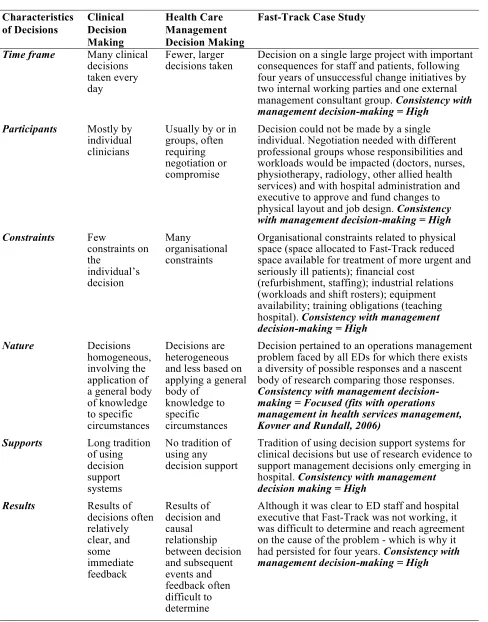
shown in Table 1, the decision characteristics match Walshe and Rundall’s (2001) criteria for
distinguishing ‘typical’ management decisions from clinical decisions.
The Fast-Track decision process extended over a four-year period and involved
multiple participants and organisational constraints. The ED established two internal working
parties to resolve Fast-Track’s problems without success. A management consulting firm then
provided recommendations, including assigning a separate workforce of nurses and senior
doctors to Fast-Track. Recommendations were not implemented because ED staff resisted
TABLE 1: Characteristics of Fast-Track Case Study Characteristics of Decisions Clinical Decision Making Health Care Management Decision Making
Fast-Track Case Study
Time frame Many clinical
decisions taken every day
Fewer, larger
decisions taken Decision on a single large project with important consequences for staff and patients, following four years of unsuccessful change initiatives by two internal working parties and one external management consultant group. Consistency with management decision-making = High
Participants Mostly by
individual clinicians
Usually by or in groups, often requiring negotiation or compromise
Decision could not be made by a single individual. Negotiation needed with different professional groups whose responsibilities and workloads would be impacted (doctors, nurses, physiotherapy, radiology, other allied health services) and with hospital administration and executive to approve and fund changes to physical layout and job design. Consistency with management decision-making = High
Constraints Few
constraints on the individual’s decision Many organisational constraints
Organisational constraints related to physical space (space allocated to Fast-Track reduced space available for treatment of more urgent and seriously ill patients); financial cost
(refurbishment, staffing); industrial relations (workloads and shift rosters); equipment availability; training obligations (teaching hospital). Consistency with management decision-making = High
Nature Decisions
homogeneous, involving the application of a general body of knowledge to specific circumstances
Decisions are heterogeneous and less based on applying a general body of
knowledge to specific circumstances
Decision pertained to an operations management problem faced by all EDs for which there exists a diversity of possible responses and a nascent body of research comparing those responses.
Consistency with management decision-making = Focused (fits with operations management in health services management, Kovner and Rundall, 2006)
Supports Long tradition
of using decision support systems
No tradition of using any decision support
Tradition of using decision support systems for clinical decisions but use of research evidence to support management decisions only emerging in hospital. Consistency with management
decision making = High
Results Results of
decisions often relatively clear, and some immediate feedback Results of decision and causal relationship between decision and subsequent events and feedback often difficult to determine
Although it was clear to ED staff and hospital executive that Fast-Track was not working, it was difficult to determine and reach agreement on the cause of the problem - which is why it had persisted for four years. Consistency with management decision-making = High
Over the next two years, senior physicians took ownership of the strategic direction of
the ED. In 2008, Dr Clancy (a pseudonym) acquired the ED’s Patient Flow Portfolio. Dr
Clancy spent 80% of his work time performing a clinical role and the remaining 20% was
devoted to managing his portfolio, which included Fast-Track. Dr Clancy was trained as an
evidence-based medical practitioner but did not have any formal management training.
Associated with the field site hospital for 11 years, he was familiar was Fast-Track’s
contested management history. Our analysis focuses on the evidence-based process Dr
Clancy enacted to successfully reform Fast-Track.
Data Collection and Analysis
We collected data retrospectively because the redesign of Fast-Track preceded our
involvement at the field site. While retrospective case studies offer advantages of efficient
and focused data collection (Leonard-Barton, 1990), they have potential biases of informants
inaccurately recalling events and desiring to present themselves and their organisation in a
positive light (Golden, 1992). To minimise biases, we utilised multiple informants to allow
cross-checking of information (Eisenhardt, 1989b), focused on knowledgeable informants at
executive and clinical levels and encouraged free rather than forced recall (Miller, Cardinal
and Glick, 1997) and moved beyond interview self-reports and triangulated with archival
documents (Leonard-Barton, 1990).
We conducted interviews with 24 emergency physicians and registrars, four hospital
executives and one nurse who had been heavily involved in the design of Fast-Track. Each
interview was conducted by two members of the research team at the field-site, lasted one
hour on average and was digitally recorded and transcribed. Interviews were semi-structured
to allow the opportunity for probing and clarification (Flick, 2002). In addition to questions
about professional values, identity and training as part of the larger research project. For
similar reasons we also collected observations of the work of emergency physicians in
overseeing patient flow through the hospital ED, including in the physical space designated
as Fast-Track, over a two-year period. While not explicitly analysed in our case study, these
observations increased the robustness of our interview data by building trust with key
informants and giving us familiarity with ED work flow to facilitate meaningful probing.
In addition to the 29 interviews focused on the reform of Fast-Track, another
researcher associated with the overarching project conducted 22 interviews with emergency
nurses. These interviews provided background information and insights into the daily work
practices of nurses in the ED, including their activities in Fast-Track. Interview data
collection was augmented with internal organisational documents and publicly available
records.
We analysed the data using inductive procedures recommended for case studies
(Eisenhardt, 1989b; Eisenhardt and Graebner, 2007; Miles and Huberman, 1994). Drawing
upon analytical methods recommended by Corbin and Strauss (2008), the first author
reviewed all of the interviews and documents and performed open coding using ‘sensitising
questions’ of what is being done, when, by whom and why. Statements relating to a similar
stage of decision making were grouped into preliminary categories and assigned descriptive
labels (Miles and Huberman, 1994) which were iteratively refined by the research team.
TABLE 2: Representative Data for Coding Categories
Category Representative Data
Problem Recognition and Assigning a Mandate
Flow is an important thing to try and maintain functionality. … We’ve just got to keep looking at different things and improve specific patient’s care. (I-16)
Despite good intentions, this clinical area has consistently failed to meet expectations, and efforts to identify the underlying reasons for this poor performance have not translated into sustainable solutions (Working Party Update).
When I was a resident here, Fast-Track was the least well supported area. If we were short staffed, Fast-Track was the first place we took staff away from … which meant our waiting times were terrible, our did-not-wait times were terrible, patient complaints I’m sure were very high and it was a very unsatisfying shift working. (I-8)
I think to some extent we wanted to try something because it wasn’t working what we were doing and we needed to get better. (I-19)
We knew we needed to look at those processes. Clancy was the one who put his hand up and I guess as a group, we all said, ‘Well, we trust that you are going to go off and do a good job.’ (I-5)
Any way of actually providing us with some direction is a good thing. So I think there was a lot of backing for Clancy to do that. … senior backing. (I-12)
Assembling Literature and Internal Evidence
Clancy can give you his little summary of all the literature that he’s made that literally is that thick of journal articles and his own summary. There’s lots of things that are tried. There’s no magic bullet. (I-16)
The rest of the country and internationally people talk about what we can do to improve patient flow in terms of Fast-Track, different ways of streaming patients. So I guess Clancy has probably thought about this a bit more. (I-3)
Clancy did a lot of research, presented a lot of statistics as to what he thought … Clancy loves doing all those figures and numbers. (I-5)
If you’re trying to work out a problem, gather the data about it. (I-14)
Cross-pollinating Evidence and Reformulating the Problem
I was also quick to acknowledge the fact that I had adapted a lot of other people’s ideas just to develop an understanding of why it hadn't worked the first time. (I-Dr Clancy)
Through good careful analysis, there’s a better way of doing patient flow. (I-21) Clancy put in a lot of intellectual time and initiative to try and make something work. (I-20)
He’s also one to be a little bit more rational in his thinking … They’re usually good ideas. They’re well thought out. (I-29 – Executive).
When Clancy went and did all the research and all the papers that have been published about this stuff, he came up with a set of recommendations which were almost exactly the same as a set of recommendations made by one of the nurses who had a lot of experience in that area. (I-17)
Category Representative Data Engaging Stakeholders and Generating Evidence-Based Alternatives
There’s a huge amount of thought and time and effort. Clancy didn’t just come to us with an idea. He came to us with an idea and all the data that supported it. Like he just threw it out there and it just made sense. (I-9)
Clancy had the input of nursing staff and had to engage them because it made a difference to how they practised. (I-8)
I tried to have a couple of meetings where I’d involve people who I thought were key stakeholders locally. It wasn’t the kind of thing I thought required involvement of anyone outside the department for fast tracking – it’s discharged patients, it doesn’t really involve other members of the hospital. (I-Dr Clancy)
Commitment to an Evidence-based Solution and
Implementation
He had enough evidence to support the fact that Fast-Tracks do help, other people are doing it, that it wasn’t hard to be convinced to give it a go. (I-19)
I have no interest to go and do all of the same research that Clancy has so I am kind of relying on the fact that he has gone and done all of that work. He has presented me with a model. It seems like a good model to me. I am happy to go along with it. (I-5)
I looked at what caseload I thought should be managed by Fast-Track then working out how many people that actually translated to and what are their cumulative lengths of stays now, what would I hope they would be, how many hours of bum on seat is that going to be, how many cubicles will I need. So I sort of did those things. (I-Dr Clancy)
Clancy diagnosed some problems, said this is how I think it should happen. We trusted him enough to try and that had good results. (I-17)
The way the new Fast-Track is modelled it is a lot easier to get patients in and out quickly because you have got three dedicated beds, they are almost always free, you have got a dedicated nurse and it is more about the patient selection and the patients that are going there. … (I-24)
Evaluation of Outcomes
Fast-Track is great. It is a simple efficiency manoeuvre that is also better for patients. (I-21)
Great positive feedback for the organisation and then great positive feedback from outside the ED because our numbers have started getting better. We perform well on our times and part of that is a result of Fast Track. (I-17)
It makes for a very satisfying morning when you can just see quick simple things, treat them and dispose of them appropriately. I find that is a lot more satisfying, in terms of being able to provide quick and appropriate care, so that is good. (I-24) Patient satisfaction-wise …. you actually get the automatic feedback from them, especially since a lot of them have unfortunately been on the flip side of it a few years before or have heard stories or know of people. And so to now come up, have your wound sutured and be home within half an hour, they’re always amazed and grateful. So it’s really nice to actually see people satisfied with the service – which is the way it should be. (I-23)
We completed our analysis by using our coding to generate a narrative that
represented “a relatively complete rendering of the story” of Fast-Track (Eisenhardt and
Graebner, 2007, p. 29). In doing so, we also identified and coded additional categories of data
that, as we shall discuss later, related to the importance of a ‘fit’ between the organisational
context of the decision process and the decision-maker’s personal characteristics. As a
confirmability check, we sought feedback from key informants who were involved with
Fast-Track, including the emergency physician who led the redesign of the unit, that our case
narrative was a faithful representation of their experience (Denzin, 1989). In the presentation
of findings that follows, we identify quotes from interviews as I-1 to I-29.
Findings
We present the findings from the study in two sections. We first outline the EBM decision
process stages that were enacted in the reorganisation of Fast-Track. We follow this by
‘opening up’ the decision-maker and context (Langley et al., 1995) with a particular focus on
the role these played in the success of the EBM decision process.
The EBM decision process
We identified five major stages in the decision process, which we present below.
1. Problem Recognition and Assigning a Mandate
When Dr Clancy took over leadership of the patient flow portfolio, there was shared
recognition among ED staff that Fast-Track was a problem: ‘We all recognised that we
needed to do something’ (I-12). Increases in ED overcrowding created pressure to manage
resources with ‘optimal efficiency’ and make the Fast-Track area ‘more functional’ in caring
those things that should have been done well and hadn’t been, and we were happy to make it
a priority’ (I-5). Thus, Dr Clancy was ‘given the mandate by the team’ (I-4) of senior
physicians to resolve the problems with Fast-Track.
The hospital’s executives were supportive of an internal change agent within the ED
taking responsibility for patient flow after department resistance to the management
consultancy group’s recommendations two years prior. An executive claimed, ‘I’m not a big
fan of management consultants. But [instead] you let doctors think up their own ideas and
support them’ (I-28). Assigning Clancy ownership of the problem triggered the next stage in
the EBM process for, as one interviewee explained, it meant:
“We had someone in the trenches preparing and collecting data and being methodical about it and then preparing a good evidence-based response to the problem.” (I-12)
2. Assembling Literature and Internal Evidence
Dr Clancy approached his mandate by collecting both internal and external evidence relevant
to the problem. Clancy was both systematic and open-minded during evidence collection.
Consistent with the medical profession’s scientific empiricism, he sought to bracket any
potential biases that might have arisen from his personal experience of Fast-Track by
following the evidence:
“In terms of gathering the evidence, it wasn’t just a case of find the evidence to prove or disprove what I wanted to do. … I went out there and I read it all and the answers started to just come out of the woodwork”. (Dr Clancy)
Dr Clancy began with a literature review of patient flow studies in Emergency
Departments. Searching peer-reviewed scientific journals, Clancy identified 24 articles most
relevant to the problem of streaming ED patients who have short processing times (11
Australian studies, 13 international studies). He systematically reviewed each article in terms
methodology (what data are collected using what methods?), and outcomes (what are the outcomes of the intervention?). Articles selected for review applied concepts from operations research in organisation and management studies to hospitals, including queuing theory,
process mapping, process re-engineering, lean thinking, six sigma and change management.
Clancy subsequently used the language of operations management in his reports and spoke in
his interview of ‘wearing my operational efficiency hat’.
In addition to his systematic review of external evidence about patient streaming
strategies in hospitals, Clancy assembled internal data about patient flow in his local context.
The ED in our case study used an electronic patient tracking system, the Emergency
Department Information Systems (EDIS). For every service episode, staff entered data into
EDIS to record patient registration, basic clinical decision-making, patient movements and
laboratory tests. Clancy accessed EDIS data to develop a baseline understanding of patient
flow. Other evidence was available to Clancy in the reports of previous working parties and
the management consulting group. These reports presented stakeholder and management
consultant perspectives on the causes of Fast-Track’s problems, recommended solutions, and
evaluated the outcomes of those solutions which had been implemented.
3. Cross-Pollinating Evidence and Reformulating the Problem
After assembling the evidence he appraised to be most relevant to the problem, Dr Clancy
looked for patterns within and between the different sources of evidence using an approach
resembling the iterative analysis of qualitative researchers (Eisenhardt, 1989b; Miles and
Huberman, 1994). Clancy described a process of ‘cross-pollinating all this information’ to
help inform decision-making about Fast-Track. He tested insights from the literature review
against the EDIS data to assess the applicability of different streaming strategies to the local
integrated insights from the literature to explain the underlying ‘reasons’. As analysis
proceeded, the patterns from EDIS and the literature began to converge into a set of tentative
‘ideas’ about possible models for reforming Fast-Track which he assimilated with the
recommendations of previous working parties and the management consulting group:
“Some things just keep coming up over and over and over again. You’ve already heard a million ideas and you read a lot of things … And then in addition to that, when I did some counting here (of our internal capacity data), I noticed that this would go on at these times of day and so on. So now I’ve got these ideas about how we can make the department function more efficiently. … And then you look at these things that have worked, it’s apparent to you from cross-pollinating all this information why it is and there’s still a little bit of intuitive filling in the blanks.”
Immersion in the internal and external evidence provided Clancy with deep insight
into the problems affecting Track. Moreover, the recommendations for improving
Fast-Track offered in previous reports were based on ‘good ideas’ that were well supported in the
literature: ‘I just kept coming back to the same recipe as had been suggested beforehand’.
Thus, Clancy concluded that the problem with Fast-Track was that its implementation had
been undermined by resource allocation and patient selection criteria. With the problem
reformulated, Clancy moved on to engaging stakeholders.
4. Engaging Stakeholders and Generating Evidence-Based Alternatives
Dr Clancy formed a working party and presented a 17 page report of the evidence he had
collected and analysed. Under Clancy’s leadership, the working party evaluated two
alternative strategies for streaming patients: (1) two streams of Admit or Discharge, and (2)
three streams of Resuscitation, Acute and Fast-Track. The first strategy was rejected because
EDIS patient volumes suggested it ‘would not conform to the ideal Fast Track clientele
endorsed by the literature’ (Working Party Update). The second strategy was already in use
but ineffective. Principles on how to better implement this strategy were derived from the
that it is perhaps the single greatest requirement of a successful Fast-Track service’ (Working
Party Report). Second, the literature indicated ‘the overall gain in efficiency’ of a Fast-Track
unit was related to the extent to which resources - both staff and space - were quarantined
from the rest of the ED (Working Party Update). Third, the ‘defining characteristic’ of a
Fast-Track patient was the shortness of expected processing time (Update).
These evidence-based principles helped Dr Clancy and the working party generate
ideas for how to resource and select patients for Fast-Track. At a combined forum for
medical and nursing staff, Clancy presented alternative ideas for reforming Fast-Track. To
facilitate evidence-based discussion, he provided executive summaries of the literature in
pamphlet form:
“Clancy of course presented various ideas to us and there was discussion about what would and wouldn’t work. It wasn’t like a dictatorship where we were presented with a plan and that was it. We all had the opportunity to have input.” (I-5)
The working party used stakeholder feedback to refine their ideas. They also
incorporated the results of an internal Staff Satisfaction Survey. As they evaluated and
refined alternatives for resourcing Fast-Track, Clancy continued to explore the practical
feasibility of these alternatives using current and predicted activity levels based on
EDIS data. Through this process of fitting general principles, derived from external
evidence, to internal evidence capturing the local context, the working party
consolidated their ideas into a ‘detailed evidence-based model’ for Fast-Track (Working
Party Report).
5. Committing to an Evidence-Based Solution and Implementation
The model recommended by Dr Clancy’s Working Party comprised the following
elements: (1) three streams, with patients in Resuscitation treated in order of urgency and
adapted from previous studies; (3) hours of operation estimated from EDIS data on
patient volumes and peak arrivals; (4) autonomous staffing, with doctor and nursing
needs calculated by extrapolating medical and nursing productivity rates reported in the
literature; and (5) structural redesign of ED spaces to quarantine physical space for
Fast-Track. Each recommendation in the Working Party’s report was justified by evidence
which helped to persuade ED staff and hospital executives to make a commitment to
implementing the Working Party’s recommendations. Underpinning this commitment
was trust in Dr Clancy as an evidence-based practitioner:
“Most people felt there wasn’t too much about patient flow that he hadn’t read or thought about before. So you kind of go, ‘Well, you might as well just leave it to him. If he can’t sort it out, then no one else can’.” (I-20)
After the Working Party’s recommendations were accepted, hospital management
funded the restructuring of the physical layout of the ED and staff were trained in the
appropriate application of the revised patient selection criteria. Substantive improvements in
efficiency were gained from the implementation of Fast-Track, including reduced patient
waiting times and greater staff satisfaction. As a doctor who had experience of working in
Fast-Track before and after its redesign commented:
“It works better for the whole department. It flows more efficiently. […] The way it’s designed, set up and run is very, very good for everyone. You get a lot of positive patient feedback about Fast-Track now.” (I-23)
The Importance of the decision maker and the context
We have articulated a process for EBM decision-making that could, on the face of it, be
universally applicable. However, ‘opening up’ the decision-maker and the context of the
decision reveals insights that were important to the success of this particular process. These
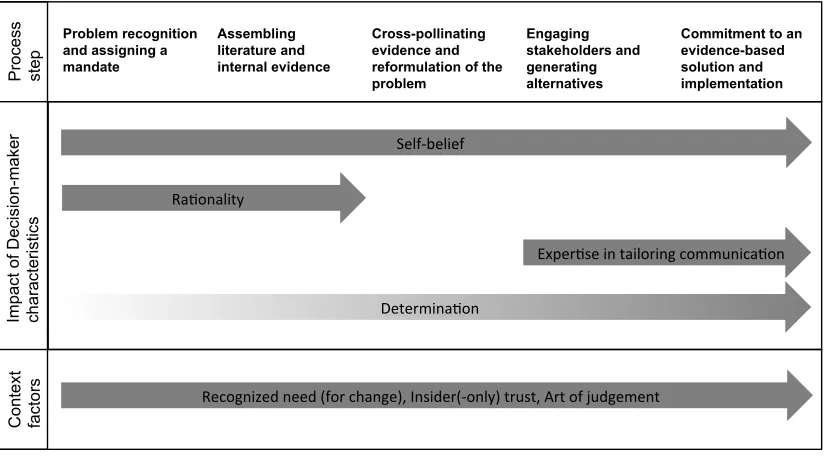
Figure 1: Decision-maker and context factors in relation to the EBM decision process
Opening up the decision-maker
A number of Clancy’s personal characteristics and abilities were intrinsic to the development
and execution of the EBM process. The first of these to note – and quite prominent in the data
– is self-belief1. This self-belief relates both to Clancy as an individual and to his socialisation
within his chosen field:
“I suppose I’m one of those people that doesn’t need to impress anyone but myself and so medicine allows me to do that… I come here and be myself and that’s good.”
Self-belief allows Clancy to assume a mandate to address the Fast-Track problem, and
legitimates intuitively ‘playing around’ with the evidence he gathers. If Clancy was not so
sure of whom he is – a clinician fully immersed in the context and familiar with diagnostic
1 While Clancy’s self-belief may be related to his status as a physician, our data suggests that
self-belief is an intrinsic personal quality of Clancy. Numerous doctors with similar medical training and experience as Clancy were of the opinion that Clancy’s personal qualities – his determination, confidence, self-belief – were specific to him and critical to his success. They indicated that not every doctor would have been as effective as Clancy because they might not possess these personal qualities.
Problem recognition and assigning a mandate Assembling literature and internal evidence Cross-pollinating evidence and reformulation of the problem
Engaging stakeholders and generating alternatives
clues that may be incomplete – he would not be confident in making a leap of faith in
reformulating problems and possible solutions:
“Start looking for reasons why I think that is and then you know you look at these things that have worked […] and there’s still a little bit of intuitive filling in of the blanks.”
Moreover, Clancy recognises that his confidence persuades stakeholders to engage
with the ideas he offers: “It helps if you are confident in your own assessment … that’s
almost a personality thing.”Self-belief was also important at the end of EBM process when it
was balanced with Clancy’s awareness of the potential for implementable action:
“I’m careful not to promise more than what I think I can deliver […] [Fast-Track] was doable I think. I did that because I said I would.”
Self-belief was clearly an important personal characteristic throughout the EBM
process. In contrast, another characteristic that might be assumed to be evident throughout the
process – rationality – was more apparent in the early phases. For example, it was evident in
Clancy’s initial interest in an EBM approach:
“I’m a rational kind of person. I like to know the rationale of things and I feel quite happy acting a certain way if I know the rationale behind it.”
This preference for rationality led to Clancy taking on the challenge of gathering evidence
(internally and from literature) although he recognised that others might not need the details:
‘There are a lot of situations which it’s not necessary for everyone to know the rationale for
everything.’
Later in the process, a focus on rationality was less necessary and Clancy’s expertise
in tailoring communication became more prominent, particularly in meeting the needs of time-pressured colleagues in order to engage them:
Clancy’s expertise in tailoring communication was multi-dimensional. First, it
included skills in assembling written materials into convenient formats – “I put the literature
summary into a sort of pamphlet form and people could read it if they wanted to.” Second, he
demonstrated the ability to present ideas in persuasive, economical language:
“Doctors are more concerned with scientific methodology and things like that […but…] people’s attention spans aren’t that long in the final analysis. They like to know that they can look into the evidence behind something if they want to. But by the same token, if they trust you that you’ve done a thorough job on things…”
Finally, he maintained consistency in how the key ideas were communicated: ‘I just kept
pedalling the message.’
In the latter stages of the process another characteristic became apparent (although it
can be implicitly regarded as present throughout): determination. This determination was
linked to Clancy’s self-belief: ‘…if everyone was interested in seeing things through in the
same level of detail I am, they’d all be welcome.’ It was also linked to a belief in the power
of sustained thought and effort:
“There aren’t too many problems that can withstand sustained consideration from someone as long as someone’s prepared to take it on.”
However, Clancy also made a judgement about whether sustained effort on his part would
have an impact on the intended stakeholder audience and actually lead to an implemented
solution: ‘I don’t want to waste my time doing something that will not penetrate people’s
behaviour.’
Interestingly, the four personal characteristics of the decision-maker that our analysis
‘opened up’ is that they are not concerned, in the main, with the aspect of the process that
makes it evidence-based; that is, the actual assembly of literature and internal evidence.
Instead, these characteristics provide a possible means of identifying the ‘right’ person to take
on this kind of decision problem, and they also suggest how they might drive the process to
Opening up the decision context
In comparison to the decision-maker, aspects of the context are not so easily ascribed to
particular stages of the EBM decision process. Indeed, one of the most important factors, the
recognised need for a decision on how to change Fast-Track, preceded the start of the
process: ‘Fast-Track was such a terrible place to work before, that when we were setting it up
the thought of having to spend a whole day at Fast-Track was soul destroying’ (I-8). By the
outset of the decision process, matters had reached the edge of desperation: ‘We can’t do
business like this for the next ten years. This will drive everybody mad’ (I-3).
Despite the recognised need for change, the decision process could not be driven by
‘just anyone’, however well-grounded in evidence the recommended solution might be. The
eventual solution to the Fast-Track problem decided on by Dr Clancy was quite similar to an
earlier proposal presented by an external management consultancy team, which was not
perceived to be legitimate: ‘The hospital paid nearly a million dollars but because it was an
external review nobody paid any attention to it – who are they to tell us what to do?’(I-17).
Stakeholders in this context were clear that an acceptable solution would have to come from
aninsider: ‘Dr Clancy’s worked here and he knows how the system works’ (I-3). It was
important that the decision maker was a trusted insider – ‘one of our own people’ (I-17) –
because the art of judgement was seen to be intrinsic to the medical profession (and therefore
would not be within the capabilities of an outsider):
“Medicine is just great. There’s no black and white about this. It’s all grey and it's just shades of grey […] It’s not science. It’s all art. It’s how you pull the right things together to try and get the right decision in the end” (I-16).
“I follow the evidence but within the evidence there is always that little bit of
Since the stakeholder community is comprised of medical professionals who value the
art of judgement so highly, evidence by itself would never be convincing without an advocate from this community to ‘bring it to life’:
“He blows me away. He puts up the data and the equations and the mathematics and it’s like shit, you know. If he’s put that much thought and that much process and that much passion into it then I’d be horrified to think anyone would disagree” (I-9). The evidence remains important, but it has an impact on stakeholders partly because it
supports the (somewhat intuitive) judgements made by the decision-maker, rather than being
persuasive in and of itself. This meant that sometimes the evidence could even be implicit:
“He’s summarised but I don’t think he’s sort of presented it as a critical review of what actually needs to be done […] I don’t know, he might have done that critical appraisal in his head…” (I-3).
In sum, as with the personal characteristics we discussed above, opening up the
context reveals a number of key factors that complement the use of evidence. These
contextual factors suggest that evidence is necessary but not sufficient for an EBM decision
process to reach an acceptable solution. These contextual factors are entirely appropriate for
the medical domain in this case where day-to-day clinical judgement is required whenever
diagnostic evidence is inconclusive. This also implies that the decision-maker has to match
up to the stakeholder community’s expectations about demonstrating the art of judgement.
Our data suggest that in this context, where there was a recognised need for change, the EBM
decision-maker still had to be a trusted insider and a skilled artist able to convince
stakeholders of his judgement with or without an explicit display of evidence.
Discussion
Our study of Fast-Track-revealed an evidence-based process involving five stages: (1)
problem recognition and assigning a mandate; (2) assembling literature and internal evidence;
generating evidence-based alternatives; and (5) commitment to an evidence-based solution
and implementation. Progression through these stages was led by a physician manager who
systematically sought out and evaluated the best available internal and external evidence to
generate alternative solutions.
In some respects, the EBM decision process we found resembles those in prior studies
in making and change management. The stages are reminiscent of rational
decision-making studies reporting that managers facing structured problems should try to search for
and evaluate information (Hickson et al., 1986; Langley, 1989; Mintzberg et al., 1976; Nutt,
1984; Witte, 1972) through analytic comprehensiveness (Fredrickson, 1984), procedural
rationality (Dean and Sharfman, 1996) and discovery processes of intelligence gathering and
evaluation (Nutt, 2008). The change management literature has also long acknowledged the
need for change agents trusted by stakeholders. These similarities raise the possibility that
EBM simply provides a new way of framing issues and problems without changing these
issues and problems or the most effective ways to deal with them. We do not, however,
believe this to be the case in general, and our study provides specific advances.
Addressing the general point first, what distinguishes EBM from other decision
processes is the explicit and systematic use of scientific evidence, in concert with other
sources of evidence, to inform decision-making. But we agree that empirical investigation of
how this might occur in practice has been lacking to date. By unpacking how EBM is enacted
inside an actual organisation, our study illustrates how evidence is brought to life inside
organisations through social processes involving decision-makers and stakeholders operating
within the situational realities of their context. In this way, we contribute to the EBM
Our study extends prior work by opening up of the role of the decision-maker and
decision context in shaping the EBM decision process. We identified four relevant personal
characteristics of the decision-maker: self-belief, a preference for rationality, expertise in
tailoring communication, and determination. In relation to the context, three factors were
prominent: a recognised need for change, insider (only) trust; and stakeholder regard for the
art of judgement. Thus, the key theoretical insight that is generalisable from our case (Ridder,
Hoon and McCandless Baluch, 2014) is that a fit between the personal characteristics of the
decision-maker and the demands of the context - person-context fit - is important in arriving
at an implementable decision through an EBM process. Thus, we extend Swan and
co-authors’ (2012) notion that evidence is co-produced by decision-makers and stakeholders by
showing how co-production through EBM requires person-context fit. Our findings also
advance understanding by contributing to debates centred on the four key criticisms of EBM
identified at the outset of the paper. We address each of these below.
EBM privileges rationality
A criticism noted by several scholars is EBM’s privileging of rationality and the scientific
method in managers’ decision processes (eg Bartenuk, 2014; Learmonth, 2006, 2008;
Tourish, 2013). Philosophically this privileging is problematic because it ignores multiple
epistemologies in conducting management research (Learmonth, 2006); pragmatically it is
problematic because overemphasising rationality as a mode of knowing downplays intuition,
which is important for creative problem solving, innovation and effective decision-making in
dynamic organisational environments (Sadler-Smith and Burke, 2009; Sadler-Smith and
Shefy, 2007; Sinclair and Ashkanasy, 2005; Taggart and Robey, 1981; Vance, Groves, Paik
and Kindler, 2007). These problems are illustrated by Erez and Grant’s (2014) call to teach
To an extent, our study counters criticism that EBM privileges rationality by showing
how EBM is enacted by interplay between rationality and intuition. The decision-maker in
our study had a preference for rationality and expressed this by methodically reviewing
scientific literature and ‘number crunching’ hospital data. However, the decision-maker had
to draw upon intuition to ‘cross-pollinate’ and make sense of the patterns within and across
different types of data. Consistent with Eisenhardt’s (1989a; 1999) findings that managers
develop intuition as they engage with operational information, our study suggests that
rationality and intuition reinforce each other in the practice of EBM. Cross-pollinating
between empirical literature and local data during an EBM decision process increases holistic
understanding of the problem confronting the organisation and pattern recognition of how
contextual factors might impact alternative solutions.
This insight, however, points to a possible limitation of EBM in practice. Interplay
between rationality and intuition in the collection and analysis of literature and internal
evidence requires skill and time. Clancy’s training and his clinical role as a user of medical
evidence put him in a more favourable position to engage with evidence than would be
common for most managers who may not have his skills in evidence interpretation nor the
time for doing it. Thus, EBM may not be as readily achievable in contexts where repositories
of reader-friendly summaries of evidence are not available and have to be constructed by
untrained and time-poor practitioners, which is more typically the case for organisational
problems.
Evidence is incomplete and insufficient
Echoing the preceding discussion, a second criticism of EBM is that the evidence base in
management and organisation studies is often insufficient or incomplete as a guide for
lends weight to this criticism by suggesting there is a strong relationship between a
convergent evidence base and ease of implementing an EBM decision process. In our study,
the research literature supplied agreement on cause-and-effect relationships (early doctor
input increases effectiveness, resource quarantining increases efficiency) which resonated
with personal experiences of ED staff and could be translated into alternative solutions for the
design of Fast-Track. Our study suggests that EBM decision processes may be particularly
suited to operations management problems since this sub-field in organisation and
management studies has shown itself to be well-suited to formal scientific approaches and
thus has a well-developed literature of this kind.
The nature of the problem in our study brings to the surface important limitations to
the general applicability of EBM. The problem was operational, non-urgent, structured by
defined goals and measurable outcomes, and self-contained within a department. It is clear
from our study, and from the findings of previous studies in the decision-making literature
(Mintzberg and Westley, 2001; Nutt, 1984, 2008) that rational-analytic approaches like EBM
are well-suited to these types of organisational problems. For more complex and system-wide
problems in large organisations and for problems involving longer-term strategic change
processes (Mintzberg and Waters, 1990), implementing EBM is expected to be a more
contested process. In our study, the relatively small set of stakeholders shared similar
perspectives on the value of evidence and from whom it could be trusted, and used their
power to resist outsider-driven operational changes. In contrast, complex strategic problems
involve many diverse stakeholders and political contests (Hickson et al., 1986; Pettigrew,
1973; Pfeffer, 1981), rendering agreement on what (and who) is and is not legitimate
evidence less likely. Power and politics may play out with competing groups supporting,
resisting and mobilising different sources of evidence, potentially stalling EBM. Further
to strategic problems and how this process differs from operations management problems,
especially under conditions when the evidence base is insufficient and incomplete.
How EBM plays out in particular contexts is unclear
A third criticism stems from limited empirical investigation of EBM in practice (Reay et al.,
2009), which means the nuances of how EBM decision processes are enacted in different
organisational contexts is unclear (Arndt and Bigelow, 2009; Briner et al., 2009). Our study
speaks directly to this debate by offering an illustrative case of EBM in a public hospital
emergency department in Australia. In our study, there was a close fit between what the
decision-maker leading the EBM process supplied (self-belief, preference for rationality,
expertise in tailoring communication and determination) and what the organisational context
demanded (change, a trusted insider and the art of judgement being applied to evidence).
Thus, our findings suggest that an EBM process is more likely to produce an implementable
decision when the personal characteristics of the decision-maker fit the requirements of the
context.
Challenging prior studies showing limited adoption of EBM in healthcare
management in practice (Kovner et al., 2000; Kovner and Rundall, 2006; Swan et al., 2012;
Walshe and Rundall, 2001), our study offers future researchers a starting point for
investigating the range of contextual conditions under which EBM is likely to be effective
and ineffective. We speculate that the particular personal characteristics and contextual
factors we identified in our study of a hospital setting are likely to be relevant in other
organisational settings involving medical professionals and potentially other types of
professional organisations, such as engineering and law. However, given that our analysis of
elaborate our findings. Comparative case studies could unpack the impact of personal
characteristics, such as self-belief and determination, on whether and how a decision-maker
incorporates evidence into their decision processes and with what consequences in different
organisational contexts. Nevertheless, we believe our key insight related to the importance of
person-context fit in EBM decision processes is likely to be theoretically generalisable and
we encourage future research that explores how the fit between EBM and the specific social
realities of the decision context varies from situation to situation.
The role of the situated expertise of the decision-maker has been lost
A final criticism concerns EBM’s lack of attention to the ‘situated expertise’ of the
decision-maker in the decision process (Morrell, 2008). Although EBM was inspired by the movement
towards evidence-based practice in medicine (Pfeffer and Sutton, 2006; Rousseau, 2006), the
concept of ‘situated expertise’ has largely been ignored in the transfer of ideas from medicine
to management (Morrell, 2008). Situated expertise, defined as “the proficiency and judgment
that individual clinicians acquire through clinical experience and clinical practice”, is core to
evidence-based medicine (Sackett et al., 1996, p. 71). By devaluing the role of situated
expertise, EBM has been criticised for missing the point that evidence-based practice has
been successful in improving decision-making in medicine because clinicians have the
expertise and experience to make judgments that contextualise scientific evidence to local
situations.
To a degree, our study supports this critique. Our study was set in what might be
described as a cross-over context from evidence-based medicine to EBM. The
decision-maker was a physician who sought to adapt his knowledge of evidence-based practice to an
operations management problem. In this medical/management situation, the decision-maker
stakeholders placed value on situated expertise in the engagement and implementation stages.
Thus, our study highlights the potential for situated expertise to be an enabler of
evidence-based practice in management just as it is in medicine.
We argue, therefore, that there is a need to (re-)legitimate situated expertise in the
practice and teaching of EBM. Historically, the rhetoric of EBM has emphasised scientific
evidence as a replacement for traditional management decision-making grounded in personal
experience (Pfeffer and Sutton, 2006; Rousseau, 2006). Our findings suggest that the notion
of evidence replacing a manager’s personal experience is short-sighted. This is not to say that
we disregard the value of evidence, but instead we argue that situated expertise – which is
underpinned, in part, by personal experience and judgment - is needed in the handling,
adaptation and communication of this evidence. Our study indicates that evidence does not
speak for itself, and neither does it allow decision processes to be enacted without
context-sensitive judgment.
These insights point to the need for a more balanced view of EBM in which managers
engage with evidence in context as an integral part of practice grounded in situated expertise.
This view has implications for future research and for how management education and
development programs are constructed by business schools. Future research is needed to
better understand the art of judgement that is core to situated expertise, as well as the
different forms in which this expertise is enacted, encountered and valued in different
contexts. Management educators can then incorporate this understanding into their teaching
to support managers-to-be to develop situated expertise, which we suggest is essential to
enacting EBM in practice in useful and meaningful ways.
Evidence-based management, as a “science-informed practice of management” (Rousseau,
2012, p. xxiii), has been criticised for privileging rationality, downplaying the divergent
evidence base in management and organisation studies, conducting limited empirical
investigation of EBM in actual practice and devaluing situated expertise. Our paper
contributes to debates over these critiques of EBM by ‘opening up’ the decision process,
decision-maker, and context in a qualitative study of EBM in a hospital emergency
department in Australia. While we find support, to a degree, for some of the criticisms of
EBM, our study reveals important insights into EBM decision processes and the role of
person-context fit in engaging with evidence and stakeholders to reach an implementable and
effective decision. These insights provide for a more context-sensitive application of EBM
with potential benefits for public administration and effective management in the private
sector, as well as a more nuanced understanding for management educators of how EBM is
enacted in practice through situated expertise. We encourage further research to examine how
the interrelationships we observed between EBM decision process, decision-maker and
References
Allison, G. (1971). Essence of Decision: Explaining the Cuban Missile Crisis. Boston,
MASS: Little, Brown and Company.
Arndt, M. and B. Bigelow (2009). 'Evidence-based management in health care organizations:
A cautionary note', Health Care Management Review, 34(3), pp. 206-213.
Baack, S. (2007). Book Review of 'Hard facts, dangerous half-truths and total nonsense:
Profiting from evidence-based management', Academy of Management Learning and
Education, 6(1), pp. 139-141.
Baba, V. V. and F. HakemZadeh (2012). 'Toward a theory of evidence-based decision
making'. Management Decision, 50(5), pp. 832-867.
Bartenuk, J. 2014. 'Introduction: Bringing life to a correlation of 0.14: Teaching EBM
engagingly and convincingly', Academy of Management Learning and Education,
13(1), pp. 102-103.
Bennis, W. G. and J. O'Toole (2005). 'How business schools have lost their way', Harvard
Business Review, 83, pp. 96-104.
Briner, R. B., D. Denyer and D.M. Rousseau (2009). 'Evidence-based management: Concept
cleanup time?' Academy of Management Perspectives, 23(4), pp. 19-32.
Butler, R. (1990). 'Decision-making research: Its uses and misuses. A comment on Mintzberg
and Waters: Does decision get in the way?' Organization Studies, 11(1), pp. 11-16.
Casio, W. F. (2007). 'Evidence-based management and the marketplace for ideas', Academy
of Management Journal, 50(5), pp. 1009-1012.
Cohen, M. D., J.G. March and J.P.Olsen (1972). 'A garbage can model of organizational
choice', Administrative Science Quarterly, 17(1), pp. 1-25.
Corbin, J. and A. Strauss (2008). Basics of Qualitative Research (Third ed.). Thousand Oaks,
CA: Sage.
Cyert, R. M. and J.G. March (1963). A Behavioral Theory of the Firm. Englewood Cliffs, NJ:
Prentice Hall.
Daft, R. (1995). Organization Theory and Decision. St Paul, MN: West Publishing Company.
Dane, E. and M.G. Pratt (2007). 'Exploring intuition and its role in managerial
decision-making', Academy of Management Review, 32, pp. 33-54.
Das, T. K. and B.-S. Teng (1999). 'Cognitive biases and strategic decision processes: An
Dean, J. W. and M. P. Sharfman (1996). 'Does decision process matter? A study of strategic
decison-making effectiveness', Academy of Management Journal, 39(2), pp. 368-396.
Denzin, N. K. (1989). The Research Act: Theoretical Introduction to Sociological Methods.
Englewood Cliffs, NJ: Prentice Hall.
Eisenhardt, K. (1989a). 'Making fast decisions in high-velocity environments', Academy of
Management Journal, 32, pp. 543-577.
Eisenhardt, K. M. (1989b). 'Building theories from case study research', Academy of
Management Review, 14(4), pp. 532-550.
Eisenhardt, K. and M. Zbaracki (1992). 'Strategic decision making', Strategic Management
Journal, 13, pp. 17-37.
Eisenhardt, K. M. (1999). 'Strategy as strategic decision making', Sloan Management Review,
40, pp. 65-72.
Eisenhardt, K. M. and M. Graebner (2007). 'Theory building from cases: Opportunities and
challenges', Academy of Management Journal, 50(1), pp. 25-32.
Erez, A. and A. Grant (2014). 'Separating data from intuition: Bringing evidence into the
management classroom', Academy of Management Learning and Education, 13(1),
pp. 104-119.
Flick, U. (2002). An Introduction to Qualitative Research (2nd ed.). London: Sage.
Fredrickson, J. W. (1984). 'The comprehensiveness of strategic decision processes:
Extension, observations, future directions', Academy of Management Journal, 27, pp.
445-466.
Golden, B. R. (1992). 'The past is the past - Or is it? The use of restrospective accounts as
indicators of past strategy', Academy of Management Journal, 35, pp. 848-860.
Hickson, D. J., R.J. Butler, D. Cray, G.R. Mallory and D.C. Wilson (1986). Top Decisions:
Strategic Decision-making in Organizations. San Francisco: Jossey-Bass.
Klingebiel, R. and A. De Meyer (2013). 'Becoming aware of the unknown: Decision making
during the implementation of a strategic initiative', Organization Science, 24(1), pp.
133-153.
Kovner, A. R., J.J. Elton and J. Billings (2000). 'Evidence-based management', Frontiers of
Health Services Management, 16(4), pp. 3-22.
Kovner, A. R. and T.G. Rundall (2006). 'Evidence-based management reconsidered', Frontiers of Health Services Management, 22(3), pp. 3-22.