An Analysis of Pre-Flashover
Fire Experiments with Field
Modelling Comparisons
Christian van
der
Pump
Fire Engineering Research Report 2000/10
An Analysis of Pre-Flashover Fire
Experiments with Field Modelling
Comparisons
By
Christian van
der
Pump
Supervised by
Dr Charles Fleischmann
Fire Engineering Research Report
March 2000
This report was presented as a project report as part of the M.E (Fire) degree at the University of Canterbury
School of Engineering University of Canterbury
Abstract
Firstly, this report investigates the behaviour of pre-flashover fires conducted in a two-compartment structure. Secondly, it looks at preliminary field modelling results of the pre-flashover fires using the SMARTFIRE program.
A two-compartment structure was built so that pre-flashover fire experiments could be conducted. Each room in the compartment measured 2.4 m wide, 3.6 m long, and 2.4 m high. A doorway, with dimensions 2.0 m high and 0.8 m wide separated the rooms. All fires were placed in one room (the fire room) where seven fire experiments were conducted consisting of four differently sized fires. Six of the fires, 55 kW, 110 kW, and 160 kW in size were located in the centre of the fire room. The seventh fire was located in the corner of the fire room and was 110 kW in size. Thermocouple trees were located along the centre-line of the compartment so that vertical temperature profiles could be measured; floor and ceiling thermocouples accompanied the thermocouple trees. In addition, gas sampling points measuring O2 and CO2 concentrations were positioned evenly throughout the compartment.
Temperature profiles in the fire room revealed constant cool lower layer and hot upper layer temperatures with a sharp temperature gradient between the two layers. Temperatures in the upper layer for the centrally located fires reached 130oC for the 55 kW fire, 200oC for the 110 kW fire, and 250oC for the 160 kW fire. Temperature profiles in the upper layer for the corner fire were not constant with height but showed a temperature gradient, where the temperature reached 335oC near the ceiling. Temperature profiles in the room next to fire room (the adjacent room) showed constant temperature profiles that were close to the ambient temperature in the lower layer. The upper layer temperature profiles displayed temperature gradients that continued up to the ceiling. Temperatures in the upper layer for the centrally located fires in the adjacent room reached 110oC for the 55 kW fire, 160oC for the 110 kW fire, 200oC for the 160 kW fire, and 225oC for the corner fire.
Acknowledgements
I would like to acknowledge the following people all of whom assisted me throughout the course of this project:
• Dr Charley Fleischmann, my supervisor.
• Associate Professor Andrew Buchanan; thank you for allowing me (a non-engineering student) to participate in the M.E.F.E course.
• The New Zealand Fire Service, for their financial assistance.
• Dr Tony Enright, for encouraging me to ‘Faculty Jump’ from Chemistry to Engineering.
• Carol Caldwell, for the work experience you provided during the year and for introducing me to a sensible and practical approach to fire engineering. • Dr Hamish McLennan, my future employer with Holmes Fire and Safety
Limited.
• Peter Coursey, civil computer lab technician, for your prompt help with installing the SMARTFIRE program.
• Simon Weaver, my classmate and project partner.
Table of Contents
Abstract iii
Acknowledgements v
List of Figures xii
List of Tables xvi
1 Introduction 1
1.1 Overview 1
1.2 Experiments 1
1.3 Zone and Field Models 2
1.4 Grounds for the Research 3
1.5 Goals of the Research 3
1.6 Outline of this Report 4
1.7 Limitations of this Report 4
2 Experimental Set-up 6
2.1 General Description 6
2.2 Metal Frame 7
2.3 Insulation 7
2.3.1 Gib® Fyreline 7
2.3.2 Intermediate Service Board 8
2.4 Fire Set-up 9
2.4.1 Gas Burner 9
2.4.2 Spark and Pilot Flame 10
2.4.3 Gas Supply 11
2.5 Fume Hood and Chimney 11
3.2 Thermocouples 12
3.2.1 Field Trees 13
3.2.2 Zone Trees 14
3.2.3 Floor and Ceiling Surface Thermocouples 15
3.2.4 Corner Thermocouples 16
3.2.5 Aspirated Thermocouples 17
3.3 Gas Analysis 18
3.4 Bi-directional Probes 20
3.5 Data Acquisition 21
3.6 Mass Flow Meter 22
3.7 Visual Record 22
4 Observations 23
5 Experimental Results and Discussion 28
5.1 Aims 28
5.2 Data Presentation and Analysis 28
5.2.1 Field Trees: 28
5.2.2 Corner Thermocouples 29
5.2.3 Surface Thermocouples: 29
5.2.4 Gas Analysis 30
5.3 Method 30
5.3.1 General Method for the Field Trees, Corner Thermocouples and
Surface Thermocouples 30
5.3.2 Method for Field Trees 31
5.3.3 Corner Thermocouples 31
5.3.4 Surface Temperature Profiles 32
5.3.5 Gas Analysis 32
5.4.4 Gas Analysis 63
5.5 Discussion 65
5.5.1 General Behaviour for Field Trees 65
5.5.2 Fire Room Field Trees 66
5.5.3 The Adjacent Room Field Trees 71
5.5.4 Doorway Field Tree 74
5.5.5 Corner Thermocouples 76
5.5.6 Surface Temperatures 78
5.5.7 Gas Analysis 80
5.6 Overall Discussion 82
5.7 Limitations and Assumptions 83
6 SMARTFIRE Introduction and Overview 85
6.1 Introduction 85
6.2 Overview of the SMARTFIRE System 86
6.2.1 Front End User Interface 87
6.3 Knowledge Based System (KBS) 88
6.3.1 Overview of Mesh Generation by KBS 88
6.3.2 Knowledge Acquisition 89
7 SMARTFIRE Simulation Methodology and Parameters 93
7.1 Introduction 93
7.2 Computer Hardware and Software 93
7.3 SMARTFIRE Variables 93
7.3.1 Fire Properties 93
7.3.2 Surface Material 94
7.3.3 Temperature 94
7.3.4 Grid Generation 94
7.3.5 Convergence Limits and Radiation Issues 95
7.3.6 Running the Simulation 95
8 SMARTFIRE Results and Discussion 96
8.1 Results 97
8.1.1 55 kW Fire 97
8.1.2 110 kW Fire 101
8.1.3 160 kW Fire 105
8.1.4 110 kW Corner Fire 109
8.2 Grid Statistics for the Fire Simulations 113
8.3 Computer Simulation Times 113
8.4 Discussion 113
8.4.1 Fire Simulation Visual Profiles 113
8.4.2 Grid Statistics for the Fire Simulations 115
8.4.3 Computer Simulation Time 115
9 Comparisons 117
9.1 Aim 117
9.2 Method 117
9.3 Results 118
9.3.1 55 kW Fire Comparisons 118
9.3.2 110 kW Fire Comparisons 123
9.3.3 160 kW Fire Comparisons 128
9.3.4 110 kW Corner Fire Comparisons 133
9.4 Discussion 138
9.4.1 Discussion Structure 138
9.4.2 Comparisons for the 55 kW Fire 138
9.4.3 Comparisons for the 110 kW Fire 140
9.4.4 Comparisons for the 160 kW Fire 142
9.4.5 Comparisons for the 110 kW Corner Fire 144
10.2 Conclusions from the SMARTFIRE Simulations 150
10.3 Conclusions from the Comparisons 150
10.4 Further Research 151
11 Nomenclature 152
12 References 153
Appendix 1: Tabulated Experimental Field Tree Temperatures 156
Appendix 2: Tabulated Surface Temperatures 184
Appendix 3: Reproducibility 185
List of Figures
Figure 2.1 Illustration of the Final Layout of Two-Compartment Structure 8
Figure 2.2 The Intermediate Service Board 8
Figure 2.3 Gas Burner. 9
Figure 3.1 Field Tree Positions. 13
Figure 3.2 Field Thermocouple Trees in the Fire Room. 14
Figure 3.3 Zone Tree in the Adjacent Room 15
Figure 3.4 Corner Thermocouple Locations 16
Figure 3.5 Corner Thermocouple Positions. 16
Figure 3.6 Corner Thermocouples 17
Figure 3.7 Aspirated Thermocouples 18
Figure 3.8 Bi-directional Probes 20
Figure 4.1 55 kW Fire Photo 24
Figure 4.2 110 kW Fire Photo 25
Figure 4.3 160 kW Fire Photo 26
Figure 4.4 110 kW Corner Fire Photo 27
Figure 5.1 Temperature Profile for Tree 1 (All Fires) 33
Figure 5.2 Temperature Profiles for Tree 2 (All Fires) 34
Figure 5.3 Temperature Profiles for Tree 3 (55 kW, 110 kW, and 160 kW fires) 34
Figure 5.4 Temperature Profiles for Tree 4 (All Fires) 35
Figure 5.5 Temperature Profiles for Tree 5 (Doorway, All Fires) 35
Figure 5.6 Temperature Profiles for Tree 6 (All Fires) 36
Figure 5.7 Temperature Profiles for Tree 7 (All Fires) 36
Figure 5.8 Temperature Profiles for Tree 8 (All Fires) 37
Figure 5.9 Temperature Profiles for Tree 9 (All Fires) 37
Figure 5.18 Temperature Variations for Tree 9 (All Fires) 46 Figure 5.19 Temperature Profiles for Fire Room, 55 kW Fire 47 Figure 5.20 Temperature Profiles for the Adjacent Room, 55 kW Fire 48 Figure 5.21 Temperature Profiles for the Fire Room, 110 kW Fire 49 Figure 5.22 Temperature Profiles for the Adjacent Room, 110 kW Fire 49 Figure 5.23 Temperature Profiles for the Fire Room, 160 kW Fire 50 Figure 5.24 Temperature Profiles for the Adjacent Room, 160 kW Fire 50 Figure 5.25 Temperature Profiles for the Fire Room, 110 kW Corner Fire 51 Figure 5.26 Temperature Profiles for the Adjacent Room, 110 kW Corner Fire 51 Figure 5.27 Floor Temperatures throughout Two-Compartment Structure 60 Figure 5.28 Ceiling Temperatures throughout Two-Compartment Structure 61 Figure 5.29 Temperature Difference between 300 mm TC and Floor TC 61 Figure 5.30 Temperature Difference between 2375 mm TC and Ceiling TC 62
Figure 6.1 SMARTFIRE Block Diagram 87
Figure 6.2 Example of Efficient Cell Distribution 89
Figure 6.3 SMARTFIRE CBR Cycle 90
Figure 6.4 Adjacency Aspect Ratio Examples 91
Figure 8.1 Visual Contour Profile for the Two-compartment Structure (55 kW Fire
without Six-flux Radiation Sub-model) 97
Figure 8.2 Visual Contour Profile for the Two-compartment Structure (55 kW Fire
with Six-flux Radiation Sub-model) 98
Figure 8.3 Visual Contour Profile for the Fire Room (55 kW Fire without Six-flux
Radiation Sub-model) 99
Figure 8.4 Visual Contour Profile for the Fire Room (55 kW Fire with Six-flux
Radiation Sub-model) 99
Figure 8.5 Visual Contour Profile for the Adjacent Room (55 kW Fire without
Six-flux Radiation Sub-model) 100
Figure 8.6 Visual Contour Profile for the Adjacent Room (55 kW Fire with Six-flux
Radiation Sub-model) 100
Figure 8.7 Visual Contour Profile for the Two-compartment Structure (110 kW Fire
without Six-flux Radiation Sub-model) 101
Figure 8.8 Visual Contour Profile for the Two-compartment Structure (110 kW Fire
Figure 8.9 Visual Contour Profile for the Fire Room (110 kW Fire without Six-flux
Radiation Sub-model) 103
Figure 8.10 Visual Contour Profile for the Fire Room (110 kW Fire with Six-flux
Radiation Sub-model) 103
Figure 8.11 Visual Contour Profile for the Adjacent Room (110 kW Fire without
Six-flux Radiation Sub-model) 104
Figure 8.12 Visual Contour Profile for the Adjacent Room (110 kW Fire with Six-flux
Radiation Sub-model) 104
Figure 8.13 Visual Contour Profile for the Two-compartment Structure (160 kW Fire
without Six-flux Radiation Sub-model) 105
Figure 8.14 Visual Contour Profile for the Two-compartment Structure (160 kW with
Six-flux Radiation Sub-model) 106
Figure 8.15 Visual Contour Profile for the Fire Room (160 kW Fire without Six-flux
Radiation Sub-model) 107
Figure 8.16 Visual Contour Profile for the Fire Room (160 kW Fire with Six-flux
Radiation Sub-model) 107
Figure 8.17 Visual Contour Profile for the Adjacent Room (160 kW Fire without
Six-flux Radiation Sub-model) 108
Figure 8.18 Visual Contour Profile for the Adjacent Room (160 kW Fire with Six-flux
Radiation Sub-model) 108
Figure 8.19 Visual Contour Profile for the Two-compartment Structure (110 kW
Corner Fire without Six-flux Radiation Sub-model) 109
Figure 8.20 Visual Contour Profile for the Two-compartment Structure (110 kW
Corner Fire with Six-flux Radiation Sub-model) 110
Figure 8.21 Visual Contour Profile for the Fire Room (110 kW Corner Fire without
Six-flux Radiation Sub-model) 111
Figure 8.22 Visual Contour Profile for the Fire Room (110 kW Corner Fire with
Six-flux Radiation Sub-model) 111
Figure 8.23 Visual Contour Profile for the Adjacent Room (110 kW Corner Fire
without Six-flux Radiation Sub-model) 112
Figure 9.3 Comparisons for Tree 3 (55 kW Fire) 119
Figure 9.4 Comparisons for Tree 4 (55 kW Fire) 120
Figure 9.5 Comparisons for Tree 5 (Doorway, 55 kW Fire) 120
Figure 9.6 Comparisons for Tree 6 (55 kW Fire) 121
Figure 9.7 Comparisons for Tree 7 (55 kW Fire) 121
Figure 9.8 Comparisons for Tree 8 (55 kW Fire) 122
Figure 9.9 Comparisons for Tree 9 (55 kW Fire) 122
Figure 9.10 Comparisons for Tree 1 (110 kW Fire) 123
Figure 9.11 Comparisons for Tree 2 (110 kW Fire) 123
Figure 9.12 Comparisons for Tree 3 (110 kW Fire) 124
Figure 9.13 Comparisons for Tree 4 (110 kW Fire) 124
Figure 9.14 Comparisons for Tree 5 (Doorway, 110 kW Fire) 125
Figure 9.15 Comparisons for Tree 6 (110 kW Fire) 125
Figure 9.16 Comparisons for Tree 7 (110 kW Fire) 126
Figure 9.17 Comparisons for Tree 8 (110 kW Fire) 126
Figure 9.18 Comparisons for Tree 9 (110 kW Fire) 127
Figure 9.19 Comparisons for Tree 1 (160 kW Fire) 128
Figure 9.20 Comparisons for Tree 2 (160 kW Fire) 128
Figure 9.21 Comparisons for Tree 3 (160 kW Fire) 129
Figure 9.22 Comparisons for Tree 4 (160 kW Fire) 129
Figure 9.23 Comparisons for Tree 5 (Doorway, 160 kW Fire) 130
Figure 9.24 Comparisons for Tree 6 (160 kW Fire) 130
Figure 9.25 Comparisons for Tree 7 (160 kW Fire) 131
Figure 9.26 Comparisons for Tree 8 (160 kW Fire) 131
Figure 9.27 Comparisons for Tree 9 (160 kW Fire) 132
Figure 9.28 Comparisons for Tree 1 (110 kW Corner Fire) 133
Figure 9.29 Comparisons for Tree 2 (110 kW Corner Fire) 133
Figure 9.30 Comparisons for Tree 3 (110 kW Corner Fire) 134
Figure 9.31 Comparisons for Tree 4 (110 kW Corner Fire) 134
Figure 9.32 Comparisons for Tree 5 (Doorway, 110 kW Corner Fire) 135
Figure 9.33 Comparisons for Tree 6 (110 kW Corner Fire) 135
Figure 9.34 Comparisons for Tree 7 (110 kW Corner Fire) 136
List of Tables
Table 2.1 Compartment Dimensions...7
Table 3.1 Thermocouple Locations on Field Trees...14
Table 3.3 Aspirated Thermocouple Positions ...18
Table 3.4 Gas Sampling Point Locations ...19
Table 5.1 Fire Room Rear Corner Temperatures (oC) for the 55 kW Fire ...52
Table 5.2 Fire Room Rear Corner Temperature Standard Deviations (oC) for the 55 kW Fire...52
Table 5.3 Fire Room Front Corner Temperatures (oC) for the 55 kW Fire ...52
Table 5.4 Fire Room Front Corner Temperature Standard Deviations (oC) for the 55 kW Fire...53
Table 5.5 Adjacent Room Corner Temperatures (oC) for the 55 kW Fire ...53
Table 5.6 Adjacent Room Corner Temperature Standard Deviations (oC) for the 55 kW Fire...53
Table 5.7 Fire Room Rear Corner Temperatures (oC) for the 110 kW Fire ...54
Table 5.8 Fire Room Rear Corner Temperature Standard Deviations (oC) for the 110 kW Fire...54
Table 5.9 Fire Room Front Corner Temperatures (oC) for the 110 kW Fire ...54
Table 5.10 Fire Room Front Corner Temperature Standard Deviations (oC) for the 110 kW Fire...55
Table 5.11 Adjacent Room Corner Temperatures (oC) for the 110 kW Fire ...55
Table 5.12 Adjacent Room Corner Temperature Standard Deviations (oC) for the 110 kW Fire...55
Table 5.13 Fire Room Rear Corner Temperatures (oC) for the 160 kW Fire ...56
Table 5.14 Fire Room Rear Corner Temperature Standard Deviations (oC) for the 160 kW Fire...56
Table 5.15 Fire Room Front Corner Temperatures (oC) for the 160 kW Fire ...56
Table 5.16 Fire Room Front Corner Temperature Standard Deviations (oC) for the 160 kW Fire...57
Table 5.17 Adjacent Room Corner Temperatures (oC) for the 160 kW Fire ...57
Table 5.18 Adjacent Room Corner Temperature Standard Deviations (oC) for the 160 kW Fire...57
Table 5.19 Fire Room Rear Corner Thermocouple Temperatures (oC) for the 110 kW Corner Fire ...58
Table 5.20 Fire Room Rear Corner Temperature Standard Deviations (oC) for the 110 kW Corner Fire...58
Table 5.21 Fire Room Front Corner Temperatures (oC) for the 110 kW Corner Fire .58 Table 5.22 Fire Room Front Corner Temperature Standard Deviations (oC) for the 110 kW Corner Fire...59
Table 5.23 Adjacent Room Corner Temperatures (oC) for the 110 kW Corner Fire...59
Table 5.24 Adjacent Room Corner Temperature Standard Deviations (oC) for the 110 kW Corner Fire...59
Table 5.25 O2 Consumption and CO2 Production Profiles for Tree 2 (% vol) ...63
Table 7.2 Ambient Temperatures for Simulations ...94
Table 8.1 Grid Statistics for Each Simulation...113
Table 8.2 Computer Simulation Times for the Four Fires ...113
Table A.1 Run 1 Temperatures for Field Trees 1, 2, and 3...156
Table A.2 Run 1 Temperatures for Field Trees 4, 6, and 7...157
Table A.3 Run 1 Temperatures for Field Trees 8 and 9...158
Table A.4 Run 1 Temperatures for Field Tree 5 (Doorway) ...159
Table A.5 Run 2 Temperatures for Field Trees 1, 2, and 3...160
Table A.6 Run 2 Temperatures for Field Trees 4, 6, and 7...161
Table A.7 Run 2 Temperatures for Field Trees 8 and 9...162
Table A.8 Run 2 Temperatures for Field Tree 5 (Doorway) ...163
Table A.9 Run 3 Temperatures for Field Trees 1, 2, and 3...164
Table A.10 Run 3 Temperatures for Field Trees 4, 6, and 7...165
Table A.11 Run 3 Temperatures for Field Trees 8 and 9...166
Table A.12 Run 3 Temperatures for Field Tree 5 (Doorway) ...167
Table A.13 Run 4 Temperatures for Field Trees 1, 2, and 3...168
Table A.14 Run 4 Temperatures for Field Trees 4, 6, and 7...169
Table A.15 Run 4 Temperatures for Field Trees 8 and 9...170
Table A.16 Run 4 Temperatures for Field Tree 5 (Doorway) ...171
Table A.17 Run 5 Temperatures for Field Trees 1, 2, and 3...172
Table A.18 Run 5 Temperatures for Field Trees 4, 6, and 7...173
Table A.19 Run 5 Temperatures for Field Trees 8 and 9...174
Table A.20 Run 5 Temperatures for Field Tree 5 (Doorway) ...175
Table A.21 Run 6 Temperatures for Field Trees 1, 2, and 3...176
Table A.22 Run 6 Temperatures for Field Trees 4, 6, and 7...177
Table A.23 Run 6 Temperatures for Field Trees 8 and 9...178
Table A.24 Run 6 Temperatures for Field Tree 5 (Doorway) ...179
Table A.25 Run 7 Temperatures for Field Trees 1, 2, and 3...180
Table A.26 Run 7 Temperatures for Field Trees 4, 6, and 7...181
Table A.27 Run 7 Temperatures for Field Trees 8 and 9...182
Table A.28 Run 7 Temperatures for Field Tree 5 (Doorway) ...183
Table A.29 Tabulated Floor Temperatures ...184
Table A.30 Tabulated Ceiling Temperatures ...184
Table A.31 Conditions for Each Run ...185
Table A.32 Results for Tree 1 Comparisons ...187
Table A.33 Results for Tree 2 Comparisons ...187
Table A.34 Results for Tree 3 Comparisons ...188
Table A.35 Results for Tree 4 Comparisons ...188
Table A.36 Results for Tree 5 (Doorway) Comparisons ...189
Table A.37 Results for Tree 6 Comparisons ...189
Table A.38 Results for Tree 7 Comparisons ...190
Table A.39 Results for Tree 8 Comparisons ...190
1 Introduction
1.1 Overview
In 1992, the performance-based building code (BIA, 1992) was introduced in New Zealand. This has allowed fire engineers to employ innovative design, with the aim of more efficient use of space, building materials, and a more cost effective design, provided that performance and safety requirements can be demonstrated (Buchanan, 1999). Commonly, the design process for this involves fire engineers using computer models that simulate fires in enclosures such as buildings, yet fire experiments used to verify the accuracy of fire computer models are significantly more simplistic than the scenarios that computer models are applied to.
1.2 Experiments
compartments to correct for radiation effects. Bi-directional probes were placed in the doorway between the fire and adjacent rooms. Gas sampling lines, 16 in all, were positioned along the centre of the room.
1.3 Zone and Field Models
Two types of computer models, zone and field, are used to simulate fires in enclosures. Zone models divide the volume to be simulated into uniform hot upper, and cold lower, layers, solving the conservation equations of mass, energy and species for each zone, and use empirical correlations to describe characteristics such as entrainment into the fire plume. The advantages of zone models are: - they are easy to run, require little computational time, and are relatively inexpensive. Disadvantages associated with zone models are scenarios where the limitations of the empirical correlations are breached, such as irregular geometries, or fires which have restricted entrainment areas; results of zone models are then likely to be imprecise.
1.4 Grounds for the Research
With the rapid advancement of computer processing power, reducing computational times of field models to practical levels, the option is becoming viable for fire engineers to use field models to simulate fires to determine the performance and safety levels in buildings, in the event of a fire. It is commonly assumed that field models produce far more accurate results than zone models. However, field models have not been subjected to extensive validation procedures. The most commonly used experimental data used to validate field models is the Steckler et al. (1982) room fire experiments. This involved a series of 45 experiments conducted in a compartment measuring 2.8 m × 2.8 m in plane and 2.18 m in height. The walls were 0.1 m thick and all were covered with light weight ceramic fibre board. The series of experiments consisted of a gas burner fuelled by methane being placed systematically in eight different floor locations with a variety of single compartment openings ranging from small windows to wide doors. Fires were fixed in size for the duration of each experiment, producing strengths of 31.6, 62.9, 105.3 and 158 kW. Steady state was assumed to be reached in 30 minutes. Instrumentation included bi-directional probes and bare wire thermocouples being placed in a vertical plane located midway between the inner and outer edges of the doorjamb. Also, a stack of aspirated thermocouples were placed in the front corner of the room to measure the gas temperature profiles.
Clearly, the validation of field models needs to extend well beyond this simplified scenario, yet there is insufficient data available for more complex geometries and scenarios that field models can be validated with. This research aims to provide data in greater detail and for more complex scenarios to validate field models.
1.5 Goals of the Research
temperature variations, corner temperatures, surface temperatures, and concentrations for O2 and CO2.
Following the analysis of the four fire experiments, simulations using the SMARTFIRE fire field modelling program developed by the University of Greenwich Fire Safety Engineering Group will be conducted and compared with the experimental results. Two simulations will be run for each fire, one with and one without the six-flux radiation model. Validation with experimental data will only include temperatures measured by the field trees.
1.6 Outline of this Report
Following this introduction, chapters 2 specifies the experimental set-up, and chapter 3 specifies instrumentation used, for the experiments. Observations from the experiments are described in the next in chapter 4. The results and discussion for the experiments are discussed extensively in chapter 5.
The next chapters (6 7, and 8) relate to the SMARTFIRE field modelling program. Chapter 6 provides an overview of SMARTFIRE; chapter 7 outlines the details of how simulations were run for each experiment; chapter 8 gives the results computed by the SMARTFIRE simulations.
Finally, in chapter 9, comparisons are made between experimental temperature profiles and SMARTFIRE simulations, with an overall conclusion closing the report in chapter 10.
1.7 Limitations of this Report
The limitations of the fire experiments carried out at McLeans Island are as follows: • Thermocouples were uncorrected for the effects of radiation. Twenty aspirated
pipes housing the thermocouples, rendering temperatures measured by the aspirated thermocouples unusable for radiation correction.
• No experiment is repeated with exactly the same conditions. Appendix 3 gives a fuller account of this and determines how accurately each experiment is likely to be repeated.
The limitations of the SMARTFIRE simulations carried out are as follows:
• It has been assumed that the KBS system used by SMARTFIRE assigns the appropriate number of cells to the problems and distributes the cells appropriately. No runs have been done with higher cell resolutions.
• All surfaces of the compartment were modelled as gypsum plaster. The interior surface of the two-compartment structure was insulated with Intermediate Service Board, with Gib® Fyreline underneath. The option to select two surfaces for the compartments was not available with the SMARTFIRE program, so gypsum plaster was used as a surface for the two-compartment structure.
• The arrival of the SMARTFIRE program for the use in this project was late. Because of this, simulations were run by selecting recommended default settings. Thus, SMARTFIRE simulations and results must be viewed as
2 Experimental
Set-up
The purpose of this chapter is to describe the configuration of the two compartment experimental set-up used to conduct the fire experiments at McLeans Island for the period 26 November to 1 December 1999. First, a general description is given, followed by specific details on how the two-compartment structure was built.
2.1 General Description
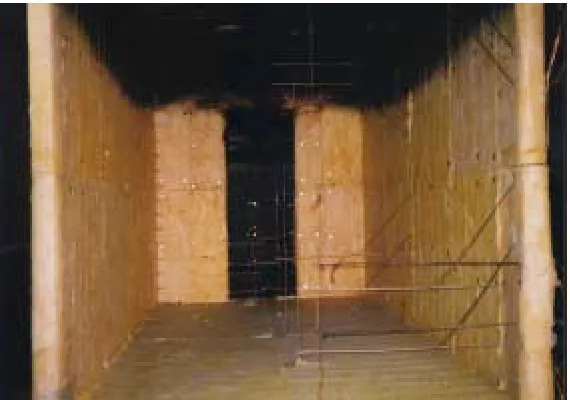
A two-compartment building was constructed to conduct pre-flashover experiments. Starting from steel sections, the frame was built which then allowed Gib® Fyreline and Intermediate Service Board to be placed in the interior of the compartment.
The two compartments were separated by a doorway, which had been constructed from steel studs that were welded to the steel frame. This doorway was then insulated with Gib® Fyreline and Intermediate Service Board, along with the interior of the compartments.
An illustration of the final layout of the two-compartment structure is shown in Figure 2.1 with interior dimensions specified in Table 2.1.
Figure 2.1 Illustration of the Final Layout for the Two-Compartment Structure.
2.4m
800
mm 2.4m
2.0 m
Fire Room
Adjacent Room
3.6 m 3.6 m
Front Opening
Table 2.1 Compartment Dimensions
Dimensions Fire Room Doorway Adjacent Room
Height (m) 2.4 2.0 2.4 Length (m) 3.6 0.1 3.6 Width (m) 2.4 0.8 2.4
2.2 Metal Frame
Construction of the two-compartment structure began with a metal frame that was slightly larger than the final interior dimensions. This allowed space for the installation of insulating materials on the inside of the container, so that the final interior dimensions would be met.
The frame was first constructed in two separate sections, and then welded together to form the frame for the two-compartment structure. This formed the starting point for the construction of the two-compartment structure. The frame was elevated 0.5 m to allow access underneath the structure so various instruments could be installed later.
Wooden joists 140 mm × 40 mm were attached to the steel frame at spacings of 600 mm to the horizontal section of the steel frame to provide the foundation for a floor and ceiling.
2.3 Insulation
Once the compartment frame was constructed, the interior was insulated with Gib® Fyreline and Intermediate Service Board to minimize heat transfer and damage to the structure and attached instrumentation.
2.3.1 Gib® Fyreline
vertical and horizontal centres. The 12.5 mm Gib® Fyreline provides 60 minutes of post-flashover fire protection.
Generous amounts of Gib® 4 Plus was used to seal all joints between Gib® Fyreline plasterboards to ensure minimum leakage within the compartment.
2.3.2 Intermediate Service Board
[image:25.595.156.441.403.603.2]Upon exposure to temperatures over 100oC (which fire gases exceed considerably), the Gib® Fyreline can dehydrate, altering the thermal properties of the Gib® Fyreline. This undesirable effect would lead to changing thermal properties of the Gib® Fyreline with each experiment. To prevent the dehydration of the Gib® Fyreline from the effects of the fire experiments, Intermediate Service Board (0.6 m × 1.2 m) was fitted to the interior of the compartment, over the Gib® Fyreline (see Figure 2.2 below).
Figure 2.2The Intermediate Service Board used to line the
Interior of the two-compartment structure.
2.4 Fire Set-up
2.4.1 Gas Burner
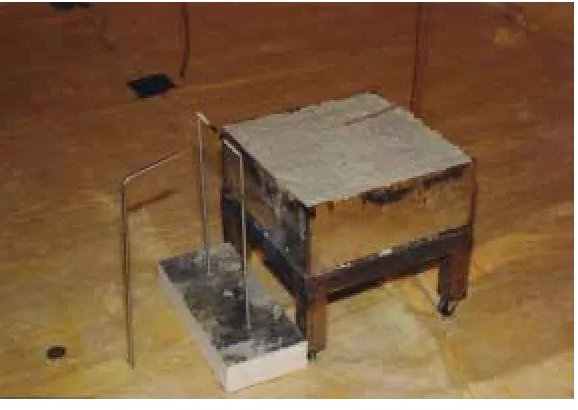
[image:26.595.155.444.235.440.2]A square gas burner 300 mm wide, elevated 300 mm above the surface of the compartment floor, was placed in the centre of the fire room to provide the fire (see Figure 2.3 below).
Figure 2.3Gas Burner.
Note: Pilot flame pipe and electrodes to the left of the burner.
A square gas burner is desirable for this experiment as when field models are used to simulate fires, the volume of the compartment is meshed into square and rectangular volumes (see Section 1.3 Zone and Field Models). Therefore a square burner is likely to be modelled more accurately than a circular burner, particularly when a fire is placed in the corner of a room, since a square burner can sit flush in the corner whereas a circular burner cannot.
the end of a pipe that is expelling combustible gases rapidly is not a buoyancy driven flame, but a momentum driven flame (McCaffery 1995).
The Froude number is a dimensionless number and is determined using the following expression:
r g V Fr
2
2
= (2.1)
Where: V is the gas velocity (ms-1),
r is the radius of the orifice (m), and g is the gravitational constant (9.8 ms-1).
To ensure that the LPG from the LPG supply (see Section 2.4.3 for details of the gas supply) is a buoyancy driven flame and not a momentum driven flame, the LPG was dispersed over a much wider area than the diameter of the pipe from the LPG supply that supplies the burner. By feeding the LPG line into the bottom of the burner and dispersing it through a gravel bed of a much larger area, a diffusion flame was established.
2.4.2 Spark and Pilot Flame
A pilot flame was set up to ensure ignition of the burner. The tip of the pilot flame pipe was positioned approximately 150 mm from the fire,at a height of approximately 400 mm. LPG from the main gas source was fed to the pilot flame pipe through the floor.
2.4.3 Gas Supply
LPG was used to supply the burner and pilot flame for all experiments. Four 45 kg LPG cylinders were stored outside the building and placed on a load cell, enabling the mass loss rate of LPG to be measured during experiments. For all experiments, all the gas cylinders were connected to a single gas line feeding the burner, ensuring consistent gas flow. Gas flow to the burner was controlled by a mass flow meter (see Section 3.6 Mass Flow Meter).
2.5 Fume Hood and Chimney
3 Instrumentation
The purpose of this chapter is to describe the instrumentation used to measure properties such as temperature profiles, gas species concentrations, and velocities of gas currents generated by the compartmented fires.
3.1 General Description
After the construction of the compartment (the steel frame, Gib® Fyreline, and Intermediate Service Board) was complete, instrumentation was put in place to measure properties of the fires. The physical properties measured were:
• Vertical temperature profiles throughout the compartment, • Surface temperatures throughout the compartment,
• O2, and CO2 concentrations at various locations in the compartment, and • Velocity profiles through the central doorway and exterior opening.
All of these properties are commonly predicted using computer zone or field models (Cox, 1994) to give an approximation of the behaviour of compartmented fires.Thus, instrumentation that measures these properties was placed extensively throughout the compartment.
3.2 Thermocouples
positions throughout the compartment enabling exposed thermocouples to be corrected for radiation.
3.2.1 Field Trees
To enable the validation of vertical temperature profiles for field models such as SMARTFIRE, thermocouple trees were placed evenly throughout the compartment. Spacing for the nine thermocouple trees is illustrated in Figure 3.1 below.
Figure 3.1Field Tree Positions (Crosses indicate field trees).
The thermocouple trees were positioned 100 mm off the centre of the compartment, with the end 100 mm bent at a 900 angle so that the tip of the thermocouple was positioned along the centre of the room.
Thermocouples used on the trees were type K bare bead 24 gauge with low temperature glass insulation (K24lt), and type K bare bead 24 gauge with high temperature glass insulation (K24ht). Each thermocouple tree held 14 thermocouples (tied in place with wire). Each tree had identical thermocouple spacing, with the exception of the thermocouple tree in the central doorway of the compartment. This had 13 thermocouples spaced evenly at 150 mm, starting at 1900 mm from the floor. Type K24ht were used for the top nine thermocouples for each tree (which were fed into the compartment through the ceiling), as this region undoubtedly reaches high temperatures. The remaining five thermocouples below were of type K24lt (fed through the floor). Spacing for the thermocouples (abbreviated as TC) are listed in
900
mm 1800 mm 2700mm 3600mm 4500mm 5400mm 6300mm 7200mm 150 mm Tree 2 Tree 3 Tree 4 Tree 5 Tree 6 Tree 7 Tree 8 Tree 9 Tree 1
Table 3.1 Thermocouple Locations on Field Trees
TC Height (mm) 2375 2350 2300 2250 2200 2150 2100
TC Type K24ht K24ht K24ht K24ht K24ht K24ht K24ht
TC Height (mm) 1850 1600 1350 1100 900 600 300
[image:31.595.115.478.195.493.2]TC Type K24ht K24ht K24lt K24lt K24lt K24lt K24lt
Table 3.2 Thermocouple Locations on Field Trees in the Doorway
TC Height (mm) 1900 1750 1600 1450 1300 1150 1000
TC Type K24ht K24ht K24ht K24ht K24ht K24ht K24ht
TC Height (mm) 850 700 550 400 250 100
TC Type K24ht K24ht K24lt K24lt K24lt K24lt
Figure 3.2Field Thermocouple Trees in the Fire Room.
Note how the thermocouples are bent 900. This is so they are positioned along the centre-line of the room.
Type K24ht and K24lt thermocouples measured temperature as a voltage, which was sent to a computer and converted to a temperature (see Section 3.5 Data Acquisition).
3.2.2 Zone Trees
(Weaver, 2000) which can then be compared to zone model data) with each thermocouple insulated with stainless steel piping that was mounted to the wall through the exterior of the compartment. Figure 3.3 shows the configuration of the zone thermocouple tree in the adjacent room.
Figure 3.3Zone Tree in the Adjacent Room
3.2.3 Floor and Ceiling Surface Thermocouples
3.2.4 Corner Thermocouples
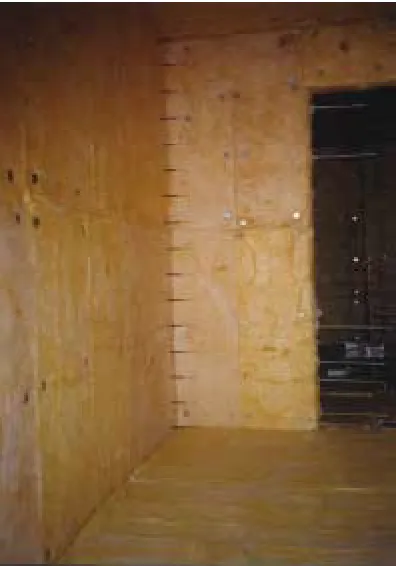
To measure temperature profiles in the corner (along the centre-line of the compartment) of each room, thermocouples (type K24ht) were positioned in the corners, as shown in Figure 3.4. Thermocouples were positioned in a similar way to the field trees, where they were aligned along the ceiling 100 mm off the centre-line of the compartment, with the end 100 mm bent at a 900 angle so the tip of the thermocouple was positioned along the centre-line of the room. Each corner contained 15 evenly spaced thermocouples. Figure 3.5 shows the spacing for the corner thermocouples. Figure 3.6 shows a picture of the corner thermocouples located near the back wall of the fire compartment.
Figure 3.4Corner Thermocouple Locations
Figure 3.5Corner Thermocouple Positions. Each cross
represents a thermocouple position.
Fire Room 225 Adjacent Room
mm 225 mm
25 mm
75 mm
125mm
175 mm
225 mm
25 mm 75 mm 125 mm 175 mm 225 mm Back
Corner
Front Corner
Figure 3.6Corner Thermocouples
3.2.5 Aspirated Thermocouples
Radiation can be emitted and absorbed by thermocouples (Blevins, 1999). If the thermocouple’s temperature is high it will radiate heat, lowering its temperature. If a thermocouple is cool but near the fire (for instance, near the floor by the fire) it will absorb radiation, increasing its temperature. Both of these affect the thermocouple’s ability to measure the surrounding air temperature accurately. To overcome this, 20 aspirated thermocouples were positioned throughout the compartment. The aspirated thermocouples were type K24lt thermocouples but insulated with ¼ inch steel tubing. Air is drawn through the steel tubing from a pump. Since the steel pipe conceals the thermocouples, radiation from the fire does not increase its temperature, and emission of radiation by the thermocouple does not reduce its temperature as the constant airflow ensures a very low temperature gradient between the thermocouple and the air.
Table 3.3 Aspirated Thermocouple Positions
Location Height (mm)
Tree 2 300, 600, 2100, 2250 Tree 4 300, 600, 2100, 2250 Tree 5 300, 600, 1600, 1900 Tree 7 300, 600, 2100, 2250 Tree 9 300, 600, 2100, 2250
Figure 3.7 Aspirated Thermocouples and
Gas Sample Lines
Note: Unfortunately the aspirated thermocouples were not able to be used to correct for the effects of radiation on the bare thermocouples as it was discovered that the pump was drawing insufficient air through the aspirated thermocouple lines.
3.3 Gas Analysis
Table 3.4 Gas Sampling Point Locations
Position Sampling Point (Height from Floor, mm)
Tree 2 300, 600, 1950, 2250 Tree 4 300, 600, 1950, 2250 Tree 5 400, 700, 1600, 1900 Tree 7 300, 600, 1950, 2250
The gas analysing equipment (referred to as gas analyser throughout the rest of this report) used to determine the concentrations of O2, CO2, and CO consisted of a Servomex 540A paramagnetic oxygen analyser for O2 and a Siemens ULTRAMAT 6.0 NDIR gas analyser (dual-cell, dual beam with a flowing reference gas) for CO2 and CO. Note: The CO concentration for these experiments was below the limitations of the gas analyser, therefore no analysis of CO concentrations for the experiments is given.
3.4 Bi-directional Probes
Velocity profiles through the doorway and on the ceiling of the compartment were measured using bi-directional probes, as shown in Figure 3.8.
Figure 3.8Bi-directional Probes Located in the Doorway
The 7 bi-directional probes in the doorway were spaced at intervals of 300 mm starting at 100 mm off the floor. The bi-directional probes were then connected to a differential pressure transducer that measured the pressure difference across the bi-directional probe head as a voltage. A computer then recorded this voltage.
By measuring the pressure drop across the bi-directional probe, the velocity can be determined (Emmons, 1995). This is done using the following expression:
ρ
p
Where: V is the velocity (ms-1),
∆p is the pressure drop across the bi-directional probe (N/m2), and ρ is the density of the air (kg/m3).
Air density is determined using the ideal gas law:
RT Mp
=
ρ (3.2)
Where: M is the molecular mass of the air in the compartment (kg/mol), p is the pressure in the compartment (N/m2),
R is the universal gas constant (8134 J/kg.mol.K), and T is the temperature in Kelvin (K).
The air in the compartment contains combustion products. Since the exact composition of the combustion gasses is not known and 10% of the air or less is used for combustion, the composition is assumed to be ambient air. The molecular weight of air is 28.95 mol/kg at 25oC. Using the ideal gas law the density can be determined:
( )
3
8 . 352
m kg T
=
ρ (3.3)
Therefore, the temperature is required at each bi-directional probe location to determine the density of air. Each bi-directional probes position was in line with type K24lt and type K24ht thermocouples, enabling the temperature at each bi-directional probe to be measured. Note: Unfortunately the bi-directional probe data was unable to be analysed as preliminary results suggested the bi-directional probes contained blockages.
was used to record temperatures measured by the field, corner and surface thermocouples. All measurements were recorded every 5.2 – 5.3 seconds by both computers and saved as CSV files, which were on average a size of one Mbyte.
3.6 Mass Flow Meter
The mass flow rate of LPG to the burner must be controlled to produce consistent and reproducible fire sizes. To control the mass flow rate of LPG to the burner, a High Flow Mass Controller and Meter Model 5853E was installed between the burner and LPG cylinders. The High Flow Mass Controller and Meter Model 5853E controlled mass flow within the desired range with a quoted error by the manufacturer of 1%.
3.7 Visual Record
4 Observations
The purpose of this section is to give a qualitative account of the experiments conducted at McLeans Island. The following observations were made:
• As fire size increased, flame height increased.
• All fires hot gases contained soot particles, indicating incomplete combustion. • As fire size increased, so did the level of soot generated by the fire.
• As fire size increased, flame height increased.
• In the fire room, the centrally located fires were all leaning away from the doorway. This behaviour has been observed previously (Quintiere et al., 1981). This is a result of incoming air’s momentum pushing over the fire’s flames.
• As fire size increased, radiation emitted by the fire increased. This was easily felt by standing in front of the compartment.
• The ceiling jet was clearly visible in the adjacent compartment. Since the adjacent compartment had no soffit, this prevented the build-up of hot gases. • In the fire compartment, the production of hot, turbulent gases could be seen.
This increased with an increase in fire size.
• A hot buoyant upper layer could be seen in the fire compartment. This hot upper layer was caused by the soffit constraining gas flow out of the fire compartment.
• The 110 kW corner fire’s flames were the highest of all fires. The corner fire’s flames reached and extended along the ceiling.
5 Experimental Results and Discussion
Details relating to measurements made by the field thermocouple trees (commonly referred to as ‘trees’ throughout the rest of this report), corner thermocouples, surface thermocouples, and gas sample lines of the centrally located 55 kW, 110 kW, 160 kW fires, and the 110 kW corner fire are presented and discussed in this chapter.
5.1 Aims
This chapter aims to present steady state results from the data collected by the: 1. Field tree thermocouples,
2. Corner thermocouples, 3. Surface thermocouples, and 4. Gas sampling locations.
Details on how the above four sets of results are expressed, are discussed in Data Presentation and Analysis below.
5.2 Data Presentation and Analysis
This section discusses how data collected for the field trees (see Appendix 1 for tabulated results), corner thermocouples, surface thermocouples (see Appendix 2 for tabulated results), and gas sampling locations are presented and analysed.
5.2.1 Field Trees:
1. Temperature profiles of the field trees are compared for the four fires.
2. Investigate the temperature variation from the average temperature
during steady state for the thermocouple locations on each tree. This is
expressed on 9 bar graphs (with the four fires represented in each graph) where the standard deviation from the average temperature for each thermocouple tree during steady state, was recorded. The level and location of turbulence and/or mixing of ambient air with hot fire gases inside the compartment will be seen if the standard deviation during steady state is sizeable.
3. An overall comparison per fire between field trees in each room. This
is expressed as 8 Temperature vs. Height scatter graphs with the field trees for each room on one graph, for each fire (Note: Trees 1, 2, 3 and 4 are in the fire room and trees 6, 7, 8, and 9 are in the adjacent room, with tree 5 situated in the doorway. See Section 3.2.1 for locations). This will give an insight to how vertical temperature profiles change within each room.
5.2.2 Corner Thermocouples
The average temperatures measured by the corner thermocouples located in the rear and front of the fire room, and in the adjacent room, are presented in tabular format. Each table represents one corner thermocouple set for each fire. The standard deviations for the temperatures measured over the steady state period are included to give an indication of the temperature variations for the thermocouples.
5.2.3 Surface Thermocouples:
The temperatures measured by the surface thermocouples are presented in four separate graphs. They are:
1. Temperature vs. Floor Thermocouple Location, 2. Temperature vs. Ceiling Thermocouple Location,
These graphs are presented to gain an insight into temperature profiles by the surface thermocouples.
5.2.4 Gas Analysis
The concentration profiles of O2 and CO2 are presented in tabular format where the concentrations for each species at each sample point location for the trees which have sampling lines attached (see Section 3.3 for locations) are presented for the four fires. Included is the ratio of O2 consumption to CO2 production (see Appendix 4 for the background theory on the expected ratio of O2 consumption to CO2 production). This will give an indication of the efficiency of the LPG combustion within the compartment.
5.3 Method
5.3.1 General Method for the Field Trees, Corner Thermocouples and Surface Thermocouples
presented in Appendix 1. Note: The 110 kW corner fire is denoted as 110 kW c in all graph legends and in some tables throughout the rest of this report).
5.3.2 Method for Field Trees
Reduction Technique for Temperature Profile of the Field Trees for Different Fires
Thermocouple temperatures on each tree were averaged using the method mentioned in Section 5.3.1. One scatter graph is plotted for each field tree, illustrating its vertical temperature profile. Temperatures measured by each tree for the four fires, are represented on each graph.
Reduction Technique for the Variation in Temperature for the Field Trees during Steady State
The standard deviation for the 10 minute steady state period, was determined for the temperatures measured by the thermocouples on each tree, and then plotted on a bar graph. The horizontal axis represents the standard deviation for the temperature on each field tree, and the vertical axis represents the thermocouple height on each tree.
Comparisons Between Field Trees in Each Room per Fire
Thermocouple temperatures on each tree were averaged using the method mentioned in Section 5.3.1. Vertical temperature profiles for trees in each room are plotted on scatter graphs for the four fires.
5.3.3 Corner Thermocouples
5.3.4 Surface Temperature Profiles
Temperature profiles for the surface thermocouples, both ceiling and floor, have been determined in a similar fashion to the tree thermocouples, that is, temperatures recorded were averaged over a ten minute period starting from the 45th minute into the experiments. Throughout this section, surface thermocouples on the ceiling and floor are referred to as ‘ceiling and floor thermocouples’.
5.3.5 Gas Analysis
Concentration profiles of O2 and CO2 were measured at various heights and locations (mentioned in Section 3.3) in the two-compartment structure.
During each experiment, sample point locations were sampled for three minutes, starting from the 13th minute of each experiment. To allow for the time lag associated with sampling lines, the concentration for each sample point location was determined by averaging measurements over the last minute. This gave each sample point two minutes for the gas species at that location to reach the gas analyser.
5.4 Results
5.4.1 Field Trees
Temperature Profiles of Each Tree for Different Fires
Results for the temperature profiles of each tree for the four fires are listed below in Figures 5.1 – 5.9. Field trees are listed in numerical order.
0 500 1000 1500 2000 2500
0 50 100 150 200 250 300 350
Temperature (oC)
H
e
ight
(
m
m
)
55 kW 110 kW 160 kW 110 kW c
0 500 1000 1500 2000 2500
0 50 100 150 200 250 300 350
Temperature (oC)
H
e
ight
(
m
m
)
55 kW 110 kW 160 kW 110 kW c
Figure 5.2 Temperature Profiles for Tree 2 (All Fires)
0 500 1000 1500 2000 2500
0 100 200 300 400 500 600
Temperature (oC)
H
e
ight (m
m
)
55 kW 110 kW 160 kW
0 500 1000 1500 2000 2500
0 50 100 150 200 250 300
Temperature (oC)
H
e
ight
(
m
m
)
55 kW 110 kW 160 kW 110 kW c
Figure 5.4 Temperature Profiles for Tree 4 (All Fires)
0 400 800 1200 1600 2000
0 50 100 150 200 250 300
Temperature (oC)
H
e
ight
(
m
m
)
55 kW 110 kW 160 kW 110 kW c
0 500 1000 1500 2000 2500
0 50 100 150 200 250
Temperature (oC)
H
e
ight
(
m
m
)
55 kW 110 kW 160 kW 110 kW c
Figure 5.6 Temperature Profiles for Tree 6 (All Fires)
0 500 1000 1500 2000 2500
0 50 100 150 200
Temperature (oC)
H
e
ight
(
m
m
)
55 kW 110 kW 160 kW 110 kW c
0 500 1000 1500 2000 2500
0 50 100 150 200
Temperature (oC)
H
e
ight (mm)
55 kW 110 kW 160 kW 110 kW c
Figure 5.8 Temperature Profiles for Tree 8 (All Fires)
0 500 1000 1500 2000 2500
0 50 100 150
Temperature (oC)
H
e
ight
(
m
m
)
55 kW 110 kW 160 kW 110 kW c
Variation in Temperature for Each Tree
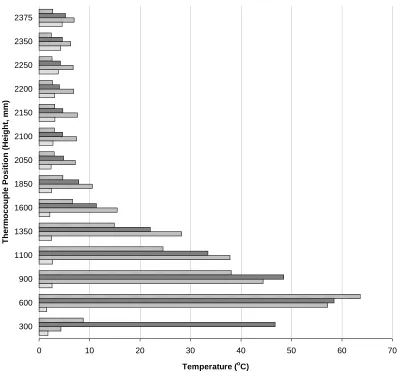
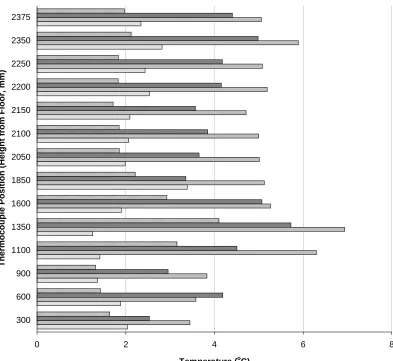
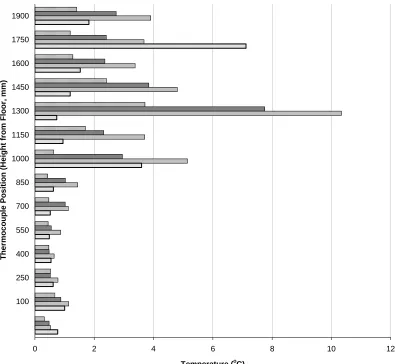
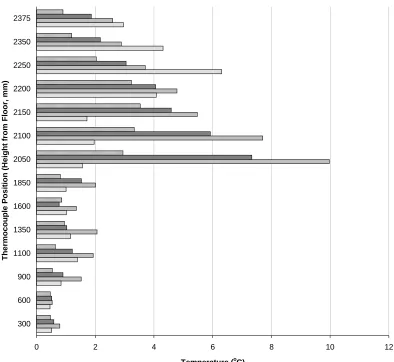
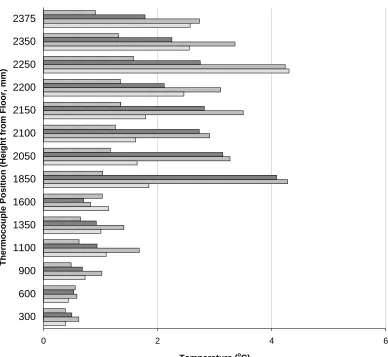
Results for temperature variations (expressed as standard deviations) recorded over the 10 minute steady state period are listed below in Figures 5.10 – 5.18. Field trees are listed in numerical order.
0 2 4 6 8 10 12 14
2375
2350
2250
2200
2150
2100
2050
1850
1600
1350
1100
900
600
300
Ther
m
o
couple P
o
sition (H
eight fr
om
Floor
, m
m
)
Temperature (oC)
55 kW 110 kW 160 kW 110 kW c
0 2 4 6 8 10 2375
2350
2250
2200
2150
2100
2050
1850
1600
1350
1100
900
600
300
The
rm
oc
ouple
Pos
ition (H
e
ight fr
om
Floor
, m
m
)
Temperature (oC)
55 kW 110 kW 160 kW 110 kW c
0 10 20 30 40 50 60 70 2375
2350
2250
2200
2150
2100
2050
1850
1600
1350
1100
900
600
300
Ther
m
o
coupl
e P
o
si
ti
on (H
ei
ght,
m
m
)
Temperature (oC)
[image:57.595.101.500.70.446.2]55 kW 110 kW 160 kW 110 kW c
0 2 4 6 8 2375
2350
2250
2200
2150
2100
2050
1850
1600
1350
1100
900
600
300
Thermocouple Position (Height from Floor, mm)
Temperature (oC)
[image:58.595.104.497.73.434.2]55 kW 110 kW 160 kW 110 kW c
0 2 4 6 8 10 12 1900
1750
1600
1450
1300
1150
1000
850
700
550
400
250
100
The
rm
o
c
ouple
Pos
it
ion (
H
e
ight
f
rom
Floor
, m
m
)
Temperature (oC)
[image:59.595.103.498.72.436.2]55 kW 110 kW 160 kW 110 kW c
0 2 4 6 8 10 12 2375
2350
2250
2200
2150
2100
2050
1850
1600
1350
1100
900
600
300
The
rm
oc
ouple
Pos
ition (H
e
ight fr
om
Floor
, m
m
)
Temperature (oC)
[image:60.595.104.498.72.434.2]55 kW 110 kW 160 kW 110 kW c
0 2 4 6
2375
2350
2250
2200
2150
2100
2050
1850
1600
1350
1100
900
600
300
Thermocouple Position (Height from Floor, mm)
Temperature (oC)
[image:61.595.110.498.73.430.2]60 kW 120 kW 180 kW 120 kW c
0 1 2 3 4 2375
2350
2250
2200
2150
2100
2050
1850
1600
1350
1100
900
600
300
T
hermocouple Posit
ion (Height
f
rom F
loor,
m
m
Temperature (oC)
[image:62.595.115.498.70.421.2]55 kW 110 kW 160 kW 110 kW c
0 1 2 3 4 2375
2350
2250
2200
2150
2100
2050
1850
1600
1350
1100
900
600
300
The
rm
oc
ouple
Pos
ition (H
e
ight fr
om
Floor
, m
m
)
Temperature (oC)
55 kW 110 kW 160 kW 110 kW c
[image:63.595.103.501.87.447.2]Comparisons between Field Trees in Each Room per Fire
Comparisons between field trees in each room for each fire are listed below in Figures 5.19 – 5.26. Graphs are presented in order of increasing fire size.
0 500 1000 1500 2000 2500
0 20 40 60 80 100 120 140
Temperature (oC)
H
e
ight
(
m
m
)
[image:64.595.103.493.165.436.2]Tree1 Tree2 Tree4
0 500 1000 1500 2000 2500
0 20 40 60 80 100 120
Temperature (oC)
H
e
ight
(
m
m
)
[image:65.595.103.498.77.343.2]Tree 6 Tree 7 Tree 8 Tree9
0 500 1000 1500 2000 2500
0 50 100 150 200 250
Temperature (oC)
H
e
ight
(
m
m
)
[image:66.595.108.496.101.370.2]Tree1 Tree2 Tree4
Figure 5.21 Temperature Profiles for the Fire Room, 110 kW Fire
0 500 1000 1500 2000 2500
0 50 100 150 200
Temperature (oC)
Hei
ght
(
m
m
)
[image:66.595.101.495.422.689.2]0 500 1000 1500 2000 2500
0 50 100 150 200 250 300
Temperature (oC)
H
e
ight
(
m
m
)
[image:67.595.103.496.78.348.2]Tree1 Tree2 Tree4
Figure 5.23 Temperature Profiles for the Fire Room, 160 kW Fire
0 500 1000 1500 2000 2500
0 50 100 150 200 250
Temperature (oC)
H
e
ight (mm)
Tree 6 Tree 7 Tree 8 Tree9
[image:67.595.101.495.399.673.2]0 500 1000 1500 2000 2500
0 50 100 150 200 250 300 350
Temperature (oC)
H
e
ight
(
m
m
)
[image:68.595.100.496.78.346.2]Tree1 Tree2 Tree3 Tree4
Figure 5.25 Temperature Profiles for the Fire Room, 110 kW Corner Fire
0 500 1000 1500 2000 2500
0 50 100 150 200 250
Temperature (oC)
H
e
ight
(
m
m
)
Tree 6 Tree 7 Tree 8 Tree9
[image:68.595.100.493.397.668.2]5.4.2 Corner Thermocouples
Results of the temperature profiles for the corner thermocouples are presented below for the four fires in Tables 5.1 – 5.24.
Table 5.1 Fire Room Rear Corner Temperatures (oC) for the 55 kW Fire Distance from Wall Distance
from Ceiling 25 mm 75 mm 125 mm 175 mm 225 mm
25 mm 126.9 131.0 130.4 130.1 131.2 75 mm 129.3 132.0 131.4 130.9
125 mm 130.0 133.0 131.8 175 mm 130.7 132.5
225 mm 132.4
Table 5.2 Fire Room Rear Corner Temperature Standard Deviations (oC) for the 55 kW Fire Distance from Wall
Distance
from Ceiling 25 mm 75 mm 125 mm 175 mm 225 mm
25 mm 0.88 0.81 0.71 0.60 0.72 75 mm 0.82 0.70 0.71 0.59 125 mm 0.74 0.72 0.66
175 mm 0.68 0.75
225 mm 0.72
Table 5.3 Fire Room Front Corner Temperatures (oC) for the 55 kW Fire Distance from Wall Distance
from Ceiling 25 mm 75 mm 125 mm 175 mm 225 mm
25 mm
124.0 122.6 118.0 117.9 122.3
75 mm
122.7 123.2 117.8 122.5
125 mm
125.4 118.0 118.0
175 mm
122.9 118.2
Table 5.4 Fire Room Front Corner Temperature Standard Deviations (oC) for the 55 kW Fire Distance from Wall
Distance
from Ceiling 25 mm 75 mm 125 mm 175 mm 225 mm
25 mm
1.03 1.01 1.20 1.41 1.59
75 mm 1.27 1.31 1.55 1.53 125 mm 1.35 1.36 1.50
175 mm 1.38 1.27
225 mm 1.37
Table 5.5 Adjacent Room Corner Temperatures (oC) for the 55 kW Fire Distance from Wall Distance
from Ceiling 25 mm 75 mm 125 mm 175 mm 225 mm
25 mm 101.7 102.2 102.5 106.0 105.2 75 mm 103.0 103.4 102.1 102.2
125 mm
102.6 100.5 90.1
175 mm
102.2 98.5
225 mm
101.5
Table 5.6 Adjacent Room Corner Temperature Standard Deviations (oC) for the 55 kW Fire Distance from Wall
Distance
from Ceiling 25 mm 75 mm 125 mm 175 mm 225 mm
25 mm
1.64 1.59 1.59 1.75 1.60
75 mm 1.64 1.67 1.55 1.79 125 mm 1.65 1.54 1.49
175 mm 1.54 1.41
Table 5.7 Fire Room Rear Corner Temperatures (oC) for the 110 kW Fire Distance from Wall Distance
from Ceiling 25 mm 75 mm 125 mm 175 mm 225 mm
25 mm
192.6 198.4 197.3 197.4 200.2
75 mm 196.5 199.2 200.5 199.4 125 mm 197.3 200.5 201.3
175 mm 198.0 200.0
225 mm 200.0
Table 5.8 Fire Room Rear Corner Temperature Standard Deviations (oC) for the 110 kW Fire Distance from Wall
Distance
from Ceiling 25 mm 75 mm 125 mm 175 mm 225 mm
25 mm 1.77 1.57 1.30 1.21 1.68 75 mm 1.56 1.48 1.63 1.33 125 mm
1.31 1.44 1.50
175 mm
1.36 1.31
225 mm
1.30
Table 5.9 Fire Room Front Corner Temperatures (oC) for the 110 kW Fire Distance from Wall Distance
from Ceiling 25 mm 75 mm 125 mm 175 mm 225 mm
25 mm
186.4 186.4 178.0 178.1 186.9
75 mm 187.0 187.6 178.5 187.0 125 mm 190.3 178.5 178.6
175 mm 187.4 178.8
Table 5.10 Fire Room Front Corner Temperature Standard Deviations (oC) for the 110 kW Fire Distance from Wall
Distance
from Ceiling 25 mm 75 mm 125 mm 175 mm 225 mm
25 mm
2.16 2.26 2.51 2.92 3.45
75 mm 2.76 2.82 3.19 3.13 125 mm 2.92 2.85 2.93
175 mm 2.87 2.70
225 mm 2.91
Table 5.11 Adjacent Room Corner Temperatures (oC) for the 110 kW Fire Distance from Wall Distance
from Ceiling 25 mm 75 mm 125 mm 175 mm 225 mm
25 mm 155.1 156.0 156.2 161.7 162.3 75 mm 157.1 158.8 158.0 158.1
125 mm
157.3 154.3 125.5
175 mm
156.6 150.4
225 mm
155.7
Table 5.12 Adjacent Room Corner Temperature Standard Deviations (oC) for the 110 kW Fire Distance from Wall
Distance
from Ceiling 25 mm 75 mm 125 mm 175 mm 225 mm
25 mm
2.87 2.73 2.66 3.23 3.01
75 mm 3.05 3.02 2.82 3.04 125 mm 2.96 2.77 2.26
175 mm 2.93 2.66
Table 5.13 Fire Room Rear Corner Temperatures (oC) for the 160 kW Fire Distance from Wall
Distance
from Ceiling 25 mm 75 mm 125 mm 175 mm 225 mm
25 mm
241.3 249.0 246.8 248.3 252.3
75 mm 247.6 250.1 253.2 251.5 125 mm 249.0 252.0 253.9
175 mm 250.6 251.6
225 mm 252.1
Table 5.14 Fire Room Rear Corner Temperature Standard Deviations (oC) for the 160 kW Fire Distance from Wall
Distance
from Ceiling 25 mm 75 mm 125 mm 175 mm 225 mm
25 mm 2.86 2.78 2.04 2.14 2.81 75 mm 2.75 2.64 2.72 2.55 125 mm
2.63 2.61 2.76
175 mm
2.65 2.43
225 mm
2.62
Table 5.15 Fire Room Front Corner Temperatures (oC) for the 160 kW Fire Distance from Wall
Distance
from Ceiling 25 mm 75 mm 125 mm 175 mm 225 mm
25 mm
237.8 238.1 230.3 230.0 238.5
75 mm 239.0 239.5 230.5 238.7 125 mm 242.5 230.4 230.5
175 mm 239.8 230.6