DATA MINING TECHNOLOGY
IN PREDICTING THE CULTIVATED LAND DEMAND
Liu Yaolin a, *, Miao Zuohua a
a
School of Resource and Environment Science, Wuhan University, China, Wuhan - [email protected]
KEY WORDS: Data Mining, Fuzzy Logic Theory, Transition Probability Matrix, Weight
ABSTRACT:
Although data mining is relative young technique, it has been used in a wide range of problem domains over the past few decades. In this paper, the authors present a new model to forecast the cultivated land demand adopts the technique of data mining. The new model which is called fuzzy Markov Chain model with weights ameliorate the traditional Time Homogeneous Finite Markov chain model to predict the future value of cultivated land demand in land use planning. The new model applied data mining technique to extract useful information from enormous historical data and then applied fuzzy sequential cluster method to set up the dissimilitude fuzzy clustering sections. The new model regards the standardized self-correlative coefficients as weights based on the special characteristics of correlation among the historical stochastic variables. The transition probabilities matrix of new model was obtained by using fuzzy logic theory and statistical analysis method. The experimental results shown that the ameliorative model combined with technique of data mining is more scientific and practical than traditional predictive models.
This research is supported by the Natural Science Fund of China (No. 40271088), the Ministry of Education Fund of China for scholar returned from abroad (No. 152174).
1. INTRODUCTION
Data mining is the nontrivial extraction of implicit, previously unknown, and potentially useful information from the mass, incomplete, fuzzy, uncertain and stochastic data. Data mining is the important step of Knowledge Discovery in Database (KDD) (Li, 2001). It has three major components such as clustering or classification, association rules and sequence analysis. The tasks of data mining are mainly such as association analysis, clustering, classification, prediction, time-series pattern, and deviation analysis etc. Data mining encompass a number of different technical approaches such as statistical methods, artificial neural network, decision trees, genetic algorithms, nearest neighbour method, rough set theory, and fuzzy logic theory etc.
At present time, data mining mainly applied to the trade territories such as banking, telecom, insurance, transportation, and retailing. It solved the behaviours of marketable analysis such as database marketing, customer segmentation & classification, credit scoring, and fraud detection etc.
Geo-spatial data mining, a subfield of data mining, is a process to discover interesting and potentially useful spatial patterns embedded in spatial databases. Efficient tools to extract information from massive geo-spatial datasets are crucial for organizations own, generate, and manage geo-spatial datasets. These organizations are spread across many domains including ecology and environmental management, public safety, transportation, public health, tourism (Hinzle, 2004).
Technique of data mining is relative young research field. New models and theories appeared every year. Many problems and challenges were presented for data mining such as enhancing the efficiency of model, data mining from dynamic sets, data mining on web, fuzzy spatial association rules mining etc.
As a new kind of data analysis technique data mining developed fast. Many kinds of datasets can be the objects of data mining. Because time series data are very common in datasets, Time Series Data Mining (TSDM) has been one of the focuses of current data mining research (Murray, 1998). The cultivated land demand data are time series data but researches on how to apply the technique of data mining to predict cultivated land use are not discovered at current time. In this paper, the authors present a new model adopt data mining technique to predict the cultivated land demand in land use planning.
2. DATA MINING AND PREDICTION OF
CULTIVATED LAND DEMAND
Prediction is one of tasks of data mining technique. It is a process to find the mutative rule from mass, fuzzy, stochastic data and then construct predictive model to forecast the trend, category, and character of future value.
Prediction of cultivated land demand is an important stage of land use planning. The result of prediction accurate or not relate directly with the quality of land use planning. Linear regression prediction model and trend prediction model were traditional methods which only used mathematical method to analyzed the time series data and not considered the “fuzzy and uncertain” effect of natural and social factors. Traditional methods on prediction of cultivated land demand applied the technique of data mining un-sufficiently.
The fuzzy logic theory is one of technical approaches of data mining. It is an un-classical mathematics theory for uncertain problems. It makes available a convenient and meaningful tool to the practicing engineers to incorporate these seemingly vague but practically powerful factors in the several phases of a project life cycle.
Markov chain model can predict a good many problems, but it exist shortages. The traditional Time Homogeneous Finite Markov Chain model transact the time series data with pure algebra method and not consider the effect of fuzzy, uncertain information embedded in data. This paper presents new Markov chain model combined with fuzzy logic theory.
Cultivated land demand data are stochastic time series data, so Markov chain model can be employed to forecast the future data according to historical data. Generally time series data can be divided into a continuous real number zone. In order to use Markov chain model, the continuous real number zone should be divided into finite number unambiguous state sets. But states during the process of prediction of cultivated land demand were not unambiguous but fuzzy. According to the instance, the authors present that using the fuzzy state sets describe the classified states will be closely to the actual status. Factors were diverse, complicated, and uncertain which affected cultivated land demand, so the authors indicate that the new model should adopt the technique of data mining. In this paper, the authors combine the fuzzy logic theory and data mining technique with traditional Markov chain model to enhance the precision of prediction of cultivated land demand. In order to effectively employ the historical data, new model also calculated the weights according the correlations among historical data series.
3. CONSTRUCTION OF NEW MODEL
Calculation of transition probabilities is the important step of Markov chain model process. Transition probabilities were calculated based on the unambiguous sate sets. The authors solved this problem by extending the transition probabilities matrix from unambiguous state sets to fuzzy state sets. Fuzzy sequential cluster model is one of useful method to classify time series data. In this paper, the authors apply fuzzy sequential cluster model to divide the historical data of cultivated land demand into fuzzy state zones and then construct the transition probabilities matrix of Markov chain model by using fuzzy logic theory and data mining technique.
3.1 Fuzzy Sequential Cluster Model
In order to make the divided zones reasonable, the new model apply fuzzy sequential cluster model to divide the cultivated land demand data into several fuzzy mutative zones based on the analysis of data structure. Fisher algorithm was the traditional algorithm of fuzzy sequential cluster model (HU, 1990). The fundamental of Fisher algorithm can be described as following equation:
∑
=+
−
=
j i l l ijx
i
j
X
1
1
(1)where
X
ij = average vector{
x
iL
x
j}
,
j
≥
i
= one possible fuzzy sequential clustering zone of stochastic variables series.
n
x
x
1L
The correlation among time series data meets the following equation:
(
) (
l ij j i l ij lx
x
x
x
j
i
D
=
∑
−
′
−
=)
,
(
)
(2)where
D
(
i
,
j
)
= the diameter of{
x
iL
x
j}
,
j
≥
i
.It denotes the discrepant degree among variables locate at one and the same clustering zone. And it shows that when
smaller indicates discrepancy among data series smaller and the correlation more adjacent, contrariwise the discrepancy larger and correlation is dispersive. In order to compare the effect among different possible clustering, Fisher algorithm defined the error function described as following:
)
,
(
i
j
D
(
)
[
]
∑
(
= +−
=
k j j ji
i
D
K
n
P
e
1 11
,
,
)
(3)where
e
[
P
(
n
,
K
)
]
= the error numerical value
K
= the number of clustering zones,D
(
i
j,
i
j+1−
1
)
is obtained from Eq2, is one possible clustering be expressed as following:(
n
K
P
,
)
( ) {
n
K
i
i
} {
i
i
}
{
i
n
P
,
:
i=
1
,
L
,
2−
1
;
2,
L
,
3−
1
;
L
;
k,
L
,
}
(4) From Eq 3 we can see that when get minimal value the best fuzzy clustering division will be obtained. At the same time, the number(
[
P
n
K
e
,
)
]
K
can be obtained at the inflexion of correlation graph betweene
[
P
(
n
,
K
)
]
andK
.3.2 Time Homogeneous Finite Markov Chain Model
A Time Homogeneous Finite Markov Chain model was a stochastic process with finite sets of state (Breikin, 1997). How to calculate these transition probabilities is the important step of Markov chain model. The transition probability only depended on the state in the previous step. It can be described as following:
{
n
}
S
=
1
,
2
,
L
,
{
x
j
x
i
}
p
n=
n−1=
(5)where
j
= the series number of state among state setsn
andn
−
1
= time.In Eq5
x
n=
j
express the Markov chain process locate atj
state at
n
time andx
n−1=
i
express the process locate ati
state atn
−
1
time. Define denotes the transition probability from( )
n
p
ijj
state toi
state at time. These transition probabilities form the transition probability matrix expressedas
( )
n ij j iP
P
, , 2 , 1 L ==
. It is an non-negative matrix (such a matrix is called stochastic). The transition probabilities matrix can be described as following:n
n
×
⎥
⎥
⎥
⎥
⎦
⎤
⎢
⎢
⎢
⎢
⎣
⎡
=
=
nn n n n n ijP
P
P
P
P
P
P
P
P
P
P
L
L
L
L
L
L
L
2 1 2 22 21 1 12 11)
(
(6)4. FUZZY MARKOV CHAIN MODEL WITH WEIGHTS
BASED ON DATA MINING
As above sections analyze, the authors present a new model adopt the technique of data mining. The new model is summarized as the following steps:
1. Calculate the self-correlative coefficient of cultivated land demand data
The cultivated land demand data series are depended on each other. In order to describe the correlation, new model calculate the self-correlative coefficients among data. The equation of self-correlative coefficients calculation can be expressed as:
( )(
)
∑
( ) (
∑
)
∑
− = − = + − = +−
−
−
−
=
nk t k n t k t t k n t k t t kx
x
x
x
x
x
x
x
r
1 2 1 2 1.
(7)where = the self-correlative coefficients of
k
grade (step is ),k
r
k
x
t = the cultivated land demand data att
timex
= the average value of all cultivated land demand data seriesn
= the data number of cultivated land demand data series2. Standardizing self-correlative coefficients data as weights
Different fuzzy clustering zone has different effect on predictive value. In order to describe this difference, the new model takes the standardized self-correlative coefficient data as weight. The weight can be calculated by following equation:
∑
==
m k k k kr
r
1ϖ
(8)where
ϖ
k =weight,r
k can be obtained with Eq7. 3. Calculate the cultivated land use trend coefficients The cultivated land use trend coefficient (LUTC) is an important parameter to express the utilized degree of cultivated land during one unit time. The coefficient can be calculated by following equation:( )
1
100
100
100
×
×
×
=
ds
s
t
S
i (9)where = the cultivated land area at the beginning time of supervision
i
s
ds
= the reductive amount of calculate land during time of supervision
t
= the time’s length of supervisionS
= the cultivated land use trend coefficient whichwas scaled up to 100 in order to make research conveniently
4.
5.
Divide the fuzzy clustering zones
With step3 the data of cultivated land use trend coefficients were obtained. New model applies the fuzzy sequential cluster model to divide these coefficients data series into several fuzzy clustering zones. Thus, the fuzzy clustering zone state for each historical cultivated land demand data located at can be confirmed.
Calculate the transition probability
Calculation of transition probabilities is the main step of new model. In this paper, the authors calculate the transition probability for each different step by using fuzzy logic theory. The process of calculation can be described as following: Assume is the stochastic time series data of cultivated land demand, is one fuzzy clustering set for . The new model obtains the transition probability by following equations: n t
x
x
X
:
1L
k ke
e
E
:
1L
tX
( )( )
k
i
x
M
m n l l e m i i,
1
,
2
L
1=
=
∑
− =μ
(10) and, ( )( )
(
)
m l e m n l l e m ijx
x
M
j i + − =∑
⋅
=
μ
μ
1 (11)where
M
i =the number of data which locate at the fuzzy clustering statee
i(e
i⊂
E
k) amongX
t( )m ij
M
=the data number transitioned frome
ifuzzy clustering state to state through steps, = the step number of transition
j
e
m
m
( )
l eix
μ
= the fuzzy membership function which denotes the degree ofx
l belongs toe
i fuzzy state. From Eq10 and Eq11, The authors obtain the transition probability frome
i fuzzy clustering state toe
j state by the following equation:( ) ( ) ( )m i m ij m ij
M
M
P
=
(12) 6. 7.Construct the new transition probabilities matrix. Each line vector is the different step transition probabilities of historical data calculated with Eq12.
Calculate the predictive value
Summing the data of each row vector belongs to one and the same state with the corresponding weight in the new transition probabilities matrix by the following equation:
( )k i m k k i
P
P
∑
==
1ϖ
(13)where
P
i( )k = the transition probability ofk
stepi
= the serial number of fuzzy clustering zonek
ϖ
= weight obtained with Eq8.In this paper, the fuzzy clustering state of predictive value is obtained according to the maximum subordination principle, that is:
max
. The predictive value can be calculated with the following equation:{
P
i,
i
∈
I
}
( )k 1d
2
2dQ
Q
Y
)
=
+
(14) whereY
)
(k)= the predictive value= the left value of fuzzy clustering value zone = the right value of fuzzy clustering value zone
d
Q
1d
Q
28. Quality assessment of the new model
Relative error between predictive value and factual value is taken as the quality assessment parameter of new model. Relative error can be calculated by the following equation:
( ) ( )
(
−
)
( )×
100
100
=
Y
)
kY
kY
kσ
(15) whereσ
= the relative error( )k
Y
)
= predictive value obtained with Eq14= factual value obtained from statistical yearbook
( )k
Y
5. EXPERIMENTAL RESULTS AND ANALYSES
The historical cultivated land demand data of one county in the province of Hubei (Table 1) during 1950~2003 periods were obtained from Hubei Province Statistical Yearbook.
• Calculate the self-correlative coefficient of cultivated land demand data of research area, that is:
r
= 0.980,= 0.941, = 0.905, = 0.871.
1 2
r
r
3r
4• Standardizing self-correlative coefficients data as weights, that is:
ϖ
1 = 0.266,ϖ
2 = 0.255,ϖ
3 = 0.245,ϖ
4= 0.236.• Applying fuzzy sequential cluster model to divide the cultivated land demand data which be arranged from low to high order into fuzzy clustering zones. Figure 2 shows the correlation between error and the number of category.
Figure 1. Cultivated land used trend degree
Figure 1 is the graph of cultivated land used trend degree. In the graph, negative value express that the area of cultivated land was increased, contrariwise positive value express that the area of cultivated land was decreased. As figure1 shown, the change of cultivated land area was great before 1979 and the change was slow after 1979.
Figure 2. Correlation graph of error ( ) and number of categories (K)
(
[
P n K]
e ,
)
As figure 2 shown, 4 is the number of best division category. Table 2 shows the result of fuzzy clustering zones using the method of fuzzy sequential clustering.
States Levels Distinguished Standards 1 Increase Quickly X ≥ 0.591 2 Increase Slowly 0 ≤ x< 0.591 3 Decrease Slowly -1.349≤x<0
4 Decrease Quickly x<-1.349 Table 2. Fuzzy clustering zones of cultivated land data
Year 1950 1951 1952 1953 1954 1955 1956 1957 1958 1959 Area /hm2 63646.57 65866.61 72073.33 73480.01 73493.30 75440.02 74406.67 74673.43 73226.68 70020.02 LUTC 3.488 9.423 1.951 0.018 2.649 -1.370 0.359 -1.937 -4.379 States 1 1 1 2 1 4 2 4 4 Year 1960 1961 1962 1963 1964 1965 1966 1967 1968 1969 Area /hm2 66973.33 70626.61 67006.59 67180.01 67179.80 67179.80 65846.67 65333.33 60073.38 58926.61 LUTC -4.351 5.455 -5.126 0.259 0.000 0.000 -1.984 -0.780 -8.051 -1.909 States 4 1 4 2 2 2 4 3 4 4 Year 1970 1971 1972 1973 1974 1975 1976 1977 1978 1979 Area /hm2 56866.69 56400.06 56720.08 55986.67 55566.39 55380.07 55333.33 55086.59 55073.33 55073.33 LUTC -3.496 -0.821 0.567 -1.293 -0.751 -0.335 -0.084 -0.446 -0.024 0.000 States 4 3 2 3 3 3 3 3 3 2 Year 1980 1981 1982 1983 1984 1985 1986 1987 1988 1989 Area /hm2 55046.68 54933.31 54866.55 54906.60 54806.58 54739.51 54553.33 54366.62 54086.57 53906.48 LUTC -0.048 -0.206 -0.122 0.073 -0.182 -0.122 -0.340 -0.342 -0.515 -0.333 States 3 3 3 2 3 3 3 3 3 3 Year 1990 1991 1992 1993 1994 1995 1996 1997 1998 1999 Area /hm2 53146.37 53059.21 52986.37 52419.11 51939.02 51233.13 50805.66 50453.31 49500.02 48952.89 LUTC -1.410 -0.164 -0.137 -1.071 -0.916 -1.359 -0.834 -0.694 -1.889 -1.105 States 4 3 3 3 3 4 3 3 4 3 Year 2000 2001 2002 2003 Area /hm2 48259.91 47606.62 46959.82 46327.01 LUTC -1.416 -1.354 -1.359 -1.347 States 4 4 4 3 Table 1. Cultivated land demand data and states during 1950~2003 period
• Confirming the fuzzy state of each historical data locate at based on the standard of table 2. The result is described in table 1.
• Calculate the transition probability matrix of each transition step. That is following:
⎥
⎥
⎥
⎥
⎦
⎤
⎢
⎢
⎢
⎢
⎣
⎡
=
14
/
5
14
/
5
14
/
2
14
/
1
24
/
5
24
/
16
24
/
3
24
/
0
8
/
2
8
/
3
8
/
2
8
/
1
5
/
2
5
/
0
5
/
1
5
/
2
1P
⎥
⎥
⎥
⎥
⎦
⎤
⎢
⎢
⎢
⎢
⎣
⎡
=
13
/
5
13
/
3
13
/
2
13
/
1
24
/
5
24
/
17
24
/
2
24
/
0
8
/
3
8
/
4
8
/
1
8
/
0
5
/
0
5
/
0
5
/
3
5
/
2
2P
⎥
⎥
⎥
⎥
⎦
⎤
⎢
⎢
⎢
⎢
⎣
⎡
=
12
/
3
12
/
3
12
/
3
12
/
1
24
/
3
24
/
17
24
/
2
24
/
0
8
/
3
8
/
4
8
/
1
8
/
0
5
/
2
5
/
0
5
/
2
5
/
1
3P
⎥
⎥
⎥
⎥
⎦
⎤
⎢
⎢
⎢
⎢
⎣
⎡
=
12
/
4
12
/
4
12
/
3
12
/
0
23
/
3
23
/
17
23
/
1
23
/
0
8
/
3
8
/
3
8
/
1
8
/
1
5
/
2
5
/
0
5
/
2
5
/
1
4P
• Predict the cultivated land demand data in 2003 based on the historical data and corresponding transition probabilities matrix during 1999-2002 periods. Table
3 shows the result of prediction using the proposed new model in this paper.
Transition Probabilities year states steps weights
1 2 3 4
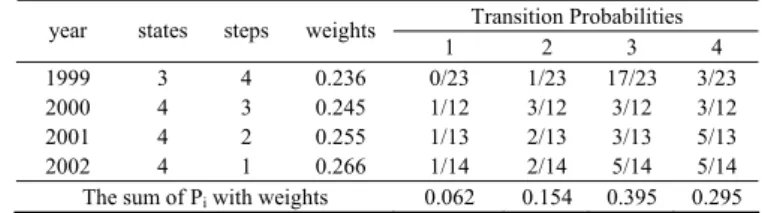
1999 3 4 0.236 0/23 1/23 17/23 3/23 2000 4 3 0.245 1/12 3/12 3/12 3/12 2001 4 2 0.255 1/13 2/13 3/13 5/13 2002 4 1 0.266 1/14 2/14 5/14 5/14
The sum of Pi with weights 0.062 0.154 0.395 0.295 Table 3. Prediction of cultivated land demand data in 2003
Table 4. Prediction of cultivated land demand data in 2004 As table 3 shown, the
max
{ }
p
i=
0
.
395
andi
=
3
. It shows that the predictive data locate at third fuzzy sequential clustering zone (decrease slowly). The fuzzy zone of predictive value can be calculated, that is:[
]
. Thus, the predictive value82
.
46959
,
33
.
46326
( )kY
)
in 2003 is 46642.84 hm2 while the factual value is 46327.01 hm2 obtained from the statistical yearbook. It is easily to calculate the relative error only 0.68%. It indicates that applying the reformative model (fuzzy Markov chain model with weights) to predict the cultivated land demand data will effectively enhance the precision of prediction. At the same time new model can reduce the complexity of calculation. With the same process, the authors predict the cultivated land demand data in 2004 based on the historical data andTransition Probabilities year states steps weights
1 2 3 4 2000 4 4 0.236 0/12 3/12 4/12 4/12 2001 4 3 0.245 1/12 3/12 3/12 3/12 2002 4 2 0.255 1/13 2/13 3/13 5/13 2003 3 1 0.266 0/24 3/24 16/24 5/24
corresponding transition probabilities matrix during 2000-2003 periods. Table 4 shows the result of prediction using the proposed new model in this paper.
As table 4 shown, the
max
{ }
p
i=
0
.
342
andi
=
3
. It shows that the predictive data locate at third fuzzy sequential clustering zone (decrease slowly). Fuzzy zone of predictive value can be calculated, that is:[
45702
.
06
,
46327
.
01
]
. Thus, the predictive value in 2004 is 46014.53 hm2.6. CONCLUSIONS AND DISCUSSIONS
The traditional models for prediction of cultivated land demand were not effectively solved the fuzzy and uncertainty information. As a new kind of data analysis technique, data mining can extract the useful information from enormous historical data. Thus, the authors presented a new model to reform the general Time Homogeneous Finite Markov Chain model. The new model adopted the data mining technique such as fuzzy logic theory, weights, statistical analysis, and cultivated land use trend coefficients model.
As experimental results and analyses shown, the reformative model can divide the time series data more reasonable and effectively describe the distributing rule existed in the data series. New model take standardized self-correlative coefficient of each transition step as weight and be combined with correlation analysis. The physics concept of new model was clear and calculation was simply. The new model provided a groping method for enhancing the precision of prediction. At the same time, the authors indicate that the influence of other fuzzy state zones besides the maximum subordination state zone should be considered when calculated the predictive value. The corresponding weight for each fuzzy clustering state zone should be defined and then calculate the predictive value with the average value of all weights. Adopt another theory and model into the calculation of weight for fuzzy clustering state zones is the research at next stage.
REFERENCES
LI Deren, WANG Shuliang, SHI Wengzhong, 2001. On Spatial Data Mining and Knowledge Discovery. Geomatics and Information Science of Wuhan University, 21(6), pp. 491-499.
LI Deren, CHENG Tao, 1994. Knowledge discovery from GIS.
The Canadian Conference on GIS, Ottawa, Canadian. Vol 1,
pp.1001-1012.
Murray A T, Estivill-castro V, 1998. Clustering Discovery Techniques for Exploratory Spatial Data Analysis. International Journal of Geographical Information Science, 12(5), pp. 431-443.
Helma C, 2004. Data mining and knowledge discovery in predictive toxicology. 11th International Workshop on Quantitative Structure-Activity Relationships in the Human Health and Environmental Sciences, 15(6), pp. 367-383.
LIU Yaolin, LIU Yanfang, ZHANG Yumei, 2004. Prediction of Gross Arable Land Based on Grey-Markov Model. Geomatics and Information Science of Wuhan University, 29(7), pp.
575-580.
F. Hinzle, M.. Sester, 2004. Derivation of implicit information from spatial data sets with data mining. In: The International Society for Photogrammetry and Remote Sensing, Istanbul, Turkey, Vol 35, pp.335-341.
Breikin T.V., Arkov V.Y., Kulikov G.G, 1997. On Stochastic System Identification: Markov Models Approach. In: Korea Proceedings of the 2nd Asian Control Conference, Seoul, Korea,
pp. 775-778.
HU Guoding, ZHANG Runchu, 1990. Analyzing Multivariate Data-Transacting with Pure Algebra Method. Tianjing: Nankan University Press.
Micheline Kamber , JIA Weihan , 2001. Data Mining: Concept and Techniques. Beijing: China Mechanical Industry Press. CHNEG Baoxue, YU Jingshan ,2004. Feasibility Study of Applications of Data Mining to Weather Forecast. Applied Science and Technology, 31(3), pp. 48-50.
LIANG Wuqi, JIANG Keqing, 2004. Research on Fuzzy Cluster Analysis and Application in Data Mining. Journal of Anqing Teachers College (Natural Science), 10(2), pp.65-68. LAN Rongqin, LIN Lixia, CHENG Liangyou, 2004. Status and Progress of Spatial Data Mining and Knowledge Discovery.
Geographical Information, 02(3), pp. 19-21.
FENG Yaolong, HAN Wenxiu, 1999. The Application of Weighted Markov-Chain to the Prediction of River Run off State. Systems Engineering-Theory and Practice, 10(10), pp. 89-93.
Nedeljkovic I., 2004. Image classification based on fuzzy logic. In: the International Society for Photogrammetry and Remote Sensing, Istanbul, Turkey, Vol34, PartXXX, pp. 83-89.