1
IMPLEMENTATION AND
EVALUATION OF A BOTNET
ANALYSIS AND DETECTION
METHODS IN A VIRTUAL
ENVIRONMENT
Shahzad Waheed Matriculation# 01007306
Submitted in partial fulfilment of the requirement of Edinburgh Napier University for the degree in MSc in Advanced Security and Digital Forensics
School of Computing, Edinburgh Napier University Submitted on 20th Aug 2012
Supervisor: Prof. Bill Buchanan Second marker: Dr. Imed Romdani
2
Authorship declaration
I, SHAHZAD WAHEED, confirm that this dissertation and the work presented in it are my own achievement.
1. Where I have consulted the published work of others this is always clearly attributed.
2. Where I have quoted from the work of others the source is always given. With the exception of such quotations this dissertation is entirely my own work.
3. I have acknowledged all main sources of help.
4. If my research follows on from previous work or is part of a larger collaborative research project I have made clear exactly what was done by others and what I have contributed myself.
5. I have read and understand the penalties associated with Academic Misconduct.
Signed:
Date: 20 Aug 2012
3
Data Protection declaration
Under the 1998 Data Protection Act we cannot disclose your grade to an unauthorised person. However, other students benefit from studying dissertations that have their grades attached.
Please sign your name against one of the options below to state your preference.
The University may make this dissertation, with indicative grade, available to others.
4
Abstract
Botnets are one of the biggest cyber threats. Botnets based on concepts that used for the development of malware or viruses before origin of the Internet in 1990s. Botnet is a form of malware controlled by a Botmaster using Command and Control (C&C). Since emerging of one of the first botnets PrettyPark in 1999, it has been a significant enhancement in last decade for botnet development techniques by hackers. Botnets of current age are with features such as P2P architecture, encrypted traffic, use of different protocols, stealth techniques and spreading through social networking websites such as Facebook and Bebo. With enhancements in botnet development, the objectives of cyber criminals advanced to get financial as well. ZeuS is one of the well known botnets of current with a main target is to get the financial gain. It uses advanced botnet techniques such as encrypted traffic, use of HTTP protocol and stealth techniques to hide itself from the OS.
Overall objective of this thesis is application of botnet analysis and detection techniques on ZeuS bot to demonstrate that how these techniques are applicable to other modern botnets such as KoobFace, Torpig, and Kelihos etc. ZeuS code leaked in May 2011 to open the doors for hackers to utilise techniques used by ZeuS to develop new bots and for researchers to learn the internal working of one of the modern botnet of the current age. In this thesis, “ZeuS toolkit with Control Panel (CP)” is used. It contains tools to create a ZeuS bot executable with user defined configuration and ZeuS Control Panel (CP) developed in PHP and MySql, to install on a machine to act as a ZeuS “C&C server”. Ethically, according to “CSSR: British Computer Society Code of Conduct”, ZeuS botnet analysis is performed in a virtual environment with two machines i.e. “Bot victim with HIDS (Host Based Intrusion Detection System)” and “C&C server” that are isolated from host machine running VMware and the Internet. Bot executed to infect “Bot victim” machine with ZeuS bot to convert it into a “zombie” being controlled by “C&C server” machine running ZeuS Control Panel (CP). ZeuS bot analysis performed in three layers i.e. binary, application and communication layer.
On binary layer analysis, reverse engineering tools used to reverse engineer the ZeuS executable to explore its internal. ZeuS reversed engineered C++ code by REC was not in a meaningful form. It indicates that ZeuS binary obfuscated using some algorithm. Only basic information i.e. version and header information for ZeuS bot executable could be found using PE Explorer tool. On application layer, during ZeuS bot execution, all activities related to threads/process, file system (.dll files accessed and files created) and registry changes captured using Procmon. Important information captured by Procmon is creation of a copy of bot executable (sdra64.exe) and data file “user.ds” created in windows subfolder “/system32” and in registry “Userinit” key modified by ZeuS to enable the ZeuS execution before Windows GUI appears (execution of Explorer.exe). On communication layer, packets during bot synchronisation with botmaster and bot commands sent by “C&C server” to “Bot victim” captured for to create rules for HIDS for signature based detection on “Bot victim”. These rules implemented and raised alarm as expected successfully. Anomaly based detection requires “learning” or profiling that requires interaction of machine on Internet. Ethically it is not possible in isolated virtual environment. DNS based detection and process to reveal a “rootkit” that modifies MBR (master boot record) of the hard disk, is not applicable for ZeuS analysis.
Literature review of this thesis covers all aspects of botnet analysis and detection techniques regardless of that they are not applicable in this project ethically or ZeuS bot does not support them. Objective of providing this information is to give an overview of all analysis and detection techniques that are applicable to the modern botnets of current age.
5
Contents
Authorship declaration ... 2
Data Protection declaration ... 3
Abstract ... 4
Table of Contents ... Error! Bookmark not defined. List of Figures ... 9
1 INTRODUCTION ... Error! Bookmark not defined. 1.1 Background ... Error! Bookmark not defined. 1.2 Aims and Objectives ... Error! Bookmark not defined. 1.3 Thesis Structure ... Error! Bookmark not defined. 1.4 Ethics ... Error! Bookmark not defined. 2 LITERATURE REVIEW ... 12
2.1 Classification of Botnets ... 15
2.1.1 Attacking behaviour ... 15
2.1.1.1 Infecting and recruiting new hosts ... 15
2.1.1.2 DDoS attacks ... 16
2.1.1.3 Data stealing ... 16
2.1.1.4 Keystrokes capturing ... 17
2.1.1.5 Email Spamming and Phishing ... 17
2.1.2 Botnet C&C mechanisms ... 18
2.1.2.1 Centralised Architecture with Single C&C Server ... 18
2.1.2.2 Centralised Architecture with Multiple C&C Servers ... 19
2.1.2.3 Decentralised P2P Architecture ... 19
2.1.3 Communication Protocols ... 19
2.1.3.1 IRC based Botnets ... 19
2.1.3.2 IM based Botnets ... 21
2.1.3.3 HTTP/Web Based Botnets ... 21
2.1.3.4 Other Protocols ... 22
2.1.4 Rallying mechanism ... 22
2.1.4.1 Hard-coded IP addresses ... 22
6 2.1.4.3 Distributed DNS service ... 23 2.1.4.4 FastFlux DNS ... 23 2.1.5 Evasion Techniques ... 23 2.1.5.1 Encrypted Traffic ... 23 2.1.5.2 Rootkits ... 23 2.2 Botnets Lifecycle ... 24 2.2.1 Exploitation ... 24
2.2.1.1 Tricking user to download a malicious code ... 24
2.2.1.2 Attacks against Un-patched Vulnerabilities and ports ... 25
2.2.1.3 Scanning for Backdoors left by other Trojans or Worms ... 25
2.2.1.4 Password cracking attempts ... 26
2.2.2 Rallying and Securing the Botnet Client ... 26
2.2.3 Listen and execute the C&C Commands ... 27
2.3 Evolution of Botnets and case studies ... 27
2.3.1 Pretty Park Bot (1999) ... 28
2.3.1.1 Pretty Park propagation / Infection techniques ... 28
2.3.1.2 Pretty Park strengths, weaknesses and removal ... 29
2.3.2 GT (Global Threat) Bot (2000) ... 30
2.3.3 SDBot (early 2002) ... 30
2.3.4 Agobot aka Gaobot (2002) ... 33
2.3.5 Mytob (2005) ... 33
2.3.6 ZeuS Bot (2007) ... 34
2.3.7 KoobFace Bot (2008) ... 36
2.3.8 Torpig Bot (2009) ... 38
2.3.9 Hlux / Kelihos Bot (2011-2012) ... 39
2.4 Botnet detection techniques ... 40
2.4.1 Signature-based detection ... 41
2.4.2 Anomaly-based detection ... 42
2.4.3 DNS-based detection ... 45
7
3 DESIGN ... 47
3.1 Introduction ... 47
3.2 Botnet analysis framework ... 47
3.3 Intrusion detection systems (IDS) ... 49
3.4 Components of Botnet analysis & evaluation system ... 50
3.4.1 Snort ... 50
3.4.2 Wireshark (Ethereal) ... 51
3.4.3 PE Explorer ... 51
3.4.4 Procmon (Process monitor) ... 53
3.4.5 WAMP Web Server ... 53
3.4.6 VMware workstation ... 54
3.5 Conclusions ... 56
4 IMPLEMENTATION ... 57
4.1 ZeuS botnet toolkit walkthrough ... 57
4.1.1 ZeuS Configuration Builder ... 57
4.1.1.1 Config.txt (Configuration settings text file) ... 57
4.1.1.2 webinjects.txt (Web Injects text file) ... 59
4.1.1.3 zsb.exe (ZeuS configuration builder executable) ... 60
4.1.2 ZeuS builder (bot executable builder) ... 61
4.1.3 ZeuS C&C Control Panel (CP) ... 62
4.2 Building an isolated virtual environment for ZeuS analysis ... 63
4.2.1 Bot/Victim machine setup ... 63
4.2.2 ZeuS C&C Server setup ... 64
4.2.2.1 WAMP server setup and testing ZeuS CP installation ... 64
4.2.2.2 ZeuS CP installation and synchronisation with the bot ... 65
4.3 Testing the synchronisation of the bot and CP ... 69
4.4 Conclusions ... 71
5 RESULTS COLLECTION AND EVALUATION ... 73
5.1 Bot victim machine results collection and evaluation ... 73
8
5.1.1.1 Bot configuration builder process ... 73
5.1.1.2 Bot removal process ... 74
5.1.2 Bot.exe execution results collection ... 74
5.1.2.1 Procmon captured, bot.exe data analysis ... 75
5.1.2.2 ZeuS bot Communication layer results collection and evaluation ... 77
5.1.3 Bot.exe binary layer analysis ... 78
5.2 Control Panel (CP) machine analysis/results collection ... 79
5.2.1 CP synchronisation with bot victim - results collection ... 79
5.2.2 CP command/script sending to bot victim – results collection ... 80
5.3 IDS/Snort setup and results collection ... 82
5.3.1 ZeuS anomaly based detection evaluation ... 82
5.3.2 ZeuS signature based detection evaluation ... 83
5.3.2.1 ZeuS “Communication layer” analysis for signature based detection ... 83
5.3.2.2 Snort rules implementation for Signature based detection ... 86
5.3.2.3 Testing snort rules and finding “false positive” for IDS efficiency ... 87
5.4 Conclusions ... 87
6 CONCLUSIONS... 88
6.1 Introduction ... 88
6.2 Meeting the objectives ... 88
6.3 Critical analysis ... 89
6.4 Future work ... 90
6.5 Personal reflection ... 91
7 REFERENCES ... 93
8.1 Config.txt code for ZeuS configuration builder ... 101
9
List of Figures
Figure 1: Spreading Botnet infection through Facebook video link Figure 2: MyDoom variant botnet
Figure 3: Simple C&C Operation
Figure 4: Single Server Centralised C&C architecture Figure 5: Centralised C&C architecture
Figure 6: Example of utilisation of Twitter by a Botmaster Figure 7: Common Steps in Botnet Life Cycle
Figure 8: Botnet Example Commands Figure 9: Evolution / History of Botnets Figure 10: Pretty Park attachment icon
Figure 11: Files and Registry Keys used by SDBot Figure 12: LSA Shell error window
Figure 13: RPC Error / Shutdown Window Figure 14: Restart / lsass error window
Figure 15: General steps for Mytob Propagation Figure 16: ZeuS fake webpage requesting card details Figure 17: ZeuS Fraud Scheme exposed by FBI Figure 18: ZeuS control Panel, Summary Statistics
Figure 19: KoobFace spreading using YouTube-like video page Figure 20: Geographical distribution of KoobFace threat Figure 21: The Torpig network infrastructure.
Figure 22: Geographical distribution of Kelihos Sept 2011 version Infections Figure 23: Classification of basic Botnet/malware detection techniques
Figure 24: Signature based detection - Set of known signatures/malicious behaviour Figure 25: Anomaly based detection behaviour characterisation
Figure 26: Files byte distribution, X-Axis: ASCII value 0-255, Y-Axis: Frequency %age Figure 27: GhostBuster methodology to find hidden files by Ghostware/Rootkit
10
Figure 28: A scenario for DNS-based botnet Figure 29: DNS replication technique
Figure 30: Virtual environment for bot analysis Figure 31: ZeuS layered analysis architecture Figure 32: Network based IDS Setup
Figure 33: Wireshark Interface
Figure 34: PE Explorer components/windows Figure 35: Procmon interface
Figure 36: phpMyAdmin Interface Figure 37: VMware work station interface Figure 38: Network adapter settings
Figure 39: Configuration builder config.txt code Figure 40: Web injection example
Figure 41: ZeuS configuration builder – Information tab Figure 42: ZeuS configuration builder – Builder tab Figure 43: ZeuS bot executable builder interface Figure 44: Custom config.txt parameter settings Figure 45: MySql connectivity verification Figure 46: ZeuS control panel folder contents
Figure 47: ZeuS bot installation initiation / parameters page Figure 48: ZeuS control panel installation confirmation Figure 49: ZeuS control panel login page
Figure 50: ZeuS control panel administration screen Figure 51: Bots search page
Figure 52: Bot “Full information” page Figure 53: Bot scripts commands list
Figure 54: CP summary showing 1 bot detected successfully
11
Figure 56: CP database “cpdb”
Figure 57: .dlls utilised by ZeuS configuration builder Figure 58: File activity by bot removal process
Figure 59: ZeuS builder process, registry keys accessed Figure 60: .dlls utilised by Bot executable
Figure 61: Procmon sdra64.exe insertion in userinit registry key
Figure 62: Bot query if any existing bot versions supposed to create these keys Figure 63: Bot file creation entries for sdra64.exe and user.ds
Figure 64: Bot GET / cfg.bin request packet sent to CP Figure 65: Bot POST / gate.php packet sent to CP Figure 66: Bot.exe header information
Figure 67: Version information for bot.exe Figure 68: Script to rename anon bot to “qazi”
Figure 69: Scripts list after sending rename_bot command to bot victim successfully Figure 70: Bot successfully renamed to “qazi” in bot list shown by CP
Figure 71: Packet contents of CP command “rename_bot qazi” sent to bot victim Figure 72: In result of “kos” command, Windows XP rebooted with error Figure 73: Packet contents of CP command “kos” sent to bot victim Figure 74: GET /cfg.bin packet structure
Figure 75: Packet containing latest version of cfg.bin downloaded by bot Figure 76: POST /gate.php packet structure
12
1 INTRODUCTION
1.1 Background
Before Internet, there was already an idea of a computer virus. A computer virus is software that exploits the weaknesses of an Operating system resulting misuse of computer resources or damage to the data. DOS had some vulnerability that discovered by the developers of the generation of computer viruses. The famous viruses at that time were Stoned, Brain, Cascade and members of Jerusalem family (virus-scan-software, 2012). Popular Antivirus software used at that time was Dr Solomon Toolkit, MacAfee and Norton antivirus that developed initially for DOS environment. Development of a virus was with quite limited features as there was no concept such as phishing, spamming etc to spread viruses rapidly and there was no Internet where billions of computers are connected and vulnerable to threats. Only way to spread a PC virus is by a storage media that could be floppy disk or hard disk.
In 1990, the Internet was emerged to bring a big change in the information technology. The Internet on one hand provided facilities for the users and on other hand it given a platform for hackers to develop more effective malware that could spread faster than before. The Internet also resulted in invention of new type of malware such as Worms and Botnets that are based on the concepts used to develop a computer virus. In early days of the Internet, spam emails been a very popular way of spreading malware. With evolution and enhancements in Internet in last decade, currently in addition to spam emails, social networking sites such as Facebook, Bebo, and Twitter being used by hackers to spread malware easier and faster than before. Initially, the hackers were only interested in stealing or destroying data, spamming but now a day they are also interested in getting financial gain and stealing money using the Internet.
In current age, Botnets are one of the biggest cyber threats. A Botnet is a group / network of infected machines that are controlled by a Botmaster using command and control (C&C) mechanism (Microsoft, 2012). Botnet targets data stealing, combating cyber attacks such as DDoS and hacking into bank accounts to get a financial gain. In 1999, PrettyPark was a widespread Bot that used to spread through emails and used IRC for C&C. In last decade the botnets became more and more sophisticated related to hiding, spreading, infecting and to perform their task to achieve their goals. ZeuS is one of the latest Windows based botnet with latest techniques being used by botnets of current age. ZeuS was discovered in July 2007, when it was stealing information from US Department of Transportation. In 2009, security company Prevx discovered that ZeuS compromised 74,000 FTP accounts on popular websites including Bank of America, Monster.com, Oracle, Cisco, Amazon and NASA. ZeuS Botnets compromised 3.9 million computers in US. On 28 Oct 2009, ZeuS used social networking website Facebook to send more than 1.5 million phishing messages. In Oct 2010, FBI discovered that ZeuS stolen about $70 million by hacking into computers of United States.
In May 2011, ZeuS code was leaked out and a full commercial ZeuS toolkit being sold for as much as $10,000. A version of a standard toolkit initially being sold for $700 but later on after a few months a free edition of toolkit was introduced to promote the other commercial editions of toolkit (Microsoft, 2012). This public edition of ZeuS given benefit to students and researchers to study about development of ZeuS bot that is one of the latest botnet. In this project, this “standard toolkit” will be used for the application of botnet analysis and detection techniques. This toolkit has two main components i.e. ZeuS builder with ZeuS configuration builder and Control Panel (CP). ZeuS builder
13
generates the bot executable (binary) with the user defined settings. C&C control panel (CP) could be installed on a web server supporting PHP and MySql such as WAMP server for Windows. CP monitors bot activity, receives/store reports/data from bots and send commands/scripts to the bots to perform different actions as required.
1.2 Aims and Objectives
The overall objective of this thesis is to develop an infrastructure for botnet application of a botnet analysis and detection techniques on ZeuS botnet ethically in a virtual environment in compliance with “CCSR: British Computer Society Code of Conduct”. ZeuS botnet is one of the latest botnet with the latest features used by the botnets of the current age. Therefore, this project gives and an idea that how botnet analysis and detection techniques used in this project could be applied to the botnets of current age ethically. Following are main objectives of this thesis
Objective 1: Literature review is first objective of this thesis that highlights taxonomy, classification, communication protocols and evolution of botnets from emerging of Botnets since 1999 (When Sub7 and Pretty Park developed) till botnets today with emphasis on development of botnet technologies that comes with a new botnet. This knowledge and the techniques could be applied for the analysis and detection of the botnets of current age.
Objective 2: Design and implementation of ZeuS analysis and evaluation framework in isolated virtual environment ethically according to “CCSR: British Computer Society Code of Conduct”. It includes setting up virtual environment with “Client Victim with HIDS” and “C&C server” machines with a choice of right tools that will be used to collect and analyse the data for behaviour of ZeuS bot on binary, application and communication layers to fulfil Objective 3.
Objective 3: Evaluation of techniques and tools used in objective 1 & 2 in a framework described in objective 2 for ZeuS botnet. It involves results collection and analysis on three layered architecture with binary, application and communication layers as purposed in Objective 2, to cover all aspects of application of botnet analysis and detection techniques.
1.3 Thesis Structure
This thesis is divided into following chapters
Chapter 1- Introduction is this chapter giving overview of the thesis with background of this thesis, aims and objectives, thesis structure and ethical requirements of this thesis.
Chapter 2 – Literature review firstly it introduces Botnets including their classification of botnets, Botnet life cycle and a brief history of botnets. In section 2.3, it describes the history of botnets with case studies of botnets from 1999 (Pretty Park and Sub 7) till today latest Botnets Zeus & Kelihos with focus on that what new techniques are being by a botnet as compared to the previous botnets before them. In last section 2.4, it describes different Botnet detection techniques and these techniques used to evaluate them on ZeuS bot.
Chapter 3 – Design describes the framework and its components/tools for the analysis of ZeuS bot according to “CCSR: British Computer Society Code of Conduct”. Firstly, this chapter gives the details of the purposed framework for the analysis of ZeuS botnet in the VMware with introduction to IDS. It also describes a 3-layered architecture with binary, application and communication layers for
14
ZeuS botnet analysis. In section 3.4, all the tools are described with highlighting their features that that will be used for results collection and evaluation of the ZeuS bot toolkit.
Chapter 4 – Implementation describes the installation and implementation of the environment with virtual machines “Bot victim with HIDS” and “C&C Server” with all tools /software as described in design section and installation of ZeuS bot toolkit components. Firstly, section 4.1 gives an introduction to the ZeuS toolkit and its components. Section 4.2, describes the building of purposed ZeuS botnet evaluation framework and all the installation process steps carried out to install ZeuS botnet components on “Bot victim with HIDS” and “C&C server” machines. After installation of ZeuS botnet components, section 4.3 describes the testing of synchronisation of bot and CP to ensure that purposed framework is ready for evaluation and results collection.
Chapter 5 – Results collection and Evaluation described all the steps and process carried out to evaluate the all components of the ZeuS bot on three layers (binary, application and communication) defined in “Chapter 3”. Firstly, section 5.1, describes results collection on “Bot victim” machine on binary and application layers. Section 5.2 is based on result collection and analysis on communication layer that includes synchronisation of bot with C&C and receiving commands from C&C when bot is active. Section 5.3 describes analyses of packets collected during experiments carried out in section 5.2 to define and implement rules for “signature based” ZeuS activity detection in Snort. This section also describe that how other detection techniques such as anomaly and DNS based detection techniques could be applied for a botnet that could not be applied on ZeuS bot ethically.
Chapter 6 – Conclusions first of all, describes how different chapters that how Chapter 1-5 meets and fulfil the objectives 1-3. Section 6.3 gives critical analysis of the work carried out in this project, Section 6.4 describes future work that could be carried out to tackle with botnet threats in near future and personal reflection with challenges that been faced to complete this thesis.
1.4 Ethics
To comply with BCS – Code of Conduct (BCS, 2012) related to public safety and health, a virtual environment VMware will be used for evaluation of Zeus bot. This machine will be isolated from the host operating system where VMware is running and the Internet. Techniques to isolate the proposed system is described in chapter 4 that is necessary to stop ZeuS bot to spread to other machines in a local network or the Internet. All the evaluation and data collection are performed according to “CCSR: British Computer Society Code of Conduct”. For evaluation of anomaly based detection and signature based detection where Internet connection or communication with other machines in outside networks to be used for statistics collection, has been excluded from the project as they could not performed ethically.
15
2 LITERATURE REVIEW
A Botnet is a network of infected/compromised computers/devices (zombies), controlled by the Botmaster. Each computer is called a Bot or a zombie that communicates with other Bot in a Botnet via Internet or a local area network (Microsoft, 2012). A Botmaster controls the infected machines/Zombies/Bots by sending commands /instructions/scripts via IRC, HTTP or P2P services through the mechanism called C&C (Command and Control). Bots respond to Botmaster commands and take action accordingly. Action taken by a Bot could be anything from destroying data on host, data stealing, combating a DDoS attack with the help of other Bots or expanding the Botnet by infecting the other machines on a local network or the Internet.
2.1 Classification of Botnets
Botnets are classified according to attacking behaviour, command and control (C&C) mechanism, rallying mechanisms, communication protocols, evasion techniques and other activities such as abnormal system calls and traceable DNS queries (Buchanan, 2011).
2.1.1 Attacking behaviour
A Botnet has an objective that needs to be done for the creator of a Botnet. Attacking behaviour is how achieve their goals. The attacking behaviour could be infecting new computers to expand a Botnet, DDoS, Phishing/Spamming, identity theft, stealing data, personal or sensitive information from the host, etc (Trend Micro, 2006).
2.1.1.1 Infecting and recruiting new hosts
A Bot could infect other computers to make a part of the Botnet. Reason to spread the Botnet on more computers could be recruiting computers to participate in a DDoS attacks, stealing data from multiple computers, advancing inside a network to use a Bot to do a man-in-the-middle attack. Recruiting more hosts makes Botnets stronger and more effective to achieve the goals.
Common ways to spread Bots to expand the Botnet are:
- Social engineering by tricking people to execute the malware.
- Through the social networking websites such as Facebook.
- By sending spam emails etc.
Target of techniques used by Botnets to infect new hosts is to make the users or encourage the users to download and install the malware. When malware installed on the host, it turns a host to a Zombie/Bot that becomes a part of that Botnet. To encourage the Internet users to download the malware, there are many things kept in the hackers mind such as current politics, people interests, current hot topics and current on-going events such as Halloween, etc.
Recently during Halloween, in Facebook, a video link with heading "Girl-Killed-Herself-on-Halloween-after-dad-posted-this-on-her-wall" (Emery, 2011), as shown in Figure 1. The heading of this topic during Halloween seems interesting for everyone using Facebook and encouraged to click on this link to view the video. When a user clicks on this video, another window opens that requests user to download and install the plug-in to view this video. When a user clicks on this link, the user computer becomes a Bot that sends this link automatically posted to the wall of everyone in the
16
Facebook friend’s lists to trap other people to download this malware and so on. By this way Botnet expands very fast like a chain reaction.
Figure 1: Spreading Botnet infection through Facebook video link (Emery, 2011)
2.1.1.2 DDoS attacks
In DoS attacks, a server is flooded by traffic to make the server resources so busy that it is unable to serve the genuine users. Compromised computers (Bots) could be used for a DDoS attack on the target machine. DDoS attacked are not easy to defend as traffic comes from multiple sources unlike a DoS attacks where blocking a one IP could stop the attack. Strength of a DDoS attack depends on attacking technique and number of compromised hosts.
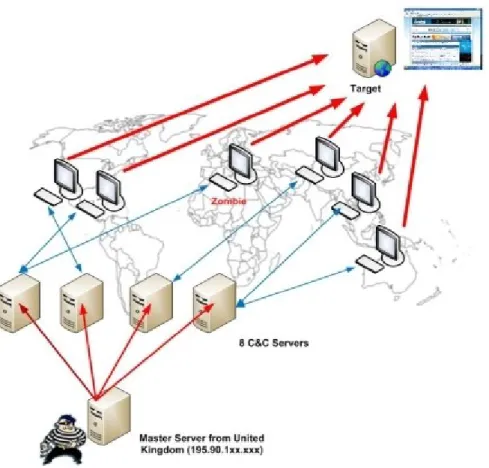
Recently, MyDoom Botnet infected 167,000 computers in Korea and USA (Constantin 2009). The Vietnamese security vendor Bach Khoa Internetwork Security (BKIS) researchers discovered the master control server was located in the UK. US govt urged that North Korea was involved in these DDoS attacks. Graham Cluley, senior technology consultant responded in his blog that "No evidence has been produced showing that the government of North Korea are behind the denial-of-service attacks," explaining that, "A hacker can be based anywhere on Earth and command a worldwide botnet to bombard websites with traffic." The security researcher concludes that, "If Mr Hoekstra has been advised by internet experts that the attacks definitely came from North Korea, I would politely suggest that he finds himself some new internet experts." AVG's Chief Research Officer, agrees and says that, "It was silly to blame North Korea, because the whole point of a DDoS from a remote controlled botnet is that no one really knows who's driving it" (Constantin, 2009).
2.1.1.3 Data stealing
Malware installed in a compromised computer could steal everything including data on storage media, serial number, passwords etc. Data stealing by malware is a growing problem for the Internet users. In 2008, it has been significant rise in data stealing malware to raise concerns for home and business users. According to Anti Phishing Working Group (APWG) statistics, password stealing raised 827% from Jan 2008 to December 2008 (Trend Micro, 2009). Data stealing for a business could result in disclosure of very sensitive information to the hackers, who could use themselves or sell this information to their business competitor. In addition to data stealing, malware could delete or modify the data that could cost a huge amount for a company especially deleting / modifying the accounts records.
17
Figure 2: MyDoom variant botnet (Constantin, 2009)
2.1.1.4 Keystrokes capturing
Key logging is a technique used by a Botnet to store the keystrokes while typed and sent to the hacker (Spamlaws, 2012). Due to this mechanism, the hacker gets the passwords and credit card details typed by the user. Keystrokes capturing technique is very common in malwares to steal online banking details, passwords for emails and passwords social networking websites.
To avoid key loggers to steal information from the user machines, one-time passwords are introduced. Along with one-time passwords, in most of banking websites only some selective characters of the password needed to typed (not the full password) in order to get access to online banking. So the key logger is not able to all parts of login credentials that are not enough for the hacker to break into the user bank accounts. Some banks use a technique called virtual keyboard that is on-screen keyboard that is used by clicking on them and no keys are pressed from the actual keyboard of the user. Some botnets such as ZeuS counter attacked this by capturing the screenshots (Shah, 2010).
2.1.1.5 Email Spamming and Phishing
Botnets get access to the cookies and keystroke logs to get access to mailing service to send spam emails to all addresses in the users address book. The email sent to receivers contains a link with a message encouraging user to click on the link or download attachment. This message could be like “Please download this song”, “My wedding Pictures”, “Here are your documents” etc. Malware is downloaded and installed via attachment, or by clicking link in the email to convert the computer into a zombie, whereas in some cases there is a link that downloads the malware.
18
Email service providers such as Yahoo and Hotmail got detection system for such malware that will warn the users before download but it is not possible to deal with the fresh threats. There is also a reporting system for suspected phishing sites in Internet explorer, Hotmail and outlook express, that helps Microsoft to update their database by inspecting the reported links for phishing (Microsoft, 2012).
2.1.2 Botnet C&C mechanisms
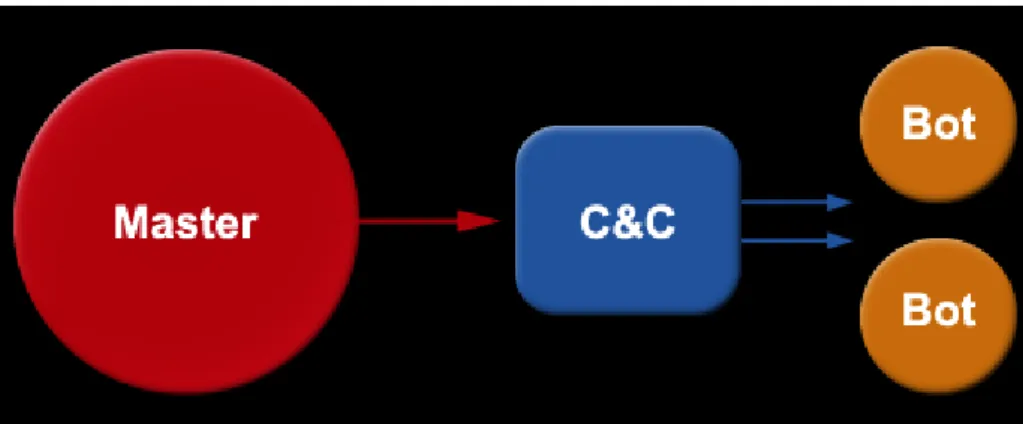
C&C is the way a Botmaster communicates with the slaves or Bots. When a bot is installed on the victim machine, next step is to communicate and synchronise with the C&C server. Steps for the synchronisation of a bot with a C&C server is shown in Figure 3. When a bot is synchronised with its C&C server, it registers it in its database and bot becomes ready to listen to C&C server for commands and scripts to perform operations as requested by Botmaster on the C&C server (Kamluk, 2008). C&C could have centralised, P2P and Hybrid (combination of centralised and P2P) architectures. In both architectures, there could be a single or multiple C&C servers.
Figure 3: Simple C&C Operation (Hudak, 2010)
2.1.2.1 Centralised Architecture with Single C&C Server
Centralised C&C belong to the first generation of Botnets where the Botmaster controls the bots through a single C&C server at a single point inform of a star topology as shown in Figure 4. The advantages of Centralised C&C architecture are easy to configure, easy to maintain and it requires less programming skills as compared to p2p botnets. Due to a simple architecture, commands are executed faster in C&C architecture as compared to other architectures.
The disadvantages of centralised C&C are that they could be detected and mitigated easily (Emre, 2011). Botmaster could only access the Bots via C&C server, therefore C&C should be up and running and accessible by the Botmaster. Mitigation is very simple for centralised C&C botnets is by detecting the C&C server and shut it down.
19
Figure 4: Single Server Centralised C&C architecture (Kamluk, 2008)
2.1.2.2 Centralised Architecture with Multiple C&C Servers
In some cases there are multiple C&C servers exists where one C&C server is an active C&C server and others are failover C&C servers. In case of failover or shutting down one C&C server, the other backup C&C server takes over (Ollmann, 2009). All the C&C servers need to make communication with each other periodically to determine their status.
The advantage of this architecture is that shutting down or blocking one C&C server do not stop the communication of the Botmaster with its bots until all active and backup C&C servers are shut down, whereas the disadvantage of this architecture is programming complexity. Hacker has to develop a way of communication between C&C servers to determine the status of other C&C servers. If an active C&C server shuts down, one of the backup C&C servers become active and all bots should be updated with the location of a new C&C server.
2.1.2.3 Decentralised P2P Architecture
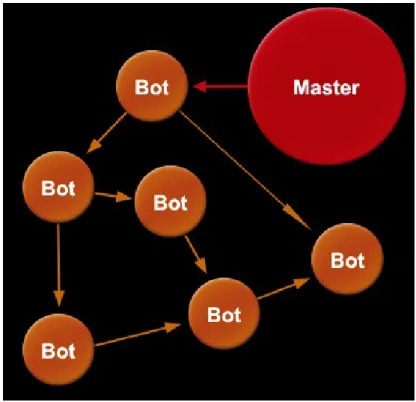
In decentralised architecture, one bot is connected to further bots in a form of a mesh topology as shown in Figure 5. Each new infected machine has information of bots to that it will be connected in the Botnet. P2P botnets are new threat to the Internet since emergence of based P2P “Storm bot” in 2007 (Ruitenbeek and Sanders, 2008). The advantages of this architecture are due to complex architecture, decentralised botnets are harder to detect and mitigated as they have no centre like centralised C&C server architecture whereas the Disadvantages of decentralised architecture are slow communication of a Bot with C&C server and other bots. They are more difficult to programme as all bots have information that is not only to connect to C&C but also with its peers to that is connected in a mesh topology.
2.1.3 Communication Protocols
A botmaster communicates with its clients/bots using communication protocols.
2.1.3.1 IRC based Botnets
IRC been first protocol used for Botnets. IRC (Internet Relay Chat) is a multi-user multi-channel plain text chatting system (Lo, 2004). IRC is a client/server based model. A client is identified by its nickname. When a client sends a message to other client (nick), the message is sent to server with message and target nickname information and server delivers message to the target client. Due to this
20
mechanism, a client could send message to any client that is connected to that IRC server makes a client to communicate with multiple clients simultaneously.
Figure 5: Decentralised C&C architecture
When a new machine is infected with an IRC bot, Bot programme contains details of the IRC server such as irc.dal.net and a nickname of the Botmaster who is already connected to that Botnet server, waiting for confirmation from a new Bot/infected machine.
The advantages of using IRC to be used for Botnets is that it is already developed with hundreds of IRC servers worldwide and code already exists, just a need to utilise it. IRC has very simple set of commands. There are many interfaces such as mIRC available on internet for free to provide more macros and graphical interface to help the user to do different tasks more easily for a Botmaster. Whereas, the disadvantages of IRC based botnets are IRC communication is usually in a plain text format, therefore it is easy to sniff using tools such as Wireshark to discover the nick and location of the Botmaster. IRC used port 6667, blocking this port blocks the functionality of an IRC based botnet. mIRC Bot example – GTbot (Global Threat Bot) Trojan (TrojanResearch, 2012)
This Trojan is downloaded by users thinking it as a cleaner version of mIRC. When this Trojan is downloaded by a client, it installs its files to c:\windows\system\fonts directory following files
c:\WINDOWS\SYSTEM\fonts Folder -
c:\WINDOWS\SYSTEM\fonts\icmp.vbs Size: 108 bytes VBS script
c:\WINDOWS\SYSTEM\fonts\mirc.ini Size: 27,638 bytes mIRC configuration settings and mIRC script
c:\WINDOWS\SYSTEM\fonts\Mirc2.ini Size: 40,997 bytes mIRC script c:\WINDOWS\SYSTEM\fonts\MIRC3.INI Size: 17,733 bytes mIRC script
c:\WINDOWS\SYSTEM\fonts\moo.dll Size: 90,112 bytes Unaltered 4.0.2.65 version
21
version 1.6
c:\WINDOWS\SYSTEM\fonts\pepsi.vbs Size: 103 bytes VBS script written by Mirc2.ini and launches the Pepsi.exe DDOS tool
c:\WINDOWS\SYSTEM\fonts\PR.INI Size: 29,882 bytes mIRC script
c:\WINDOWS\SYSTEM\fonts\remote.ini Size: 1,556 bytes mIRC Remote.ini file c:\WINDOWS\SYSTEM\fonts\TEMP.EXE Size: 446,464 bytes mIRC version 5.7 c:\WINDOWS\SYSTEM\fonts\Temp.scr Size: 73,303 bytes Text File, Referenced
by mirc.ini, mirc3.ini, pr.ini. Contains 7,456 nicks
c:\WINDOWS\SYSTEM\fonts\TEMP2.EXE Size: 22,016 bytes Hide Window application
c:\WINDOWS\SYSTEM\fonts\WHVLXD.DAT Size: 55 bytes Registry Key Data c:\WINDOWS\SYSTEM\fonts\WHVLXD.EXE Size: 24,576 bytes Registry Key
Creator
It creates a key in registry without modifying any other keys.
HKEY_LOCAL_MACHINE\SOFTWARE\Microsoft\Windows\CurrentVersion\Run "WHVLXD" Type: REG_SZ
Data: c:\WINDOWS\SYSTEM\fonts\WHVLXD.exe
GTbot merges its code into mIRC scripts. It used ‘hide window’ function to hide the instance of mIRC used by it and runs in stealth mode. This bot has a very limited functionality includes some scanning and DoS attacks on mIRC clients.
2.1.3.2 IM based Botnets
IM (Internet Messaging) based Botnet uses IM such as AOL, MSN or Yahoo. This is not very common type of botnets. The advantage of this type of botnets are a ready-made system exists that could be utilised, whereas disadvantages are, unlike mIRC, a temporary nick cannot be created. It should be registered manually by entering CAPTCHA code. Vendors like AOL, MSN and YAHOO have adequate measurements against CAPTCHA descriptors. Therefore IM-based Botnets have a limited number of login accounts as time is required to create an email account on AOL, MSN or YAHOO. Also a one ID cannot be logged into multiple computers that make IM based botnets more limited.
2.1.3.3 HTTP/Web Based Botnets
IRC and IM Based Botnets had defect that they could be blocked easily by a firewall without affecting every day work for a home or office user. HTTP based botnets use HTTP protocol that is a primary protocol for web browsing, that is required by any home and office user. HTTP based botnets uses HTTP to logon to the website operated by the Botmaster or Botmaster left information on the website that could be interpreted by the bot (Microsoft, 2012). Win32/Svelta bot discovered in 2009, it receives information from social networking websites such as twitter to read instructions from Botmaster in form of encoded blogs. Many bots redirects the users to illegal contents website or phishing websites hosted by the Botmaster such as ZeuS bot.
Advantage of HTTP based botnets is that unlike IRC blocking port 6667 would not affect the functionality of a computer but port http (80) could not be blocked it could affect a home or office user as it is for the Internet browsing. Therefore instead of blocking port http (80), contents filtration is applied in Intrusion Detection System. One of the biggest features of a HTTP based botnet is that it
22
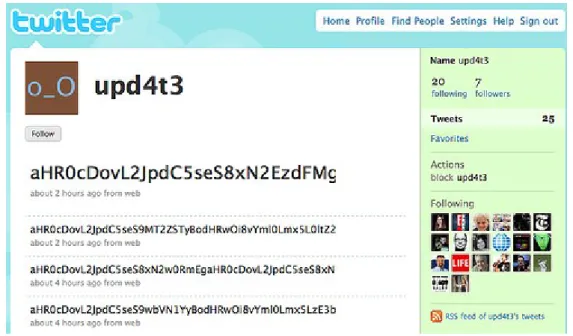
is not necessary that a Botmaster should own a website. A social networking site such as twitter could be used to host updates for the bots that could be accessed by bots any time. Figure 6 shows a user account “upd4t3” left some commands by twitting on its twitter page that are encrypted and only be understood by the bots for them these commands are left.
Figure 6: Example of utilisation of Twitter by a Botmaster (Nazario, 2009)
It gives flexibility for the Botmaster to leave commands / instructions to the bots by simple logging into that Twitter account from any location. Bot subscribes to RSS feeds to receive updates from the Botmaster.
2.1.3.4 Other Protocols
Modern botnets could use their own custom created protocols and random ports for C&C (Microsoft, 2012). In some cases these custom protocols transmit the plain text or encrypted data over UDP or TCP ports chosen by Botmaster that are assigned to the different protocol or service.
2.1.4 Rallying mechanism
Rallying mechanism is the way a bot rally around its Botmaster. It could be a hard coded IP addresses, Dynamic DNS (DynDNS), Distributed DNS service or fast-flux DNS.
2.1.4.1 Hard-coded IP addresses
In hard-coded IP addresses been used by early generation of botnets and they are very rate in the current age. A botmaster is sitting on a fixed IP address that is hard-coded into the code of the bot. Hard-coded IP addresses could be found easily and by blocking that fixed IP address by implementing ACLs on firewall or router stops the communication of a Bot with its Botmaster to receive any further instructions (Dittrich, 2005). IP address of the Botmaster could be found easily by scanning for unusual packets sent/received by the host to a local or Internet destination by using tools such as Wireshark. Only advantage of hard-coded IP addresses is that they do not need advanced programming skills as compared to modern mechanisms.
23
Dynamic DNS or DynDNS is the system by which IP addresses to a domain is assigned automatically. The users subscribe to the websites such as www.dyndns.com that provide facility of assigning IP address to a domain name automatically. This service is provided for the internet servers with dynamic IP address to be accessed by their clients when their IP is changed. New IP address could be assigned to the domain name either by a new IP is assigned to that domain name either by logging on to their website or by using a tool that runs on the computer and it detects the IP change and updates it (Harley, et al., 2007). Dynamic DNS system is often abused by hackers in order to develop more sophisticated Botnets that are harder to detect (Anderson, 2009). This mechanism allows hacker to create multiple disposable hosts and hacker changes the IP address of computer whenever needed and bots will be still accessing the Botmaster.
User accounts abusing dynamic DNS service could be shut down by contacting www.dyndns.com
customer service for an abuse. Sometimes it could not be possible if that service that is providing dynamic DNS service just like www.dyndns.com is located in a country that is out of reach for the law enforcement authorities due to lack such law implementation in that country.
2.1.4.3 Distributed DNS service
In distributed DNS service, the hackers create their own DNS servers that are located in the world location where the law enforcement authorities have no access due to lack of implementation of relevant law in that country (OpenDNS, 2012). This technique is being widely by the modern botnets.
2.1.4.4 FastFlux DNS
In FastFlux DNS, the DNS records changes after a certain time period such as 60 seconds, as set by the botmaster. Initially it was used by spammers to change URLs in the email address to counter filtering efforts (Danchev, 2009). For Botnets, FastFlux DNS allows the hacker to change C&Cs IP periodically. Criminals use this technique to create botnet with nodes and drop them before law enforcement takes any action (Tech Target, 2012).
2.1.5 Evasion Techniques
Evasion techniques are used by Botnet to hide its activities to be detected by botnet detection systems such as encrypted traffic, rootkits, DNS exploits, HTTP/VoIP tunnelling and IPv6 tunnelling.
2.1.5.1 Encrypted Traffic
First generation of Botnet is IRC based in plain text where the traffic could be sniffed easily using tools such as Wireshark. Modern botnets use encryption technologies to hide it data from sniffing to make their detection harder for IDS/IPS. Hackers use encryption technologies in social networking websites such as twitter (as shown in figure 6) and blogs. In 2007, Storm Botnet used 40-byte encryption keys to encrypt the command. In addition to encryption, it uses P2Parchitecture to make it harder to detect by an IDS/IPS (Keizer, 2007).
2.1.5.2 Rootkits
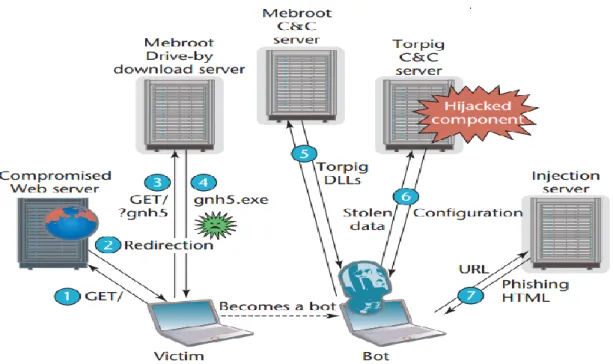
Rootkit modify the victim computer MBR (master boot record) so that a Botnet is loaded as a windows service before any antivirus or botnet detection software is loaded during the boot process. Torpig bot speeded using Mebroot rootkit in 2008. Torpig also uses different hiding techniques to hide itself from the operating system and opens a backdoor to communicate with the Botmaster.
24
Mebroot changes the MBR so that it is executed before Window starts. It enables Mebroot to overcome Windows security system (Ben, 2012).
2.2 Botnets Lifecycle
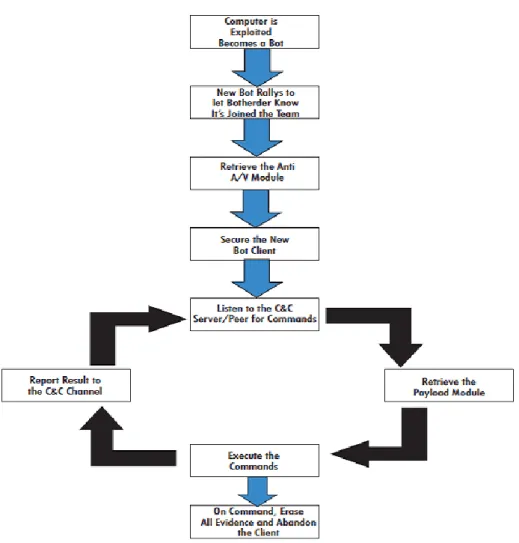
Common steps for Botnet life cycle are shown in Figure 7.
2.2.1
Exploitation
In first step, the life of a Bot begins when the client is exploited. A Botnet client could be exploited by malicious code by tricking a user to download a malware and Bot attacks against vulnerabilities of the host operating system, open a backdoor for communication with the Botmaster and steals data/passwords (Harley et al., 2007).
Figure 7: Common Steps in Botnet Life Cycle (Harley et al., 2007, p.36)
2.2.1.1 Tricking user to download a malicious code
It requires good social engineering skills by a Botmaster. Commonly used methods are
- Email attachments, when they are opened, a malicious code is executed. Such emails
25
- By sending Phishing emails, Phishing emails look like a genuine email sent by a bank, Online buying websites, tax office, etc, that look like a genuine email from HMRC, asking to click on a link to update their information or to get a tax return (HMRC, 2012). When a user clicks on that link, it redirects to the webpage that looks like a genuine page of a company but has a malicious code in the background encouraging user to enter information such as password, credit card information and other sensitive information. When user enters the information, it is sent to the botmaster.
-
Encouraging users to download a malware, In this method a user is encouraged usually through a social networking website to download malicious software as discussed in section 2.1.1.1.2.2.1.2 Attacks against Un-patched Vulnerabilities and ports
When a Botnet is installed on host, it could scan for vulnerabilities in the host operating system and open ports to find out its weaknesses. Hackers that develop botnets know the vulnerabilities of the different versions of the operating systems. Operating systems vendors such as Microsoft are aware of these vulnerabilities and provide patches to update operating systems for these vulnerabilities. If these patches are not installed, the operating systems could contain vulnerabilities that could be used by botnets to infect and misuse the victim machine. There are also some vulnerabilities known by hackers that are not been noted by vendors. More vulnerability in system makes a Bot to spread and perform its operations more easily. An outline is:
Agobot exploited vulnerability in Windows XP in Remote Procedure Call (RPC) Distributed Component Object Model (DCOM) using ports 135 (DCOM2), 139 (NetBIOS), file shares on 445 (NetPass), RPC locator vulnerability, port 80 vulnerability in IIS5 WEBDAV and many others.
SDBot exploited ports 139 (NetBIOS), 1433 (MSSQL), CISCO router vulnerability on port 80, 143 (IMail IMAPD login username and password), 5000 (UNDP), IIS using SSL and many others.
Other Bots IRCBot, BotZori, Zotob, Esbot, Bobax, Spybot attempted to spread by Microsoft Plug-n-play vulnerability (MS 05-039).
2.2.1.3 Scanning for Backdoors left by other Trojans or Worms
Instead of writing own subroutines for opening ports for communication with a Botmaster, it is a good idea to find any ports already opened by any malware such as Trojan or Worm that is already installed on the host operating system before installation of the bot.
SDBot exploits the following backdoors (Clark, 2007, p.29)
- Optix backdoor on port 3140
- Bagle backdoor on port 2745
- NetDevil backdoor on port 903
26
- MyDoom backdoor on port 3127
- Kauang backdoor on port 17300
2.2.1.4 Password cracking attempts
A bot tries to find passwords to escalate its abilities in host machine or a network on higher levels. It could be
- Password guessing by trying common user ids such as administrator, guest, admin, root, student, teacher etc and passwords such as abc123, 123456, admin, blank password etc.
- Brute-Force by running a brute-force algorithm to crack a password.
- Others, could be any password cracking technique such as dictionary attacks, rainbow tables
etc.
For example, RBot first of all tries to connect to the target host using ports 139 and 445. When connection is established, it tries to connect to the windows share \\{target ip}\ipc$. If unsuccessful, it goes to other computer in the network until it gets access to that share. IPC (Inter-Process Communication) is a hidden share used for data sharing between applications and computers (IPC$ Share Null Session Exploit, 2008). If still no success, it will try the list of common usernames and passwords.
2.2.2
Rallying and Securing the Botnet Client
When a Bot installed on the host computer, it tries to connect with its rallying C&C server. In advanced Botnets, this communication is encrypted to hide their communications from anti-Botnet tools. A bot requests the latest updates, latest list of C&C servers, IP addresses and the way to connect to a new C&C server if a primary C&C goes down or to find a new IP address of the C&C server in case of dynamic C&C.
After securing communication with the Botmaster, Bot secure itself from removal by antivirus or anti botnet tools. To stop functionality of a antivirus software a bot could download antivirus removal software from their website and executes in background to remove it or make antivirus software corrupted or execute the commands such as net stop to stop the antivirus applications. For example RBot gives following commands to stop possible antivirus applications (Clark, 2007, p32)
net start >>starts
net stop "Symantec antivirus client" net stop "Symantec AntiVirus"
net stop "Trend NT Realtime Service" net stop "Symantec AntiVirus"
net stop "Norton antivirus client" net stop "Norton antivirus"
net stop "etrust antivirus"
net stop "network associate mcshields" net stop "surveyor"
Turning off antivirus software may alert a user that something is going wrong in the system. To avoid this, some botnet replaces the antivirus files such as .dll files with own files to show the user that
27
antivirus is running but actually it is a bot itself that looks like actual antivirus tool. For more security a bot could also stop the antivirus tool to down any updates to show user that the installed antivirus software is a last updated version. Modern Botnets also use rootkits as discussed in section 2.1.5.2 and techniques to make it stealth from the bot client operating system.
2.2.3 Listen and execute the C&C Commands
Once a bot client is secured, it starts listening to C&C for commands. A bot knows a set of commands that are programmed by the hacker. Botmaster gives the commands to the bot and a bot executes a subroutine associated with that command. Commands execution may be scheduled by a bot or triggered by any events. Some examples of Botnet commands are shown in Figure 8.
Figure 8: Botnet Example Commands (Harley et al., 2007, pp.41)
Some advanced bots could also retrieve payload or modules from the Botmaster to execute the commands that enables a bot to execute command with latest subroutine or code by Botmaster. After execution of the command, a bot try to remove any trace in the computer that could be detected by antivirus/anti botnet software.
2.3 Evolution of Botnets and case studies
This section describes the case studies related to common Botnets from early ages until today and how they exploited the vulnerabilities of the operating system and utilised weaknesses of time-to-time Internet developments and the common techniques being used for Botnet detection. Timeline for common Botnets from 1999 up to 2011 is shown in Figure 9.
The first GMBot was developed in late 1980s. Its objective was to emulate a live person IRC sessions. Check Point (2011) describes GMBot as was not a malicious bot. In 1999 first malicious IRC based bots Sub7 and Pretty Park were emerged. From time to time, the objectives of Botnets developed from corrupting or stealing computers data to financial gain or a way to make a huge amount of fortune. Zeus bot in 2006 sold for several thousand dollars. Initially Botnets utilised IRC and then further developed to use more sophisticated protocols such as HTTP, ICMP and SSL for C&C of a
28
compromised network (Trend Micro, 2010). In mid-2011, code for bots Zeus was leaked and the secrets behind development of these Bots were exposed to anyone who wants to create their own Botnet.
Figure 9: Evolution / History of Botnets (Check Point, 2011)
2.3.1 Pretty Park Bot (1999)
Pretty park worm was distributed from a email spammer in France on 28 May 1999 infected Windows 95, 98 and Me. It belongs to first generation of IRC based bots in late 90s. Other variants of this worm are Trojan Horse, W32.PrettyPark, Trojan.PSW.CHV, CHV, W32/Pretty.worm.unp, I-Worm.PrettyPark [Kaspersky], W32/Pretty.gen@MM [McAfee], W32/Pretty [Sophos], WORM_PRETTYPARK [Trend] (Trend Micro, 2010). Pretty Park is controlled via IRC to send instructions; it sends “keep alive” to its Botmaster every 30 seconds.
2.3.1.1 Pretty Park propagation / Infection techniques
Pretty Park spreads through email attachments. It is very common that the Spam messages got heading “Important Message” therefore to encourage receiver to download the malware, email heading is “C:\CoolPrograms\PrettyPark.exe” that looks like something from a user local drive (ZDnet, 2000). Email body shows Kyle from “South Park” cartoon show. It does not have lines of text to make itself suspicious but it has only one link “Test: PrettyPark.exe”. Attachment has icon shown in Figure 10.
When a user double clicks it, PrettyPark.exe attachment is downloaded that is actually malware. When PrettyPark.exe is executed, malware is installed in the user PC and 3D pipes screen saver started and in-case if 3D screensaver is not present, it tries to execute Canalisation3D.SCR and proceeds to do the following steps (About.com, 2007)
- In \Windows\Systems folder, it creates a file name Files32.vxd.
- It modifies the registry key HKEY_LOCAL_MACHINE\Software\Classes\ exefile\shell\open\command default value to "%1" %* to FILES32.VXD "%1" %*", so that the script in Files32.vxd is executed every time when .Exe file is executed by modifying the linked registry key in HKEY_CLASSES_ROOT (ZDnet, 2000).
- It activates two subroutines with interval of repeating execution after 30 seconds and 30 minutes.
29
- Subroutine with interval 30 seconds, tries to connect to a list of IRC channels and send ping-pong messages to certain users if they are connected or not. This technique is used to detect other infected computers.
- Subroutine with interval 30 minutes,tries to access the email address books, sends its copy as a customised email to all email addresses. By this technique, it tries to spread itself to other computers. If someone tries to download that malware from that email, it will be infected as well and same steps are repeated on their computer and so on (PC-Help, 1999).
- It may also be used as a backdoor to send confidential information such as Computer details (Name, product keys/serial numbers of Windows/Software installed, registered owner); email addresses passwords, ICQ/MSN messenger/Yahoo messenger passwords, Dialup networking usernames and passwords, etc.
Figure 10: Pretty Park attachment icon
2.3.1.2 Pretty Park strengths, weaknesses and removal
Pretty park propagation is based on a clever idea with a good formatted email that encourages the user to click on the link to download malware. It spreads fast by using addresses of victims Internet address books. This makes more probable for it to spread further as the receiver will trust that this email is from his friend/relative and it should not be harmful. This technique was more useful at that time as in early ages of Internet, users was not so careful as today but it could not be so effective in current age. Its activity could be observed easily using tools to monitor registry and file systems and any antivirus tool could detect its changes made to registry and file systems. Moreover, it used IRC that is easy to block to stop its activity.
PrettyPark has high distribution level but a low damage level. About.com (2007) suggest the following steps to remove PrettyPark
- Start Regedit.exe for registry editor.
- Change the registry keys HKEY_LOCAL_MACHINE\Software\Classes\exefile\
shell\open\command and HKEY_CLASSES_ROOT\exefile\shell\open\command to its default value "%1" %*.
30
- Restart computer.
- Delete Files32.exe in Windows\System directory.
2.3.2 GT (Global Threat) Bot (2000)
PrettyPark and Sub 7 bots were based on IRC, where victim machines are connected to IRC channels to listen to commands. Due to introduction of mIRC client and could run customs scripts with features to listen to raw TCP/UDP sockets, that created a good platform to do a DDoS attacks more easily and effectively and many ideas to improve the Botnet development (Raywood, 2010).
GT Bot consumed the features gifted by mIRC client. As compared to previous Botnets, GT Bot has following features / improvements
- BNC (BouNCe): To make Bot client access to a server anonymously by hiding its hostmask. BNC is used to relay the traffic and connections in the networks. A user can hide the source and actual target to that the user connects. For example if a normal user logon as [email protected], through BNC, this address could be modified as [email protected] that hides the name of IRC server to that user is actually connected. It could also route traffic through specific location and gives features such as to create vhosts (Virtual Hosts) (Wikipedia, 2012, BNC (Software)).
- Using Modular Approach instead of one package: In email body, unlike PrettyPark, it does not have malware as an attachment that could be detected by scanning tools used by email providers such as Yahoo or Microsoft. It uses social engineering techniques to draft email from a network security provider with a link (instead of malware as an attachment), that directs to a fake company website that is actually hosted by the hacker, where user is asked to download a software that is a malware in disguise, unlike PrettyPark that was not modular but embedded into one package.
- Has access to raw TCP/UDP ports (build-in feature of mIRC client).
- It could scan for computers infected with Sub 7 or PrettyPark via IRC and upgrade them to GT Bot.
2.3.3 SDBot (early 2002)
SDBot was written by a Russian Programmer with nickname SD in C++. The author also published the source code with contact details (email and ICQ) information. It allowed hackers to study techniques used by SDBot as well as enabled them to do modifications/enhancements in its source code to produce many variants of this Bot. In June 2006, Microsoft reported that 678,000 computers were infected by SDBot (Zang et al., 2011).
SDBot copies itself to the Windows main directory and to make it executed every time windows start, it modifies one or both of registry keys
HKEY_LOCAL_MACHINE\Software\Microsoft\Windows\CurrentVersion\Run HKEY_LOCAL_MACHINE\Software\Microsoft\Windows\CurrentVersion\RunOnce
31
Changes made to files and registry keys are shown in Figure 11. Some symptoms of SDBot infections are (Microsoft, 2011) are the LSA Shell error message window as shown in Figure 12, and Windows shuts down after displaying a dialog box, stating Remote Procedure Call (RPC) terminated unexpectedly as shown in Figure 13. Along with this Windows can restart without user interaction after displaying a dialog box, stating error in lsass.exe as shown in figure 14.
Figure 11: Files and Registry Keys used by SDBot (Norman ASA, 2004)
32
Figure 13: RPC Error / Shutdown Window
Figure 14: Restart / lsass error window
SDBot features and improvements as compared to previous Botnets are SDBot connects to a channel on IRC server to receive the commands to do many actions that include many actions and features that were not used in previous Botnets PrettyPark, Sub 7 and GTBot. SDBot commands includes actions such as scanning un-patched computers on the network, open ports on the host, monitoring network traffic, Enabling/Disabling DCOM, Downloading and executing remote files, retrieving CD keys for games, logging keystrokes, redirecting TCP traffic, uploading through FTP, performing DoS/DDoS attacks, sending spam emails, launching servers (HTTP/HTTPD, SOCKS4, FTP/TFTP), screen & webcam capturing and manipulating operating system processes and services.
GT Bot exploits the MS03-026 (Buffer Overrun in RPC Interface. It is a vulnerability of windows that allows a hacker to execute a code of his own choice) to create a remote shell on the victim machine to copy itself and execute on the remote computer (Microsoft, 2003). It could also be instructed through backdoor ports opened by Optix, MyDoom, Bagle, Netdevil etc. Later variants of SDBot install a kernel-mode rootkit driver which hides SDBot from process viewing applications and task manager.
33
2.3.4 Agobot aka Gaobot (2002)
Agobot was written in C++ and a little amount of Assembly language by a German Programmer Ago Gembe in 2002. It has a modular design rather than infecting the system with entire code at one time (Harley, 2007, pp.10). Agobot has three modules:
Module 1 is initial module containing IRC Bot client and the remote access backdoor.
Module 2 attack and shut down any antivirus software and processes.
Module 3 stops users to access any antivirus tools websites.
Next module is executed when the primary tasks of the current module are completed. Other Bots related to Agobot family are Phatbot, Forbot and XtermBot. The features of Agobot as compared to previous Botnets are (Harley et al, 2007, pp.11):
- Capability to hide itself using rootkit technology.
- Modifies the host files to prevent them to access any antivirus websites.
- Terminates any antivirus / monitoring processes.
- Uses techniques to make reverse engineering difficult.
- A variant of Agobot, Phatbot has capability to use WASTE, a P2P for C&C that uses a public key encryption technology.
- Capability to update its modules remotely and uninstall the outdated modules.
2.3.5 Mytob (2005)
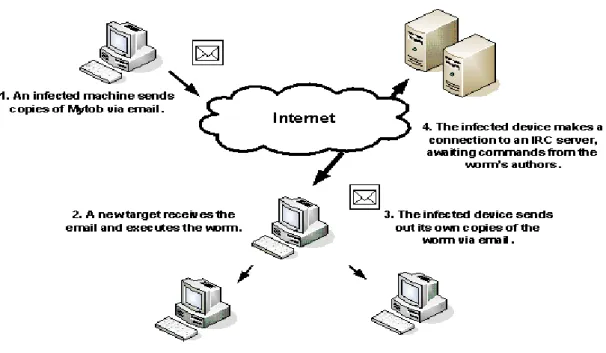
From 2003, the hackers started think about getting a financial gain using Botnets. Mytob is a part of Botnets created for this purpose. First version of Mytob was released in Feb 2005 (ESET, 2005). Mytob sends phishing emails that look like legitimate-looking messages that encourage user to perform steps resulting downloading and installation of the malware. Mytob infects systems running Windows 95, 98, 2000, Me, NT (server/workstation), XP and 2003 Server (Rouse, 2005).
Earlier versions of this bot appeared as email attachments and later forms sends emails with a link to a legitimate-looking website containing malware or of an organisation such as online banking logon page for a bank to hack into a bank account. Mytob propagation process is shown in Figure 15. Mytob code is a hybrid code that is combination of modules and features taken from MyDoom for mass spam mailing and IRC/Worm features of SDBot.
34
Figure 15: General steps for Mytob Propagation (Infectionvectors.com, 2005)
2.3.6 ZeuS Bot (2007)
ZeuS was first identified in July 2007, when it was stealing information from US Department of Transportation. It targets only Windows machines (Masood, 2011). In 2009 it became widespread when security company Prevx discovered that ZeuS compromised 74,000 FTP accounts on popular websites including Bank of America, Monster.com, Oracle, Cisco, Amazon and NASA. ZeuS Botnets compromised 3.9 million computers in United States. On 28 Oct 2009, more than 1.5 million phishing messages were sent on Facebook to spread ZeuS. November 14-15 2009, 9 million phishing emails sent to spread ZeuS that looked like genuine emails from US mobile service provider Verizon (Raju, 2010). In 2010, several attacks by ZeuS reported including in July 2010, more than 15 US banks were compromised.
In May 2011, ZeuS code was leaked due to that hackers got aware of latest Botnets techniques used by ZeuS and the code that could be modified by hackers to make their own version of ZeuS. That resulted in spreading of ZeuS bot faster and many cybercrime networks founded that were interested in stealing money from banks.
On 1st October 2010, FBI discovered a major international cyber crime network which used ZeuS to
hack into United States computers to steal around $70 million. More than 90 suspects arrested in United States and arrests were made in UK and Ukraine. ZeuS fraud scheme exposed by FBI is shown in Figure 17.
The hackers do unauthorised transfers from victim’s bank accounts to the accounts controlled by “money mules”. These bank accounts are created by submitting fake documents and phony names to the banks in different countries. That money is sent to their client’s bank accounts providing this
35
service for a “small price” as compared to the transaction amount or it is withdrawn from bank accounts as cash and smuggle out of the country.
Some variants of ZeuS are free, whereas individual modules are sold up to $10,000 in underground market of cyber criminals, that lets hackers to take full control of the victim’s computer (Messmer, 2012). ZeuS is distributed with its full toolkit that includes a control panel to monitor and control the botnet as shown in Figure 18.