Received 28 May 2012, revised 5 February 2013, online published 16 May 2013 2013, DESIDOC
1. INTRODUCTION
Radar signal recognition is one of the kernel aspects of the radar emitter recognition process. After electronic intelligence (ELINT) system intercepting the signal emitted from enemy radar, the character (or parameters) of target radar signal is analyzed to realize the identification of radiation sources by radar signal recognition technology. So, radar signal recognition is an crucial research content of modern ELINT system and radar counter-measures. Due to the wide deployment of complex radar system in recent years, the five traditional parameters, i.e. time of arrival (TOA), radio frequency (RF), pulse amplitude (PA), pulse width (PW) and direction of arrival (DOA) cannot meet the requirement in classifying the complex modulation radar signal. Novel character extraction method, especially radar intra-pulse character1 for identifying
the complex modulation radar signal, has become the key issue to be solved in the field of electronic countermeasures.
To solve the problem of radar signal modulation type recognition, several methods have been developed. Zhang2
has extracted wavelet packet character and resemblance coefficient character3 to classify the radar signal of different
modulation types. Pu4 has extracted the derived character of
instantaneous frequency and main ridge slice character of the ambiguity function5. Classification result of the above
methods attains good performance at medium SNR (5 dB), but poor at low SNR. Zhu6 puts forward a classification method
for the complex radar signal based on time-frequency atomic character, which achieves good classification result in low SNR. But the construction of over-complete time-frequency atom library is time-weighted and unstabilized, so it can’t meet the requirement in practice project.
Time-frequency distribution is a powerful tool to deal with non-stationary signal. Compared with other analytic instrument, it can obtain the time and the frequency information simultaneously. Therefore, time-frequency analysis method has been widely used in signal recognition7-9.
It provides a new approach for signal recognition that utilizes image processing technology to extract time-frequency image character. Gulum10 utilizes some time-frequency distribution
and image processing methods to recognize low probability of intercept (LPI ) radar signal. The experimental results show that the recognition effect is related to the selected type of time-frequency analysis and image processing methods. It can be concluded that the keystones for signal identification from the time-frequency image are: (a) the choice of time-frequency distribution with high time-frequency resolution and less cross terms; (b) the choice of suitable image processing methods; (c) the choice of the excellent time-frequency image character.
Different radar signals have different time-frequency images. From the perspective of image processing, image character mainly contains gray character, texture character, shape character, colour character and edge character. We deem that the most salient character of time-frequency image is shape character. Moment is an effective region-based shape descriptor. It has been widely used in image reconstruction and retrieval11. In this paper, stable time-frequency image
based on shape character is extracted for recognizing radar signal. Unfortunately, due to noise and cross terms, it can not guarantee the stability of the character to directly extract character from time-frequency image. So, the preprocessing for time-frequency image, which can improve the image data with suppressing unwanted deformation or enhancing some
Automatic Recognition of Radar Signal Based on Time-Frequency
Image Shape Character
Jiandong Zhu
*, Yongjun Zhao, Jiang Tang, and Junkui Xu
Zhengzhou Information Science and Technology Institute, Zhengzhou-450 002,China
*E-mail: [email protected]
ABSTRACT
Radar signal recognition is one of the key technologies of modern electronic surveillance systems. Time-frequency image provides a new way for recognizing the radar signal. In this paper, a series of image processing methods containing image enhancement, image threshold binarization and mathematical morphology is utilized to extract the shape character of smoothed pseudo wigner-ville time-frequency distribution of radar signal. And then
the identification of radar signal is realized by the character. Simulation results of eight kinds of typical radar signal
demonstrate that when signal noise ratio (SNR) is greater than -3 dB, the Legendre moments shape character of the time-frequency image is very stable. Moreover, the recognition rate by the character is more than 90 per cent except for the FRANK code signal when SNR > -3 dB. Test also show that the proposed method can effectively recognize radar signal with less character dimension through compared with exitsing algorithms.
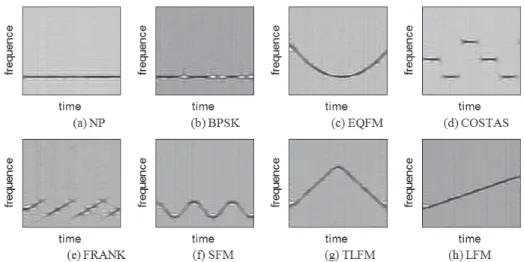
Figure 2. The SPWD of 8 kinds of signal at SNR = 5 dB.
of the important image character, is necessary for subsequent processing before character extraction. The proposed radar signal recognition process based on the time-frequency image is shown in Fig.1.
It can be seen in Fig. 1, firstly the time-frequency distribution with high resolution and less cross terms is selected to get the time-frequency image of radar signal in classification algorithm. And then, the image pretreatment method is used to further reduce noise and cross terms in the image. Because the shape character of time-frequency image is used to classify radar signal in this article, the techniques such as image enhancement, image binarization and mathematical morphology processing should be used in pretreatment. 2. SMOOTHED PSEUDO WIGNER
TIME-FREQUENCY DISTRIBUTION
The Wigner-Ville distribution (WVD) has a perfect time-frequency resolution, but it suffers from undesirable interference cross terms due to the inherent quadratic structure of its transformation. A smoothing operation (i.e. lowpass filtering) may attenuate the cross terms because they are oscillatory. Unfortunately this attenuation of cross terms leads to a lower time-frequency resolution. Each time-frequency distribution of Cohen’s class can be derived from the WVD via a two-dimensional convolution with a kernel function. It is clear that this convolution will result in a smoothing of the WVD only if the kernel function is sufficiently smooth. In this paper, we use a kind of Cohen’s class time-frequency distribution called smoothed pseudo wigner distribution (SPWD), which employs windowing in the frequency domain to suppress the leakage
Figure 1. The process of proposed radar signal recognition method based on time-frequency image.
effects and additional smoothing in the time domain to reduce cross terms. The SPWD of a signal s(t) is defined as
2 ( ) ( ) ( / 2) ( , ) ( / 2) j f g u h s t u s SPWD t f t u e d du ∞ ∞ −∞ −∞ ∗ − π τ τ − + τ = − + τ τ
∫ ∫
(1)
where h(t) and g(t) are smooth window function of frequency and time domain respectively, and satisfy h(0)=G(0)=1, whereG(f) is the Fourier transform of g(t). After the windowing smooth processing in time domain and frequency-domain, the SPWD realize lowpass filtering to WVD, so cross terms can be greatly inhibited.
Figure 2 shows the SPWD of 8 kinds of representative radar signal at SNR = 5 dB. These signal include normal pulse (NP) signal, BPSK signal, even quadratic frequency modulation (EqFM) signal, COSTAS frequency hopping signal, FRANK code signal, sinusoidal FM (SFM) signal, the triangular linear FM (TLFM) signal and linear FM (LFM) signal. We can clearly identify the obvious difference of the time-frequency images with every modulation type from Fig. 2. To achieve automatic recognition of the above signal, the character needs to be extracted from their time-frequency images.
3. TIME-FREQUENCY IMAGE PREPROCESSING
Time-frequency distribution can be seen as a two-dimensional image, so it can be further processed using some image processing methods. In fact, self-terms of signal in time-frequency plane can be seen as the ‘object’ of the image, while noise and cross terms can be seen as the ‘background’ of the image correspondingly.
3.1 Enhancements of Time-frequency Image
The image enhancement is able to suppress noise and improve overall contrast of the image. There are a lot of image enhancement methods, such as the median filtering algorithm, the mean filter algorithm and the adaptive Wiener filtering. This article adopts the adaptive Wiener filter12. To some extent,
image enhancement can reduce noise and cross terms in the time-frequency image at the cost of self-terms diffusion. Still, considering the adverse effect of noise and cross terms of time-frequency distribution in latter character extraction, the cost of self-terms diffusion in image enhancement is tolerable, which can be compensated by the subsequent image processing. 3.2 Adaptive Binarization of Time-frequency image
After the image enhancement, threshold binarization processing of gray-scale image is used to turn the time-frequency image into a binary image. The binarization can further filter noise and cross terms of the time-frequency distribution. Image binarization processing can be described as follows: 1, ( , ) ( , ) 0 , ( , ) P t Thr B t P t Thr ω ≥ ω = ω < (2)
where, p(t,ω) represents the time-frequency image. The choice of a reasonable threshold Thr is very crucial to the binarization. The threshold of binarization is selected according to one-dimensional maximum entropy method13 in this article. 3.3 Morphological Processing of Time-frequency
Image
After the binarization, open operation of mathematical morphology is executed to the binary image. Mathematical morphology is especially suitable for processing the shape of objects. It simplifies the image and maintains the main shape character of objects. Open operation processing contains corrosion operation and expansion operation, which uses certain structural elements to handle image. The expansion operation causes the dilatation of connective domain in the image, whereas the corrosion operation causes the shrinkage of connective domain. Open operation of binary image is
expressed as follows:
1 2
( ( , ) )
A= B t ω ΘB ⊕B (3) where B1 and B2 represent the erosion and dilation structure element respectively, Θ represents the erosion operation, and
⊕ represents the dilation operation. In this paper, the disc and diamond are respectively selected for structure elements B1
and B2.
After the above pretreatment, the time-frequency image is shown in Fig. 3. It can be seen that the shape of eight kinds of signal is more distinguishing after pretreatment.
4. TIME-FREQUENCY SHAPE CHARACTER EXTRACTION
It can be seen from Figs. 2 and 3 that there is obvious difference in the geometry shape among the time-frequency images of radar signal with different modulation types. Thus, time-frequency image shape character can be extracted for signal recognition after pretreatment. Shape character not only describes the contour of the image, but also indicates the region surrounded by the contour.
The moment function is a very effective image shape descriptors, and usually employed to express the global character of the image shape. It provides a wealth of image geometric information, which has the characteristics of minimal information attenuation and mathematical precise characterization. At present, a large number of moment functions have been proposed to describe the target shape. Moments can be divided into orthogonal moments and non-orthogonal moments. Compared with non-non-orthogonal moments, orthogonal moment has better capability of describing characterization and robustness against noise, and does not bring redundant information17. Therefore, Legendre moments
of orthogonal moments are extracted as the time-frequency shape character in this paper.
The (p+q) order Legendre moments of the two-dimensional function f (x,y) are defined as follows:
1 1 1 1 (2 1)(2 1) ( ) ( ) ( , ) 4 pq p q p q P x P x f x y dxdy − − + + λ = ⋅
∫ ∫
(4) where, Pp(x) is the p order orthogonal Legendre polynomial,and satisfy 0 ( ) p k p pk k P x c x = =
∑
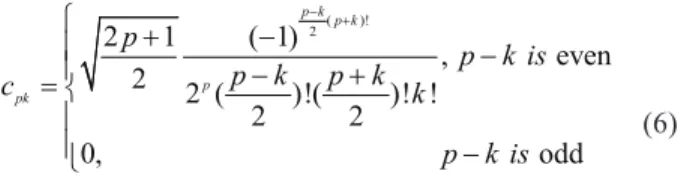
(5) In the Eqn (5), cpk is the orthogonal coefficient, which is defined as ( )! 2 2 1 ( 1) , even 2 2 ( )!( )! ! 2 2 0, odd p k p k p pk p p k is p k p k c k p k is − + + − − − + = − (6) Because each Legendre polynomial with different order is orthogonal, the image can be reconstructed by Legendre moments.Legendre moments are entitled to describe image shape. The lower order moments describe the overall shape of an image, and higher moments describe the detail information of an image18. Legendre moments of different order of the
time-frequency image demonstrate different stability with the change of SNR. The lower order moments are less affected by the noise, while higher order moments are much more influenced by the noise. Take the low order Legendre moments λ00 for example, when SNR is from -9 dB to 15 dB with the
step of 3 dB, the mean value and normalized mean square error (NRMSE) of λ00 belongs to the time-frequency image after
pretreatment is shown in Fig. 4. here, suppose λˆi is the i-th
estimate value of λ , i=1,2,…N, and l is the mean of λ, the NRMSE of λ is defined as 2 1 1 N (ˆ ) / i i NRMSE N = =
∑
λ − λ λ (7)It can be seen from Fig. 4, when SNR>-3 dB, λ00 keeps
good stability. It must be pointed out that other low-order Legendre moments also show the similar stability (there is not listed). Thus, Legendre moments can be extracted as a kind of very good character to identify radar signal. In theory, if the difference of time-frequency image shape is large, the signal can be identified only by selecting some low-order Legendre
moments. however, because the NP signal and BPSK signal are very similar in overall shape (as shown in Figs 2 and 3), so it is needed to extract a certain number of higher order Legendre moments. In this paper, three order Legendre moments λpq,p,q = 0,1,2,3 (a total number of 16) are selected as the image shape character after pretreatment.
5. TRAINING AND CLASSIFICATION
After extracting the character, it is required to choose the classifier for classification. Vapnik14 proposed a machine
learning method called support vector machine (SVM) which is based on the structural risk minimization principle. This method can be adapted to the small sample learning situations, which is not overly dependent on the quantity and quality of input samples, and has strong generalization ability.
To avoid the calculation of the nonlinear surface segmentation in the original input samples space, input character space is mapped to high dimensional character space using inner product function in the SVM method. After the generalized optimal classification surface is found, the training data obtains a maximum classification interval.
At present, the SVM algorithm is well applied in the pattern recognition, speech recognition, human face image recognition, text classification, etc. The SVM algorithm has already roughly equivalent to or superior to traditional learning algorithms in classification accuracy. Thus, this article selects SVM as a classifier for training and classification, and selects gaussian radial basis function (RBF) as kernel function of SVM. The gaussian radial basis function selected in this paper is defined as:
2
( , ) exp{ |x xi j x xi j| }
Φ = −γ −
(8) 6. EXPERIMENTAL RESULTS AND ANALYSIS
In this section, recognition effect of time-frequency image shape character using eight kinds of typical radar emitter signal is tested. The parameters of signal selected are: the carrier frequency f0 = 1 Mhz, the sampling frequency fs = 10 Mhz, the sampling time t = 51.2 us. When SNR ranging from -9 dB to 15 dB with step of 3 dB, we produce 200 emitter signal at
each SNR for 8 kinds of radar signal with different modulation. The time-frequency transform, image pretreatment and image character extraction mentioned above are implemented to the above-mentioned signal. Finally, we use SVM classifier for recognition, and the Gaussian radial basis function (RBF) is selected as kernel function of SVM. The samples number ratio of training set and test set of SVM is 1:4, i.e, at each SNR, for total number of 1600 radar signal, the size of training sample is 320, and the test sample is 1280.
Figure 5 shows the classification results of 8 kinds of radar signal using time-frequency image Legendre character. It can be seen in Fig. 5, the recognition rate of all signal is improved with the increasing of SNR. When SNR is greater than 3 dB, the recognition rate of all signal is close to 100 per cent. When the SNR dropped to -3 dB, except for FRANK code signal, the recognition rate of the other signal is greater than 90 per cent. This result is in line with the stability of Legendre moments when SNR greater than -3 dB.
time-frequency image is cropped according to the marginal frequency distribution. Moreover, the image is turned into a binary image by adaptive binarization algorithm. Finally the binary image extracted is used as recognition character by a neural network classifier.
The evaluation index of a classification algorithm is its classification efficiency and classification effect. Classification efficiency is measured by its computational complexity, running time, and characteristic dimension. Classification effect is measured by its classification accuracy. In order to further verify the classification efficiency and classification effect of time-frequency image shape character-based identification algorithm proposed in this paper, we compare it with the method based on wavelet packet character2 and the binary
time-frequency image character16. For the time being, the radar
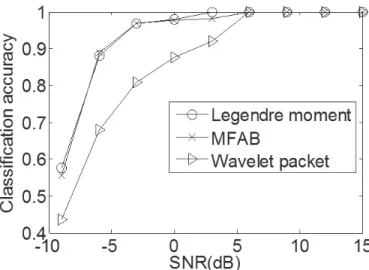
signal recognition method based on wavelet packages character is a representative non-image processing method with a high recognition rate. In the mean time, MFAB method is the typical recognition method based on time image processing. This is the reason why we choose these two methods in comparison. The comparison of average recognition accuracy for 8 kinds radar signal mentioned above is given in Fig.7.The dimension of wavelet packet character is 64 by using 6 layer wavelet packages, and the dimension of binary frequency image character is 2500. Considering the objectivity in evaluating the three algorithm, three kinds of extracted character are all used by support vector machines classifier in identification. It can be seen from the Fig. 7, the proposed method and the method16 is almost equivalent in recognition accuracy rate, and
both significantly better than wavelet packet character of the
Figure 6. The process of MFAB. Figure 5. Recognition results based on time-frequency image
Legendre moments character.
Figure 7. Average recognition rate comparison for 8 kinds radar signal of the three algorithms.
Compared with this method, Zilberman15 uses the
morphology method of corrosion and dilation to extract the binary image of ‘modulation energy center’ from the time-frequency image as the character for low probability of intercept (LPI) radar signal recognition, and achieves good recognition effect. But the authors point out that the method is suitable only for single-carrier signal identification, and poor for multi-carrier signal identification, which limits its application in radar signal recognition. In order to overcome the shortcoming, they proposed a marginal frequency adaptive binarization algorithm (MFAB)16. The basic process of the
algorithm is shown in Fig. 6. Firstly, the signal-free region of time-frequency image is deleted in the method. And then
literature2, especially in low SNR.
In the following part, classification efficiency of recognition of the three methods is further compared. Suppose the number of training samples is l, the number of testing samples is m, the dimension of character is dh, and the number of support vectors in SVM classifier is Nsv. In the training phase, when the number of support vectors is much smaller than the upper bound l, that isN lsv/ <<1, then the computational complexity19 is ( 3 2 )
sv sv sv h
O N +N l N d l+ . When the number of
support vectors achieves the upper bound, that is N lsv/ ≈1, the computational complexity19 is ( 3 )
sv sv sv h
O N +N l N d l+ . The
computational complexity19 of the test phase is ( )
sv h
O N d m . Therefore, the computational complexity of training and test phases by using SVM are both associated with the character dimension. The larger the character dimension is, the higher the computational complexity is. In this paper, the simulation experiment is implemented under following computation circumstance: Windows XP Professional computer with Intel dual-core 2.20Ghz processor and 2GB EMS memory, Matlab R2009a experimental platform. Table 1 gives recognition efficiency comparison of the three methods. It can be seen that the proposed algorithm is better than both methods2,16 in the
aspects of character dimension, character extraction time and classification time. It further illustrates the high efficiency of the shape character of time-frequency image for recognition.
REFERENCES
1. Sheng, Xulong & hu, Guobing. Intrapulse modulation
recognition of radar signal based on statistical tests of the time-frequency curve. In the International Conference on Electronics and Optoelectronics (ICEOE), 2011, pp. 300-304.
2. Zhang, Gexiang; Jin ,Weidong & hu, Laizhao. Application of wavelet packet transform to signal recognition. In the Proceedings of International Conference on Intelligent Mechatronics and Automation. 2004, pp. 542-547. 3. Zhang, Gexiang; Rong, haina; Jin, Weidong & hu,
Laizhao. Radar emitter signal recognition based on resemblance coefficient characters. Lecture Notes
Artificial Intelligence, 2004, 30(66), 665-670.
4. Pu, Yuwei; Jin, Weidong & hu, Laizhao. Automatic classification of radar emitter signal based on cascade character extraction. J. Southwest Jiao Tong Uni., 2007, 42(3), 373-379.
5. Pu, yun-wei; Jin, wei-dong & Zhu, Ming. Extracting the main ridge slice characteristics of ambiguity function for radar emitter signal. J. Infrared Millim. Waves, 2008, 27(2),133-137.
6. Zhu, Ming; Jin, Weidong & Pu, Yunwei. Character extraction of radar emitter signal based on Gaussian chirplet atoms. J. Infrared Millim. Waves, 2007, 26(4), 302-306.
7. Thayaparan, T.; Stankovic, L.; Amin, M. Chen; V. Cohen, L. Boashash, B. Time-frequency approach to radar detection, imaging, and classification. IET Signal Processing, 2010, 4(4), 325-328.
8. Luigi, Christophe De & Jauffret, Claude. Estimation and classification of FM signal using time-frequency transforms. IEEE Trans. Aero. Electr. Syst., 2005, 41(2), 421-437.
9. Du Plessis, Marthinus C. & Olivier, Jan C. Radar transmitter classification using a non-stationary signal classifier. In the Proceedings of the 2009 International Conference on Wavelet Analysis and Pattern Recognition, 12-15 July 2009, pp. 482-485.
10. Gulum, T.O. Autonomous non-linear classification of LPI radar signal modulation. Monterey, California, Naval Postgraduate School, 2007. Thesis
11. Zhang, hui; Shu, huazhong & Guoniu, N. han. Blurred image recognition by Legendre moment invariants. IEEE Trans. Image Processing, 2010, 19(3), 596-611.
12. Gonzalez, R.C. & Woods, R.E. Digital image processing. Prentice-hall, Inc., 2002.
13. Shanbhag, A.G. Utilization of information measure as a means of image thresholding. CVGIP-GMIP, 1994, 56(6), 414-419.
14. Vapnik, V.N. Statistical learning theory. New York: Wiley, 1998.
15. Zilberman, E.R. & Pace, P.E. Autonomous time-frequency morphological character extraction algorithm for LPI radar modulation classification. In the Proceedings of the IEEE International Conference on Image Processing, Atlanta, GA, 2006, pp. 2321-2324.
16. Zilberman, E.R. & Pace, P.E. Autonomous cropping
Experimental
methods Character dimension Single sample extraction time(s) Classification time (s)
Zilberman16 2500 3.62 1.13
Zhang2, et al. 64 2.28 0.65
This paper 16 1.99 0.41
Table 1. The recognition efficiency comparison of three algorithms
7. CONCLUSION
This article achieves automatic recognition of radar signal by using the image processing method to extract time-frequency image shape character. Theoretical analysis and simulation show that the extracted time-frequency image shape character has very good robustness and recognition effect in low SNR. Compared with existing methods, this method has the advantages of lower characters dimension, shorter character extraction time and classification time.
From the available research achievement in radar signal recognition, we can see some of the images characters used to identify radar signal have shortcomings of high character dimension and poor stability, which is closely related to the image pretreatment method and the selection of image character. Referring to the progress in image processing technology, it will be very meaningful and challenging research for radar signal recognition problem to solve in selecting more suitable image pretreatment methods and more effective character. ACKNOWLEDGEMENT
This work is supported by the National high Technology Research and Development Program of China #2011AA7031015.
and character extraction using time-frequency marginal distributions for LPI radar classification. In the Proceedings of the 8th IASTED International Conference on Signal and
Image Processing, 14-16 August 2006.
17. Shu, h.Z.; Zhou, J. & hall, G.N.Image reconstruction from limited range projections using orthogonal moments.
Pattern Recognition, 2007, 40(2), 670-680.
18. Teh, C.h. & Chin, R.T. On image analysis by the methods of moments. IEEE Trans. Pattern Anal. Machine Intelligence, 1988, 10(4), 496-513.
19. Christoper, J.C. A tutorial on support vector machines for pattern recognition. Data Mining Knowledge Discovery, 1998, 2(2), 121-167.
Contributions
Mr Jiandong Zhu received a BS and MS in Applied Maths from Information Engineering University, Zhengzhou, China in 2003 and 2006. Currently he is pursuing his PhD (Electrical Eng.) at Information Engineering University since September, 2009. his research interests include: Radar signal processing and information security.
Dr Yongjun Zhao received his BS, MS, and PhD in Electrical Engineering from Information Engineering University, Zhengzhou, China in 1984, 1992, and 2001, respectively. Presently he is a Professor of Information Engineering University. his research interests include: Radar signal processing and array signal processing.
Mr Jiang Tang received his BS and MS in Electrical Engineering from Information Engineering University, Zhengzhou, China in 2008 and 2011. his research interests include: Radar signal processing.