Reliability for Exascale Computing:
System Modelling and Error Mitigation
for Task-parallel HPC Applications
Omer Subasi
Department of Computer Architecture
Universitat Politècnica de Catalunya
A dissertation submitted in fulfilment of
the requirements for the degree of
Doctor of Philosophy / Doctor per la UPC
October 2016
Advisor
: Jesus Labarta
Coadvisor: Osman Unsal
Structural unit in charge of the programme
Decision of the committee
In a meeting with the examination committee convened for this purpose, the doctoral candidate presented the topic of his/her doctoral thesis entitled
__________________________________________________________________________________________ _________________________________________________________________________________________. Once the candidate had defended the thesis and answered the questions put to him/her, the examiners decided to award a mark of:
UNSATISFACTORY SATISFACTORY GOOD VERY GOOD
(Full name and signature)
Chairperson
(Full name and signature)
Secretary
(Full name and signature)
Member
(Full name and signature)
Member
(Full name and signature)
Member
______________________, _____________________________________________
The votes of the members of the examination committee were counted by the Doctoral School at the behest of the Doctoral Studies Committee of the UPC, and the result is to award the CUM LAUDE DISTINCTION:
YES NO
(Full name and signature)
Chair of the Standing Committee of the Doctoral School
(Full name and signature)
Secretary of the Standing Committee of the Doctoral School
Barcelona, _________
International doctoral degree statement
As the secretary of the examination committee, I hereby state that the thesis was partly (at least the abstract and the conclusions) defended in a language commonly used in scientific communication in the field that is not an official language of Spain. This does not apply if the stay, report or expert is from a Spanish-speaking country.
(Nom, cognoms i signatura)
Acknowledgements
My advisors Jesus Labarta, Osman Unsal and Adrián Cristal gave me the oppor-tunity for PhD studies. Their support, confidence, technical advise, and help have played a major role shaping my research ideas into the contributions expressed in this dissertation. I am very grateful to and thank Jesus, Osman and Adrián for their generosity and comprehension which helped me to go through the difficulties during this four-year long study.
I would like to thank Franck Cappello, who kindly invited me to a three-month in-ternship at Argonne National Lab in the United States. I had a great and productive time at Argonne Lab thanks to Franck’s always positive attitude and enthusiasm. At Argonne, I also benefited from a great working environment and met a number of colleagues that made my stay even more enjoyable. Sheng, Leonardo, Prasanna – thank you all for the helpful moments and interesting conversations.
I would also like to acknowledge all my friends and colleagues from the office that helped me throughout my PhD; for their insights and expertise in technical matters, and for their unconditional support. Many thanks go to Erdal Mutlu, Burcu Mutlu, Ferad Zyulkyarov, Gülay Yalçın, Oscar Palomar, Javier Arias, Oyku Melikoglu, Ismail Kuru and many others. I sincerely thank you all for your help and all the great moments we have had together.
I would like to thank my family for supporting me during this endeavour. My deepest thanks to my father, whom I lost in 2015, who was always supportive of me.
My graduate work has been supported by FI-DGR AGAUR 2013 scholarship, HiPEAC PhD Collaboration Grant, funding from Barcelona Supercomputing Cen-ter, the European Community’s Seventh Framework Programme [FP7/2007-2013] under the Mont-blanc 2 Project, grant agreement no. 610402, and TIN2015-65316-P TIN2015-65316-Project.
As high performance computing (HPC) systems continue to grow, their fault rate increases. Applications running on these systems have to deal with rates on the order of hours or days. Furthermore, some studies for future Exascale systems predict the rates to be on the order of minutes. As a result, efficient fault tolerance solutions are needed to be able to tolerate frequent failures.
A fault tolerance solution for future HPC and Exascale systems must be low-cost, efficient and highly scalable. It should have low overhead in fault-free execution and provide fast restart because long-running applications are expected to experi-ence many faults during the execution.
Meanwhile task-based dataflow parallel programming models (PM) are becoming a popular paradigm in HPC applications at large scale. For instance, we see the adaptation of task-based dataflow parallelism in OpenMP 4.0, OmpSs PM, Argob-ots and Intel Threading Building Blocks.
In this thesis we propose fault-tolerance solutions for task-parallel dataflow HPC applications. Specifically, first we design and implement a checkpoint/restart and message-logging framework to recover from errors. We then develop performance models to investigate the benefits of our task-level frameworks when integrated with system-wide checkpointing. Moreover, we design and implement selective task replication mechanisms to detect and recover from silent data corruptions in task-parallel dataflow HPC applications. Finally, we introduce a runtime-based coding scheme to detect and recover from memory errors in these applications. Considering the span of all of our schemes, we see that they provide a fairly high failure coverage where both computation and memory is protected against errors.
Contents
Contents ix
List of Figures xiii
List of Tables xvii
1 Introduction 1
1.1 Problem Statement and Contributions of Thesis . . . 2
1.1.1 Checkpointing and Message-logging for Task-parallel Dataflow HPC Applications . . . 2
1.1.2 Selective Task Replication in Task-parallel Dataflow HPC Applications 3 1.1.3 Memory Reliability for Task-parallel Dataflow HPC Applications . . . . 3
1.2 Thesis Organization . . . 4
2 Background 5 2.1 Error Classification and Failure Model . . . 5
2.2 Task-parallel Dataflow Programming . . . 6
2.3 OmpSs PM and Nanos Runtime . . . 8
2.3.1 OmpSs and Nanos . . . 8
2.3.2 The OmpSs+MPI hybrid programming model . . . 10
2.4 HPC Memory Reliability . . . 11
2.4.1 Background . . . 11
3 The State of the Art 15
3.1 Checkpointing Systems . . . 15
3.2 Modeling Checkpointing Systems . . . 17
3.3 Replication . . . 18
3.4 SDC Detection and Mitigation . . . 20
3.5 Memory Reliability . . . 21
3.5.1 Hardware-based Memory Reliability . . . 21
3.5.2 Software-based Memory Reliability . . . 21
4 NanoCheckpoints: A Task-Based Asynchronous Dataflow Framework for Effi-cient and Scalable Checkpoint/Restart 23 4.1 Introduction . . . 23
4.2 NanoCheckpoints Design . . . 24
4.2.1 Baseline Checkpoint/restart Design . . . 25
4.2.2 Singleton Copy Mechanism . . . 26
4.3 Experimental Evaluation . . . 27
4.3.1 Methodology and Experimental Setup . . . 27
4.3.2 Fault Injection Mechanisms . . . 29
4.3.3 Evaluation and Discussion . . . 29
4.4 Conclusions . . . 35
5 Marriage Between Coordinated and Uncoordinated Checkpointing for the Exas-cale Era 37 5.1 Introduction . . . 37
5.2 Combining Task-level Checkpointing with System-wide Checkpointing . . . 39
5.3 Model Formalization and Analytical Assessment . . . 42
5.3.1 The waste time of a system-wide scheme . . . 43
5.3.2 The waste time of task-level scheme . . . 44
5.3.3 The waste time of the combined model . . . 45
5.3.4 Discussion on the Generality of the Model . . . 47
5.4 Performance Benefits of the Combined Model . . . 47
5.5 Evaluation . . . 48
CONTENTS
5.5.2 Analysis of Unified Scheme . . . 50
5.5.3 Benchmark Evaluation Results . . . 52
5.6 Conclusion . . . 53
6 Unified Fault-tolerance Framework for Hybrid Task-parallel Message-passing Ap-plications 57 6.1 Introduction . . . 57
6.2 Deterministic model and application requirements . . . 59
6.3 Fault coverage . . . 61
6.4 Message logging protocol for MPI+OmpSs applications . . . 61
6.5 Unified Model for Task-level Fault Tolerance and System-wide Checkpointing . 63 6.5.1 The wasted time of a system-wide scheme . . . 64
6.5.2 The wasted time of a task-level scheme . . . 65
6.5.3 The wasted time and the optimal checkpoint interval of the unified model 67 6.5.4 Performance Score of the Unified Model . . . 68
6.6 Evaluation . . . 69
6.6.1 Experimental setup . . . 69
6.6.2 Fault-free execution . . . 70
6.6.3 Execution with faults . . . 72
6.6.4 Unified Model Experiments . . . 74
6.7 Conclusion . . . 78
7 Replication for Task-parallel HPC Applications 79 7.1 Automatic Risk-based and Programmer-directed Partial Redundancy for Re-silient HPC . . . 80
7.1.1 Introduction . . . 80
7.1.2 Design of Our Framework . . . 81
7.1.3 Evaluation . . . 89
7.1.4 Conclusions . . . 98
7.2 Modelling Task-Parallel Dataflow Applications . . . 98
7.2.1 Selective Task Replication Design: . . . 100
7.2.2 Reliability Model . . . 101
7.2.4 Evaluation . . . 110
7.2.5 Fault Injection . . . 112
7.2.6 Experimental Results . . . 113
7.2.7 Conclusion . . . 122
7.3 Conclusion . . . 122
8 CRC-based Memory Reliability for Task-parallel HPC Applications 123 8.1 Introduction . . . 123
8.2 Design and Implementation . . . 126
8.2.1 Failure Model . . . 126
8.2.2 Snapshots (SNAP) Design . . . 128
8.2.3 Checksum-based Scheme (CHKS) Design . . . 128
8.2.4 CRC-based Scheme (CRC) Design . . . 129
8.2.5 Hardware-assisted Acceleration of CRC . . . 130
8.3 Evaluation . . . 131
8.3.1 Benchmark Behavior Analysis . . . 131
8.3.2 Overhead and Scalability Results . . . 135
8.3.3 Reliability of Three Mechanisms . . . 139
8.3.4 Comparison and Usage of Schemes . . . 144
8.4 Conclusions . . . 145
9 Conclusion 147 9.1 Future Work . . . 148
10 Publication List 151
List of Figures
2.1 Example code in Dataflow and Fork-join. . . 7
2.2 Sample OmpSs code and its task dependency graph . . . 9
2.3 Sample OmpSs/MPI code . . . 11
2.4 a) Tasking MPI calls and b) Task dependency graph and overlap of communi-cation with computation . . . 12
4.1 Designs of NanoCheckpoints . . . 26
4.2 Scalability of Checkpoint/Restart . . . 30
4.3 Scalability of Checkpointing Overheads . . . 32
4.4 Scalability of Singleton in distributed benchmarks . . . 34
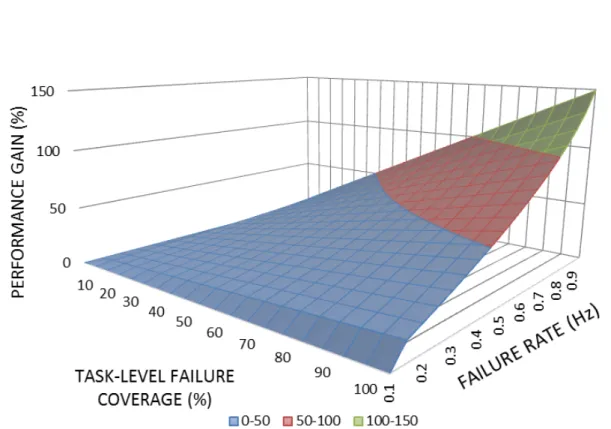
5.1 Performance gain predicted by our analytical model as a function of task-level failure coverage and failure rate. As seen, increasing failure rate - expected for the Exascale era - is the dominating factor for the performance gain (improve-ment). . . 40
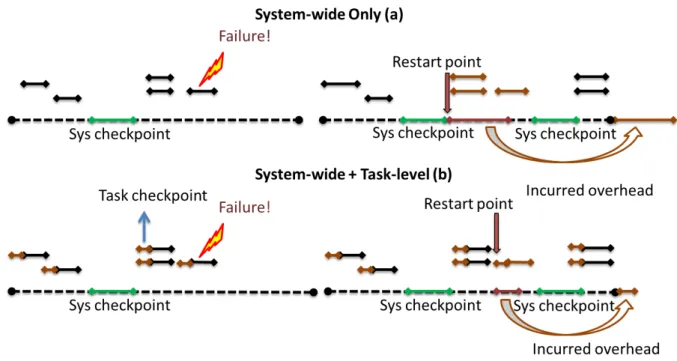
5.2 System-wide vs. System-wide + Task-level Checkpointing: Short line seg-ments show task computations. In the system-wide only case, in (a), the restart point is the last global checkpoint. In the combined scheme, in (b), the restart point is the beginning of the failed task computation. Note that in the system-wide only case, we lose all computation since the last global checkpoint whereas in the combined scheme, it is only the computation since the beginning of the failed task. . . 41
5.3 Comparison of the Unified Model to the System-wide-only Model . . . 48
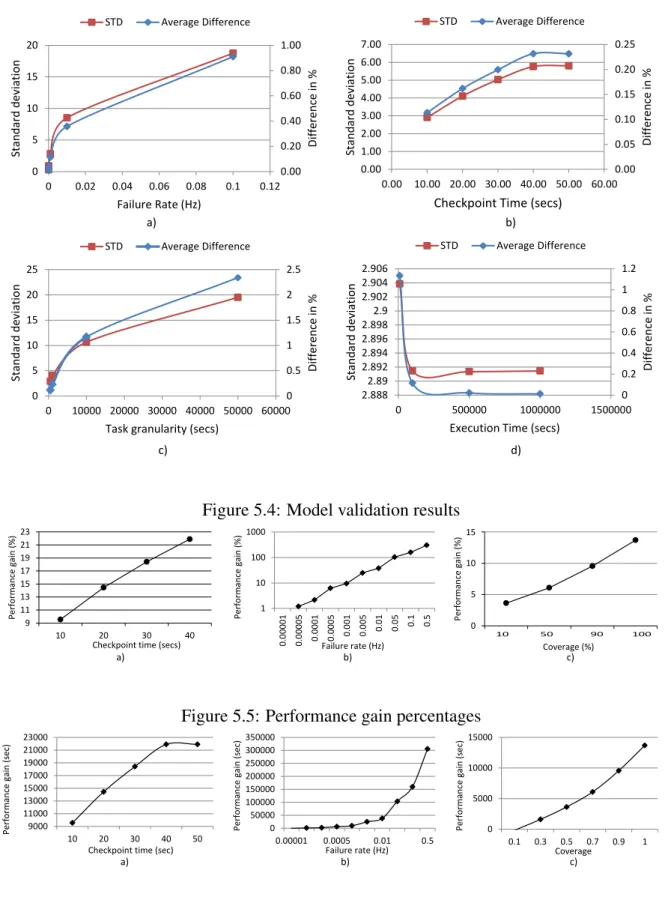
5.5 Performance gain percentages . . . 51
5.6 Performance gain amounts in seconds . . . 51
5.7 Performance gain of our benchmarks . . . 54
5.8 γfactor values of our benchmarks . . . 54
6.1 Example of a task dependency graph . . . 60
6.2 Relative strong scalability of the fault tolerance execution compared with non-resilient execution . . . 71
6.3 Relative weak scalability of the fault tolerance execution compared with non-resilient execution . . . 71
6.4 Runtime overhead in the presence of faults . . . 73
6.5 Model validation results . . . 75
6.6 Performance score results . . . 77
7.1 Task replication design: SDC mitigation . . . 82
7.2 Sparse LU task dependency graph . . . 84
7.3 Scalability for shared-memory benchmarks . . . 91
7.4 Scalability for distributed benchmarks . . . 92
7.5 Task redundancy overheads . . . 94
7.6 Comparison to random task selection: Cholesky . . . 95
7.7 Comparison to random task selection: FFT . . . 95
7.8 Comparison to random task selection: Sparse LU . . . 96
7.9 Comparison to random task selection: Perlin . . . 96
7.10 Comparison to random task selection: Stream . . . 96
7.11 The Markov model for a single task . . . 104
7.12 App_FIT results . . . 115
7.13 Target_Rep results . . . 117
7.14 Task argument sizes vs. Task memory usages . . . 117
7.15 Target_Rep overheads . . . 118
7.16 Task replication overheads . . . 119
7.17 Complete replication scalability (shared memory) . . . 120
7.18 Complete replication scalability (distributed) . . . 121
LIST OF FIGURES
8.2 Arguments waiting idle or being used but not modified by task computations . . 133
8.3 Performance overheads of our schemes . . . 136
8.4 CRC Hardware-based overheads . . . 137
8.5 Scalability of the benchmarks . . . 138
List of Tables
4.1 Details of task-parallel shared-memory benchmarks . . . 28
4.2 Details of distributed benchmarks . . . 28
4.3 Checkpointing Overheads (a) with First Design (b) with Singleton Copy Mech-anism . . . 33
4.4 Efficiency of Singleton Copy Mechanism . . . 34
5.1 Model Parameters . . . 42
5.2 Benchmark Set . . . 52
5.3 Coverage Coefficients: C factor (%) . . . 52
5.4 Walltime overhead (%) . . . 52
5.5 Checkpoint/Restart time of Tasks vs FTI . . . 55
5.6 NanoCheckpoints’ peak checkpoint size . . . 55
6.1 Model Parameters . . . 63
6.2 Benchmark parameters . . . 69
6.3 Memory overhead . . . 70
6.4 Task statistics with corresponding fault rates (faults/sec) . . . 70
6.5 Task-level failure coverages of benchmarks . . . 76
6.6 FTI Checkpointing time of benchmarks . . . 77
7.1 Lessons learned from Component Analysis . . . 88
7.2 Details of task-parallel shared-memory benchmarks . . . 90
7.3 Details of distributed benchmarks . . . 90
7.4 Partial task selection results . . . 97
7.6 Model validation results . . . 114
7.7 App_FIT threshold results . . . 114
8.1 Details of Benchmarks . . . 132
8.2 Tasks and Memory Statistics . . . 132
8.3 Reduced % AVF and % Final Wait Times . . . 143
1
Introduction
As we get closer to the Exascale time-frame, fault-tolerance is becoming one of the main con-cerns along with power and energy consumption in High Performance Computing (HPC). The mean time between errors is expected to be on the orders of hours or even minutes [1] for future HPC and exascale systems. Moreover the extent and impact of Exascale failure types such as silent data corruptions (SDCs) or silent errors could present a significant threat for large-scale application reliability [2]: Such errors are not detected and applications produce wrong results. Another type of errors that is common in HPC systems is the fail-stop errors: The computing process/unit aborts execution and loses all computation and data. Hardware-only solutions are not expected to handle these two types of errors at Exascale error rates [3]. Thus software based fault-tolerance solutions are needed to complement the hardware based ones.
Meanwhile task-based and data-driven programming models (PM) are becoming widely used in HPC community [4]. As an example we see the adaptation of task-based dataflow parallelism in OpenMP 4.0 [5] and Intel Threading Blocks [6]. The performance of dataflow parallelism is shown to be higher than that of the traditional fork-join model due to amount of parallelism achieved [7]. Moreover, these models provide unique advantages in terms of fault
tolerance: In task-based dataflow programs, the failure containment is better than traditional parallel programs (for example those implemented with Pthreads) since an error is most likely to cause only the failure of the single task in which it occurs rather than the entire application. Furthermore, even if the error propagates to other tasks, having a dataflow model facilitates tracing the error through dependent tasks to its root cause. Additionally, the asynchronous nature of dataflow computation enables low-overhead error recovery by overlapping recovery of faulty task(s) with execution of other tasks that are independent of the faulty task(s). Therefore we find that it is important to provide fault-tolerance support for task-parallel data-driven HPC applications using data-driven execution model to mitigate fail-stop errors and SDCs.
In this thesis, we present fault-tolerance mechanisms to detect and recover errors that occur during the computations of task-parallel dataflow HPC applications.
1.1
Problem Statement and Contributions of Thesis
This thesis proposes several mechanisms for reliability of task-parallel dataflow HPC applica-tions which we briefly list below. In addition, we present the contribuapplica-tions of this thesis.
1.1.1
Checkpointing and Message-logging for Task-parallel Dataflow HPC
Applications
Checkpoint/restart is a well-known technique to mitigate fail-stop errors. However with the ex-pected exascale error rates [1], this technique is projected to be not viable. Novel mechanisms are needed to handle fail-stop errors. In particular, with the introduction of new programming models (PMs), such as task-based dataflow PMs, there is no known mechanisms that can inte-grate task-level checkpoints and system-wide checkpoints.
Moreover hybrid PMs that combine message passing and task-parallelism to overlap com-putation and communication have emerged. There are no known fault-tolerance solutions for applications programmed in these new PMs.
In this thesis,we propose NanoCheckpoints which is a task-level checkpoint/restart frame-work for fail-stop errors that occur during the executions of task-parallel dataflow HPC appli-cations. We show that our scheme has low overhead and is highly scalable at high core counts and large scale. Moreover, we develop a unified mathematical model to optimize the check-point interval of system-wide checkcheck-pointing when task-level checkcheck-pointing and system-wide
checkpointing are integrated to provide complete failure coverage. Furthermore, we extend NanoCheckpoints with a message logging protocol to provide reliability for hybrid distributed task-parallel programs. Finally, we develop a formal performance model for these hybrid PMs that shows the merits of our framework and protocol.
1.1.2
Selective Task Replication in Task-parallel Dataflow HPC
Applica-tions
The straightforward way to cope with SDCs or silent errors is to replicate all tasks in a task-parallel application. However this might be too costly or even not needed. That is, the complete task redundancy is only needed for very high error coverage. Smart mechanisms are needed for partial/selective replication of tasks. To the best of our knowledge, in the context of task-parallel dataflow programs, no such mechanisms exist which can trade-off between reliability and performance/power/energy costs.
In this thesis, we propose four different runtime-based selective task replication mecha-nisms that target both fail-stop errors and SDCs. The first one is a completely automatic, transparent-to-user, risk-based and lightweight heuristic. The second one incorporates pro-grammer knowledge. Finally, the third and fourth ones are developed in a formal way and are also completely automatic and transparent to user. Experiments show that all four schemes are low-overhead, highly scalable and effective in SDC detection.
1.1.3
Memory Reliability for Task-parallel Dataflow HPC Applications
Memory reliability will be one of the major concerns for future HPC and Exascale systems. This concern is mostly attributed to the expected massive increase in memory capacity and the number of memory devices in Exascale systems. For memory systems Error Correcting Codes (ECCs) are the most commonly used mechanism. However state-of-the art hardware ECCs will not be sufficient in terms of error coverage for future computing systems in the Exascale era. Stronger hardware ECCs providing more coverage have prohibitive costs in terms of area, power and latency. Software-based solutions are needed to cooperate with hardware.
In this thesis, we propose a Cyclic Redundancy Checks (CRCs) based software mecha-nism for task-parallel HPC applications. Experiments that our mechamecha-nism incurs very low performance overhead with hardware acceleration while being highly scalable at large scale.
Our mathematical analysis demonstrates the effectiveness of our scheme and its error cover-age. In addition, results show that our CRC-based mechanism reduces memory vulnerability significantly.
1.2
Thesis Organization
Chapter2presents background information on basic terminology, task-based programming and memory reliability.
Chapter3discusses the state of the art for fault-tolerance in HPC systems.
Chapter 4 introduces NanoCheckpoints, our checkpoint/restart framework for task-parallel dataflow HPC applications.
Chapter5presents our mathematical model which unifies task-level checkpointing with system-wide checkpointing. It additionally show the benefits of this unification experimentally.
Chapter6presents our message logging protocol to handle errors that occur in distributed task-parallel applications. Moreover, it presents our unified model for the integration of our protocol with system-wide checkpointing.
Chapter7discusses our selective task replication mechanisms and their in-depth evaluation. Chapter 8 presents our cyclic redundancy checks based memory reliability scheme for task-parallel HPC application, and its mathematical and experimental evaluation.
2
Background
In this chapter we discuss the relevant concepts and topics to our research which will help to understand the overall research and contributions of the thesis. We first introduce the error classification and failure model (Section2.1). Then we discuss task-parallel dataflow program-ming and its advantages favoring fault-tolerance (Section2.2). After that, we present OmpSs programming model (PM) and its runtime (Section 2.3). Finally, we present background on memory reliability and cyclic redundancy checks (Section2.4).
2.1
Error Classification and Failure Model
Throughout this thesis, we refer to failures or errors as the manifestation of faults. Errors are classified into three categories based on their propagation (or lack thereof) from typical er-ror detection/correction hardware. The first class is the Detected and Corrected Erer-rors (DCE) where an error is detected and corrected by the hardware. The second class consists of errors that are Detected and Uncorrected Errors (DUE) where the hardware is unable to recover from the detected error. DUEs are expected to become more frequent in the future with the increasing
likelihood of double-bit and multi-bit flips [8, 9] for caches and memory. Moreover, a single bit flip in parity protected processor structures such as register files could also lead to a DUE. DUEs typically result in the crash of applications since it is impossible for the faulted proces-sor/hardware to recover [10]. Because of this, we consider DUEs as fail-stop errors. The third class of errors consists of Silent Data Corruptions (SDCs). In SDC, the error is not detected, and the application terminates with wrong results. Recent research suggests that SDC can be a serious threat for HPC and exascale [2, 11]. A previous study at CERN found that SDC could be a serious concern since the observed SDC rate was orders of magnitude higher than manufacturer specifications [12]. Thus in this thesis we target SDCs and DUEs i.e. fail-stop errors.
2.2
Task-parallel Dataflow Programming
Tasks, as a higher level abstraction, provide a more convenient and friendly interface for ex-pressing parallelism in parallel programs [4, 13]. Depending on how tasks are scheduled for execution and how they interleave during execution, task-based parallel programming can be either fork-join parallelism [14] or dataflow parallelism [15]. In both, tasks execute in par-allel but are synchronized differently. Under fork-join parpar-allelism tasks have to be explicitly synchronized with a join barrier whereas under dataflow parallelism tasks are synchronized im-plicitly depending on their inputs and outputs. Annotating these inputs and outputs of tasks in a correct and complete way is the programmer’s responsibility as a programming discipline in dataflow programming models. However they are most often simply the inputs and outputs of functions. There are also tools for the automation of the annotations [16]. One can find exam-ple imexam-plementation of fork-join tasks in OpenMP 3.0 [17] and dataflow tasks in OmpSs [18], OpenMP 4.0 [19] and Intel TBB [6].
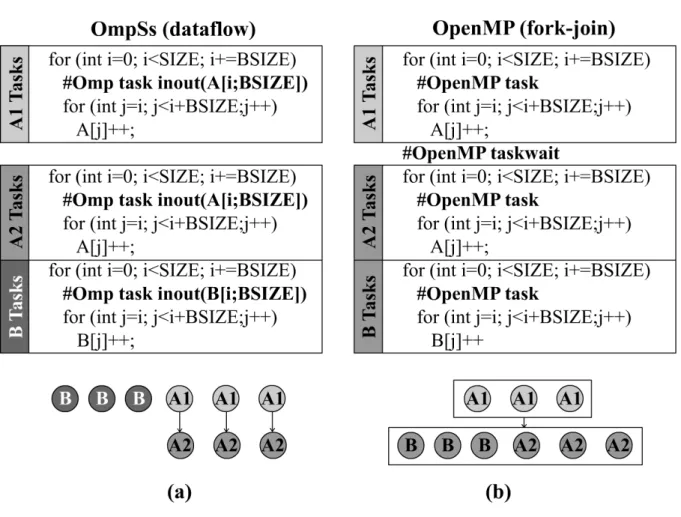
A recent comparison between dataflow and fork-join parallelism by Amer et al. [7] suggests that the dataflow execution model tends to perform better because it exploits the available parallelism better. This can be demonstrated with a simple contrived example in Figure 2.1. Figure 2.1 (a) is an example dataflow code in OmpSs with three tasks
A1
,A2
andB
each incrementing the elements of an array. In tasksA1
andA2
, theinout
keyword is used to declare arrayA
as both input and output. In similar way, arrayB
in taskB
is declared as both input and output. Figure2.1(b) is the same example but for fork-join in OpenMP 3.0. The difference between Figure2.1(a) and (b) is that the fork-join tasks do not declare explicitly theirFigure 2.1: Example code in Dataflow and Fork-join.
inputs and outputs and the fork-join code has the
taskwait
pragma directive between tasksA1
andA2
. The figures under the code are the dependency graphs of the tasks for dataflow and fork-join, respectively. In dataflow the dependencies between the tasks are inferred from tasks’ inputs and outputs whereas the dependencies in fork-join has to be enforced explicitly with a synchronization barrier like thetaskwait
directive. Such synchronization in fork-join is necessary because the input of taskA2
is the output of taskA1
and taskA2
cannot start execution before taskA1
completes. However, using ataskwait
barrier also prevents the execution of taskB
although it does not depend on neither taskA1
nor taskA2
. In dataflow the dependence between the tasks is more accurately reflected indicating that taskB
can execute even before taskA1
if its input is ready.fault-tolerance:
1. Better failure containment:Tasks provide better failure containment since they contain failures within their computations rather than the entire application. The restart of the entire application is mostly avoided this way.
2. Asynchronous execution and overlap of computation and recovery: The asyn-chronous nature of dataflow execution enables low-overhead error recovery by overlapping recovery of faulty task(s) with execution of other tasks that are independent of the faulty task(s).
3. Minimal checkpoint size: As stated above, task inputs are available through program-mer annotations which represent the minimal state of the tasks needed to be checkpointed for the fault recovery. In contrast, solutions in OpenMP typically checkpoint the entire address space of the application since the runtime is unaware of the exact application state to protect.
4. Easiness of SDC detection: Since the error propagation is only possible through the task outputs, the detection of SDC can be easily done by the comparison of the outputs. There is no need for an additional SDC detection mechanism such as the work of Di et al. [20] which converts SDC detection into a one-step look-ahead prediction problem.
5. Enabler for heuristics: With this knowledge of the task inputs and outputs at runtime, we are able to design and implement very efficient and low-overhead selective task replication heuristics.
2.3
OmpSs PM and Nanos Runtime
In this section we review the pure OmpSs PM and its runtime, and elaborate on the hybrid OmpSs+MPI programming.
2.3.1
OmpSs and Nanos
We now give a short introduction to the OmpSs programming model and the Nanos [21] dataflow runtime. OmpSs is a task-based parallel programming model derived from OpenMP. It extends OpenMP tasking constructs with a new data directionality (dependency) clauses to support asynchronous parallelism and heterogeneity, i.e. to support devices such as GPUs. OmpSs applications utilize source-to-source Mercurium [22] compiler and the Nanos runtime. OmpSs uses a thread-pool execution model instead of the traditional OpenMP fork-join model. The master thread starts the execution and all other threads cooperate to complete the
work it generates. OmpSs has a memory model where multiple address spaces may exist, for example, due to the use of heterogeneous kernels. This means that shared data may reside in memory locations that are not directly accessible from other computational resources. Thus, the code can only safely access private data and the shared data that has been explicitly marked as such with the help of the extended OmpSs syntax.
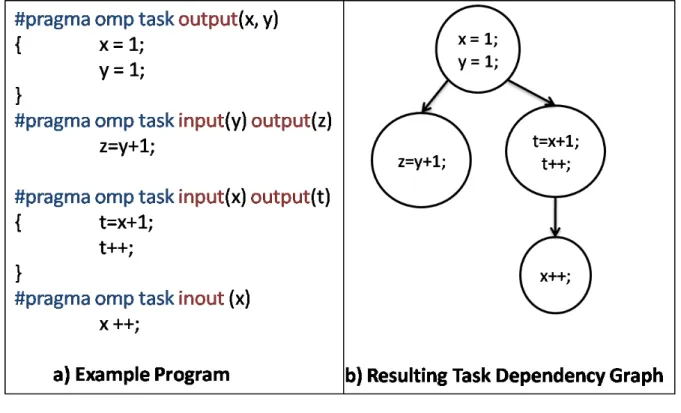
OmpSs programs are parallelized by declaring and instantiating tasks. Tasks are pieces of code that can be executed on parallel resources. When the programmer taskifies an application, i.e. defines source code segments as tasks, he specifies task inputs and outputs to express the data dependencies. Based on this information, Nanos dynamically generates a task dependency graph of the program. When the program reaches a section of code declared as a task, an instance of the task is created and its execution is delegated to Nanos. A task is created in a waiting state, but, once all its input dependencies are resolved, it becomes ready and is executed by a thread from the thread pool as soon as there is an available core. After it finishes, the dependency graph is updated so that its dependent tasks become ready for execution. Figure
2.2shows a sample program code and its task dependency graph generated at runtime.
The main properties of the OmpSs PM are asynchronous parallelism and dataflow-based execution, because the order of task executions only follows the dependency graph but can be out of order from the point of view of the program.
Taskifying an application with OmpSs pragmas is easy because the programmer only needs to express data dependencies and/or target heterogeneous devices where particular tasks should be executed leaving everything else to the runtime. This greately facilitates his work and shifts the burden of parallelization from the programmer to the runtime. As experiments showed [23], [24], and [25], the performance of OmpSs and Nanos is on par or superior to other programming models and their associated runtimes because it exploits implicit and irregular parallelism.
We refer the reader to [18] for further details on the OmpSs PM.
2.3.2
The OmpSs+MPI hybrid programming model
Pure OmpSs PM targets shared-memory machines but it can be combined with MPI to allow execution on distributed memory systems. In such a hybrid model the work is distributed between the MPI processes and then parallelized inside each process by means of OmpSs. This approach is similar to the hybrid OpenMP+MPI model and it mixes a dataflow execution with the message passing model providing some performance benefits. In particular, it helps to hide the communication latencies and achieve higher Gflops/s performance as it was shown in [26]. In an OmpSs+MPI application, the programmer can taskify parts of code that include com-munication calls. This creates an opportunity to overlap comcom-munication and computation be-cause such tasks can run in parallel with other non-dependant tasks. If a task includes an MPI call the programmer must list the buffer used for the call among the task input or output param-eters so that the runtime knows which tasks depend on communication.
If a task has stalled waiting for completion of a blocking MPI call, the runtime can preempt such task and free the core for other tasks ready for execution. This helps to utilize resources more efficiently.
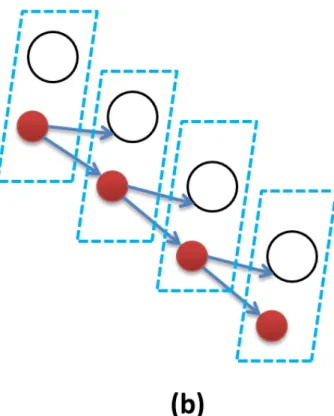
Figure2.3is a simplified code example taken from a matrix multiplication application that we used as one of our benchmarks in this paper. Each process multiplies blocks of a matrix and exchanges results with other processes. Figure 2.4 (a) shows what part of the code was taskified, and Figure2.4 (b) schematically shows the overlapping of tasks in one process. The red nodes represent SendRecv tasks with MPI communication calls inside and the white nodes represent the mxm computation tasks. The parallelograms demonstrate the communication and
i = n * my_rank ; / / f i r s t C b l o c k f o r( i t = 0 ; i t < n o d e s ; i t ++ ) { mxm ( (d o u b l e * )A , (d o u b l e * ) B , (d o u b l e *)&C [ i ] [ 0 ] ) ; i f ( i t < n o d e s−1) { SendRecv ( (d o u b l e * ) A , (d o u b l e * ) r e c e i v e b u f ) ; } i = ( i +n)%m; / / n e x t C b l o c k / / swap p o i n t e r s ptmp= a ; a = r e c e i v e b u f ; r e c e i v e b u f =ptmp ; . . . }
Figure 2.3: Sample OmpSs/MPI code computation tasks’ overlap.
2.4
HPC Memory Reliability
We now discuss memory reliability in HPC systems and cyclic redundancy checks.
2.4.1
Background
With shrinking feature sizes, error rates in main memory are expected to increase [27]. More-over in future HPC systems the More-overall memory capacity and the number of memory devices will increase which will lead to higher error rates.
Memory in current HPC systems is mostly protected by hardware ECCs. Single bit-error correction and double bit-error detection (SECDED) [28] and Chipkill [29] are the most widely used ECCs. Chipkill [29] is used to mitigate DRAM chip failures. Considering future HPC and Exascale systems, on one hand Sridharan et al. [30] report that Chipkill will not be sufficient to mitigate the projected Exascale error rates. On the other hand, stronger ECCs, such as BCH [31], in hardware will incur prohibitive overheads given the predicted fault rates [32]. For BCH codes, Strukov et al. [33] show that the area (storage) overheads are linearly proportional to the length of code, i.e. data plus redundant information, and to the number of errors that can be detected and corrected. Moreover the latency or the performance delay is linearly
propor-Figure 2.4: a) Tasking MPI calls and b) Task dependency graph and overlap of communication with computation
tional to the number of errors that can be corrected. Furthermore, BCH codes have expensive encoding and decoding algorithms. These overheads will be prohibitive especially when the ECC support is not aware of the minimal, precise application data to be protected.
2.4.2
Cyclic Redundancy Checks
Cyclic Redundancy Checks [34] are cyclic codes that are typically used for error detection only. They are mostly used in communication, digital and mobile networks, and aviation. These codes are well-suited for burst errors, i.e. contiguous sequence of errors in data, over a digital network. The CRC computation requires a pre-specified polynomial, called generator polynomial, which becomes the divisor and the data becomes dividend which is considered to be a polynomial over Galois Field GF(2). The remainder of the polynomial division becomes the check value, also called CRC. A CRC is called an n-bit CRC, denoted by CRC-n, when its check value is n-bits. When a generator polynomial with degree n is used, the remainder will have length n since the polynomial has n+1 length. If generator polynomial has a degree of n, then all burst errors no longer than n bits will be detected for arbitrary data length. However the fault detection capability of a CRC depends on Hamming Distance (HD) achieved with the selected generator polynomial as well as the size of data it protects. For instance the 32-bit CRC polynomial standardized for Ethernet has a HD of 4 for data of size Ethernet Maximum Transmission Unit (MTU), i.e. maximum size of data that a protocol can pass onwards (Ether-net MTU is 1500 bytes). There had been research by exhaustively searching the optimal CRC polynomials i.e. those providing highest HD, for different data sizes [35] [36]. Therefore, one should use different CRC polynomials for different applications to provide flexibility to the user to adapt the CRC-polynomial according to the sizes of task arguments for an application to achieve the best fault detection capability, i.e. largest HD.
3
The State of the Art
In this chapter we present related work to our research in this thesis. We first discuss the state of the art in checkpoint/restart systems (Section 3.1). Then we present related work in checkpointing and performance modeling in HPC systems (Section3.2). We then move onto discussing replication which is a well-known technique in fault-tolerance literature (Section
3.3). In Section 3.4, we present the state-of-the-art on silent data corruptions or silent errors which are the type of errors that we aim to mitigate in this thesis. Finally, we close related work by discussing the literature on memory reliability (Section3.5).
3.1
Checkpointing Systems
Checkpoint/restart, or checkpointing, is a well-known rollback recovery technique deployed to mitigate fail-stop errors [37]. In checkpointing the application state, called checkpoint, is saved and the application is restarted by using the checkpoint when a failure occurs. The most common types of checkpointing are coordinated and uncoordinated checkpointing for distributed applications. In coordinated checkpointing, processes coordinate with each other to
reach a consistent global state before taking a checkpoint. The main drawback of coordinated checkpointing is the expensive coordination. Uncoordinated checkpointing was proposed to avoid the expensive coordination [37]. In uncoordinated checkpointing, the states of processes are saved independently, which avoids the coordination but supplementary application data is also logged such that a consistent global state could be formed in a restart. The logging of supplementary data is called message logging which is a technique used to prevent domino effect [37]. Domino effect is a condition in which, in the lack of message logging, the restart of a process causes other processes to restart; and in the end all processes have to restart losing all useful computation. Uncoordinated checkpointing has its own disadvantages. The log size, communication overhead, and fault-free execution overheads can be prohibitive.
To address these issues, hierarchical coordinated checkpointing schemes are proposed such as [38] and [39]. These schemes partition the application processes into groups in which each group can checkpoint independently. They limit the coordination among the processes in a single group and they perform costly global checkpoints less frequently than those within each group. However message logging is performed across the groups to be able for a global restart. Moreover the coordination among the processes belonging to the same group can still be ex-pensive.
Basic checkpointing and message logging algorithms often suffer from low scalability and large memory footprint. Considerable work has been done to address these issues [40]. Some researchers suggest considering the knowledge on correlation between hardware faults in order to lower the message log memory overhead [41], [42]; others combine coordinated checkpoint-ing with message loggcheckpoint-ing for the same purpose [43]. To the best of our knowledge, however, no prior work has tackled message logging for hybrid PMs.
The Berkeley Lab Checkpoint/Restart [44] is a widely adopted approach in high perfor-mance computing for fault-tolerance. As a system-level solution, the most important drawback of this mechanism is the large memory footprint that is generated during checkpointing process due to the lack of knowledge of user-level structures. This mechanism provides a binary check-point solution that increases dependency with operating system, it generates the checkcheck-point using the I/O interaction at Linux kernel level. BLCR needs an operating system modification for a good performance. Our proposed solution in Chapter4is runtime-level, which does not create OS dependency and decreases the usage of memory.
Application-level approaches exist such as [45], however such solutions are not generic and have to be adapted for each single application with developer/programmer knowledge.
These approaches are more efficient than system-level ones. Our novel solution (Chapter 4) has the knowledge of the explicit asynchronous execution flow, which enables us to build a more accurate non-centralized incremental checkpoint and to share information through all the active threads.
System-level solutions have recently evolved into multi-level nature with the main idea to be performing expensive global checkpoints less frequently. Sato et. al. [39] proposes an approach based on multi-level checkpointing for petascale and exascale systems. Their check-pointing system merges non-blocking and multi-level checkcheck-pointing. This system is shown to be efficient on future post-petascale systems. Another hybrid solution proposed for hybrid petascale systems is the Fault Tolerance Interface by Bautista-Gomez et. al [38]. Our proposed framework is complementary to these system-wide solutions (Chapter4).
Ma and Krishnamoorthy [46] propose an approach for task-parallel computations in the presence of work-stealing. The main objective of the work is to identify tasks to be recovered and to recover partial data updates accurately and efficiently. They track the communication operations and maintain an idempotent data store for this purpose. They target fault tolerance within a task parallel phase complementary to checkpointing and fault detection which consti-tute some parts of our work (Chapter4). Chung et al. [47] introduce the Containment Domains (CD) for system resiliency. CDs are programming constructs for the programmer to express resilience concerns as well as to specialize fault detection and recovery according to applica-tion under consideraapplica-tion. In addiapplica-tion, CDs provides flexibility in terms of state preservaapplica-tion, location of preservation as well as the method of fault detection.
Algorithm-Based Fault Tolerance [48] requires additional programmer effort for generating specific redundant calculation on the algorithm.
Bronevetsky et al. [49] proposed an application-level checkpointing technique for OpenMP applications. The application state is regularly stored to disks and in case of a failure it is loaded and application is restarted. Fu and Yang [50] explore thread-level redundancy to detect and recover from transient errors. Tahan and Shawky [51] propose triple modular redundancy fault-tolerance for OpenMP programs via task replication at compiler level.
3.2
Modeling Checkpointing Systems
There has been a significant body of work to model checkpointing systems in order to find the optimal checkpoint interval to minimize the total waste. Young and Daly study the sequential
jobs [52] [53]. For parallel jobs, studies such as [54], [55] and [56] model the coordinated checkpointing protocols.
Considering hierarchical and partially coordinated checkpointing systems, the studies of Di et al. [57] and [58] investigate how to model and analytically determine the optimal checkpoint interval of each level in the hierarchy. In these studies Di et al. characterize the overheads of a multilevel scheme under analytically found checkpoint intervals. Balaprakash et al. [59] address the question of optimizing the checkpoint intervals while also considering the energy consumption of a multilevel scheme. As with the models for the coordinated schemes [54], [55] and [56], these hierarchical models cannot be used for non-hierarchical unified uncoor-dinated and cooruncoor-dinated checkpointing systems such as combined task-level and system-wide checkpointing. The unified model proposed by Bosilca et al. [60] models a range of check-pointing systems from fully coordinated scheme on one extreme to partially coordinated hi-erarchical schemes on the other extreme. However their model does not fit to the case of the non-hierarchical uncoordinated and coordinated unification since for the uncoordinated task-level checkpointing, a periodic checkpointing interval cannot be imposed. The data-driven and task-parallel execution model prevents periodicity which in fact turns out to be an enabler for affordable overall fault tolerance. Moreover, their assumption of tightly-coupled applications is not needed for our unified model (Chapter5) and is not the case for a task-parallel applica-tion. If one of the computing resources, such as a processor, fails, then a task can simply be rescheduled to another processor whereas a tightly-coupled application would have to recover and restart. As a result, our mathematical framework [61] (Chapter5) is the first to study the non-hierarchical unification of the uncoordinated checkpointing with the coordinated check-pointing.
3.3
Replication
Replication is a well-known technique that has been adopted in various domains from avia-tion to distributed systems [62]. This technique has been used for reliability, performance and ensuring quality of service. However in most cases the complete replication of a system or an application can be prohibitively costly to achieve the intended purpose. As a result, selec-tive replication becomes the only viable solution. For instance concerning the performance of systems, the work of Beckmann et al. [63] investigates selective replication to increase the per-formance of the caches of chip multiprocessors using a metric based on hit latency and misses.
In case of aiming for better quality of service (QoS), Gruneberger et al. [64] propose a selective replication heuristic to increase QoS while keeping costs affordable in the context of distributed event-processing systems.
However selective replication as a way to address the trade-off between resource costs and reliability has not been investigated thoroughly, particularly in HPC community. Moreover, on one hand, the aforementioned studies [63, 64] cannot be employed to increase reliability while keeping cost affordable since those techniques and heuristics do not capture the reliability critical aspects of systems. On the other hand, there is the growing body of evidence showing that selective fault-tolerance support is of key-importance to decrease the resource costs while providing the required level of reliability. For instance, Luo et al. [65] and Fang et al. [66] find that different applications and different phases in applications (in our case tasks) exhibit different vulnerabilities. Although neither of these works state it explicitly, it follows that selective fault-tolerance is a natural fit to achieve a reasonable trade-off between costs and the required level of reliability for different applications. Thus, to the best of our knowledge, our selective replication heuristics in Chapter7 are the first to address the trade-off between resource costs and application-specific reliability requirements, in particular for task-parallel HPC applications.
Meanwhile even though the performance and efficiency advantages of task-based dataflow programming models [5] and runtimes [67] are well-established, to the best of our knowledge, there has been no research investigating selective replication in these programming models. As consequence, we strive to leverage the resilience advantages of such frameworks to develop fully automatic runtime selective task replication heuristics (Chapter7). Although our selective task replication framework does not provide complete failure coverage such as errors from the operating system or network/MPI communications, it is orthogonal and seamlessly integrable to system-wide fault-tolerance solutions such as [2, 38] (Chapter 7). As mentioned earlier, FTI [38] is a scalable multilevel checkpointing scheme addressing stop-failures such as DUE failures while Fiala et al. [2] propose SDC detection and correction methods for large-scale message-passing HPC applications. Ferreira et al. [68] investigates the applicability of process replication for exascale systems.
Research on reliability modelling, such as [69, 70, 71], has been conducted for various types of computing systems. However they all model the reliability of systems rather than that of applications to predict the failure rates of the systems. For instance, Thanakornworakij et al. [69] provide a model for HPC systems while Welke et al. [70] establish generic models
based on Markov modelling that are applicable for hardware or software systems having well-known architectures such as simplex and triplex modular redundant architectures. Elliott et al. [71] combine and analyse double and triple replication with checkpointing for message-passing HPC systems. However, none of these models can be utilized to achieve application-specific re-liability with selective redundancy under application-specific rates of SDCs and crashes/DUEs.
3.4
SDC Detection and Mitigation
Research on SDC mitigation can be categorized mainly into three different categories: algorithm-based fault tolerance (ABFT) technique, replication of computation, and runtime analysis tech-nique.
ABFT [48,72,73, 74,75,76] techniques are tailored solutions to specific numerical algo-rithms. As a result, they are usually efficient. However, they fundamentally lack the ability to be applicable to other algorithms than the specific numerical or algebraic kernel they are designed for.
Replication-based schemes [2] can be deployed for mission-critical situations. In such con-texts, double or triple redundancy of computation is performed in order to detect SDCs by comparing the results of replica computations. The inherent drawback of the replication is its high cost; for instance, with double redundancy, the cost is 100%. Partial replication [77] has been proposed to decrease costs while providing required level of reliability. Partial or selective replication is shown to be promising (Chapter7).
Runtime data analysis recently has gained attention in the HPC community. Studies [20,78, 79] investigate and compare different prediction methods such as linear curve fitting or ARMA models, to detect SDCs. They convert the problem of detecting SDC into next-step prediction problem. Sharma et al. [80] utilize temporal features of data (in addition to spatial features) and provide a tailored SDC detector for stencil applications where they use support vector machines as a linear function approximator. The main drawbacks of temporal data analytics are the memory overhead and the computation cost of maintaining snapshot data. Subasi et al. [81] propose a spatial technique, called SSD, which incurs low memory cost while having low computation overhead.
3.5
Memory Reliability
We discuss memory reliability in two parts according to whether fault-tolerance is implemented mainly in software or hardware.
3.5.1
Hardware-based Memory Reliability
There have been hardware-based studies [82], [83] and [84] that propose stronger ECCs for HPC systems. For instance, Li et al. [82] propose memory protection by using BCH codes while decreasing the power overheads for certain applications; the proposed scheme incurs more overhead than Chipkill for computation-bound applications. Bamboo ECC [83] provides more flexibility in terms of data granularity and coding strength than Chipkill. As opposed to our design in Chapter8, these techniques require custom hardware to deploy the proposed so-lution. Nevertheless, our framework (Chapter8) is orthogonal to any hardware-based scheme, and can be used on top of the hardware schemes as a runtime-level scheme to protect critical and precise application data.
On a rather different research direction, Levy et al. [85] propose lightweight error correction for DRAMs by utilizing the existing similarities between the faulty page and some other DRAM pages for post-petascale supercomputers. However, this technique does not offer any error detection support and relies on the signals from the machine check architecture.
3.5.2
Software-based Memory Reliability
In comparison to hardware, software-based memory error fault-tolerance has not been investi-gated thoroughly for HPC. Our work [86] (Chapter8) is the first to investigate different software techniques with respect to different costs (memory or computation) and different fault-tolerance capabilities. As a software-based technique, Maruyama et al. [87] introduce fault tolerance for GPUs that lack standard ECCs. They achieve error detection via data coding and recovery via checkpointing. This is similar to our approach however they do not utilize acceleration of cod-ing. Fiala et al. [88] propose a software-based data corruption detection library which incurs 53% performance penalty on average, which is much higher than that of our CRC mechanism (Chapter8). In contrast to our mechanism, their library is not immune to the overheads due to data access patterns within the application. In addition, we design and implement hardware ac-celeration of our CRC scheme, which is widely applicable in most of the state-of-the-art HPC
processors and incurs only 1.7% performance penalty (Chapter8). The work of Borchert et al. [89] proposes flexible software-based ECCs which are in essence designed for operating system data structures.
4
NanoCheckpoints: A Task-Based
Asynchronous Dataflow Framework for
Efficient and Scalable Checkpoint/Restart
4.1
Introduction
In this chapter, we introduce NanoCheckpoints framework which consists of two checkpoint/ restart mechanisms leveraging advantages of task-parallel dataflow programing. NanoCheck-points is composed of two main designs: Baseline checkpoint/restart and the Singleton mecha-nism. Both NanoCheckpoints designs are at the runtime level, and do not require any modifica-tions at all to application code or operating system (OS). Checkpointing and error recovery are task-local, asynchronous, automatic and completely transparent to the user. In the first design, we use the task directionality information to develop an efficient incremental checkpoint/restart scheme that only checkpoints minimal data to recover from errors. Our results indicate that the design is scalable even for high error rates. In addition, average checkpointing overhead
is about 6% of the fault-free execution times for shared memory benchmarks. In the sec-ond design, we develop a singleton copy mechanism that further decreases the checkpointing memory overheads. Singleton copy mechanism decreases the memory usage for checkpoints about 122× in comparison to the first design. Moreover, it has 3% performance overhead for shared memory benchmarks. Finally, in addition to the shared-memory applications, we evaluate NanoCheckpoints with hybrid OmpSs+MPI applications to demonstrate its very low overhead, on average 2%, and high scalability (with 1024 cores) for larger scales.
Our main contribution is the development of NanoCheckpoints, a task-local fault tolerance framework based on a dataflow runtime coupled with a task-based PM. To the best of our knowledge, this is the first work that explores the checkpoint/restart advantages of a dataflow runtime in detail. In summary, our contributions in this chapter are:
• A low-cost and scalable checkpoint/restart mechanism leveraging the asynchronous dataflow execution model with 6% performance overhead on average for shared memory bench-marks.
• A singleton copy mechanism to further minimize memory usage for checkpoints with 3% performance overhead on average for shared memory benchmarks.
• Evaluation of NanoCheckpoints for hybrid OmpSs+MPI benchmarks with 2% check-pointing overhead and high scalability.
• Analysis of checkpointing overhead in terms of time and space with respect to distinct computation and memory complexities of shared memory benchmarks.
4.2
NanoCheckpoints Design
In this section, we present the two NanoCheckpoints designs in detail. We implement our framework in publicly available OmpSs PM and its Nanos runtime. However, our frame-work is applicable for other task-parallel dataflow platforms. Nevertheless, the performance of OmpSs+Nanos is on par with the highly optimized commercial and open source implemen-tation of OpenMP [23], [25] and it has successfully served as a pilot platform to push dataflow task parallelism to OpenMP 4.0. In the case of the distributed OmpSs+MPI model, it combines dataflow execution with the message passing model providing significant performance benefits.
It hides the communication latencies and achieves higher performance compared to MPI only [26].
4.2.1
Baseline Checkpoint/restart Design
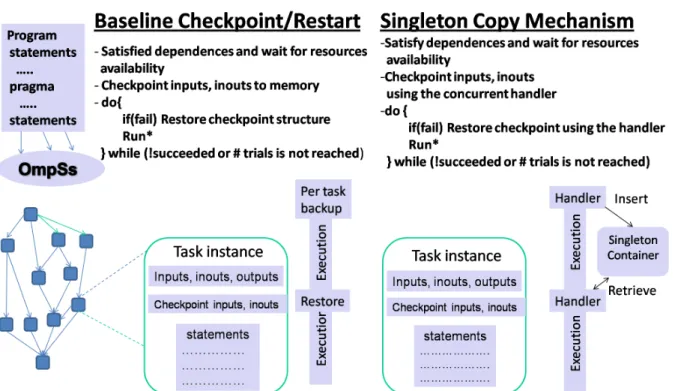
The first mechanism we propose is the baseline checkpoint/restart. We checkpoint the task inputs when the task is ready to execute, which means that all its data dependencies are guar-anteed to be satisfied by the runtime. This is necessary for the mechanism to be correct since if we checkpoint before the data dependencies are satisfied, we may checkpoint incorrect task input data. We checkpoint to main memory. When a task is about to finish, in case of an error, the runtime restores and restarts its execution, otherwise releases the dependencies and removes the checkpoint and related software data structures. We detect errors via capturing sig-nals propagated by OS/hardware at the runtime. Task computations are issued within try-catch blocks and signals are treated as exceptions. After catching the exception, the runtime restores the task and reissues it for a number of times which is provided as a configuration parameter. After these trials if the task computation does not succeed, the runtime schedules it to a new core, since most probably a permanent error is encountered in this case. If the computation does not succeed even after this migration, then the application aborts. When we evaluate our design we consider that the failure is detected at the end of a task, this way we penalize our scheme by assuming a relatively high error detection latency.
We support global modifying task computations, such as tasks updating a shared global variable, by the privatization of the modified data (although we did not encounter any mutable global state in the applications we studied in this work). In task-parallel dataflow programming, programmer expresses the global state modifications, such as a global variable modified within a task, as a shared variable by using data sharing attribute clauseshared. This shared variable is treated as an input and the variable is checkpointed just as the other inputs. Furthermore, the task works on a private copy of the variable. If the task successfully finishes its computation, then the value of the private copy becomes the value of the global variable at the end of the task and the private copy is deleted. If an error occurs, the task is restored as explained above where the private copy is restored by its checkpoint. We note that it is programmer responsibility to provide correct synchronization for globally shared variables among the tasks. However, this is mostly done in a straightforward way by simply using pragmas for atomic statements or for critical sections.
Figure 4.1: Designs of NanoCheckpoints
4.2.2
Singleton Copy Mechanism
In order to minimize the memory usage, we implement a singleton copy mechanism based on a concurrent hashmap. We exploit the fact that in a task parallel program, tasks are likely to share the same inputs. We implement a hashmap for maintaining the single checkpoints of task inputs. During the execution of a task parallel application, tasks insert or retrieve inputs into or from the map. Note that there is no additional synchronization needed for accessing a shared task input since by the construction of task dependencies no two tasks will be modifying a shared task input simultaneously. This mechanism enables significantly lower memory usage for checkpoints and lower checkpointing overhead as can be seen from our results in Section
4.3
Experimental Evaluation
In this section, we first present our methodology and experimental setup. Then we present our fault injection implementation. Finally, we discuss our results.
4.3.1
Methodology and Experimental Setup
We implement Nanos runtime counters through which memory/timing information is obtained by utilizing information from OS to measure time and memory consumption by our mech-anisms. We run our experiments in Marenostrum supercomputer [90] hosted at Barcelona Supercomputing Center.
We conduct experiments to assess the behaviour of NanoCheckpoints in terms of scalability and the performance overheads with respect to fault-free executions. In addition, we perform experiments to see the improvements from our singleton copy mechanism in terms of memory usage and checkpointing overhead. We obtain all results by running each single case 10 times and take the average of overheads, speedups or execution times as the final results.
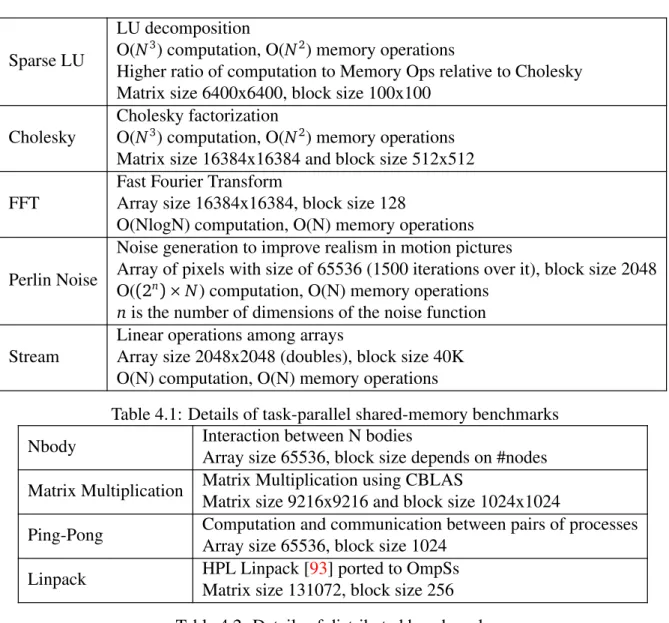
Our experiments are two-fold: The intra-node experiments on task-parallel shared memory benchmarks (listed in Table4.1) are presented in Subsection4.3.3. The inter-node experiments on hybrid task-parallel MPI applications adopting the OmpSs model (listed in Table 4.2) are presented in Subsection 4.3.3. With intra-node experiments, we aim to evaluate NanoCheck-points in terms of overheads, scalability, efficiency and analyse it with respect to different characteristics of different applications in detail. With inter-node experiments, we will addi-tionally show i) NanoCheckpoints is well-suited for such hybrid MPI programs and ii) it incurs low overhead, on average 2%, and is highly scalable at large scale and for high core counts. We run with upto 1024 cores and 64 nodes in these experiments.
For the intra-node experiments, we use four HPC benchmarks,-Sparse LU decomposition, Cholesky factorization, Fast Fourier Transform, Perlin Noise [91] and an artificial synthetic benchmark, the stream application. Table5.2shows information about benchmarks, in partic-ular, the input data sizes, the complexity of the computation and memory operations and the block sizes which determine the input data sizes for a single task in the parallel program. For the artificial stream application, we rewrote and adapted McCalpin’s implementation [92] by adding task pragmas and taskifying it to run in OmpSs. We choose this benchmark set such that we have different applications with different computational and memory complexity to assess
Sparse LU
LU decomposition
O(N3) computation, O(N2) memory operations
Higher ratio of computation to Memory Ops relative to Cholesky Matrix size 6400x6400, block size 100x100
Cholesky
Cholesky factorization
O(N3) computation, O(N2) memory operations Matrix size 16384x16384 and block size 512x512 FFT
Fast Fourier Transform
Array size 16384x16384, block size 128
O(NlogN) computation, O(N) memory operations
Perlin Noise
Noise generation to improve realism in motion pictures
Array of pixels with size of 65536 (1500 iterations over it), block size 2048 O((2n)×N) computation, O(N) memory operations
nis the number of dimensions of the noise function Stream
Linear operations among arrays
Array size 2048x2048 (doubles), block size 40K O(N) computation, O(N) memory operations
Table 4.1: Details of task-parallel shared-memory benchmarks Nbody Interaction between N bodies
Array size 65536, block size depends on #nodes Matrix Multiplication Matrix Multiplication using CBLAS
Matrix size 9216x9216 and block size 1024x1024
Ping-Pong Computation and communication between pairs of processes Array size 65536, block size 1024
Linpack HPL Linpack [93] ported to OmpSs Matrix size 131072, block size 256 Table 4.2: Details of distributed benchmarks
the impact of these complexities on the checkpointing overhead. In addition, with the synthetic stream benchmark, we aim to stress our mechanisms. We run with upto 16 cores (threads) in our intra-node experiments.
For the inter-node experiments, Table4.2 shows the information about distributed bench-marks.
4.3.2
Fault Injection Mechanisms
We implement our fault injection mechanism to test the correctness of our mechanisms as well as to have an injection capability to corrupt the outputs of tasks at runtime. We inject faults in the outputs of the tasks by flipping bits of the outputs. We do multi-bit flips. Each flip is a random bit of a random element of the task output. We inject with different fault rates per task. We use fault rate x% to mean that the probability of a fault or faults occurring in a single task is x/100. This also corresponds to the injection of the faults approximately in x% of all tasks. We note that the fault rates in our experiments are high considering time frequency of faults in HPC systems, since the rates here are forsingletask. This effectively simulates higher fault rate for the overall system. The rationale for this is that if we achieve good performance for the upper bound case of high error rates, it would confirm our expectation that our implementations are what we call “failure scalable". Moreover, we do accelerated error injection, i.e. we simulate fault rates that are expected for future HPC and exascale systems and thus we stress test our mechanisms to assess how they cope with those boosted rates. We note that since we inject at runtime, the overheads reported in this work include also the fault injection overhead.
4.3.3
Evaluation and Discussion
In this subsection, we present the experimental results and discussion regarding them. We first present the intra-node experiments, and then present the inter-node experiments.
Checkpoint/Restart Results
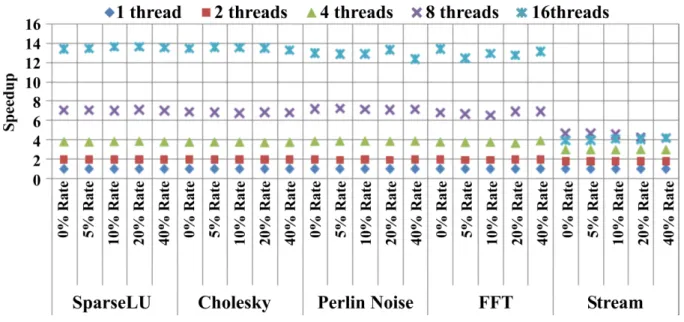
Figure 4.2 illustrates the scalability of our mechanism for the benchmarks. We note that the speedups are over 1-thread case with the same fault rate. With the increasing number of threads, our mechanism scales very well except for stream. We see that it scales well up to 8 threads. The stream application does not even scale with 16 threads without any of our mechanisms enabled. This application does not have much parallelism other than operating on different parts of arrays with different threads. It mainly consists of memory operations. In addition, the dependencies are more tight compared to the other benchmarks. This is why it does not scale (even when fault tolerance mechanisms are disabled). We purposely chose and adapted it to analyze the behavior of such an extreme memory-intensive application in terms of perfor-mance. Moreover, since each single task has more inputs and larger input sizes relative to other
Figure 4.2: Scalability of Checkpoint/Restart
benchmarks, it is a good candidate to stress our design.
The checkpointing overheads of our design with respect to the fault-free execution times are 2%, 6%, 9%, 3%and 13%for Sparse LU, Cholesky, FFT, Perlin and Stream, respectively when 16 threads are utilized. Fault-free execution time refers to the execution time of a benchmark where no injections is performed and no mechanism is enabled. As we see, the checkpointing overheads are quite small with respect to total fault-free execution time. This shows that our design is quite efficient and does not degrade the performance of the applications. Our scheme improves usage of memory bandwidth due to the asynchronous and distributed nature of task executions. Tasks are distributed over threads, thus checkpointing is distributed over different threads of execution which constitutes a further reason of low overhead. The stream benchmark which we choose to assess characteristics of a memory-bound application incurs checkpointing overhead more 10% due to the fact that the benchmark consists of mainly memory operations rather than pure computation. Such applications have not only scalability problems but also checkpointing problems. Nevertheless, shortly we will show that the singleton copy mecha-nism reduces both memory usage for checkpointing and checkpointing overhead for the stream benchmark.
Our benchmarks provide a wide spectrum of computational complexity and memory oper-ations. SparseLU and Cholesky benchmarks both have O(N3) computation and O(N2) memory
operations (see Table5.2). Our experiments show that such a ratio of computation to memory operation incurs lower checkpointing overhead. In particular, the coefficient of the compu-tational complexity of the SparseLU implementation we use is bigger than that of Cholesky with a factor of about 3. This further affects the checkpointing overhead. The FFT bench-mark has a computation of O(NlogN) and memory operations of O(N) complexity. This lower ratio of computation to memory operations incurs a bigger ratio of checkpointing time to fault-free execution time. For Perlin Noise, even though it has an exponential coefficient in the computation complexity and tasks are computation-bound, the massive number of duplicate checkpoints leads to a higher checkpointing overhead with respect to SparseLU. Again, the singleton copy mechanism reduces the overhead to the lowest among our benchmarks and uses more than 380×less memory for the checkpoints. In the case of the stream, the complexities are the same in terms of computation and memory. This couples with higher input numbers and larger sizes of inputs of the tasks resulting in a higher overhead. Overall, except for the stream, checkpointing overheads are less than 10% of fault-free executions.
Figure4.3shows the scalability of checkpointing overheads in all applications. We see that as the number of threads increases, less overall time is used for checkpointing. The speedup of the checkpointing overhead depends not only on the size of the checkpoint but most sig-nificantly on the task dependency graph as it leads to different level of overlapping of check-pointing and computation in different dependency graphs. This is why we observe different speedups for different benchmarks at high number of threads. The special super-linear case for stream is due to the fact that with 8 and more cores the checkpoints fit in the caches leading to a boosted decrease in checkpoint times. Checkpoints may or may not be flashed to main memory later since at the end of the tasks checkpoints are deleted. Even though sometimes checkpoints are moved to main memory, this data movement is efficiently overlapped with the computation of tasks.
Singleton Copy Results
The scalability of the singleton copy mechanism is very similar to the baseline implementation, consequently we omit figures for brevity. For instance, even with 40% per task fault rate, the average speedup for 16 threads for the singleton copy mechanism is 13.6 excluding stream benchmark over the 1-thread case. For stream, these speedups are little over 3.