THE VIS FRAMEWORK: ANALYZING COUNTERPOINT IN LARGE
DATASETS
Christopher Antila and Julie Cumming
McGill University
[email protected]; [email protected]
ABSTRACT
TheVIS Framework for Music Analysisis a modular Python library designed for “big data” queries in symbolic musical data. Initially created as a tool for studying musical style change in counterpoint, we have built on themusic21and
pandaslibraries to provide the foundation for much more. We describe the musicological needs that inspired the creation and growth of the VIS Framework, along with a survey of similar previous research. To demonstrate the effectiveness of our analytic approach and software, we present a sample query showing that the most commonly repeated contrapuntal patterns vary between three related style periods. We also emphasize our adaptation of typical
n-gram-based research in music, our implementation strat-egy in VIS, and the flexibility of this approach for future researchers.
1. INTRODUCTION 1.1 Counterpoint
“The evolution of Western music can be characterized in terms of a dialectic between acceptable vertical sonori-ties on the one hand. . . and acceptable melodic motions on the other.” [12] A full understanding of polyphonic mu-sic (with more than one voice or part) requires descrip-tion in terms of this dialectic, which is called counterpoint. Whereas music information retrieval research (such as [6]) typically describes polyphonic music only in terms of ver-tical (simultaneous or harmonic) intervals, musicologists interested in contrapuntal patterns also want to know the horizontal (sequential or melodic) intervals in each voice that connect the vertical intervals. Since counterpoint de-scribes how pitches in independent voices are combined in polyphonic music, a computerized approach to counter-point analysis of symbolic music can provide a wealth of information to musicologists, who have previously relied primarily on prose descriptions of musical style. 1
1We wish to thank the following people for their contributions:
Natasha Dillabough, Ichiro Fujinaga, Jane Hatter, Jamie Klassen, Alexan-der Morgan, Catherine Motuz, Peter Schubert. The ELVIS Project was
c
⃝Christopher Antila and Julie Cumming.
Licensed under a Creative Commons Attribution 4.0 International Li-cense (CC BY 4.0).Attribution:Christopher Antila and Julie Cumming. “The VIS Framework: Analyzing Counterpoint in Large Datasets”, 15th International Society for Music Information Retrieval Conference, 2014.
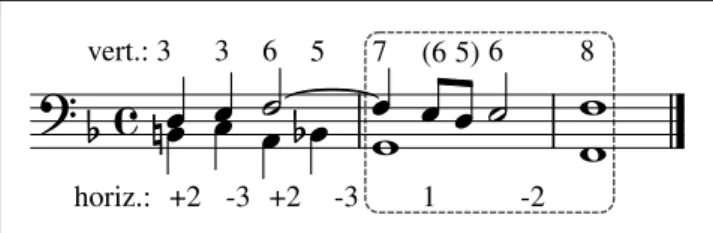
-2 (6 1 5) 6 8 +2 3 7 vert.: 3 horiz.: 5 +2 -3 -3 6
Figure 1. Symbolic score annotated with vertical and hor-izontal intervals. A common contrapuntal module appears in the box.
Figure 1 shows the counterpoint between two voices in a fragment of music. We annotated the vertical intervals above the score, and the lower voice’s horizontal intervals below. Note that we show intervals by diatonic step size, counting number of lines and spaces between two notes, rather than semitones. We describe this contrapuntal mod-ule further in Section 2.1. By using intervals rather than note names, we can generalize patterns across pitch levels, so the same pattern may start on any pitch. For this article, we ignore interval quality (e.g., major or minor third) by using diatonic intervals (e.g., third), allowing generaliza-tion across mode and key. We do use interval quality for other queries—this is a choice available in VIS at runtime. To allow computerized processing of contrapuntal pat-terns, we encode the counterpoint between two voices with alternating vertical and horizontal intervals. In Figure 1, the first two beats are “3 +2 3.” We call these patterns in-tervaln-grams, wherenis the number of vertical intervals. Ourn-gram notation system is easily intelligible to music theorists and musicologists, and allows us to stay close to musicology.
1.2 Research Questions
Until recently, musicologists’ ability to accurately describe polyphonic textures was severely limited: any one person can learn only a limited amount of music in a lifetime, and the computer-based tools for describing or analyzing poly-phonic music in detail are insufficiently precise for many repertoires. Descriptions of musical style and style change are often vague, derived from intuitive impressions and personal knowledge of repertoire rather than quantifiable
supported by the Digging into Data Challenge; the Canadian team re-sponsible for the work described in this paper was additionally funded by the Social Sciences and Humanities Research Council of Canada.
evidence. Our project attempts the opposite by quantita-tively describing musical style change using counterpoint. We chose counterpoint not only because musicologists are already aware of its importance, but because it allows us to consider structure in all polyphonic music, which in-cludes the majority of surviving Western music created after 1300. Our project’s initial goal is to find the most frequently-repeated contrapuntal patterns for different pe-riods, genres, and composers, to help form detailed, evid-ence-based descriptions of style periods and style change by knowing which features change over time and when. In addition, statistical models will allow a fresh approach to attribution problems (determining the composer of a piece where it is not otherwise known), by enabling us to de-scribe some of the factors that distinguish a composer’s style.
1.3 The VIS Framework
Our project’s most important accomplishment is the VIS Framework—the software we developed to answer the re-search questions described above. (VIS stands for “verti-cal interval successions,” which is a way to describe coun-terpoint). Currently VIS’s primary function is to find con-trapuntal patterns in symbolic music, recording them with the notation described above in Figure 1 so they may be counted. However, we designed the framework to allow a much broader set of queries, and we intend to add sup-port for additional musical dimensions (like meter and har-mony) as well as more complicated statistical experiments (like Markov-chain modeling).
We used theCounterpoint Web App, a Web-based user interface for VIS’s counterpoint functionality, to run the analyses presented in this article.2 Such Web-based soft-ware encourages musicologists to participate in data-driven analysis even if they are otherwise unable to program. The Web App’s visual design, the use of musicologist-friendly terms and user workflows, and the ability to output analy-sis results on musical scores are significant advantages. At the same time, programmers are encouraged to download and extend the VIS Framework using its well-documented Python API. While our Framework provides a guide for structuring analysis workflows, each analytic step benefits from our integration of themusic21andpandaslibraries. Together, these allow analytic approaches more amenable to musicians and statisticians, respectively. 3
2. BACKGROUND 2.1 Contrapuntal Modules
Acontrapuntal moduleis a repeated contrapuntal pattern made from a series of vertical (harmonic) and horizontal (melodic) intervals—a repeated interval n-gram. [11] We are primarily interested in the frequency and nature of two-voice contrapuntal modules. VIS allows us to computerize tedious score analysis previously done by hand, as when Peter Schubert identified modules in Palestrina. [13] While
2Visitcounterpoint.elvisproject.ca.
3Refer topandas.pydata.organdmit.edu/music21.
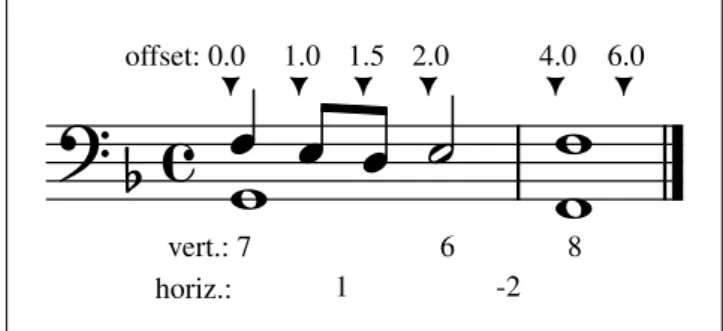
8 4.0 -2 6 2.0 6.0 offset: 0.0 horiz.: vert.: 7 1.5 1 1.0
Figure 2. “Cadence” contrapuntal module from Figure 1, withmusic21offset values.
two-voice contrapuntal modules are the primary structural element of much Renaissance music, we can find contra-puntal modules in nearly all polyphonic music, so our soft-ware and research strategies will be useful for a wide range of music. [3]
Figure 2 shows a representation of the “7 1 6 -2 8” in-terval 3-gram (a 3-gram because there are three vertical intervals). Using a half-note rhythmic offset, the first verti-cal interval is a seventh, the horizontal motion of the lower part is a unison (1), there is a vertical sixth, the lower part moves down by a second (-2), and the final vertical interval is an octave. In modal counterpoint, this is a highly con-ventionalized figure used to signal a cadence—a closing or concluding gesture for a phrase or piece. This is the same 3-gram as in the box in Figure 1.
Importantly, our analysis method requires that voicing information is encoded in our files. MIDI files where all parts are given in the same channel cannot be analyzed use-fully with our software.
2.2 Previous Uses ofn-Grams in MIR
We have chosen to map musical patterns with n-grams partly because of their previous use in natural language processing.4 Some previous uses ofn-grams in music anal-ysis, and computerized counterpoint analanal-ysis, are described below.
J. Stephen Downie’s dissertation presents a method for indexing melodicn-grams in a large set of folk melodies that will be searched using “Query by Humming” (QBH). [7] Downie’s system is optimized for what he calls “lookup,” rather than “analysis,” and he admits that it lacks the de-tail required by musicologists. Importantly, Downie only indexes horizontal intervals: melody rather than counter-point.
Another QBH lookup system, proposed by Shyamala Doraisamy, adapts n-grams for polyphonic music. [5, 6] While this system does account for polyphony, it does not record horizontal intervals so it lacks the detailed contra-puntal information we seek. Furthermore, Doraisamy’s in-tervals are based on MIDI note numbers rather than the di-atonic steps preferred by musicologists. Finally, the largest interval allowed by Doraisamy’s tokenization strategy is 26 4As in the Google Ngram Viewer; refer to
semitones—just over two octaves, and therefore narrower than the normal distance between outer voices even in Re-naissance polyphony. Considering the gradual expansion of range in polyphonic music, to the extremes of the late 19th-century orchestra, the gradual appearance of large in-tervals may be an important style indicator.
Meredith has proposed geometric transformation sys-tems for encoding multi-dimensional musical information in a computer-friendly way. [9, 10] We especially appreci-ate the multi-dimensional emphasis and the mathematical properties of these systems, and the software’s ability to work even when voicing information is not available in the symbolic file.
Finally, J¨urgensen has studied accidentals in a large fif-teenth-century manuscript of organ intabulations with an approach very similar to ours, but carried out using the Humdrum Toolkit. [8] She locates cadences by identifying a contrapuntal model and then records the use of acciden-tals at the cadence. While she searches only for specific contrapuntal modules, we identify all of then-grams in a test set in order to determine the most frequently recurring contrapuntal patterns.
2.3 Multi-Dimensionaln-Grams in VIS
Considering these previous uses ofn-grams and counter-point in MIR, we designed our software with the flexi-bility to accommodate our requirements, as well as those of future analysis strategies. By tokenizingn-grams with strings that minimally transform the input, musicologists can readily understand the information presented in ann -gram. This strategy offers a further benefit to programmers, who can easily createn-grams that include different musi-cal dimensions without necessarily developing a new token transformation system. Users may choose to implement any tokenization strategy on top of our existing n -gram-indexing module.
The example 3-gram shown in Figure 2 is tokenized in-ternally as “7 1,” “6 -2,” “8 END.” Although there appear to be 2n−1tokens, we consider a vertical interval and its following horizontal interval as a combined unit—as though it were a letter in an n-gram as used in computa-tional linguistics. The simplicity afforded by using strings as tokens, each of which may contain an arbitrary array of musical information, has been advantageous.
Indeed, the difficulty of determining a musical analogue to the letter, word, and phrase divisions used in computa-tional linguistics may be one of the reasons that computer-driven research has yet to gain much traction in mainstream musicology. That music lacks an equivalent for space char-acters poses an even greater problem in this regard: while some music does use clear breaks between phrases, their exact placement can often be disputed among experts. Mu-sicologists also wish to account for the multiple simultane-ous melody lines of polyphonic music, which has no equiv-alent in natural language. These are the primary motivating factors behind our multi-dimensional interval n-gram to-kens that encode both vertical and horizontal intervals. As our research continues, context models and multiple
view-point systems, in the style of Conklin and Witten, will par-tially obviate the questions of whichnvalue to use, and of how best to incorporate varied musical elements. [1]
The popularity of Python within scientific computing communities allows us to benefit from any software that acceptspandasdata objects. The easy-to-learn, object-or-iented API of music21, along with the relatively high number of supported file formats, are also significant ad-vantages. In the 1980s, a music analysis toolkit consisting of a collection ofawkscripts was sensible, but Humdrum’s limitation to UNIX systems and a single symbolic file for-mat pose undesirable limitations for a big data project.
3. EXPERIMENT 3.1 Data Sets
We present an experiment to quantitatively describe style change in the Renaissance period, providing a partial an-swer for our primary research question.5 We assembled test sets for three similar style periods, named after a rep-resentative composer from the period: Ockeghem (1440– 85), Josquin (1485–1521), and Palestrina (1540–85). The pieces in the test set were chosen to represent the style pe-riod as accurately as our project’s database allowed.6 The twenty-year gap between the later periods is a result of less symbolic music being available from those decades. Each set consists of a mixture of sacred and secular vocal music, most with four parts, in a variety of genres, from a variety of composers. Though we analyzedn-grams between two and twenty-eight vertical intervals long, we report our re-sults only for 3-grams because they are the shortest contra-puntal unit that holds meaning. Note that we include results from all possible two-part combinations, reflecting Renais-sance contrapuntal thinking, where many-part textures are composed from a series of two-part structures. [3, 13]
The Ockeghem test set consists of 50 files: 28 in the MIDI format and 22 in **kern. For the composers, 8 pieces were written by Busnoys, 32 by Ockeghem, and 10 are late works by Dufay. The longest repeatedn-gram was a 25-gram.
The Josquin test set consists of 56 files: 18 MIDI, 23 **kern, 9 MusicXML, and 6 NoteWorthy Composer. For the composers, 3 pieces were written by Agricola, 7 by Brumel, 6 by Compre, 2 by Fvin, 12 by Isaac, 19 by Josquin, 3 by Mouton, 2 by Obrecht, and 2 by la Rue. The longest repeatedn-gram was a 28-gram.
Finally, the Palestrina test set consists of 53 files: 30 MIDI, 15 **kern, 6 MusicXML, and 2 NoteWorthy Com-poser. For the composers, 15 pieces were written by Pales-trina, 9 by Rore, 28 by Victoria, and 1 by Wert. The longest repeatedn-gram was a 26-gram.
3.2 Methodology
TheVIS Frameworkuses a modular approach to query de-sign, dividing analysis tasks into a series of well-defined 5You may download our test sets from
elvisproject.ca/ismir2014.
steps.7 We intend the module break-down to be helpful for musicologists who wish to reason about and design their own queries. Thus, musicological concerns drove the cre-ation of many of the analysis steps, such as the filtering modules described below. The intervaln-gram frequency experiment in this article uses the following modules: Note-RestIndexer,IntervalIndexer,HorizontalIntervalIndexer,
FilterByOffsetIndexer,FilterByRepeatIndexer, NGramInd-exer,ColumnAggregator, and finally the FrequencyExper-imenter.8
The NoteRestIndexer finds note names and rests from a music21 Score. The IntervalIndexerand Horizontal-IntervalIndexercalculate vertical and horizontal intervals, respectively.
TheFilterByOffsetIndexeruses a basic algorithm to fil-ter weak-beat embellishing tones that otherwise obscure structural counterpoint. We regularize observations to a giv-en rhythmic offset time interval using themusic21offset, measured in quarter lengths. Refer to Figure 2 as an exam-ple, where vertical intervals are filtered with a 2.0 offset. Events beginning on a multiple of that duration will be re-tained (like the notes at 0.0, 2.0, and 4.0). Events lasting for multiples of that duration will appear to be repeated (like the note at 4.0, which is also recorded at 6.0). Events not beginning on a multiple of the duration will be removed (like the notes at 1.0 and 1.5) or shifted to the following offset, if no new event occurs. For this study, we chose a half-note (2.0) offset interval in accordance with Renais-sance notation practices, but this can be changed in VIS at runtime.
TheFilterByRepeatIndexerremoves events that are iden-tical to the immediately preceding event. Because of its placement in our workflow for this experiment, subsequent vertical intervals will not be counted if they use the same pitches. Our intervaln-grams therefore necessarily involve contrapuntalmotion, which is required for proper pattern recognition. Such repeated events arise in musical scores, for example, when singers recite many words on the same pitch. TheFilterByOffsetIndexermay also create repeated events, as at offset 6.0 in Figure 2. Users may choose not to run this module.
In this article, ourNGramIndexerincludes results from all pairs of part combination. Users may exclude some com-binations at runtime, choosing to limit their query to the highest and lowest parts, for example. On receiving inter-vals from the FilterByRepeatIndexer, the NGramIndexer
uses the gliding window technique to capture all possible overlapping interval n-grams. The indexer also accepts a list of tokens that prevent ann-gram from being counted. We use this feature to avoid counting contrapuntal pat-terns that include rests. Finally, the NGramIndexer may add grouping characters, surrounding “vertical” events in brackets and “horizontal” events in parentheses to enhance legibility of longn-grams. The 3-grams in this article are short enough that grouping characters are unnecessary; on
7This section refers to the 2.xrelease series.
8For more information about the VIS Framework’s analysis
mod-ules and overall architecture, please refer to our Python API at
vis.elvisproject.ca.
the other hand, the legibility of the “[10] (+2) [9] (1) [8] (+2) [7] (1) [6] (-2) [8]” 6-gram found 27 times in the Pal-estrina test set greatly benefits from grouping characters.
TheFrequencyExperimentercounts the number of oc-currences of each n-gram. These results, still specific to part combinations within pieces, are then combined with theColumnAggregator.
On receiving a spreadsheet of results from VIS, we cal-culated the number ofn-grams as the percentage total of alln-grams in each of the test sets. For each set, we also counted the total number of 3-grams observed (including all repetitions of all grams), the number of distinct 3-gram types (whether repeated or not), and the number of 3-gram types that occur more than once; these are shown below in Table 1.
3.3 Results
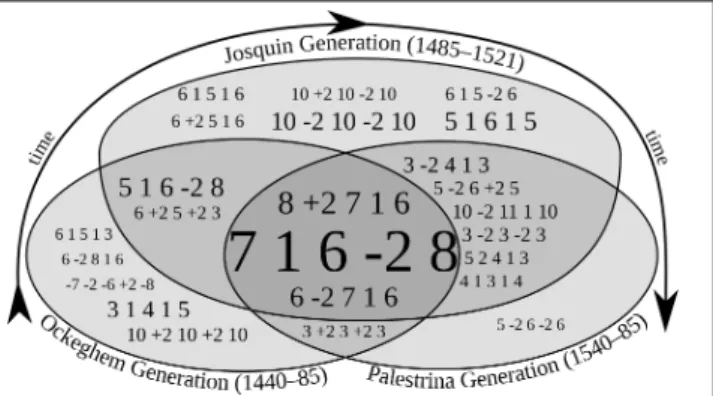
Due to the limited time span represented in this study, we wish to suggest avenues for future exploration, rather than offer conclusive findings. We present a visualization of the experimental results in Figure 3, a hybrid between a Venn diagram, word cloud (i.e., a 3-gram cloud), and a time-line. The diagram includes interval 3-grams that consti-tute greater than 0.2% of the 3-grams in at least one of the test sets. When a 3-gram appears in an intersection of style periods, that 3-gram constitutes greater than 0.2% of the 3-grams in those sets. As in a world cloud, the font size is scaled proportionately to a 3-gram’s frequency in the test sets in which it is common. Most visually striking is the confirmation of musicologists’ existing experiential knowledge: certain contrapuntal patterns are common to all three style periods, including the cadence module (“7 1 6 -2 8”) and two other 3-grams that end with the “7 1 6” cadential suspension. These results make sense because cadences are an essential feature of musical syntax.
Test Set Total Types Repeated Types Ockeghem 30,640 10,644 4,509 (42%) Josquin 31,233 9,268 4,323 (47%) Palestrina 33,339 10,773 5,023 (47%) Table 1. Summary of 3-gram repetitions in our query.
In addition to the common cadential patterns noted above, both Figure 3 and Table 1 show evidence of stylistic change over time. Most notably, the Josquin and Palestrina test sets show a higher level of repetition than the Ockeghem set. The number of 3-grams included in Figure 3 is higher in the Josquin test set (with seventeen 3-grams) than ei-ther the Ockeghem or Palestrina sets (both with eleven 3-grams). Yet Table 1 indicates the Josquin and Palestrina sets both have a higher percentage of 3-gram types that are repeated at least once (47% in both sets, compared to 42% in the Ockeghem set). These data suggest an increase in repetition of contrapuntal modules from the Ockeghem to the Josquin generations, which was retained in the Pa-lestrina generation. Figure 3 only partially reinforces this suggestion: while five 3-grams are unique to the Ockeghem set, six are unique to the Josquin set, but only one is unique
Figure 3. Frequency of contrapuntal modules is different between temporally-adjacent style periods.
to the Palestrina set. Moreover, the “5 -2 6 -2 6” module, unique to the Palestrina set, is the least common 3-gram in Figure 3—how did contrapuntal repetition both decrease in Palestrina’s generationandremain the same?
Previous research by Cumming and Schubert may help us explain the data. In 2008, Cumming noted that exact repetition became much more common in Josquin’s life-time than in Ockeghem’s. [2] Schubert showed that com-posers tended to repeat contrapuntal patterns in inversion during Palestrina’s lifetime, so that the lower voice is moved above the original upper voice. [13] Inversion changes a contrapuntal pattern’s vertical intervals in a consistent way that preserves, but switches, the horizontal intervals of the two parts. For example, “7 1 6 -2 8” inverts at the octave to “2 -2 3 +2 1.” While humans can recognize both forms as two versions of the same pattern, VIS currently shows only exact repetition; future enhancements will permit us to equate the original and the inversion. This decision may explain why our data show lower rates of repetition for the Palestrina test set.
We find further evidence of stylistic change in Figure 3: certain patterns that musicologists consider to be common across all Renaissance music are in fact not equally com-mon in our three test sets. For example, motion by parallel thirds and tenths appears to be more common in certain style periods than others, and in a way that does not yet make sense. The Palestrina set shares ascending parallel thirds (“3 +2 3 +2 3”) with the Ockeghem and descending parallel thirds (“3 -2 3 -2 3”) with the Josquin set. Ascend-ing parallel tenths (“10 +2 10 +2 10”) are more common in the Ockeghem set, and descending parallel tenths (“10 -2 10 -2 10”) in the Josquin set. In particular, descending parallel thirds are an order of magnitude less common in the Ockeghem test set than the Josquin or Palestrina (con-stituting 0.013%, 0.272%, and 0.225% of 3-grams in their test set, respectively). Conventional musicological wisdom suggests these 3-grams will be equally common in all three test sets, and that parallel tenths will be more common than parallel thirds in later style periods, as the range between voices expands. Since the reasons for such a deviation are not yet known, we require further investigation to study the changing nature of contrapuntal repetition during the Re-naissance period. Yet even with these preliminary findings
it is clear that evidence-based research has much to offer musicology.
4. FUTURE WORK
Our research will continue by extending VIS to add the option of equivalence classes that can group, for example, inversionally-related intervaln-grams. We will also build on previous work with melody- and harmony-focussed mul-tiple viewpoint systems to create an all-voice contrapuntal prediction model. [1, 14]
Our experiments will continue with larger test sets for increased confidence in our findings, also adding style peri-ods earlier than the Ockeghem and later than the Palestrina sets, and subdividing our current style periods. This will help us reassess boundaries between style periods, and ex-actly what such a boundary entails. We will also compare results of single pieces with test sets of various sizes.
Finally, we will implement additional multi-dimension-al n-gram tokens, for example by adding the note name of the lowest voice. This approach would encode Figure 2 as “7 F 1 6 F -2 8 E.” In Renaissance music, this type of
n-gram will clarify the relationships between contrapuntal modules and a piece’s mode.
5. CONCLUSION
TheVIS Framework for Music Analysisis a musicologist-friendly Python library designed to analyze large amounts of symbolic musical data. Thus far, our work has concen-trated on counterpoint—successions of vertical intervals and the horizontal intervals connecting them—which some scholars view as composers’ primary concern throughout the development of Western music. Our software uses multi-dimensional n-grams to find and count the frequency of repeated contrapuntal patterns, or modules. In particular, by retaining all inputted dimensions and using strings as tokens (rather than integers or characters), we simultane-ously allow musicologists to quickly understand the con-tent of an n-gram while also avoiding the challenge of developing a new tokenization strategy for every musical dimension added to the n-gram. We hope this flexibility and ease-of-use encourages musicologists and non-expert programmers, who would otherwise be discouraged from computer-based music analysis, to experiment more freely. The results of our query presented in this article, which compares the most commonly-repeated contrapuntal mod-ules in three Renaissance style periods, show the type of insight possible from computerized music research. The time-consuming effort required for previous work on con-trapuntal modules is greatly reduced when analysts have access to specialized computer software. We analyzed more than 150 polyphonic compositions for intervaln-grams be-tween two and twenty-eight vertical intervals in length, which would have taken months or years for a human. Even with simple mathematical strategies like counting the frequency of intervaln-grams to know which are most com-mon, we can confirm existing intuitive knowledge about
the foundations of counterpoint while also suggesting av-enues for future research on the nature of musical repeti-tion.
6. REFERENCES
[1] D. Conklin and I. Witten. Multiple viewpoint systems for music prediction.Journal of New Music Research, 24(1):51–73, 1995.
[2] J. Cumming. From variety to repetition: The birth of imitative polyphony. In Bruno Bouckaert, Eugeen Schreurs, and Ivan Asselman, editors,Yearbook of the Alamire Foundation, number 6, pages 21–44. Alamire, 2008.
[3] J. Cumming. From two-part framework to movable module. In Judith Peraino, editor,Medieval music in practice: Studies in honor of Richard Crocker, pages 177–215. American Institute of Musicology, 2013. [4] M. S. Cuthbert and C. Ariza. music21: A toolkit for
computer-aided musicology and symbolic music data. InProceedings of the International Symposium on Mu-sic Information Retrieval, pages 637–42, 2010. [5] S. Doraisamy. Polyphonic Music Retrieval: The
n-gram approach. PhD thesis, University of London, 2004.
[6] S. Doraisamy and S. Rger. Robust polyphonic music retrieval with n-grams.Journal of Intelligent Informa-tion Systems, 21(1):53–70, 2003.
[7] J. S. Downie.Evaluating a Simple Approach to Music Information Retrieval: Conceiving melodic n-grams as text. PhD thesis, University of Western Ontario, 1999. [8] F. J¨urgensen. Cadential accidentals in the Buxheim
or-gan book and its concordances: A midfifteenth-century context for musica ficta practice.Acta Musicologica, 83(1):39–68, 2011.
[9] D. Meredith. A geometric language for representing structure in polyphonic music. InProceedings of the International Society for Music Information Retrieval, pages 133–8, 2012.
[10] D. Meredith, K. Lemstr¨om, and G. Wiggins. Algo-rithms for discovering repeated patterns in multidimen-sional representations of polyphonic music.Journal of New Music Research, 41(4):321–45.
[11] J. A. Owens.Composers at Work: The Craft of Musi-cal Composition 1450–1600. Oxford University Press, 1997.
[12] P. Schubert. Counterpoint pedagogy in the renaissance. In T. Christensen, editor, The Cambridge History of Western Music Theory, pages 503–33. Cambridge Uni-versity Press, 2002.
[13] P. Schubert. Hidden forms in Palestrina’s first book of four-voice motets.Journal of the American Musicolog-ical Society, 60(3):483–556, 2007.
[14] R. Whorley, G. Wiggins, C. Rhodes, and M. Pearce. Multiple viewpoint systems: Time complexity and the construction of domains for complex musical view-points in the harmonisation problem.Journal of New Music Research, 42(3):237–66, 2013.