Executive functions modulated by context, training, and age
Kumulative Habilitationsschrift
zur Erlangung der Lehrbefähigung für das Fach Psychologie vorgelegt dem Rat der Mathematisch-Naturwissenschaftlichen Fakultät II
der Humboldt-Universität zu Berlin
von
Dr. rer. nat. Tilo Strobach
Prof. Dr. Jan-Hendrik Olbertz Prof. Dr. Elmar Kulke Präsident der Humboldt-Universität zu Berlin Dekan der
Mathematisch-Naturwissenschaftlichen Fakultät II
Gutachter:
Prof. Werner Sommer (Humboldt-Universität zu Berlin)
Prof. Birgit Stürmer (International Psychoanalytic University Berlin) Prof. Klaus Oberauer (Universität Zürich)
Prof. Iring Koch (RWTH Aachen)
Habilitationsschrift vorgelegt am 5. Juni 2013 in Berlin
Abstract
The present review aims at a systematization of findings in the field of executive functions and their modulation due to different operational parameters (i.e., dimensions). This systematization is realized in the form of the Framework on modulations of executive functions. Basically, this framework illustrates how different types of executive functions (i.e., Shifting, Inhibition, Updating, Dual tasking) are modulated by their context (Context dimension), training (Training dimension), age (Age dimension), and combinations of these dimensions. The present review includes examples of studies that demonstrate a realization of each of these dimensions and their effects on executive function types. In detail, the Context dimension modulates the executive function type Dual tasking (i.e., due to task order predictability in dual tasks; Hendrich et al., 20121) and Inhibition (i.e., due to the level of
concurrent working memory demand in a Stroop task; Soutschek et al., 2013); however, Töllner et al. (2012) demonstrated that Context also affects processes that are not related with executive functioning (i.e., perception and motor processes) in a dual-task situation. The framework’s Training dimension was realized when (1) Strobach et al. (2012a) investigated effects of training on the executive function Shifting in a task switching situation and (2) Salminen et al. (2011, 2012), Schubert and Strobach (2012), as well as Strobach et al. (2012b) investigated transfer effects on executive functioning of Dual tasking and Shifting after video game and working memory training. Finally, Strobach et al. (2012c, 2012d) illustrated modulation effects of age and training (i.e., the combination of Age and Training dimension) on the executive function type Dual tasking. In this way, the final line of research demonstrated one potential combination of how studies target two dimensions of the Framework on modulations of executive functions concurrently. In sum, this framework helps to systematize research gaps and future studies in this field (i.e., executive functions). Furthermore, it has the potential for an adaption to alternative fields of cognitive research (e.g., perceptual adaptation) to realize their systematization.
Content
1. Conceptualizing framework: Framework on modulations of executive functions ... 6
2. Framework on modulations of executive functions and its context dimension ... 11
2.1. Context modulates the executive function Dual tasking ... 11
2.2. Context modulates the executive function Inhibition ... 14
2.3. Context modulates perception and motor processes ... 15
3. Framework on modulations of executive functions and its training dimension ... 18
3.1. Testing effects of training on executive functions ... 18
3.2. Testing the effects of transfer on executive functioning after training ... 20
4. Framework on modulations of executive functions and its aging dimension ... 26
5. Discussing Framework on modulations of executive functions ... 32
References ... 36
Executive functions modulated by context, training, and age
How do we perform successfully in demanding situations that require the performance of different simultaneous tasks, planning a chain of tasks and subtasks or the avoidance of inappropriate behavior? That is: which cognitive functions help us to avoid confusion when coordinating different tasks such as making phone calls, writing emails, and having conversations with colleagues in an office context (Mark, Hausstein, & Klocke, 2008), when paying a newspaper before leaving a news stand in a shop context, or not saying swearwords, something that is ineffective in patients with Tourette syndrome (Hill, 2004)? How behavior is appropriately controlled in such (more or less) complex situations?
Typically, processes controlling such behavior are summarized as executive functions and define a set of general-purpose control mechanisms. These mechanisms are often linked to the prefrontal cortex of the brain, which modulate the operation of various cognitive sub-processes and thereby regulate the dynamics of human cognition (Baddeley, 1986; Miyake & Friedman, 2012; Miyake, Friedman, Emerson, Witzki, & Howerter, 2000). Executive functions are important to study because they are a core component of control or self-regulation ability, which has been shown to have significant implications for everyday activities (Mischel et al., 2011; Moffitt et al., 2011).
While these significant implications are relatively established in the literature (Miyake & Friedman, 2012) and are included into advanced frameworks such as Badeleley’s (1986) multi-component working memory model, Norman and Shallice’s (1986) Supervisor Attention System (SAS) or Meyer and Kieras’ (1997) executive processing–interactive control (EPIC) model, a systematization and organization of effects is required that modulate executive functioning and modulate control of behavior in complex situations. That is, there is no comprehensive framework that systematizes research in the context of the following questions: What executive functions are modulated and are there functions that are immune to modulation effects? Which factors modulate executive functioning?
The present review summarizes research findings that exemplarily provide answers to these questions in form of a framework that allows a systematic view on modulated executive functioning. Such a framework should generally lead to a better understanding of the processing and modulation characteristics of executive functions. Further, it should help to sort, identify, and illustrate a systematization of existing and lacking research in this field. Exemplarily, such a framework was introduced by Cattell (1966) to systematize various methods of data measurements (e.g., cross-sectional, longitudinal, burst measurements). Note that the presented framework has no character of a theoretical model that allows generating specific predictions and hypotheses that can be tested empirically; the latter is not the aim of the present work.
Importantly, the present review goes beyond investigating the basic occurrence and phenomena of executive functions and their effects on task performance. For example, this review is not related with the investigation of the basic occurrence of additional processing time when performing a new task following an old task in a task switching paradigm and the resulting task switch costs to shift between different tasks (e.g., Monsell, 2003). It focuses on work that is associated with the modulation of such effects (e.g., task switch costs) and the modulation of related executive functioning.
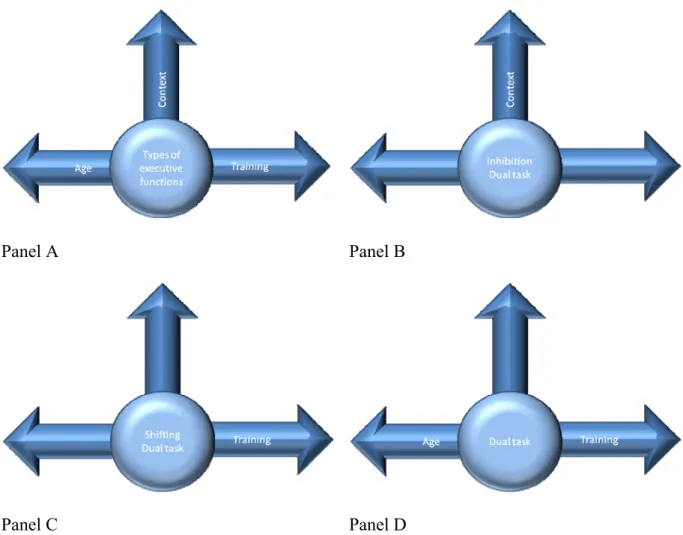
As illustrated in Figure 1, I integrate findings of research on executive functions into a conceptual framework that includes a categorization of the various types of executive functions and their modulation along three dimensions: the Framework on modulations of executive functions. This framework includes dimensions representing the major characteristics of studies (i.e., experimental manipulations or operating parameters) in this field. The dimensions represent (1) modulations of executive functions as a result of context, (2) modulations of these functions as a result of training, and (3) modulations of these functions as a result of cognitive aging. After introducing this framework, I discuss my research literature that exemplarily illustrates work on each of the framework’s dimensions.
Finally, I present options for how to combine findings across different dimensions to demonstrate the relevance of this framework for future studies in the field of executive functions.
Panel A Panel B
Panel C Panel D
Figure 1: Panel (A): Overview of the Framework on modulations of executive functions including the different types of executive functions and the modulating dimensions Context, Training, and Age. Panel (B): Illustration of the realization of modulated types of executive functions Inhibition and Dual tasking in accordance with the Context dimension (Chapter 2). Panel (C): Illustration of the realization of modulated types of executive functions Shifting and Dual tasking in accordance with the Training dimension (Chapter 3). Panel (D): Illustration of the realization of the modulated type of executive functions Dual tasking in accordance with the combination of the Training and age dimensions (Chapter 4).
1. Conceptualizing framework: Framework on modulations of executive functions The first part of this framework represents a categorization of the different types of executive functions which are potentially susceptible for modulation. This part represents different instances or types of executive functions. The categorization of these different types is based on the work of Miyake and colleagues (e.g., Friedman & Miyake, 2004; Miyake &
Friedman, 2012; Miyake et al., 2000): on Shifting, Inhibition, Updating, and Dual tasking. This categorization results from correlation analysis basically showing that variance in situations primarily tapping on Shifting, Inhibition, Updating, and Dual tasking share some unity. However, this variance and types of related executive functions also have unique predictive utility and are clearly independent in these situations (e.g., Miyake et al., 2000). For instructive purposes, I introduce each type briefly in the following section and take an independent perspective on them in the remainder of this work (i.e., I ignore the unity portion between the different executive function types).
Also referred to as ‘‘attention switching’’ or “task switching”, the first executive function (i.e., Shifting) concerns shifting back and forth between multiple tasks, operations, or mental sets (Monsell, 1996). Models of cognitive control including central executive units like the SAS (Norman & Shallice, 1986) often assume that the ability to shift between tasks or mental sets is an important aspect of executive functioning. The specific explanation and functioning of Shifting involves the disengagement of irrelevant information (e.g., the task set of a previous/ finalized task) and/ or the subsequent active engagement of relevant information (e.g., the task set of an upcoming task; Mayr & Keele, 2000; Monsell, 2003; Rubinstein, Meyer, & Evans, 2001).
The second executive function is Inhibition, related to the ability to deliberately inhibit or stop dominant, automatic, or pre-potent responses when necessary. The color Stroop task (MacLeod, 1991; Stroop, 1935) is a prototypical Inhibition task. In this task, participants are instructed to respond to the ink color of a stated color; these color words are congruent (e.g., GREEN in green ink) and incongruent (e.g., GREEN in red ink). Typically, reaction times (RTs) in incongruent trials are increased compared to congruent trial RTs (i.e., the Stroop effect), indicating the requirement to inhibit or to override the tendency to produce a more dominant or automatic response on naming the color word.
The third executive function in the model by Miyake and colleagues is the updating and monitoring of representations and information in working memory. This Updating function is related to the monitoring and coding of incoming information for relevance to a task at hand. Further, this function then appropriately revises working memory content by replacing old, no longer relevant information with newer, more relevant information (Miyake et al., 2000; Morris & Jones, 1990).
A forth executive function, the Dual tasking function, is added to the established types of executive functions (i.e., Shifting, Inhibition, & Updating; Miyake & Friedman, 2012) in the present framework. The formation of this additional Dual tasking function results from the fact that performance in a complex dual-task situation is not clearly related to these established functions (Miyake et al., 2000). This additional function describes one’s ability to coordinate two simultaneously presented and performed tasks. The specific realization of Dual tasking may include task scheduling (de Jong, 1995; Sigman & Dehaene, 2006), task switching (Lien, Schweickert, & Proctor 2003; Liepelt, Strobach, Frensch, & Schubert, 2011; Strobach, Frensch, Soutschek, & Schubert, 2012a), and/ or task disengagement (Sigman & Dehaene, 2006). Due to this variety of potential realizations, the label of this forth executive function is related with the situation of its measurement/ testing (i.e., dual-task situations).
Following the categorization of different executive function types, I introduce the dimension Context. This dimension describes the phenomena that executive functioning is modulated by specific situation and/ or condition characteristics. Typically, these characteristics are promptly located to executive function processing. They have a relatively focused effect on duration and are no long-lasting effects (an example for the latter could be systematized on the training dimension). For example, performing a switch to a new task is more efficient when the time interval to an old task is prolonged (e.g., Roger & Monsell, 1995). An influential theory of Botvinick, Braver, Barch, Carter, and Cohen (2001) explains the occurrence of modulations of executive functioning due to context information with a
specific mechanism of cognitive control. According to this theory, the cognitive system continuously monitors ongoing response processing to identify conflicts, incongruences, or difficulties. If a conflict/ incongruence/ difficulty is detected as a result of processed task information, the level of cognitive control is enhanced to adjust conflict processing in a given context. For example, such adjustments may enhance and/or suppress the processing of task-relevant stimulus or response characteristics to enable successful behavior (see also Egner & Hirsch, 2005).
The dimension Training is related to the modulation of executive functioning as a result of experience with a task. This experience is typically realized in a number of experimental sessions and its effects typically are (1) long-lasting in relation to modulations due to context information and (2) improvements in task performance; in contrast, the impact of context information has no typical direction (i.e., it impairs and improves performance). Training is either provided in a rather structured protocol with exact timings of tasks and with exact control of the amount of task experience (e.g., dual n-back training by Jaeggi Buschkuehl, Jonides, & Perrig, 2008) or there is a rather unstructured, relaxed control of protocols (e.g., video game training; Green & Bavelier, 2003). This relaxation more often than not results from an adaptation of task situations from real-world scenarios that are relatively flexible and less controllable. Structured and unstructured types of training are further considered as having effects on (1) the situation that was a matter of training (i.e., the trained situation), (2) situations that are structurally similar to the trained situation, or (3) structurally dissimilar situations (Karbach & Kray, 2009; Klauer, 2001). The latter two considerations focus on the range of transfer effects of training: near vs. far (i.e., transfer to structurally similar tasks vs. transfer to structurally dissimilar tasks). Basically, the focus on transfer may give an idea about the efficiency of provided training from an applied perspective. For example, Amir, Beard, Cobb, and Bomyea (2009) demonstrated the efficiency of training in a simple probe detection paradigm to result in changes in attention
bias and a decrease in general anxiety, as indicated by both self-report and interviewer measures; the latter measures are assessed in situations that are structurally dissimilar from the paradigm applied during training (in this case, this is evidence for far transfer). From a theoretical perspective, the assessment of transfer effects enables structuring potential processing and/ or neuronal overlaps between executive functions (Dahlin, Neely, Larsson, Bäckman, & Nyberg, 2008a; Dahlin, Nyberg, Bäckman, & Neely, 2008b). For example, Strobach et al. (2012a) provided evidence for the acquisition of task coordination skills during dual-task training (i.e., optimized Dual tasking), but these skills are not transferred to a task switching situation. According to the applied logic, there is no evidence that executive functions of Dual tasking and Shifting share common underlying functional processes or mechanisms; this assumption is consistent with correlation findings assuming Dual tasking and Shifting as separable types of executive functions (Miyake et al., 2000).
The Age dimension describes the modulating effects of cognitive aging on executive functioning. A number of studies and meta-analyses (e.g., Verhaeghen, 2011) found evidence for specific age-related deficits in Inhibition (e.g., Stroop task), or Shifting (e.g., task switching). Importantly, these age-related deficits are largely explained by lacking options to compensate reduced processing speed or working memory capacity in older adults in contrast to younger adults. As a result, the present review investigates conditions under which an aging cognitive system is basically not able to compensate for potential cognitive declines and age has a true effect on executive functioning. One such condition includes processes of divided attention realized in dual-task situations (Verhaeghen, 2011; Verhaeghen, Steitz, Sliwinski, & Cerella, 2003). This particular strategy (i.e., a focus on age-related deficits after compensating for basic processing differences) follows the testing the limits approach. This testing the limits approach investigates the maximum cognitive performance potential or the “latent” reserve capacity of an older cognitive system and its executive functioning under optimal conditions (i.e., when compensated for basic processing differences). Baltes,
Lindenberger and colleagues (e.g., Lindenberger, Kliegl, & Baltes, 1992; Lindenberger & Baltes, 1995) argued that this testing the limits approach has the potential to lead to an identification of true age-related cognitive decline. Such true decline is assumed to exist for dual tasking (e.g., Verhaeghen, 2011) and is, therefore, the present review’s focus when dealing with studies on the age dimension.
In the following sections, I introduce my exemplary work on the context, training, and age dimensions and discuss how different types of executive functions are modulated in accordance with these dimensions. These examples show separate modulations due to these dimensions, but there is at least one example with a combination of dimensions (Chapter 4). In particular, these combinations illustrate the potential complexity of investigations on modulated executive functions. However, they also demonstrated the strength of the Framework on modulations of executive functions to systematize such investigations.
2. Framework on modulations of executive functions and its context dimension 2.1. Context modulates the executive function Dual tasking
How is executive functioning modulated by its context? In particular: How is the executive function Dual tasking modulated by variations along the Context dimension? The present section reviews data that show modulations of this executive function processing in accordance with variations of context factors.
The dimension Context in the present section is realized by a modulation of decisions on the order of simultaneously or near-simultaneously presented stimuli in situations of the dual-task type; such decisions are related with executive functioning of dual-task scheduling (e.g., Sigman & Dehaene, 2006; Szameitat, Lepsien, von Cramon, Sterr, & Schubert, 2006) and are modulated by different context requirements. In detail, such different requirements either include (1) a (mere) decision about the temporal order of stimulus presentations (i.e., temporal order judgment, TOJ) or, in addition, (2) the execution of choice reactions on these
stimuli on pre-specified response categories (i.e., dual tasks, DT). First, it is an open question in the research literature whether decisions on the order of stimulus presentation (and related executive dual-task scheduling) generally differ under these context modulations (TOJ vs. DT).
Second, it is essential to investigate where processes of executive functioning of dual-task scheduling (modulated in accordance with the different context requirements) are exactly located within the DT processing architecture; I will adapt the assumptions of the DT architecture to TOJ. The architecture of dual-task processing is basically the central response selection model (Pashler, 1994; Schubert, 1999, 2008). In this model, firstly and secondly presented choice RT tasks are fractioned into a perception, central response selection, and final motor stage. The model’s essence is that central response selection stages of two tasks cannot be performed simultaneously, but this central stage of a second task is prolonged until the end of this stage in the first task; in contrast, perception and motor stages can run in parallel with any other stages.) Hendrich, Strobach, Buss, Müller, and Schubert (2012) tested three hypotheses about locations of potential executive functioning of dual-task scheduling: These processes are located (A) at the beginning of the perception stage of the firstly presented task stimulus, (B) after the termination of the perception of this task stimulus, or (C) after the end of this task’s central stage. The authors tested the Hypotheses (A) and (B) in DT and TOJ situations while Hypothesis (C) is exclusive for the DT situation (note: there is no response selection required in TOJ situations). The general logic applied to test the potential locations of executive processes associated with dual-task scheduling was as follows: To investigate the location of these scheduling processes in the TOJ and in the DT condition, there was a manipulation of the relative timing (i.e., long latency vs. short latency) of the first two task processing stages (perception and central response-selection stage) under the DT condition and the first stage, the perception stage, under the TOJ condition. The effects on response order under DT and TOJ conditions were analyzed to investigate the impact of the
context factor response required vs. no response required and to localize related executive functioning (response order under TOJ conditions was realized in a decision on the firstly and secondly presented stimulus). Under the DT condition, if scheduling occurs at the very beginning of task processing (i.e., at the beginning of the perception stage of the firstly presented task stimulus, Hypothesis A), then both timing manipulations, the manipulation of the perception stage and the manipulation of the central stage, should fail to show an effect on response order. This is because manipulations of perception and response-selection stage latencies do not affect the outcome of a scheduling process located before these manipulated stages. However, if the scheduling occurs after perception and before the response-selection stage (Hypothesis B), then only the manipulation of the perception stage timing should have an impact on response order decisions; latency manipulations of the response-selection stages are located after such decisions and, therefore, do not affect their outcome. Finally, if task order scheduling occurs after the central stage, then both timing manipulations have an effect on response order. This is because the manipulations of perceptual and central latencies can affect the outcome of a scheduling process located after these manipulated stages. For the TOJ condition, exclusively the timing manipulation at the perception stage is decisive: if this manipulation results in an effect on response order decisions, dual-task scheduling then is located after the perception stage; if there is no effect on response order, scheduling is at the beginning of this stage.
The timing characteristics in the DT were manipulated in a visual task (mapping the magnitude of visually presented numbers on manual responses) and response order was assessed in a combination of this visual task with an auditory task: long and short perception stages were realized with low contrast visual stimuli and high contrast visual stimuli, respectively, while long and short central processing resulted from compatible and incompatible stimulus-response mappings; the TOJ condition exclusively included the perception stage manipulation. As illustrated in Figure 2, manipulating the perception stage
timing had an effect on response order under both the DT and TOJ condition (Panel A) while there was no significant response order effect when manipulating the central stage (Panel B). Therefore executive functions of dual-task scheduling are located after the perception stage and, exclusively relevant for the DT condition, before the initiation of the central response-selection stage. In sum, the response order data under DT and TOJ conditions suggest that processes related with dual-task scheduling have an identical location in situations with the execution of a choice reaction on task stimuli on pre-specified response categories and in situations with no such choice reactions. This example of a modulation of context information (i.e., response requirements) therefore has no effect on executive functions of the Dual tasking type (i.e., dual-task scheduling).
Panel (A) SOA [in ms] 400 120 60 0 60 120 400 Tr ia ls in w hi ch to ne w as re po rte d as fi rs t [i n %] 0 20 40 60 80 100
TOJ - high contrast TOJ - low contrast DT - high contrast DT - low contrast
Number presented first Tone presented first
Panel (B) SOA [in ms] 400 120 60 0 60 120 400 TOJ DT - compatible mapping DT - incompatible mapping
Number presented first Tone presented first
Figure 2: Proportion of trials in which participants reported the tone as first in the temporal order judgment (TOJ) responded to the tone task as first in dual tasks (DT) when realized with [Panel A] high and low visual stimulus contrast [Panel B] compatible and incompatible stimulus response mappings (exclusively in dual task; TOJ is realized under high contrast conditions); SOA = stimulus onset asynchrony.
2.2. Context modulates the executive function Inhibition
Soutschek, Strobach, and Schubert (2013) applied a situation of the Stroop task type to investigate the impact of Context on the modulation of the executive function Inhibition. In the context of the Stroop effect (i.e., RTs in incongruent trials increase congruent trial RTs; MacLeod, 1991; Stroop, 1935), the Gratton effect describes an increased Stroop effect after congruent than after incongruent trials (Kerns et al., 2004; Völter et al., 2012). This effect can
be explained with conflict-related enhancements of executive functioning of the Inhibition type after the latter trial type. Such executive functioning is suggested as functionally and anatomically related to working memory functions (Braver et al., 1997; Kerns et al., 2004). If so, related processes are modulated by concurrent working memory demands: Increased working memory demands should exhaust capacity available for executive functioning and should suppress the conflict-related enhancement of related processes; this should lead to a reduction of the Gratton effect. The study of Soutschek et al. investigated this suggestion in three experiments in which they combined different working memory tasks with the Stroop paradigm and measured the magnitude of this effect. The authors found that high working memory demands led to a reduction of the Gratton effect which is consistent with the assumption of suppressed conflict-triggered enhancement of executive functioning of the Inhibition type as a result of (1) concurrent working memory demand and (2) the overlap of working memory and Inhibition functions. In this way, the study of Soutschek et al. provides an example of context-related modulation (i.e., modulation of the Graton effect due to concurrent working memory demand) of executive functioning of Inhibition.
2.3. Context modulates perception and motor processes
Töllner, Strobach, Schubert, and Müller (2012) demonstrated that modulations in accordance with the Context dimension not only affects executive functioning, but also affects the processing of non-executive functions. In particular, this demonstration was realized in dual-task situations with varying task orders. This varying task order modulates latencies of processes within component tasks, namely processes related with stimulus perception or attention and motor response execution processes. These findings result from investigations of specific components of encephalographic (EEG) data that allow a fractioning of discrete processes within task processing streams. Of these data, the Lateralized-Readiness-Potential (LRP) is a well-known event-related potential (ERP) component generally agreed to reflect the activation and execution of effector-specific motor responses (e.g., Osman & Moore,
1993). The LRP negativity is strongest over the motor areas contralateral to a unimanual response, typically elicited in the 150-millisecond time window pre-response. This LRP negativity can be time-locked to either stimulus or response onset. Timing demands required by motor response execution processes are derivable from the response-locked LRP (rLRP) onset timing (e.g., Miller, 2007). In case of visual search tasks (e.g., Treisman & Gelade, 1980), the Posterior-Contralateral-Negativity (PCN), is a similarly prominent and extensively explored EEG brain response that has been linked to the focal-attentional selection of task-relevant target objects in visual space (e.g., Luck & Hillyard, 1994; Eimer, 1996; Woodman & Luck, 1999). Specifically, the PCN is a negative-going deflection most prominent over the visual areas contralateral to the side of an attended object, elicited in the time window approximately 175–300 milliseconds post-stimulus.
rLRPs were recorded in a dual-task situation combining an auditory task (i.e., pitch of a tone: high vs. low) and a visual search task (orientation of a target object to be determined: vertical vs. horizontal); the latter additionally allows recording of PCN components (Lehle, Cohen, Sangals, Sommer, & Stürmer, 2011; Stürmer & Leuthold, 2003; Töllner et al., 2012). Importantly, the dual-task situation combined both component tasks with varying intervals between stimulus presentations (i.e., stimulus onset asynchronies, SOA) and with a priority to perform the firstly presented task in the context of dual tasks of the Psychological Refractory Period (PRP) type. In fact, participants were instructed to respond in the order of stimulus presentation according to two conditions: in the standard PRP condition with fixed and predictable task order, as well as in a dynamic PRP condition with mixed and non-predictable task order. The findings unequivocally showed that task order predictability and SOA interactively determine the speed of (visual) attentional processes (as indexed by the PCN timing) when the search task was the first or the second task of the PRP situation. In fact, PCN latencies were delayed under a dynamic PRP condition, in contrast with standard PRP, and were delayed with decreasing SOA. By contrast, motor response execution times (as
indexed by the rLRP timing) are influenced independently by task order predictability for the first, and SOA for the second, task. Similarly in the auditory and visual task, rLRP latencies were reduced in the first task under standard PRP than dynamic PRP conditions while rLRP latencies in the second task were similarly reduced with increasing SOAs under dynamic and standard PRP conditions. Overall, this set of findings complemented classical (e.g., Pashler, 1994; Pashler & Johnston, 1989; Schubert, 1999) as well as advanced versions of the central response selection model (e.g., Schubert, Fischer, & Stelzel, 2008; Sigman & Dehaene, 2006; Sommer, Leuthold, & Schubert, 2001). It provided electrophysiological evidence for modulations of both perceptual and motor processing dynamics that, in summation with central capacity limitations, give rise to impaired processing of two tasks in dual-task situations, particularly, in situations with varying task orders. In this way, pre-attentive, perceptual processes and motor processes within the component tasks are modulated in accordance with the Context dimension. These processes are, however, not systematized in the present modulation framework since they are not categorized as executive functions. This, in turn, illustrates one limiting example of the present framework to describe modulations of complex situation behavior.
A final word concerning the Context dimension is to stress that this dimension includes numerous ways to modulate executive functioning. The previous sections included modulations by varying task order in dual tasks and additional working memory load in a Stroop task (i.e., Inhibition). Alternatives are the modulating influence of mood (e.g., mood induction) or neurostimulation (e.g., transcranial magnetic stimulation, transcranial direct current stimulation) among others. In this way, the Context dimension should be able to include numerous alternative ways how executive functions can be modulated.
3. Framework on modulations of executive functions and its training dimension Does experience with a task situation in form of training modulate executive functioning? That is, is there an optimized control of subprocesses, due to improved executive functioning, after repeated task performance? The present section reviews studies testing such improvements in two types of situations: training situations and transfer situations. While training situations (i.e., training tests) were presented before and while testing improvements in executive functioning, executive functioning in transfer tests was tested after practicing alternative situations; in the latter case, training and transfer situations are dissimilar.
3.1. Testing effects of training on executive functions
Strobach, Liepelt, Schubert, and Kiesel (2012b) tested training effects on executive functioning in a paradigm of the task-switching type (e.g., Kiesel et al., 2010; Monsell, 2003). In paradigms of this type, participants are instructed to perform two different choice RT tasks (i.e., Task A and Task B) and both tasks may be required in two types of blocks. In single-task blocks, either Task A or Task B is presented exclusively. In mixed blocks, subjects are instructed to perform both tasks; the required task is indicated by a pre-specified task sequence (e.g., AABBAABB…; Roger and Monsell, 1995) or by a pre-cue that precedes or accompanies stimulus presentation (e.g., Altmann, 2004; Hoffmann, Kiesel, & Sebald, 2003), resulting in trials with task repetitions and task switches. Thereby, mixing costs define the difference between the mean RT performance in trials with task repetitions in mixed blocks and the mean performance in single-task blocks (i.e., isolated task presentation; Koch, Prinz, & Allport, 2005; Rubin & Meiran, 2005). They may be related to a decision process associated with the selection of the currently required task in repetition trials. In trials of single-task blocks, no such decision process is required because there is only one potential task. Switch costs, however, define the difference between the performance in task switch trials and the performance in task repetition trials within mixed blocks (Rogers & Monsell, 1995). While in task repetitions the previously activated and applied task set is maintained, a
new task set needs to be activated in task switches (i.e., Shifting). The activation of a new task set results in switch costs that are explained by two alternative (and not exclusive) processes (Monsell, 2003): task implementation to activate the task set in an upcoming switch trial and/ or the task set from the previous task trial slows down (i.e., inhibits) several task processes in an upcoming switch trial.
In essence, Strobach et al. (2012b) investigated training effects on mixing and switch costs and related executive functioning with participants trained on a visual and an auditory task. These tasks with different input modalities were chosen because they had shown eliminated performance costs in a comparable dual-task training study (Schumacher et al. 2001; Strobach, Frensch, & Schubert, 2008; see Chapter 4). Participants either performed the tasks with univalent responses (i.e., visual-manual and auditory-verbal stimulus-response modalities) or bivalent responses (i.e., visual-manual and auditory-manual stimulus-response modalities). Both valence conditions revealed substantial mixing and switch costs at the beginning of training. Yet, mixing costs were eliminated after eight training sessions while switch costs were still minimally existent as illustrated in Figure 3 (illustrated in proportional reduction of switch and mixing costs). The finding of eliminated mixing costs suggests that the present task situation allows for an optimization of executive functioning in a task-switching paradigm. Particularly, the elimination of mixing costs might be associated with a direct activation of a currently required task based on the presented stimuli when the task is repeated. In this case, executive functioning related with a decision process on the currently required task could be bypassed. In this way, the study by Strobach et al. (2012b) demonstrated modulation (i.e., optimization) of executive functioning in a training situation and provided one example of such a modulating effect on the Training dimension of the Framework on modulations of executive functions; in this case, such an effect was demonstrated in a task switching situation.
Sessions
2 3 4 5 6 7 8Proportion
of
initial
costs
[%]
-80 -60 -40 -20 0 20 40 60 80 100 Mixing costs Switch costs Plot 1 RegrFigure 3: The figure illustrates the proportional reduction of mixing and switch RT costs as a result of task switching training. Costs start at a relative value of 100% in Session 2 (in this case, the starting point of training) and decrease during training. Regression slope for the training-related reduction of mixing costs is negatively steeper than the regression slope for the reduction of switch costs; this steeper regression slope indicates a higher decrease of mixing costs than of switch costs during learning. As a result, mixing costs finish at a lower level than switch costs in Session 8 when related to the extent of these costs in Session 2.
3.2. Testing the effects of transfer on executive functioning after training
However, what about executive functioning in situations that were not included in a prior training protocol? That is, are there transfer effects between dissimilar training and transfer situations? The present review includes investigations of transfer effects on executive functioning after video game training and working-memory training. These investigations follow the question of whether or not these types of training might result in optimizations and transfers of executive functioning that are used to efficiently coordinate different tasks in complex task situations such as dual tasks and task switching.
The particular situation of video games seems highly adequate for optimizing and transferring executive functioning, as gaming typically requires the fast performance of multiple actions such as fighting enemies, locating supplies, or navigating in varying
situations (Boot, Kramer, Simons, Fabiani, & Gratton, 2008). These actions are performed at the same time or within close temporal proximity during the games and participants are required to continuously vary their priorities for different actions to achieve the goals of the game (e.g., survival of a fight situation). Moreover, the various actions are performed under strong time constraints. Typically, any relaxation in the players’ action regime is punished by feedback through competition measures or by game termination. In cognitive research, these characteristics have been shown to be of high importance for developing and transferring optimized executive functioning (Karbach & Kray, 2009; Kramer, Larish, & Strayer, 1995; Liepelt at el., 2011). A potential improvement of executive functioning during video game training, including their required coordination of and rapid switching between multiple game-related actions, may speed up processes involved in the activating of mapping rules of two tasks and scheduling the two task streams of a dual task (Jiang, Saxe, & Kanwisher, 2004; Kamienkowski, Pashler, Sigman, & Dehaene, 2011; Liepelt et al., 2011; Luria & Meiran, 2003; Oberauer & Kliegl, 2004; Schubert & Szameitat, 2003; Sigman & Dehaene, 2006; Szameitat et al., 2006). In the task switching context, a potential improvement of executive functioning may speed-up switching from one task to another.
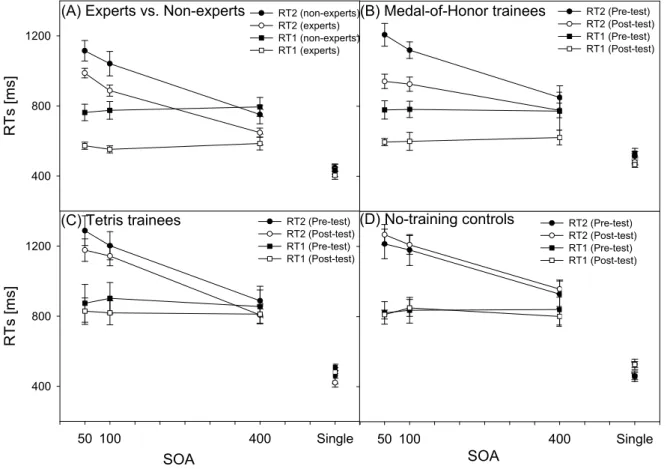
Strobach, Frensch, and Schubert (2012c) and Schubert and Strobach (2012) tested dual-task and task switching performance in persons with an extreme amount of video game training, i.e. a minimum of six hours per week within the last six months (prior testing) of video game playing. These video game experts were contrasted with non-experts (i.e., persons without or minimal video game training) with respect to their performance in a dual-task and task switching situation. The dual-task situation was of the standard PRP type (e.g., Pashler, 1994; Schubert, 1999) combining a first auditory-manual task (i.e., pitch discrimination of tones: high, middle, & low) and a second visual-manual task (i.e., size discrimination of triangles: large, medium, & small) with SOAs of 50, 100, and 400 ms. As illustrated in Figure 4A, the data show the typical pattern in standard PRP situations with constant RT1 and an
increased RT2 with decreasing SOA. However, figuratively speaking, graphs of experts showed a “downward shift” in contrast with the non-expert graphs. That is, RTs in the first and the second dual task were constantly shorter in experts while the single-task RTs (i.e., with isolated performance of tasks) were similar in experts and non-experts. This dual-task advantage of experts (indicated by shorter dual-task RTs) indicates specifically optimized and speeded processes of executive task control.
RTs [ms ] 400 800 1200 RT2 (non-experts) RT2 (experts) RT1 (non-experts) RT1 (experts) RT2 (Pre-test) RT2 (Post-test) RT1 (Pre-test) RT1 (Post-test) SOA 50 100 400 Single RTs [m s] 400 800 1200 RT2 (Pre-test) RT2 (Post-test) RT1 (Pre-test) RT1 (Post-test) SOA 50 100 400 Single RT2 (Pre-test) RT2 (Post-test) RT1 (Pre-test) RT1 (Post-test)
(A) Experts vs. Non-experts (B) Medal-of-Honor trainees
(C) Tetris trainees (D) No-training controls
Figure 4: Reaction times (RTs) in ms in single-task trials (Single) and dual-task trials for Task 1 and 2 of the dual-task test in Strobach et al. (2012c). Panel (A): RTs for the video game experts and non-experts were compared. Groups of non-gamers were trained with the action video game Medal of Honor (Panel B), with the puzzle game Tetris (Panel C) or had no training (Panel D) and their RTs were measured in a pre-test session (pre-test) and in a post-test session (post-test).
In videogame experts and non-experts, performance in task switching was assessed in a paradigm introduced by Rogers and Monsell (1995): letters and digits of letter-digit pairs were categorized as consonants/ vowels or even/ odd digits, respectively, in switch, repetition, and single-task trials. While switch and repetition trials represent changes between and repetition of tasks in successive trials in mixed blocks, respectively, tasks are presented in
isolation in single-task blocks. RT analyses of these three trial types reflect a clear difference between video game experts and non-experts: While RTs for repetition and single-task trials are similar in both groups, experts respond faster in switch trials when compared with RTs in non-experts. These faster switch RTs resulted in a reduction of switch costs while mixing costs were similar (for mixing and switch costs see Chapter 3.1). This data pattern may be associated with effects of optimized executive functioning that allow a speeded switch between tasks (i.e., Shifting), but no repetition of tasks. The speeded switch may reflect optimized implementation processes to activate the task set of an upcoming task (e.g., Rogers & Monsell, 1995; Rubinstein, Meyer, & Evans, 2001) and/or a reduced inhibition of this task through the task set of a previous task (e.g., Allport, Styles, & Hsieh, 1994; Mayr & Keele, 2000; for a combined approach see Monsell, 2003; Strobach et al., 2012b). On the other hand, the lacking performance advantage in videogame experts in the repetition situation indicates that this type of expertise is not related with enhanced skills associated with the sustained control in intermixed task settings (Rubin & Meiran, 2005).
However, the issue as to whether there is a causal role of videogame playing on improving and transferring executive skills to dual tasks and task switching remains open when merely comparing expert vs. non-expert performance (Boot, Blakely, & Simons, 2011; Boot & Simons, 2012). The enhanced executive functioning observed in video gamers could either be the result of video game playing per se (and would represent a realization of modulated executive functioning along the Training dimension of the Framework on modulations of executive functions), or it could be the case that these gamers have inherently optimized executive functioning (Green & Bavelier, 2003, 2006). According to the latter alternative, greater success at videogames due to higher inherent skills might provide a motivating factor to play these games more often, whereas the lower inherent skills of non-gamers possibly limit their success and, as a result, cause them to refrain from playing. To focus on the causal role of playing videogames, Strobach et al. (2012c) trained two groups of
non-gamers in two games with different demands on executive functioning for 15 h, and tested their performance in the dual-task and task switching tests (see above) in a pre-test and post-test session before and after training, respectively. The two games were (1) the complex, demanding, fast-paced, and, therefore, “executive” ego shooter Medal of Honor and (2) the puzzle game Tetris; this game contains a challenging visuo-spatial component involving mental rotation processes in working memory (Okagaki & Frensch, 1994; Sims & Mayer, 2002); however, it is less “executive” and requires focusing on only one task and one object at a time. The pre-test data in dual tasks and task switching showed no pre-test difference between groups. The players of Medal of Honor, however, showed a particular decrease of RT1 and RT2 in dual tasks from pre- to post-test (but no effect on single tasks, Figure 4B). In addition, switch RTs, but not repetition and single-task RTs, speed up in task switching between these test sessions. In contrast, there were no such changes in the dual-task and task switching tests in the Tetris group which were paralleled by the findings for a third no-training group (for dual tasks, see Figure 4C & 4D). These findings clarified the causal relation between video game training and the optimization of executive functioning in dual tasks and task switching.
How generalizable or specific are these transfer effects on dual tasks and task switching? To investigate this issue, I present the data of transfer tests on dual tasks and task switching after working memory training (Salminen, Strobach, & Schubert, 2011, 2012). In the context of working-memory training, a dual n-back task is an inherently complex task that taps various executive functions (Jaeggi et al., 2008). This complexity is because it consists of two n-back tasks (n-back task: participants indicate when a current stimulus matches the one from n steps earlier in a sequence of stimuli) – a visuo-spatial and an auditory-verbal one – and these tasks have to be performed simultaneously. One n-back task alone requires diverse executive processes, such as working memory updating, monitoring of ongoing performance, and inhibition of irrelevant items. In the dual n-back, the presentation of two n-back tasks in
different modalities calls for yet additional functions, such as dividing attentional resources and managing the performance of two simultaneous tasks. Another crucial component of the task is that it is adaptive; that is, the level of difficulty is constantly adjusted according to each individual’s performance; the development of task specific strategies is minimized in this way (Klingberg, Forssberg, H., & Westerberg, 2002; Klingberg et al., 2005). In contrast, working memory tasks include only minimal “speeded” components. That is, participants are instructed to perform correctly without instructions on the speed of responses. This fact may result in no acquisition and transfer of skills required in situation including the control of speeded tasks such as dual tasks and task switching. Because of these assumptions, it is plausible to ask whether or not dual n-back training results in optimizations and transfers of executive functions that are used to coordinate several different tasks in these complex task situations.
Salminen et al. (2011, 2012) tested these assumptions when performing a pre-test - training - post-test design. While pre- and post-tests included dual tasks and task switching of the type of Strobach et al. (2012c), dual n-back training was similar to the situation introduced by Jaeggi et al. (2008). That is, a group of participants training the combined (i.e., simultaneous, dual) visuo-spatial and auditory-verbal n-back tasks for 14 daily sessions. The data of this training group demonstrated the following when contrasted with the data of a control group that underwent no training: After training, the n-back level in the training group was tremendously higher. This higher level illustrates a higher level of achieved task difficulty that was adaptive to the performance level. Further, the training group showed improvements in the repetition condition (i.e., mixing costs) in the task switching test. The remaining post-test, as well as all pre-test, comparisons showed no differences between the training and the control group. Thus, working-memory training exclusively optimized and transferred executive functions to situations of repeated task performance. These skills are
associated with optimized sustained control, i.e. maintaining two task sets in working memory and selecting appropriately between them.
In sum, the present findings demonstrate the differential effects of two training situations that are promising to result in transfer effects: While videogame training leads to an optimized activation/ inhibition of sequential tasks (demonstrated by reduced switch costs during task switching) and activation/ coordination of two simultaneous tasks (demonstrated by reduced dual-task RTs), working memory training rather leads to optimized sustained control of two task sets in working memory. Thus, both types of training resulted in modulation (i.e., optimizations) of different executive function types. These modulations can be illustrated in form of the Training dimension in the Framework on modulations of executive functions.
4. Framework on modulations of executive functions and its aging dimension
The investigation of modulations of executive functioning due to age is approached from the context of dual-task situations (i.e., the executive function Dual tasking). As outlined below, this age-related modulation is combined with training effects. In this way, the present section reviews studies that modulate executive functions in accordance with the Age dimension and its combination with the Training dimension in the Framework on modulations of executive functions.
Age-related differences in dual-task performance have been demonstrated in numerous dual-task paradigms. In these paradigms, older adults commonly show greater interference in dual-task than in single-task situations when compared to younger adults (e.g., Allen, Smith, Vires-Collins, & Sperry, 1998; Glass et al., 2000; Hartley, 2001; Hartley & Little, 1999; Hein & Schubert, 2004; McDowd & Shaw, 2000). Among others, this greater interference is related to dual-task specific components such as ineffective executive functioning when activating and coordinating different tasks (Hartley & Little, 1999; Verhaeghen, 2011; Verhaeghen et
al., 2003). However, irrespective of this age-specific ineffectiveness, a number of studies provided evidence that younger as well as older adults benefit from training. That is, both age groups are able to optimize dual-task performance and show reduced dual-task interference after training (e.g., Allen, Ruthruff, Elicker, & Lien, 2009; Baron & Matilla, 1989; Bherer et al., 2006, 2008; Göthe, Oberauer, & Kliegl, 2007; Hartley, Maquestiaux, & Silverman Butts, 2011; Maquestiaux, Didierjean, Ruthruff, Chauvel, & Hartley, in press; Maquestiaux, Hartley, & Bertsch, 2004; Maquestiaux, Laguë-Beauvais, Ruthruff, & Bherer, 2008; Maquestiaux, Laguë-Beauvais, Ruthruff, Hartley, & Bherer, 2010).
Some dual-task training studies with younger adults have provided evidence for an extremely optimized dual-task performance (Hazeltine, Teague, & Ivry, 2002; Maquestiaux et al., 2008; Schumacher et al., 2001; Strobach et al., 2008). These studies demonstrated minimized (and in some cases even eliminated) dual-task interference at the end of training. While such findings illustrate a promisingly large range of training-related cognitive plasticity and related optimized skills in younger adults, there is, however, no study comparing optimized dual-task performance after training in younger adults with this performance after training in older adults (Allen et al., 2009). Such investigation of dual-task training effects is interesting for age research as it provides more conclusive evidence regarding cognitive plasticity in dual-task situations and related modulation of executive functioning in older adults (Bherer et al., 2006).
The specific aim of two studies (Strobach, Frensch, Müller, & Schubert, 2012d, 2012e) was to test the dual-task performance level (i.e., the executive function Dual tasking) of older adults compared to younger adults after training to provide indicators for the acquisition of optimized executive functioning in the former age group. These tests were realized in the context of a dual-task situation of Schumacher et al. (2001). This is because this situation was assumed to obey conditions for optimal dual-task performance (Hartley et al., 2011; Meyer & Kieras, 1999; Tombu & Joclicoeur, 2004) and potential skill acquisition
after training. In fact, Schumacher et al. asked participants to perform a paradigm that consisted of tasks with different perception and motor components: a visual-manual task (i.e., visual task: left, central, & right stimulus position on manual finger responses) and an auditory-verbal task (auditory task: low, middle, & high tone on verbal number words). The training procedure requires practicing three different trial types: participants performed only one of the two tasks in single-task blocks (single-task trials); in mixed blocks, participants either responded to only one task (i.e., mixed single-task trials) or actually executed two motor responses to simultaneously presented stimuli in the two tasks (dual-task trials with stimulus onset asynchrony, SOA, of 0 ms). Participants were instructed to give equal priority on both tasks in dual-task trials (in contrast to priority instructions in PRP dual tasks) and awarded with performance-based financial feedback. The difference in performance between the dual-task and mixed single-task trials provides a measure of dual-task performance costs (i.e., dual-task costs) and the processing necessary to perceive multiple stimuli and coordinate the execution of two responses. (I will exclusively analyze the difference between dual tasks vs. mixed single tasks [the dual-task costs] in the following section and neglect the difference between single tasks and mixed single tasks.)
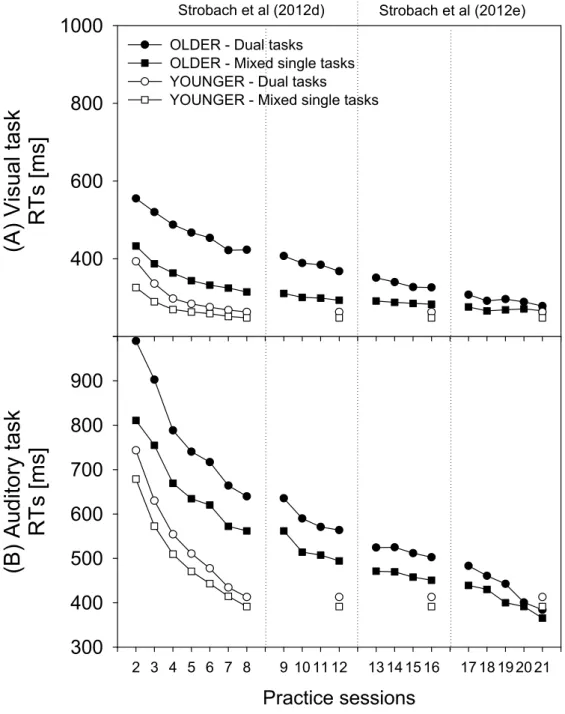
As illustrated in Figure 5, optimized dual-task performance in younger adults demonstrated extremely reduced dual-task costs in both the visual and the auditory component tasks after eight training sessions (see also Liepelt et al, 2011; Strobach et al., 2008; Tombu & Jolicoeur, 2004). This optimized dual-task performance was compared with dual-task performance levels of older adults in the identical dual-task situation separately after eight training sessions and also after 12 training sessions (Strobach et al., 2012d). These analyses showed that comparing the training benefit on the dual-task costs of the visual and auditory task, this benefit is similar for younger and older adults performing eight training sessions. However, dual-task costs were consistently larger in older adults compared with younger adults in Session 8. Even four more training sessions (i.e., in Session 12) exclusively
for older adults (but not for younger adults) could not lead to a disappearance of this difference. These findings suggest that, among others, older adults are impaired in those executive functions necessary to perceive multiple stimuli and to coordinate the execution of two responses at the end of this training amount when compared with a performance level achieved in younger adults.
Potentially, however, a further increase of the amount of training in older adults can reduce the dual-task performance difference in older and younger adults and, consequently, generate dual-task data consistent with the assumption of optimized executive functioning across age groups. To test this assumption, Strobach et al. (2012e) performed 16 sessions of dual-task training of the Schumacher et al. (2001) type in older adults and compared their dual-task performance after this training amount with those of younger adults after eight sessions (see Strobach et al., 2012d). As illustrated in Figure 5, this comparison revealed that dual-task costs were consistently larger in older adults compared with younger adults after 16 and eight sessions, respectively. Thus, the age difference in dual-task costs was still existent after a double amount of training in older adults in contrast to that amount in younger adults. Furthermore, it seems that an additional increase of this amount of training in older adults is not promising in order to negotiate the dual-task difference since older adults were not able to showed further reductions in dual-task costs at the end of their 16 training sessions.
A number of dual-task studies reported that simplified component tasks lead to a reduced impairment of one or both tasks in dual-task situations and, therefore, a reduction of dual-task costs (e.g., Pashler, 1994; Schubert, 1999, 2008; Van Selst & Jolicoeur, 1997). This was particularly demonstrated for trained dual-task performance in older adults (Maquestiaux et al., 2004). The reduction of dual-task costs following simplified component tasks was explained with a reduced load on working memory capacity and a more efficient coordination of concurrent tasks. This simplification potentially leads to a similar level of optimized dual-task performance at the end of training in younger and older adults.
Strobach et al (2012e) realized one way to simplify tasks: They reduced the number of stimulus-response mappings in the component tasks that constitute the dual-task situation of the Schumacher et al. (2001) type. In fact, the group of older adults that trained for 16 dual-task training sessions performed five additional sessions in which the number of stimulus-response mappings was reduced from three to two in both the visual task (excluding the central stimulus position) and auditory tasks (excluding the middle tone). After these five sessions (i.e., in Session 21), the dual-task performance with simplified tasks in older adults was compared with that performance of younger adults after eight training sessions and three-choice visual and auditory tasks. This comparison showed, for the first time in the aging and training literature, similar levels of dual-task performance across different age groups at the end of training (Figure 5). These similar levels in younger and older adults are indicated by similar dual-task costs after 21 sessions (i.e., 16 sessions with three-choice tasks plus five sessions with two-choice tasks; older adults) and eight sessions (younger adults). In this way, both older adults and younger adults achieved the same level of optimized dual-task performance.2 Note, however, that the achievement of similar dual-task performance levels in
older adults, compared with younger adults, occurs exclusively under these very specific conditions.
These findings are consistent with the assumption that, across different age groups, executive functioning is modulated with training and runs more efficient with optimized task coordinating. Although the present studies (Strobach et al., 2012d, 2012e) include no direct empirical test for the acquisition of task coordination skills as it was realized in younger adults (Liepelt et al., 2011; Strobach et al., 2012a), I assume, however, that the achieved level of optimized dual-task performance is exclusively available with improved optimized executive functioning in form of optimized task coordination skills; alternative mechanisms such as faster processing of elements within the component tasks cannot exclusively explain
optimized dual-task performance (Kamienkowski et al., 2011; Sangals, Wilwer, & Sommer, 2007). Therefore, Strobach et al. (2012d, 2012e) demonstrate investigations on the present framework’s Age and Training dimensions to modulated executive functioning.
Practice sessions 2 3 4 5 6 7 8 9 10 11 12 13 14 15 16 1718 19 2021
(B)
Auditory
task
RTs
[ms]
300 400 500 600 700 800 900 1000 Strobach et al (2012d)(A)
Vi
sual
task
RTs
[ms]
200 400 600 800 1000OLDER - Dual tasks
OLDER - Mixed single tasks YOUNGER - Dual tasks
YOUNGER - Mixed single tasks
Strobach et al (2012e)
Figure 5: Mean reaction times (RTs) in ms on single-task trials in mixed blocks (Mixed single tasks), and dual-task trials (Dual tasks) for (A) the visual task and (B) the auditory task in Strobach et al. (2012d: Training session 2 - 12) and Strobach et al. (2012e: Training session 13 – 21). The RT difference between the (increased) dual-task RTs and mixed single-task RTs reflect the magnitude of dual-task costs.
5. Discussing the Framework on modulations of executive functions
The present work demonstrates how different dimensions of the Framework on modulations of executive functions (Chapter 1) and combinations of dimensions (e.g., Chapter 4) can be realized in empirical studies. In sum, the Context dimension modulates the executive function type Dual tasking and Inhibition (Hendrich et al., 2012; Soutschek et al., 2013); however, Töllner et al. (2012) demonstrated that Context also affects processes that are not related with executive functioning (i.e., perception and motor processes) and, thus, showed one case of modulated behavior in complex situations that is not captured within the present framework (Chapter 2). The framework’s Training dimension was realized when (1) Strobach et al. (2012b) investigated effects of training on the executive function Shifting and (2) Strobach et al. (2012c), Schubert and Strobach (2012), as well as Salminen et al. (2011, 2012) investigated transfer effects on the executive function Dual tasking and Shifting after video game and working memory training, respectively (Chapter 3). Finally, Strobach et al. (2012d, 2012e) illustrated modulating effects of age and training (i.e., the combination of Age and Training dimensions) on the executive function type Dual tasking (Chapter 4). In this way, the final line of research demonstrated one potential combination of how studies target two dimensions of the Framework on modulations of executive functions concurrently.
How does the Framework on modulations of executive functions contributes to other theories? What are the theoretical implications of this framework (i.e., implications beyond the structuring of existing and lacking research)? In the following, I will exemplarily illustrate the present framework’s contribution and implications in the context of Norman and Shallice’s (1986) SAS.
The SAS provides one specific realization of executive functioning of attentional control. This model specifies how thoughts and action schema become activated or suppressed for routine and non-routine situations. Schemas specify an individual's actions, thoughts or their series under the influence of environmental conditions. Every stimulus
condition turns on the activation of a response or schema (Friedenberg & Silverman, 2012). The initiation of an appropriate schema under routine, well-learned situations is monitored by contention scheduling which laterally inhibits competing schemas for the control of cognitive apparatus (Shallice & Burgess, 1991). Under unique, non-routine procedures the SAS controls schema activation. The SAS is an executive monitoring system that supervises and controls contention scheduling by influencing schema activation probabilities and allowing for general strategies to be applied to novel problems or situations during automatic attentional processes. In the context of SAS, the Training dimension in the present Framework on modulations of executive functions is characterized as a transition from the involvement of the central SAS component to contention scheduling. That is, there is a transition from higher-level processing that has control of contention scheduling to lower-higher-level processing that regulates schemata for familiar, automatic actions as well as some novel situations; the former mechanism includes monitoring conscious, deliberate planning of actions and novel situations that cannot be solved by previously learned schemata. For instance, while working memory updating may be performed with the inclusion of high-level SAS processing at the beginning of training, portions of contention scheduling dominate updating at the end of training (Salminen et al., 2012). Further, aging (i.e., the Aging dimension) as well as context (i.e., the Context dimension) also influence some specific executive functions that are characteristic of SAS; for instance, planning or inhibition is impaired in elderly persons (Bayliss & Roodenrys, 2000). In essence, a model like SAS is able to provide one potential explanation or illustration of the findings included into the present Framework on modulations of executive functions. The novel contribution of this framework is however to illustrate the potential validity of the SAS. For example, to my knowledge, there is no study interpreting findings such as those of Strobach et al. (2012d: dual-task training in younger and older adults) in the context of SAS. That is, there is no interpretation of findings of training studies and an aging perspective as following: during dual-task training, there is a transition from higher-level processing
![Figure 2: Proportion of trials in which participants reported the tone as first in the temporal order judgment (TOJ) responded to the tone task as first in dual tasks (DT) when realized with [Panel A] high and low visual stimulus cont](https://thumb-us.123doks.com/thumbv2/123dok_us/10902977.2979297/14.892.121.770.534.789/proportion-participants-reported-temporal-judgment-responded-realized-stimulus.webp)