Wayne State University Dissertations
1-1-2013
The Effects Of Applying Authentic Learning
Strategies To Develop Computational Thinking
Skills In Computer Literacy Students
Wendye Dianne Mingo
Wayne State University,Follow this and additional works at:http://digitalcommons.wayne.edu/oa_dissertations
This Open Access Dissertation is brought to you for free and open access by DigitalCommons@WayneState. It has been accepted for inclusion in Wayne State University Dissertations by an authorized administrator of DigitalCommons@WayneState.
Recommended Citation
Mingo, Wendye Dianne, "The Effects Of Applying Authentic Learning Strategies To Develop Computational Thinking Skills In Computer Literacy Students" (2013).Wayne State University Dissertations.Paper 674.
TO DEVELOP COMPUTATIONAL THINKING SKILLS IN COMPUTER LITERACY STUDENTS
by
WENDYE DIANNE MINGO DISSERTATION
Submitted to the Graduate School of Wayne State University,
Detroit, Michigan
in partial fulfillment of the requirements for the degree of
DOCTOR OF PHILOSOPHY
2013
MAJOR: INSTRUCTIONAL TECHNOLOGY
Approved By: _________________________________________ Advisor Date _________________________________________ _________________________________________ _________________________________________ _________________________________________
© COPYRIGHT BY WENDYE DIANNE MINGO
2013
ii
Needless to say, this was a long, long journey. It started almost ten years ago when I decided to look into the Instructional Technology department at Wayne State University because it sounded like a pretty interesting field at the time. My journey in this program lasted longer than most marriages, interest rates and fashion trends but I greatly appreciate how much the experience has matured me as a person. This accomplishment comes with a number of people that I owe my deepest gratitude. Before thanking anyone, I would first like to thank my Lord and Savior Jesus Christ for carrying me from the beginning to the end of this journey.
I have a number of Wayne State University faculty members to thank starting with my awesome dissertation committee. My dissertation chairman, Dr. Monica Tracey, welcomed me back with open arms and accepted me as her student when I returned to the program. Furthermore, she worked diligently with me on a very complex study providing the wisdom and guidance that was necessary to successfully get me through. Dr. Tracey, thank you for the precious and valuable time that you spent with me!
I enjoyed taking the interactive technology classes under the direction of Dr. Timothy Spannaus. I never imagined that I would actually use the learning experiences from every class I had with him to create the prototype for my dissertation. Dr. Spannaus, thank you for years of preparing me and providing me the technological guidance for my study!
Dr. James Moseley’s meticulous attention to detail was instrumental in making my dissertation into what it has become. His experience is very valuable to the instructional technology department and doctoral students alike. Dr. Moseley, thank you for being a member of my committee!
iii
computational thinking; a topic that I have come to fully embrace. Dr. Brockmeyer thank you for not only providing the charge for my study but reaching out from the Computer Science department to offer your support!
Finally, I would like to thank my former advisor, Dr. Rita Richey for giving me the necessary foundation in instructional technology required for me to accomplish this goal.
I would like to extend a heart-felt thank you to Michele Norris. Michele’s encouragement, quick wit and humor for almost ten years helped me to keep my sanity. The duck and grape joke will be with me always. Next, I would like to thank Khayyam Hashmi and the Computer Science department for permitting me to work with the computer literacy students. I wish Khayyam all the best in his studies and future endeavors. I would like to also thank Dr. Janice Green, Paul W. Johnson, Gursharon Shergill and Betsy Baumann. I am grateful for their patience with me at the end of this long and winding road during the most challenging times of my life.
I would like to thank my mom, Joan Mingo, who was there for me since day one of this journey and who would never let me quit, no matter how many times I told her that I wanted to set my dissertation ablaze. She also spent so many hours proofing numerous drafts and helping me out wherever she could. Mom, thank you for being there for me!
I would also like to thank my brother, Dr. Alfie Mingo. Although he is my younger brother, I look up to him for his drive, tenacity and being the shining example in our family. I would like to thank a number of other immediate family members: My dad, Charles Mingo for his support and my aunts, Pauline Kelly and Dr. Helen J. Powell for being such positive role models in my life.
iv
(Bear) Mattock has been a big brother figure to me for over twenty years. His positive and motivational way of looking at life kept me encouraged and helped me keep things in perspective. Dolores Shepherd, my sorority sister and former teacher, has known me since my days at Ferris Middle School in Highland Park, Michigan and has pushed me academically as long as I have known her.
Finally, I would like to thank the following colleagues for their encouragement, time and support: Srilakshmidevi Akasapu, Shikha Arora, Bernice Brogan, Sara Ibrahim, Usha Kompalli, Sravana Muthavarapu, Mark Parker, Murthy Punyamurtula, James Roosa, Shabnam Saghir, James Tang and Janine Zurro.
v
Acknowledgements_____________________________________________________________ii List of Tables_________________________________________________________________ x List of Figures________________________________________________________________ xii Chapter 1 Introduction __________________________________________________________1 Statement of the Problem______________________________________________________ 1 Purpose of the Study__________________________________________________________ 5 Research Questions Investigated ________________________________________________ 6 Variables___________________________________________________________________ 7 Definition of Terms___________________________________________________________7 Authentic Learning Environment______________________________________________ 7 Situated Learning__________________________________________________________ 7 Computational Thinking_____________________________________________________ 7 Motivation________________________________________________________________8 ARCS Model of Motivational Design __________________________________________8 Simulation________________________________________________________________ 8 Web-based learning ________________________________________________________9 Summary __________________________________________________________________ 9 Chapter 2 Review of the Literature________________________________________________ 10
Authentic learning___________________________________________________________ 10 Defining Authentic Learning________________________________________________ 10
vi
Designing Authentic Learning Environments___________________________________ 13 Concerns With Authentic Learning Environments________________________________ 17 Applications of Authentic Learning Environments_______________________________ 19 Technological Trends______________________________________________________ 19 Theories Applied in Authentic Learning Environments____________________________ 20 Authentic Learning Characteristics____________________________________________21 Student Interactions_______________________________________________________ 23 Computational Thinking______________________________________________________ 25 Computational Thinking Teaching Strategies___________________________________ 25 Technology-based Solutions_________________________________________________ 27 Curriculum Solutions______________________________________________________ 28 Authentic Learning, Computational Thinking and Technology________________________ 30 Summary__________________________________________________________________ 32 Chapter 3 Methodology________________________________________________________ 34
Instructional Interventions ____________________________________________________35 COTHAULE Instructional Intervention________________________________________ 35 COTHAULE Testing Procedures_____________________________________________ 43 Expert Reviews___________________________________________________________ 47 Online Learning Materials Instructional Intervention _______________________________50 Participants________________________________________________________________ 51
vii Sample__________________________________________________________________52 Treatment_______________________________________________________________ 53 Risks___________________________________________________________________ 53 Instrumentation_____________________________________________________________ 54 Demographics Survey______________________________________________________ 54 Computational Thinking Pretest______________________________________________ 54 Computational Thinking Posttest_____________________________________________ 57 Instructional Materials Motivational Survey____________________________________ 58 Procedures_________________________________________________________________ 59 Analysis___________________________________________________________________60 Research Question One ____________________________________________________ 61 Research Question Two____________________________________________________ 62 Summary__________________________________________________________________ 65 Chapter 4 Results_____________________________________________________________ 65
Data Cleansing Process_______________________________________________________ 65 Demographics Summary______________________________________________________70 Pretest – Posttest t-Test Introduction____________________________________________ 76 Pretest Independent t-Test Results______________________________________________ 77 Posttest Independent t-Test Results _____________________________________________79 Pretest – Posttest Correlated Groups_____________________________________________81
viii
Manova Evaluation of Assumptions___________________________________________ 86 MANOVA Statistical Results________________________________________________ 89 IMMS Written Feedback ___________________________________________________89 Summary__________________________________________________________________ 90 Chapter 5 Discussion__________________________________________________________ 92
Purpose___________________________________________________________________ 92 Research Background________________________________________________________ 93 Research Results____________________________________________________________ 94 Revisit of Authentic Learning Guidelines ______________________________________95 Limitations of the Study______________________________________________________ 98 Generalizability___________________________________________________________ 98 Researcher Control________________________________________________________ 98 Students Incentive_________________________________________________________99 Recommendations__________________________________________________________ 100 Future Research_________________________________________________________100 Considerations for Complex Research Design__________________________________ 101 Improvements to COTHAULE______________________________________________104 Significance of the Study____________________________________________________ 107 Conclusion_______________________________________________________________ 108 Appendix A: COTHAULE Case Studies________________________________________ 109
ix
Appendix C: Cothaule Design Storyboard_______________________________________ 148 Appendix D: Cothaule Database Schema________________________________________ 150 Appendix E: COTHAULE Screenshots_________________________________________ 151 Appendix F: COTHAULE Functional and Operability Testing Spreadsheet____________ 158 Appendix G: COTHAULE Usability Testing Procedures___________________________ 178 Appendix H: Computational Thinking Authentic Learning Participant Questionnaire_____ 180 Appendix I: Computational Thinking Pretest_____________________________________ 181 Appendix J: Computational Thinking Posttest____________________________________ 189 Appendix K: IMMS Permission to Use_________________________________________ 198 Appendix L: Instructional Materials Motivation Survey____________________________ 199 Appendix M: Consent Form__________________________________________________ 201 Appendix N: Data Cleansing and Validation Procedures____________________________ 203 Appendix O: Pretest Summary Results__________________________________________207 Appendix P: Posttest Summary Results_________________________________________ 209 Appendix Q: IMMS Summary Data____________________________________________ 211 Appendix R: MANOVA Assumption Testing____________________________________ 213 Appendix S: IMMS Open-Ended Raw Data Feedback_____________________________ 216 References________________________________________________________________ 224 Abstract__________________________________________________________________ 236 Autobiographical Statement__________________________________________________ 238
x
Table 1: Constructivist Characteristics Used in Authentic Learning Environments 21
Table 2: Test Case Test Results 45
Table 3: Summary Results of Self-Assessment Survey 46
Table 4: COTHAULE Expert Review Feedback 48
Table 5: Pretest Expert Review Findings 55
Table 6: Posttest Expert Review Findings 57
Table 7: Summary of Data Analysis Techniques 63 Table 8: Participant Age Range by Gender 71 Table 9: Participant Ethnicity by Gender 72 Table 10: Participant Year of College by Gender 72 Table 11: Participant Academic Program Interest by Gender 73
Table 12: Participant Academic Major by Gender 74 Table 13: Participant Computer Comfort by Gender 76 Table 14: Participant Comfort with Computer Game by Gender 76 Table 15: Pretest t-Ratio Test Group Results 78 Table 16: Pretest Independent Samples T-Ratio Test Results for Equality of Means 78
Table 17: Pretest Difficulty Rating 80 Table 18: Posttest t-Ratio Test Group Results 80
Table 19: Posttest Independent Samples T-Ratio Test Results for Equality of Means 81
Table 20: Posttest Difficulty Rating 81
Table 21: Experimental & Control Group Paired Sample Correlations 82 Table 22: Experimental & Control Group Paired Samples Test Results 83
xi
Table 24: IMMS Composite Cronbach Alpha Results 84
Table 25: IMMS Experimental and Control Group Cronbach Alpha Results 86
Table 26: IMMS ARCS Subscale Pearson’s R Results 86
Table 27: IMMS Subscale Mean Percentages 89
Table F1: COTHAULE Functional and Operability Testing Spreadsheet 158
Table G1: COTHAULE Usability Testing Procedures 178
Table N1: Data Cleansing and Validation Procedures 203
Table O1: Pretest Summary Results 207
Table P1: Posttest Summary Results 209
Table Q1: Experimental Group IMMS Results 209
Table Q2: Control Group IMMS Results 212
Table R1: Descriptive Statistics Showing Evidence of Test for Outliers 213 Table R2: Z-Score Adjustment Table for ARCS Subscale Items 214 Table R3: Levene's Test of Equality of Error Variances 215 Table R4: Evidence of Robust Test of Equality of Means 215 Table R5: Evidence of the Test for Absence of Multicollinearity and Singularity 215
xii
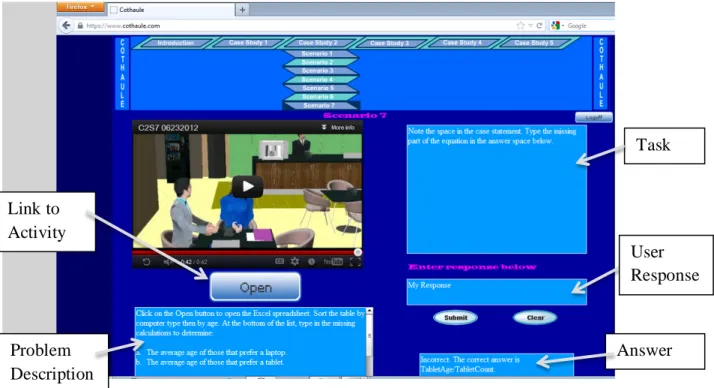
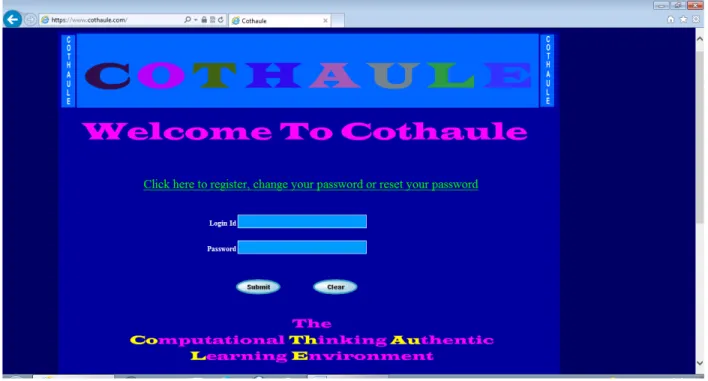
Figure 1: Screenshot of COTHAULE prototype 43
Figure 2: Logical relationships between the demographics survey and the posttest 67
Figure 3: Logical relationships between the demographics survey and the posttest 67 Figure 4: Logical relationships between the demographics survey, the pretest and the
posttest 68
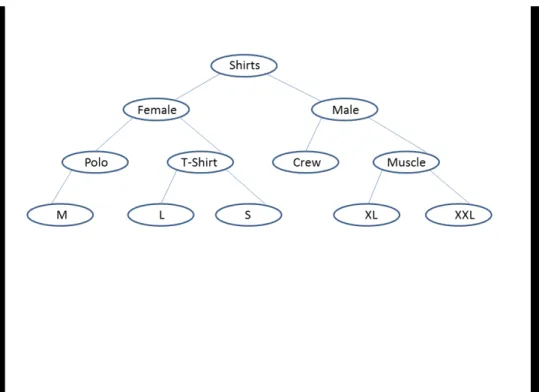
Figure 5: Logical relationships between the pretest the posttest and COTHAULE 68 Figure C1: COTHAULE storyboard for the fill-in-the-blank problem 148 Figure C2: COTHAULE storyboard for the multiple-choice problem 149
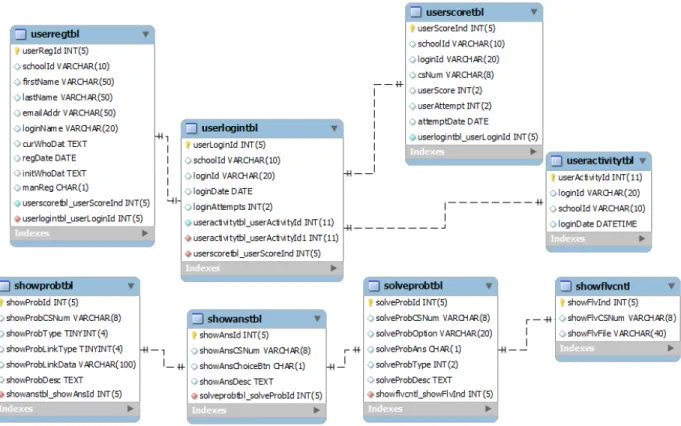
Figure D1: Cothaule database schema 150
Figure E1: COTHAULE website login screen 151
Figure E2: COTHAULE user assistance screen 151
Figure E3: COTHAULE introduction Screen 152
Figure E4: COTHAULE overview screen 152
Figure E5: COTHAULE instructions screen 153
Figure E6: COTHAULE resources screen 153
Figure E7: COTHAULE about screen 154
Figure E8: Splash screen for case study one 154
Figure E9: Multiple-choice example with a link to an authentic learning activity 155 Figure E10: Fill-in-the-blank example with a link to an authentic learning activity 155 Figure E11: Full screen screenshot of a scenario in case study two 156 Figure E12: Full screen screenshot of a scenario in case study three 156 Figure E13: Full screen screenshot of a scenario in case study four 157 Figure E14: Full screen screenshot of a scenario in case study five 157
xiii
Figure K1: Screenshot of first page of email for permission to use IMMS 198 Figure K2: Screenshot of second page of email for permission to use IMMS 198 Figure M1: First page showing the screenshot of the consent form provided to the computer
literacy students to request participation 201
Figure M2: Second page showing the screenshot of the consent form provided to the
computer literacy students to request participation 202
Figure R1: Evidence of test for linearity 213
CHAPTER 1 INTRODUCTION
Instructors in various capacities continue to aspire to implement real-world learning opportunities in the classroom that actually reflect societal situations in which learning could be applied. Authentic learning provides engaging opportunities within learning environments to students by allowing them to participate in real-world problem-solving activities (Herrington & Oliver, 2000). Authentic learning also optimizes the relevancy of learning to students and encourages them to develop applicable competencies for various aspects of their lives (Gulikers, Bastiaens & Martens, 2005). Computational thinking is a fundamental skill commonly practiced within the field of computer science that could benefit other disciplines (Wing, 2006). Although a number of computational thinking initiatives have been implemented, a limited number of them are applicable to disciplines external to the sciences. In one study, authentic learning was used as an instructional strategy to teach computational thinking within a scientific discipline (Pulimood & Wolz, 2008). However, no initiatives have been implemented within the non-scientific disciplines that use concepts from authentic learning as an instructional strategy to teach computational thinking skills. This study attempted to both construct a tool that will integrate these skills using authentic learning strategies as the instructional venue and assess the motivation and knowledge acquired with using this tool to teach computational thinking skills to undergraduate computer literacy students.
Statement of the Problem
While the number of occupations that require computer literacy skills has dramatically increased over the last ten years, the number of students in the United States actually majoring in computer and information sciences, computer engineering or some computer technology-dependent field of study has struggled to keep up with industry demand. Enrollment declined
significantly between 2002 where there was an average of 400 undergraduate majors per computer science department and 2007 where the average dropped to under 200 (Zweben, 2012). Since then, there have been modest increases in enrollment between 2008 and 2011 averaging about 10% per year bringing the average number of majors per computer science department up to about 280. The continued lack of interest and enrollment in computer science and other sciences and quantitative disciplines is also reflective in the number of Americans who possess the necessary technical skills to fully function in most professions (Jolly, Campbell & Perlman, 2004). Computer technology is no longer the novelty that it was two decades ago. Practically every occupation relies on computers in some form of computer usage whether it be programming, engineering, designing, research, analysis, information processing or data entry (Denning, 2007; Margolis, Estrella, Goode, Holme, & Nao, 2008; Wing, 2006). Unfortunately, society does not fully comprehend how exposure to the computational thinking problem-solving opportunities often realized in the classrooms of four-year computer science programs provides a significant advantage to those students who major in this field. The learning experience not only provides graduates the background and the foundation to function in practically any technology-based occupation but it also provides them the advantage of being able to obtain employment in many professions aside from computer science (Margolis et al., 2008; Wing, 2006).
In 2006, Jeanette Wing, head professor of computer science at Carnegie Mellon University, introduced a term called computational thinking (Wing, 2006). Computational thinking involves knowing how and when to apply a number of problem-solving techniques normally associated with computer science, including but not limited to reduction, transformation, simulation, recursion, abstraction, decomposition and heuristics (Wing, 2006). Computational thinking also boasts a number of benefits for various disciplines and professions
(Adams, 2008; Hambrusch, Hoffman, Korb, Haugan & Hosking, 2009; Priami, 2009; Topi, 2008; Wing, 2006). What people do not realize is that they commonly and unwittingly employ or experience some type of computational thinking skill or characteristic. A building equipped with backup generators that automatically turn on in case of a power outage is a computational thinking example of fail-over and redundancy. An Internet search engine such as Google or Yahoo uses heuristics to return a number of responses that may or may not be the answer but closely resembles the search item. Finally, algorithms are formulated to calculate fixed monthly mortgage payments and can be used to estimate payments if the mortgage was based on an adjustable rate.
According to Wing (2006), colleges and universities should support the practice of teaching computational thinking skills to students external to the computer science discipline. Furthermore, computational thinking was initially supported by the Cyber-Enabled Discovery and Innovation (CDI) initiative, which was sponsored by the National Science Foundation. This initiative encouraged research-based agendas that will develop educational opportunities in computational thinking for students across many scientifically based disciplines (National Science Foundation, 2007). As a result of this initiative, programs and classes were introduced that focus on computational thinking for disciplines that are primarily geared towards the sciences; however, few programs have focused on computational thinking opportunities for disciplines that are not based on the sciences.
Authentic learning is an instructional strategy that exposes the learner to real-world situations by using a variety of interactive and engaging learning activities (Lombardi, 2007; Reeves, Herrington & Oliver, 2002). “Authentic learning intentionally brings into play multiple disciplines, multiple perspectives, ways of working, habits of mind, and community” (Lombardi,
2007, p. 2). Authentic learning benefits learners by allowing them to learn realistic and applicable tasks in a safe environment (Radinsky, Bouillion, Hanson, Gomez, Vermeer, & Fishman, 1998; Resnick, 1987). It also benefits learners by allowing them to “engage in the type of multidisciplinary problem solving and critical thinking that researchers and experts use every day” (Windham, 2007, p. 3). Authentic learning allows learners to experience real-life situations that they normally would not experience in a traditional classroom setting. Knowledge acquired in an authentic learning environment is likely to be more retrievable than what is experienced in a traditional setting because of its interdependency between the situation where the learning could be applied and the learner’s cognition (Herrington & Oliver, 2000). When learning is separated from its context, learners lose the benefit by perceiving knowledge as an educational product having no meaningful purpose instead of being a tool that is applicable in various problem-solving circumstances (Herrington & Oliver, 2000).
Authentic learning practices have evolved over the years as technology has advanced. Currently, authentic learning is often implemented using some type of electronic or web-based learning environment. Prior to the influence of advanced technology, authentic learning activities were conducted using activities such as reading literature, listening to music, watching videos, looking at pictures or constructing something by hand (Brown, Collins, & Duguid, 1989; Cognition and Technology Group at Vanderbilt, 1990; Collins, Brown, & Newman, 1987; Gordon, 1998; Lello, 1980; Windham, 2007). A major benefit that technology brings to authentic learning is simulation. Simulation has many capabilities such as fast-forwarding time-sensitive activities, safely and accurately displaying the outcome of a specific action based on decisions made by the learner, repeating scenarios as necessary by the click of a button and allowing multiple learners to cohabit the same learning environment (Lombardi, 2007). Additionally,
technology makes it easier to record learner activities, which helps to automate assessments and can pause an activity allowing the learner to resume where the last activity concluded at a later time. Finally, web-based environments support the integration of various types of software including word processors, spreadsheets, presentations and email that could jointly function in an authentic learning environment.
The overall feedback for authentic learning and computational thinking initiatives as separate entities was positive within the context that they were applied (Cortina, 2007; Edwards, Nash, Sacre, Courtney, & Abbey, 2008; Garde, Heid, Haag, Bauch, Weires, & Leven, 2007; Hambrusch et al., 2009). The challenge becomes integrating the two entities where authentic learning is used as the instructional strategy to teach computational thinking.
Purpose of the Study
The purpose of this study was to determine if a prototype of a tool that uses authentic learning strategies to develop skills in computational thinking can be used to increase the motivation and knowledge acquisition of undergraduate computer literacy students. Although computer literacy is not a declared profession as what is preferred in an authentic learning environment, there is hardly a profession in existence that does not heavily depend upon its substance. This study had a threefold approach. First, there was a lengthy and stringent process involving the design and the development of the tool. Next, subject matter experts in the field of information technology reviewed the tool and corresponding assessment instruments. Finally, an assessment was conducted to measure the acquired knowledge and motivation from using this tool against another instructional intervention. This study involved the following eight steps:
1. Problems and examples taken from computer science and computer literacy books were used to assist with designing computational thinking techniques that would be integrated
within the authentic learning tool.
2. Using the computational thinking problems that were created from the computer science and computer literacy instructional materials, a prototype of an authentic learning tool was developed that provided students with real-world campus-life scenarios in computer literacy that were structured into computational thinking methods and problem-solving opportunities.
3. The information obtained from the same computer science and computer literacy books were also used to develop the pretest and posttest.
4. Informal expert reviews with experts in the field of information technology were conducted to evaluate the tool, the pretest and the posttest. Their feedback was used to make improvements to the materials where feasible.
5. A sample of computer literacy students was given the pretest to measure their existing computational thinking skills.
6. After being split into an experimental and control group, students were issued either the authentic learning tool or another instructional intervention.
7. The sample of computer literacy students was given the posttest to measure acquired computational thinking skills.
8. The study concluded with giving the students a motivation assessment for the instructional interventions that were assigned to them.
Research Questions Investigated
This study was guided by the following two research questions:
1. What are the effects of using an authentic learning tool to teach computational thinking on the knowledge acquisition of undergraduate computer literacy students?
2. What are the effects of using an authentic learning tool to teach computational thinking on the motivation of undergraduate computer literacy students?
Variables
The authentic learning tool served as the independent variable in this study while motivation and knowledge acquisition served as the dependent variables.
Definition of Terms
The terms that are used in this research are as follows:
Authentic learning environment. An authentic learning environment is an actual, life like, virtual or technologically based environment that allows students to perform complex and realistic tasks that they would find relevant to the subject being studied within the environment, their future professions or to their everyday lives (Herrington & Oliver, 2000; Gulikers, Bastiaens, et al., 2005).
Situated learning. Situated learning is a learning strategy that “investigates learning as an essentially social phenomenon that takes place at the juncture of everyday interactions” (Henning, 1999, p. 143). The objective of situated learning is to examine how learning relates to the social situation where it occurs (Lave & Wenger, 1991). The position assumed by situated learning is that “learning is an integral and inseparable aspect of social practice” (p. 31). In situated learning, the focus migrates from the types of cognitive processes or activities that take place within the minds of individuals to the types of social engagements and co-participation activities that provide opportunities for learning to increase (Lave & Wenger, 1991).
Computational thinking. Computational thinking is comprised of a set of skills focusing on problem-solving capabilities normally applied by computer scientists (Wing, 2006). There are a number of skills supported by computational thinking involving applying reduction,
embedding, transformation or simulation techniques to simplify problems. Computational thinking also involves thinking recursively, using heuristic reasoning to discover a solution and using abstraction and decomposition when attacking large complex tasks or designing large complex systems. Finally, computational thinking involves thinking in terms of prevention, protection, and recovery from worst-case scenarios by using redundancy, damage containment, and error correction (Wing, 2006).
Motivation. Motivation is the intention of achieving a goal that leads to goal-directed behavior (The Columbia Encyclopedia, 2008). It is the stimulation of peoples’ desires to be interested and involved in their surroundings and the desire for people to do their best (Keller, 1987).
ARCS model of motivational design. ARCS is an acronym that stands for Attention, Relevance, Confidence and Satisfaction, where each member of the acronym represents a category within the model (Keller, 1987). Each category has three related sub-categories that are paired with questions used to guide instructors in designing motivational instruction along with types of strategies to apply. The motivational design process has four activities: define, design, develop and pilot, that are each paired with three sub-activities and corresponding process questions. The members of the ARCS acronym are used to determine levels of motivation by addressing the following four questions: does the instruction hold the learner’s attention; is the instruction relevant to the learner; does the learner have confidence that the instruction can be applied; and is the learner satisfied with what has been learned (Keller, 1987).
Simulation. Simulation is a methodology that resembles learning in the real world by replicating a phenomenon within some type of apparatus and simplifying it by adding, removing or altering functionality within the apparatus (Alessi & Trollip, 2001).
Web-based learning. Web-based learning is a subset of e-learning that delivers instruction on a computer by way of the Internet or intranet (Clark & Mayer, 2008). It contains the following features: content relative to the learning objective; instructional methods to facilitate learning; media elements including words, pictures, sound and video; synchronous or asynchronous learning; and the ability to build new knowledge and skills that relate to the learning goals or organizational performance of the individual (Clark & Mayer, 2008).
Summary
This section began with an introduction of authentic learning and computational thinking and the benefits that both provide. It described the imbalance of technological skills held and obtained by Americans to the number of occupations that require these skills and how that gap continues to widen where the number of occupations are outpacing the number of people qualified to fulfill them. The push for teaching computational thinking in classrooms for all students regardless of educational levels can assist in closing that gap. This section concluded with discussing the purpose of the study, the steps I took to complete the study, the variables used and the research questions that were addressed as part of this study. I begin the next section with a discussion on constructivism as the theoretical foundation of this study followed by a detailed discussion on authentic learning, which is the primary focus of the study and conclude with a brief overview of computational thinking and a sample of associated studies that have been conducted.
CHAPTER 2 REVIEW OF THE LITERATURE
The two primary sections described within this literature review pertain to authentic learning and computational thinking. The first section begins with defining authentic learning and constructivism as its theoretical foundation. It continues with describing design practices of authentic learning environments and discusses some of the concerns mentioned in the literature with using authentic learning as an instructional strategy. It also expounds on authentic learning studies by reviewing applications of authentic learning, technological approaches that were used, theories that were applied, students’ perceptions of the studies conducted and students’ knowledge outcomes. The second section discusses the importance of computational thinking and continues with a summary on learning strategies, computer applications and courses used to teach computational thinking skills. It concludes with a brief discussion on authentic learning, computational thinking and technology.
Authentic learning
In this section I begin with a review of how authentic learning is defined throughout the literature. I then briefly discuss constructivism which is the theoretical backbone for authentic learning. My review of authentic learning included the following: (a) design strategies used, (b) concerns, (c) applications, (d) technological trends, (e) theories used, (f) characteristics, and (g) outcomes of student interactions.
Defining authentic learning. Authentic learning is an instructional strategy that “focuses on real-world, complex problems and their solutions, using role-play exercises, problem-based activities, case studies and participation in virtual communities of practice” (Lombardi, 2007, p. 2). It is simply defined as the ordinary practices of the culture (Brown et al., 1989) and as the mapping between structured learning activities and some meaningful context for that activity
(Radinsky et al., 1998). Brophy and Allman (1991) defined authentic learning as a method for applying procedural or strategic knowledge as tools to accomplish life applications that justify the reason for including them. In an authentic learning situation, learning revolves around authentic tasks including real-world problems and simulations closely associated with the field of study (Nicaise, Gibney, & Crane, 2000). As described by Cronin (1993), “the power of the authentic learning movement has been in the simplicity of its central idea: students' experiences in school should more closely resemble the experiences they encounter in real life” (p. 7).
Theoretical support for authentic learning. Constructivism is a learning perspective that states that each person constructs reality, individually and socially, by interpreting perceptual experiences of the external world (Jonassen, 1991; Jonassen, 1999). The principle of constructivism states that, “all knowledge is constructed by individuals on the basis of what appears to be adaptive, viable or satisfying” (Gruender, 1996, p. 24). Constructivists posit that knowledge cannot be transmitted from one person to another. Instead the learner is involved with constructing or interpreting reality based upon what the learner perceives (Jonassen, 1999). Constructivists are also partial to learning in ill-structured domains rather than structured domains. Within structured domains, there are predefined correct solutions that the learner must work to solve but assumes no ownership of the problem (Jonassen, 1999). Within ill-structured domains, problems do not have specific goals or boundaries, guidance on what rules and principles should be applied for a solution, or general rules or principles to assist with determining an outcome. In addition, problems could contain none or many solutions, contain various ways of evaluating solutions, and require learners to support their solutions (Jonassen, 1999).
promote the experience of meaning making and knowledge construction during learning. According to Huang (2002) constructivist learning environments should “provide real-world, case-based environments for meaningful and authentic knowledge” (p. 34). There are several guidelines describing the composition of a constructivist learning environment that focus on the role of the teacher, the student and the learning environment. In the teacher’s role, the teacher should be expected to function as a coach or a guide for the learner (Honebein, 1996; Jonassen, 1999). In addition, the teacher should maintain the authentic context of the learning task by embedding learning in realistic and relevant contexts (Honebein, 1996). Jonassen (1999) adds that the teacher should model the desired performance of the activity to the learner and scaffold learning to support performance beyond what the learner is able to accomplish alone.
Honebein (1996) provides a set of guidelines, based on publications by Cunningham, Duffy and Nuth (1993) and Knuth and Cunningham (1993) that focus primarily on the role of learners:
• Learners should be allowed to assume responsibility for constructing their own knowledge by determining the topics to be learned, the methods for learning them and the problem-solving strategies.
• Learners must be able to engage in activities that will enable them to examine various solutions to problems for testing and enriching their understanding.
• Learners must play a lead role in identifying issues, directions, goals and even objectives. • Learners should be encouraged to be socially interactive with other students and teachers. • Learners should be expected to experiment with various types of media.
• Learners should be expected to explain their problem-solving processes on how they came to the conclusion that was reached.
Jonassen (1999) provides guidelines for a constructivist learning environment that focus more on the learning environment. The three integrated components of the learning environment include the problem context, the authentic problem representation or simulation, and the problem manipulation space. Next, a constructivist learning environment should have cognitive knowledge-constructing tools that will assist the learner with knowledge scaffolding. A constructivist learning environment should also support conversation among learners and contain collaboration tools that will support the learning community (Jonassen, 1999).
Designing authentic learning environments. Over the years various authors have derived similar guidelines as to how an authentic learning environment should be designed. Reeves, Herrington and Oliver (2002) assembled and summarized an extensive list of design guidelines that are commonly found throughout the literature and are briefly revisited here.
Real-world relevance. Real-world relevance is the primary design requirement for an authentic learning environment where activities must resemble tasks as much as possible that are performed by professionals in practice (Reeves et al., 2002). For a teacher to be able to guide a student to a level of expertise in a topic or field, the environment must support the teacher in engaging the student in realistic and complex authentic activity (Young, 1993). Newmann and Welhage (1993) discuss the importance of connectedness in an authentic learning environment stating that students should address real-world problems, and use personal experiences as a context for applying knowledge. The Cognition and Technology Group at Vanderbilt (1990) describes two levels of authenticity supporting the real-world design requirement which involve using objects and data in the learning environment that are directly related to the topic and involving the actual tasks that the students are asked to perform pertaining to the topic. These tasks could be contrived to fit the classroom provided that the activities do not lose their
authentic characteristics. Tasks in an authentic learning environment may not be completely authentic but should be relative to the context in which it is applied (Cronin, 1993). It may not be feasible for learners to be exposed to a full range of conditions such as those found in a workplace. Learners could face challenges with safety; there could be insufficient opportunities to make corrections when an error occurs; plus the experience itself could prove to be expensive when something is mishandled (Resnick, 1987). By bridging apprenticeships that use simulated real-world work environments and specially designed social interactions, learners are given the opportunities to observe and practice in traditional ways (Resnick, 1987).
Ill-defined tasks. Authentic learning environments should be designed to be ill-defined, requiring students to define the tasks needed to complete the activity (Reeves et al., 2002). Given a task in an authentic learning environment, students should be able to find their own issues plus find the appropriate information required to address the issues (Cognition and Technology Group at Vanderbilt, 1990). Conditions of an authentic learning environment should also be ill-structured while problems presented in the environment should be ill-formulated and have unknown solutions (Lebow & Wager, 1994).
Flexible time on tasks. Serious intellectual activity cannot be limited to set blocks of classroom periods scheduled over a set number of days (Means & Olson, 1994). Therefore, authentic learning environments should be designed using complex tasks that students can investigate over an extended period of time (Reeves et al., 2002). Activities should be durable enough to allow learners the opportunity to engage in active and generative problem solving that involve personal values and beliefs (Lebow & Wager, 1994). This will encourage learners to be accountable for the activities and to engage in long-term purposeful learning.
allow students to examine tasks from different perspectives using various resources (Reeves et al., 2002). Authentic activities can be situated in one of two ways: either by allowing students to cover multiple topics using several distinct and separate resources, or by applying the macro-context approach which involves using one resource and digressing on the information obtained from that resource to cover multiple topics and perspectives (Young, 1993). Authentic activities should also be designed so various perspectives of a problem are addressed by students (Bransford, Vye, Kinzer, & Risko, 1990). This will allow students to produce multiple solutions that can be compared and contrasted to solutions from other students (Bransford, Vye et al., 1990).
Collaboration. Authentic learning environments should be designed with activities that support collaboration between students (Reeves et al., 2002). Petraglia (1998) considers collaboration to be a powerful tool to motivate learners and a crucial skill to have in the workforce. In a collaborative setting, students are allowed to (a) have considerable interaction about ideas of a topic, (b) articulate ideas to others that are not scripted or controlled, (c) have dialogue that build on ideas which help to promote improved understanding of a topic, (d) share their knowledge and skills while observing the learning processes and activities of others, and (e) address the various viewpoints of other learners (Newmann & Welhage, 1993; Petraglia, 1998). Similar to any real-life situation involving teams with experts in various complex domains, no one person contains all of the knowledge or can solve a problem alone (Young, 1993). Therefore, in order for students to succeed in solving real-world problems, students should have some exposure in working collaboratively on a team (Gordon, 1998).
Open to integration. Authentic learning environments should be designed so they can be integrated and applied across subject areas and domains (Reeves et al., 2002). These
environments would avoid inert learning situations that provide students with relevant knowledge but renders them incapable of using it in other problem-solving contexts (Bransford, Sherwood, Hasselbring, Kinzer, & Williams, 1990). Rather than being subjected to arbitrary facts, these environments would also support students with transferring information learned in the classrooms to knowledge that can be applied in various situations (Bransford, Sherwood et al., 1990).
Integrated with assessment. Authentic learning environments should be designed to have activities seamlessly integrated with assessment (Reeves et al., 2002). Gulikers, Bastiaens and Kirschner (2004) refers to this as an authentic assessment, which is defined as “an assessment requiring students to use the same competencies, or combinations of knowledge, skills, and attitudes, that they need to apply in the criterion situation in professional life” (p. 69). The benefits of authentic assessment is that the locus of control rests with the student giving the student authority to determine the topic, time allocated to work on the assignment, control on the pace of the assignment, and control of the conditions under which the assignment is produced (Meyer, 1992). Young (1995) proposes three ways of supporting assessments in authentic learning environments: (a) assessments should emphasize the learning process as well as the product being learned; (b) assessments should support the complex, unpredictable and spontaneously chaotic characteristics of real learning opportunities; and (c) rather than answering routine multiple choice questions and being expected to be able to recall factual knowledge, technologies should be implemented to expose learners to rich, problem-solving, situated learning environments that parallel the real world.
Polished products. Authentic activities should be designed to create polished products that will not only allow students to obtain a grade but will also allow students to apply the
products for what they were actually created for (Reeves et al., 2002; Means & Olsen, 1994). Within an authentic learning environment, students should be able to take products that they create, exhibit them publicly to subject matter experts and benchmark them against real life standards of quality (Gordon, 1998). Three models were developed in support of this design requirement. Radinsky et al. (1998) defined the simulation and the participation models. The simulation model posits that classroom activity should be created as similar to communities of practice outside of school as possible. The participation model is based on the assumption that the authenticity of an activity depends on the extent to which learners engage in the authentic practices as part of a community. Barab, Squire and Dueber (2000) developed the evolutionary model that boasts having greater benefits than the other two models. The co-evolutionary model limits the risk of facilitating the development of inert and impractical knowledge by having teachers learn in the environment in which the learning is to be applied, limiting physical space and time constraints, and assisting teachers in engaging in the types of practices or use the technologies that are desired for the students to learn.
Competition and diversity. Finally, authentic learning environments should be designed to allow competing solutions and diversity of outcome (Reeves et al., 2002). Debate and discourse is encouraged in an authentic learning environment because discourse enables students to build and validate hypotheses while debate provides students with opportunities to view knowledge and information from various perspectives (Nicaise et al., 2000).
Concerns with authentic learning environments. There are some concerns with designing or using authentic learning environments. One debated topic involves the resources required in relation to developing these environments. Linn, Baker and Dunbar (1991) caution that when designing authentic assessments, the level of detail required in developing efficient
data collection designs and scoring procedures may prove to be expensive. On the other hand, Cronin (1993) believes that developing original, creative and fun authentic learning solutions can be accomplished without taking significant time, energy and resources to implement.
Another concern initially expressed by Petraglia (1998) and reiterated by various authors (Barab et al., 2000; Gulikers et al., 2005; Herrington, Oliver & Reeves, 2002) is the challenge with Preauthentication. Preauthentication is defined as “the educational practice whereby "authentic" learning technologies, environments, or pedagogies are devised prior to, and independent of, a learner and a specific learning context” (p. 198). In preauthentication, students are “presented with environments and specific tasks predetermined to correspond to tasks as they exist in the real world” (p. 11). The problem is that if a student does not perceive the learning as authentic, it will not be. There must be some effort to persuade the students that the learning is meaningful to them or the purpose of using an authentic learning environment is lost. In order to ensure that meaningfulness is attained, students should have ownership of their learning, the learning should be part of a bigger picture and students must be encouraged to generate multiple perspectives within a learning task (Petraglia, 1998).
There are some other precautions to consider when creating authentic assessments. The first item is to ensure that a student’s performance is directly examined based on meaningful, intellectual tasks and problems that provide worthwhile experiences (Linn et al., 1991; Wiggens, 1990). Next, Wiggens (1990) states that students should be challenged to create well-rounded responses rather than be provided with correct responses to questions without reasoning. Linn et al. (1991) agree but raise concern with students memorizing solutions to standard features in an assessment without understanding or developing the expected problem-solving skills. Wiggens, (1990) also believes that it is safe to assume that criteria are standardized when authentic
products are rated. However, there could actually be challenges in reducing biases against minorities such as finding tasks appropriate for various cultures, fairly scoring students’ responses, and finding time and money to review topics to address various cultures (Linn et al., 1991). Next is the issue of generalizability. In an authentic assessment, it is important to consider how accurately the results of authentic assessments reflect actual student achievement (Linn et al., 1991). Also, Reeves and Okey (1996) believe that the knowledge and skills acquired by students in an authentic assessment cannot always be generalized to other contexts nor does an authentic assessment allow for accurate comparisons between students. Finally, gaps in coverage in an authentic assessment can result in reducing the importance of the information, misleading high scores, and a distorted view of the instruction (Linn et al., 1991).
Applications of authentic learning environments. The context in which authentic learning environments have been applied occurs in various educational settings for various reasons. In the field of nursing, authentic learning environments have been used to build competency skills, improve techniques in diagnosing illnesses, and teach proper care for patients and for the elderly (Edwards et al., 2008; Reilly & Spratt, 2006; Woolley & Jarvis, 2006). The field of law is also taking advantage of using authentic learning for more real life settings as opposed to the traditional textbook approach (Barton, McKellar & Maharg, 2007; Martens, Bastiaens & Kirschner, 2007). In the field of medicine, authentic learning environments are being used to construct medical cases for medical students (Garde et al., 2007). Finally, in the sciences authentic learning environments are being used to teach bioprocess engineering to chemical and agricultural engineering students (Sessink, van der Schaaf, Beeftink, Hartog & Tramper, 2006).
is to use technologies that can give students the most realistic experience in the topic that they are studying. The most common technologies used in the literature included web-based technologies, multimedia environments and fully functional simulations. Web-based technologies were used in the Learning Materials, Quality Aged Care and the Constructivist e-Learning Environment studies (Edwards et al., 2008; Martens et al., 2007; Sessink et al., 2006).
Multimedia environments that are not hosted on a web-based environment were also common in a number of studies. CAMPUS, a computer-based training course, is an application that is installable from a CD-Rom (Garde et al., 2007). Buiten Dienst, VitalSim, the Preservice Learning Environment and Ardcallough are all multimedia environments used to teach students in general education, nursing, K-12 education and law respectively (Barton et al., 2007; Gulikers, et al., 2005; Herrington & Oliver, 2000; Reilly & Spratt, 2006). These multimedia environments that are physically hosted on computers use a number of electronic media and techniques such as audio, video, pictures and interactivity techniques including the ability to send and receive email, request and response scenarios and problem-solving opportunities.
The one fully functional authentic learning environment, Clinical Practice Suite, is a simulation where students physically learned in an environment that resembles a real-life hospital setting (Woolley & Jarvis, 2006). The setting contains wards used to represent various clinical scenarios, it operates using closed circuit television, videos, microphones for communication to staff overseeing the students and it contains a comprehensive library of digital learning materials.
Theories applied in authentic learning environments. A common trait in many of the authentic learning environments was that each environment was based on a constructivist
approach or was based on the design requirements commonly found in authentic learning. A summary of the constructivist characteristics that were applied in some of the studies is provided in Table 1.
Table 1
Constructivist Characteristics Used in Authentic Learning Environments
Author Environment Characteristic
(Martens et al., 2007) Constructivist e-Learning Environment: 10-point constructivist educational design model
Learner control over content and sequence Learner control over learning strategy Top down organization
Content in context Discovery
Zone of proximal development Authentic activity
Articulation and discussion Meta-cognitive strategies Intrinsic motivation (Woolley & Jarvis,
2006)
Clinical Practice Suite: constructivist learning environment (Jonassen, 1991) Modeling Coaching Scaffolding Articulation Reflection Exploration (Barton et al., 2007)
Ardcallough: General traits of constructivism
Authentic problem-solving opportunities Open or ill-structured problems
The ability to construct knowledge Embedding the problem in the context of social negotiation
Authentic learning characteristics. Earlier studies by Gulikers et al., (2005) and Herrington and Oliver (2000) both used characteristics based on the work completed by Herrington and Oliver (2000), which then used the term “situated learning environments” to describe what is known today as authentic learning environments. The characteristics in a situated learning environment include authentic context, authentic activity, multiple perspectives,
expert performances, collaboration, reflection, articulation, coaching and scaffolding, and authentic assessment. These characteristics slightly differ from the current list of characteristics that is now used to describe authentic learning environments (Reeves, Herrington & Oliver, 2002). Recent studies used elements taken from the more recently defined characteristics of authentic learning environments. The authentic learning characteristics used in the Quality Aged Care environment involved facilitating the application of aged care theory to practice through authentic learning situations that simulate practice, encourage the development of professional competencies and generic capabilities, and promote flexibility in teaching and learning for both nursing students and staff (Edwards et al., 2008). In addition to being based on four constructivist learning traits, Ardcallough also uses a learning model called transactional learning that is used to develop task authenticity and is based off of legal transactions commonly found in law (Barton et al., 2007). The transactional learning characteristics, which are also subsets of the authentic learning characteristics, include active learning, real life legal transactions, reflection, collaborative learning, holistic learning, professional role-play, and task authenticity. The Learning Materials guidelines consisted of authentic learning characteristics such as student activation, authentic contexts and tasks, modularly designed materials, personalized support and the use of motivating materials (Sessink et al., 2006). Finally, in addition to having ties to Bloom’s Taxonomy, the CAMPUS authentic environment is based on a set of principles called practice fields that mirror many of the characteristics found in authentic learning environments (Garde et al., 2007). Practice fields principles include active engagement in domain-related practices, ownership of the dilemma and development of a resolution, reflection of actions and decisions, engagement in ill-defined dilemmas, motivating context, a collaborative and social working environment, coaching and problem-solving support, and a learning environment that
supports real world complex thinking and tasks (Barab & Duffy, 2000).
Student interactions. CAMPUS is a computer-based training (CBT) application that constructs medical cases for medical students in training. Out of 218 participants that participated in the CAMPUS study, 80.7% of participants reportedly liked learning with CAMPUS, 72% stated that learning with CAMPUS is effective and 73.5% said that learning with CAMPUS was motivating for further learning (Garde et al., 2007).
Quality Aged Care is a web-based application used to teach nursing school students how to work effectively with older people, which addresses the concern of the rapid increase of the elderly in the world. In the study conducted for Quality Aged Care a relatively small sample size of 42 was used. Most of the survey ratings scored between 4 and 5 on a scale of 1 to 5 with 5 being the highest score (Edwards et al., 2008). Nineteen questions were included in this survey that focused on usability, likability, interactivity, navigability and relativity.
Buiten Dienst is an electronic virtual learning environment where students are given the role of junior advisor of a consultancy agency. The job of the junior advisor is to address the problem of a high sick-rate in a bus company. In the qualitative portion of the Buiten Dienst study, a test involving six variables resulted in no significant difference between a comparison of the authentic and non-authentic environment used to address the same learning problem (Gulikers, Bastiaens, et al., 2005). The six variables that were tested included perceived authenticity, motivation, innovation, support, extent of confusion, and explorative behavior.
The Constructivist e-Learning Environment (CEE) is a web-based e-learning environment used by post-graduate law students whose purpose is to examine problems with the principles used by educational developers of the CEE and determine whether tasks designed in a CEE are perceived as being authentic, interesting or challenging. The CEE study reports that the
students scored the study lower than the developers of the environment (Martens et al., 2007). Results taken from eleven variables showed that the environment was not perceived as authentic to the students nor did the students appreciate role-play as much as the developers had expected.
The VitalSim environment is a high-fidelity simulation-based learning product used to teach undergraduate nursing students how to diagnose illnesses and care for patients (Reilly & Spratt, 2006). VitalSim reported an overall favorable rating in a qualitative study stating that the simulation encouraged thinking, motivated learning and was realistic. It also increased students’ confidence and provided a better experience than a classroom setting (Reilly & Spratt, 2006).
The Preservice Learning Environment is a multimedia-based situated learning instructional design model that assists pre-service teachers with developing assessment strategies for mathematics classrooms (Herrington & Oliver, 2000). The study conducted for the Preservice Learning Environment used qualitative analysis techniques to measure how well the environment and the outcome of the environment match the expectations of an authentic learning environment. The results showed that the majority of students realized the importance in collaboration, hearing multiple perspectives, integrated assessment, significant time on task and the creation of polished products. There was some apprehension while working on the ill-defined tasks although overall students seem to respond well to the assignment (Herrington & Oliver, 2000).
Ardcallough is a simulation environment primarily used in a one-year course for the attainment of the Diploma in Legal Practice (Barton et al., 2007). Its purpose is to teach graduate students who desire to become legal solicitors or advocates in Scotland. In the Ardcallough study, although the training was criticized for being too short, students positively assessed the environment stating that it can produce transactional learning, enrich the overall learning
experience and provide a useful and fair assessment of learning (Barton et al., 2007).
Learning Materials (LM) is a web-based learning environment used to teach bioprocess engineering to undergraduate students (Sessink et al., 2006). For this study, limited qualitative or quantitative data were provided although the researchers reported positive results. Students rated the usefulness of the materials at a 3.9 on a 1 to 5 scale. The students also described the environment as both challenging and fun, quickly learned from their initial designs and would continuously look to improve them, and were self-motivated enough to optimize their designs in order to compete with other students (Sessink et al., 2006).
The number of quantitative studies that actually document how well authentic learning environments improve knowledge acquisition is limited. In the quantitative portion of the Buiten Dienst study, the multiple-choice comprehensive exam resulted in no significant difference between a comparison of the authentic and non-authentic environment used to accomplish the same learning goal (Gulikers et al., 2005).
Computational Thinking
Researchers have implemented computational thinking strategies in various forms since the creation of the term in 2006 and have even introduced computational thinking like solutions prior to then. The purpose of this section is to review how researchers have accomplished this using teaching strategies, technology-based solutions and curriculum strategies. Some examples include research that was not labeled computational thinking but were based on similar characteristics of the skill.
Computational thinking teaching strategies. The Computational Thinking Language (CTL) is a teaching strategy that includes a vocabulary, a notation, and techniques in revisiting, advancing and integrating computational concepts (Lu & Fletcher, 2009). The objective of the
CTL is to introduce a common language that can be used to annotate and describe computation and abstraction, suggest information and execution, and provide notation around which semantic understanding of computational processes can be understood. A series of examples were provided that displayed ways in which computational thinking could be integrated into primary and secondary curricula.
The Renaissance Computing teaching strategy gives students the opportunities to apply computational thinking skills to various disciplines, allows training outside of computer science, provides interdisciplinary problem-solving and collaborative learning skills, and can assist instructors with developing meaningful and engaging authentic applications for non-computer science majors (Soh et al., 2009). This strategy is used to prepare students for the challenges presented by any one computational domain by exposing the students to multiple domains where computational thinking plays a predominant role. The authors concluded with discussing plans for teacher training workshops and pilot classes to be implemented over the next school year.
Problem-solving models were used as a teaching strategy designed to promote inquiry-based education in a multidisciplinary setting (Pulimood & Wolz, 2008). These models were implemented as teaching strategies that included the promotion of collaborative problem solving in a traditional computer science content focused course, a multidisciplinary course with highly personalized learning goals, and trans-disciplinary collaboration between distinct courses with on-demand content shared across disciplines. These models were also applied within an authentic learning approach where students were responsible for solving real-life problems in collaboration with their peers. Students were participative in the traditional computer science course in concocting real-world projects that both met a real need and were multidisciplinary. In the multidisciplinary courses, 90% of students achieved a grade of 85 while 87% of students
viewed the class as valuable. In the trans-disciplinary courses, however, students complained about the lack of participation from the students in the partnered course plus students did not appreciate the expertise from students that were not from their disciplines.
Technology-based solutions. Some researchers have attempted to implement
computational thinking strategies by using some type of computer technology-based solution. Three of the solutions that have been implemented include installed computer application and web-based solutions. Escape Machine is a computer application based on a puzzle game built using a hub-and-strut construction kit called Posey that is used to provide a platform for play to teach a powerful and common abstraction technique called a state machine (Weller, Do & Gross, 2008). The purpose of Escape Machine is to teach concepts in computational thinking, using objects-to-think-computationally-with, to K-12 students using tools that are both economically feasible and commonly used in classrooms. In a pilot study conducted with university students, the students found the application fun, intriguing, engaging and enjoyed playing the game within a collaborative setting (Weller et al., 2008).
BLASTed was implemented as an educational website to introduce biology, computer science and mathematics students to its parent tool called the Basic Local Alignment Search Tool (BLAST) (Adams, Matheson & Pruim, 2008). BLASTed introduces important issues in computational thinking to biology students by providing the relevant background information on genetics and algorithms. As a result of developing BLASTed the researchers pointed out the importance of teamwork among faculty members when developing interdisciplinary materials, recognized that biology is no longer a math-free zone, and emphasized the time and hard work that is required to implement effective interdisciplinary teaching (Adams, et al., 2008).