Quantum Reinforcement Learning for
Dynamic Spectrum Access
in
Cognitive Radio Networks
Sinan Nuuman
Doctor of Philosophy
University of York
Electronics
Abstract
This thesis proposes Quantum Reinforcement Learning (QRL) as an improvement to conventional reinforcement learning-based dynamic spectrum access used within cognitive radio networks. The aim is to overcome the slow convergence problem associated with exploration within reinforcement learning schemes.
A literature review for the background of the carried out research work is illustrated. Review of research works on learning-based assignment techniques as well as quantum search techniques is provided. Modelling of three traditional dynamic channel assignment techniques is illustrated and the advantage characteristic of each technique is discussed. These techniques have been simulated to provide a comparison with learning based techniques, including QRL. Reinforcement learning techniques are used as a direct comparison with the Quantum Reinforcement Learning approaches. The elements of Quantum computation are then presented as an introduction to quantum search techniques. The Grover search algorithm is introduced. The algorithm is discussed from a theoretical perspective. The Grover algorithm is then used for the first time as a spectrum allocation scheme and compared to conventional schemes. Quantum Reinforcement Learning (QRL) is introduced as a natural evolution of the quantum search. The Grover search algorithm is combined as a decision making mechanism with conventional Reinforcement Learning (RL) algorithms resulting in a more efficient learning engine. Simulation results are provided and discussed. The convergence speed has been significantly increased. The beneficial effects of Quantum Reinforcement Learning (QRL) become more pronounced as the traffic load increases. The thesis shows that both system performance and capacity can be improved. Depending on the traffic load, the system capacity has improved by 9-84% from a number of users supported perspective. It also demonstrated file delay reduction for up to an average of 26% and 2.8% throughput improvement.
Contents
Abstract ... 2 Contents ... 3 List of Tables ... 8 List of Figures ... 9 Acknowledgments... 12 Declaration ... 13 Chapter 1 : Introduction……….14 1.1 Overview ... 14 1.2 Hypothesis... 17 1.3 Thesis Outline. ... 18Chapter 2 : Literature Review………21
2.1 Introduction ... 22
2.2 Cognitive Radio ... 22
2.3 Radio Resource Management ... 28
2.3.1 Multiple Access Techniques ... 28
2.3.1.1 Channelization Techniques... 29
2.3.1.2 Random Access Schemes ... 30
2.3.2 Frequency Band Allocation ... 31
2.3.2.1 Frequency Planning and Cell Clustering ... 32
2.3.2.2 Fractional Frequency Reuse ... 33
2.3.2.3 Multi-beam Frequency Planning ... 34
2.3.2.4 Protocol Architecture ... 35
2.3.2.5 Spectrum Utilization and Channel Borrowing ... 35
2.3.3.1 Dynamic Spectrum Access Scenarios ... 37
2.3.3.2 Radio Environment Map ... 38
2.3.3.3 Spectrum Sensing ... 38
2.4 Machine Learning ... 39
2.4.1 Reinforcement Learning (RL) ... 40
2.4.2 Quantum Computation ... 43
2.5 Traditional Dynamic Channel Assignment Techniques ... 46
2.6 Intelligent Dynamic Channel Assignment Schemes. ... 48
2.6.1 Reinforcement Learning (RL) Based Schemes ... 48
2.6.1.1 RL-based Schemes before introducing Cognitive Radio ... 48
2.6.1.2 RL-based Schemes after introducing Cognitive Radio ... 49
2.6.2 Quantum Reinforcement Learning Based Schemes ... 58
2.7 Conclusion. ... 61
Chapter 3 : System Modelling and Performance Evaluation…………..…………..…….62
3.1 Introduction ... 62
3.2 System Simulation Technique ... 63
3.3 Traffic Model ... 66
3.4 Performance Measurements ... 67
3.4.1 Signal-to-Interference-plus-Noise-Ratio (SINR) ... 67
3.4.2 Blocking Probability and Outage Probability ... 68
3.4.3 Average File Delay... 68
3.4.4 Throughput ... 69
3.4.5 The Truncated Shannon Bound (TSB) ... 69
3.5 Verification of Simulation Results ... 71
Chapter 4 : Traditional Spectrum Assignment Techniques………...72
4.1 Introduction ... 72
4.2 System Modelling and Architecture ... 73
4.2.1 Base Stations and Mobile Stations Layout ... 73
4.2.2 Base Stations Antennas and Frequency Plans ... 73
4.2.3 Dynamic Spectrum Access Schemes ... 74
4.2.4 Radio Propagation Models ... 75
4.2.4.1 WINNER II B1 ... 76
4.3 Single Base Station Simulation Results ... 79
4.4 Simulation Results ... 81
4.6 Conclusion ... 87
Chapter 5 Quantum Computation and Quantum Search………88
5.1 Introduction. ... 88
5.2 Quantum Computation. ... 89
5.2.1 The Bra-Ket Notation ... 89
5.2.2 The Quantum Superposition of States ... 90
5.2.3 The Qubits ... 92
5.2.3 Quantum Gates ... 94
5.3 Classical Channel Search. ... 94
5.4 Quantum Channel Search: Grover’s Algorithm ... 97
5.4.1 The Oracle ... 97
5.4.2 The Search Procedure... 99
5.4.3 The Geometrical Visualization... 102
5.4.4 The Number of Needed Grover Iterations... 105
5.5 Simulations for Quantum Search ... 109
5.5.1 System Performance ... 109
5.5.2 Channel Partitioning ... 116
5.6 Conclusion. ... 119
Chapter 6 : Quantum Reinforcement Learning………121
6.1 Introduction ... 121
6.2 Traditional Reinforcement Learning (RL) ... 121
6.3 Value Function ... 126
6.4 Weighting Factors ... 127
6.5 Reinforcement Learning Based Resource Allocation Scheme ... 127
6.6 Quantum Reinforcement Learning (QRL) ... 130
6.6.1 Introduction ... 130
6.6.2 Grover Quantum Search Algorithm: ... 130
6.7 Spectrum Assignment Algorithm ... 134
6.8 Results ... 136
6.8.1 System Performance ... 136
6.8.2 Channel Partitioning ... 145
6.9 Conclusions ... 147
Chapter 7: Future Work………...149
7.1 Introduction ... 149
7.2 Intelligent LTE Systems ... 149
7.2.1 Intelligent Fractional Frequency Reuse (FFR) ... 151
7.2.2 Intelligent Connection Mobility Control: ... 152
7.3 Intelligent Topology Management ... 153
Chapter 8: Conclusions………157
8.1 Summary and Conclusions for Thesis Chapters ... 157
8.2 Summary of Novel Contributions ... 159
Definitions... 162
Glossary ... 164
Table 4.1. Sample System Simulation Parameters………79
Table 5.1. Parameters for Quantum Search Simulations……….………109
Table 6.1. Weighting Factor Values………127
Figure 1.1. Three High Level 5G Use Cases as Defined by 3GPP and IMT 2020[1]... 15
Figure 2.1. Spectrum Occupancy Measurements in a Rural Area (top), near Heathrow Airport (middle) and in Central London (bottom) (directly reproduced From [26]). ... 23
Figure 2.2 . Illustration of Spectrum Hole Utilization (directly reproduced from [3]) ... 25
Figure 2.3. Cognition Cycle [2]. ... 26
Figure 2.4. Clustering in GSM networks (3 Cells/Cluster) ... 33
Figure 2.5. Fractional Frequency Reuse ... 34
Figure 2.6: Standard Reinforcement Learning [22]... 42
Figure 3.1. Simulation Procedure Flowchart. ... 65
Figure 4.1. BuNGee Square Topology ... 73
Figure 4.2. ABS 3D antenna pattern (directly reproduced from [122]) ... 74
Figure 4.3. LOS path loss ... 78
Figure 4.4. NLOS path loss ... 78
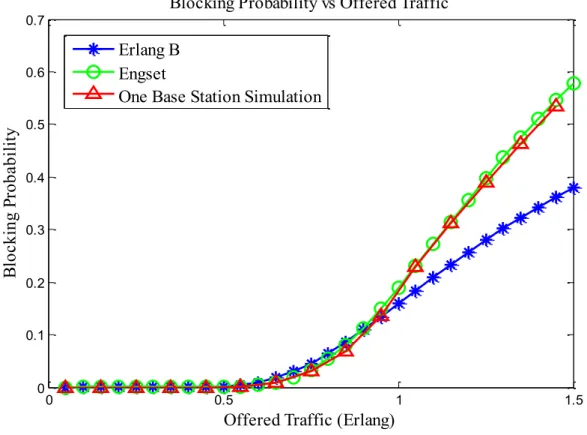
Figure 4.6. Blocking Probability as a Function of Offered Traffic. ... 82
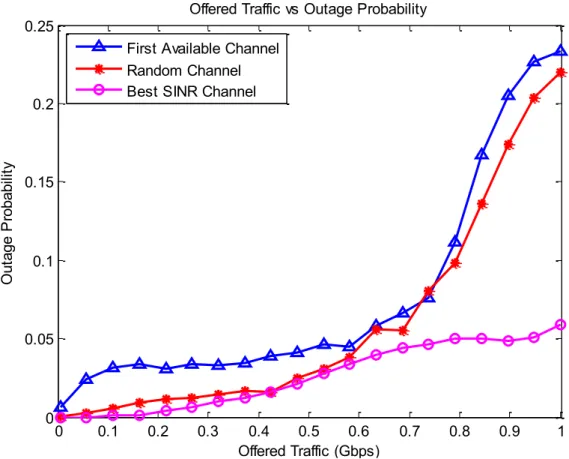
Figure 4.7. Outage Probability as a Function of Offered Traffic ... 83
Figure 4.8. Average File Delay as a Function of Offered Traffic. ... 84
Figure 4.9. System Throughput as a Function of Offered Traffic. ... 84
Figure 4.10. File delay as a Function of System Throughput... 86
Figure 5.1. The Action of a Single Grover Iteration ... 103
Figure 5.3. Flowchart of the Quantum Search (Grover Algorithm) Channel Allocation
Scheme... 111
Figure 5.4. Offered Traffic vs. Blocking Probability ... 112
Figure 5.5. Offered Traffic vs. Outage Probability ... 113
Figure 5.6. Offered Traffic vs. Delay ... 114
Figure 5.7. Throughput vs. Delay ... 114
Figure 5.8. Offered Traffic vs. Throughput ... 115
Figure 5.9. Channel Usage by Different Users (500 Events) ... 117
Figure 5.10. Channel Usage by Different Users (1000 Events) ... 117
Figure 5.11. Channel Usage by Different Users (2000 Events) ... 118
Figure 5.12. Channel Usage by Different Users (3000 Events) ... 118
Figure 6.1. Reinforcement Learning Model in a Cognitive Radio Scenario[9]. ... 123
Figure 6.3. Quantum Reinforcement Learning Algorithm ... 133
Figure 6.4. Flowchart of QRL based spectrum assignment algorithm ... 135
Figure 6.5. System Blocking Probability as a function of No. of Events for Different Values of Discount Factor. ... 137
Figure 6.6. Normalized RMSD vs. No. of Events ... 140
Figure 6.7. Normalized RMSD vs. No. of Events ... 141
Figure 6.8. Blocking Probability vs Offered Traffic ... 141
Figure 6.9. System Throughput vs Delay per File ... 142
Figure 6.11: Offered Traffic vs. System Throughput ... 144
Figure 6.12. Channel Usage by Users (500 Events) ... 145
Figure 6.13. Channel Usage by Users (1000 Events) ... 146
Figure 6.14. Channel Usage by Users (2000 Events) ... 146
I would like to express my thanks and great gratitude to the Department of Electronics and the University of York for giving me the chance and full support towards accomplishing my study. Great thanks and appreciations go also towards my supervisor, Professor David Grace for his unlimited and unforgettable support on both the scientific and personal side of the research journey. Many thanks and gratitude goes to my second supervisor Mr. Tim Clarke for his great support and inspiration.
I would like to thank the whole of my family as for my wife Dena who has been supporting me here in the UK and my beloved mother and sister, who have been supporting me with every possible way from far away back home as they always did.
My appreciation and gratitude are also for my friends in the research group for their support to me since arriving to the UK up until the end.
Many thanks go to the members of the York LJC and especially to Ben and Rachael Rich for their support to me and my family during difficult times which made carrying out the research possible.
This work has not been presented for an award at this, or any other university. All contributions presented in this thesis as original are as such to be the best knowledge of the author. References and knowledge to other researchers have been given as appropriate.
Some of the research presented in this thesis has been published. The publications are listed in the next section.
Publications
1- “A Quantum Inspired Reinforcement Learning Technique for Beyond Next
Generation Wireless Networks”, Sinan Nuuman, David Grace, Tim Clarke, Presented at IEEE WCNC 2015, New Orleans, USA
(http://ieeexplore.ieee.org/xpl/login.jsp?tp=&arnumber=7122566&url=http%3A%2F %2Fieeexplore.ieee.org%2Fxpls%2Fabs_all.jsp%3Farnumber%3D7122566)
In Preparation:
1- “Accelerated Dynamic Spectrum Access for LTE Networks using Quantum Reinforcement learning”, IEEE Transactions on Mobile Computing.
Chapter 1
: Introduction
1.1 Overview ... 14 1.2 Hypothesis... 17 1.3 Thesis Outline. ... 18
1.1 Overview
With every single year that passes, the number of the wireless enabled devices increases. These devices have created an exponential growth in the consumed data at a typical rate of 53% [1]. As a result, the infrastructure, the technology, and the intelligent schemes that tackle the capacity and performance problems within wireless networks must evolve at the same level if not better to support the growing demand.
It seems that the accomplished increase in the spectral efficiency of the 4G-based network is not enough to deliver the data rate necessary for the highest three level use cases for 5G defined by 3GPP[1]. These use cases are illustrated in figure 1.1 [1]. The ultimate goal for 5G is to provide an ubiquitous and instantaneous mobile broadband data. As a result, it is obvious that a more efficient and adaptable utilization of the radio spectrum is needed at least as an essential part of the overall solution which might also include exploring wider range of the spectrum.
The conventional licensed fixed frequency allocations have been used since the beginning of wireless mobile networks. These have become a bottleneck for more efficient spectrum utilization, under which a great portion of the licensed spectrum is severely underutilized [2]. Although the fixed spectrum assignment policy generally served well for many years, this efficiency proved to be due to limited demand in the early years. The dramatic increase in the access to the limited spectrum for mobile services later on has shown how limited these
techniques are. This increase is straining the effectiveness of the traditional spectrum policies [3-8].
The inefficient spectrum usage necessitates a new communication solution approach to exploit the existing wireless spectrum dilemma. This new networking approach is referred to as Cognitive Radio (CR) networks. It has been recognized, that, the spectrum usage is concentrated on certain portions of the spectrum while a significant amount of the spectrum remains unutilized [2, 3].
Figure 1.1. Three High Level 5G Use Cases as Defined by 3GPP and IMT 2020[1] Dynamic Channel Assignment (DCA) was proposed to solve the problem of fluctuating traffic. In a DCA scheme, instead of implementing a fixed frequency plan, all frequencies are placed into a frequency pool and made available to all users [8, 9]. The channels are then assigned on a call-by-call basis. DCA schemes are categorized as either Centralized Dynamic Channel Assignment (CDCA) or Distributed Dynamic Channel Assignment (DDCA). A centralized controller assigns channels from the available channel pool to the calls in the case
Immersive
Experience
Enhanced Mobile BroadbandImmersive
Experience
Enhanced Mobile BroadbandFor Everything
Massive Machine Type Communication
For Everything
Massive Machine TypeCommunication
Instant Action
Ultra Reliable Machine Type CommunicationInstant Action
Ultra Reliable Machine Type Communication5G
of CDCA schemes. The central controller needs to exchange a large amount of information with the base station [10-12].
In DDCA schemes, the users do not need to communicate with other base stations or any kind of central controllers. They attempt to exploit the information usually available for users to select a suitable channel [13, 14]. This thesis concentrates on the study of a fully distributed learning-based dynamic spectrum access.
Cognitive radio networks will possibly solve this problem by providing higher bandwidth to mobile users of dynamic spectrum access networks. This is done through improving opportunistic access capability to the licensed bands without interfering with the already transmitting users [9]. Learning and adaptation are two essential features of a cognitive radio transceiver. Intelligent algorithms are used to learn the parameters of the surrounding environment. The knowledge obtained is exploited by the transceiver for the purpose of choosing the appropriate frequency band (i.e., channel) for transmission as well as its own transmission parameters to gain the best possible performance. Cognitive radio improves the capability of a wireless transceiver by using software that makes the radio transceiver capable of operating in multiple frequency bands. The cognitive radio is a special type of software defined radio which is capable of adapting itself according to the all-time-changing environment. Two main elements that affect the implementation of cognitive radio in achieving the desired system performance which are: efficient learning and intelligent decision making algorithms [2, 15]. This thesis is concentrating on improving both the decision process and learning efficiency (i.e. speed) of existing learning-based schemes. Cognitive radio networks on the other hand, provided many research challenges[16]. These challenges are imposed by the existence of a broad range of available spectrum as well as the wide range of desired Quality-of-Service (QoS) requirements for different applications. These differences must be diagnosed and managed as mobile terminals move between wireless
networks within the available spectrum pool. The cognitive radio technology will enable the users to perform [3]:
Spectrum Sensing: this determines the available part of the spectrum by sensing whether a licensed user exists in case of operating within a licensed band.
Selection: selecting the best among available channels.
Spectrum Sharing: this coordinates access to the channel with other users.
Spectrum Mobility: this vacates the licensed channel to operate in another channel when a licensed user is detected.
Dynamic Spectrum Access was born as a technical concept with the launch of 3G cellular as a result of tensions that have appeared over the possibility of disruption and high cost of relocating existing users to make room for the 3G technology [17, 18]. At that point, it became obvious that the need for more spectrum will continue to rise as new technologies will keep arising.
One of the most effective techniques that has been used for solving network problems by learning through only trial and error is reinforcement learning (RL). Cognitive Radio (CR) networks have attracted research on such techniques to learn better spectrum utilization for which it has successfully been applied [19-23] in association with DSA schemes.
1.2 Hypothesis
The hypothesis of this thesis is that Quantum-inspired Reinforcement Learning (QRL) offers two improvements compared to more conventional reinforcement learning (RL) techniques. It essentially presents a significant improvement to the convergence speed. Thus, it causes an obvious improvement in system QoS, throughput performance, and system capacity. This causes a reduction in cooperation overhead and as a result the energy consumption needed in case of information exchange within other learning techniques.
Quantum reinforcement learning can offer up to one order of magnitude enhancement to convergence speed over conventional reinforcement learning techniques.
Learning techniques in general, including reinforcement learning, consist of two main parts. These are the decision making part and the learning and reasoning part. Serious efforts have been made to implement reinforcement learning techniques on a distributed level with dynamic channel assignment [9, 20-22, 24, 25]. Previous attempts to modify the reinforcement learning speed focused on the learning and reasoning part. Specifically, they dealt with the basis upon which weights or Q-values are updated and how are they calculated. This thesis focuses on the way decisions are made in the first place as well as modifying the way it is judged and analysed for a faster learning process.
The growing number of wireless devices makes reinforcement learning and learning in general less effective for the reason that learning needs time, particularly the time needed to find the proper resource allocation policy. As a result, more capacity can be gained for a communication system as high adaptability potentially supports system capacity. A one order of magnitude speed up in convergence speed offers a much shorter collision period among fully distributed learning agents within a Multi-Agent Reinforcement Learning process (MARL).
1.3 Thesis Outline.
The rest of this thesis is outlined as follows:
Chapter 2 provides background information as well as a literature review for the thesis work. An explanation of the fundamentals of cognitive radio networks and the types of radio resource management for dynamic spectrum access is presented. The literature review summarises the work that has been done on channel assignment techniques within wireless networks including the pre-cognitive radio and post-cognitive radio eras. A definition and an
introduction to the idea of reinforcement learning are also included. The advantages resulting from the application of Reinforcement Learning (RL) in wireless communication networks are illustrated. In addition, the disadvantages of Reinforcement Learning in case of large action space are referred to as well. A short introduction to the idea behind quantum computation which will be used as a modification to reinforcement learning in this thesis is included. The reasons and ideas behind proposing Quantum Reinforcement Learning instead of Reinforcement Learning (RL) are clarified. The few research works that included comparisons of Quantum Reinforcement Learning (QRL) with Reinforcement Learning (RL) are reviewed.
Chapter 3 illustrates the system modelling techniques and performance evaluation parameters used in the thesis work. The system simulation procedure is explained as well as the traffic model used within it. In addition, the parameters used for system performance measurements are all briefly illustrated. Finally, the methods used to verify the performance results are given. It gives the basis that has been used for comparison among different schemes that has been experimented in this thesis.
Chapter 4 includes an illustration of three traditional dynamic channel assignment techniques. Their merits are discussed as an introduction to understand the reason behind the viability of our newly proposed scheme later on. The architecture used for all the simulations in the thesis is explained. Details of the system architecture like the base stations, antennas and radio propagation model are specified. Finally, simulation results for the explained dynamic channel assignment techniques are given to compare them and identify their respective merits.
Chapter 5, introduces quantum computation (QC) and quantum search (QS) techniques. An emphasis is placed on the used Grover search algorithm and the theoretical idea behind it. The search procedure for the Grover algorithm and its advantage over the conventional search
methods are illustrated. An explanation for how to determine the number of Grover algorithm iterations is presented including in cases when multiple targets (solutions) exist. A theoretical explanation of the difference between classical and quantum searches is included to put the basis for the reason behind the proposal of quantum search application. Simulations for Grover algorithm based channel assignment schemes are illustrated and compared to conventional schemes as well as reinforcement learning scheme. Chapter 5, represents an essential basis for the development of the full quantum reinforcement learning scheme in chapter 6. It introduces the separation of the search process from the learning engine and develop it independently. It is the point when the advantages of two traditional search techniques can be gathered in one search algorithm. The Grover search algorithm is also applied as a spectrum assignment mechanism and compared to traditional assignment techniques from chapter 4.
Chapter 6, presents the modelling and performance simulation of the full quantum reinforcement learning scheme. An introduction to the theory and idea of reinforcement learning is given. An explanation for the version of the base reinforcement learning strategy used for comparison as well as for quantum search modification is illustrated. The results for quantum reinforcement learning technique as well as the results of other comparison techniques are presented with discussion. The ideas behind the performed modifications of the new QRL scheme over the RL scheme are explained. Differences between the QRL and RL schemes are also illustrated.
Chapter 7 presents some recommendations for future work based on the accomplishments of the thesis work. Suggestions for applications that can exploit the new ideas deduced from this thesis are presented. Chapter 8 illustrates key conclusions for the thesis chapters, and then sums up the novel contributions within the thesis work. It bullets the main ideas used in this thesis to gain the produced novel contributions.
Chapter 2
: Literature Review
2.1 Introduction ... 22
2.2 Cognitive Radio ... 22
2.3 Radio Resource Management ... 28
2.3.1 Multiple Access Techniques ... 28
2.3.1.1 Channelization Techniques... 29
2.3.1.2 Random Access Schemes ... 30
2.3.2 Frequency Band Allocation ... 31
2.3.2.1 Frequency Planning and Cell Clustering ... 32
2.3.2.2 Fractional Frequency Reuse ... 33
2.3.2.3 Multi-beam Frequency Planning ... 34
2.3.2.4 Protocol Architecture ... 35
2.3.2.5 Spectrum Utilization and Channel Borrowing ... 35
2.3.3 Dynamic Spectrum Access... 36
2.3.3.1 Dynamic Spectrum Access Scenarios ... 37
2.3.3.2 Radio Environment Map ... 38
2.3.3.3 Spectrum Sensing ... 38
2.4 Machine Learning ... 39
2.4.1 Reinforcement Learning ... 40
2.4.2 Quantum Computation. ... 43
2.5 Traditional Dynamic Channel Assignment Techniques ... 46
2.6 Intelligent Dynamic Channel Assignment Schemes. ... 48
2.6.1.1 Reinforcement Learning-based Schemes before introducing Cognitive Radio ... 48 2.7.1.2 Reinforcement Learning-based Schemes after introducing Cognitive Radio49 2.6.2 Quantum Reinforcement Learning Based Schemes ... 58 2.7 Conclusion. ... 61
2.1 Introduction
This chapter provides the background behind some of the accomplished works on dynamic spectrum access schemes in cognitive radio networks. It pictures the growing problem of spectrum allocation with the growing number of wireless devices.
For the reasons mentioned above, this chapter explains the concept of intelligent (cognitive) radio networks, and why they were put into action. It explains the principles of Radio Resource Management (RRM) techniques. It then illustrates previous works that investigated traditional spectrum assignment procedures. Later on, a review of some of the investigated reinforcement learning-based schemes is presented. In addition, some of the works dealing with quantum reinforcement learning within fields other than wireless networks that have inspired the proposal of this work are also illustrated.
2.2 Cognitive Radio
A reliable and efficient wireless communications system has always meant three important things: an efficient allocation of users to the available spectrum, while avoiding collisions as much as possible and providing minimum transmission delay.
Since the beginning of the era of wireless networks and wireless-enabled devices, spectrum allocation strategies became the core of interest among wireless network providers. This is mainly due to the fact that the number of users as well as the number of the network applications proved to be in a continuous growth. Different approaches and policies have been
proposed to tackle the problem of the apparently limited spectrum. For many years, wireless networks have been dominated by one essential strategy. This strategy is fixed frequency planning or fixed spectrum division among coverage areas. This strategy has proved to be quite restricting and limited. This is due to the limited viable solutions that are applicable to such strategies and their inadaptability with communication traffic fluctuations over vast service areas. Moreover, studies showed clearly that the available spectrum is extremely underutilized. Figure 2.1 is an example of the spectrum usage in a few places in the UK (directly reproduced from [26]). The temporal and geographical variations of the spectrum usage can be observed.
Figure 2.1. Spectrum Occupancy Measurements in a Rural Area (top), near Heathrow Airport (middle) and in Central London (bottom) (directly reproduced From [26]). The channel usage levels are represented using colours within figure (2.1). The unused frequency is represented in blue while the red is the highly used frequency. The rest of the colours represent different degrees of usage between them. The figure shows that a large proportion of the spectrum is underutilized regardless of time and location.
The next stage approach proposed later on for better allocation of the available spectrum was an open pool strategy. The whole spectrum as an open pool is offered for the whole service area. This idea has been introduced for the first time in [7, 27]. This approach was described as dynamic spectrum allocation and known also later as cognitive radio. The concept upon which cognitive radio is based is the utilization of the available spectrum by opportunistic access to the licensed bands without interfering with other existing users. The suggested definition of cognitive radio in [26] : ‘a radio system employing a technology, which makes it possible to obtain knowledge of its operational environment, policies and internal state, to dynamically adjust its parameters and protocols according to the knowledge obtained and to learn from the results obtained’. As a result, the main motivation for the idea of cognitive radio is maximizing the efficiency of the available spectrum utilization through an all-time reliable solution. The desired solution should also be able to monitor (sense) the spectrum for available windows as well as monitoring traffic loads and spectrum usage temporally and spatially. It means that the cognitive user can use more than one frequency band for transmission depending on the length of availability time of these bands. A spectrum hole or white space is the name used for the available spectrum in this case. In other words, a spectrum hole or white space is ‘ an assigned frequency band to a licensed (primary) user although at a specific time and geographical location, the same band seems to be unused by that user’ [3]. Thus, we can state that full use of the available spectrum holes (white spaces) means the utilization of the spectrum is beyond the capabilities of the traditional fixed frequency scheme plans. If a spectrum hole was requested by a primary (licensed) user while being used by a cognitive (unlicensed) user, the cognitive user shall have two options. It might either change the transmission parameters to be able to stay in the same hole without interfering with the licensed user or simply move to another spectrum hole. This process is described by figure 2.2 (directly reproduced from [3]):
Figure 2.2 . Illustration of Spectrum Hole Utilization (directly reproduced from [3]) We can deduce that a cognitive radio has to make full use of the available spectrum and should be capable of accessing the spectrum in a fully dynamic way. The two key features that make such capability a possible task are cognition and adaptation. Further details of spectrum management techniques will be discussed in section 2.3.
The most important property that distinguishes a cognitive radio system from others that implement traditional channel assignment techniques is the embedded capability of cognition. The required capabilities from a cognitive radio system makes it essential for it to sense any variations within the radio environment over a period of time or space [5]. This property is what makes the spectrum holes discoverable and utilizable. The procedure that represents a cognitive operation which is also called a cognitive cycle is shown in figure 2.3 [2]:
Figure 2.3. Cognition Cycle [2].
The three main functions that can be observed within the cognitive cycle in the figure are [3, 28-30]:
1. Spectrum Sensing: The process of determining the spectrum status as well as the activity of users by sensing the target frequency band. Further details are mentioned about spectrum sensing in the following section.
S p ec tr u m H ol e In fo rm at io n R F S ti m ul i T ra n sm it te d S ig n al Spectrum Decision RF Stim uli Radio Environment Radio Environment Cha nnel Cap acity Spectrum Anlysis Spectrum Hole Information Spectrum Sensing
2. Spectrum Analysis: The processes of utilizing the information gained from spectrum sensing. It includes scheduling the spectrum access and planning it. Knowledge about the spectrum holes (e.g. interference estimation) is gained by carrying out information analysis.
3. Spectrum Decision: It is the decision of the cognitive user of whether access the available spectrum or not. It is based on the information arising from spectrum sensing and spectrum analysis. As a result, the cognitive radio system should be able to determine available channels as well as appropriate transmission parameters [5]. All decisions should be based on the main objectives like enhancing the system performance (e.g. maximizing the throughput of the unlicensed users) and fulfilling the constraints (e.g. maintaining the interference caused to licensed users below the target threshold).
Most learning and reasoning strategies are developed and applied for the purpose of enhancing the cognition capability of communication systems. Previous studies focused on exploiting the information gained from the spectrum to produce more successful cycles (i.e. enhancing the spectrum decision part). This thesis proposes a novel learning-based approach which focuses on both enhancing the spectrum decision made by the cognitive user and the learning part as well to reduce the number of events needed to reach optimum performance. Adaptation is another important capability of a cognitive radio system [3, 6]. The system should be able to adapt itself to the changes within the wireless environment by adjusting specific parameters in the transmission operation. It is the speed of such adaptation that differentiates between one learning scheme and another. This thesis seeks a faster learning process through a novel change in the decision making process as well as new way of knowledge base updating as a key for a better adaptation.
2.3 Radio Resource Management
At the system level, the task of reducing channel interference as well as the control of other characteristics of radio transmission, is carried out through one of the radio resource management (RRM) methods [31]. These methods are essentially aimed to improve the utilization of the available spectrum and enhancing system energy efficiency. Several processes can be considered as a part of radio resource management. These processes include:
Handover
Channel allocation Power control
The work carried out within this thesis focuses on the aspect of channel allocation and improving it as a way of interference control to increase both system capacity and performance.
The ultimate goal for all algorithms that have been developed during the last decade investigating RRM [32] has been maximizing both system capacity and transmission rate and system energy efficiency. Radio resource management allows multiple users to use the same network through multiple techniques. All used techniques aim to allocate a shared available spectrum to the users who demand transmission using the system.
2.3.1 Multiple Access Techniques
These techniques have been developed as variable ways of allocating limited available spectrum within the wireless system to multiple users. In other words, these are ways of sharing the spectrum. They are based on a multiple access protocol and control mechanisms,
known as media access control (MAC). Different categories exist within multiple access techniques which are:
2.3.1.1 Channelization Techniques
This type of technique is based on dividing the available spectrum within the wireless system into frequency bands (channels). Such a division is usually done in different forms. It is one of the principle techniques that has always been used within wireless cellular systems. The channels can be allocated to multiple users. There might be multiple channels allocated simultaneously within a link in a data packet network. This is due to the fact that there could be data packets and relayed traffic in transmission simultaneously. As mentioned before, there are different forms of channelization. Four fundamental channelization techniques have been developed for the purpose of multiple accesses [33] which are:
Frequency Division: In this case, the available spectrum range is divided into multiple frequency bandss (channels). These channels are allocated to several transmitting users. Interference among neighbour sub-channels might appear in frequency division techniques. Thus, a guard band (unallocated frequency range) is used for separation. Time Division: In this case, the frequency range is not divided as in frequency
division. Instead the frequency range is divided into time periods (slots). The usage time is divided among users as time slots. In this case as well, interference might appear between neighbouring transmitters. It occurs as a result of possible delay that usually happens as a result of more than one user using the same frequency during certain portions of time divisions. Thus, guard bands are used between time slots to prevent interference.
Code Division: This kind of division has been developed to combine the benefits of both frequency and time division. Each user can fully utilize the entire spectrum in
both frequency and time domains. Spreading codes are employed to divide signals among multiple users.
Space Division: In this case, the wireless transmission coverage area is divided rather than dividing the frequency or time. Directional antennas are used in this case to connect users in different directions. The negative gain of antennas at the side lobes controls the interference. The negative side of this type of division is that narrow beam antennas are large in size and thus difficult to implement on mobile stations and small cell base stations. Thus, such division techniques are exclusively applied to backhaul networks among base stations.
Some communication systems might use more than one division technique. Time and frequency divisions are both used in OFDMA within 4G systems [34, 35]. The FP7 BuNGee is an example project that implements directional antennas on the backhaul network, which use both space division and OFDMA techniques [36].
2.3.1.2 Random Access Schemes
These schemes are used to provide distributed multiple access and flexibility in spectrum access. One of the basic random access schemes is ALOHA. It allows multiple users to transmit on a common channel. Collisions occur when users try to use the same time slot and also when random back off is performed for retransmission. ALOHA is a promising technique for its simplicity which makes it desirable for networks that require minimum implementation overheads for energy saving. The detection of the carrier before transmission of data is introduced within the carrier sense multiple access (CSMA) scheme [37].
In CSMA, a request to send (RTS) and clear to send (CTS) mechanism can be used. When a node intends to transmit, it will broadcast an RTS frame to the nodes in vicinity before transmission [38]. A reply with a CTS frame comes back from the destination node. In such a
case, any other nodes that received RTS or CTS frames will avoid sending data for a given time. The transmission is then started by the source node to send data packets to the destination node. To acknowledge the delivering of the data packets, the receiver replies with an ACK (Acknowledgement) frame. Any packet that is transmitted without having an ACK reply for it in a given time will be considered a lost packet. These CSMA mechanisms are performed by the IEEE 802.11 standard. To resend the lost packet, different schemes are used which include [38, 39]:
1-persistent: the transmitter continuously detects the channel and sends data once it is free.
P-persistent: the transmitter sends data on idle channels with a probability of p.
Non-persistent: the transmitter back off the lost packet and wait for a random time to resend.
The 1-persistent technique is considered effective at low traffic loads. However, it may cause high number of collisions at high traffic load. In this case, the non-persistent is applied instead [38].
2.3.2 Frequency Band Allocation
Within frequency band allocation (FA), the whole available spectrum is divided into multiple frequency bands. These bands are allocated to multiple groups of base stations. Each base station divides the allocated frequency band into multiple sub-channels. In other words, channelization is applied in this case on a portion of the whole spectrum of the whole system within each base station BS. In current cellular communication systems, this frequency band allocation (FA) mechanism is widely used for the purpose of spectrum management [40]. FA strategies can be divided into the following categories [38]:
2.3.2.1 Frequency Planning and Cell Clustering
Reducing inter-band interference is usually the main purpose for the use of frequency planning (FP) within FA strategies. The clustering algorithm used within GSM systems is a typical FP strategy [38, 40]. A group of adjacent cells that have all the available frequencies is defined as a cluster in this algorithm. To avoid inter-cell interference, a different frequency band is assigned to each cluster member (cell/base station). The network usually consists of several clusters where the same frequency pattern is applied to each cluster. The same band is shared by two cells in a neighbour cluster [33]. The number of cells (base stations) within each cluster determines the spectrum efficiency [38]. An example of clustering in GSM cellular networks that shows clusters divided into 3 cells is shown in figure 2.4.
The number of clusters within specific network coverage area and specific available frequency range defines the size of the cluster and as a result the bandwidth within each cell. As the number of clusters increases, the size of the cluster decreases and as a result more frequency reuse is applied. On the other hand, reducing cluster size reduces the distance between cells using the same bandwidth and as a result increases interference.
Figure 2.4. Clustering in GSM networks (3 Cells/Cluster) 2.3.2.2 Fractional Frequency Reuse
The strategy of frequency band allocation can be applied to fractional zones within the cell. A Fractional Frequency Reuse (FFR) scheme for inter-cell interference coordination has been proposed by 3GPP LTE in an OFDMA HetNet [41]. Based on the patterns of antennas of the eNBs, this scheme has been designed as omni-directional and sectored schemes as shown in figure 2.5.
With the FFR, the small cell with an omni-directional antenna is divided into inner and outer zones. Each of them has its own frequency band allocated to it. This is to make the users within the inner zones of adjacent cells capable of reusing the same frequency band. On the other hand, cluster based FA is applied on users near the cell edges within the outer zones as they receive more interference from neighbour cells. It is for this reason that, this scheme can achieve higher system capacity compared to conventional clustering based FA. This is due to the fact that the inner zone has less frequency constraints than the outer zone. The omni-directional FFR scheme has been essentially proposed for Pico or Femto cells in LTE [38].
Reuse Distance
Single Cell
Cluster
Figure 2.5. Fractional Frequency Reuse
To include all frequencies in a single cellular area, a further sectored FFA scheme has been designed. In this case, the outer zone is further divided into three sector zones using three sectored antennas as in figure 2.5-b. Each sector of the outer zone is allocated a different frequency band. As a result, the whole available spectrum range can be used within the inner cell. On the other hand each of the outer zone parts uses a portion of the frequency band used by the inner zone. This set up is used to prevent users within outer zones of adjacent cells from using same frequency bands and as a result it reduces interference [42, 43].
2.3.2.3 Multi-beam Frequency Planning
In some network architectures like the heterogeneous mobile broadband network proposed in the FP7 BuNGee project [36], directional antennas have been used to establish wireless links.
In the BuNGee project, each ABS is supported with 4 (or 2 based on locations) directional antennas within the access network. On the other hand, HBSs are supported with multiple directional antennas to connect to several ABSs within a square area in the backhaul network.
A A A A A A B B B B B B C C C C C C D D D D D D
Four frequency bands are allocated to different antenna beams on ABSs and HBSs in a special strategy that has been designed based on the antenna beams. Based on the streets to be covered and the location of the ABSs, each ABS assigns different frequency bands to four or two antenna beams. Frequency allocation for antenna beams for adjacent ABSs is coordinated to avoid interference among antenna beams covering the same street.
Four different frequency bands are allocated to a group of four adjacent antennas within backhaul network.
2.3.2.4 Protocol Architecture
The architecture where a FA strategy is used can either be centralized or coordinated or set as a distributed architecture.
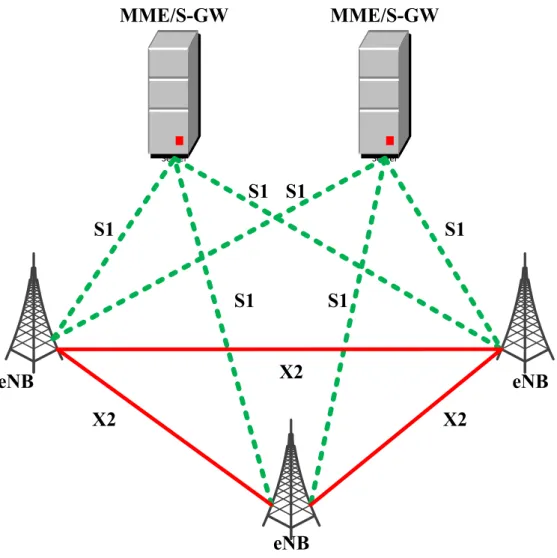
A centralized FA usually used within 2G systems. In this case, the allocation of frequency bands to different cells is done by the Radio Network Controller (RNC) [32]. The Inter-Cell Interference Coordination (ICIC) strategy has been introduced within LTE systems [44-46]. In this case, an X2 interface is employed to exchange control information among eNBs [38, 47]. The neighbouring fractional zones can achieve band separation by exchanging information through X2 links. Dynamic FA becomes essential when coordination overhead issue occurs. Such a situation appears if the topology of the network is rapidly changed. 2.3.2.5 Spectrum Utilization and Channel Borrowing
Due to the fact that the number of channels provided by FA to a single cell, zone or an antenna is fixed and constrained to the band size, a limited number of users can be supported [32]. Within highly dense networks, traffic load can be highly dynamic in density based on time and location [48]. The uniform assignment of frequency bands is therefore unable to support the traffic dynamics. Based on queuing theory, this causes the users to be blocked
[49]. Spectrum utilization becomes difficult to accomplish in the whole network to maintain adequate network performance.
To accommodate non-uniform users’ distribution and density across the network, a channel borrowing scheme has been proposed for FA. Any cell that has its allocated band fully utilized can borrow channels from neighbour or adjacent cells. Two types of channel borrowing can be recognised:
The borrowing can include all the channels in the band for temporary use.
A portion of the channels will be reserved for use in their allocated cell only. The remaining channels can be borrowed by adjacent cells [40].
To some extent, the borrowing scheme within FA can reduce blocking probability through dynamic scheduling of radio resources. On the other hand, this scheme contradicts with the principle of FA and might cause band overlap and thus loses the advantages of the FA scheme.
2.3.3 Dynamic Spectrum Access
RRM in Cognitive Radio networks has attracted a lot of research regarding Dynamic Spectrum Access (DSA) in the last few years [38, 50]. The rapid growth of wireless device users and the growing demand for high speed data transmission rate systems have brought up the belief that the radio spectrum available for wireless networks use has become insufficient for the growing demand in the recent years.
To overcome the problem of insufficient available spectrum for mobile networks, extra frequency bands have been used to support the necessary coverage. As an example, the 800 MHz spectrum band that has been used to provide coverage in LTE networks that have been deployed in many countries. This band has been used due to the fact that this low frequency range has favourable propagation characteristics [51]. On the other hand, this band is the UHF
band that is allocated to analogue and digital TV transmission in many countries as well. As a result and to make it possible to make this band available for LTE, Ofcom in the UK has to clear this band and reallocate another spectrum band for digital TV stations [52].
Thus, it has been shown that the capacity of frequency bands is inflexible as studies showed that the spectrum is not used all the time everywhere as usage depends on user locations [53]. Based on these facts, frequency band allocation mechanisms are limited in supporting high speed and high performance wireless networks.
As a result, the Dynamic Spectrum Access strategy has been introduced for further utilization of the spectrum that is still underutilized.
2.3.3.1 Dynamic Spectrum Access Scenarios
DSA has been first designed to facilitate Opportunistic Spectrum Access (OSA) [54]. It is meant to allow opportunistic “secondary users” to access the licensed spectrum occupied by “primary users”.
Reliable QoS is assured for primary users as they are given priority to use the spectrum. On the other hand, secondary users have to find unoccupied spectrum holes to be able to transmit. In addition, the occupation of secondary users for the channel is temporary and they have to release the channel when requested by a primary user. The release of the whole licenced spectrum for all users by the operators might not be possible. This is because of the greedy usage of secondary users for the spectrum that is already causing undesired interference to primary users as well as the high cost of spectrum band purchasing. Assuring a reliable QoS for secondary users is not going to be possible in this case.
Channel assignment in the case of DSA is done either by the base stations (BS) or the mobile stations (MS). As mentioned before in section 2.2, in DSA, the available spectrum is offered
as an open pool to all BSs and MSs in the network. By this, any channel can be possibly assigned based on demand to any link and released when the demand ends [55].
As there is no FP in this case, the network might suffer from co-channel interference rather than limited frequency bandwidth.
2.3.3.2 Radio Environment Map
For the purpose of supplying reliable information about available channels within the network, the Radio Environment Map (REM) has been proposed [56, 57]. It employs a dynamic database for spectrum management purposes. The database contains information on both BS locations and spectrum usage [58].
Any BS that needs to use a channel needs to search the database for empty channels first. After finding an appropriate channel and occupies it, it updates the database. The database is dynamically updated by distributed BSs, but maintained at a central server.
Undoubtedly this scheme guarantees up-to-date spectrum occupancy information that helps to limit interference. On the other hand, information exchange among distributed BSs might be excessively high. In addition, management and storage complexities might arise as the possible growth in the number of users can make the database quite large and difficult to manage and store. In REM, spectrum awareness might be used for updating spectrum information [59]. The REM with a spectrum database is a standardized technology in IEEE 802.22 Wireless Regional Area Network (WRAN) [60] and ETSI draft [61] for TV White Space wireless access.
2.3.3.3 Spectrum Sensing
DSA has attracted a lot of research for spectrum sensing within cognitive radio networks [62]. As mentioned in section 2.2, the main reason for spectrum sensing is to support the network users with information about the unoccupied channels. Channel quality is usually
checked through interference measurements. The measurements are carried out prior to data transmission. Energy detectors are used to scan the frequency bands and gather the interference power on each channel.
Decisions about channel quality are then set by the sensing entity based on a threshold interference value that reveals whether the scanned channel has sufficient SINR for transmission [63].
2.4 Machine Learning
Machine learning is a research field which studies artificial learning systems. The main interest of this field is focused on the strategies and algorithms that enhance the performance of learning agents through experience. The learning capabilities of the agents are based upon ideas from statistics, computer science, engineering, cognitive science, optimization theory and mathematics [25, 64-66]. The cognition part within cognitive radio systems is the part within which machine learning techniques are used. This thesis focuses on a learning strategy for dynamic spectrum access in cognitive radio networks, and we here attempt to illustrate a brief definition and review of the ideas behind it.
One definition for a learning process can be as in [67], as ‘the process of exploiting a set (class) of tasks T and performance measures P to gain an experience E that results in improving the performance P’. A fully complete learning process should include three main elements. These elements are: a class of tasks (target goal or output), a measuring parameter for improving performance (error rate) and a source of experience (training data or input). Based on the information used by the learning agent to learn from (training data) and their availability, we can basically categorize three main types of learning [65-69]:
Supervised Learning [65, 68]: The learning here is accomplished through a two-stage process. First, the learning agent is given the time to observe a set of inputs accompanied with a set of desired outputs (target) for them. Then, according to that
the agent learns a function that maps from inputs to outputs. Thus, in this case, the outputs are available from the environment which acts as a teacher and the target is known in advance. Such learning is mostly used for cases where the learned objective has static properties like text recognition.
Unsupervised Learning [65, 66]: Both stages of supervised learning are merged into one here. The learning agent in this case is given a set of inputs to learn through them without any support. No prior knowledge is available about the desired outputs, or rewards or punishments. In other words, the agent in this case learns depending on the inputs exclusively. Such type of learning is useful specifically when the learned objective is dynamic and changes all the time.
Reinforcement Learning (RL) [64, 69]: The agent in this case interact with the environment through selecting actions. Based on these actions, the agent receives either a reward or a punishment accordingly. The goal of the agent is to learn to maximize the future rewards (or minimizes future punishments) over its lifetime. As no prior knowledge of desired results is available here, reinforcement learning can also be categorized as unsupervised learning.
2.4.1 Reinforcement Learning (RL)
Reinforcement learning (RL) is highly distinguishable from other learning techniques by the fact that the agent starts collecting information about the learned system from scratch. Such collection is made from the results of the actions made by the learning agent. These results themselves are the measure of the quality of the learning progress [64, 69]. The knowledge required for learning is gained as the agent interacts directly with the environment in this case. Rewards are given for successful actions of the agent, while failed ones result in punishments. This means that reinforcement learning (RL) does not need an environmental model as it is trial-and-error based learning. It is therefore an attractive candidate for
distributed cognitive radio scenarios [9]. This is due to the fact that no knowledge needs to be exchanged in the case of multiple agents learning the same environment. It is also because each individual agent does not need any prior knowledge about the environment which is a concerning feature in distributed cognitive radio. The main elements of a reinforcement learning (RL) system can be identified as in [64]:
1. Policy: It is the element that defines the way of decision (action) making at a specific time in response to the gained environmental state.
2. Reward Function: It is the function that maps each environmental state to an action (or state-action pair) to a single value which is called the reward. The desirability of the action according to a specific environmental state is indicated by the given reward. Maximizing the rewards gained by the learning agent on the long run is the optimum goal in reinforcement learning (RL).
3. Value Function: It is the total amount of reward (value of the state) that the agent expects to accumulate over time starting from the specified state.
A simple model for a reinforcement learning (RL) algorithm can be mapped as in figure 2.6. It consists of the following [64]:
1. a set of possible states, represented by S; 2. a set of actions, A;
3. a set of numerical rewards R;
The learner and decision maker is called the agent. The outer part that interacts with the learning agent is called the environment.
Figure 2.6: Standard Reinforcement Learning (RL) [22]
Thus, Reinforcement Learning (RL) is a very well suited technique for cognitive radio networks. In this case, the action of data transmission interacts with the radio environment and the goal is spectrum allocation.
In Reinforcement Learning, a register or table that is referred to as Q table is setup for every state with elements representing each action. In some cases, a Q table is set up for actions only. It is when one state for the system is considered. The values within Q table indicate the desirability of different actions. In other words, they represent the probability of selecting each action. Under the policy , the action-value of a state-action pair is defined by [64]: { | } {∑ | } ( 2-1)
where stands for the reward which is associated with first taking action in state following policy . The reward value is discounted by on each state . Values
Agent
Environment Reward rt State St Action at rt+1 St+1are usually averaged over many random samples of rewards. A Monte-Carlo method is used for this purpose. The number of iterations taken in pair is what decides the degree of accuracy of Q in a static environment. The target of solving a reinforcement learning task is to find a policy that leads to the maximum possible accumulated rewards over the long run. Based on high order Q values , the improved policy for Markov Decision Processes (MDP) can be defined:
( 2-2)
In a dynamic channel assignment application of Reinforcement Learning (RL), a channel with the highest Q value that is not currently occupied will be selected.
One of the widely implemented algorithms of Reinforcement Learning (RL) Q learning. It is developed for the purpose of improving the action-selection policy for finite Markov Decision Processes (MDP). Initially Q returns pre-chosen arbitrary values . Then each time an agent selects an action, it receives a reward in a new state. The Q table is updated based on rewards from the previous state and the selected action. The action-value function is defined as [63]:
( ) ( 2-3)
where is a discount factor that is used to decide the trades off between the importance of current and previous states. is the learning rate that decides the speed of convergence.
2.4.2 Quantum Computation
As a tool that was first introduced in the 1970s, Quantum computation relies on exploiting quantum physical properties of atoms or nuclei to process information using quantum bits, or
qubits. Qubits can usually perform certain calculations much faster than classical bits [70, 71]. A qubit can exist in two basic states which are | ⟩ and | ⟩. These states correspond to the classical logic bit states 0 and 1. The difference between the quantum and classical bit however, is that, a qubit can also lie in the superposition of both the | ⟩ and | ⟩ states. As a result, when expressing a qubit | ⟩, it is reasonable to write:
| ⟩ | ⟩ | ⟩ ( 2-4)
where and are complex coefficients that represent the probabilities of the qubit laying in the | ⟩ and | ⟩ states respectively. The above representation shows a dual existence phenomenon which is called the state superposition principle. It is what makes quantum computation different from classical computation [72].
As mentioned before, a qubit normally lies in a superposition of the | ⟩ and | ⟩ states. In case of measuring (detecting) it, the result will be either | ⟩ or | ⟩. However, we cannot know whether the result will be state | ⟩ or | ⟩. The only fact that we know that we might get the qubit in state | ⟩ with probability | | , or in state | ⟩ with probability | | . These two parameters are the appearance probabilities of the qubit in | ⟩ or | ⟩ states. As a result, the sum of squared probabilities must be equal to 1 to satisfy the following equation:
| | | | ( 2-5)
In quantum computation, computational processes are carried out on the qubit using the so called unitary transformation (U). As the qubit normally exists in superposition states, the application of the unitary transformation on it means practically performing the transformation on both states simultaneously. This corresponds to the evaluation of different values of a function for different values of at the same time. Such a case is referred to as the special property of quantum computation known as quantum parallelism. This is what makes quantum computation outperform traditional computational techniques.
The idea of parallel state update is the main point of attraction in quantum computation that suggests the viability of it as an active tool for speeding up exploration phase in a reinforcement learning (RL) based algorithm. The above property suggests that we can carry out calculations with a significant speed up compared to the time it is required in case of classical computation [72]. Based on this fact, Dong and his co-workers [73-75] have presented the concept of Quantum Reinforcement Learning (QRL) inspired by the state superposition principle and quantum parallelism. Their research works included the application of QRL for robot learning.
Their proposed QRL scheme has accomplished a learning speedup due to the reduction of the number of trials needed by the agent to choose the best channel. Punishments have been restricted to only failed action selections. This has meant a smaller number of explorations by the agent. Exploration only happens in case of failed actions. Moreover, channel ranking proved to be better produced with presented QRL scheme.
The idea behind the proposed improvement in QRL which makes the difference to RL lies within the decision making process. While QRL still adopt the trial and error strategy, the decision that based on the result of this strategy is different. QRL algorithm starts by agent randomly selecting an action. Then, all later decision made by the agent are made upon channel preference. In QRL, another preference table is set up instead of Q table and works with it that is called the amplitude table. The procedure for updating the amplitude table values is explained in chapter 6. The agent in a QRL scheme keeps using a successful action and does not explore. The agent starts to explore the next preferred action within the amplitude table if the selection of the most preferred (and previously selected successfully) action has failed. This is due to the strategy that is used to update amplitude values that turns the highest amplitude value action into the lowest one in case of failure. As the exploration selections made by the agent in a QRL scheme is based on a table formed from previous
experience, success in choosing an action for exploration in this case is much more probable than in the case of RL.
2.5 Traditional Dynamic Channel Assignment Techniques
Dynamic channel assignment strategies appeared within the research literature a long time before the birth of cognitive radio. Intelligent dynamic strategies were introduced for the first time during the 1980s. The road for the birth of cognitive radio was paved through the gradual developments that improved those techniques. The following review provides an overview of the previous research work.
The first time a channel assignment process was made based on defining an interference threshold as an essential tool to improve performance was in 1989 by Akerberg [76]. The channel selection policy was based on the Least Interference Channel (LIC). That means that at the time of assignment, the channel that has the least interference power from other users using the same frequency is selected. The performance of this scheme is assisted through comparison with schemes that are based on other assignment conditions with different interference threshold settings (Non-LIC). The results showed that tighter interference thresholds enhanced the system performance. Such a conclusion was expected, as the focus was mainly on dropping probability reduction as a performance indicator. Call dropping in this paper is given 10 times the importance of call blocking. Thus, choosing better quality channels (channels with the least value of interference affecting them) definitely reduced the call dropping and as a result boosted system performance significantly.
A further study was carried out which gave both blocking probability and dropping probability equal importance for performance evaluation in [77]. In this research paper, a Local Autonomous Dynamic Channel Allocation (LADCA) with power control was proposed. The researchers showed that applying both distributed channel assignment and distributed power control combined can actually improve system performance. A conclusion