Seed Orchards –
Genetic Considerations on Function,
Management and Seed Procurement
Finnvid Prescher
Faculty of Forest Sciences
Department of Forest Genetics and Plant Physiology Umeå
Doctoral thesis
Swedish University of
Agricultural Sciences
Acta Universitatis Agriculturae Sueciae
2007:75
ISSN 1652-6880 ISBN 978-91-576-7374-9 © 2007 Finnvid Prescher, Umeå Tryck: Arkitektkopia, Umeå 2007
Abstract
Prescher, F. 2007. Seed orchards – genetic considerations on function, management and seed procurement. Doctor’s dissertation.
ISSN 1652-6880, ISBN 978-91-576-7374-9
Seed orchards are a cost-efficient way to increase future forest production. This thesis summarizes and discusses the results of eleven studies developing models and evaluating real seed orchard data to improve seed orchard management in Pinus sylvestris L. and Picea abies (L.) Karst.
When establishing a new seed orchard, not much emphasis should be put on selecting clones with high fertility, since variation in female fertility was found to be rather low and difficult to forecast. For considering active life time of a seed orchard, the possible genetic improvement is an important factor, but there are other factors such as seed production and seed harvest cost that have to be considered as well. The age at which replacement is justified seems to be 30 years for Pinus sylvestris, and 40 years for Picea abies. The age becomes shorter if forest owners are willing to pay more for genetically better reproductive material.
It is suggested that advanced-generation seed orchards in Sweden should contain 20-25 tested clones, with ramets deployed linearly with respect to breeding value, for an effective number of 15-18 clones. Even considering the complication that outcrossing pollen is more effective than selfing; the linear deployment concept is close to optimal. The linear deployment algorithm was applied to genetic thinning of two orchards, combining desires for high gain and conservation of gene diversity.
The harvesting of cones can often be started as soon as significant amounts of cones develop (typically by age eight in Pinus sylvestris), but if contaminating pollen changes the adaptability of the harvested seed, harvest may be postponed until levels of orchard pollen increase or the use of the seeds modified.
Around one quarter of the seed production occurred in the top level of the crown, half in the middle, and one quarter in the bottom. A yield of 9 kg seed per hectare is possible in Pinus sylvestris seed orchards. The cone harvest is a dominating cost which has consequences for management, e.g., orchards should be pruned in order to reduce tree height and thus lower harvesting costs.
Key words: Seed orchard, fertility variation, clone number, linear deployment, rotation age, orchard management, cone harvest, seed characters
Author’s address: Finnvid Prescher, Svenska Skogsplantor AB, Seed production, SE-34014 Lagan, Sweden. E-mail: [email protected]
This thesis is dedicated to my family, especially
my late father Max!
Contents
Introduction, 7Objectives, 11
Material and methods, 12
Seed orchard data, 12 Developed models, 13 Mathematical framework, 14
Results and Discussion, 16
Variation in fertility, 16
Seed orchard turnover, 20
Optimal number of clones, 23
Prediction of fertility prior to orchard establishment, 27
Deployment of clones to a seed orchard, 28
Thinning of seed orchards using the linear deployment algorithm, 30
Biological seed production, 31
Impact of growth and seed related characters on seed procurement, 33
Suggestions for future seed orchard management, 35
Suggestions for further research on seed orchards, 36
References, 38
Appendix
Papers I-XI
This thesis is based on the following papers that will be referred to by their respective Roman numerals:
I.Prescher, F., Lindgren, D., Almqvist, C., Kroon, J., Lestander, T. & Mullin, T. 2007. Female fertility variation in mature Pinus sylvestris clonal seed orchards. Scandinavian Journal of Forest Research 22:00-00 (in press).
II. El-Kassaby, Y.A., Prescher, F. & Lindgren, D. 2007. Advanced generation seed orchards as affected by breeding advance, timing of seed crop, and cost components with special reference to Scots pine in Sweden. Scandinavian Journal of Forest Research 22:88-98.
III.Moriguchi, Y, Prescher, F. & Lindgren, D. Optimal lifetime for Swedish
Picea abies seed orchards. (Submitted).
IV. Lindgren, D. & Prescher, F. 2005. Optimal clone number for seed orchards with tested clones. Silvae Genetica 54(2):80-92.
V. Lindgren, D., Tellalov, Y. & Prescher, F. 2007. Seed set for Scots pine grafts are difficult to predict. In Isik, F. (ed) Low input breeding and conservation of forest genetic resources. Proceedings of the IUFRO Division 2 Joint Conference. Antalya, Turkey, 9-13 October 2006. pp 139-141.
VI. Kroon, J., Prescher, F., Wennström, U. & Lindgren, D. Cone set over time for different clones in a seed orchard. (Manuscript).
VII. Prescher, F., Lindgren, D. & El-Kassaby, Y. 2006. Is linear deployment of clones optimal under different clonal outcrossing contributions in seed orchards? Tree Genetics and Genomes 2:25-29.
VIII. Prescher, F., Lindgren, D. & Karlsson, B. 2007. Genetic thinning of clonal seed orchards using linear deployment may improve both gain and diversity. Forest Ecology and Management (in press).
IX.Prescher, F, Lindgren, D., Wennström, U., Almqvist, C., Ruotsalainen, S. & Kroon, J. 2005. Seed production in Scots pine seed orchards. In Fedorkov, A. (ed) Status, monitoring and targets for breeding programs. Proceedings of the meeting of Nordic forest tree breeders and forest geneticists, Syktyvkar. pp. 65-71.
X. Bilir, N., Prescher, F., Ayan, S. & Lindgren, D. 2006. Growth characters and number of strobili in clonal seed orchards of Pinus sylvestris. Euphytica 152:293-301.
XI.Bilir, N., Prescher, F., Lindgren, D. & Kroon, J. Variation in seed related characters in clonal seed orchards of Pinus sylvestris. (Manuscript). Publications I, II, IV, V, VII, VIII, IX and X are reproduced with the kind permission of journal publishers.
Introduction
Seed orchards are today the link between the breeding population and the production forest of conifers in Sweden, where genetic gain is realized in merchantable wood harvest. A seed orchard is an operation requiring considerable investment; one hectare of Pinus sylvestris L. seed orchard in Sweden is estimated to cost about 23 000 € to establish, including the first five years of management (Rosvall et al., 2003). It is important that the orchard functions well, producing as much seed as possible while at the same time efficiently transmitting genetic progress from the breeding population to the forest. A seed orchard that does not produce seed is a failure, not only for the company that owns it, but also for society that loses improved material and the possibility for greater forest production in the future. Furthermore, a non-functioning orchard does not produce income that could fund future seed orchards.
The concept of grafted conifer seed orchards has a long history. The first development in Scandinavia was by Syrach Larsen in Denmark, about 70 years ago (Larsen, 1934; Larsen, 1956). The concept was brought to Sweden by Holger Jensen (Jensen, 1942, 1945) and a large seed orchard program was launched. To make grafts on a large scale was a slow procedure; the selected plus trees in the natural forest were old, producing small numbers of scions that were not very vigorous. It was more feasible, albeit time consuming, to first establish a few grafted plants and then to collect more vigorous scion materials from these. A number of small graft archives and experimental seed orchards were established. The development of orchards in Denmark was hampered by the enemy occupation and the urgency to rebuild after World War II. Sweden on the other hand was less affected and could immediately accelerate its established tree breeding program, stimulated by the large timber demand for rebuilding Europe, where Sweden was the major unharmed supplier. The first full-scale conifer seed orchard in Scandinavia was established 1949 in Drögsnäs at Brunsberg in Värmland (Anonymous, 1962). Many of the guidelines suggested by Larsen (1934) are still used today when establishing new seed orchards in Sweden.
The first round of seed orchards in Sweden was established in the 1950s and 1960s with clones from selected plus-trees. These have produced improved seeds expected to increase volume production by 10% (Rosvall et al. 2002). The most recent reliable Swedish figures suggest that Scots pine plus-tree progenies in northern Sweden produce a stem volume 18.9% greater than unimproved seed at an average age of 27.4 years (Andersson et al., 2007). Jansson (2007) found 12% higher volume growth for Scots pine in southern Sweden at age 26-36. These figures support the final rotation estimate of 10%, if the volume increase is interpreted as a site index increase and growth curves are followed to full rotation age. The second round seed orchards, established during the 1980s and composed of both untested and tested clones, are expected to give genetic gains in the magnitude of 10-25% in height growth (Rosvall et al., 2002). Now, a third round of seed orchards is under establishment with tested clones, and is predicted to produce progenies with about 25% greater production than unimproved seedlots.
Management of a seed orchard involves decisions that have implications for the development of forests long into the future. Today, about 60% of plants delivered from Swedish forest nurseries originate from seed orchards, and this figure is rising. Improving seed orchards is the most cost-efficient way to increase future seed production and sustainable harvests from forest plantations. Seed orchard seeds produce faster and more even germination in the nursery, and more uniform seedling crops (Wennström, pers. comm. 2007). Barnett (1996) ascribes this, not only to the genetic superiority of the clones, but also to the more intensive management of an orchard. Seed orchard seeds are more reliable and predictable that forest stand seeds. Furthermore, selfing is more common in wild stands than in seed orchards (Kjær, 1999), which also affects the uniformity of seedling performance. Factors such as the desire for increased timber production and increasing utilization of biomass for replacement of fossil fuels are reasons for a growing interest in improved seed. Consequently, a programme for establishing new seed orchards called the “third round” (Rosvall & Eriksson, 2002) has been inaugurated in Sweden. At least 360 hectares of new seed orchards for Pinus sylvestris and Picea abies are planned for establishment during the next decade, some of which have already been planted in recent years.
Clonal forestry is sometimes envisioned as an alternative to seed orchards in Sweden, but currently it is used in a very small scale. Much less than a percent of forest seedlings produced and used are currently cuttings. The use of clones up to year 2000 was reviewed by Sonesson et al (2001), but has declined since that in Sweden. Some trials are currently established with clones produced by SE-technology by some companies, but it will take more than a decade until it is evaluated and production in a commercial scale may be an option (Rosvall, 2007). Clones of Salix are used for production of bio energy products, but not on what is regarded as forest land. The total use is in the magnitude of 15000 ha (Gustafsson, Larsson & Nordh, 2006).
The genetic composition of a seedlot is important. Genetic gain, avoidance of inbreeding depression and genetic diversity are essential, and these may be affected, negatively or positively, by factors like self-fertilization, inbreeding, relatedness among parents, pollen contamination, spatial distribution, flowering phenology and synchrony, as well as male and female fertility. To handle calculations, reference is often made to an ideal situation. This however seldom occurs under natural conditions, but is useful as a theoretical reference point or to make calculations about magnitudes manageable, and thus more in accordance with general knowledge and more transparent. The ideal situation entails no pollen contamination, no selfing and otherwise random mating, Hardy-Weinberg equilibrium, no linkage disequilibrium, no inbred or related clones, and equal gamete contributions from all clones to the seed crop.
The location of a seed orchard has been widely discussed. In early years, this discussion focused on where highest seed yields could be obtained; later, attention shifted to the genetic consequences of locating a seed orchard outside its target utilization area. The production of seed is limited by harsh climatic conditions at
high altitudes and latitudes, and a southward transfer of seed orchards has been advocated by numerous authors (Wright, Lemmien & Bright, 1966; Sarvas, 1970; Molotkov, Patlaj & Davidova, 1982). Mátyás (1991) summarized the expected advantages as:
- accelerated initial development and increased cone production; and - phenological isolation from local populations as temperature sum
requirements for flowering of different sources are dissimilar.
It has been shown, since the onset of flowering varies among clones (Jonsson, Ekberg & Eriksson, 1976), that contaminating pollen from surrounding stands can decrease the hardiness of offspring and change the seed crop’s degree of adaptation (Pulkkinen, Haapanen & Mikola, 1995; Nikkanen, 2002). Furthermore, as pollen contamination can vary over time, both in quantity and quality, contamination from a source with different adaptation reduces the predictability of orchard seed performance. Owens et al. (2001) pointed out a number of negative effects of a southern location, such as environmental preconditioning and genetic aftereffects. These have been demonstrated to occur in Pinus sylvestris
(Andersson, 1994), Picea abies (Skrøppa & Johnsen, 1994; Johnsen et al., 1995, 1996), Picea glauca (Stoehr et al., 1998) and Larix laricina (Greenwood & Hutchinson, 1996).
A rather high level of pollen contamination is something forestry and seed orchard managers have to tolerate for Pinus sylvestris and Picea abies in Sweden. It reduces the genetic gain, but provides some assurance that the orchard seeds originate from a large number of parents, representing many gene variants. Several studies have been conducted to estimate levels of contamination in Pinus sylvestris
seed orchards, with reports between 2 and 74% (Müller-Starck, 1982; Nagasaka & Szmidt, 1985; El-Kassaby Rudin & Yazdani, 1989; Harju, 1995; Wang et al. 1991; Pakkanen & Pulkkinen, 1991; Yazdani & Lindgren, 1991; Paule & Gömöry, 1992; Harju & Nikkanen, 1996). For Picea abies, levels between 43 and 71% have been reported (Paule, Lindgren & Yazdani, 1993; Pakkanen, Nikkanen & Pulkkinen, 2000). Nikkanen (2002) showed that pollen contamination can be reduced if a Picea abies orchard is exposed to more sunlight. Kang (2001) concluded that pollen contamination often exceeds 30-40%, even in mature conifer seed orchards. The latest estimate for Swedish conditions is 30-50%, sometimes even extending to 70% (Almqvist, 2007). Also foreign investigations using modern molecular markers point on high number rates of contamination, compatible with the Swedish estimates (e.g. Moriguchi, 2005). Contamination levels in the order of 50% decrease the genetic gain of seed orchard crop by about 25%. Throughout this thesis, a value for pollen contamination of 50% is used as a standard assumption when relevant.
Early contamination estimates are predominantly based on isozymes, which give some room for different interpretations and require rather large “corrections” for non-detected contaminants. It is now possible to make more accurate and precise estimates with molecular tools, and perhaps the estimates will be somewhat modified downwards.
The most natural way to decrease pollen contamination is to locate a seed orchard rather far away from other stands of the same species. This is not so easy, as windborne pollen can travel as far as 2 000 km (Koski, 1987). In Sweden, where seed orchards are normally pruned, it is thought that by not pruning to reduce the height of two or more border rows around the orchard, a “protective curtain” can be created. The border rows can also act as pollen producers, even if their seeds are not normally harvested due to higher collection costs. It has been shown by Yazdani & Lindgren (1991) and Nikkanen (2002) that pollen contamination is reduced on the lea-side as well as in the centre part of the orchard compared to the edge, indicating that these border rows are beneficial. Thus, the larger the seed orchard is, the less impact contamination has on the seed crop. As an alternative, the border can be planted with a non-orchard species, which may help to filter out some of the alien pollen (Mátyás, 1991).
The negative effects of pollen contamination can be reduced or eliminated by adding pollen, and this can also manipulate the balance of parental contributions. So-called “supplemental mass pollination” (SMP) has been widely described in the literature (e.g., Franklin, 1971; Eriksson, 1996), but has not been applied to a great extent, due to limited success and high cost. Controlled mass pollination (CMP) is more expensive than SMP, since the female strobili must be isolated and pollinated artificially, but this provides seeds with much-improved genetic quality (Bridgwater et al., 1998). CMP is today used in some south-eastern US Pinus taeda seed orchards as a standard procedure for more than 3 per cent of the plant production (McKeand et al., 2007). In New Zealand Pinus radiata seed orchards are established as controlled pollination orchards today; the produced seed is then usually amplified by vegetative propagation (Sweet, 1995). One further step is to asexually propagate elite genotypes by somatic embryogenesis (SE). A thorough review of this technique and its application to practical forestry is given by Nehra et al. (2005). In Europe, however, seed orchards are often only seen as the main source of forest tree germplasm, providing stable and sufficient seed production at a reasonable cost (Giertych, 1987). The rotation times of forests in Europe are longer and the willingness to pay for the additional gain much less than, say, the south-eastern US. It is thus likely that SMP, CMP, and SE will not have an impact on practical conifer seed orchard management in Sweden, at least not in the foreseeable future.
Clone-wise harvest and planting of only the best, open-pollinated (OP) families can dramatically increase productivity of forest plantations. Today, 59% of Pinus taeda and 43% of Pinus elliottii are deployed to plantations as half-sib families in the south-eastern US (McKeand et al., 2007). However, this is only possible if there is a surplus of seed, which today is not the case in Sweden.
Seed orchards have become the main suppliers of seed, not only for nursery production, but if there is a surplus of seed, also for direct seeding in the boreal forest. In this case, it is not only the genetic superiority of orchard seeds that matters, but perhaps even more important is their physiological advantage (Wennström, 2001). The current trend is to replace natural regeneration of Scots pine with seeding of genetically improved seed (Ahtikoski & Pulkkinen, 2003).
This has encouraged selective harvest from seed orchards to produce a genetically best fraction for use in nurseries, and a second fraction for direct seeding.
Objectives
This thesis deals with factors influencing the seed crop from clonal seed orchards of Pinus sylvestris and Picea abies, with the overall goal of improving their efficiency. The specific objective is to give the seed orchard manager tools to assist in management decisions based on both developed models and real seed orchard data. The following questions are discussed:
1) How great is the variation in female fertility in a mature seed orchard, and what impact does this have on the composition of the seedlot? (I) 2) When should a seed orchard be replaced by a new one and what factors -
including genetic progress in long-term breeding - are most important for this decision? (II, III)
3) What is the appropriate number of tested parental genotypes in a seed orchard, and what are the relevant factors to be considered in its determination? (IV)
4) Is it possible to predict the seed production ability of clones and to use this information when establishing a seed orchard? (V, VI)
5) How can genetic gain and gene diversity be combined in an efficient way through the establishment of clones in a seed orchard or during genetic thinning? (VII, VIII)
6) What potential seed production can be expected and how variable is it? (IX, X)
7) What variation in seed-related characters can be expected and what impact has this on seed procurement? (XI)
Materials and methods
The material used in the thesis is of two types: a) seed orchard data, collected by the authors (I, V, VI, IX, X, XI) and/or extracted and analysed from the published work of others (I); and, b) models developed using real data or data estimated from best knowledge (II, III, IV, VII, VIII). This section gives a brief summary of the materials and methods used in the different papers; for detailed information, please refer to the respective paper.
Seed orchard data
In paper I, data on cones and seeds per ramet from six Swedish, two Finnish, one American and one Polish mature Pinus sylvestris seed orchard were used to describe clonal variation in female fertility. From five of the orchards, records for two or more consecutive years were available. Variance components were estimated by ANOVA or restricted maximum likelihood using ASReml (Gilmour et al., 2002) for among-clone variation, among-ramet-within-clone variation, and clone-by-year interactions. The variance components were used to calculate the sibling coefficient, Ψ (Kang, 2001. The variance components were standardized to a ramet mean of 100, which can be seen as a percent average scale, to facilitate comparisons among the datasets.
The cone set in a clonal archive was compared to that for the same clones in four
Pinus sylvestris seed orchards (Skaholma, Robertsfors, Klocke and Sävar) and some clone trials in paper V. Correlations between observations in the clonal archive and the seed orchards, and gain possible by selecting the top-ranking cone producers in the archive, were calculated to estimate how efficient it is to consider estimates of clone fertility as criteria for seed-orchard inclusion.
Paper VI studied the relationships among cone set for different clones at different times. Records of cone set for years 11 to 30 in an experimental Scots pine seed orchard at Sävar (latitude 64˚ N) were used.
In study IX, data from five Scots pine seed orchards in central and northern Sweden were used, as well as those from the experimental seed orchard (paper VI). The age of the orchards was between 20 and 41 years at time of assessment. Per-unit-area seed production was calculated for these orchards. The following characters describing female fertility were assessed at two seed orchards (Långtora and Skaholma): number of filled seeds; weight of filled seeds; volume of cones; number of cones; and seed weight. Furthermore, numbers of cones were counted from the ground to estimate the accuracy of such visual assessments. The variation (CV) among grafts was calculated for the aforementioned characters.
Data from three Turkish Pinus sylvestris seed orchards between 12 and 21 years of age were used in papers X and XI. In X, the characters studied were: number of male and female strobili; length of the trunk below and above the longest branch; total height; diameter at base and breast height; crown diameter; and number of
branches. Variation, broad-sense heritability (H2) and correlations between characters were estimated. In paper XI, cones were counted and collected on three grafts, chosen at random from 14 to 25 clones in each orchard, and from three heights above the ground. The cones were assessed for: number; diameter; length; form; fresh weight; dry weight; percentage of moisture; number of filled seeds per cone and per graft; number of total seed per cone and graft; and percentage of filled seed per cone and graft. Variance components were calculated for the characters using ANOVA and H2 was estimated. Genetic and phenotypic correlations were estimated using ASReml (Gilmour et al., 2002).
Developed models
A model was developed in paper II to study and evaluate various biological, genetic, economic and management factors associated with advanced-generation seed orchard establishment using parameter estimates for Pinus sylvestris in Sweden. The factors considered were: planting density; rate of genetic advance in the breeding population; timing of first seed collection; seed value; seed production cost; orchard rotation age; and pollen contamination level. The model was formulated as a Microsoft Excel spreadsheet, where different inputs were tested to optimize rotation age and age of first cone harvest. The model was also applied in a simplified form to Picea abies in paper III, with some factors regarded as unimportant for spruce. The programme and model itself is applicable to a wide range of species, seed orchards and situations, but the specific inputs and applications must refer to actual data or case-specific estimates. The worksheets are currently available on the website managed by Dag Lindgren: http://www-genfys.slu.se/staff/dagl/index.htm .
A model is constructed in paper IV to maximize a goodness criterion or “benefit” for seed orchards. This can be seen as an effort to express “value for forestry” in a single quantity and to optimize the number of clones to be included in seed orchards. The benefit is a function of:
- number of tested genotypes available for selection; - number of top-ranking clones planted in seed orchard; - contribution to pollination from:
o the ramet itself; o the closest neighbours; o the rest of the orchard; and
o sources outside the orchard (contamination);
- variation among genotypes for fertility;
- variation among genotypes in “value for forestry” - efficiency of self pollination;
- production of selfed genotypes (reduction in “value for forestry”); - gene diversity (expressed as Status Number);
- the “value for forestry” of gene diversity; - genetic variation among the candidates;
- correlation between selection criterion (e.g., height in progeny test) and “value for forestry” (e.g., production in forests from the orchard); and - the number of top-ranking ones clones harvested.
Appropriate values for these factors were established for two scenarios (one for
Pinus sylvestris in Sweden and a second for Pinus taeda in the south-eastern USA) and the number of clones for a seed orchard was optimized.
Paper VII presents a theoretical framework considering the influence of outcrossing pollen frequency on differences in reproductive success of clones and how this should influence the deployment of clones. Formulae for effective clone numbers are presented based on the number of gametes produced by the clones as well as the number of successful gametes (“outcrossing effective number”). The Excel tool ‘Solver’ was used to search for optimal clonal contributions. This tool was applied to different effective clone numbers, with the algorithm searching to maximize genetic gains.The model was also applied to a real case to optimize the establishment of a clonal Picea abies seed orchard, where the breeding values of 161 candidate clones were known, and the model results compared to linear deployment.
In paper VIII, two Swedish Picea abies seed orchards were genetically thinned using linear deployment. The linear deployment algorithm was first presented by Lindgren and Matheson (1986), and later developed for application to genetic thinning by Bondesson and Lindgren (1993). One operation was a seed orchard in Lagan (latitude 57˚N), which was established with cuttings (a selection of clones referred to in paper VII) at a dense spacing. Since the establishment of this orchard was with left-over cuttings from a clonal forestry programme, there are huge differences in number of ramets from each clone. The seed orchard was thinned in 2006, using breeding values (Boije, 2001) as inputs in the algorithm. Another thinning operation was applied to an old grafted seed orchard at Maglehem (latitude 56˚N), originally composed of 36 clones. Breeding values were obtained from measurements in four progeny trials, using the BLUP technique. The orchard was genetically thinned 1994 with the linear deployment algorithm.
Mathematical framework
Some of the formulae presented in the original papers, and which are essential for the transparency of this thesis, are presented below.
The sibling coefficient,Ψ, expresses the probability that successful gametes (“sibs”) will originate from the same parent compared to the case with no differences in parental fertility. The concept was introduced in Kang and Lindgren (1999):
∑
==
N i ip
N
1 2ψ
where N is the census number of the parents; and p is the probability that a gene in the offspring originates from parent i. The sibling coefficient is a probabilistic interpretation, where the corresponding variance interpretation is expressed by the
coefficient of variation (CV) for fertility. The relationship between them can be formulated
1
)
1
(
2+
−
=
N
N
CV
ψ
The sibling coefficient cannot be less than 1. If Ψ = 1, all individuals have the same fertility; if Ψ = 2, it means that the probability that two randomly drawn successful gametes share the same parent is twice that where fertilities are equal across the population. A sibling coefficient Ψ=2 also means that variable fertility among clones can be compensated for by choosing twice as many as the desired number of clones with equal fertility.
Sibling coefficient can be seen as a part of a larger theory including the concepts of status number and effective number of clones and effective number of seed crops. These concepts and theories and the relation between status number and the “classical effective numbers” as well as to gene diversity are described and discussed in more detail e.g. by Lindgren & Kang (1997), Lindgren & Mullin (1998) and Kang (2001).
Part of the theory of the relation between female and male fertility relating to their correlation is dealt with by Kang & El-Kassaby (2002). Often the variance in total fertility is lower than either female or male taken separately.
Broad-sense heritabilities for female fertility were calculated as:
R C C
VC
VC
VC
H
+=
2where VCC is the variance component among clones in an individual year; and VCR is the variance component among ramets within clone and year.
Broad-sense heritability is somewhat doubtful as concept. There are many reasons clones may behave differently in a seed orchard, and all of them are not genetic. Seed orchards are usually not regarded as randomized experiments, thus less effort has been done to manage ramets from different clones equally, than in an experiment. Scions of different clones may be harvested at different times and on different objects. The physiological state of the mother tree may be reflected in its grafts; grafting is typically done clone-wise; the root-stocks may be different for different clones; clones may be grown together in the nursery; different clones may be planted at different years. All these differences may have effects which appear as clonal differences, and are interpreted as genetic differences when broad-sense heritability is estimated. It is thus likely that the actual broad-sense heritability is somewhat lower than expressed here. It might have been better to talk about clonal repeatability instead to consider this difficulty. Even the genetic variation among clones is likely to be exaggerated of this reason; it does not matter so much as long as it is just a question about the actual fertility differences within a seed orchard, but may be more disturbing in other connections.
Results and Discussion
Variation in fertility
Fertility variation is an important factor in evolution, and thus deserves much attention from a basic scientific point of view.
Some of the data here may be relevant for that, but the emphasis in this thesis has been from a seed manager’s point of view. For an orchard manager, there are several reasons to consider fertility of female parents before that of male parents: 1) seeds are the source of income from a seed orchard; 2) cones and seeds are used to audit the operation; 3) about two-thirds of the tree improvement effect comes from the seed parents as half of the pollen parents are outside the seed orchard; and 4) seeds from a known tree can be harvested and counted, which can be considered as the exact number of successful female gametes of that parent, while male gamete contributions are more tricky to estimate. About half of the male gametes do not origin from the seed orchard at all. Even if molecular techniques are available today to determine the pollen parent (Buiteveld et al., 2001; Moriguchi et al., 2004; Hansen & Kjær, 2006), they are laborious and costly, require much competence, are somewhat inaccurate, and can be done only for a limited amount of material by an organisation with good resources.
Variation in genetic contributions to seed crops depends of course also on male fertility. Paper X gives some estimates about the variation in male strobili. The variation among clones for male strobili was low and similar variable as the female. The numbers of male and female strobili were positively correlated. Furthermore, both the numbers of male and female strobili increased with the stem diameter of the ramet. Thus it seems reasonable that male and female fertility are correlated in rather young seed orchards, as both depend on the size of the graft. Savolainen et al. (1993) investigated mature seed orchards (study I uses some of these data) and reported negative genetic correlations (rg= -0.135 to -0.593) between male and female fertility. Negative correlation between male and female tends to make reproduction more equal among genotypes and reduce the total fertility variation (Kang & El-Kassaby, 2002). Considering the large uncertainties in estimates of male fertility variation regarding statistical error and methodology, it seems likely that much of negative correlations found are non-significant noise or caused by special circumstances with limited general significance. Kang et al. (2003) found that variations in fertility are similar for both genders but it seems to be somewhat smaller for male than for female fertility. Kang & El-Kassaby (2002) reported a weak positive correlation between male and female fertility. These observations support that the fertility variation among trees and clones can be somewhat, but not much, smaller if both female and male fertility variations are considered compared with only female. If 50% of the pollen is contamination, the fertility variation on the male side of seed orchard clones is much reduced in the seed crop compared to among the clones. Thus it seems likely that fertility variations in seed orchard crops usually are smaller if both genders are considered than what this thesis focus on - female fertility variations.
An extensive review of fertility variation in forest trees was done by Kang et al. (2003), including conifer clonal seed orchards. As a rule of thumb, it was suggested that the variation among clones typically corresponds to a coefficient of variation CV=1 and sibling coefficient Ψ=2. The variation in fertility seemed to be higher in young seed orchards and in years when seed production is low. These suggested values, or calculations based on them, probably overestimate the relevant variability in seed productivity per ramet among clones. Variation among ramets within clones combined with small ramet samples, interaction between years and clones, scale effects, differences among clones in the relationship between observed female strobili and final yield of good seeds, probably all contribute to overestimates of clone variability. Additionally, the ambition to express a rule of thumb with a numerically simple but somewhat upward truncated value and a smaller variation in seed production in mature seed orchards and in good seed years than reported in the experiments reviewed, also contributes to this overestimate.
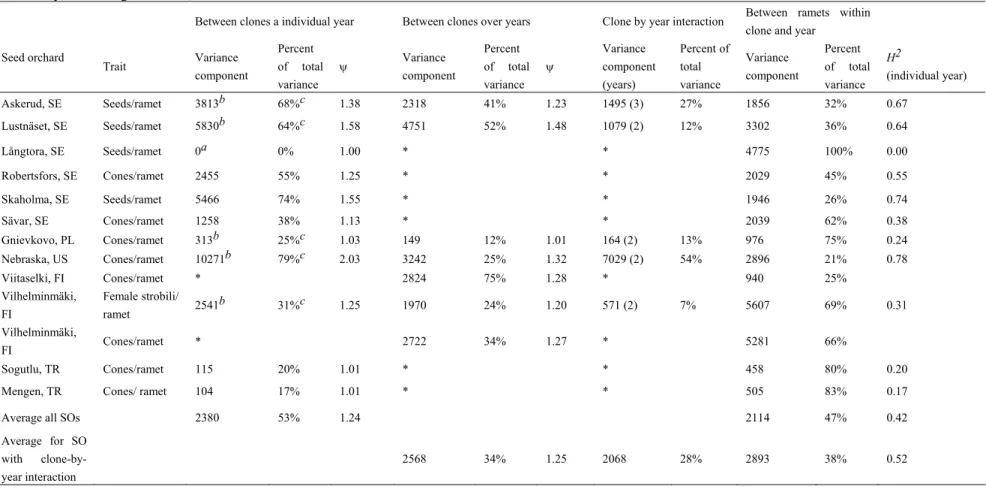
Variation in female fertility, assessed by the number of cones per ramet or seeds per ramet, in mature Scots pine seed orchards was found to be less than expected when the study was initiated (I). The variation among clones is of the same magnitude as variation among ramets within clones. The average sibling coefficient, Ψ, was 1.35 among clones in single years, and 1.26 among clones over years, which is much lower than the rule of thumb suggested by Kang et al. (2003). Table 1, based on a similar table in paper I, includes additional data that became available from the two mature seed orchards reported in paper XI. When the variance components from these Turkish seed orchards are included, the sibling coefficient decreases even more among clones in single years, Ψ=1.24. The rather low among-clone variation is somewhat surprising; it does not seem to be in accordance with casual observations, common opinions or earlier studies (e.g., O’Reilly, Parker & Barker, 1982; Schmidtling, 1983; Matziris, 1993). In this case, the seed orchards are mature, i.e., they have reached an age when there is abundant flowering on most of the orchard trees (c.f. VI). This decrease in variation as a seed orchard ages is also supported by the studies of Byram, Lowe & McGriff (1986). The trees have also generally been pruned, so they are similar in size. The rather low variation suggests that seed production in a seed orchard is not expected to increase to a large extent if clones that seem to be characterized by low cone production are avoided during orchard establishment.
Clone-by-year interactions between adjacent years were found to be significant, but were slightly lower (about 80%) than the among-clone variation (I). In paper VI, the results indicated that the interactions in cone set between adjacent years were even lower, and decreased as the orchard trees aged.
The effective number of clones in a seed orchard can be expressed as the census number divided by the sibling coefficient, Ψ. In a seed orchard with 40 equally deployed clones (same number of ramets) and Ψ=1.24, the effective number of clones will be 40/1.24 ≈ 32. The typical variation in fertility among clones results
in the effective number of clones being 20% lower than the census number, in a seed orchard where clones are equally represented.
In a seed orchard there are at least two factors which increase the sibling coefficient (and thus decrease the effective number and gene diversity) than given in Table 1. The first factor is that there are a limited number of ramets of each clone and a variation among these ramets. Thus, there will be a variation among different samples of ramets. As most seeds in a seed orchard crop come from clones with many ramets (the magnitude 50) in Swedish conifer seed orchards this effect can usually be assumed to be small. It will be smaller in future seed orchards which will have more ramets of fewer clones (c.f. study IV). Another, quantitative more important, factor is that ramet number varies among clones (Kang et al., 2001), and thus have impact on the fertility variation among clones in a seed orchard.
This implies that the seed crop will seldom be dominated by progenies from a few clones, especially not over the harvest of several years, and that fertility variation among clones seems to reduce “gene diversity” of seed orchard crops less than was earlier suggested (Matziris, 1993; El-Kassaby, 1995). These results agree with those reported for Picea glauca (Moench) Voss and P. engelmanni Parry ex Englem. by Stoehr et al. (2005). The variance component among clones in single years describes how much gene diversity a customer receives when using a commercial seed crop, whereas the average clonal variation in seed production over several years is more relevant to the gene diversity over the whole forest area regenerated with seed from an orchard.
Table 1. Variance components and percentages of total variance for cones/ramet, seeds/ramet and female strobili/ramet (values standardized to ramet mean = 100), broad-sense heritability, and sibling coefficient, Ψ.
Between clones a individual year Between clones over years Clone by year interaction Between ramets within clone and year
Seed orchard Trait Variance component Percent of total variance ψ Variance component Percent of total variance ψ Variance component (years) Percent of total variance Variance component Percent of total variance H2 (individual year) Askerud, SE Seeds/ramet 3813b 68%c 1.38 2318 41% 1.23 1495 (3) 27% 1856 32% 0.67 Lustnäset, SE Seeds/ramet 5830b 64%c 1.58 4751 52% 1.48 1079 (2) 12% 3302 36% 0.64 Långtora, SE Seeds/ramet 0a 0% 1.00 * * 4775 100% 0.00 Robertsfors, SE Cones/ramet 2455 55% 1.25 * * 2029 45% 0.55 Skaholma, SE Seeds/ramet 5466 74% 1.55 * * 1946 26% 0.74 Sävar, SE Cones/ramet 1258 38% 1.13 * * 2039 62% 0.38 Gnievkovo, PL Cones/ramet 313b 25%c 1.03 149 12% 1.01 164 (2) 13% 976 75% 0.24 Nebraska, US Cones/ramet 10271b 79%c 2.03 3242 25% 1.32 7029 (2) 54% 2896 21% 0.78 Viitaselki, FI Cones/ramet * 2824 75% 1.28 * 940 25% Vilhelminmäki, FI Female strobili/ ramet 2541b 31%c 1.25 1970 24% 1.20 571 (2) 7% 5607 69% 0.31 Vilhelminmäki, FI Cones/ramet * 2722 34% 1.27 * 5281 66% Sogutlu, TR Cones/ramet 115 20% 1.01 * * 458 80% 0.20 Mengen, TR Cones/ ramet 104 17% 1.01 * * 505 83% 0.17
Average all SOs 2380 53% 1.24 2114 47% 0.42
Average for SO with clone-by-year interaction
2568 34% 1.25 2068 28% 2893 38% 0.52
*) no observation; a) non significant negative variance component set to 0; b) the value is given when there are observations for several years and is the sum of the variance component between clones over years and the variance component for interaction; c) is the sum of the percentage of variance component between clones over years and the percentage of the variance component for interaction
Seed orchard turnover
Long-term breeding successively increases genetic gain in the breeding population, such that seed orchards become genetically outdated (Nanson, 1986; Williams & Askew, 1993; El-Kassaby, 2003), as the gain from a new seed orchard will be considerably greater. The manager must decide when to establish a new seed orchard, and the critical factor may be additional genetic gain, rather than biological or management problems with existing orchards. There are several biological, genetic, economic and management factors to be considered to optimize seed orchard turnover. A model was developed to evaluate the benefit of various options to enhance and give support for such decisions. The options and variables included in the model are:
- seed orchard area (size); - planting density of the orchard;
- type of orchard material (grafts, cuttings (III)); - establishment and management costs;
- cone harvest (and its dependence of tree height) and seed processing costs;
- development over time of the seed orchard crop; - rate of genetic progress in long-term breeding;
- genetic penalty, representing the gain differential between the seed orchard and a hypothetical new orchard incorporating the latest genetic progress in the breeding population;
- impact of pollen contamination;
- how the genetic quality influences the value of the seeds; and
- the orchards productive lifespan (from establishment to the last year of operation).
The model appear to deal with an individual seed orchard, but actually it deals with a permanent seed supply programme which is planned to last forever, and is a part of such a programme. It could be seen as new small seed orchards started every year covering an equal share of the seed need, thus the manager works at no specific age of seed orchard. But it makes it easier to develop the model by regarding it as a single seed orchard. The application of the model in II and III meets an annual seed need from forestry. There are annual income and expenses, and the aim is to maximize the profit, i.e. the difference between income and expenses. The model does not calculate the monetary value of improved seed, it just evaluates the consequences for seed orchard establishment. The monetary value of improved seeds as a function of their genetic value have been analysed in other independent calculations (e.g. Ahtikoski & Pulkkinen, 2003) and are not a part of this model. The model does not include interest and should thus not be seen as an investment calculus. It aims at developing tools for those responsible for seed orchards, to act in the best way. Income or expenses can be seen as occurring at the same time as all phases and ages are considered. Thus it may not be motivated to correct for that they occur at different times. Gain is less worth in monetary units if it occurs later, as the value of genetically updated seeds is the same over time and does not increase. Thus seed of a certain genetic quality loose
their value the later they occur. The market will demand successively higher genetic quality over time, but will pay the same price. Like computers, the price will not increase over time even if the quality of the product continuously increases. The monetary value of seeds, which are the best the breeding population have to offer, is constant, although the genetic value of the breeding population improves.
Genetic thinning or selective harvest has not been included in the model. Future seed orchards (from what is called “1.5-generation” and forwards) will mainly be established with tested clones with known breeding values, and additional precision in breeding values, when time comes for thinning, will be marginal, thus genetic thinning is unlikely. Even if new breeding values for phenotypic selections become available, the gain by thinning and selective harvest would be small compared to the gain when establishing a new seed orchard, using the same data as the selection intensity will be much higher for a new seed orchard. The model may be less applicable without modification for situations where strong genetic thinning is foreseen as an important tool. The model is, as said before, not an investment model; more factors must be considered in a less generalised way for detailed analyses when the establishment of a new seed orchard in a specific case is justified.
The model is applicable to a wide range of species, seed orchards and situations; however, the specific inputs and applications used here refer to typical Swedish grafted clonal Pinus sylvestris (II) and Picea abies (III) seed orchards, currently in use. Annual variation is experienced in factors such as flowering among clones, flowering among ramets within clones, pollen contamination, costs, etc. These variations change with age (I, Byram, Lowe & McGriff, 1986) and tree species.
Picea abies, for example, has a large annual variation in cone production (Nikkanen & Ruotsalainen, 2000; Eriksson, Ekberg & Clapham, 2006). The model uses fixed or gradual changes over time, and deals with expectations, predictions and averages over time, so that the annual variations are levelled out and therefore of minor interest.
For Pinus sylvestris (II), the cone harvest is a major component of the total cost; in the base scenario for the model it accounts for 77% of the seed cost. Establishment (10%) and/or management (13%) costs should therefore not be limiting when planning a new orchard. In Picea abies (III), harvest costs are lower, since the cones are mainly harvested from the ground after topping the orchard trees. Here the number of seeds produced at a given planting density is more important for the benefit of the seed orchard. Differences in planting density within the studied range seem not to be so important in either Pinus sylvestris or Picea abies. The current practice is around 400 per hectare for Scots pine and Norway spruce in northern Sweden, and 200 for Norway spruce in southern Sweden where the trees are not so slender (Sylvén, 1909, 1916); this seems in agreement with the model scenarios.
The waiting period before beginning seed harvests is critical, both for the economic return and the genetic superiority of seeds from the orchard. When
harvests begin early, pollen contamination affects the seed orchard crop more and decreases the genetic quality compared with a later onset of harvest. In young orchards, where pollen production has not started, contamination level is 100%. If the seed orchard is located outside the target planting zone of the selected clones, pollen contamination will also affect the seed crop’s adaptation to environmental and climatic factors (Pulkkinen, Haapanen & Mikola, 1995). This suggests that, where early harvests are planned, seed orchards should preferably be situated near the utilization area so that the contaminating pollen has hardiness similar to that of the orchard’s own pollen. There can also be positive effects of pollen contamination; it reduces inbreeding (selfing and mating among relatives) and increases gene diversity. Were it not for pollen contamination, early seed crops would not occur. The estimated impact of pollen contamination is shown in Table 2 (from paper II).
Table 2. Assessment of the amount of gain/loss caused by contamination and selfing, and the corresponding reduction in genetic diversity in tested clonal Pinus sylvestris seed orchards (adopted from IV and Nilsson & Lindgren (2005)).
Orchard Source of gain/loss
Young Mature Losses due to contamination:
Number of clones 20 20
Average BV1 (%) 20 20
Contamination level (%) 100 50 Seed crop BV (%) 10.0% 15.0%
Losses due to Selfing:
Within ramet Selfing 0 -1.6% Among ramet Selfing 0 -0.7%
Diversity loss: -0.5% -1.1%
Adaptation uncertainty: -2.0% -1.0%
Total: 7.5% 10.6%
1 Breeding value.
Pollen contamination is not the only problem arising with early cone harvests. As described above (I), the variation in female fertility is greater in young orchards than in mature ones. This means that the composition of the seed crop also differs on the maternal side compared to a more mature crop where the genetic base is broader. Years with poor flowering give a similar result (Schmidtling, 1983; Matziris, 1993). Such early or poor crops should be used carefully (Gömöry, Bruchanik & Longauer, 2003), or collection avoided entirely due to high harvest costs and a low seed yield.
The main reason to begin harvesting early is to capture the higher genetic gain from clones in a newly established seed orchard. With the above-stated advantages and drawbacks (IV), it seems justified to start seed collection as quickly as
economically feasible, and this usually means a starting age of 8 years for Pinus sylvestris and 15 years for Picea abies. The later age for spruce is due to differing biology, as it normally starts flowering later than pine.
Another part of the puzzle is the annual genetic progress in the breeding population. In study III, it was shown that faster progress shortens the optimal productive life of a seed orchard. In other words, the genetic penalty imposed by producing seeds from older selections increases, and the benefit (value of seeds minus production costs) decreases over the life of the orchard. An annual rate of genetic progress of 0.35% was used in the base scenario for both Pinus sylvestris
and Picea abies (II, III, Rosvall et al., 2002).
Under many scenarios, including the most reasonable, the point when a seed orchard is genetically outdated occurs before production is limited for biological or management reasons (II, III). Therefore, the optimal rotation age for Pinus sylvestris is suggested to be around 30 years (II). This is lower that the typical 40-year productive life of today’s orchards; the Långtora and Skaholma orchards studied in papers I and V were even older. The differential between the breeding and production population will hence be smaller, and the value to the forest owner, who has access to more-improved material, will increase. In practice, this conclusion is, of course, dependent on the actual breeding population, where gain typically progresses in jumps, rather than the steady progress assumed in the models. As a rule of thumb, it seems that the seed orchard manager should begin planning for a new seed orchard 15 years after the establishment of the earlier one, even if the old seed orchard is expected to retain good seed production to age 45. In practice, the old seed orchard constitutes a backup if the new one does not produce up to expectations or if seed demand increases. Selective harvest of clones with high breeding values in the old seed orchard can be considered, so that even when the seed demand can be largely met by the new seed orchard, the best parents in the old orchard can continue to contribute. If seed demand for direct sowing grows, which seems to be the case for the moment, the old seed orchard can help supply that need.
It is suggested in paper III that the corresponding rotation age for Picea abies
should be 40 years. The turnover of orchards is much dependent on the market value for improved material. If forestry is willing to pay more for a unit of genetic gain, the optimal rotation age decreases; however, the establishment of a new seed orchard also depends on the genetic gain currently available from the breeding population. Annual progress is an estimated average over time, while the actual gain possible increases stepwise depending on periodic activities such as measurements in progeny tests and calculation of breeding values. This is important for individual establishment decisions.
Optimal number of clones
Not much has been presented in the literature concerning the optimal number of clones that should be deployed in a seed orchard (IV; Lindgren, 1974). The focus
of other authors has been to establish minimum standards regarding selfing and the loss of biodiversity, rather than to balance advantages and disadvantages. The topic is important, especially as it applies to advanced-generation seed orchards. The number of clones is one of the first choices to be made when considering a new seed orchard, and it is a critical decision point in the establishment. The number of clones is one of the most commonly reported statistics for seed orchards, and is easily understood. Selection intensity, and thus the genetic gain, will be higher if fewer tested clones are used; there can be considerable cost in lost gain, if many unnecessary clones are used. Environmental and legal requirements also tend to favour large numbers of clone, because it is regarded as safer, even in the absence of a quantitative measure of what this safety is worth or how it relates to the number of clones. Several factors are related to the context of clone numbers, and will be discussed below.
One must first decide which criteria to use in order to suggest a suitable number of clones for an orchard. In paper IV, this criterion is expressed as benefit for forestry. The value for forestry is mainly predicted forest production, but possible risks for lost production are considered as well, and expressed as a negative effect on benefit. When a formula for benefit has been developed, it was maximized (IV).
There are factors associated with the number of clones in a seed orchard and, if these factors and their dependence on clone number are quantified, it becomes possible to find an optimum. The most problematic in this context is to quantify the value of gene diversity, i.e., the positive value of having many clones in a seed orchard, and to quantify the relationship between that value and number of clones. The subject that often is mentioned in conjunction with diversity is susceptibility or resistance to pests and diseases. It is widely accepted that greater gene diversity decreases this risk. Furthermore, if a disaster occurs, the ecological niche that is released would be faster exploited by other genetic materials if gene diversity within stand is high. The loss of gene diversity is expressed as the difference to the gene diversity in the population the initial plus trees was selected from. The loss of gene diversity accompanying a low number of clones can logically be quantified as the inverse of clone number (IV), however, a quantification of what gene diversity is worth must also be considered. A factor is needed which sets the loss of gene diversity proportional to the inverse of the number of clones on the same scale as the genetic gain. This factor is called DivCoeff in paper IV.
To make DivCoeff more understandable, numeric examples are given. If DivCoeff
has the value one, and the seed crop is a homozygous line, then the seed crop has no value. If DivCoeff is zero, it means that the benefit of a seed orchard crop is independent of its gene diversity, thus the amount of gene diversity does not matter and need not be adjusted for. In the calculations of optimum clone number for Scots pine, a value of DivCoeff = 0.4 (or rather -0.4 as lack of gene diversity has a negative impact on benefit) has been used, based on considerations of upper bounds compatible with no observed negative effects in materials with low gene diversity. That means that the quantitative value of the lack of diversity, which is
withdrawn from the gain to get the benefit, is 40 % of the loss of gene diversity in the seed orchard crop.
In a seed orchard, there may be different sources of pollen involved in fertilizing female strobili:
- selfing pollen from the orchard tree itself;
- selfing pollen from other ramets of the same clone in the orchard; - outcrossing pollen from other clones in the orchard; and
- contaminating pollen from outside the orchard.
The different pollination patterns tested in the model, however, did not have a major influence on the optimal number of clones in the seed orchard.
A high number of candidate clones favours marginally a high number of selected clones. This is as the selection intensity, and thus the gain becomes more sensitive to the selected number if there are fewer candidates, and it thus becomes more favourable to use few clones in the seed orchard the fewer alternatives there are. Self-pollination is another factor that influences the optimum number of clones. If selfing does not result in seeds or reduced seed production, or if seeds from selfing do not result in inbreeding depression, there is little need to avoid selfing by using a high numbers of clones.
High genetic gain and strong correlations between estimated and true breeding values favour a low optimal number of clones.
0.0 0.2 0.4 0.6 0.8 1.0 1.2 0 20 40 60 8 Number of clones B e n e fi t, gai n and d iver si ty 0 Benefit Gain Diversity
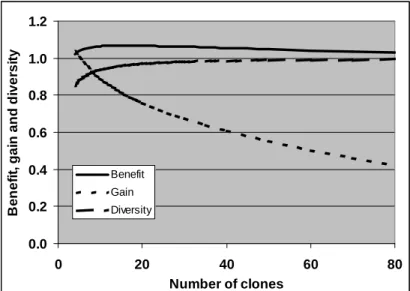
Figure 1. Example of how benefit, gene diversity and genetic gain depend on number of clones. The gain and benefit are in compatible units, but the value for gene diversity loss has to be multiplied with the factor DivCoeff to make the unit compatible with the two others.
An example of the relationship between clone number and benefit (goodness of a seed orchard), gene diversity and gain is shown in Figure 1 (from paper IV). As clone number increases, gene diversity also increases, slowly approaching unity; the genetic gain drops and the benefit reaches a maximum. The maximum is broad; minor deviations in clone number from the optimum are not critical. Little benefit will be lost when the number of clones is somewhat larger than the optimum, but even one percent has an immense economic value in forestry. The optimum number of clones calculated in paper IV is 16 for Swedish Pinus sylvestris seed orchards. In this scenario, sibling coefficient Ψ=2 was used. According to paper I and the extended Table 1 in this thesis, the average sibling coefficient Ψ=1.24 for mature Pinus sylvestris orchards, which when inserted into the model reduces the optimum number to 11 clones. As explained earlier, the model assumption Ψ=2 recommended by Kang et al. (2003), is actually somewhat high and can be said to discount for some unintentional inequality in ramet number. Factors like mortality causes such inequalities, and thus “the effective clone number” based on the number of ramets may turn out some years after establishment to be slightly higher than originally planned by tools like linear deployment.
The calculations assume that the clones are deployed to the orchard with equal numbers of ramets, which is seldom the case in a real orchard due to technical problems during establishment. Since equal deployment is not optimal (VII; Lindgren & Matheson, 1986), and that unequal deployment will be more favourable when breeding values are better estimated, a larger number of clones are recommended. In a seed orchard with a similar effective number of clones, the census number of clones can be 25 or 50% higher when deployed unequally, which results in an orchard that is somewhat more optimal than if the clones were deployed equally. On the other hand, the advantage of a few clones is mainly the greater genetic gain, a benefit that becomes more pronounced that in advanced-generation orchards established with clones having known breeding values. The use of genetic thinning and selective harvest could justify an increase in the number of clones. Advanced-generation seed orchards will be established with tested clones and the additional gain in reducing the number of remaining or harvested clones will thus be less than in a seed orchard established with untested material.
Self pollination has a lower efficiency in fertilizing the ovule than outcrossing (VII; Koski, 1973; Woods & Heaman, 1989; Williams & Savolainen, 1996; Nikkanen, Pakkanen & Heinonen, 2002) and this increases the share of zygotes with fathers outside the orchard. Therefore, as the fraction of contaminating pollen increases with decreasing number of clones, this will reduce the value of the seed crop. This is an argument for a larger number of clones.
A larger number of clones give freedom of action later on in the seed orchard’s life, to make adjustments for new techniques, etc. Future options can be based on information that was not available when the seed orchard was established.
Furthermore, consideration should be given to seed production and pollen production potential, in addition to the breeding values of selected clones. Some clones may fail after establishment, due to incompatibility, a technical malfunction in the system, or other such losses. This could lead to a lower number of clones, compared to what was originally planned. To be prepared for such events, a larger number of clones than appears theoretically optimal may be justified, and the penalty for using a larger number seems low (Figure 1).
The abovementioned factors combine to influence the number of clones that should be selected. For Swedish conifer seed orchards, 20 clones seem to be appropriate in a standard situation, where unrelated, tested clones are deployed in reasonably equal proportions, although this number is somewhat reconsidered later in this thesis. Paper IV also includes a scenario for Pinus taeda, and here about 10 clones are recommended under the same circumstances as above, because specific circumstances in the two scenarios suggest different model parameters.
Prediction of fertility prior to orchard establishment
Normally, breeding values are given more emphasis during selection of clones to a seed orchard than is their capacity to produce seed (Sorensen & Webber, 1997). For the economy of the seed orchard, it could be more important to select clones able to produce seeds. When practical decisions are made about what clones to place in a seed orchard, the cone-set ability of candidate clones is often reviewed, and seemingly poor cone producers are not selected. Knowing both breeding values and fertility of candidate clones, these characters may be balanced to establish seed orchards in an optimal way considering both factors (Lindgren et al., 2004). To consider fertility, however, requires knowledge about how well it can be predicted. Papers V and VI discuss the prediction of female fertility prior to orchard establishment.
Seed production in Pinus sylvestris starts at about age 8 (IV) and becomes more abundant from age 15 (VI; Matyas & Rauter, 1987). After age 15, annual fluctuations are more important than the continuous increase in cone production over time; single-year observations do not give a reliable estimate of future rank for cone set in the orchard. Broad-sense heritability was low for cone set at young ages (0.1-0.3), indicating that the onset of cone set is strongly environmental. The heritability rises as the orchard mature, with values reported in the range of 0.5-0.6 (I; VI; Byram, Lowe & McGriff, 1986). It can be discussed if conclusions are correct when studying an experimental seed orchard with different treatments in plots as in paper VI. The model however “corrects” for plot effects, and age of the graft, thus much of the reasons for environmental variation in a common seed orchard has been removed. The model considers just the within plot variation (thus variation over 50*50 m) while a typical seed orchard spans over 10 hectares. As it is not a common seed orchard but considered as an experiment located on the site of a major experimental research station, the management can be assumed to be better and more uniform than in a common seed orchard. Thus the heritability obtained can be expected to be higher than in an ordinary seed orchard.
The observed female fertility for clones can have other causes than genetic; clones may be different because of how they are produced. These differences are not likely to repeat if a new seed orchard is established. The broad-sense heritability may be overestimated and not be a good guidance for how well clonal characteristics are repeated if the vegetative multiplication is repeated under other circumstances.
The correlation between cone set for a clone in a particular year and the observation at age 30 becomes stronger over time. The genetic correlation is more than twice as high (rg≈ 0.5) for cone set at mature age (>20 years) compared to
that at a more juvenile age (<13 years). As cone production is accumulated, stronger genetic and phenotypic correlations are found with the end of the observation period (age 30).
Collection of cumulative cone-yield data would provide greater reliability when ranking candidate clones for seed production. This has not been done in practical operations in Sweden and probably seldom elsewhere, except for the experimental seed orchard studied in VI. Neither is seems worthwhile to do in the future, since the information on accumulative cone production over a decade of mature production in a seed orchard would come too late to be useful. Genetically better genotypes would be preferred when reliable cone-set data of old material become available. Furthermore, it would mean a considerable long-term-investment for an uncertain output to collect and register individual clone seed set for a large number of years.
In paper V, correlations are calculated between female fertility in clone archives or grafted plus-trees and performance of these same clones in seed orchards. The 18 comparisons showed correlations close to zero, and in none was there a significant relationship between cone-set observations in the archive or plus-trees and female fertility in seed orchards, for the same trial. The two lowest correlations were found in the experimental seed orchard, described in paper VI, where the orchard and the archive actually grow only a few hundred meters from each other.
Zobel & Talbert (1984) suggested that seed characters could be used as criteria during selection of parental trees to a seed orchard, thus enhancing seed production. Lindgren et al. (2004) suggested that breeding value and predicted seed yield could be balanced when determining the number of ramets for different clones. Our results, however, indicate that there are logistic and practical difficulties in predicting the fertility of a clone prior to orchard establishment, and that little or no effort seems justified to collect and consider such data as a selection criterion when designing new seed orchards.
Deployment of clones to a seed orchard
Equal deployment of tested clones to a seed orchard is not optimal from a genetic standpoint (c.f. IV, VII, VIII). Lindgren & Matheson (1986) introduced an algorithm for “linear deployment”, to deploy clones proportional to their breeding