University of Wollongong University of Wollongong
Research Online
Research Online
University of Wollongong Thesis Collection
2017+ University of Wollongong Thesis Collections
2019
Metamorphic Testing with Input Patterns
Metamorphic Testing with Input Patterns
Liqun SunUniversity of Wollongong
Follow this and additional works at: https://ro.uow.edu.au/theses1
University of Wollongong University of Wollongong
Copyright Warning Copyright Warning
You may print or download ONE copy of this document for the purpose of your own research or study. The University does not authorise you to copy, communicate or otherwise make available electronically to any other person any
copyright material contained on this site.
You are reminded of the following: This work is copyright. Apart from any use permitted under the Copyright Act 1968, no part of this work may be reproduced by any process, nor may any other exclusive right be exercised, without the permission of the author. Copyright owners are entitled to take legal action against persons who infringe
their copyright. A reproduction of material that is protected by copyright may be a copyright infringement. A court may impose penalties and award damages in relation to offences and infringements relating to copyright material.
Higher penalties may apply, and higher damages may be awarded, for offences and infringements involving the conversion of material into digital or electronic form.
Unless otherwise indicated, the views expressed in this thesis are those of the author and do not necessarily Unless otherwise indicated, the views expressed in this thesis are those of the author and do not necessarily represent the views of the University of Wollongong.
represent the views of the University of Wollongong.
Recommended Citation Recommended Citation
Sun, Liqun, Metamorphic Testing with Input Patterns, Master of Philosophy thesis, School of Computing and Information Technology, University of Wollongong, 2019. https://ro.uow.edu.au/theses1/548
Research Online is the open access institutional repository for the University of Wollongong. For further information contact the UOW Library: [email protected]
Metamorphic Testing with Input Patterns
Liqun Sun
This thesis is presented as part of the requirements for the conferral of the degree:
Master of Philosophy
Supervisor:
Dr. Zhi Quan (George) Zhou Co-supervisor:
Dr. Casey Chow
The University of Wollongong
School of Computing and Information Technology
This work © copyright by Liqun Sun, 2019. All Rights Reserved.
No part of this work may be reproduced, stored in a retrieval system, transmitted, in any form or by any means, electronic, mechanical, photocopying, recording, or otherwise, without the prior permission of the author or the University of Wollongong.
Declaration
I, Liqun Sun, declare that this thesis, submitted in partial fulfilment of the requirements
for the conferral of the degreeMaster of Philosophy, from the University of Wollongong,
is wholly my own work unless otherwise referenced or acknowledged. This document has not been submitted for qualifications at any other academic institution.
Liqun Sun
Publications
1. L. Sun and Z. Q. Zhou, “Metamorphic Testing for Machine Translations: MT4MT,” in Proceedings of the 25th Australasian Software Engineering Conference (ASWEC 2018), pp. 96-100. IEEE, 2018, doi: 10.1109/ASWEC.2018.00021.
2. Z. Q. Zhou and L. Sun, “Metamorphic Testing of Driverless Cars,” Communications of the ACM, vol. 62, no. 3, pp. 61–67, March 2019. DOI: 10.1145/3241979 3. Z. Q. Zhou, L. Sun, T. Y. Chen, and D. Towey, “Metamorphic Relations for
Enhanc-ing System UnderstandEnhanc-ing and Use,” IEEE Transactions on Software EngineerEnhanc-ing, DOI: 10.1109/TSE.2018.2876433.
4. Z. Q. Zhou, L. Sun, T. Y. Chen, and D. Towey, “An Extended Abstract of: Meta-morphic Relations for Enhancing System Understanding and Use,” in Proceedings of the 41st International Conference on Software Engineering (ICSE ’19), 2019.
Abstract
Despite endeavour to do their best to eliminate defects and to satisfy the end users as much as possible, developers hardly ever deliver faultless software. It is imperative for software developers to detect the defects and errors by software testing. However, for a long time, the oracle problem has often been an unavoidable challenge for software testing, which indicates that it is unlikely or unaffordable to verify the output given by a piece of soft-ware. To mitigate the oracle problem, metamorphic testing has become a popular method. Identification of effective metamorphic relations is critical when applying metamorphic testing. In most of the previous research, testers identify metamorphic relations manually and the way they do this is not systematic. Compared with identifying metamorphic re-lations case by case in most scenarios, deriving metamorphic rere-lations from a high level of abstraction by a systematic methodology becomes an ambitious goal. For this purpose, this thesis propose a concept of metamorphic relation input patterns. A metamorphic re-lation input pattern can help both developers and end users to construct various concrete metamorphic relations to detect defects in software under test across many different appli-cation domains. Using this method, empirical studies have been further conducted using a variety of popular real-life services and applications. The present research proves the simplicity of the process and the wide applicability of the methodology by showing the detection of many previously unknown failures in the software under test.
Acknowledgments
It is incredibly difficult for an international student to do research in an unfamiliar country. Fortunately, with helping hands to overcome obstacles and difficulties, I finally completed my research.
Before starting a new chapter in my life, firstly, I would like to thank my supervisor Dr. Zhi Quan Zhou for the support in not only my study and research, but also in my daily life. I would not have been able to go the distance without his guidance, patience, intelligence and encouragement. I am also grateful to Dr. Casey Chow for kindly acting as my co-supervisor.
Secondly, I would like to thank my wife and my parents for supporting me spiritually throughout the course of my study in Australia.
Last, but not least, I would like to express my gratitude to my friends at the university for their many helps and tolerance.
Contents
Publications iv Abstract v 1 Introduction 1 1.1 Background . . . 1 1.2 Research Goals . . . 21.3 Contributions of the Thesis . . . 2
1.4 Organisation of the Thesis . . . 2
2 Literature Review 3 2.1 Metamorphic Testing . . . 3
2.1.1 Basic Concepts of Metamorphic Testing . . . 3
2.1.2 The Applications of Metamorphic Testing . . . 4
2.1.3 Metamorphic Testing from User Perspective . . . 5
2.1.4 Constructing and Selecting Metamorphic Relations . . . 6
2.1.5 Testing from User Perspective . . . 7
2.2 Summary . . . 8
3 Identification of Metamorphic Relation Input Patterns 9 3.1 Background . . . 9
3.2 Changing Direction . . . 11
3.3 Replacement . . . 11
3.4 Perturbation . . . 12
4 Empirical Evaluation of the Changing Direction MRIP 13 4.1 Case Study of 65 Top Commercial Websites . . . 13
4.1.1 Problems in Commercial Websites: A Motivating Example . . . . 13
4.1.2 Objectives of the Experiment . . . 15
4.1.3 Derived Metamorphic Relations . . . 16
4.1.4 Experimental Design . . . 16
4.1.5 Experimental Results . . . 17
CONTENTS viii
4.1.6 Type 1 of MR Violation: Count Inconsistency . . . 17
4.1.7 Type 2 of MR Violation: Incompleteness of Search Results . . . . 21
4.1.8 Type 3 of MR Violation: Separate Section . . . 22
4.1.9 Type 4 of MR Violation: Same Price Not Reverse . . . 23
4.1.10 Type 5 of MR Violation: Different Price Not Reverse . . . 24
4.1.11 Recommended User Countermeasures . . . 25
4.2 Case Study of Google Maps Navigation . . . 27
4.2.1 Objectives of the Experiment . . . 27
4.2.2 Derived Metamorphic Relations . . . 27
4.2.3 Experimental Design . . . 27
4.2.4 Experimental Results . . . 28
4.2.5 Further Analysis . . . 29
4.3 Case Study of Location-based Search . . . 30
4.3.1 Objectives of the Experiment . . . 30
4.3.2 Derived Metamorphic Relations . . . 30
4.3.3 Experimental Design . . . 30
4.3.4 Experimental Results . . . 32
4.3.5 Recommended User Countermeasures . . . 32
4.4 Case Study of Image Analysis Using MATLAB, OpenCV, and Facebook . 32 4.4.1 Objectives of the Experiment . . . 33
4.4.2 Derived Metamorphic Relations . . . 33
4.4.3 Experimental Design . . . 33
4.4.4 Experimental Results . . . 34
4.5 Case Study of Video Analysis Using Google Cloud Video Intelligence . . 35
4.5.1 Derived Metamorphic Relations . . . 35
4.5.2 Objectives of the Experiment . . . 35
4.5.3 Experimental Design . . . 35
4.5.4 Experimental Results . . . 35
5 Empirical Evaluation of the Replacement MRIP 39 5.1 Background . . . 39
5.2 Objectives of the Experiment . . . 39
5.3 Derived Metamorphic Relation . . . 40
5.3.1 Experimental Design . . . 40
5.3.2 Experimental Results . . . 41
6 Empirical Evaluation of the Perturbation MRIP 44 6.1 Objectives of the Experiment . . . 44
6.2 Derived Metamorphic Relation . . . 46
CONTENTS ix
6.2.2 Experimental Results . . . 47
7 Discussions and Conclusion 50
7.1 Usefulness of MRIPs . . . 50
7.2 Conclusion and Future Work . . . 51
Bibliography 53
A Nouns used in MRReplaceNoun 59
A.1 Subject nouns . . . 59
Chapter 1
Introduction
1.1
Background
As software development and deployment grows more complex, in spite of strict imple-mentations and skilled developers, delivering valid software of high quality is one of the most difficult goals. To a certain extent, software testing is seen as a ‘last line of de-fence‘ against defects and is a widespread approach to determine whether the software satisfies expectations, specification and requirements. It is a widely-accepted practice for a business organisation to spend more than fifty percent of development costs on testing [1].
However, conducting software testing usually involves two intractable problems. Firstly, to evaluate quality and to find faults, testing generally uses a mechanism, namely oracle, against which testers can determine whether the outputs are correct for the software under test (SUT) [2]. The main difficulty in testing software is known as the oracle problem [2] which means the oracle is either expensive or impossible to be applied under certain circumstances. The research community considers this to be one of the fundamental chal-lenges in software testing [3]. Secondly, running a program on a finite number of concrete test cases generally cannot prove the correctness of the program for the entire input do-main, and it is practically not feasible to perform exhaustive testing. Metamorphic testing (MT) [4, 5] is a testing methodology that addresses the oracle problem and automated test case generation problem. A key activity of MT is the identification of metamorphic relations (MRs).
In this thesis, we propose a concept of metamorphic relation input patterns (MRIPs), with which multiple concrete MRs can be derived. We then use these MRs to assess a series of popular applications in the absence of an oracle.
CHAPTER 1. INTRODUCTION 2
1.2
Research Goals
This research has two main goals:
1. To study the pattern concept in the context of metamorphic testing in order to help stakeholders to derive concrete metamorphic relations that can determine whether software works properly across multiple scenarios and application domains.
2. To conduct empirical studies to evaluate the effectiveness of the proposed approaches.
1.3
Contributions of the Thesis
1. We develop a concept of a metamorphic relation input pattern, which can be used to derive multiple concrete metamorphic relations.
2. The empirical results show that our approach is easy to implement, effective to detect defects and is widely applicable to a range of application fields.
3. We extend metamorphic testing to help users to easily probe the characteristics of systems and make the systems serve their purpose with proper inputs.
1.4
Organisation of the Thesis
The remainder of this thesis is structured as follow. In Chapter 2, the literature on meta-morphic testing and its application is reviewed. Chapter 3 proposes three metameta-morphic relation input patterns to derive multiple concrete metamorphic relations. In Chapters 4, 5 and 6, we conduct empirical studies by using derived MRs from three MRIPs to evaluate various applications. Chapter 7 presents the conclusion of this thesis and discusses the future directions for work in this area.
Chapter 2
Literature Review
2.1
Metamorphic Testing
2.1.1
Basic Concepts of Metamorphic Testing
A challenge in software testing is known as the oracle problem [2] which means the oracle is either expensive or impossible to be applied under certain circumstances. Metamorphic testing (MT) [6, 7, 8] has been proven to be able to effectively alleviate the oracle problem and test case generation problem. MT provides researchers and stakeholders a practical and powerful testing approach that is simple in concept and easy to implement, and has gained increasing popularity in recent years.
MT differs from conventional testing techniques in that it does not focus on the verifi-cation of each individual output of the software under test (SUT), but instead checks the
relationsamong the inputs and outputs ofmultipleexecutions of the SUT. Such relations
are called metamorphic relations(MRs). MRs are necessary properties of the intended
program’s functionality. If an MR is violated for certain test cases, then the SUT must
be at fault. For example, consider a program p(G, a, b)that identifies the shortest path
from an origin nodeato a destination nodebin an undirected graphG. WhenGis large
and complex, and whena and bare chosen randomly, it is hard to verify the output of
p because of the lack of a tangible oracle. Nevertheless, some MRs can be identified
for the shortest path problem. One of the MRs could state that swapping the origin and destination nodes should not affect the length of the shortest path [9]. Based on this MR,
MT can be performed by running the program ptwice: once for asource execution, on
asource input (G, a, b)to produce asource output; and once for afollow-up execution, on afollow-up input (G, b, a)to produce a follow-up output. If a source output and its follow-up output are found to have different lengths, we say that the MR has been
vio-lated, and therefore a fault inphas been revealed. Many different MRs can be identified
for the shortest path proble [9].
The increasing interest in MT is not only because of its ability to test software in the 3
CHAPTER 2. LITERATURE REVIEW 4 absence of an oracle, but also because MT is based on a perspective not previously used by other testing techniques [10]. Researchers and practitioners have used MT to detect previously unknown software faults in various application domains [11, 12, 13, 14].
When studying MT for machine learning software, Xie et al. [15] found that an MR violation could reveal problems not only in the implementation but also in the choice of algorithm. In this situation, the MR was identified based on the expected functionality of the system: A violation of this MR, therefore, could indicate that the chosen algorithm was not appropriate (and not just that the implementation had faults). Xie et al.’s study was at the algorithm selection level, checking whether or not the adopted algorithm was appropriate. More recently, Zhou et al. [16] developed MT into a unified framework that covers verification, validation, and other types of software quality assessment. They showed that MRs could be identified by users based on their expectations (reflecting what they really cared about), rather than being based on the system designs chosen by the system designer or developer. Their study used MT at the top (system/services) level, and involved very large scale empirical studies with major web search engines.
The basic steps for MT as follows can be summarised [7]:
1. Identifying properties of the intended functionality of the SUT under test with nec-essary domain knowledge to construct metamorphic relations.
2. Build and run a test case generator to generate source test cases involved in the MRs; where an existing test suite is being used as the source test suite, the test case generator can simply take the existing test cases.
3. Build and run a test driver to execute the source test cases, generate follow-up test cases by referring to the prescribed MRs, and verify the test results against the MRs.
2.1.2
The Applications of Metamorphic Testing
Since the emergence of MT, much work has been done on various applications from different domains.
Segura et al. [7] highlighted the following areas where MT had been applied: Web services and applications, computer graphics, embedded systems, simulation and mod-elling, machine learning, bioinformatics, numerical programs (which only accounted for 5%), variability and decision support, compilers, components, autonomous vehicles, and others.
Jiang et al. [17] used metamorphic testing to support program repair without an ora-cle. In conventional automated programming, such as generate-and-validate techniques and correct-by-construction techniques, automated program repair (APR) based on test suites may have an oracle problem. Jiang et al.’s study mainly investigated the feasibility of combining metamorphic testing with APR and the repair effectiveness of this novel
CHAPTER 2. LITERATURE REVIEW 5 approach. Jiang et al. used metamorphic testing as a checking mechanism to compare the outcome of individual outputs rather than using a test oracle. After conducting an empirical study on subject programs, IntroClass benchmark suite, which consists of 1143 C program versions, the results showed that this integration is both feasible and effective. Sun et al. proposed an automated testing framework for Service-Oriented Application (SOA) to facilitate the testing of the orchestrated web services without an oracle from the perspective of service consumers [18]. The tester could use Web Services Description Language (WSDL) of the web service to construct metamorphic relations and configu-ration. The source test cases were generated by service description which recorded the previously executed tests or randomly from scratch. The follow-up test cases were gen-erated by changing a source test case according to a metamorphic relation. Three web services with seeded faults were evaluated and the results showed that this approach was effective and efficient for implementing metamorphic testing.
Chan et al. [19] introduced a so-called metamorphic service on SOA. The SOA system in their study consistsed of a main service and other supportive services. Some meta-morphic relations are linked between successful offline test cases and online supportive service computing. The results showed that when compared with the control experiment, the metamorphic service required less effort and detected more faults.
2.1.3
Metamorphic Testing from User Perspective
Based on the empirical experience of teaching software testing, it has been reported that metamorphic testing was suitable testing technique for end-users [20].
Liu et al. reported their experience of teaching metamorphic testing in a software test-ing subject [21]. The empirical study collected assignments from students at Swinburne University of Technology for three years. These students were from a variety of back-grounds, and had different career orientations. The results showed that the majority of students could understand the concept and identify metamorphic relations by themselves. Most students could develop automation testing with the lack of supporting tools and limited teaching time. However, test cases created by different entities may not show the same failure-detection effectiveness. Liu et al. suggested that it is important to find diverse metamorphic relations to improve failure-detection rates and also suggested a pos-itive correlation between domain knowledge and good metamorphic relations.
Liu et al. conducted an in-depth study on the question “how effectively does meta-morphic testing alleviate the oracle problem?” [22], and showed that, for the purpose of software verification, a small number of (on average, around six) diverse MRs were suffi-cient to match the fault-detection effectiveness of a test oracle for software implementing a knapsack algorithm.
CHAPTER 2. LITERATURE REVIEW 6
2.1.4
Constructing and Selecting Metamorphic Relations
To a large extent, generation, selection and prioritisation of metamorphic relations domi-nates the effectiveness of metamorphic testing.
Chen et al. [9] were the first to investigate the nature of good MRs. They showed that if an MR’s follow-up execution differs a lot from its source execution then this MR is likely to have a higher chance of revealing a failure. They did not quantitatively define the notion of “difference” or “dissimilarity” between source and follow-up executions, but pointed out that this could include, for example, execution paths, data flows, coverages, etc. In a follow-up study, Cao et al. [23] developed quantitative metrics for measuring the execu-tion differences between source and follow-up execuexecu-tions, using the concepts of coverage Manhattan distance (CMD), frequency Manhattan distance (FMD), and frequency Ham-ming distance (FHD). The development of these metrics were inspired by Zhou et al.’s previous work on adaptive random test case prioritisation [24, 25]. Cao et al. investigated the correlation between the fault-detection effectiveness of metamorphic relations and the distance between the source and follow-up executions. Their results show that there is a significant positive correlation between the branch coverage Manhattan distance (BCMD) and the fault-detection capability of the MRs. They suggested a few ways for testers to apply their findings in practice.
Kanewala et al. reported an innovative approach to predict metamorphic relations using machine-learning techniques [26]. They created control flow graphs (CFG) from source code and extracted a set of features from the CFGs. Two algorithms, namely, support vector machine (SVM) and decision tree, were trained by these features. Their results showed that the metamorphic relations predicted by SVM were more effective for scien-tific computing applications. Additionally, their study suggested that small training sets could be doable for real-life testing. In recent work, Kanewala et al. [27] proposed a machine learning approach for automatic identification of metamorphic relations. Their approach uses graph kernels to evaluate the similarity among graphs. Their experiment involved six metamorphic relations and a corpus of 100 numerical functions. They as-sumed that functions are more likely to have similar metamorphic relations if they have similar operations. The empirical results show that the graph kernel using all paths in the CFG has the best prediction accuracy.
Chen et al. conducted a study on identifying metamorphic relations effectively and sys-tematically using the category-choice framework [28]. In brief, they partitioned the input domain by category according to the specification, and this framework defines all possible combinations of inputs. A Java tool for this specification-based framework, namely MR-Gen, was designed to partly replace manual metamorphic relation identification. Three groups of participants were required to identify metamorphic relations for a parking fee system. The result showed that a tester using the tool could identify metamorphic relations
CHAPTER 2. LITERATURE REVIEW 7 effectively and efficiently. The limitation of this study was the number and classification of participants. A total of 19 participants were involved and it was hard to distinguish the inexperienced from the experienced. In addition, it is not easy to get more real-life specifications from industry.
Gotlieb and Botella proposed a framework to automatically find test cases that vio-late an identified metamorphic relation [29]. This framework accepted programs that only consist of a single structured procedure and leveraged constraint logic programming techniques. The results showed that the prototype of this framework could work but in-efficiently and that it would be impossible to conduct exhaustive search in a reasonable amount of time.
Ding et al. proposed a framework to iteratively generate metamorphic relations and test cases [30]. They refined the relations and tests by evaluating the test coverage, and mutation testing. A Monte Carlo simulation program was used to discuss the effectiveness of this approach.
2.1.5
Testing from User Perspective
Some empirical studies on web search engines were proposed to check both faults and user expectations. The metamorphic relations were conceived without deep knowledge of the underlying working mechanism of the search engines. A web search engine is the predominant gate which connects users and the Internet. Because of its complicated ar-chitecture and mass data, it is difficult to test search engines using conventional methods. Moreover, it is challenging to find an objective method to assess page ranking quality which involves user experience.
Zhou et al. presented an automatic metamorphic testing approach for web search en-gines, including Google, Yahoo! and Live Search [31, 32]. By querying with different operators or file types and comparing the source and follow-up outputs, search engine failures were detected. The results showed that the performance of these web search en-gines was not as good as users expected. This study also gave providers some suggestions about service quality.
More recently, Zhou et al. [16] developed a unified metamorphic testing framework for not only verification and validation but also other types of software quality assessment from user perspectives. They conducted large-scale empirical studies of major search en-gines including Google, Bing, Chinese version of Bing, and Baidu. In their study, the adopted the software quality model standard ISO/IEC 25010 for software quality assess-ment.
Segura et al. [33] further applied metamorphic testing to the domain of RESTful web APIs.
CHAPTER 2. LITERATURE REVIEW 8
2.2
Summary
This chapter briefly reviewed some of the literature on different applications and aspects of metamorphic testing. Although the existing applications of metamorphic testing cover verification, validation and other types of assessment of software, most of the works fo-cused on construction of MRs that are capable of detecting faults in a specific domain. The present thesis fills this gap by studying the identification and application of MRs without a domain limitation.
Chapter 3
Identification of Metamorphic Relation
Input Patterns
3.1
Background
One of the most critical activities in all MT research is to identify effective MRs [6]. To apply MT, normally, testers are inclined to identify MRs from scratch case by case to initiate their work. This practice might be convenient in some situations but neither systematic nor efficient. To make this process more systematic, Zhou et al. were the first to propose an idea of using an abstract form of MR to derive multiple concrete MRs, and they called this abstract form of MR a “general metamorphic relation” [31, p. 3]. In the context of testing search engines, they described a “general metamorphic relation” as follows:
MRSEARCH: If search criterionX2implies search criterionX1 (that is, ifX2
is satisfied then X1 is satisfied), then #(X2)≤#(X1), where #(X)denotes the
number of results satisfying the search criterionX.
Using this general MR, many concrete MRs can be derived [31], such as:
MROR: IfA1≡(A2ORB), then #(A2)≤#(A1), whereA1,A2, andBdenote
query conditions. A logical operator “OR” is used in this case for inclusive disjunction (∨).
MRAND: IfA1≡(A2ANDB), then #(A1)≤#(A2), where a logical operator
“AND” is provided in this case for logical conjunction (∧).
In a follow-up work, a concept of “general relation” was reported by Zhou et al. to
generalise thesubset relation among the source and follow-up outputs [32]:
Pages(X2)⊆Pages(X1),
CHAPTER 3. IDENTIFICATION OF METAMORPHIC RELATION INPUT PATTERNS10
wherePages(X1)denotes the source output which meets the query criterionX1andPages(X2)
denotes the follow-up output which satisfies the search criterionX2.
The results from empirical studies show the fault-detection effectiveness of the derived concrete MRs is at a high level [31, 32]. For example, when the user queried the Microsoft search engine with GLIF and then with GLIF OR 5Y4W, it respectively returned 11,783
and zero results. This apparently violated metamorphic relationMROR and, because the
violation was reproducible, a defect in the search engine was identified.
Also using abstract MRs to derive concrete ones for systematic MR generation, Segura et al. [33] first introduced the term “pattern” into the MT research community. They
explicitly proposedmetamorphic relation output pattern(MROP) in the context of
test-ing RESTful web APIs (that implement create, read, update, or delete operations over a resource). They stated that an MROP “defines an abstract output relation typically iden-tified in Web APIs” and that “each MROP is defined in terms of set operations among test outputs such as equality, union, subset, or intersection.” They found MROPs to be very helpful for deriving concrete MRs. More specifically, they identified six MROPs: (1) Equivalence (representing relations where the source and follow-up outputs include the same items although not necessarily in the same order); (2) Equality (representing relations where the source and follow-up outputs must contain the same items, in the same order); (3) Subset (representing subset relations among the source and follow-up
outputs, similar to the “general relation” (Pages(X2)⊆Pages(X1)) proposed by Zhou et
al. [32, p. 223]); (4) Disjoint (representing relations where the source and follow-up out-puts should be disjoint sets—having no elements in common); (5) Complete (representing relations where the union of the follow-up outputs should contain the same items as the source output); and (6) Difference (representing relations where the source and follow-up outputs should differ in a specific set of items).
A concrete example of an “equivalence” MROP is that a search for YouTube videos should return the same set of videos “regardless of the ordering criteria specified (date, rating, relevance, title, or number of views)” [33]. Segura et al. [33] hypothesized that their proposed patterns could also be useful for automated inferencing of likely MRs for a given API; however, they also pointed out that such research, as in [34, 27, 35], was challenging, and still at an early stage.
Compared with Zhou et al.’s initial work on this topic [31, 32], Segura et al. [33] in-vestigated the pattern concept explicitly and systematically, providing strong evidence of its potential usefulness and, hence, opening a new MT research direction into “metamor-phic relation patterns” in a broad sense, as foreseen by Segura in his keynote at the third International Workshop on Metamorphic Testing (ICSE MET ’18) [36].
Nevertheless, the work of both Zhou et al. [31, 32] and Segura et al. [33] faced a similar limitation: Their patterns were only designed for a specific type of program: Search engines [31, 32] or RESTful web APIs (performing one of four operations over
CHAPTER 3. IDENTIFICATION OF METAMORPHIC RELATION INPUT PATTERNS11 a resource—create, read, update, and delete) [33]. Furthermore, Segura et al. [33] only studied patterns for output relations, and the outputs must be sets. These limitations mean that all previous work [31, 32, 33] has a significant applicability problem.
In this thesis, we propose a concept of metamorphic relation input pattern (MRIP) that has no such restrictions of application domains.
3.2
Changing Direction
We first define a metamorphic relation input pattern (MRIP) as follows:
Definition 1: Ametamorphic relation input pattern(MRIP) is an abstraction that characterises the relations among the source and follow-up inputs of a set of (possibly infinitely many) metamorphic relations.
We next define the first MRIP, ”change direction.”
Definition 2: Thechange directionMRIP refers to the existence of adirection
element in the source input, either physical or logical, explicit or implicit, which can be changed to construct the follow-up input.
The “change direction” MRIP can be used to probe a system from different viewpoints, which will be useful for users and testers. The present research investigates 65 top
com-mercial websites by inspecting very common website features, namelysearchand sort.
Although thesortfunction may involve many filters and recommendation algorithms, this
study only focuses on the “direction” element regarding the user input, or more specif-ically, the sort criterion (from high price to low price, or from low price to high price). We also test the “direction” element in Google Maps navigation service. From a user perspective, the direction is from the start point to the destination. Similarly, the “direc-tion” element in a Google Maps location-based search is the direction from one source location to a target location. We also tested face recognition functions of three popular ap-plications. These applications allow users to upload photographs that may include human faces. The “direction” element of the input is the direction of the x-axis of 2D images. Finally, we tested the Google Cloud Video Intelligence. It is a video analysis service that makes videos searchable and discoverable. The “direction” element indicates whether a video is played forwards or in reverse.
3.3
Replacement
The second MRIP we propose is named ”replacement,” defined as follows:
Definition 3: The replacement MRIP refers to the construction of the follow-up input by replacing part of the source input.
CHAPTER 3. IDENTIFICATION OF METAMORPHIC RELATION INPUT PATTERNS12 The “replacement” MRIP can provide fundamental insights into the association be-tween input and output in some systems. If we replace the value of a relatively inde-pendent entity in a system’s input, only a corresponding part in the system’s output is expected to be changed. The logic behind it is that some changes to the input should not impact the unrelated parts or the structure of the output. It is reported that a risk assessment tool called COMPAS, which is used to predict the risk of recidivism, is al-legedly biased against black defendants [37]. The algorithm behind the tool is expected to make fair decisions regardless of skin colour. In other words, ethnicity is replaceable in this case. For software testing, an example of using the replacement MRIP is given as follows: The colours of vehicles should not have an impact on the recognition of these vehicles for a self-driving car. Therefore, testers can replace an object’s colour and expect the same classification result. A fault in the obstacle recognition module is revealed if it classifies a red object as a car in the first test and then classifies the same object as a tree in the second test when the colour of the object is changed to green.
3.4
Perturbation
We define our third MRIP, perturbation, as follows:
Definition 4: The perturbation MRIP refers to the construction of the follow-up input by applying small changes (perturbations) to the source input.
Almeida et al. studied Web Services for governmental applications and proposed six perturbation operations to mutate SOAP messages [38]. The empirical results show that test cases derived from these transformations were effective in real-life web services. However, their technique needs a tester to determine whether the outputs are correct or not. In the present study, we investigate the use of the perturbation MRIP for a different application domain in the absence of an oracle. Our result verification is fully automated.
Chapter 4
Empirical Evaluation of the Changing
Direction MRIP
Five metamorphic relations derived from MRIP of Changing Direction are proposed to apply to a variety of application domains, including commercial websites, web mapping service, video analysis, open source software and social media.
4.1
Case Study of 65 Top Commercial Websites
A website is sophisticated software which runs a range of programming languages. User experience largely depends on its functional correctness and usability. Because of the lack of reliable oracle (because of complex architecture and dynamic content), it is gener-ally difficult to verify and validate a modern website with conventional testing methods. Metamorphic testing is an alternative testing approach to alleviate the oracle problem in assessing websites. This section takes advantage of MRIP to evaluate 65 popular com-mercial websites from the user perspective. The results show that most of the websites failed to provide reliable price sorting to the users. Corresponding countermeasures are also presented to mitigate the defects and to improve user experience.
4.1.1
Problems in Commercial Websites: A Motivating Example
As an example of using MT on a commercial website, consider www.realestate.com.au and search rental properties. More than 5.5 million Australians visited realestate.com.au during February 2016 [39]. Currently, it is Australia’s No.1 advertising website for real estate according to Alexa traffic ranking [40].
Firstly, we choose “Rent”, uncheck “Surrounding suburbs”, keep other filters with de-fault, use “Wollongong, NSW 2500” as query terms and the system returns 115 results for properties for rent in Wollongong. After sorting the list by “Price (Low - High)”, the first property “$260 86C Auburn Street, Wollongong, NSW” should be the cheapest of
CHAPTER 4. EMPIRICAL EVALUATION OF THE CHANGING DIRECTION MRIP14 the results (see Figure 4.1(a)). Then we set the filter “Min. Price pw” with 250(see Figure 4.1(b)), there are fewer results and the first property changes to “$260 12A/30 Rowland Ave, Wollongong, NSW” (see Figure 4.1(c)). This reveals a fault in the system.
(a)Results sorted by price
(b)Price filter (c)Results filtered and sorted by price
Figure 4.1:Fault in price sorting on realestate.com.au
Secondly, we choose “Rent”, uncheck “Surrounding suburb”, keep other filters with default, use “3/28 Gothenburg Street, Stuart Park, NT 0820” as query terms, the system gives the match feedback for this address (see Figure 4.2(a)). Then we find all rental
CHAPTER 4. EMPIRICAL EVALUATION OF THE CHANGING DIRECTION MRIP15 properties on this street by using “Gothenburg Street, Stuart Park, NT 0820”, we expect the results include the previous one. Nevertheless, it shows the results for properties for rent in “Gothenburg Cres, Stuart Park, NT 0820” (see Figure 4.2(b)). We find the system somehow automatically replace the query terms. It is noteworthy that the original query terms could be seen in the URL.
(a) Excerpt of the results page for query “3/28 Gothenburg Street, Stuart Park, NT 0820”
(b) Excerpt of the results page for query “Gothenburg Street, Stuart Park, NT 0820”: All four results are wrong as they do not match user query.
Figure 4.2:Fault in searching on realestate.com.au
The above examples show that a popular commercial website can have multiple bugs, easily causing erroneous search results that may bring losses to users when they are un-aware of these errors in the retrieved information.
4.1.2
Objectives of the Experiment
Sixty-five commercial websites were chosen from a range of major ranking lists on the basis for either popularity or annual revenue. There are 35 retailing websites from “Global Powers of Retailing 2017” [41] which is an annual report that identifies the top 50 largest e-retailers around the world regarding annual revenue in 2015. There are eleven real es-tate websites from “eBizMBA top 15 Realeses-tate” [42] and eight car sales websites from
CHAPTER 4. EMPIRICAL EVALUATION OF THE CHANGING DIRECTION MRIP16 “eBizMBA top 15 Car” [43]. eBizMBA is a guide which identifies the top 15 most popu-lar websites in their category rank that are derived from average of each website’s Alexa Global Traffic Rank and the U.S. Traffic Rank from Quantcast. There are 11 pharmacy websites from “Alexa Top Sites by Pharmacy” [44] which is a web traffic rank for online pharmacies provided by Alexa. Only websites which published in English whose features include price sorting were used in this study.
4.1.3
Derived Metamorphic Relations
MRPriceSort: Lets(q,c)denote aper f ectquery function, whereqdenotes a query criterion
andcdenotes a sorting criterion. We removed all other query conditions and the results
are supposed to be completely sorted according toc. Ifc1 andc2 denote the criteria that
sorts the results by price in ascending and descending order respectively, thens(q,c1)and
s(q,c2)should return exactly the same set of results, but in reverse order.
4.1.4
Experimental Design
An experiment was conducted on each website withMRPriceSortwhich includes one source
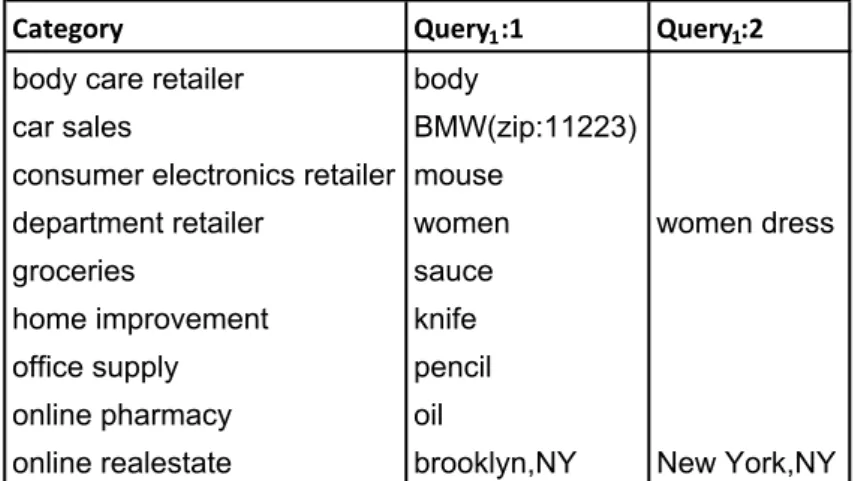
test case and one follow-up test case. It is noted that the sequence of execution does not impact the results. The source and follow-up test cases used different direction, sorting by price in ascending and descending order but populated exactly the same query term as the text input. It would be perfect for comparison if all 65 websites use the same query term but this was impossible because of the different businesses associated with them. For example, real estate websites would collect user’s location information about the areas interested in to generate reasonable results but a fashion websites do not ask for location information. To minimise the number of query terms, the 65 websites were grouped into nine categories (see Table 4.1) according to their business types. To make sure query terms were suitable for all websites within the same category, the query terms were selected manually. All websites within the same category were performed using the corresponding query term (see Table 4.1). For instance, the query term “source” was used to test grocery websites and “oil” was used to test pharmacy websites. Another standard is that they need to return search results with at least one record. However, we found that some websites did not respond with results for a general keyword. This strat-egy is probably driven by commercial considerations. For example, www.sears.com only showed an advertisement page when the search term used was “women.” Therefore, we used “women dress” and the website returned a list containing expected goods. For those websites that could not return results, a backup query term was generated for them. They are listed in the third column of Table 4.1.
CHAPTER 4. EMPIRICAL EVALUATION OF THE CHANGING DIRECTION MRIP17
Category Query1:1 Query1:2
body care retailer body
car sales BMW(zip:11223)
consumer electronics retailer mouse
department retailer women women dress
groceries sauce
home improvement knife
office supply pencil
online pharmacy oil
online realestate brooklyn,NY New York,NY
Table 4.1: Query terms
4.1.5
Experimental Results
Table 4.2 summarizes the results of all 65 websites under test. Columns #3, #4, #5, #6 and #7 of Table 4.2 show five types of MR violation, namely count consistency, completeness of result, separate section, same price reverse and different price reverse. Only five websites (www.hsn.com, www.asos.com, www.tesco.com, mexmeds4you.com, www.pharmacy2u.co.uk) did not violate MR.
In this section, the observations, causes and their relationship with software quality model standard ISO/IEC 25010 [45] are discussed.
4.1.6
Type 1 of MR Violation: Count Inconsistency
In a normal running system, the result counts should be the same If there are no changes of the items in the results from the source test case. A lack of count consistency implies at least one of the price sorting result count is inaccurate. The precision of the result count
is related to thefunctional correctness (underfunctional suitability), which refers to the
“degree to which a product or system provides the correct results with the needed degree of precision”.
Observations
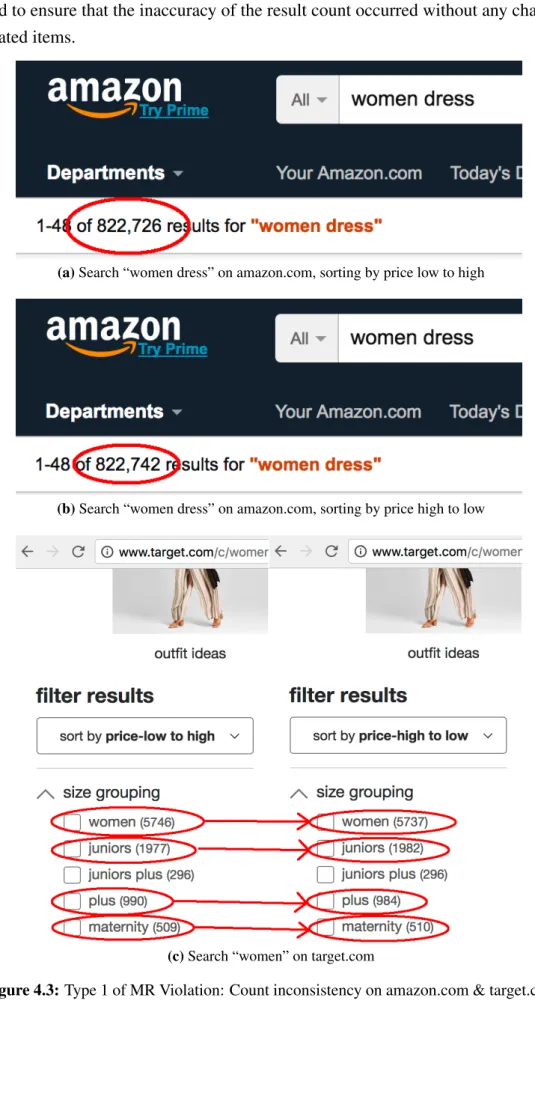
The result counts between the output of source and the follow-up test case were compared. A total of five websites were count inconsistent. For instance, searching “women dress” in amazon.com returned 822726 results (see Figure 4.3(a)) for price low to high and 822742 results (see Figure 4.3(b)) for price high to low. Not only is there inconsistency in total count, but also counts in filters is sometimes different. When we searched “women” in target.com, four source test case and follow-up test case counts in size group filter were
CHAPTER 4. EMPIRICAL EVALUATION OF THE CHANGING DIRECTION MRIP18 1 2 3 4 5 6 7 W eb si te C ate g o ry Type 1 co u n t co n si ste n cy Type 2 co m p le te n es s o f re su lts Type 3 se p ar ate s ec ti o n Type 4
same price reverse
Type 5 d iffe re n t p ri ce r ev er se 1 w w w .b at ha nd bo dyw orks. co m bo dy ca re re ta ile r ✓ ✓ -x ✓ 2 w w w .a ut ot ra de r. co m ca r sa le s ✓ ✓ bo tto m: "n o pri ce a va ila bl e"; fe at ure d/ pre mi um/ st an da rd x ✓ 3 w w w .c ar fax .c om ca r sa le s ✓ x bo tto m: "ca ll fo r pri ce " "O th er ca rs w ith fre e C AR F AX R ep ort s" x ✓ 4 w w w .ca rg uru s. co m ca r sa le s ✓ x "f ea tu re d list ", "st an da rd li st " x ✓ 5 w w w .c ar m ax .c om ca r sa le s ✓ ✓ -x ✓ 6 w w w .ca rs. co m ca r sa le s ✓ x bo tto m: "n ot p rice d" x ✓ 7 w w w .c ar sd ire ct. co m ca r sa le s ✓ x bo tto m: "co nt act se lle r" x x 8 w w w .kb b. co m ca r sa le s ✓ x to p: "p riva te se lle r" bo tto m: "p rice N /A" x ✓ 9 w w w .th ec ar co nn ec tio n. co m ca r sa le s ✓ ✓ bo tto m: "n o pri ci ng ", "f ea tu re d list in g", "st an da rd li st " x ✓ 10 w w w .b est bu y. co m co nsu me r el ect ro ni cs re ta ile r ✓ ✓ -x ✓ 11 w w w .cu rrys. co .u k co nsu me r el ect ro ni cs re ta ile r ✓ ✓ -x ✓ 12 w w w .a ma zo n. co m de pa rt me nt re ta ile r x x bo tto m: cu rre nt u na va lia bl e x x 13 w w w .co st co .co m de pa rt me nt re ta ile r ✓ ✓ -x ✓ 14 www.hsn.com d ep ar tm en t re ta ile r ✓ ✓ -✓ ✓ 15 w w w .jcp en ne y. co m de pa rt me nt re ta ile r ✓ ✓ -x ✓ 16 w w w .jo hn le w is. co m de pa rt me nt re ta ile r ✓ ✓ -x ✓ 17 w w w .jo yb uy. co m de pa rt me nt re ta ile r ✓ ✓ -x x 18 w w w .ko hl s. co m de pa rt me nt re ta ile r ✓ ✓ -x x 19 w w w .ll be an .co m de pa rt me nt re ta ile r ✓ ✓ -x x 20 w w w .ma cys. co m de pa rt me nt re ta ile r ✓ ✓ -x x 21 w w w .o ve rst ock. co m de pa rt me nt re ta ile r ✓ x -x x 22 w w w .q vc. co m de pa rt me nt re ta ile r ✓ ✓ -x ✓ 23 w w w .se ars. co m de pa rt me nt re ta ile r ✓ x -x ✓ 24 w w w .ta rg et .co m de pa rt me nt re ta ile r x x -x ✓ 25 w w w .ve ry. co .u k de pa rt me nt re ta ile r ✓ ✓ -x x 26 w w w .w al ma rt .co m de pa rt me nt re ta ile r x x -x ✓ 27 w w w .w ayf ai r. co m de pa rt me nt re ta ile r ✓ ✓ -x x 28 be df ord fa ir. bl ai r. co m fa sh io n re ta ile r ✓ ✓ -x x 29 sh op .n ord st ro m. co m fa sh io n re ta ile r ✓ ✓ -x x 30 st ore .n ike .co m fa sh io n re ta ile r ✓ ✓ -x x 31 www.asos.com fa sh io n r eta ile r ✓ ✓ -✓ ✓ 32 w w w .h m. co m fa sh io n re ta ile r ✓ ✓ -x ✓ 33 w w w .n ei ma nma rcu s. co m fa sh io n re ta ile r ✓ ✓ -x ✓ 34 w w w .n ext .co .u k fa sh io n re ta ile r ✓ ✓ -x ✓ 35 w w w .za la nd o. co .u k fa sh io n re ta ile r ✓ ✓ -x ✓ T able 4.2: Results of Experiments (to be continued)
CHAPTER 4. EMPIRICAL EVALUATION OF THE CHANGING DIRECTION MRIP19 1 2 3 4 5 6 7 W eb si te C ate g o ry Type 1 co u n t co n si ste n cy Type 2 co m p le te n es s o f re su lts Type 3 se p ar ate s ec ti o n Type 4
same price reverse
Type 5 d iffe re n t p ri ce r ev er se 36 w w w .o ca do .co m gro ce rie s ✓ ✓ bo tto m: o ut o f st ock x ✓ 37 w w w .sa in sb urys. co .u k gro ce rie s ✓ ✓ -x ✓ 38 w w w .te sc o .c o m groceries ✓ ✓ -✓ ✓ 39 w w w .h ab ita t.co .u k ho me imp ro ve me nt ✓ ✓ -x ✓ 40 w w w .h ome de po t.co m ho me imp ro ve me nt ✓ x -x x 41 w w w .w ill ia ms-so no ma .co m ho me imp ro ve me nt ✓ ✓ bo tto m: un ra tin g ite ms x ✓ 42 w w w .st ap le s. co m of fice su pp ly ✓ x bo tto m: ou t o f st ock on lin e x ✓ 43 w w w .vi ki ng -d ire ct .co .u k of fice su pp ly ✓ ✓ bo tto m: "cu rre nt u na va lia bl e" x ✓ 44 me di ch est .co m on lin e ph arma cy ✓ ✓ -x x 45 mexmeds4you.com online pharmacy ✓ ✓ -✓ ✓ 46 w el l.ca on lin e ph arma cy ✓ ✓ bo tto m: "so ld o ut " x ✓ 47 w w w .ci nco tta ch emi st .co m. au on lin e ph arma cy ✓ ✓ -x x 48 w w w .cvs. co m on lin e ph arma cy ✓ ✓ -x ✓ 49 w w w .e ph arma cy. co m. au on lin e ph arma cy ✓ ✓ -x ✓ 50 w w w .me dsh op exp re ss. co m on lin e ph arma cy ✓ ✓ -x x 51 w w w .n et ph arma cy. co .n z on lin e ph arma cy ✓ ✓ -x ✓ 52 www.pharmacy2u.co.uk online pharmacy ✓ ✓ -N/A ✓ 53 w w w .p ha rmco m. co m on lin e ph arma cy ✓ ✓ -x ✓ 54 w w w .w al gre en s. co m on lin e ph arma cy ✓ ✓ bo tto m: "p rice d pe r st ore " x ✓ 55 ho tp ad s. co m on lin e re al est at e ✓ x -x x 56 w w w .a pa rt me nt gu id e. co m on lin e re al est at e ✓ ✓ -x x 57 w w w .a pa rt me nt s. co m on lin e re al est at e x x bo tto m: "n o ava ila bi lit y" x ✓ 58 w w w .h ome s. co m on lin e re al est at e ✓ ✓ -x ✓ 59 w w w .re al to r. co m on lin e re al est at e ✓ ✓ -x ✓ 60 w w w .re df in .co m on lin e re al est at e ✓ x -✓ ✓ 61 w w w .re ma x. co m on lin e re al est at e ✓ ✓ -x ✓ 62 w w w .re nt .co m on lin e re al est at e ✓ ✓ bo tto m: "co nt act fo r pri ci ng " x x 63 w w w .tru lia .co m on lin e re al est at e ✓ x -x ✓ 64 w w w .zi llo w .co m on lin e re al est at e x x -x ✓ 65 w w w .zi pre al ty. co m on lin e re al est at e ✓ ✓ -x ✓ In co n si ste n cy r ate (% ) 7.69 26.15 24.62 92.19 29.23 T able 4.3: Results of Experiments (continued)
CHAPTER 4. EMPIRICAL EVALUATION OF THE CHANGING DIRECTION MRIP20 different (see Figure 4.3(c)). In the experiment, the count consistency was repeatedly verified to ensure that the inaccuracy of the result count occurred without any changes of the related items.
(a)Search “women dress” on amazon.com, sorting by price low to high
(b)Search “women dress” on amazon.com, sorting by price high to low
(c)Search “women” on target.com
CHAPTER 4. EMPIRICAL EVALUATION OF THE CHANGING DIRECTION MRIP21
Cause Analysis
Firstly, consider the consistency between the result count and the quantity of retrieved results. The result count on the web page is usually used to show the exact number of results. Only two websites, namely, sears.com and hotpads.com, displayed the estimated result counts “500+” and “28.9k”, respectively. There are three causes for the incon-sistency between them: the algorithm that obtains the count of results has a defect; the result count represents an outdated count of results, or the result count is the statistic of a different data source. The second of the causes may emerge in a system with a cache component because the calculation of the result count could be expensive for a large scale of data and this design could reduce the load on the system resource by tolerating the inconsistency to some degree. The third cause is related to a system with scaling issues. For example, the data source is from a master database and the count is calculated based on a slave database. During the experiments, we ensured that all detected failures were repeatable, and this practice effectively excluded the possibility of false positives caused by database update in the server side.
The count inconsistency between output of source and the follow-up test case may be explained in three ways: the algorithm may behave differently for sorting ascending or descending, the generated time of count in the cache may not be synchronised for sorting ascending or descending, or if the system uses different data source for sorting ascending or descending, the asynchrony between two data source leads to count inconsistency.
4.1.7
Type 2 of MR Violation: Incompleteness of Search Results
Incompleteness of search results is revealed by comparing the result count with the num-ber of items in the result set. Part of the result set has no chance of being shown because of truncation. Furthermore, in a price sorting scenario, this fault may mislead the users who want to determine the lowest price at the end of the result set by sorting price in
descend-ing order. This constraint is related to thecapacity(underperformance efficiency), which
refers to the “degree to which the maximum limits of a product or system parameter meet requirements” [45].
Observations
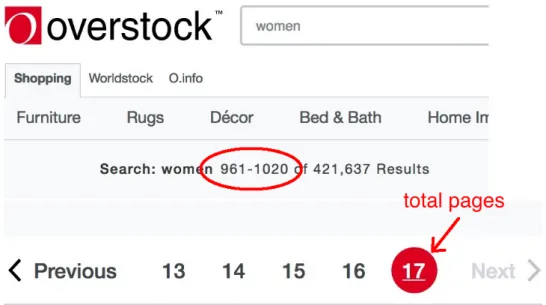
After comparing the total count of results with the results list, 17 websites that did not satisfy the completeness of search results were found. These websites have a limitation on the number of returned results and truncates the results list when the total number of the results exceeds the limitation. The sizes limit varied from hundreds to tens of thousands. For example, overstock.com only returned a maximum 1020 results but it showed 421637 items found for “women” (see Figure 4.4).
CHAPTER 4. EMPIRICAL EVALUATION OF THE CHANGING DIRECTION MRIP22
Cause Analysis
In this study, all websites with this fault have a pre-defined maximum size for a result set and this limitation may vary from hundreds to tens of thousands. Table scan for search and sorting operation which needs numerous intermediate data, involve many I/O activities [46]. A constraint, the number of items in a result set is generally used to improve the performance.
Figure 4.4:Type 2 of MR Violation: Incompleteness of results on overstock.com
4.1.8
Type 3 of MR Violation: Separate Section
We find some items always stay at the beginning or end of the result set. They belong to separate sections which are independent of price sorting. Consequently, users cannot di-rectly find the lowest and highest price from first item in ascending and descending order,
respectively. This requirement for extra effort is related to functional appropriateness,
which refers to the “degree to which the functions facilitate the accomplishment of spec-ified tasks and objectives” [45] .
Observations
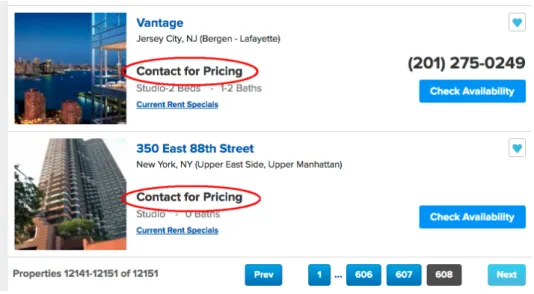
A total of 16 websites were found to not sort all results together and to have a fixed section (top or bottom) to separate the results. For example, rent.com always keeps “contact for pricing” items at the bottom of list regardless of descending or ascending order (see Figure 4.5).
CHAPTER 4. EMPIRICAL EVALUATION OF THE CHANGING DIRECTION MRIP23
Cause Analysis
Some websites prefer to place featured items at the beginning of the result set and leave low priority items, such as “out of stock” and “price unavailable”, at the end regardless of price sorting. The top position serves as an advertisement position and the items at the end of list may be unavailable to users but still need to be searched. The effectiveness of this business strategy is not part of this present study. However, from a user’s perspective, this strategy makes the price sorting fail to fulfil the purpose of its operation.
Figure 4.5:Type 3 of MR Violation: Separate section on rent.com
4.1.9
Type 4 of MR Violation: Same Price Not Reverse
Most websites used in this study do not reverse order for same price items even though price sorting only involves the order of different prices. Nevertheless, it has a negative im-pact on both the users and the website. Let us suppose that there are four items (A,B,C,D) with price $10, $9, $9 and $8. The list shows “A”, “B”, “C”, “D” when it is sorted by price in descending order. It shows “D”, “B”, “C”, “A” when it is sorted by price in ascending order. High exposure of a certain product is unfair to other products. Additionally, users review the list and stop at “B” and then reverse the list and may stop at “B” because they think the entire list has been reviewed.
Observations
Only five websites reverse order for items with the same price. Most commercial websites keep the same sequence for the same priced items after reversing price order. For example, a $7.95 knife on williams-sonoma.com keeps the same order (see Figure 4.6). This could not be determined for one website (www.pharmacy2u.co.uk) because no items of the same price are shown in the list.
CHAPTER 4. EMPIRICAL EVALUATION OF THE CHANGING DIRECTION MRIP24
Cause Analysis
Websites that have this fault may sort a result set on multiple properties and price is the first priority when users perform price sorting. From a user perspective, the property of the second priority is hidden and cannot be changed. As a result, the “price sorting” is not just purely sorting by price.
(a)Search “knife” on williams-sonoma.com, sorting by price high to low
(b)Search “knife” on williams-sonoma.com, sorting by price low to high
Figure 4.6: Type 4 of MR Violation: Fail to reverse same price items on williams-sonoma.com
4.1.10
Type 5 of MR Violation: Different Price Not Reverse
Sorting price is a process of arranging items in a numerical descending or ascending order. The violation of sequence for different price is the most serious fault of all categories. Users cannot trust the lowest and highest prices, but they also cannot refer to any part of
CHAPTER 4. EMPIRICAL EVALUATION OF THE CHANGING DIRECTION MRIP25
Observations
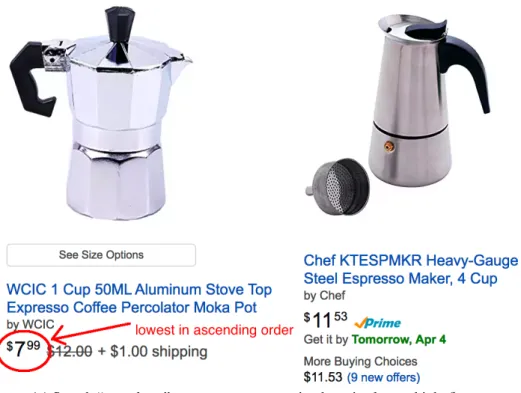
Because of the truncation of large result lists by some of the websites as explained previ-ously, it was decided to use more specific queries (as shown in Table 4.4) to investigate “different price reverse”. Nineteen websites do not sort different price properly. For ex-ample, first page sorting by price low to high shows $7.99 is the lowest price (see Figure 4.7(a)), but last page sorting by price high to low shows $11.53 is the lowest price (see Figure 4.7(b)). It reveals a system default in sorting function.
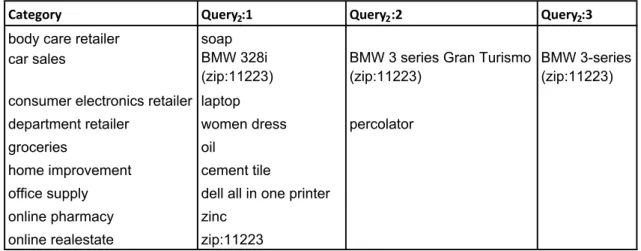
Category Query2:1 Query2:2 Query2:3
body care retailer soap
car sales BMW 328i
(zip:11223)
BMW 3 series Gran Turismo (zip:11223)
BMW 3-series (zip:11223) consumer electronics retailer laptop
department retailer women dress percolator
groceries oil
home improvement cement tile
office supply dell all in one printer
online pharmacy zinc
online realestate zip:11223
Table 4.4:Query terms for truncated result list
Cause Analysis
There are three causes for this fault: some items are groups consisting of several prices and the website chooses different prices for the item while sorting different orders, incorrect implement of sorting, for example, only sorting the first page of list or code does not works, different sorting based on different data sources that are not synchronised.
4.1.11
Recommended User Countermeasures
If the result count is from an outdated cache, the user could obtain the count by calculating the result list. In this research, the smallest number of count inconsistency is over 8000. This suggests that users could narrow down the search scope to avoid count inconsistency. To avoid being frustrated by type 2 and 3 MR violation, users could obtain a completed result set by merging the output of source and follow-up test case. On the other hand, users should sort price in descending and ascending order to find highest and lowest price items at the beginning of the result set, respectively
CHAPTER 4. EMPIRICAL EVALUATION OF THE CHANGING DIRECTION MRIP26
(a)Search “percolator” on amazon.com, sorting by price low to high, first page
(b)Search “percolator” on amazon.com, sorting by price high to low, last page
Figure 4.7: Type 1 of MR Violation: Fail to reverse different price items on amazon.com
If same price items always keep a fixed sequence, it is better for users to go through all the same price items to overcome type 4 MR violations. In a scenario of finding the lowest and highest price in the result set, if a system cannot sort a list by price properly, users could repeatedly leverage the price filter, which function is assumed normal, by setting minimum and maximum prices according to the first and last items in the result
CHAPTER 4. EMPIRICAL EVALUATION OF THE CHANGING DIRECTION MRIP27 set, respectively, until desirable results are achieved.
4.2
Case Study of Google Maps Navigation
4.2.1
Objectives of the Experiment
In this section, the study shows that direction is not only the essential nature of a sorting algorithm, but also a navigation software’s core.
Navigation software is designed to plan an optimal path from a starting point to a des-tination. Users can include extra conditions, such as travel mode and time. The generated path provides a series of instructions for the user to go to the target location. On one hand, Navigation software is unsurprisingly attractive to Internet user and it is installed on more than 50% of smart phones in the world [14]. On the other hand, the failure of navigation systems may be fatal because any error in this kind of software may result in significant accidents, especially with autonomous cars, and delivery drones becoming more and more popular around the world.
Although navigation software is both widespread and critical, the oracle problem still disturbs them just as it does other software. Because of infinite possible paths, it is difficult to verify whether the instructions created by the software are the most optimal option for user. In this section, this study demonstrate how the approach can assist non-professionals to estimate the returned results on maps.google.com (Google Maps web version). The popularity of Google Maps is unrivalled among all mapping services (except in China, where many Google services are not accessible) [14].
4.2.2
Derived Metamorphic Relations
MRReverseDirection: When using navigation software, a “direction” element can be defined as the direction from the starting point to the target location. Hence, a concrete MR can
be derived from the “change direction” MRIP: swapping the starting point and target
location should generate a path with a very similar cost. It should be pointed out that the
cost of a path is about distance or time consumed (the equivalence in MR meanseither
similar distancesorsimilar times). The “time” is an estimated time without taking road
conditions into account.
4.2.3
Experimental Design
In this study, the travel method selected was walking. This is because compared to other travel methods, such as driving and taking a bus, walking can effectively avoid one-way roads which is very common in the city. An investigation discovered very few one-way
CHAPTER 4. EMPIRICAL EVALUATION OF THE CHANGING DIRECTION MRIP28 roads for pedestrians. Because of unstable networks and web pages, all test results were manually validated.
In our experiments, Hong Kong and London, as the world’s most visited cities, were selected as the candidate cities. One thousand pairs of valid addresses were generated for each city (some are in English and others are in Chinese). Request were sent to Google Maps for each pair of addresses (A, B), to get the path from A to B and then from B to A for walking. The outputs were then compared and under normal circumstances, the distances and time durations of the returned paths were expected to be similar. We used Google Maps default settings in all experiments. Furthermore, we did not sign-in any related accounts to because any personalised settings in the browser may influence the results.
4.2.4
Experimental Results
For London, 42% of the test cases returned different durations and 8% returned different distances. The corresponding rates for Hong Kong were 72% and 16%. According to the statistics, most differences were ignorable. However, some remarkable cases were discovered that might reveal a defect in the software. Two examples are introduced in Figure 4.8.
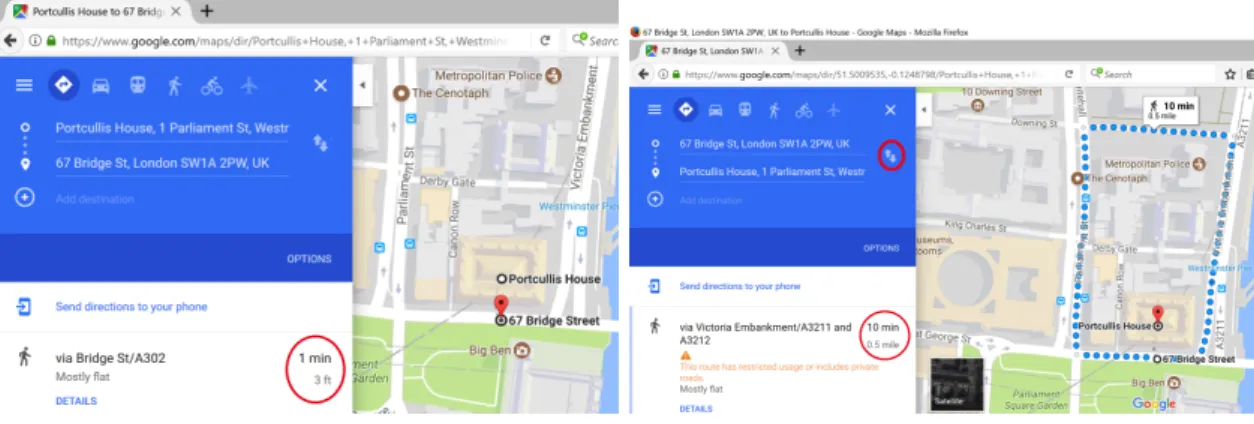
Figure 4.8a illustrates that, given a starting point (Portcullis House) and a destination
(67 Bridge St), user will be given a path with a distance of “3 ft”a; It was a surprise to
see that swapping the source and destination returned a path of “0.5” miles (Figure 4.8b)
b. The algorithm may have its own legitimate reason to return these two paths. From the
users’ perspective, the difference between the two paths is unacceptable. Moreover, as shown in Figure 4.8b, it is said that “This route has restricted usage or includes private roads.” In this case, the user is provided a route that may make the travel difficult.
Figure 4.8ccand Figure 4.8ddshow a test case in Hong Kong which is very similar to
the example in London.
aURL: https://www.google.com/maps/dir/Portcullis+House,+1+Parliament+St, +Westminster,+London+SW1A+2JR,+UK/51.5009535,-0.1248798/@51.5013344,-0.1252238, 17z/data=!4m8!4m7!1m5!1m1!1s0x487604c449a7df5d:0xe7a541ace7056d37!2m2!1d-0. 1248698!2d51.5012679!1m0 bURL: https://www.google.com/maps/dir/51.5009535,-0.1248798/Portcullis+House, +1+Parliament+St,+Westminster,+London+SW1A+2JR,+UK/@51.5019238,-0.1271069,17z/ data=!3m1!4b1!4m8!4m7!1m0!1m5!1m1!1s0x487604c449a7df5d:0xe7a541ace7056d37!2m2! 1d-0.1248698!2d51.5012679 cURL: https://www.google.com/maps/dir/Mei+Foo+Sun+Chuen+Stage+7+-+1-3+Mount+ Sterling+Mall,+1-3+Mount+Sterling+Mall,+Hong+Kong/22.3370167,114.1412827/@22. 3374341,114.1379989,17z/data=!3m1!4b1!4m9!4m8!1m5!1m1!1s0x3403f8ab6af1cdfb: 0x5d48e5358a826c08!2m21d114.1393603!2d22.3375777!1m0!3e2 dURL: https://www.google.com/maps/dir/22.3370167,114.1412827/Mei+Foo+Sun+ Chuen+Stage+7+-+1-3+Mount+Sterling+Mall,+1-3+Mount+Sterling+Mall,+Hong+Kong/@22. 3385225,114.1375424,17z/data=!3m1!4b1!4m9!4m8!1m0!1m5!1m1!1s0x3403f8ab6af1cdfb: 0x5d48e5358a826c08!2m2!1d114.1393603!2d22.3375777!3e2
CHAPTER 4. EMPIRICAL EVALUATION OF THE CHANGING DIRECTION MRIP29
(a)Walking navigation in London: 3 ft, 1 min.
(b)Bad case detected: MR violation after reversing origin and destination: 0.5 miles, 10 min.
(c)Walking navigation in Hong Kong: 250 m, 3 min.
(d)Bad case detected: MR violation after reversing origin and destination: 750 m, 10 min.
Figure 4.8:A “change direction” MR revealed Google Maps navigation defects in Lon-don (a&b) and Hong Kong (c&d)
4.2.5
Further Analysis
In all experiments, we used the default settings in Google Maps. To improve accuracy and make the experiments repeatable, real-time traffic data were disabled. To avoid person-alised results, we did not log into any online accounts, including those for Google. All of the returned paths were checked to ensure that they did not have any one-way limitations for walking. It was determined that, following a “change direction” MR, users can easily find a better path using the icon shown on the page (such as those shown in Figure 4.8b and 4.8d). Without further information about the software, the reason why the software returned the very large difference between paths cannot be determined and the short one is obviously suitable to walk to both directions (Figure 4.8b and 4.8d). In other words, as a countermeasure, the user is recommended to select the shortest paths given by Figure 4.8a and 4.8c regardless of the direction.
This study has more meaning than just helping a user better use navigation software. The methods suggested could be simply used to optimise any existing navigation software without changing its design and architecture. Someone may argue that such an obvious bad case as that shown in Figure 4.8b is meaningless because the user can verify and
CHAPTER 4. EMPIRICAL EVALUATION OF THE CHANGING DIRECTION MRIP30 refuse the results immediately. However, some scenarios, such as self-driving cars and delivery robots have no human to check the rationality of path. Even if the system could do an exhaustive check and find the best path, the resource is unaffordable.
(a)The same bad case as in Figure 4.8b but with a slightly different starting point.
(b) The bad case was detected and the shortcut was found by swapping the origin and destination, using the same “change di-rection” MR.
Figure 4.9:Detecting the same bad case in another path, in London.
4.3
Case Study of Location-based Search
A different type of search product was investigated and the queries included both text and geographic information. Generally speaking, distances and directions are indispensable properties of geographic information.
4.3.1
Objectives of the Experiment
A case study was conducted using the “search and find nearby places” feature (see Fig-ure 4.10) of Google Maps. The number of location-based online searches has increased rapidly over the past few years. One in five searches is location-related [47] now. Google declared that location-related search helps businesses to make their advertising reach the right customers [48].
4.3.2
Derived Metamorphic Relations
MRSeeEachOther : In some software system, users can reasonably expect that if they can find B from A then they can also find A from B, where A and B denote two entities in the system.
4.3.3
Experimental Design
The test followed the steps provided by Google (see Figure 4.10). First, thecurrent