EUR 24427 EN - 2010
Review of QSAR Models and Software
Tools for Predicting Genotoxicity and
Carcinogenicity
The mission of the IHCP is to provide scientific support to the development and implementation of EU policies related to health and consumer protection.
The IHCP carries out research to improve the understanding of potential health risks posed by chemical, physical and biological agents from various sources to which consumers are exposed.
European Commission Joint Research Centre
Institute for Health and Consumer Protection
Contact information
Address: Via E. Fermi 2749, 21027 Ispra (VA), Italy E-mail: [email protected] Tel.: +39 0332 789566 Fax: +39 0332 786717 http://ihcp.jrc.ec.europa.eu/ http://www.jrc.ec.europa.eu/ Legal Notice
Neither the European Commission nor any person acting on behalf of the Commission is responsible for the use which might be made of this publication.
A great deal of additional information on the European Union is available on the Internet. It can be accessed through the Europa server http://europa.eu/
JRC 59068 EUR 24427 EN
ISBN 978-92-79-16103-2 ISSN 1018-5593
doi:10.2788/26123
Luxembourg: Publications Office of the European Union © European Union, 2010
Reproduction is authorised provided the source is acknowledged Printed in Italy
ABSTRACT
The review of QSARs for genotoxicity and carcinogenicity was performed in a broad sense,
considering both models available in software tools and models that are published in the
literature. The review considered the potential applicability of diverse models to pesticides as
well as to other types of regulated chemicals and pharmaceuticals. The availability of models
and information on their applicability is summarised in tables, and a range of illustrative or
informative examples are described in more detail in the text. In many cases, promising
models were identified but they are still at the research stage. For routine application in a
regulatory setting, further efforts will be needed to explore the applicability of such models
for specific purposes, and to implement them in a practically useful form (i.e. user-friendly
software). It is also noted that a range of software tools are research tools suitable for model
development, and these require more specialised expertise than other tools that are aimed
primarily at end-users such as risk assessors. It is concluded that the most useful models are
those which are implemented in software tools and associated with transparent documentation
on the model development and validation process. However, it is emphasised that the
assessment of model predictions requires a reasonable amount of QSAR knowledge, even if it
is not necessary to be a QSAR practitioner.
LIST OF ABBREVIATIONS
AhR
Aryl Hydrocarbon Receptor
CHL
Chinese Hamster Lung cells
CHO
Chinese Hamster Ovary cells
DfW
Derek for Windows (Lhasa Ltd)
DNA
Deoxyribonucleic acid
ECHA
European Chemicals Agency
EU
European Union
GHS
Globally Harmonized System of Classification and Labelling of Chemicals
JRC
Joint Research Centre
NCCT
National Center for Computational Toxicology
NTP
National Toxicology Program
OECD
Organisation for Economic Cooperation and Development
QMRF
QSAR Model Reporting Format
QSAR
Quantitative Structure-Activity Relationship
SAR
Structure-Activity Relationship
SAs
Structural Alerts
SCE
Sister Chromatid Exchange
TTC
Threshold of Toxicological Concern
UDS
Unscheduled DNA synthesis
CONTENTS
1. Introduction ... 1
2. Background biology... 1
3. Regulatory classification of mutagens and carcinogens ... 2
4. Databases... 2
5. Structure-activity relationships for non-congeneric chemicals ... 4
6. Types of expert systems ... 5
7. Software tools ... 5
8. Literature reviews and comparative evaluation studies ... 9
9. Conclusions ... 11
10. References ... 13
11. Figures ... 29
1. Introduction
To date, hundreds of (Q)SAR models have been published in the literature for predicting genotoxicity
and carcinogenicity. The most commonly modelled endpoint for genotoxicity has been Ames test
mutagenicity, whereas carcinogenicity models have focused mostly on the rodent bioassay. In this
report describes the background biology, the various methodologies used, and summarises some of the
key conclusions from the extensive literature concerning the predictivity and applicability of existing
models.
2. Background biology
Mutagenicity refers to the induction of permanent transmissible changes in the amount or structure of
the genetic material in cells or organisms. These changes may involve a single gene (point mutations),
a block of genes or entire chromosomes (structural or numerical chromosome aberrations).
Genotoxicity is a broader term and refers to processes that alter the structure, information content or
segregation of DNA and which are not necessarily associated with mutagenicity. Such processes
include unscheduled DNA synthesis (UDS), sister chromatid exchange (SCE), DNA strandbreaks,
DNA adduct formation, and mitotic recombination. In many cases, genotoxicity may lead to cancer.
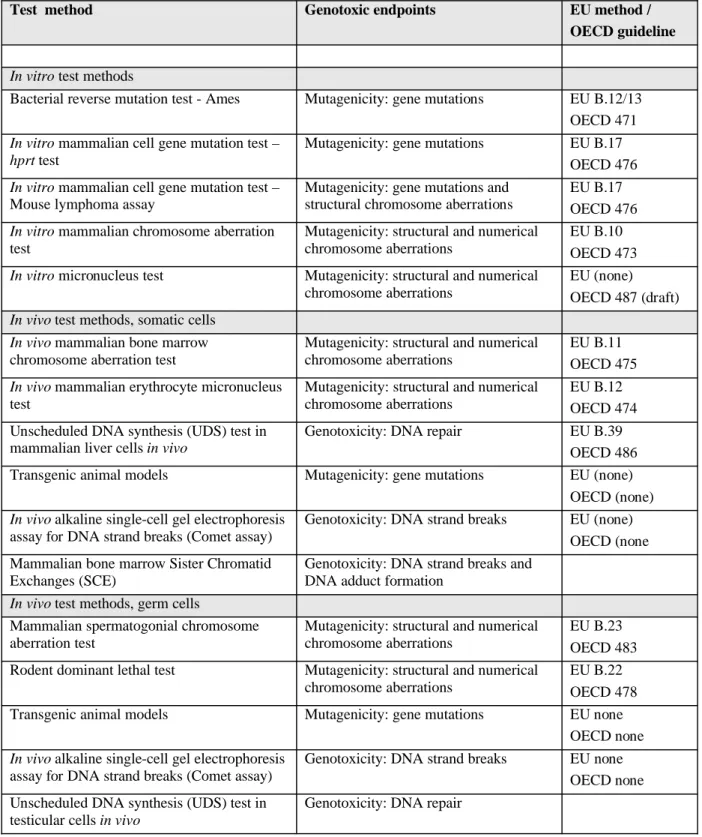
Thus, genotoxicity testing is performed to assess the potential of substances to induce genotoxic
effects which may cause heritable damage or lead to cancer in humans. A summary of different types
of genotoxicity test is given in Table 1.
Chemicals are defined as carcinogenic if they induce tumours, increase tumour incidence and/or
malignancy or shorten the time to tumour occurrence (ECHA, 2008). Traditionally, carcinogens have
been identified from epidemiological studies or from animal experiments. Carcinogenic chemicals
have conventionally been divided into two broad categories based of the presumed mode of action:
genotoxic or non-genotoxic. Genotoxic carcinogens cause damage by interacting directly with DNA –
many known mutagens are in this category. In contrast, non-genotoxic carcinogens cause “epigenetic”
changes, i.e. effects that do not involve alterations in DNA but that may influence the carcinogenic
process. The mechanistic understanding of the carcinogenic process differs considerably between the
two modes of action. The distinction is not absolute – chemicals can be carcinogenic by both models
of action.
A unifying scientific theory for the mode of action of epigenetic carcinogens is still missing, because
they act through a wide variety of different and specific mechanisms. For this reason, QSARs for
epigenetic carcinogenicity are still in an early stage of development. A number of structural alerts
(SAs) and characteristics of several types of non-genotoxic carcinogens have been summarised and
(Woo & Lai, 2003). Recognised mechanisms of non-genotoxic carcinogenicity include peroxisome
proliferation, aryl hydrocarbon receptor (AhR) binding, inhibition of gap junctional intercellular
communication, oxidative stress, alteration of DNA methylation, endocrine disruption and renerative
cell proliferation (Woo & Lai, 2003).
In contrast, in the case of genotoxic carcinogens, the electrophilic theory was introduced more than 25
years ago by James and Elizabeth Miller (Miller & Miller, 1981) who also led the way for the use of
(Q)SAR in the prediction of genotoxicity and carcinogenicity. In general, genotoxic carcinogens have
the unifying feature that they are either electrophiles or can be activated to electrophilic reactive
intermediates (pro-electrophiles). The electrophilic theory of genotoxic carcinogenicity has led to two
main (Q)SAR approaches for modelling genotoxic chemicals: a) to identify the electrophilic
functional groups or substructures, i.e. to develop SAR models based on structural alerts (SAs); and b)
to find molecular descriptors which can be quantitatively related to the activity of the chemicals, i.e. to
develop QSARs. Most studies have provided qualitative models (SARs), which provide a
“coarse-grain” approach for the identification of genotoxic potential. In addition, although more challenging,
numerous studies have attempted to develop quantitative models (QSARs), which provide a more
precise means of assessing genotoxicity and carcinogenicity, mainly for congeneric sets of chemicals.
3. Regulatory classification of mutagens and carcinogens
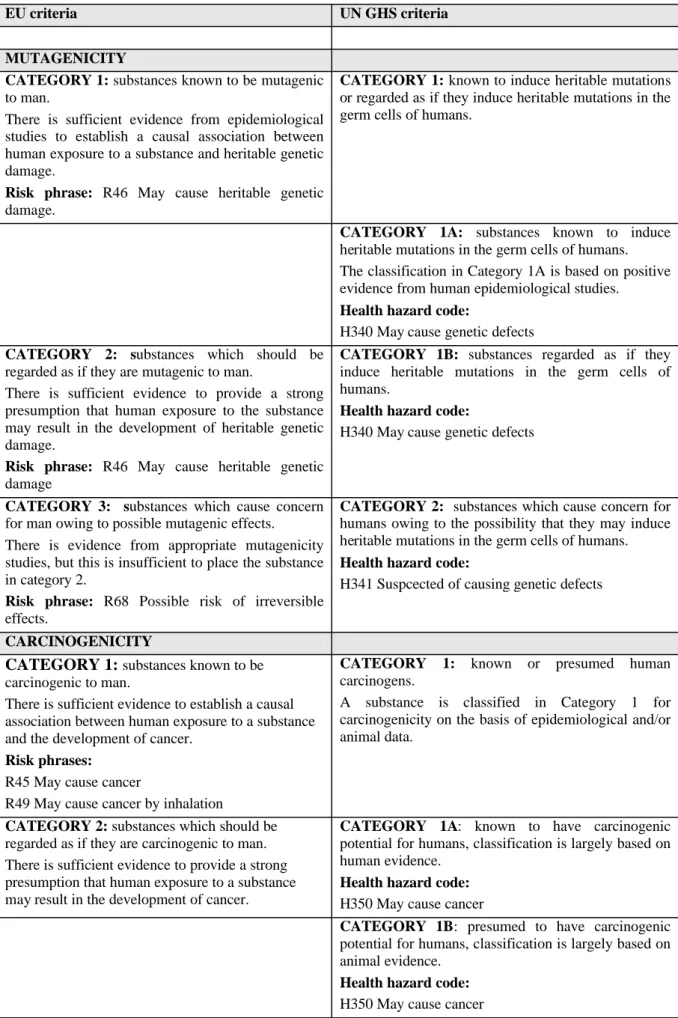
A summary of the former EU and new GHS criteria for classifying substances on the basis of
mutagenicity and carcinogenicity is given in Table 2. These schemes classify substances into different
levels of concern based on the strength and weight of available evidence. Expertise in ergaultory
toxicology is required to apply the classification criteria in a consistent manner.
4. Databases
A number of web-based databases provide access to experimental data for mutagenicity
carcinogenicity, and are thus useful for (Q)SAR development and assessment. Until recently, public
toxicity databases were constructed primarily as “look-up-tables” of existing data, and most often did
not contain chemical structures. However, modern technologies are now providing powerful tools to
create new types of searchable databases, providing an effective means of linking toxicity with
chemical structure. Some databases only allow information to be retrieved chemical-by-chemical but
others provide the possibility to download an entire database. Several reviews have surveyed the status
of public toxicity databases (Richard & Williams 2003; Benigni
et al
., 2008a). In this section, a short
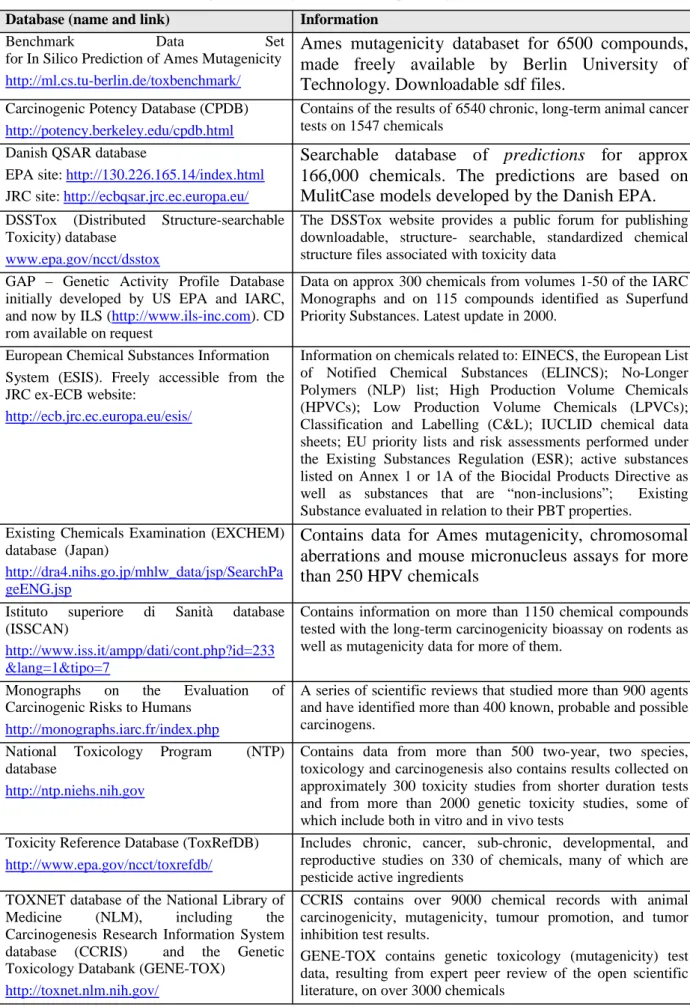
explanation is given of the main databases, and a summary is presented in Table 3.
CPDB: The Carcinogenic Potency Database (CPDB) (
http://potency.berkeley.edu/cpdb.html
) provides
a unique resource of the results of 6540 chronic, long-term animal cancer tests on 1547 chemicals. The
CPDB provides easy access to the bioassay literature, with qualitative and quantitative analyses of
both positive and negative experiments that have been published over the past 50 years in the general
literature through 2001 and by the National Cancer Institute/National Toxicology Program through
2004. The CPDB is downloadable in pdf, xls and txt formats, and is searchable by chemical name,
CAS number, or author.
Danish QSAR database: The Danish EPA has developed a (Q)SAR database as a free source of
predicted toxicities (not experimental data) for over 166,000 chemicals. For information on
genotoxicity, the database contains predictions for various types of Ames test as well as a range of in
vitro endpoints: chromosomal aberrations (CHO and CHL cells), gene mutation assays (mouse
lymphoma/tk, CHO/hprt) and Unscheduled DNA Synthesis (UDS) in rat hepatocytes. A range of in
vivo models are also included (Drosophila SLRL, mouse micronucleus, rodent dominant lethal assay,
mouse Sister Chromatid Exchange (SCE) in bone marrow and mouse Comet assay). All these models
were derived using the MULTICASE software. For information on carcinogenicity, the database
includes (in addition to the genotoxicity models), eight MULTICASE FDA cancer models, rodent
carcinogenic potency, hepatospecificity, oestrogenicity and aryl 33 hydrocarbon (AH) receptor
binding. The Danish QSAR database can be freely accessed over the internet from the JRC website
(
http://ecbqsar.jrc.it/
). The database includes a flexible system for chemical structure and parameter
searching. This database should be used with caution, since the data are not experimental data but
predictions, many of which will not resultfrom use of the more recent models.
DSSTOX: Both the CPDB and the online NTP database have been “chemically-indexed” in the
DSSTox (Distributed Structure-searchableToxicity)
database (
http://www.epa.gov/ncct/dsstox
),
developed by US EPA’s National Center for Computational Toxicology (NCCT). DSSTOX
emphasises quality procedures for accurate and consistent chemical structure annotation of
toxicological experiments. Chemical structures and summary mutagenicity and carcinogenicity data
have been published for the entire CPDB inventory (
www.epa.gov/ncct/dsstox/sdf_cpdbas.html
),
along with the URL address locating the specific chemical data webpage on the CPDB website
provided for each indexed chemical substance. Chemical structures and indicators of data availability
have also been provided for the entire chemical inventory of the online NTP database, for each of the
four main NTP study areas (developmental, immunological, genetox, and chronic cancer bioassays).
ECHA CHEM: Information on susbtances evaluated under REACH are provided by ECHA CHEM,
which is hosted by the European Chemicals Agency (ECHA)
(
http://echa.europa.eu/chem_data_en.asp
).
ESIS: The European chemical Substances Information System (ESIS) is a freely accessible data via
the JRC ex-ECB website (
http://ecb.jrc.ec.europa.eu/esis/
) providing information on chemicals related
to: EINECS (European Inventory of Existing Commercial chemical Substances); ELINCS (European
List of Notified Chemical Substances); NLP (No-Longer Polymers); the Biocidal Products Directive
(BPD) active substances listed in Annex I or IA of Directive 98/8/EC or listed in the so-called list of
“non-inclusions”; PBT (Persistent, Bioaccumulative, and Toxic) or vPvB (very Persistent and very
Bioaccumulative) assessments of Existing Substances; Classification and Labelling (C&L), the Export
and Import of Dangerous Chemicals listed in Annex I of Regulation (EC) No 689/2008; High
Production Volume Chemicals (HPVCs) and Low Production Volume Chemicals (LPVCs), including
EU Producers/Importers lists; IUCLID Chemical Data Sheets; EU Priority Lists and EU Risk
Assessments produced under the Existing Substances Regulation (ESR).
EXCHEM: This database (
http://dra4.nihs.go.jp/mhlw_data/jsp/SearchPageENG.jsp
) was developed
by the Chemicals Investigation Promoting Council, Japan and was supervised by Office of Chemicals
Safety Evaluation and Licensing Bureau Pharmaceutical and Food Safety Bureau Ministry of Health,
Labour and Welfare, Japan. EXCHEM contains data for Ames mutagenicity, chromosomal aberrations
and mouse micronucleus assays for more than 250 HPV chemicals. Most of the information is in
Japanese but there is also information in English. The database is searchable by CAS number and
name.
GAP: The Genetic Activity Profile Database was initially developed by US EPA and IARC, and now
by ILS (
http://www.ils-inc.com
). Data on approx 300 chemicals were compiled from volumes 1-50 of
the IARC Monographs and on 115 compounds identified as Superfund Priority Substances. The data
(qualitative and quantitative) are displayed as graphic profiles and data tables for up to 200 short-term
assays that range from bacterial tests to human studies in vivo. The latest version was produced in
2000 (GAP2000). A CD rom is available on request from ILS.
IARC: The International Agency for Research on cancer (IARC) website provides access to the
IARC
Monographs on the Evaluation of Carcinogenic Risks to Humans
(
http://monographs.iarc.fr/index.php
). The IARC Monographs have reviewed more than 900 chemcials
and have identified more than 400 known, probable and possible carcinogens. The monographs are
searchable by key word, CAS number, synonym or chemical name.
ISSCAN: This database (
http://www.iss.it/ampp/dati/cont.php?id=233&lang=1&tipo=7
), developed
by the Istituto Superiore di Sanità (Rome, Italy), contains information on more than 1150 chemical
compounds tested with the long-term carcinogenicity bioassay on rodents (rat, mouse). Historically,
this database was developed to support the development of (Q)SAR models for chemical
carcinogenicity. ISSCAN is downloadable in pdf, xls and sdf formats, and is searchable by chemical
name and CAS number.
NTP: The US National Toxicology Program (NTP) (
http://ntp.niehs.nih.gov
) provides access to
publicly available data from more than 500 two-year, two species, toxicology and carcinogenesis
studies collected by the NTP and its predecessor, the National Cancer Institute's Carcinogenesis
Testing Program. The NTP database also contains results relating to approximately 300 toxicity studies
from shorter duration tests and from more than 2000 genetic toxicity studies, including both in vitro
and in vivo tests. In addition, test data from the immunotoxicity, developmental toxicity and
reproductive toxicity studies are continually being added to this database. The data can be accessed as
technical reports; the user can browse them directly, make searches (by chemical name or CAS
number, for example), or download the reports in pdf form.
ToxRefDB: This database (
http://www.epa.gov/ncct/toxrefdb/
) was developed by the NCCT, in
partnership with EPA's Office of Pesticide Programs (OPP), to store data from in vivo animal toxicity
studies. The original aim was to populate ToxRefDB with pesticide registration toxicity data that has
been historically stored as hard-copy and scanned documents by OPP. ToxRefDB currently includes
chronic, cancer, sub-chronic, developmental, and reproductive studies on 330 chemicals, many of
which are pesticide active ingredients. ToxRefDB is downloadable in xls format but without structural
information.
TOXNET: The TOXNET database of the US National Library of Medicine (NLM)
(
http://toxnet.nlm.nih.gov
) is a cluster of different databases, collecting information on toxicology,
hazardous chemicals, environmental health, and toxic releases. From the website, it is possible to
search within and across the databases by several identifiers, such as chemical name, CAS number,
molecular formula, classification code, locator code, and structure or substructure. Among the
TOXNET databases, the Chemical Carcinogenesis Research Information System (CCRIS) and the
GENE-TOX
databases deal specifically with mutagenicity and carcinogenicity data. CCRIS contains
over 9000 chemical records with animal carcinogenicity, mutagenicity, tumour promotion, and tumor
inhibition test results provided by the National Cancer Institute (NCI). Test results have been reviewed
by experts in carcinogenesis and mutagenesis. GENE-TOX was developed by the US EPA and
contains genetic toxicology (mutagenicity) test data, resulting from expert peer review of the open
scientific literature, on over 3000 chemicals.
5. Structure-activity relationships for non-congeneric chemicals
One of the simplest and best known approaches to predict genotoxicity and carcinogenicity for
structurally diverse chemicals is based on the use of SAs, sometimes accompanied by modulating
factors. This section traces the development of the main SA-based approaches.
The first list SAs for mutagenicity was proposed by Ashby (Ashby 1985), who subsequently extended
the lists with additional SAs as well as some detoxifying functionalities (Ashby and Tennant 1988).
The resulting 19 SAs are referred to collectively as the Ashby poly-carcinogen model, often
represented by a fictitious chemical structure containing all of the alerts (Figure 1).
Bailey
et al
. (Bailey
et al
. 2005) generated a list of 33 SAs for regulatory use in the US FDA. This list
was based on the Ashby alerts and on a list compiled by Munro
et al
. (Munro
et al
., 1996).
Kazius
et al
. (Kazius
et al
. 2005) produced another list of SAs by using a combination of data mining
and expert knowledge. This list contains 29 SAs accompanied with detoxifying fragments and is
reported to classify its training set (2401 mutagens and 1936 non-mutagens) with an accuracy of 82%.
The Laboratory of Mathematical Chemistry (LMC, Bourgas, Bulgaria) has developed a list of 17 SAs.
These are implemented in the OASIS TIMES software (see below).
More recently, Benigni and Bossa (2008) combined the above sources and some information from the
OncoLogic software to generate a list of 33 SAs. Five of the Benigni-Bossa alerts refer to
non-genotoxic mechanisms of action and several of them have accompanying modulating factors. The
reported accuracy of prediction is 78% for mutagenicity and 70% for carcinogenicity, based on an
analysis of the ISSCAN database. The Benigni-Bossa SAs is implemented in the Toxtree software and
in the OECD Toolbox (see below).
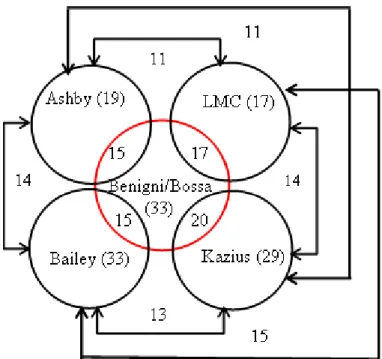
The relationships (overlaps) between the different lists of SAs are illustrated in Figure 2. For the
purpose of this Venn diagram, comparison between alerts was based simply on the main functional
group in the SA and not on exact matches between whole alerts. In the different lists, SAs are
described with different levels of detail. At present, the most comprehensive list of SAs is the
Benigni-Bossa list (the number of the SAs containing in the Bailey list is the same but many of these alerts
contain the same functional group and different substitutes).
6. Types of expert systems
An expert system has been defined as any formalised system that is often, but not necessarily,
computer based, and that can be used to make predictions on the basis of prior information (Deaden
et
al
., 1997). Expert systems (and their implementation in software tools) are based on three main
modelling approaches referred to rule-based, statistically-based, or hybrid methods.
Rule-based systems contain “if-then-else” rules that combine toxicological knowledge, expert
judgment and fuzzy logic. Commonly used software tools based on this approach include OncoLogic
(Woo
et al
. 1995), Derek (Sanderson & Earnshaw 1991; Ridings
et al
., 1996) and HazardExpert
(Smithing & Darvas 1992). Derek and HazardExpert can be used in conjunction with their sister
programs Meteor and Metabolexpert to predict the genotoxicity and carcinogenicity potential of
metabolites as well as parent compounds. In addition to these commercial tools, models included in the
freely available Toxtree software and the OECD Toolbox are rule-based.
Statistically-based systems use a variety of statistical, rule-induction, artificial intelligence, and pattern
recognition techniques to build models from non-congeneric databases. Statistically based systems are
included in the commercial tools MultiCASE and TOPKAT, and the publicly available Lazar and
CAESAR models. In addition, many models published in the literature and not implemented in
software are statistically based.
Hybrid models are based on a combination of knowledge-based rules and statistically-derived models.
These are based on the general idea that, within the structural space of a single SA (considered to
represent a single interaction mechanism), statistically derived models can quantitatively predict the
variation in the reactivity of the alert conditioned by the rest of the molecular structure. Examples of
the hydrid approach include models implemented in the OASIS TIMES (Mekenyan
et al
,. 2004;
Mekenyan
et al
., 2007; Serafimova
et al
., 2007) as well as some literature-based models not
implemented in software.
A good example of hydrid model in the literature is the Purdy model for carcinogenic potential (1996).
Purdy’s model is a decision tree with 11 individual rules or QSARs for different chemical classes. The
QSARs are relatively simple in form, ranging from an allowed range or cut-off of a computed property
value (for example, logP, molecular volume, E(LUMO), partial atomic charges and
superdelocalisibilities), to a three dimensional constraint specifying a fixed distance between lone pairs
of electrons. The author reported a high accuracy of classification (92% and 88% for the training and
test sets, respectively) The main advantages of the Purdy model is that is based on simple rules, and
the reasoning underlying the prediction can be seen. The main disadvantages are that the rules is
restricted to a few chemical classes and do not have clear mechanistically interpretations. In addition,
the model is not yet automated so is not practically available for routine use. However, this limitation
could easily be addressed by a software programmer.
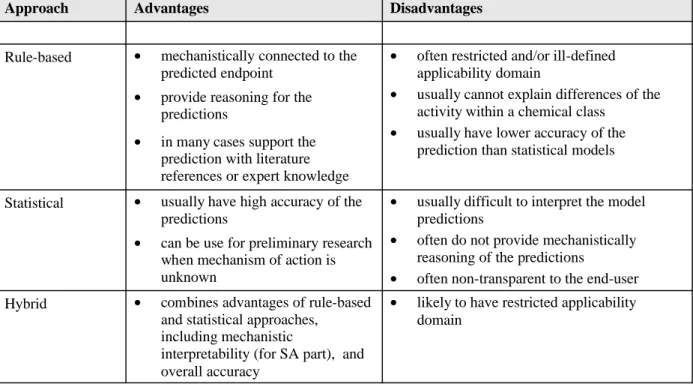
The advantages and disadvantages of the three main approaches are summarised in Table 4.
7. Software tools
Genotoxicity and carcinogenicity prediction is featured in a wide range of commercial and freely
available software tools, the most commonly used of which are described below. A summary is given
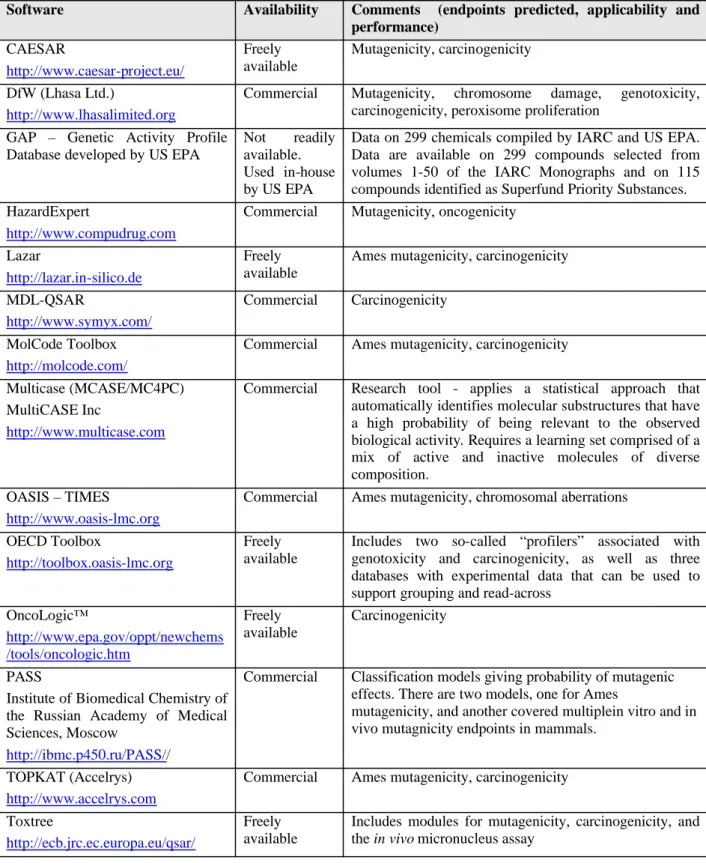
in Table 5.
CAESAR: A statistical model for mutagenicity was developed and released as an open source
software tool in the frame of the EU CAESAR project (
http://www.caesar-project.eu/
). Gini and
colleagues (Ferrari
et al
., 2009) used the Support Vector Machine (SVM) classification method to
develop a model based on the 4225 compounds from the Kazius-Bursi mutagenicity database. The
authors reported correct classification rates of 92.3% and 83.2% for the training and test sets,
respectively. The results were considered to be in the same order of magnitude as experimental error.
No information was provided about the applicability domain. In order to minimise the number of false
negatives, the authors investigated the combined use of their model with some SAs from the
Benigni-Bossa rulebase (using Toxtree). As expected, the results showed that the number of false negatives
could be reduced but this was at the expense of increasing the number of the false positives. This
resulted in a slight change in accuracy of 1.1% less. The authors concluded that by using the so-called
“cascade model”, a classification accuracy close to the reliability of the Ames test data could be
achieved. In fact, they achieved this accuracy by using just the SVM classification algorithm.
In the CAESAR project, two complementary approaches (regression and classification) were applied
to develop models for carcinogenicity. The original dataset, extracted from the CPDB, consisted of
805 chemicals with rat TD50 values. This dataset was spit into training (n=644) and test (n=161) sets.
The regression model was developed by applying a Monte Carlo method to TD50 data. The
classification model was developed by applying the Counter-Propagation Artificial Neural Network
(CP-ANN) method and a set of MDL descriptors. The authors reported an accuracy of classification of
91-96% for the training set and 68-74% for the test set.
Derek:
This is a commercial system developed and marketed by Lhasa Ltd. The development of
knowledge-based rules in Derek is overseen by collaborative group which consists of representatives
from commercial, educational and non-profit organisations. The current version of Derek (v. 12;
released in December 2009) contains 89 alerts for mutagenicity, 77 for chromosome damage, and 61
for carcinogenicity. The chromosome damage alerts are based primarily on data from the in vitro
chromosome aberration test, however additional assays (in vivo chromosome aberration test, in vitro
and in vivo micronucleus test and L5178Y TK+/- assay) have been considered when writing alerts, and
some alerts are entirely based on alternative assays. The chromosome damage alerts cover both direct
DNA damage and other genotoxic mechanisms.
The hazard assessment in Derek is usually justified with relevant literature references, which give the
user more confidence in the predictions. The main advantages of the system are the transparency in the
predictions, the fact that the rule development is peer-reviewed by a user group, and new rules can be
added easily. It should be noted that DfW does not provide negative predictions (the absence of a
predicted hazard simply means that no relevant alerts were identified; it does not necessarily mean the
absence of hazard). A QMRF for the DfW mutagenicity model is available in the JRC QSAR Model
Database.
In a recent study, Crettaz and Benigni (2005) assessed the ability of DfW to qualitatively predict the
rodent carcinogenicity and the genotoxic potential of 60 pesticides registered in Switzerland. The
percentage of false negatives was 31% for carcinogenicity. The associated sensitivity of 69% indicates
that most of the pesticides with positive rodent bioassay results were detected by DfW. On the other
hand, the low specificity of 47% is equivalent to a false positive rate of 53%. Such chemicals would be
predicted as carcinogenic while rodent bioassays would not confirm this potential.
In a recent EFSA-sponsored study on the applicability of TTC concept to pesticides and their
metabolites carried out by the Chemicals Regulation Directorate (UK), DfW was used to predict the
genotoxicity and carcinogenicity of 100 randomly selected pesticide active substances (CRD, 2009). It
was concluded that DfW is not reliable predictor for these two endpoints. However, authors note that
the dataset of 100 compounds is inevitably biased by excluding compounds with high genotoxic
potential. When the analysis focused on compounds of greatest potential concern, those with positive
study results for both tumours and genotoxicity, the predictivity based on an alert for either
genotoxicity or carcinogenicity was good (10/12 correct), although the ratioanle for the prediction was
often incorrect. It was concluded that additional work should be performed on the reliability of
genotoxicity predictions from DfW and other (Q)SAR programs.
HazardExpert: The HazardExpert models (Smithing and Darvas, 1992) are proprietary, the software
now being marketed by CompuDrug Ltd. The program works by searching the query structure for
known toxicophores that are derived from the literature in the field of QSAR or from the US EPA and
Interagency Testing Committee (ITC) monographs. Predictions are made in four levels of toxicity,
taking into account the effects of bioavailability and bioaccumulation.
As an evaluation of its ability to predict human and animal carcinogenicity, 192 agents evaluated in the
IARC Monographs (volumes 1-42) were processed through Hazardexpert (Dearden
et al
., 1997). The
difference between the classification in the IARC list and that assessed by Hazardexpert was used for
the analysis. As a result, some important fragments were found to be missing from the toxic fragments
database, including vinyl chlorides, organophosphates, organometallic compounds, and isocyanates.
In a separate evaluation study based on 80 NTP chemicals (56 rodent carcinogens; 24
non-carcinogens), HazardExpert was found to have an overall concordance of 51%, and to be good at
identifying non-carcinogens (specificity of 81%), but poor at identifying carcinogens (sensitivity of
36%).
Lazar: The predictive performance of Lazar was assessed by Helma (2006), who used a training set of
1447 chemicals from the CPDB and 4337 chemicals from the Kazius/Bursi database for external
validation. Leave-one-out and external validation experiments indicated that Salmonella mutagenicity
can be predicted with 85% accuracy for compounds within the applicability domain of the CPDB. The
LOO accuracy of Lazar predictions for rodent carcinogenicity was reported as 86%, and the accuracies
for other carcinogenicity endpoints varied between 78 and 95% for structures within the applicability
domain. A QMRF for Lazar mutagenicity is under preparation.
MDL QSAR: This is a commercial software tool originally developed by MDL and now marketed by
Symyx Ltd (see above). The software has been used by Contrera
et al
. (2005a) to develop discriminant
models for bacterial mutagenicity using a dataset of over 3000 chemicals and with sensitivity,
specificity and concordance of 81%, 76% and 81%, respectively. These models are not readily
transferable and thus of limited practical used.
Valerio
et al
. (2007) evaluated the utility of a discriminant analysis modelling approach (MDL-QSAR)
to estimate the carcinogenic potential of small, organic, naturally occurring chemicals found in the
human diet. They used as a training set of over 1200 chemicals, comprised primarily of
pharmaceuticals, industrial chemicals and some natural products. A sample set of 123 naturally
occurring chemicals found in the human diet with known low and high risk potential as rodent
carcinogens, and a control group of 19 synthetic dietary chemicals with known high carcinogenic
potential were use as a test set. The predictive performance based on this test set was an overall
concordance of 80%, a sensitivity of 97%, and a marginal specificity of 53%. These results support the
usefulness of the MDL-QSAR software in identifying the rodent carcinogenic potential of naturally
occurring organic chemicals. As also noted by the authors, further assessment of the software will be
needed for a wider range of dietary chemicals.
MultiCASE: The MultiCASE models are proprietary. The software has been widely used by the
Danish EPA to build models for a range of genotoxicity and carcinogenicity endpoints. Genotoxicity
models include Ames mutagenicity (two models), direct mutagenicity, base-pair mutagenicity,
frame-shift mutagenicity, chromosomal aberrations (two models), mouse micronucleus assay, mouse sister
chromosomal exchange. Carcinogenicity models include rat, mouse, female, male carcinogenicity,
TD50 rat, mouse carcinogenicity. The Danish EPA reported concordances between 56-100% for the
different models (
http://www.mst.dk/English/Chemicals/Substances_and_materials/QSAR/
). More
information on these models, and pre-generated predictions for over 166,000 chemicals and can be
found at the EPA website (
http://www.mst.dk/English/Chemicals/
) as well the as JRC website
(
http://ecbqsar.jrc.it/
). The JRC version of the Danish database includes a flexible system for chemical
structure and property searching.
In a study by Matthews and Contrera (1998), MCASE was used with numerous in-house modifications
of the system, including: a) enhancement of the size of the control database modules; b) optimization
of MCASE SAR assay evaluation criteria; c) incorporation of a carcinogenic potency scale for control
compound activity and MCASE biophores; d) construction of individual rodent gender and
species-specific modules; and e) use of assay acceptance criteria for query and control database compounds.
The optimised system was reported to demonstrate excellent sensitivity for carcinogens (97%), and
specificity for non-carcinogens (98%), in a test set of 126 chemicals. While these seem like very
promising results, they are not verifiable: the MCASE model is not readily transferable, and the data
used are confidential and therefore are not available for use in the development other modelling
methodologies or to assist in the assessment of the improved MCASE system. Similar studies have
been carried out more recently by Matthews and co-workers, with more extensive datasets (Matthews
et al
., 2006a, 2006b).
OASIS/TIMES: The hybrid approach has been used by Mekenyan and colleagues to develop models
for Ames mutagenicity and chromosomal aberration. These models are implemented in the OASIS
TIMES software. Each SA is accompanied by modulating factors, to account for the influence of the
rest of the molecule, as well as with defined and documented mechanism of interaction with DNA (for
the mutagenicity model) and/or nuclear proteins and enzymes (for the chromosomal aberration model).
Expert knowledge was used to define the SAs and the mechanistic basis for prediction (interaction
with biological macromolecules) is well documented. A pattern recognition approach (COREPA) was
used to derive modulating factors for each SA.
In contrast to other models for genotoxicity, the OASIS models include a liver metabolic simulator
based on documented metabolic pathways. The training sets used for the models were split into
chemicals that are mutagenic without metabolic activation, mutagenic after metabolic activation, and
non mutagenic with and without metabolic activation. This is an important advantage of the
OASIS/TIMES software, because the role of metabolism is rarely accounted for. To demonstrate the
importance of metabolism, the authors showed that when predictions are obtained without using the
metabolic simulator for chemicals known to be active after metabolic activation, the sensitivity was
dramatically decreased to 22%. The main disadvantage of the OASIS/TIMES software is that it is a
little bit slower than other software.
OECD Toolbox:
The current version of this software (
http://toolbox.oasis-lmc.org
) implements two
so-called “profilers” connected with genotoxicity and carcinogenicity. The first one is the
Benigni-Bossa rulebase (Benigni
et al
., 2008b) and the second is the OASIS DNA binding profiler developed
by LMC Bourgas (Serafimova
et al
., 2007). The OECD Toolbox also includes a few databases with
experimental data that can be used to support grouping and read-across: a) the ISSCAN database –
1149 chemicals containing data for carcinogenicity and Ames mutagenicity; b) the EXCHEM database
– 256 chemicals containing data for Ames mutagenicity, chromosomal aberrations and mouse
micronucleus assay; c) the OASIS Genotox database – 2684 chemicals with data for Ames
mutagenicity and chromosomal aberrations as well as data for metabolism. The Toolbox also includes
the Danish EPA database containing predicted data of different genotoxicity and carcinogenicity
endpoints for more than 166,000 chemicals.
Oncologic: Oncologic is a knowledge-based system developed by LogicChem Inc (Woo & Lai, 2005).
It can be freely download from the US EPA website
(
http://www.epa.gov/oppt/newchems/tools/oncologic.htm
). It uses a series of hierarchically ordered
rules to describe and predict the carcinogenic potential of chemicals. These rules have been developed
in collaboration with the structure-activity team at the US EPA’s Office of Pollutions Prevention and
Toxics. The current version (December 2009) includes over 40,000 rules based on knowledge and
generalisations derived from the examination of more than 10,000 chemicals belonging to
approximately 50 chemical classes. The main advantages of the system are that it includes a large
amount of human knowledge, the predictions are restricted to those classes for which adequate
knowledge is available, and reports usually include supporting information to justify the prediction.
The main disadvantages are that there is no possibility for batch calculations, and the system requires
some chemistry expertise, with the user needed to take decisions step-by-step during the prediction.
TOPKAT:
The TOPKAT models are proprietary. According to Enslein (1994), the accuracy of
mutagenicity and carcinogenicity predictions are extremely high: 98% (against a mutagenicity dataset
of 1083 chemicals) and 99.6% (against a carcinogenicity dataset of 705 chemicals), respectively.
However, some subsequent evaluation studies (Prival 2001) indicate that for external sets of
chemicals, the accuracy of TOPKAT prediction is considerably lower (40-75% against datasets of
30-40 chemicals) and these results were not significantly better when the analyses were restricted to
predictions made inside the OPS.
Toxtree:
Toxtree currently includes two modules for mutagenicity and carcinogenicity prediction –
the Benigni-Bossa rulebase (which expands on the Ashby supermutagen model; see above) and the
ToxMic rulebase for the in vivo micronucleus assay (Benigni
et al
., 2010). The developers have
reported an accuracy of prediction around 70% for carcinogenicity, 78% for mutagenicity and 59% for
the
in vivo
micronucleus assay (Benigni
et al
., 2009).
MolCode Toolbox: This commercial tool developed and marketed by Molcode Ltd includes modules
for Ames mutagenicity and female rat carcinogenicity.
8. Literature reviews and comparative evaluation studies
The literature relating to the
in silico
prediction of genotoxicity and carcinogenicity is huge, with more
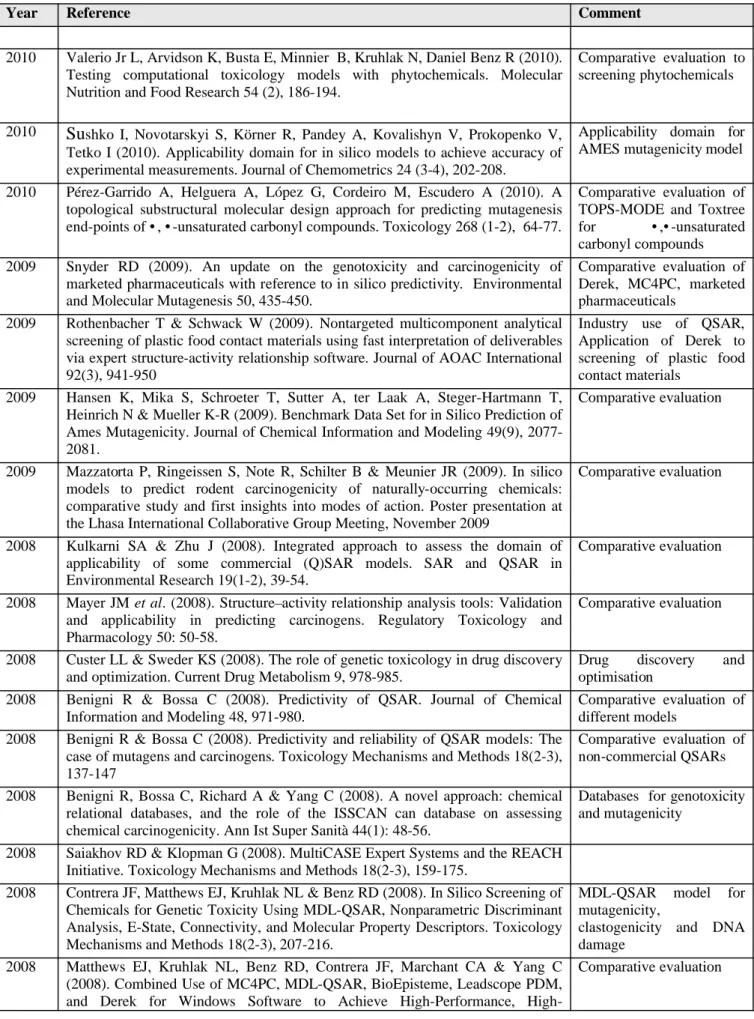
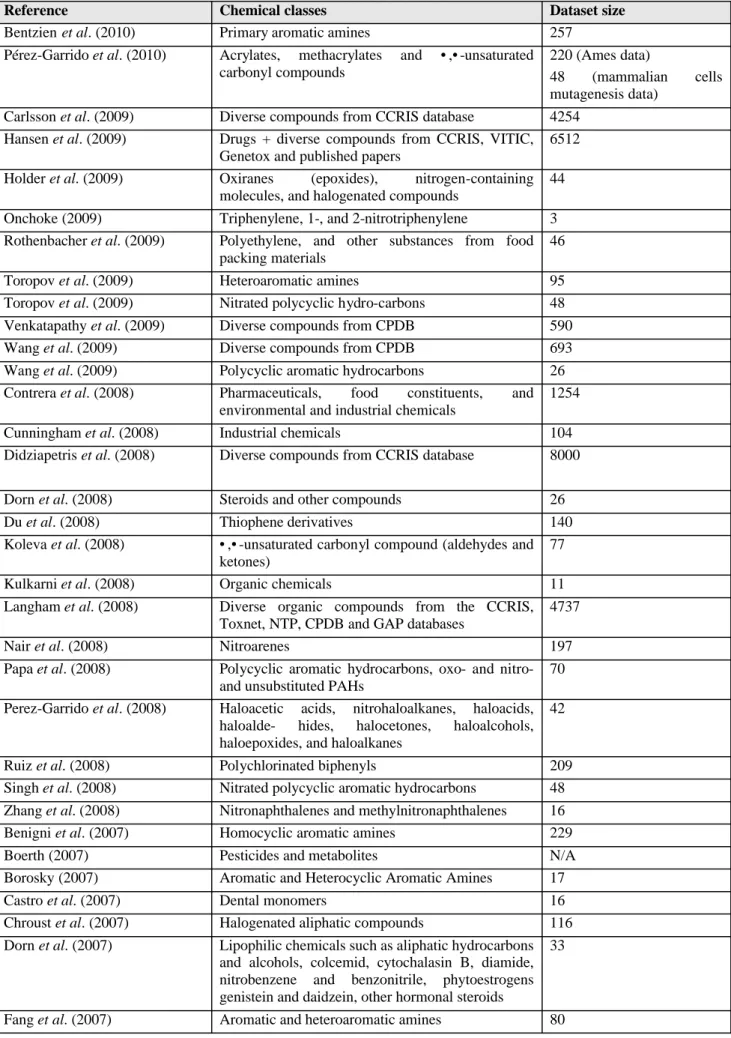
than 100 papers dedicated to (Q)SARs. A list of reviews, expert opinions and evaluation studies is
given in Table 6, whereas details of primary research studies published in the past 10 years for
genotoxicity and carcinogenicity models are given in Tables 7 and 8, respectively. Given the extent of
the literature in this field, this section focuses on key findings from evaluation studies that have
compared the performances of different models, including software models. A number of such
“multi-model evaluation studies” have been published (Table 6), which have been well summarised by
Benigni
et al
. (2007). A representative selection of evaluation studies is described below.
Zeiger
et al
. (1996) used 100 NTP chemicals to compare ability of two computer systems (TOPKAT
and CASE), one physicochemical screening test and one human expert system to predict Salmonella
whereas the physicochemical system produced a lower (61%) concordance. Similar results for DfW
and TOPKAT were reported by Cariello
et al
. (2002) - the accuracy of prediction of Ames
mutagenicity by DfW was 65% (against a dataset of 400 GlaxoSmithKline chemicals). The overall
concordance for TOPKAT was 73% but it should also be noted that TOPKAT was capable to predict
300 out of the 400 chemicals.
Two other evaluation exercises were devised by the NTP. In the first exercise (Benigni 1997),
regarding the prediction of rodent carcinogenicity for 44 chemicals, different approaches were
compared: computer-based systems (CASE, TOPKAT, DfW, COMPACT), human experts (Benigni,
Tennant and Ashby, Weisburger and Lijinsky) and experimental data. For the structure-based
approaches the overall accuracy was in the range 50-65%, whereas the Tennant and Ashby approach
attained an accuracy of 75%. In the second exercise, based on 30 chemicals, the list of methods was
extended. In this second exercise, the highest overall accuracy achieved was 60-65% (Benigni and
Zito, 2004).
An informative survey was performed by Benigni and Bossa (2008). They summarised the outcomes
of a series of external prediction exercises performed by various investigators with three non-local
models in the commercial domain: MultiCase, TOPKAT, and DfW. The results included those
obtained in the prospective prediction exercises by the NTP as well as several studies performed by
companies using in-house datasets. The common characteristic of these studies is that the chemicals to
be predicted were different from those used in the training sets by the model developers, and were
performed independently. It was found that the predictions for external chemicals vary considerably
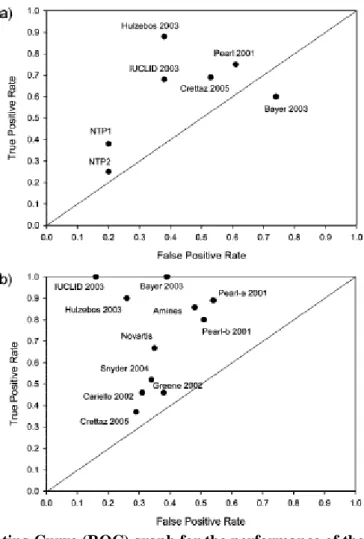
both in terms of overall accuracy and in terms of relative proportions of true and false positives. As an
example, Figure 3. shows a Receiver Operating Curve (ROC) graph which summarises the predictive
performance of the DfW software system in a series of external prediction exercises for
carcinogenicity (a) and mutagenicity (b). In the ROC Curve, a perfect performance would be in the
top-left corner (100% true positives, 0% false positives). The line represents performances that could
be obtained by chance, so for a model to be better than chance, it needs to be in the top-left quadrant of
the figure. The observations for TOPKAT and MultiCase were similar to those for DfW. These
findings contrast with the usually good performances reported by the model developers, as assessed on
large non-congeneric databases.
Mayer et.al. (2008) compared the abilities of several computer-based models (OncoLogic,
MultiCASE, Ashby-Tennant structural alerts) to predict carcinogenicity with several genotoxic tests
(Ames, mouse lymphoma assay and chromosomal aberration). Using data for 650 chemicals from the
CPDB database, the authors found that the (Q)SAR methods produced a higher concordance frequency
(71% to 88% versus 62% to 75% for genetic tests) and lower percentage of false negatives (8.6% to
27% versus 20% to 39% for genetic tests).
Similar findings were reported by Snyder (2009) who compared the carcinogenicity test results of 545
marketed drugs with genotoxicity assay results. The data were taken primarily from the Physicians
Desk Reference (PDR; 1999-2008). The analysis included an evaluation of the predictivity of Derek
and MCASE/MC4PC. The authors reported a low predictability of carcinogenicity based on the
genotoxic assays. The two software programs performed reasonably well, and better than the in vitro
genotoxic assays, in terms of high specificity (low percentage of false positives) and overall
concordance. The weakness of the software was the low sensitivity of both programs, but it was still
higher than that performed from in vitro assays.
Building on the study using MDL QSAR study by Valerio and colleagues (2007), Mazzatorta
et al
.
(2009) examined the performance of a wider series of
in silico
tools for predicting the carcinogenicity
of natural chemicals. They extracted 50 chemicals from the Valerio data set, the majority of which
were pyrrolidine alkaloids and phenolic-type compounds (20 high-risk and 30 low-risk chemicals in
terms of carcinogenicity) and they applied two statistical models (MC4C and Lazar) and three
knowledge-based expert systems (Toxtree, Derek and OncoLogic). Based on the results, the authors
categorised the models into three performance groups. The first group - high sensitivity (>90%) and
low to medium specificity (<68%) - includes OncoLogic. The second group - medium sensitivity and
specificity (between 58 and 80%) - includes MC4PC and Lazar. The third group - low sensitivity
(<41%) and high specificity (>74%) includes Derek and Toxtree. These results indicate that the
carcinogenicity potential of naturally occurring chemicals can be reliably predicted by using a battery
of software tools that combine high sensitivity (thereby minimising false negatives) and high
specificity (thereby minimising false positives).
The battery approach was also investigated by Matthews
et al
. (2008), who explored the combined use
of MC4PC, MDL-QSAR, BioEpisteme, Leadscope PDM and Derek in predicting carcinogenic
potential. They found that the use positive predictions from any two programs showed better overall
performance than use of the single programs alone, with a sensitivity of about 85% and specificity of
58%. When focussing on defined modes of action, the authors reported that consensus positive
predictions of carcinogenicity by two QSAR programs could detect 99% of the carcinogens (including
both genotoxic and nongenotoxic carcinogens) in the study.
The results of (Q)SAR evaluation studies such as those described here can also be placed into context
by considering the results of a study by Kirkland
et al
. (2005) who evaluated the abilities of some of
the most commonly used
in vitro
genotoxicity tests (Ames, mouse lymphoma assay [MLA], in vitro
micronucleus [MN] and chromosomal aberrations [CA] as well as battery of three of these tests) to
discriminate rodent carcinogens from non-carcinogens. The authors based their comparison on a large
dataset of over 700 chemicals compiled from the CPDB, NTP and IARC databases as well as other
publications. It was found that combinations of two and three test systems had greater sensitivity than
individual tests resulting in sensitivities of around 90% or more, depending on the test combination
The sensitivity of individual methods was between 59% (for Ames for over 500 chemicals) and 79%
(for MN for over 80 chemicals). The specificity of the Ames test was reasonable (73.9%), but all
mammalian cell tests had a low specificity (below 45%), and this was reduced in combinations of two
and three test systems. When a battery of three tests was investigated, 75–95% of the non-carcinogens
were incorrectly predicted (i.e. were false positives) results in at least one test in the battery. This
highlights deficiencies in the current ability to extrapolate from in vitro mutagenicity results to in vivo
carcinogenicity.
In a recent study by Hansen et. al. (2009), and a large Ames mutagenicity data set comprising about
6500 non-confidential compounds was compiled and made publicly available (
http://ml.cs.tu-berlin.de/toxbenchmark/
). They used the dataset to compare the predictive performances of three
commercial tools (Derek, MultiCASE, and an off-the-shelf Bayesian machine learner in Pipeline
Pilot) with four non-commercial machine learning implementations (Support Vector Machines,
Random Forests, k-Nearest Neighbours, and Gaussian Processes). PipelinePilot, trained with the
developed data set, showed the best predictive perfromance of the three commercial tools followed by
MultiCASE. The expert system Derek gave the lowest sensitivity and specificity of all considered
models. However, closer examination of the results reveals that the difference between the best
commercial model (Pipeline Pilot) and the best machine learning approach (SVM) is a sensitivity of
just a few percent, so it is difficult to draw firm conclusions. In general, machine learning algorithms
are expected to perform better in cases such as this where they derive their knowledge exclusively
from the training data, as opposed to models such as MultiCASE and Derek, which have rules derived
from other datasets ot based on expert knowledge. This study is useful not only in terms of the dataset
which is made publicly available, but also because it demonstrates the power of machine learning
approaches. Such approaches are particularly useful in model discovery, after which optimal models
could be used as the basis for developing models with a mechanistic basis.
9. Conclusions
When considering computational models for genotoxicity and carcinogenicity prediction, it should be
remembered that these endpoints are based on multiple mechanisms of action, and are experimentally
assessed by multiple tests, the results of which require expert interpretation. Thus, the in silico models
are often modelling the “higher-level” interpretation of one or more experimental results rather than
the “lower-level” experimental data themselves. This is different to models for some other endpoints
(e.g. acute toxicity) where the models can be based directly on experimental data (e.g. LD50 values).
At present, (Q)SAR methods are more reliable for predicting genotoxic potential than carcinogenic
potential. Carcinogenicity prediction represents a considerable challenge due to the multitude of
possible mechanisms of toxic action. The prediction of non-genotoxic carcinogenicity and
carcinogenicity in humans is especially problematic. Models for predicting carcinogenic potency are
lacking.
The accuracy of Ames mutagenicity prediction is typically 70-75%, whereas for carcinogenicity it is
generally between 50-75%, depending on the (Q)SAR and dataset used. This is reasonable taking into
account the complexity of the carcinogenicity endpoint, and the fact that models do not explicitly
include ADME properties, which could be critical steps in the carcinogenic process. An important
direction for future research would be to incorporate ADME considerations in the overall prediction. It
will also be important to build more models for non-genotoxic mechanisms of action.
When evaluating (Q)SARs and software models on the basis of published papers, it is easy to obtain
mixed messages. Thus, it is important to critically evaluate the design of the study. The accuracy of
model prediction reported by the model developers is usually quite high for both training and test sets.
However, this can be deceiving and is generally a consequence of the way in which the training and
test sets were formed by splitting available datasets. In contrast, the accuracy of the prediction for
external and independently chosen test sets is not so high.
When using computational models for regulatory purposes, it is concluded that predictions of
genotoxicity and carcinogenicity should not be based on the use of any single model alone, but on a
Weight of Evidence approach including information is possible from all available sources (QSARs,
read across, in vitro test methods). Studies such as those performed by Valerio
et al
. (2007), Coterrill
et al
. (2008) and Mazzatorta
et al
. (2009) support the usefulness of computational tools, especially
when used in batteries that combine high sensitivity models (to minimise false negatives) with high
specificity models (thereby minimising false positives). Building on such studies, there is a need for
further research aimed at developing and assessing model batteries and integrated testing strategies for
genotoxicity and carcinogenicity.
As with all endpoints, predictions should always be interpreted by an expert with knowledge of the
endpoint and an appreciation of the strengths and limitations of the specific model applied. An
essential piece of information is the applicability domain of the model, and the reliability of prediction
for the chemical of interest. Unfortunately, this information is often not available or easily obtained.
10. References
Andrews LE, Banks TM, Bonin AM, Clay SF, Gillson AE & Glover SA (2004). Mutagenic N-Acyloxy-N-alkoxyamides: Probes for Drug-DNA Interactions. Australian Journal of Chemistry 57(4), 377-381.
Ashby J (1985). Fundamental structural alerts to potential carcinogenicity or noncarcinogenicity. Environmental Mutagenesis 7, 919–921.
Ashby J & Paton D (1993). The influence of chemical structure on the extent and sites of carcinogenesis for 522 rodent carcinogens and 55 different human carcinogen exposures. Mutation Research286, 3-74.
Ashby J & Tennant RW (1988). Chemical structure, Salmonella mutagenicity and extent of carcinogenicity as indicators of genotoxic carcinogenesis among 222 chemicals tested in rodents by the U.S. NCI/NTP. Mutation Research 204(1), 17-115.
Bacha PA, Gruver HS, Den Hartog BK, Tamura SY & Nutt RF (2002). Rule Extraction from a Mutagenicity Data Set Using Adaptively Grown Phylogenetic-like Trees. Journal of Chemical Information and Computer Sciences 42(5), 1104-1111.
Bahram H (2005). Optimal QSAR analysis of the carcinogenic activity of drugs by correlation ranking and genetic algorithm-based PCR. Journal of Chemometrics 18(11), 475-485.
Baeten A, Tafazoli M, Kirsch-Volders M & Geerlings P (1999). Use of the HSAB principle in quantitative structure-activity relationships in toxicological research: application to the genotoxicity of chlorinated hydrocarbons. International Journal of Quantum Chemistry 74(3), 351-355.
Bailey A, Chanderbhan N, Collazo-Braier N, Cheeseman M & Twaroski M (2005). The use of structure-activity relationship analysis in the food contact notification program. Regulatory Toxicology and Pharmacology 42, 225–235
Bang SJ & Cho SJ (2004). Comparative molecular field analysis (CoMFA) and comparative molecular similarity index analysis (CoMSIA) study of mutagen X. Bulletin of the Korean Chemical Society 25(10), 1525-1530.
Basak SC, Balasubramanian K, Gute BD, Mills D, Gorczynska A & Roszak S (2003). Prediction of Cellular Toxicity of Halocarbons from Computed Chemodescriptors: A Hierarchical QSAR Approach. Journal of Chemical Information and Computer Sciences 43(4), 1103-1109.
Benigni R (1997). The first US National Toxicology Program exercise on the prediction of rodent carcinogenicity: definitive results. Mutation Research 387, 35–45.
Benigni R (2004). Prediction of human health endpoints: mutagenicity and carcinogenicity. In Predicting Toxicity and Fate (Cronin M & Livingstone D, ed.), CRC Press, 173-192.
Benigni R (2004). Chemical structure of mutagens and carcinogens and the relationship with biological activity. Journal of Experimental & Clinical Cancer Research 23(1), 5-8.
Benigni R (2005). Structure•activity relationship studies of chemical mutagens and carcinogens: Mechanistic investigations and prediction approaches. Chemical Reviews 105 (5), 1767–1800.
Benigni R & Bossa C (2006). Structure-activity models of chemical carcinogens: state of the art, and new directions. Annali dell'Istituto Superiore di Sanita 42(2), 118-126
Benigni R & Bossa C (2008). Predictivity of QSAR. Journal of Chemical Information and Modeling 48, 971-980.
Benigni R & Bossa C (2008). Structure alerts for carcinogenicity, and the Salmonella assay system: a novel insight through the chemical relational databases technology. Mutation Research 659, 248–261.
Benigni R & Bossa C (2008). Predictivity and reliability of QSAR models: The case of mutagens and carcinogens. Toxicology Mechanisms and Methods 18(2-3), 137-147
Benigni R, Bossa C, Richard AM & Yang C (2008a). A novel approach: chemical relational databases, and the role of the iss can database on assessing chemical carcinogenicity. Ann Ist Super Sanità 44(1), 48-56.
Benigni R, Bossa C, Jeliazkova N, Netzeva T & Worth A (2008b). The Benigni / Bossa rulebase for mutagenicity and carcinogenicity – a module of Toxtree. EUR 23241 EN. http://ecb.jrc.ec.europa.eu/qsar/publications/
Benigni R, Bossa C, Netzeva T, Rodomonte A & Tsakovska I (2007). Mechanistic QSAR of aromatic amines: new models for discriminating between homocyclic mutagens and nonmutagens, and validation of models for carcinogens. Environmental and Molecular Mutagenesis 48(9), 754-771.
Benigni R, Bossa C, Tcheremenskaia O & Worth A (2009). Development of structural alerts for the in vivo micronucleus assay in rodents. EUR 23844 EN. http://ecb.jrc.ec.europa.eu/qsar/publications/
Benigni R, Bossa C & Worth A (2010). Structural analysis and predictive value of the rodent in vivo micronucleus assay results Mutagenesis, in press. Available online: doi:10.1093/mutage/geq010
Benigni R, Cotta-Ramusino M, Andreoli C & Giuliani A (1992). Electrophilicity as measured by Ke: molecular determinants, relationship with other physical-chemical and quantum mechanical parameters, and ability to predict rodent carcinogenicity. Carcinogenesis 13(4), 547-53.
Benigni R, Passerini L & Rodomonte A (2003). Structure-activity relationships for the mutagenicity and carcinogenicity of simple and •-• unsaturated aldehydes. Environmental and Molecular Mutagenesis 42(3), 136-143.
Benigni R, Conti L, Crebelli R, Rodomonte A & Vari MR (2005). Simple and •,•-unsaturated aldehydes: Correct prediction of genotoxic activity through structure-activity relationship models. Environmental and Molecular Mutagenesis 46(4), 268-280.
Benigni R & Giuliani A (1992). QSAR studies in genetic toxicology: congeneric and noncongeneric chemicals. Archives of Toxicology, Supplement 15, 228-237.
Benigni R & Giuliani A (1994). Quantitative structure-activity relationship (QSAR) studies in genetic toxicology: mathematical models and the "biological activity" term of the relationship, Mutation Research, Fundamental and Molecular Mechanisms of Mutagenesis 306(2), 181-6.
Benigni R, Netzeva TI, Benfenati E, Bossa C, Franke R, Helma C, Hulzebos E, Marchant C, Richard A, Woo Y-T & Yang C (2007). The Expanding Role of Predictive Toxicology: An Update on the (Q)SAR Models for Mutagens and Carcinogens. Journal of Environmental Science and Health 25, 53–97.
Benigni R & Zito R (2003). Designing safer drugs: (Q)SAR-based identification of mutagens and carcinogens. Current Topics in Medicinal Chemistry 3(11), 1289-1300.
Benigni R & Zito R (2004). The second National Toxicology Program comparative exercise on the prediction of rodent carcinogenicity: definitive results. Mutation Research 566, 49-63.
Bentzien J, Hickey E, Kemper R, Brewer M, Dyekjaer J, East S, Whittaker M (2010). An in silico method for predicting ames activities of primary aromatic amines by calculating the stabilities of nitrenium ions. Journal of Chemical Information and Modeling 50(2), 274-97.
Bercu JP, Morton SM, Deahl JT, Gombar VK, Callis CM, van Lier RB. (2010). In silico approaches to predicting cancer potency for risk assessment of genotoxic impurities in drug substances. Regulatory Toxicology and Pharmacology. (in press)
Bhat KL, Hayik S, Sztandera L & Bock CW (2005). Mutagenicity of aromatic and heteroaromatic amines and related compounds: A QSAR investigation. QSAR & Combinatorial Science 24(7), 831-843.
Blake BW, Enslein K, Gombar VK & Borgstedt HH (1990). Salmonella mutagenicity and rodent carcinogenicity: quantitative structure-activity relationships. Mutation research 241(3), 261-71.
Boerth DW (2007). Molecular modeling for screening of pesticide-nucleotide binding potentials. Abstracts of Papers, 233rd ACS National Meeting, Chicago, IL, United States, March 25-29, 2007 (2007), AGRO-104. Borosky GL (2007). Ultimate Carcinogenic Metabolites from Aromatic and Heterocyclic Aromatic Amines: A
Computational Study in Relation to Their Mutagenic Potency. Chemical Research in Toxicology 20(2), 171-180.
Brown, S.J., Raja, A.A. & Lewis, D.F.V. (1994). A comparison between COMPACT and Hazardexpert evaluations for 80 chemicals tested by the NTP/NCI rodent bioassay. ATLA 22, 482-500.
Bruce E, Autenrieth R, Burghardt R, Donnelly K & McDonald T (2008). Using quantitative structure-activity relationships (QSAR) to predict toxic endpoints for polycyclic aromatic hydrocarbons (PAH). Journal of Toxicology and Environmental Health, A 71(16),1073-84.
Bull RJ & Reckhow DA (2007). Use of chemical models and structure-activity relationships to identify novel disinfection by-products of potential toxicological concern. Preprints of Extended Abstracts presented at the ACS National Meeting, American Chemical Society, Division of Environmental Chemistry 47(1), 695-700. Buttingsrud B, Ryeng E, King RD & Alsberg BK (2006). Representation of molecular structure using quantum
topology with inductive logic programming in structure-activity relationships. Journal of Computer-Aided Molecular Design 20(6), 361-373.
Cariello NF, Wilson JD, Britt BH, Wedd DJ, Burlinson B & Gombar V (2002). Comparison of the computer programs DEREK and TOPKAT to predict bacterial mutagenicity. Mutagenesis 17(4), 321-329.
Carlsson L, Helgee EA & Boyer S (2009). Interpretation of Nonlinear QSAR Models Applied to Ames Mutagenicity Data. Journal of Chemical Information and Modeling 49(11), 2551-2558.
Casalegno M, Benfenati E & Sello G (2006). Application of fragment-based model to the prediction of the genotoxicity of aromatic amines. Internet Electronic Journal of Molecular Design 5(8), 431-446.
Cash GG, Anderson B, Mayo K, Bogaczyk S & Tunkel J (2005). Predicting genotoxicity of aromatic and heteroaromatic amines using electrotopological state indices. Mutation Research, Genetic Toxicology and Environmental Mutagenesis 585(1-2), 170-183.
Cash GG (2001). Prediction of the genotoxicity of aromatic and heteroaromatic amines using electrotopological state indices. Mutation Research, Genetic Toxicology and Environmental Mutagenesis 491(1-2), 31-37. Castro EA, Toropova AP, Toropov AA & Maksudov SK (2007). SMILES based optimal descriptors: QSAR
modeling mutagenicity. Physical Chemistry: An Indian Journal 2(3), 171-175.
Chen S, Kao C, Huang M, Shih M, Chen Y, Huang S & Liu T (2003). Assessment of Genotoxicity of Benzidine and Its Structural Analogues to Human Lymphocytes Using Comet Assay. Toxicological Sciences 72(2), 283-288.
Chen JJ, Tsai CA, Young JF & Kodell RL (2005). Classification ensembles for unbalanced class sizes in predictive toxicology. SAR and QSAR in Environmental Research 16(6), 517-529.
Cho SJ (2003). Computational study of mutagen X. Bulletin of the Korean Chemical Society 24(6), 731-732. Cho SJ (2005). Hologram quantitative structure activity relationship (HQSAR) study of mutagen X. Bulletin of
the Korean Chemical Society 26(1), 85-90.
Chroust K, Pavlova M, Prokop Z, Mendel J, Bozkova K, Kubat Z, Zajickova V & Damborsky J (2007). Quantitative structure-activity relationships for toxicity and genotoxicity of halogenated aliphatic compounds: wing spot test of Drosophila melanogaster. Chemosphere 67(1), 152-159.
Combes R. (2000). The use of structure-activity relationships and markers of cell toxicity to detect non-genotoxic carcinogens. Toxicology in Vitro 14(4), 387-399.
Combes R & Rodford R (2004). The use of expert systems for toxicity prediction - illustrated with reference to the DEREK program. In Predicting Toxicity and Fate (MTD Cronin and DJ Livingstone, Eds), CRC Press, 193–204.
CRD (2009). Applicability of thresholds of toxicological concern in the dietary risk assessment of metabolites, degradation and reaction products of pesticides, Final report to EFSA in relation to EFSA Grant Agreement EFSA/PPR/2008/01. Chemicals Regulation Directorate, UK.
Contrera JF, Matthews EJ, Kruhlak, NL & Benz RD (2005a). In silico screening of chemicals for bacterial mutagenicity using electrotopological E-state indices and MDL QSAR software. Regulatory Toxicology and Pharmacology 43(3), 313-323.
Contrera J, Maclaughlin P, Hall L & Kier L (2005b). QSAR modeling of carcinogenic risk using discriminant analysis and topological molecular descriptors. Current Drug Discovery Technologies 2(2), 55-67.
Contrera JF, Kruhlak NL, Matthews EJ & Benz RD (2007). Comparison of MC4PC and MDL-QSAR rodent carcinogenicity predictions and the enhancement of predictive performance by combining QSAR models. Regulatory Toxicology and Pharmacology 49(3), 172-182.
Contrera JF, Matthews EJ, Kruhlak NL & Benz RD (2008). In Silico Screening of Chemicals for Genetic Toxicity Using MDL-QSAR, Nonparametric Discriminant Analysis, E-State, Connectivity, and Molecular Property Descriptors. Toxicology Mechanisms and Methods 18(2-3), 207-216.
Cotterill JV, Chaudhry MQ, Matthews W & Watkins RW (2008). In silico assessment of toxicity of heat-generated food contaminants. Food and Chemical Toxicology 46, 1905–1918
Crettaz P & Benigni R (2005). Prediction of the rodent carcinogenicity of 60 pesticides by the DEREKfW expert system. Journal of chemical information and modeling 45(6), 1864-1873.
Cronin M (2006). The role of hydrophobicity in toxicity prediction. Current Computer-Aided Drug Design, 2(4), 405-413.
Cronin MT, Jaworska J, Walker J, Comber M, Watts C & Worth A (2003). Use of QSARs in international decision-making frameworks to predict health effects of chemical substances. Environmental Health Perspectives 111(10), 1391-1401.
Cronin MT, Dearden J, Walker J & Worth A (2003). Quantitative structure-activity relationships for human health effects: Commonalities with other endpoints. Environmental Toxicology and Chemistry 22(8), 1829-1843.
Cunningham AR, Moss ST, Iype SA, Qian G, Qamar S & Cunningham SL (2008). Structure-Activity Relationship Analysis of Rat Mammary Carcinogens. Chemical Research in Toxicology 21(10), 1970-1982. Custer LL & Sweder KS (2008). The role of genetic toxicology in drug discovery and optimization. Current
Drug Metabolism 9, 978-985.
Dearden JC (2003). In silico prediction of drug toxicity. Journal of Computer-Aided Molecular Design 17(2-4), 119-127.
Dearden JC, Barratt MD, Benigni R, Bristol DW, Combes RD, Cronin MTD, Judson PN, Payne MP, Richard AM, Tichy M, Worth AP & Yourick JJ (1997). The Development and Validation of Expert Systems for Predicting Toxicity. Alternatives to Laboratory Animals 25, 223-252.
Deeb O, Hemmateenejad B, Jaber A, Garduno-Juarez R & Miri R (2007). Effect of the electronic and physicochemical parameters on the carcinogenesis activity of some sulfa drugs using QSAR analysis based on genetic-MLR and genetic-PLS. Chemosphere. 67(11):2122-30. Epub 2007 Feb 20.
Dhar K (2006). Qsar for carcinogenicity in methyl benz[a]anthracenes and benz[c]acridines using •-electronic data in a self-consistent field MO theory. Polycyclic Aromatic Compounds 26(5), 385-397.
Didziapetris R, Lanevskij K & Japertas P (2008). Trainable QSAR model of Ames genotoxicity. Abstracts of Papers, 236th ACS National Meeting, Philadelphia, PA, United States, August 17-21, 2008 (2008), TOXI-088.
Dobo KL, Greene N, Cyr MO, Caron S & Ku WW (2006). The application of structure-based assessment to support safety and chemistry diligence to manage genotoxic impurities in active pharmaceutical ingredients during drug development. Regulatory Toxicology and Pharmacology 44(3), 282-293.
Dorn SB, Degen GH, Bolt HM, van dLJ, van AFAA, van dDDJ, den DDJ & Lommerse JPM (2008). Some molecular descriptors for non-specific chromosomal genotoxicity based on hydrophobic interactions. Archives of Toxicology 82(5), 333-8.
Dorn SB, Degen GH, Mueller T, Bonacker D, Joosten HFP, van der Louw J, van Acker FAA & Bolt HM (2007). Proposed criteria for specific and non-specific chromosomal genotoxicity based on hydrophobic interactions. Mutation Research, Genetic Toxicology and Environmental Mutagenesis 628(2), 67-75.
Du H, Wang J, Watzl J, Zhang X & Hu Z (2008). Classification structure-activity relationship (CSAR) studies for prediction of genotoxicity of thiophene derivatives. Toxicology letters 177(1), 10-9.