AFFINITY SEPARATION
Af
\
nity Membranes
K. Haupt, Lund University, Lund, Sweden S. M. A. Bueno, Universidade Estadual de Campinas, Brazil
Copyright^ 2000 Academic Press
The rapid development in biotechnology and the large potential of biomolecules for applications in medicine, food industry and other areas, result in an increasing demand for efRcient and reliable tools for the puriRcation of proteins, peptides, nucleic acids and other biological substances. This situation is be-ing additionally enforced by the increasbe-ing number of recombinant gene products that have arrived on the market or that are currently being investigated, such as insulin, erythropoietin and interferons. The recov-ery of fragile biomolecules from their host environ-ments requires their particular characteristics to be taken into account for the development of any extrac-tion or separaextrac-tion process. On the other hand, there is a demand for techniques that can easily be scaled up from laboratory to industrial production level.
In this context, the use of afRnity methods has the advantage that coarse andRne puriRcation steps are united through the introduction of a speciRc rec-ognition phenomenon into the separation process. The most widely used method for preparative
af-Rnity separation of biomolecules is liquid chromato-graphy on beaded resins (soft gels). Despite the commercial availability of many afRnity ligands immobilized on to gel beads for use in column chromatography, there are some drawbacks in a large scale application of these supports. Flow rates and thus performance are limited by the compressibility of the resins and pore diffusion. Because of these intrinsic limitations, other chromatographic tech-niques, such as perfusion chromatography, or dif-ferent separation techniques, such as afRnity pre-cipitation and afRnity phase partitioning, have been suggested as possible alternatives. Another tech-nique that is gaining increasing importance is mem-brane-based separation. Adsorptive membrane chromatography was introduced as a puriRcation method in the mid 1980s. Microporous membranes have been successfully coupled with biological or biomimetic ligands, yielding afRnity membrane chromatography supports. Several of them, with for
example protein A and G, dye or metal chelate ligands, are commercially available. AfRnity mem-brane chromatography is in fact a hybrid technique combining afRnity gel chromatography and mem-brane filtration, with the advantages of the two technologies.
The purpose of the present review is to discuss relevant aspects and developments that are important for the design of an afRnity membrane chromato-graphy process, including the choice of the membrane material, coupling chemistry, afRnity ligands, membrane conRgurations, operation modes and scale-up. In a wider sense, membrane-based afR n-ity fractionation also comprises afRnity Rltration methods where the target molecule binds to an
af-Rnity ligand coupled to nanoparticles, which can then be separated byRltration through a membrane. How-ever, this application will not be discussed here in detail.
General Characteristics of Membrane
Chromatography
In contrast to chromatographic supports based on beaded resins with dead end pores, membrane chromatographic supports have through-pores and lack interstitial space. Mass transfer is mainly govern-ed by forcgovern-ed convection and pore diffusion is negligible. The observed back-pressures are normally quite low, and highSow rates and thus high through-puts and fast separations become possible without the need for high pressure pumps or equipment. As the association time for an antibody}antigen complex is typically about 1 s or less, but the diffusion of a protein molecule to the centre of a 50m porous bead takes tens of seconds, in a membrane support, the low diffusional limitation leads to faster ad-sorption kinetics and higher throughput efRciency. Little deterioration of the separation efRciency occurs even at elevatedSow rates. On the other hand, with afRnity membranes the formation of the afRnity complex can become the rate-limiting process at highSow rates.
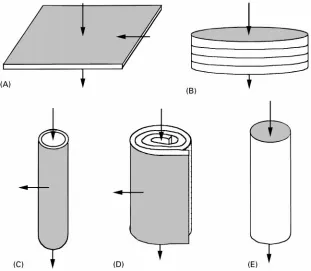
Figure 1 Different geometries of affinity membranes. (A) Flat sheet; (B) stack of flat discs; (C) hollow fibre; (D) spiral-wound flat sheet; (E) continuous rod. The arrows indicate flow directions. (Adapted fromJournal of Chromatography 702, Roper DK and Lightfoot EN, Separation of biomolecules using adsorptive membranes, pp. 3I26, Copyright 1995, with permission from Elsevier Science.) in membrane chromatography systems compared to
conventional columns packed with beaded supports, owing to the larger throughput/bed volume ratio.
Although the speciRc surface area of membranes is typically only 1% of that of conventional chromato-graphic resins, microporous membrane systems have high internal surface areas and reasonably high ca-pacities. The open-pore structure of membranes in-creases the accessibility of afRnity ligands and reduces steric hindrance compared to small-pore ad-sorbents.
Membrane Geometry
Just like Rltration membranes in general, afRnity membranes can be produced in different conR g-urations, and membrane modules of various geomet-ries are commercially available or have been manu-factured in research laboratories (Figure 1).
Flat sheet or disc membranes can be mounted as individual membranes in specially designed cartridges or in commercial ultraRltration units for use in dead-endRltration mode. This allows for the production of inexpensive single- or multiple-use devices for the rapid adsorption of a target molecule from dilute samples in batch or continuous recycling mode.
Car-tridges are also available that allow for operation in cross-SowRltration mode.
Stacks ofSat membrane discs have been employed for afRnity membrane chromatography in col-umn-like devices, the main purpose being to increase the adsorption capacity. Another conRguration is continuous rod-type membranes which can be dir-ectly cast in a chromatographic column. Both types of membrane columns are compatible with conven-tional high performance liquid chromatography or fast protein liquid chromatography systems and have advantages over columns packed with beaded resins, as described above. Being highly porous with a mean pore diameter of 0.1}10m, they allow for efR -cient separations even at highSow rates.
If the target molecule is to be recovered from com-plex feed solutions such as cell homogenates or blood plasma, or from solutions containing high molecular mass additives such as antifoam agents or even partic-ulate material, the use of membranes in dead-end
mounted as bundles in tubular cartridges. Another conRguration areSat-sheet membranes that are spi-ral-wound around a cylindrical core. Both systems have the advantage of high surface area/cartridge volume ratios and high operational capacities.
Membrane Material, Activation and
Ligand Coupling
Membrane Material
Due to the speciRc properties of biomolecules, the membrane materials to be used for their separation should ideally possess the following characteristics:
E Macroporosity: This will allow biomolecules to cross the membrane and to access the afRnity sites.
E Hydrophilicity: Using hydrophilic supports, non-speciRc adsorption by hydrophobic interactions and denaturation of biomolecules can be avoided. E Presence of functional groups: These are required
for the coupling of an afRnity ligand.
E Chemical and physical stability: The material has to withstand the sometimes harsh conditions dur-ing derivatization, operation and regeneration. E Biocompatibility: This is particularly important if
the membranes are used in extracorporeal devices, for example for blood treatment.
E Large surface area relative to membrane volume: This will allow for the construction of small, integ-rated devices with high operational capacities.
Cellulose and cellulose acetate were among theRrst materials that have been used for afRnity mem-brane preparation. They are hydrophilic and biocom-patible, and due to the presence of hydroxyl groups, ligand coupling can be easily achieved using for example CNBr or carbonyldiimidazole activation. In order to improve the mechanical and chemical stabil-ity of cellulose membranes, chemical cross-linking with epichlorohydrin is sometimes carried out. Cellu-lose membranes normally have a rather small pore size, resulting in a high pressure drop. Attempts to produce membranes with larger pores using coarse celluloseRbres have resulted in a less uniform mem-brane structure.
Polysulfone is another suitable membrane material which has goodRlm-forming properties. It is of
suf-Rcient physical, chemical and biological stability, and ligands can be coupled after chloromethylation-amination or acrylation-chloromethylation-amination.
Microporous polyamide (nylon) membranes have also been used for the preparation of afRnity
membranes. This material is mechanically stable and has a rather narrow pore size distribution. It contains only a small number of terminal amino groups for ligand coupling, which can, however, be increased by partial hydrolysis of the amide functions.
A suitable membrane material is polyvinyl alcohol, in particular because of its hydrophilicity and bio-compatibility. Poly(ethylene-co-vinyl alcohol), which has a somewhat higher chemical stability, has also been used. Both materials contain hydroxyl groups and can be activated by the CNBr method, allowing immobilization of afRnity ligands having an amino function. Ligands can also be coupled using epichlorohydrine or butanediol diglycidyl ether-activation.
Other materials that have been used for afRnity membranes are poly(methyl methacrylate), poly(hy-droxyethyl dimethacrylate), polycaprolactam, poly (vinylidene diSuoride), poly(ether-urethane-urea) and silica glass.Table 1shows a list of membrane mater-ials and the appropriate ligand-coupling chemistries.
Composite Membranes
The main difRculty when choosing a membrane for afRnity separation of biomolecules is some-times toRnd a material that fulRls several or all of the above-mentioned requirements. For example, a chemically stable material might be too hydropho-bic and lead to nonspeciRc and irreversible adsorp-tion of the protein to be separated, whereas a hy-drophilic material that is compatible with the fragile protein molecules might not withstand the conditions required for ligand coupling and for regeneration and sterilization of the membrane. Therefore, the choice of a membrane material will sometimes be a compro-mise. The use of a composite membrane consisting of two or more different materials may often be the only solution to a particular separation problem. This approach consists of the grafting of hydrophilic poly-mers on to a chemically and mechanically stable microporous membrane. The result is an increased biocompatibility as well as the introduction of suit-able functional groups for ligand coupling. One example is the radiation-induced graft polymeriz-ation of 2-hydroxyethyl methacrylate or glycidyl methacrylate on to a polyethylene hollowRbre mem-brane. This increases the hydrophilicity of the mater-ial and introduces active hydroxyl groups or reactive epoxy groups.
Activation and Ligand Coupling
Table 1 Membrane materials and possible chemistries for ligand coupling
Membrane material Coupling chemistries Ligand functional group
Cellulose, cellulose diacetate Epichlorohydrin, butanediol diglycidyl ether Amino, (hydroxyl) Carbonyldiimidazole Amino, hydroxyl
CNBr Amino
Anhydride Amino
Hydrazide Amino
Polysulfone Acrylation-amination, chloromethylation-amination Cl\(aromatic) Ethylene glycol diglycidyl ether Amino, (hydroxyl)
Polyamide Glutaraldehyde (Schiff base) Amino, amido
Divinyl sulfone Hydroxyl
2-Fluoro-1-methylpyridinium toluene-4-sulfonate Primary amino Butanediol diglycidyl ether Amino, (hydroxyl)
Formaldehyde Hydroxyl
Poly(vinyl alcohol), poly(ethylene vinyl alcohol) Epichlorohydrin, butanediol diglycidyl ether Amino, (hydroxyl) Electrostatically spun poly(ether-urethane-urea) Carbonyldiimidazole Amino, hydroxyl
CNBr Amino
Carbonyldiimidazole Amino, hydroxyl Glass Glycidoxypropyl trimethoxysilane Amino, (hydroxyl)
Aminopropyltrimethoxysilane Carboxyl
aspect is that these solutions need to access the pores of the membrane. In many cases it will therefore be necessary to do the activation in dynamic mode, that is, by forced convection. This is especially important if the membrane material is hydrophilic and the ac-tivation and coupling solutions are based on nonpolar solvents, since in that case the wettability of the membrane by the solutions will be low.
Spacer Arms
Occasionally, afRnity membranes may show poor performance if the ligand, and in particular a small ligand, is coupled directly to the membrane. This is often due to a low steric availability of the ligand, a problem that can be overcome by the use of a suit-able spacer arm. In that way, the ligand accessibility for the molecule to be separated is improved, result-ing in an increase in membrane-bindresult-ing capacity. For example, 1,6-diminohexane or 6-aminohexanoic acid are often used as spacers. In other cases, the coupling method itself provides a spacer, as is the case with butanediol diglycidyl ether. If composite membranes with crafted Sexible copolymer chains are used, spacer arms are not normally required.
Af
\
nity Ligands
Biologicial Ligands
Just like other afRnity separation techniques,
af-Rnity membrane technology uses biomolecules as the afRnity ligands, thus taking advantage of the spe-ciRcity of biological recognition. One of the most
common applications is the use of immobilized mono-clonal antibodies against natural or recombinant pro-teins as the ligand for immunoafRnity separation. Another important example are membranes with covalently coupled protein A or protein G for im-munoglobulin puriRcation from plasma, serum or cell culture supernatants. Immobilized lectines have been used for the puriRcation of glycoproteins. The use of inhibitors or coenzymes for the puriRcation of en-zymes is also possible. Although biomolecules are widely used as ligands for their selectivity, they do have drawbacks. Their poor stability and sometimes high price can make them problematic for use in large scale afRnity separation. Drastic conditions are often necessary for elution of the ligate, for example with high afRnity antibody}antigen interactions. This can lead to partial inactivation of the molecule to be puriRed. Ligand denaturation and inactivation, in particular with protein ligands, can occur during regeneration and sterilization of the membrane. An-other important issue is the possible leaching of the afRnity ligand, leading to a contamination of the
Rnal product, which is particularly problematic if the product is to be used in medical applications.
Pseudobiospeci\c Ligands
structural features of ligand and ligate rather than on a biological function, whereas biomimetic ligands have a certain structural resemblance with a biolo-gical ligand. For example, textile dyes can be used for the separation of proteins, and in particular Cibacron Blue F3GA has been employed as ligand in afR n-ity membranes for the puriRcation of dehydrogen-ases, since it often binds speciRcally to the nucleotide-binding site. Other dyes may adsorb proteins less speciRcally, but by selection of the right dye (a large number of different dyes is currently available) and the appropriate adsorption and elution condi-tions, highly efRcient separations can be ob-tained.
Proteins carrying accessible histidine residues on their surface have been shown to have afRnity for transition metal}chelate ligands. Typical examples are the iminodiacetate}copper(II) complex (IDA-Cu(II)) and the nitrilotriacetate}nickel (NTA-Ni(II)) ligand widely used for puriRcation of recombinant proteins with genetically attached poly-His tails.
A third group are amino acids such as phenylalanine, tryptophane and histidine. Being the least selective, they have nevertheless been success-fully employed for protein puriRcation. However,
Rtuned adsorption and elution conditions are ne-cessary to achieve efRcient separation. Mention should also be made of the thiophilic afRnity system that has been used with afRnity mem-branes. It is based on the salt-promoted adsorption of proteins via thiophilic regions (containing aromatic amino acids) on to sulfone or thioether-containing heteroaliphatic or aromatic ligands.
Molecularly Imprinted Membranes
A completely different approach for the prepara-tion of afRnity membranes is the use of molecu-larly imprinted polymeric materials. These are pro-duced by polymerization of functional and cross-linking monomers in the presence of the target mol-ecule (the molmol-ecule to be separated later), which acts as a molecular template. In this way, binding sites are introduced in the polymer that are complementary in shape and functionality to the target molecule, and that often have speciRcities comparable to those of antibodies. At the same time, the cross-linked poly-meric material provides a porous, chemically and physically very stable support. Even though the tech-nology is in principle applicable to larger bio-molecules such as proteins, it has mainly been used for the separation of small molecules like amino acids and peptides. The molecular imprinting technique is reviewed in more detail elsewhere.
Scale-up
Process scale-up tends to be rather easy in adsorptive membrane chromatography, at least compared to the use of conventional beaded resins as the chromato-graphic support. It has been demonstrated that the diameter of a stack of disc membranes can be in-creased by up to one order of magnitude and more, with the dynamic capacity remaining constant. This allows for the processing of considerably larger sample volumes at higherSow rates. With radialSow membranes, when both the height and diameter of the cartridge were increased and the Sow rate ad-justed proportionally to the increased cartridige vol-ume, the apparent speciRc capacity decreased only slightly.
Applications
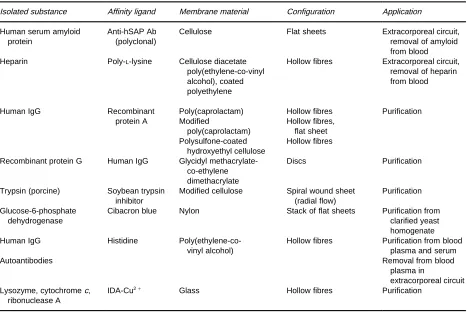
Several different applications of afRnity mem-branes have been described. Typical examples of their use for the separation and puriRcation of bio-molecules are shown inTable 2.
The most common application is the separation and puriRcation of biomolecules and especially pro-teins for large scale production. A common example is the separation of immunoglobulins from blood-serum or plasma or from cell culture supernatants. Hollow-Rbre cartridges with immobilized protein A or pseudobiospeciRc ligands have been used for this purpose.Figure 2shows a chromatogram from a case study of immunoglobulin G separation from human plasma using a small, developmental-scale (28 cm2
surface area) poly(ethylene-co-vinyl alcohol)
hollow-Rbre membrane cartridge. The pseudobiospeciRc afRnity ligand histidine was immobilized on to the membrane after activation with butanediol dig-lycidyl ether, thus introducing a spacer arm. Serum was injected 10-fold diluted in cross-Sow Rltration mode. Weakly retained and entrapped proteins were then removed by washing the lumen and the outer shell of theRbres, as well as the pores in back-Sushing mode. Adsorbed immunoglobulins were subsequently eluted with a buffered solution of 0.4 mol L\1
NaCl in back-Sushing mode. The eluted fraction con-tained 93% immunoglobulins (82% IgG, 10.8% IgM). The dynamic binding capacity of the mem-brane for immunoglobulin G was determined to be 1.9 g m\2. The process could then be scaled up by
using a cartridge with 1 m2membrane surface area.
Table 2 Examples for the use of affinity membranes for isolation and purification of biomolecules
Isolated substance Affinity ligand Membrane material Configuration Application
Human serum amyloid protein
Anti-hSAP Ab (polyclonal)
Cellulose Flat sheets Extracorporeal circuit, removal of amyloid from blood Heparin Poly-L-lysine Cellulose diacetate
poly(ethylene-co-vinyl alcohol), coated polyethylene
Hollow fibres Extracorporeal circuit, removal of heparin from blood
Human IgG Recombinant protein A
Poly(caprolactam) Modified
poly(caprolactam)
Hollow fibres Hollow fibres,
flat sheet
Purification
Polysulfone-coated hydroxyethyl cellulose
Hollow fibres
Recombinant protein G Human IgG Glycidyl methacrylate-co-ethylene dimethacrylate
Discs Purification
Trypsin (porcine) Soybean trypsin inhibitor
Modified cellulose Spiral wound sheet (radial flow)
Purification
Glucose-6-phosphate dehydrogenase
Cibacron blue Nylon Stack of flat sheets Purification from clarified yeast homogenate Human IgG Histidine
Poly(ethylene-co-vinyl alcohol)
Hollow fibres Purification from blood plasma and serum
Autoantibodies Removal from blood
plasma in
extracorporeal circuit Lysozyme, cytochromec,
ribonuclease A
[image:6.568.140.431.431.654.2]IDA-Cu2# Glass Hollow fibres Purification
AfRnity membranes have also been suggested for use in extracorporeal circuits, for the removal of toxic substances such as certain metabolites or anti-bodies from blood. For example, exogenous human serum amyloid P component, a substance associated with Alzheimer’s disease, has been removed from whole rat blood in an extracorporeal circulation sys-tem. This model system used a polyclonal antibody coupled to cellulose Sat-sheet membranes. The bio-compatibility of the membrane was also demon-strated. A similar application is the removal of autoan-tibodies from human plasma, using membrane-bound afRnity ligands in extracorporeal circuits.
Apart from preparative applications, small car-tridges with membrane discs or continuous mem-brane rods should be useful for analytical-scale separ-ations and afRnity solid-phase extraction, for example for immunoextraction.
Conclusions
AfRnity membrane separation techniques com-bine the speciRcity of afRnity adsorption with the unique hydrodynamic characteristics of porous membranes. They provide low pressure separation systems which are easy to scale up and ideal for the processing of large volumes of potentially viscous feed solutions (e.g. microbial broth, bacterial cell extract, conditioned media) often involved in the production of recombinant proteins. The additional microRltration effect of membranes allows for the processing even of unclariRed, particle-containing feed solutions. The high performance of this separ-ation technique is due to the presence of through-pores and the absence of diffusional limitations; mass transfer is mainly governed by forced convec-tion. AfRnity membranes are used in applications such as puriRcation of biomolecules, Rnal product polishing, removal of unwanted substances from patients’ blood in extracorporeal circuits, but also
for smaller scale analytical separations. Biological afRnity ligands and biomimetic or pseudobios-peciRc ligands are currently employed, as well as different membrane conRgurations such as Sat sheets, hollow Rbres or continuous rods. The technology is now in the process of being adapted more and more for large scale industrial separation and puriRcation.
See also: I/ Affinity Separation. Membrane Separ-ations. II/Affinity Separation: Dye Ligands; Immuno-affinity Chromatography; Imprint Polymers; Rational Design, Synthesis and Evaluation: Affinity Ligands; Chromatography: Liquid: Large-Scale Liquid Chromatography. Membrane Separations: Filtration. III/ Immunoaffinity Extraction. Appendix 1/Essential Guides for Isolation/Purification of Enzymes and Properties. Essential Guides for Isolation/Purification of Immunoglobulins. Appendix 2/Essential Guides to Method Development in Affinity Chromatography.
Further Reading
Brandt S, Goffe RA, Kessler SB, O’Connor JL and Zale SE (1988) Membrane-based afRnity technology for commericial scale puriRcations.Bio/Technology6: 779. Charcosset C (1998) PuriRcation of proteins by membrane chromatography.Journal of Chemical Technology and Biotechnology71: 95.
Klein E (ed.) (1991) AfTnity Membranes: Their Chem-istry and Performance in Adsorptive Separation Pro-cesses. New York: John Wiley.
Roper DK and Lightfoot EN (1995) Separation of bi-omolecules using adsorptive membranes. Journal of
Chromatography702: 3.
Suen S-J and Etzel MR (1992) A mathematical model of afRnity membrane bioseparations. Chemical Engin-eering Science47: 1355.
ThoKmmes J and Kula MR (1995) Membrane chromatogra-phy}an integrative concept in the downstream process-ing of proteins.Biotechnology Progress11: 357.
Af
\
nity Partitioning in Aqueous Two-Phase Systems
G. Johansson, Center for Chemistry and Chemical Engineering, Lund University, Lund, Sweden
Copyright^ 2000 Academic Press
Aqueous Two-phase Systems in
General
The division of water into non-miscible liquid layers (phases) by addition of two polymers has led to the
remarkable possibility of being able to partition pro-teins and other cell components between phases of nearly the same hydrophilicity. Proteins can be separ-ated by partitioning if they have unequal distribution between the phases, i.e. when their partition