2017
User data spectrum theory: Collecting,
interpreting, and implementing user data in
organizations
Andrea J. Peer Iowa State University
Follow this and additional works at:https://lib.dr.iastate.edu/etd
Part of theArt and Design Commons,Higher Education Administration Commons,Higher Education and Teaching Commons, and theOrganizational Behavior and Theory Commons
This Dissertation is brought to you for free and open access by the Iowa State University Capstones, Theses and Dissertations at Iowa State University Digital Repository. It has been accepted for inclusion in Graduate Theses and Dissertations by an authorized administrator of Iowa State University Digital Repository. For more information, please [email protected].
Recommended Citation
Peer, Andrea J., "User data spectrum theory: Collecting, interpreting, and implementing user data in organizations" (2017).Graduate Theses and Dissertations. 15396.
User data spectrum theory:
Collecting, interpreting, and implementing user data in organizations
by
Andrea Jo Peer
A dissertation submitted to the graduate faculty
in partial fulfillment of the requirements for the degree of
DOCTOR OF PHILOSOPHY
Major: Human Computer Interaction
Program of Study Committee: Stephen Gilbert, Co-major Professor
Sree Nilakanta, Co-major Professor Holly Bender
Charles B Shrader Jared Danielson
Iowa State University
Ames, Iowa
2017
TABLE OF CONTENTS
LIST OF TABLES ... vi
LIST OF FIGURES ... viii
NOMENCLATURE ... x
REFERENCES ... xii
ACKNOWLEDGEMENTS ... xiii
ABSTRACT ... xv
CHAPTER 1 INTRODUCTION ... 1
1.1. Problem Statement ... 1
1.2. Purpose of This Study ... 5
1.3. Contribution of This Study ... 5
1.4. Organization of This Study ... 6
REFERENCES ... 7
CHAPTER 2 LITERATURE REVIEW ... 9
2.1. The Challenge of Implementing a More Responsive UX ... 9
2.1.1. The Empirical Approach ... 12
2.1.2. The Cognitive Approach ... 12
2.1.3. The Predictive Modeling Approach ... 13
2.1.4. The Anthropomorphic Approach ... 15
2.1.5. Other Research Pursuits in Responsiveness ... 15
2.2. The Challenge of Implementing UX in Different Organizations ... 17
2.3. The Challenge of Building Adequately Skilled UX Practitioners to Select and Carry Out UX Methods Within the Organizational Context ... 22
2.4. Conclusion ... 27
REFERENCES ... 28
CHAPTER 3 THE NEED FOR A NEW DIAGNOSTIC TOOL TO MAXIMIZE ORGANIZATIONS’ UX CAPACITY ... 33
3.1. Why is the Need for UX Analysis Tools Increasing? ... 33
3.2. Why Is UX So Hard? ... 37
3.3. Why Is Product Development So Difficult? ... 40
3.4. Why Is Incorporating UX Into the Product Development Process So Difficult? ... 41
3.5. The Challenge of Measuring UX Maturity: The Differences Between UX and Product Development Across Organizations ... 47
3.6. The New Diagnostic Tool: The User Data Spectrum Survey ... 49
3.7. What Is UX Capacity and What Does It Mean to Have It? ... 50
3.7.1 The User Data Spectrum ... 51
3.7.2. Skill Set of the Source ... 53
3.7.3. Representativeness of the Source ... 54
3.7.5. Product Development Process ... 55
REFERENCES ... 55
CHAPTER 4 USER DATA SPECTRUM SURVEY DESIGN ... 60
4.1. Goal and Design of the User Data Spectrum Survey ... 60
4.1.1. Aims of the Survey ... 60
4.2. Overview of Opportunities and Challenges Represented in the Survey ... 61
4.3. Overview of the Supporting Survey Theory ... 61
4.4. Survey Design ... 63
4.4.1. Good UX Research Practice Versus Organization Orientation ... 63
4.4.2. Systems Knowledge Versus Content Knowledge ... 66
4.5. Survey Design Overview ... 67
4.5.1. Survey Components ... 67
4.6. Description of Each Survey Component ... 69
4.6.1. Part I: General Organization Characteristics and Motivation ... 69
4.7. Part II: Orientation ... 71
4.7.1. Overview of the Orientation Section ... 71
4.7.2. Goal of the Orientation Section ... 73
4.8. Introductions to Parts III and IV ... 78
4.8.1. Overview of the Introduction Section ... 78
4.8.2. Goal of the Intro Section ... 80
4.9. Part III: Design Vision ... 81
4.9.1. Overview of the Design Vision Section ... 81
4.9.2. Strength, Source, Shared Understanding ... 82
4.9.3. Goal of the Design Vision Section ... 82
4.10. Part IV: Skill Set ... 84
4.10.1. Overview of the Skill Set Section ... 84
4.10.2. Goal of the Skill Set Section ... 87
4.11. Part V: Representativeness ... 88
4.11.1. Overview of the Representativeness Section ... 88
4.11.2. Goal of the Representativeness Section ... 89
4.12. Part VI: Process ... 91
4.12.1. Overview of the Process Section ... 91
4.12.2. Goal of the Process Section ... 92
4.13. Part VII: UX Maturity ... 94
4.13.1. Overview of the UX Maturity Section ... 94
4.13.2. Goal of the UX Maturity Section ... 95
4.14. Part VIII: Final Questions ... 96
4.14.1. Overview of the Final Section ... 96
4.14.2. Goal of the Final Section ... 96
REFERENCES ... 97
CHAPTER 5 USER DATA SPECTRUM FINDINGS ... 99
5.1. Introduction ... 99
5.2. Basic Premise of the Research ... 99
5.3. Respondents ... 101
5.5. Method ... 104
5.6. Findings ... 105
5.6.1. End-User Data Orientation Construct Analysis ... 105
5.6.2. Four Growth Variables Construct Analysis ... 127
5.6.3. Team Structure and Product Maturity Construct Analysis ... 136
5.6.4. UX Maturity Construct Analysis ... 139
5.6.5. Full Model Analysis ... 141
5.7. Limitations ... 143
REFERENCES ... 145
CHAPTER 6 RAPID MEANINGFUL SCENARIOS ... 146
6.1. Opening ... 146
6.2. Translating Human Expression Into Useful Technologies ... 148
6.3. Rapid Meaningful Scenario Development ... 149
6.4. Overview of CIRTL and its Needs Assessment Initiative ... 150
6.5. RMS Overview ... 152
6.5.1. Strategic Vision Analysis ... 152
6.5.2. Interview Protocol Creation ... 153
6.5.3. Intervention ... 153
6.5.4. Three-Day Sprints: Interviews, Generating Scenarios, and Prototype Testing ... 153
6.5.5. Prototype Iteration ... 159
6.5.6. Release Decision ... 160
6.5.7. Scenario Validation ... 161
6.6. Applying RMS to CIRTL ... 162
6.6.1. Strategic Vision Analysis ... 162
6.6.2. Interview Protocol Creation ... 163
6.6.3. Intervention ... 163
6.6.4. Intervention Results and Prototype Iterations ... 164
6.6.5. Generating Scenario Results ... 165
6.6.6. Prototype Testing Results ... 166
6.6.7. Sharing of Results: Final Design Recommendation ... 169
6.6.8. Presentation and Feedback From the CIRTL Community ... 174
6.7. Conclusion of CIRTL Intervention ... 175
6.8. Conclusion ... 175
REFERENCES ... 177
CHAPTER 7 THE FUTURE OF USER EXPERIENCE EDUCATION ... 179
7.1. The Future of User Experience Education ... 179
7.2. Laying the Foundation: The State of the Debate for HCI as a Field ... 182
7.2.1. Evolution From Simple to Complex ... 183
7.3. Beyond Philosophical Debate: Create Practical Curricular Structures to Serve Students and the Field ... 188
7.4. Crowdsource to Visualize the Connections in the Complex HCI System ... 191
7.5. Conclusion ... 194
CHAPTER 8 DISCUSSION ... 196
8.1. Discussion ... 196
8.2. Limitations ... 198
8.3. Future Directions ... 200
REFERENCES ... 202
APPENDIX A USER DATA SPECTRUM SURVEY ... 203
LIST OF TABLES
Table 4.1. Three Dimensions of User Data Handling That Occur Within an Organization ... 63
Table 4.2. System Versus Content Knowledge ... 66
Table 4.3. Part I Questions ... 71
Table 4.4. Part II Questions ... 76
Table 4.5. UCD Models ... 79
Table 4.6. Questions for Parts III–IV ... 81
Table 4.7. Part III Questions ... 83
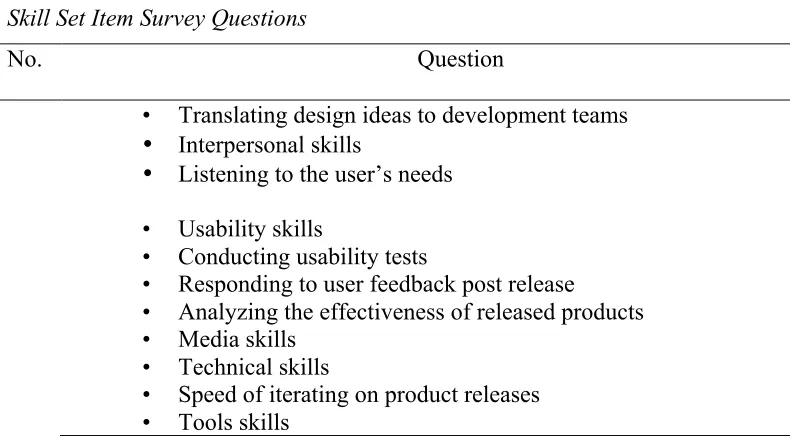
Table 4.8. Skill Set Survey Questions ... 86
Table 4.9. Part IV Questions ... 87
Table 4.10. Part V Questions ... 90
Table 4.11. Part VI Questions ... 93
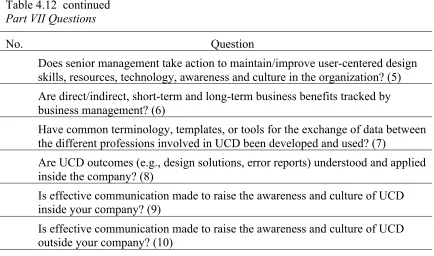
Table 4.12. Part VII Questions ... 95
Table 4.13. Part VIII Questions ... 97
Table 5.1. Constructs and Items in Full User Data Spectrum Model ... 103
Table 5.2. O1–O11 Questions, Answer Choices, and Answer Codes ... 107
Table 5.3. Items O1–O4 and the Orientation Code Per Answers ... 111
Table 5.4. Item O5 Response and Orientation Code ... 114
Table 5.5. Item O6 Response and Orientation Code ... 115
Table 5.6. O7 Responses for Time Allocation With Experts ... 117
Table 5.7. Item O7 Responses Across All Companies ... 117
Table 5.8. Item O8 Responses(n = 67) ... 120
Table 5.9. Item O9 Responses (n=67) ... 122
Table 5.10. Item O12 Orientation Coding (n = 53) ... 125
Table 5.12. Orientation Reliability Statistics ... 127
Table 5.13. Orientation Item-Total Statistics ... 127
Table 5.14. Item O1-O12 Correlations ... 127
Table 5.15. Representativeness ... 130
Table 5.15. P1 Item (n = 38) ... 129
Table 5.16. Process Item-Total Statistics ... 127
Table 5.17. Process Item-Total Statistics ... 127
Table 5.18. Item P1-P8 Correlations ... 127
Table 5.19. Questions and Categories for Items DV1-4 ... 132
Table 5.20. Design Vision Reliability Statisitics ... 134
Item 5.21. Design vision Item-Total Statistics ... 127
Table 5.22. Skill Set Reliability Statistics ... 127
Table 5.23. Skill Set Item-Total Statistics ... 127
Table 5.24. Item PM1 Survey Questions ... 137
Table 5.25. Item PM2 Survey Questions ... 138
Table 5.26. Product maturity Reliability Statistics ... 138
Table 5.27. Team Structure Item-Total Statistics ... 127
Table 5.28. Team Structure Reliability Statistics ... 127
Table 5.29. Product maturity Item-Total Statistics ... 127
Table 5.30. UX Maturity Item Questions ... 140
Table 5.31. Coefficients, Part Correlations, and Tolerances of Predictors included in the Model ... 141
Table 6.1. Final Count of Needs Assessment Interviews and Usability Tests ... 164
Table 6.2. University Role of All People Engaged in Site Visits ... 165
Table 6.3. CIRTL Role of All People Engaged in Site Visits ... 165
LIST OF FIGURES
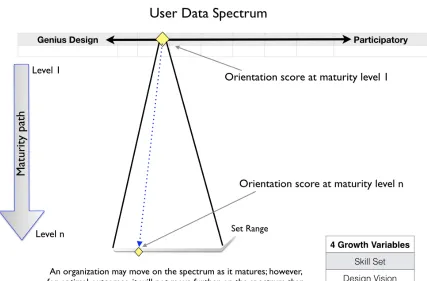
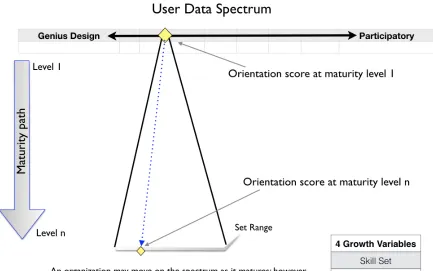
Figure 3.1. The User Data Spectrum. ... 51
Figure 3.2. UX maturity from the end-user orientation on the User Data Spectrum. ... 52
Figure 4.1. User Data Spectrum Categories ... 73
Figure 5.1. User data spectrum maturity trajectory with four growth variables ... 101
Figure 5.2. Full User Data Spectrum model. ... 103
Figure 5.3. End-user data orientation analysis. ... 110
Figure 5.4. Illustrating the 74 responses for O1 and O2 results ... 113
Figure 5.5. Item O7 survey question ... 116
Figure 5.6. Item O7 responses for all companies ... 118
Figure 5.7. Item O8 survey question ... 119
Figure 5.8. Item O9 survey question ... 121
Figure 5.9. Item O10 survey question ... 122
Figure 5.10. Item O12 survey question ... 124
Figure 5.11. Four growth variable constructs ... 128
Figure 5.12: Final Process Construct ... 131
Figure 5.13: Final Design Vision Construct ... 133
Figure 5.14. Item SS4 questions ... 134
Figure 5.15: Final Skill Set Constructs ... 135
Figure 5.16: Final Growth Variable Constructs ... 136
Figure 5.17: Resulting User Data Spectrum model ... 143
Figure 6.1 RMS intervention process ... 145
Figure 6.2. SUS comparison of means ... 157
Figure 6.3. Two-sample t-test for all 38 testing events ... 158
Figure 6.5. Content needs to be like news and current ... 160
Figure 6.6. Seeing faces is important ... 161
Figure 6.7. “Find it—take it—adapt it—share it” concept in prototype ... 162
Figure 6.8. Member directory in prototype ... 163
Figure 6.9. Learning community space in baseline and prototype ... 164
Figure 7.1. Depiction of HCI as a discipline from the 1992 Curriculum initiative ... 173
Figure 7.2. Carroll’s Conception of the HCI discipline ... 174
NOMENCLATURE
Design: There are many definitions of design. For this research, the term design describes both product and process. Most important to this body of work is the process description. A design process is a
set of methods and a structured way to go about creating something for an end goal or to encourage a
change of state in the world. The final product is the thing that the world/end-user interacts with.
Interaction can encompass any and/or all types, including physical, emotional, or cognitive interaction.
Designer: A person who has had training in a design discipline. In an HCI context, this person may have the title of usability engineer, user interface designer, user experience designer,
interaction designer, information architect, user-centered design consultant, or human-centered
designer.
Design research: An inquiry focused on producing a contribution of knowledge. An intention to produce knowledge and not the work to more immediately inform the development
of a commercial product (Zimmerman, Stolterman, & Forlizzi, 2010).
Discovery sprint: A sprint dedicated to gathering user data and testing prototypes before development. This type of sprint is seen in extreme and dual track development environments.
Development sprint: A sprint dedicated to developing. It is no different from regular sprints, except that usually a discovery sprint has happened prior and user data is being fed into
the development sprint activity. This type of sprint is seen in extreme and dual track
development environments.
Human-centered design: “Human-centered design is characterized by: the active involvement of users and a clear understanding of user and task requirements; an appropriate
allocation of function between users and technology; the iteration of design solutions;
Interpreting user data: The act of translating user data collected into design language
and/or system requirements.
Implementing user data: The act of incorporating user data into the actual design or
functionality of the system.
Software development process: A structure imposed on the development efforts of software. There are many different types of software development processes, also referred to as
lifecycles.
Sprint: The basic unit of development in an agile scrum. Usually a sprint is 1 week to 1
month in duration.
Usability: “[Usability refers to] the extent to which a product can be used by specified users to achieve specified goals with effectiveness, efficiency and satisfaction in a specified
context of use” (International Organization for Standardization, 1998, ISO 9241-11). Usually
there are performance and satisfaction measures that quantify the usability of a system.
User: “Can be a paying customer, internal employee, physician, call-center operator, automobile driver, cell phone owner, or any person attempting to accomplish some goal—
typically with some type of software, website, or machine.” (Sauro & Lewis, 2012, p. 9)
User-centered design: User-centered design (UCD) is an approach to design that focuses on learning about the people who will use the product. UCD processes incorporate user-centric
methods during the planning, design and development of a product.
User data: Any data that represent the thoughts, actions, behaviors, words, needs, wants, context, and environments of the end stakeholder(s) interacting with the system.
complexity, purpose, usability, functionality, etc.) and the context (or the environment) within
which the interaction occurs (e.g. organizational/social setting, meaningfulness of the activity,
voluntariness of use, etc.)” (Hassenzahl & Tractinsky, 2006, p. 91-97).
User research: “User research is the systematic study of the goals, needs, and capability of users so as to specify design, construction or improvement of tools to benefit how users work
and live” (Schumacher, 2010, p. 6).
UX capacity: UX capacity is an organization’s facility or power to perform UX practices and produce UX results.
REFERENCES
International Organization for Standardization. (1998). ISO 9241-11:1998: Ergonomic
requirements for office work with visual display terminals (VDTs)—Part 11: Guidance on usability. Retrieved December 8, 2016, from
http://www.iso.org/iso/catalogue_detail.htm?csnumber=16883
International Organization for Standardization. (1999). ISO 13407:1999: Human-centred design
processes for interactive systems. Retrieved December 8, 2016, from http://www.iso.org/iso/catalogue_detail.htm?csnumber=21197
Sauro, J., & Lewis, J. (2012). Quantifying the user experience: Practical statistics for user research. Amsterdam, the Netherlands: Elsevier.
Schumacher, R. (2009). The Handbook of Global User Research. Burlington, MA: Morgan Kaufmann.
Hassenzahl, M. & Tractinsky, N. (2006). User experience - a research agenda, Behaviour & Information Technology, 25(2), 91–97. http://doi.org/10.1080/01449290500330331
Zimmerman, J., Stolterman, E., & Forlizzi, J. (2010). An analysis and critique of Research through design: Towards a formalization of a research approach. In Proceedings of the 8th ACM Conference on Designing Active Systems (pp. 310–319).
ACKNOWLEDGEMENTS
First and foremost, I’d like to give my gratitude to my committee for helping me delivery
this body of research. A special thank you to Dr. Stephen Gilbert who engaged in many months
of weekly meetings, early mornings, late evenings, and weekends to advise and support this
work. To Dr. Holly Bender, who always provided a safe space and encouraging words as I
fumbled my way though the writing. To Dr. Sree Nilakanta, who provided a rich experience over
the course of my graduate career, which planted the seeds for this research. To Dr. Jared
Danielson for his unwavering support and consult. To Dr. Brad Shrader for helping me work
through some of the difficult concepts in my theory.
I am blessed to have a few friends and colleagues that provided a critical support
network. My deepest gratitude to Dr. Janea Triplett for supporting my heart, mind and soul
throughout my academic career. Many thanks to one of the most forward thinking woman I
know, Anita Glenn-Reller who always pushed me to find the connection and stay in the flow.
And many other close friends who offered encouraging words and support.
I sought help from consultants that specialized in writing and statistical calculations. The
folks at Academic Coaching and Writing were fantastic to work with and I would not have got
this done without them. Namely, my writing coach Dr. Amy Brown worked with me tirelessly
every week for 2 years. With her expertise and coaching style, she helped me find my voice that
could fit in with the academic world.
Finally, I want to thank my family. My sister is my rock and her beautiful family always
provided an escape when I needed it. My father and his wife always helped me laugh while still
pushing me to keep my nose to the grindstone. And my mother who went above and beyond to
encouraged creativity and hard work. This dissertation would not have been possible without
ABSTRACT
Organizations interested in increasing their user experience (UX) capacity lack the tools
they need to know how to do so. This dissertation addresses this challenge via three major
research efforts: 1) the creation of User Data Spectrum theory and a User Data Spectrum survey
for helping organizations better invest resources to grow their UX capacity, 2) a new UX method
and model for organizations that want to capitalize on spoken words from end users called Rapid
Meaningful Scenarios (RMS), and 3) a recommendation for UX education in response to the
current ACM SIGCHI education Living Curriculum initiative. The User Data Spectrum work is
based on 30 interviews and 110 survey responses from UX stakeholders across 120 companies.
These data informed the theory as well as a factor analysis performed to identify the most
relevant items in the User Data Spectrum survey. The Rapid Meaningful Scenarios methodology
was developed based on iterative UX experience with a real-world organization and refined to
aid UX professionals in creating structured results based on end users' words. The UX education
recommendation integrates experience with the HCI curriculum at Iowa State University and
curriculum discussions within the SIGCHI community over the past 5 years. The overall
contribution of this research is a set of tools that will enable UX professionals and organizations
CHAPTER 1
INTRODUCTION
1.1. Problem Statement
This dissertation addresses a critical problem facing companies developing software
products today: This goal is the essence of creating a good user experience (UX). However,
companies differ in their UX maturity. While existing tools exist to enable companies to measure
their UX maturity, a gap arises in the next step. Once a company knows its UX maturity level,
there are no agreed upon methods for it to know what it can do to increase its UX maturity. This
research addresses this gap.
Businesses developing customer facing software products today struggle to keep a
competitive edge. Some might argue that speed to market is the competitive advantage.
However, Joe Pine and Jim Gilmore, Dean Helen LeBaron Hilton Endowed Co-chairs at the
College of Family & Consumer Sciences at Iowa State University and visiting scholars at MIT
Design Lab, have suggested that the global consumer market is moving into an economy where
experience is the most valued commodity (Pine & Gilmore, 1999). Competitiveness in this
experience economy is less about speed to market and more about delivering and/or producing
an experience for end users that emotionally compels them and drives repeat business and viral
demand.
Company leaders and academic researchers have begun to explore whether user
experience (UX) might offer the most potentially useful path to deliver on the promise of the
experience economy (Forlizzi & Ford, 2000). Scholars and practitioners in the UX field have
long recognized the need for UX practitioners to address the challenge of incorporating greater
products,thereby promoting more pleasurable and joyful (or hedonic) responses through
technology interactions (Carroll, 1997; Hassenzahl, 2014; Norman, 2003). John Carroll, an
established thought leader in the UX field, speaking about the end product, has argued “that
virtually every aspect of the product experience is overdetermined by independent psychological
rationales inherent in its design” (Carroll & Kellogg, 1989, p. 7). No matter how brilliantly
crafted the engineering, the users’ connection to the psychological rationales in the design will
supersede the engineering intent.Psychologist MarkHassenzahl, a well-recognized scholar in
the UX field, has discussed the concept of “product character,” which is a mechanism designers
can incorporate into products that communicates to the user the practical and hedonic
possibilities of the product (Hassenzahl, 2005, p. 32). One of the founders of the UX field, Don
Norman (2003), in his recent research on emotional design, encourages UX designers to
primarily focus on producing emotionally stimulating products and move away from a primary
focus of efficiency and effectiveness. Karen Holtzblatt, another leader in the UX field, has noted
that joy is a key component of products that are well designed, and that joy is part of the basis for
products being deemed “cool” (Holtzblatt, 2011). UX scholars and practitioners call for
technology to not only be easy to understand, as once was the design goal, but to also evoke
human emotion, motivate human behavior, and connect to deeper psychological triggers. While
this concept of responding to human needs—be it emotional, behavioral or psychological—is
highly dependent on the user’s situation, the goal remains to promote an affective response from
the end user and thereby establish an experience with or through that technology product.
Organizations have increasingly embraced the UX field by hiring more UX practitioners
and putting UX-educated people in positions of power and authority within their organization.
establishing practical ways to meet the new reality of delivering in the experience economy.
Most notably, incorporating UX into the product development process is a well-known challenge
(Earthy, Jones, & Bevan, 2001). UX does not happen in a vacuum. If done well, it must adapt to
the organization’s practices and culture. There are now standards from the International
Organization for Standardization (ISO) and established models that organizations and UX
practitioners can use to overcome these challenges. Most notable and relevant to embedding UX,
the usability maturity model in ISO TR 18529 contains a structured set of processes derived from
ISO 13407. ISO 13407 has since been replaced with ISO 9241-210. These standards can be used
to assess the extent to which an organization is capable of carrying out a user-centered design.
The standards then lay the foundation for the body of research on UX maturity models by Earthy
et al. (2001). In 2007, Law, Roto, Vermeeren, Kort, and Hassenzahl (2008) established the UX
Manifesto, demanding that UX be a part of the product development process in organizations.
While the UX Manifesto and body of standards give strong guidelines as to how UX might be
embedded into an organization, Venturi and Troost (2004) conducted a survey on what practices
are actually being implemented within organizations. They quoted a finding by Rosenbaum that
of 134 HCI professionals, “lack of knowledge and ineffective communication on UCD” as well
as “resistance to user-centered design or usability” accounted for 56.6% (combined) of the
reason why usability does not play a strategic role in product development within organizations
(Rosenbaum, Rohn, & Humburg, as cited in Venturi & Troost, 2004, p. 449). Similarly, another
body of scholars, notably Nielsen, Bias, and Mayhew, supported this by making claims of
developers not using UX approaches and organizational culture prejudices against UX practice
(as noted by Mayhew & Bias, 1994; Norman, 1999). Furthermore, the Rosenbaum study showed
mentioned by 28.6% of the respondents, resistance to user-centered design or usability (26%),
lack of knowledge and ineffective communication on UCD (combined: 30.6%)” (Rosenbaum,
Rohn, & Humburg, as cited in Venturi & Troost, 2004, p. 449).
In order for organizations to realize the potential of user experience to deliver in the
experience economy, this dissertation explores ways to grow an organization’s UX capacity. UX
capacity is an organization’s facility or power to perform UX practices and produce UX results.
UX is fundamentally related to the design of a system. The role of UX could be primarily
focused or span a range anywhere from the front-end design to the back-end architecture design
or everything in between. Historically, the primary paradigm of research on UX capacity centers
on maturity models. A maturity model is a construct that an organization may use to access
itself—its methodologies and practices. ISO standards encouraged organizations to use maturity
models to assess and then advance methods, processes, and practices. Today, academic research
has identified two primary UX maturity models: a usability maturity model (Jokela, 2010) and
another by Earthy (1996). However, a query of a representative sample of industry-based UX
thought leaders identified eight additional models. These include the enterprise maturity model
by Ashley and Desmond (2009), the corporate UX maturity model by Van Tyne (2009), and the
corporate usability model by Nielsen (2006). Other industry thought leaders include the widely
recognized industry blog, JohnnyHolland.org; Tomar Sharon, UX leader at Google and author of
It’s Our Research; and Eric Schaffer, a leader in HCI certification courses (Feijo, 2010; Schaffer
& Lahiri, 2013; Sharon, 2012).
One commonality of these diverse ways of modeling UX capacity is that they excel in
identifying the current maturity level relative to their UX practice. However, this does not take
This research explores two hypotheses: 1) The social and cultural nuances of organizations shape
the trajectories of UX development and 2) Organizations can benefit by first identifying and then
working in alignment with their orientation to UX, irrespective of their relative maturity state.
1.2. Purpose of This Study
This dissertation investigates three key questions related to UX theory and practice to
help businesses adapt to the changing demands of technology consumers.
1. How can organizations better capitalize on the potential of UX as an avenue to
implement responsiveness to human emotion, behavior and psychological needs into
their technology products?
2. How can diverse organizations more deeply embed UX design practice in their
product development practices to increase their UX Maturity?
3. How can academia and industry prepare UX practitioners with adequate skill sets to
select and carry out UX methods within organizational contexts as the field continues
to change?
1.3. Contribution of This Study
The primary contribution of this work is the development of the User Data Survey to
create a tool that organizations can use to place themselves on the User Data Spectrum, a scale
described below, to have a better identification of their UX orientation.By identifying their UX
orientation, different organizations may learn how to grow their UX capacity using a customized
company-specific approach by focusing on four variables, also identified through the User Data
Survey, in a way that fits the nuances of their organizational culture. The secondary contribution
through a discussion of HCI education and a case study applying the User Data Spectrum to one
organization.
1.4. Organization of This Study
To investigate these questions, Chapter 2 begins with the literature review, focusing
specifically on research related to these questions. For example, how might organizations meet
the challenges related to implementing a more responsive UX and develop appropriate training
and professional development paths for their UX labor force? The final theme addressed in the
literature review is the challenge of implementing UX in different organizations. The literature
explored there lays the foundation for the arguments that figure in later chapters.
Chapter 3 explains the need for the central contribution of this dissertation, which is a
new survey called the User Data Spectrum survey. Chapter 4 describes the research and
supporting justification for how this tool was designed. Chapter 5 evaluates the ability of the tool
to be used by organizations for the purpose of growing their UX capacity.
Chapter 6 focuses on the difficulties diverse organizations encounter as they try to embed
UX design practice more deeply into product development. It presents a case study about a
higher education organization, the Center for the Integration of Research, Teaching and Learning
(CIRTL). The User Data Spectrum survey was not fully developed at the time this case was
conducted. However, this chapter demonstrates how some of the principles that later informed
the User Data Spectrum were implemented to support CIRTL’s goals and its online product.
Since skill set is one of the growth variables of greatest potential significance in the User
Data Spectrum theory, Chapter 7 suggests how industry and academia can work together
synergistically to continue to create new solutions. Chapter 8 considers limitations of this body
REFERENCES
Ashley, J., & Desmond, K. (2009). Usability maturity: A case study in planning and designing an enterprise application suite. In Proceedings of the First International Conference on Human Centered Design (pp. 579–584). http://doi.org/10.1007/978-3-642-02806-9_67
Carroll, J. M. (1997). Human-computer interaction: Psychology as a science of design. Annual Review of Psychology, 48, 61–83. http://doi.org/10.1146/annurev.psych.48.1.61
Carroll, J. M., & Kellogg, W. A. (1989). Artifact as nexus: Hermeneutics meets
theory-based design. CHI ’89: Proceedings of the SIGCHI Conference on Human Factors in
Computing Systems, 7–14. http://doi.org/10.1145/67449.67452
Earthy, J. V. (1996). Development of the usability maturity model (Deliverable D5.1.1t). Retrieved September 19, 2016, from
http://www.processforusability.co.uk/Documents/IN511T1.pdf
Earthy, J., Jones, B. S., & Bevan, N. (2001). The improvement of human-centred processes: Facing the challenge and reaping the benefit of ISO 13407. International Journal of Human-Computer Studies, 55, 553–585. http://dx.doi.org/10.1006/ijhc.2001.0493
Feijo, R. (2010, April 16). Planning your UX strategy [Blog post]. Retrieved December 21, 2014, from johnnyholland.org/2010/04/planning-your-ux-strategy/
Forlizzi, J., & Ford, S. (2000). The building blocks of experience: An early framework for interaction designers. DIS ’00: Proceedings of the 3rd Conference on Designing Interactive Systems: Processes, Practices, Methods, and Techniques, 419–423. http://dx.doi.org/10.1145/347642.347800
Hassenzahl, M. (2005). The thing and I: Understanding the relationship between user and product. In M. A. Blythe, K. Overbeeke, A. F. Monk, & P. C. Wright (Eds.), Funology
(pp. 31-42). Amsterdam, the Netherlands: Springer.
Hassenzahl, M. (2014). User experience and experience design. In M. Soegaard & R. Friis (Eds.), Encyclopedia of human-computer interaction (2nd ed.). Retrieved September 19, 2016, from https://www.interaction-design.org/literature/book/the-encyclopedia-of-human-computer-interaction-2nd-ed/user-experience-and-experience-design
Holtzblatt, K. (2011). What makes things cool?: intentional design for innovation. Interactions, 18(6),
40–47. http://dx.doi.org/10.1145/2029976.2029988
Jokela, T. (2010). Usability maturity models: Making your company user-centered. User
Law, E., Roto, V., Vermeeren, A. P. O. S., Kort, J., & Hassenzahl, M. (2008). Towards a shared definition of user experience. CHI ’08: Extended abstracts on human factors in
computing systems, 2395–2398. http://dx.doi.org/10.1145/1358628.1358693
Mayhew, D. J., & Bias, R. G. (1994). Cost-justifying usability. Boston, MA: Academic Press.
Nielsen, J. (2006, May 1). Corporate usability maturity: Stages 5-8. Retrieved December 8, 2016, from https://www.nngroup.com/articles/usability-maturity-stages-5-8/
Norman, D. A. (1999). Affordance, conventions, and design. Interactions, 6(3), 38–43. http://dx.doi.org/10.1145/301153.301168
Norman, D. A. (2003). Emotional design: People and things. Retrieved September 19, 2016, from http://jnd.org/dn.mss/emotional_design_people_and_things.html
Pine, B. J., II, & Gilmore, J. H. (1999). The experience economy: Work is theatre and every business a stage. Cambridge, MA: Harvard Business School Books.
Schaffer, E., & Lahiri, A. (2013). Institutionalization of UX: A step-by-step guide to a user experience practice (2nd ed.). Upper Saddle River, NJ: Addison-Wesley.
Sharon, T. (2012). It’s our research: Getting stakeholder buy-in for user experience research projects. Waltham, MA: Elsevier.
Van Tyne, S. (2009). Corporate user-experience maturity model. In M. Kurosu (Ed.), Human
centered design (pp. 635–639). Berlin, Heidelberg: Springer.
Venturi, G., & Troost, J. (2004). Survey on the UCD integration in the industry. Proceedings of the Third Nordic Conference on Human-Computer Interaction (pp. 449–452).
CHAPTER 2
LITERATURE REVIEW
To address the research questions noted in Chapter 1, this literature review addresses the
following three different yet related areas of research: 1) how organizations increase their UX
capabilities, 2) how this process differs across organizations, and 3) what education and training
preparation is required to do so. Each of these areas is explored below, emphasizing the
underlying issues they share and highlighting the meta or unifying concepts that inform the
arguments in the remaining chapters of this dissertation.
1. How can organizations better capitalize on the potential of UX as an avenue to
implement responsiveness to human emotion, behavior, and psychological needs into
their technology products?
2. How can diverse organizations more deeply embed UX design practice in their
product development practices to increase their UX Maturity?
3. How can academia and industry prepare UX practitioners with adequate skill sets to
select and carry out UX methods within organizational contexts as the field continues
to change?
2.1. The Challenge of Implementing a More Responsive UX
Scholars and practitioners in the field have long recognized the need for UX practitioners
to address the challenge of incorporating greater responsiveness to human emotional, behavioral,
and psychological needs into technology products. Recently, however, the call has evolved from
responding to more mechanical usability and task accomplishment to promoting more
pleasurable and joyful (or hedonic) responses through technology interactions.Psychologist
that communicates to the user the practical and hedonic possibilities of the product. At a basic
level, communication is a form of responding to the human. Schmitt (1999), who founded the
Center on Global Brand Leadership at Columbia Business School, argued customers want
products “that dazzle their senses, touch their hearts and stimulate their minds” (p. 22). The call
is for technology not only to be easy to understand, as once was the design goal, but also to
evoke human emotion, motivate human behavior, and connect to deeper psychological triggers.
While this concept of responding to human needs—be it emotional, behavioral, or
psychological—is highly dependent on the user’s situation, the goal remains to promote an
affective response from the end user.
One could argue that the call to be responsive to human emotions, behavior, and
psychological needs is a historic characterization of the field of human computer interaction
(HCI). Harrison, Tatar, and Sengers (2007) articulated this history in their article, “The Three
Paradigms of HCI.” Human factors and classical cognitivism/information processing were the
first two paradigms of the field of HCI; the third they called the “phenomenologically-situated
paradigm” (Harrison et al., 2007, p. 1). Harrison et al.’s third paradigm articulated the shift in
paradigm to an intentional focus on context, social effects, and emotional state/response of users
when designing the experience. Harrison et al. clearly articulated the complexities associated
with the shifting focus of this third paradigm. Don Norman, in his research on emotional design,
contended that the affective response of the user is based on the heuristic of a design (Norman,
2004). Hassenzahl’s view, however, is more nuanced. He asserted that users’ experience of
emotion cannot be manufactured, though the likelihood of a particular emotional response
increases if designers, in the design process, strive to address the underlying psychological needs
product that the user interacts with. But design is also the process the designer uses to create the
end product. With more of an engineering orientation, Norman focuses more on the noun; and
Hassenzahl, with more of a design orientation, focuses more on the verb.
If the focus is on design as a verb, the question becomes “How might a designer
incorporate responsiveness into the design process?” And if the focus is on design as a noun, the
question is, “How might the end product be perceived to be responsive?” Carroll (1989),
speaking about the process, asserted that “HCI designs characteristically embody multiple,
distinct psychological claims” (p. 1). Furthermore, speaking about the end product, Carroll
(1989) argued “that virtually every aspect of a system’s usability is overdetermined by
independent psychological rationales inherent in its design” (p. 7). No matter how brilliantly
crafted the engineering, the users’ connection to the psychological rationales in the design will
supersede the engineering intent.
Whether design is a verb or a noun, pursuit of responsiveness clearly has evolved from
the beginnings of the field in the mid-1990s. One can even argue that the definition of
responsiveness in the early days of the field would not be sufficient today to capture the call for
responsiveness to which my research points. In the mid-1990s, Eberts (1987) and Eberts &
Eberts (1989) classified the field of HCI as having four major approaches: (a) the empirical
approach, (b) the cognitive approach, (c) the predictive modeling approach, and (d) the
anthropomorphic approach. All four of Ebert’s approaches would fall into the first and second
paradigms in Harrison’s (2007) research on the three paradigms of HCI. All early approaches
and paradigms have the beginnings of responsiveness. It is worth reviewing these four
2.1.1. The Empirical Approach
The empirical approach uses classical experimental design to quantify a person or end
user’s ability to use the system being designed (Eberts & Eberts, 1989). The standard usability
testing method is an example of this approach. While usability testing remains an important step
in the user-centered design (UCD) process today, the primary objective is to ensure the end user
has little to no difficulty accomplishing the task for which the system was designed. It is about
the utility of the system and not primarily about the degree of emotional response evoked by that
interaction. Satisfaction questions such as SUS, SUMI, SUM, PSSUQ, and SEQ (Brooke, 1996;
Kirakowski & Corbett, 1993; Sauro, 2016; Sauro & Kindlund, 2005) are established measures in
the field of user experience; however, satisfaction is at best a latent variable of emotional
response. Jarrett and Oliver (as cited in Carroll, 2003) articulated that satisfaction can also occur
when the end user is indifferent or in a neutral emotional state. Irrespective of the accuracy of the
measure of emotional response used in the empirical approach, the point remains that this is a
quantitative design paradigm to measure whether a design has achieved responsiveness to human
emotion, behavior, and psychological needs. This approach is most frequent among software
companies.
2.1.2. The Cognitive Approach
In the 1980s, as understanding of the workings of the human brain and drivers of human
action increased, the effort to promote responsiveness focused more on targeting logical analysis
of cognitive processes leading to particular behavioral responses. HCI research turned its
attention from the heuristic approach to a focus on the cognitive capacity of the end users. The
cognitive approach uses research on how humans perceive, store, retrieve, process, manipulate,
that emerged from the cognitive approach was Craik (1967) and Johnson-Laird’s (1981) early
research on mental models. But mental models proliferated throughout the field when Norman
(1983) created his triangle that combined research on mental modals (the user’s understanding of
the system and world), conceptual models (the engineer’s understanding of the system built), and
interface design (the graphics of the interface; Allen, 1997; Carroll & Reitman, 1987; Craik,
1967; Johnson-Laird, 1981). Theories about metaphors, spatial reasoning, problem solving,
attentional models, perception, and neural networks were used in the design of systems with the
cognitive approach.
While the cognitive approach aligns with Harrison’s (2007) first and second paradigms,
the use of metaphors (e.g., using a trashcan icon on the screen to communicate the act of
deleting, similar to how one would throw something away in the physical world) has
phenomenological undertones. Developing symbols that users can relate to is a first step toward
responsiveness. However, as Harrison (2007) described, the phenomenology focus was a side
effect or on the periphery of the focused research. The research attention was centered on the
cognitive capacity and response and not yet primarily focused on the emotional or hedonic.
2.1.3. The Predictive Modeling Approach
The predictive modeling approach was a natural branch from the cognitive approach. The
predictive modeling approach turned attention to focus on the cognitive logic behind task
accomplishment. Even today, most standard user-experience measures (such as time-on-task and
errors) reflect this moment in the history of approaches to UX design. It can also be argued that
the cognitive revolution in HCI was paramount in establishing the field of HCI (Harrison et al.,
2007). Card, Moran & Newell (1983) stated that many cognitive paradigms could be compared
computer and human interaction with computers as a coupling of information processors
working together to accomplish a goal. Therefore, HCI should be focused on enabling
communication between the human processor and the computer processor to accomplish the
goal.
The cognitive and information processing work that make up the cognitive approach to
HCI resulted in computational models. The models describe the observed state or a targeted end
user and the state of the computer in order to optimize the relationship. These models are the
essence of the predictive modeling approach to HCI. The most notable cognitive models that
have persisted as a cornerstone of cognitive model research are the GOMS (goals, operators,
method, and selection) family of models developed by Newell (1994). Laird (2012) developed
the Soar architecture as a unified theory of cognition (Biswas & Robinson, 2010). While the
cognitive models under the GOMS family allow HCI designers to construct systems based on
cognitive decision-making processes, the Soar architecture (a cognitive architecture that falls
under the cognitive approach) better supports approaches to solving problems through chunking
mechanisms. Chunking is a method of dividing larger problems into smaller solvable chunks
(Biswas & Robinson, 2010; Laird, Rosenbloom, & Newell, 1984; Newell, 1994). There are other
models that couple cognition and ergonomics such as Fitt’s law (used for prediction of
movement over time) and Hick’s law (used for predicting visual search time; Biswas &
Robinson, 2010; Fitts, 1954; Hick, 1952).
In 2005, Grudin articulated that ACM SIGCHI (the most popular conference in HCI) was
more dominated by the classical cognitive/information processing paradigm than any other
paradigm (as cited in Harrison et al., 2007). While the cognitive approach and the predictive
practices might incorporate responsiveness into systems, the primary focus area is on cognitive
processing and not the hedonic phenomenon (often unable to be explained by cognitive research
alone) that also creates the feeling of responsiveness for end users.
2.1.4. The Anthropomorphic Approach
Designers began by trying to model the computer after the characteristics of the human,
prompted by the assumption that if the computer could mimic something about human
appearance or affect, doing so would elicit a sense of responsiveness from humans. That resulted
in Clippy and, more recently, human-like avatars. Such products attempted to leverage the theory
of anthropomorphism, in which users attribute human-like traits to nonhuman things, and
subsequently feel a human response toward the nonhuman object. Unfortunately, these efforts to
promote human emotion have sometimes fallen victim to the “uncanny valley” effect. This
phenomenon actually undercuts the desired goal, because the avatar is perceived as so
human-like that it creates cognitive dissonance and interferes with the human’s willingness to accept this
proxy as a representative for him- or herself. As Lim argued, “Computers do not need affective
abilities for the fanciful goal of becoming humanoids”; instead, Lim called for a “meeker and
more practical goal” for “computers to function with intelligence and sensitivity towards
humans” (as cited in Peter & Beale, 2008, p. 97). Nass and Yen summarized the tendency for
humans to anthropomorphize their technology in the popular press summary of their years of
research, The Man Who Lied to His Laptop (2010).
2.1.5. Other Research Pursuits in Responsiveness
Beyond Ebert’s four approaches, it is important to note influence of biomechanics and
human factors aspects of interaction in the history of research regarding responsiveness to human
by the physical makeup of the humans performing those behaviors. For example, people under
five feet tall cannot be military pilots, because a person of that height cannot reach the foot
pedals and instrumentation of the aircraft. The aircraft design dictates the behavior.
Transitioning from biomechanics, which focuses on the interaction between human and
physical objects, to software development, which primarily focuses on the interaction between
human and computer programs, most software technologies do not have the immediate
behavioral implications that physical objects do. Focusing on Harrison’s phenomenological
paradigm in HCI, software technologies may rely on an associated psychological need. For
example, researcher and therapist Tara Donker (2013) studied apps given to high risk youths.
The app requested the youths to input their emotional state at any given moment; then,
depending on their entry, the app would provide an activity for them to do with the intention of
altering their current emotional state (Donker, 2013). Fitness apps are another example of
attempting to influence user behavior. Most apps have some sort of visual or tactical feedback to
promote a particular behavior. Through a little haptic feedback on one’s wrist, for example, the
Apple Watch tells the user to stand after a period of inactivity.
Additionally, research in online communities focuses on designing systems based on the
human psychological need for connectedness and considers the phenomena associated with
social contexts as the central research focus that informs the design of online communities
(Carroll, 2014; Preece, 2000).
Throughout the history of HCI and the multitude of approaches to UX, scholars have
demonstrated that UX provides an avenue to implement responsiveness to human emotion,
behavior, and psychological needs in our technology products. Because emotion, behavior, and
given to each aspect of the experience. Furthermore, some scholars have proposed that the
human response cannot be fabricated; therefore, attention can only be paid to the design process
(Hassenzahl, 2005). Alternatively, focus on the heuristics of the final product may achieve what
Schmitt (1999) envisioned: the products that “dazzle their senses, touch their hearts and stimulate
their minds” (p. 205).
2.2. The Challenge of Implementing UX in Different Organizations
Another theme emerging in the literature is an argument that for the field to advance, UX
design practice needs to be more deeply embedded in the product development practices of
organizations. In order to do this, chosen UX methods have to fit an organization's culture. The
previous section discussed how UX is incorporated into a product with the purpose of creating a
hedonic experience. It is also important to understand the body of thought on the more tactical
practice of UX. Research on how employees practice UX within an organization reveal both
opportunity and challenges in incorporating UX within product development practices.
First, UX does not happen in a vacuum. If done well, it must adapt to the organization’s
practices and culture. There is no pure form of UX practice. That is why it is important to
provide a general overview of what the research tells us about product development practices
within organizations. It should be noted that a full exploration of product development processes
lies beyond the scope of this dissertation. However, a general overview is pertinent.
All products, be they software, hardware, or services, follow a process to move from
concept to market. The process is referred to as the product development life cycle (PDLC), or
more specifically in software, the software development life cycle (SDLC). Both of these life
cycles have many models. Additionally, organizations may range from flat and one dimensional
processes. Considering the product development process in the organizational structure is a
critical issue for this dissertation because the amount of hierarchy is usually tied to the
organization structure and calls for certain kinds of UX strategy and practice. Likewise, the
amount of hierarchy influences the product development process within the organization. For
example, large companies developing many products, like Microsoft, Google, or John Deere,
rely on portfolios and overarching enterprise processes to increase the chances of cross business
alignment and management of the subsequent cross business interdependencies. A small start-up
with maybe only one product can afford to be much more flexible in its product development
process as the cross business nature of the bigger organizations does not exist (Hudson, 2009).
The implementation of UX practices is dependent upon understanding of the larger PDLC and
SDLC.
UX practice in organizations usually starts with a few select methods being incorporated
at some stage of the product development lifecycle (Bevan, 2009; Earthy, Jones, & Bevan,
2001). Implementing UX methods in the SDLC is often the first step of organizations to
incorporate UX in the product development process; however as organizations mature and
increase the UX capacity, full UX models may be implemented within the product development
process. User-centered design (UCD), started by Norman (1986), is the most dominant
methodology within the field of User Experience. There are several UCD models. Venturi’s
definition captures the common understanding of the benefit of organizations implementing
UCD into their organization: “UCD integration improves its impact on the company business
and that UCD infrastructure, communication and manager commitment play a major role in
establishing the UCD maturity into the company” (Venturi, Troost, & Jokela, 2006, p. 449).
are based on the UCD model (Herrman, 2010; Jokela, 2010; Nielsen, 2006; Van Tyne, 2009).
UX is a broader term that does not necessarily come with the formal methods that UCD
supposes. Most importantly and relevant to the question of what motivates an organization to
embed UX into product development practices is the research demonstrating the return on
investment of UCD. Venturi, Bevan, and Bias have produced several scholarly works that show
UCD integration does in fact provide value to an organization’s bottom line (Bevan, 1995; Bias,
Mayhew, & Upmanyu, 2002; Venturi & Troost, 2004).
In 2007, Law, Vermeeren, Hassenzahl, and Blythe conducted a workshop at an ACM
SIGCHI conference that not only acknowledged the need for a UX manifesto but attempted to
draft one. The primary impetus behind this attempt to draft the UX manifesto was to recognize
that UX deserves as much attention as the parallel agile manifesto created by Beck, Beedle, Van
Bennekum, and Cockburn (2009; Law et al., 2007). By definition, such efforts by industry
leaders are not peer-reviewed scholarship. However, the forum is scholarly and internationally
recognized. Additionally, Law, the facilitator of the workshop, is well published in the field
(Law et al., 2007). One of the key questions raised was how to embed UX in the product
development practice. Law et al. (2007) asked in their UX manifesto, “Are there any
well-defined policies [that] position UX in a map of the Information Technology (IT) landscape,
which is populated by usability, human factors, interaction design, software engineering,
marketing, and other domains?” (p. 1). What is particularly relevant for this dissertation is the
section in the UX Manifesto that addressed the policies that link UX and software engineering.
The assertion is that these policies can be found “in the definition of quality models that address
a mesh of functional and non-functional quality factors (e.g. reliability, security, accessibility)
on the part of industry and technology scholars that to achieve the desired product value, UX
needs to be embedded into the product development process within organizations. The UX
Manifesto created by Law et al. spurred practitioners into action and gave greater visibility to the
work of scholars on this important topic. Even governmental standard bodies took note. In 2001,
Bevan documented the wide resulting body of standards related to UX practice with input from
the UX community. Most notable and relevant to embedding UX, the usability maturity model in
ISO TR 18529 contains a structured set of processes derived from ISO 13407 (Bevan, 2001).
These standards can be used to assess the extent to which an organization is capable of carrying
out a user-centered design. The standards then laid the foundation for the body of research on
UX maturity models by Earthy and Bevan. ISO 15504, “Software Process Assessment Scale:
Incomplete, Performed, Managed, Established, Predictable or Optimizing” (Earthy et al., 2001)
provided a method for rating “each human-centered design (HCD) process” (p. 558). Bevan
(2001) underscored the significance of this development, saying that Earthy et al. “assert that
software engineers, system engineers and usability professionals have a professional
responsibility to adopt the definition of good practice in ISO 13407 and ISO TR 18529 as their
baseline” (p. 568).
While the UX manifesto and body of standards give strong guidelines as to how UX
might be embedded into an organization, Venturi and Troost (2004) conducted a survey on what
practices were actually being implemented within organizations. They quoted a finding by
Rosenbaum that of 134 HCI professionals, “lack of knowledge and ineffective communication
on UCD” as well as “resistance to user-centered design or usability” accounted for 56.6%
(combined) of the reason why usability does not play a strategic role in product development
Mayhew, supported this by making claims of developers not using UX approaches and
organizational culture prejudices against UX practice (Mayhew & Bias, 1994; Nielsen, 2006).
Furthermore, the Rosenbaum study shows that the major “obstacles to a greater strategic impact
are resource constraints, which were mentioned by 28.6% of the respondents, resistance to
user-centered design or usability (26%), lack of knowledge and ineffective communication on UCD
(combined: 30.6%)” (p. 340).
Hellman and Rönkkö (2008) articulated one of the key issues that drives this dissertations
inquiry with their question, “How do industry and manufacturers manage to successfully get a
UX idea into and through the development cycle? That is, to develop and sell it in the market
within the right timeframe and with the right content” (p. 32).
In agile development, in an effort to address the deficits of waterfall development, teams
are directed to take smaller parts of the product to develop and make quick iterations on that
product. This direction aimed to prioritize action over documentation and planning. However, in
the pursuit of action and breaking a product down into manageable chunks of development
efforts, the full vision of the product often is lost and therefore the intended experience is
compromised. UX by nature addresses problems holistically. The industry trend toward more of
the agile development methodologies further exacerbates the difficulty of deeply embedding UX
into the product development process. Bevan’s work on ISO standards and the Usability Book of
Knowledge (User Experience Professionals’ Association, n.d.) clearly directs how UX methods
might be incorporated into the smaller chunks of development work in an agile process.
However, Hellman and Rönkkö (2008) added to this work and addressed the holistic nature of
UX contrasted with the compartmentalized approach in agile with his research. They introduced
development process. By introducing the assessment of the experience vision throughout the
development process, Hellman and Rönkkö provided a mechanism by which organizations may
measure the “temperature of UX in the product during the development between vision and final
product” (Hellman & Rönkkö, 2008, p. 34). Temperature here refers to how well the small chunk
of development work that is being presented (as a part of the bigger product delivery) hits the
holistic UX mark. Further, Hellman and Rönkkö urged that UX practitioners are most effective
when in leadership positions in the organization to be champions of the experience vision.
This section of the literature review notes the both the wide variety of approaches that
organizations have used to integrate UX practices, and the growing standardization of UX
methods. Interestingly, Hellman and Rönkkö’s (2008) suggestion of establishing an experience
vision, in a sense, echoes Hassenzahl’s (2005) emphasis on including the hedonic element of
human experience in the design process. These calls for more attention to the complexity of
evoking responses through design raise the question of how to educated and prepare UX
practitioners to meet this challenge.
2.3. The Challenge of Building Adequately Skilled UX Practitioners to Select and Carry Out UX Methods Within the Organizational Context
Some scholars have argued that UX practitioners must have the adequate skill set to
select and carry out these methods within the organizational context (Bevan, 2005). At a very
abstract level, the assumption made for this research is that knowledge required for UX skills is
acquired through both formal and informal education. Formal education may include a range of
activities from professional training events to degree programs at accredited universities. The
concept of skill set, in this research, is a construct that depends on both university education and
spikes in activity and plateaus or gaps followed by bursts of research and writing about the field
that led to a mass exodus of parts of the community, such as social science researchers, as virtual
reality and high tech researchers entered the field. Because of the plateaus and spikes in the field,
the literature around the skill set focused on investigating the underlying epistemology of the
theory and practice. Questions emerged about how this epistemology differed from the related
epistemologies behind science, engineering, and design. Additionally, researchers questioned
whether HCI could be a discipline in itself. Scholars like Long and Carroll (1989, 2003) drove
deep into the exploration and articulations of the epistemology, whereas other scholars, Churchill
and Preece (2013) focused on developing a curriculum based on the premise that this is a field
unto itself. Recent developments in higher education, such as the rise of massive open online
course and other online educational opportunities, have increased the availability of high-quality
professional development opportunities delivered by leaders in the field. Currently, there is little
research investigating the differences in skill set mastery between individuals who pursued
piecemeal taking of courses versus those who pursued a traditional university curriculum.
The exploration of the HCI epistemology started in the early 1980s when the field of HCI
emerged. Early explorations were largely informed by the dominant field of study, cognitive
engineering. One of the first articles that explored the field of HCI as a discipline reflects the
influence of cognitive engineering paradigms on the field; in their 1989 article, “Conceptions of
the Discipline of HCI: Craft, Applied Science, and Engineering,” Long and Dowell attempted to
frame the field of study. Carroll (2010) recognized that these researchers were the first to do the
necessary work of defining this new field. In keeping with the prevalent paradigm in the 1980s
and early 1990s focused on efficiency and task accomplishment, Long and Dowell articulated the
achieving a broadly practiced, “expert performance of relatively low-level tasks domains in
which ‘human behavior can be usefully deterministic’” (Long & Dowell, 1989, p. 19). It is
interesting to note here that the tone of the language used in this period reflects the drive to
measure and quantify human behavior.
Long and Dowell (1989) were the first researchers to organize the discipline primarily
into three distinct categories: engineering, science, and craft. In this article, Long and Dowell
explored the discipline through each of these three emphases. Because of their training as
engineers, they tended to gravitate to the evaluation of each category by the way it lends itself to
generalization. Ultimately, they concluded that the science and craft of HCI are not sufficiently
generalizable. While important for practitioners, the academic discipline of HCI should be
primarily grounded in engineering because of its generalizability (Long & Dowell, 1989). Carroll
(2010) recognized the contribution of Long and Dowell for providing the “intellectual
scaffolding” for taking on the difficult task of defining the discipline HCI. In fact, as he
articulated a more refined definition in keeping with the more contemporary focus on user
experience, he continued to draw on Long and Dowell’s categories. From 1980 to today, these
three categories have remained foundational, although researchers have explored new
approaches to help them work in concert in both academic and industrial applications. Carroll
(2010) proposed a useful way of conceiving the relationship among the three: craft, as the
primary source of innovation in HCI, drives science; science, as the mechanism to understand
those innovations after they occur, provides a foundation for engineering models. Carroll also
supported looking at these three categories acting in concert and examined how they may be
linked up to define the field of HCI instead of looking at each category in isolation or as