78
Grounded Word Sense Translation
Chiraag Lala
University of Sheffield
Pranava Madhyastha
Imperial College London
Lucia Specia
Imperial College London
Abstract
Recent work on visually grounded language learning has focused on broader applica-tions of grounded representaapplica-tions, such as vi-sual question answering and multimodal ma-chine translation. In this paper we consider grounded word sense translation, i.e. the task of correctly translating an ambiguous source word given the corresponding textual and vi-sual context. Our main objective is to investi-gate the extent to which images help improve word-level (lexical) translation quality. We do so by first studying the dataset for this task to understand the scope and challenges of the task. We then explore different data settings, image features, and ways of grounding to in-vestigate the gain from using images in each of the combinations. We find that grounding on the image is specially beneficial in weaker uni-directional recurrent translation models. We observe that adding structured image informa-tion leads to stronger gains in lexical transla-tion accuracy.
1 Introduction
The multimodal machine translation (MMT) shared task has been conducted for the past three
years (Specia et al.,2016;Elliott et al.,2017;
Bar-rault et al., 2018) with the main goal of investi-gating the effectiveness of information from im-ages in machine translation (MT). However, as
ac-knowledged inBarrault et al. (2018), it has been
difficult to evaluate the impact of multimodality (images) on the sentence-level translation quality, since the changes incurred by having an additional modality can be quite subtle. The MMT shared task consists of translating English sentences that describe an image into a target language given the English sentence itself and the image that it de-scribes.
Recently proposed, the multimodal lexical
translation (MLT) (Lala and Specia, 2018) is a
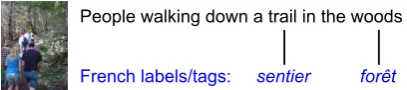
People walking down a trail in the woods
[image:1.595.314.518.222.267.2]French labels/tags: sentier forêt
Figure 1: A labeled example from the dataset for mul-timodal lexical translation. Only ambiguous words in the sentence are labeled to their corresponding transla-tion in the target language.
similar task but focused at the word level and only at ambiguous words. In MLT, the objective is to correctly translate each ambiguous word in the En-glish source sentence into a corresponding word in the target language given the word itself, the En-glish sentence in which it occurs and the image being described by that sentence. This is similar
to the task of Visual Sense Disambiguation (Gella
et al.,2016) where the objective is to disambiguate the ambiguous verbs using text and image con-texts. The authors of MLT proposed to define a word in the source language to be ambiguous if it has multiple translations in the target language with different meanings in the dataset. However, they did not suggest any models for that.
In this paper, we propose to treat MLT as a sequence labeling task, as depicted by the
ex-ample in Figure 1, similar to part-of-speech
tag-ging or named entity recognition. Our approach draws inspiration from neural sequence-based
ap-proaches to word sense disambiguation (Raganato
et al.,2017;Yuan et al.,2016;K˚ageb¨ack and Sa-lomonsson,2016) and approaches to ground
ma-chine translation (Caglayan et al., 2017). More
specifically, we propose and empirically evalu-ate grounded translation disambiguation models based on recurrent sequential units for the task of MLT. Our primary contributions are:
• An investigation of the MLT dataset to
Train Val Test
Sentences 29,000 1,014 1,000
Labels EnDe 49,626 1,775 1,708
[image:2.595.106.257.62.122.2]Labels EnFr 41,191 1,427 1,298
Table 1: Data splits of the dataset for multimodal lexi-cal translation, where EnDe indicates English-German, and EnFr, English-French.
we find the task is challenging because of the skewed distribution of translation candi-dates in the training set and that the scope of improvements from images is about 7.8% for German and 8.6% for English-French.
• An investigation into data settings for the
task: we find that models trained to tag all words, irrespective of their ambiguity level, perform better than other settings.
• A study on the effect of visual representations
for grounded recurrent models: we find that simple unidirectional recurrent models gain more with conditioning of visual information than stronger bidirectional recurrent models.
• An investigation on different visual
repre-sentations for the task: we find that struc-tured image information (in the form of ob-jects) perform better than the popularly used
ResNetpool5image features.
2 Dataset for MLT
Lala and Specia (2018) extract the MLT dataset
from the Multi30K (Elliott et al., 2016, 2017).
MLT was also used to compute Lexical Trans-lation Accuracy for systems submitted to the
WMT18 multimodal translation shared task (
Bar-rault et al.,2018).
The dataset consists of 31,014 images with one English description per image, where the ambigu-ous words in the description, if any, are labeled to their corresponding lexical translations in the tar-get language conforming to the given context (see
Figure1). The dataset is split into training,
valida-tion and test sets in the same way as in the WMT’s
MMT task in 2016 (see Table1).
2.1 Skewed Distributions of Translations
Statistics about the dataset for MLT are shown
in Table 2. We emphasize that a key aspect of
Language Pair UA APS APHW TCPA SR WSR
EnDe 745 1.68 15.0 4.1 1.8 1.5
EnFR 661 1.39 12.5 3.0 1.6 1.3
Table 2: Some key statistics of the original dataset for MLT. UA: Unique Ambiguous words. APS: Ambigu-ous words Per Sentence. APHW: AmbiguAmbigu-ous words Per Hundred Words. TCPA: Translation Candidates Per Ambiguous word. SR: Skewness Ratio as de-scribed in Section2.1. WSR: Weigthed average of SRs.
the dataset worth noting is the skewed distribu-tion over the lexical transladistribu-tion candidates. For
instance, the English word woodshas two
possible lexical translations in French in this dataset
-forˆetandbois. Ideally, we would want both these lexical translations to occur equal number of times (uniform distribution) but in reality the
distribu-tion is skewed -bois occurs 79 times (we call it
the Most Frequent Translation (MFT)) whileforˆet
occurs 16 times.
For a better understanding of the skewness of the distributions, we define a Skewness Ratio (SR) of a word as the ratio of count of the word to the count of its most frequent translation. For
exam-ple, SR(woods) = count(woods)/count(bois) = 1.2.
For the whole dataset, we simply average the SRs
over all the ambiguous words1. The averaged SR
will be a number between 1 and the TCPA (the averaged Translation Candidates Per Ambiguous word). If it is closer to 1 this means that, in the dataset, the distribution over lexical translations is skewed. If it is closer to TCPA, then the distribu-tion is more uniform.
We note, our definition of Skewness Ratio is similar to the inverse of ‘Average Time-anchored Relative Frequency of Usage’ metric defined in
Ilievski et al. (2016) which is used to assess po-tential bias of meaning dominance with respect to its temporal popularity.
The averaged Skewness Ratios for both
lan-guage pairs, mentioned in Table2, are much closer
to 1 than to their corresponding TCPAs. This
implies that the distributions over the translations are highly skewed and suggests that it will be ex-tremely challenging to demonstrate improvements over the MFT because of bias to MFT as indicated inPostma et al.(2016).
1We also compute the weighted average of SRs, called
WSR in table2, weighted by the frequency of the ambiguous
2.2 When Humans Find Images Useful
We extended the dataset for MLT to include the 2018 test set of MMT shared task by manually la-beling the examples. In the process, human anno-tators were further instructed to inform whenever the image was useful in performing lexical trans-lation.
2.2.1 Setup
The 2018 test set of the MMT shared task was made available, consisting of 1071 images and one English description per image. The ambigu-ous words from the original MLT dataset were searched in this test set using string matching to identify ambiguous test instances. From these test instances, the English description together with the ambiguous word and the set of all lexical trans-lation candidates of the ambiguous word were provided to human annotators who are bilingual speakers of both English and the target language (German or French) under consideration. The cor-responding images were also provided but not ex-plicitly shown to the annotators; they had the op-tion to look at the image if they have to and specify when they used the image.
The objective for the annotators was to se-lect those translation candidates they thought con-formed both the English description and the cor-responding image; or in other words, they had to filter out the translation candidates that did not conform either the English description or the im-age, while having the option to look at the image (if they thought the visual context was needed to make a decision) or ignore it completely (if they thought the visual context was not needed). If they selected all available options (i.e. they did not filter out any single option) then those exam-ples were removed from the study.
2.2.2 Results and Discussion
The human annotations of this experiment can be
found together with the MLT dataset onhttps:
//github.com/sheffieldnlp/mlt. The
results are shown in Table3and discussed below.
For English-German, the extension consists of 358 instances of ambiguous words. In 111 (or 31%) of these instances the annotators opted to look at the image. In 83 of these 111 image-aware instances the annotator selected the lexical trans-lation candidate which happened to be the most frequent translation. The annotators did not know which translation candidate was the most frequent
Language Pair Ins Img Img-MFT Img-MFT / Ins (Scope) EnDe 358 111 28 7.8% EnFr 407 72 35 8.6%
Table 3: Results of the Human Experiment. Ins: In-stances with ambiguous words. Img: the Ins inIn-stances where the Image was used. Img-MFT: the Img in-stances where the Most Frequent Translation was not selected (filtered out) by the annotators. Img-MFT / Ins (Scope): the ratio of Img-MFT to Ins expressed in percentage; and as discussed in Section2.2.2this re-flects the Scope of improvement at Lexical Translation using Images.
for the given ambiguous word in the corpus. This leaves us with 28 instances, which is 7.8% of all the instances, where the annotators looked at the image and chose to filter out the most frequent translation. Although the sample size is small, these numbers help us understand the scope of im-age at word-level translation task (7.8% for EnDe and 8.6% for EnFr; i.e. around 8% on average).
Ambiguous words where humans opted to look
at the image include pool, hat, coat, field, wall,
etc., suggesting textual context is not sufficient for
such words. Ambiguous words where humans
ig-nored the image include area, fall, watch, walk,
etc., suggesting the textual context is often
suffi-cient to identify the correct translation.
3 Lexical Translation Models
We explore two neural sequence labeling
architec-tures following Graves (2012), using long
short-term memory networks (LSTMs)2:
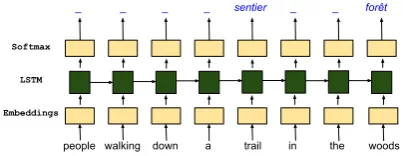
people walking down a trail in the woods _ _ _ _ sentier _ _ forêt
Softmax
LSTM
[image:3.595.314.516.545.623.2]Embeddings
Figure 2: Unidirectional long short-term memory net-work used as a tagger for lexical translation of am-biguous words. The remaining unamam-biguous words are tagged to a common label (an underscore ‘ ’ in this case).
2We also experimented with sequence-to-sequence
ap-proaches (Sutskever et al.,2014;Cho et al.,2014;Bahdanau
et al.,2015) and their application to word sense
ULSTM: This is a single layer unidirectional
LSTM network (Hochreiter and Schmidhuber,
1997). A similar setting is used in Yuan et al.
(2016) as a classifier for word sense
disambigua-tion. In our setup we use the LSTM as a tagger
(see Figure2).
BLSTM: This is a single layer bidirectional
LSTM network (Graves and Schmidhuber,2005)
used as a tagger. BLSTMs are used in (K˚ageb¨ack
and Salomonsson, 2016) as a classifier for word sense disambiguation and have shown promising results. Recent work also suggests that BLSTM-based tagging models give state of the art
perfor-mance on multilingual sequence tagging (Plank
et al.,2016).
people walking down a trail in the woods people walking down a sentier in the forêt
Image ResNet-50 (pretrained) Pool5 2048D
Linear projection
[image:4.595.80.283.283.375.2]300D
Figure 3: Multimodal-BLSTM for lexical translation of ambiguous words. Unambiguous words are tagged to self.
We extend these architectures to make them multimodal, as follows:
Multimodal Tagger: Following previous work in grounded machine translation and image
cap-tioning (Caglayan et al., 2017; Karpathy and
Fei-Fei, 2015; Vinyals et al., 2015), we propose multimodal models that are identical to the text-only ULSTM and BLSTM models but are
con-ditioned with image information. Specifically,
the hidden states of the LSTMs are initialized with the image features. We used the ResNet-50 (He et al.,2016) based image features and ex-tract 2048-dimensional features exex-tracted from the
pool5 layer of a pre-trained ResNet-50 model. To match the dimensions of the hidden states of the LSTM, we learn a linear projection. A multi-modal BLSTM architecture, trained on a data set-ting where we also label the unambiguous words to itself, is depicted in Figure 2.
Object-based Grounding: Given that the ambi-guities are associated with content words, we as-sume that these correspond to objects and propose a model that uses objects in the image associated
to the ambiguous words. We experiment with two ways of incorporating object information - a) Ini-tializing and b) Prepending.
The Initializing approach is identical to the multimodal tagger above where instead of the 2048-dimensional ResNet-50 image features we initialize the ULSTM and BLSTM with a binary vector representing the presence or absence of ob-jects in the image corresponding to its ambiguous
words. In thePrependingapproach, motivated by
recent work in neural machine translation (
John-son et al.,2017), we prepend the word that repre-sents the object category (e.g. ‘person’) associated with the ambiguous word to the source sentence.
We extract object category information from
the images using annotations on Plummer et al.
(2015). These consist of a set of 16 object
cate-gories that abstractly depict the objects present in the image.
3.1 Data Settings
A significant proportion of sentences in the train-ing (16% for EnDe and 21% for EnFr) dataset do not have any ambiguous word. Therefore at training time we experiment in two ways a) to
ig-nore such sentences (‘ambiguous sentences’
set-ting); or b) train on all sentences (‘all sentences’
setting). Secondly, for unambiguous words (i.e. tokens that are not labelled), we experiment in
two settings – a) leave it unlabelled (‘ambiguous
word’ setting) or b) to label it to itself (‘all words’
setting). These choices amount to four different data settings for training.
3.2 Training and Baselines
Training and Evaluation: For optimization, we
use the Adam (Kingma and Ba, 2014) algorithm
with a learning rate = 0.001 and batch size = 32. The LSTM hidden state dimensions and the word embedding dimensions are set to 300 and the dropout rate is set to 0.3. Training is stopped early if model accuracy over the validation set does not improve for 30 epochs and then the best perform-ing model over the validation set is selected. These models are implemented and trained in the Tensor-Flow framework.
label-ing accuracy on other words3. We also measure
gains from the image, i.e. the difference(∆)
be-tween the performance of multimodal and corre-sponding text-only baseline models.
Frequency Baselines: We consider baselines that completely disregard the visual and the textual contexts. The Random baseline translates an am-biguous word by selecting a translation candidate at random. The MFT baseline selects the most fre-quent translation of the ambiguous word as seen in the training data. As noted earlier, the most frequent translation is expected to be difficult to outperform because of the skewed distribution of
translation candidates in the dataset (Postma et al.,
2016).
Text-only and Image-only Baselines: The text-only baselines are the ULSTM and BLSTM that do not consider the visual contexts. The image-only baselines are the multimodal tagger condi-tioned on the image (either image features or ob-ject vector) except that they do not read textual context but only the ambiguous words in the sen-tence, i.e. all unambiguous words are removed.
4 Results and Discussion
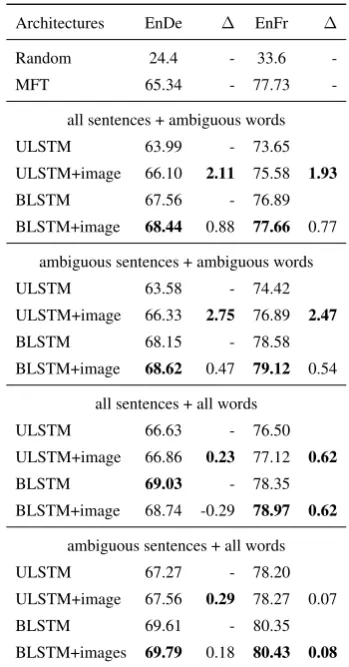
Results of the two text-only (ULSTM and BLSTM) and two multimodal models (UL-STM+image and BL(UL-STM+image) in the four dif-ferent data settings on the test set are shown in
Ta-ble4.
We observe that all models perform better than Random baseline and most models perform bet-ter than MFT. We see that the BLSTM models al-ways perform better than the corresponding UL-STM models, as expected.
With ResNet-50pool5global image features,
the multimodal ULSTM+image models perform better than the corresponding text-only ULSTM
models in all data settings (See Table 4). This
shows ULSTM models benefit from the ResNet-50 image features. The same cannot be said for BLSTM. Also, ULSTM tends to gain more from the image as compared to the BLSTM. We posit the lack of sufficient contextual information in ULSTMs as the reason. The visual information
3
As a sanity check we note that, for all the models we ex-perimented with, the labeling/tagging accuracy on all words (both ambiguous and unambiguous combined) ranges be-tween 85% and 94% on the validation set and 85% and 91% on the test set.
Architectures EnDe ∆ EnFr ∆
Random 24.4 - 33.6
-MFT 65.34 - 77.73
-all sentences + ambiguous words
ULSTM 63.99 - 73.65
ULSTM+image 66.10 2.11 75.58 1.93
BLSTM 67.56 - 76.89
BLSTM+image 68.44 0.88 77.66 0.77
ambiguous sentences + ambiguous words
ULSTM 63.58 - 74.42
ULSTM+image 66.33 2.75 76.89 2.47
BLSTM 68.15 - 78.58
BLSTM+image 68.62 0.47 79.12 0.54
all sentences + all words
ULSTM 66.63 - 76.50
ULSTM+image 66.86 0.23 77.12 0.62
BLSTM 69.03 - 78.35
BLSTM+image 68.74 -0.29 78.97 0.62
ambiguous sentences + all words
ULSTM 67.27 - 78.20
ULSTM+image 67.56 0.29 78.27 0.07
BLSTM 69.61 - 80.35
[image:5.595.328.503.61.395.2]BLSTM+images 69.79 0.18 80.43 0.08
Table 4: Comparing multimodal models with their text-only counterparts in different data settings. We observe ULSTM benefits more from the ResNet-50 global im-age feature as compared to BLSTM.
seems to compensate for the incomplete textual
context. We provide examples in Figure4.
En: a balding man wearing a red life jacket is sitting in a small life boat Reference: vêtir bateau ULSTM: porter bateau ULSTM+img: vêtir bateau BLSTM: vêtir bateau BLSTM+img: vêtir bateau
En: a girl wearing a life vest floats in water Reference: vêtir flotter eau
ULSTM: porter eau ULSTM+img: vêtir flotter eau BLSTM: porter flotter eau BLSTM+img: vêtir flotter eau
Figure 4: Examples showing ULSTM tends to bene-fit more from the ResNet-50pool5image features as compared to BLSTM.
[image:5.595.309.522.510.662.2]Architectures EnDe ∆ EnFr ∆
Random 24.4 - 33.6
-MFT 65.34 - 77.73
-all sentences + ambiguous words
ImageOnly 67.56 - 77.20
ObjectOnly 68.33 - 78.89
BLSTM 67.56 - 76.89
BLSTM+image 68.44 0.88 77.66 0.77
BLSTM+object 67.80 0.24 79.28 2.39
BLSTM+object-prepend 70.08 2.52 80.89 4.00
ambiguous sentences + ambiguous words
ImageOnly 67.92 - 78.35
ObjectOnly 68.15 - 79.74
BLSTM 68.15 - 78.58
BLSTM+image 68.62 0.47 79.12 0.54
BLSTM+object 69.03 0.88 79.43 0.85
BLSTM+object-prepend 70.44 2.29 80.20 1.62
all sentences + all words
ImageOnly 67.56 - 77.20
ObjectOnly 68.33 - 78.89
BLSTM 69.03 - 78.35
BLSTM+image 68.74 -0.29 78.97 0.62
BLSTM+object 69.85 0.82 79.89 1.54
BLSTM+object-prepend 70.90 1.87 81.97 3.62
ambiguous sentences + all words
ImageOnly 67.92 - 78.35
ObjectOnly 68.15 - 79.74
BLSTM 69.61 - 80.35
BLSTM+images 69.79 0.18 80.43 0.08
BLSTM+object 69.79 0.18 81.28 0.93
[image:6.595.95.267.69.442.2]BLSTM+object-prepend 71.02 1.41 82.59 2.24
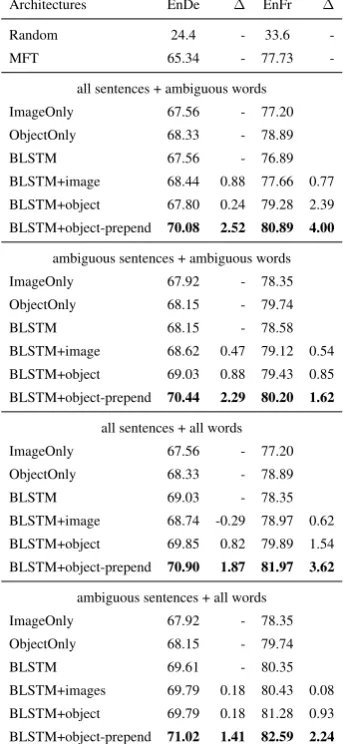
Table 5: Comparing object-based grounding BLSTM models with other BLSTM models in different data set-tings.
labeling since in such data settings the number of labels are larger than the source language vocabu-lary. Nevertheless, we observe that this data set-ting outperforms others. We hypothesize that a possible reason is that it forces the models to
cap-ture better context. We also note that the gains∆
from the image are larger in theambiguous words
data setting, especially for ULSTM. This suggests that the image information assists the model to learn better context representations. Models tend
to perform slightly better in theambiguous
sen-tencessetting as compared toall sentences. This hints that more data is not necessarily better as the unambiguous sentences are not always rele-vant to the task. This is in line with observations inPostma et al.(2016).
Results of our proposed object-based struc-tured grounding models (BLSTM+object and
BLSTM+objct-prepend) together with other
BLSTM models are shown in Table 5. The
object-based structured grounding models outper-form the multimodal models that use ResNet-50 image features in most cases. More specifically, grounding via prepending performs the best in all data settings with gains over the corresponding text-only baselines ranging from 1.41% to 2.52% for EnDe and 1.62% to 4.00% for EnFr across
different data settings. The best multimodal
model is BLSTM+object-prepend trained in the
ambiguous sentencesandall wordsdata settings and it outperforms the best performing text-only baseline model by 1.41% for EnDe and 2.24% for EnFr. This suggests that region-specific informa-tion in terms of explicit objects corresponding to the ambiguous words in the sentences are highly
beneficial. We observe a similar trend when
comparing the ObjectOnly baseline vs ImageOnly
baseline, i.e. object information is better than
ResNet-50 global image features in absence of textual context too.
5 Conclusions
We studied the MLT dataset and found that the dis-tribution of translation candidates is very skewed making the word-level translation task challeng-ing. In a human study, we found the scope of improvement gains from images is about 7.8% for EnDe and 8.6% for EnFr in this task on this dataset. We proposed grounded models for the task of word-level translation. We found the ‘am-biguous sentences’ and ‘all words’ data setting is most suitable for the task. Also, we found the ULSTM tends to benefit more from the image as compared to the BLSTM and posit that this is be-cause the image compensates for the weak tex-tual information for the ULSTM. We found that object-based grounded models, i.e. models that have explicit information about the objects associ-ated with the ambiguities, outperform other mod-els including ones which use the popularly used
ResNet-50 pool5 global image features. Also,
we found that grounding by prepending performs better than initializing.
Acknowledgements
References
Dzmitry Bahdanau, Kyunghyun Cho, and Yoshua Ben-gio. 2015. Neural machine translation by jointly learning to align and translate. In Proceedings of International Conference on Learning Representa-tions.
Lo¨ıc Barrault, Fethi Bougares, Lucia Specia, Chi-raag Lala, Desmond Elliott, and Stella Frank. 2018. Findings of the third shared task on multimodal ma-chine translation. InProceedings of the Third Con-ference on Machine Translation: Shared Task Pa-pers.
Ozan Caglayan, Walid Aransa, Adrien Bardet, Mer-cedes Garc´ıa-Mart´ınez, Fethi Bougares, Lo¨ıc Bar-rault, Marc Masana, Luis Herranz, and Joost van de Weijer. 2017. LIUM-CVC submissions for WMT17 multimodal translation task. InProceedings of the Second Conference on Machine Translation. Asso-ciation for Computational Linguistics.
Kyunghyun Cho, Bart van Merrienboer, Caglar Gul-cehre, Dzmitry Bahdanau, Fethi Bougares, Holger Schwenk, and Yoshua Bengio. 2014. Learning phrase representations using rnn encoder–decoder for statistical machine translation. InProceedings of the 2014 Conference on Empirical Methods in Nat-ural Language Processing (EMNLP).
Desmond Elliott, Stella Frank, Lo¨ıc Barrault, Fethi Bougares, and Lucia Specia. 2017. Findings of the second shared task on multimodal machine transla-tion and multilingual image descriptransla-tion. In Proceed-ings of the Second Conference on Machine Transla-tion.
Desmond Elliott, Stella Frank, Khalil Sima’an, and Lu-cia SpeLu-cia. 2016. Multi30k: Multilingual english-german image descriptions. In Proceedings of the 5th Workshop on Vision and Language.
Spandana Gella, Mirella Lapata, and Frank Keller. 2016. Unsupervised visual sense disambiguation for verbs using multimodal embeddings. In Proceed-ings of the 2016 Conference of the North American Chapter of the Association for Computational Lin-guistics: Human Language Technologies.
Alex Graves. 2012. Supervised sequence labelling. In
Supervised sequence labelling with recurrent neural networks. Springer.
Alex Graves and J¨urgen Schmidhuber. 2005. Frame-wise phoneme classification with bidirectional lstm and other neural network architectures. In Proceed-ings of Neural Networks.
Kaiming He, Xiangyu Zhang, Shaoqing Ren, and Jian Sun. 2016. Deep residual learning for image recog-nition. InProceedings of the IEEE Conference on Computer Vision and Pattern Recognition.
Sepp Hochreiter and J¨urgen Schmidhuber. 1997. Long short-term memory. InProceedings of Neural Com-putation.
Filip Ilievski, Marten Postma, and Piek Vossen. 2016. Semantic overfitting: what ’world’ do we consider when evaluating disambiguation of text? In Pro-ceedings of COLING 2016, the 26th International Conference on Computational Linguistics: Techni-cal Papers.
Melvin Johnson, Mike Schuster, Quoc V Le, Maxim Krikun, Yonghui Wu, Zhifeng Chen, Nikhil Thorat, Fernanda Vi´egas, Martin Wattenberg, Greg Corrado, et al. 2017. Googles multilingual neural machine translation system: Enabling zero-shot translation.
Transactions of the Association for Computational Linguistics, 5.
Mikael K˚ageb¨ack and Hans Salomonsson. 2016. Word sense disambiguation using a bidirectional lstm. In
Proceedings of International Conference on Compu-tational Linguistics.
Andrej Karpathy and Li Fei-Fei. 2015. Deep visual-semantic alignments for generating image descrip-tions. In Proceedings of the IEEE conference on computer vision and pattern recognition.
Diederik Kingma and Jimmy Ba. 2014. Adam: A method for stochastic optimization. InProceedings of International Conference on Learning Represen-tations.
Chiraag Lala and Lucia Specia. 2018. Multimodal lex-ical translation. InProceedings of the Eleventh In-ternational Conference on Language Resources and Evaluation (LREC 2018).
Barbara Plank, Anders Søgaard, and Yoav Goldberg. 2016. Multilingual part-of-speech tagging with bidirectional long short-term memory models and auxiliary loss. The 54th Annual Meeting of the As-sociation for Computational Linguistics.
Bryan A Plummer, Liwei Wang, Chris M Cervantes, Juan C Caicedo, Julia Hockenmaier, and Svetlana Lazebnik. 2015. Flickr30k entities: Collecting region-to-phrase correspondences for richer image-to-sentence models. InProceedings of the IEEE in-ternational conference on computer vision.
Marten Postma, Ruben Izquierdo Bevia, and Piek Vossen. 2016. More is not always better: balanc-ing sense distributions for all-words word sense dis-ambiguation. In Proceedings of COLING 2016, the 26th International Conference on Computational Linguistics: Technical Papers.
Alessandro Raganato, Claudio Delli Bovi, and Roberto Navigli. 2017. Neural sequence learning models for word sense disambiguation. InProceedings of the 2017 Conference on Empirical Methods in Natural Language Processing.
Ilya Sutskever, Oriol Vinyals, and Quoc V Le. 2014. Sequence to sequence learning with neural net-works. InAdvances in Neural Information Process-ing Systems.
Oriol Vinyals, Alexander Toshev, Samy Bengio, and Dumitru Erhan. 2015. Show and tell: A neural im-age caption generator. In Proceedings of the IEEE conference on computer vision and pattern recogni-tion.
Dayu Yuan, Julian Richardson, Ryan Doherty, Colin Evans, and Eric Altendorf. 2016. Semi-supervised word sense disambiguation with neural models. In