Human Language Technologies: The 2015 Annual Conference of the North American Chapter of the ACL, pages 1416–1421,
Type-Driven Incremental Semantic Parsing with Polymorphism
∗Kai Zhao
Graduate Center
City University of New York
[email protected]
Liang Huang
Queens College and Graduate Center
City University of New York
[email protected]
Abstract
Semantic parsing has made significant progress, but most current semantic parsers are extremely slow (CKY-based) and rather primitive in representation. We introduce three new techniques to tackle these problems. First, we design the first linear-time incremental shift-reduce-style semantic parsing al-gorithm which is more efficient than conventional cubic-time bottom-up semantic parsers. Second, our parser, being type-driven instead of syntax-driven, uses type-checking to decide the direction of reduc-tion, which eliminates the need for a syntactic gram-mar such as CCG. Third, to fully exploit the power of type-driven semantic parsing beyond simple types (such as entities and truth values), we borrow from programming language theory the concepts of sub-type polymorphism and parametric polymorphism to enrich the type system in order to better guide the parsing. Our system learns very accurate parses in GEOQUERY, JOBSand ATISdomains.
1 Introduction
Most existing semantic parsing efforts employ a CKY-style bottom-up parsing strategy to generate a meaning representation in simply typed lambda calculus (Zettle-moyer and Collins, 2005; Lu and Ng, 2011) or its variants (Wong and Mooney, 2007; Liang et al., 2011). Although these works led to fairly accurate semantic parsers, there are two major drawbacks: efficiency and expressiveness. First, as many researches in syntactic parsing (Nivre, 2008; Zhang and Clark, 2011) have shown, compared to cubic-time CKY-style parsing, incremental parsing can achieve comparable accuracies while being linear-time, and orders of magnitude faster in practice. We therefore introduce the first incremental parsing algorithm for se-mantic parsing. More interestingly, unlike syntactic pars-ing, our incremental semantic parsing algorithm, being strictlytype-driven, directly employs type checking to automatically determine the direction of function applica-tion on-the-fly, thus reducing the search space and elimi-∗We thank the reviewers for helpful suggestions. We are also grate-ful to Luke Zettelmoyer, Yoav Artzi, and Tom Kwiatkowski for pro-viding data. This research is supported by DARPA FA8750-13-2-0041 (DEFT), NSF IIS-1449278, and a Google Faculty Research Award.
nating the need for a syntactic grammar such as CCG to explicitly encode the direction of function application.
However, to fully exploit the power of type-driven in-cremental parsing, we need a more sophisticated type system than simply typed lambda calculus. Compare the following two phrases:
(1) the governor of New York (2) the mayor of New York
If we know thatgovernoris a function from state to per-son, then the firstNew Yorkcan only be of typestate; sim-ilarly knowingmayormaps city to person disambiguates the secondNew Yorkto be of typecity. This can not be done using a simple type system with just entities and booleans.
Now let us consider a more complex question which will be our running example in this paper:
(3) What is the capital of the largest state by area? Since we knowcapitaltakes a state as input, we expect the largest state by areato return a state. But doeslargest always return a state type? Notice that it is polymorphic, for example, largest city by population, or largest lake by perimeter. So there is no unique type forlargest: its return type should depend on the type of its first argu-ment (city,state, orlake). This observation motivates us to introduce the powerful mechanism of parametric poly-morphism from programming languages into natural lan-guage semantics for the first time.
For example, we can define the type oflargestto be a template largest: ('a→t)→('a→i)→'a
where'ais atype variablethat can match any type (for formal details see §3). Just like in functional program-ming languages such as ML or Haskell, type variables can be bound to a real type (or a range of types) during function application, using the technique of type infer-ence. In the above example, whenlargestis applied to city, we know that type variable'ais bound to type city (or its subtype), solargestwould eventually return a city.
We make the following contributions:
• We design the first linear-time incremental semantic parsing algorithm (§2), which is much more efficient than the existing semantic parsers that are cubic-time and CKY-based.
• In line with classical Montague theory (Heim and Kratzer, 1998), our parser is type-driven instead of syntax-driven as in CCG-based efforts (Zettlemoyer and Collins, 2005; Kwiatkowski et al., 2011; Krish-namurthy and Mitchell, 2014) (§2.3).
• We introduce parametric polymorphism into nat-ural language semantics (§3), along with proper treatment of subtype polymorphism, and implement Hindley-Milner style type inference (Pierce, 2005, Chap. 10) during parsing (§3.3).1
• We adapt the latent-variable max-violation percep-tron training from machine translation (Yu et al., 2013), which is a perfect fit for semantic parsing due to its huge search space (§4).
2 Type-Driven Incremental Parsing
We start with the simplest meaning representation (MR), untyped lambda calculus, and introduce typing and the incremental parsing algorithm for it. Later in §3, we add subtyping and type polymorphism to enrich the system.
2.1 Meaning Representation with Types
The untyped MR for the running example is: Q: What is the capital of the largest state by area? MR:(capital (argmax state size))
Note the binary functionargmax(·,·)is a higher-order function that takes two other functions as input: the first argument is a “domain” function that defines the set to search for, and second argument is an “evaluation” func-tion that returns a integer for an element in that domain.
The simply typed lambda calculus (Heim and Kratzer, 1998; Lu and Ng, 2011) augments the system with types, including base types (entities e, truth valuest, or num-bersi), and function types (e.g.,e→t). Socapitalis of typee→e,stateis of typee→t, andsizeis of typee→i. Theargmaxfunction is of type(e→t)→(e→i)→e.2 The simply typed MR is now written as
(capital:e→e (argmax:(e→t)→(e→i)→e
state:e→t size:e→i))).
2.2 Incremental Semantic Parsing: An Example
Similar to a standard shift-reduce parser, we maintain a stack and a queue. The queue contains words to be 1There are three kinds of polymorphisms in programming lan-guages: parametric (e.g., C++ templates), subtyping, and ad-hoc (e.g., operator overloading). See Pierce (2002, Chap. 15) for details.
2Note that the type notation is always curried, i.e., we repre-sent a binary function as a unary function that returns another unary function. Also the type notation is always right-associative, so
(e→t)→((e→i)→e)is also written as(e→t)→(e→i)→e.
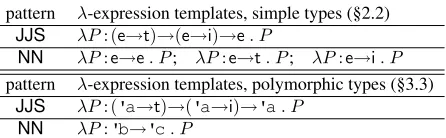
pattern λ-expression templates, simple types (§2.2)
JJS λP:(e→t)→(e→i)→e. P
NN λP:e→e. P; λP:e→t. P; λP:e→i. P
pattern λ-expression templates, polymorphic types (§3.3)
JJS λP:('a→t)→('a→i)→'a. P
[image:2.612.318.541.57.126.2]NN λP:'b→'c. P
Table 1: POS-based meaning representation templates used in the running example (see Figure 1). The polymorphic types greatly simplifies the representation for common nouns (NN).
parsed, while the stack contains subexpressions of the fi-nal MR, each of which is a valid typed lambda expres-sion. At each step, the parser choose toshiftorreduce, but unlike standard shift-reduce parser, there is also a third possible action,skip, skipping a semantically vacu-ous word (e.g., “the”, “of”, “is”, etc.). For example, the first three words of the example question“What is the ...” are all skipped (steps 1–3in Figure 1 (left)).
The parser thenshiftsthe next word,“capital”, from the queue to the stack. But unlike incremental syn-tactic parsing where the word itself is moved onto the stack, here we need to find agroundedpredicate in the GeoQuery domain for the current word. Triggered by the POS tagNNof word “capital”, the template λP :
e→e. P is fetched from a predefined MR templates set like Table 1. In its outermost lambda abstraction, variable Pneeds to be grounded on-the-fly before we push the ex-pression onto the stack. We find a predicatecapital:e→e
in the GEOQUERY domain applicable to the MR tem-plate. After the application, we push the result onto the stack (step 4).
Next, words“of the”are skipped (steps 5–6). For the next word“largest”,argmax: (e→t)→(e→i)→eis ap-plied to the MR template triggered by its POS tagJJSin Table 1, and the stack becomes (step 7)
capital:e→e argmax:(e→t)→(e→i)→e. At this step we have two expressions on the stack and we could attempt to reduce. But type checking fails be-cause for left reduce, argmaxexpects an argument (its “domain” function) of type(e→t)which is different from
capital’s type (e→e), so is the case for right reduce. So we have to shift again. This time for word“state”:
state:e→t. The stack becomes:
capital:e→e argmax:(e→t)→(e→i)→e state:e→t.
2.3 Type-Driven Reduce
At this step we can finally perform a reduce action, since the top two expressions on the stack pass the type-checking for rightward function application (a partial ap-plication):argmaxexpects an(e→t)argument, which is exactly the type ofstate. So we conduct a right-reduce, applyingargmaxonstate, which results in
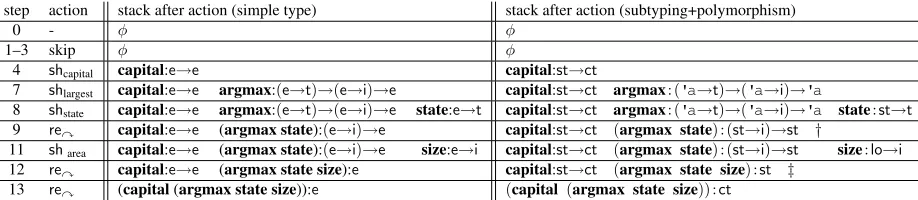
step action stack after action (simple type) stack after action (subtyping+polymorphism)
0 - φ φ
1–3 skip φ φ
4 shcapital capital:e→e capital:st→ct
7 shlargest capital:e→e argmax:(e→t)→(e→i)→e capital:st→ct argmax:('a→t)→('a→i)→'a
8 shstate capital:e→e argmax:(e→t)→(e→i)→e state:e→t capital:st→ct argmax:('a→t)→('a→i)→'a state:st→t 9 rey capital:e→e (argmax state):(e→i)→e capital:st→ct (argmax state):(st→i)→st †
11 sharea capital:e→e (argmax state):(e→i)→e size:e→i capital:st→ct (argmax state):(st→i)→st size:lo→i 12 rey capital:e→e (argmax state size):e capital:st→ct (argmax state size):st ‡
[image:3.612.77.536.57.157.2]13 rey (capital(argmax state size)):e (capital (argmax state size)):ct
Figure 1: Type-driven Incremental Semantic Parsing (TISP) with (a) simple types and (b) subtyping+polymorphism on the example question: “what is the capital of the largest state by area?”. Steps 5–6 and 10 are skip actions and thus omitted. The stack and queue in each row are the resultsaftereach action.†: Type variable'ais binded tost.‡: From Eq. 4,st<:lo⇒(lo→i)<:(st→i). while the stack becomes (step 9)
capital:e→e (argmax state):(e→i)→e
Now if we want to continue reduction, it does not type check for either left or right reduction, so we have to shift again. So we move on to shift the final word“area”with predicate:size:e→iand the stack becomes (step 11):
capital:e→e (argmax state):(e→i)→e size:e→i. Now we can do two consecutive right reduces supported by type checking (step 12, 13) and get the final result:
(capital (argmax state size)):e.
Here we can see the novelty of our shift-reduce parser: its decisions are largely driven by the type system. When we attempt a reduce, at most one of the two reduce actions (left, right) is possible thanks to type check-ing, and when neither is allowed, we have to shift (or skip). This observation suggests that our incremental parser is more deterministic than those syntactic incre-mental parsers where each step always faces a three-way decision (shift, left-reduce, right-reduce). We also note that this type-checking mechanism, inspired by the clas-sical type-driven theory in linguistics (Heim and Kratzer, 1998), eliminates the need for an explicit encoding of direction as in CCG, which makes our formalism much simpler than the synchronous syntactic-semantic ones in most other semantic parsing efforts (Zettlemoyer and Collins, 2005; Zettlemoyer and Collins, 2007; Wong and Mooney, 2007).3
3 Subtype and Parametric Polymorphisms
Currently in simply typed lambda calculus representation functioncapitalcan apply to any entity type, for examplecapital(boston), which should have been disallowed by the type checker. So we need a more sophisticated system that helps ground with refined types, which will in turn help type-driven parsing.
3We need to distinguish between two concepts: a) “direction of re-duction”:f(g)org(f). Obviously at any given time, between the top two (unarized) functionsfandgon the stack, at most one reduction is possible. b) “order of arguments”:f(x, y)orf(y, x). For predicates such asloc:lo→lo→tthe order does matter. Our parser can not dis-tinguish this purely via types, nor can CCG via its syntactic categories. In practice, it is decided by features such as the voice of the verb.
top(root)
i(integer) lo(location)
nu(nature unit) lk(lake) rv(river)
au(admin. unit) ct(city) st(state)
t(boolean)
Figure 2: Type hierarchy for GEOQUERY(slightly simplified).
3.1 Semantics with Subtype Polymorphism
We first augment the meaning representation with a do-main specific type hierarchy. For example Figure 2 shows a (slightly simplified) version of the type hierarchy for GEOQUERY domain. We use <: to denote the (tran-sitive, reflexive, and antisymmetric)subtyping relation
between types; for example in GEOQUERY,st<:lo. Each constant in the GEOQUERY domain is well typed. For example, there are states (michigan:st), cities (nyc:ct), rivers (mississippi:rv), and lakes (tahoe:lk).
Similarly each predicate is also typed. For example, we can query the length of a river,len:rv→i, or the pop-ulation of some administrative unit, population:au→i. Notice thatpopulation(·)can be applied to both states and cities, since they are subtypes of administrative unit, i.e., st <: au and ct <: au. This is because, as in Java and C++, a function that expects a certain type can always take an argument of a subtype. For example, we can query whether two locations are adjacent, using
next_to:lo→(lo→t), as thenext_to(·,·)function can be applied to two states, or to a river and a city, etc.
Before we move on, there is an important consequence of polymorphism worth mentioning here. For the types of unary predicates such ascity(·) andstate(·) that charac-terizeits argument, we define theirs argument types to be the required type, i.e.,city:ct→t, andstate:st→t. This might look a little weird since everything in the domain of those functions are always mapped to true; i.e.,f(x)
subtyping and polymorphism: capitaltakes a state type as input, soargmaxmust returns a state, and therefore its first argument, thestatefunction, must have typest→t
so that the matched type variable'awill be bound tost. This more refined design will also help prune unneces-sary argument matching using type checking.
3.2 Semantics with Parametric Polymorphism
The above type system works smoothly for first-order functions (i.e., predicates taking atomic type arguments), but the situation with higher-order functions (i.e., predi-cates that take functions as input) is more involved. What is the type ofargmaxin the context “the capital of largest state ...”? One possibility is to define it to be as general as possible, as in the simply typed version (and many con-ventional semantic parsers):
argmax:(top→t)→(top→i)→top.
But this actually no longer works for our sophisticated type system for the following reason.
Intuitively, remember thatcapital:st→ctis a function that takes a state as input, so the return type ofargmax
must be a state or its subtype, rather thantopwhich is a supertype ofst. But we can not simply replacetopby
st, sinceargmaxcan also be applied in other scenarios such as “the largest city”. In other words, argmaxis a polymorphicfunction, and to assign a correct type for it we have to introducetype variables:
argmax:('a→t)→('a→i)→'a,
where type variable'ais a place-holder for “any type”.
3.3 Parsing with Subtype Polymorphism and Parametric Polymorphism
We modify the previous parsing algorithm to accommo-date subtyping and polymorphic types. Figure 1 (right) shows the derivation of the running example using the new parsing algorithm. Below we focus on the differ-ences brought by the new algorithm.
Note that we also modified the MR templates as in Ta-ble 1. The new MR templates are more general due to the polymorphism from type variables. For example, now we use only one MR templateλP:'b→'c. P to replace the threeNNMR templates for simple types.
In step 4, unlikecapital:e→e, we shift the predicate
capital :st→ct; in step 7, we shift the polymorphic ex-pression for“largest”:argmax:('a→t)→('a→i)→'a. And after the shift in step 8, the stack becomes
capital:st→ct argmax:('a→t)→('a→i)→'a state:st→t
Atstep 9, in order to applyargmaxontostate:st→t, we simply bind type variable 'a to type st, results in
(argmax state) : (st→i)→st.
After the shift instep 11, the stack becomes:
capital:st→ct (argmax state):(st→i)→st size:lo→i.
Can we still apply right reduce here? According to sub-typing requirement (§3.1), we want lo→i <: st→i to hold, knowing thatst<:lo. Luckily, there is a rule about function types in type theory that exactly fits here:
A<:B
B→C<:A→C (4)
which states the input side is reversed (contravariant). This might look counterintuitive, but the intuition is that, it is safe to allow the functionsize:lo→ito be used in the context where another typest→iis expected, since in that context the argument passed tosizewill be state type (st), which is a subtype of location type (lo) thatsizeexpects, which in turn will not surprisesize. See the classical type theory textbook (Pierce, 2002, Chap. 15.2) for details.
Several works in literature (Zettlemoyer and Collins, 2005; Zettlemoyer and Collins, 2007; Wong and Mooney, 2007; Kwiatkowski et al., 2013) employ some primitive type hierarchies and parse with typed lambda calculus. However, simply introducing subtyped predicates with-out polymorphism will cause type checking failures in handling high-order functions, as we discussed above.
4 Training: Latent Variable Perceptron
We follow the latent variable max-violation perceptron algorithm of Yu et al. (2013) for training. This algorithm is based on the “violation-fixing” framework of Huang et al. (2012) which is tailored to structured learning prob-lems with abundant search errors such as parsing or ma-chine translation.The key challenge in the training is that, for each ques-tion, there might be many different unknown derivations that lead to its annotated MR, which is known as the spurious ambiguity. In our task, the spurious ambigu-ity is caused by how the MR templates are chosen and grounded during the shift step, and the different reduce orders that lead to the same result. We treat this unknown information as latent variable.
More formally, we denote D(x) to be the set ofall partial and full parsing derivations for an input sentence x, and mr(d)to be the MR yielded by a full derivation d. Then we define the sets of (partial and full) reference derivations as:
goodi(x, y)=∆{d∈D(x)| |d|=i,∃full derivationd0s.t. dis a prefix ofd0,mr(d0) =y},
Those “bad” partial and full derivations that do not lead to the annotated MR can be defined as:
badi(x, y)=∆{d∈D(x)|d6∈goodi(x, y),|d|=i}.
At stepi, the best reference partial derivation is d+
i (x, y)=∆ argmax d∈goodi(x,y)
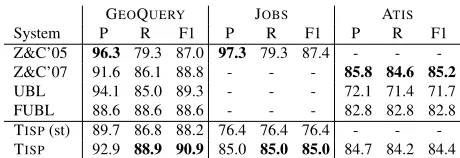
GEOQUERY JOBS ATIS
System P R F1 P R F1 P R F1
Z&C’05 96.3 79.3 87.0 97.3 79.3 87.4 - - -Z&C’07 91.6 86.1 88.8 - - - 85.8 84.6 85.2
UBL 94.1 85.0 89.3 - - - 72.1 71.4 71.7
FUBL 88.6 88.6 88.6 - - - 82.8 82.8 82.8
TISP(st) 89.7 86.8 88.2 76.4 76.4 76.4 - -
-TISP 92.9 88.9 90.9 85.0 85.0 85.0 84.7 84.2 84.4
Table 2: Performances (precision, recall, and F1) of various parsing algorithms on GEOQUERY, JOBS, and ATISdatasets. TISPwith simple types are marked “st”.
while the Viterbi partial derivation is d−i (x, y)=∆ argmax
d∈badi(x,y)
w·Φ(x, d), (6)
whereΦ(x, d)is the defined feature set for derivationd. In practice, to compute Eq. 6 exactly is intractable, and we resort to beam search. Following Yu et al. (2013), we then find the stepi∗ with the maximal score differ-ence between the best referdiffer-ence partial derivation and the Viterbi partial derivation:
i∗=∆argmax
i w·∆Φ(x, d +
i (x, y), d−i (x, y)),
and do update w ← w + ∆Φ(x, d+
i∗(x, y), d−i∗(x, y))
where∆Φ(x, d, d0)=∆Φ(x, d)−Φ(x, d0).
We also use minibatch parallelization of Zhao and Huang (2013); in practice we use 24 cores.
5 Experiments
We implement our type-driven incremental semantic parser (TISP) using Python, and evaluate its perfor-mance on GEOQUERY, JOBS, and ATISdatasets.
Our feature design is inspired by the very effective Word-Edge features in syntactic parsing (Charniak and Johnson, 2005) and MT (He et al., 2008). From each parsing state, we collect atomic features including the types and the leftmost and rightmost words of the span of the top 3 MR expressions on the stack, the top 3 words on the queue, the grounded predicate names and the ID of the MR template used in the shift action. We use bud-get scheme similar to (Yu et al., 2013) to alleviate the overfitting problem caused by feature sparsity. We get 84 combined feature templates in total. Our final system contains 62 MR expression templates, of which 33 are triggered by POS tags, and 29 are triggered by specific phrases.
In the experiments, we use the same training, develop-ment, and testing data splits as Zettlemoyer and Collins (2005) and Zettlemoyer and Collins (2007).
For evaluation, we follow Zettlemoyer and Collins (2005) to useprecisionandrecall:
Precision= ##of successfully parsed questionsof correctly parsed questions ,
top(root)
i(integer) jb(job)
qa(qualification)
pa(platform) ar(area)
ye(year)
[image:5.612.72.302.55.134.2]t(boolean)
Figure 3: Type hierarchy for JOBSdomain (slightly simplified).
Recall= #of correctly parsed questions#of questions .
5.1 Evaluation on GEOQUERYDataset
We first evaluate TISPon GEOQUERYdataset.
In the training and evaluating time, we use a very small beam size of 16, which gives us very fast decoding. In serial mode, our parser takes∼83s to decode the 280 sentences (2,147 words) in the testing set, which means ∼0.3s per sentence, or∼0.04s per word.
We compare the our accuracy performance with ex-isting methods (Zettlemoyer and Collins, 2005; Zettle-moyer and Collins, 2007; Kwiatkowski et al., 2010; Kwiatkowski et al., 2011) in Table 2. Given that all other methods use CKY-style parsing, our method is well bal-anced between accuracy and speed.
In addition, to unveil the helpfulness of our type sys-tem, we train a parser with only simple types. (Table 2) In this setting, the predicates only have primitive types of location lo, integer i, and boolean t, while the con-stants still keep their types. It still has the type system, but it is weaker than the polymorphic one. Its accuracy is lower than the standard one, mostly caused by that the type system can not help pruning the wrong applications like(population:au→i mississippi:rv).
5.2 Evaluations on JOBSand ATISDatasets
We also evaluate the performance of our parser on JOBS and ATISdatasets. Figure 3 shows the type hierarchy for JOBS. We omit the type hierarchy for ATISdue to space constraint. Note that ATIScontains more than 5,000 ex-amples and is a lot larger than GEOQUERYand JOBS.
We show the results in Table 2. In JOBS, we achieves very good recall, but the precision is not as good as Zettle-moyer and Collins (2005), which is actually because we parsed a lot more sentences. Also, TISPwith simple types is still weaker than the one with subtyping and parametric polymorphisms. For ATIS, our performance is very close to the state-of-the-art.
6 Conclusion
References
Eugene Charniak and Mark Johnson. 2005. Coarse-to-fine n-best parsing and maxent discriminative reranking. In Pro-ceedings of ACL, pages 173–180, Ann Arbor, Michigan, June.
Zhongjun He, Qun Liu, and Shouxun Lin. 2008. Improving statistical machine translation using lexicalized rule selec-tion. InProceedings of COLING, pages 321–328, Manch-ester, UK, August.
Irene Heim and Angelika Kratzer. 1998. Semantics in Genera-tive Grammar. Blackwell Publishing.
Liang Huang, Suphan Fayong, and Yang Guo. 2012. Structured perceptron with inexact search. InProceedings of NAACL. Jayant Krishnamurthy and Tom M Mitchell. 2014. Joint
syntactic and semantic parsing with combinatory categorial grammar.
Tom Kwiatkowski, Luke Zettlemoyer, Sharon Goldwater, and Mark Steedman. 2010. Inducing probabilistic ccg grammars from logical form with higher-order unification. In Proceed-ings of the 2010 conference on empirical methods in natu-ral language processing, pages 1223–1233. Association for Computational Linguistics.
Tom Kwiatkowski, Luke Zettlemoyer, Sharon Goldwater, and Mark Steedman. 2011. Lexical generalization in ccg gram-mar induction for semantic parsing. In Proceedings of EMNLP, EMNLP ’11.
Tom Kwiatkowski, Eunsol Choi, Yoav Artzi, and Luke Zettle-moyer. 2013. Scaling semantic parsers with the-fly on-tology matching.
Percy Liang, Michael I. Jordan, and Dan Klein. 2011. Learning
dependency-based compositional semantics. InAssociation for Computational Linguistics (ACL), pages 590–599. Wei Lu and Hwee Tou Ng. 2011. A probabilistic
forest-to-string model for language generation from typed lambda cal-culus expressions. InProceedings of EMNLP.
Joakim Nivre. 2008. Algorithms for deterministic incremental dependency parsing.Computational Linguistics, 34(4):513– 553.
Benjamin C. Pierce. 2002. Types and Programming Lan-guages. MIT Press.
Benjamin Pierce, editor. 2005. Advanced Topics in Types and Programming Languages. MIT Press.
Yuk Wah Wong and Raymond J Mooney. 2007. Learning syn-chronous grammars for semantic parsing with lambda calcu-lus. InAnnual Meeting-Association for computational Lin-guistics, volume 45, page 960.
Heng Yu, Liang Huang, Haitao Mi, and Kai Zhao. 2013. Max-violation perceptron and forced decoding for scalable mt training. InProceedings of EMNLP 2013.
Luke Zettlemoyer and Michael Collins. 2005. Learning to map sentences to logical form: Structured classification with probabilistic categorial grammars. InProceedings of UAI. Luke S Zettlemoyer and Michael Collins. 2007. Online
learn-ing of relaxed ccg grammars for parslearn-ing to logical form. In In Proceedings of EMNLP-CoNLL-2007. Citeseer.
Yue Zhang and Stephen Clark. 2011. Shift-reduce ccg parsing. InProceedings of ACL.