Review Article
Early surgery predicts a better prognosis of urinary
function in cauda equina syndrome with retention:
a systematic review and meta-analysis
Hongxing Song1, Qingkun Song2, Chenli Sun1, Lei Yu1, Zhenwei Wang1, Yinshan Li3
1Department of Orthopaedics, Beijing Shijitan Hospital, Capital Medical University, Beijing 100038, China; 2 De-partment of Cancer Research, Beijing Shijitan Hospital, Capital Medical University, Beijing 100038, China; 3The First Hospital of Shizuishan, Shizuishan 753200, China
Received September 30, 2015; Accepted December 19, 2015; Epub February 15, 2016; Published February 29, 2016
Abstract: Background: The timing of surgical intervention for cauda equina syndrome with retention remains de-bated. This systematic review and meta-analysis aimed to investigate the relationship between the timing of surgi-cal intervention and the prognosis of micturition function in cauda equina syndrome with retention.Material and methods: Literatures in PubMed and ELSEVIER between Jan 1, 1990 and Dec 31, 2014 were reviewed. 10 studies were included in our meta-analysis by Generic Inverse Variance method at the 24-, 48-hour time point with Review Manager 5.0 to identify the evidence of urgent surgical decompression in cauda equina syndrome with retention. Events were defined as either the abnormal recovery of urinary function, or the catheterization. Results: There was a significant difference in the abnormal urinary function at 24- hour breakpoint. Operation beyond 24 hours increased the risk of the abnormal urinary function by 54%. Additionally, a significant difference in the catheterization requir-ing was observed at 48-hour breakpoint. A delayed operation after 48-hours increased the risk of catheterization by 47%. Conclusions: Bladder dysfunction caused by cauda equina syndrome with retention can be effectively attenu-ated by an early surgery. An operation within 24 hours may prevent the occurrence of abnormal urinary function. Meanwhile, an operation within 48 hours may help to reduce the usage of catheter.
Keywords: Lumbar disc herniation, cauda equina syndrome, urinary retention, surgical outcome, evidence-based medicine
Introduction
Cauda equina syndrome (CES) is a rare but an extremely serious surgery emergency [1-3]. It can be induced by many diseases, such as lum-bar disc herniation, lumlum-bar spinal stenosis, trauma, hematoma, tumors and infection [4-7]. This study focuses on the CES originated from lumbar disc herniation with or without lumbar spinal stenosis. The clinical manifestations of CES are very complicated [8, 9]. It has been reported that urinary dysfunction is the most common characteristics of CES [10, 11]. It is well known that voiding dysfunction has a poor prognosis, which seriously affects patients’ daily life and emotions. Therefore, the recovery of micturition function is a major concern of CES patients and animportant predictor for the prognosis.
Gleave and Macfarlane classified CES into two
stages according to the severity of bladder
dys-function: incomplete cauda equina syndrome (CESI) and cauda equina syndrome with
reten-tion (CESR) [12]. CESI was defined as altered
urinary sensation, loss of desire to void, poor urinary stream, and the need to strain in order
to micturate. CESR was defined as painless uri
-nary retention and/or overflow incontinence. It
was indicated that the extents of recovery of bladder function from CESR and CESI were dif-ferent, with the latter always better [10]. It is inapposite to explore to relationship of surgical timing with clinical outcome in a mixture of the two different patient subpopulations [13]. Unfortunately, most of the studies in the
litera-tures failed to setup a clear classification into -CESR and CESI [10, 14].
The timing of urgent surgical intervention is debated [15-17]. Several investigation spro-posed that an early surgical intervention
showed no relevance between the prognosis and operation timing [10, 21]. The lack of sup-porting evidence and the presence of major
flaws in statistical methodology lead to the
inconsistent results [22-25]. After reviewing a large number of literatures, we suspected that the differences in the research objects and the postoperative evaluation standard of bladder function may introduce the above opposite opinions. So far, previous studies have not
stratified the patients and their outcomes
according to timing of surgery.
To fill in the gap in knowledge, we investigated
the relationship between the timing of urgent surgical intervention and the prognosis of mic-turition function by meta-analysis. Here, CESR was set as the research object, and the
abnor-mal urinary function and catheterization requir -ing were set as the outcomes of bladder func-tion at 24- and 48-hours after surgery.
Material and methods
Data resources and searching strategy
Databases: PubMed and ELSEVIER have been chosen for the literature review. PubMed was accessed through NCBI (http://www.ncbi.nlm. nih.gov/pubmed/). ELSEVIER was accessed via Capital Medical University
(http://www.science-nary recovery from CESR arising from herniated lumbar discs with or without spinal stenosis. We aimed to determine the effects of the oper-ations on clinical outcome in 24 and 48 hours. The inclusion criteria were CESR, cohort design, and original reports. The exclusion criteria were CESI, cross-sectional and case-control study design, reanalysis of previous data, review and comments to the related studies.
Criterion of urinary function outcome
According to Gleave and Macfarlane,
postoper-ative urinary function outcome was defined as:
“excellent” for a complete recovery of bladder function in the immediate posterior period; “good” for a complete recovery of bladder func-tion during the follow-up; “fair” for an incom-plete recovery of bladder functionnot requiring
catheterization; “poor” for permanent urinary incontinence requiring catheterization [12]. In
[image:2.629.102.382.77.343.2]the current studywe used 3 categories of uri-nary outcome: normal, fair, andpoor. The “nor-mal” group combined the “excellent” and “good” subgroups mentioned above. We con-ducted two analyses according to the recovery level of bladder function: one analysis is to compare the normal (“excellent” or “good”) with the “abnormal” (“fair” or “poor”) groups; the Figure 1. Flow diagram of article searching.
direct.com/science/search). To improve the surgical man-agement, we chose the arti-cles published between Jan. 01 1990 to Dec. 31 2014. The publications focused on the timing effects of surgi- cal treatments on the urinary prognosis among CRES pa- tients were searched using the terms “cauda equina syn-drome (ICD-10: J83.4)”, “sur-gery/operation”, “human” in various combinations. No lan-guage restrictions were appli- ed. The literatures cited in the
identified articles were also
searched manually. Hongxing Song and Qingkun Song con-ducted the searches.
Study selection
uri-Table 1. Study characteristics of included articles
Reference Sample size Timing of surgery
Urinary function outcome Normal
(Normal) (Fair+poor)Abnormal (Normal+fair)No cath (Poor)Cath
Dining 1993 14 <24 h 8 1 8 1
>24 h 1 4 1 4
Sulla 1996 58 <24 h 6 3 6 3
>24 h 33 16 44 5
<48 h 12 6 14 4
>48 h 27 13 36 4
Shapiro 2000 44 <24 h 17 1 18 0
>24 h 11 15 11 15
<48 h 19 1 20 0
>48 h 9 15 9 15
Buchner 2002 22 <24 h 9 2 10 1
>24 h 8 3 11 0
Mangialardi 2002 5 <24 h 2 2 4 0
>24 h 1 0 1 0
<48 h 3 2 5 0
>48 h 0 0 0 0
Yamanishi 2003 8 <24 h 0 2 1 1
>24 h 0 6 5 1
<48 h 0 8 6 2
>48 h 0 0 0 0
Radulovic 2004 47 <48 h 3 4 6 1
>48 h 30 10 36 4
McCarthy 24 <24 h 2 0 2 0
>24 h 15 7 18 4
<48 h 13 3 14 2
>48 h 4 4 6 2
Olivero 2009 27 <24 h 4 2 5 1
>24 h 21 0 21 0
<48 h 12 2 13 1
>48 h 13 0 13 0
Todd 2011 34 <24 h 2 5 6 1
>24 h 0 27 1 26
<48 h 2 16 7 11
>48 h 0 16 0 16
second analysis was to compare “no
catheter-ization” (“excellent”, or “good”, or “fair”) group with “catheterization” (“poor”) group.
Data extraction
The data of authorship, publication year,
sam-ple size, timing of surgery and urinary function
outcome were collected from the eligible
stud-ies. The risk ratio and 95% confidence interval
were extracted or calculated by the raw data
from the included studies. Hongxing Song and Chenli Sun extracted the data. The disagree-ments were discussed and resolved by Hong- xing Song (orthopedics) and Qingkun Song (epidemiology).
Data synthesis
[image:3.629.102.530.95.577.2]version 5.0 to evaluate the pooled effects. “Generic Inverse Variance” method was
recom-mended in RevMan 5.0 to synthesize the data [26]. “Events” were defined as the abnormal recovery of urinary function/catheterization;
and the early operation was set as control. Log risk ratio and standard error were input for analyses. In addition, RevMan 5.0 provided not only the summary of estimated effects but also the heterogeneity among the studies. We used Chi2 tests to assess the heterogeneity where
the P-value of <0.05 indicated a significant het -erogeneity. The random analysis model was
used for the significant heterogeneity and the fixed analysis model was used for non-signifi -cant heterogeneity. In individual studies that lost follow-up, information biases were assessed. Reporting biases between studies were assessed by Egger’s tests.
Results
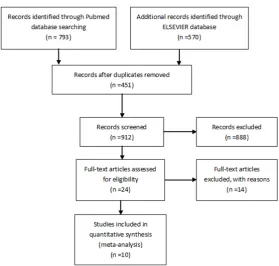
Over 800 articles were reviewed, however, only
24 studies were considered relevant to our pur-pose after screening the topics and abstracts. Eventually, 10 studies are included in our
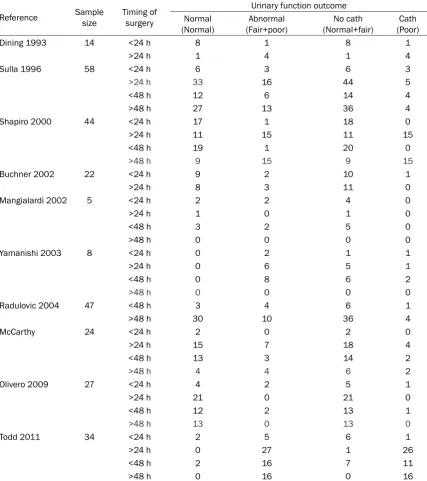
meta-analysis at the 24-, 48-hour time point by a careful sorting of the contents [1, 19, 21, 27-38] (Figure 1 and Table 1).
The information on the authorship, publication
year, sample size, timing of surgery and urinary
function outcome had been extracted from 10 studies between Jan. 1 1990 to Dec. 31 2014,
where the sample size was ranged from 6 to 58; timing of surgery was fixed at the 24-, and
48-hour time point. Different groups were
clas-sified based on the recovery of bladder func
-tion: normal vs. abnormal, no catheterization vs. catheterization. The follow-up was ranged
from 1 to 5 years. For limited numbers of case in those studies, the rate of lost follow-up was <1%. The outcomes of abnormal urinary
func-tion and catheterizafunc-tion requiring were objec -tively judged by doctors in hospitals. Risk of biases in individual studies was pretty low. When we chose the abnormal urinary function
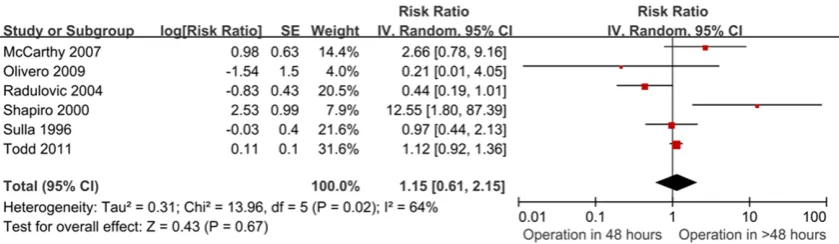
as the event, the synthesized RR (relative risk)
[image:4.629.105.527.83.215.2]of the surgical treatment in 24 hours was 1.54 with the 95% CI of (1.05-2.27), compared with that in longer than 24 hours. The heterogeneity Figure 2. Effect of operation in 24 hours on abnormal urinary function among CESR patients.
[image:4.629.107.527.257.379.2]was non-significant, indicating the operation in
more than 24 hours increased the risk of the abnormal urinary function by 54% (Figure 2). The operation in more than 48-hours increased
the RR to 1.15, the effect was non-significant and the heterogeneity was significant (Figure 3).
When we chose catheterization as the event, there was no significant difference in the cath
-eterization requiring for the surgical interven
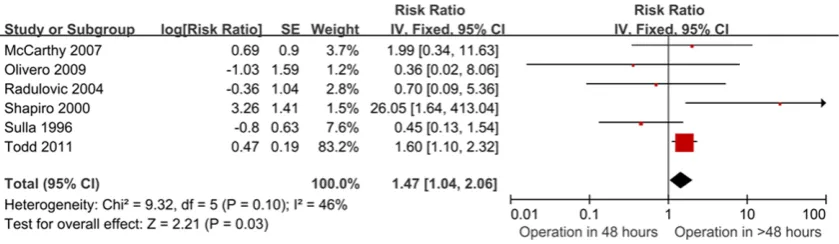
-tion at ≤24 h vs. >24 h (Figure 4). However, the surgical treatment in >48 h was associated
with a 47% increased risk of the catheterization
requiring (P=0.03), in contrast to that ≤48 h. The heterogeneity was non-significant (Figure 5).
All the P-values in the reporting bias test were
>0.05, indicating no significant reporting bias
in the analysis (Table 2). Discussion
The relationship between the operation time and the prognosis for CES is unclear. The pos-sible explanation of this uncertainty may be
summarized as the following: 1) Complex and
various clinical symptoms of CES. There has
been no universal standard for the definition
and diagnosis of CES in the literatures [39, 40]. Based on 105 published papers, Fraser
identi-fied 17 different definitions. Such different defi -nitions reduced the comparability [41]. 2) Different patient population. The study popula-tion should be distinguished according to the severity of bladder dysfunction. 3) Lack of
well-accepted definition for the degree of the uri -nary function recovery. Different evaluation systems lead to inconsistent conclusions. 4) Di- fferent follow-up time. As the recovery varied from months to years, the results varied accord-ingly. Further studies are required to be
con-ducted in a large sample size with long-term
follow-up, in order to obtain reliable results of the bladder function recovery. 5) CES as a rare disease. Most investigations had very
small-sample sizes. The reliability of the results can
be undermined by lack of statistical power [33-35]. Therefore, the present study was focused on CESR and set exclusively the abnormal
[image:5.629.110.527.82.222.2]uri-nary function and the catheterization requiring
Figure 4. Effect of operation in 24 hours on catheterization requiring among CESR patients.
[image:5.629.106.526.266.388.2]as the primary endpoints. The included studies were all cohort designs with a mean followed up time for at least 2 years. Limited lost follow-up happened and all of the outcomes were
assessed by a standard clinical definition.
It is generally believed that the severity of blad-der dysfunction at the time of surgery is the dominant factor for bladder function recovery [10]. An urgent decompression surgery could get a satisfactory recovery of bladder function-for CESI patients, not function-for CESR patients. Numerous literatures showed that the curative
efficiency couldn’t be increased even by an
early surgery [22]. Nevertheless, Delong et al. reported that the surgical timing was still impor-tant for CESR [13]. In the present meta-analy-sis, the bladder function was improved by the
earlier surgery. There was a significant differ -ence in the abnormal urinary function for the
surgery at ≤24 h vs. >24 h breakpoint. This
result is in accordance with the previous report [13] and may provide a supporting theoretical basis of the early surgery timing for CESR
patients. Moreover, a significant difference in catheterization requiring was observed at the ≤48 h vs. >48 h breakpoint, indicating that the
patients may discard the urine catheter and
recover to void even with various difficulties in
urinating, such as straining to void. The 48 h is again a critical time point for the improvement of patients’ quality of life and social engage-ment, and alleviation of depressions. The results are different from a meta-analysis by Delong. It was possibly to be caused by new studies included in our analysis. A 2000
meta-analysis by Ahn et al concluded that a signifi -cant improvement in urinary function occurred in patients who underwent decompression within 48 hours versus after 48 hours. But the
studies did not classify CESR and CESI definite -ly. Moreover, criteria of postoperative urinary
function outcome did not classified clearly. A
2014 meta-analysis by Chau et al concluded
that there was no significant difference in uri -nary function at the surgery at 48-hours
break-point. In our study, we further analyzed the uri -nary function at the 24-hours breakpoint.
Moreover, our research analyzed no catheter
-ization with catheter-ization groups at 24 and
48-hours break point for operation. Simply, our updated meta-analysis set a clear inclusion
cri-terion, classified the outcome definitely and
included more studies.
In the present meta-analysis, there was no
sig-nificant difference in the catheterization
remaining at the 24-h breakpoint; nor in the abnormal urinary function at the 48-h break-point. This could be a type II error due to the
small sample size. CES can cause sphincter
dysfunction that may seriously affect the patient’s daily life and leads to depression.A recent study including 14 CESR cases reported that a delayed surgical decompression could improve the bladder function obviously, but an early emergency operation would restore the bladder function to the greatest extent [42]. Therefore, we stand for the emergency operati-on as sooperati-on as possible to achieve the maximal
benefit.
Tandon and Sankaran classified the CES into 3
subtypes accordingto its onset priorities: sud-denly and without a history of back problems (Type I); subacute bladder dysfunction in sev-eral days or weeks, with a history of chronic low back pain and/or sciatica (Type II); slowly and insidiously, progressing gradually to severe vis-ceral impairment with urinary retention (Type
III).The Onset of symptoms was thought to be
critical for decision making [43]. In the present study, the onset priority of the CESR has been
not defined yet. The statistical analysis regard -less of acute and non-acute patients might introduce inappropriate interpretation. Further study on subtypes of CES should be conducted based on its onset priorities. The prognosis of
the surgery intervention must be analyzed sep
-arately to draw more convincing and definitive
conclusions. Conclusions
[image:6.629.99.297.96.226.2]The bladder dysfunction for the CESR patients may be reduced effectively by an early surgery. The operation within 24-hours may decrease Table 2. Test of publication bias in analyses
Events Treatment time Egger’s test t P Abnormal urinary
function ≤24 hours>24 hours 0.40 0.703 ≤48 hours -0.25 0.813 >48 hours
Catheterization
the occurrence of abnormal urinary function. The operation within 48-hours may help to reduce the usage of catheter. We suggest that
a universal standard of definition, clinical mani
-festations, classification, onset priorities, and
comprehensive evaluation of CES, and a long-term (extending to several years) follow-up time should be used in the future studies. A
multi-center randomized control trial means more to the field.
Disclosure of conflict of interest
None.
Address correspondence to: Dr. Yinshan Li, The First Hospital of Shizuishan, Shizuishan 753200, China. Tel: 86-952-3325089; Fax: 86-952-3313- 454; E-mail: [email protected]
References
[1] Dinning TA and Schaeffer HR. Discogenic com-pression of the cauda equina: a surgical emer-gency. Aust N Z J Surg 1993; 63: 927-934. [2] Khan SN, Hoskins J and Singh K. Cauda
equi-na syndrome: Principles of diagnosis and man-agement. Contemp Spine Surg 2011; 12: 1-5. [3] Schoenfeld AJ and Bader JO. Cauda equina
syndrome: an analysis of incidence rates and risk factors among a closed North American military population. Clin Neurol Neurosurg 2012; 114: 947-950.
[4] Gitelman A, Hishmeh S, Morelli BN, Joseph SA Jr, Casden A, Kuflik P, Neuwirth M and Stephen M. Cauda equina syndrome: a comprehensive review. Am J Orthop (Belle Mead NJ) 2008; 37: 556-562.
[5] Raj D and Coleman N. Cauda equina syndrome secondary to lumbar disc herniation. Acta Or-thop Belg 2008; 74: 522-527.
[6] Spector LR, Madigan L, Rhyne A, Darden B 2nd and Kim D. Cauda equina syndrome. J Am Acad Orthop Surg 2008; 16: 471-479.
[7] Siracusa G, Sparacino A and Lentini VL. Neuro-genic bladder and disc disease: a brief review. Curr Med Res Opin 2013; 29: 1025-1031. [8] Balasubramanian K, Kalsi P, Greenough CG
and Kuskoor Seetharam MP. Reliability of clini-cal assessment in diagnosing cauda equina syndrome. Br J Neurosurg 2010; 24: 383-386. [9] Fairbank J, Hashimoto R, Dailey A, Patel AA
and Dettori JR. Does patient history and physi-cal examination predict MRI proven cauda equina syndrome? Evid Based Spine Care J 2011; 2: 27-33.
[10] Qureshi A and Sell P. Cauda equina syndrome treated by surgical decompression: the
influ-ence of timing on surgical outcome. Eur Spine J 2007; 16: 2143-2151.
[11] Shi J, Jia L, Yuan W, Shi G, Ma B, Wang B and Wu J. Clinical classification of cauda equina syndrome for proper treatment. Acta Orthop 2010; 81: 391-395.
[12] Gleave JR and Macfarlane R. Cauda equina syndrome: what is the relationship between timing of surgery and outcome? Br J Neurosurg 2002; 16: 325-328.
[13] DeLong WB, Polissar N and Neradilek B. Tim-ing of surgery in cauda equina syndrome with urinary retention: meta-analysis of observa-tional studies. J Neurosurg Spine 2008; 8: 305-320.
[14] Kennedy JG, Soffe KE, McGrath A, Stephens MM, Walsh MG and McManus F. Predictors of outcome in cauda equina syndrome. Eur Spine J 1999; 8: 317-322.
[15] Kohles SS, Kohles DA, Karp AP, Erlich VM and Polissar NL. Time-dependent surgical out-comes following cauda equina syndrome diag-nosis: comments on a meta-analysis. Spine (Phila Pa 1976) 2004; 29: 1281-1287. [16] Daniels EW, Gordon Z, French K, Ahn UM and
Ahn NU. Review of medicolegal cases for cau-da equina syndrome: what factors lead to an adverse outcome for the provider? Orthope-dics 2012; 35: e414-419.
[17] Kumar JR, Krishnan RU and Menon KV. Timing of surgery in cauda equina syndrome. Amrita J Med 2012; 8: 28-30.
[18] Todd NV. Cauda equina syndrome: the timing of surgery probably does influence outcome. Br J Neurosurg 2005; 19: 301-306; discussion 307-308.
[19] Shapiro S. Medical realities of cauda equina syndrome secondary to lumbar disc hernia-tion. Spine (Phila Pa 1976) 2000; 25: 348-351; discussion 352.
[20] Ahn UM, Ahn NU, Buchowski JM, Garrett ES, Sieber AN and Kostuik JP. Cauda equina syn-drome secondary to lumbar disc herniation: a meta-analysis of surgical outcomes. Spine (Phila Pa 1976) 2000; 25: 1515-1522.
[21] Olivero WC, Wang H, Hanigan WC, Henderson JP, Tracy PT, Elwood PW, Lister JR and Lyle L. Cauda equina syndrome (CES) from lumbar disc herniations. J Spinal Disord Tech 2009; 22: 202-206.
[22] Chau AM, Xu LL, Pelzer NR and Gragnaniello C. Timing of surgical intervention in cauda equina syndrome: a systematic critical review. World Neurosurg 2014; 81: 640-650.
[23] Bydon M and Gokaslan ZL. Time to treatment of cauda equina syndrome: a time to reevalu-ate our clinical decision. World Neurosurg 2014; 82: 344-345.
[25] Nater A and Fehlings MG. The timing of decom-pressive spinal surgery in cauda equina syn-drome. World Neurosurg 2015; 83: 19-22. [26] Cohen AJ, Ross Anderson H, Ostro B, Pandey
KD, Krzyzanowski M, Kunzli N, Gutschmidt K, Pope A, Romieu I, Samet JM and Smith K. The global burden of disease due to outdoor air pollution. J Toxicol Environ Health A 2005; 68: 1301-1307.
[27] O’Flynn KJ, Murphy R and Thomas DG. Neuro-genic bladder dysfunction in lumbar interverte-bral disc prolapse. Br J Urol 1992; 69: 38-40. [28] Busse JW, Bhandari M, Schnittker JB, Reddy K
and Dunlop RB. Delayed presentation of cauda equina syndrome secondary to lumbar disc herniation: functional outcomes and health-related quality of life. CJEM 2001; 3: 285-291. [29] Hussain SA, Gullan RW and Chitnavis BP. Cau-da equina syndrome: outcome and implica-tions for management. Br J Neurosurg 2003; 17: 164-167.
[30] Crocker M, Fraser G, Boyd E, Wilson J, Chitna-vis BP and Thomas NW. The value of interhos-pital transfer and emergency MRI for suspect-ed cauda equina syndrome: a 2-year retrospective study. Ann R Coll Surg Engl 2008; 90: 513-516.
[31] Dhatt S, Tahasildar N, Tripathy SK, Bahadur R and Dhillon M. Outcome of spinal decompres-sion in Cauda Equina syndrome presenting late in developing countries: case series of 50 cases. Eur Spine J 2011; 20: 2235-2239. [32] Sulla I. [The time factor in cauda equina
syn-drome]. Bratisl Lek Listy 1996; 97: 96-99. [33] Mangialardi R, Mastorillo G, Minoia L, Garofalo
R, Conserva F and Solarino GB. Lumbar disc herniation and cauda equina syndrome. Con-siderations on a pathology with different clini-cal manifestations. Chir Organi Mov 2002; 87: 35-42.
[34] Buchner M and Schiltenwolf M. Cauda equina syndrome caused by intervertebral lumbar disk prolapse: mid-term results of 22 patients and literature review. Orthopedics 2002; 25: 727-731.
[35] Yamanishi T, Yasuda K, Yuki T, Sakakibara R, Uchiyama T, Kamai T, Tsujii T and Yoshida K. Urodynamic evaluation of surgical outcome in patients with urinary retention due to central lumbar disc prolapse. Neurourol Urodyn 2003; 22: 670-675.
[36] Radulovic D, Tasic G, Jokovic M and Nikolic I. [The role of surgical decompression of cauda equina in lumbar disc herniation and recovery of bladder function]. Med Pregl 2004; 57: 327-330.
[37] McCarthy MJ, Aylott CE, Grevitt MP and Hegar-ty J. Cauda equina syndrome: factors affecting long-term functional and sphincteric outcome. Spine (Phila Pa 1976) 2007; 32: 207-216. [38] Todd NV. Causes and outcomes of cauda
equi-na syndrome in medico-legal practice: a single neurosurgical experience of 40 consecutive cases. Br J Neurosurg 2011; 25: 503-508. [39] Korse NS, Jacobs WC, Elzevier HW and
Vleg-geert-Lankamp CL. Complaints of micturition, defecation and sexual function in cauda equi-na syndrome due to lumbar disk herniation: a systematic review. Eur Spine J 2013; 22: 1019-1029.
[40] Sun JC, Xu T, Chen KF, Qian W, Liu K, Shi JG, Yuan W and Jia LS. Assessment of cauda equi-na syndrome progression pattern to improve diagnosis. Spine (Phila Pa 1976) 2014; 39: 596-602.
[41] Fraser S, Roberts L and Murphy E. Cauda equi-na syndrome: a literature review of its defini-tion and clinical presentadefini-tion. Arch Phys Med Rehabil 2009; 90: 1964-1968.
[42] Aly TA and Aboramadan MO. Efficacy of de-layed decompression of lumbar disk hernia-tion causing cauda equina syndrome. Orthope-dics 2014; 37: e153-156.