Proceedings of the 7th Joint Conference on Lexical and Computational Semantics (*SEM), pages 173–179
Fine-grained Entity Typing through Increased Discourse Context
and Adaptive Classification Thresholds
Sheng Zhang Johns Hopkins University
Kevin Duh
Johns Hopkins University
Benjamin Van Durme Johns Hopkins University
Abstract
Fine-grained entity typing is the task of as-signing fine-grained semantic types to entity mentions. We propose a neural architecture which learns a distributional semantic repre-sentation that leverages a greater amount of se-mantic context – both document and sentence level information – than prior work. We find that additional context improves performance, with further improvements gained by utiliz-ing adaptive classification thresholds. Experi-ments show that our approach without reliance on hand-crafted features achieves the state-of-the-art results on three benchmark datasets. 1 Introduction
Named entity typing is the task of detecting the type (e.g., person, location, or organization) of a named entity in natural language text. Entity type information has shown to be useful in natural language tasks such as question answering (Lee et al., 2006), knowledge-base population (Carl-son et al., 2010; Mitchell et al., 2015), and co-reference resolution (Recasens et al.,2013). Mo-tivated by its application to downstream tasks, re-cent work on entity typing has moved beyond stan-dard coarse types towards finer-grained semantic types with richer ontologies (Lee et al.,2006;Ling and Weld,2012;Yosef et al.,2012;Gillick et al., 2014; Del Corro et al., 2015). Rather than as-suming an entity can be uniquely categorized into a single type, the task has been approached as a multi-label classification problem: e.g., in “... be-came a top seller ... Monopoly is played in 114 countries. ...” (Figure1), “Monopoly” is consid-ered both agameas well as aproduct.
The state-of-the-art approach (Shimaoka et al., 2017) for fine-grained entity typing employs an attentive neural architecture to learn representa-tions of the entity mention as well as its con-text. These representations are then combined
Entity
Encoder Context EncoderSentence-level Document-level
Context Encoder
sentence-level context document-level context
Attention
Feature representation Type embeddings
… Logistic Regression
Adaptive Thresholds
[ /game, /product ] Output types:
Featurizer
[image:1.595.307.524.226.389.2]“… became a top seller … is played in 114 countries. …”Monopoly
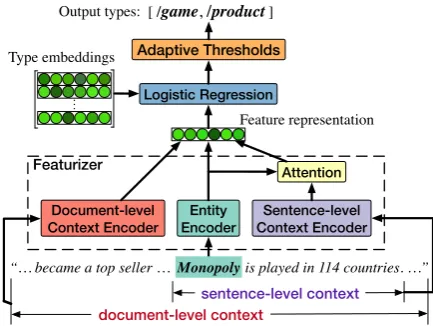
Figure 1: Neural architecture for predicting the types of entity mention “Monopoly” in the text “... became a top seller ... Monopoly is played in 114 countries. ...”. Part of document-level context is omitted.
with hand-crafted features (e.g., lexical and syn-tactic features), and fed into a linear classifier with a fixed threshold. While this approach outper-forms previous approaches which only use sparse binary features (Ling and Weld, 2012; Gillick et al., 2014) or distributed representations (Yo-gatama et al., 2015), it has a few drawbacks: (1) the representations of left and right contexts are learnt independently, ignoring their mutual con-nection; (2) the attention on context is computed solely upon the context, considering no alignment to the entity; (3) document-level contexts which could be useful in classification are not exploited; and (4) hand-crafted features heavily rely on sys-tem or human annotations.
To overcome these drawbacks, we propose a neural architecture (Figure 1) which learns more context-aware representations by using a better at-tention mechanism and taking advantage of se-mantic discourse information available in both the document as well as sentence-level contexts.
ther, we find that adaptive classification thresh-olds leads to further improvements. Experiments demonstrate that our approach, without any re-liance on hand-crafted features, outperforms prior work on three benchmark datasets.
2 Model
Fine-grained entity typing is considered a multi-label classification problem: Each entity ein the textxis assigned a set of typesT∗drawn from the fine-grained type setT. The goal of this task is to predict, given entityeand its contextx, the assign-ment of types to the entity. This assignassign-ment can be represented by a binary vector y ∈ {1,0}|T |
where|T |is the size ofT. yt = 1iff the entity is assigned typet∈ T.
2.1 General Model
Given a type embedding vectorwtand a featurizer ϕthat takes entityeand its contextx, we employ the logistic regression (as shown in Figure 1) to model the probability ofeassignedt(i.e.,yt= 1)
P(yt= 1) = 1
1 + exp (−wt|ϕ(e, x)), (1)
and we seek to learn a type embedding matrix W = [w1, . . . , w|T |]and a featurizerϕsuch that
T∗ = argmax
T
Y
t∈T
P(yt= 1)·
Y
t /∈T
P(yt= 0).
(2) At inference, the predicted type setTˆ assigned
to entityeis carried out by
ˆ
T =t∈ T :P(yt= 1)≥rt , (3)
withrtthe threshold for predictingehas typet.
2.2 Featurizer
As shown in Figure 1, featurizer ϕin our model contains three encoders which encode entityeand its contextxinto feature vectors, and we consider bothsentence-levelcontextxsanddocument-level context xd in contrast to prior work which only takes sentence-levelcontext (Gillick et al., 2014; Shimaoka et al.,2017). 1
1Document-level context has also been exploited in Yaghoobzadeh and Sch¨utze(2015);Yang et al.(2016);Karn et al.(2017);Gupta et al.(2017).
The output of featurizerϕis the concatenation of these feature vectors:
ϕ(e, x) =
f(e)
gs(xs, e) gd(xd)
. (4)
We define the computation of these feature vectors in the followings.
Entity Encoder: The entity encoderf computes the average of all the embeddings of tokens in en-titye.
Sentence-level Context Encoder:The encodergs for sentence-level contextxsemploys a single bi-directional RNN to encodexs. Formally, let the tokens inxs be x1s, . . . , xns. The hidden state hi for token xi
s is a concatenation of a left-to-right hidden state−→hi and a right-to-left hidden state←h−i,
hi =
"−→
hi
←−
hi
# =
"−→
f(xis,−→hi−1) ←−
f(xis,←−hi+1) #
, (5)
where −→f and ←−f are L-layer stacked LSTMs units (Hochreiter and Schmidhuber, 1997). This is different fromShimaoka et al.(2017) who use two separate bi-directional RNNs for context on each side of the entity mention.
Attention: The feature representation for xs is a weighted sum of the hidden states: gs(xs, e) =
Pn
i=1aihi, where ai is the attention to hidden statehi. We employ the dot-product attention (Lu-ong et al.,2015). It computes attention based on the alignment between the entity and its context:
ai=
exp (h|iWaf(e))
Pn
j=1exp (h|jWaf(e))
, (6)
whereWa is the weight matrix. The dot-product attention differs from the self attention (Shimaoka et al.,2017) which only considers the context.
Document-level Context Encoder: The encoder gd for document-level contextxd is a multi-layer perceptron:
gd(xd) =relu(Wd1tanh(Wd2DM(xd))), (7)
2.3 Adaptive Thresholds
In prior work, a fixed threshold (rt = 0.5) is used for classification of all types (Ling and Weld, 2012;Shimaoka et al.,2017). We instead assign a different threshold to each type that is optimized to maximize the overall strict F1 on the dev set.
We show the definition of strictF1in Section3.1.
3 Experiments
We conduct experiments on three publicly avail-able datasets.2 Table1shows the statistics of these
datasets.
OntoNotes: Gillick et al. (2014) sampled sen-tences from OntoNotes (Weischedel et al., 2011) and annotated entities in these sentences using 89 types. We use the same train/dev/test splits in Shi-maoka et al.(2017). Document-level contexts are retrieved from the original OntoNotes corpus.
BBN:Weischedel and Brunstein(2005) annotated entities in Wall Street Journal using 93 types. We use the train/test splits in Ren et al.(2016b) and randomly hold out 2,000 pairs for dev. Document contexts are retrieved from the original corpus.
FIGER:Ling and Weld(2012) sampled sentences from 780k Wikipedia articles and 434 news re-ports to form the train and test data respectively, and annotated entities using 113 types. The splits we use are the same inShimaoka et al.(2017).
Train Dev Test Types
OntoNotes 251,039 2,202 8,963 89
BBN 84,078 2,000 13,766 93
[image:3.595.306.463.79.260.2]FIGER 2,000,000 10,000 563 113
Table 1: Statistics of the datasets.
3.1 Metrics
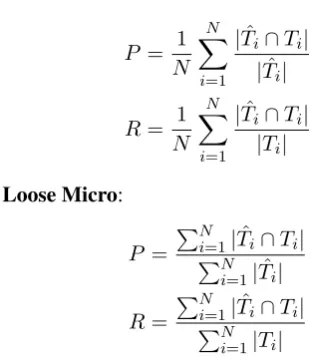
We adopt the metrics used in Ling and Weld (2012) where results are evaluated via strict, loose macro, loose micro F1 scores. For the i-th
in-stance, let the predicted type set be Tˆi, and the
reference type set Ti. The precision (P) and re-call (R) for each metric are computed as follow.
Strict:
P =R= 1
N N
X
i=1
δ( ˆTi =Ti)
2We made the source code and data publicly available at https://github.com/sheng-z/figet.
Loose Macro:
P = 1
N N
X
i=1
|Tˆi∩Ti|
|Tˆi|
R= 1
N N
X
i=1
|Tˆi∩Ti|
|Ti|
Loose Micro:
P = PN
i=1|Tˆi∩Ti|
PN i=1|Tˆi|
R= PN
i=1|Tˆi∩Ti|
PN i=1|Ti|
3.2 Hyperparameters
We use open-source GloVe vectors (Pennington et al., 2014) trained on Common Crawl 840B with 300 dimensions to initialize word embed-dings used in all encoders. All weight parame-ters are sampled from U(−0.01,0.01). The
en-coder for sentence-level context is a 2-layer bi-directional RNN with 200 hidden units. The DM output size is 50. Sizes ofWa,Wd1 and Wd2 are
200×300,70×50, and50×70respectively. Adam optimizer (Kingma and Ba,2014) and mini-batch gradient is used for optimization. Batch size is 200. Dropout (rate=0.5) is applied to three feature functions. To avoid overfitting, we choose models which yield the best strictF1on dev sets.
3.3 Results
We compare experimental results of our approach with previous approaches3, and study
contribu-tion of our base model architecture, document-level contexts and adaptive thresholds via ablation. To ensure our findings are reliable, we run each experiment twice and report the average perfor-mance.
Overall, our approach significantly increases the state-of-the-art macro F1 on both OntoNotes
and BBN datasets.
On OntoNotes (Table 3), our approach im-proves the state of the art across all three met-rics. Note that (1) without adaptive thresholds or document-level contexts, our approach still out-performs other approaches on macroF1and micro
F1; (2) adding hand-crafted features (Shimaoka
et al., 2017) does not improve the performance.
ID Sentence Gold Prediction
A ... Canada’s declining crude output, combined with ... will
help intensify U.S. reliance on oil from overseas. ... /other
/other
/other/health
/other/health/treatment
B Bozell joins Backer Spielvogel Bates and Ogilvy Group as U.S. agencies with interests in Korean agencies.
/organization
[image:4.595.83.518.67.151.2]/organization/company /organization/organization/company
Table 2: Examples showing the improvement brought by document-level contexts and dot-product attention. Entities are shown in the green box. The gray boxes visualize attention weights (darkness) on context tokens.
Approach Strict Macro Micro
BINARY(Gillick et al.,2014) N/A N/A 70.01 KWSABIE(Yogatama et al.,2015) N/A N/A 72.98 PLE(Ren et al.,2016b) 51.61 67.39 62.38
Ma et al.(2016) 49.30 68.23 61.27 AFET(Ren et al.,2016a) 55.10 71.10 64.70 FNET(Abhishek et al.,2017) 52.20 68.50 63.30 NEURAL(Shimaoka et al.,2017) 51.74 70.98 64.91 w/o Hand-crafted features 47.15 65.53 58.25 OURAPPROACH 55.52 73.33 67.61
w/o Adaptive thresholds 53.49 73.11 66.78 w/o Document-level contexts 53.17 72.14 66.51 w/ Hand-crafted features 54.40 73.13 66.89
Table 3: Results on the OntoNotes dataset.
This indicates the benefits of our proposed model architecture for learning fine-grained entity typ-ing, which is discussed in detail in Section 3.4; and (3) BINARY and KWASIBIE were trained on
a different dataset, so their results are not directly comparable.
Approach Strict Macro Micro
PLE(Ren et al.,2016b) 49.44 68.75 64.54
[image:4.595.78.287.493.590.2]Ma et al.(2016) 70.43 75.78 76.50 AFET(Ren et al.,2016a) 67.00 72.70 73.50 FNET(Abhishek et al.,2017) 60.40 74.10 75.70 OURAPPROACH 60.87 77.75 76.94 w/o Adaptive thresholds 58.47 75.84 75.03 w/o Document-level contexts 58.12 75.65 75.11
Table 4: Results on the BBN dataset.
On BBN (Table4), whileMa et al.(2016)’s la-bel embedding algorithm holds the best strictF1,
our approach notably improves both macroF1and
microF1.4 The performance drops to a
competi-tive level with other approaches if adapcompeti-tive thresh-olds or document-level contexts are removed.
On FIGER (Table5) where no document-level context is currently available, our proposed
ap-4Integrating label embedding into our proposed approach is an avenue for future work.
Approach Strict Macro Micro
KWSABIE(Yogatama et al.,2015) N/A N/A 72.25 Attentive(Shimaoka et al.,2016) 58.97 77.96 74.94 FNET(Abhishek et al.,2017) 65.80 81.20 77.40
Ling and Weld(2012) 52.30 69.90 69.30 PLE(Ren et al.,2016b) 49.44 68.75 64.54
Ma et al.(2016) 53.54 68.06 66.53 AFET(Ren et al.,2016a) 53.30 69.30 66.40 NEURAL(Shimaoka et al.,2017) 59.68 78.97 75.36 w/o Hand-crafted features 54.53 74.76 71.58 OURAPPROACH 60.23 78.67 75.52
w/o Adaptive thresholds 60.05 78.50 75.39 w/ Hand-crafted features 60.11 78.54 75.33
Table 5: Results on the FIGER dataset.
proach still achieves the state-of-the-art strict and micro F1. If compared with the ablation
vari-ant of theNEURALapproach, i.e., w/o hand-crafted
features, our approach gains significant improve-ment. We notice that removing adaptive thresh-olds only causes a small performance drop; this is likely because the train and test splits of FIGER are from different sources, and adaptive thresholds are not generalized well enough to the test data.
KWASIBIE, Attentive and FNETwere trained on a
different dataset, so their results are not directly comparable.
3.4 Analysis
im-prove the results. One possible explanation is that hand-crafted features are mostly about syntactic-head or topic information, and such information are already covered by our attention mechanism and document-level contexts as shown in Table2. Compared to hand-crafted features that heavily rely on system or human annotations, attention mechanism requires significantly less supervision, and document-level or paragraph-level contexts are much easier to get.
Through experiments, we observe no improve-ment by encoding type hierarchical informa-tion (Shimaoka et al.,2017).5 To explain this, we
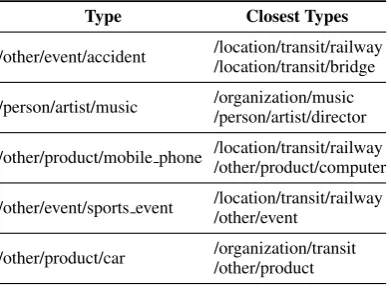
compute cosine similarity between each pair of fine-grained types based on the type embeddings learned by our model, i.e.,wtin Eq. (1). Table6 shows several types and their closest types: these types do not always share coarse-grained types with their closest types, but they often co-occur in the same context.
Type Closest Types
/other/event/accident /location/transit/railway/location/transit/bridge
/person/artist/music /organization/music/person/artist/director
/other/product/mobile phone /location/transit/railway/other/product/computer
/other/event/sports event /location/transit/railway/other/event
[image:5.595.86.282.347.491.2]/other/product/car /organization/transit/other/product
Table 6: Type similarity.
4 Conclusion
We propose a new approach for fine-grained en-tity typing. The contributions are: (1) we pro-pose a neural architecture which learns a distribu-tional semantic representation that leverage both document and sentence level information, (2) we find that context increased with document-level in-formation improves performance, and (3) we uti-lize adaptive classification thresholds to further boost the performance. Experiments show our approach achieves new state-of-the-art results on three benchmarks.
5The type embedding matrixW for the logistic regres-sion is replaced by the product of a learnt weight matrixV and the constant sparse binary matrixSwhich encodes type hierarchical information.
Acknowledgments
This work was supported in part by the JHU Hu-man Language Technology Center of Excellence (HLTCOE), and DARPA LORELEI. The U.S. Government is authorized to reproduce and dis-tribute reprints for Governmental purposes. The views and conclusions contained in this publica-tion are those of the authors and should not be interpreted as representing official policies or en-dorsements of DARPA or the U.S. Government.
References
Abhishek Abhishek, Ashish Anand, and Amit Awekar. 2017. Fine-grained entity type classification by jointly learning representations and label embed-dings. InProceedings of the 15th Conference of the European Chapter of the Association for Computa-tional Linguistics: Volume 1, Long Papers, pages 797–807, Valencia, Spain. Association for Compu-tational Linguistics.
Andrew Carlson, Justin Betteridge, Richard C Wang, Estevam R Hruschka Jr, and Tom M Mitchell. 2010. Coupled semi-supervised learning for information extraction. InProceedings of the third ACM inter-national conference on Web search and data mining, pages 101–110. ACM.
Luciano Del Corro, Abdalghani Abujabal, Rainer Gemulla, and Gerhard Weikum. 2015. Finet: Context-aware fine-grained named entity typing. In Proceedings of the 2015 Conference on Empirical Methods in Natural Language Processing, pages 868–878, Lisbon, Portugal. Association for Compu-tational Linguistics.
Dan Gillick, Nevena Lazic, Kuzman Ganchev, Jesse Kirchner, and David Huynh. 2014. Context-dependent fine-grained entity type tagging. arXiv preprint arXiv:1412.1820.
Nitish Gupta, Sameer Singh, and Dan Roth. 2017. En-tity linking via joint encoding of types, descriptions, and context. InProceedings of the 2017 Conference on Empirical Methods in Natural Language Pro-cessing, pages 2681–2690, Copenhagen, Denmark. Association for Computational Linguistics.
Sepp Hochreiter and J¨urgen Schmidhuber. 1997. Long short-term memory. Neural computation, 9(8):1735–1780.
Diederik Kingma and Jimmy Ba. 2014. Adam: A method for stochastic optimization. arXiv preprint arXiv:1412.6980.
Quoc Le and Tomas Mikolov. 2014. Distributed repre-sentations of sentences and documents. In Proceed-ings of the 31st International Conference on Ma-chine Learning (ICML-14), pages 1188–1196.
Changki Lee, Yi-Gyu Hwang, Hyo-Jung Oh, Soojong Lim, Jeong Heo, Chung-Hee Lee, Hyeon-Jin Kim, Ji-Hyun Wang, and Myung-Gil Jang. 2006. Fine-Grained Named Entity Recognition Using Con-ditional Random Fields for Question Answering. Springer Berlin Heidelberg, Berlin, Heidelberg.
Xiao Ling and Daniel S. Weld. 2012. Fine-grained entity recognition. In Proceedings of the Twenty-Sixth AAAI Conference on Artificial Intelligence, AAAI’12, pages 94–100. AAAI Press.
Minh-Thang Luong, Hieu Pham, and Christopher D. Manning. 2015. Effective approaches to attention-based neural machine translation. InProceedings of the 2015 Conference on Empirical Methods in Nat-ural Language Processing, pages 1412–1421, Lis-bon, Portugal. Association for Computational Lin-guistics.
Yukun Ma, Erik Cambria, and SA GAO. 2016. La-bel embedding for zero-shot fine-grained named en-tity typing. InProceedings of COLING 2016, the 26th International Conference on Computational Linguistics: Technical Papers, pages 171–180. The COLING 2016 Organizing Committee.
Tom M. Mitchell, William W. Cohen, Estevam R. Hr-uschka Jr., Partha Pratim Talukdar, Justin Bet-teridge, Andrew Carlson, Bhavana Dalvi Mishra, Matthew Gardner, Bryan Kisiel, Jayant Krishna-murthy, Ni Lao, Kathryn Mazaitis, Thahir Mo-hamed, Ndapandula Nakashole, Emmanouil Anto-nios PlataAnto-nios, Alan Ritter, Mehdi Samadi, Burr Set-tles, Richard C. Wang, Derry Tanti Wijaya, Abhi-nav Gupta, Xinlei Chen, Abulhair Saparov, Malcolm Greaves, and Joel Welling. 2015. Never-ending learning. InProceedings of the Twenty-Ninth AAAI Conference on Artificial Intelligence, January 25-30, 2015, Austin, Texas, USA., pages 2302–2310.
Jeffrey Pennington, Richard Socher, and Christo-pher D. Manning. 2014. Glove: Global vectors for word representation. InEmpirical Methods in Nat-ural Language Processing (EMNLP), pages 1532– 1543.
Marta Recasens, Marie-Catherine de Marneffe, and Christopher Potts. 2013. The life and death of dis-course entities: Identifying singleton mentions. In Proceedings of the 2013 Conference of the North American Chapter of the Association for Computa-tional Linguistics: Human Language Technologies, pages 627–633, Atlanta, Georgia. Association for Computational Linguistics.
Xiang Ren, Wenqi He, Meng Qu, Lifu Huang, Heng Ji, and Jiawei Han. 2016a. Afet: Automatic fine-grained entity typing by hierarchical partial-label embedding. InProceedings of the 2016 Conference on Empirical Methods in Natural Language Pro-cessing, pages 1369–1378, Austin, Texas. Associ-ation for ComputAssoci-ational Linguistics.
Xiang Ren, Wenqi He, Meng Qu, Clare R. Voss, Heng Ji, and Jiawei Han. 2016b. Label noise reduction in entity typing by heterogeneous partial-label embed-ding. In Proceedings of the 22Nd ACM SIGKDD International Conference on Knowledge Discovery and Data Mining, KDD ’16, pages 1825–1834, New York, NY, USA. ACM.
Sonse Shimaoka, Pontus Stenetorp, Kentaro Inui, and Sebastian Riedel. 2016. An attentive neural ar-chitecture for fine-grained entity type classification. In Proceedings of the 5th Workshop on Automated Knowledge Base Construction, pages 69–74, San Diego, CA. Association for Computational Linguis-tics.
Sonse Shimaoka, Pontus Stenetorp, Kentaro Inui, and Sebastian Riedel. 2017. Neural architectures for fine-grained entity type classification. In Proceed-ings of the 15th Conference of the European Chap-ter of the Association for Computational Linguistics: Volume 1, Long Papers, pages 1271–1280, Valencia, Spain. Association for Computational Linguistics.
Ralph Weischedel and Ada Brunstein. 2005. Bbn pro-noun coreference and entity type corpus. Linguistic Data Consortium, Philadelphia, 112.
Ralph Weischedel, Eduard Hovy, Mitchell Mar-cus, Martha Palmer, Robert Belvin, Sameer Prad-han, Lance Ramshaw, and Nianwen Xue. 2011. Ontonotes: A large training corpus for enhanced processing. Handbook of Natural Language Pro-cessing and Machine Translation. Springer.
Yadollah Yaghoobzadeh and Hinrich Sch¨utze. 2015. Corpus-level fine-grained entity typing using con-textual information. In Proceedings of the 2015 Conference on Empirical Methods in Natural Lan-guage Processing, pages 715–725, Lisbon, Portugal. Association for Computational Linguistics.
Zichao Yang, Diyi Yang, Chris Dyer, Xiaodong He, Alex Smola, and Eduard Hovy. 2016. Hierarchi-cal attention networks for document classification. InProceedings of the 2016 Conference of the North American Chapter of the Association for Computa-tional Linguistics: Human Language Technologies, pages 1480–1489, San Diego, California. Associa-tion for ComputaAssocia-tional Linguistics.
Short Papers), pages 291–296, Beijing, China. As-sociation for Computational Linguistics.