254
HeLI-based Experiments in Swiss German Dialect Identification
Tommi Jauhiainen
University of Helsinki @helsinki.fi
Heidi Jauhiainen
University of Helsinki @helsinki.fi
Krister Lind´en
University of Helsinki @helsinki.fi
Abstract
In this paper we present the experiments and results by the SUKI team in the German Dialect Identification shared task of the VarDial 2018 Evaluation Campaign. Our submission using HeLI with adaptive language models obtained the best results in the shared task with a macro F1-score of 0.686, which is clearly higher than the other submitted results. Without some form of unsupervised adaptation on the test set, it might not be possible to reach as high an F1-score with the level of domain difference between the datasets of the shared task. We describe the methods used in detail, as well as some additional experiments carried out during the shared task.
1 Introduction
The fifth VarDial workshop (Zampieri et al., 2018) included for the second time a shared task for German Dialect Identification (GDI). The varieties of German were from the areas of Basel, Bern, Lucerne, and Zurich. These varieties are considered dialects of Swiss German (gsw) by the ISO-639-3 standard (Lewis et al., 2013). For the first time the GDI shared task included a separate track for unknown language detection.
We have used the HeLI method and its variations in the shared tasks of the three previous VarDial workshops (Jauhiainen et al., 2015a; Jauhiainen et al., 2016; Jauhiainen et al., 2017a). The HeLI method is robust and competes with the other state-of-the-art language identification methods. For the current workshop we wanted to try out some variations and possible improvements to the original method. We submitted two different runs on the four-way classification track and in the end we did not submit any runs on the unknown language detection track.
2 Related Work
The differences between definitions of dialects and languages are not usually clearly defined, at least not in terms which would be able to help us automatically decide whether we are dealing with languages or dialects. Also the methods used for dialect identification are most of the time exactly the same as for general language identification. Language identification of close languages and dialects is one of the remaining challenges of language identification research. For a recent survey on language identification and the methods used in the field, the reader is referred to an article by Jauhiainen et al. (2018).
2.1 German dialect identification
The German dialect identification has earlier been considered by Scherrer and Rambow (2010), who used a lexicon of dialectal words. Hollenstein and Aepli (2015) experimented with a perplexity based language identifier using character trigrams. They reached an average F-score of 0.66 on sentence level between 5 German dialects.
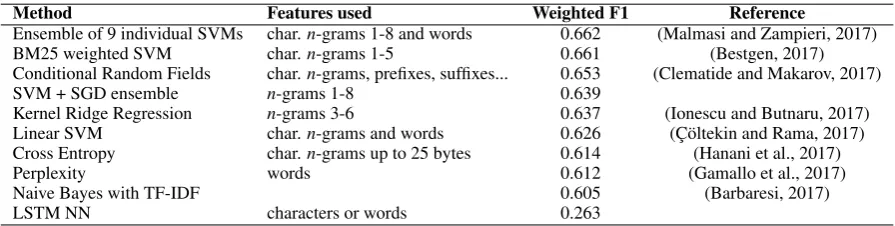
The results of the first shared task on German dialect identification are described by Zampieri et al. (2017). Ten teams submitted results on the task utilizing a variety of machine learning methods used
for language identification. We report the results in Table 1. The methods used are listed in the first column, used features in the second column, best reached weighted F1-score in the third column, and the describing article in the fourth column.
Method Features used Weighted F1 Reference
Ensemble of 9 individual SVMs char.n-grams 1-8 and words 0.662 (Malmasi and Zampieri, 2017) BM25 weighted SVM char.n-grams 1-5 0.661 (Bestgen, 2017) Conditional Random Fields char.n-grams, prefixes, suffixes... 0.653 (Clematide and Makarov, 2017)
SVM + SGD ensemble n-grams 1-8 0.639
Kernel Ridge Regression n-grams 3-6 0.637 (Ionescu and Butnaru, 2017) Linear SVM char.n-grams and words 0.626 (C¸ ¨oltekin and Rama, 2017) Cross Entropy char.n-grams up to 25 bytes 0.614 (Hanani et al., 2017)
Perplexity words 0.612 (Gamallo et al., 2017)
Naive Bayes with TF-IDF 0.605 (Barbaresi, 2017)
[image:2.595.75.523.114.227.2]LSTM NN characters or words 0.263
Table 1: The weighted F1-scores using different methods on the 2017 GDI test set.
2.2 Unknown language detection
Unknown languages are languages with which the language identifier has not been trained. Especially in a real-world situation it is always possible to encounter unknown languages. If the language identi-fication method used produces a comparable score for different texts, it is possible to try thresholding. In thresholding, we find a score under (or over) which our prediction of the language is so poor, that we label it as unknown. Suzuki et al. (2002) describes a language identification method which was originally designed for identifying the language of web pages crawled from the internet. They had a pre-determined threshold for each language known by the identifier and if the threshold was not reached the web page was categorized as junk. In the Finno-Ugric Languages and the Internet project (Jauhiainen et al., 2017b), we have also experimented with unknown language (or just junk) detection in order to cope with pages written in languages not known to our identifier. The method we use in production is based on a language set identification method (Jauhiainen et al., 2015b), which determines the languages used on a page. The method is simply a threshold for the number of languages: if too many languages are found in a piece of text, the text is categorized as junk. In the production environment our threshold is currently 10 languages on one web page. The production threshold has been empirically determined for the parameters used with the language set identification method and for the number of languages known by the identifier.
2.3 Language model adaptation
Language model adaptation was used by Chen and Liu (2005) for identifying the language of speech. In the system built by Chen and Liu (2005), the speech is first run through Hidden Markov Model-based phone recognizers (one for each language), which tokenize the speech into sequences of phones. The probabilities of those sequences are calculated using corresponding language models and the most prob-able language is selected. An adaptation routine is then used so that each of the phonetic transcriptions of the individual speech utterances is used to calculate probabilities for wordst, given a word n-gram history ofhas in Equation 1.
Pa(t|h) =λPo(t|h) + (1−λ)Pn(t|h), (1)
wherePo is the original probability calculated from the training material,Pnthe probability calculated
from the data being identified, andPa the new adapted probability. λis the weight given to original
probabilities. This adaptation method resulted in decreasing the error rate in a three-way identification between Chinese, English, and Russian by 2.88% and 3.84% on an out-of-domain (different channels) data, and by 0.44% on in-domain (same channel) data.
C(gi, M) =
1
n[log(P(M|gi))−log(P(M|gj))], (2)
whereM is the sequence to be identified,nthe number of frames in the utterance,gi the best identified
language, and gj the second best identified language. The two other evaluated confidence measures
were clearly inferior. Although theC(gi, M)measure performed the best of the individual measures, a
Bayesian classifier based ensemble using all the three measures gave slightly higher results. Zhong et al. (2007) use the same language adaptation method as Chen and Liu (2005), using the confidence measures to set theλfor each utterance.
3 Test setup
The dataset used in the shared task consists of manual transcriptions of speech utterances by speakers from different areas: Bern, Basel, Lucerne, and Zurich. The transcriptions are written entirely in lower-cased letters. Samardˇzi´c et al. (2016) describe the ArchiMob corpus, which is the source for the shared task dataset. Zampieri et al. (2017) describe how the training and test sets were extracted from the Archi-Mob corpus for the 2017 shared task. The sizes of the training and development sets can be seen in Table 2. The first track of the shared task was a standard four-way language identification between the four German dialects present in the training set.
Variety Training Development Bern (BE) 32,447 8,471 Basel (BS) 30,770 11,116 Lucerne (LU) 32,955 9,966
Zurich (ZH) 32,714 9,039
Table 2: The sizes in words of the datasets distributed for the 2018 GDI shared task.
This year the GDI task also included a second track for unknown dialect detection. The unknown dialect was not included in the training or the development sets, but it was present in the test set. The test set was identical for both tracks, but the lines containing unknown dialect were ignored when calculating the scores for the first track.
4 Basic HeLI method, run 1 on track 1
We first presented the HeLI method, originally published by Jauhiainen (2010), at the VarDial 2016 (Jauhiainen et al., 2016). To make this article more self-contained, we present the full description of the method as it is used in the best submitted run for the GDI shared task. The survey by Jauhiainen et al. (2018) uses the same unified notation to define the features and methods used for language identification. This description differs from the original mostly in that we are leaving out the cut-off valuecfor the size of the language models as using all the available material was always the best option. When we are not using the cut-off value, no derived corpusC0 consisting of the used features is generated. The final submissions were done with a system using only lowercased character 4-grams, so we present the method without the back-off function. For the complete description of the HeLI method see our VarDial 2016 article (Jauhiainen et al., 2016).
4.1 Description of the HeLI method using only 4-grams of characters
The corpus containing only the n-grams of the length 4 in the language models is called C4. The domaindom(O(C4))is the set of all charactern-grams of length4found in the models of any language
g ∈G. The valuesvC4
g(u)are calculated similarly for alln-gramsu ∈dom(O(C
4))for each language
g, as shown in Equation 3.
vC4
g(u) =
−log10
c(C4
g,u)
lC4
g
, ifc(Cg4, u)>0
p , ifc(Cg4, u) = 0,
(3)
wherec(C4
g, u) is the number of n-gramsu found in the corpus of the languageg andlC4
g is the total number of then-grams of length4in the corpus of languageg. These values are used when scoring the words while identifying the language of a text. The wordtis split into overlapping 4-grams of characters
u4
i, wherei = 1, ..., lt−4. lt is the length of the word in characters, including the preceding and the
following space-characters. Each of then-gramsu4i is then scored separately for each languageg. If then-gramu4i is found indom(O(Cg4)), the values in the models are used. If then-gramu4i is not found in any of the models, it is simply discarded. We define the functiondg(t,4)for countingn-grams
intfound in a model in Equation 4.
dg(t,4) = lt−4 X
i=1
1 , ifu4i ∈dom(O(C4))
0 , otherwise. (4)
When all then-grams of the size4in the wordthave been processed, the word gets the value of the average of the scoredn-gramsu4i for each language, as in Equation 5.
vg(t,4) =
1
dg(t,4) lt−4 X
i=1
vC4
g(u
4
i) , ifdg(t,4)>0, (5)
where dg(t,4)is the number of n-grams u4i found in the domaindom(O(Cg4)). If all of the n-grams
of the size 4 were discarded, dg(t,4) = 0, a word gets the penalty value p for every language, as in
Equation 6.
vg(t,0) =p (6)
The mystery text is tokenized into words using the non-alphabetic and non-ideographic characters as delimiters. The words are lowercased. After this, a score vg(t,4)is calculated for each wordtin the
mystery text for each languageg. The whole lineM gets the scoreRg(M)equal to the average of the
scores of the wordsvg(t,4)for each languageg, as in Equation 7.
Rg(M) =
PlT(M)
i=1 vg(ti,4)
lT(M)
(7)
where T(M) is the sequence of words and lT(M) is the number of words in the line M. Since we
are using negative logarithms of probabilities, the language having the lowest score is returned as the language with the maximum probability for the mystery text.
4.2 Experiments on the development set and results on the test set
is something we have noticed before in settings where the training data is of very good quality. If we are using the identifier in a production setting with, for example, Wikipedia-derived language models, some of the models include so much noice that not using the complete models improves the results (Jauhiainen et al., 2017b). The optimal penalty value is also clearly tied to the maximum size of the used language models.
Lowercased words Lowercasednmax Penaltyp Cut-offc Recall
yes 8 5.1 16,947 64.47%
yes 8 4.9 15,000 64.41%
yes 8 4.8 10,000 64.19%
Table 3: Basic HeLI method results on the development set with varyingc.
We decided to use all the available data and then optimized the used language models and the penalty valuep. The results on the development set with different model combinations can be seen in Table 4. The penalty valueppresented in the third column was the optimal one for each configuration. The HeLI method using charactern-grams from one to four attained the best recall 65.97%.
Lowercased words Lowercasednmax Penaltyp Recall
no 4 5.8 65.97%
no 5 5.4 65.39%
no 6 5.3 64.79%
no 8 5.4 64.56%
no 7 5.1 64.51%
yes 8 5.1 64.47%
no 3 5.7 62.80%
no 2 5.7 53.43%
no 1 5.6 33.13%
Table 4: Basic HeLI method results on the development set using different language model combinations.
We also experimented with leaving out the lower ordern-grams. The results of these experiments on the development set can be seen in Table 5. To our surprise, the best results were attained using only the 4-grams of characters, which means that the backoff function of the HeLI method is not used at all. The recall on the development set was 66.10%. We also re-tested using lower cut-offsc, but leaving off any material in the language models only made the results worse again.
Lowercased words Lowercasedn-gram range Penaltyp Recall
not used 4 - 4 5.8 66.10%
not used 1 - 4 5.8 65.97%
not used 2 - 4 5.8 65.97%
not used 3 - 4 5.8 65.97%
Table 5: Basic HeLI method results on the development set with differentn-gram ranges.
We decided to use the character 4-grams and the penalty value of 5.8 for the first run. We added the development data to the training data and generated new models. The system attained a recall of 63.97% on the test set, which was somewhat less than what we had seen with the development set.
5 HeLI with language model adaptation, run 2 on track 1
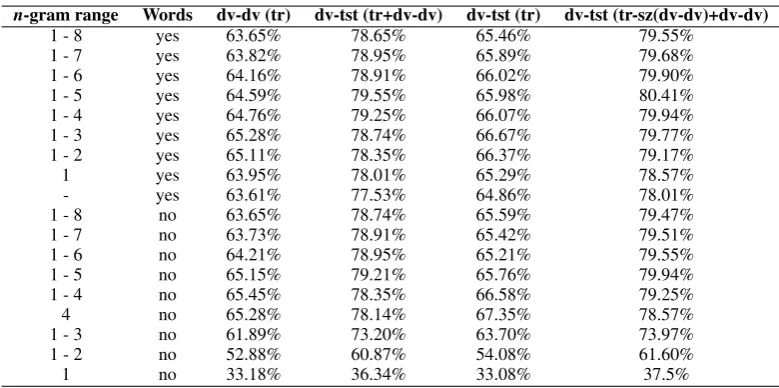
without includingdv-dvin the training set in order to see ifdv-tstwas for some reason generally easier to identify thandv-dv. The second half of the development data,dv-tst, turned out to be a little bit easier to identify than the first half,dv-dv, using the original models generated from just the training data as can be seen in the fifth column of Table 6. Another hypothesis is that the development data is from an another source than the training data and the first half introduces a great number of new words which are relevant to the second half. Also we wanted to know if just 15.9% increase in training text amount could generate this much better recall. In order to test this hypothesis we removed the same amount of lines as was indv-dv from the training data, marked astr-sz(dv-dv)in the table, and inserted thedv-dvlines instead. The recall percentages from those tests are in the final column of Table 6 and they suggest that the development data is indeed from a somewhat different domain than the training data and the identifier actually performs better when some of the original training data is removed.
It can also be seen from the results of the experiments that the best models for in-domain experiments were word and charactern-grams from one to five and for the out-of-domain they were charactern-grams from one to four or just 4-grams. This would then indicate that if the domain of the language to be tested is the same or similar to the one that the models have been created from, the models could use longer charactern-grams and words, if not, then using just charactern-grams is a better strategy.
n-gram range Words dv-dv (tr) dv-tst (tr+dv-dv) dv-tst (tr) dv-tst (tr-sz(dv-dv)+dv-dv)
1 - 8 yes 63.65% 78.65% 65.46% 79.55%
1 - 7 yes 63.82% 78.95% 65.89% 79.68%
1 - 6 yes 64.16% 78.91% 66.02% 79.90%
1 - 5 yes 64.59% 79.55% 65.98% 80.41%
1 - 4 yes 64.76% 79.25% 66.07% 79.94%
1 - 3 yes 65.28% 78.74% 66.67% 79.77%
1 - 2 yes 65.11% 78.35% 66.37% 79.17%
1 yes 63.95% 78.01% 65.29% 78.57%
- yes 63.61% 77.53% 64.86% 78.01%
1 - 8 no 63.65% 78.74% 65.59% 79.47%
1 - 7 no 63.73% 78.91% 65.42% 79.51%
1 - 6 no 64.21% 78.95% 65.21% 79.55%
1 - 5 no 65.15% 79.21% 65.76% 79.94%
1 - 4 no 65.45% 78.35% 66.58% 79.25%
4 no 65.28% 78.14% 67.35% 78.57%
1 - 3 no 61.89% 73.20% 63.70% 73.97%
1 - 2 no 52.88% 60.87% 54.08% 61.60%
[image:6.595.103.493.288.482.2]1 no 33.18% 36.34% 33.08% 37.5%
Table 6: Baseline HeLI recalls using different combinations of training and development sets.
What we learned from these experiments with the basic HeLI method is that, if we would be able to somehow incorporate well identified sentences into the original models it might introduce crucial new word or charactern-gram vocabulary. We decided to try always adding the character 4-grams from the most confidently identified sentence to the language model of the respective language and re-identifying the rest, always marking the best identified sentence as not needing to be identified again. This process is recursive and it runs until all the sentences except the last one are used for language modelling. In order to decide which sentence is most confidently identified, we need a confidence score. As a confidence measureCM, we used the difference between the scores of the bestRg(M)and the second bestRh(M)
identified language for each line. Later we found that basically the same confidence measure was earlier proposed by Zhong et al. (2007). In our case it is calculated using the Equation 8:
CM(Cg, M) =Rh(M)−Rg(M) (8)
whereM is the line containing the mystery text. It could be beneficial to end the recursive adaptation before all the sentences are exhausted, if the confidence score is reliable enough. However, we did not have time to experiment with a cut-off value for the confidence score before the submissions were due.
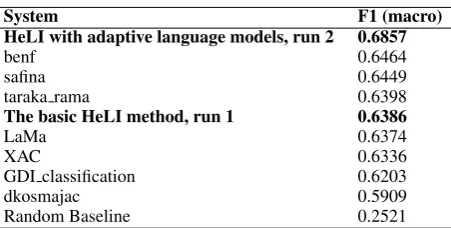
We suspected that using higher ordern-grams or words could produce even better results, but we did not have time to test this theory. We added the development data to the training data, generated new language models and submitted our run 2. The second run reached a recall of 69.19% on the test set, an increase of 5.22%. The macro F1-score attained on the run 2 was 0.6857. The results are very good considering that there was an unknown dialect within the actual test set and all the lines in the unknown dialect were incorrectly incorporated into some of the language models. The final results compared with the best results submitted by other teams are shown in Table 7.
System F1 (macro)
HeLI with adaptive language models, run 2 0.6857
benf 0.6464
safina 0.6449
taraka rama 0.6398
The basic HeLI method, run 1 0.6386
LaMa 0.6374
XAC 0.6336
GDI classification 0.6203
dkosmajac 0.5909
Random Baseline 0.2521
Table 7: Results compared with the other submitted runs. Our submitted results are bolded.
6 Experiments with unknown language detection, track 2
The basic HeLI method always maps the mystery textM into one of the languages it has been trained with. The 2015 Discriminating Between Similar Languages shared task included an unknown category which contained several a priori unknown languages. One of the methods we used in 2015 was using a threshold for the scoreRg(M)to detect the unknown language. In order to assess the suitability of using
the threshold score with the German dialects, we compared the range of the scores whengwas correctly or incorrectly identified using the character 4-gram language models on the development set. The score ranges can be seen in Table 8, where the line with correct identifications is bolded. The lower the score, the better the mystery text fits the language. The scores ranged from 1.28 to 4.56 when the dialect was correctly identified, with most of the scores higher than the lower ranges of the incorrect identifications. The fact that the worst absolute score (4.56) was attained with a correct identification drove us to the conclusion that simply using the score as a cut-off would not be a quick solution to the unseen language problem. Due to time restrictions, we did not pursue this investigation further. We were also unable to test the language set based thresholding method we are using in the production environment. In the end, we did not submit any results to the unknown language detection track.
Correct language Identified language Lowest score Highest score
ZH ZH 1.28 4.56
ZH LU 2.37 4.23
ZH BS 1.71 4.21
[image:7.595.187.413.167.281.2]ZH BE 2.26 3.95
Table 8: Score ranges when trying to identify the dialect from Zurich area.
7 Conclusions
Acknowledgments
This research was partly conducted with funding from the Kone Foundation Language Programme (Kone Foundation, 2012).
References
Adrien Barbaresi. 2017. Discriminating between Similar Languages using Weighted Subword Features. In Pro-ceedings of the Fourth Workshop on NLP for Similar Languages, Varieties and Dialects (VarDial), pages 184– 189, Valencia, Spain.
Yves Bestgen. 2017. Improving the Character Ngram Model for the DSL Task with BM25 Weighting and Less Frequently Used Feature Sets. InProceedings of the Fourth Workshop on NLP for Similar Languages, Varieties and Dialects (VarDial), pages 115–123, Valencia, Spain.
C¸ a˘gri C¸ ¨oltekin and Taraka Rama. 2017. T¨ubingen system in VarDial 2017 shared task: experiments with language identification and cross-lingual parsing. InProceedings of the Fourth Workshop on NLP for Similar Languages, Varieties and Dialects (VarDial), pages 146–155, Valencia, Spain.
Yingna Chen and Jia Liu. 2005. Language Model Adaptation and Confidence Measure for Robust Language Identification. InProceedings of International Symposium on Communications and Information Technologies 2005 (ISCIT 2005), volume 1, pages 270–273, Beijing, China.
Simon Clematide and Peter Makarov. 2017. CLUZH at VarDial GDI 2017: Testing a Variety of Machine Learning Tools for the Classification of Swiss German Dialects. In Proceedings of the Fourth Workshop on NLP for Similar Languages, Varieties and Dialects (VarDial), pages 170–177, Valencia, Spain.
Pablo Gamallo, Jose Ramom Pichel, and I˜naki Alegria. 2017. A Perplexity-Based Method for Similar Languages Discrimination. InProceedings of the Fourth Workshop on NLP for Similar Languages, Varieties and Dialects (VarDial), pages 109–114, Valencia, Spain.
Abualsoud Hanani, Aziz Qaroush, and Stephen Taylor. 2017. Identifying dialects with textual and acoustic cues. InProceedings of the Fourth Workshop on NLP for Similar Languages, Varieties and Dialects (VarDial), pages 93–101, Valencia, Spain.
Nora Hollenstein and No¨emi Aepli. 2015. A Resource for Natural Language Processing of Swiss German Di-alects. In Proceedings of the International Conference of the German Society for Computational Linguistics and Language Technology (GSCL 2015), pages 108–109, University of Duisburg-Essen, Germany.
Radu Tudor Ionescu and Andrei Butnaru. 2017. Learning to Identify Arabic and German Dialects using Mul-tiple Kernels. InProceedings of the Fourth Workshop on NLP for Similar Languages, Varieties and Dialects (VarDial), pages 200–209, Valencia, Spain.
Tommi Jauhiainen, Heidi Jauhiainen, and Krister Lind´en. 2015a. Discriminating Similar Languages with Token-Based Backoff. InProceedings of the Joint Workshop on Language Technology for Closely Related Languages, Varieties and Dialects (LT4VarDial), pages 44–51, Hissar, Bulgaria.
Tommi Jauhiainen, Krister Lind´en, and Heidi Jauhiainen. 2015b. Language Set Identification in Noisy Synthetic Multilingual Documents. InProceedings of the Computational Linguistics and Intelligent Text Processing 16th International Conference, CICLing 2015, pages 633–643, Cairo, Egypt.
Tommi Jauhiainen, Krister Lind´en, and Heidi Jauhiainen. 2016. HeLI, a Word-Based Backoff Method for Lan-guage Identification. In Proceedings of the Third Workshop on NLP for Similar Languages, Varieties and Dialects (VarDial3), pages 153–162, Osaka, Japan.
Tommi Jauhiainen, Krister Lind´en, and Heidi Jauhiainen. 2017a. Evaluating HeLI with Non-Linear Mappings. InProceedings of the Fourth Workshop on NLP for Similar Languages, Varieties and Dialects (VarDial), pages 102–108, Valencia, Spain.
Tommi Jauhiainen, Krister Lind´en, and Heidi Jauhiainen. 2017b. Evaluation of Language Identification Methods Using 285 Languages. InProceedings of the 21st Nordic Conference on Computational Linguistics (NoDaLiDa 2017), pages 183–191, Gothenburg, Sweden. Link¨oping University Electronic Press.
Tommi Jauhiainen. 2010. Tekstin kielen automaattinen tunnistaminen. Master’s thesis, University of Helsinki, Helsinki.
Kone Foundation. 2012. The Language Programme 2012-2016. http://www.koneensaatio.fi/en.
M. Paul Lewis, Gary F. Simons, and Charles D. Fennig, editors. 2013. Ethnologue: Languages of the world, seventeenth edition. SIL International, Dallas, Texas.
Shervin Malmasi and Marcos Zampieri. 2017. German Dialect Identification in Interview Transcriptions. In Proceedings of the Fourth Workshop on NLP for Similar Languages, Varieties and Dialects (VarDial), pages 164–169, Valencia, Spain.
Tanja Samardˇzi´c, Yves Scherrer, and Elvira Glaser. 2016. ArchiMob–A corpus of spoken Swiss German. In Proceedings of the Language Resources and Evaluation (LREC), pages 4061–4066, Portoroz, Slovenia.
Yves Scherrer and Owen Rambow. 2010. Word-based Dialect Identification with Georeferenced Rules. In Pro-ceedings of the 2010 Conference on Empirical Methods in Natural Language Processing (EMNLP 2010), pages 1151–1161, Massachusetts, USA. Association for Computational Linguistics.
Izumi Suzuki, Yoshiki Mikami, Ario Ohsato, and Yoshihide Chubachi. 2002. A Language and Character Set De-termination Method Based on ngram Statistics. ACM Transactions on Asian Language Information Processing (TALIP), 1(3):269–278.
Marcos Zampieri, Shervin Malmasi, Nikola Ljubeˇsi´c, Preslav Nakov, Ahmed Ali, J¨org Tiedemann, Yves Scherrer, and No¨emi Aepli. 2017. Findings of the VarDial Evaluation Campaign 2017. InProceedings of the Fourth Workshop on NLP for Similar Languages, Varieties and Dialects (VarDial), Valencia, Spain.
Marcos Zampieri, Shervin Malmasi, Preslav Nakov, Ahmed Ali, Suwon Shon, James Glass, Yves Scherrer, Tanja Samardˇzi´c, Nikola Ljubeˇsi´c, J¨org Tiedemann, Chris van der Lee, Stefan Grondelaers, Nelleke Oostdijk, Antal van den Bosch, Ritesh Kumar, Bornini Lahiri, and Mayank Jain. 2018. Language Identification and Mor-phosyntactic Tagging: The Second VarDial Evaluation Campaign. InProceedings of the Fifth Workshop on NLP for Similar Languages, Varieties and Dialects (VarDial), Santa Fe, USA.