THEORY/CONCEPTUAL
Proposal, project, practice, pause: Developing a framework
for evaluating smart domestic product engagement
Tony Woodall1 &Julie Rosborough1&John Harvey1
Received: 25 February 2016 / Accepted: 2 April 2017
#The Author(s) 2017. This article is an open access publication
Abstract Smart homes are fast becoming a reality, with smart TVs, smart meters and other suchBsmart^ devices/systems already representing a substantial household presence. These, which we collectively termBsmart domestic products^ (SDPs), will need to be promoted, adopted, and normalized into daily routines. Despite this, the marketing canon lacks a substantive discourse on pertinent research. We look to help correct this by melding ideas from organizational sociology, innovation diffusion and appropriation studies, and service dominant logic. Consequently, we suggest a framework for research that responds directly to the specific characteristics of SDPs. Using the SDP eco-system as a context, our frame-work emphasizes the interplay of embeddedness, practice, value and engagement. It comprises a four-stage horizontal/ longitudinal axis we describe as proposal, project, practice and pause. Cross-sectionally we focus on value, and combine as-pects of existing thought to suggest how this impacts each stage of our engagement continuum. We subsequently identify perceived personal advantage as the resultant of these two axes and propose this as the key for understanding consumer and SDP sociomaterial engagement. This article also advances a definition of SDPs and ends with an agenda for further research.
Keywords Smart homes . Smart domestic products . Service dominant logic . Practice theory . Sociomateriality . Customer engagement . Consumer perceived advantage
Introduction
We are soon to experience a paradigm shift in the way we live (Moreno-Munoz et al.2016). This change will neither affect our relationship with friends and family nor directly impact our wealth or ability to live in peace with our neighbors. This change will not determine how we eat, dream, aspire or go about our daily work–unless, that is, we work from home. Initially, at least beyond our front door, we will see no differ-ence at all. However, once we are inside, ourBsmart^homes will engender a new way of living. They will take care of an array of concerns ranging from energy use, comfort, leisure, healthcare, safety and security (Alam et al.2012). The smart products incorporated into the smart home will, in turn, inte-grate with otherBsmart^contexts –smart grids, smart com-munities and smart cities. Beyond this they eventually will all interconnect via the Internet of Things (IoT; Ashton2009).
The IoT blends virtual and physical worlds (Barakat2016), replacing conventional people-to-people networks with thing-to-thing networks. These operate both autonomously from and invisibly to the public (Gubbi et al. 2013). Consumers will seemingly be able to control the technologies introduced or built into their homes, but their connectivity to a larger technological infrastructure means control will only be partial. Once connected to the IoT, they will be subject to a dedicated system of distributed intelligence. The information they pro-vide will potentially be subject to scrutiny, analysis and dis-semination. If required, networks can be used to reverse-control the flow of data, offering information, advice and even instruction back to the homes where they are located (Alam * Tony Woodall
Julie Rosborough [email protected]
John Harvey
1 Division of Marketing, Nottingham Business School, Nottingham
et al.2012). This paradoxically Orwellian Utopia may seem distant, but we have already started the journey. For example, the increasingly ubiquitous smart utility meter, Amazon’s Echo, Google’s Nest thermostats and even some smart TVs are already linked into networks primed either for private or government intervention (Timm2016). Contexts in which smart devices reside have consequently been described as context-aware, pervasive computing environments (Chen, Finin and Joshi2003).
Despite this being an issue of substantial marketing inter-est, the relevant literature has yet to address smart service diffusion in any substantive way. Wuenderlich, Heinonen, Ostrom, Patricio, Sousa, Voss and Lemmink (2015) make this point too. They also note that it is theBembeddedness^ of smart technology that simultaneously represents its most fun-damental and challenging characteristic. How, they ask, will this affect consumers’emotional and behavioral responses to Bsmart^offerings? How will this be factored into decisions on acceptance or rejection? And to what extent will customers of differing socioeconomic and cultural circumstance be willing to normalize embedded services into their daily lives? According to Mani and Chouk (2016), resistance to smart technologies is an ongoing worry for the IoT industry. Issues of security, intrusiveness and uncertain utility are a clear con-sumer concern. Submitting to external scrutiny and monitor-ing, even for personal benefit (theBprivacy paradox^; Hérault and Belvaux2014), has been cited as a worry – especially where products were conceived with persuasion in mind. It is perhaps not surprising therefore that uptake of smart domes-tic products has been slow and abandonment swift (Lazar et al.2015).
In their review of priorities for service research, Ostrom et al. (2015) highlight the need for more insight into how value emerges in multi-actor, networked, collaborative contexts. They note a need for more understanding of the potential for company, customer and technology integration– and smart contexts represent the frontier for such research. Before perti-nent inquiry can begin though, we need to address one central concern: How, given the unique and emergent nature of smart homes and associated products, can marketers begin to under-stand the factors likely to impact Bsmart^ engagement? Although innovation diffusion research frameworks exist (see later) none answer directly to the specific character of smart technology. This article addresses this deficiency, ac-knowledging and accommodating factors we believe likely to uncover the effect of Bperceived embeddedness^ (Wuenderlich et al. 2015). We also respond to Yadav and Pavlou (2014) whose call for the development of domain-specific frameworks in computer-mediated environments sets the principle agenda for our work.
We begin by defining our subject, a category of technolog-ical interfaces we call smart domestic products (SDPs). We then draw attention to a range of theories and concepts that
inform our perspective on technology and customer engage-ment. Subsequently, we go on to develop a theoretical frame-work for SDP engagement focused on two primary axes. For the horizontal we describe a four-phase engagement continu-um termed‘proposal, project, practice, pause’. For the vertical we focus on value, and this underpins discussion of an asso-ciated property (customer perceived advantage) that we pro-pose as the fundamental unit for future/associated research.
Defining smart domestic products (SDPs)
An understanding of the context and potential for SDP use is only slowly emerging. Amazon’s Echo and Belkin’s Crock Pot slow cooker, for example, are part of this domain and represent a category that is growing. These products are de-signed purely to extend the potential for material consump-tion, but much of the smart domestic technology currently in use or in development is intended for positive (Botella, Riva, Gaggioli, Wiederhold, Alcaniz and Baños2012) or transfor-mative (Mick2006) use. This focuses on the enhancement of either human or ecological states, with personal well-being its aim. Such devices may monitor energy use, parameters of health (e.g., blood pressure, cardiovascular function) or agility – tracking movement via strategically located RFID (radio-frequency identification) sensors. This captures the notion of Bambient assisted living^ (Garcia and Rodrigues 2015), the purpose of which is either to support, assist or impose behav-ioral regimes. All smart technologies are designed to remove the need for conscious reflection – at one extreme helping sustain the user’s existing habits (calm technology; e.g., Weiser and Brown1997) or, at the other, directing the user towards a particular set of actions (persuasive, or captalogical, technology; e.g., Fogg1999).
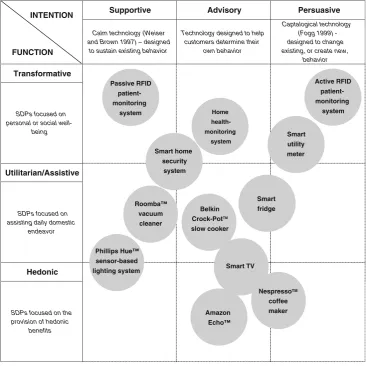
consumer products are largely benign, suppliers will likely be seeking to expand their active capacity. And this, in turn, will impact category perceptions as a whole, perhaps both recalling and reconfiguring Packard’s (1957) notion of the Bhidden persuader.^ Figure 1 draws on our discussion and uses both generic and branded examples to illustrate the cur-rent SDP domain.
SDPs and engagement
For both present and future customers to become effective SDP consumers, optimizing benefits for themselves and for other stakeholders (society, governments, sponsors, sup-pliers), both inertia and anxiety need to be addressed. Customers will need toengagewith the technologies at their disposal and achieve symbiosis with the infrastructures that underpin them. Engagement has recently emerged as an issue of substantial interest in the marketing literature, initiated pri-marily through a special issue of The Journal of Service Research(e.g., Brodie, Hollebeek, Jurićand Ilić2011). This is notper sea new concept, but its emerged topicality aligns it
with other preexisting concepts (e.g., value, experience, cus-tomer networks, co-creation) recently rehabilitated in re-sponse to the growing influence of Service-Dominant Logic (SDL; see Lusch and Vargo2014for a review).
It is suggested that customer engagement (or individual customer/supplier commitment; Sashi 2012) has cognitive, affective and behavioral components (e.g., Brodie et al.
2011; Vivek, Beatty and Morgan2012). And, as with many other marketing concepts it is graduated in intensity. So et al. (2012), for example, suggest consumers pass through stages of increasing commitment (identification, enthusiasm, attention, absorption and interaction) before achieving full engagement with an offering. SDPs are stereotypical en-gagement platforms (Ramaswamy 2008). These are inter-faces that offer mutually beneficial co-creational opportuni-ties for a wide range of service system stakeholders (Jaakkola and Alexander 2014). However, unless complicit atalllevels of engagement SDP consumers will not realize full benefits, while objectives for commercial or social am-bition will be considerably undermined. In a smart context therefore, we associate engagement with psychological embeddedness.
Supportive Advisory Persuasive
Calm technology (Weiser and Brown 1997) – designed
to sustain existing behavior
Technology designed to help customers determine their
own behavior
Captalogical technology (Fogg 1999) -designed to change existing, or create new,
behavior
Transformative
Utilitarian/Assistive
SDPs focused on assisting daily domestic
endeavor
Hedonic
SDPs focused on the provision of hedonic
benefits
Passive RFID patient-monitoring
system
Smart utility meter Home
health-monitoring
system
Active RFID patient-monitoring
system
Smart home security
system
Phillips Hue™ sensor-based lighting system
Roomba™ vacuum
cleaner
Smart fridge Belkin
Crock-PotTM slow cooker
Smart TV
NespressoTM coffee maker Amazon
Echo™ INTENTION
FUNCTION
SDPs focused on personal or social
well-being
[image:3.595.178.545.349.715.2]To address all customer types, it is unlikely that a conven-tional information-deficit approach will work (Owens and Driffill2008). Endorsing extrinsically defined benefits with-out prior consumer insight is unlikely to correct any observed engagement discrepancy. Gangale, Mengolini and Onyeji (2013) suggest that key issues for successful smart product engagement are the development of consumer trust and con-fidence. Secondly, differential targeting is key. These factors are familiar to marketers but, with a few notable exceptions (e.g., Ahn, Kang and Hustvedt2016; Gray and Bean2011; Walker2016), the marketing literature has thus far failed to address the SDP challenge. Rather, it is in engineering, tech-nical sciences, healthcare and applied energy where research has been applied thus far (Wilson, Hargreaves and Hauxwell-Baldwin2015).
Engaging with technology
Marketing and technology
Overcoming barriers to early levels of engagement– identifi-cation, enthusiasm and adoption– is essential to achieving deeper levels of association (absorption and interaction: So et al.2014). This is especially relevant for people–technology relationships, and in this more general context marketers have not been slow to respond (e.g., Mick and Fournier1998; Parasuraman2000; Meuter, Ostrom, Bitner and Roundtree
2003; Ha and Stoel2009). Marketing interest in the innova-tion diffusion/engagement field has focused more recently on self-service technologies (SSTs), addressing a range of computer-mediated objects including kiosks of varying types, the internet, interactive voice-response systems, and mobile services (Lin and Hsieh2011; Wang, Harris and Patterson
2013). SDPs can readily be consigned to the broader category of SST–defined by Meuter, Ostrom, Roundtree and Bitner (2000) as technological interfaces enabling customers to (co)produce services without direct service employee involve-ment. Critically though, SDPs represent a special, relationally advanced case.
The marketing literature tends to envisage SSTs in largely independent rather than codependent terms, encountered merely as agents or representatives of the service economy. Customers are free to move away and reengage at will from the interfaces concerned; a similar condition to that which applies to other non-domestic products with smart character-istics (e.g., Fitbit/Jawbone; Nike Plus/Adidas miCoach apps). This is perhaps why the SST diffusion-engagement canon (e.g., Hilton and Hughes 2013; Reinders, Frambach and Kleijnen2015; Åkesson, Edvardsson and Tronvoll2014) has tended to consider these as operand resources (things that are acted upon) rather than operant resources– entities that have causal efficacy, agency and can consequently be
considered integrators of resource (Foundational Premise 9/ Axiom 4, Vargo and Lusch2016). SDPs are, however, woven into the fabric of daily life, intended to improve the living (Wilson et al. 2015) rather than just the service experience. As a consequence, humans and smart technology might best be considered ontologically similar rather than distinct.
The Service-Dominant Logic (SDL) canon has been slow to spotlight the role of technology and its potential as an inte-grator of resource (see Campbell, O'Driscoll and Saren2014; Kleinaltenkamp et al. 2012; and Storbacka, Brodie, Böhmann, Maglio and Nenonen 2016). The progenitors of SDL though have latterly acknowledged technology’s impor-tance to value-creation processes. Both Akaka and Vargo (2013) and Löbler and Lusch (2014), for example, suggest technology has both operandandoperant characteristics and is therefore an integrator of economic and social resource. However, associated work has focused on business-to-business innovation, and the juxtaposition of technology and everyday life is addressed more directly in other disciplines. In the next section we explore this more diverse theoretical base, before moving on to develop a framework for SDP engage-ment research.
Technology–human relationships
Drawing on the concept of sociomateriality (Leonardi2013; Orlikowski2007) Campbell et al. (2014) argue thatBmaterial stuff^is not subservient to human will nor lacking in agency. They concur with Orlikowski (2009) who suggests that those considered to occupy separate human, synthetic and material worlds are effectivelyBentangled.^They should therefore be considered jointly rather than apart. In a Bsmart^ domestic context especially, this suggests embedded technologies should be considered less facilitator and more collaborator. Similarly, although adopting a much wider take on how the animate and inanimate co-habit, Actor Network theorists (e.g., Callon1986; Latour1987; Law1992) posit that once humans and objects interact, they exist differently. In other words, they occur as hybrids rather than as a human/material duality (Latour1993). This condition results from theBimbrication^ (Leonardi2011) or interweaving of human, material and in-stitutional agency to create a symbiotic other. The components of such a hybrid can simultaneously be dependent, indepen-dent and interdepenindepen-dent. Hybridization, we suggest, therefore r e p r e s e n t s t h e f i n a l c o n d i t i o n f o r S D P p h y s i c a l embeddedness.
in which institutions, technologicalBthings^ and consumers (collectively,Bactants^) are all equally, and causally, effica-cious (generalized symmetry; Callon1986). Each actant exists within a host of interweaving hybrid relationships– smart product and customer; customer and community; community and institutions; institutions and commerce–representing a heterogeneous social network. The persuasive potential de-signed into SDPs, however, heightens the transactional possi-bilities for the technologies concerned, thus furthering technology’s reach. Smart products generally (and SDPs par-ticularly) therefore, distinguish themselves as a category either distinct within or separate from the SST. Thus, the overtly sociological and ethical parameters that apply demand a dif-fusion study framework that directly acknowledges such con-cerns, a task we undertake in the sections that follow.
Framework development: A longitudinal perspective
Our objective now is to develop a framework for exploring/ explicating the dynamics of SDP engagement. First, we de-velop our model in the horizontal, with Fig.2 summarizing key longitudinal phases. Second, we develop this vertically to address cross-sectional issues of interest. The following nar-rative explains the first of these two phases of model development.
In studies of innovation,diffusionoften describes a condi-tion of the many. It signifies public rather than individual acceptance (Rogers2003). At the personal leveladoption denotes a similar state, and for technology the process by which this might be achieved has been styledappropriation (Ilmonen2004). Gram-Hanssen (2008,2011) explicates this as a broadly linear sequence that begins withinternalization, or accepting that a proposed consumption object will play some role in one’s life. This is then followed bycognitive adoption, a phase during which we introduce the new object into our lives or consider how we intend it to feature in the way we do things. Following cognitive adoption is configurationor the procedure for integrating the artifact into context; and, finally, there is externalization, or the act of sharing with others the role for which the thing has been sanc-tioned. Stages of appropriation can be readily associated with ideas discussed earlier–the evolving nature of customer en-gagement, and notions of hybridization and imbrication de-rived from Actor Network Theory and sociomateriality. In terms of SDP embeddedness appropriation leads to thesocial linking of relationships and context.
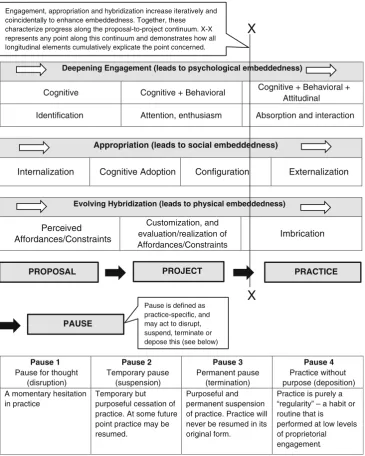
Taken individually the top three rows of Fig.2 illustrate diverse ways for describing the introduction of a new technol-ogy into the lifeworld of a consumer. Coincidentally, their parallel arrangement identifies similarities between the con-cepts concerned. Taken together, and viewed in transverse (e.g., X– X on Fig.2), a more complex view of each/any
point in the horizontal can be obtained, thus providing for a more complete understanding of the conditions for engage-ment that apply. However, the model as described thus far lacks both a unifying core and defining characteristics that distinguish this as a framework for smart product engagement. Further, reference to the first two elements of the Evolving Hybridization continuum identifies concepts that we have not yet addressed. To attend to these discrepancies, we next review a further range of ideas arising from disciplines discussed thus far. In the process, and drawing on a tradition for applying alliterative mnemonics to contexts of marketing interest (e.g., Constantinides2006), we outline a continuum of events we termproposal, project, practice, pause.
Proposal
Before project or practice can ensue, the consumer must be aware that an object of engagement exists. Some means of proposal, either internally or externally generated, must intially occur. Reference back to SDL and the marketing lit-erature suggests that the proposal–in the case of smart meters for example, the pitch from government and energy suppliers; for Amazon’s Echo, TV advertisements; for a health monitor, recommendation from a doctor–would correspond with the notion of a value proposition (see Foundational Premise 7; Vargo and Lusch2004). This, argue Frow and Payne (2011), denotes the benefits a supplier delivers to a customer and that coincidentally are considered to be of value. More pertinently however, value propositions might be seen as actor-to-actor invitations that are focused on the provision of mutually ben-eficial service (Chandler and Lusch 2015). Such invitation will invoke a bundle of attributes that the supplier would hope to deliver and would hope the customer finds to be of value.
Holttinen (2010) suggests that value is tied to practices, not offerings, and that understanding the meaning structures of practices is essential to the framing of effective propositions (Skålén, Gummerus, von Koskull and Magnusson 2015). Considered this way, the value proposition concept provides an explanation for how relationships among customer, suppli-er, market offering and practice might emerge. Understanding, though can be further enriched by reference to cognitive psy-chology. Adopted also by those interested in the relationship between humans and the material, the notion ofBaffordance^ can readily be associated with that of the value proposition. First discussed by Gibson (1979) affordances areBthe possi-bilities for action called forth by it to a perceiving subject.^ (Fayard and Weeks2007, p. 609). Thus, doors afford entry and exit; a laptop affords searching and word-processing; a motor car affords travel.
action/value-creation in the subject’s mind, and the value derived accrues via a process of negotiation between all actors within the pertinent service ecosystem. As Fayard and Weeks (2014) suggest, a recognition of affordance allows an observer to explain how the material shapes action. Affordances, there-fore, assist goal-oriented activity and consequentlyBallow^ those activities to emerge (Markus and Silver 2008). Resources–on both customer and supply side–can also act to constrain, and can consequently also interrupt or disturb action. Materiality exits independently of people, but the affordances and constraints this offers do not (Hutchby
2001). It is consequently these – rather than technologies themselves–that determine the extent of engagement that is likely to exist. We will return to affordances later.
Project and practice
Interestingly, the notion of engagement is to be found in the-ories of practice–also strongly associated with sociomaterial study.Practices, suggest Schatzki (1996), are the fundamental unit of analysis for social phenomena (e.g., experiences, ac-tions, activities). These can be imagined as either dispersed or universally performed (e.g., explaining, describing, following rules–Bknowing how^); or as disciplinarily integrative (e.g., farming, cooking and attending meetings, for example). These latter comprise combinations of dispersed practice, or Bknowing what.^ Reckwitz (2002) suggests that practices give the social world its visible orderliness and allow us to understand the everyday roles of both human and non-human
Deepening Engagement (leads to psychological embeddedness)
Cognitive Cognitive + Behavioral Cognitive + Behavioral + Attitudinal
Identification Attention, enthusiasm Absorption and interaction
Appropriation (leads to social embeddedness)
Internalization Cognitive Adoption Configuration Externalization
Evolving Hybridization (leads to physical embeddedness)
Perceived Affordances/Constraints
Customization, and evaluation/realization of Affordances/Constraints
Imbrication
Pause 1
Pause for thought (disruption)
Pause 2
Temporary pause (suspension)
Pause 3
Permanent pause (termination)
Pause 4
Practice without purpose (deposition)
A momentary hesitation in practice
Temporary but purposeful cessation of practice. At some future point practice may be resumed.
Purposeful and permanent suspension of practice. Practice will never be resumed in its original form.
Practice is purely a “regularity” – a habit or routine that is performed at low levels of proprietorial
engagement.
PRACTICE PROJECT
PROPOSAL
X
X
PAUSE
Engagement, appropriation and hybridization increase iteratively and coincidentally to enhance embeddedness. Together, these characterize progress along the proposal-to-project continuum. X-X represents any point along this continuum and demonstrates how all longitudinal elements cumulatively explicate the point concerned.
Pause is defined as practice-specific, and may act to disrupt, suspend, terminate or depose this (see below) Fig. 2 A composite model of
[image:6.595.180.546.53.510.2]objects. He defines practices as activities that are routinized, elementally complex, and integrated. In this sense both what is to be done and why it is to be done are culturally embedded. Schatzki’s (1996) teleoaffective structures–ends, beliefs, mo-tivations, purposes–are key components of practice and to a certain extent goal-oriented. Goals though, are not personally defined, but are normatively and culturally constructed and limited by practical intelligibility (the capacity to make sense of an opportunity, event or activity).
Although sociomateriality, ANT and practice theory were developed primarily for organizational settings, relevant ideas have more recently transferred beyond the office and into other domains, including the home (e.g., Hand and Shove
2007; Shove and Pantzar 2005; Shove, Watson, Hand and Ingram 2007). Following Warde (2005), the notion of consumption-as-practice has also gained momentum and has moved on from the relatively niche area of consumer culture and now informs critical thought at the periphery of the mar-keting mainstream (e.g., Goulding, Shankar and Canniford
2013; Schau et al.2009; Skålén, Pace and Cova2015). A broad consensus is developed here that posits practice as the context for co-creating value and,ipso facto, for furthering engagement (Storbacka et al.2016).
Practices are conceptually associated with both routine and habit, are emergent and continuously updated over time (Warde2005). In the context of SDPs, it is evident that engagement is likely to increase coincidentally as practice emerges and hybridization evolves – assuming that relevant practices and the technologies they are asso-ciated with are themselves Bengaging^ (see later). The transitional process of engagement connecting new and habitual practice allows either integration of material entities into existing practice or perhaps the construction of a new practice. Hand and Shove (2007) suggest that the process of domestication permits home artifacts to move from novelty to normality, with their use becoming rou-tinized rather than exceptional– or, as suggested earlier, made independent of conscious reflection.
Campbell (2005) further identifies that objects will be ap-propriated differently in diverse social, cultural and practical settings. Thus he suggests we can consider each individual as acraftconsumer, every one of us personally customizing the appropriation process to suit our own world of meaning– especially at the outset, before habit or routine is established. For each person, initial experiences might be collectively con-sidered a project–Bplanned, temporally bounded episodes or sequences of activity resulting in an observable outcome^ (Watson and Shove 2008, p. 9). Here it is the normalized outcome that is most appropriately considered as practice. This, we believe, is likely to apply particularly for SDPs, where motivation to engage will be less certain or assured than for a familiar, more conventionally configured domestic convenience.
For Watson and Shove (2008) however, a project is con-sidered an alternative to practice, in that the first is temporally bounded and the other ongoing. We believe though, that project can be interpreted as a stage that precedes practice. Considered as sequential rather than parallel activities, project and practice can be seen as distinct stages of developing engagement. We acknowledge project as a temporarily constrained phenomenon, but for our purposes suggest it is initiated through acceptance of a proposal and finished when it emerges into practice. Project is effectively a rehearsal and practice a performance, both related to something that is new and also potentially ambiguous as to benefit. Schau et al. (2009) associate practices with appren-ticeship or learning, but we suggest they differ: it isprojects that operate like apprenticeships and as a consequence precedepractice. Only after trial, preparation and accommo-dation (which collectively we call project) does practice ren-der action reproducible and repeatable. Therefore, we suggest project and practice be considered separate events.
Pause, and summary
And finally to pause. Other factors, including those associated with customers–free will, awareness, capability and capacity (Fayard and Weeks2007) and self-efficacy too (e.g., Wang et al. 2013) – will help determine the degree to which affordances can be realized. And referring back to a captalogical/persuasive perspective on technology we can see that affordances (and constraints) can be multi-directional. SDPs afford opportunities for customer action, but coinciden-tally afford opportunity for action further back through the supply chain. In turn these reverse affordances may be the triggers that prefigure suspicion in consumer minds. Thus affordances for one stakeholder may be a form of constraint for another, meaning there is a tension within the SDP ecosys-tem that needs to be resolved or at least understood.
The issue here for supply-side stakeholders is whether en-gagement outcomes (or practices) conform to what was ini-tially proposed or intended. Imbrication implies full assimila-tion of all resource integrators to create a viable and ongoing social system. In our account this means agency, social struc-ture, material relations and culture are all emergent features of human life that are ontologically irreducible. Imbricated rela-tionships though, are just pinned into place (Shove2003); they remain in flux, and each hybrid component will continually attempt to assert its independence. For the customer any en-gagement doubt will be strongest when constraints outweigh affordances, perhaps leading to aBpause,^or a reconsideration of, or reflection on, the original hypothesis. And also perhaps to the proposal on which it was based and the context in which it is experienced.
where it is attitudinally unstable. This is represented in Fig.2
as both/either a point or period of reassessment. This is an opportunity for determining– either sub-consciously or via return to conscious reflection– whether practice should be continued, discontinued or maybe sustained, but at some sub-optimal level. Perhaps undergone as an anesthetic, rather than aesthetic, experience (Dewey2005/1932). Pause is there-fore considered a behavioral condition that might be fleeting, temporary, or permanent. Consideration naturally precedes and characterizes project (the customizing/rehearsal stage) but pause, or re-consideration, is specific to practice. Following any momentary hesitation in practice (type 1, Fig.2) the pause could be transitory – as reflection fades and practice is renewed (type 2)–or permanent, as reflection turns to disaffection (type 3). This could subsequently trans-form into rupture, alienation or divorce, meaning the SDP is purposely ignored or even disconnected. Pauses 1–3 there-fore, occur at (or are)Bsituations of disturbed equilibrium^ (Dewey, in Gouinlock1976) initiated by doubt. Pause could occur any time, but types 1, 2 and 3 would most likely arise at some personally or socially determined occasion where the possibility of continuity is brought into question.
Alternatively, pause could manifest itself as practice with-out purpose, or mere regularity (Rouse2001), playing no ef-fective role in the normative practice of SDP engagement (see pause type 4, Fig.2). We note that Warde (2014, p. 14) sug-gests,BFor most folk, most of the time, most of daily life occurs in a state of distraction. Habit and routine are normal –the default mode of engagement in the world.^But we also discern that distraction evokes the lowest, least efficacious levels of engagement. Furthermore, the lack of conscious awareness that characterizes practice (Torriti, Leach and Devine-Wright2011) and which is the default aim of SDPs, can also become an obstacle. Thus practice may be or become an impediment to externalization and could limit imbrication. Consequently, we need to distinguish practice that is engaging –in an involving/absorbing sense–from practice that is mere regularity. This latter, characterized by torpor, we identify as disengagement, with pause 4 its manifestation. Thus, although consumer and technology may appear entangled, their rela-tionship may be little more than a Bdead^ marriage (Witztum, Van der Hart and Friedman1988), a meaningful relationship in name only. Consequently, benefits may be at least sub-optimal, inconsequential, or at worst, non-existent.
Figure2 illustrates a four-stage continuum, the first three drawing vertically upon related ideas and the fourth representing ways in which the third might be disturbed. Stage 1 is Proposal, when an outside agency suggests/ promotes SDP adoption. At this point the consumer internal-izes the proposition and begins to make sense of it by hypoth-esizing potential affordances, constraints and likely collective effect. Once a decision to adopt is made, the consumer begins to engage behaviorally with the technology and provisionally
to configure it in terms of both location and deployment. Here, engagement aligns withProject(stage 2), as consumers begin to understand how they and the technology will, or can, work together. The consumer –in partnership with the SDP con-cerned – customizes this configuration to fit their specific sociocultural context, gradually realizing perceived affordances and constraints. At Stage 3 engagement achieves the status of Practice, meaning hybridization is potentially complete – with the conditions for technology, consumer and social/physical context to be fully imbricated, in place.
Ideally, engagement and adoption will now be attitudinal as well as cognitive/behavioral, and consumers should be happy to externalize to others the meaning the technology has for their life. Furthermore, at Stage 3 thepotentialfor psycholog-ical, social and physical embeddedness is achieved. However, Pausecould interject as a corrective to Stage 3. This could disrupt (pause 1; pause 2); suspend and follow (pause 3); or, perhaps, supplant (pause 4) practice. These final pauses, each equally damaging, constitute a special challenge to marketers. Installation/supply of a SDP will not automatically lead to its effective use, andBembedding^will not inevitably occur.
Framework development: A cross-sectional
perspective
Value and personal advantage
If marketers are to give equal regard to every phase of engage-ment, a means for expressing consumer reaction along our continuum is clearly required. To address this, we add a ver-tical element to our model representing a set of consumption-related criteria that focus on both the positives and negatives associated with SDP engagement. Warde (2005) suggests con-sumption is an aspect of all (deliberative) practices, but it can be argued that its primary purpose is not to support the practice itself but rather to support outcome. It has already been dem-onstrated that, from a marketing perspective, instead of representing per se the fundamental unit of analysis for social phenomena, practice can be considered one aspect of a com-plex engagement trajectory. Consumers are continuously pur-suing, or wish to sustain, a preferred outcome; something that we term personal advantage (Woodall2003). The next phase of our discussion therefore, completes our SDP research framework (see Fig.3) and explains how and why we choose the term personal advantage, and how this derives from a review of the associated phenomenon, consumer value.
are realized both cognitively and emotionally. In such a con-text we argue that perceived personal advantage provides a more relevant unit of analysis than does practice. This is because, at any point in the engagement continuum, it rep-resents the manifest locus of subject, object and cultural/ socioeconomic context.
Perceived personal advantage is closely associated with perceived consumer value. In many ways it is synonymous with consumer value but is specified differently. In the
marketing literature consumer value represents what is posi-tive only, and is used to describe many different conditions. We prefer the term consumer advantage because (a) this tran-scends the polysemic nature of the word‘value’and (b) it can readily be attributed in the converse (disadvantage). We define perceived personal advantage/disadvantage as an aggregate positive or negative perception that results from an individ-ual’s conscious or unconscious processing of consumption-related cost/benefit information and/or experience. In the Composites
of value
Phases of engagement, embeddedness and value formation
Proposal Project Practice Pause
Advantage perceived in the present and in Retrospect
Advantage perceived in Prospect and in the Present
Price
Attributes
Experience
Acquisition and relationship costs
Outcomes
Supply-side Hybrid
(Agent of informational embeddedness)
SDP/Customer Hybrid
Customer/ Community Hybrid A1
A2 A3
A1
A2 A3
A1
A2 A3
A1
A2 A3
Smart product ecosystem Advantage formed within and between hybrids
Conduits to apprehension of advantage (see Fig. 4) A1 - Assignment A2 - Argument A3 - Actualization
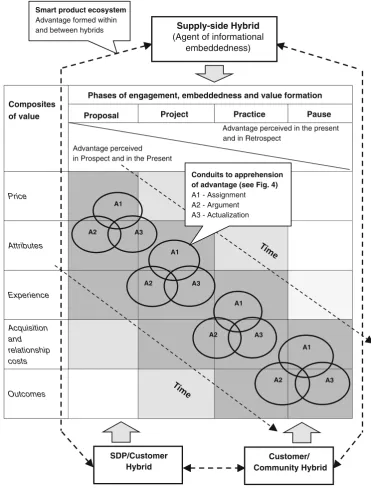
Note: Advantage (or disadvantage) is an aggregate positive or negative perception resulting from an individual’s conscious or unconscious processing (or trade-off) of consumption-related cost/benefit information and/or experience. It is closely related to value, but it is an umbrella term for and outcome that reconciles and/or aggregates different positions and perspectives on value.
[image:9.595.103.475.53.544.2]following discussion we draw on the value-related literature to demonstrate this. We show also how the notion of advantage can help to refine and extend our framework for understanding SDP engagement.
The case for trade-offs
The Service Dominant Logic (Vargo and Lusch2004) and later Customer Dominant Logic (e.g., Grönroos and Voima2013; Heinonen, Strandvik, Mickelsson, Edvardsson, Sundström and Andersson2010; Tynan, McKechnie and Hartley2014) liter-atures, focus on theco-creationand/orformation of value. Also on the economic concept of value-in-use (also expressed as value-in-experience, value-in-context and most recently, value-in-the-experience and value-in-life). Here value is framed heuristically as an abstract consumption outcome that increases general well-being, and in that literature its compo-sition is only rarely (e.g., Ng and Smith2012) contemplated. Here there is no shortage of extant commentary on the rela-tionship between value and practice (e.g., Ellway and Dean
2016; Helkkula, Kelleher and Pihlström 2012; Holttinen
2010,2014) but this most frequently applies again, in the ag-gregate, thus neglecting structure and constitution.
However, the broader consumer behavior literature repre-sents value not as a single unifying concept, but as a multi-compositional domain premised on associated but differing ideas. These coalesce around different arrangements of what we term the composites of value. For example, means-end chain logic (Gutman 1982) assumes theattributesof market offerings provide the potential for value, and that these are transformed into meaningful outcomes viaexperiences. Other perspectives view value as the outcome of a trading-off process whereby customers weigh the relative effects of benefit and sacrifice (Bget^andBgive^). Here optimum value occurs when positive difference is greatest. At its most basic (e.g., Gale
1994; Oh1999; Ostrom and Iacobucci1995), this branch of the literature considers just attributes andprice, the conse-quence expressed asBvalue for money.^Other trade-off per-spectives however (Grönroos1997; Heskett et al.1997) iden-tify thatBgive^components go beyond price, and incorporate bothacquisition costs(time, effort, maintenance) and psycho-logical costs(e.g., fear and anxiety). As a result, some later contributions (e.g., Mayr and Zins2012; Ruiz, Gremler, Washburn and Carrión2008; Woodall, Hiller and Resnick
2014) have adopted a wider perspective on the benefits/ sacrifices relationship than that which focuses purely on value for money. These look to compile a more complex/granular account that incorporates elements of the means-end approach. The co-creation literature suggest consumer value is idio-syncratic, phenomenological, contextual and meaning-rich (Vargo and Lusch2008). Also, that it comprises affective, social, economic, cognitive, physical, psychological and bio-logical dimensions (Heinonen et al. 2010). Co-creation/
formation literatures are therefore seen to offer a more phe-nomenologically authentic take on value than those concerned with trade-offs. These latter, associated with neo-classical ap-proaches to consumer behavior, are said to endorse rational foundations for choice (Gummerus 2013). However, as Rodríguez et al. (2006) suggest, trade-offs often occur without either pre-meditation or even awareness of their occurrence. Malafouris (2013) similarly argues that all forms of sense-making have non-cognitive aspects–suggesting coincidental-ly, thatBthe material^has a hitherto underappreciated impact on the sense-making process. Further, a trade-off perspective helps us recognize that value, or personally perceived advan-tage, can be appreciated as positive, neutral, or negative.
We express the way that people process value/advantage in consumption as awrangle. We posit this as a complex internal dispute between multiple agendas striving for congruence in overlapping contexts. According to neurologists the brain is a highly distributed and self-organizing system of neural net-works that functions on the basis of learning and adaptation (Kazmina et al.2014). It deploys various and multiform feed-back loops. A wrangle, therefore, is thus best characterized as a mechanism for abductive reasoning, and designates trade-offs also as idiosyncratic, cognitive/affective and contextual.
The nature of trade-offs
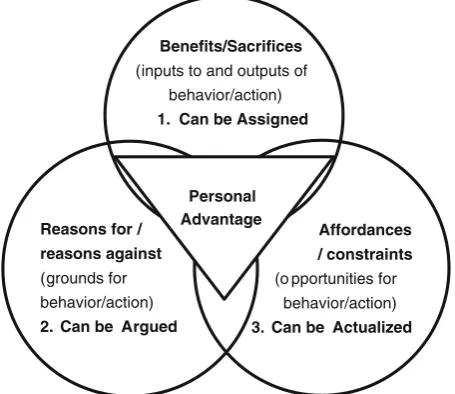
The trade-off tradition focuses primarily on benefit and sacri-fice, but ifBto wrangle^implies a networked rather than bina-ry approach to sense-making there must be more to it than this. Our thesis therefore, is that the benefit/sacrifice dyad is just one of three epistemologically relevant and dichotomous con-structs nested within the category, personal advantage (Fig.4). Benefits and sacrifices are essentially inputs to, and outputs of, a trade-off process that can be named, listed, described and
[image:10.595.312.540.503.700.2]assigned (this is what went in, and this is what came out). Consequently, these can be readily articulated via the previ-ously noted composites of value and remain key to under-standing. However, we note a recent strand of TRA-related research (e.g., Claudy et al.2015) where, based on Westaby’s (2005) Behavioral Reasoning Theory (BRT), bothBreasons for^ and Breasons against^ are given as key antecedents to innovation diffusion. We are convinced by their suggestion thatBreasons^play a role in the wrangling process (they have causal efficacy) and that both continuance and defection will result partly from consciously/sub-consciously rehearsed arguments.
These arguments may be played out contemplatively, con-versationally, or even unconsciously, with inputs to a particu-lar course of action being balanced and accorded weight. This doesn’t imply that decisions are entirely reasoned, but does suggest that grounds for (and against) specific decisions will be accounted for in perceptions of personal advantage. Consumers will wish to defend, both to themselves and to others, what they want to do (Westaby2005). Concerns about data security and social status, for example, are much more likely to be articulated as issues of debate than they are, say, as issues of classification, quantity or quality.BReasons for^and Breasons against^therefore, we suggest, represent an addition-al conduit to apprehension.
Lastly, we return to Gibson’s (1979) notion of affordances and to the limiting impact of constraints. Determining the ways in which consumers understand both their relationship with technology and the extent to which they believe it im-pacts their personal/social being aids our account of SDP en-gagement in two ways. First, this explicitly acknowledges the pervasive effect of the material. Second, this adds further depth to considerations of personal advantage, and recognizes the interplay between grounds for engagement (and disen-gagement) and the essence of the technology itself. Here we note inter alia, that not just SDPs themselves, but also related and performative associations (advertisements, exhortations, etc.; Cochoy1998) will help inform a customer’s capacity for action. We argue consequently, that to identify how sources of value impact customer meaning we need to access multifari-ous insights into value formation. In our model therefore, con-duits to apprehension are collectively represented via (1) as-signment, (2) argument (reasons for or reasons against) and (3) actualization (physical and/or psychological and/or eco-nomic realization of affordance and constraint).
An extended model of SDP engagement
Drawing on positions taken thus far we suggest a multiform structure that conceptually maps pertinent aspects of engage-ment and embeddedness that should be of interest to mar-keters. Our full model (see Fig.3 further above) depicts:
engagement phases, composites of value (that inform percep-tions of advantage), and key hybrids that configure the SDP ecosystem. A fourth element (conduits to the apprehension of advantage) is represented by a triform sub-framework that nests within the broader model structure and addresses the routes by which composites of value/advantage might be con-stituted within the consumers’sphere of understanding.
Proposal, project, practice (and, potentially, pause) repre-sent phases of engagement where subject/object hybrid rela-tionships fluctuate, as familiarity with, or expertise in, SDP endeavor emerges. At each phase (though we posit a progres-sive/recursive, rather than an episodic/linear, continuum) the consumer will be both object of and party to an ongoing sense-making process. This acknowledges the causality of both hu-man and non-huhu-man entities. Huber, Lynch, Corfhu-man, Feldman, Holbrook, Lehmann, Munier, Schkade and Simonson (1997) suggest that value is viewed in prospect, in the present and also in retrospect. This means that all compos-ites can–potentially, coincidentally, and to varying degrees– feature at any given time in the customers’estimation of value. We thus argue that each of the horizontal phases will be dif-ferently informed by varying and overlapping perceptions of value, or advantage. Thoughts at proposal for example, are likely directed to the present and future, while practice and pause invoke the present and the past. Pause may occasion a re-imagining of the value proposition and consequently of likely outcomes.
The composites of value are drawn from the preceding discussion on value trade-offs and are:price (what, if any-thing, is given up directly to the supplier to allow use of the SDP);attributes(the features, properties and qualities of the SDP and its attendant ecosystem);experiences(events occur-ring in association with, or having association to, the SDP, and that leave an impression);acquisition and relationship costs (anything that has to be given up in order to sustain and/or maintain experience with the SDP and its ecosystem); and, outcomes (long-, medium- and/or short-term consequences of association with the SDP). Price and costs however are not necessarily money-based, and comprise economic, psy-chological, physical and time-related components.
horizontal element it is most closely associated with. But per-ceptions will also be influenced by both proceeding and pre-ceding elements, in both axes, according to the strength and proximity of each. Thus the band is wide and progressively shaded.
The service ecosystem will also determine how advan-tage is perceived. Here we suggest that a supply-side hybrid (a convergence of institutional forces supplying/ monitoring the SDP), a customer/SDP hybrid (the con-sumer at home) and a customer/community hybrid (the consumer and his/her social mélange) will dominate. Clearly, there will be many other system components at play (see Edvardsson, Kleinaltenkamp, Tronvoll,
McHugh and Windahl 2014) but for expedience our
model emphasizes those hybrids that we most readily identify as integrators of resource.
Discussion and key theoretical positions
Recent innovation diffusion studies in the marketing field (e.g., Claudy et al. 2015; Laukkanen 2016; Patsiotis, Hughes and Webber2013) suggest that a small number of research models dominate (e.g., Theory of Reasoned Action [TRA]; Technology Acceptance Model [TAM]). However, there is no clear consensus on the most relevant factors impacting diffusion or the best way of determining how these might be defined. This is unsurprising given the wide array of potentially causal variables apparent to students of consumer behavior, the diverse demographic and psychological nature of consumers, and the infinite variety of innovation objects that present for attention. The recent emergence of SDPs adds to this variety and complicates the challenge.
The evolving literature on SDPs exists overwhelmingly on non-marketing platforms, comprising largely sector- rather than discipline-focused studies (e.g., computing, healthcare, engineering, and energy management). These tend to focus on what can be achieved through SDPs and how these might be designed, configured, applied or managed. Diffusion-related studies are fewer but increasing (e.g., Buchanan, Banks, Preston and Russo2016; Lazar et al. 2015; Portet, Vacher, Golanski, Roux and Meillon2013; Tseng, Hsu and Chuang2013; Yang, Lee and Zo2017). Given their largely applied nature though, these tend to rely on established theo-retical frameworks and SDP-specific theory development is slow to emerge.
Our proposed framework acknowledges this and is focused specifically on establishing the extent to which consumers perceive either advantage or disadvantage in their SDP rela-tionships. The framework is premised on a range of key the-oretical positions which characterize the distinctive nature of our approach. Conceptually, our study draws on two diverse areas of thought that surfaced within the field of consumer
behaviour a little more than a decade ago. These are Service Dominant Logic (SDL) and organizational sociology. Recently marketing scholars have sought to explore how these connect (e.g., Akaka, Vargo and Lusch2013; Löbler2011; Skålén and Edvardsson 2016; Vargo and Lusch 2016), pri-marily invoking structuration theory and practice theory. Less frequently combined, though, are studies concerning SDL and concerns of a social/material nature. This leads to our first theoretical position.
There is an emerging weight of theory that now posits structural, material, human and synthetic entities as inter-reli-ant. Callon, Law and Latour’s Actor Network Theory, Orlikowski’s Sociomateriality, Shove’s Theories of Domestication, and Malafouris’s Theory of Material Engagement have emerged to represent a collective and in-creasingly normalized logic. The smart home we suggest, is just the latest context in which people and technology are seen to combine. First there was the office and more recently the servicescape (Bitner 1992) where SSTs have become indis-pensable to service experience. We acknowledge this evolved imperative and our framework responds to a call (Campbell et al.2014) forBthe material^to be given due causal regard in research concerning one specific SDL axiom: resource integration.
Academics have recently grappled with notions of how social beings make sense of their environments; how patterns of life emerge, stabilize and give meaning and shape to soci-ety. Ascendant theories of practice hold that tacitly determined routines rather than individuals should be the fundamental focus for research. Via Bourdieu, Giddens, Schatzki and Reckwitz and with roots in the philosophy of Heidegger and Wittgenstein (Halkier, Katz-Gerro and Martens2011) practice theory has taken hold. But by elevating the status of structure, culture and routine, consumption-related reflection has been marginalized. Normative sociological perspectives applied in recent marketing studies (e.g., Holttinen 2014) have conse-quently led to the view that practice begets value. Thus prac-tice becomes the focus of attention. We argue that the pracprac-tices that emerge to accommodate novel and relationally advanced products (such as SDPs) are those that are perceived to offer the best personal advantage. Thus, for this as yet unfamiliar consumption domain the factors contributing to perceptions of advantage should warrant primary attention – at least from marketers. Bonnington (2015) suggests that human reflexivity is essential to the shaping of practice, and we concur. Our second proposition therefore, is that while the material helps constitute both, to large extent the consumer performs SDP practice and not the reverse.
phase that follows from introduction of and rehearsal with a product. On the other hand, we see practice as a habitual condition that can vary from fully engaging to disengaging. Therefore, a mnemonic device is used, recalling other market-ing tenets (see Constantinides2006) and suggesting that it incorporates other largely unexplored consumption condi-tions. Thus, in addition to proposal and practice we introduce project and pause.
The first (project) acknowledges that both the potential and function of a newly presented product should be fully under-stood and rehearsed before effective practice can occur (espe-cially important for a product category that requires full embeddedness to become effective). Pause, as both disruption to and suspension of customer commitment and loyalty, has already been extensively explored, but we also posit this as a condition that cansupplant continuance. Pause, defined as Bpractice without purpose,^is applied because of its particular relevance to SDPs. For products that contribute to life experi-ence rather than service experiexperi-ence, the possibility of begin-ning as or deteriorating into torpor is a real danger. Our third proposition therefore, is that SDP-related marketing research should not just consider acquisition as one key area of study and practice as another, but should distinguish the latter as comprising three distinct phases of interest.
Our fourth proposition is that perceptions of advantage derive via a complex set of parameters that should be consid-ered both separately and in concert. By this we mean that although advantage will ultimately appear as a gestalt (an articulated whole comprising distinct parts that are capable of appreciation; Smith1988) we need to know how this ac-crues and is made manifest in the context of personal reflec-tion. Given the compound nature of relationships among peo-ple, society, organizations and SDPs, we need to take account of the widest array of thoseBparts^that can be appreciated. Engagement at any stage along the proposal-to-pause contin-uum is judged on the basis of cumulatively observed evidence of psychological, social and physical embeddedness. At any point there will be a corresponding measure of perceived ad-vantage that derives from the strength and proximity of both longitudinal and cross-sectional framework characteristics.
In turn, our fifth proposition suggests this perceived advan-tage forms because of the collectively weighted outcome of assignations, arguments and actualizations–both consciously and sub-consciously directed towards the gestalt view. Of es-pecial relevance to the SDP domain we emphasize the need to explore the dichotomous effects of both affordances and con-straints as well as reasons for and against both adoption and continuance. The first of these acknowledges the causality arising from an individual’s relationship with the material; the second accedes to a need to understand the issues of inter-nal debate that help form either positive or negative sentiment. Formal diffusion models (e.g., UTAUT, TAM, TBA) draw conclusions by measuring the strength of attitudinal/
intentional antecedents to acceptance or rejection. However, we have identified critiques that suggest there is little consen-sus as to what these might be. By contrast we address the common factors that underlie and structure these attitudes and intentions, and draw attention primarily to the interplay of advantage and engagement.
Our sixth proposition relates to how actors are character-ized in technology diffusion marketing studies. These normal-ly posit the customer and the technologies they use as onto-logically distinct. Consequently, these are viewed primarily as protagonists of essentially different quality and significance. We suggest that as technology becomes increasingly familiar –as computer-mediated environments are more the norm and less the exception – productengagement will be the least difficult challenge to overcome. In smart homes, the technol-ogy product (SDP) and the consumer will become one (the customer/SDP hybrid), and residents will blend to become smart communities (the customer/community hybrid). The major protagonist then becomes the supply-side hybrid–that is, the agent of informational embeddedness; or in practical terms, suppliers’objectives and the Internet of Things.
Full union with this final class of embeddedness is the final hurdle for complete SDP engagement. For many SDPs in many smart contexts this will be easily overcome. But as the systems of distributed intelligence become more integrated, more extensive and – potentially – as much a channel for persuasion as they are for support or advice (see Fig.1), then both consumers and communities will react. The danger is that as SDPs move more towards the right-hand side of Fig.1, the more contentious will be those designed for hedonic purpose, and the less trustworthy will be those specified as transforma-tional. Our seventh proposition is that this will be the primary ongoing challenge for SDP engagement.
Conclusion and directions for further research
Our framework contributes to an expanded view on innova-tions diffusion in the specific context of the smart home. Coincidentally we link with a vital principle of marketing thought that suggests value resides at its core (e.g., Drucker
1954; Vargo and Lusch2004). The framework is complex and unlikely to submit to one approach to research. It can however, beBdepunctualized^(considered manifest at any point; Latour
2005) to surface knowledge relating to macro, meso or micro concerns. The notion that we can move upwards to an under-standing of social structures and coincidentally downwards to a more nuanced appreciation of individual actions and rela-tionships offers the potential for a nested, multilevel model of causation (Little2012).
In the field of innovations diffusion, there is room for both qualitative and quantitative research, so our framework en-courages a methodologically liberal approach. Below we list some objectives for early research, and these will also help assess the theoretical positions advanced in this article.
1. Marketing researchers will want to know how, or if, par-ticular SDP types or properties facilitate smooth transition fromproposal, toproject, and then topracticethat has effective purpose. Similarly, which products/properties are mostly likely to engenderpause–either by disrupting, suspending or supplanting practice. Characterizing those customers most likely to succumb to the most damaging types of pause would be useful. Also, what affects their decisions? Evidence on factors contributing both indepen-dently and collectively to psychological, social and phys-ical embeddedness will provide insight concerning theory propositions one, two and four.
2. Exploring the three suggested conduits to apprehension will help surface those personal, social, cultural and insti-tutional factors that weigh most heavily on consumers’ minds. Innovation diffusion researchers have noted that positive and negative constructs comprise different vari-ables and, consequently, are causally distinct. Exploring issues of assignation, argument and actualization (both collectively and apart) will help advance relevant inquiry and provide support (or otherwise) regarding theory prop-ositions three and five.
3. Marketers will also wish to know how SDPs help shape the behavior of society at large, and how these will inform both consumption and practice (or consumptionas prac-tice) beyond their immediate and intended effect. What will our priorities be in the new smart world, and how will the advantage (or disadvantage) that we perceive to arise from these shape our daily lives? Comparative examina-tion of the impact of practice on percepexamina-tions of advantage, and of the impact of advantage on perceptions of practice will offer insight into theory proposition four.
4. It would be of special interest to marketing researchers to know how the supply-side hybrid impacts the process of appropriation and hybridization at each phase in the en-gagement continuum. Also how consumers apprehend the nature of the hybrid to determine which factors, and which contributing party or component, have the greatest positive or negative impact. Results will help inform the legitimacy of our concluding theory propositions six and seven.
5. Finally, recognizing that consumers and the artifacts with which they associate can be imagined in three distinct but complementary forms–dependent, independent and in-terdependent–means that marketing researchers can ob-tain a more granular and comprehensive perspective on those they wish to reach. Acknowledging that hybrids
exist and that they interlink as well within a smart ecosys-tem (see dotted lines on Fig. 3) should also encourage marketing researchers to explore relationships among consumers, artifacts and significant others. Relevant re-search will further test our ideas regarding proposition six.
We believe also that our ideas and frameworks offer a gate-way to further conceptual inquiry. Practice theory has now entered the marketer’s vocabulary, but to date little thought has been given to how the tacit and routinized nature of prac-tices impact the nature of habit-related marketing issues such as loyalty and commitment. Similarly, an approach to practice that perceives this coincidentally in abstract, dispositional and typological forms suggests direction for further inquiry into how practice might best be conceptualized for a marketing context. We also note that Gibson’s ideas on affordance and constraint have thus far been applied primarily to contexts where material and synthetic entities are of most concern (e.g., engineering, information systems). Though customers are also subject to a wide array of environmental forces, and applying this theory in a consumption context may enrich an understanding of their behavior.
Other issues warrant further inquiry too. This article is focused chiefly on engagement, with embeddedness a supporting property (see Fig. 2). It would be interesting to take embeddedness as the primary focus and use this to direct further conceptual inquiry. In turn, this may reveal other areas of analysis that would benefit our understand-ing. Further (see Fig.1), we began this article by locating intention and function as key variables for defining SDP-type objects. But other axes could be applied too, perhaps focusing on the nature and extent of the intelligence net-works that underpin particular devices or systems, or on the multiplicity of function that each product performs. Lastly, we are struck by imperatives apparent in other dis-ciplines that focus on smart contexts (sustainability, do-mestication, health, etc.) and the emphasis they place on behavior change. Perhaps the major contribution that mar-keting can make is to emphasize it is products that should be changed to accommodate customers, and not vice versa.
Open AccessThis article is distributed under the terms of the Creative C o m m o n s A t t r i b u t i o n 4 . 0 I n t e r n a t i o n a l L i c e n s e ( h t t p : / / creativecommons.org/licenses/by/4.0/), which permits unrestricted use, distribution, and reproduction in any medium, provided you give appro-priate credit to the original author(s) and the source, provide a link to the Creative Commons license, and indicate if changes were made.
References
Akaka, M. A., & Vargo, S. L. (2013). Technology as an operant resource in service (eco)systems.Information Systems and e-Business Management, 12(3), 367–384.
Akaka, M. A., Vargo, S. L., & Lusch, R. F. (2013). The complexity of context: A service ecosystems approach for international marketing.
Journal of International Marketing, 21(4), 1–20.
Åkesson, M., Edvardsson, B., & Tronvoll, B. (2014). Customer experi-ence from a self-service system perspective.Journal of Service Management, 25(5), 677–698.
Alam, M. R., Reaz, M. B. I., & Ali, M. A. M. (2012). A review of smart homes—Past, present, and future.IEEE Transactions on Systems, Man, and Cybernetics, Part C (Applications and Reviews), 42(6), 1190–1203.
Ashton, K. (2009). That‘internet of things’thing, RFID Journal, June 22.
http://www.Itrco.Jp/Libraries/RFIDjournal- that%20Internet% 20of%20Things %20Thing.Pdf. Accessed 15 July 2016.
Barakat, S. M. (2016). Internet of things: Ecosystem and applications.
Journal of Current Research in Science, 4(1), 32–34.
Bitner, M. J. (1992). Servicescapes: The impact of physical surroundings on customers and employees.Journal of Marketing, 56(2), 57–71. Bonnington, O. (2015). The indispensability of reflexivity to practice:
The case of home energy efficiency.Journal of Critical Realism, 14(5), 461–484.
Botella, C., Riva, G., Gaggioli, B., Wiederhold, M. A., Alcaniz, M., & Baños, R. M. (2012). The present and future of positive technologies.
Cyberpsychology, Behavior and Social Networking, 15(2), 78–84. Brodie, R. J., Hollebeek, L. D., Jurić, B., & Ilić, A. (2011). Customer
engagement: Conceptual domain, fundamental propositions, and implications for research. Journal of Service Research, 14(3), 252–271.
Buchanan, K., Banks, N., Preston, I., & Russo, R. (2016). The British public’s perception of the UK smart metering initiative: Threats and opportunities.Energy Policy, 91, 87–97.
Callon, M. (1986). The sociology of an actor-network: The case of the electric vehicle. In M. Callon, J. Law, & A. Rip (Eds.),Mapping the dynamics of Science and technology: Sociology of Science in the real world(pp. 19–34). London: MacMillan Press.
Campbell, C. (2005). The craft consumer: Culture, craft and consumption in a postmodern society.Journal of Consumer Culture, 5(1), 23–42. Campbell, N., O'Driscoll, A., & Saren, M. (2014). Reconceptualizing resources: A critique of service-dominant logic. Journal of Macroeconomics, 33(4), 306–321.
Chandler, J. D., & Lusch, R. F. (2015). Service systems: A broadened framework and research agenda on value propositions, engagement, and service experience.Journal of Service Research, 18(1), 6–22. Chen, H., Finin, T., & Joshi, A. (2003). An ontology for context-aware
pervasive computing environments.The Knowledge Engineering Review, 18(3), 197–207.
Claudy, M., Garcia, R., & O’Driscoll, A. (2015). Consumer resistance to innovation: A behavioral reasoning perspective.Journal of the Academy of Marketing Science, 43(4), 528–544.
Cochoy, F. (1998). Another discipline for the market economy: Marketing as a performative knowledge and know-how for capital-ism.The Sociological Review, 46(1), 194–221.
Constantinides, E. (2006). The marketing mix revisited: Towards the 21st-century marketing.Journal of Marketing Management, 22(3– 4), 407–438.
Dewey, J. (1976). Value and nature. In J. Gouinlock (Ed.),The moral writings of John Dewey(pp. 56–82). New York: Hafner Press. Dewey, J. (2005/1932). Art as experience.New York: Pedigree. Drucker, P. E. (1954). What is our business–And what should it be? In P.
E. Drucker (Ed.),Practice of management(pp. 49–61). New York: Harper and Row.
Edvardsson, B., Kleinaltenkamp, M., Tronvoll, B., McHugh, P., & Windahl, C. (2014). Institutional logics matter when coordinating resource integration.Marketing Theory, 14(3), 291–309.
Ellway, B. P., & Dean, A. M. (2016). The reciprocal intertwining of practice and experience in value creation.Marketing Theory, 16(3), 299–324.
Fayard, A.-L., & Weeks, J. (2007). Photocopiers and water-coolers: The affordances of informal interaction.Organization Studies, 28(5), 605–634.
Fayard, A.-L., & Weeks, J. (2014). Affordances for practice.Information and Organization, 24(4), 236–249.
Fogg, B. J. (1999). Persuasive technologies. Communications of the ACM, 42(5), 26–29.
Frow, P., & Payne, A. (2011). A stakeholder perspective of the value proposition concept.European Journal of Marketing, 45(1/2), 223–240.
Gale, B. (1994).Managing customer value: Creating quality and service that customers can see. New York: The Free Press.
Gangale, F., Mengolini, A., & Onyeji, I. (2013). Consumer engagement: An insight from smart grid projects in Europe.Energy Policy, 60, 621–628.
Garcia, N. M., & Rodrigues, J. J. (2015).Ambient assisted living. Boca Raton: CRC Press.
Gibson, J. (1979).The ecological approach to visual perception. Boston: Houghton-Mifflin.
Goulding, C., Shankar, A., & Canniford, R. (2013). Learning to be tribal: Facilitating the formation of consumer tribes.European Journal of Marketing, 47(5/6), 813–832.
Gram-Hanssen, K. (2008). Consuming technologies–developing rou-tines.Journal of Cleaner Production, 16(11), 1181–1189. Gram-Hanssen, K. (2011). Understanding change and continuity in
resi-dential energy consumption.Journal of Consumer Culture, 11(1), 61–78.
Gray, D. M., & Bean, B. (2011). Can social marketing segmentation initiatives be used to increase household electricity conservation?
Journal of Non-profit and Public Sector Marketing, 23(3), 269–305. Grönroos, C. (1997). Value-driven relational marketing: From products to resources and competencies.Journal of Marketing Management, 13(5), 407–419.
Grönroos, C., & Voima, P. (2013). Critical service logic: Making sense of value creation and co-creation.Journal of the Academy of Marketing Science, 41(2), 133–150.
Gubbi, J., Buyya, R., Marusic, S., & Palaniswami, M. (2013). Internet of things (IoT): A vision, architectural elements, and future directions.
Future Generation Computer Systems, 29(7), 1645–1660. Gummerus, J. (2013). Value creation processes and value outcomes in
marketing theory: Strangers or siblings?Marketing Theory, 13(1), 19–46.
Gutman, J. (1982). A means-end chain model based on consumer cate-gorization processes.The Journal of Marketing, 46(2), 60–72. Ha, S., & Stoel, L. (2009). Consumer e-shopping acceptance:
Antecedents in a technology acceptance model.Journal of Business Research, 62(5), 565–571.
Halkier, B., Katz-Gerro, T., & Martens, L. (2011). Applying practice theory to the study of consumption: Theoretical and methodological considerations.Journal of Consumer Culture, 11(1), 3–13. Hand, M., & Shove, E. (2007). Condensing practices: Ways of living with
a freezer.Journal of Consumer Culture, 7(1), 79–104.
Heinonen, K., Strandvik, T., Mickelsson, K. J., Edvardsson, B., Sundström, E., & Andersson, P. (2010). A customer-dominant logic of service.Journal of Service Management, 21(4), 531–548. Helkkula, A., Kelleher, C., & Pihlström, M. (2012). Characterizing value
as an experience: Implications for service researchers and managers.
Journal of Service Research, 15(1), 59–75.
Hérault, S., & Belvaux, B. (2014). Privacy paradox and the adoption of intrusive technologies. The case of mobile location-based services.
Décisions Marketing, 74, 67–82.