J. M. Shearer
A Thesis Submitted for the Degree of PhD
at the
University of St Andrews
1986
Full metadata for this item is available in
St Andrews Research Repository
at:
http://research-repository.st-andrews.ac.uk/
Please use this identifier to cite or link to this item:
http://hdl.handle.net/10023/13779
Interval methods for nonlinear systems
J.M . Shearer
All rights reserved INFORMATION TO ALL USERS
The quality of this reproduction is dependent upon the quality of the copy submitted. In the unlikely event that the author did not send a com plete manuscript and there are missing pages, these will be noted. Also, if material had to be removed,
a note will indicate the deletion.
uest
ProQuest 10166982
Published by ProQuest LLO (2017). Copyright of the Dissertation is held by the Author.
All rights reserved.
This work is protected against unauthorized copying under Title 17, United States C ode Microform Edition © ProQuest LLO.
ProQuest LLO.
789 East Eisenhower Parkway P.Q. Box 1346
I Jonathan Marc Shearer hereby certify that this thesis which is approximately 70,000 words long has been w ritten by me, that it is a record of work carried out by me, and that it has not been submitted in any previous application for a higher degree.
the University of St Andrews and that he is qualified to submit this thesis in application for that degree.
I was admitted as a research student under Ordinance No. 12 on
1®^ October 1982 and as a candidate for the degree of Ph.D. on
1^^ October 1982; the higher study for which this is a record was earried out in the University of St Andrews between 1982 and 1985.
1 In tro d u c tio n ... 1
2 Preliminary r e s u lt s ... 10
3 • Methods for the solution of a class of nonlinear algebraic equations based on the symmetric single-step a lg o r ith m ... 19
4 The use of an inner iteration in the algorithm of Alefeld and P la tz o d e r ... 44
5 The Symmetric o p e ra to r... 64
6 The package for symbolic computation . . . 89
7 Applications of the package...116
A ppendices A N o ta tio n ... 139
B Example problems ... 143
C Description of the Pseudo-code... 150
1.
Introduction
111 numerical mathematics, there is a need for methods which provide a user with the solution to his problem without requiring him to understand the mathematics underlying the method of solution. Such a method involves co m p utab le tests to determine whether or not a solution exists in a given region, and whether, if it exists, such a solution may be found by using the given method. If these tests are not satisfied then the user must be notified of the failure of the method. If the tests are satisfied, and the problem may be solved, the user should be supplied with the solution to the problem together with rigorous bounds for the error in the computation.
compiiter.
The advent of packages which allow symbolic computations to be carried out on a given computer is also an im portant advance for computational numerical mathe matics. In pai‘ticular, the ability to compute derivatives automatically removes the need for a user to supply them, thus eliminating a major source of error in the use of methods requiring first or higher derivatives. Unfortunately most of the packages for symbolic computation currently available, such as M AGSYM A [Bog—77a], and REDUCE 2 [Hea.—73a], are difficult to interface with implementations of numerical algorithms.
In this thesis some methods for the solution of systems of nonlinear algebraic equations are presented. Nonlinear systems arise in the numerical solution of many problems in all areas of applied science. Examples of problems which give rise to nonlinear systems include optimization and the solution of ordinary and partial dif ferential equations. Many examples are given by Ortega and Rheinboidt [GrtR-69a] and Dennis and Schnabel [DenS~S3a].
The notation used throughout the thesis is described in Appendix A. In this thesis, particular emphasis w ill be given to methods which use interval arithmetic and symbolic computation for the solution of systems of nonlinear algebraic equations. Algorithms for estimating the solution of the system of nonlinear equations
f( x ) — 0 (1.1)
- 3
under appropriate conditions, converges to . Theorem 1.1 is typical of the type of results which guarantee the existence of a solution in a given region, and the. convergence of an iterative sequence to the solution.
T heorem 1.1 s (Kantorovich) Let / : D Ç be a given mapping w ith / e C^{D) where D C D is an open convex set. If (i) 3q > 0 such that
||/(a:) - /(W it. < 111^ "
y\\
(^«, y G D);
(1.2)(ii) 3x e D and 3/9,?/ > 0 such that f { x ] ^ < /9 , f ( x ) ^ / { ^ ) and a ~ /9?/q < | ; (iii) B [S, r*] = {.x* e R " | ||.x - S|| < r* } c D . where
r* = { x - ( l -
2a ) i } / ( ^ 7),(1.3)
then (a) 3a;* E D such that /(a;*) = 0 and x* is unique in B[æ, where
= { l + (1 - 2 a )î } /( ,
87
);
(1.4)
(b) the sequence (æ(^) ) generated from
(1.5)
w ith = S is such that (VA > 0) , is well-defined and E B [æ, r*j ; (c) (VA > 0)
< { 2 a f (1.6)
. »v ^ . . . . .. • • • . _ ' _
which is typified in Theorem 1.1. In applying Theorem 1.1 it is neccessary to verify that inequalities such as those in (ii) hold. If such inequalities are to be tested by the computer, then the finite precision of the computer arithmetic must be taken into account. Therefore it is not sufficient to use machine arithmetic without allowing for rounding error. Many interval methods [Ale—T2a], [Ale—77a] also suffer from the fact that the existence, uniqueness and convergence results associated w ith them are difficult to test using a computer.
Ideally an iterative method for estimating an isolated zero of f : D Ç R” ~r R’^ should have the following properties.
(1) There exist a co m p u ta b le set of sufficient conditions for the existence of a unique zero .x* of / such that
(î = 1 ,..., n) (1.7)
where (?' = 1, . . . , n) are machine numbers and are such that € R ’^ I < (Pi < (f = 1 ,..., n ) | C D.
(2) Using the method, the c o m p u te r can generate, under the conditions referred to in (1) 2/1 sequences j nnd (•'«''[s j in R such that for / “ I,.,.,//.
< a;! < (VA > 0) (1.8) and 3k* e.N such that, (VA > A*) == ^ , x \p — zjg ^ , and
- 5 ”
where g > 0 is a (small) machine-dependent real number. If the computer could have unlimited memory and could perform exact arithmetic then
0 (A —> oo). (I.IO)
(3) There exist a set of co m p u ta b le sufficient conditions for the non-existence of a zero X* of / , such that (1.7) holds; these conditions contain entities which would, in any case, be computed in the implementation of the method.
Property (1) allows us to establish the existence of a zero x* of / in a given subset of D using the computer, and Property (2) then guarantess that the sequences 8,nd ^^ w ill converge to x* from above and below respectively. Since the sequences and are actually computed by the machine, they provide, by virtue of (1.8), rigorous error bounds with rounding taken into account. Property (2) also contains a natural stopping criterion. By (1.8), for ; = 1, . . . , D , decreases moiiotonically as A increases (VA < A*) and then remains constant (VA > A*) . The precision of the machine arithmetic sets a natural bound $ on the width of the interval j which is guaranteed to contain x* (? ~ 1 ,..., n) . Numerical convergence can therefore be considered to have been obtained when and — x^ÿ {i = I, . . . , n ) , for some A .
It would be possible, using a method which has properties (l)-{3 ), to analyze a so-called box D where
by systematically dividing D into sub-boxes, rejecting’ those sub-boxes which Prop erty (3) indicates do not contain a zero of / , and constructing a list of sub-boxes of D which Property (1) indicates contain a unique solution of / which may be bounded by Property (2). Several iterative methods which have properties (l)-(3 ) now exist.
Moore [M oo-66a,] appears to have been the originator of the first interval arith metic form of Newton’s method for the solution of systems of nonlinear algebraic equations with the introduction of the interval Newton operator N : > I(R " ) defined by
N (x ) = m (x) ~ f (x )“ ^ /(m (;r)). (1.11) Hansen [Han—68a] has modified Moore’s method by using a technique for obtaining a narrower inclusion of the Jacobiaii of / . Both of these methods however require the inversion of an interval m atrix. The Gauss algorithm for interval m atrix inver sion is applicable only when the interval m atrix is, for example, strictly diagonally dominant, and pivoting techniques [Heb—74a] are not in general, elfective. Kuper- mann and Hansen [AleH-83a], [Kup—67a], [Han—69a] have described a strategy for transforming the m atrix to become strictly diagonally dominant. Several authors, among whom are Alefeld and Herzberger [AleH-83a], and Monsch [Mon—73a], have presented techniques for bounding the inverse but there is still no robust, generally applicable algorithm for the inversion of an interval matrix.
Krawczyk [Kra—69a] has removed the need to invert interval matrices by intro ducing the Krawczyk operator K : I(R ’^) -4- J(R” ) defined by
g(v) = Y f ( y ) ,
R(x) = / - rf'{s ),
■
y G X is arbitrary and Y G M (R ” ) is any non-singular point m atrix. Krawczyk [Kra.—69a] and Nickel [Nic—71a] appear to have been the first authors to give satis factory existence and convergence theorems for the Krawczyk and interval Newton methods respectively. Alefeld and Herzberger [A le li“72a] have also developed a form of the interval Newton method, which has been improved by Madsen [Mad—73a] but Madsen’s methods requires an interval m atrix containing the inverse of the Jacobian to be known.
Moore [Moo—77a] has made a major advance by developing simple computa tionally verifiable sufficient conditions for the existence of a unique zero of / in a given box, and the convergence of a modified Krawczyk algorithm to this zero. This modified algorithm has become known as the Krawczyk-Moore algorithm. The com putational effectiveness of the Krawczyk-Moore algorithm has been greatly enhanced by the search procedure of Moore and Jones [Jon—78a], [MooJ-77a], [Jon—80a] by means of which a given box can be systematically sub-divided into smaller boxes in order to find a safe box x , which Moore’s computationally verifiable tests [Moo—77a] show to contain a unique zero of / to which the Krawczyk-Moore algorithm with = X w ill converge. A further advance has been made by Moore [Moo—78a] who has shown that the computationally verifiable conditions corresponding to the -Krawczyk%foore algorithm can %e simplified when g fs air nA ube.'In' the same paper, Moore has shown that the sequence generated from, the modified Newton method
kind. Qi [Qi— 80a] has generalized Moore’s results to boxes other than n-cubes by introducing an alternative norm.
An article reviewing the “staie of the a rt” in the application of interval analysis to the solution of systems of nonlinear algebraic equations has been written by Moore [Moo—78b]; Moore [Moo—80a] gives a list of the principal non-existence, existence, uniqueness and convergence results which were known in 1979/80. A more detailed account of the Moore-Jones search procedure is also given in this paper. The compu tational effectiveness of the existence and uniqueness results due to Moore [Moo—78a] has been clearly demonstated by R ail [Ral—80a] who has shown that the computa tional labour required to apply the Kantorovich theorem (Theorem 1.1) is far greater than that which is required to apply Moore’s theorem.
A major source of computational labour in the Krawczyk-Moore algorithm arises from the need to compute I — K / (x(^) ) (k > 0) . Wolfe [Wol—80a] has intro duced a modification of the Krawczyk-Moore algorithm in which the value of and Y are re-used for several inner itérations^ thereby significantly reducing the computational labour involved.
An important modification of the Krawczyk-Moore algorithm has been made by Hansen and Sengupta |HanS-81a] who have replaced K : I( R ) -4 I(R ^ ) with H : I(R '') J(R '') defined by
i— 1 71
- 9
where æ* = m (x^) (* = ! , . . . , n) . Moore and Qi [MooQ"S2a] have described com prehensive existence, uniqueness and convergence results for the modified algorithm.
Hansen [Han—78a] has introduced an extended interval arithmetic in which the inverse of an interval containing zero can be computed, and has applied these ideas to the hiteiw'al Newton method. Hansen and Sengupta [HanS-Sla] have shown how these ideas can be used together w ith their modification of the Krawczyk-Moore algorithm to give a more efficient algorithm, Hansen and Greenberg [HanG-83a] have used this algorithm as the basis for a hybrid interval Newton method.
Alefeld and Platzoder [AleF-83a] have introduced a method similar to the Krawczyk-Moore algorithm, but requiring much less computational labour in each iteration. Qi [Qi— 82a] has suggested a further improvement to the Krawczyk-Moore algorithm and has introduced an existence-convergence result involving the second derivative of / , which appears to be the only result of its kind.
2. Prelim inary results
This chapter contains certain results which are used subsequently. Much other background material is contained in [OrtR-69a], [AleH-83a], and [Vai*—62a).
Lem m a 2.1 : Let A € M (R ”') . Then given any e > 0 , there is a norm II* II : M (R ’^) -H- R such that
||A|| < p(A) -h e.
Proof : A proof of Lemma 2.1 is given by Ortega and Rheinboidt ([CrtR-69a], 2,2.8).
Lem m a 2.2 t Let A € M(R^^) and assume that A > 0 . Then (J — A) ^ exists and is nonnegative if and only if p (A) < 1 .
Proof : A proof of Lemma 2.2 is given by Ortega and Rheinboidt ([OrtR-*69aj,
— i l —
D e fin itio n 2.1 t A m atrix A. € M (R " ) is an M -m a tm i if and only if A is invertible, A~~^ > 0 , and a/y < 0 (?*, j = 1, . . . , n; î 7^ y) .
Lem m a 2.S 1: Let A E and B E , If |B| < A , then p (B ) < p(A) .
Proof : A proof of Lemma 2.3 is given by Ortega and Rheinboidt ([OrtR-'69a],
2.4.9). ^
Lem m a 2.4 : Let A% G M {R ^) be an M -m atrix w ith diagonal part D i , and off-diagonal part - B i = A i - D i . If Dg E M (R " ) is any nonnegative diagonal m atrix and Bg E M(R^^') is any nonnegative m atrix w ith zero diagonal satisfying Bg < B i , then A — (D i + B 2) ~ (B i “ B2) is an M -m atrix and A~^ < Ai~'^ .
Proof : A proof of Lemma 2,4 is given by Ortega and Rheinboidt ([OrtR-69a],
2.4.10).
D e fin itio n 3.2 ; Let B , Q , B be real n x n matrices. Then
B = Q - B
Lem m a 3.5 : If B = Q - R is a regular splitting of the real n >< n m atrix B and B "^ > 0 then
Proof : A proof of this result is given by Varga ([Var-G2a] Theorem 3.13). ^
D e fin itio n 2.3 : Let g : H ” be a given mapping. Then g is a P-contraction if and only if 3B G M (R ”') such that B > 0 , |ôf(æ) “ gf(//')l < B |æ “ y I (Væ. y G and p (B) < 1 . ^
Lem m a 2.6 : If y : H ”" — is a P-contractioii then g has a unique fixed point X* € . Furthermore if G and the sequence ) is generated from
(A > 0)
then —f x* (k — oo) .
Proof : A proof of Lemma 2.6 is given by Ortega and Rheinboidt ([GrtR~69a], 13.1.2). ^
13
-also that
v)
-
A(w, u)|<
P ju“
u| (Vu, u, VG BP),|A(u,Û)-A(u,u)| < Q | u - u | ' (Vu,u,uGR''),
and that the sequence is generated from
_^(/c+i) _ ^(/îH-i) j > 0), w ith G R" given. If p (B) < 1 where
then h has a unique fixed point G R"' and —»■ a;* (A -4 oo) .
Proof : That is defined follows from Lemma 2.6 because (VS G R^) A(‘ ,S) : "V R ’* is a P-coiitraction and (Vy G R^^) A(y,' ) : R " —> R” is a Q-coutraction. If S,S G R"^ are given and y — A (y, S) , ? = A(y, S) , y = A(y,S) , S = A(y, S) , then by Lemma 2.2
| g - y | < ( / - B ) ^ ' Q | S - S | and
| ? - î | < ( I - Q ) - ' f | g - g | . So if g : R^ -4 R ' is defined by
y = A(y,Æ), g(«:) = % ,g (a ;)),
'then g 'is an" S-cbnfraction' and ' ^ = y(%:(^') ) ' (VA > 0) '. So by^ Lemma 2.6, g has a unique fixed point æ* G R and —> x* (A 00) . Finally it is easy to show that
Lem m a 2.8 s Let h : R X x R -4 R be a given mapping' and suppose that 3 B ,Q ,R G M (R '') such that B > 0 , p ( B ) < l , Q > 0 , p ( Q ) < l , R > 0 , p(R) < 1 . Suppose also that
|A(u, y, w) ~ h{u, u, w)\ < P |u - u| (Vu, w, v, w € R ) , |A(u, V, w) - A(u, ViVj)\ < Q |u — uj (Vu, u, u, lu G ), |A(u, u, w) — A(u, u, w)| < R |w - w| - (Vu, u, w, w G R^^),
and that the sequence is generated from “ h(y(^), )
jgR'+l) _ yRUj (VA > 0) with G R” given. If p (B) < 1 where
B = (f - (P + R) (L - P)"^ (Q
+ R)
then k has a unique fixed point x* G R and -4 z* (A -4 00) .
Proof : That (^(^)) is defined follows from Lemma 2.6 because (VS G R ) h ( 'iX ,x ] : R^ —^ R^ is a P-contraction and (Vy G R'^) . A(y, », y) : R -4 R^ is a Q-contraction. If x,x G R are given and y ~ A(y, ai, S) , z — A(y, z, y) , ■ y = A (y, x) and z = A (y, z, ÿ) then by Lemma 2.2
( j - p r q Q + i î ) | ï - ® i , and
So if y : R^ -4 R Is defined by
- 1 6
then g is an S-contraction and (VA > 0) . So by Lemma 2.6, g has a unique fixed point G R and —v x* (A -4 oo) .
If æ* = y(æ*) then since
y* = A(y*,.i;*,a;*) and
a;* ~ A(y*,at*,y*)
it follows that
| y * - a ; * | _ < R K - y * |
whence by Lemma 2.2 x* — y* and so a;* ~ h(x*j x*, x*) . Conversely, if x* = h(x*^x*,x*) , then
| y * - a ; * | < P | y * - a ; * | whence .r* = y* and so
ly(.r*) - x*\ = IA (a;*, y (%*),%*) - A(æ*,a;*,a;*)|
< Q |0(.i:*)-:^ *)l whence g{x*) — æ* , ^
Lem m a 2.9 s (Taylor’s Theorem) If f : D Ç R —> R is a given mapping with / G 0 ^(D ) where D C D is an open convex set then (V;f, y G D) 30i G [0,1]
suchthaifb^^ ^ * y :
11
fi(y) - fi(3i) = /'((()(% “ y=i
Proof : A proof of Lemma 2.9 is given by Ortega and Rkeiuboldt ([OrtR"69a],
S.2.2).
^
Lem m a 2.10 : Let f : S C ~¥ E"' be G-diB'crentiable in an open neigh bourhood S Ç S of a point æ* at which f : S JVf(E” ) is continu ous and /(a *) ~ 0 . Suppose that f ( x ) — F[x) ~ Q(.a) (Va 6 5) where P : 5 —>• A f(E ^) is continuous in S , P(a*) is nonsingular, and p (Jf(a *)) < 1
where P(a) = P (a )“'^ . Then there exists an open neighbourhood S* of a* such that for any G 5* and any sequence (m/c) of positive integers, the sequence generated from
-i
f-
^
{k >0)
is defined and converges to . Furthermore, if irik —> oo [k oo) then converges R-superiinearly.
Proof : A proof of Lemma 2.10 is given by Ortega and Rheinboldt ([OrtR-69a],
10.3.1). ^
D e fin itio n 2.4 Î The sequence (x(^)) in J(lP^) is nested if and only if Ç (VA > 0) .
IT
Lem m a 3.11 : If ) is a nested sequence in f(E ^ ) then 3x* G I( E ” ) such that X* C x(^) (VA > 0) and x(^) x* [k —> oo) .
Proof : By hypothesis we have, for ? = 1, . . . , ri
(VA > 0).
Therefore, for i ~ the sequence f ^ 1 is monotonie increasing and is bounded above by æjÿ . Therefore 3æ*j < such that | x*j- [k oo) . Similarly such that i (A —> oo) , If for some i , x^j > xf^ it is easily shown that 3A > 0 such that (VA > A) which contradicts the hypothesis that }ç(^) Gi(E^^) (VA > 0) . Therefore a:*/ < (% == 1,.. .,n ) and the result follows. ^
Lem m a 2.12 : (Brouwer’s Theorem) Every continuous mapping f ‘ D Ç E"' —j-E^^ , where D is a convex, bounded, closed subset of E^^ , which maps D into itself has at least one fixed point u G D ; that is
(Vir G D , /(.t) G D) {3u e D such that u ~ f{u)).
Proof : A proof of Lemma 2.12 is given by Brouwer [Bro—12a|. _
extension of f : D M (E ’^) . The Krawczyk operator K : 1(D) Î(R ^) is defined by
K (x ) - m (x) - Y f ( n i (x)) + (J - (x ))(x - m (x)),
where Y G M(E^^) is
nonsingular.
If K (x ) Ç x , thon B.'i:* € K (x ) such that /(a *)=
0 and the sequence (.tVO)generated
from- y /( j;W ) (A > 0)
w ith = m (x ) , converges to x* . Furthermore
if
K (x ) C int(x) then x*is
the unique zero of / in x .19
3. Methods for the solution of a class of nonlinear
algebraic equations based on the symmetric
step algorithm
Let / : E ”' —+ E^^ be defined by
/(a:) = Ax + Td{x) + c (3.1)
in which A. and T are real n x n matrices with
A = D - L ~ - U
= D - E , (3.2)
and
T = 2b - Ty) - 21/
= Tz) - 2b
(3.3)
AlefekI
[Ale—72a] has
obtained results forthe
relaxed totabstep method (R,G) and relaxed single-step method (R E) for the solution of /(;r) ~0
with T = / and has also described some generalizations (R G I, R E Ï, R G ÏD ,REID,
R E ID K ) in which interval arithmetic is used. Alefeld has also obtained some results for the generalized linear iterative methods N R G and N R E in which the system of linear algebraic equations corresponding to Newton’s Method is solved by using the relaxed total-step and relaxedsingle-step
methods respectively. He has described some gen eralizations (N R G ID , N R E ID , N R E ÏD K ) in which intervalarithmetic is used and
he also describes modifications (NRGID*, N R B ID '\ NREIDK *) which under
ap-propriate conditionsare
superlinearlyconvergent.
Additional information on these and other algorithms is given in |AleH-S3a|.Alefeld [Ale—77a] has also considered the so-cadled symmetric single-step method (SE, SEDIC) for the solution of systems of linear algebraic equations with interval coefficients.
Some real methods and some
interval
methods for the solution of /(.r) =0
which are basedon the symmetric single-step method are described in this chapter.
Computational experience indicates that these methods can be more .efficient than the corresponding methods of Alefeld [Ale—72a] which are based upon the single-step method.3,1 P re lim in a rie s
21
Lem m a 8.1 : I f / : is given by (3.1)“ (3.3) then
{D
+ Tody^ {x) -{ D + Tod)-'-
{y)| <D-^ \x -
ÿ|Proof : Let r : —i- be defined by
r M = (D-|-TDcf)(:r) = Dæ + TDd{x).
Now for Î =
|'«i - < Ui - Vi H- t "
da
1
da i" (Wj] j"
So
|w — i)| < D ^ |r(w) — r(y)|
Let X ~ î*(ït) , 2/ = r(i)) . Then
r ^ (æ) ~ r ^ (y)] < D ^ - y|
whence the result follows.
□
Lem m a 8.2'. s If / •: . R 7 . i s .giyen. by (3.1)-(3.3), 3/i > 0 such, that (Va;,y € R ” ) |(f(a;) - d(^)| < p\x - y\ , and n\tij \ < |(iy| («,/ = 1 ,..., n) then (V a ;,ye R '')
Proof : By the isotonicity of d we have (Væ, y G
1(— — yy) “I- ” ^y(yy))l ^ l^^ul ~ %'l - U 9^ 0
whence the result follows. ^
Lem m a 8.8 : Let A G be given by (3.2). Then
( p ( ( D - t r ) “ ' i ( P - 7 . ) “ ^ ) < l ) <=» { p { D ~ ^ B ) < l ) ,
Proof : Let M = D~^ L , N — D~^ U . Then Lemma 2.2 gives
{ I - M ) - ' > 0 and
( i - n y > 0
whence
(7 - A O "' ( I - M ) " ' M N > 0.
Now
{D - u y L ( D ~ l y [7 = ( 7 - jY ) " ' M (7 - JW)” ' N ■■= ( 7 - Y ) " ' ( 7 - A f)"'M J V .
Therefore by Lemma 2.2 since p ^ { D — U)~^ L {D - ü j < 1 it follows that
2 3
-0 <
+
whence by Lemma 2.2 p [ M -f iV) < 1 . B ut M i- iV = D “ ^ L - f D~^ U = D~^ B . Therefore p [ D ~ ^ B ) < 1 .
Conversely suppose that
l > p ( D - ^ S ) = p ( A 7 + iV ). Since M + N > 0 , by Lemma 2.2
(J - (M + JV ))"' > a. Also
I - (M + jV) = ( / - 77)
-is a regular splitting of (J — (M + N) ) . Therefore by Lemma 2.5
1 > p ( {{/ - M )(7 - A')}"' MJV)
= = p [ ( D - U y L ( D - L ) - ^ u )
3.2 The a lg o rith m s S S S l and M S S S l
The most natural application of the symmetric single-step method to the solution of f {x ) = 0 where / : -+ R^^ is defined by (3J.) results in the algorithm S S S l, which consists of generating the sequence by solving
. . . D pW ■ ¥ T D d ( y y ) . - L y y - T L d ( y y ] - U x < - ' ‘^ = 0 .. (3.4) for p i*' and (hen solving
T heorem S .l s If (i) / : —?■ BP is defined by (3.1) ; (ii) 3y > 0 such that
(Va;,y G R^)
\d{x) - d(y)| < fi |æ - y\ ;(iii)
y |4y| < l« i;i [hJ = i, • .., «)where T = P { ^ ) < ^ where
S = (D - Î7 ) " ' L { D - l y U,
then the S S S l sequence , generated from (3.4) - (3.5) w ith € i î ’“ arbitrary, converges to the unique solution of f( x) — 0 in .
Proof : Since D > 0 and To > 0 are diagonal and invertible, and d :
R ’^ is continuous, diagonal and isotone, (D + j£><^)~^ : R^ —+ R" exists. Let A i R"" X R"" R"" be defined by
A(u, u) = (D + 3 b d )-^ + T c d (u ) + R n h T [/d (i;) - c } .
Then the S S S l sequence (:r(^)) is generated from
2/(^) = A(y(^),%(^)),
(VA > 0). From Lemma 3.1 and (iii) we have, for * = 1 ,..., a ,
(|A(%, t;) - A(«, u)|),. = (I (D + (^w + Tf,d!(«) + R u + T L ^ v ) - c)
- (D + T b d )-" (LÛ + 2bd(fi.) + R u + T [;d(u) - c ) |) .
< ( D - " |(L « + T j r d ( u ) ) - ( L u + 3 b 4 « ) ) D (
• •• •..■■;• y - l • y • v .
whence
2 5
-0) - h(u, y)l < Q 1^' - ^
where ? = D 'iR , Q = R -^ R , P > 0 ; p(P) = 0 < 1 , Q > 0 and
p(Q) = 0 < 1 . Furthermore if
R = (7 - f (7 - f Q then
S = { D - U y L { D - L y u
and p (S') < 1 . The remainder of the proof is a direct consequence of Lemma 2.7. ^
A considerable saving in computational labour may be made by noting that
(VA > 0) and . Computational experience shows
that a little more labour may be saved by setting but Theorem 3.1 is not then applicable. The modification of S S S l in which and =
(VA > 0) w ill be referred
to
as M S S S I.8.3 T he a lg o rith m s BSS2 and M S S 82
In S S S l, (3.4) and (3,5) are equivalent to solving 2n nonlinear algebraic equations in one real variable, each of which must be solved using a subsidiary iter ative algorithm. The algorithm SSS2 is an attempt to avoid the problem of solving the 2n equations and consists of generating the sequence (z^^)) by solving the
linear equation., . , . . , . ... •
+ T o d y y - LpC:) - T[,d{y<-” '>) - - O V d )*'*') + e = 0 (3.6)
for and then solving the linear equation
for , The following theorem shows that the sequence generated from SSS2 converges to the unique solution of f{x). — 0 under hypotheses which are often valid when the equation f { x) '= 0 arises from the discretization of boundary value problems.
Theorem
3.2 i If (i) f : R " is defined by (3.1) ; (ii) 3y > 0 such that (Vz,y G R^) |d(a;) - d ( y ) | < - y| ; (iii) (hJ = l, .. .,y i)where T =
= («v),»xr. ! (M 7>(5') < 1 where
S = (D - Î7)"' ( i +
p T o ) {D- i ) “ '
(U + hTd),then the sequence
, generated from SSS2 with
£H'* arbitrary,
con-verges to the unique solution of f {x ) = 0 in R ” .Rroo/ ; Let A : R ''
x
R""x
R"" R"" be defined byh(«, V, lu) = D “ ^ {L u + T hd(’u)-I- Uv A Tud{v) - 3b>d(w) - c}
Then the SSS2 sequence (a;(^")) is generated from
_ h {iP "\ (VA > 0).
On setting P — D "^ L , Q ~ D ~ ^ U ^ and R = (àD~^ Tjy , the rest of the proof
follows immediately from Lemma 2.8. _
27
reducing the rate of convergence of the 8 8 8 2 sequence by replacing
with
and w ith ,thereby obtaining the algorithm M S 8 8 2 which consists
of
generating fromj=zl f-1
- ^ ü i jx f ^ ~ ^ “ Cj} (s = 2 , (3.8) y= i+ l i=:i4-l
(fc+1) Ah) '^n Oil Î
„ ( W ) ---1 f _ an ' { - tu d ily f " ) - E ^ û ü P ~ E Ujdj{yj ) - V L “ ‘7a .-.y + ^ l
7=1 j = : l y = M - l
y Z ) " Cj} (î = n “ 1 ,..., i) , (3.9)
y = i - f i
The following theorem
shows
that the sequence generated from M SSS2 converges to the unique solution of f [ x ) ■—0
, where / : ^R"
is definedby
(3.1) , under hypotheses which are often valid when the equation /(.'b) — 0 arises fromthe
discretization of boundary value problems.Theorem
8.3
s If (i) / : —> R'^ is defined by (3.1) ; (ii) Bp > 0 such that(Væ,y
G R ") |d(z) - tf(y)| < p |z - y| ; (iii) p \Uj\ < |a,y| ( i j =1 ,..., «)
where T = (ti3)n,xn ’ = W fL x » i 1 , then / has a unique zero æ* G R^ . Furthermore if 7 — || (R + p7b)|| < 1 then the sequence (a;(^)) generated from M S S 82 w ith a;(°) G R^' arbitrary converges toR^^ R^ exists. Let g : R ”' —*■ R’^ be defined by
S(æ) = (.0 + T o d y {Bx + TBd(x) - c).
Then (.-c = <=*- (/(%) = 0) . Furthermore by Lemma 3.1 and Lemma 3.2 (V;r,y 6 R*^)
' {D + T o d y (æ) - {D + T o d y (y) < D~^ \x - y\ and
\B{x - y) H- %b((f(.æ) - d(W)l ^ ^ I a: - &/|,
whence (V.i',y G R ” ) |y(^) - g(y)| < D ^ R |;r - y| . Therefore g is a ( D " ^ R ) -contraction and by Lemma 2.6 / has a unique zero z* G R" . Now
7 = { I an~^ tii p| + Y l-1 ^hy| } < 1
so by (3.8) ,
2 ,.. .,n ) . So by (3.9)
11^ and - a;|| < 7 I I --- %:*|[ {i = 7 II — :r*|| and Xi(kyi) $
<
7 ||a;(^) - a.:*|| (: = M — 1 ,..., I) . Therefore < 7 - rr*||
□
8.4 The a lg o rith m s N 88 S 1 and N M S S 8 1
Symmetric Single-step method (N S S S l); it belongs to the class of generalized linear iterative methods [OrtR-69a].
It may be shown that, if / : is a given G-differeiitiable mapping and N S S S l is applied to the equation f(x) = 0 to obtain the sequence then
where
ff(h) _ p(k)~^g(k)
= (DC) - !/ ( * ) ) - ' n W (p(k) _ # ) ) - ' i(fc) n W - ' [/(*=) = (DC:)
_
in which
Ç(k) =
and
/'($ (':)) = D W - L(*=) - (/W , ' (3.10)
' where DC^) is diagonal, £C=) jg strictly lower triangular, and 17C') }g strictly upper triangular. We have the following theorem.
T heorem 3.4 ; If (i) f : S Ç R^ R ” is G-differentiable in an open neighbour hood S Ç S of a point x* G S such that /{.'»*) — 0 and : R —^ M (R ^) is continuous at z* ; (ii) /'(% *) ~ Fd Fl — % where Fo is diagonal and
(iii) p (R *) < 1 where R * = ( F D - 2 b ) " ^ F L ( F D - . P i) " ^ f b , then there is an open neighbourhood 5* of æ* such that 5* c 5 and for any E R* and any sequence (m/c) the N S S S l sequence (:r^^"^) is defined, and -+ z* (A —> oo) . Furthermore, if *-> oo (A —> oo) then ) converges
R-super linearly,
f roof ; In Lemma 2.10 let f : R* -+ M (R '') and Q : R* -4 M (R '') be defined by
P(æ) = (D(a;) - L(a;)) D (3 )-^ (D(n;) - D(a;)) and
<5(æ) =i(Æ )D(æ)"' i7(a;)
where D : -* M (Fy
, i ; S'* -» M(R’‘) and
1/ : S* ■-*M(R")
are such that (Vx € 5*) , B(x) is diagonal, L(a;) is strictly lower triangular, R(x) is strictly upper triangular, and/%$) = D(æ) - L(a;) - D(æ). Then (Vx E R*)
/(a ;) = R(a;) - Q(a;) and
R * = R(.^*)
-3 1
C o ro lla ry 8.1 : Suppose that in (3.1) , A is an M -m atrix. Let S Ç be an open convex set, and let fx > 0 be such that (V;e G S) 0 < <ij(.x‘) < /i
(* — l , . . . , n ) . Suppose that < |a,-yl ( i j ~ ; i j ) and that p(^[D ~ u y L { D - l y f / ) < 1 . If / : JR" - t R " defined by (3.1) has a zero X* G S then there is an open neighbourhood 5* of a;* such that 5* c S and
for any G S* and any sequence (m/J the NS.SSI sequence (a;(^)) is defined and converges to æ* . Furthermore, if m/. —> oo (A -+ oo) then converges R-superlineaidy.
Proof : Since 0 < d\{x*] < p (f = 1 , . . . ,») and -■ k u l ( b i = 1 ,.,., n ; i ^ j ) , it follows that
0<L4-Tbd% :B *) < L
and
0 < 17 + T[;(('(a;*) < D .
Let A i — D — U . Then because p U) — 0 < 1 , it follows from Lemma 2.2 that
= ( / - D - ^ t r ) - ' > 0 .
So A i is aa M -m atrix . Let = D , B i = Ü7 , Dg = Tod'(x*) , and B i = - T u d ‘ {x*) . Then D j > 0 , Rg > 0 , and if
. . . .4,2 = D j -f-Dg -- (B i - ilg ) . . . . . = D + Tod'(x*) - U - Tud'{x*)
then by Lemma, 2.4 ylg is an M -m atrix and A g " ' < A i" ^ . Therefore
Similarly
0 <
( D + T D d ' { x ' ^ ) - L - T i , d ' { x * ) y < [ D - L ) ~ \
So if f b = D + T o d 'ix *) , i b = D + 2bd'(.-):*) , Fu U + Tud’ (x*) and = {Fd - Fu)-'- F t (Fd - % ) " ' Fu , then
0 < F * < ( D - R ) " ' i ( D - L ) " ' i 7 .
Therefore by Lemma 2.3
p { H * ) < p ( ^ { D - U y L { D - L y u ' ^
<
1.
The results which are to be proved now follow from Theorem 3.4.
I
1
The hypothesis p (^[D - U)~^ L (D - L)~^ < 1 may be replaced with p [ D ~ ^ B ) <
1
in both Theorem 3.1 and Corollary3.1.
This result follows from Lemma 3.3.In the implementation of N S S S l, the symmetric single-step method is used to obtain an approximate solution of the system of linear algebraic equations
If (m = 0 ,..., m^) are the iterates generated from the symmetric
single-step algorithm then and . If =
£?(fc) _ p(k) _ jj{k) ^ ^vhere is diagonal, is strictly lower triangular, khd is strictly Upper triangular^ and ' = = ^ then the ^{k,m) computed from
y{k,77i) _ l){k )-^ pik)y(k,m) ^ £)(/c)“ i ^ p(k)~^ ]^{k) ^
33
A significant
saving in computational labour may be made by noting that (Vm > 0)
and
^Computational
experience showsthat it is possible to save a little more labour by setting also, but Theorem 3.4 is not then applicable. The modification
of N S S S l in which
= and (m ~ 0, ...,m fc - 1) (VA > 0) w ill be called N M S S S l.3.5 T he a lg o rith m s ÏSSS1 and IM S S S l
The most natural application of an interval form of the symmetric single-step method for the solution of f { x ) ~ - 0 where f : R ^ '—> is given by (3.1) involves the solution of several nonlinear algebraic equations in one variable for each
iteration,
ill much the same way as for S S S l. The algorithm îS S S l is a modification of the“most natural” application in the same spirit as SSS2 and consists of generating the sequence (%(^)) from
=
h i5
) 'n
2
^^'^
(s =
1
,..., n),
(3.
11
)
(
y
,y ) n y
(: = n ,...,l) ,
(3.12)
where h : i'(R ’^) x I(R ^ ) X I(R ") -4- 1(R^^) is defined by
h(u, V, w)
= {L n + 2bd(u) R v + % d(v) - 3bd(w ) - c] .(3.13)
The following theorem.;is valid.., . •
continuous inclusion monotonie Interval extension of d ; (iv) 3i/ > 0 such that (Vx € 7(x(°))) w (d(x)) < i/w (x) ; (v) p (| | (|i?| 4- ly |T|)) < 1 ; (vi) Bx* 6
such that /(a;"') = 0 , then the sequence (x(^)) generated from IS S B l is defined and x* 6 Ç (VA > 0) . Furthermore a:* (A oo) .
jProo/ ; That æ* G x(^+^) Ç x(^) (VA > 0) follows from (3.11) - (3.13) by a simple inductive argument. Because C x(^") (VA > 0) , by Lemma 2.11 3x* G I(R ” ) such that x* Ç (VA > 0) , and x(^) •-» x* (A -+ oo) . Furthermore by the continuity of h and of the intersection mapping
w (x*) < w (h (x *,x *,x * )) <-| I (|D| + ly |T|)w ( x * ) ,
whence by (v), w (x*) = 0 . Therefore x(^) —> x* (A co) . U
As in the real case, it follows from (3.11) and (3.12) that differs from term only. This suggests a modification of the ÏSSS1 sequence in which is replaced by and ' is replaced by , thereby obtaining the algorithm IM S 881 which consists of generating (x(^)) from
n
(t
= 2, . . . ,n),
— Ln ’
The proof of the following theorem is similar to that of Theorem 3.5.
“ 35 —
) generated from IM S S S l is defined and æ* G C (VA > 0) . Furthermore x(^) —> æ* (A ~+ oo) . |.__j
3.6 The algomthms IN8 8S1 and ÎN M 8S81
Let / : 5 C R ’’' —f be a given mapping and suppose that / G (7^(5) . Let X G 1(5) be given and suppose that / has exactly one zero xP G x . If æ G x then by Lemma 2.9 G [O, l] (% = 1 ,..., n) such that
J(æ \ æ)a;* = J(a:*,S)æ - /(^)
(3.14)
where
\ / nXii
For s “ 1 ,..., M , if Jii ^ 0 then by (3.14)
= .'Kj — Jj-j-
^
~)
d- Y Z *^L’(*^y ” ■^i)
d*.A‘(*'^0}'
y=i y=M-i
Let f ' : 1(5) —» J(M (R ’’ )) be a continuous inclusion monotonie interval extension of /N
5
M(R"^) where f { x ) = ( ^ j f i i ^ P n x n (^ ^ '5') . Then J.(a:*,$) G f'( x ) . Therefore if (x(^)) is generated from the interval Newton symmetric single-step algorithm (IN S S S I). "
.
. . ...
(3.16)
= m (x y -" ‘))
(3.16)
+
+
(
8.
17)
. (* = l,,..',n)
.
(3.18)
{k,m' ' = æ r ' - ) _ {k,m) __ f t A /; ^ y T % ' ' "(Ak,77i) _
y=i
+ J 2 - P ' ’” " ' ) + f i y ' ' A } < (8.19)
y=t+i
=
=
(3.20)
^(k+1) (g 21)
with
Ç X , where F?y^ = djf^(x(^)) (?,.? — l ,. . ., n ) and if 0 ^
(« = i , ..., n) then (VA > 0)
is defined and a;* G
ç
.
T h e o rem
3.7
i Let / : 5 Ç .E^^'—
> E " and x G 1(5) be given. If (i) / G<7^(5) ; (ii) f! : 1(5) -j- I(7\{f(E” )) is a
continuous
inchision monotonie interval extension of f : S M (E ^ ) ; (iii) (V^ G f(5 ')) f (x) = D (x) - L (x ) - U (x ) where D : f ( 5 ) - + f ( M ( E '') ) , L : f ( 5 } - ^ I ( M ( E '') ) ,and H : f ( 5 ) - ^ I ( M ( E '') ) are such that (Vx G 1(5)) , D (x ) is diagonal, L (x ) is strictly lower triangular, and U (x) is strictly upper triangular; (iv) 0 ^ D (x ) ; (v) / has exactly one zero ar* G X ; (vi) the sequence (x^^^) is generated from IN S S S l with = x , then x(^) is defined (VA > 0) , 3x* G I(E ^ ) such that .-r* G x* Ç x(^^d-i) g %(^) (VA >.0). and. x(^) —^ x* - (A —> oo), - .•■• • . \ , > . .• .•37
That xP e (VA > 0) follows from a simple inductive argument based on (3.14) and (3.15)-(3.21). That 3x* such that ,.ï* G x* and -4- x* (A —^ co) follows from Lemma. 2.11 since c x(^) (VA > 0) .
T heorem 8.8 : If
the
hypotheses of Theorem3.7
are valid and ifalso
p (|S .(£ )l~ ^ |B (x )0 < 1 where B (x ) = L (x ) + U (x) (x G 1(5)) then^(k) ^ (/ç oo) .
Proof : By the continuity of the mappings (3.16)-(3.20) it follows that 3x*, u* G 1(5) such that for s = 1 ,..., n
= m w ) - E ? r ' { “ W ) ) + / . ( “ K ) ) }
and X* “ bJ H x* where F* ~ f'(x * ) . Therefore x* C n* , and because
0
^ D (x *) it follows by a similar argument to one which was used by Alefeld[Ale—72a] that for 2 —
1,,..,
n,
0 e m ( x p ) + /i(ra (x*)).
Therefore,
for * =
nw (x ^) < w (u H
f L I w (xy)
whence
where D * = D (x *) and B * = B (x *) . Now x'' Ç x so D " Ç D (x ) and B* C B (x ) . Therefore |B *| < D ( x ) " / | |B (x)| , whence by Lemma 2.3
|B *|) < 1 and so by Lemma 2.2 | > 0 . Therefore by (3.22), w (x*) = 0 , whence x^^) x* {k > oo) .
T h eorem 3.9 : If the hypotheses of Theorem 3.8 are valid and if also m-k oo (A -4 oo) then (VA > 0) > 0 such that ||w ) j| < c^k) ||,^y (x(^) where |1* || : RP' R is any m ultiplicative norm, and ^ 0 (A oo) .
< w
where “ f.^(x^^'^) . So
w <
I
I
w (x^^'"")) + w - /(«:*)|where = D_(x(^)) , and = B (x(^)) = L (x(^))4 -U (x(^)) . By Lemma 2.9
Therefore
39
where
'(k)
Now by the inclusion monotonicity of f! , < Q(k) ^(k) (VA
>
0) . Furthermore, since-+ æ* (A
-4 00) , w^ 1
—»•
0 (A “ 4 00) . Therefore if a(^) = (VA > 0) then j(A
-4 00) where D* = D(z») and R* = B(:t*) . Butæ* G g so
0 < |D * -^ ||B * | < |D (g)'-^ ||B (x)| whence p (|D * -^ ||B * |) < D (x )"^ |B (x )lj < 1 . Therefore 3A > 0 such that < 1 (VA > A) . Therefore by Lemma 2.1 for some norm | | - : M (R ^) -4 R'^ , < % (VA > A) , whence by (3.23)IIw ^ w (VA > A)
where 0 (A —> 00) . Therefore because all norms on are topologically equivalent, it follows that (VA > 0) 3c(^) > 0 such that IIw II < II w (x^^"^)|| and
c(^)
.-4 Q (A -» 00) .From (3.17)-(3.20), , whence . Further
more yRvw-t-i) c . This suggests the algorithm ÏN M S S S 1 , which is
obtained from ÏN SSS1 by setting ,
and (m = 0 ,..., ?n)t - 1) (VA > 0)) . It may be shown that •theorems 3.7, 3.8 and 3.9 are valid fo r.IN M S S S l. Tlie proofs are similar to those
8.7
Num erical
re s u ltsThe algorithms which aie described in this chapter, (together with others wliicli computational experience shows
to
be inferior) have been implemented in Triplex S- algol [BaiC— a], [ColM“S2a], [MorG-83aj on a Vax-4i/T80 computer. The convergence criteria used arel|/(-'r^^'^)|| < si for
the real algorithms and ||w (x^^^^)||<
for
the interval algorithms. In the Newton algorithms the number of inner iterations m k is given by n i } ;=
i u q -f- [A/^j (A> 0)
where }A/Z] is the Integer part ofA/f .
To illustrate the effectiveness of the algorithms in this chapter results for Exam ple
4
and Example 6, which are described in Appendix B, are given. For Example 4, if 5 Ç then |ff(.z-) — (y)| < p [.'s — |/| (Væ, y E 5) wherep = QhP max max { (.s* - ^t/2 + 1)®} , l<f<%
z£S ^ ^
and if d ; J(.R” ) -4 is defined by ■
(&(x) = 2A^(^; - ti/2 -f 1)® (î = 1 ,,.., n),
then w (d (x)) < z/w (x) (Vx G 1(5)) where
Î/ = 6IP max max f Iz; - t,-/2 + l|^ ) .
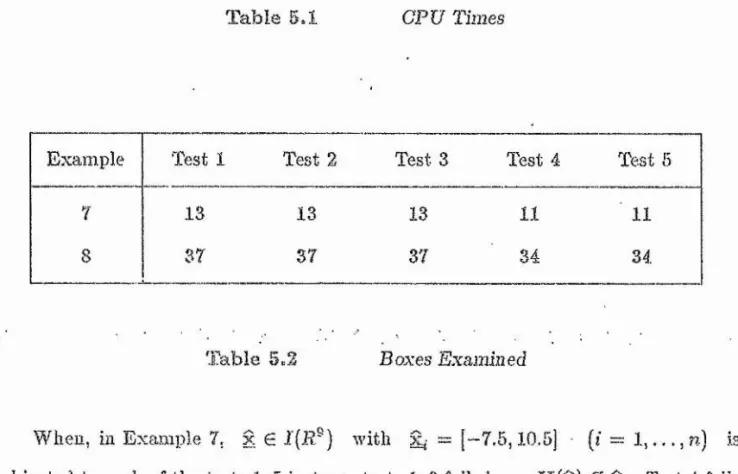
Tables 3..1-3.4 contain
the
CPU times, in seconds, required for the convergence criteria to be satisfied.In
Table 3.1 the SSS2 and M SS S3 algorithms are compared w ith the algorithm R E [Ale—72a]. In Table 3.2 the N S S S Î and N M S S S l algorithms are compared w ith the algorithm N R E *, which is obtained from the algorithm N R E [Ale—72a] by replacing m w ith . In Table 3.3 thealgorithms
ÏSSS1 and ÏM S B S 1 are compared w iththe
algorithmREIDK
[Ale—72a].In
Table 3.4. the algorithms IN S S S l and ÏN M S S S 1 are compared with the algorithmNRBIDK*
[Ale—-72a].
The algorithms
RE
andREIDK require the solution of several nonlinear equa
tions in one variable of the form a.x + jSd(n:) — 7 . Several iterative algorithms were tested. The most efHcient consists of computing x — ( j — j^d (^))/a ^ where x is a, given in itia l estimate of the required solution and x is taken to be the final estimate of the solution. It can be shown that this method generates convergent sequences for R E andREIDK
under easily satisfiable conditions.The in itia l iterates
are
computed, as suggested by Alefeld [Ale-72a], from= A -'- {Td{0) + c)
for the real algorithms, and from
= [ - a , a]
where
a ^ \ A - ^ (T d (0 )+ c )|,
The computational results which are contained in tables 3.1-3.4 together with results from several other numerical experiments suggest that the replacement of the
single-step
method w ith the symmetricsingle-step
method can leadto
significant reductions in GPU time.Example RE SSS2 M8SS3
4 / V £1=10“ ® /n~10 \ 8.4 G.G 5.8
6 / \ £1=10-® /\ 4.4 3.8 3.7
Table 8.1
Example N E E * NSSSl NMSSSl
4
C A V d
G
c r A - c
9.3 6.T 6.6
5.8 ■ 4.7 4.6
mo~10 l—b
- 43
Example
REIDK
ISSSl
IMSSSl
^
( ; = x o - .o
G
c r ix V j
76.8
66.8
62.4
55.9
.
89.6
39.4
Table 3.8
Example
NREIDK*
INSSSl
INMSSSl
4
/
\ ^2 — 10"^ 11— 1 0 \^
89.2
73.4
69.3
6 V $2=10-'!
/ n~16
\
)88.6
61.6
60.5
0 =5 i” 20
The Krawczyk-Moore aig:orithm for bounding an isolated zero of a given mapping / : —>• using interval arithm etic [Kra~“69a], [MoO“-77a], [Moo—T8a,], has been shov/n to be very
effective,
especially when combined w ith a Moore and Jones search procedure [MooJ-TTa], [Joii—TSa], [Jon-»80a]. Subsequently several authors have sug gested modifications of the Krawczyk-Moore algorithm which improve computational efficiency.Alefeld and Platzoder [AleP-83a] have introduced a quadratically convergent al gorithm, similar to the Krawczyk-Moore algorithm, which as they point out, requires less computational labour per iteration than does
the
Krawczyk-Moore algorithm.In
this thesis,KM
and A P denote the Krawczyk-Moore and Alefeld-Platzoder algo rithms respectively. A modification A P S W , of the algorithm A P , which is .similar to the modification K M W , of the algorithm K M , which has been suggested by Wolfe4 6
-4.1 P re lim in a rie s
Let A € M (R ^) and b € I {R^) be given. Let b) € I(R ’^) be the
result of applying the Gauss algorithm [AleH~83a] to the pair (A, b) . As explained by Alefeld and Platzoder [AleP-SSa], there exist matrices D i , . . . , 6 M j , î i , . . . , (£ , G i, . . . , G A f(R ^) dependent only on A such that
g A , b) = D i(T i(...
(D,,
(. '. (Gg(Gib). -
(4.1)
Therefore
w (5(A ,b)) = p i l iTil • • •
|Z?„| |G „-i| • • ■ IG2I |C?i| w (b)
= (b) (4.2)
where € A f(R ^) depends only on A .
Let K jv:I(R " )xf(M (R ''))xM (R " )-4'f(R '') be defined by
KjY(x,P,A) = m ( x ) - g A , { / ( m ( x ) ) - ( A - P ) ( x - m ( x ) ) } ) (4.3)
where A G M (R " ) is nonsingular, ^ : A-f(R” ) x I(R ") —+ I(R ” ) is as described previousl]:, and f : R^ is a given mapping. We have the following results.
Lemma-4.1 s . ' •
. •
• • '
(a) Let A G A4(R^^) be nonsingular. Then for b G R ”" arbitrary
(b) Let A e M { R ‘^) be nonsingular and let a ,b G l(.E ” ) be such that w (a) <
/9w (b) for some ^ > 0 . Then
w ( g A ,a ) ) < jdw ( g ( A ,b ) ) .
Proof : The proof of Lemma 4.1 is identical to that of [AleP-88a] Lemma 1.
Lem rna 4.3 i Suppose that f : D Ç R " R^^ is a given mapping with / € G ^(P ) . Let f : 1(D) — I(iV f(R ^)) be a continuous inclusion monotonie interval extension of f : D Af(R^^) . Let G 1(D) be given w ith w (x(^)) > 0 . If p(o) =r m ( f (x^^^)) is nonsingular and
W < aw ,
where a G [0,1) , then f'(x (°)) does not contain any singular matrices.
Proof : Tlie proof of Lemma 4.2 is identical to that of [AleP-SSa) Lemma 2. ^
Lem m a 4.3 :
(a) If x ,y G l(R ^ ^ ) and /? > 0 are such that w (y) < /?w (x) , F g I(A L (R ^ ))
A € A4(R^^ ) , and A~^ exists, then
47
(b )If F,G G I(M (R '')) arc such that G Ç E , xG Ï(R '" ), A E A 4(R ''),aud
A~~^ exists then
W (Kjy ( & G, A) ) < W ( K ( x , E, A)).
Proof :
fa) Lot
and
a = /(m (x)) - (A - F)(x - m (x)),
b = /(m (x)) - (A - F )(y - m ( ^ ) .
If w (y) < /9w (x) , then w (b) < (a) and by Lemma 4.1(b),
w (5 (A ,b )) < /?w ( g A , a ) ) ,
whence the result follows.
(b) Let
a = /(m (x)) - (A - F )(x - m (x)), and
b = /(m (x)) - (A - G )(x -- m (x)).
I f G. Ç F , then w (b) < w (a) and by Lemma 4.1(b) w ith $ ^ 1 ^
w ( g A ,b ) ) < w ( g A , a ) ) ,
Lem m a 4.4 s Suppose that f : D Ç ^ R
is
a givenmapping
with / G G^[D) . Let : 1(D) -h- I(A f(R ’*')) be an inclusion monotonie interval extension of f I D A4(R") . Suppose that 3D Ç D such that (Vx G 1(D)) ,m
( f (x))is
nonsingular. Supposealso
that 3A > 0 such that (Vx G 1(D )) ,||w (£'(x))|| < A ||w (x)||. (4.4)
Then > 0 such that (Vx G 1(D))
IIw ( i£ .v ( x ,f (x ),m ( f (x ))))|| < /ij|w (x )|f'.
Proof : The proof of Lemma
4.4
is similar to the proof of part (b) ofthe
theorem given by Alefeld and Platzoder [AleP-83aj, ^4 .2 T h e a lg o rith m J
Let / : D C R" R^ be a given mapping with / G D ^(D ) where D C D is an open convex set. Let f : 1(D) --1- I(R ^ ) and f : 1(D) —v J(M (R ^)) be continuous inclusion monotonie interval extensions of / : D —> and f : D
M(R^^) respectively. Let x G i'(D ) , a sequence of non-negative integers , and a G [0,1) be given. Then the algorithm A P S W for bounding an isolated zero of / in X is as follows.
A lg o rith m 4,1 (A P 8 W )
2. F.(°) :=
3.
:= m
4.
:= 3ç(°)
5. for m = 0 to
do
5.1.
:=
6. ;= x^°’*’*
7. A: := 1
8. wh ile tru e do
8
.
1
.
8.2. := m
8.3. uC^):=K^(x(^\F(^),A(*:))
8.4. :~ n
8.5. i f w ^ < aw th e n
8.5.1. gC:) := xC:)
8.5.2.
;=
8.5.3. for m = 1
to p('°) do8.5.3.1. ut*'”’) :=
K
j,,,(
x(*’’"),
f( * \
x(‘=))
5.5.3.2. %(*''"+:)
n x V ’"*)
8.5.4.
;=
8.5.5.
;=
8.5.6. v W :=
■ 8.5.7. %(*'^) := yW
8.5.8. for m = 1 to
do
8.5.8.1.
;=
5.5.8.2.
:=
n
8.5.9. ;= x(A,p"''+i)
.6. A; := A + 1
The algorithm
A P 8 W
differs from the algorithmA P
essentially in that the Jacobian is re-used times in the iteration. If —0 (VA
> 0) then A P 8 W andA P
are identical.T h eorem 4.1 : Let / : D Ç —»• be a given mapping w ith / G G^(D) where D C D is an open convex set. Let f : 1(D) i’(R ” ) and f : Î(D ) —> I(A f(R ”')) be inclusion monotonie interval extensions of / : D —> and / ' : D -+ M [ R ) respectively. Suppose that G 1(D) is such that w (x^^^) > 0 , that “ m (f^(x^®))) is nonsingular, and, that for some a G [0,1)
w (x(°) 1 f ' (x^°^ ), ^^°^ )) < A W . (4.5)
51
(Vx 6 1
(D))
l|w (£ '(x))|| < A ||w (x)i|
then for each > 0 , > 0 such that
w w j (V/c > 0).
(4.6)
I f A P S W terminates because an empty intersection occurs in one of the steps 5.1, 8.4, 8.5.3.2, 8.5.7 or 8.5.8.2, then there is no zero of / in .
Finally if, instead of (4.5),
(x((^)),BC))) C m t(x(^))
(4.7)
then (4.5) holds for some a G [0,1) , 3a;* G such that /(æ *) — 0 , and x* .(0)
IS unique m x '
Proof : From Lemma 4.2, ^ exists (VA > l) , and therefore the sequence (%(^) ) generated from A P S W is well defined provided no empty intersections occur.
The Krawczyk operator K : I(R.”') X M (F/^) I{R ^) is defined by
K (x , Y) ~ m (x) - F /( m (x)) + (J - Y f (x ))(x - m (x)).
By Lemma 4.1(a)
SO, if z* G x(^) , then G . By Lemma 4.1(a) and the inclusion mono
whence (æ* G (æ* G *"+ !)) . Therefore, by induction on m ,
Now by induction ou k ,
(æ* G A /(-P") = 0 ) (æ* G (VA > 0 )).
From the way is formed,
^(fc-i-i) _ ^(/c.,;?^ ^ + i) Ç C ' ' - C (VA > 0). (4.8)
We shall show that
w < R" w ^ (VA > i) . (4.9)
From (4.5), (4.9) holds for A — 1 . Assume that (4.9) holds for all A such that 0 ^ 5 ^ ' If is generated from steps B.5.5-8.5.9, then
So by (4.8),
w
53
Now is computed from steps 8.5J-8.5.4, so
w j < w ^K jy f ),
< a w ^ . (4.11)
We next show that
w ^ w ( j = 0 ,..., A — A). (4.12)
By (4.11), (4.12) holds for j = 0 . Now if (4.12) holds for some J , (0 < j < A - A) , then
Therefore, by finite induction on / , (4.12) holds for / = 0 ,..., A — A , Therefore
< w . (4,13)
Using (4.10) and (4.13), regardless of how is computed, we have
and so (4.9) holds (VA > 0) . So w (x(^)) -4- 0 (A —>'■ 00) , whence, because
X* G (VA > 0) , it follows that -+ a;* (A -+ 06) . • ' •
we have, by Lemma 4.4,
w .(k)
Further, since x(^,":+i) c K^y ), f^(x(^) ), ) it follows by a simple induc tive argument that
I < ju(^) w p^^'^+2
where
That there is no zero of / in if A P S W terminates due to an empty intersection follows from
e A /(a:*) = 0^ =>- G (VA > 0)^ .
Finally, if instead of (4.5), (4.7) holds then clearly (4,5) holds w ith
a = I^ w ^Kyy(%(°), f (%(°)) , y j^w ) ) . }
Also since
from Lemma 2.13, 3,t* G such that f [ x ) ~ 0 , and x* is unique in x(^) .
□
6 5
-4.3 Metho ds fo r determ ining th e number o f inner ite ra tio n s in K M W and A P 8 W
Computational experience w ith both K M W and A P S W has shown that the choice of the number of inner iterations, , greatly afl’ects the efficiency of both algorithms. Wolfe [W ol-80a] has considered choosing — p , (VA > O) , for some fixed integer p in the implementation of K M W , and has suggested that the optimal value for p might be estimated using techniques similar to those described by Brent [Bre—'fSa]. This is however difficult to implement; in practice. Hansen and Greenberg [HanG-83a] suggest re-using the Jacobian m atrix while the width of successive iterates is being sufficiently reduced. Unfortunately it is difficult to determine what constitutes a sufficient width reduction since this varies greatly from problem to problem.
In this section two methods which automatically select ,
independently of
the size and complexity of the systemof
equations, are presented. Assume that the iterate (A > 0, m > 1) has been computed, and that a reliable estimate of the relative efficienciesof
computing a new outer iterate, and that of computing a new inner iterate, can be obtained. Then whichever iterate is expected to be more efficient should be computed and the decision process repeated. Efficiency indices pjr and po corresponding to the computation of and4-1,1)
respectively
are given byPf =
— In ^ |w jw
) / T}
and
Pq = — In ^ w j I j w ^ j To,
^(fc+i,i) respectively from . Experience w ith both K M W and APSW has shown that the CPU time required to compute each outer iterate does not vary greatly w ith k , Therefore the CPU time for the next outer iterate could be estimated by the CPU time for the previous outer iterate. Similarly the CPU time for the next inner iterate could be estimated by the CPU time required to compute the last inner iterate.
Since we have not yet decided whether to compute or
the time of the decision process, we do not know the values of ||w j| and 11 w so these quantities must be estimated. From the theory for A P S W ,
w
M
Therefore
Similarly, if 3A > 0 such that ||w (f^(x))|| < A ||w (x)|| (V x G i {x^°^)) then,