extended mass function
Anne M. Green1,∗1School of Physics and Astronomy, University of Nottingham,
University Park, Nottingham, NG7 2RD, United Kingdom
(Dated: September 25, 2016)
The recent discovery of gravitational waves from mergers of ∼ 10M black hole binaries has stimulated interested in Primordial Black Hole dark matter in this mass range. Microlensing and dynamical constraints exclude all of the dark matter being in compact objects with a delta function mass function in the range 10−7 . M/M . 105. However it has been argued that all of the dark matter could be composed of compact objects in this range with an extended mass function. We explicitly recalculate the microlensing and dynamical constraints for compact objects with an extended mass function which replicates the PBH mass function produced by inflation models. We find that the microlensing and dynamical constraints place conflicting constraints on the width of the mass function, and do not find a mass function which satisfies both constraints.
I. INTRODUCTION
Primoridal black holes (PBHs) can form in the early Universe via the collapse of large density perturba-tions [1, 2] produced by a period of inflation [3]. PBHs with mass M &1015g will not have evaporated by the present day [4]. Since PBHs form before nucleosynthe-sis they are non-baryonic and are therefore a cold dark matter candidate [5]. There are various, mass dependent, constraints on the abundance of PBHs, from their lensing and dynamical effects, and also their effects on various astrophysical objects and processes. See Refs. [5–7] for compilations of these constraints.
Ref. [5] has highlighted three mass windows (at 1016− 1017g, 1020−1024g and 1−103M
) where PBHs could potentially make up all of the dark matter. The ob-servational constraints on the abundance of PBHs are usually calculated assuming a delta function mass func-tion, and exclude all of the dark matter being in PBHs of any single mass. Refs. [5, 8] have pointed out that an extended mass function, as is expected to be produced from the collapse of large inflationary density perturba-tions [9, 10], might still be compatible with all of the observational constraints. The constraints calculated as-suming a delta function mass function can not be di-rectly applied to an extended mass function however. In this paper we explicitly recalculate the constraints for extended mass functions which mimic those expected for PBHs produced by the collapse of inflationary density perturbations. We focus on the intermediate black hole mass range, 1−103M
, since there has been much recent interest in PBHs of this mass [11–13] in light of the dis-covery of gravitational waves from∼10MBH binaries by LIGO [14].
In Sec. II we review the microlensing [15] and dynami-cal [16] constraints on intermediate mass (1.M/M.
103 MAssive Compact Halo Objects. In Sec. III we re-calculate these constraints for extended differential halo fractions (DHFs) which mimic the DHFs found for PBHs produced from the collapse of large inflationary density perturbations in Ref. [5]. Finally we conclude with dis-cussion in Sec. IV.
II. CONSTRAINTS
We will consider the same two constraints considered in Ref. [5] for intermediate mass PBHs: microlensing [15] and dynamical heating of star clusters/ultra-faint dwarf galaxies [16]. There are other constraints on compact objects of this mass. Disruption of wide binaries exclude halo fractions,f =ρMACHO/ρDM, greater than unity for
M &100M [17–20]. However these constraints require assumptions about the initial distribution of the semi-major axes of the binaries, and also the smallest MA-CHO mass for which a delta function mass function is excluded depends on what sub-set of binaries is consid-ered [20]. The X-rays emitted due to accretion of gas onto multi-Solar mass PBHs would produce measurable changes in the spectrum and anisotropies of the Cos-mic Microwave Background radiation [21, 22]. However Ref. [11] argues that there are significant uncertainties as-sociated with modelling the complex physical processes involved. The strong gravitational lensing of extragalac-tic fast radio bursts will place tight limits on MACHOs in this mass range in the future [23].
A. Microlensing
parame-ter for which the amplification of the background star is above the required threshold and RE is the Einstein radius:
RE(x) = 2
GM x(1−x)L
c2
1/2
, (1)
whereLis the distance to the source,M is the MACHO mass andxis the distance of the MACHO from the ob-server, in units of L [24]. The distance to the LMC is much greater than its line of sight depth, so all of the source stars can be assumed to be at the same distance (∼ 50 kpc) and the angular distribution of sources ig-nored. For a non–delta function mass function ψ(M), defined so that the fraction, f, of the total mass of the halo in the form of MACHOs is
f =
Z ∞
0
ψ(M) dM , (2)
the differential event rate is [25–27]1:
dΓ dˆt =
32LuT ˆ t4v
c2
Z ∞
0
ψ(M) M
Z xh
0
ρ(x)R4E(x)e−Q(x)dx
dM ,
(3) where ˆt is the time taken to cross the Einstein diam-eter, xh ≈ 1 is the extent of the halo and Q(x) = 4R2E(x)u2T/(ˆt2vc2), wherevc = 220 km s−1 is the local cir-cular speed.
Microlensing analyses usually assume a standard halo, which consists of a cored isothermal sphere:
ρ(R) =ρ0
R2
c+R20
R2
c+R2
, (4)
with local dark matter densityρ0= 0.0079Mpc−3, core radiusRc≈5 kpc and Solar radiusR0≈8.5 kpc. Eq.(3) then becomes [27]
dΓ dˆt =
512ρ0(R2c+R20)LG2uT ˆ
t4v c2c4
×
Z ∞
0
ψ(M)M
Z xh
0
x2(1−x)2
A+Bx+x2e
−Q(x)dx
dM ,(5)
where A= (R2
c +R02)/L2, B =−2(R0/L) cosbcosl and
b = −33◦ and l = 280◦ are the galactic latitude and longitude, respectively, of the LMC.
The expected number of events,Nexp, is given by
Nexp=E
Z ∞
0 dΓ
dˆt (ˆt) dˆt , (6)
where E is the exposure in star years and (ˆt) is the detection efficiency i.e. the probability that a microlens-ing event with duration ˆt is detected. For the EROS-2 survey E = 3.77×10⁷ star years. The detection
1 This expression assumes a a spherical halo with an isotropic ve-locity distribution and ignores the transverse veve-locity of the mi-crolensing tube, which has a small effect on the differential event rate [25].
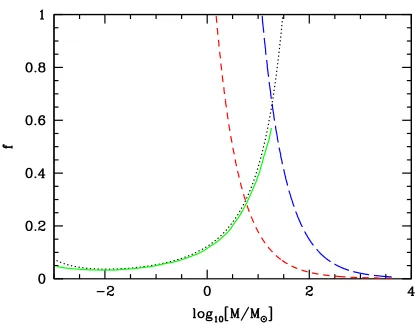
FIG. 1. The constraints on the halo fraction,f, of MACHOs as a function of mass, M, for a delta function mass func-tion. The green solid line is a digitisation of the result from the EROS-2 microlensing survey (bottom panel of Fig. 15 of Ref. [15]) and the black dotted line is our implementation of their constraint, as described in the text. The published EROS-2 limit stops atf∼0.6 because they only plot the limit for halo fractions in the range 0< f < 0.6. The short red and long blue dashed lines are from the disruption of the star cluster in Eridanus II and the heating of ultra-faint dwarfs respectively [16]. See the text for details
efficiency, in terms of Einstein radius crossing time, is given in Fig. 11 of Ref. [15] (and as stated in the figure caption is multiplied by a factor of 0.9 to take into ac-count lensing by binary lenses). No events were observed and the EROS collaboration calculate constraints on the halo fraction, f, for a delta function mass function (i.e. withψ(M) =δ(M)) by finding the value off for which Nexp = 3.0. Their results, from Fig. 15 of Ref. [15], are shown in Fig. 1 along with our implementation of their constraints. Our constraints are in good agreement with theirs for−3 <log10(M/M) <1. Tighter constraints can be obtained for log10(M/M)< −3 by considering the EROS-1 and MACHO data [28], however these data do not place tighter constraints on the multiple Solar mass PBHs that we are interested in. Marginally tighter constraints could be obtained for log10(M/M)>−2 by also considering the EROS-2 SMC data. However the one observed event is consistent with expectations from self-lensing (i.e. lensing by objects in the SMC itself) [29].
B. Dynamical constraints
Ref. [16] showed that MACHOs with M & 5M dy-namically heat the stars in star clusters or ultra-faint dwarf galaxies causing the half-light radius,rh, to evolve with time as
drh dt =
4√2πGf M
σ ln Λ
αM?
ρr2 h
+ 2βrh
−1
[image:2.612.339.547.53.216.2]whereσis the MACHO velocity dispersion,M?is the to-tal stellar mass,ρis the total dark matter density,αand β are parameters that depend on the mass distribution and ln Λ is the Coulomb logarithm
ln Λ≈ln
rhσ2
G(M+M)
. (8)
We follow Ref. [16] and takeα= 1 andβ= 10.
Ref. [16] found the constraints on the MACHO halo fraction,f, as a function of MACHO mass,M, from the disruption of theM? = 3000M star cluster [30] at the centre of Eridanus II [31, 32] and also from the observed sizes of the compact ultra-faint dwarf galaxies [31–34]. For the star cluster they found the constraints from re-quiring that
1. the timescale for the half-light radius to grow from rh,0 = 2 pc to the observed value, rh = 13 pc, is larger than the cluster age,
2. the timescale for the cluster to double in area is less than the cluster age.
In each case they considered two ages for the cluster, 3 and 12 Gyr which are at the lower and upper ends of the plausible range of values, and two different values for the dark matter density and velocity dispersion (1 & 0.02Mpc−3 and 5 & 10 km s−1 respectively). For the ultra-faint dwarfs they found the constraints from requiring that
1. the timescale to grow from rh,0 = 2 pc to the ob-served value,rh= 30 pc, is less than 10 Gyr,
2. the timescale to double in area is less than 10 Gyr,
forρ= 1Mpc−3 and σ= 5 & 10 km s−1. Apart from for the low density cases, ρ = 0.02Mpc−3, the Eri II star cluster disruption constraints are tighter than the ultra-faint dwarf constraints. However, as discussed in Ref. [16], it is possible that the star cluster constraints can be evaded, for instance if the star cluster has only recently inspiraled to the centre of Eri II, or if the star cluster’s apparent position at the centre is a projec-tion effect. The ultra-faint dwarf constraints are there-fore more robust. We consider the tightest constraint from the Eri II star cluster (which comes from consider-ing the timescale for the half-light radius to grow from rh,0 = 2 pc to rh = 13 pc and setting ρ = 1Mpc−3 and σ = 5 km s−1) and the weakest ultra-faint dwarf constraint (which comes from considering the timescale to grow from rh,0 = 2 pc to rh = 30 pc and setting
ρ = 1Mpc−3 and σ = 5 km s−1). These constraints are shown in Fig. 1.
Finally, generalising the dynamical heating calculation to a non-delta function mass function, Eq. (7) becomes
drh dt =
4√2πG σ
αM?
ρr2 h
+ 2βrh
−1Z ∞
0
ψ(M)Mln Λ dM .
(9)
III. EXTENDED MASS FUNCTIONS
As can be seen from Fig. 1, together the microlens-ing and dynamical constraints exclude MACHOs with a delta function mass function in the mass range 10−3 <
M/M<104 making up all of the dark matter (f = 1). However it has recently been pointed out that for mass ranges where a delta function mass function withf = 1 is excluded an extended mass function might still satisfy all of the constraints [5]. For PBHs produced from the collapse of large inflationary density perturbations an ex-tended mass function is expected, due to the spread in masses produced by critical collapse [9] and also, poten-tially, from a spread in formation times [10]. However, as emphasised in Ref. [5], an extended DHF can not be confronted with the observations by simply comparing it directly with the constraints on the halo fraction calcu-lated for a delta function. For instance if a constraint is independent ofM,f(M)< flim, in the rangeM1toM2, the integral of the DHF over this mass range must be less thanflim, and it is not possible to havef(M)∼flimfor MACHOs with multiple masses within this range.
Ref. [5] presents a technique for applying mass depen-dent PBH abundance constraints calculated assuming a delta function halo fraction to extended DHFs. They divide the relevant mass range into bins. First they in-tegrate the extended DHF within the lowest mass bin and compare the result with theweakestbound onf for a delta function halo fraction in this mass range. They then repeat the process for the first and second bins, first to third bins and so on until the whole mass range for whichf <1 has been covered. For the constraint on the upper part of the mass range the process is reversed i.e. first they integrate the extended DHF within the highest mass bin and compare the result with theweakestbound onffor a delta function mass function in this mass range. This process underestimates the strength of the con-straint, since apart from at one edge of the bin the obser-vational constraint is actually stronger than the consid-ered value. If a DHF is excluded by this process it is defi-nitely excluded, however some DHFs that are allowed by this method will in fact violate the constraint, and hence be excluded. For instance, some DHFs which are allowed when confronted with the microlensing delta function constraints using this method in fact produce Nexp >3 microlensing events, and are hence excluded. Conversely comparing the integral of the extended DHF with the tightest bound on f for a delta function halo fraction would overestimate the strength of the constraint. In that case a DHF which was allowed would definitely be allowed, however DHFs that were ruled out might actu-ally be consistent with the constraint.
To explicitly demonstrate this, we consider the EROS-2 microlensing limit in the mass range 10−2< M/M
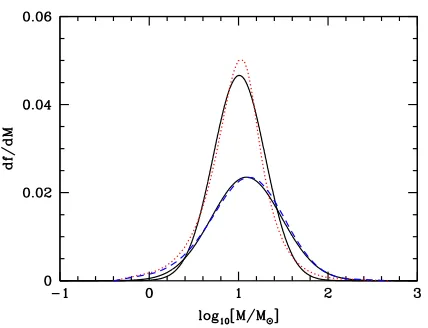
FIG. 2. The PBH DHF, df /dM, for the axion-curvaton (red dotted line) and running mass (blue dashed) inflation models from Ref. [5]. The black lines are the least squares fit of the functional form Eq. (10) to these DHFs. In all cases the DHFs integrate to unity (i.e. all of the halo dark matter is in the form of PBHs).
to the limit f < 0.036 for M = 10−2M
, while for
M = 10−1M, f < 0.053. We consider a top-hat
ex-tended mass function which is flat for 10−2 < M/M < 10−1 and zero elsewhere. If the amplitude is fixed so that f = 0.053 i.e. to match the weakest constraint on f in this mass range (as in the method presented in Ref. [5]) then the number of microlensing events expected isNexp = 3.6, which exceeds the limit. This confirms that that the method presented in Ref. [5] under-estimates the strength of the constraint. The largest halo fraction al-lowed for the top-hat extended DHF is in factf = 0.044, which is close to the mean of the values for a delta func-tion mass funcfunc-tion with mass at the upper and lower ends of the mass range considered.
Using the weakest value of the delta function limit leads to larger errors in mass regions where the delta function halo fraction limit varies rapidly with mass. It might be possible to devise a reliable way of applying the limits calculated for a delta function to extended DHFs in these regions, for instance by comparing with the ap-propriately mass-weighted average of the delta function limit. However to definitively ascertain whether or not a DHF is consistent with a given constraint, it is necessary to explicitly recalculate the constraint for that DHF.
[image:4.612.73.287.52.216.2]Fig. 6 of Ref. [5] shows two PBH DHFs, originating from axion curvaton (AC) and running-mass (RM) in-flation, which they find satisfy the EROS-2 microlens-ing and dynamical constraints usmicrolens-ing their method. Us-ing the expressions in Sec. II A, for the number of mi-crolensing events produced by an extended DHF, we find that these DHFs would have produced 5.5 (AC) and 4.1 (RM) microlensing events in the EROS-2 survey. There-fore they are both excluded by the EROS-2 microlensing constraint alone. Integrating Eq. (9) we find that these extended DHFs would produce excessive heating of the
FIG. 3. Constraints on the width, σ, of the DHF func-tional form, eq. (10), as a function of the central massMc. Parameter values in the red hatched area in the bottom left produceNexp≥3 microlensing events in the EROS-2 survey and are excluded at 95% confidence. The blue hatched area in the top right is excluded by the heating of ultra-faint dwarfs. The constraint from the disruption of the star cluster in Eri II is tighter and excludes a large region of parameter space
Eri II star cluster within 1.1 (AC) and 0.7 Gyr (RM) and of ultra-faint dwarf galaxies within 5.8 (AC) and 3.8.Gyr (RM). Therefore these two DHFs each produce too many microlensing events and also excessively heat ultra-faint dwarfs, and are hence excluded by both constraints indi-vidually.
In order to explore whether extended DHFs can sat-isfy both the microlensing and dynamical constraints we consider a functional form for the DHF
ψ(M)≡ df
dM =Nexp
−(logM −logMc)
2
2σ2
. (10)
whereN is a normalisation constant chosen so that the DHF is normalised to unity 2. The least squares fits of Eq. (10) to the axion curvaton and running-mass inflation DHFs from Ref. [5] are shown in Fig. 2. The numbers of microlensing events and disruption time-scales for the best-fit functional forms differ from those of the original DHFs by less than 10%, indicating that Eq. (10) is a reasonable approximation to the PBH DHF produced by these inflation models.
Fig. 3 shows the σ and Mc values excluded by mi-crolensing and the weakest ultra-faint dwarf heating con-straint. The requirement that the DHF producesNexp ≤ 3 microlensing events in the EROS-2 survey places a lower limit on σ for Mc < 30M, i.e. narrow DHFs
[image:4.612.341.546.54.216.2]FIG. 4. The differential PBH halo fraction, df /dM, for the axion-curvaton (dotted red line) inflation model from Ref. [5] compared with the broadest differential halo fraction, cen-tered at the same mass, which satisfies the ultra-faint dwarf disruption constraint (solid green) and the narrowest differ-ential halo fraction which satisfies the EROS-2 microlensing constraint (dashed black).
are excluded. On the other-hand the dynamical heat-ing constraints place an upper limit on σ (i.e. broad halo DHFs are excluded), and for the weakest ultra-faint dwarf constraint a delta function mass function is ex-cluded forM >12M. These two competing constraints on the width of the DHF overlap, and there is no width and central mass for which both constraints are satis-fied. For the tightest Eri II star cluster constrain a delta function halo function is excluded for M > 1.5M and the overlap between the microlensing and dynamical con-straints is even larger.
To illustrate the conflict between the constraints, in Fig. 4 we compare the PBH DHF from the axion cur-vaton inflation model from Ref. [5], with the broadest DHF (centered at the same mass) which satisfies the ultra-faint dwarf disruption constraint and the narrowest DHF which satisfies the EROS-2 microlensing constraint. The axion curvaton DHF is significantly broader than the broadest DHF which satisfies the ultra-faint dwarf disruption constraint and significantly narrower than the narrowest DHF which satisfies the EROS-2 microlensing constraint. It is therefore clearly excluded by both con-straints.
IV. DISCUSSION
Microlensing surveys [15, 28] constrain the halo frac-tion of MACHOs with 10−7 < M/M
< 10, while
dy-namical heating constraints are sensitive to M/M & 10 [16]. Together they exclude MACHOs with 10−7 <
M/M < 105 and a delta function mass function from making up all of the dark matter. However Refs. [5, 8] have pointed out that MACHOs with an extended mass function, as expected for PBHs formed from the collapse of large inflationary density perturbations [9, 10], might be compatible with these constraints. Furthermore inter-est in PBHs withM ∼10M [11–13] has recently been stimulated by the discovery of gravitational waves from massive black hole mergers by LIGO [14].
We have explicitly calculated the microlensing and dy-namical constraints for the DHFs found for PBHs pro-duced by two inflation models in Ref. [5] and also for a variable width DHF which replicates their shape. The DHFs studied in Ref. [5] both produce Nexp > 3 mi-crolensing events in EROS-2 and also cause excessive dy-namical heating of ultra-faint dwarf galaxies. In gen-eral we find that the dynamical constraints place a (cen-tral mass dependent) upper limit on the width of the DHF (i.e. wide distributions are excluded), while the mi-crolensing constraints place a (central mass dependent) lower limit on the width of the DHF (i.e. narrow dis-tributions are excluded). These constraints overlap and there are no parameter values which satisfy both the mi-crolensing limt and the weakest ultra-faint dwarf heating limit.
We have not proved that there is no extended DHF, with all of the dark matter in compact objects in a single mass range, which can satisfy both the microlensing and dynamical constraints. However we have shown that
• to ascertain whether an extended DHF satisfies the microlensing and dynamical constraints it is neces-sary to recalculate the limits for the specific mass function, rather than using the limits derived for a delta function mass function,
• generic DHFs, which replicate the PBH distribu-tions produced by inflation models, can not simul-taneously satisfying the EROS-2 microlensing con-straint and also the weakest ultra-faint dwarf heat-ing limit.
ACKNOWLEDGMENTS
A.M.G. acknowledges support from STFC grant ST/L000393/1 and is grateful to Marit Sandstad for use-ful comments that have improved the presentation of the manuscript.
[1] B. J. Carr and S. W. Hawking, Mon. Not. Roy. Astron. Soc.168(1974) 399.
[3] B. J. Carr and J. E. Lidsey, Phys. Rev. D48(1993) 543. [4] B. J. Carr, Astrophys. J.206(1976) 8.
[5] B. Carr, F. Kuhnel and M. Sandstad, arXiv:1607.06077 [astro-ph.CO].
[6] B. J. Carr, K. Kohri, Y. Sendouda and J. Yokoyama, Phys. Rev. D81(2010) 104019 [arXiv:0912.5297 [astro-ph.CO]].
[7] A. M. Green, Fundam. Theor. Phys. 178 (2015) 129 [arXiv:1403.1198 [gr-qc]].
[8] S. Clesse and J. Garca-Bellido, Phys. Rev. D 92 (2015) no.2, 023524 doi:10.1103/PhysRevD.92.023524 [arXiv:1501.07565 [astro-ph.CO]].
[9] J. C. Niemeyer and K. Jedamzik, Phys. Rev. Lett. 80 (1998) 5481 [astro-ph/9709072].
[10] F. Khnel, C. Rampf and M. Sandstad, Eur. Phys. J. C 76(2016) no.2, 93 [arXiv:1512.00488 [astro-ph.CO]]. [11] S. Bird, I. Cholis, J. B. Muoz, Y. Ali-Hamoud,
M. Kamionkowski, E. D. Kovetz, A. Raccanelli and A. G. Riess, Phys. Rev. Lett.116(2016) no.20, 201301 [arXiv:1603.00464 [astro-ph.CO]].
[12] S. Clesse and J. Garca-Bellido, arXiv:1603.05234 [astro-ph.CO].
[13] M. Sasaki, T. Suyama, T. Tanaka and S. Yokoyama, Phys. Rev. Lett. 117 (2016) no.6, 061101 [arXiv:1603.08338 [astro-ph.CO]].
[14] B. P. Abbott et al. [LIGO Scientific and Virgo Col-laborations], Phys. Rev. Lett. 116(2016) no.6, 061102 [arXiv:1602.03837 [gr-qc]].
[15] P. Tisserandet al.[EROS-2 Collaboration], Astron. As-trophys.469(2007) 387 [astro-ph/0607207].
[16] T. D. Brandt, Astrophys. J. 824 (2016) no.2, L31 [arXiv:1605.03665 [astro-ph.GA]].
[17] J. Chaname and A. Gould, Astrophys. J.601(2004) 289 [astro-ph/0307434].
[18] J. Yoo, J. Chaname and A. Gould, Astrophys. J. 601 (2004) 311 [astro-ph/0307437].
[19] D. P. Quinn, M. I. Wilkinson, M. J. Irwin, J. Marshall, A. Koch and V. Belokurov, Mon. Not. Roy. Astron. Soc. 396(2009) 11 [arXiv:0903.1644 [astro-ph.GA]].
[20] M. A. Monroy-Rodrguez and C. Allen, Astrophys. J.790 (2014) no.2, 159 [arXiv:1406.5169 [astro-ph.GA]]. [21] M. Ricotti, J. P. Ostriker and K. J. Mack, Astrophys. J.
680(2008) 829 [arXiv:0709.0524 [astro-ph]].
[22] L. Chen, Q. G. Huang and K. Wang, arXiv:1608.02174 [astro-ph.CO].
[23] J. B. Muoz, E. D. Kovetz, L. Dai and M. Kamionkowski, Phys. Rev. Lett. 117 (2016) 091301 [arXiv:1605.00008 [astro-ph.CO]].
[24] B. Paczynski, Astrophys. J.304(1986) 1. [25] K. Griest, Astrophys. J.366(1991) 412.
[26] A. De Rujula, P. Jetzer and E. Masso, Mon. Not. Roy. Astron. Soc.250(1991) 348.
[27] C. Alcocket al.[MACHO Collaboration], Astrophys. J. 486(1997) 697 [astro-ph/9606165].
[28] C. Alcock et al. [MACHO and EROS Collaborations], Astrophys. J.499(1998) L9 [astro-ph/9803082]. [29] D. S. Graff and L. T. Gardiner, Mon. Not. Roy. Astron.
Soc.307(1999) 577 [astro-ph/9811394].
[30] D. Crnojevic, D. J. Sand, D. Zaritsky, K. Spekkens, B. Willman, J. R. Hargis, Astrophys. J.824(2016) no. 1, L14 [arXiv:1604.08590]
[31] S. E. Koposov, V. Belokurov, G. Torrealba and N. W. Evans, Astrophys. J. 805 (2015) no.2, 130 [arXiv:1503.02079 [astro-ph.GA]].
[32] K. Bechtolet al.[DES Collaboration], Astrophys. J.807 (2015) no.1, 50 [arXiv:1503.02584 [astro-ph.GA]]. [33] J. D. Simon and M. Geha, Astrophys. J.670(2007) 313
[arXiv:0706.0516 [astro-ph]].