Anveshan: A Framework for Analysis of Multiple Annotators’ Labeling
Behavior
Vikas Bhardwaj,
Rebecca J. Passonneau and Ansaf Salleb-Aouissi
Columbia University New York, NY, USA
(becky@cs|ansaf@ccls).columbia.edu
Nancy Ide
Vassar College Poughkeepsie, NY, USA
Abstract
Manual annotation of natural language to capture linguistic information is essen-tial for NLP tasks involving supervised machine learning of semantic knowledge. Judgements of meaning can be more or less subjective, in which case instead of a single correct label, the labels assigned might vary among annotators based on the annotators’ knowledge, age, gender, intu-itions, background, and so on. We intro-duce a framework ”Anveshan,” where we investigate annotator behavior to find out-liers, cluster annotators by behavior, and identify confusable labels. We also in-vestigate the effectiveness of using trained annotators versus a larger number of un-trained annotators on a word sense annota-tion task. The annotaannota-tion data comes from a word sense disambiguation task for pol-ysemous words, annotated by both trained annotators and untrained annotators from Amazon’s Mechanical turk. Our results show that Anveshan is effective in uncov-ering patterns in annotator behavior, and we also show that trained annotators are superior to a larger number of untrained annotators for this task.
1 Credits
This work was supported by a research supple-ment to the National Science Foundation CRI award 0708952.
2 Introduction
Manual annotation of language data in order to capture linguistic knowledge has become increas-ingly important for semantic and pragmatic an-notation tasks. A very short list of a few such tasks illustrates the range of types of annotation,
in varying stages of development: predicate ar-gument structure (Palmer et al., 2005b), dialogue acts (Hu et al., 2009), discourse structure (Carbone et al., 2004), opinion (Wiebe and Cardie, 2005), emotion (Alm et al., 2005). The number of ef-forts to create corpus resources that include man-ual annotations has also been growing. A common approach in assessing the resulting manual anno-tations is to report a single quantitative measure reflecting the quality of the annotations, either a summary statistic such as percent agreement, or an agreement coefficient from the family of met-rics that include Krippendorff’s alpha (Krippen-dorff, 1980) and Cohen’s kappa (Cohen, 1960). We present some new assessment methods to use in combination with an agreement coefficient for understanding annotator behavior when there are multiple annotators and many annotation values.
Anveshan (Annotation Variance Estimation)1is a suite of procedures for analyzing patterns of agreement and disagreement among annotators, as well as the distributions of annotation values across annotators. Anveshan thus makes it pos-sible to explore annotator behavior in more detail. Currently, it includes three types of analysis: inter-annotator agreement (IA) among all subsets of an-notators, leverage of annotation values for outlier detection, and metrics for comparing annotators’ distributions of annotation values (e.g., Kullbach-Liebler divergence).
As an illustration of the utility of Anveshan, we compare two groups of annotators on the same an-notation word sense anan-notation tasks: a half dozen trained annotators and fourteen Mechanical Turk-ers. Previous work has argued that it can be cost effective to collect multiple labels from untrained labelers at a low cost per label, and to combine the multiple labels through a voting method, rather than to collect single labels from highly trained
la-1Anveshan is a Sanskrit word which literally means
search or exploration.
belers (Snow et al., 2008; Sheng et al., 2008; Lam and Stork, 2003). The tasks included in (Snow et al., 2008), for example, include word sense an-notation; in contrast to our case, where the av-erage number of senses per word is 9.5, the one word sense annotation task had three senses. We find that the same half dozen trained annotators can agree well or not on sense labels for poly-semous words. When they agree less well, we find that it is possible to distinguish between prob-lems in the labels (e.g., confusable senses) and systematic differences of interpretation among an-notators. When we use twice the number of Me-chanical Turkers as trained annotators for three of our ten polysemous words, we find inconsistent re-sults.
The next section of the paper presents the moti-vation for Anveshan and its relevance to the word sense annotation task, followed by a section on related work. The word sense annotation data is given in section 5. Anveshan is described in the subsequent section, followed by the results of its application to the two data sets. We discuss the comparison of trained annotators and Mechanical Turkers, as well as differences among words, in section 7. Section 7 concludes with a short recap of Anveshan in general, and its application to word sense annotations in particular.
3 Beyond Interannotator Agreement (IA)
Assessing the reliability of an annotation typically addresses the question of whether different anno-tators (effectively) assign the same annotation la-bels. Various measures can be used to compare different annotators, including agreement coeffi-cients such as Krippendorff’s alpha (Krippendorff, 1980). Extensive reviews of the properties of such coefficients have been presented elsewhere, e.g., (Artstein and Poesio, 2008). Briefly, an agree-ment produce values in the interval [-1,1] indicat-ing how much of the observed agreement is above (or below) agreement that would be predicted by chance (value of 0). To measure reliability in this way is to assume that for most of the instances in the data, there is a single correct response. Here we present the use of reliability metrics and other measures for word sense annotation, and we as-sume that in some cases there may not be a single correct response. When annotators have less than excellent agreement, we aim to examine possible causes.
We take word sense to be a problematic anno-tation to perform, thus requiring a deeper under-standing of the conditions under which annotators might disagree. The many reasons can only be touched on here. For example, word senses are not discrete, atomic units that can be delimited and enumerated. While dictionaries and other lexical resoures, such as WordNet (Miller et al., 1993) or the Hector lexicon (cf. SENSEVAL-1 (Kilgarriff and Palmer, 2000)), do provide enumerations of the senses for a given word, and their interrela-tions (e.g., a list of senses, a tree of senses), it is widely agreed that this is a convenient abstraction, if for no other reason than the fact that words shift meanings along with the communicative needs of the groups of individuals who use them. The con-text in which a word is used plays a significant role in restricting the current sense. As a result, it is often argued that the best representation for word meaning would consist in clustering the contexts in which words are used (Kilgarriff, 1997). Yet even this would be insufficient because new com-munities arise, new behaviors and artifacts emerge along with them, hence new contexts of use and new clusters. At the same time, contexts of use and the senses that go along with them can fade away (cf. the use ofhandbagdiscussed in (Kilgar-riff, 1997) pertaining to disco dancing). Because an enumeration of word senses is somewhat arti-ficial, annotators might disagree on word senses because they disagree on the boundaries between one sense and another, just as professional lexi-cographers do.
Apart from the artificiality of creating flat or hierarchical sense inventories, the meanings of words can vary in their subjectivity, due to differ-ences in the perception or experience of individu-als. This can be true for word senses that are inher-ently relative, such ascold(as in,turn up the ther-mostat, it’s too cold in here); or that derive their meaning from cultural norms that may differ from community to community, such asjustice; or that change as one grows older, e.g., whether a long time to waitpertains to hours versus days.
un-derstand reasons for disagreement on senses, we collect labels from multiple annotators. When an-notators agree, having multiple anan-notators is re-dundant. But when annotators disagree, having multiple annotators is necessary in order to de-termine whether the disagreement is due to noise based on insufficiently clear sense definitions ver-sus a systematic difference between individuals, e.g., those who see a glass as half empty where others see it as half full. To insure the opportu-nity to observe how varied the labeling of a single word can be, we collect word sense annotations from multiple annotators. One potential benefit of such investigation might be a better understanding of how to model word meaning.
In sum, we hypothesize the following cases:
• Outliers: A small proportion of annotators may assign senses in a manner that differs markedly from the remaining annotators.
• Confusability of senses: If multiple annota-tors assign multiple senses in an apparently random fashion, it may be that the senses are not sufficiently distinct.
• Systematic differences among subsets of an-notators: If the same 50% of annotators al-ways pick senseX where the remaining an-notators always pick sense Y, it may be that properties of the annotators, such as their age cohort, account for the disagreement.
4 Related Work
There has been a decade-long community-wide ef-fort to evaluate word sense disambiguation (WSD) systems across languages in the four Senseval ef-forts (1998, 2001, 2004, and 2007, cf. (Kilgarriff, 1998; Pedersen, 2002a; Pedersen, 2002b; Palmer et al., 2005a)), with a corollary effort to investi-gate the issues pertaining to preparation of man-ually annotated gold standard corpora tagged for word senses (Palmer et al., 2005a).
Differences in IA and system performance across part-of-speech have been examined, as in (Ng et al., 1999; Palmer et al., 2005a). Fac-tors that have been proposed as affecting agree-ment include whether annotators are allowed to as-sign multilabels (V´eronis, 1998; Ide et al., 2002; Passonneau et al., 2006), the number or granu-larity of senses (Ng et al., 1999), merging of re-lated senses (Snow et al., 2007), sense similar-ity (Chugur et al., 2002), entropy (Diab, 2004;
Palmer et al., 2005a), and reactions times required to distinguish senses (Klein and Murphy, 2002; Ide and Wilks, 2006).
We anticipate that one of the ways in which the data will be used will be to train machine learning approaches to WSD. Noise in labeling and the im-pact on machine learning has been discussed from various perspectives. In (Reidsma and Carletta, 2008), it is argued that machine learning perfor-mance does not vary consistently with interannota-tor agreement. Through a simulation study, the au-thors find that machine learning performance can degrade or not with lower agreement, depending on whether the disagreement is due to noise or sys-tematic behavior. Noise has relatively little impact compared with systematic disagreements. In (Pas-sonneau et al., 2008), a similar lack of correla-tion between interannotator agreement and ma-chine learning performance is found in an empiri-cal investigation.
5 Word Sense Annotation Data
5.1 Trained Annotator data
The Manually Annotated Sub-Corpus (MASC) project (Ide et al., 2010) is creating a small, representative corpus of American English written and spoken texts drawn from the Open American National Corpus (OANC).2 The MASC corpus includes hand-validated or manual annotations for a variety of linguistic phenomena. The first MASC release, available as of May 2010, consists of 82K words.3 One of the goals of MASC is to support efforts to harmonize WordNet (Miller et al., 1993) and FrameNet (Ruppenhofer et al., 2006), in order to bring the sense distinctions each makes into better alignment.
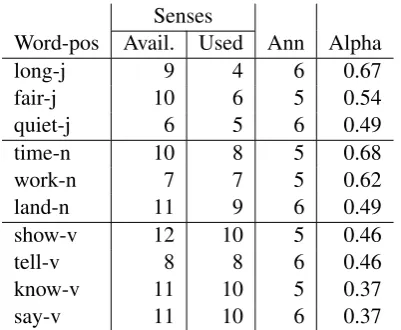
We chose ten fairly frequent, moderately poly-semous words for sense tagging. One hundred oc-currences of each word were sense annotated by five or six trained annotators. The ten words are shown in Table 1, the words are grouped by part of speech, with the number of WordNet senses, the number of senses used by the trained annotators (TAs), the number of annotators, and Alpha. We call this the Trained annotator (TA) data.
We find that interannotator agreement (IA) among half a dozen annotators varies depending on the word. For ten words nearly balanced with
2
http://www.anc.org
Senses
Word-pos Avail. Used Ann Alpha
long-j 9 4 6 0.67
fair-j 10 6 5 0.54
quiet-j 6 5 6 0.49
time-n 10 8 5 0.68
work-n 7 7 5 0.62
land-n 11 9 6 0.49
show-v 12 10 5 0.46
tell-v 8 8 6 0.46
know-v 11 10 5 0.37
[image:4.595.82.283.61.226.2]say-v 11 10 6 0.37
Table 1: Interannotator agreement on ten poly-semous words: three adjectives, three nouns and four verbs among trained annotators
respect to part of speech, we find a range of about 0.50 to 0.70 for nouns and adjectives, and about 0.37 to 0.46 for verbs. Table 1 shows the ten words and the alpha scores for the same five or six an-notators. The layout of the table illustrates both that verbs have lower agreement than adjectives or nouns, and that within each part of speech, an-notators achieve varying levels of agreement, de-pending on the word. The annotators, their level of training, the number of sense choices, the anno-tation tool, and other factors remain constant from word to word. Thus we hypothesize that the differ-ences in IA reflect differdiffer-ences in the degree of sub-jectivity of the sense choices, the sense similarity, or both. Anveshan is a data exploration framework to help understand the differences in the ability of the same annotators to agree well on sense anno-tation for some words and not others.
As shown, annotators achieve respectable agreement on long, time and work, and lower agreement on the remaining words. Verbs have lower agreement overall.
Figure 1 shows WordNet senses forlongin the form displayed to annotators, who used an annota-tion GUI developed in Java. The sense number ap-pears in the first column, followed by the glosses, then sample phrases; only three senses are shown, to conserve space. Note that annotators did not see the WordNet synsets (sets of synonymous words) for a given sense.
5.2 Mechanical Turk data
Amazon’s Mechanical Turk is a crowd-sourcing marketplace where Human Intelligence Tasks
Senses
Word-pos Avail. Used Ann Alpha
long-j 9 9 14 0.15
fair-j 10 10 14 0.25
[image:4.595.317.518.62.132.2]quiet-j 6 6 15 0.08
Table 2: Interannotator agreement on adjectives among Mechanical Turk annotators
(HITs) such as sense annotation for words in a sentence, can be set up and results from a large number of annotators (or turkers) can be obtained quickly. We used Mechanical Turk to obtain anno-tations from 14 annotators on the set of adjectives to analyze IA for a larger set of untrained annota-tors.
The task was set up to get 150 occurrences an-notated for each of the three adjectives: fair,long andquiet, by 14 mechanical turk annotators each. 100 of these occurrences were the same as those done by the trained annotators. For each word, the 150 instances were divided into 15 HITs of 10 instances each. The average submit time of a HIT was 200 seconds. We report the IA among the Me-chanical Turk annotators using Krippendorff’s Al-pha in Table 2. As shown, the turkers have poor agreement, particularly on longand quiet, which is at the chance level.
6 Anveshan
Anveshan: Annotation Variance Estimation, is
our approach to perform a more subtle analysis of inter-annotator agreement. Anveshan uses sim-ple statistical methods to achieve the three goals identified in section 3: outlier detection, confus-able senses, and distinct subsets of annotators that agree with each other.
6.1 Method
This section uses the following notation to explain Anveshan’s methodology:
We assume that we havenannotators annotat-ingmsenses. The probability of annotatorausing sensesiis given by
Pa(S =si) =
count(si, a)
Pm
j=1count(sj, a)
where, count(si, a) is number of times si was
1 primarily temporal sense; being or indicating a relatively great or greater than average duration or passage of time or a duration as specified: “a long life”; “a long boring speech”; “a long time”; “a long friendship”;
“a long game”; “long ago”; “an hour long”
2 primarily spatial sense; of relatively great or greater than average spatial extension or extension as specified: “a long road”; “a long distance”; “contained many long words”; “ten miles long”
[image:5.595.308.525.164.283.2]3 of relatively great height: “a race of long gaunt men” (Sherwood Anderson); “looked out the long French windows”
Figure 1: Three of the WordNet senses for ”Long”
Anveshan uses the Kullbach-Liebler divergence (KLD), Jensen-Shannon divergence (JSD) and Leverage to compare probability distributions. The KLD of two probability distributions P and
Qis given by:
KLD(P, Q) =X
i
P(i) logP(i)
Q(i)
JSD is a modified version of KLD, it is also known as total divergence to the average, and is given by:
J SD(P, Q) = 1
2KLD(P, M) +
1
2KLD(Q, M)
where
M = (P +Q)/2
We define LeverageLevof probability distribu-tion P over Q as:
Lev(P, Q) =X
k
|P(k)−Q(k)|
We now compute the following statistics:
• For each annotatorai, we computePai.
• We computePavg, which is(PiPai)/n.
• We computeLev(Pai, Pavg),∀i
• Then we compute J SD(Pai, Paj) ∀(i, j),
wherei, j≤nandi6=j
• Lastly, we compute a distance measure for each annotator, by computing the KLD be-tween each annotator and the average of the remaining annotators, i.e. we get
∀i, Dai = KLD(Pai, Q), where Q =
(P
j6=iPaj)/(n−1)
These statistics give us a deeper understanding of annotator behavior. Looking at the sense us-age probabilities, we can identify how frequently senses are used by an annotator. We can see how much an annotator deviates from the average sense
0 0.2 0.4 0.6 0.8 1
[image:5.595.307.507.337.433.2]A107 A101 A103 A102 A105 A108
Figure 2: Distance measure (KLD) for Annotators oflongin TA Data
0 0.2 0.4 0.6 0.8
A101 A102 A103 A105 A107 A108
101 102 999 103 108
Figure 3: Sense Usage distribution forlongby an-notators in TA Data
usage distribution by looking at Leverage. JSD be-tween two annotators gives us a measure of how close they are to each other. KLD of an annota-tor with the remaining annotaannota-tors shows us how different the annotator is from the rest. In the fol-lowing section we show results, which illustrate the effectiveness of Anveshan in identifying use-ful patterns in the data from the trained annotators (TAs) and Mechanical Turkers (MTs).
6.2 Results
Word Old Alpha Ann Dropped New Alpha
long 0.67 1 0.80
land 0.49 1 0.54
know 0.377 1 0.48
tell 0.45 2 0.52
say 0.37 2 0.44
[image:6.595.308.526.62.158.2]fair 0.54 2 0.63
Table 3: Increase in IA score by dropping annota-tors (TA Data)
0 0.05 0.1 0.15 0.2 0.25
105 102 104 103 101 999 108 106 107 110 109
[image:6.595.72.294.62.159.2]A102 A105
Figure 4: Sense usage patterns of annotators ‘102’ and ‘105’ forshowin TA Data
number. An additional “None of the Above” label is represented as 999; annotators select this when no sense applies, when the word occurs as part of a large lexical unit (collocation) with a clearly dis-tinct meaning, or when the sentence is not a cor-rect example for other reasons (e.g., wrong part of speech).
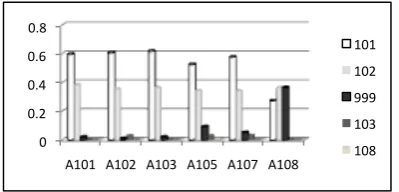
Figure 2 shows the distance measure (KLD) for each annotator from the rest of the annotators for the word long with respect to the probability for each of the four senses used (cf. Table 1). It can be clearly seen that annotator A108 is an outlier. A108 differs in her excessive use of label 999, as shown in Figure 3. Indeed, by dropping A108, we see that the IA score (Alpha) jumps from 0.67 to 0.8 for long. Similar results were obtained for annotations for other words as well. Table 3 shows the jump in IA score after outlier(s) were dropped.
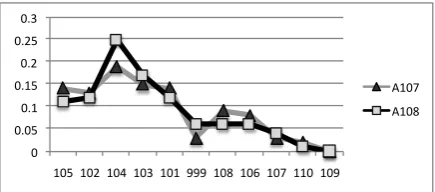
Anveshan helps us differentiate between noisy disagreement versus systematic disagreement. The word show with 5 annotators has a low agreement score of 0.45. By looking at the sense distributions for the various annotators, and observing annotation preferences for each annotator, we can see that annotators A102 and A105 have similar behavior (Figure 4, with a pairwise alpha of 0.52 versus 0.46 for all five
0 0.05 0.1 0.15 0.2 0.25 0.3
105 102 104 103 101 999 108 106 107 110 109
[image:6.595.73.292.212.310.2]A107 A108
Figure 5: Sense usage patterns of annotators ‘107’ and ‘108’ forshowin TA Data
0 0.05 0.1 0.15 0.2 0.25 0.3 0.35
105 102 104 103 101 999 108 106 107 110 109
Overall A101
Figure 6: Sense usage distribution of annotator ‘101’ vs. the average of all annotators for show in TA Data
annotators), and annotators A107 and A108 have similar behavior (Figure 5, with a pairwise alpha of 0.53). In contrast, Annotator A101 has very distinct preferences (Figure 6). This behavior is captured by computing JSD scores among all pairs of annotators. As can be seen in Figure 7, the pairs A102-A105 and A107-A108 have very low JSD values, indicating similarity in annotator behavior. At the same time we also see the pairs having A101 in them have a much higher JSD score, which is attributed to the fact that A101 is different from everyone else. If we look at corresponding Alpha scores, we see that pairs having low JSD values have higher agreement scores and vice versa.
[image:6.595.308.527.214.306.2]0 0.1 0.2 0.3 0.4 0.5 0.6
A105 A108 A105 A102 A107 A108
A102 A107 A101 A101 A101 A101
[image:7.595.306.527.61.161.2]JSD Alpha
Figure 7: JSD and Alpha scores for pairs of anno-tators forshowin TA Data
0 0.1 0.2 0.3 0.4 0.5 0.6
Overall A101 A103
[image:7.595.73.292.90.223.2]102 101 108 103
Figure 8: Sense usage distribution forsay in TA Data for annotators ‘101’ and ‘103’
0 0.05 0.1 0.15 0.2 0.25 0.3 0.35
A102 A105 A108 A101 A107
Figure 9: Distance measure (KLD) for annotators ofworkin TA Data
0 0.2 0.4 0.6 0.8 1 1.2
[image:7.595.308.526.210.325.2]Overall A101 A102 A104 A107 A108 A111 A112 A115 A116 A117 A118 A119 A120 A121 106 109 999 108 103 102 101
Figure 10: Sense usage distribution among MTs forlong
0 0.2 0.4 0.6 0.8 1 1.2
A101 -‐TA
A102 -‐TA
A103 -‐TA
A104 -‐TA
A105 -‐TA
A102 -‐MT
A106 -‐MT
A107 -‐MT
A108 -‐MT
A114 -‐MT
105 999 102 101
Figure 11: Sense usage distribution among TAs and MTs forfair
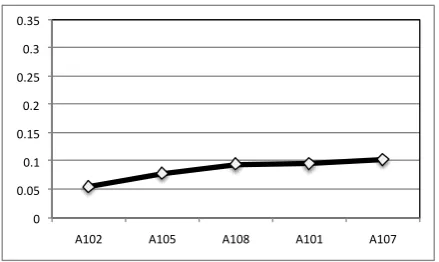
Anveshan not only helps us understand under-lying patterns in annotator behavior and remove noise from IA scores, but also helps identify cases where there is no noise and no systematic subsets of annotators that agree with each other. An example can be seen in for the nounwork. We observed that the annotators do not have largely different behavior, which is reflected in Figure 9. As none of the annotators are significantly differ-ent from the others, the KLD scores are low and the plotted line does not have any steep rises, as seen in Figure 2.
Similar to the results for TA data, Anveshan was successful in identifying outliers in Mechan-ical Turk data as well. In order to compare the agreement among TAs and MTs, we looked at IA scores of all subsets of annotators for the three ad-jectives in the Mechanical Turk data. We observed that MTs used much more senses than TAs for all words and that there was a lot of noise in sense age distribution. Figure 10 illustrates the sense us-age statistics forlongamong MTs, for frequently used senses.
[image:7.595.72.292.330.458.2] [image:7.595.72.292.564.695.2]subsets of MT annotators whose agreement was comparable or greater than the same number of the TAs, however forfair, we found one set of 5 an-notators whose IA score (0.61) was greater than the IA score (0.54) of trained annotators. We also observed that among both these pairs of annota-tors, the frequently used senses were the same, as illustrated in Figure 11. Still, the two groups of an-notators have sufficiently distinct sense usage that the overall IA for the combined set drops to 0.43.
7 Conclusion and Future Work
For annotations on a subjective task, there are cases where there is no single correct label. In this paper, we presented Anveshan, an approach to study annotator behavior and to explore datasets with multiple annotators, and with a large set of annotation values. Here we looked at data from half a dozen trained annotators and fourteen un-trained Mechanical Turkers on word sense anno-tation for polysemous words. The analysis using Anveshan provided many insights into sources of disagreement among the annotators.
We learn that IA Scores do not give us a com-plete picture and it is necessary to delve deeper and study annotator behavior in order to identify noise possibly due to sense confusability, to elim-inate noise due to outliers, and to identify system-atic differences where subsets of annotators have much higher IA than the full set.
The results from Anveshan are encouraging and the methodology can be readily extended to study patterns in human behavior. We plan to extend our work by looking at JSD scores of all subsets of annotators instead of pairs, to identify larger subsets of annotators who have similar behavior. We also plan to investigate other statistical meth-ods of outlier detection such as the orthogonalized Gnanadesikan-Kettenring estimator.
References
Cecilia Ovesdotter Alm, Dan Roth, and Richard Sproat. 2005. Emotions from text: machine
learn-ing for text-based emotion prediction. InHLT ’05:
Proceedings of the conference on Human Language Technology and Empirical Methods in Natural Lan-guage Processing, pages 579–586, Morristown, NJ, USA. Association for Computational Linguistics.
Ron Artstein and Massimo Poesio. 2008. Inter-coder
agreement for computational linguistics.
Computa-tional Linguistics, 34(4):555–596.
Marco Carbone, Yaakov Gal, Stuart Shieber, and Bar-bara Grosz. 2004. Unifying annotated discourse
hi-erarchies to create a gold standard. InProceedings
of the 5th Sigdial Workshop on Discourse and Dia-logue.
Irina Chugur, Julio Gonzalo, and Felisa Verdejo. 2002. Polysemy and sense proximity in the senseval-2 test
suite. In Proceedings of the SIGLEX/SENSEVAL
Workshop on Word Sense Disambiguation: Re-cent Successes and Future Directions, pages 32–39, Philadelphia.
Jacob Cohen. 1960. A coeffiecient of agreement
for nominal scales. Educational and Psychological
Measurement, 20:37–46.
Mona Diab. 2004. Relieving the data acquisition
bot-tleneck in word sense disambiguation. In
Proceed-ings of the 42nd Annual Meeting on Association for Computational Linguistics, pages 303–311.
Jun Hu, Rebecca J. Passonneau, and Owen Rambow.
2009. Contrasting the interaction structure of an
email and a telephone corpus: A machine learning approach to annotation of dialogue function units. In Proceedings of the 10th SIGDIAL on Dialogue and Discourse.
Nancy Ide and Yorick Wilks. 2006. Making sense about sense. In E. Agirre and P. Edmonds, editors, Word Sense Disambiguation: Algorithms and Appli-cations, pages 47–74, Dordrecht, The Netherlands. Springer.
Nancy Ide, Tomaz Erjavec, and Dan Tufis. 2002.
Sense discrimination with parallel corpora. In
Pro-ceedings of ACL’02 Workshop on Word Sense Dis-ambiguation: Recent Successes and Future Direc-tions, pages 54–60, Philadelphia.
Nancy Ide, Collin Baker, Christiane Fellbaum, and Re-becca Passonneau. 2010. The manually annotated sub-corpus: A community resource for and by the
people. In Proceedings of the 48th Annual
Meet-ing of the Association for Computational LMeet-inguis-
Linguis-tics, Uppsala, Sweden.
Adam Kilgarriff and Martha Palmer. 2000.
Introduc-tion to the special issue on senseval. Computers and
the Humanities, 34:1–2.
Adam Kilgarriff. 1997. I don’t believe in word senses. Computers and the Humanities, 31:91–113.
Adam Kilgarriff. 1998. SENSEVAL: An exercise in evaluating word sense disambiguation programs. In Proceedings of the First International Conference on Language Resources and Evaluation (LREC), pages 581–588, Granada.
Devra Klein and Gregory Murphy. 2002. Paper has been my ruin: Conceptual relations of polysemous
words. Journal of Memory and Language, 47:548–
Klaus Krippendorff. 1980. Content Analysis: An In-troduction to Its Methodology. Sage Publications, Beverly Hills, CA.
Chuck P. Lam and David G. Stork. 2003. Evaluating classifiers by means of test data with noisy labels. InProceedings of the 18th International Joint Con-ference on Artificial Intelligence (IJCAI-03), pages 513–518, Acapulco.
George A. Miller, Richard Beckwith, Christiane Fell-baum, Derek Gross, and Katherine Miller. 1993. In-troduction to WordNet: An on-line lexical database
(revised). Technical Report Cognitive Science
Laboratory (CSL) Report 43, Princeton University, Princeton. Revised March 1993.
Hwee Tou Ng, Chung Yong Lim, and Shou King Foo. 1999. A case study on inter-annotator agreement for
word sense disambiguation. InSIGLEX Workshop
On Standardizing Lexical Resources.
Martha Palmer, Hoa Trang Dang, and Christiane
Fell-baum. 2005a. Making fine-grained and
coarse-grained sense distinctions. Journal of Natural
Lan-guage Engineering, 13.2:137–163.
Martha Palmer, Daniel Gildea, and Paul Kingsbury. 2005b. The proposition bank: An annotated corpus
of semantic roles.Comput. Linguist., 31(1):71–106.
Rebecca J. Passonneau, Nizar Habash, and Owen Ram-bow. 2006. Inter-annotator agreement on a
mul-tilingual semantic annotation task. InProceedings
of the International Conference on Language Re-sources and Evaluation (LREC), pages 1951–1956, Genoa, Italy.
Rebecca Passonneau, Tom Lippincott, Tae Yano, and Judith Klavans. 2008. Relation between agreement measures on human labeling and machine learning performance: results from an art history domain. In Proceedings of the Sixth International Conference on Language Resources and Evaluation (LREC), pages 2841–2848.
Ted Pedersen. 2002a. Assessing system agreement and instance difficulty in the lexical sample tasks of
Senseval-2. InProceedings of the ACL-02 Workshop
on Word Sense Disambiguation: Recent Successes and Future Directions, pages 40–46.
Ted Pedersen. 2002b. Evaluating the effectiveness of ensembles of decision trees in disambiguating
SEN-SEVAL lexical samples. InProceedings of the
ACL-02 Workshop on Word Sense Disambiguation: Re-cent Successes and Future Directions, pages 81–87.
Dennis Reidsma and Jean Carletta. 2008.
Reliabil-ity measurement without limits. Comput. Linguist.,
34(3):319–326.
Josef Ruppenhofer, Michael Ellsworth, Miriam
R. L. Petruck, Christopher R. Johnson, and
Jan Scheffczyk. 2006. Framenet ii:
Ex-tended theory and practice. Available from
http://framenet.icsi.berkeley.edu/index.php.
Victor S. Sheng, Foster Provost, and Panagiotis G. Ipeirotis. 2008. Get another label? improving data quality and data mining using multiple, noisy
label-ers. InProceeding of the 14th ACM SIG KDD
Inter-national Conference on Knowledge Discovery and Data Mining, pages 614–622, Las Vegas.
Rion Snow, Daniel Jurafsky, and Andrew Y. Ng. 2007.
Learning to merge word senses. In Proceedings
of the 2007 Joint Conference on Empirical Meth-ods in Natural Language Processing and Compu-tational Natural Language Learning, pages 1005– 1014, Prague.
Rion Snow, Brendan O’Connor, Daniel Jurafsky, and
Andrew Y. Ng. 2008. Cheap and fast - but
is it good? evaluating non-expert annotations for
natural language tasks. In Proceedings of
Em-pirical Methods in Natural Language Processing (EMNLP), pages 254–263, Honolulu.
Jean V´eronis. 1998. A study of polysemy judgements
and inter-annotator agreement. InSENSEVAL
Work-shop, pages Sussex, England.
Janyce Wiebe and Claire Cardie. 2005. Annotating expressions of opinions and emotions in language.
language resources and evaluation. In Language