Evaluating machine translation for assimilation via a gap-filling task
Ekaterina Ageeva
School of Linguistics Higher School of Economics
Moscow, Russia
Francis M. Tyers
HSL-fakultetet
UiT Norgga árktalaš universitehta 9017 Romsa, Norway
Mikel L. Forcada
Dept. Llenguatges i Sistemes Informàtics Universitat d’Alacant
E-03071 Alacant, Spain
Juan Antonio Pérez-Ortiz
Dept. Llenguatges i Sistemes Informàtics Universitat d’Alacant
E-03071 Alacant, Spain
Abstract
This paper provides additional observa-tions on the viability of a strategy indepen-dently proposed in 2012 and 2013 for eval-uation of machine translation (MT) for as-similation purposes. The strategy involves human evaluators, who are asked to restore keywords (tofill gaps) in reference transla-tions. The evaluation method is applied to two language pairs, Basque–Spanish and Tatar–Russian. To reduce the amount of time required to prepare tasks and analyse results, an open-source task management system is introduced. The evaluation re-sults show that the gap-filling task may be suitable for measuring MT quality for as-similation purposes.
1 Introduction
As suggested by Church and Hovy (1993), modern machine translation (MT) systems may be divided into two broad categories according to their pur-pose: post-editing and assimilation systems. The output of the former is intended to be transformed into text comparable to human translation; the lat-ter systems’ goal is to enhance user’s comprehen-sion of text. Both kinds may be evaluated, either to control for quality in the development process or to compare the systems. Importantly, according to Church and Hovy (1993), the evaluation methods must closely consider the system’s primary pur-pose.
Despite the fact that, as a result of widespread usage of online MT, assimilation (or gisting)
c
�2015 The authors. This article is licensed under a Creative Commons 3.0 licence, no derivative works, attribution, CC-BY-ND.
is currently the most frequent application of MT (in 2012, daily output of Google Trans-late matched the yearly output of human transla-tions1), few methodologies are established for
as-similation evaluation of MT. The methods include post-editing and comparison by bilingual experts (Ginestí-Rosell et al., 2009), and multiple choice tests (Jones et al., 2007; Trosterud and Unham-mer, 2012). These approaches are often costly and prone to subjectivity: see the discussion by O’Regan and Forcada (2013). As an alternative, the modification of cloze testing (Taylor, 1953) was introduced for assimilation evaluation,first by Trosterud and Unhammer (2012) as a supplemen-tary technique, and then by O’Regan and Forcada (2013) as a stand-alone method. Prior to this, cloze tests have been used to evaluate raw MT qual-ity (Van Slype, 1979; Somers and Wild, 2000). While these authors ask informants tofill gaps in MT output, Trosterud and Unhammer (2012) and O’Regan and Forcada (2013) ask informants tofill gaps in the reference (human) translation. A des-ignated number of keywords is removed from the human-translated sentences. The evaluators are then asked tofill the gaps with suitable words with and without the help of MT output. The gap-filling task models how well users comprehend the key points of the text, as it is roughly equivalent with answering questions. Thus, the method does not directly evaluate the quality of machine-produced text, but rather its usefulness in understanding the meaning of the original text.
The gap-filling method has been successfully used to evaluate the Basque–English Apertium language pair. In this work we extend the
tion to two more language pairs: Basque–Spanish and Tatar–Russian. The former pair, while not pro-ducing output suitable for post-editing, is a good example of an assimilation MT system. In ad-dition, Basque and Spanish are not mutually un-derstandable, and therefore constitute a good pair for evaluation. For the latter pair, the evaluation served as a quality check in the period of active development during the Google Summer of Code 2014 programme. In addition to evaluating, we ex-plore the previously unconsidered aspects of the experiment: the correlation between evaluators’ scores, and the effects of the linguistic domain of texts and the percentage of gaps in a sentence. To facilitate the evaluation, we introduce an auto-mated system which creates task sets from paral-lel corpora given a range of parameters (number of gaps in a sentence, hint type, gap filler, etc.), checks evaluators’ answers, and calculates and re-ports generalized results. This system is integrated into the Appraise MT evaluation platform (Feder-mann, 2012); the code is open-source and is avail-able on GitHub.2
We anticipate that the assessed MT systems will contribute to the users’ understanding of text, that is, the users will show better results in gap-filling tasks when assisted with MT. We also expect to see different results depending on text domain and the relative number of gaps in a sentence.
The paper is organised as follows: in section 2 we describe the gap-filling method for assimilation evaluation: the task layout, the choice of words, and how the tasks are generated. Section 3 in-troduces the experimental material, the evaluators, the distribution of tasks and the evaluation proce-dure. In section 4 we describe and discuss the ex-periment results. Finally, section 5 draws some conclusions. This paper is concerned primarily with assimilation evaluation; for a deeper discus-sion on evaluation see e.g. (Koehn, 2010, ch. 8).
2 Methodology
This section discusses the reasoning behind the gap-filling method and task structure. The
gap-filling method of evaluating machine translation for assimilation purposes is based on the follow-ing hypothesis: a reader’s understandfollow-ing of a given text correlates with the number of words they are able to correctly restore in the text. Therefore, the base of an assimilation task is a (reference)
sen-2https://github.com/Sereni/Appraise
tence, where some of the words are blacked out, or removed. The sentence is produced by a human (as opposed to machine-translated), and it is in the language known to evaluators, which is also the
target languageof the machine translation system. The additional elements of the task are what we call hints, or extra sentences that help the partic-ipant to understand the main sentence. There are two types of hints: first, the source, which is se-mantically equivalent to thereference, also human-produced, but in the source language of the pair. The second type is the machine-translated hint, which comes from the machine translation of the
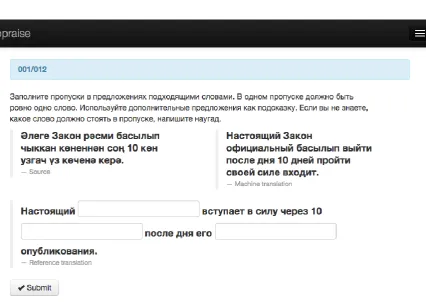
sourcesentence. Table 1 shows a sample task, and Figure 1 shows the task in the online evaluation environment.
In the course of the experiment, following O’Regan and Forcada (2013), we offer these hint combinations:
Reference sentence only: The participants are asked to fill the gaps without being given any context. This task serves as a baseline score and as an indicator of gaps that can be completed using common knowledge or lan-guage intuition (e.g. idioms and strong collo-cations). For example, in an English phrase ‘Jack ordered <...> and chips’, one of the nat-ural answers would be ‘fish’. Such an answer, however, may be unrelated to the meaning of the source text, and may be given on the basis of collocation only.
Reference sentence and source sentence: By setup, the participants have no command of the source language, however, it may help them tofill in proper nouns or loan words.
Reference sentence and MT hint: In addition to the reference sentence, the participants see the source sentence translated via the MT sys-tem, in this case Apertium (Forcada et al., 2011). This type of task is used for measur-ing the contribution of machine translation to understanding the gist of the text.
Reference sentence and both hints: This task is added to check whether MT and source pro-vide complementary hints.
den-Ref Ayudas económicas para el tratamiento de toxicomanías en comunidades terapéuticas no concertadas.
Task Ayudas económicas para el { } de toxicomanías en comunidades terapéuticas no concertadas.
Src Komunitate terapeutiko itundu gabeetan toxikomaniak tratatzeko diru-laguntzak ematea.
MT Comunidad terapéutico pactar gabeetan toxikomaniak las-ayudas de dinero para tratar dar.
Table 1:An example group of sentences showing the gapped sentence and hint types. Reference, MT and task sentences are in Spanish, the source sentence is in Basque.
Ref Примерно полчаса;вам нужно выйти через7остановок,потом пройти ещё около100метров. 10% Примерно полчаса;вам нужно выйти через7 { },потом пройти ещё около100метров. 20% { }полчаса;вам нужно{ }через7остановок, { }пройти ещё около100метров. 30% Примерно полчаса;вам нужно{ }через7 { },потом пройти{ }около100 { }.
[image:3.595.88.515.404.706.2]Table 2:Example of different gap percentage settings for a Russian reference sentence.
sity”). For the evaluations described in this paper we use gap densities of 10, 20 and 30 percent (Ta-ble 2), and the following parts of speech: noun (in-cluding proper nouns), adjective, adverb and lexi-cal verb (as opposed to auxiliary verb).
For each sentence, the list of candidate key-words is prepared. It is composed of all the key-words that fall into the allowed PoS list. The number of gaps in the sentence is calculated based on sen-tence length and specified gap density. All refer-ence sentrefer-ences are longer than 10 words. Finally, the required number of keywords is selected from the candidate list in such a manner that the gaps are distributed evenly throughout the sentence. We start at a random word in a sentence and check whether it is a keyword candidate. If yes, we re-move it, and re-movenwords forward, going back to the beginning of sentence if necessary. The step lengthnis the sentence length divided by the de-sired number of gaps. If the word is not a keyword, or has already been removed, we look at the next word instead. The process is repeated until the des-ignated number of words has been removed, or un-til there are no more words in the keyword list.
Keyword removal could be one of the most time-consuming steps in task preparation. It nor-mally requires human effort, because we would like to determine the words that contribute the most to understanding the text as opposed to re-moving random words. In our automatic setup, the above procedure is performed by a script in-tegrated into the task generation pipeline. Parts of speech are determined with Apertium’s morpho-logical analysers. To control for homonymy, we only allow the word into the candidate list if all of its possible part of speech attributions are on the PoS list. For example, if we only allow nouns on the word list, and the word "fly" receives two pos-sible part of speech attributions from the tagger, noun and verb, it is not considered for the candi-date list.
Having prepared the sentence sets, we assemble them into XML formatted for the Appraise plat-form.
3 Experimental set-up
In this section we will discuss the evaluators, the evaluation procedure, and the tasks in more detail. For each experiment we called for native speak-ers of target language of the language pair (i.e. Spanish and Russian) who had no command of
source language of the pair (Basque and Tatar, re-spectively). The knowledge was self-reported, and the participants were not asked about any other languages they may know. Eleven evaluators par-ticipated in the Basque–Spanish experiment, and 28 in Tatar-Russian (although not everyone com-pleted the task in full, see discussion). The ma-jority of Russian participants were aged 20–25, with university degrees or in the process of ob-taining them. Although we have not asked the participants about their knowledge of languages other than Tatar and Russian, it is reasonable to as-sume that most Russian participants knew English to some extent. The Spanish participants were uni-versity staff with background in computer science. By design, our gap-filling tasks require a human translation (reference) of source sentences. Call-ing for a human translator, however, would signif-icantly increase the resources needed for evalua-tion. We therefore use parallel text sources, which provide the same sentence in two languages simul-taneously:
1. For Basque–Spanish, from the corpus of le-gal texts “Memorias de traducción del Servi-cio Oficial de Traductores del IVAP”;3
2. For Tatar-Russian, from the following sources on three different topics:
(a) Casual conversations, from a textbook4
of spoken Tatar;
(b) Legal texts, from the Constitution and laws5of Tatarstan;
(c) News, from the President of Tatarstan website6.
Each set features 36 pairs of sentences. For the Basque–Spanish experiment the pairs were drawn randomly from the corpora; for Tatar–Russian, compiled by hand by the developer of the language pair in Apertium. The Basque–Spanish experiment featured 94, 181 and 272 gaps in the 10, 20 and 30 % tasks, respectively. For Tatar–Russian these numbers are 272, 396 and 724, due to longer sen-tences used in task creation.
3http://tinyurl.com/ivaptm2
4Литвинов И.Л. Я начинаю говорить по-татарски. Казань: Татарское кн. изд-во, 1994. — 320 с. ISBN 5–298–00463–6 (стр. 219, 220, 232, 233, 234)
5http://tatarstan.ru
3.1 Procedure
The evaluations took place online, in a sys-tem called Appraise (Federmann, 2012), which is designed specifically for various MT evaluation tasks. We adapted the code of Appraise to accom-modate for the gap-filling tasks. The tasks were uploaded into the system and manually distributed between the participants by the following rules:
1. Each participant evaluates every sentence (understood as a succession of words), a to-tal of 36;
2. these sentences are divided into 4 groups of 9, one for each evaluation mode (see section 2); 3. in total, all sentences of the set are evaluated
with 10, 20 and 30% of words removed; 4. each participant may encounter a given
sen-tence in only one of the percentage variations; 5. each sentence-mode-percentage combination
is evaluated by more than one participant. The participants are given the instructions in their native language; these instructions are re-peated above each task in the evaluation system. For the participants’ convenience, the body of questions is split into smaller groups which al-low multiple evaluation sessions. The instructions are the following: read all the available hints and
fill each gap with one suitable word, guessing if unsure. Participants’ answers are recorded and marked correct or incorrect automatically. In addi-tion, the time taken tofill the gaps in one sentence is recorded.
This variety of the gap-filling task requires open answers, and it is therefore possible that the par-ticipants may provide words thatfit the gaps well, but do not match the original answer. To account for these cases, we process all the answers to de-tect possible synonyms (a method suggested by O’Regan and Forcada (2013)). An answer is con-sidered a candidate synonym if it is given by two or more evaluators, and it does not match the answer word. We record each candidate synonym along with the answer key and the context sentence. For example, the word asumir is the original answer in the Spanish sentence Aprender a jugar y di-vertirse en el agua sin asumir riesgos (’Learning to play and have fun in the water without taking risks’). However, two or more evaluators gave a different answer, correr (correr riesgos, ’running risks’). Based on this data, an expert, who is na-tive speaker of the target language and who has not
participated in the evaluations, decides whether the candidate synonym is an acceptable replacement to the answer key in the given context. We then check participants’ results against the compiled synonym list and increase scores where appropriate. On average, the scores improve by three percentage points in all evaluation modes. Candidate syn-onyms are extracted automatically from the eval-uators’ responses, and each individual score is au-tomatically updated according to the synonym list. The synonym lists for Basque–Spanish and Tatar–Russian contain 52 and 25 words, respec-tively. The time taken to compile each list depends on the number of candidate synonyms, and in our case was approximately 30 minutes.
4 Results and discussion
The results are presented in this section. Table 3 shows the proportion and standard deviation of correct answers depending on evaluation mode and gap density. The evaluators’ correct answer per-centage is averaged over the number of evaluators. In addition to the percentage of correct answers we kept a record of the time taken tofill the gaps in one sentence. To reduce the noise from partici-pants who were distracted during evaluation, when calculating times we remove all the results over 6 minutes (the statistical mode is approximately two minutes). The typical time taken to complete one question varies from under one minute for tasks without hints and few gaps, to approximately two minutes for tasks with more hints and gaps.
We expect the scores obtained in different task modes inside one gap density to decrease when go-ing from tasks with MT and source hint to tasks with MT hint only, to tasks with source hint only, andfinally, to tasks with no hint. We also expect that with the increase in gap density, the time taken tofill the gaps should also increase, and the per-centage of correct answers should decrease.
Density MT & Src Basque–SpanishMT Src No hint MT & Src Tatar–RussianMT Src No hint
10% 62±32 58±28 40±39 49±40 57±42 64±41 54±43 46±41
[image:6.595.74.527.71.140.2]20% 65±30 70±27 31±28 31±30 65±31 60±33 46±31 39±32 30% 48±26 40±24 26±20 18±18 59±28 56±26 40±28 35±30
Table 3:Average number of gaps successfullyfilled (%), using a synonym list, for each language pair in all four task modes.
with their own answer unassisted. However, in the no-hint task the participant is required to read only one (reference) sentence, as opposed to two or three (reference and hints) in other tasks. Also, the number of gaps in 10%-gap tasks is low, as it never exceeds three. We found that, as opposed to trying to devise the best word for no-hint gaps, the participants often resorted tofiling these gaps with random words, which takes little time.
We will now discuss the percentage of correct answers based on task type. In general, tasks with MT hints score higher than tasks without MT hints. This aligns well with our expectations and sug-gests than machine translation helps to understand the provided text. In addition, tasks with source hints are completed better than tasks without hints, and the same relation holds between MT+source and MT-only types of tasks. In view of the rel-atively large standard deviations, the significance of the hints’ contribution was tested using a linear regression model. The data points (y) were rep-resented as an individual evaluator’s average score (the number of correct answers divided by the to-tal number of answers) in each of the percentage-hint combinations. Two separate models were cre-ated: one for no-hint (x = 0) vs MT-hint (x = 1)
tasks, and another for no-hint (x = 0) vs source-hint (x = 1) tasks. Given the null hypothesis that
the slopebof the regression liney=a+bxequals zero, the contribution of MT hint is found to be significant on thep < 0.001level, while the
con-tribution of the source hint is significant only with p <0.162.
Two records in the data do not align with our ex-pectations: the no-hint 10% sentences in Basque– Spanish, which scored significantly higher than the source-hint in the same category, and MT+source 10% sentences in Tatar–Russian, which we would have expected to score higher than the correspond-ing MT-only task. In thefirst case, this is largely due to the use of synonyms list. Before taking synonyms into account, the scores were 32 and 35 percent for source and no-hint tasks, respec-tively. This still shows a small difference in
fa-vor of no-hint tasks. However, the latter percent-age increases significantly after we extend the an-swer list with synonyms. Such an increase sug-gests that, in this case, the content words were restored by semantic context rather than through strong collocation. The second pattern, low scores in Tatar–Russian 10% MT+source, does not stem from the task content. Instead, it is the result of the
fixed order of tasks: the participants have always been given MT+source 10% sentences first, fol-lowed by other task types. The participants have not received any training tasks before the main evaluations. Therefore, it is possible that the ac-commodation period is responsible for lower-than-expected scores in this mode of evaluation.
It remains questionable whether we can com-pare results for different gap densities. The 10%, 20%, and 30% sets contained the same sentences. However, in each case different words were re-moved. It appears that some content words are eas-ier tofill than the others. This may explain why in Basque–Spanish the 20% MT tasks are completed with better accuracy than 10% tasks.
It is worth noting that many participants re-ported feeling frustrated in the course of evalu-ations, especially while working on the no-hint tasks. The latter required suggesting the words with very little context, which led some of the par-ticipants to giving random words for answers, or leaving the space blank. 6 out of 49 participants quit the experiment before completing it. Consid-ering the importance of receiving the full set of evaluations, we must address the issue of partici-pant motivation in the upcoming experiments. It may be beneficial to offer monetary compensation for the evaluators’ efforts (in our case, they were volunteers).
4.1 Annotator agreement
After obtaining the results we calculated Krippen-dorff’s alpha (Krippendorff, 1970) measure to rep-resent annotator agreement, shown in Table 4.
Density MT & SrcBasque–SpanishMT Src No hint MT & Src Tatar–RussianMT Src No hint
10% 0.496 0.517 0.400 0.124 0.598 0.459 0.711 0.517
20% 0.714 0.700 0.358 0.275 0.740 0.667 0.473 0.261
[image:7.595.96.505.71.140.2]30% 0.559 0.430 0.406 0.300 0.534 0.581 0.411 0.412
Table 4:Krippendorff Alpha measure of annotator agreement, for each language pair in all four task modes.
and missing data (not all the gaps were evaluated). To calculate Krippendorff’s alpha we used an algo-rithm implementation by Thomas Grill,7 dividing
the answers in each gap into two categories: cor-rect and incorcor-rect. The previously obtained syn-onym lists were taken into account, i.e. if the two answers are different but both correct, they fall into one category. The measure was calculated sepa-rately for each hint and percentage combination.
The interpretation of Krippendorff’s alpha varies depending on the application. One of the general guidelines suggested by Landis and Koch (1977) for kappa-like measures (which includes Krippendorff’s Alpha) is as follows: k < 0
in-dicates “poor” agreement, 0 to 0.2 “slight”, 0.21 to 0.4 “fair”, 0.41 to 0.6 “moderate”, 0.61 to 0.8 “substantial”, and 0.81 to 1 “near perfect”.
In general, the level of annotator agreement is relatively high. As the MT and MT+source hints are introduced, the agreement increases (measures closer to 1): the annotators are more consistently correct or incorrect in each given sentence. The agreement measure for the same sentences with-out hints is closer to zero, which attests to the re-liability of our methodology. We note the outlier score in Tatar–Russian 10% source tasks, which has the most contribution from the news texts. This set of sentences contains many loan words, which have similar form in Tatar and Russian (e.g. presi-dent, minister, championship), and are understood by Russian speakers. The gaps with loan words have mostly beenfilled correctly, while there was some disagreement in other gaps.
4.2 Results for different domains
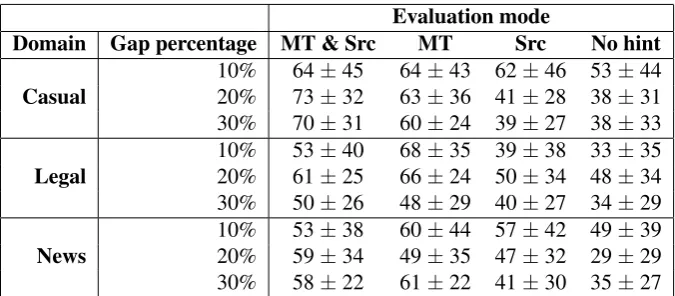
For the Tatar–Russian language pair the partici-pants were offered texts from three different do-mains (in equal proportions): casual conversations, legal texts and news. The results by domains are displayed in table 5. The MT system used in the evaluation has been targeted to translate texts from all three of the domains. Taking into consideration
7http://grrrr.org/data/dev/krippendorff_ alpha/
the above discussion of 10% MT+Source tasks, we observe similar results across the three cate-gories. Note that the source sentences paired with MT improve participants’ performance in casual texts, compared to MT-only task mode. This may be due to the fact that many words are borrowed from Russian into Tatar, and are in fact understood by Russian speakers.
5 Conclusions
We have conducted assimilation evaluation of two Apertium translation directions: Basque–Spanish and Tatar–Russian. The results suggest that this evaluation method reflects the contribution of MT to users’ understanding of text. The version of the toolkit used in this experiment may be downloaded from our repository.8
The experiments may easily be repeated for any language pair (provided a parallel corpus) and any machine translation system. Based on our expe-rience, we would like to suggest the following amendments to the procedure:
1. As reported by O’Regan and Forcada (2013), unless the evaluation is targeted at a specific text domain, it may be beneficial to include a stylistic variety of texts in the initial corpus. Neighboring sentences on the same topic may assist the users in gap-filling tasks;
2. If possible, increase the number of evaluators, or reduce the number of questions per partic-ipant. In the above experiments each partici-pantfilled from 110 to 187 gaps, divided into small groups. Reducing the amount of work may increase task completion rate;
3. To account for the adaptation period, pro-vide training tasks before the main evalua-tions take place.
As a consideration for future work, it may be beneficial to compare the results of evaluation by
Evaluation mode
Domain Gap percentage MT & Src MT Src No hint
Casual 10%20% 6473±±4532 6364±±36 4143 62±±28 3846 53±±4431 30% 70±31 60±24 39±27 38±33
Legal 10%20% 5361±±4025 6668±±24 5035 39±±34 4838 33±±3534
30% 50±26 48±29 40±27 34±29
News 10%20% 5359±±3834 4960±±35 4744 57±±32 2942 49±±3929
[image:8.595.130.468.70.218.2]30% 58±22 61±22 41±30 35±27
Table 5:Tatar–Russian Average number of gaps successfullyfilled (%), using a synonym list, for three different domains, in all four task modes.
gap-filling method with the traditional evaluation metrics, as well as with human evaluation.
Acknowledgments: This work has been partly funded by the Spanish Ministerio de Economía y Competitividad through project TIN2012-32615. Ekaterina Ageeva’s work has been supported by Google Summer of Code 2014 through the Aper-tium project. We thank the volunteers who partici-pated in the evaluations.
References
Church, K. W. and Hovy, E. H. (1993). Good ap-plications for crummy machine translation. Ma-chine Translation, 8(4):239–258.
Federmann, C. (2012). Appraise: an open-source toolkit for manual evaluation of MT output.The Prague Bulletin of Mathematical Linguistics, 98:25–35.
Forcada, M. L., Ginestí-Rosell, M., Nordfalk, J., O’Regan, J., Ortiz-Rojas, S., Pérez-Ortiz, J. A., Sánchez-Martínez, F., Ramírez-Sánchez, G., and Tyers, F. M. (2011). Apertium: a free/open-source platform for rule-based machine transla-tion. Machine translation, 25(2):127–144. Ginestí-Rosell, M., Ramırez-Sánchez, G.,
Ortiz-Rojas, S., Tyers, F. M., and Forcada, M. L. (2009). Development of a free Basque to Span-ish machine translation system. Procesamiento del Lenguaje Natural, 43:187–195.
Jones, D., Herzog, M., Ibrahim, H., Jairam, A., Shen, W., Gibson, E., and Emonts, M. (2007). ILR-based MT comprehension test with multi-level questions. In HLT 2007: The Conference of the North American Chapter of the Associa-tion for ComputaAssocia-tional Linguistics; Companion
Volume, Short Papers, pages 77–80. Association for Computational Linguistics.
Koehn, P. (2010). Statistical machine translation. Cambridge University Press.
Krippendorff, K. (1970). Estimating the reliabil-ity, systematic error and random error of interval data. Educational and Psychological Measure-ment, 30(1):61–70.
Landis, J. R. and Koch, G. G. (1977). The mea-surement of observer agreement for categorical data. biometrics, pages 159–174.
O’Regan, J. and Forcada, M. L. (2013). Peeking through the language barrier: the development of a free/open-source gisting system for Basque to English based on apertium.org. Proce-samiento del Lenguaje Natural, 51:15–22. Somers, H. and Wild, E. (2000). Evaluating
ma-chine translation: the Cloze procedure revisited. InTranslating and the Computer 22: Proceed-ings of the Twenty-second International Confer-ence on Translating and the Computer.
Taylor, W. L. (1953). "Cloze procedure": a new tool for measuring readability.Journalism quar-terly.
Trosterud, T. and Unhammer, K. B. (2012). Eval-uating North Sámi to Norwegian assimilation RBMT. In Proceedings of the Third Inter-national Workshop on Free/Open-Source Rule-Based Machine Translation (FreeRBMT 2012). Van Slype, G. (1979). Critical study of methods