A Benchmark Dataset for Automatic Detection of Claims and
Evidence in the Context of Controversial Topics
Ehud Aharoni*
Anatoly Polnarov*
Tamar Lavee†
Daniel Hershcovich
IBM Haifa Research
Lab, Haifa, Israel
Hebrew University,
Israel
IBM Haifa Research
Lab, Haifa, Israel
IBM Haifa Research
Lab, Haifa, Israel
Ran Levy
Ruty Rinott
Dan Gutfreund
Noam Slonim‡
IBM Haifa Research
Lab, Haifa, Israel
IBM Haifa Research
Lab, Haifa, Israel
IBM Haifa Research
Lab, Haifa, Israel
IBM Haifa Research
Lab, Haifa, Israel
Abstract
We describe a novel and unique argumenta-tive structure dataset. This corpus consists of data extracted fro m hundreds of Wikipedia ar-ticles using a meticulously monitored manual annotation process. The result is 2,683 argu-ment e le argu-ments, collected in the conte xt of 33 controversial topics, organized under a simp le claim-evidence structure. The obtained data are publicly available for academic research.
1 Introduction
One major obstacle in developing automatic ar-gumentation mining techniques is the scarcity of relevant high quality annotated data. Here, we describe a novel and unique benchmark data that relies on a simple argument model and elabo-rates on the associated annotation process. Most importantly, the argumentative elements were gathered in the context of pre-defined controver-sial topics, which distinguishes our work from other previous related corpora.1 Two recent
* These authors contributed equally to this manuscript. † Present affiliation: Yahoo!
‡ Corresponding author, at [email protected]
works that are currently under review [Rinott et al, Levy et al] have reported first results over different subsets of this data, which is now pub-lically available for academic research upon re-quest. We believe that this novel corpus should be of practical importance to many researches, and in particular to the emerging community of argumentation mining.
Unlike the classical Toulmin model (Freeley and Steinberg 2008), we considered a simple and robust argument structure comprising only two components – claim and associated supporting evidence. The argumentative structures were carefully annotated under a pre-defined topic, introduced as a debate motion. As the collected data covers a diverse set of 33 motions, we ex-pect it could be used to develop generic tools for automatic detection and construction of argu-mentative structures in the context of new topics.
2 Data Model
We defined and implemented the following con-cepts:
Topic – a short, usually controversial statement that defines the subject of interest. Context
1
pendent Claim (CDC) – a general concise statement that directly supports or contests the Topic. Context Dependent Evidence (CDE) – a text segment that directly supports a CDC in the context of a given Topic. Examples are given in Section 6.
Furthermore, since one can support a claim us-ing different types of evidence (Rieke et al 2012, Seech 2008), we defined and considered three CDE types: Study: Results of a quantitative analysis of data given as numbers or as conclu-sions. Expert: Testimony by a person / group / committee / organization with some known ex-pertise in or authority on the topic. Anecdotal: a description of specific event(s)/instance(s) or concrete example(s).
3 Labeling Challenges and Approach
The main challenge we faced in collecting the annotated data was the inherently elusive nature of concepts such as "claim" and "evidence." To address that we formulated two sets of criteria for CDC and CDE, respectively, and relied on a team of about 20 carefully trained in-house la-belers whose work was closely monitored. To further enhance the quality of the collected data we adopted a two-stage labeling approach. First, a team of five labelers worked independently on the same text and prepared the initial set of can-didate CDCs or cancan-didate CDEs. Next, a team of five labelers—not necessarily the same five— independently crosschecked the joint list of the detected candidates, each of which was either confirmed or rejected. Candidates confirmed by at least three labelers were included in the corpus.
4 Labeling Guidelines
The labeling guidelines defined the concepts of Topic, CDC, CDE, and CDE types, along with relevant examples. According to these guidelines, given a Topic, a text fragment should be labeled as a CDC if and only if it complies with all of
the following five CDC criteria: Strength: Strong content that directly supports or contests the provided Topic. Generality: General content that deals with a relatively broad idea. Phrasing: Is well phrased, or requires at most a single and minor "allowed" change.2 Keeping text spirit: Keeps the spirit of the original text from which it was extracted. Topic unity: Deals with one, or at most two related topics. Four CDE criteria were defined in a similar way, given a Topic and a CDC, except for the generality criterion.
5 Labeling Details
The labeling process was carried out in the GATE environment (https://gate.ac.uk/). The 33 Topics were selected at random from the debate motions at http://idebate.org/ database. The la-beling process was divided into five stages:
Search: Given a Topic, five labelers were asked to independently search English Wikipe-dia3 for articles with promising content.
Claim Detection: At this stage, five labelers independently detected candidate CDCs support-ing or contestsupport-ing the Topic within each article suggested by the Search team.
Claim Confirmation: At this stage, five la-belers independently cross-examined the candi-date CDCs suggested at the Claim Detection stage, aiming to confirm a candidate and its sen-timent as to the given Topic , or reject it by refer-ring to one of the five CDC Criteria it fails to meet. The candidate CDCs confirmed by at least three labelers were forwarded to the next stage.
Evidence Detection: At this stage, five la-belers independently detected candidate CDEs supporting a confirmed CDC in the context of the given Topic. The search for CDEs was done
2
For example, anaphora resolution. The enclosed data set contains the corrected version as well, as proposed by the labelers.
only in the same article where the corresponding CDC was found.
Evidence Confirmation: This stage was car-ried out in a way similar to Claim Confirmation. The only difference was that the labelers were required to classify accepted CDE under one or more CDE types.
Labelers training and feedback: Before join-ing actual labeljoin-ing tasks, novice labelers were assigned with several completed tasks and were expected to show a reasonable degree of agree-ment with a consensus solution prepared in ad-vance by the project administrators. In addition, the results of each Claim Confirmation task were examined by one or two of the authors (AP and NS) to ensure the conformity to the guidelines. In case crude mistakes were spotted, the corre-sponding labeler was requested to revise and resubmit. Due to the large numbers of CDE can-didates, it was impractical to rely on such a rig-orous monitoring process in Evidence Confirma-tion. Instead, Evidence Consensus Solutions were created for selected articles by several ex-perienced labelers, who first solved the tasks independently and then reached consensus in a joint meeting. Afterwards, the tasks were as-signed to the rest of the labelers. Their results on these tasks were juxtaposed with the Consensus Solutions, and on the basis of this comparison individual feedback reports were drafted and sent to the team members. Each labeler received such a report on an approximately weekly basis.
6 Data Summary
For 33 debate motions, a total of 586 Wikipedia articles were labeled. The labeling process re-sulted in 1,392 CDCs distributed across 321 ar-ticles. In 12 debate motions, for which 350 dis-tinct CDCs were confirmed across 104 articles, we further completed the CDE labeling, ending up with a total of 1,291 confirmed CDEs – 431 of type Study, 516 of type Expert, and 529 of type Anecdotal. Note that some CDEs were
as-sociated with more than one type (for example, 118 CDEs were classified both under the type Study and Expert).
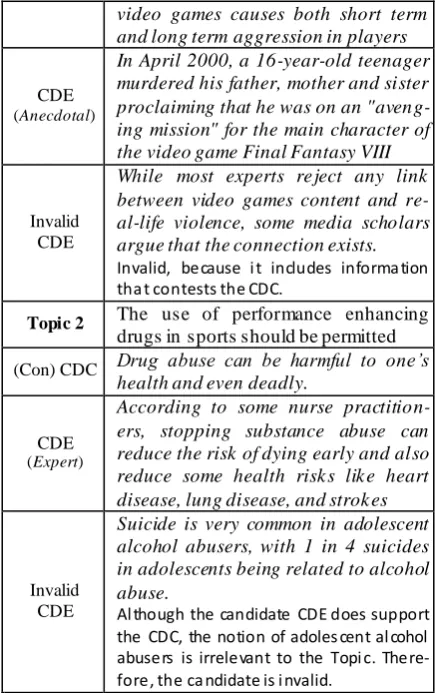
Presented in Tables 1 and 2 are several exam-ples of CDCs and CDEs gathered under the Topics we worked with, as well as some inac-ceptable candidates illustrating some of the sub-tleties of the performed work.
Topic The sale of violent video ga mes to mi-nors should be banned
(Pro) CDC
Violent video games can increase chil-dren’s aggression
(Pro) CDC
Video game publishers unethically train children in the use of weapons Note tha t a valid CDC is not necessaril y fa c-tua l .
(Con) CDC
Violent games affect children positively
Invalid CDC 1
Video game addiction is excessive or compulsive use of computer and video games that interferes with daily life. This sta tement defines a concept relevant to the Topic, not a relevant cl aim.
Invalid CDC 2
Violent TV shows just mirror the vio-lence that goes on in the real world. Thi s claim is not releva nt enough to Topic.
Invalid CDC 3
Violent video games should not be sold to children.
This candida te simpl y repea ts the Topi c and thus is not considered a va lid CDC.
Invalid CDC 4
“Doom” has been blamed for nationally covered school shooting.
This candi date fails the generali ty cri terion, as it focuses on a speci fi c single vi deo game. Note tha t i t could serve as CDE to a more general CDC.
Table 1: Examples of CDCs and invalid CDCs.
Topic 1 The sale of vio lent video games to minors should be banned
(Pro) CDC Violent video games increase youth
violence
CDE
(Study)
video games causes both short term and long term aggression in players
CDE
(Anecdotal)
In April 2000, a 16-year-old teenager murdered his father, mother and sister proclaiming that he was on an "aveng-ing mission" for the main character of the video game Final Fantasy VIII
Invalid CDE
While most experts re ject any link between video games content and re-al-life violence, some media scholars argue that the connection exists. Invalid, because i t includes informa tion tha t contests the CDC.
Topic 2 The use of performance enhancing
drugs in sports should be permitted
(Con) CDC Drug abuse can be harmful to one’s
health and even deadly.
CDE
(Expert)
According to some nurse practition-ers, stopping substance abuse can reduce the risk of dying early and also reduce some health risk s lik e heart disease, lung disease, and strok es
Invalid CDE
Suicide is very common in adolescent alcohol abusers, with 1 in 4 suicides in adolescents being related to alcohol abuse.
Al though the candidate CDE does support the CDC, the notion of adoles cent al cohol abusers is irrelevant to the Topi c. There-fore, the ca ndidate is i nvalid.
Table 2: Examples of CDE and invalid CDE.
7 Agreement and Recall Results
To evaluate the labelers’ agreement we used Co-hen’s kappa coefficient (Landis and Koch 1977). The average measure was calculated over all labelers' pairs, for each pair taking those articles on which the corresponding labelers worked to-gether and omitting labeler pairs which labeled together less than 100 CDCs/CDEs. This strate-gy was chosen since no two labelers worked on the exact same tasks, so standard multi-rater agreement measures could not be applied. The obtained average kappa was 0.39 and 0.4 in the Claim confirmation and Evidence confirmation
stages, respectively, which we consider satisfac-tory given the subtlety of the concepts involved and the fact that the tasks naturally required a certain extent of subjective decision making.
We further employed a simple method to ob-tain a rough estimate of the recall at the detection stages. For CDCs (and similarly for CDEs), let n be the number of CDCs detected and confirmed in a given article, and x be the unknown total number of CDCs in this article. Assuming the i -th labeler detects a ratio of x, and taking a strong assumption of independence between the labelers, we get:
.
We estimated from the observed data, and computed x for each article. We were then able to compute the estimated recall per motion, end-ing up with the estimated average recall of 90.6% and 90.0% for CDCs and CDEs, respec-tively.
8 Future Work and Conclusion
There are several natural ways to proceed further. First, a considerable increase in the quantity of gathered CDE data can be achieved by expand-ing the search scope beyond the article in which the CDC is found. Second, the argument model can be enhanced – for example, to include coun-ter-CDE (i.e., evidence that contest the CDC). Third, one may look into ways to add more la-beling layers on the top of the existing model (for example, distinguishing between factual CDCs, value CDCs, and so forth). Fourth, new topics and new sources besides Wikipedia can be considered.
[image:4.595.72.290.141.488.2]References
Austin J. Freeley and David L. Steinberg. 2008. Argumentation and Debate. Wadsworth, Belmont, California.
Chris Reed. 2005. ―Preliminary Results from an Argument Corpus‖ in Proceedings of the IX Symposium on Social Communication, San-tiago de Cuba, pp. 576-580.
J. Richard Landis and Gary G. Koch. 1977. ―The measurement of observer agreement for categorical data.‖ Biometrics 33:159-174.
Kevid D. Ashley and Vern R. Walker. 2013. ―Toward Constructing Evidence-Based Le-gal Arguments Using LeLe-gal Decision Doc-uments and Machine Learning‖ in Proceed-ings of the Fourteenth International Con-ference on Artificial Intelligence and Law (ICAIL ’13), Rome, Italy, pp. 176-180.
Marie-Francine Moens, Erik Boiy, Raquel Mo-chales Palau, and Chris Reed. 2007. ―Au-tomatic Detection of Arguments in Legal Texts‖ in Proceedings of the International Conference on AI & Law (ICAIL-2007), Stanford, CA, pp. 225-230.
Richard D. Rieke, Malcolm O. Sillars and Tarla Rai Peterson. 2012. Argumentation and Critical Decision Making (8e). Prentice Hall, USA.
Ran Levy, Yonatan Bilu, Daniel Hershcovich, Ehud Aharoni and Noam Slonim. ―Context Dependent Claim Detection.‖ Submitted
Ruty Rinott, Lena Dankin, Carlos Alzate, Ehud Aharoni and Noam Slonim. "Show Me Your Evidence – an Automatic Method for Context Dependent Evidence Detection.‖ Submitted.