Automatic Summarization As Means Of Simplifying Texts, An Evaluation
For Swedish
Christian Smith and Arne J¨onsson Santa Anna IT Research Institute AB
Link¨oping, Sweden
[email protected], [email protected]
Abstract
We have developed an extraction based summarizer based on a word space model and PageRank and compared the read-ability of the resulting summaries with the original text, using various measures for Swedish and texts from different gen-res. The measures include among oth-ers readability index (LIX), nominal ratio (NR) and word variation index (OVIX). The measures correspond to the vocab-ulary load, idea density, human interest and sentence structure of the text and can be used to indicate the difficulty a reader might have in processing the text. The re-sults show that the summarized texts are more readable, indicating that summariza-tion can be used to reduce the effort to read a text.
1 Introduction
Many persons have, for various reasons, problems assimilating long complex texts. Not only persons with visual impairments or dyslexia, but also, for instance, those having a different mother tongue or persons in need of a quick summary of a text. In the project EasyReader we are developing an in-teractive tool for automatic summarization of texts from different genres.
Automatic summarization can be done in vari-ous ways. A common distinction is extract versus abstract summaries. An extract summary is cre-ated by extracting the most important sentences from the original text. An abstract summary on the other hand is a summary where the text has been broken down and rebuilt as a complete rewrite to convey a general idea of the original text. Fur-thermore, the summaries can be indicative (only providing keywords as central topics) or informa-tive (content focused) (Firmin and Chrzanowski,
1999). The former might be more usable when a reader needs to decide whether or not the text is in-teresting to read and the latter when a reader more easily needs to get a grasp of the meaning of a text that is supposed to be read.
For various user groups it can also be benefi-cial if the text is easy to read and not only shorter. There are numerous measures of readability and readability for a number of different summariza-tion techniques has been investigated by, for in-stance, Margarido et al. (2008). The difficulty of the text or the readability can also be measured by several automatic measures. Vadlapudi and Ka-tragadda (2010) present an investigation on auto-matic evaluation of various aspects of readability for summaries. Readability has also been used, to, for instance, re-rank webpages to better suit a par-ticular user (Newbold et al., 2010).
In this paper we will examine the readability of automatically created summaries by comparing them to the readability of the original full-length text. First, we describe the techniques used by the summarizer. Second, an overview of readability and some valid measures is presented. Third, we present results from the automatic readability eval-uation of the generated summaries.
2 The summarizer
The summarizer used in our investigations is called COGSUM (J¨onsson et al., 2008b; J¨onsson et al., 2008a). It is an extraction based summa-rizer, using the word space model random index-ing (RI), c.f. Hassel (2007) and a modified version of PageRank (Brin and Page, 1998).
2.1 The word space model
positioning of words in a multidimensional space, instead of looking at only shallow linguistic properties. This facilitates the creation of sum-maries, since the positioning in the word space can be used to evaluate the different passages (words or sentences for instance) in relation to a document with regards to informational and semantic content.
Every word in a given context occupies a spe-cific point in the space and has a vector associated to it that can be used to define its meaning.
Word spaces are constructed according to the distributional hypothesis and the proximity hy-pothesis. In the distributional hypothesis, words that occur in similar contexts have similar mean-ings so that awordis the sum of its contexts and thecontextis the sum of its words, where the con-textcan be defined as the surrounding words or the entire document. The proximity hypothesis states that words close to each other in the word space have similar meaning while those far from each other have dissimilar meaning.
The word space is constructed from a matrix where text units are columns and the words in all text units are rows in the matrix. A certain entry in the matrix is nonzero iff the word correspond-ing to the row exists in the text unit represented by the column. The resulting matrix is very large and sparse which makes for the usage of techniques for reducing dimensionality. Latent Semantic Anal-ysis is one such technique that, however, can be computationally expensive unless used with alter-native algorithms (Gorrell, 2006).
2.2 Random Indexing (RI)
Random Indexing (Sahlgren, 2005; Kanerva, 1988) is a dimension reduction technique based on sparse distributed representations that provides an efficient and scalable approximate solutions to dis-tributional similarity problems. The basic idea of Random Indexing is to accumulate context vectors based on the occurrence of words in contexts. This technique can be used with any type of linguistic context, is inherently incremental, and does not re-quire a separate dimension reduction phase as for instance Latent Semantic Analysis.
Random Indexing can be described as a two-step operation:
Step 1 A unique d-dimensional index vector is
assigned and randomly generated to each context (e.g. each document or each word).
These index vectors are sparse and high-dimensional. They consist of a small number,
ρ, of randomly distributed +1s and -1s, with
the rest of the elements of the vectors set to 0.
Step 2 Context vectors are produced on-the-fly. As scanning the text, each time a word occurs in a context (e.g. in a document, or within a sliding context window, w), that context’s d-dimensional index vector is added to the
context vector for the word. Words are thus represented byd-dimensional context vectors
that are effectively the sum of the index vec-tors of all the contexts in which the word ap-pears.
In COGSUM the vectors for whole sentences and the similarity between these and the average document vector are of interest. The average doc-ument vector is calculated by dividing the total document vector, which consists of the sum of all unique words’ context vectors, with the number of unique words in the document, Equation 1.
~
doc= 1
N
N X
i=1
~
wi (1)
whereN denotes the number of unique words. The sentence vectors are then calculated by sub-traction of the average document vector from the context vectors of the words in the sentence which are summed together and divided by the number of words in the sentence, Equation 2.
~ sentj =
1
S
S X
i=1
(w~i−doc~ ) (2)
whereS denotes the number of words in sentence j.
2.3 PageRank
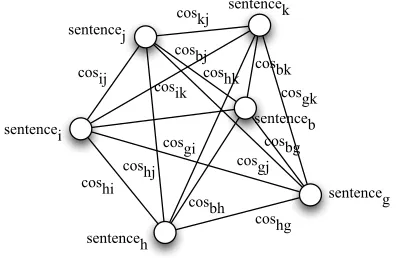
are based on a cosine angle comparison of their meaning vectors, see Figure 1. As it is fully con-nected, all vertices are connected with each other.
cosij
coshj coshi
cosbj coskj
cosgi
sentencei sentenceb
sentenceh
sentencek sentencej
sentenceg cosbk
cosbg
cosbh cosik
coshg cosgj
[image:3.612.98.296.115.244.2]cosgk coshk
Figure 1: A simplified graph where sentences are linked and weighted according to the cosine values between them.
The algorithm rank ingoing and outgoing links to pages depending on the number of links as fol-lows:
P RW(si) = 1−d
N +d×
X
sj∈In(si)
P RW(s j)
Out(sj) (3)
where si is the sentence under consideration,
In(si) are the set of sentences that link to si,
Out(sj)are the set of sentences that link fromsi andN is the total number of sentences. dis the damping factor.
The damping factor is originally set to account for the possibility of a surfer clicking a random web link when he gets bored (Brin and Page, 1998). With regards to the ranking of sentences, we see the damping factor as the possibility of a sentence containing some implicit information that a certain reader might consider more impor-tant at the time. The computation is carried out on all sentences iteratively until node weights con-verge.
Sentences with similar content will then con-tribute with positive support to each other. This does not exclusively depend on the number of sen-tences supporting a sentence, but also on the rank of the linking sentences. This means that a few high-ranked sentences provide bigger support than a greater number of low-ranked sentences. This leads to a ranking of the sentences by their impor-tance to the document at hand and thus to a sum-mary of desired length only including the most im-portant sentences.
2.4 Achieving a summary
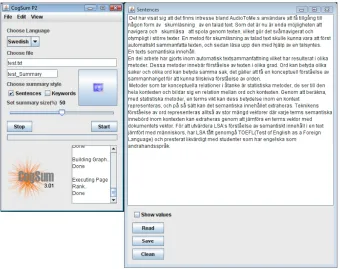
COGSUM, see Figure 2, takes as input only the text to be summarized along with a list of stop words (common function words such as preposi-tions). When the text has been processed using RI and PageRank, the most important sentences are extracted, for instance 30% of the original text, re-sulting in a condensed version of the original text with the most important information intact. Since all sentences are ranked, the length of the sum-mary is easy to specify, in COGSUMthis is imple-mented as a simple slider. COGSUMis designed for informative summaries, but it is also possible to have indicative summaries by clicking a ”key-words” check box, see Figure 2.
It it important to note that the algorithm only takes the current document as total context and the information within the document, without any knowledge from an outside corpus (other than a list of stop words). This makes it highly portable to different domains, genres and languages (Mi-halcea, 2004).
Evaluations of COGSUM with human users show that summaries produced by COGSUM are useful, considered informative enough and read-able (J¨onsson et al., 2008a). COGSUM has also been evaluated on gold standards for news texts and authority texts showing that it is better than another Swedish summarizer (SweSum, (Dalia-nis, 2000)) on authority texts and almost as good on news texts, texts that the other summarizer was especially adapted to handle (Gustavsson and J¨onsson, 2010).
3 Readability
Figure 2: The COGSUMinterface.
Chall (1958) included the reader and concluded that there are four types of elements that seem to be significant for a readability criterion; vocabu-lary load, sentence structure, idea density and hu-man interest. By mapping these psychological cri-teria of the individual with measurable readability properties of a text, several automatic measures of readability have been proposed.
3.1 Automatic measures
Automatic measures of readability for English is abundant, e.g. The Flesch Reading Ease Formula, Flesch-Kincaid, Dale-Chall, the Coleman-Liau test, Gunning Fog and SMOG (DuBay, 2004). For Swedish we have for instance: LIX, NR and OVIX (M¨uhlenbock and Kokkinakis, 2009; Ry-bing et al., 2010).
The Flesch Reading Easy score can be com-puted as:
Score= 206.835−(1.015×nn((ws)))−(84.6×ASW) (4) wheren(w) denotes the number of words, n(s) the number of sentences andASW the number of
syllables.
The measures correspond to how
understand-able a text is, e.g. a Flesch Reading Easy score between 70 and 80 is ”Fairly Easy” which means that the text can easily be understood by a (U.S.) 7th grade student. The Flesch-Kincaid Grade level is a U.S. grade level version that normalises (4) to correspond to readability for students in various grades.
For Swedish, being an inflecting and com-pounding language, the readability index LIX (Bj¨ornsson, 1968) is almost exclusively used. LIX measures the number of words per sentence and also the number of long words (>6 characters) in the text through the formula:
LIX = n(w)
n(s) + (
n(words > 6chars)
n(w) ×100)
(5) wheren(s)denotes the number of sentences and
n(w)the number of words.
Contrary to Flesch’s original formula (and many of its modifications) the LIX formula does not consider syllables but instead word length. As LIX only considers ratios, sentence length and proportion of long words, it does not depend on text length.
difficult to read. A high LIX value indicates this, see Table 1.
Table 1: LIX-values for different genres, from M¨uhlenbock and Kokkinakis (2009)
.
LIX value Text genre -25 Children’s books 25-30 Easy texts
30-40 Normal text/fiction 40-50 Informative text 50-60 Specialist literature
>60 Research, dissertations
In an effort to enhance the LIX formula, M¨uhlenbock and Kokkinakis (2009) have included an additional parameter called Extra Long Words (XLW). Extra Long Words are words with more than 14 characters and indicates a larger propor-tion of compounds of usually three or more stems, relatively common in Swedish. LIX has however been considered insufficient for a complete read-ability assessment of a text, since target groups of readers often are highly heterogeneous. By taking into account additional parameters, a better view of a text’s readability can be achieved. This is done by mapping Chall’s elements of readability to automatic measures (M¨uhlenbock and Kokki-nakis, 2009). LIX is for instance, together with the amount of extra long words, mapped to vocab-ulary load.
Lexical variation or OVIX (word variation in-dex) measures the ratio of unique tokens in a text and is used to indicate theidea density, in conjunc-tion with the nominal ratio (NR). OVIX is calcu-lated as:
OV IX = log(n(w))
log(2−loglog((nn((uww))))) (6)
where n(w) denotes the number of words and
n(uw)the number of unique words. OVIX does not depend on text length (Lundberg and Reichen-berg, 2009).
NR is calculated by dividing the number of nouns, prepositions and participles with the num-ber of pronouns, adverbs and verbs:
N R= n(noun) +n(prep) +n(part)
n(pro) +n(adv) +n(v) (7)
where n(noun) denotes the number of nouns,
n(prep)the number of prepositions,n(part)the
number of participles,n(pro)the number of pro-nouns,n(adv)the number of adverbs, and n(v) the number of verbs.
A higher NR indicates a more professional and stylistically developed text, while a lower value indicate more simple and informal language. In some contexts a low NR can indicate a narrative style, such as in children’s books. NR should not depend on text length.
The degree of human interest is measured simply through the proportion of proper nouns (PN) and by measuring the length of sentences (ASL), sentence structure can broadly be gath-ered (M¨uhlenbock and Kokkinakis, 2009).
4 Evaluation
We have evaluated summarized texts from a read-ability perspective by creating summaries of texts from different genres and compared their readabil-ity to the original text.
We use three types of texts representing three different genres:
• DN. Newspaper texts from the Swedish newspaper ”Dagens Nyheter”; ca 25,000 words divided in 130 articles.
• FOF. Popular science texts from the Swedish Magazine ”Forskning och Framsteg”; ca 20,000 words divided in 31 articles.
• FOKASS. Authority texts from the Swedish Social Insurance Administration (Sw. F¨ors¨akringskassan); ca 25,000 words from 2 brochures. The brochures were divided so that each chapter was an article resulting in a total of 35 ”articles”
The texts were summarized using COGSUM with a random index dimensionality,d, of 100, a
focus window size, w, of 4 (2 left, 2 right) and ρ = 4, i.e. 2 positive 1:s and 2 negative 1:s, in line with Chatterjee and Mohan (2007). The texts were also stemmed using the snowball algorithm (Swedish) and stop words were removed. The PageRank damping factor was set to .85 (Brin and Page, 1998) and the number of iterations when the weights converged was below 50.
page (F¨ors¨akringskassan, 2011). They were sum-marized to different lengths (30%, 50% and 70%) and compared with the originals (100%) with re-gards to the different readability measures.
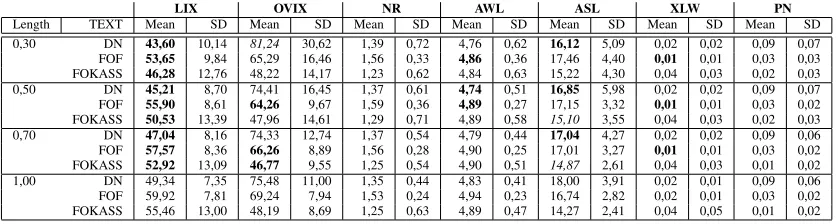
[image:6.612.92.298.302.726.2]The summaries were evaluated using 7 mea-sures, see Table 2. The values of the measures of the summaries were also compared to the full length texts using a paired-samples T-test. 5 Results
Table 2 shows the mean values for the various readability measures used on the different texts. Roughly, low values on any readability measure means that the text is more readable. The ta-ble also includes values on average word length (AWL).
The following significant differences were found:
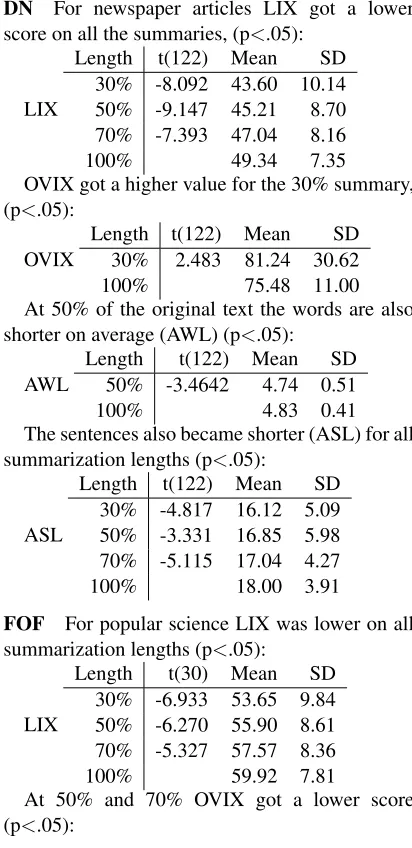
DN For newspaper articles LIX got a lower score on all the summaries, (p<.05):
LIX
Length t(122) Mean SD
30% -8.092 43.60 10.14 50% -9.147 45.21 8.70 70% -7.393 47.04 8.16
100% 49.34 7.35
OVIX got a higher value for the 30% summary, (p<.05):
OVIX Length t(122) Mean30% 2.483 81.24 30.62SD
100% 75.48 11.00
At 50% of the original text the words are also shorter on average (AWL) (p<.05):
AWL Length50% -3.4642t(122) Mean4.74 0.51SD
100% 4.83 0.41
The sentences also became shorter (ASL) for all summarization lengths (p<.05):
ASL
Length t(122) Mean SD 30% -4.817 16.12 5.09 50% -3.331 16.85 5.98 70% -5.115 17.04 4.27
100% 18.00 3.91
FOF For popular science LIX was lower on all summarization lengths (p<.05):
LIX
Length t(30) Mean SD
30% -6.933 53.65 9.84 50% -6.270 55.90 8.61 70% -5.327 57.57 8.36
100% 59.92 7.81
At 50% and 70% OVIX got a lower score (p<.05):
OVIX
Length t(30) Mean SD
50% -7.136 64.26 9.67 70% -6.017 66.26 8.89
100% 69.24 7.94
At 30% and 50% we had lower average word length, (p<.05):
AWL
Length t(30) Mean SD
30% -2.234 4.86 0.36 50% -2.465 4.89 0.27
100% 4.94 0.23
We had a smaller proportion of extra long words for all summarization lengths (p<.05):
XLW
Length t(30) Mean SD
30% -2.689 0.01 0.01 50% -2.458 0.01 0.01 70% -2.464 0.01 0.01
100% 0.02 0.01
FOKASS Authority texts also displayed a lower LIX for all summarization lengths (p<.05):
LIX
Length t(34) Mean SD
30% -8.497 46.28 12.76 50% -5.939 50.53 13.39 70% -4.642 52.92 13.09
100% 55.46 13.00
OVIX was lower for 70% summarizations (p<.05):
OVIX
Length t(34) Mean SD
70% -2.209 46.77 9.55
100% 48.19 8.69
The sentences were longer at 50% and at 70% (p<.05):
ASL
Length t(34) Mean SD
50% 2.144 15.10 3.55 70% 2.606 14.87 2.61
100% 14.27 2.41
No significant differences could be observed in nominal ratio (NR) or proper nouns (PN) for any text genre or summarization length.
6 Discussion
A significantly lower LIX could be observed across the board of summaries, regardless of length and genre. This shows that the complexity of the text is reduced when the text is summarized by the summarizer.
LIX OVIX NR AWL ASL XLW PN
Length TEXT Mean SD Mean SD Mean SD Mean SD Mean SD Mean SD Mean SD
0,30 DN 43,60 10,14 81,24 30,62 1,39 0,72 4,76 0,62 16,12 5,09 0,02 0,02 0,09 0,07
FOF 53,65 9,84 65,29 16,46 1,56 0,33 4,86 0,36 17,46 4,40 0,01 0,01 0,03 0,03
FOKASS 46,28 12,76 48,22 14,17 1,23 0,62 4,84 0,63 15,22 4,30 0,04 0,03 0,02 0,03
0,50 DN 45,21 8,70 74,41 16,45 1,37 0,61 4,74 0,51 16,85 5,98 0,02 0,02 0,09 0,07
FOF 55,90 8,61 64,26 9,67 1,59 0,36 4,89 0,27 17,15 3,32 0,01 0,01 0,03 0,02
FOKASS 50,53 13,39 47,96 14,61 1,29 0,71 4,89 0,58 15,10 3,55 0,04 0,03 0,02 0,03
0,70 DN 47,04 8,16 74,33 12,74 1,37 0,54 4,79 0,44 17,04 4,27 0,02 0,02 0,09 0,06
FOF 57,57 8,36 66,26 8,89 1,56 0,28 4,90 0,25 17,01 3,27 0,01 0,01 0,03 0,02
[image:7.612.93.512.58.170.2]FOKASS 52,92 13,09 46,77 9,55 1,25 0,54 4,90 0,51 14,87 2,61 0,04 0,03 0,01 0,02 1,00 DN 49,34 7,35 75,48 11,00 1,35 0,44 4,83 0,41 18,00 3,91 0,02 0,01 0,09 0,06 FOF 59,92 7,81 69,24 7,94 1,53 0,24 4,94 0,23 16,74 2,82 0,02 0,01 0,03 0,02 FOKASS 55,46 13,00 48,19 8,69 1,25 0,63 4,89 0,47 14,27 2,41 0,04 0,05 0,01 0,02
Table 2: Means of the measured readability scores, LIX, NR, and OVIX. AWL is the average length of the words in the text, ASL is the average sentence length, XLW is the proportion of words longer than 14 characters, and PN is the proportion of proper nouns in the text. Means that are significantly better than the original texts of the same genre are in bold, whereas means that are worse are in italics.
lengths. Thus, for popular science, the vocabulary load decreased when articles were summarized.
OVIX also seems to be most effectively reduced for popular science texts when summarized, indi-cating that idea density is also reduced.
The average sentence length can be seen as a way of analyzing the structure of the sentence, without adopting syntactic parsing (M¨uhlenbock and Kokkinakis, 2009). This seems to be most prominent in newspaper articles. Newspaper texts had a high idea density from the start (by a high variation in words, OVIX) and a low LIX. They benefitted from summarization by getting a lower value on average sentence length, or sentence structure, for all summarization lengths.
Authority texts did not benefit as much from summarization, for all summarization lengths, as the other genres. OVIX was lower for 70% sum-maries but sentences got, for instance, longer for long summaries (50% and 70%).
No significant differences were found for any text on the amount of proper nouns (PN) and NR. A low NR might indicate a stylistically simple text such as narrative children’s books while a higher NR is more common in advanced texts and since the summarizer at this point does nothing to rewrite sentences, a change in NR is not to be ex-pected.
To conclude; there seems to be a difference be-tween different genres in how a summary is af-fecting the readability of the texts. Popular sci-ence seems to benefit most by being summarized, followed by newspaper articles. The vocabulary load and complexity of sentence structure can be lowered in newspaper articles and popular science, where also idea density in addition can be lowered.
7 Summary and future research
We have shown that automatic summarization have a positive impact on readability for texts from different genres and with different summarization lengths. This shows that summarization can be used as a promising means to make a text more easy to read and may work well as a first step in an effort to make texts available with reduced dif-ficulties across several target domains for different types of texts.
The evaluations were done using a number of automatic measures of readability. A next step is to conduct experiments with humans to gain fur-ther insights on readability of the summaries. For instance, a general problem with extract summa-rizations is that the sentences that are extracted can refer to a sentence that hasn’t been extracted, resulting in a fragmentation of the text that may increase the workload required by the reader.
Rewriting the text automatically based on syn-tactical properties of a target easy-to-read corpus, such as presented by Rybing et al. (2010), will probably further increase readability, and will also be investigated in future studies. Future research also include investigations on the interaction ef-fects, found in this study, between various read-ability measures.
Acknowledgement
References
C.H. Bj¨ornsson. 1968.L¨asbarhet. Stockholm: Liber. Sergey Brin and Lawrence Page. 1998. The
anatomy of a large-scale hypertextual web search engine. Computer Networks and ISDN Systems, 30(1-7):107–117.
J.S. Chall. 1958. Readability: An appraisal of re-search and application. Columbus, OH: Ohio State University Press. Reprinted 1974. Epping, Essex, England: Bowker Publishing Company.
Nilhadri Chatterjee and Shiwali Mohan. 2007. Extraction-based single-document summarization using random indexing. InProceedings of the 19th IEEE international Conference on Tools with Artifi-cial intelligence – (ICTAI 2007), pages 448–455. Hercules Dalianis. 2000. Swesum – a text summarizer
for swedish. Technical Report TRITA-NA-P0015, IPLab-174, NADA, KTH, Sweden.
William H. DuBay. 2004. Smart language: Read-ers, Readability, and the Grading of Text. Costa Mesa:Impact Information.
Lars Eld´en. 2007. Matrix Methods in Data Mining and Pattern Recognition. Society for Industrial & Applied Mathematics (SIAM).
Th´erese Firmin and Michael J Chrzanowski, 1999. An Evaluation of Automatic Text Summarization Sys-tems, volume 6073, pages 325–336. SPIE.
F¨ors¨akringskassan. 2011. F¨ors¨akringskassans
website, January. http://www.
forsakringskassan.se.
Genevieve Gorrell. 2006. Generalized Hebbian Algo-rithm for Dimensionality Reduction in Natural Lan-guage Processing. Ph.D. thesis, Link¨oping Univer-sity.
P¨ar Gustavsson and Arne J¨onsson. 2010. Text sum-marization using random indexing and pagerank. In Proceedings of the third Swedish Language Technol-ogy Conference (SLTC-2010), Link¨oping, Sweden. Martin Hassel. 2007. Resource Lean and Portable
Automatic Text Summarization. Ph.D. thesis, ISRN-KTH/CSC/A–07/09-SE, KTH, Sweden.
Arne J¨onsson, Mimi Axelsson, Erica Bergenholm, Bertil Carlsson, Gro Dahlbom, P¨ar Gustavsson, Jonas Rybing, and Christian Smith. 2008a. Skim reading of audio information. InProceedings of the The second Swedish Language Technology Confer-ence (SLTC-08), Stockholm, Sweden.
Arne J¨onsson, Bjarte Bugge, Mimi Axelsson, Erica Bergenholm, Bertil Carlsson, Gro Dahlbom, Robert Krevers, Karin Nilsson, Jonas Rybing, and Chris-tian Smith. 2008b. Using language technology to improve interaction and provide skim reading abili-ties to audio information services. InProceedings of eChallenges e-2008, Stockholm, Sweden.
Pentii Kanerva. 1988. Sparse distributed memory. Cambridge MA: The MIT Press.
Ingvar Lundberg and Monica Reichenberg. 2009. Vad ¨ar l¨attl¨ast? Socialpedagogiska skolmyndigheten. Paulo R. A. Margarido, Thiago A. S. Pardo, Gabriel M.
Antonio, Vin´ıcius B. Fuentes, Rachel Aires, San-dra M. Alu´ısio, and Renata P. M. Fortes. 2008. Au-tomatic summarization for text simplification: Eval-uating text understanding by poor readers. In Com-panion Proceedings of the XIV Brazilian Symposium on Multimedia and the Web.
Rada Mihalcea. 2004. Graph-based ranking al-gorithms for sentence extraction, applied to text summarization. In Proceedings of the ACL 2004 on Interactive poster and demonstration sessions, ACLdemo ’04, Morristown, NJ, USA. Association for Computational Linguistics.
Katarina M¨uhlenbock and Sofie Johansson Kokkinakis. 2009. Lix 68 revisited – an extended readability measure. InProceedings of Corpus Linguistics. Neil Newbold, Harry McLaughlin, and Lee Gillam.
2010. Rank by readability: Document weighting for information retrieval. In Hamish Cunningham, Allan Hanbury, and Stefan M. R¨uger, editors, Ad-vances in Multidisciplinary Retrieval, First Informa-tion Retrieval Facility Conference, IRFC 2010, Vi-enna, Austria, May 31, 2010. Proceedings, volume 6107 ofLecture Notes in Computer Science, pages 20–30. Springer.
Jonas Rybing, Christian Smith, and Annika Silvervarg. 2010. Towards a rule based system for automatic simplification of texts. InProceedings of the third Swedish Language Technology Conference (SLTC-2010), Link¨oping, Sweden.
Magnus Sahlgren. 2005. An Introduction to Random Indexing. Methods and Applications of Semantic Indexing Workshop at the 7th International Confer-ence on Terminology and Knowledge Engineering, TKE 2005.
Spr˚akbanken. 2011. Concordances of spr˚akbanken, January. http://spraakbanken.gu.se/
konk/.