Spin detection at elevated temperatures using a driven double quantum dot
G. Giavaras,1J. Wabnig,1,2B. W. Lovett,1 J. H. Jefferson,3and G. A. D. Briggs1 1Department of Materials, University of Oxford, Oxford OX1 3PH, United Kingdom
2Cavendish Laboratory, Department of Physics, University of Cambridge, Cambridge CB3 0HE, United Kingdom 3QinetiQ, St. Andrews Road, Malvern WR14 3PS, United Kingdom
共Received 8 December 2009; revised manuscript received 9 June 2010; published 6 August 2010兲 We consider a double quantum dot in the Pauli blockade regime interacting with a nearby single spin. We show that under microwave irradiation the average electron occupations of the dots exhibit resonances that are sensitive to the state of the nearby spin. The system thus acts as a spin meter for the nearby spin. We investigate the conditions for a nondemolition read-out of the spin and find that the meter works at temperatures compa-rable to the dot charging energy and sensitivity is mainly limited by the intradot spin relaxation.
DOI:10.1103/PhysRevB.82.085410 PACS number共s兲: 85.35.⫺p, 73.63.Kv, 73.23.Hk
I. INTRODUCTION
Electron spins in semiconductors and molecular systems are good candidates for qubits due to their relatively long coherence times. Manipulation of single spins and controlled interaction between pairs of spins are essential ingredients for quantum information processing. Single spin rotation has been demonstrated in electrostatically defined quantum dots using the electron-spin-resonance technique.1 Coherent
ma-nipulation of a pair of qubits, giving rise to entanglement, has also been achieved in a semiconductor double dot共DD兲 device based on fast electrical pulses and operating the dots in the spin blockade regime.2Single spin rotations together
with entanglement generation, in principle, enable universal quantum operations. A further operation for a quantum pro-cessor is spin detection, which is essential for projection of the quantum state after computation and read-out of the re-sult. This is the main focus of this paper.
Single spin detection is also important for future spin-tronic devices in general, and various electrical and optical schemes have been proposed and demonstrated. For ex-ample, Elzerman et al.3 demonstrated experimentally a
single-shot read-out of a quantum dot spin using a spin to charge conversion technique while Rugar et al.4 employed
magnetic resonance force microscopy to probe the state of a single spin. Theoretically, spin filters and spin pumps which make use of excited states in ac-driven DDs have been examined.5,6 Other schemes for spin read-out involve open
quantum dots with an inhomogeneous Zeeman splitting and closed DD systems which are coupled to quantum point con-tacts 共QPCs兲.7,8It has been shown that the dc-electrical
cur-rent and shot noise through the dots or the point contacts can provide valuable information about the spin state, the energy spectrum, and the relevant decoherence rates.7,8 However,
for optically nonactive molecular spins no reliable read-out scheme exists.
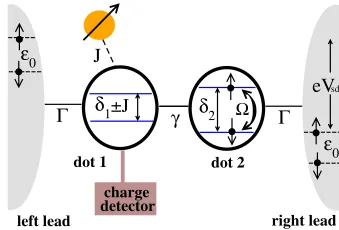
In this work we consider a single spin 共target spin兲 that interacts with the spins of two tunnel-coupled quantum dots, as shown schematically in Fig. 1, and demonstrate how to probe its state by monitoring the average electron occupation on one of the two dots. Under a range of parameters, the interaction between the target spin and the spins on the DD induces an effective Zeeman splitting that is different in each
dot. Also, the sign of the Zeeman splitting depends on the orientation of the target spin. This target-spin-dependent asymmetry of the Zeeman splitting makes it possible to ro-tate only one of dot spins and thus results in a target-spin-dependent lifting of the Pauli blockade. We show this lifting of the blockade as a change in the average dot occupation, which can be measured by a charge detector. Alternatively, the change in occupation is directly related to a change in the current through the DD, which, however, might be too small to detect by standard dc-measurement techniques.
In order to realize a nondemolition spin measurement the spins on the DD and the target spin must have different Zee-man splitting, most likely to be achieved by differentg fac-tors through g-factor engineering or choice of materials. A general spin interaction always contains so-called
spin-δ1 γ δ2
Γ
---left lead right lead
dot 1 dot 2
ε0
---
-
---J
eVsd
±J Ω
)
Γdetectorcharge
• •
• ε0 • •
[image:1.609.349.519.438.553.2]•
FIG. 1. 共Color online兲 Schematic illustration of the proposed system for a single spin detection. Two tunnel-coupled quantum dots are connected to leads enabling current to pass through. A nearby spin interacts with the spins on dot 1 and under a range of parameters, this interaction induces a different Zeeman splitting in the two dots. In an external magnetic field and under microwave irradiation the spins on the two dots can be rotated with a Rabi frequency ⍀ and the average electron occupation exhibits reso-nances which are sensitive to the state of the nearby spin. A charge detector is capacitively coupled to dot 1 and is used to monitor a change in the occupation. In the rotating frame with respect to the incident microwave field the lead electrons have a Fermi energy that depends on their spin state with a relative energy difference
0=ប0, where0 is the frequency of the driving magnetic field. Vsdis the bias voltage across the dots. The effective Zeeman split-ting in each dot,␦1⫾J and ␦2, respectively, depends on both the
flip terms, which are suppressed when the difference in the Zeeman splitting of the DD electrons and the target spin is larger than the spin-spin interaction strength.
A theoretical investigation has shown that a single quan-tum dot works as a spin meter, but the proposed device has the drawback of operating only at low temperatures, compa-rable to the energy scale set by the Zeeman spitting.9In this
paper we show that the driven DD spin detector works at much higher temperatures, comparable to the DD charging energy and we find that the main limitation to its sensitivity is intradot spin relaxation. Thus we present a scheme that allows the spin state of a nearby spin to be probed noninva-sively in a single shot, using different electron occupations on the DD for spin up and spin down orientations as a basic read-out mechanism.
In the following section we introduce our model and dis-cuss technical details of the solution. In Sec. III we show how the DD acts as a spin meter and explore how interdot hopping, microwave intensity, temperature, spin-spin interac-tion strength, and spin relaxainterac-tion influence its performance. We conclude in Sec. IV by discussing the operation of the spin meter for experimentally accessible parameters.
II. PHYSICAL MODEL
The total system consists of the DD, a nearby spin, me-tallic leads, and a bosonic heat bath. This system is modeled by the Hamiltonian
Htot=HS+Hleads+HT+HB+HSB, 共1兲 where HS models the DD and the spin,Hleads 共HB兲 models the leads 共heat bath兲, and HT 共HSB兲 models the interaction between the leads 共heat bath兲 and the DD. Specifically, for the DD and the nearby target spin we write the Hamiltonian as
HS=HDD+HM+HI, 共2兲 whereHDDis a Hubbard Hamiltonian describing the DD,HM is due to the applied magnetic fields, and HI models the interaction of the nearby spin with the DD system. For the DD we have
HDD=
兺
i=1 2ini−␥
兺
共
c1†c2+c2 †
c1兲+U
兺
i=1 2ni↑ni↓+Vn1n2,
共3兲 that allows up to two electrons per dot.10The number
opera-tor is ni=兺ni=兺ci †c
i for dot i=兵1 , 2其 and spin =兵↑,↓其. The operator ci
† 共
ci兲 creates共annihilates兲 an elec-tron on dotiwith on-site energyi.␥is the tunnel coupling between the two dots, U is the charging energy 共intradot Coulomb energy兲, andVis the interdot Coulomb energy. The Hamiltonian part due to the applied magnetic fields, that breaks the spin degeneracy, is
HM=
兺
i=0 2⌬i 2i
z +
兺
i=1 2
ប⍀cos共0t兲i x
, 共4兲
wherei= 0 refers to the target spin and the spin operators are defined in the standard wayi=兺⬘c†i⬘ci⬘with be-ing the vector of the 2⫻2 Pauli matrices.⌬i=giBBiis the Zeeman splitting due to a static magnetic field Bi along z, and a g factor gi, ⍀ is the Rabi frequency, and 0 is the frequency of the oscillating magnetic field along x. For a single spin the oscillating magnetic field rotates the z com-ponent of the spin with frequency⍀when⌬=ប0. We have ignored the effect of the oscillating field on the target spin which is a good approximation for narrow-band radiation that is only resonant with the spins on the DD 共or alterna-tively only with the target spin兲, a condition that can be achieved, for example, by engineering different g factors in the dots and the target spin.
Moreover, we assume that the target spin interacts only with dot 1, although the basic idea can be extended to the most general case when the target spin interacts with both dots. As shown below our scheme is still efficient provided that the strength of the interaction between the target spin and each dot is different, a condition that is typically satis-fied. We consider an Ising interaction between dot i= 1 and the target spini= 0 of the form
HI=
J
20 z
1
z 共
5兲
withJbeing the strength of the interaction.Jmainly depends on the distance of dot 1 from the target spin as well as the actual size of the dot and the target spin. Physical values for
J for a purely dipolar interaction are within the range of a few megahertz as shown in Ref.9. This form of interaction is justified when there is negligible tunnel coupling between dot 1 and the nearby spin so that to a good approximation hopping can be ignored. In addition, spin-flip processes are weak due to the Zeeman splitting induced by the static mag-netic field and thus neglected. This is a good approximation when the difference in the Zeeman splittings between the target spin and the DD spins is much larger than the interac-tion strength J. Under these conditions the Ising interaction, Eq. 共5兲, is a reasonable choice and leads to a nondemolition measurement.
nondemolition measurement possible共for details see Appen-dix兲.
For the DD with single orbital levels there are in total 16 states and the maximum number of electrons is 4. The many-body states of the DD and target spin system can be written in the form 兩DD典兩T典, where 兩DD典 denotes the many-body states of the DD and 兩T典=兩↑典 or 兩↓典 denotes the two pos-sible target spin states. Starting with Eq. 共2兲 we can define the two uncoupled spin up,HS
+1
, and spin down,HS −1
, Hamil-tonians in the subspace 兩DD典兩↑典 and 兩DD典兩↓典, respectively, depending on the state of the target spin. From Eqs.共3兲–共5兲, it can be shown that
HS=HDD+
⌬0 2 +
⌬1+J 2 1
z +⌬2
2 2 z
+
兺
i=1 2ប⍀cos共0t兲i x
共6兲
with= +1共−1兲for target spin up共down兲.
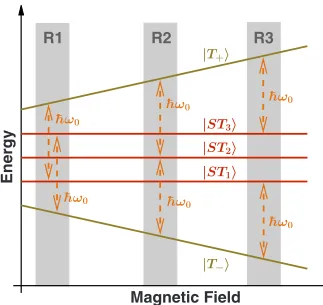
Figure 2 shows schematically the two-electron energy-level diagram as function of the static magnetic field of the undriven system 共⍀= 0兲 and for spin up.12 The upper and
lower energy levels correspond to the triplets 兩T+典 and 兩T−典
which as explained in the next section lead to spin blockade. The remaining three energy levels, 兩STi典, i= 1 , 2 , 3 corre-spond to two-electron states that contain a singlet component and thus allow electronic transport. For the driven system
共⍀⫽0兲 transitions from the 兩T⫾典 to 兩STi典 states can take place lifting the spin blockade and resulting in a change in the average occupation. Within a simplified approach if a transition frequency matches the frequency of the driving field the corresponding transition probability is expected to be high. The regions R1, R2, R3 in Fig. 2 illustrate such a resonant behavior. The magnetic field where the resonances occur depends on the energy splitting of the兩STi典 states and therefore on the interdot hopping␥and the coupling strength
J. Additionally, as shown in the next section, interference effects, for instance, when兩T⫾典→兩ST2典, can yield a vanish-ingly small probability for particular magnetic fields.
Having described the interaction of the DD with the os-cillating magnetic field we analyze the dissipative interac-tions with the leads and the phonon heat bath. The left and right leads are described by a Hamiltonian of the form
Hleads=
兺
ᐉk⑀ᐉkdᐉk †
dᐉk, 共7兲
wheredᐉ†k 共dᐉk兲 creates共annihilates兲an electron in lead ᐉ =兵L,R其with momentum k, spin , and energy ⑀ᐉk. The in-teraction between the dots and the leads is given by the tun-neling Hamiltonian
HT=
兺
k共tLc1 †
dLk+tRc2 †
dRk兲+ H.c., 共8兲
where tL 共tR兲 is the tunnel coupling between dot 1 共2兲 and leadL 共R兲and we consider the symmetric case withtL=tR.
To take into account spin relaxation we have considered a generic bosonic bath that is modeled as a set of harmonic oscillators and is described by the Hamiltonian
HB=
兺
jប1,ja1,†ja1,j+
兺
jប2,ja2,†ja2,j. 共9兲
We have assumed that each quantum dot is coupled to an independent bosonic bath and there are no environment-induced correlations between the two dots. The operatorsa1,j †
共a1,j兲create共annihilate兲a boson in modej and similarly for
a2,†j共a2,j兲while1,jare the corresponding frequencies of the bath modes. The interaction between the bath and the spins of the DD is given by the general model Hamiltonian
HSB=1 −
兺
j
⌳1,ja1,j †
+2−
兺
j⌳2,ja2,j †
+ H.c., 共10兲
where the spin-flip operators arei −
=ci↓ †
ci↑ and⌳1,j共⌳2,j兲is the coupling constant between dot 1共2兲and thejth mode of the corresponding bath. HSB allows spin-flip processes for electrons in the DD via energy exchange with the bath which, as shown in the next section, leads to a leakage cur-rent. We consider spin relaxation only in the DD since for the target spin an upper limit to its relaxation rate is set implic-itly by the coupling to the leads. In our scheme the relaxation rate of the target spin has to be smaller than the electron tunneling rate from the leads to the DD to ensure a measur-able change in the DD occupations before spin relaxation.
To investigate the electron occupation of the system we employ a master equation approach and derive an equation of motion for the reduced density matrix,, for the system of interest that consists of the DD and the target spin.13 The occupation probabilities are given by the diagonal elements of . It is convenient to eliminate the time dependence from the system HamiltonianHSand for this reason we perform a rotating-wave approximation.13,14This approximation is well
justified for weak driving, i.e., when ⍀Ⰶ0 as in our sys-tem. In the devices we are considering the ratio 0/⍀0
ⲏ1000 but a recent experimental investigation shows that even for ratios 0/⍀⬇10 the rotating-wave approximation still predicts the correct spin dynamics.15 In the rotating
frame an arbitrary system operator K is transformed as
Uz†KUz with the unitary operator Uz= exp共−iz0t/2兲 and
z=兺 i=0 2
i z .
Energy
Magnetic Field
R1 R2 R3
¯
hω0
¯
hω0
¯
hω0
¯
hω0
¯
hω0
¯
hω0
|ST1 |ST3 |ST2 |T+
[image:3.609.89.251.67.220.2]|T−
FIG. 2.共Color online兲Schematic illustration of the two-electron energy diagram for the undriven system. 0is the oscillating fre-quency of the driving field.兩T+典and兩T+典are blocked triplet states,
Starting with the total density matrix, , and within the standard Born and Markov approximations13 we derive an
equation of motion for by tracing over the leads and bosonic bath degrees of freedom, i.e., = TrE兵其, where TrE兵¯其means trace over the environmental degrees of free-dom. In the rotating frame and having performed a rotating-wave approximation the density matrix satisfies the equa-tion of moequa-tion,
˙共t兲=LS共t兲+Lleads共t兲+LB共t兲 共11兲
with the free evolution term
LS共t兲= −
i
ប关HS,共t兲兴,
and the terms due to the electronic leads
Lleads共t兲= − 1
ប2TrE
再
冕
0⬁
d†HT共t兲,关U共兲HT共t−兲U†共兲,共t兲丢leads兴‡
冎
and the bosonic bathLB共t兲= − 1
ប2TrE
再
冕
0⬁
d†HSB共t兲,关V共兲HSB共t−兲V†共兲,共t兲丢B兴‡
冎
.The operators are U共兲= exp关−i共HS+Hleads兲/ប兴 and V共兲 = exp关−i共HS+HB兲/ប兴 with leads, B being the equilibrium density matrix for the leads and the bosonic bath, respec-tively. The time-dependent operators are ci↑共t兲=ci↑exp共 −i0t/2兲, ci↓共t兲=ci↓exp共+i0t/2兲 and the Hamiltonian HS depends on the nearby spin,= +1共−1兲for spin up共down兲, i.e.,
HS=HDD+
␦0 2 +
␦1+J 2 1
z +␦2
22 z
+
兺
i=1 2ប⍀
2 i
x 共
12兲
and we have introduced the magnetic field detuning ␦i=⌬i −ប0.
For the numerical calculations we write Eq. 共11兲 in the energy basis. This results in a system of 256 coupled equa-tions for all the matrix elements ofwhich is solved numeri-cally taking into account the normalization condition for the diagonal elements,兺i=1
16
i,i= 1. We are interested in the steady state, st, that corresponds to˙= 0 in Eq. 共11兲. The quantity of interest is the average electron occupation of the DD, for example, of dot 1, that is calculated as N1= Tr兵n1st其. In the next section we present the basic results and explain the in-fluence of various system parameters on the average electron occupation of the DD.
III. INVESTIGATION OF SPIN METER
Before we examine the influence of microwave radiation we have to make a choice for the operating regime of the DD. DD systems and their physical response are highly tun-able by adjusting the gate voltages and the source-drain bias voltage in the leads. A regime which is easily accessible and has attracted a lot of interest is the Pauli spin blockade re-gime which has been demonstrated experimentally in various systems such as AlGaAs/GaAs and Si/Ge double quantum dots16,17 as well as carbon nanotube dots.18 In this regime
one electron is confined in each dot and the three triplet states are almost equally and fully populated. In the absence of spin relaxation and microwaves the共1,1兲triplet states are blocked from moving on to a共0,2兲state by the Pauli exclu-sion principle关共n,m兲denotes a charge state withn共m兲 elec-trons on dot 1共2兲兴. Thus the electrical current as a function of the source-drain bias is suppressed.
For a fixed source-drain bias in the spin blockade regime a change in the occupations of the two dots can occur and a microwave-induced current can flow provided that the two dots have a different Zeeman splitting.19In this case the
os-cillating magnetic field in combination with a static field induces coherent spin rotations that mix two-electron states and current flows through the transport cycle 共0 , 1兲→共1 , 1兲
→共0 , 2兲→共0 , 1兲. When the two dots have the same Zeeman splitting the spins in the two dots rotate at the same rate in the triplet subspace and therefore the average occupation re-mains fixed and current does not flow.19,20In this case only
spin relaxation can give rise to a change in the occupation of the dots.
Inspection of theizterms in Hamiltonian共12兲shows that the interaction of the nearby spin with the spins on dot 1 induces an effective Zeeman asymmetry between the two dots of orderJthat depends on the orientation of the nearby spin. This suggests that a microwave-induced change in the occupation of the DD could take place and reveal informa-tion about the spin state when the dot parameters are ad-justed to the spin blockade regime.
this work we assume for simplicity that⌬1=⌬2and thus the Zeeman asymmetry is due entirely to the presence of the nearby spin, and further thatJis independent of the applied magnetic field.
For the numerical calculations the internal parameters of the DD are adjusted to zero-energy detuning and specifically we choose E共1 , 1兲−E共0 , 2兲= 0, with E共n,m兲 being the en-ergy of the charge state共n,m兲. For a practical realization this configuration could be achieved via adjusting the gate volt-ages that define the confining potential of the DD.20 We
choose for the on-site energies1= −U/2,2= −Uand for the interdot Coulomb energyV=U/2.22 The bias voltage isV
sd =共L−R兲/e=U/2e and it is applied symmetrically, thus
L=U/4 and R= −U/4, with L 共R兲 being the chemical potential of the left 共right兲 lead. When the interdot hopping satisfies␥ⰆUand the temperaturekBTⱗU/80 the current as a function of source-drain bias is suppressed due to spin blockade and each dot contains a single electron.
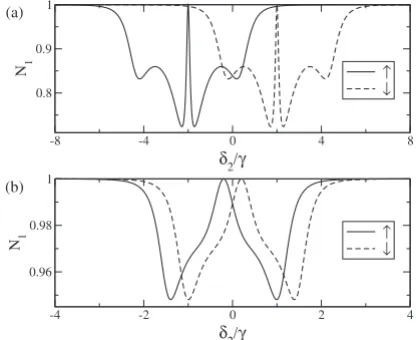
Figure3共a兲shows the average electron occupation of dot 1 as a function of the magnetic field detuning␦2for the two possible states of the target spin. We consider no spin relax-ation and therefore we set⌳1,j=⌳2,j= 0 in Eq.共10兲. The dot occupation exhibits resonances 共peaks兲 due to intradot spin rotations induced by the oscillating magnetic field and inter-dot tunneling, and it is constant close to unity far from the resonances due to spin blockade. For each spin configuration there are in total four peaks whose positions depend on␥and
J. The two outer peaks correspond to resonances R1 and R3
共see Fig. 2兲 and we would expect a third resonance atប0 =共⌬1+⌬2⫾J兲/2, corresponding to R2, but this resonance is split by an antiresonance, resulting in the two inner peaks. In terms of spin-dependent detuning the condition for the anti-resonance is兩␦1⫾J兩=兩␦2兩. This very symmetric situation to-gether with the microwave driving leads to the emergence of an eigenstate of the system with purely 共1,1兲triplet compo-nents, resulting in spin blockade. It can be shown from the steady-state occupations that for this detuning the 兩S02典 =兩0 ,↑↓典 state is unoccupied and the current is suppressed.
Away from the symmetry point, when ⬎␥ប⍀/J, defining the distance from the symmetry point as=兩␦1⫾J兩−兩␦2兩, the eigenstate is no longer a pure triplet and current can flow, resulting in the two inner peaks left and right of the antireso-nance. We can try to gain an intuitive understanding of the outer peak positions. Naively one would expect the outer peaks to appear when either the spin in dot 1 is on resonance or the spin in dot 2 is on resonance. However, for finite interdot hopping the outer peaks are somewhat shifted from the positions that one would expect for independent spins since intradot spin rotations take place with interdot hopping. As a result the shift is large when␥is large. Interdot hopping leads to delocalization of the electron spins via the resonant coherent transitions兩↑,↓典↔兩0 ,↑↓典and兩↓,↑典↔兩0 ,↑↓典, with an amplitude proportional to␥, that populate the兩0 ,↑↓典state and thus lead to a change in the populations. In addition, the populations of the兩↑,↓典and兩↓,↑典states are unequal leading to a mixing of the 共1,1兲 singlet and the Sz= 0 triplet that depends on the magnitude of Jand␥. WhenJ is small the two outer peaks overlap with the inner peaks as shown, for example, in Fig.3共b兲, though the important point is that the spin up and spin down signals can still be distinguished共see also below兲 making the measurement feasible. When J= 0 resonances do not occur since the spins in the two dots rotate at the same rate and the兩S02典 state remains unoccupied.
The change in the dot occupation is large when the Rabi frequency,⍀, is smaller than␥/បor the same order of mag-nitude, a condition that allows interdot hopping while intra-dot spin rotations take place. In the opposite limit spin rota-tions dominate and the average dot occupation remains close to unity in both dots. IfJis much smaller than␥the mixing of two-electron states is weak, whereas in the opposite limit interdot transitions are suppressed and the microwaves have no significant effect resulting in a rather small resonant change. Therefore, probing a small Jneeds a small ␥.
To quantify this effect we show in Fig. 4共a兲 the relative occupation on resonance as a function ofJ, for a fixed
inter--4 -2 0 2 4
δ2/γ
0.96 0.98 1
N1 ↑↓
-8 -4 0 4 8
δ2/γ
0.8 0.9 1
N1 ↑
↓
(a)
[image:5.609.333.536.67.236.2](b)
FIG. 3. 共a兲 Average occupation of dot 1 as a function of the magnetic field detuning ␦2when the target spin is up 共solid line兲
and down共dashed line兲, for the parametersJ= 4␥,␥= 1.5⫻10−6U, kBT=U/100,ប⍀= 10−6U, andប0= 10−3U.共b兲The same as in共a兲
forJ= 0.4␥.
0 0.15 0.3
0 0.015 0.03
0 2 4 6
0 0.1 0.2 0.3
N1
kBT=U/100
kBT=U/20 kBT=U/15 kBT=U/10
kBT=U/5
0 2 4 6
J/γ 0
0.1 0.2 0.3
∆Ν
1
r
(a)
(b)
r
FIG. 4. 共a兲Microwave-induced change in the occupation of dot 1 as a function of the interaction strength Jfor different tempera-tures and when the target spin is up and ␥= 1.5⫻10−6U, ប⍀
= 10−6U, andប
0= 10−3U. 共b兲Maximum difference of the spin up
and spin down occupations for the same parameters as in共a兲 with
[image:5.609.68.276.69.239.2]dot hopping and for different temperatures, when the nearby spin is up. A spin down results in the same behavior. The relative occupation of dot 1, N1r, is calculated as N1r=N10
−N1p, whereN1pis the occupation on resonance, i.e., the value of the occupation at the strongest peak, andN10is the occu-pation off resonance 共background occupation兲. The weak feature in the curves atJ⬇2␥ is due to the outer peaks共R1 and R3 regions in Fig.2兲becoming distinguishable from the inner peaks 共R2 region兲. For temperatures kBTⱗU/80, the background occupation is fixedN10⬇1, due to spin blockade and hence the relative occupation is essentially temperature independent. In this regime there is to good approximation one electron in each dot in the 兩T⫾典 states. With increasing temperature spin blockade is gradually lifted and the back-ground occupation increases. All one- and two-electron states acquire a finite population and even three-electron states, for instance, 共1,2兲, become occupied and have to be included in the dynamics of the density matrix. This happens since the lengthening tail of the Fermi-Dirac distribution of the lead electrons leads to the opening of additional transport channels. The exact temperature dependence ofN1r depends on various factors such as coupling to the leads, spin relax-ation rate, as well as the applied source-drain bias. Even though this dependence may not be monotonic in all cases for high enough temperatures共kBTⲏU兲the resonances can-not be clearly resolved and N1r⬇0. From Fig.4共a兲 we con-clude that the DD detector has a higher temperature range of operation compared with a single dot since the charging en-ergy is the relevant enen-ergy scale. A similar increase in oper-ating temperature has been predicted for an undriven DD read-out of a charge qubit.23
In a spin read-out situation we are not only interested in the height of the resonant peaks but we want to distinguish two target spin states. Thus, the figure of merit for a spin read-out has to be the maximum difference in population for target spin up and target spin down. In Fig.4共b兲we plot the maximum difference ⌬N1r of the spin up and spin down oc-cupations as a function ofJand for a fixed interdot hopping. ForJⲏ2␥the maximum difference occurs at the inner peak of the spin up 共down兲 occupation with ␦2⬍0 共␦2⬎0兲. The results indicate that a large difference can be induced making possible the discrimination between spin up and spin down states.
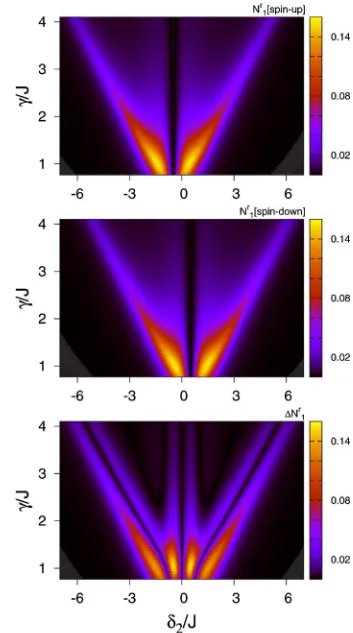
As shown above, the achievable difference in dot occupa-tion depends on a range of parameters. Figure 5 shows a contour plot of the average occupation as a function of de-tuning and interdot hopping for a fixed spin interaction strength.24The occupation exhibits a distinct resonant pattern
for both spin up and down and further it enables the two possible outcomes to be distinguished in a range of interdot hopping. Our calculations confirm that this is a robust behav-ior that occurs for other values of J in the range
⬃共10−7– 10−6兲U. However, as explained above for␥ⰇJthe occupation peaks decrease and this could make the spin de-tection relatively difficult.
In addition to the temperature effect the background av-erage occupation increases due to spin relaxation and as a result the microwave-induced resonances cannot be clearly resolved since the relative occupation in both dots drops. Spin relaxation and decoherence will also influence the peak
height of the resonances since they inhibit coherent spin ro-tations. Spin-flip processes which take place because of the interaction of the DD spins with the bosonic bath described by Eq. 共10兲, allow incoherent transitions between two-electron states, for example, 兩↑,↑典↔兩↓,↑典, 兩↑,↓典, which in turn populate the 兩S02典 state, lifting the spin blockade, and thus increasing the background occupation. This happens even in the absence of the nearby spin, i.e., when J= 0, though spin blockade can still be recovered as shown in Ref. 19depending on the spin relaxation rate and the coupling to the leads.
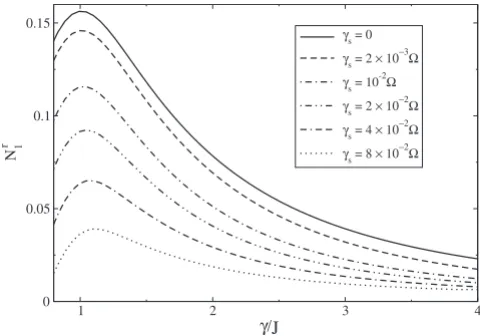
To examine the effect of spin relaxation on the driven DD spin detector we have calculated the change in population for various spin relaxation rates ␥s. Results are shown in Fig.6 for the relative occupation of the strongest共outer兲peaks as a function of hopping when the nearby spin is up 共the same behavior results for spin down兲. We have taken ␥s =兩⌳兩2D共␦⑀兲关2n共␦⑀,T兲− 1兴/ប with the Bose function
n共␦⑀,T兲=关exp共␦⑀/kBT兲− 1兴−1 and␦⑀=ប0.Dis the density of states for the bosonic bath that is taken constant and also
[image:6.609.345.522.67.384.2]兩⌳兩=兩⌳1,j兩=兩⌳2,j兩 in Eq.共10兲. This expression for ␥s can be derived by assuming a single spin with Zeeman splitting␦ coupled to a bosonic bath at temperatureTwhich we assume to be the same as the temperature in the leads. We focus on the most interesting experimental regime in which the spin
FIG. 5.共Color online兲Relative occupation of dot 1 as a function of magnetic field detuning ␦2and interdot hopping ␥ for spin up
and down for the parameters J= 9⫻10−7U, k
BT=U/100, ប⍀
= 10−6U, andប
0= 10−3U. The lower frame shows the absolute
relaxation rate is much smaller than the tunneling rate through the DD and the system weakly deviates from the spin blockade regime. As seen in Fig. 6, the effect of spin relaxation becomes important as ␥s increases, which in turn leads to a decrease in the relative occupation. The sensitivity of the spin detector is limited by the minimum detectable change in the occupations. The optimum resolution can be achieved when the driving is efficient. This happens when the Rabi frequency, which is controlled by the intensity of the oscillating field, is larger than the spin relaxation rate of the dot spins and the target spin, as well as the tunneling rate through the DD.
IV. DISCUSSION AND CONCLUSIONS
In summary, we have suggested an electrical scheme to probe a single spin which makes use of two serially tunnel-coupled quantum dots connected to metallic leads. The spin is located at some distance from the dots, which has to be smaller than the typical interdot separation, and the total sys-tem is in a static magnetic field under the application of a microwave magnetic field. The spin interacts with the spins on the dots and this interaction results in an effective Zeeman splitting that is different in the two dots. Due to an electron-spin-resonance effect the electron occupations of the dots exhibit resonances which reveal information about the state of the nearby spin. In particular, the ac-driven DD spin meter provides an explicit signal in the induced occupations for both spin orientations and enables the spin state to be probed noninvasively in a single shot provided that the target spin has a differentgfactor from the DD system, a condition that is typically satisfied.
In order to detect the resonant change in occupation, a charge detector, e.g., a quantum point contact 共QPC兲 or a single-electron transistor共SET兲has to be employed. As long as the bias voltage of the QPC/SET is smaller than the level spacing on the DD, it will not influence the operation of the device as a spin meter. A further source of error would be an inaccurate charge detector, whereby the recorded electron
count does not correspond to the actual electron count. How-ever, provided the miscount is smaller than the average change in population, spin up and spin down can still be distinguished.
We identified a range of parameters for which the DD spin meter can operate and analyzed how we can tune its sensitivity with the interdot hopping and intensity of the mi-crowave field that defines the Rabi frequency for spin rota-tions. The operation of the DD spin meter depends on a lifting of a Pauli spin blockade, and therefore it can operate at much higher temperatures than the single dot which is limited to temperatures comparable to the Zeeman energy.9 For instance, for a charging energy of 10 meV and spin-spin interaction strength in the range ⬃5 MHz the resonances survive up to temperatures of a few tens of kelvins. To achieve a similar operating temperature with a single dot, magnetic fields of a few tens of teslas and correspondingly microwave frequencies of several hundreds of gigahertz would be necessary, conditions which are available only in specialized laboratories. The sensitivity of the meter is lim-ited by internal spin relaxation which essentially leads to a small change in the occupations and as a consequence the resonances cannot be clearly resolved. For an efficient read-out the tunneling rates from dots to leads and the microwave-induced Rabi frequency have to be larger than all the rel-evant spin relaxation rates.
Finally, the change in population effected by the micro-wave field has to be seen in relation to the relaxation time of the target spin. On one hand, the spin read-out has to be completed within the relaxation time of the target spin, oth-erwise random spin-flips will obscure the result. On the other hand, for a given change in population,⌬Ni, of doti= 1 , 2 a certain number of electrons, n, has to pass through the DD and be counted by the charge detector. To achieve reliable statistics the requirementn⬎1/⌬Ni2has to be fulfilled since then fluctuations in the average number are smaller than the change in population that we want to distinguish. At a given tunneling rate⌫through the device, this determines the mini-mum time of the measurement Tm=n/⌫= 1/共⌫⌬Ni
2兲⬍T 1, which must be smaller than the spin relaxation time of the target spin. We arrive therefore at a minimum tunneling rate through the dot,⌫⬎1/共⌬Ni2T1兲. However, we are not free to increase the tunneling rate arbitrarily; once the tunneling rate approaches the Rabi frequency the resonance peaks in the population are suppressed. By demanding 10⌫⬍⍀ we ob-tain the minimum resolvable change in population as ⌬Ni =
冑
10/共T1⍀兲.We conclude by estimating the feasibility of measuring the state of a molecular spin system, for example, Sc@C82, which can be coupled with a carbon nanotube DD.18 Such
carbon-based systems are promising candidates for quantum information processing and around several kelvins have a
T1⬇1 s共Refs.25and26兲. Then with a Rabi frequency of 10 MHz we arrive at a minimum resolvable change in popula-tion of⌬Ni= 0.001. An interdot hopping of␥= 10 MHz and a spin-spin interaction ofJ⬇5 MHz共see Ref.9for an esti-mation ofJ兲would lead to⌬Ni⬇0.07 in the case of no spin decoherence. With a spin decoherence rate of ␥s= 1 MHz this reduces to ⌬Ni⬇0.007. In order to be able to resolve such a difference in occupation, spin-flip processes have to
1 2 3 4
γ/ 0
0.05 0.1 0.15
N1
γs= 0
γs= 2× 10
−3Ω
γs= 10 -2
Ω γs= 2× 10
−2 Ω γs= 4× 10⁻²Ω
γs= 8× 10
−2Ω
J
[image:7.609.52.292.67.235.2]r
FIG. 6. Relative occupation of dot 1 as a function of the interdot hopping for different spin relaxation rates when the target spin is up and the parameters J= 9⫻10−7U, k
be sufficiently suppressed by a difference in Zeeman splitting of the target and the dot spin 共see Appendix兲. To resolve
⌬Ni⬇0.007 with⍀= 10 MHz a difference in Zeeman split-ting ␦⌬⬇1 GHz is needed. For a g factor of g= 2 for the molecule andg= 2.1 for the carbon nanotube27this results in
a required microwave frequency of0⬇20 GHz. Consider-ing all estimates a sConsider-ingle spin read-out with realistic param-eters at liquid-helium temperatures is feasible.
ACKNOWLEDGMENTS
We would like to thank Mark Buitelaar for discussions. The work is part of the UK QIP IRC共Grant No. GR/S82176/ 01兲. J.W. thanks the Wenner-Gren Foundations for financial support. B.W.L. thanks the Royal Society. J.H.J. acknowl-edges support from the UK MoD. G.A.D.B. is supported by EPSRC共Grant No. GR/S15808/01兲.
APPENDIX: DERIVATION OF EFFECTIVE ISING COUPLING
Consider two spins with different Zeeman splittings de-scribed by the Hamiltonian
H0=
⌬
2A z
+⌬+␦⌬ 2 B
z
, 共A1兲
where⌬共⌬+␦⌬兲denotes the Zeeman splitting of spinA共B兲
and ␦⌬ the difference in Zeeman splitting between spin A
and spin B. In this analysis spin B is the target spin, which interacts with spinA via an isotropic Heisenberg interaction given by
H1= J 2共A
x B x
+A y
B y
+A z
B z兲
, 共A2兲
whereJdenotes the strength of the interaction. In addition to the diagonal contributionA
z
B z
, the Heisenberg Hamiltonian couples spin states which differ in energy by ␦⌬ via A
x B x
+A y
B y
, and we can treat the HamiltonianH1 as a perturba-tion to the Hamiltonian H0. The eigenstates of the
unper-turbed Hamiltonian are the spin states 兩1共0兲典=兩↑↑典, 兩2共0兲典 =兩↑↓典,兩3共0兲典=兩↓↑典, and兩4共0兲典=兩↓↓典and so the first-order cor-rection to the energy eigenvalues becomes
Ei共 1兲=具
i
共0兲兩H
1兩i共
0兲典. 共A3兲
We can therefore write the Hamiltonian including the first-order correction as
H=⌬ 2A
z
+⌬+␦⌬ 2 B
z +J
2A z
B z
. 共A4兲
The free Hamiltonian of spin Bcommutes withH. The new eigenstates are found using the standard formula
兩i典=兩i共 0兲典+
兺
i⫽j
具i共0兲兩H1兩j共0兲典
Ei共0兲−E共j0兲
兩共j
0兲典, 共A5兲
which gives 兩1典=兩↑↑典, 兩2典=兩↑↓典−J/␦⌬兩↓↑典, 兩3典=兩↓↑典 +J/␦⌬兩↑↓典, and 兩4典=兩↓↓典. Typically the difference in Zee-man splitting ␦⌬ is at least two orders of magnitude larger than the Heisenberg interaction strengthJ, resulting in a very small admixture of 兩↓↑典 共兩↑↓典兲 in the eigenstate 兩2典 共兩3典兲. This leads to a very small but finite probability for a spin-flip in spinB.
Consider now the situation in which a current is flowing through the DD adjacent to the target spin. If a target spin-flip can take place a channel for decoherence exists via the coupling to the lead electrons. The decoherence rate has to be proportional to the tunneling rate through the device, ⌫, and is suppressed by the reduced probability for a spin-flip, resulting in the effective decoherence rate for the target spin given by ⌫共J/␦⌬兲2, and a corresponding coherence time
TcJ= 1/⌫共J/␦⌬兲2. The measurement has to be done within this coherence time and the information about the initial tar-get spin state is scrambled. If we compare this coherence time with the measurement time Tm= 1/⌫⌬Ni
2
, we conclude that the minimum resolvable change in occupation number is given by⌬NiJ=J/␦⌬. The off-resonant microwave radiation can be treated similarly, resulting in a coherence time Tc⍀ = 1/⌫共ប⍀/␦⌬兲2. The minimum resolvable number difference is then max共⌬NiJ,⌬Ni⍀兲.
1F. H. L. Koppens, C. Buizert, K. J. Tielrooij, I. T. Vink, K. C.
Nowack, T. Meunier, L. P. Kouwenhoven, and L. M. K. Vander-sypen,Nature共London兲 442, 766共2006兲.
2J. R. Petta, A. C. Johnson, J. M. Taylor, E. A. Laird, A. Yacoby,
M. D. Lukin, C. M. Marcus, M. P. Hanson, and A. C. Gossard,
Science 309, 2180共2005兲.
3J. M. Elzerman, R. Hanson, L. H. Willems van Beveren,
B. Witkamp, L. M. K. Vandersypen, and L. P. Kouwenhoven,
Nature共London兲 430, 431共2004兲.
4D. Rugar, R. Budakian, H. J. Mamin, and B. W. Chui, Nature
共London兲 430, 329共2004兲.
5E. Cota, R. Aguado, and G. Platero,Phys. Rev. Lett. 94, 107202
共2005兲.
6R. Sánchez, E. Cota, R. Aguado, and G. Platero,Phys. Rev. B
74, 035326共2006兲.
7S. D. Barrett and T. M. Stace, Phys. Rev. Lett. 96, 017405
共2006兲.
8H.-A. Engel, V. N. Golovach, D. Loss, L. M. K. Vandersypen,
J. M. Elzerman, R. Hanson, and L. P. Kouwenhoven,Phys. Rev. Lett. 93, 106804共2004兲.
9J. Wabnig and B. W. Lovett,New J. Phys. 11, 043031共2009兲. 10A single orbital description is also valid for carbon nanotube
quantum dots when the valley degeneracy is broken and the induced single-particle splitting is large. See, for example, Ref.
18.
11J. A. Weil and J. R. Bolton,Electron Paramagnetic Resonance:
Elementary Theory and Practical Applications 共Wiley, New York, 2007兲.
12We are interested in static magnetic fields which produce a
and spin interaction strengths. In this regime the 兩T−典 共兩T+典兲 is the lowest共highest兲two-electron state.
13C. W. Gardiner and P. Zoller, Quantum Noise 共Springer, New
York, 2000兲.
14J. Wabnig, B. W. Lovett, J. H. Jefferson, and G. A. D. Briggs,
Phys. Rev. Lett. 102, 016802共2009兲.
15G. D. Fuchs, V. V. Dobrovitski, D. M. Toyli, F. J. Heremans, and
D. D. Awschalom,Science 326, 1520共2009兲.
16K. Ono, D. G. Austing, Y. Tokura, and S. Tarucha,Science 297,
1313共2002兲.
17N. Shaji, C. B. Simmons, M. Thalakulam, L. J. Klein, H. Qin,
H. Luo, D. E. Savage, M. G. Lagally, A. J. Rimberg, R. Joynt, M. Friesen, R. H. Blick, S. N. Coppersmith, and M. A. Eriksson,
Nat. Phys. 4, 540共2008兲.
18M. R. Buitelaar, J. Fransson, A. L. Cantone, C. G. Smith,
D. Anderson, G. A. C. Jones, A. Ardavan, A. N. Khlobystov, A. A. R. Watt, K. Porfyrakis, and G. A. D. Briggs,Phys. Rev. B
77, 245439共2008兲.
19R. Sánchez, C. López-Monís, and G. Platero,Phys. Rev. B 77,
165312共2008兲.
20F. H. L. Koppens, C. Buizert, I. T. Vink, K. C. Nowack,
T. Meunier, L. P. Kouwenhoven, and L. M. K. Vandersypen,J.
Appl. Phys. 101, 081706共2007兲.
21G. Giavaras, J. Wabnig, B. W. Lovett, J. H. Jefferson, and G. A.
D. Briggs,Physica E共Amsterdam兲 42, 895共2010兲.
22The exact value of V does not affect the main conclusions as
long as ␥ⰆU and the DD parameters are adjusted to zero-energy detuning.
23T. Gilad and S. A. Gurvitz,Phys. Rev. Lett. 97, 116806共2006兲. 24The interdot hopping cannot be made arbitrarily small since this
will invalidate the Born approximation.
25A. Ardavan, M. Austwick, S. C. Benjamin, G. A. D. Briggs, T. J.
S. Dennis, A. Ferguson, D. G. Hasko, M. Kanai, A. N. Khlo-bystov, B. W. Lovett, G. W. Morley, R. A. Oliver, D. G. Pettifor, K. Porfyrakis, J. H. Reina, J. H. Rice, J. D. Smith, R. A. Taylor, D. A. Williams, C. Adelmann, H. Mariette, and R. J. Hamers,
Philos. Trans. R. Soc. London, Ser. A 361, 1473共2003兲. 26S. C. Benjamin, A. Ardavan, G. A. D. Briggs, D. A. Britz,
D. Gunlycke, J. Jefferson, M. A. G. Jones, D. F. Leigh, B. W. Lovett, A. N. Khlobystov, S. A. Lyon, J. J. L. Morton, K. Por-fyrakis, M. R. Sambrook, and A. M. Tyryshkin,J. Phys.: Con-dens. Matter 18, S867共2006兲.
27F. Kuemmeth, S. Ilani, D. C. Ralph, and P. L. McEuen,Nature