ISSN Print: 2327-4336
DOI: 10.4236/gep.2019.78016 Aug. 26, 2019 221 Journal of Geoscience and Environment Protection
Development of Operational Technology for
Meteorological High Performance Computing
Jing Sun, Bin Wang
*National Meteorological Information Center, China Meteorological Administration, Beijing, China
Abstract
As an important branch of information technology, high-performance com-puting has expanded its application field and its influence has been expand-ing. High-performance computing is always a key area of application in me-teorology. We used field research and literature review methods to study the application of high performance computing in China’s meteorological de-partment, and obtained the following results: 1) China Meteorological De-partment gradually established the first high-performance computer system since 1978. High-performance computing services can support operational numerical weather prediction models. 2) The Chinese meteorological de-partment has always used the relatively advanced high-performance compu-ting technology, and the business system capability has been continuously improved. The computing power has become an important symbol of the level of meteorological modernization. 3) High-performance computing technology and meteorological numerical forecasting applications are increa-singly integrated, and continue to innovate and develop. 4) In the future, high-performance computing resource management will gradually transit from the current local pre-allocation mode to the local remote unified sche-duling and shared use. In summary, we have come to the conclusion that the performance calculation business of the meteorological department will usher in a better tomorrow.
Keywords
High Performance Computing, Supercomputer, Parallel Computing, Acceleration Component, Meteorology, Numerical Prediction System
1. Introduction
High-performance computing addresses the need for supercomputing perfor-mance through parallel computing. Science and technology personnel have car-How to cite this paper: Sun, J., & Wang, B.
(2019). Development of Operational Tech-nology for Meteorological High Perfor-mance Computing. Journal of Geoscience and Environment Protection, 7, 221-229.
https://doi.org/10.4236/gep.2019.78016
Received: September 20, 2018 Accepted: August 23, 2019 Published: August 26, 2019
Copyright © 2019 by author(s) and Scientific Research Publishing Inc. This work is licensed under the Creative Commons Attribution International License (CC BY 4.0).
http://creativecommons.org/licenses/by/4.0/
DOI: 10.4236/gep.2019.78016 222 Journal of Geoscience and Environment Protection ried out many studies on this. Research by Reshmi & Poongodi (2018) shows that high-performance computing becomes the most important field in various industries and organizations, which needs to be concentrated more today due to their massive resource requirements. A new generation of computational scien-tists is expected to further increase the impact of advanced computing in con-ceiving creative, powerful ways to understand the universe and solve complex problems (Esteban, 2018). Also, high-throughput, large-scale medical image computing demands tight integration of high-performance computing infra-structure for data storage, job distribution, and image processing. The Vander-bilt University Institute for Imaging Science (VUIIS) Center for Computational Imaging (CCI) has constructed large-scale image storage and processing infra-structure with HPC (Huo et al., 2018).
Meteorology has always been one of the important application areas for high performance computing. With the rapid development of meteorological numer-ical forecasting business and scientific research work, the demand for high-performance meteorological data has surged. Since the 1990s, the high-performance computing capabilities of the Chinese meteorological de-partment have made great progress, and the application support capability has been continuously improved. The level of informationization of meteorological services has made important contributions. However, there are few studies and summaries for the application of high performance computing in meteorology, so we will fill the gaps or adds to the existing literature.
In the rest of the paper, we will elaborate on the development of high-performance computing technology, the application and development of high-performance meteorological computing, and future prospects.
2. Development of High Performance Computing
Technology
High Performance Computing (HPC) mainly refers to computationally intensive and fast and efficient operations (Chen & Sun, 2017; Sharma et al., 2018; Wei &
Wang, 2017). High-performance computers are often referred to as
supercom-puters. High-performance computing has become an important branch of the discipline of computer science and technology. It refers to the research and de-velopment of high-performance computers from the aspects of architecture, pa-rallel algorithms and software development. High-performance computing con-stitutes the important support technology of scientific research, also with theo-retical and experimental science.
tech-DOI: 10.4236/gep.2019.78016 223 Journal of Geoscience and Environment Protection nology for national development, and its development level has become an impor-tant indicator to measure a country’s overall national strength (Wang et al., 2008). High-performance computing plays an indispensable role in national science and technology, national defense, industry, finance, service, and life.
According to the Flynn’s macroscopic classification (Flynn, 1966; Flynn, 1972;
Flynn & Rudd, 1996), most modern high- performance computer systems
be-long to the MIMD (Multiple Instruction Stream Multiple Data Stream) type of computer.
The hardware components of high-performance computer systems produced by various manufacturers are basically the same. The architectures mainly clude Cluster and MPP. The processors include X86 and RISC. The internal in-terconnection network includes Infiniband, OPA, Ethernet, and proprietary networks. The mainstream operating system includes Linux and UNIX systems, the compiler uses Intel/GNU/PGI compiler, and uses parallel environment such as MVAPICH/OpenMPI. The job management software uses commercial soft-ware (LSF, PBSpro, LoadLeveler, etc.) or open source softsoft-ware (Slurm, OpenPBS, Torque, etc.).
Currently, high-performance computer systems are mainly cluster system ar-chitectures. Cluster refers to a group of independent computers, including compute nodes, storage nodes, service nodes, pre-processing nodes and other types of servers. They are connected by a high-speed communication network according to a certain structure to form a single computer system to achieve uni-fied management scheduling. Parallel processing is more efficient. The biggest feature of the cluster system is to provide high reliability, scalability and cata-strophic (Ji, 2012).
At present, the key performance indicators for measuring high-performance computer systems mainly include system architecture, machine scale, number of processors (cores), peak speed, measured speed, operating efficiency, memory access speed, network interconnection performance, and performance per watt.
The global supercomputer TOP500 ranking(Roudas et al., 2012; Strohmaier
& Meuer, 2000) is a regular evaluation of global high-performance computer
systems by international academic organizations. It is published once every six months and has become the industry-recognized de facto standard for measur-ing high-performance computmeasur-ing. It has become the vane of development status and trends.
The latest data of the world supercomputer TOP500 (June 2018) shows that there are 273 systems over PFLOPS, and the open system technology represented by X86+ Linux has the upper hand. It also used the CPU+ accelerator device. The number and proportion of hybrid architectures continues to increase. The architecture is dominated by the Cluster structure, and the internal node inter-connection network is dominated by Infiniband technology. The X86 processor chip has a large advantage, and the Linux operating system still dominates.
DOI: 10.4236/gep.2019.78016 224 Journal of Geoscience and Environment Protection are becoming increasingly apparent. High-performance computing systems face the challenges of low cost, low power consumption, availability of parallel pro-gram support, and efficient use of existing legacy code.
In the past few decades, the speed of computer processors has been increasing in accordance with Moore’s Law. Applications get better performance as pro-cessor frequencies increase. However, a higher main frequency leads to an in-crease in energy consumption, resulting in a physical bottleneck of a single CPU chip such as heat dissipation and leakage. In the “post-Moore era”, especially the peak speed of high-performance computers from Terascale to Petascale, only re-lying on the increase of CPU chip clock frequency cannot meet the application requirements, for this CPU+ acceleration component hybrid architecture is gradually emerging, relying on acceleration components The rapid development of technology and better cost performance support.
Current mainstream acceleration component technologies include GPU (Graphic Processing Unit) and many cores. The number and proportion of hy-brid architecture building systems in the TOP500 are constantly improving. Five of the top 10 systems have adopted an accelerated component hybrid architec-ture, ranking first in the world and ranking second in the world in Shenwei Tai-hu Light supercomputer system (Duan et al., 2017). The computer uses domestic Shenwei multi-core technology, with a total of 10.64 million processor cores.
3. Meteorological High Performance Computing
Applications and Development
Meteorological applications have always been an important area of high perfor-mance computing. Meteorological high-perforperfor-mance computing applications are always the focus of high-performance computing in terms of scale and scope. Advances in high-performance computing technology have played a key role in the development of numerical weather prediction applications. At almost any time, numerical weather prediction systems used the fastest high-performance computers at the time, and numerical weather prediction systems were the fast-est. High-performance computers can demonstrate their outstanding predictive application value (Zheng, 2001).
3.1. High-Performance Computer Systems in China National Level
Meteorological Department
compre-DOI: 10.4236/gep.2019.78016 225 Journal of Geoscience and Environment Protection hensive computer system in China at that time, mainly used for meteorology. Data processing and running MOS numerical forecasting mode have ended the history of China without numerical forecasting business. In July 1980, the Eura-sian regional model was put into operation. In August 1983, the AEura-sian regional model was put into operation. Since then, China’s numerical weather forecast has entered the practical stage.
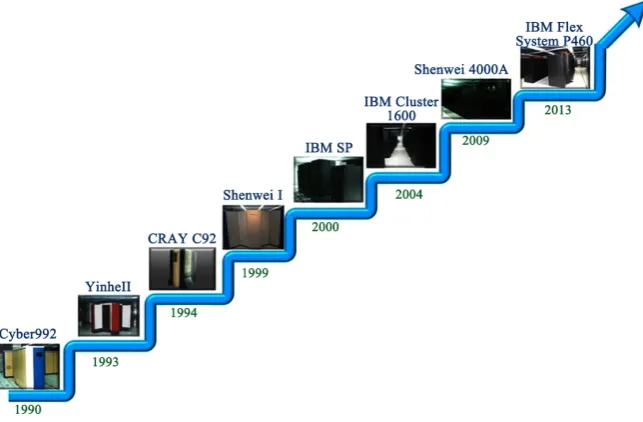
Since the mid-1990s, in order to adapt to the rapid development of meteoro-logical numerical forecasting business and scientific research work, the meteo-rological high-performance computer system has been continuously upgraded and its capabilities have been significantly enhanced. National Meteorological Business Center has introduced Galaxy II, CRAY J90, CRAY EL98, CRAY C92, IBM SP2, IBM SP, Dawning 1000A, Galaxy III, Shenwei I, Shenwei New Cen-tury-32I, Shenwei New Century-32P, IBM Cluster 1600 High-performance computer systems such as SGI Altix4700, Shenwei 4000A, and IBM Flex P460 support the operation of numerical forecasting services, research and develop-ment, and data processing services (see Figure 1).
Since the early 1990s, national meteorological computing capabilities have grown by an order of magnitude every five years. In 2014, after more than tril-lions of IBM Flex P460 systems were put into operation, computing power was 1 billion times higher than in 1978, and nearly 30 times higher than during the 11th Five-Year Plan period.
From the perspective of the model, the initial stage mainly used gener-al-purpose supercomputers, and since the mid-1990s, it has turned to massively parallel architecture computers.
From the development history, imported high-performance computer systems dominated before 2000, and domestic and imported high-performance comput-ers went hand in hand after 2000.
DOI: 10.4236/gep.2019.78016 226 Journal of Geoscience and Environment Protection
Figure 1. China Meteorological Administration high-performance computer develop-ment process.
3.2. High-Performance Computer Systems in Provincial
Meteorological Departments
With the continuous development of regional center numerical forecasting business research, since 2000, some regional and provincial meteorological de-partments have built high-performance computer systems of different scales ac-cording to their own development needs. The Northeast, East China, Central China, South China, Southwest, Northwest, and Xinjiang Regional Meteorologi-cal Centers installed the IBM Flex P460 high-performance computer system in 2014, which greatly improved the high- performance computing power of the regional center.
High-performance computing resources are always scarce resources for the meteorological field. Due to the imbalance between the national level and the local level and the development of numerical forecasting services between local and local, the current scarce resources are distributed within the department (including geographical distribution). Therefore, high-performance computing resources distributed in national bureaus and regional centers will be shared and used to achieve unified management, monitoring and resource sharing, which will solve the problems of resource integration, sharing and collaborative man-agement in meteorological countries and local departments.
DOI: 10.4236/gep.2019.78016 227 Journal of Geoscience and Environment Protection current situation of the model application data environment, the existing high-performance computing resource management of the China Meteorologi-cal Administration adopts the “resource pre-allocation” strategy based on the principle of localization priority. For high- performance computer systems at national and regional centers, a pre-allocated unified resource application scheme is adopted to establish a sophisticated resource statistics, allocation and audit mechanism, and corresponding resource pre-allocation and specification means are provided to unify high-performance computing resources. Combined with the needs of each unit and user each year and the usage of the previous year, the corresponding annual resource allocation amount is determined, the resources of each system are uniformly allocated, and the use of high-performance computing resources at the national level and regional centers is reasonably planned. Establish a unified monitoring platform for meteorologi-cal high-performance computing in the National Bureau, realize unified real-time monitoring of the operational status and resource usage of high-performance computer systems at the national and regional levels, and realize unified real-time monitoring of the national regional two-level numerical forecasting service system.
According to the different characteristics of the numerical forecasting busi-ness model and scientific research mode operation, different application me-thods are adopted. According to the current situation of computing resource load of each system, local resources are preferentially used.
We establish a unified operation platform for numerical models at the nation-al level, which can coordinate the planning of nationnation-al and regionnation-al model oper-ations, and achieve unified scheduling and operation and maintenance man-agement of numerical forecasting services. Since the business model application is relatively mature and the input and output data flow is fixed, the numerical forecasting service will mainly run on local high-performance computers. The regional numerical forecasting business model that cannot be satisfied by the re-gional center local system is deployed to the national high-performance com-puter system through resource pre-allocation management. Business backup is carried out in a cold backup mode. In special periods such as major meteorolog-ical services or major meteorologmeteorolog-ical disasters, the application of hot backup mode is used to simultaneously run a certain business model to ensure reliable operation of the business. Due to the diversity and uncertainty of the application of the R&D model, resources are used according to the principle of local priority and off-site deployment (Wang et al., 2010b).
4. Conclusion and Discussion
DOI: 10.4236/gep.2019.78016 228 Journal of Geoscience and Environment Protection turning point in the development of computing technology, and the future de-velopment trend must be the integration of multiple technologies. The develop-ment of high performance computing presents a trend of polymorphism, hete-rogeneity and extreme scale parallelism. Domestic and foreign manufacturers are stepping up the development of high-end computer systems. It is foreseeable that heterogeneous acceleration architecture computers will usher in greater de-velopment. Lightweight nuclear technology will promote the integration of pro-cessors and acceleration devices, and the programming software tool chain is maturing.
High-performance computer system construction, resource management, and technology development will better support the development of meteorological numerical model software business and scientific research. In response to new trends in technology development, we have added applications for new technol-ogies such as large-scale core and GPU computing. We must pay attention to the parallel computing of cross-cut talents, promote the development of the meteo-rological business model to the new parallel technology architecture platform, and improve parallel scalability. We also need to coordinate the layout, con-struction and management of high-performance computing resources in the meteorological department, and gradually reduce the small-scale system with geographically dispersed. In order to meet the needs of the numerical weather and climate forecasting model business operation and scientific research work, we will build a new generation of domestic high-performance computer systems, alleviate the shortage of computing resources, and support the business research work of numerical weather forecasting, climate prediction and climate change.
In the future, high-performance computing resource management will gradu-ally transit from the current local pre-allocation mode to the local remote uni-fied scheduling and shared use. Based on the national level and regional uniuni-fied central meteorological information sharing platform, it realizes dynamic and unified scheduling of cross-systems for limited applications such as numerical forecasting service application and GRAPES mode research and development, and realizes off-site backup and reliable operation of business applications.
Conflicts of Interest
The authors declare no conflicts of interest regarding the publication of this pa-per.
References
Chen, X., & Sun, J. (2017). Study and Analysis of the High Performance Computing Fail-ures in China Meteorological Field. Journal of Geoscience and Environment Protec-tion, 5, 28-40.https://doi.org/10.4236/gep.2017.512002
DOI: 10.4236/gep.2019.78016 229 Journal of Geoscience and Environment Protection
Esteban, M. (2018). Accelerating Discovery and Innovation through Advanced Compu-ting: Perspective of a High-Performance Computing Scientist in Costa Rica. Compu-ting in Science & Engineering, 20, 36-38.
https://doi.org/10.1109/MCSE.2018.032211035
Flynn, M. J. (1966). Very High Speed Computers. Proceedings of the IEEE, 54, 1901-1909. https://doi.org/10.1109/PROC.1966.5273
Flynn, M. J. (1972). Some Computer Organizations and Their Effectiveness. IEEE Trans-actions on Computers, 21, 948-960.https://doi.org/10.1109/TC.1972.5009071
Flynn, M. J., & Rudd, R. W. (1996). Parallel Architectures. ACM Computing Surveys, 28,
67-70.https://doi.org/10.1145/234313.234345
Huo, Y., Blaber, J. D., Stephen, M., Boyd, B. D., Bao, S., Parvathaneni, P. et al. (2018). Towards Portable Large-Scale Image Processing with High-Performance Computing.
Journal of Digital Imaging, 31, 304-314.https://doi.org/10.1007/s10278-018-0080-0
Ji, G. (2012). Research on Clustering Technology and Load Balancing Scheduling Algo-rithm. Computer Age, 8, 37-43.
Reshmi, B., & Poongodi, P. (2018). Profit and Resource Availability-Constrained Optimal Handling of High-Performance Scientific Computing Tasks. Journal of Supercomput-ing, 3, 1-15.https://doi.org/10.1007/s11227-018-2332-7
Roudas, I., Hemenway, B. R., Grzybowski, R. R., & Karinou, F. (2012). Optimal Wave-length-Space Crossbar Switches for Supercomputer Optical Interconnects. Optics Ex-press, 20, 24-26.https://doi.org/10.1364/OE.20.020407
Sharma, R., Sinha, P., & Verma, M. (2018) Computationally Efficient Problem Reformu-lations for Capacitated Lot Sizing Problem. American Journal of Operations Research, 8, 312-322.https://doi.org/10.4236/ajor.2018.84018
Strohmaier, E., & Meuer, J. D. (2000). Top 500 Supercomputer Sites 11/2000. Bench-marks, 12, 91-120.
Wang, B., Zong, X., & Tian, H. (2010a). Design and Establishment of National Meteoro-logical Computing Grid. Journal of Applied Meteorology, 21, 632-640.
Wang, B., Zhou, B., & Wei, M. (2010b). Establishment and Optimization of Meteorologi-cal Computing Grid Model Prediction System. Computer Application Research, 27,
4182-4184.
Wang, W., Wang, R., & Dong, S. (2008). Research on Feature Analysis and Practical Me-thods of High Performance Scientific Computing. Computer Science, 35, 217-219. Wei, M., & Wang, B. (2017). Evaluation of the Application Benefit of Meteorological
High Performance Computing Resources. Journal of Geoscience and Environment Protection, 5, 153-160.https://doi.org/10.4236/gep.2017.57012