ISSN Online: 2161-7198 ISSN Print: 2161-718X
DOI: 10.4236/ojs.2018.84047 Aug. 23, 2018 721 Open Journal of Statistics
Haplotype Frequency Comparison for
Case-Parents Data
Caixia Li
1, Peixing Li
1,2*1School of Mathematics, Sun Yat-sen University, Guangzhou, China
2Guangdong Province Key Laboratory of Computational Science, Sun Yat-sen University, Guangzhou, China
Abstract
For case-parents data, the information from offspring can be used to reduce the uncertainty of parents’ haplotype. In this article we develop likelihood ra-tio test to compare haplotype frequencies in transmitted and non-transmitted group. The maximum likelihood estimate of the haplotype frequencies for the family data is obtained via expectation-maximization (EM) algorithm. Our proposed method can handle the uncertainty of haplotypes and missing data. The simulations show that the method is more powerful to test association between haplotype and traits than TRANSMIT. We also demonstrated the method to detect the association between Megsin gene and immunoglobulin A nephropathy.
Keywords
Haplotype, Transmission Disequilibrium Test, Likelihood Ratio Test, Expectation-Maximization Algorithm
1. Introduction
In association studies, to avoid false positive results caused by population strati-fication, family-based tests of association are often used for fine mapping of a disease susceptibility locus. Transmission disequilibrium test (TDT) proposed by Spielman is an association test for case-parents triad data [1] [2]. The classic TDT is McNemar test on a 2-way transmission/non-transmission table.
Multiple linked markers can provide more polymorphism information than single marker (especially SNPs). However, haplotype phase is often uncertain for multi-locus genotype. There may be several haplotype pairs compatible with ob-served genotype. Many haplotype reconstruction algorithms are developed, e.g. expectation-maximization (EM) algorithm [3], pseudo MCMC [4], Bayesian
How to cite this paper: Li, C.X. and Li, P.X. (2018) Haplotype Frequency Compar-ison for Case-Parents Data. Open Journal of Statistics, 8, 721-730.
https://doi.org/10.4236/ojs.2018.84047
Received: July 25, 2018 Accepted: August 20, 2018 Published: August 23, 2018
Copyright © 2018 by authors and Scientific Research Publishing Inc. This work is licensed under the Creative Commons Attribution International License (CC BY 4.0).
DOI: 10.4236/ojs.2018.84047 722 Open Journal of Statistics haplotype inference [5] for population data of unrelated individuals.
TDT has been extended for tightly linked marker loci. Zhao et al. (2000) [6]
performed TDT via two steps: constructing the underlying haplotype first, and then constructing the 2-way transmission/non-transmission table in TDT by as-signing a weight to each possible phase. Based on conditional likelihood, Clayton (1999) proposed a score test with program TRANSMIT [7]. The TDT-type me-thods were widely used in medical studies and GWAS studies [8][9].
In this paper, based on full likelihood, we proposed a likelihood ratio test in-tegrating haplotype construction for case-parent or case-parents data.
2. Method
The key idea is from classical case-control association study. Association be-tween trait and marker yields some allele or haplotypes are found more often in case group than control group. In case-parents data, the allele or haplotypes of the case are transmitted from the parents. And so, we can test whether a partic-ular allele or haplotype exists more often in transmitted (case) than in non-transmitted (control).
For tightly linked marker loci, we treat haplotypes as extended alleles and use the transmission information to reduce the phase uncertainty.
Let H denote the number of haplotypes for l tightly linked loci. The set of all possibleH H
(
+1 2)
genotypes (haplotype pairs) is(
)
{
1 1,1 2, ,1 , 2 2, 2 3, ,2 , , 1 ,}
G= H H H− H H H .
For a case-parents trios, the genotypes for father, mother and affected child are denoted by g g gf, m, c respectively. Let F=
(
F F1, , ,2 FH)
and(
)
* * * *
1, , ,2 H
F = F F F denote haplotype frequency for transmitted and non-transmitted group, and Rij =P Affected i j P Affected H H
(
|) (
|)
denoterelative risk for genotype i/j reference to H/H. Under multiplicative haplotype risk Rij =R Ri j, where Ri = Rii is relative risk for haplotype i reference to H.
Under assumption of Hardy-Weinberg equilibrium, the probability of the father transmitted haplotype i and non-transmitted j, whereas the mother transmitted haplotype k and non-transmitted j to the child conditional on that the child is affected, is
(
, , |)
* *f m c i j k l
P g =i j g =k l g =i k A =F F F F (1) where A means the child is affected, and *
1
H i i i j j j
F =R F
∑
= R F is regarded asfrequency of haplotype i for disease population.
However, we only observed the genotype of each locus. The haplotype phase of the l tightly linked loci is often uncertainty, especial for missing parental ge-notype data. So there exist ambiguities to decide which haplotype is transmitted or not transmitted from the parent. Then
(
)
( )
* *
, , ,
, , | r r r r
f m c i j k l
i j k l G
P g g g A F F F F
∈
=
DOI: 10.4236/ojs.2018.84047 723 Open Journal of Statistics
( )
i j, ,( )
k l, , and( )
i k, are compatible with g gf, m and gc, respectively. Here, missing parental genotype is allowable.Suppose there are N case-parentstrios, and then there are 2N parents in all. The genotypes for the r-th trios are g g grf, rm, rc. The log-likelihood
(
)
(
)
( )
* * *
1 1 , , ,
ln , ln , , | ln r r r r
r r r r r
N N
rf rm rc i j k l
r r i j k l G
L F F P g g g A F F F F
= = ∈ = =
∑
∑
∑
. (3)
It is difficult to find the maximum likelihood estimate (MLE)
(
F Fˆ ˆ, *)
di-rectly. We employ expectation-maximization (EM) algorithm to estimate the haplotype frequencies
(
F Fˆ ˆ, *)
, by treating underlying haplotype pairs as“missing data”. The complete-data log-likelihood after adding missing data
(
)
(
)
{
i j k l1, , , , ,1 1 1 i j k lN, , ,N N N}
is(
*)
(
* *)
1
ln c , N ln ir jr kr lr r
L F F F F F F
=
=
∑
. (4)We can show that the expected complete-data log-likelihood Q F F
(
, *)
in E(expectation) step (see Appendix)
(
*)
(
*)
(
)
(
* *)
1 , , , 1
ln , ln c , N M r , , , ln i j k l ,
r i j k l
Q F F E L F F w i j k l F F F F
= =
= =
∑ ∑
(5)where
(
)
( )(
)
(
)
* * * * , , , , , , , , , , ,0, , , , .
r i j k l
r
i j k l
r i j k l G
r F F F F
i j k l G F F F F
w i j k l
i j k l G ′ ′ ′ ′ ′ ′ ′ ′ ∈ ∈ = ∉
∑
An iterative procedure can be used to find the MLE via EM algorithm. Given the current estimates
(
F F( )t , *( )t)
, the estimates in the next step: ( ) ( )
(
)
( )(
)
( ) ( )
(
)
( )(
)
1
1 , , , 1 * 1
1 , , , 1
1 , , , , , , ,
2
1 , , , , , , ,
2
N H
t t t
h r r
r i j k l
N H
t t t
h r r
r i j k l
F w i h k l w i j k h
N
F w h j k l w i j h l
N + = = + = = = + = +
∑ ∑
∑ ∑
(6)1, 2, ,
h= H. Under the null hypothesis F F= *, we have
( ) ( )
( )
(
)
( )(
)
( )(
)
( )(
)
1 * 1
1 , , , 1
1 , , , , , , , , , , , ,
4
t t
h h
N H
t t t t
r r r r
r i j k l
F F
w h j k l w i h k l w i j h l w i j k h N
+ +
= =
=
=
∑ ∑
+ + + (7)Let L F0
( )
ˆ denote the Likelihood under the null hypothesis F F= * or(
1,1, ,1)
R= . The likelihood ratio statistic
(
*)
( )
0
ˆ ˆ ˆ
2lnL F F, 2lnL F
Λ = − (8)
follows an asymptotic χ2 distribution with H-1 degrees of freedom (df) when the
null hypothesis is true.
DOI: 10.4236/ojs.2018.84047 724 Open Journal of Statistics
* *
1 1 1
1 , i i , 1,2, , 1,
H H
H H H
H i
j j j j j j
j j j
F R
F R i H
F R F R F F R F
= = =
= = = = −
∑
∑
∑
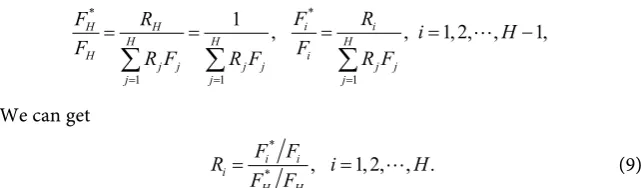
We can get
*
*i i , 1,2, , .
i
H H
F F
R i H
F F
= = (9)
The maximum likelihood estimator (MLE) of the relative risk Ri for haplo-type i relative to haplotype H is therefore given as
* *
ˆ ˆ
ˆ .
ˆi ˆi
i
H H
F F R
F F
= (10)
3. Application
We apply our method to the published data which was used for family-based association analysis for immunoglobulin A nephropathy (IgAN) [10]. Two tightly linked loci C2093T and C2180T, located in the 3' untranslated region (UTR) in Megsin gene, were studied. This dataset contains 232 families with an affected child were entered into analysis (Table 1). There are missing data since the genotyping information of some parents are not available. Out of 232 nuc-lear families, only 125 (53.9%) families are complete case-parents trios for both loci, and 107 (46.1%) families are case-parent families for the locus C2093T or C2180T, which including 25 C2180T single parent families (SPF), 26 C2093T SPF, and 56 C2093T & C2180T SPF.
There exist 4 haplotypes for Megsin C2093T-C2180T, CC, CT, TC and TT, coded as 1, 2, 3 and 4. Give initial value F( )0 =F* 0( )=
(
0.25,0.25,0.25,0.25)
and precision ε =10−6. The haplotype frequency estimates after the iterative
procedure stops
(
)
(
)
*
ˆ 0.078118, 0.508773, 0.245039, 0.168070 ,
ˆ 0.055631, 0.638335, 0.181438, 0.124596 .
F F
= =
The log-likelihood lnL F F
(
ˆ ˆ, *)
= −904.475. For the null model, the haplotype frequency estimation
(
)
*
ˆ ˆ 0.065499,0.579534,0.211046,0.143921 , F F= =
and log-likelihood lnL0 = −911.554. So likelihood ratio statistic
(
)
2 911.554 904.475 14.158
Λ = × − = , df = 3, P = 0.0027. The results show the
[image:4.595.217.538.70.164.2]significant difference between F and F*, the transmitted haplotype frequencies
Table 1. 232 families entered into analysis.
C2093T trios +
C2180T trios C2093T trios + C2180T SPF C2093T SPF + C2180T trios C2093T SPF + C2180T SPF Total
125 25 26 56 232
DOI: 10.4236/ojs.2018.84047 725 Open Journal of Statistics and non-transmitted haplotype frequencies. *
2
ˆ
F is much higher than Fˆ2. That
means haplotype 2 (2093C-2180T) is over-transmitted from parents to cases. In addition, reference to haplotype 4 (2093T-2180T), the estimated relative haplo-type risk Rˆ=
(
0.961,1.692,0.9 ,199)
.4. Simulations
In our simulations, two tightly linked single nucleotide polymorphism (SNP) marker genotype data for 100 case-parents trios are generated. In a similar way in Morris et al. (1997) [11], samples are generated for simulation using the transmission model provided by Bickeboller et al. (1995) [12].
(
)
(
)
( )
(
) (
)
(
)
(
)
, , |
, , ,
| , , , ,
|
,
c f m
c f m
c f m c f m
p
c
si tj uk vl p
su
si uk tj vl p
P g si uk g si tj g uk vl A P g si uk g si tj g uk vl A
P A
P A g si uk g si tj g uk vl P g si uk g si tj g uk vl K
P A g s u
h h h h K
f h h h h
K
= = =
= = =
=
= = = = = =
=
= =
= ⋅
where s t u v, , , ∈
{
D d i j k l, , , , ,}
∈{
1,2, , H f}
, su =P A s u(
|)
is penetrance forgenotype s u, and Kp =P A
( )
is prevalence.The frequencies of mutant disease allele D and normal allele d in a disease lo-cus are denoted by q q1= and q2= −1 q. Under Hardy-Weinberg Equilibrium,
the population prevalence is therefore 2 2 1
(
)
(
1)
2p DD Dd dd
K =q f + q −q f + −q f . We assume that there is no recombination between disease and marker locus. Linkage diseqilibrium parameter to detect association between disease locus and marker locus is defined as in Sham (1995) [13]
, , ; 1,2, , ,
si si
i s
h
e s D d i H F q
= = =
where hsi is frequency of disease-marker haplotype si. The
{ }
esi satisfies1
1
H i si i= Fe
=
∑
and 21
1
s si s= q e
=
∑
. All esi=1(
s D d i= , ; 1,2,3,4=)
implies linkageequilibrium. eDi>1 means marker haplotype i is positively associated with the
disease, and eDi<1 means marker haplotype i is negatively associated. In our
simulations, the LD pattern is given as
1
1 1
1
1
1 1 , 0 1, 2,3, ,
1
D Dk F e
e e F e k H
F
−
≤ = ≤ ≤ = ≤ =
−
DOI: 10.4236/ojs.2018.84047 726 Open Journal of Statistics
2 3 4 4
0 1
3
D D D e
e e e −
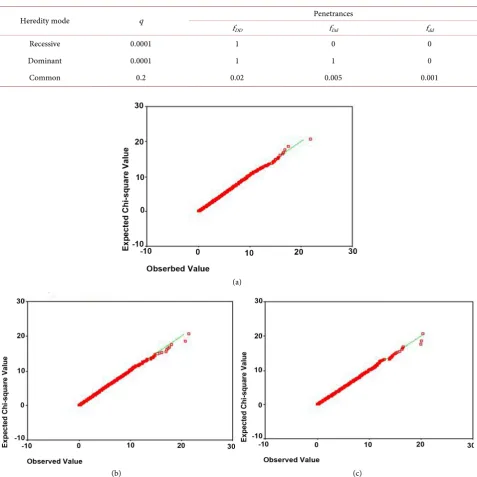
≤ = = = ≤ . Three classical genetic models, recessive, dominant and common models, specified heredity modes are considered. These models are shown in Table 2.
[image:6.595.60.538.212.690.2]For each genetic model, 5000 replicated samples were generated to evaluate the distribution of test statistics in the case of no association, i.e. e = 1. The quantile-quantile (QQ) plots for test statistic Λ from 5000 samples under the null hypothesis for the three genetic models are showed in Figures 1(a)-(c). The
Table 2. Genetic models for simulation study.
Heredity mode q Penetrances
fDD fDd fdd
Recessive 0.0001 1 0 0
Dominant 0.0001 1 1 0
Common 0.2 0.02 0.005 0.001
(a)
(b) (c)
Figure 1. QQ plots for test statistic Λ from 5000 samples. Red: expected quantiles of distribution χ2
( )
3 versus observedDOI: 10.4236/ojs.2018.84047 727 Open Journal of Statistics plots show that the scatters of the observed quantiles and the expected quantiles of distribution χ2
( )
3are very close to the line y = x.
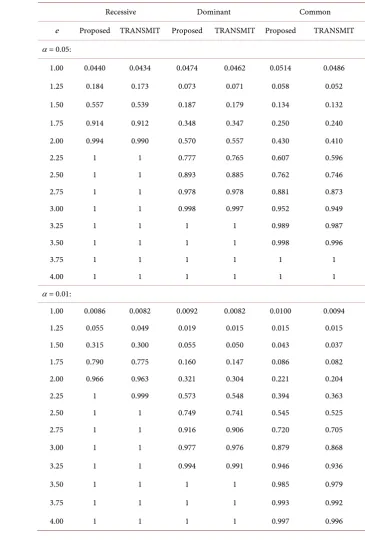
[image:7.595.169.535.192.736.2]In addition, 1000 replicated samples were generated for statistical power anal-ysis. The statistical significance level α= 0.05 or 0.01. The empirical power for our proposed method, comparison with TRANSMIT, are summarized in Table 3, under different association level e for three disease model.
Table 3. Comparisons of empirical power.
Recessive Dominant Common
e Proposed TRANSMIT Proposed TRANSMIT Proposed TRANSMIT
α = 0.05:
1.00 0.0440 0.0434 0.0474 0.0462 0.0514 0.0486
1.25 0.184 0.173 0.073 0.071 0.058 0.052
1.50 0.557 0.539 0.187 0.179 0.134 0.132
1.75 0.914 0.912 0.348 0.347 0.250 0.240
2.00 0.994 0.990 0.570 0.557 0.430 0.410
2.25 1 1 0.777 0.765 0.607 0.596
2.50 1 1 0.893 0.885 0.762 0.746
2.75 1 1 0.978 0.978 0.881 0.873
3.00 1 1 0.998 0.997 0.952 0.949
3.25 1 1 1 1 0.989 0.987
3.50 1 1 1 1 0.998 0.996
3.75 1 1 1 1 1 1
4.00 1 1 1 1 1 1
α = 0.01:
1.00 0.0086 0.0082 0.0092 0.0082 0.0100 0.0094
1.25 0.055 0.049 0.019 0.015 0.015 0.015
1.50 0.315 0.300 0.055 0.050 0.043 0.037
1.75 0.790 0.775 0.160 0.147 0.086 0.082
2.00 0.966 0.963 0.321 0.304 0.221 0.204
2.25 1 0.999 0.573 0.548 0.394 0.363
2.50 1 1 0.749 0.741 0.545 0.525
2.75 1 1 0.916 0.906 0.720 0.705
3.00 1 1 0.977 0.976 0.879 0.868
3.25 1 1 0.994 0.991 0.946 0.936
3.50 1 1 1 1 0.985 0.979
3.75 1 1 1 1 0.993 0.992
DOI: 10.4236/ojs.2018.84047 728 Open Journal of Statistics
5. Discussion
Haplotype frequencies are usually estimated when haplotypes are reconstructed or linkage disequilibrium is tested. For tightly linked loci, the likelihood as a function of haplotype frequencies in transmitted and non-transmitted group was given for case-parents data. We estimate the MLEs of the haplotype frequencies via an EM algorithm. The results showed that haplotype frequencies could be es-timated using a simple iterative procedure. The likelihood ratio test to compare haplotype frequencies in transmitted and non-transmitted group was used to detect association. When the information of parents is not available in the nuc-lear family, classical TDT is no longer suitable. However, as you can see in the application, missing parental genotypes are allowed in our method. In addition, when there are siblings available, the information can be used to reduce the un-certainty of phase, and the likelihood can be given similarly.
Under different simulated conditions where heredity mode, linkage disequili-brium coefficient are specified, 5000 and 1000 replicated samples were generated to evaluate the distribution of test statistics and statistical power respectively. Our method is more powerful than TRANSMIT.
Conflicts of Interest
The authors declare no conflicts of interest regarding the publication of this pa-per.
References
[1] Spielman, R.S., McGinnis, R.E. and Ewens, W.J. (1993) Transmission Test for Lin-kage Disequilibrium: The Insulin Gene Region and Insulin-Dependent Diabetes Mellitus.American Journal of Human Genetics, 52, 506-516.
[2] Spielman, R.S. and Ewens, W.J. (1996) The TDT and Other Family-Based Tests for Linkage Disequilibrium and Association. American Journal of Human Genetics, 59, 983-989.
[3] Clayton, D.G. (1999) Transmission/Disequilibrium Tests for Extended Marker Haplotypes. American Journal of Human Genetics, 65, 1161-1169.
https://doi.org/10.1086/302566
[4] Stephens, M., Smith, N.J. and Donnelly, P. (2001) A New Statistical Method for Haplotype Reconstruction from Population Data. American Journal of Human Ge-netics, 68, 978-989.https://doi.org/10.1086/319501
[5] Niu, T., Qin, Z.S., Xu, X. and Liu, J.S. (2002) Bayesian Haplotype Inference for Mul-tiple Linked Single-Nucleotide Polymorphisms. American Journal of Human Ge-netics, 70, 157-169.https://doi.org/10.1086/338446
[6] Zhao, H., Zhang, S., Merikangas, K.R., Trixler, M., Wildenauer, D.B., Sun, F., Kidd, K.K. (2000) Transmission/Disequilibrium Test Using Multiple Tightly Linked Markers. American Journal of Human Genetics, 67, 936-946.
https://doi.org/10.1086/303073
DOI: 10.4236/ojs.2018.84047 729 Open Journal of Statistics [8] Abdulkadir, M., Londono, D., Gordon, D., et al. (2017) Investigation of previously Implicated Genetic Variants in Chronic Tic Disorders: A Transmission Disequili-brium Test Approach. European Archives of Psychiatry and Clinical Neuroscience, 268, 1-16.
[9] Wang, M., Ji, Z., Wang, S., et al. (2017) Mechanisms to Protect the Privacy of Fami-lies When Using the Transmission Disequilibrium Test in Genome-Wide Associa-tion Studies. Bioinformatics, 33,
[10] Li, Y.J., Du, Y., Li, C.X., et al. (2004) Family-Based Association Study Showing That Immunoglobulin a Nephropathy Is Associated with the Polymorphisms 2093C and 2180T in the 3′ Untranslated Region of Megsin Gene. Journal of the American So-ciety of Nephrology, 15, 1739-1743.
https://doi.org/10.1097/01.ASN.0000130858.00688.46
[11] Morris, A.P., Whittaker, J.C. and Curnow, R.N. (1997) A Likelihood Ratio Test for Detecting Patterns of Disease-Marker Association. Annals of Human Genetics, 61, 335-350.https://doi.org/10.1017/S0003480097006349
[12] Bickeböller, H. and Clerget-Darpoux, F. (1995) Statistical Properties of the Allelic and Genotypic Transmission/Disequilibrium Test for Multiallelic Markers. Genetic Epidemiology, 12, 865-870. https://doi.org/10.1002/gepi.1370120656
[13] Sham, P.C. and Curtis, D. (1995) An Extended Transmission/Disequilibrium Test (TDT) for Multi-Allele Marker Loci. Annals of Human Genetics, 59, 323-336.
DOI: 10.4236/ojs.2018.84047 730 Open Journal of Statistics
Appendix (E Step in EM Algorithm)
Give the current estimate
(
F F( )t , *( )t)
, the distribution of missing data ( ){
(
)
(
)
}
( ) ( )
(
)
( )
(
)
1 1 1 1
* 1
1 1 1 1 1
, , , , , , , ,
, , | , , , , ,
, , , , , , , , , , , , 1,2, , ,
t
M N N N N
N
t t rf r r rm r r rc r r rf rm rc
r N
t
r r r r r N N N N
r
P i j k l i j k l
P g i j g k l g i k A g g g F F
w i j k l i j k l i j k l H
= = = = = = = =
∏
∏
where ( )(
)
( ) ( ) ( ) ( ) ( ) ( ) ( ) ( ) ( )(
)
(
)
* * * * , , , , , , , , , , ,0, , , , .
r
t t t t
i j k l
r
t t t t
t i j k l
r i j k l G
r F F F F
i j k l G F F F F
w i j k l
i j k l G ′ ′ ′ ′ ′ ′ ′ ′ ∈ ∈ = ∉
∑
And then the expected complete-data log-likelihood ( ) ( )
(
)
(
)
( ) ( )(
)
( ){
(
)
(
)
}
(
)
( )(
)
1 1 1 1
1 1 1 1
* *
* *
* *
1 1 1 1 , , , 1 , , , 1 1
* *
, , , 1 , , , 1 1
, | , ln , | ,
ln , , , , , , , ,
ln , , ,
r r r r
N N N N
r r r r N N N N
t t t t
c
H H N
t
i j k l M N N N N
i j k l i j k l r
N
H N
t
i j k l n n n n n
i j k l i j k l r n
Q F F F F E L F F F F
F F F F P i j k l i j k l
F F F F w i j k l
= = = = = = = = =
∑
∑
∑
∑
∑
∏
(
)
(
)
( )(
)
(
)
(
)
1 * *1 , , , 1 1, , , , 1
* *
1 , , , 1
, , , ln , , ,
, , , ln
H
N
N M M
t
r i j k l n
r i j k l n n ri j k l
N M
r i j k l
r i j k l
w i j k l F F F F w i j k l