ISSN Online: 2325-744X ISSN Print: 2325-7458
DOI: 10.4236/jacen.2018.74015 Nov. 28, 2018 176 Journal of Agricultural Chemistry and Environment
Analysis of Maize Production Efficiency Based
on DEA-Malmquist Indexes: A Case Study of
Henan Province
Bingjun Li, Xiaoxiao Zhu
*College of Information and Management Science, Henan Agricultural University, Zhengzhou, China
Abstract
In order to improve the production efficiency of maize in Henan, China, the HP (High-Pass) filter method is used to obtain the maize trend yield. Se-condly, the Malmquist index method is used to analyze the changes of TFP (Total Factor Productivity) of maize in 18 cities in Henan Province in the past 11 years. Finally, the amount of slack in maize input and output is analyzed. The results show that the research and development level of advanced tech-nology of maize production in Henan Province has been improved to some extent in recent years; the advanced technology in various regions has not been fully promoted and utilized; there is a certain degree of relaxation in the input of various elements of maize; the resource allocation is unreasonable, and there is a certain amount of space for saving.
Keywords
DEA-Malmquist Index Method, HP Filter Method, Henan Province, Maize
1. Introduction
Henan Province is located in the center of Huang-Huai Maize dominant indus-trial belt, and its light and heat resources are abundant, forming the cultivation system of wheat and maize cropping twice a year. Located in the continental monsoon climate zone, Henan Province is an important grain producing area in China. The summer maize planting area and output account for about 10% of the country, but the summer maize yield is high and unstable. As a big grain planting province, Henan planted 3316.86 thousand hectares of maize in 2016, with a total yield of 17.5297 million tons. In fact, the yield per unit area of maize in Henan Province is 5638 kg/ha in 2012 and decreased to 5285 kg/ha in 2016, How to cite this paper: Li, B.J. and Zhu,
X.X. (2018) Analysis of Maize Production Efficiency Based on DEA-Malmquist In-dexes: A Case Study of Henan Province. Journal of Agricultural Chemistry and Environment, 7, 176-187.
https://doi.org/10.4236/jacen.2018.74015
Received: October 29, 2018 Accepted: November 25, 2018 Published: November 28, 2018
Copyright © 2018 by authors and Scientific Research Publishing Inc. This work is licensed under the Creative Commons Attribution International License (CC BY 4.0).
DOI: 10.4236/jacen.2018.74015 177 Journal of Agricultural Chemistry and Environment while the planting area of maize in 2012 is 3100 thousand hectares, and by 2016 it had increased to 3316.86 thousand hectares. The input of other controllable elements is also in the state of growth; the input gradually increases and the output decreases, which indicates that the production efficiency of maize in He-nan Province is low, so it is necessary to adjust the input of production factors to increase the yield of maize.
Data Envelopment Analysis (DEA), Malmquist Index Method, Stochastic Frontier Analysis (SFA), and DEA-Tobit models are widely used in productivity studies in the agricultural sector. Many scholars have studied the production ef-ficiency of maize, and most scholars’ research mainly concentrates on the above methods to study the maize production efficiency in the country or in some provinces and cities, mainly the following parts.
For the study of maize production efficiency in China: Yang Guoqing et al.[1]
used the Malmquist index analysis method in DEA to analyze the growth of ma-ize production efficiency in China’s main mama-ize producing areas from the pers-pective of time gradient and regional difference. Yan Yijun et al. [2] used the stochastic frontier analysis (SFA) method to calculate the maize production effi-ciency in 20 provinces and regions of China, and analyzed the output elasticity of each input factor. Wang Jun et al. [3] analyzed the total factor productivity of maize production in China’s core producing areas from 2001 to 2008 using Sto-chastic Frontier Analysis (SFA) method. Liu Nian et al.[4] used the DEA-Malmquist index method to measure the total factor productivity (TFP) of China’s maize from 2002 to 2013. Based on DEA model, Malmquist index method and ESDA analysis method, Zhang Lina et al.[5] analyzed the temporal and spatial charac-teristics of the change of comprehensive technical efficiency and total factor productivity of maize production in 20 major maize provinces (regions) of Chi-na from 2005 to 2015.
Prov-DOI: 10.4236/jacen.2018.74015 178 Journal of Agricultural Chemistry and Environment ince. The results showed that there is no significant difference in the technical efficiency of maize production among different types of labor transfer farmers. Taking the three counties of Ganzhou, Linze and Gaotai in Zhangye City as ex-amples, the DEA-Tobit model is used to analyze the production efficiency and influencing factors of different types of farmers field maize [12]. On the basis of using DEA to measure the production efficiency, Yang Xiao et al. improved the simulation of redundant input elements based on the calculation results. On the basis of using DEA to measure the production efficiency, Yang Xiao et al.[13]
improved the redundant input elements based on the calculation results. Qian Jinxia [14] used maize per unit yield and meteorological data from 39 counties (cities) in Shanxi Province from 1991 to 2000 to analyze the regional distribution characteristics of maize climate resource utilization efficiency and maize climate resource utilization efficiency in Shanxi Province. Liu Xiaoying et al.[15] stu-died the utilization efficiency of light and heat resources of winter wheat and summer maize in northern Henan. Wang Xueqiu [16] used correlation analysis to analyze the relationship between the scale of maize management and produc-tion efficiency in Jilin Province.
The above scholars have used the actual production as the output index of maize, and the actual production of maize is affected by other factors, the actual yield could not be used as the exact output corresponding to the input of each element of maize. The analysis using actual production does not accurately re-flect maize production efficiency. In this paper, the HP filter method is used to process the yield data of maize, and the trend yield is obtained as the output in-dex of maize. The Malmquist inin-dex method of DEA is used to study the growth of maize TFP in 2006-2016 in various cities of Henan Province. The change of total factor productivity of maize is decomposed into technical efficiency and technological progress, and further decomposed into pure technical efficiency, scale efficiency and technological progress. Then the influence of efficiency change is analyzed concretely.
2. Theory and Method
2.1. DEA-Malmquist Index Method
Data Envelopment Analysis (DEA) is first proposed by A.Charnes and W. W. Cooper [17] in the United States in 1978. The DEA model can be divided into CCR model and BCC model. It is a systematic analysis method for the relative effectiveness or benefit evaluation of the same type of units (departments) based on multiple indicator inputs and multiple indicator outputs and the concept of “relative efficiency”.
DOI: 10.4236/jacen.2018.74015 179 Journal of Agricultural Chemistry and Environment productivity (total factor productivity, (TFP) by using the mathematical linear programming model. Decompose the Malmquist index while analyzing the effi-ciency changes of production decision-making units in different periods to find the root cause of total factor productivity change [18]. Fareetal (1994) defined an output-based Malmquist productivity index [19], which uses panel data to de-compose total factor productivity into two parts: technical efficiency change (effch) and technological progress (techch). The technological progress index re-flects the “frontier movement effect” from the period t to the t + 1, and the tech-nical efficiency change under the Constant Return Scale (CRS) can be further decomposed into pure technical efficiency changes (pech) and scale efficiency (sech) changes under variable-scale compensation (VRS). The Malmquist expo-nent calculation formula based on DEA can be expressed as follows:
(
)
(
)
(
)
(
(
)
)
(
(
)
)
(
)
(
)
(
(
)
)
1 1 1
0
1 1 1 1 1 1
0 0 0
1 1 1
0 0 0
1
1 1 2
0 0
1 1 1 1
0 0 , , , , , , , , , , , , ,
pech sech techch
t t t t t
t t t t t t t t t
t t t t t t t t t
t t t t t t
t t t t t t
M x y x y
D x y VRS D x y CRS D x y VRS
D x y VRS D x y CRS D x y VRS
D x y D x y
D x y D x y
+ + + + + + + + + + + + + + + + + + = ⋅ ⋅ ⋅ = × × (1)
Among them, D x y0t
(
t, t)
and D0t+1(
xt+1,yt+1)
represent the distance func-tion of two periods. 1(
1 1)
0t t , t , ,t t 1
M + x+ y x y+ > , that is, TFP > 1, indicates that
the total factor productivity is in the growth stage, and the resource allocation efficiency of maize is improved. 1
(
1 1)
0t t , t , ,t t 1
M + x+ y x y+ < , that is, TFP < 1,
in-dicates that the total factor productivity is in the declining stage, and the re-source allocation efficiency of maize is decreased. The change of technical effi-ciency is used to measure the ratio of the actual output to the theoretical maxi-mum output under the same input condition or the ratio of the actual input to the theoretical maximum input under the same output condition, effch > 1, which indicates that the decision making unit is close to the technical frontier. Technological progress reflects the fact that during the implementation of the policy, through technological transformation or other means to achieve the same amount of output to reduce input or the same amount of input to improve out-put, pech > 1, indicating that the decision-making unit has technological progress or innovation.
2.2. HP Filter Method
The HP filtering method is a decomposition method of time series in state space. It assumes that the time series consists of two parts, namely: long-term trend component and short-term fluctuation component. The HP filter method can be considered as a high-pass filter, which can separates high-frequency components with periods below 8 years [20].
DOI: 10.4236/jacen.2018.74015 180 Journal of Agricultural Chemistry and Environment yield ct by HP filter, in which gt is a stable high frequency trend signal and
t
c is an unstable low frequency disturbance signal. The principle is to remove the low frequency signal ct by filtering, thereby detecting the high frequency
signal gt from the production sequence. HP filter decomposes yt into:
t t t
y =g c+ .
The detection method of high frequency signal gt is often defined as the
so-lution of the following minimization formula, namely:
(
)
(
) (
)
21 1
1 1
min T t t T t t t t
t y g t g g g g
λ + −
= =
− + − − −
∑
∑
(2)In the formula,
λ
is the HP filter parameter. Whenλ
=0, the minimizedsolution of the function is
{ }
yt sequence. With the increase ofλ
value, thetrend of minimum solution estimation is smoother. The general experience of
λ
is as follows:100, annual data 1600, quarterly data 14400, monthly data λ
=
(3)
3. Data Collection
According to the scientificity, comprehensiveness and availability of data and the accuracy and rigor of data calculation, this paper selects the trend yield of maize per unit area (kg/ha), the number of people engaged in maize production (10,000 people), the effective irrigation area of maize (1000 ha), the sowing area of maize (1000 ha), the corn fertilizer application (ton), and the total power of maize machinery (10,000 kilowatts) in Henan Province from 2006 to 2016, data obtained from the Henan Provincial Bureau of Statistics [21]. The yield per unit area of maize in Henan Province is shown in Table 1. The trend yield of maize per unit area is taken as the output index; the number of people engaged in ma-ize production, the effective irrigation area of mama-ize, the sowing area of mama-ize, the amount of corn fertilizer applied, and the total mechanical power of maize are taken as input indexes. The input-output index system of maize production efficiency is constructed, and the efficiency is analyzed by DEA-Malmquist ex-ponent method.
4. Efficiency Analysis
4.1. Time Dimensional Analysis
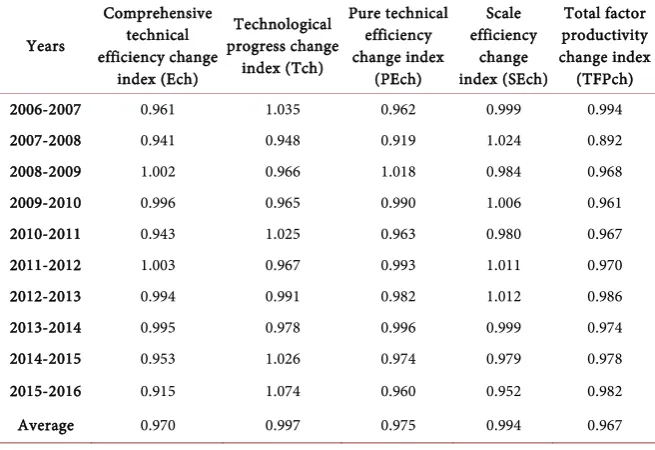
Using DEAP2.1 software to calculate the overall situation of maize production efficiency during the period of 2006-2016 in Henan Province is shown in Table 2.
DOI: 10.4236/jacen.2018.74015 181 Journal of Agricultural Chemistry and Environment
Table 1. Maize per unit production of Henan Province in 2006-2016 (Unit: kg/ha).
2006 2007 2008 2009 2010 2011 2012 2013 2014 2015 2016
Zhengzhou 4969.27 4935.21 4900.85 4866.43 4831.83 4797.38 4763.37 4729.37 4695.52 4662.22 4628.57 Kaifeng 5560.78 5551.61 5541.42 5529.64 5515.33 5496.57 5474.96 5450.85 5424.47 5396.69 5367.69 Luoyang 5049.09 4984.07 4918.17 4852.78 4790.00 4732.85 4680.49 4631.31 4585.01 4542.53 4500.70 Pingdingshan 4920.42 4876.89 4831.38 4782.33 4730.47 4676.18 4619.90 4562.23 4506.25 4457.83 4411.48 Anyang 6456.62 6471.13 6482.48 6488.76 6490.05 6487.20 6480.74 6470.20 6455.76 6438.09 6417.97 Hebi 6832.33 6865.44 6895.62 6921.14 6942.13 6959.32 6972.99 6982.87 6988.98 6992.31 6994.01 Xinxiang 6048.98 6072.57 6093.78 6110.55 6121.47 6125.41 6120.87 6105.91 6080.80 6047.24 6008.41 Jiaozuo 7323.62 7323.37 7321.33 7316.80 7309.13 7297.57 7281.18 7258.73 7230.56 7198.47 7164.22 Puyang 6580.71 6579.54 6576.12 6569.27 6559.56 6547.90 6534.72 6519.34 6501.04 6477.37 6450.43 Xuchang 6403.64 6387.96 6370.61 6348.99 6323.68 6295.58 6266.83 6238.26 6210.74 6185.63 6161.09 Luohe 6215.70 6211.42 6209.28 6212.66 6224.70 6245.69 6274.00 6306.06 6340.04 6375.55 6411.91 Sanmenxia 4528.95 4493.19 4455.89 4417.62 4378.75 4339.34 4299.33 4258.07 4216.21 4175.16 4134.48 Nanyang 5550.92 5524.99 5496.50 5463.45 5424.54 5378.83 5325.77 5264.84 5197.75 5128.20 5057.20 Shangqiu 6581.23 6587.49 6589.99 6586.03 6573.91 6553.04 6523.20 6484.98 6440.35 6392.01 6341.76 Xinyang 4661.81 4606.40 4559.51 4533.03 4533.37 4564.72 4627.59 4720.70 4841.45 4984.98 5142.45 Zhoukou 6127.30 6069.38 6017.31 5977.44 5954.25 5946.95 5950.13 5958.43 5969.71 5983.04 5996.11 Zhumadian 5241.99 5221.88 5207.79 5203.07 5208.34 5221.91 5240.59 5261.22 5282.03 5302.66 5322.51 Jiyuan 5214.63 5224.97 5233.02 5237.70 5239.02 5236.92 5231.04 5220.82 5206.82 5190.95 5174.11
Table 2. Indicators of maize production efficiency in Henan Province from 2006 to 2016.
Years
Comprehensive technical efficiency change
index (Ech)
Technological progress change
index (Tch)
Pure technical efficiency change index
(PEch)
Scale efficiency
change index (SEch)
Total factor productivity change index
(TFPch)
2006-2007 0.961 1.035 0.962 0.999 0.994
2007-2008 0.941 0.948 0.919 1.024 0.892
2008-2009 1.002 0.966 1.018 0.984 0.968
2009-2010 0.996 0.965 0.990 1.006 0.961
2010-2011 0.943 1.025 0.963 0.980 0.967
2011-2012 1.003 0.967 0.993 1.011 0.970
2012-2013 0.994 0.991 0.982 1.012 0.986
2013-2014 0.995 0.978 0.996 0.999 0.974
2014-2015 0.953 1.026 0.974 0.979 0.978
2015-2016 0.915 1.074 0.960 0.952 0.982
Average 0.970 0.997 0.975 0.994 0.967
[image:6.595.210.538.446.671.2]DOI: 10.4236/jacen.2018.74015 182 Journal of Agricultural Chemistry and Environment the maize production efficiency in these 18 cities showed a downward trend in 2006-2016. Total factor productivity (TFP) of maize has been fluctuating from 2006 to 2016, which is mainly affected by the change of comprehensive technical efficiency (the overall technical efficiency has decreased by 3.0% annually), and the comprehensive technical efficiency is affected by pure technical efficiency and scale efficiency. Moreover, it is greatly affected by the pure technical effi-ciency (the average value of pure technical effieffi-ciency is 0.975, while the average efficiency of scale is 0.994). The reason for this phenomenon is that it fails to ef-fectively promote the use of advanced technology or the unreasonable configu-ration of agricultural implements and low utilization efficiency.
From 2006 to 2016, the comprehensive technical efficiency change index of the annual maize production in 18 cities of Henan Province is greater than 1 in 2 time periods (2008-2009, 2011-2012), indicating that the input and output of these years are in the best allocation, and all resources have been fully utilized. The comprehensive technical efficiency change index of the remaining years is less than 1, especially in 2015-2016, the comprehensive technical efficiency change index is 0.915, which is the lowest level in the study period, and the allo-cation efficiency of input and output is the lowest during the study period.
From 2006 to 2016, the average value of technological progress in the studied cities is 0.997 (less than 1), and the technological progress of these years in 2006-2007, 2010-2011, 2014-2015, 2015-2016 is greater than 1, and is in a state of technological progress, and the progress is relatively large, 3.5%, 2.5%, 2.6% and 7.4%, while the technical progress changes of the remaining years are less than 1, indicating that these annual technologies have not improved.
The period of corn production pure technical efficiency change index greater than 1 is only in 2008-2009, and only the annual technology use efficiency is ris-ing. The change in pure technical efficiency in 2013-2014 (0.996) basically tended to be 1, indicating that the efficiency of technology use in this year is basically the same as the previous year. The pure technical efficiency changes for the remaining years are all less than 1, indicating that the efficiency of technolo-gy use in these years has decreased from the previous year.
The average of maize production scale efficiency change in Henan Province is 0.994, and the scale efficiency change value of four time periods is greater than 1, which are 2007-2008 (1.024), 2009-2010 (1.006), 2011-2012 (1.011), 2012-2013 (1.012). These years scale returns are declining. In the remaining years, the scale efficiency change values are all less than 1, indicating that these years scale re-turns are increasing.
4.2. Spatial Dimension Analysis
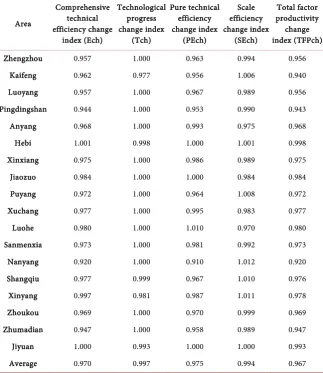
Using DEAP2.1 software to calculate the overall situation of maize production efficiency in the 18 cities of Henan Province during 2006-2016 is shown in Table 3.
DOI: 10.4236/jacen.2018.74015 183 Journal of Agricultural Chemistry and Environment
Table 3. Maize production efficiency in Henan Province from 2006 to 2016.
Area
Comprehensive technical efficiency change
index (Ech)
Technological progress change index
(Tch)
Pure technical efficiency change index
(PEch)
Scale efficiency change index
(SEch)
Total factor productivity change index (TFPch)
Zhengzhou 0.957 1.000 0.963 0.994 0.956
Kaifeng 0.962 0.977 0.956 1.006 0.940
Luoyang 0.957 1.000 0.967 0.989 0.956
Pingdingshan 0.944 1.000 0.953 0.990 0.943
Anyang 0.968 1.000 0.993 0.975 0.968
Hebi 1.001 0.998 1.000 1.001 0.998
Xinxiang 0.975 1.000 0.986 0.989 0.975
Jiaozuo 0.984 1.000 1.000 0.984 0.984
Puyang 0.972 1.000 0.964 1.008 0.972
Xuchang 0.977 1.000 0.995 0.983 0.977
Luohe 0.980 1.000 1.010 0.970 0.980
Sanmenxia 0.973 1.000 0.981 0.992 0.973
Nanyang 0.920 1.000 0.910 1.012 0.920
Shangqiu 0.977 0.999 0.967 1.010 0.976
Xinyang 0.997 0.981 0.987 1.011 0.978
Zhoukou 0.969 1.000 0.970 0.999 0.969
Zhumadian 0.947 1.000 0.958 0.989 0.947
Jiyuan 1.000 0.993 1.000 1.000 0.993
Average 0.970 0.997 0.975 0.994 0.967
than the average level, showing a positive growth, while Anyang (0.968) is basi-cally the same as the average (0.967). Nanyang City (0.920) is well below the av-erage level, and the rest of the cities are slightly below the avav-erage level. Total factor productivity is less than 1, indicating a negative growth.
In terms of technical efficiency, Hebi (1.001) is more than 1, Jiyuan is 1. The maize planting technical efficiency in these cities is relatively effective, the re-sources are fully utilized, the input and output are in the best allocation state. Xinxiang, Jiaozuo, Puyang, Xuchang, Luohe, Sanmenxia, Shangqiu and Xinyang are above the average level, Zhoukou (0.969) is close to the average level (0.970), Nanyang (0.920) is far below the average level, and the other cities are slightly lower than the average level. Below average, it indicates that the technical effi-ciency of maize planting in these areas is relatively ineffective, resources are not fully utilized, input and output allocation is unreasonable, and efficiency is low, so it needs to be improved.
DOI: 10.4236/jacen.2018.74015 184 Journal of Agricultural Chemistry and Environment Shangqiu, Zhoukou, Zhumadian is above the average level (0.997), indicating that these areas are in the leading level of Henan Province in the field of propa-ganda and application of advanced technology. The technological progress change indicators in other cities are lower than the average level, which indicates that these cities should strengthen the propaganda and application of advanced technology.
Among the 18 cities studied, 6 cities have scale efficiency values greater than 1. These cities have diminishing returns on scale, which should reduce the input of factors and avoid unnecessary waste to achieve the optimal scale. The scale effi-ciency value of Jiyuan is 1, which is in the optimal scale, while the remaining ci-ties have a scale efficiency value of less than 1, in the case of increasing returns to scale, the input of factors should be increased to achieve optimal scale.
The pure technical efficiency of Hebi, Jiaozuo and Jiyuan is 1. The maize planting is in a technically effective state, and there is no input and output slack. The pure technical efficiency of the other areas is not equal to 1, indicating that the maize planting in these areas is in a technically inefficient state. There are different degrees of input and output irrational, and the input and output should be adjusted based on the effectiveness of DEA to achieve technical effectiveness.
5. Input and Output Relaxation Analysis
5.1. Analysis of Maize Production Output
If the comprehensive technical efficiency of maize in the cities of Henan Prov-ince is the best, the average yield of maize in 2016 can be increased by 176.099 kg/hm2, and in 2006, the yield of maize can only increase by 107.978 kg/hm2,
which fully reflects the improvement of maize production technology in Henan Province in recent years.
5.2. Analysis of Maize Production Factors Input
In addition, there are some relaxations in the input factors of maize in Henan Province. If the technical efficiency is optimized while maintaining the same output, the input of factors can be saved to a certain extent.
Input of the number of maize producers
In 2006, the number of slack people engaged in maize production in Henan Province is 257170, but by 2016 it had fallen to 161640. This shows that the phenomenon of surplus labor input in Henan Province has been effectively alle-viated, mainly because of the progress of science and technology, and the im-provement of the mechanization level of maize production, which led to the ac-cumulation of labor to the secondary and tertiary industries, thus reducing the slack in the production labor of maize. This is consistent with the research by Zhang Lina et al. [5].
Input of effective irrigation area and sowing area
DOI: 10.4236/jacen.2018.74015 185 Journal of Agricultural Chemistry and Environment maize are fully and reasonably used, and the amount of relaxation is reduced. The maize sowing area increased from 8.911 thousand hectares in 2006 to 9.250 thousand hectares in 2016.
Input of chemical fertilizer application
The relaxation rate of chemical fertilizer application is 5511.475 tons in 2006 and increased to 7588.712 tons in 2016. This indicates that with the improve-ment of science and technology, the use cost of chemical fertilizers is lower, and the use of chemical fertilizers is gradually increasing, resulting in increased re-laxation of chemical fertilizer application.
Input of total mechanical power
The total power input of agricultural machinery increased from 21.495 kilo-watts in 2006 to 21.784 kilokilo-watts in 2016, mainly due to the improvement of mechanization level and the increase in machinery investment in Henan Prov-ince, which resulted in a certain amount of relaxation in the total power of agri-cultural machinery.
From 2006 to 2016, the relaxation of various inputs in Henan Province is in an optimized state, mainly due to the advancement of science and technology, which resulted in a certain cost savings for maize production in Henan Province. It is of great significance to increase the enthusiasm of farmers to grow grain and ensure national food security.
6. Conclusion
In this paper, considering the effect of other factors on maize yield, the HP filter method is used to deal with the actual yield of maize, and the trend yield cor-responding to the input of maize is obtained. The DEA Malmquist index method is used to analyze the efficiency of maize production in 18 cities of Henan Prov-ince from 2006 to 2016. The results show that: From the time dimension, the comprehensive technical efficiency change, the technological progress change, the pure technical efficiency change, the scale efficiency change and the total factor productivity change have not improved. From the perspective of spatial dimension, the total factor productivity of maize in all cities is less than 1, which is in the declining stage, showing negative growth, mainly because the produc-tion technology of each area is not reasonable and fully utilized. There is a cer-tain degree of relaxation in the input and output of maize production factors, but the relaxation of input in 2016 is better than that in 2006, mainly due to the advancement of technology and the improvement of mechanization level. Strengthen the research and development and promotion of advanced agricul-tural technology, rationally adjust the allocation of production factors, improve the production efficiency of maize in Henan Province through technological progress and efficiency improvement, and ensure the food security of the coun-try.
Acknowledgements
construc-DOI: 10.4236/jacen.2018.74015 186 Journal of Agricultural Chemistry and Environment tive comments on this paper. The work is supported by the Soft-science Founda-tion of Henan Province (172400410015), and the Philosophy and Social Program of Henan Province (2016BJJ022).
Conflicts of Interest
The authors declare no conflicts of interest regarding the publication of this pa-per.
References
[1] Yang, G.Q. and Liu, T.J. (2013) Research on the Evaluation of Production Efficiency in China Maize Zone after Entering WTO—Based on the Panel Data from 15 Prov-inces. Guangdong Agricultural Sciences, No. 3, 217-221.
[2] Luan, Y.J., Yang, Z. and Han, J. (2014) Stochastic Frontier Analysis of Corn Pro-duction Technology Efficiency. South China Rural Area, No. 8, 27-29.
[3] Wang, J., Xu, X.H., Wang, H.L., et al. (2010) Study on TFP of Maize Production in Chinese Core Advantage Area. Journal of Maize Sciences, 18, 133-137+142. [4] Liu, N., Li, X.Y. and Huang, M.L. (2017) Spatiotemporal Analysis of the Use
Effi-ciency of Maize Production Factors in China: An Empirical Study Based on DEA Model. Jiangsu Agricultural Sciences, 45, 348-352.
[5] Zhang, L.N., Chen, Z., Yang, M.L., et al. (2018) Spatio-Temporal Feature of Maize Production Efficiency in Main Producing Provinces of China. Transactions of the Chinese Society for Agricultural Machinery, 49, 183-193.
[6] Huang, Y. (2013) The Empirical Research of Hubei Province Agriculture Total Factor Productivity and the Change. Journal of Huazhong Normal University (Nat-ural Sciences), 47, 229-232.
[7] Wang, Z.D., Sun, Z.X., Zhang, G.S., et al. (2017) Decomposition and Optimization of Total Factor Productivity of Maize in Liaoning Province—A Case Study of Xin-min, Shenyang City, Liaoning Province. Jiangsu Agricultural Sciences, 45, 306-309. [8] Jiang, Y.B. and Li, S. (2016) Study on the Production Efficiency and the
Mod-erate-Scale Management of Agricultural Machinery Cooperatives in Major Grain Producing Areas: A Case of Corn Production in Heilongjiang Province. Research of Agricultural Modernization, 37, 902-909.
[9] Jiang, X.S., Liu, R.H. and Guo, Y.T. (2016) Production Technology Efficiency of Spring Maize in Northern China. Agricultural Outlook, 12, 51-54.
[10] Yang, C. and Zhong, J. (2014) Research on the Corn Production Efficiency of Shan-xi Based on DEA Model. Journal of Agricultural Mechanization Research, No. 5, 106-110.
[11] Chen, S.Q. and Zhang, G.S. (2014) An Empirical Study on the Technical Efficiency of Different Types of Labor Transfer Farmers’ Corn Production—A Case Study of Liaoning Province. Jiangsu Agricultural Sciences, 42, 416-419.
[12] Jiang, D.W., Zhong, F.L. and Guo, A.J. (2017) Field Corn Production Efficiency in Oasis Field—A Case Study of Households in Zhangye District. Journal of Arid Land Resources and Environment, 31, 167-171.
[13] Yang, X., Zhong, F.L. and Guo, A.J. (2017) Evaluation and Improvement of Oasis Farmer Households’ Production Efficiency: A Case of Seed Corn in Zhangye City. Arid Land Geography, 40, 913-919.
Efficien-DOI: 10.4236/jacen.2018.74015 187 Journal of Agricultural Chemistry and Environment cy of Maize in Shanxi Province. Journal of Maize Science, 16, 192-195.
[15] Liu, X.Y., Chen, L.C., Zhao, Q.M., et al. (2012) Light and Heat Utilization Efficiency of Winter Wheat and Summer Maize in Northern Region of Henan Province. Jour-nal of Henan Agricultural Sciences, No. 4, 29-33.
[16] Wang, X.Q. (2015) Study on the Relationship between Corn Management Scale and Production Efficiency—A Case Study of Maize Production in Jilin Province. Agri-cultural Economy, No. 5, 16-18.
[17] Charnes, A., Cooper, W.W. and Rhodes, E. (1978) Measuring the Efficiency of De-cision Making Units. European Journal of Operational Research, No. 2, 429-444. https://doi.org/10.1016/0377-2217(78)90138-8
[18] Gu, H. and Meng, L.J. (2002) The Growth and the Formation of China’s Agricultur-al TFP. Quantitative and TechnicAgricultur-al Economics, No. 10, 15-18.
[19] Wu, P. and Tan, Q. (2012) Allocation Efficiency of Farmland Water Conservancy Facilities and Regional Difference in China’s Grain Major Production Areas—Empirical Research Based on DEA Method and Malmquist Index. Research of Agricultural Modernization, 33, 331-335.
[20] Tang, D.D. (2007) Three Frequency Selective Filters and Their Applications in China. The Journal of Quantitative & Technical Economics, 9, 144-156.