DESIGN DECISIONS IN CIVIL
ENGINEERING PROJECTS
An application in road infrastructure development
TARA KINNEGING
IN CIVIL ENGINEERING PROJECTS
AN APPLICATION IN ROAD INFRASTRUCTURE DEVELOPMENT
MSc Thesis Project - Scientific Paper
Master thesis project to acquire the degree of Master of Science for the programme of Civil Engineering & Management,
Faculty of Engineering Technology, University of Twente
Document: Scientific Paper Version: Final
Place, date: Enschede, 26 October 2018
Conducted by:
A.L.T. (Tara) Kinneging BSc s1318438
Commissioned by:
ir. T. (Tim) van Dijck System Integration PMC Smart Infra Systems Witteveen+Bos
dr.ir. R.S. (Robin) de Graaf
Construction Management and Engineering Faculty of Engineering Technology
University of Twente
S. (Sander) Siebelink MSc, PDEng
Construction Management and Engineering Faculty of Engineering Technology
This paper is written to present the research that was conducted as final part of the master Civil Engineering & Management at the University of Twente, the Netherlands. This research was commissioned by Witteveen+Bos and focuses on the documentation of design decisions in civil engineering projects, applied in road infrastructure development.
This master thesis project marks the end of my student life, and I could not have wished for a better completion. I was given numerous opportunities to expand my knowledge and as a result, I have learned a great deal. This would not have been possible without the help of others.
First, I would like to thank my supervisors from the University of Twente. Robin, throughout the process I was able to explore and develop what I wanted, but you always helped me to stay focused on the right goals. I feel the time and effort you have put into giving me constructive feedback has greatly improved the end result. Sander, I really appreciate the thought and help you have put into my research, in discussing literature and the purpose of my case studies. Your feedback focused on and contributed to elevating the paper to a higher level.
Further, I would like to thank Tim who guided me on behalf of Witteveen+Bos. Tim, a graduate student could not wish for a more supportive and enthusiastic supervisor than you have been for me. Discussions during our lunch walks always provided me with new insights, and by asking exactly the right questions you enabled me to assess it myself. I look forward to implementing the outcomes of this research in practice!
1. INTRODUCTION
The documentation of design decisions is of great importance as it improves the ability to trace decisions and thus provides more insight in what decisions have been decisive in the project development and why. In the Dutch civil engineering industry, Systems Engineering (SE), which facilitates structured documentation in the design of complex systems, is applied in the majority of projects (INCOSE, 2015; Rijkswaterstaat & ProRail, 2013). However, problems still occur in many projects due to incomplete or incorrect documentation (de Graaf et al., 2017; van den Houdt & Vrancken, 2013; van der Meer et al., 2015).
In the civil engineering sector, projects often have a long duration and are dynamic in nature (van den Houdt & Vrancken, 2013). A project consists of multiple phases that have to be completed during the design of
new, or modification of existing infrastructure. For Dutch
governmental road infrastructure, project organizations are obliged to follow the phases as described in the MIRT phasing and Transport Infrastructure Planning Act1 (Ministerie van Infrastructuur en Milieu, 2016;
Tracéwet, 2017). The execution of these different phases requires the involvement of different specialized parties. Information is transferred between different
involved parties, but also from one phase to another. Documentation is thus of great importance as it is the main means to transfer this information from party to party and phase to phase. However, problems concerning
the documentation of design decisions are identified at
these transitions (van den Houdt & Vrancken, 2013). A
1 MIRT is the multiple year program for infrastructure-, spatial planning- and transport projects of the Dutch government, provinces and municipalities. The Transport Infrastructure Planning Act describes the obligatory procedure for the development of road infrastructure.
An application in road infrastructure development
A.L.T. Kinneging
1,2, R.S. de Graaf
1, T. van Dijck
2, S. Siebelink
11 University of Twente, Enschede, the Netherlands
2 Witteveen+Bos, Deventer, the Netherlands
ABSTRACT
Documentation of design decisions contributes to the traceability of significant decisions that shape a project’s
development process. It helps to deal with changes in the project and prevents the recurrence of old discussions. Yet little attention is given to the documentation of design decisions in SE and civil engineering literature. In this study, a
theoretical framework for the key elements of this documentation process was developed. Four road infrastructure
SE projects were studied and compared to this framework by means of pattern matching. This method compares theoretical and empirical patterns and determines whether they match or do not match. This analysis helped to identify if
documentation of design decisions in current practices is in keeping with theory or not. The findings of the project studies
demonstrate that the accessibility of documentation for all involved project parties and distribution of documentation tasks are in line with literature. However, the explicit documentation of design decisions and their rationale is not as extended as is recommended in theory. In literature, also the documentation of interrelations and context of decisions
is described, but this is hardly performed in practice. Findings show that in current practices, neither immediate
documentation nor periodical monitoring is applied, as recommended in literature. This research also provides a strategy for the documentation of design decisions, which aims to improve the key elements of this documentation process in
civil engineering projects. This strategy was developed for a specific engineering consulting firm and it was validated by experts of this firm, specialized in other disciplines of the civil engineering sector than road infrastructure.
clear baseline for the project is not always established as the documentation provided in these transitions is
often incomplete or missing in many projects (Farnham
& Aslaksen, 2009). Subsequently, the quality of input-documentation appears to be a problem even for a phase itself. Project disciplines do not receive the information they require, or the documentation is provided too late (Luo et al., 2017). Moreover, design decisions are not always communicated with those involved within the project organization (Elliot, 2012; van den Houdt & Vrancken, 2013). As they are dependent on the documented information of others, as a result,
different teams cannot continue their work activities or
they have to make assumptions which may turn out to be wrong (van der Meer et al., 2015).
Although SE is meant to improve transparency and traceability, the use of SE does not ensure a conclusive procedure for the documentation of design decisions (van den Houdt & Vrancken, 2013; van der Meer et al.,
2015). Therefore, approaches and formats differ per
organization or team, which makes tracing information a tedious and time-consuming task (Chachere &
Haymaker, 2011; Farnham & Aslaksen, 2009). A high level of effort is also required for managing and
controlling changes in project scope and requirements (de Graaf et al., 2017). It is hard for stakeholders or members of the project organization to determine which design decisions have been made earlier in the process
and how these affect or are affected by the changed
parameters (Luo et al., 2017). Moreover, a lack of
procedures also results in ambiguities about people’s
responsibilities for both making and documenting design decisions (van der Meer et al., 2015). This results
in miscommunication between the different involved
parties, but also between individuals of the same team. At last, discussions in projects are repeated multiple times as no documentation can be provided based on which the discussion could be closed (van den Houdt & Vrancken, 2013).
As application of the SE methodology seems not able to prevent or solve these problems, the development of an additional strategy for the documentation of design decisions in civil engineering projects is considered relevant by multiple organizations. These organizations are involved in civil engineering projects as clients, engineering consultants and contractors.
The objective of this study is to investigate current practices and provide a strategy for the documentation of design decisions in civil engineering projects. A literature research has been performed, current practices have been studied in four projects and a concept strategy has
been developed and validated. The findings of this study
can help to determine which documentation is required, and how to deal with the process of documentation to improve the traceability of design decisions.
In this study, the research question is: what are the current practices concerning the documentation of design decisions in the context of Systems Engineering, and what should a strategy for improving this documentation process comprise, that could be
implemented in an engineering consulting firm?
Chapter 2 presents the theoretical framework that has been developed based on previous research on design decisions, SE, documentation and information management. Chapter 3 presents the methodology used to achieve the research objective. Chapter 4 focuses
on the analysis and explanation of the findings of the
case studies and Chapter 5 shows the development of the concept strategy. Chapter 6 presents the results of
the validation of the concept strategy. Finally, Chapter
7 compares this study to existing literature, Chapter 8 presents the limitations and Chapter 9 the conclusion of this research.
2. THEORETICAL BACKGROUND
To establish a theoretical framework, literature considering the documentation of design decisions in the civil engineering industry is reviewed. The problems with documentation in this industry have occurred over a long period of time. However, current research in the civil engineering sector has not led to a solution or new insights on this subject. Therefore, literature of other industries was analysed to generate new input for the issues concerning the documentation of design
decisions. First, it was analysed why the documentation
of design decisions is required. In literature, what-, who-, when-, where- and how aspects of documentation
could be distinguished. This means that the specifics
and form of documentation were reviewed, followed by suggestions for assigning documentation responsibilities. Thereafter, the moment and location of documentation were analysed. Additionally, the perspective of literature on implementing a strategy for the documentation of design decisions in the civil engineering industry was analysed.
Literature research
The documentation of design decisions is required to
provide both the project organization and different
stakeholders with a reference throughout the project (Chachere & Haymaker, 2011). This documentation allows clients, project members and stakeholders to keep track of project changes, but also ensures a good traceability (de Graaf et al., 2016; van den Houdt & Vrancken, 2013). By doing so, knowledge and practices from previous phases could be reused and reoccurring discussions can be prevented (Anumba et al., 2008; de
timely completion of the different project tasks (Pirzadeh
& Lingard, 2017). At last, documentation of design
decisions could also be beneficial for communication
within the project organization as well as it allowing an
understandable representation of the design for different
stakeholders (Luo et al., 2017).
What
Literature addresses the specifics of what should be documented concerning design decisions. First, the
design decision itself should be included explicitly in documentation (Capilla et al., 2007; Deng et al., 2007; Küster, 2013; Zimmermann et al., 2009). Second, not only a design decision itself but also the rationale behind the decision should be documented (Chachere & Haymaker, 2011; Jansen et al., 2007; van der Meer
et al., 2015). The rationale comprises the justification
and process that has led to a design decision (Bhat et al., 2017; van der Ven et al., 2006). This rationale is required to determine why a decision has been made, even after a long period of time or if the decision-maker has left the project (Zdun & Capilla, 2013). Third, it is suggested to additionally document the dependencies and interrelations between design decisions (Borches Juzgado, 2010; Pahl et al., 2007). This will provide project members with more insight in the cohesion of
the entire system (MacCalman et al., 2015). Fourth, to
further extend this system overview, Babar & Gorton (2007) and de Lange et al. (2014) propose to also
document a decision’s context. The design objects and systems that are affected by a design decision are thus
included explicitly in the documentation. The context will
provide clarity on different project teams’ involvement for a decision, guiding the communication and reflection
between them (Hesse et al., 2016).
Who
A documentation strategy is not complete without assigning responsibilities for both documentation and monitoring tasks (Chachere & Haymaker, 2011). To ensure a continuous and structured documentation of design decisions, the responsibility for this should
be given to a specific person (Pirzadeh & Lingard, 2017; van den Houdt & Vrancken, 2013). Defining
clear responsibilities prevents discussion on who is
responsible for performing specific documentation
tasks. This clarity will also improve the communication about design decisions as it is clear for project members
who should be contacted concerning a specific decision (Dogan et al., 2011). Furthermore, the responsibility for
monitoring and checking the documentation should also
be assigned clearly (Farnham & Aslaksen, 2009). Only project members responsible for documenting a specific
decision are given rights to do so, similar for the rights
to check and approve the documentation which should only be given to those who have these responsibilities (Tang et al., 2004; Weinreich & Buchgeher, 2010).
When
To ensure sufficient documentation of design decisions,
agreements on the moment of documentation should be made. It is stressed in literature that design decisions should be documented continuously during the project, preferably immediately after making decisions (Anumba et al., 2008; Galliers & Leidner, 2014; van Heesch et al., 2014). As Lee & Kruchten (2008), Weinreich et al. (2015), Tyree & Akerman (2005) and Babar et al. (2006) point out, immediate documentation is required to prevent the loss of information and knowledge. In addition, this documentation should then be evaluated and reviewed periodically (Deng et al., 2007). The periodical review will ensure that documentation tasks are executed, and additionally the quality is monitored (Noordin et
al., 2012). Farnham & Aslaksen (2009) also suggest to
review previous documentation at the start of a new project phase to provide the project members with a clear baseline. This baseline provides insight in what documentation is present and what information still needs to be retrieved.
Where
Literature states additional requirements for the documentation conditions concerning the location of documentation. As many parties are involved in civil engineering projects, the transfer of information should be considered (Elliot, 2012). Easily sharing documentation is considered very important in a project organization (Maier & Hädrich, 2005; van den Houdt
& Vrancken, 2013). In order to safeguard sufficient
traceability and smooth transition of documentation across phases and people, good accessibility of the documentation is essential (Elliot, 2012; Mena et al., 2010; Noordin et al., 2012). Therefore, involved project parties should be provided with good access to the latest documentation at all times (Jansen et al., 2008; van der Meer et al., 2015). Often a web interface or software application is recommended as storage and retrieval location for documentation, sometimes complemented by a repository or database (Anumba et al., 2008). Within such an environment, the use of a
pre-defined template or query could present structured and
uniform documentation, but it also supports the user
in documenting decisions (Farnham & Aslaksen, 2009;
Mena et al., 2010; Noordin et al., 2012).
How
The first four aspects of documentation describe the
format in which the documentation could be captured. Anumba et al. (2008), Kruchten (2004) and Mena et al. (2010) suggest documenting design decisions and their dependencies in the form of an ontology. This is a network in which all properties and relations of design decisions are documented and visualized in a web (de Lange et al., 2014; Ming et al., 2016; Oude Luttikhuis et al., 2015). Another possibility to visualize the decisions is to connect them to their context. This could be visualized by placing design decisions in conceptual drawings or models (Brussel & Bonnema, 2015; van der Meer et al., 2015). By doing so, a decision is shown directly connected to the objects in the design that it
affects (Tang et al., 2004).
Implementing a strategy for the documentation of design decisions
Existing literature in the civil engineering industry
points out that difficulties might be encountered when
implementing a strategy for the documentation of design
decisions. Documentation requires time and effort of the project members, while benefits often cannot be perceived immediately (Farnham & Aslaksen, 2009; van
den Houdt & Vrancken, 2013; van der Meer et al., 2015).
Furthermore, a new approach might require training
for the project members, however proper guidance is currently often not guaranteed (Mena et al., 2010; van
den Houdt & Vrancken, 2013). Additional difficulties
occur because of the project-oriented, short-term and task-focused work culture of the civil engineering sector (Noordin et al., 2012; van der Meer et al., 2015). The level of collaboration is generally low, while the number
of involved parties is high (Farnham & Aslaksen, 2009).
On top of that, van der Meer et al. (2015) add that the documentation provided by the client at the start of the project is often uncertain and incomplete.
General overview
This literature research combines theory of the civil engineering and other sectors. Therefore, it provides new input which is required to solve long-existing problems concerning the documentation of design
decisions in the civil engineering industry. First of all,
it is important not only to document design decisions but also their rationale, interrelations and context. This
will provide a justification of why a decision has been
made, but also shows the decision in relation to other decisions and its context. Because of this, project members will have more insight in the cohesion of the entire system. The responsibilities for both documenting and monitoring this documentation should be given
to a specific person, so that all design elements are
[image:7.595.47.553.466.798.2]accounted for. Uniform documentation should be ensured by using a documentation environment in
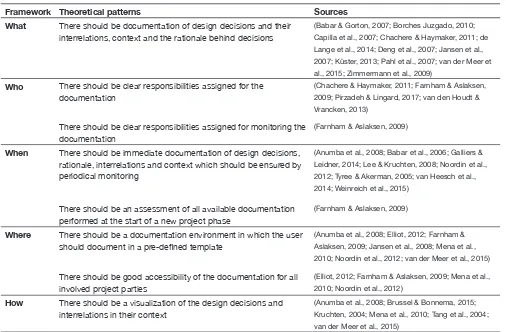
Table 1: Theoretical framework.
Framework Theoretical patterns Sources
What There should be documentation of design decisions and their
interrelations, context and the rationale behind decisions
(Babar & Gorton, 2007; Borches Juzgado, 2010; Capilla et al., 2007; Chachere & Haymaker, 2011; de Lange et al., 2014; Deng et al., 2007; Jansen et al., 2007; Küster, 2013; Pahl et al., 2007; van der Meer et al., 2015; Zimmermann et al., 2009)
Who There should be clear responsibilities assigned for the documentation
(Chachere & Haymaker, 2011; Farnham & Aslaksen, 2009; Pirzadeh & Lingard, 2017; van den Houdt & Vrancken, 2013)
There should be clear responsibilities assigned for monitoring the documentation
(Farnham & Aslaksen, 2009)
When There should be immediate documentation of design decisions, rationale, interrelations and context which should be ensured by periodical monitoring
(Anumba et al., 2008; Babar et al., 2006; Galliers & Leidner, 2014; Lee & Kruchten, 2008; Noordin et al., 2012; Tyree & Akerman, 2005; van Heesch et al., 2014; Weinreich et al., 2015)
There should be an assessment of all available documentation performed at the start of a new project phase
(Farnham & Aslaksen, 2009)
Where There should be a documentation environment in which the user
should document in a pre-defined template
(Anumba et al., 2008; Elliot, 2012; Farnham & Aslaksen, 2009; Jansen et al., 2008; Mena et al., 2010; Noordin et al., 2012; van der Meer et al., 2015)
There should be good accessibility of the documentation for all involved project parties
(Elliot, 2012; Farnham & Aslaksen, 2009; Mena et al., 2010; Noordin et al., 2012)
How There should be a visualization of the design decisions and interrelations in their context
which the user can document in a pre-defined template.
Civil engineering projects have many involved project parties, thus good accessibility to documentation for all parties is very important. To ensure continuous and complete documentation, design decisions should be documented immediately and this should be monitored by periodical reviews. At the start of each project phase, an assessment of previous documentation should be done to provide a baseline of all available information.
Theoretical framework
By means of this literature study, a theoretical framework has been developed that was used as a reference for both data collection and analysis. The theoretical framework
is summarized in Table 1. As literature did not offer one
conclusive framework for the documentation of design decisions, the framework has been developed with
separate elements from different sectors. As coherence
was not present in literature, case study research should be used to determine if cohesion between the elements of the theoretical framework could be found in practice. The relevance and existence of these elements in current practices should also be determined in the case studies. At last, the case study research should provide
a better understanding of the different elements of the
theoretical framework.
3. METHOD
This study has followed a research design developed by means of the proposed approach of Verschuren & Doorewaard (2007). A theoretical framework has been established by performing a literature research. To be able to develop a strategy for the documentation of design decisions, this framework has been compared to current practices. In accordance with the theoretical framework, these practices focus on the documentation on project and not on organizational level. To establish a clear description of current practices in which the contextual conditions play an important role, case study research was used (Miles et al., 2013; Yin, 1994). This type of research strategy has been chosen considering
the three conditions for using a case study. First, the
research question is of exploratory nature as the goal is to investigate current practices and to develop
propositions in the form of a strategy. Furthermore, the
studied projects are contemporary and the researchers have no control over the events (Yin, 1994).
This study on the documentation of design decisions has been performed in four civil engineering projects, focused on road infrastructure. Data were collected in these case studies by means of interviews and document analysis. To ensure data triangulation,
both these sources were used for cross verification
of the collected data. The case studies have been confronted with the theoretical framework by means of pattern matching (Hak & Dul, 2009). Similarities and
differences between theory and current practices have been identified based on this confrontation. Pattern
matching was used in this research as it is recommended as strategy for qualitative analysis for case studies, as it will provide critical understanding of the subject (Cao et al., 2004; Yin, 1994). Although it is not a common approach used in developing a strategy, this in-depth
understanding helped to define the improvements that
are necessary in current practices. Based on these
findings, recommendations in the form of a concept strategy are proposed. In this strategy, different
elements concerning the documentation process are integrated. Also the manner in which those elements should be applied in practice is discussed. The concept strategy for the documentation of design decisions has been validated in another set of interviews. To validate if the strategy also applies to other disciplines than road infrastructure, the participants of these interviews work in other specializations of the civil engineering industry than those who participated in the case studies.
Case studies Projects
Four SE projects in the Netherlands were studied, in which a specific engineering consulting firm is involved.
In all projects, Rijkswaterstaat (RWS)2 functioned as the client and SE was thus required to use as RWS prescribes SE in all its engineering projects (Rijkswaterstaat, 2017). The projects all focus on road infrastructure,
more specifically national highways. The projects have
been selected following the principle of ceteris paribus,
in which multiple variables affecting a dependent
variable are remained constant as much as possible. The industry, client, use of SE and project objectives and sizes are isolated variables in these case studies.
The engineering consulting firm has been involved in the projects in different project phases, based on the
Dutch Transport Infrastructure Planning Act (Tracéwet, 2017). Therefore, these four cases together provide an extensive perspective on the current practices of the
documentation of design decisions in different stages
of development in road infrastructure. The projects are as follows:
• Project A: extension of a station and widening of a highway, established by building two tunnels for the road. Studied in the development of the design route decision, route decision, contract
development and guidance of the contractor after procurement;
• Project B: widening of a highway and separation
of traffic flows. Studied in the contract
development;
• Project C: widening of a highway, construction of a switch lane and development of a sunken road construction. Studied in the development of the route decision and contract development; • Project D: widening of a highway, with the
ambition to develop a smart and sustainable road through extensive innovation. Studied in the development of the design route decision.
Each project is developed by different parties at different
stages, with a continuous involvement of the client. This research focuses on the involved project members of
both an engineering consulting firm and client. Some
of these people have been involved in the projects for the entire period of development, others have only contributed to part of the products.
Data collection
During the case studies, current practices concerning the documentation of design decisions were compared against the theoretical framework that is described in Chapter 2. To collect these data, interviews were conducted amongst team members of four projects, supported by a documentation analysis. The theoretical framework was used as outline for the interview format, so that descriptive data on current practices were gathered for identical elements. These elements describe the what, who, when, where and how characteristics concerning the documentation of design decisions in the case studies.
All participants were interviewed following a structured outline, but with addition of some probing questions if more information was required. Examples of the questions used are “was there a standardized
procedure for the documentation of design decisions?”
and “what are the major limitations of the current
method for the documentation of design decisions?”.
The interviews were conducted in a one-on-one setting of participant and researcher and had a duration of one hour. Data have been collected from in total 29 participants; six for project A, six for project B, eight for project C and nine for project D. These participants have been selected for interviews based on their roles and responsibilities. Technical managers of both the client
and engineering consulting firm were interviewed for all projects. Furthermore, both people focusing on SE
activities and those responsible for the design products have been interviewed. Several designers, technical advisors and design discipline leaders of both client and
engineering consulting firm completed the participants.
Data analysis
The qualitative, descriptive data of the case studies consist of a documentation analysis and interview transcripts. Empirical patterns were formulated for
each of the previously defined elements (Miles et al.,
2013). This condensed set of data was confronted with the theoretical framework by means of pattern matching. This method compares theoretical and empirical patterns and determines whether they match or do not match (Campbell, 1975; Hak & Dul, 2009). The theoretical framework serves as the ‘expected
pattern’, the collected set of data is the ‘observed pattern’. The theoretical pattern thus describes how
the documentation of design decisions should be done, while the observed pattern provides insight in how it is done in practice.
The confrontation either results in matches, partly matches or mismatches between the expected and observed patterns. These matches are assigned values on a three-point scale, - indicating that the patterns do not match entirely, o indicating a slight overlap and +
indicating a complete match. For each of the elements
of the framework, the matches and mismatches were evaluated by means of an explanation which provides an interpretation of the data. A match does not automatically indicate that this pattern should be used in the concept strategy, as the pattern might not have had
any significant influence on the case project. If patterns
did not match, evaluation was done to determine if this
difference in patterns has a significant effect on the
documentation of design decisions.
The pattern matching analysis has been performed
cross-case to compare the different projects and their
confrontations with the theoretical framework (Yin, 1994). The conclusions of these comparisons have resulted in a concept strategy for the documentation of design decisions developed by the researcher.
Validation of the concept strategy Participants
The concept strategy was validated by means
of interviews, which were conducted among five participants of the same engineering consulting firm
as studied in the case studies. The interviewees have
been selected based on their responsibilities and fields
of expertise. They are not part of one project team. Although the concept strategy is used by all project members, designers will be those responsible for documenting most design decisions. Therefore, four interviewees have design responsibilities in the projects
they participate in and one participant often fulfils the
of the participants is not restricted to road infrastructure,
but also comprises movable bridges, flood defences,
steel constructions and coastal- and river hydraulic engineering. The participants of the validation interviews
did not participate in the first round of data collection, so
that input and validation is strictly separated.
Data collection and analysis for validation of the concept strategy
The validation of the concept strategy is the second moment of data collection. These data are required to determine if the concept strategy meets the needs and expectations of the intended users. The data collection was, again, established by means of interviews among the participants. These interviews focused on both the principles and the practical aspect of the concept
strategy. In the first part, the participants were asked
about their opinion on the concept strategy. In the second part, the participants were presented with a prototype of the practical implementation of the concept strategy. Afterwards, they were asked about their perspective on the prototype.
Data of the interviews were analysed to be able to validate the concept strategy. Based on this analysis, conclusions and recommendations for future research are described.
4. RESULTS: CASE STUDIES
This section summarizes the background of the four case study projects from which the empirical patterns are derived. These patterns resemble the elements as
used for the theoretical patterns. Analysis of the results
explains the differences and resemblances between
theory and practice.
Case study results
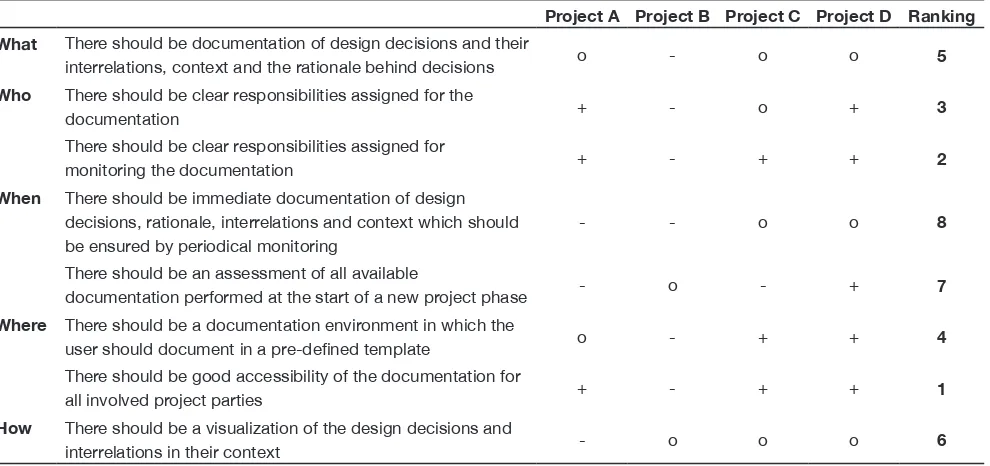
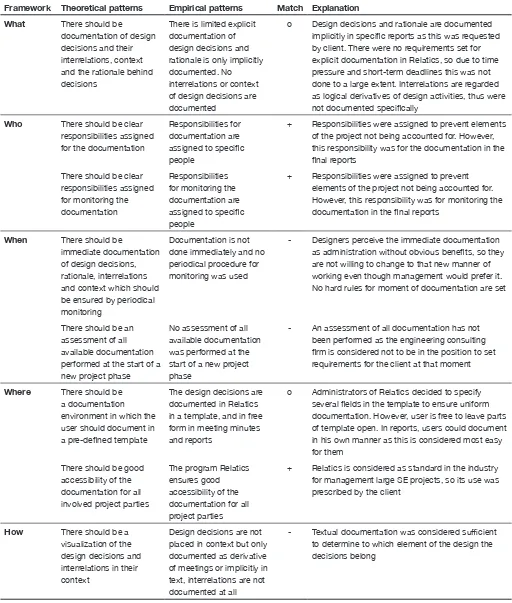
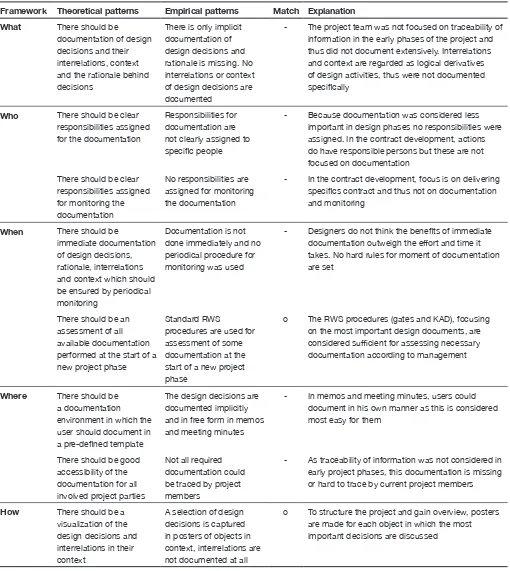
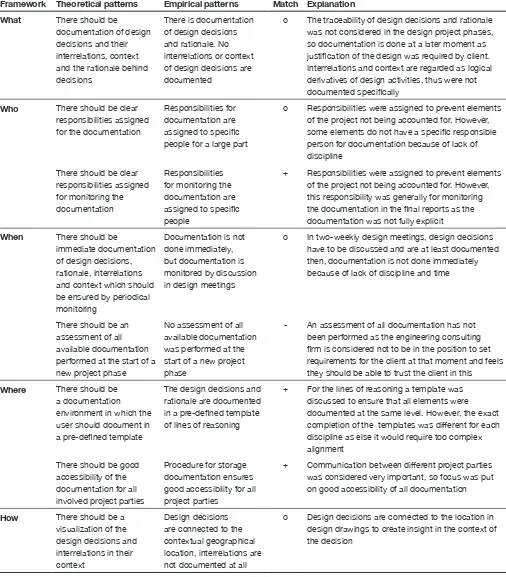
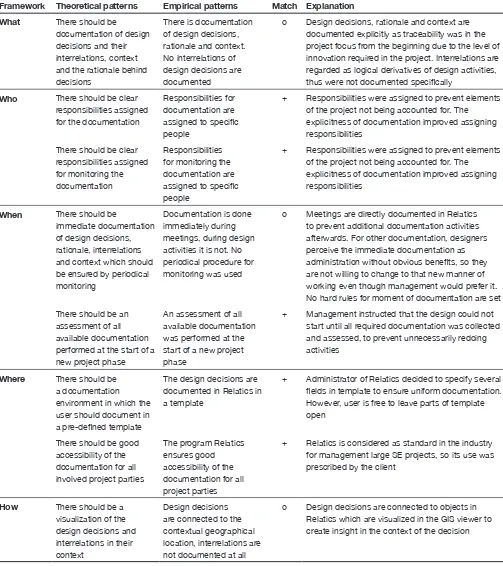
Pattern matching was used to confront the theoretical framework and current practices (Hak & Dul, 2009). Table 2 shows the summarized results of the pattern match between theoretical and empirical patterns for all projects. The confrontation was scored per element and is indicated by a three-point scale (-/o/+). By adding up the scores of all projects, the elements were ranked from most to least in correspondence with literature. The explanations of the initial scores were used to determine the ranking if the combined score was equal for multiple patterns. The extensive pattern matches for each separate project can be found in Appendix I, Tables A.1, A.2, A.3 and A.4.
These case study results are analysed and explained in the next section. As this research aims to develop a strategy for the documentation of design decisions, it
will focus on the general findings of current practices.
Therefore, the individual case study results were used to develop a general perspective of the current situation at
the engineering consulting firm.
Analysing the results What
The pattern match indicates that the documentation of design decisions, their interrelations, context and the rationale behind decisions was not covered completely in any of the projects. The case study results provide more
[image:10.595.54.549.545.778.2]insight in the differences in documentation of the specific
Table 2: Summarized results of the pattern match for all projects.
Project A Project B Project C Project D Ranking What There should be documentation of design decisions and their
interrelations, context and the rationale behind decisions o - o o 5
Who There should be clear responsibilities assigned for the
documentation + - o + 3
There should be clear responsibilities assigned for
monitoring the documentation + - + + 2
When There should be immediate documentation of design decisions, rationale, interrelations and context which should be ensured by periodical monitoring
- - o o 8
There should be an assessment of all available
documentation performed at the start of a new project phase - o - + 7
Where There should be a documentation environment in which the
user should document in a pre-defined template o - + + 4
There should be good accessibility of the documentation for
all involved project parties + - + + 1
How There should be a visualization of the design decisions and
interrelations in their context - o o o 6
aspects. Project teams document design decisions and rationale, however embedded in large documents as integral design notes. Clients often request only these
specific documents, so because of time pressure and short-term deadlines no additional effort is spent on
documenting more explicitly. In projects C and D, the clients made additional requirements concerning the documentation in order to handle project complexity and gain a better overview, which resulted in more explicit documentation. In none of the projects, the interrelations between design decisions were documented, as these are regarded as logical derivatives of design activities which do not need explicit documentation. Project D is the only project in which the context was documented. This can be explained by the involvement of several project members in this project, who were also active in projects A and C. These projects were executed before the start of project D, thus the process is developed by learning from previous experiences. Summarized, there is little explicit documentation of design decisions, their interrelations, context and the rationale behind decisions in current practices.
Who
Table 2 suggests that responsibilities for documentation are assigned in two projects, but that this is not done structurally for the other two projects. The results of
project A can be explained by the project’s contextual
complexity which could not be handled without assigning clear responsibilities. The results of project D can be explained by the clear focus on documentation in this project. Compared, documentation was not the focus of project C, hence responsibilities were not structurally assigned from the start. In project B, project members had much discussion on who should take
responsibility for a specific task which deteriorated the
division of responsibilities. Concluding, responsibilities for documentation are assigned in current practices, but doing this structurally for all aspects could be improved in
some projects. Furthermore, the pattern match indicates
that the responsibilities for monitoring the documentation are assigned in three projects. This suggests that these responsibilities are better considered in current practices than those for documenting itself. The case study results explain this by addressing the documents, as the integral design note, that serve as deliverables for the client. These documents are thoroughly checked and monitored by the discipline leaders and technical managers before they are submitted. Because of this approval approach, the responsibilities for monitoring the documentation are assigned and accountability is ensured. These documents do not have to be delivered to the client often in the current project phase of project B as the focus is on the timely development of the
contract specifications. This explains the absence of
responsibilities for strict monitoring in this project. So, responsibilities for monitoring the documentation are considered in current practices.
When
Table 2 indicates that much improvement is needed in current practices concerning immediate documentation
and periodical monitoring. First, the results show that
documentation has not been done immediately but only if a required deliverable had to be developed. An exception was made in the explicit documentation of meetings in project D, which was done immediately to prevent an additional documentation activity later. No strict rules were set in any of the projects for immediate documentation. Therefore, this was not perceived as obligatory by the designers and as they also consider it time-consuming, it was not done. Second, periodical monitoring is largely absent in current practices as it is considered an additional time-consuming task in an already full project schedule. Only in project C, design meetings are used to discuss and monitor
documentation, but this required a different demeanour
and openness of all involved disciplines. Summarized, the process is not documented immediately in current practices. Periodical monitoring is applied very limited, while this would be a satisfactory approach to
ensure this immediate documentation. Furthermore,
Table 2 suggests that the assessment of all available documentation is only performed in one project. The case study results explain the absence of an assessment by addressing the hierarchy in collaboration between client
and engineering consulting firms in practice. As the
client procures the project assignment, the engineering
consulting firm is considered to meet their requirements
but not set these themselves. The standard procedure for documentation transfer of the client is considered
sufficient by the project members in project B, but this
has not resulted in a more complete documentation. To prevent redoing activities, the management of project D initiated a phase in which design activities were withheld until all required documentation was collected and assessed. The recent start of this project allowed the project team to learn from previous experiences and therefore persist in performing an assessment. To conclude, performing an assessment of all available documentation is upcoming in current practices.
Where
The pattern match suggests that the use of a
pre-defined template in the documentation environment is
partly covered in current practices. In projects A and B,
a pre-defined template was not or partly used as the
easy as possible for the user. In the other two projects,
it was stressed that using a template benefits the
quality of documentation. However, the freedom that project members have in documenting in the template
in practice is large as fields could be left open and the
manner of entering information was not restricted by the template. This is again explained by the perspective that
following a strict template is considered too much effort. Summarized, a pre-defined template for documentation
is used in current practices but the user has much freedom in its completion. Table 2 indicates that a good accessibility of the documentation for all involved project parties is considered in current practices. The case study results explain this by addressing the extensive use of a documentation environment especially made to ensure accessibility and traceability in large SE projects. This program is considered the standard in the civil engineering industry for projects with a large number of involved parties and was thus prescribed by the clients. In project B, information was mainly communicated in person which makes accessibility to this same information hard for other project parties. Concluding, a good accessibility of the documentation for all involved project parties is covered in current practices.
How
The pattern match suggests that the visualization of design decisions and interrelations in their context is not yet structurally performed in practice. Although projects C and D do connect the decisions to the contextual geographical location in a design drawing, the interrelations are not accounted for. The absence of visualizations in the other two projects is explained by the lack of explicit documentation, which impedes developing good connections. In project B, decisions were listed per contextual object to create more overview and structure in the project, connecting the aspects in a more implicit manner. In project A, textual
documentation was considered sufficient to determine which design element the design decisions affect.
Summarized, design decisions are visualized in their context in current practices but this visualization should be complemented by the addition of interrelations.
Ranking the results
As the pattern match (Table 2) indicates, large differences between the results of the different projects emerge.
Project D seems to score best on most of the patterns, and project B never performs up to the theoretical standard. The analysis of the results was discussed in order of their place in the framework of documentation
aspects what, who, when, where and how. Furthermore,
the results were also ranked from most to least in correspondence with literature. Considering this ranking,
the following most important conclusions can be drawn: 1. Both good accessibility of documentation is
considered (see Table 2-‘Where’-ranking 1) and
clear responsibilities for monitoring documentation
are assigned in three projects (see Table
2-‘Who’-ranking 2). Only in project B, no match between theory and practice could be observed for both these patterns. Two projects (A and D) are in keeping with theory concerning the division of responsibilities for documenting itself, and one is partly (C), see
Table 2-‘Who’-ranking 3.
2. The use of a documentation environment with
pre-defined template is applied in projects C and D and for
a part of the aspects of the documentation process
in project A (see Table 2-‘Where’-ranking 4). Project
B is the only project that does not document any of the aspects as suggested in literature (see Table
2-‘What’-ranking 5). For the visualization of design
decisions and interrelations in their context, project A is the only project without any correspondence
with theory (see Table 2-‘How’-ranking 6).
3. Only in project D, a match between theory and practice could be observed concerning the documentation assessment. The other projects are only partly (B) or not in keeping with literature, see
Table 2-‘When’-ranking 7. Immediate documentation
and periodical monitoring was performed in some situations in projects C and D, but none of the projects showed practices comparable to theory
(see Table 2-‘When’-ranking 8).
General overview and explanation
Concluding, good accessibility of documentation is currently considered in practice as clients require
the use of a specific environment that contributes
to traceability and structure in handling large SE projects. The analysis also indicates that assigning responsibilities for both documenting and monitoring this documentation is done in current practices as it
is required to handle the projects’ complexity. A pre-defined template for documenting design decisions is
used to an increasing extent to improve the quality of documentation, however users are given much freedom in completing it. The client plays an important role in the presence of explicit documentation as this is more complete when the client puts emphasis and focus on documentation. The documentation of design decisions and rationale is considered in current practices but the context of and interrelations between design decisions are not documented. The design decisions have been visualized in their context in some projects, however this could be complemented by additionally developing a
in performing a documentation assessment, periodical monitoring and immediate documentation. Assessing
previous documentation is considered difficult in practice because of the difference in power position of the client and engineering consulting firm. Currently, hardly any
strict procedures for the moment of documentation are applied resulting in postponement of these tasks due to time-pressure.
Additional findings
In the interviews performed during the case studies, additional data were collected that were not used in the pattern matching analysis. These data provided the
researcher with a better understanding of the specific
approaches that are already used or are absent in current
practices. First of all, the project members stressed that
indications for when a design decision needs to be documented are required. Document analysis showed that a design decision should be documented if it deviates
from the design norms and standards, if it affects other design decisions and if it leads to choosing a specific design alternative. Furthermore, documentation has to
be performed in four types of documentation activities: for design activities, process-determining decisions or during design and technical management meetings.
Besides documenting the design decisions, the findings
stress that subsequently discussing the documentation during meetings is the only manner in which everyone
becomes familiar with the contents. Furthermore, project
members indicated that often, based on experience, an overview of design decisions that will need to be made in a project phase could be developed already at the start of that phase. This enables a better overview of the design decisions and dependencies in terms of project schedule, and provides structure for those responsible.
5. DEVELOPMENT OF A CONCEPT
STRATEGY
This section describes the development of a concept strategy, based on the performed pattern matching analysis. In line with the aspects distinguished in literature, the concept strategy describes what should be documented, who is responsible, when it should be documented, where it should be documented and how it should be documented. The pattern match of each case
shows an overview of the similarities and differences
between theoretical and empirical patterns. The case studies thus provide insight in the elements already covered in current practices, and those which could still
improve. Also, the findings indicate the relevance of and
cohesion between these elements in practice.
Considering the extent of these improvements, it may not be feasible to successfully implement the concept strategy in a project organization at once.
Therefore, the concept strategy introduces different
levels that should be implemented subsequently. In
the levels, the different elements of the strategy are
discussed, categorized under the documentation aspects what, who, when, where and how. Per level, a more extensive description is presented that explains the required steps to acquire that level of the strategy. This provides a practical perspective on the concept
strategy for the studied engineering consulting firm,
which improves its applicability for implementation in a project organization.
At first, the concept strategy addresses the base
situation, which resembles the current practices that follow from the case studies. As this level might not be current practice for each project, these elements of the strategy are also explained more in-depth. Subsequently, three levels are presented that can only
be implemented in that specific order. The researcher determined the content of the different levels based on
the results of the case studies. Important for establishing the order was the ranking of the elements, based on the correspondence of practice and theory.
Underpinnings for the concept strategy
Based on the outcomes of the pattern match analysis, the distribution of the strategy elements across the
different levels of the concept strategy was made by the
researcher. This paragraph describes the underpinnings for the development of the concept strategy.
The three elements that are generally included already in current practices, good accessibility (see
Table 2-‘Where’-ranking 1) and responsibilities for both
documenting and monitoring this documentation (see
Table 2-‘Who’-ranking 2 and 3), are addressed in the
base level.
Subsequently, the documentation of design
decisions and rationale is included in the first level.
This is because these elements are already partly
implemented (see Table 2-‘What’-ranking 5), however
also because these elements form the foundation required for the implementation of all other strategy
elements. Furthermore, the use of a pre-defined
template is implemented in this level as results show it facilitates the documentation of design decisions and rationale. At last, immediate documentation and periodical monitoring will have to be acquired in this level even though its performance is a large step from
current practices (see Table 2-‘When’-ranking 8). It is
In the second level of the concept strategy, the documentation of interrelations and context of design decisions is addressed. Implementing these aspects requires a better understanding of the project system by the user than is required for a design decision
itself. Furthermore, the results show that the design decisions and justification will need to be documented
before these aspects could be documented. If these elements are documented, the visualization of design decisions and interrelations in their context could be considered.
In the third level, the assessment of all available
documentation is addressed. Findings indicate that performing this effectively could only be achieved if
the assessors have a good understanding of what documentation should be available and what quality this should have. To acquire this knowledge, the
previous levels will have to be mastered first. Therefore,
this strategy element can only be performed if all other elements of the strategy are already implemented. Specifications of the concept strategy
This paragraph describes the specifications of the
concept strategy, of which a summarized version can be
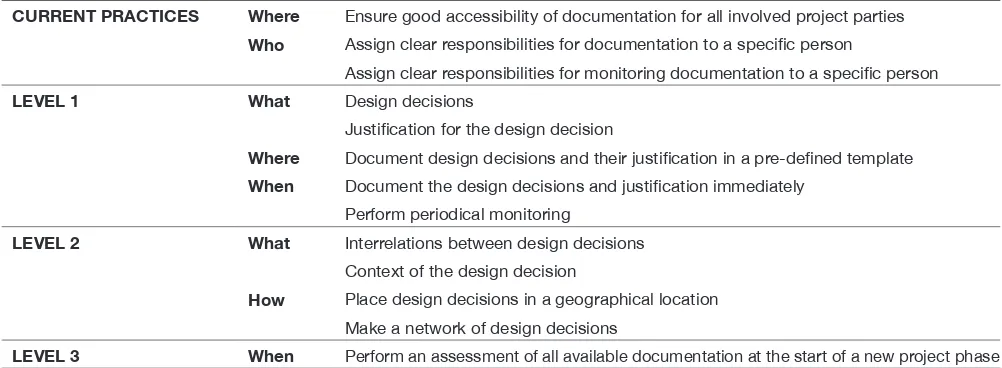
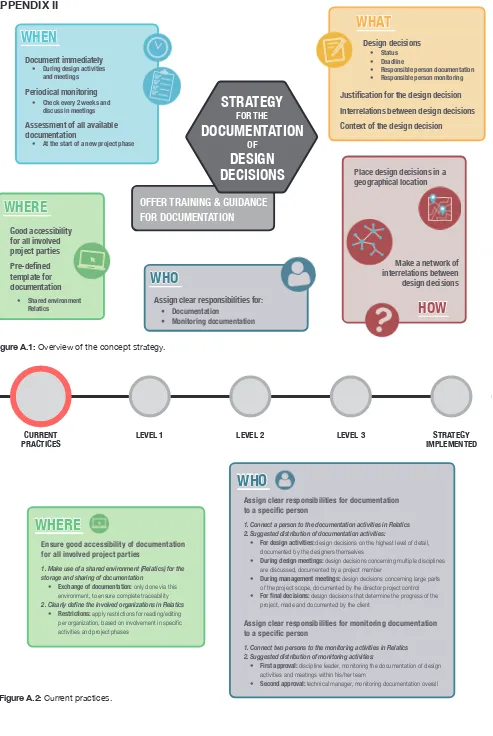
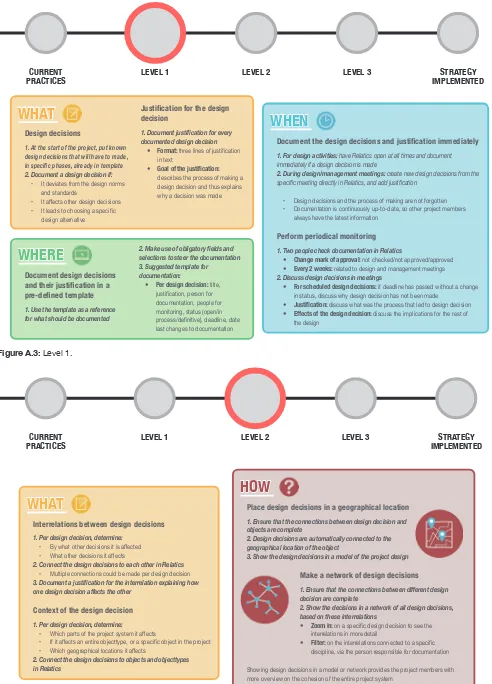
found in Table 3. In Appendix AII, Figures A.1-A.6 show
the extensive concept strategy, in the format in which it was presented to the participants of the validation sessions. The extensive descriptions of the elements
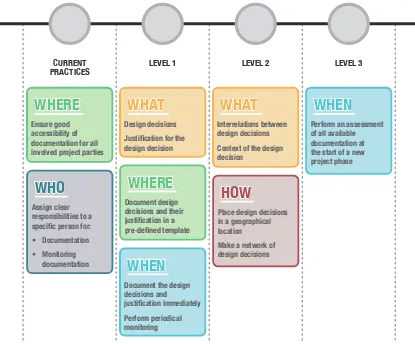
in the different levels are based on the additional data collected in the case studies. The different strategy levels are visually presented in Figure 1.
Current practices
First, suggestions for ensuring good accessibility
for all involved project parties are described. The concept strategy explains the importance of a shared
documentation environment. Furthermore, it describes the possibility of applying different user restrictions based on involvement in specific activities and project phases.
Second, the importance of assigning responsibilities for monitoring documentation is stressed. As the results indicated, performing the monitoring with two people is considered necessary. The discipline leader
is responsible for the first approval and the technical
manager for the second. The concept strategy follows this distribution of responsibilities, considering its
effective implementation in current practices. Third, also
the distribution of responsibilities for documenting itself is described. The concept strategy suggests a distribution
of responsibilities for different documentation activities that were identified in the case studies.
Level 1
First addressed in this level is the documentation of
design decisions and rationale. Although these aspects are considered in current practices, this is too little and mostly implicit as the cases showed. As documenting all design decisions is considered not desirable, indications for when a design decision needs to be documented are
described. Furthermore, at the start all known design
decisions that will have to be made during the project
have to be documented already. For the rationale, the format in which this justification should be documented is described. Secondly, the pre-defined template in
which these design decisions and rationale should be
documented is addressed. The specifics of this template
[image:14.595.47.548.592.776.2]are suggested, based on the documentation elements described in the concept strategy. Third, this level indicates the importance of immediate documentation and periodical monitoring. The concept strategy distinguishes documentation during design activities and during meetings.
Table 3: The concept strategy.
CURRENT PRACTICES Where Ensure good accessibility of documentation for all involved project parties
Who Assign clear responsibilities for documentation to a specific person
Assign clear responsibilities for monitoring documentation to a specific person
LEVEL 1 What Design decisions
Justification for the design decision
Where Document design decisions and their justification in a pre-defined template
When Document the design decisions and justification immediately
Perform periodical monitoring
LEVEL 2 What Interrelations between design decisions
Context of the design decision
How Place design decisions in a geographical location Make a network of design decisions
Level 2
The documentation of interrelations and context design
decisions is first discussed. The user is guided in steps from defining the interrelations to documenting these and adding a rationale for the relation specifically. This justification is required as the findings demonstrated it
is often unclear why decisions are related and how one
affects another. Similar steps are included for defining
and documenting the context of a design decision. Second, these new aspects of documentation should be visualized. The settings for these visualizations are to be accounted for by the software manager, so the description focuses on the implications for the project members and how the visualizations could be used in practice.
Level 3
The assessment of all available documentation at the start of a new project phase is addressed. The concept strategy describes the steps that will have to be performed during this assessment. It is important that all design activities are postponed until the assessment
is finished. Furthermore, the aspects on which the
assessment should focus are listed in this level.
6. RESULTS: VALIDATION OF THE CONCEPT
STRATEGY
This section summarizes the results of the validation of the developed concept strategy, which is shown in Table
3 and Figure 1. In this validation, the concept strategy was assessed by different experts. The extensive results
can be found in Appendix AIII, Table A.5. Because of readability, the table in Appendix AIII represents only
a selection of the most significant quotes given in the
interviews to support the results. A summary of the results
is given in the next section, focusing first on the validation
of the concept strategy in general. Subsequently, the most important results of the validation of the strategy
levels specifically are discussed.
General overview
The results of the validation indicate that the use of the
five documentation aspects (what, who, when, where and
how) as structure for the strategy is considered positive. This structure evokes recognition among the experts and thus lowers the threshold for implementation of the strategy. Some participants did indicate that intuitively it
[image:15.595.83.498.427.771.2]would be more logical to address all five aspects in every level but in different gradations, as there for example will
Figure 1: The concept strategy, showing the strategy levels and corresponding elements.
CURRENT
PRACTICES LEVEL 1 LEVEL 2 LEVEL 3 IMPLEMENTEDSTRATEGY
WHERE
Ensure good accessibility of documentation for all involved project parties
WHEN
Perform an assessment of all available documentation at the start of a new project phase
WHO
Assign clear responsibilities to a
specific person for:
• Documentation • Monitoring
documentation
WHAT
Design decisions
Justification for the
design decision
WHERE
Document design decisions and their
justification in a pre-defined template
WHEN
Document the design decisions and
justification immediately
Perform periodical monitoring
WHAT
Interrelations between design decisions Context of the design decision
HOW
Place design decisions in a geographical location
Make a network of design decisions
have to be someone responsible in all levels. The use
of different levels and the order in which the different
elements are supposed to be implemented is chosen well according to the participants. The content of the
different levels is clear and the manner in which the
elements are combined is logical.
Participants acknowledged that it would not be possible for every project organization to implement all levels because of limitations in its budget, schedule, or size of the team. Therefore, they argued that the project
team should discuss acquiring a certain level in a first
meeting of the project. Besides determining the project ambition concerning the strategy, the experts suggested to specify the strategy in two formats for both small
and large projects. The validation confirms that the
perspective of the client is decisive for a successful implementation of the strategy. The more focus the client puts on documentation, the more extensive the documentation process will be according to the experts.
Strategy levels
All participants agreed that in general, the elements described in the base level are performed in current practices. However, two of them argue that this is mainly for infra- and construction projects and less for the water disciplines. The importance of determining the levels to
be acquired specifically per project is stressed again, as it would require more effort for water projects to
implement the entire strategy. The perceived bottleneck for applying this level in practice is an undue required
effort for small projects.
The experts found the indications for when to
document a design decision in the first level logical and
clear. They suggested some additions to cover all possible decisions; if the involved costs or risks of a decision
are high, if it affects requirements or if it changes the functionality. Furthermore, they stress the importance of
a fully equipped template as this is necessary to facilitate
the elements described in the first level.
Besides that, the implementation of SE in the project should have the same decomposition as the documentation structure as otherwise the visualizations of the second level cannot be constructed. All experts were positive on visualizing the design decisions and interrelations, as they argued this indeed improves the overview and insight of project members. Also, they
indicated the visual representations as beneficial for
communication with the client and other stakeholders.
For the third level, it was argued that the assessment could be performed in different levels matching the elements described in the strategy’s levels. However,
the participants did see the, in practice often tight, project schedules as bottleneck for the successful implementation of this level.
7. COMPARISON TO EXISTING LITERATURE
This section compares the case study results of this research with existing literature, to support previous
findings and to demonstrate differences. Furthermore, it compares the findings of this study concerning the
implementation of a strategy for the documentation of design decisions to previous literature.
This research shows that explicit documentation of design decisions is important for the successful development of a civil engineering project, but also that current practices require many alterations before this documentation is up to theoretical standard. In line with the studies of Elliot (2012), van Houdt & Vrancken (2013) and Luo et al. (2017), the results show that this documentation is especially important in the transition
of information between different disciplines and
organizations. Yet practice shows that especially on these transitions, documentation is often not up-to-date and
delivery to others is too late. Furthermore, the existence
of documentation proves not to be enough for all project members to be aware of the design decisions. The importance of discussing the decisions with the entire
team is thus stressed, specifically in case of transitions between different disciplines (Jansen et al., 2008).
Also, the findings are in line with others in showing
that the use of SE does not ensure a complete and successful procedure for this documentation (van den Houdt & Vrancken, 2013; van der Meer et al., 2015). However, the results also suggest that SE was not always applied to its full potential in practice. This research also reveals that project teams struggle with determining the requirements for documenting a design decision. Project members agree with Weinreich et al. (2015) that a distinction should be made in the documentation process, as it is considered not feasible to document
every design decision. Additionally, the findings are line
with the study of Tyree & Akerman (2005) in indicating that design decisions could be used for giving direction in the development process. A set of design decisions that will need to be made in a project phase could already be developed at the start, based on experience.
This research introduces a strategy for the documentation of design decisions in civil engineering projects and shows that the implementation of such a strategy in a project organization comes with certain
difficulties. The civil engineering industry’s high
time-pressure, project-oriented and task-focused culture impede many to make the required investments in documentation (Noordin et al., 2012; van der Meer et al., 2015). Also the attitude of the designers towards a change in the standard manner of working is a bottleneck
for sufficient documentation of design decisions (van den