Preparation and Microstructural, Structural, Optical and
Electro-Optical Properties of La Doped PMN-PT
Transparent Ceramics
Fernando Andrés Londono Badillo, Jose Antonio Eiras, Flavio Paulo Milton, Ducinei Garcia Ferroelectric Ceramics Group, Physics Department, Federal University of São Carlos, São Carlos, Brazil
Email: [email protected]
Received June 30, 2012; revised July 27, 2012; accepted August 10, 2012
ABSTRACT
Transparent relaxor ferroelectric ceramics of the system lanthanum modified lead magnesium niobate have been inves-tigated for a variety of electro-optic properties that could make these materials alternatives to (Pb,La)(Zr,Ti)O3. However,
a study that relates the to properties in function stoichiometric formula, has not been analyzed heretofore. Therefore, in this work the effect of A-site substitution of La3+ in the characterization microstructural, structural, optical and electro-optical on
1x
Pb1 3 2y La Mg Nby
1 3 2 3
O3xPbTiO and 3
1z
1x
Pb Mg Nb
1 3 2 3
O3xPbTiO3zLa2O has been 3performed. It was observed that the properties according to the stoichiometric formula and the PT had a maximum whose behavior was related to the addition of lanthanum in each stoichiometries.
Keywords: Ferroelectric; Optics; Transmittance; Electro-Optical
1. Introduction
Lead magnesium niobato Pb Mg Nb
1 3 2 3
O (PMN), as 3one of the most widely investigated relaxor ferroelectric with a perovskites structure, was first synthesized in the late 1950s [1]. Initially, PMN was prepared by the con-ventional mixed oxide method, where pyrochlore phase was inevitably produced. In order to synthesize stoichiomet-ric perovskite PMN ceramics, Swartz and Shrout [2] pro-posed a columbite precursor method, where the interme-diate reaction of the formation of pyrochlore phase was bypassed, which results in the stabilization of perovskites structure as compared to the mixed oxide method. Re-cently, a novel methodology was devised to stabilize perovskites structure by adding stable normal PbTiO3
(PT). The formation of the solid solution increases the tolerance factor and electronegativity difference, leading to the stabilization of the perovskites structure and the enhancement of dielectric property of the relaxor ferro-electric [3].
A study of the optical, electrical and electro-optical properties of PMN-PT ceramics in function of the stoi- chiometrie is of interest both for possible insight into the physical nature of relaxor ferroelectrics as well as for making practical extension of its several present applica-tions to include usage in electro-optical devices. Present applications take advantages of PMN-PT singularly ex-
cellent dielectric, low thermal expansion, and high elec- trostrictive properties [4]. From the viewpoint of crystal chemistry, the substitution of Ti4+ ions for the complex
41 3 2 3
Mg Nb ions on the B-site of the perovskite struc- ture in the
1x
Pb Mg Nb
1 3 2 3
O3xPbTiO3 (PMN-PT) system leads to the outstanding properties of the PMN-PT ceramics that exhibit excellent electrical and electro-optical performance, which make them promising applications in multilayer capacitors, piezoelectric trans-ducers and actuators and optical devices [5,6]. However, perovskite structure are extremely difficult to fabricate reproducibly without the appearance of stable pyrochlore phase, which always exist in the PMN-PT ceramics and significantly deteriorates such properties as the dielectric property [7].
The optical transmittance as function of wavelength was studied in
1 3 2 3
0.38 30.62 single
crys-tal by Wan et al. It was found that the crystal is trans-parent in the visible region and rolls off in near 450 nm. Using the Senarmont compensador method, the effective electro-optic coefficient rc = 42.8 pm/V was also
ob-tained [8]. Some effect and applications, such as photore-fractive, Second-Harmonic Generation (SHG), elec-tro-optic and elasto-optical devices, are based on the large optical property coefficient of the materials [9,10]. The knowledge of factors that can modify these properties is desirable to find new application of the relaxor and
tro-optical materials. In this work, ceramics in the PMN-PT system were prepared by doping with lantha-num. La addition to PMN-PT has been shown to promote densification and through hot uniaxial pressing, optically transparent materials have been achieved, allowing the determination of various optic and electro optic proper-ties [11,12].
It is the purpose of this article, to report the micro-structural, micro-structural, electrical, optical and electro-optical properties according to the stoichiometric formula of lan-thanum doped PLMN-XPT and PMN-XPT:La with 0.11 ≤
x ≤ 0.15.
2. Experimental Procedure
The powder was synthesized by the columbite or two- stage calcining method [2]. The batch formulae were
1 x
Pb1 y La Mg Nby
1 3 2 3
O3xPbTiO3PLMN-XPT, and
1z
1x
PbLa Mg Nb
1 3 2 3
O3xPbTiO3zLaO3 2N-XPT:La, with y = 0.01. z = 0.01, X = 100 x and
-m
PM
0.11 ≤ x≤ 0.15. The starting materials were lanthanum oxide, La2O3 (Aldrich, >99% purity), niobium oxide,
Nb2O5 (Alfa Aesar 99.9% purity), magnesium carbonate
hydroxide pentahydrate, (MgCO3)4·Mg(OH)2·5H2O
(Al-drich 99% purity), lead oxide, PbO (MGK 99%) and ti-tanium oxide, TiO2 (Alfa Aesar, 99.8% purity) powders.
The (MgCO3)4·Mg(OH)2·5H2O was carried up to 1100˚C,
for 4 h, to drive off CO2 and H2O and obtain the correct
amount of MgO for a stoichiometric reaction with Nb2O5.
In the first stage, MgO and Nb2O5 powders were ball-
milled and prereacted at 1100˚C for 4 h, in air, to form the columbite phase (MgNb2O6). In the second stage, the
synthesized MgNb2O6 (MN) was ball-milled in
isopro-panol, for 24 h, with appropriate amounts of PbO, TiO2
and La2O3 and heated at 900˚C, for 4 h, in oxygen
at-mosphere, at a controlled pressure of 200 kPa. The cal-cined powders were pressed into pellets 10 mm in di-ameter and 10 mm in thickness with the addition of an appropriate amount of polyvinyl alcohol (PVA) binder. The pellets were sintered in hot uniaxial pressing in O2
atmosphere followed for 4 h at 1220˚C, and 6 MPa. The phases and the structural parameters were deter ined by X-ray diffraction (XRD) using a Rigaku dif-fractometer, with CuKαradiation. The lattice parameters were calculated by least squares from the positions of the diffraction peaks. Apparent densities were determined by the Archimedes method. The microstructural features of the samples were investigated by scanning electron mi-croscopy (SEM), using a Jeol JSM 5800 LV. The grain sizes were calculated from the SEM images of the pol-ished thermally etched surfaces by the linear-intercept method. For dielectric measurement, gold electrodes were
deposited on both faces of the disk samples (5 mm di-ameter and ~1.0 mm thick). The relative permittivity, ɛ
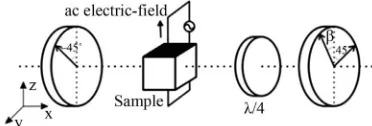
was measured by impedance analysis (HP4194A). The transmittance was measured in a spectrophotometer (Mi-cronal-B582), at wavelengths ranging from 200 to 1000 nm for optically polished samples, 600 µm thick. The method used in the electro-optical characterization, de-termination of the Pockels and Kerr coefficients, is based in the Senarmont configuration illustrated in the Figure 1
[13]. The birefringence medium (sample) is located be-tween two linear polarizer’s, P1 and P2, where the P2
po-larizer is known as analyzer, whit popo-larizer axis forming angles of ±45˚ in relation to principal axis of the sample, this definite by the electric-field direction applied. Be-tween the sample and the analyzer is located a 4 plate used to compensation the effects caused by atural birefringence of the medium. Then the analyzer is posi-tioned in the angle β that optimizes the relation between the birefringence and the applied electric-field. In the Equation (1) is presented the relation between birefrin-gence and electric-field for medium with linear and quad-ratic electro-optic response.
the n
1 2 3
n E n rE RE (1) where the birefringence induced for
3. Results and Discussion
T and PMN-XPT:La at
∆n is the electric-field
E, n is the natural birefringence of the medium, r and R
are the Pockels and Kerr electro-optic coefficients, re-spectively.
The relative density of PLMN-XP
different PT concentration are greater than 96% of the theoretical density as can be seen in Figure 2, which is especially suitable for electronic industry application [14]. The relative density of the two system exhibits the ten-dency to decrease when PT concentration is increased. This can be attributed the loss of PbO (control atmos-phere of PbO was not used in this work) [15]. As well can be seen the relative densities of PLMN-XPT ceram-ics is greater for all PT concentrations when compared with PMN-XPT:La. This possibly associated with the less occupation of La3+ in Pb2+ sites, implying in the
appear-ance of vacancies in the A and B sites in different quanti-ties [16] (La3+ atoms are lighter than Pb2+ atoms, and
[image:2.595.329.515.640.703.2]PMN-XPT:La have major number of La atoms).
Figure 2. Variation of relative density as a function of PT
The variation of density considered as relating to m
of PLMN-XPT and PMN-XPT:La ce
variation of grain size with the increase of PT con-ce
with different co
ur
nction of T curves ca
concentration of the PLMN-XPT and PMN-XPT:La ceram-ics with 0.11 ≤x≤ 0.15.
is
ass loss induced by evaporation of PbO or to variation of temperature of densification relating to the increase of PT, this changes the grain size, porosity could appear which decreases the relative density of ceramics. However the slight decrease of relative density of PLMN-XPT and PMN-XPT:La ceramics can be attributed to the variation of microstructure and to evaporation of lead at elevated sintering temperatures.
The high densification
ramics is further confirmed by SEM observation, which is shown in Figure 3. All ceramics exhibited similar mi-crostructure as can be seen in the micrograph of polished and thermally attacked surface of PLMN-13PT (shown here).
The
ntration is shown in Figure 4. An increase in PT con-centration resulted in a decrease in grain size and a cor-responding slight decrease in density [17]. The grain size in PMN-XPT:La is lesser for all concentration when com-pared to PLMN-XPT because the major quantities of La3+
resulted in reduction of grain size as observed by Kim et al. in La3+ doped PMN-PT ceramics [18].
The XRD patterns of sintered ceramics
mpositions are presented in Figure 5, where a com-plete perovskite structure (JCPDS 391488) is formed and the pyrochlore or other second phases were not detected.
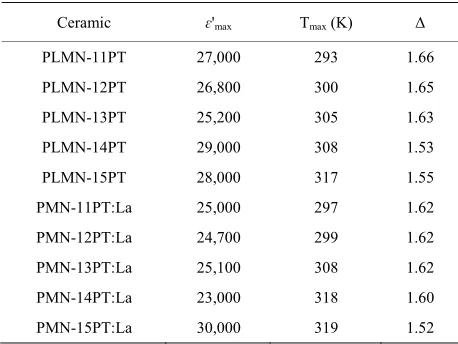
The permittivity (real, ɛ' and imaginary, ɛ") was meas-ed at various temperatures in the frequency range 1 kHz - 1MHz. In the Figure 6 can be seen a typical ex-amples of measurements realized in this work. All the samples exhibit typical relaxor behavior [19,20], with the magnitude of ɛ' decreasing with increasing frequency, and the maximum permittivity real, ɛ'max shifting to
higher temperatures, as shown in the PLMN-12PT ce-ramics (Figure 6). The data of all ceramic analyzed in this work can be seen in the Table 1.
Variations in the shape of ɛ' in fu
n be also directly related to the diffuseness coefficient,
Figure 3. SEM image of surfaces polished and thermally attacked of PLMN-13PT ceramic.
Figure 4. Grain size in function of PT concentration of the PLMN-XPT and PMN-XPT:La ceramics with 0.11 ≤x≤ 0.15.
Figure 5. XRD patterns of PLMN-XPT and PMN
Figure 6. Permittivity real, ɛ' and permittivity imaginary, ɛ" at various frequencies in function of temperature for
La with 0.11 ≤x≤ 0.15 at 1 kHz.
Tmax (K) Δ
[image:4.595.57.286.312.484.2]PLMN-XPT and PMN-XPT:La ceramics with 0.11 ≤x≤ 0.15. Table 1. Dielectric properties of PLMN-XPT and PMN-XPT:
Ceramic ɛ'max
PLMN-11PT 27,000 293 .661
PLMN-12PT 26,800 300 1.65
PLMN-13PT 25,200 305 1.63
PLMN-14PT 29,000 308 1.53
PLMN-15PT 28,000 317 1.55
PMN-11PT:La 25,000 297 1.62
PMN-12PT:La 24,700 299 1.62
PMN-13PT:La 25,100 308 1.62
PMN-14PT:La 23,000 318 1.60
PMN-15PT:La 30,000 319 1.52
from
δ in culated the San n
[image:4.595.308.538.408.496.2]coefficients as a function of PT concentration an
Table 1, cal tos Eiras equatio
[21], which for relaxors ref the level of disorder in term of the diffusivity of the ɛ'max. As can be deduced
from Table 1, the value of ɛ'max for PMN-XPT:La3+ are
smaller that PLMN-XPT, inferring that lanthanum addi-tions result in the reduction in ɛ'max, while increasing the
degree of ordering, as observed for Kim et al. [18]. The transmission spectrum as a function of wavelength (200 nm - 1100 nm) of PLMN-XPT and PMN-XP
lect
T:La ceramics with 0.11 ≤ x≤ 0.15 and 630 µm thickness is presented in Figure 7. For both of these stoichiometries formula the percentage of transmitted light begins to rise abruptly at just below 380 nm and then increases only gradually with wavelength about 500 nm. This gradual increase in transmittance continues into the near IR at least through 1100 nm without any noticeable absorption band being observed. This is similar to what was observed for most crystals with oxygen-octahedral perovskites struc-ture [22-24]. From the transmission characterization, we can see that the optical absorption is very small at higher
wavelength range. In general, optical transmission relates to reflection loss and scattering loss. Using the refractive indices measured by Mchenry et al. [12], e by the Fresnel expression, the reflection loss of the light at two surfaces was calculated about 20%. Beyond of reflection loss is observed loss by scattering which can be attributed the dispersion by ferroelectrics domain (spontaneous bire-fringence), increases in the porosity (by loss of PbO) and precipitation of spurious phases. In general the addition of PT increase the transmittance both the PLMN-XPT and PMN-XPT:La, nevertheless exist a concentration op-timal of PT in 14%. As previously mentioned the increase of content of PT promotes the densification of the sam-ples, favoring the transmittance, though the sample with PMN-XPT:La present less transmission in comparison with the PLMN-XPT in function of wavelength. This effect is attributed the replacement of lanthanum ions in the sites of the lead, that increased the number of vacancies re-ducing the density and consequently affecting the trans-mittance.
In the Table 2 can be seen the values for the electro- optic Kerr
d stoichiometric formula, which were determined un- der frequency of 200 Hz, at room temperature. The val- ues of electro-optical coefficients here obtained are simi- lar the reported in literature for La doped PMN-PT ce-
Figure 7. Percent transmission as a function of wavelength for optically polished PLMN-XPT and PMN-XPT:La with
of PLMN-XPT and lculated under
[image:4.595.308.538.583.735.2]fre-R ( 10 m /V ) 0.11 ≤x≤ 0.15 and 630 µm thickness.
Table 2. Electro-optical coefficient, R PMN-XPT:La with 0.11 ≤ x ≤ 0.15 ca quency of 200 Hz.
Ceramic × −16 2 2
PLMN-11PT 8.0
PLMN-12PT 14.1
ramics [ eater to commercial PLZT ceramics [26]. Th cients of the PLMN T ceramics
ined in this study showed high dense microstructure, independent of the
Pq for the financial support. ão Carlos Physics Institute
RENCES
[1] G. A. Smolenskii a, “Dielectric
Polarization a plex Compounds,”
12,25] and gr
e Kerr coeffi -XP
are higher when compared with PMN-XPT:La ceramics because of their major transmittance, since that the phase induced by electro-optical effect is directly proportional intensity of light transmission [27].
4. Conclusion
The ceramics obta and homogeneous
stoichiometric which were obtained. The La addition to the PLMN-XPT and PMN-XPT:La relaxor ferroelectric system was found to promote densification and inhibit grain growth, however the PMN-XPT:La ceramic to pre-sent smaller density in relation to other composition. The transmittance characterization revealed a transmission of about 50% from 0.45 µm to 1.1 µm, presenting a lower transmission in the samples of PMN-XPT:La. The quad-ratic electro-optic coefficients, calculated from measure-ments of birefringence in this work to PMN-XPT and PLMN-XPT ceramics are up to two times higher than the maximum reported for PLZT. Thus confirming the po-tential use of these system as substitutes for PLZT in electro-optical applications.
5. Acknowledgements
To CAPES, FAPESP and CN To Dr. Y. P. Mascarenhas (S
at the University São Paulo), for the use of the XRD labo-ratory facilities. And to Mr. Francisco José Picon for the technical support.
REFE
and A. I. Agranovskay nd Losses of Some Com
Soviet Physics—Technical Physics, Vol. 3, No. 7, 1958, pp. 1380-1382.
[2] S. L. Swartz and T. R. Shrout, “Fabrication of Perovskite Lead Magnesium Niobate,” Materials Research Bulletin, Vol. 17, No. 10, 1982, pp. 1245-1250.
doi:10.1016/0025-5408(82)90159-3
[3] T. R. Shrout and A. Halliyal, “Preparation of Lead-Based Ferroelectric Relaxors for Capacitors,” The Bulletin of the American Ceramic Society, Vol. 66, No. 4, 1987, pp. 704- 711.
[4] S. J. Jang, K. Uchino, S. Nomura and L. E. Cross, “Elec-trostrictive Behavior of Lead Magnesium Niobate Based Ceramic Dielectrics,” Ferroelectrics, Vol. 27, No. 1, 1980, pp. 31-34. doi:10.1080/00150198008226059
[5] Y. H. Chen, K. Uchino, M. Shen and D. Viehland, “Sub-stituent Effects on the Mechanical Quality Factor of Pb(Mg1/3Nb2/3)O3-PbTiO3 and Pb(Sc1/2Nb1/2)O3-PbTiO3
Ceramics,” Journal of Applied Physics, Vol. 90, No. 3, 2001, pp. 1455-1458. doi:10.1063/1.1379248
[6] L. B. Kong, J. Ma, W. Zhu and O. K. Tan, “Rapid For-mation of Lead Magnesium Niobate-Based Ferroelectric Ceramics via a High-Energy Ball Milling Process,” Ma-terials Research Bulletin, Vol. 37, No. 3, 2002, pp. 459- 465. doi:10.1016/S0025-5408(01)00823-6
[7] E. M. Jayasingh, K. Prabhakaran, R. Sooraj, C. Dur-gaprasad and S. C. Sharma, “Synthesis of Pyrochlore Free PMN-PT Powder by Partial Oxalate Process Route,” Ce-ramics International, Vol. 35, No. 2, 2009, pp. 591-596. doi:10.1016/j.ceramint.2008.01.022
[8] X. M. Wan, H. Q. Xu, T. H. He, D. Lin and H. S. Luo, “Optical Properties of Tetragonal Pb(Mg1/3Nb2/3)0.62
TiO0.38 Single Crystal,”Journal of A
- pplied Physics, Vol. 93, No. 8, 2003, pp. 4766-4768. doi:10.1063/1.1561991 [9] A. S. Bhalla, R. Guo, A. S. Cross, G. Burns, F. H. Dacol
and R. R. Neurgaonkar, “Glassy Polarization in the Ferro-electric Tungsten Bronze (Ba,Sr)Nb2O6,” Journal of
Ap-plied Physics, Vol. 71, No. 11, 1992, pp. 5591-5595. doi:10.1063/1.350537
[10] A. S. Bhalla, R. Guo, A. S. Cross, G. Burns, F. H. Dacol and R. R. Neurgaonkar, “Measurements of Strain and Optical Indices in the Ferroelectric Ba0.4Sr0.6Nbz: Polari- the
zation Effects,” Physical Review B, Vol. 36, No. 4, 1987, pp. 2030-2035. doi:10.1103/PhysRevB.36.2030
[11] F. A. Londono, J. A. Eiras and D. Garcia, “New Trans-parent Ferroelectric Ceramics with High Electro-Optical Coefficients: PLMN-PT,” Cerâmica, Vol. 57, No. 344,
roelectrics, Vol. 93, No. 1, 1989, pp. 2011, pp. 404-408.
[12] D. A. Mchenry, J. Giniewicz, S. J. Jang, A. Bhalla and T. R. Shrout, “Optical Properties of Hot Pressed Relaxor Ferroelectrics,” Fer
351-359. doi:10.1080/00150198908017367
[13] R. Go, “Ferroelectric Properties of Lead Barium Niobate Compositions near the Mosphotropic Phase Boundary,” Ph.D. Theses, Pennsylvania State University,
Pennsyl-the Reaction-Sintering Method,” Physica vania, 1990.
[14] C. Ding, et al., “Phase Structure and Electrical Properties of 0.8Pb(Mg1/3Nb2/3)O3 Relaxor Ferroelectric Ceramics
Prepared by
Status Solidi (A), Vol. 207, No. 4, 2010, pp. 979-985. doi:10.1002/pssa.200925377
[15] G. S. Snow, “Fabrication of Transparent Electrooptic PLZT Ceramics by Atmosphere Sintering,” Journal of American Ceramic Society, V
the ol. 56, No. 2, 1973, pp. 91- 96. doi:10.1111/j.1151-2916.1973.tb12365.x
[16] S. M. Gupta and D. Viehland, “Role of Charge Compen-sation Mechanism in La-Modified Pb(Mg1/3Nb2/3)O3-
PbTiO3 Ceramics: Enhanced Ordering and Pyrochlore
Formation,” Journal of Applied Physics, Vol. 80, No. 10, 1996, pp. 5875-5883. doi:10.1063/1.363581
[17] N. Kim, D. A. McHenry, S. J. Jang and T. R. Shrout, “Fabrication of Optically Transparent Lanthanum Modi-fied Pb(Mg1/3Nb2/3)O3 Using Hot Isostatic Pressing,”
Journal of the American Ceramic Society, Vol. 73, No. 4, 1990, pp. 923-928.
doi:10.1111/j.1151-2916.1990.tb05137.x
[18] N. Kim, W. Huebner, S. J. Jang and T. R. Shrout, “Di-electric and Piezoe
Ceram-ics,” Ferroelectrics, Vol. 93, No. 1, 1989, pp. 341-349. doi:10.1080/00150198908017366
[19] L. E. Cross, S. J. Jang, R. E. Newnham, S. Nomura and K. Uchino, “Large Electrostrictive Effects in Relaxor Ferr electrics,” Ferroelectrics, Vol. 23, No. 1, 1980, pp. 187- o-191. doi:10.1080/00150198008018801
[20] K. Uchino, S. Nomura, L. E. Cross, S. J. Jang and R. E. Newnham, “Electrostrictive Effect in Lead Magnesium Niobate Single Crystals,” Journal of Applied Physics, Vol. 51, No. 2, 1979, pp. 1142-1145. doi:10.1063/1.327724 [21] I. A. Santos and J. A. Eiras, “Phenomenological
Descrip-tion of the Diffuse Phase Transitiion Inferroelectrics,” Journal of Physics: Condensed Matter, Vol. 13, No. 50, 2001, pp. 11733-11740.
doi:10.1088/0953-8984/13/50/333
[22] X. M. Wan, H. S. Luo and X. Y. Zhao, “Refractive Indi-ces and Linear Electro-Optic Propert
(1−x)Pb(Mg1/3Nb2/3)O3−xPbTiO3 S
ies of
ingle Crystals,” Ap-plied Physics Letters, Vol. 85, No. 22, 2004, pp. 5233- 5235.
doi:10.1063/1.1829393 [23] C. J. He, L. H. Luo and
of Tetragonal Ferroelectric Single Crystal Lead Magne- X. Y. Zhao, “Optical Properties sium Niobate Lead Titanate,” Journal of Applied Physics, Vol. 100, No. 1, 2006, Article ID: 013112.
doi:10.1063/1.2217487
[24] F. A. Londono, J. Eiras and D. Garcia, “Op
tro-Optical Properties of (Pb,La)TiO Transparent Ce-3 tical and
Elec-ramics,” Optical Materials, Vol. 34, No. 8, 2012, pp. 1310-1313. doi:10.1016/j.optmat.2012.02.020
[25] K. Uchino, “Ferroelectric Devices,” Marcel Dekker, New York, 2000.
[26] K. Uchino, “Electro-Optic Ceramics and Their Display Applications,” Ceramics International, Vol. 21, No. 5, 1995, pp. 309-315. doi:10.1016/0272-8842(95)96202-Z [27] A. Yariv and P. Yeh, “Optical Waves in Crystals: