Incorporating Relational Knowledge into Word Representations using
Subspace Regularization
Abhishek Kumar
IBM Research
Yorktown Heights, NY 10598, USA
Jun Araki
Carnegie Mellon University Pittsburgh, PA 15213, USA
Abstract
Incorporating lexical knowledge from se-mantic resources (e.g., WordNet ) has been shown to improve the quality of dis-tributed word representations. This knowl-edge often comes in the form of rela-tional triplets(x, r, y)where wordsxand yare connected by a relation typer. Ex-isting methods either ignore the relation types, essentially treating the word pairs as generic related words, or employ rather restrictive assumptions to model the rela-tional knowledge. We propose a novel approach to model relational knowledge based on low-rank subspace regulariza-tion, and conduct experiments on standard tasks to evaluate its effectiveness.
1 Introduction
Distributed word representations, also known as word embeddings, are low-dimensional vector representations for words that capture semantic as-pects (Bengio et al., 2003; Pennington et al., 2014; Mikolov et al., 2013a). The algorithms for learn-ing the word embeddlearn-ings rely on distributional hypothesis(Harris, 1954) that words occurring in similar contexts tend to have similar meanings. Word embeddings have been shown to capture interesting linguistic regularities by simple vec-tor arithmetic (e.g., v(king)-v(man)+v(woman)≈ v(queen)) (Mikolov et al., 2013c). They have also been used to derive downstream features for vari-ous NLP tasks, such as named entity recognition, chunking, dependency parsing, sentiment analy-sis, paraphrase detection and machine translation (Turian et al., 2010; Dhillon et al., 2011; Bansal et al., 2014; Maas et al., 2011; Socher et al., 2011; Zou et al., 2013). Their promise as semantic word
representations has led to increasing research ef-forts on improving their quality.
To this end, researchers have attempted to incor-porate lexical knowledge into word embeddings by using additional regularization or loss terms in the learning objective. This lexical knowledge is often available in the form of triplets{(wi, r, wj)}, where the wordswiandwj are connected by rela-tion typer. These methods can be broadly classi-fied into two categories. First family of methods use a (over-)generalized notion of similarity be-tween words and ignore the type of relations, es-sentially treating the two words as generic similar words (Yu and Dredze, 2014; Faruqui et al., 2015; Liu et al., 2015). This places an implicit restric-tion on the types of relarestric-tions that can be used with these methods. Second family of methods model each relation type by a distinct operator. Bordes et al. (2013) assumed a distinctrelation vectorrfor every relation and minimize the distance between the translated first word and the second word, i.e., d(wi+r,wj)for every triplet(wi, r, wj). Socher et al. (2013) proposed a neural tensor network which uses a distinct tensor operator for every re-lation. These methods were used to learn entity and relation embeddings from a large collection of relation triplets for the task of knowledge base completion. Since these methods did not use any co-occurrence information from a text corpus, all entities were required to appear at least once in the training data, ruling out generalization to un-seen entities1. More recently, Xu et al. (2014)
combined the training objective of SKIP-GRAM (Mikolov et al., 2013a) with the training objec-tive of (Bordes et al., 2013) to incorporate lexical
1There exists work on relation extraction and
knowledge-base completion that combines structured relation triplets and logical rules with unstructured text using various forms of latent variable models (Riedel et al., 2013; Chang et al., 2014; Toutanova et al., 2015; Rockt¨aschel et al., 2015).
knowledge into word embeddings. Fried and Duh (2014) combine the training objective of (Bordes et al., 2013) with that of neural language model (Collobert et al., 2011) usingalternating direction method of multipliers (Boyd et al., 2011).
Constant translation model (Bordes et al., 2013; Xu et al., 2014; Fried and Duh, 2014) (referred as CTM from now on), although an important step in modeling relational knowledge, makes a rather restrictive assumption requiring all triplets
(wi, r, wj) pertaining to a relation type r to sat-isfy wi +r ≈ wj,∀(i, j). This restriction can be severe when learning from a large text corpus since vector representation of a word also needs to respect a huge set of co-occurrence instances with other words. CTM is also not suitable for (i) modeling symmetric relations (e.g., synonyms, antonyms), and (ii) modeling transitive relations (e.g., synonyms, hypernyms). In this paper, we propose a novel formulation for modeling the rela-tional knowledge which addresses these issues by relaxing the constant translation assumption and modeling each relation by a low-rank subspace, i.e., all the word pairs pertaining to a relation are assumed to lie in a low-rank subspace. We demon-strate effectiveness of the learned word represen-tations on the tasks of knowledge-base completion and word analogy.
2 Subspace-regularized word embedding Although our proposed framework for relational modeling is general enough to use with any ex-isting word embedding method, we work with Word2Vec model (Mikolov et al., 2013a) in this paper for illustrating our ideas and later for em-pirical evaluations. Word2Vec is a neural network model trained on sequence of words and its hid-den layer activations can be read out as the word representations. Two variants were proposed in (Mikolov et al., 2013a) – SKIP-GRAM, which maximizes the log likelihood of the local context words given the target word, and CBOW, which maximizes the log likelihood of the target word given its local context. More specifically, CBOW maximizes the objective
1
T T X
t=1
logp(wt|wtt+−cc) = T1 T X
t=1
exp(w0>
t vt) P
w∈V exp(w0>vt) (1)
where wtt−+cc represents the words (or tokens) in the local context window around the t’th word
(or token) and vt = P−c≤i≤c,i6=0wt+i can be seen as the average context vector. The vectors
w,w0 ∈ Rddenote the inputandoutput embed-dings for wordw, respectively. Theinput embed-dings are taken as the final word representations. Negative sampling was proposed to efficiently op-timize Eq. 1 (Mikolov et al., 2013b). We report empirical results withCBOW since it was compu-tationally faster than SKIP-GRAM while giving similar results in our early explorations.
We assume access to relational knowledge in the form of triplets Rk = {(wi, rk, wj)} ∀1 ≤ k≤m, where wordswi andwj are connected by relationrk andRk is the set of all triplets corre-sponding to relationrkwith|Rk|=nk. This form of knowledge is commonly available from Knowl-edge Bases like WordNet (Fellbaum, 1998). Our framework is suitable for both symmetric relations where words can be interchanged (e.g., synonyms) and asymmetric relations which have a directional nature (e.g., hypernyms).
Let dij = (wj − wi) ∈ Rd denote the dif-ference vector for the triplet (wi, rk, wj) which points from the vector of wordwi to that of word wj. Let us construct a matrix Dk ∈ Rd×nk by stacking the difference vectors corresponding to all the triplets in relationrk, i.e.,
Dk= [· · ·dij· · ·]∀{(i, j) : (wi, rk, wj)∈Rk}. (2) To incorporate this relational knowledge into word embeddings, we enforce an approximate low-rank constraint onDkassuming
Dk ≈UkA>k, (3)
where Uk ∈ Rd×p, p d is the relation ba-sis whose linear span contains all the difference vectors pertaining to relationrk. Forp = 2, this assumption implies that all the difference vectors pertaining to a relation lie in a 2-D plane. For p= 1, it reduces toDk≈ukαkT,uk∈Rd,αk∈ Rnk, implying that all the difference vectors for
Rank-1 subspace regularization can also be motivated from the fact that word embeddings are able to capture some linguistic regulari-ties (Mikolov et al., 2013c) along certain direc-tions in the vector space. For example, the dif-ference vector for word pair (king, queen) is ap-proximately aligned with the difference vector for (man,woman), encoding the genderrelation. The direction of the difference vectors carries signifi-cant information for these regularities which is ev-ident from the success ofcosinesimilarity metrics in the word analogy problems (Levy et al., 2014). CTM that assumeswi+uk=wj∀(wi, rk, wj)∈ R enforces an additional equal length constraint on thedifference vectors, which may be rather re-strictive, especially when the word vectors are also influenced by co-occurrence statistics (apart from relational knowledge). Moreover, it may face fol-lowing challenges in relational modeling:
• It does not have a natural interpretation for modeling symmetric relations (e.g., syn-onyms, antonyms) that allow interchangeabil-ity of words in a given relation triplet (i.e.,
(wi, rk, wj) ⇐⇒ (wj, rk, wi)). Having a con-stant translation ofuk ∈Rdfrom the first word to the second word leads to contradiction. • It is also not natural for modeling relations
with transitive property (i.e., (wi, rk, wj) ∧
(wj, rk, wl) =⇒ (wi, rk, wl)), again leading to contradictions. Common examples of such re-lations are synonyms and hypernyms.
The proposed rank-1 subspace relation model naturally allows for modeling such relations by doing away with the constant length restriction on the difference vectors. Our empirical evaluations verify that this relaxation indeed leads to improved quality of word vectors with respect to capturing linguistic regularities.
We incorporate the proposed relational model into the learning objective for word vectors by reg-ularizing the matrix ofdifference vectorstowards a rank-1matrix. We impose a nonnegativity con-straint on the reconstruction coefficientsαkif re-lation rk is asymmetric. This respects the unidi-rectional nature of asymmetric relations. To en-sure uniqueness of solution for uk and αk, we constrainkukk2 = 1. Leavingαkcompletely free can end up creating spurious relations between any two words that are arbitrarily far but whose differ-ence vector is directionally aligned with any of the
relation basis vectors{uk}mk=1. To avoid this, we
further impose a upper limit ofc on the absolute value of elements ofαk. We minimize the follow-ing joint objective for word vectors{wi}|iV=1| and
relation parameters{uk,αk}mk=1:
−T1 XT t=1
logp(wt|wtt−+cc) + 2|λR|Xm
k=1
Dk−ukα>k
2
F
s.t.αk≥0∀asymmetricrk,kukk2 = 1,|(αk)l| ≤c. (4)
whereDkis the matrix ofdifference vectorsas de-fined earlier andλis the regularization parameter. The first term in the objective takes into account the co-occurrence information text corpus while the second term incorporates the relational knowl-edge.
Optimizing for word vectors: We adopt parallel asynchronous stochastic gradient descent (SGD) with negative sampling approach of (Mikolov et al., 2013b). The model parameters for optimiza-tion are input embeddings (weights connecting input and hidden layer) and output embeddings (weights connecting hidden and output layer). In-put embeddings are taken as the final word em-beddings. Each computing thread works with a predefined segment of the text corpus and updates parameters that are stored in a shared memory. In each gradient step ofCBOW, a thread samples a tar-get word and its local context window and updates the parameters of the neural network. It can be seen as sampling one of theft(·), t= 1,2, . . . , T and taking a gradient step with it. A small num-ber of random target words are also sampled for the same context, treating them as negative ex-amples for the gradient update. In theCBOW ar-chitecture, representations for context words are directly encoded as columns of the linear weight matrixW∈Rd×|V|that maps input bag-of-words
embeddings.
wi←−wi−η|Rλ|
X
j:(wi,rk,wj)∈R
wi−wj+ukαkij
+ X
j:(wj,rk,wi)∈R
wi−wj−ukαkji
,
(5)
where η is the learning rate, and αkij denotes
the element of αk corresponding to the column of matrix Dk which contains difference vector
(wj −wi) (and similarly forαkji). The
modifi-cations in the learning rate as the SGD progresses are kept same as in the original implementation of CBOW2.
Optimization for uk and αk: Instead of hav-ing stochastic gradient updates, we adopt an asynchronous batch update strategy for relation basis {uk}mk=1 and reconstruction coefficients
{αk}mk=1. We launch one compute thread that
keeps solving the batch optimization problem for {uk}mk=1and{αk}mk=1in an infinite loop until the
optimization for word embeddings finishes. The batch optimization problem for a symmetric rela-tionrkis:
min
uk,αk
Dk−ukα>k
2
F , s.t. kukk2 = 1,|αk| ≤c. (6)
where Dk ∈ Rd×nk is the matrix of difference vectors for all triplets corresponding to relation rk as defined in Eq. 2. Without the absolute value constraint on αk, this problem can be ex-actly solved by SVD. We follow an alternating optimization procedure for solving this problem. We initializeuk to the top left singular vector of
Dk and then alternate between solving two least-squares sub-problems forukandαk respectively with the corresponding constraints. For asymmet-ric relations, there is an additional nonnegativ-ity constraint on αk. We use projected gradient descent to solve these constrained least-squares problems.
3 Empirical Observations
We report preliminary evaluations of the proposed model (termed asRELSUB) on the tasks of word analogy and knowledge base completion. We use
2https://code.google.com/p/word2vec/
Relation-type RELCONST RELSUB
capital-cities 48.15 59.26
currency 58.33 50.00
city-in-state 17.88 18.94
gender 44.44 50.00
similar-to 5.44 7.26
made-of 0 0
has-context 10.00 8.26
is-a 1.35 1.83
part-of 17.50 19.00
instance-of 8.40 12.98
derived-from 9.14 10.27
antonym 20.00 20.62
entails 0 4.35
causes 0 0
member-of 13.43 26.87
related-to 0 0
attribute 11.76 8.82
SEMANTIC 7.47 8.44
adjective-to-adverb 10.14 47.83
plural-verbs 61.25 71.77
plural-nouns 66.70 71.89
comparative 70.00 75.00
superlative 66.67 77.78
nationality 85.71 85.71
past-tense 42.20 66.84
present-participle 45.76 47.62
SYNTACTIC 54.88 65.38
[image:4.595.324.510.60.358.2]TOTAL 24.61 29.03
Table 1: WordRep data: Accuracy on knowledge-base completion
English Wikipedia for training which contains ap-proximately 4.8 million articles and 2 billion to-kens. We lowercase all the text and and tokenize using Stanford NLP tokenizer.
We use two datasets for evaluating the proposed method. Google word analogy data(Mikolov et al., 2013a) contains 19544 analogy relations (14
relation types – 5 semantic, 9 syntactic) of the form a:b::c:d constructed from 550unique rela-tion triplets. We use this data only for evaluarela-tion (test phase).WordRep(Gao et al., 2014) contains a large collection of relation triplets (44584triplets in total,25relation types –18semantic,7 syntac-tic) extracted from WordNet, Wikipedia and Dic-tionary. For each relation type, we randomly split the triplets in4 : 1ratio with larger split used for training and smaller split used for test. We make sure that there is no word overlap between train-ing and test triplets. We also remove triplets con-taining words from Google Analogy data from the training set.
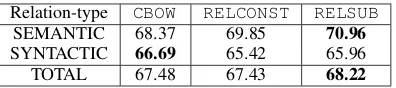
Relation-type CBOW RELCONST RELSUB
SEMANTIC 68.37 69.85 70.96
SYNTACTIC 66.69 65.42 65.96
[image:5.595.84.282.61.105.2]TOTAL 67.48 67.43 68.22
Table 2: Google analogy data: Accuracy on word analogy task
(Xu et al., 2014) for learning word embeddings. Our objective forRELCONST is same as Eq. 4 ex-cept that {αk}mk=1 are set equal to the vector of
all 1’s and norm constraint on uk are removed. This enables us to directly test the merit of the pro-posed rank-1subspace relational model over that of constant translational model in the same regu-larization framework. Note that this objective is similar in spirit to (Xu et al., 2014) in the sense that it also uses a constant translation model for relations. However, Xu et al. (Xu et al., 2014) employ a maximum margin objective on the rela-tion triplets as originally proposed in (Bordes et al., 2013). It encourages the loss (measured in terms of`2distance) for true relation triplets to be
smaller than the loss for randomly corrupted re-lation triplets. Instead of a maximum margin ob-jective for relational knowledge, our model uses a simpler regularization based objective. We could not obtain the implementation of RC-NET (Xu et al., 2014) due to copyright issues cited by its au-thors. We also cannot compare with approaches that use only knowledge-base for training (Faruqui et al., 2015) since they do not learn or modify the embeddings of unseen words and our evaluation triplets do not overlap with training triplets.
We use the CBOW implementation in publicly available Word2Vec code3 for our experiments.
Our vocabulary has 400k words and we use a dimensionality of 300 for embeddings. For all other parameters, we use default values that the Word2Vec code comes with including a context window size of 5 tokens to each side, 5 neg-ative samples per positive sample for negneg-ative sampling technique, etc. For bothRELSUB and RELCONST, we set the regularization parameter to
λ
|R| = 1e−4in all our experiments. We set the
up-per limitcin Eq. 4 to 1. The parameters were not fine tuned rigorously but these values seemed to work reasonably well for us. We do total5epochs of SGD over the text corpus for all methods.
In knowledge-base completion task, we want to predict the missing word of a relation triplet. For a triplet(x, r, y), we assume thatx(first word) and
3https://code.google.com/p/word2vec/
r (relation type) are observed and the task is to predict the missing wordy. We restrict the search for the missing word to the most frequent 300k words (75%of the vocabulary). The missing word is predicted to be the closest word along the rank-1
subspace spanned by the relation vector (restricted bycin Eq. 4). ForRELCONST, the missing word is predicted by translating the first word by the re-lation vector and then searching for nearest word. The accuracy results on WordRep data are shown in Table 1. Relaxing the constant translation to rank-1 subspace assumption results in significant improvements on this task.
In the analogy task, we want to predict the miss-ing word in an analogy tuple a:b::c:?. We use the Google word-analogy data (Mikolov et al., 2013a) for this evaluation. We observe consider-able gains withRELSUB overCBOW for seman-tic categories. The accuracy of knowledge reg-ularized methods on syntactic categories is a lit-tle worse thanCBOW and only slightly better than RELCONST, which is contrary to our observation on the knowledge-base completion task. This is due to the fact that analogy task uses the differ-ence vector(b−a)instead of the learned relation vector which is assumed to be unknown.
4 Concluding Remarks
We proposed a novel framework for modeling relational knowledge in word embeddings using rank-1 subspace regularization. Our model can be seen as a generalization of the constant trans-lational model for relations (Bordes et al., 2013; Xu et al., 2014). In the future, we would like to study the interplay between word frequencies and the strength of regularization, and perform an ex-haustive empirical evaluation. The study of higher rank subspaces for relation modeling is also an im-portant future direction.
References
Mohit Bansal, Kevin Gimpel, and Karen Livescu. 2014. Tailoring continuous word representations for dependency parsing. InProceedings of ACL 2014, pages 809–815.
Yoshua Bengio, R´ejean Ducharme, Pascal Vincent, and Christian Janvin. 2003. A neural probabilistic lan-guage model. The Journal of Machine Learning Re-search, 3:1137–1155.
2013. Translating embeddings for modeling multi-relational data. InProceedings of NIPS 2013, pages 2787–2795.
Stephen Boyd, Neal Parikh, Eric Chu, Borja Peleato, and Jonathan Eckstein. 2011. Distributed opti-mization and statistical learning via the alternating direction method of multipliers. Foundations and TrendsR in Machine Learning, 3(1):1–122. Kai-Wei Chang, Wen-tau Yih, Bishan Yang, and
Christopher Meek. 2014. Typed tensor decompo-sition of knowledge bases for relation extraction. In EMNLP.
Paramveer S. Dhillon, Dean Foster, and Lyle Ungar. 2011. Multi-view learning of word embeddings via CCA. InProceedings of NIPS 2011, pages 199–207. Manaal Faruqui, Jesse Dodge, Sujay K. Jauhar, Chris Dyer, Eduard Hovy, and Noah A. Smith. 2015. Retrofitting word vectors to semantic lexicons. In Proceedings of NAACL-HLT 2015, pages 1606– 1615.
Christiane Fellbaum, editor. 1998. WordNet: An Elec-tronic Lexical Database. MIT Press.
Daniel Fried and Kevin Duh. 2014. Incorporating both distributional and relational semantics in word rep-resentations. arXiv preprint arXiv:1412.4369. Bin Gao, Jiang Bian, and Tie-Yan Liu. 2014.
Wor-drep: A benchmark for research on learning word representations. arXiv preprint arXiv:1407.1640. Yoav Goldberg and Omer Levy. 2014. word2vec
explained: deriving mikolov et al.’s negative-sampling word-embedding method. arXiv preprint arXiv:1402.3722.
Zellig S. Harris. 1954. Distributional structure. Word, 10(23):146–162.
Omer Levy, Yoav Goldberg, and Israel Ramat-Gan. 2014. Linguistic regularities in sparse and explicit word representations.CoNLL-2014, page 171. Quan Liu, Hui Jiang, Si Wei, Zhen-Hua Ling, and
Yu Hu. 2015. Learning semantic word embeddings based on ordinal knowledge constraints. Proceed-ings of ACL 2015.
Andrew L. Maas, Raymond E. Daly, Peter T. Pham, Dan Huang, Andrew Y. Ng, and Christopher Potts. 2011. Learning word vectors for sentiment analysis. InProceedings of ACL 2011, pages 142–150. Tomas Mikolov, Kai Chen, Greg Corrado, and Jeffrey
Dean. 2013a. Efficient estimation of word repre-sentations in vector space. InProceedings of ICLR 2013.
Tomas Mikolov, Ilya Sutskever, Kai Chen, Greg S Cor-rado, and Jeff Dean. 2013b. Distributed represen-tations of words and phrases and their composition-ality. InAdvances in neural information processing systems, pages 3111–3119.
Tomas Mikolov, Wen-tau Yih, and Geoffrey Zweig. 2013c. Linguistic regularities in continuous space word representations. In Proceedings of HLT-NAACL, pages 746–751.
Jeffrey Pennington, Richard Socher, and Christo-pher D. Manning. 2014. GloVe: Global vectors for word representation. InProceedings of EMNLP 2014, pages 1532–1543.
Sebastian Riedel, Limin Yao, Benjamin M. Marlin, and Andrew McCallum. 2013. Relation extraction with matrix factorization and universal schemas. In HLT-NAACL.
Tim Rockt¨aschel, Sameer Singh, and Sebastian Riedel. 2015. Injecting logical background knowledge into embeddings for relation extraction. InHLT-NAALC. Richard Socher, Eric H. Huang, Jeffrey Pennington, Andrew Y. Ng, and Christopher D. Manning. 2011. Dynamic pooling and unfolding recursive autoen-coders for paraphrase detection. InProceedings of NIPS 2011, pages 801–809.
Kristina Toutanova, Danqi Chen, Patrick Pantel, Pallavi Choudhury, and Michael Gamon. 2015. Represent-ing text for joint embeddRepresent-ing of text and knowledge bases. Proceedings of ACL.
Joseph Turian, Lev Ratinov, and Yoshua Bengio. 2010. Word representations: A simple and general method for semi-supervised learning. In Proceedings of ACL 2010, pages 384–394.
Chang Xu, Yalong Bai, Jiang Bian, Bin Gao, Gang Wang, Xiaoguang Liu, and Tie-Yan Liu. 2014. RC-NET: A general framework for incorporating knowl-edge into word representations. InProceedings of CIKM 2014, pages 1219–1228.
Mo Yu and Mark Dredze. 2014. Improving lexical em-beddings with semantic knowledge. InProceedings of ACL 2014, pages 545–550.