2069
Syntax-Infused Variational Autoencoder for Text Generation
Xinyuan Zhang1∗, Yi Yang2∗, Siyang Yuan1, Dinghan Shen1, Lawrence Carin1
1Duke University 2ASAPP Inc.
[email protected],[email protected]
Abstract
We present a syntax-infused variational au-toencoder (SIVAE), that integrates sentences with their syntactic trees to improve the gram-mar of generated sentences. Distinct from existing VAE-based text generative models, SIVAE contains two separate latent spaces, for sentences and syntactic trees. The ev-idence lower bound objective is redesigned correspondingly, by optimizing a joint distri-bution that accommodates two encoders and two decoders. SIVAE works with long short-term memory architectures to simultaneously generate sentences and syntactic trees. Two versions of SIVAE are proposed: one cap-tures the dependencies between the latent vari-ables through a conditional prior network, and the other treats the latent variables indepen-dently such that syntactically-controlled sen-tence generation can be performed. Experi-mental results demonstrate the generative su-periority of SIVAE on both reconstruction and targeted syntactic evaluations. Finally, we show that the proposed models can be used for unsupervised paraphrasing given different syn-tactic tree templates.
1 Introduction
Neural language models based on recurrent neural networks (Mikolov et al.,2010) and sequence-to-sequence architectures (Sutskever et al.,2014) have revolutionized the NLP world. Deep latent variable modes, in particular, the variational autoencoders (VAE) (Kingma and Welling,2014;Rezende et al., 2014) integrating inference models with neural lan-guage models have been widely adopted on text generation (Bowman et al.,2016;Yang et al.,2017; Kim et al.,2018), where the encoder and the de-coder are modeled by long short-term memory
∗
Part of this work was done when the first two authors were at Bloomberg.
S
NP NP
DT
The
NN
book
SBAR WHNP
IN
that
S NP PRP
you
VP VBP
love
VP VBZ
is
ADJP JJ
good
.
[image:1.595.307.526.219.339.2].
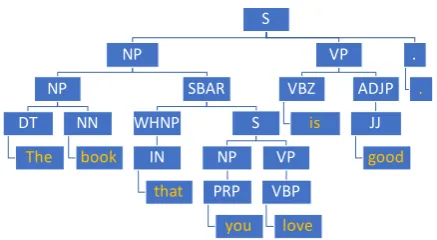
Figure 1: An example of a constituency tree structure.
(LSTM) networks (Chung et al.,2014). For a ran-dom vector from the latent space representing an unseen input, the decoder can generate realistic-looking novel data in the context of a text model, making the VAE an attractive generative model. Compared to simple neural language models, the latent representation in a VAE is supposed to give the model more expressive capacity.
trees or syntactically parsed sentences using well-developed parsers. An example of a con-stituency tree is shown in Figure1. In this work, we remove leaf nodes and linearize the bracketed parse structure into a syntactic tree sequence to simplify the encoding and decoding processes. For example, the syntactic tree sequence for the sentence “The book that you love is good.” is
(S(NP(NP(DT)(NN))(SBAR(WHNP(IN))(S(NP(PRP ))(VP(VBP)))))(VP(VBZ)(ADJP(JJ)))(.)).
Given such data, we aim to train a latent variable model that jointly encodes and decodes a sentence and its syntactic tree.
We propose a syntax-infused VAE model to help improve generation, by integrating syntactic trees with sentences. In contrast to the current VAE-based sentence-generation models, a key differenti-ating aspect of SIVAE is that we map the sentences and the syntactic trees into two latent representa-tions, and generate them separately from the two latent spaces. This design decouples the semantic and syntactic representations and makes it possible to concentrate generation with respect to either syn-tactic variation or semantic richness. To accommo-date the two latent spaces in one VAE framework, the evidence lower bound (ELBO) objective needs to be redesigned based on optimizing the joint log likelihood of sentences and syntactic trees. This new objective makes SIVAE a task-agnostic model, with two encoders and two decoders, so that it can be further used for other generative tasks.
Two variants of SIVAE that differ in the forms of the prior distributions corresponding to the syn-tactic tree latent variables are presented. SIVAE-c captures dependencies between two latent variables by making the syntax prior conditioned on the sen-tence prior. During generation, we first sample a latent variable from the sentence latent space and then sample the syntactic tree latent variable de-pending on the sampled sentence latent variable. This process resembles how humans write: think about substances like entities and topics first, then realize with a specific syntactic structure. We fur-ther propose SIVAE-i assuming the two priors are independent, and change the ELBO of the joint log likelihood correspondingly. This independence assumption manifests syntactically-controlled sen-tence generation as it allows to alter the syntac-tic structure, desirable for related tasks like para-phrase generation. Given a sentence and a syntactic tree template, the model produces a paraphrase of
the sentence whose syntax conforms to the tem-plate. Our SIVAE-based paraphrasing network is purely unsupervised, which makes it particularly suitable for generating paraphrases in low-resource languages or types of content.
The experiments are conducted on two datasets: one has trees labeled by humans and the other has trees parsed by a state-of-the-art parser (Kitaev and Klein,2018). Other than employing the standard language modeling evaluation metrics like perplex-ity, we also adopt the targeted syntactic evaluation (Marvin and Linzen,2018) to verify whether the incorporation of syntactic trees improves the gram-mar of generated sentences. Experiments demon-strate that the proposed model improves the quality of generated sentences compared to other baseline methods, on both the reconstruction and grammar evaluations. The proposed methods show the abil-ity for unsupervised paraphrase generation under different syntactic tree templates.
Our contributions are four-fold:i) We propose a syntax-infused VAE that integrates syntactic trees with sentences, to grammatically improve the gen-erated sentences. ii) We redesign the ELBO of the joint log likelihood, to accommodate two sepa-rate latent spaces in one VAE framework, for two SIVAE model variants based on different intuitions, which can be further used for other applications. iii) We evaluate our models on data with human-constituted trees or parsed trees, and yield promis-ing results in generatpromis-ing sentences with better re-construction loss and less grammatical errors, com-pared to other baseline methods. iv) We present an unsupervised paraphrasing network based on SIVAE-i that can perform syntactically controlled paraphrase generation.
2 Methodology
Given a sentencexand its corresponding syntactic treey, the goal is to jointly encodexandyinto latent representationszx∈Rdandzy ∈
L S T M
L S T M
L S T M
…
L S T M
L S T M
L S T M
…
L S T M
L S T M
L S T M
…
L S T M
L S T M
L S T M
…
[ℎ|$|; ℎ&]
𝑥
&𝑥
)𝑥
|$|𝑥
&𝑥
)𝑥
|$|ℎ
|*|𝑐
|*|𝑦
|*|𝑦
&𝑦
)𝑦
|*|𝑦
)𝑦
&Linear
Linear
𝜇
$𝜎
$𝒩
𝑧
$[ℎ|*|; ℎ&]
Linear
Linear
𝜇
*𝜎
*𝒩
𝑧
*Sentence Encoder Sentence Decoder
Tree Encoder Tree Decoder
Sentence Vocabulary
Tree Vocabulary
MLP MLP
𝒩
[image:3.595.81.516.62.231.2]𝜇2 𝜎2
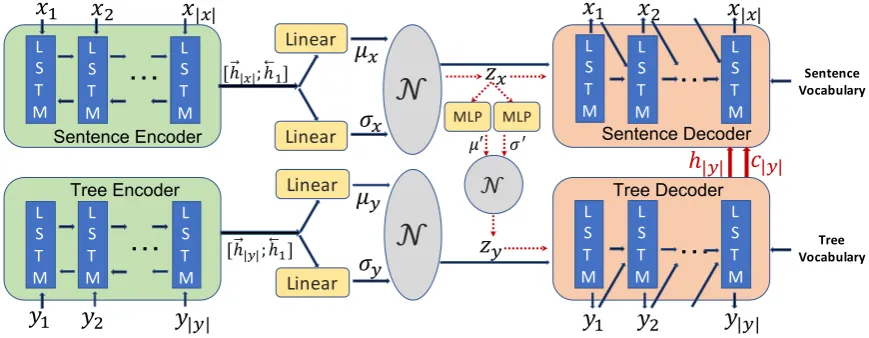
Figure 2: Block diagram of the proposed SIVAE model encoding and decoding sentences and their syntactic trees jointly. The prior network (dashed lines) is used only for the sampling stage of SIVAE-c.
model (SIVAE-c; Section2.1), directly capturing the dependencies betweenzx and zy, presumes that semantic information should influence syntax structure. During the sampling stage, the prior for zy is drawn based on zx from a conditional prior networkp(zy|zx);zximplicitly encodes the subject of the sentence, andzyencodes the corre-sponding syntax. Although this model has robust performance on generation, it doesn’t allow us to syntactically control the generated sentences by freely changing the syntactic tree template inzy. Thus we propose SIVAE-i (Section2.2), which gen-erates sentences and syntactic trees assuming the priorsp(zx)andp(zy)are independent. The entire architecture is shown in Figure2.
2.1 Modeling Syntax-Semantics Dependencies
Since the syntax of a sentence is influenced by the semantics, especially when the content is long, we first propose a generative model to exploit the dependencies betweenzxandzy, through a condi-tional prior networkpψ(zy|zx). Formally, SIVAE-c models the joint probability of the sentenSIVAE-ce and its syntactic tree:
p(x,y) = Z
dzx Z
dzy
p(x|y,zx)p(y|zx,zy)·
p(zy|zx)p(zx)dzydzx, (1)
where the prior overzx is the isotropic Gaussian p(zx) = N(0,I). We defineq(·)to be the varia-tional posterior distributions that approximate the true posterior distributions. The model is trained by
maximizing the lower bound of the log likelihood
logp(x,y)≥ L(x,y;θ, φ, ψ) = (2)
Eqφ(zx|x)logpθ(x|y,zx)−KL[qφ(zx|x)||p(zx)] +Eqφ(zy|y,zx)logpθ(y|zy)
−KL[qφ(zy|y,zx)||pψ(zy|zx)],
whereψ,φ, andθare the parameters of the prior network, the recognition networks, and the gener-ation networks, respectively. We apply the repa-rameterize trick to yield a differentiable unbiased estimator of the lower bound objective.
Conditional Prior Network The key to SIVAE-c is the SIVAE-conditional prior whiSIVAE-ch is used to model the dependencies between the sentence latent vari-ablezx and the syntactic tree latent variable zy. Givenzx, the prior forzy is sampled from a con-ditional probabilitypψ(zy|zx)modeled by a mul-tivariate GaussiansN(µ0,σ02I). The parameters of the Gaussian distribution are computed fromzx with a conditional prior network parameterized by ψ. In particular,µ0 andσ02are the outputs of mul-tilayer perceptron (MLP) networks takingzxas the input.
betweenqφ(zx|x)and the isotropic Gaussian prior p(zx)is
KL(qφ(zx|x)kp(zx)) = 1
2[−log|Σx|
−d+ tr(Σx) +µTxµx]. (3)
So we only need to modelµxand the diagonal of
Σxto compute the KL divergence.
To reconcile the conditional priorpψ(zy|zx), the variational posteriorqφ(zy|y,zx) =N(µy,σ2yI), also depends on the latent variablezx.µyandσ2y are obtained from a recognition network that con-tains a bidirectional LSTM encoder, producing a syntactic tree embedding, and two linear networks, taking the embedding andzx as inputs. The KL divergence is then given by
KL(qφ(zy|y,zx)kpψ(zy|zx)) =
1 2[log|σ
02I| −log|σ2
yI| −d+ tr( σ2yI
σ02I)
+ (µ0−µy)Tσ0−2I(µ0−µy)]. (4)
Generation Networks We employ an LSTM to generateyfrompθ(y|zy). A wordvyis selected by computing the probability ofyt=vy conditioned on previously generated wordsy−tandzy
p(yt=vy|y−t,zy)∝exp((vTyWyh y
t)), (5)
wherehyt is the current hidden states of the LSTM tree decoder
hyt = LSTM(zy,e(yt−1),hyt−1,c
y
t−1). (6)
To generate xfrom pθ(x|y,zx), we modify the generative model in GNMT (Shah and Barber, 2018). First, the last hidden states hy|y| andcy|y| in (6) are directly used as the generated syntactic treey, where|y|is the length ofy. Then we use another LSTM for sentence generation,
hxt = LSTM(zx,e(xt−1),hy|y|,hxt−1,cxt−1). (7)
The conditional probabilities ofxt = vx fort = 1,· · ·,|x|are computed as
p(xt=vx|x−t,zx,y)∝exp((vTxWxhxt)). (8)
In this way, the generated sentence is conditioned onzxand the generated syntactic treey. SIVAE-c seleSIVAE-cts possible syntaSIVAE-ctiSIVAE-c tree templates for a given sentence latent variable, but the syntactic tree template cannot be freely determined.
2.2 Syntactically-Controlled Sentence Generation
In order to freely change the syntactic tree template embedded inzy, we propose an alternative model assuming the independence of two priors. Let pri-ors zx and zy be independent random variables drawn from N(0,I). The variational posteriors qφ(zx|x)andqφ(zy|y)follow Gaussian distribu-tions parameterized by the outputs of feedforward networks, whose inputs arexandy. The model is trained by maximizing the lower bound objective
logp(x,y)≥ L(x,y;θ, φ) = (9)
Eqφ(zx|x)logpθ(x|y,zx)−KL[qφ(zx|x)kp(zx)] +Eqφ(zy|y)logpθ(y|zy)−KL[qφ(zy|y)kp(zy)].
Since y and zx are assumed to be independent when computing the joint probabilityp(x,y), we seek to minimize the mutual informationI(y;zx) during training.
The recognition networks and the generation net-works of SIVAE-i are similar to those adopted in SIVAE-c, so we omit them for brevity.
3 Unsupervised Paraphrasing
Paraphrases are sentences with the same meaning but different syntactic structures. SIVAE allows us to execute syntax transformation, producing the desired paraphrases with variable syntactic tree templates. The syntactically controlled paraphrase generation is inspired byIyyer et al.(2018); the difference is that our SIVAE-based syntactic para-phrase network is purely unsupervised. Unsuper-vised paraphrasing can be performed using both SIVAE-c and SIVAE-i.
One way to generate paraphrases is to perform syntactically controlled paraphrase generation us-ing SIVAE-i. The latent representations of an input sentencezxand a syntactic tree templatezyare fed into SIVAE-i, and the syntax of the generated sen-tence conforms with the explicitly selected target template. However, linearized syntactic sequences are relatively long (as shown in Table1) and long templates are more likely to mismatch particular input sentences, which may result in nonsensical paraphrase outputs. Therefore, we use simplified syntactic sequences as templates, by taking the top two levels of the linearized constituency trees.
The paraphrase generative process is:
Dataset Train Test Valid Ave_s Max_s Voc_s Tree Type Ave_t Max_t Voc_t PTB 39366 4921 4921 25 271 24699 Golden 113 1051 1272 wiki90M 71952 8995 8994 28 318 28907 Parsed 119 1163 387
Table 1: Statistics of the two datasets used in this paper. Ave_s/ Ave_t, Max_s/ Max_t, and Voc_s/ Voc_t denote the average length, maximum length, and vocabulary size for sentences/ tree sequences correspondingly.
2. Select and encode a syntactic template into zy;
3. Generate the reconstructed syntactic sequence yfromp(y|zy);
4. Generate the paraphrase of the original sen-tence that conforms toyfromp(x|y,zx).
We can also use a trained SIVAE-c to generate paraphrases. The paraphrase generation process is similar to sampling from a standard VAE with various tempera. The difference is that SIVAE-c first selects possible syntactic tree templates using the conditional prior networkpψ(zy|zx)then gen-erates paraphrases based on the syntactic template and the latent variable.
4 Related Work
Syntax-Aware Neural Text Generation The ability to generate sentences is core to many NLP tasks, such as machine translation (Bahdanau et al., 2015), summarization (Rush et al.,2015), and di-alogue generation (Vinyals and Le, 2015). Re-cent works have shown that neural text genera-tion can benefit from the incorporagenera-tion of syntac-tic knowledge (Shen et al.,2018;Choe and Char-niak,2016). Sennrich and Haddow(2016) propose to augment each source word representation with its corresponding part-of-speech tag, lemmatized form and dependency label;Eriguchi et al.(2016) andBastings et al. (2017) utilize a tree-based en-coder and a graph convolutional network enen-coder respectively to embed the syntactic parse trees as part of the source sentence representations;Chen et al.(2017) model source-side syntactic trees with a bidirectional tree encoder and tree-coverage de-coder;Eriguchi et al.(2017) implicitly leverage lin-guistic prior by treating syntactic parsing as an aux-iliary task. However, most of these syntax-aware generation works only focus on neural machine translation.
Deep Latent Variable Models Deep latent vari-able models that combine the complementary
strengths of latent variable models and deep learn-ing have drawn much attention recently. Genera-tive adversarial networks (Goodfellow et al.,2014) and variational autoencoders (Kingma and Welling, 2014) are the two families of deep generative mod-els that are widely adopted in applications. As VAEs allow discrete generation from a continuous space, they have been a popular variant for NLP tasks including text generation (Bowman et al., 2016; Yang et al., 2017; Xu and Durrett, 2018; Shen et al.,2019;Wang et al.,2019). The flexibil-ity of VAEs also enables adding conditions during inference to perform controlled language genera-tion (Hu et al., 2017; Zhao et al., 2017). Diver-gent from these VAE-based text generation models, our work decouples the latent representations cor-responding to the sentence and its syntactic tree respectively.
Paraphrase Generation Due to the similarity between two tasks, neural machine-translation-based models can often be utilized to achieve para-phrase generation (Hasan et al.,2016;Mallinson et al.,2017). Recently,Iyyer et al.(2018) proposed to syntactically control the generated paraphrase andGupta et al. (2018) generate paraphrases in a deep generative architecture. However, all these methods assume the existence of some parallel paraphrase corpora while unsupervised paraphrase generation has been little explored.
5 Experiments
Model
PTB wiki90M
Standard Inputless Standard Inputless
PPL NLL KL PPL NLL KL PPL NLL KL PPL NLL KL
KN5 145 132 - 593 169 - 141 141 - 588 182
-LSTM-LM 110 124 - 520 165 - 105 133 - 521 179
-VAE 112 125 2 317 153 13 106 133 5 308 164 22
SIVAE-c 98(1.6) 121(53) 5(0.5) 286(2.4) 150(99) 17(1.3) 94(1.6) 130(56) 12(1.0) 278(2.3) 161(99) 29(2.4) SIVAE-i 90(1.7) 119(60) 9(1.0) 261(2.6) 147(108) 24(2.5) 89(1.7) 128(63) 16(1.9) 256(2.4) 158(104) 36(5.1)
Table 2: Language modeling results on testing sets of PTB and wiki90M. For two SIVAE models, the syntactic tree sequence reconstruction scores are shown in parenthesis alongside the sentence reconstruction scores. Lower is better for PPL and NLL. The best results are in bold.
are about the same.
To discover whether the incorporation of syntac-tic trees is helpful for sentence generation, we com-pare our two versions of SIVAE with three base-lines that do not utilize syntactic information: a 5-gram Kneser-Ney language model (KN5) (Heafield et al., 2013), an LSTM language model (LSTM-LM) (Sundermeyer et al.,2012), and a standard VAE (Bowman et al.,2016) using an LSTM-based encoder and decoder. Experimental results of lan-guage modeling are evaluated by the reconstruction loss using perplexity and the targeted syntactic eval-uation proposed in (Marvin and Linzen,2018). In section5.3, we show the unsupervised paraphrase generation results.
Datasets We use two datasets in this paper. For sentence-level Penn Treebank (PTB), the syntactic trees are labeled by humans (i.e. “gold-standard” trees). For Wikipedia-90M (wiki90M), which does not contain human-generated trees, we first feed the sentences into a state-of-the-art constituency parser (Kitaev and Klein,2018), and then use the parsed trees as syntactic information for our model. Further, we replace (low-frequency) words that ap-pear only once in both datasets with the <unk> token. Statistics about the two datasets are shown in Table1. As we can see, the linearized sequences are much longer than sentences. The vocabulary of trees sequences is much smaller than the vocab-ulary of sentences; and golden trees have larger vocabulary than parsed trees.
Settings The parameters are fine-tuned on the validation set. Our implementation of SIVAE uses one-layer bi-directional LSTM architectures for both encoders, and one-layer unidirectional LSTM architectures for both decoders. The size of hid-den units in the LSTM is 600 and the size of word embeddings is 300. The latent variable size is set to 150 for both sentences and their syntactic trees. The hidden units size of the MLP in the conditional
prior network is 400. We also tried to use different model sizes for sentences and syntactic trees but the results are about the same and the performance even get worse when the difference of the model sizes is too big. We use SGD for optimization, with a learning rate of 0.0005. The batch size is 32 and the number of epochs is 10. The word dropout rate during decoding is 0.4. For KL annealing, the initial weights of the KL terms are 0, and then we gradually increase the weights as training pro-gresses, until they reach the KL threshold of 0.8; the rate of this increase is set to 0.5 with respect to the total number of batches.
5.1 Language Modeling Results
We explore two settings for the decoders: standard and inputless. In the standard setting, the input to the LSTM decoder is the concatenation of the la-tent representationzand the previous ground truth word. A powerful decoder usually results in good reconstruction in this setting but the model may ig-nore the latent variable. In the inputless setting, the decoder purely relies on the latent representations without any use of prior words, so that the model is driven to learn high-quality latent representations of the sentences and syntactic trees.
standard setting, VAE performs almost the same as the LSTM language model, possibly because the strong LSTM decoder plays a dominant role when it uses prior words, so the VAE becomes similar to an LSTM language model. Furthermore, the KL divergence of the proposed models indicate that SIVAE is better at avoiding posterior collapse, so the LSTM sentence decoder can take advantage of the encoded latent variable as well as the pre-viously generated syntactic tree. In the inputless setting, we see that VAE contains a significantly larger KL term and shows substantial improvement over KN5 and LSTM language models. SIVAEs further reduces PPL from 317 to 261 on PTB and from 308 to 256 on wiki90M, compared to VAE.
5.2 Targeted Syntactic Evaluation
We adopt targeted syntactic evaluation (Marvin and Linzen, 2018) to examine whether the proposed methods improve the grammar of generated sen-tences. The idea is to assign a higher probability for generating the grammatical sentence than the ungrammatical one, given a pair of sentences that only differ in grammar. There are three types of sentence pairs used in this work.
Subject-verb agreement (SVA): Third-person present English verbs need to agree with the num-ber of their subjects.
For example,simple SVA: (a). The author laughs. (b). *The author laugh.
Reflexive anaphoras (RA): A reflective pro-noun such as himself needs to agree in number (and gender) with its antecedent.
For example,simple RA:
(a). The senators embarrassed themselves. (b). *The senators embarrassed herself.
Negative polarity items (NPI): Words likeany
and ever that can only be used in the scope of negation are negative polarity items.
For example,simple NPI:
(a). No students have ever lived here. (b). *Most students have ever lived here.
In the above examples, we expect the probability of generating (a) to be higher than the probability of generating (b). However, it is trivial to identify these simple test pairs with simple syntax. Thus we include complex longer test pairs with greater
Model SVA RA NPI
S C S C S C
Humans 0.96 0.85 0.96 0.87 0.98 0.81 KN5 0.79 0.50 0.50 0.50 0.50 0.50 LSTM-LM 0.94 0.56 0.83 0.55 0.50 0.50 VAE 0.94 0.57 0.84 0.57 0.51 0.50 SIVAE-c 0.97 0.75 0.89 0.64 0.57 0.52 SIVAE-i 0.95 0.71 0.88 0.63 0.56 0.52
Table 3: Accuracy of targeted syntactic evaluation for each grammar test case. S and C denote simple test-ing pairs and complex testtest-ing pairs. The total num-ber of test sentences is 44800. Models are trained on wiki90M. The best results are in bold.
depth in relative clauses, identifying which requires more understanding of the syntactic structure.
The accuracy per grammar test case of each method is shown in Table 3. Human scores on these test pairs in (Marvin and Linzen,2018) are also shown for reference. SIVAE outperforms other baselines on grammar testing cases, demonstrating the explicit incorporation of syntactic trees helps with the grammar of generated sentences. For sim-ple SVA testing pairs, SIVAE-c has a better score than humans. Even for a difficult grammar test like NPI, our methods still makes significant progress compared to other baselines, whose scores show no syntactic understanding of these sentences. From Table3, note that KN5 can only identify simple SVA pairs. In addition, VAE has similar syntactic performance as a LSTM language model, which verifies the results in reconstruction. Between the two proposed methods, SIVAE-i makes more gram-mar mistakes than SIVAE-c, although it has better perplexity in Table2. This is because SIVAE-c considers the dependency between the sentence prior and the syntactic tree prior, so it can more ef-ficiently prevent the mismatch between two latent variables. In other words, SIVAE-c learns more robust syntactic representations, but this advantage is not reflected on the reconstruction evaluation.
5.3 Unsupervised Paraphrasing Results
The proposed method is used for generating para-phrases by implicitly selecting (SIVAE-c) or ex-plicitly changing (SIVAE-i) the syntactic tree tem-plates. Our model is not trained on a paraphrase corpora, which makes it a purely unsupervised para-phrasing network.
Syntactically Controlled Paraphrasing
para-Template Paraphrase
original the discovery of dinosaurs has long been accompanied by a legend . ( SBARQ ( NP ) ( VP ) ( , ) ( SQ ) ( ? ) ) the discovery of dinosaurs has been a legend , is it ?
( S ( “ ) ( NP ) ( VP ) ( ” ) ( NP ) ( VP ) ( . ) ) “ the discovery of dinosaurs is a legend ” he said . ( S ( VP ) ( , ) ( NP ) ( . ) ) having been accompanied , the unk lengend .
original in 1987 a clock tower and a fountain were erected at council unk monument . ( S ( PP ) ( PP ) ( NP ) ( VP ) ( . ) ) in 1987 at council a fountain was erected .
( S ( VP ) ( NP ) ( CC ) ( NP ) ( PP ) ( . ) ) build a clock and a fountain at council unk unk .
[image:8.595.74.524.64.172.2]( S ( NP ) ( ; ) ( S ) ( PP ) ( . ) ) a clock p ; he shops everything on the fountain at unk unk .
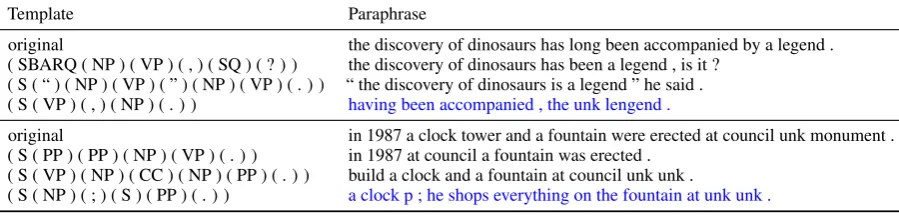
Table 4: Examples of syntactically controlled paraphrases generated by SIVAE-i. We show two successful and one failed (in blue) generations with different templates for each input sentence.
Ori the new york times has been one of the best selling newspapers in america .
Gen1 the new york times also has been used as american best selling newspaper .
Gen2 the new york times also has been used as a “ unk ” that sells in america .
Gen3 the new york times also has been used as the best “ unk ” selling in america .
Table 5: An example of paraphrases generated by SIVAE-c.
phrasing network is trained on sentences and their simplified syntactic sequences of PTB and wiki90M dataset. Table 4 shows some example paraphrases generated by SIVAE-i using different syntactic templates. We see that SIVAE-i has the ability to syntactically control the generated sentences that conform to the target syntactic tem-plate. The examples are well-formed, semantically sensible, and grammatically correct sentences that also preserve semantics of the original sentences. However, the model can generate nonsensical outputs, like the failed cases in Table4, when the target template mismatches the input sentence.
Paraphrasing with Different Tempera We fur-ther perform paraphrasing using SIVAE-c with dif-ferent tempera. Table5shows example paraphrases generated by SIVAE-i. We see that SIVAE-c can generate grammatical sentences that are relevant to the original sentence. However, the generated paraphrases are very similar, indicating that the variance of the conditional prior network is small. In other words, given a sentence latent represen-tation, the range for SIVAE-c selecting a possible syntactic tree representation is small, so it tends to generate similar paraphrases.
Qualitative Human Evaluation We adopt simi-lar human evaluation metrics as in (Gupta et al.,
Model PTB wiki90M
Rele Read Div Rele Read Div VAE 2.63 3.07 2.77 3.03 3.20 2.60 SIVAE-c 2.93 3.47 2.80 3.27 3.67 2.73 SIVAE-i 3.00 3.30 3.13 3.37 3.53 3.20
Table 6: Human evaluation results on Relevance, Read-ability, and Diversity of generated paraphrases.
2018) for generated paraphrases. For 20 origi-nal sentences, we collect 5 paraphrases for each sentence (100 in total) generated by SIVAE-c or SIVAE-i using5different syntactic templates. The models are trained on PTB and wiki90M. Three as-pects are verified in human evaluation:Relevance
with the original sentence, Readabilityw.r.t. the syntax of generated sentences, andDiversityof dif-ferent generations for the same original sentence. Three human evaluators assign a score on a scale of 1-5 (higher is better) for each aspect per generation.
The human evaluation results for unsupervised paraphrase generation using standard VAE, SIVAE-i and SIVAE-c are shown SIVAE-in Table6. SIVAE-c has the best scores and standard VAE has the worst scores at the readability of generated sentences, which further verifies that syntactic information is helpful for sentence generation. Paraphrases generated by SIVAE-i are more diverse under dif-ferent syntactic templates, compared to SIVAE-c and standard VAE. All three models show better paraphrasing performance on the wiki90M dataset.
5.4 Continuity of Latent Spaces
sen-A in january 2014 , the unk announced that one player would be one of the first two heroes .
• in january 2014 , he was one of the first two players to be the most successful .
• until the end of the first half of the series , he has played the most reported time .
• until the end of world war i , he was the first player in the united states .
• there are also a number of other members in the american war association .
B there are also a number of other american advances , such as the unk unk of the american association .
Table 7: Intermediate sentences are generated between two random points in the latent space of SIVAE-c.
tence latent space. The syntactic structure remains consistent in neighborhoods along the path, indicat-ing the continuity in the syntactic tree latent space.
6 Conclusion
We present SIVAE, a novel syntax-infused varia-tion autoencoder architecture for text generavaria-tion, leveraging constituency parse tree structure as the linguistic prior to generate more fluent and gram-matical sentences. The new lower bound objec-tive accommodates two latent spaces, for jointly encoding and decoding sentences and their syn-tactic trees. The first version of SIVAE exploits the dependencies between two latent spaces, while the second version enables syntactically controlled sentence generation by assuming the two priors are independent. Experimental results demonstrate the incorporation of syntactic trees is helpful for recon-struction and grammar of generated sentences. In addition, SIVAE can perform unsupervised para-phrasing with different syntactic tree templates.
Acknowledgments
This research was supported in part by DARPA, DOE, NIH, ONR and NSF.
We thank Kazi Shefaet Rahman, Ozan Irsoy, Igor Malioutov and other people in the Bloomberg NLP platform team for their feedback on the initial idea of the work. We thank the ACL reviewers for their helpful feedback. This work also benefitted from discussions with Tao Lei and Lili Yu.
References
Dzmitry Bahdanau, Kyunghyun Cho, and Yoshua Ben-gio. 2015. Neural machine translation by jointly
learning to align and translate. In Proceedings of the International Conference on Learning Represen-tations (ICLR).
Joost Bastings, Ivan Titov, Wilker Aziz, Diego Marcheggiani, and Khalil Simaan. 2017. Graph convolutional encoders for syntax-aware neural ma-chine translation. InProceedings of Empirical Meth-ods for Natural Language Processing (EMNLP).
Samuel R Bowman, Luke Vilnis, Oriol Vinyals, An-drew M Dai, Rafal Jozefowicz, and Samy Ben-gio. 2016. Generating sentences from a continuous space. InProceedings of the Conference on Natural Language Learning (CoNLL).
Huadong Chen, Shujian Huang, David Chiang, and Ji-ajun Chen. 2017. Improved neural machine transla-tion with a syntax-aware encoder and decoder. Pro-ceedings of the Association for Computational Lin-guistics (ACL).
Do Kook Choe and Eugene Charniak. 2016. Parsing as language modeling. Proceedings of Empirical Meth-ods in Natural Language Processing (EMNLP).
Junyoung Chung, Caglar Gulcehre, KyungHyun Cho, and Yoshua Bengio. 2014. Empirical evaluation of gated recurrent neural networks on sequence model-ing. Neural Information Processing Systems (NIPS) Workshop on Deep Learning.
Akiko Eriguchi, Kazuma Hashimoto, and Yoshimasa Tsuruoka. 2016. Tree-to-sequence attentional neu-ral machine translation. InProceedings of the Asso-ciation for Computational Linguistics (ACL).
Akiko Eriguchi, Yoshimasa Tsuruoka, and Kyunghyun Cho. 2017. Learning to parse and translate improves neural machine translation. In Proceedings of the Association for Computational Linguistics (ACL).
Ian Goodfellow, Jean Pouget-Abadie, Mehdi Mirza, Bing Xu, David Warde-Farley, Sherjil Ozair, Aaron Courville, and Yoshua Bengio. 2014. Generative adversarial nets. InNeural Information Processing Systems (NIPS).
Kristina Gulordava, Piotr Bojanowski, Edouard Grave, Tal Linzen, and Marco Baroni. 2018. Colorless green recurrent networks dream hierarchically. Pro-ceedings of the North American Chapter of the Asso-ciation for Computational Linguistics (NAACL).
Ankush Gupta, Arvind Agarwal, Prawaan Singh, and Piyush Rai. 2018. A deep generative framework for paraphrase generation. In Proceedings of the Na-tional Conference on Artificial Intelligence (AAAI).
Kenneth Heafield, Ivan Pouzyrevsky, Jonathan H Clark, and Philipp Koehn. 2013. Scalable modified kneser-ney language model estimation. In Proceedings of the Association for Computational Linguistics (ACL), volume 2.
Zhiting Hu, Zichao Yang, Xiaodan Liang, Ruslan Salakhutdinov, and Eric P Xing. 2017. Toward controlled generation of text. In Proceedings of the International Conference on Machine Learning (ICML).
Mohit Iyyer, John Wieting, Kevin Gimpel, and Luke Zettlemoyer. 2018. Adversarial example genera-tion with syntactically controlled paraphrase net-works. InProceedings of the North American Chap-ter of the Association for Computational Linguistics (NAACL).
Yoon Kim, Sam Wiseman, Andrew C Miller, David Sontag, and Alexander M Rush. 2018. Semi-amortized variational autoencoders. Proceedings of the International Conference on Machine Learning (ICML).
Diederik P Kingma and Max Welling. 2014. Auto-encoding variational bayes. InProceedings of the International Conference on Learning Representa-tions (ICLR).
Nikita Kitaev and Dan Klein. 2018. Constituency pars-ing with a self-attentive encoder. Proceedings of the Association for Computational Linguistics (ACL).
Jonathan Mallinson, Rico Sennrich, and Mirella Lapata. 2017. Paraphrasing revisited with neural machine translation. InProceedings of the Conference of the European Chapter of the Association for Computa-tional Linguistics.
Mitchell P Marcus, Beatrice Santorini, and Mary Ann Marcinkiewicz. 1993. Building a large annotated corpus of english: The penn treebank. Computa-tional Linguistics, 19(2).
Rebecca Marvin and Tal Linzen. 2018. Targeted syn-tactic evaluation of language models. In Proceed-ings of Empirical Methods for Natural Language Processing (EMNLP).
Tomáš Mikolov, Martin Karafiát, Lukáš Burget, Jan ˇ
Cernock`y, and Sanjeev Khudanpur. 2010. Recurrent neural network based language model. InEleventh annual conference of the international speech com-munication association.
Danilo Jimenez Rezende, Shakir Mohamed, and Daan Wierstra. 2014. Stochastic backpropagation and ap-proximate inference in deep generative models. Pro-ceedings of the International Conference on Ma-chine Learning (ICML).
Alexander M Rush, Sumit Chopra, and Jason We-ston. 2015. A neural attention model for abstrac-tive sentence summarization. InProceedings of Em-pirical Methods for Natural Language Processing (EMNLP).
Rico Sennrich and Barry Haddow. 2016. Linguistic input features improve neural machine translation. InProceedings of the First Conference on Machine Translation: Volume 1, Research Papers.
Harshil Shah and David Barber. 2018. Generative neu-ral machine translation. InNeural Information Pro-cessing Systems (NIPS).
Dinghan Shen, Asli Celikyilmaz, Yizhe Zhang, Liqun Chen, Xin Wang, Jianfeng Gao, and Lawrence Carin. 2019. Towards generating long and coherent text with multi-level latent variable models. arXiv preprint arXiv:1902.00154.
Yikang Shen, Zhouhan Lin, Chin-Wei Huang, and Aaron Courville. 2018. Neural language modeling by jointly learning syntax and lexicon. Proceedings of the International Conference on Learning Repre-sentations (ICLR).
Xing Shi, Inkit Padhi, and Kevin Knight. 2016. Does string-based neural mt learn source syntax? In
Proceedings of Empirical Methods for Natural Lan-guage Processing (EMNLP).
Martin Sundermeyer, Ralf Schlüter, and Hermann Ney. 2012. Lstm neural networks for language modeling. InThirteenth annual conference of the international speech communication association.
Ilya Sutskever, Oriol Vinyals, and Quoc V Le. 2014. Sequence to sequence learning with neural networks. InNeural Information Processing Systems (NIPS).
Oriol Vinyals and Quoc V. Le. 2015. A neural con-versational model. Proceedings of the International Conference on Machine Learning (ICML) Workshop on Deep Learning.
Wenlin Wang, Zhe Gan, Hongteng Xu, Ruiyi Zhang, Guoyin Wang, Dinghan Shen, Changyou Chen, and Lawrence Carin. 2019. Topic-guided variational autoencoders for text generation. arXiv preprint arXiv:1903.07137.
Jiacheng Xu and Greg Durrett. 2018. Spherical latent spaces for stable variational autoencoders. In Pro-ceedings of Empirical Methods in Natural Language Processing (EMNLP).
Zichao Yang, Zhiting Hu, Ruslan Salakhutdinov, and Taylor Berg-Kirkpatrick. 2017. Improved varia-tional autoencoders for text modeling using dilated convolutions. In Proceedings of the International Conference on Machine Learning (ICML).