3606
Improving Visual Question Answering by Referring to
Generated Paragraph Captions
Hyounghun Kim Mohit Bansal
UNC Chapel Hill
{hyounghk, mbansal}@cs.unc.edu
Abstract
Paragraph-style image captions describe di-verse aspects of an image as opposed to the more common single-sentence captions that only provide an abstract description of the image. These paragraph captions can hence contain substantial information of the image for tasks such as visual question answering. Moreover, this textual information is comple-mentary with visual information present in the image because it can discuss both more ab-stract concepts and more explicit, intermediate symbolic information about objects, events, and scenes that can directly be matched with the textual question and copied into the tex-tual answer (i.e., via easier modality match). Hence, we propose a combined Visual and Textual Question Answering (VTQA) model which takes as input a paragraph caption as well as the corresponding image, and answers the given question based on both inputs. In our model, the inputs are fused to extract re-lated information by cross-attention (early fu-sion), then fused again in the form of consen-sus (late fusion), and finally expected answers are given an extra score to enhance the chance of selection (later fusion). Empirical results show that paragraph captions, even when auto-matically generated (via an RL-based encoder-decoder model), help correctly answer more visual questions. Overall, our joint model, when trained on the Visual Genome dataset, significantly improves the VQA performance over a strong baseline model.
1 Introduction
Understanding visual information along with nat-ural language have been studied in different ways. In visual question answering (VQA) (Antol et al.,
2015;Goyal et al., 2017; Lu et al., 2016; Fukui et al., 2016; Xu and Saenko, 2016; Yang et al.,
2016; Zhu et al., 2016; Anderson et al., 2018), models are trained to choose the correct answer
given a question about an image. On the other hand, in image captioning tasks (Karpathy and Fei-Fei, 2015; Johnson et al., 2016; Anderson et al.,2018;Krause et al.,2017;Liang et al.,2017;
Melas-Kyriazi et al.,2018), the goal is to generate sentences which should describe a given image. Similar to the VQA task, image captioning mod-els should also learn the relationship between par-tial areas in an image and the generated words or phrases. While these two tasks seem to have dif-ferent directions, they have the same purpose: un-derstanding visual information with language. If their goal is similar, can the tasks help each other? In this work, we propose an approach to im-prove a VQA model by exploiting textual infor-mation from a paragraph captioning model. Sup-pose you are assembling furniture by looking at a visual manual. If you are stuck at a certain step and you are given a textual manual which more ex-plicitly describes the names and shapes of the re-lated parts, you could complete that step by read-ing this additional material and also by compar-ing it to the visual counterpart. With a similar intuition, paragraph-style descriptive captions can more explicitly (via intermediate symbolic repre-sentations) explain what objects are in the image and their relationships, and hence VQA questions can be answered more easily by matching the tex-tual information with the questions.
these paragraph captions and attribute sentences as input in addition to the standard input image fea-tures. The VTQA model combines the informa-tion from text and image with early fusion, late fusion, and later fusion. With early fusion, vi-sual and textual features are combined via cross-attention to extract related information. Late fu-sion collects the scores of candidate answers from each module to come to an agreement. In later fu-sion, expected answers are given an extra score if they are in the recommendation list which is cre-ated with properties of detected objects. Empiri-cally, each fusion technique provides complemen-tary gains from paragraph caption information to improve VQA model performance, overall achiev-ing significant improvements over a strong base-line VQA model. We also present several ablation studies and attention visualizations.
2 Related Work
Visual Question Answering (VQA): VQA has been one of the most active areas among efforts to connect language and vision (Malinowski and Fritz,2014;Tu et al.,2014). The recent success of deep neural networks, attention modules, and ob-ject plus salient region detection has made more effective approaches possible (Antol et al.,2015;
Goyal et al., 2017;Lu et al., 2016; Fukui et al.,
2016; Xu and Saenko, 2016; Yang et al., 2016;
Zhu et al.,2016;Anderson et al.,2018).
Paragraph Image Captioning: Another thread of research which deals with combined visual and language problem is the translation of visual con-tents to natural language. The first approach to this included using a single-sentence image caption-ing model (Karpathy and Fei-Fei, 2015). How-ever, this task is not able to accommodate the va-riety of aspects of a single image. Johnson et al.
(2016) expanded single-sentence captioning to de-scribe each object in an image via a dense caption-ing model. Recently, paragraph captioncaption-ing models (Krause et al., 2017; Liang et al., 2017; Melas-Kyriazi et al.,2018) attempt to capture the many aspects in an image more coherently.
3 Models
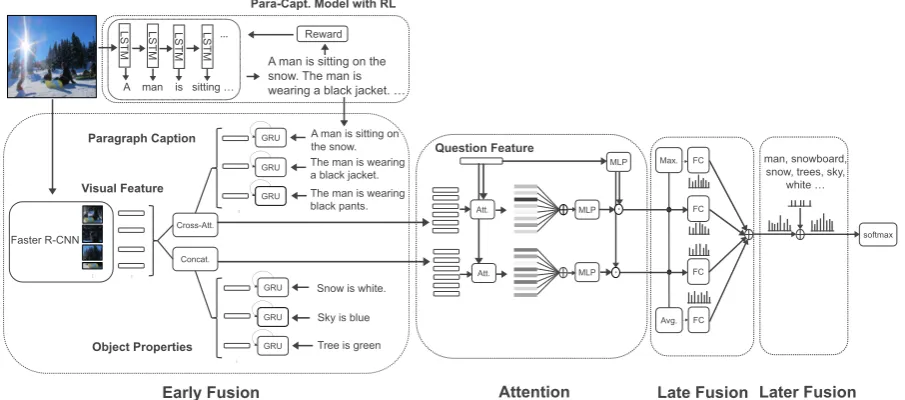
The basic idea of our approach is to provide the VQA model with extra text information from para-graph captions and object properties (see Fig.1).
3.1 Paragraph Captioning Model
Our paragraph captioning module is based on
Melas-Kyriazi et al. (2018)’s work, which uses CIDEr (Vedantam et al.,2015) directly as a reward to train their model. They make the approach pos-sible by employing self-critical sequence training (SCST) (Rennie et al.,2017). However, only em-ploying RL training causes repeated sentences. As a solution, they applyn-gram repetition penalty to prevent the model from generating such duplicated sentences. We adopt their model and approach to generate paragraph captions.
3.2 VTQA Model
3.2.1 Features
Visual Features: We adopt the bottom-up and top-down VQA model from Anderson et al.
(2018), which uses visual features from the salient areas in an image (bottom-up) and gives them weights using attention mechanism (top-down) with features from question encoding. Following
Anderson et al.(2018), we also use Faster R-CNN (Ren et al.,2015) to get visual featuresV ∈RO×d,
whereO is #objects detected anddis the dimen-sion of each visual feature of the objects.
Paragraph Captions: These provide diverse as-pects of an image by describing the whole scene. We use GloVe (Pennington et al., 2014) for the word embeddings. The embedded words are se-quentially fed into the encoder, for which we use GRU (Cho et al.,2014), to create a sentence repre-sentation,si ∈Rd:si=ENCsent(w0:T), whereT
is the number of words. The paragraph feature is a matrix which contains each sentence represen-tation in each row, P ∈ RK×d, whereK is the
number of sentences in a paragraph.
…
A man is sitting on the snow.
Faster R-CNN
A man is sitting on the snow. The man is wearing a black jacket. …
GRU
The man is wearing a black jacket.
GRU
The man is wearing black pants.
GRU
…
…
Cross-Att.
A man is sitting …
Para-Capt. Model with RL
LST
M
…
Snow is white.
GRU
Sky is blue
GRU
GRU
…
Concat.
Reward
Tree is green
man, snowboard, snow, trees, sky,
white …
softmax
Avg. Max. FC
FC
FC
Paragraph Caption
Object Properties Visual Feature
Early Fusion Attention Late Fusion Later Fusion
Att.
Question Feature
MLP
MLP
MLP
*
*
Att. FC
LST
M
LST
M
LST
[image:3.595.73.526.66.266.2]M
Figure 1: VTQA Architecture: Early, Late, and Later Fusion between the Vision and Paragraph Features.
3.2.2 Three Fusion Levels
Early Fusion: In the early fusion stage, visual features are fused with paragraph caption and ob-ject property features to extract relevant informa-tion. For visual and paragraph caption features, cross-attention is applied to get similarity between each component of visual features (objects) and a paragraph caption (sentences). We follow Seo et al. (2016)’s approach to compute the similar-ity matrix, S ∈ RO×K. From the similarity
ma-trixVp = softmax(ST)V and the new paragraph representation, Pf is obtained by concatenating
P and P ∗Vp: Pf = [P;P ∗Vp], where * is element-wise product operation. For visual feature and object property feature C, they are already aligned and the new visual feature Vf becomes
Vf = [V;V∗C]. Given the fused representations, the attention mechanism is applied over each row of the representations to weight more relevant fea-tures to the question.
ai =wTa(ReLU(Wsasfi)∗ReLU(Wqaq)) (1)
α=softmax(a) (2)
where,sfi is a row vector of new fused paragraph representation and q is the representation vector of a question which is encoded with GRU unit.
wTa, Wsa, andWqa are trainable weights. Given
the attention weights, the weighted sum of each row vector, sfi leads to a final paragraph vector
p =PK
i=1αisfi. The paragraph vector is fed to a
nonlinear layer and combined with question vector by element-wise product.
pq=ReLU(Wpp)∗ReLU(Wqq) (3)
Lp=classifier(pq) (4)
whereWp andWq are trainable weights, andLp
contains the scores for each candidate answer. The same process is applied to the visual features to obtainLv =classifier(vq).
Late Fusion: In late fusion, logits from each mod-ule are integrated into one vector. We adopt the approach of Wang et al. (2016). Instead of just adding the logits, we create two more vectors by max pooling and averaging those logits and add them to create a new logitLnew=L1+L2+...+
Ln+...+Lmax+Lavg, whereLnisnth logit, and
LmaxandLavgare from max-pooling and
averag-ing all other logits. The intuition of creataverag-ing these logits is that they can play as extra voters so that the model can be more robust and powerful.
Answer Recommendation or ‘Later Fusion’: Salient regions of an image can draw people’s at-tention and thus questions and answers are much more likely to be related to those areas. Objects often denote the most prominent locations of these salient areas. From this intuition, we introduce a way to directly connect the salient spots with can-didate answers. We collect properties (name and attributes) of all detected objects and search over answers to figure out which answer can be ex-tracted from the properties. Answers in this list of expected answers are given extra credit to enhance the chance to be selected. If logitLbeforefrom the
correspond-ing answers are in the listlc:
Lbefore={a1, a2, ..., an, ..}
Lafter ={ˆa1,ˆa2, ...,ˆan, ..}
(5)
ˆ
an=
an+c·std(Lbef ore) ifn∈lc
an otherwise (6)
where the std(·)operation calculates the standard deviation of a vector andcis a tunable parameter.
lcis the list of the word indices of detected objects
and their corresponding attributes. The indices of the objects and the attributes are converted to the indices of candidate answers.
4 Experimental Setup
Paragraph Caption: We use paragraph anno-tations of images from Visual Genome (Krishna et al., 2017) collected by Krause et al. (2017), since this dataset is the only dataset (to our knowl-edge) that annotates long-form paragraph image captions. We follow the dataset split of 14,575 / 2,487 / 2,489 (train / validation / test).
Visual Question Answering Pairs: We also use the VQA pairs dataset from Visual Genome so as to match it with the provided paragraph cap-tions. We almost follow the same image dataset split as paragraph caption data, except that we do not include images that do not have their own question-answer pairs in the train and evaluation sets. The total number of candidate answers is 177,424. Because that number is too huge to train, we truncate the question-answer pairs whose an-swer’s frequency are under 30, which give us a list of 3,453 answers. So, the final number of question-answering pairs are 171,648 / 29,759 / 29,490 (train / validation / test).
Training Details: Our hyperparameters are se-lected using validation set. The size of the visual feature of each object is set to 2048 and the dimen-sion of the hidden layer of question encoder and caption encoder are 1024 and 2048 respectively. We use AdaMax (Kingma and Ba, 2014) for the optimizer and a learning rate of 0.002. We mod-ulate the final credit, which is added to the final logit of the model, by multiplying a scalar valuec
(we tune this to 1.0).
5 Results, Ablations, and Analysis
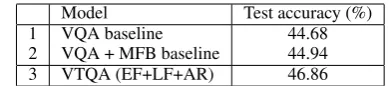
VQA vs. VTQA As shown in Table 1, our VTQA model increases the accuracy by 1.92% from the baseline VQA model for which we em-ploy Anderson et al. (2018)’s model and apply
[image:4.595.316.511.61.104.2]Model Test accuracy (%) 1 VQA baseline 44.68 2 VQA + MFB baseline 44.94 3 VTQA (EF+LF+AR) 46.86
Table 1: Our VTQA model significantly outperforms (p <0.001) the strong baseline VQA model (we do not apply MFB to our VTQA model, since it does not work for the VTQA model).
[image:4.595.312.518.163.217.2]Model Val accuracy (%) 1 VTQA + EF (base model) 45.41 2 VTQA + EF + LF 46.36 3 VTQA + EF + AR 46.95 4 VTQA + EF + LF + AR 47.60
Table 2: Our early (EF), late (LF), and later fusion (or Answer Recommendation AR) modules each improves the performance of our VTQA model.
multi-modal factorized bilinear pooling (MFB) (Yu et al.,2017). This implies that our textual data helps improve VQA model performance by pro-viding clues to answer questions. We run each model five times with different seeds and take the average value of them. For each of the five runs, our VTQA model performs significantly bet-ter (p <0.001) than the VQA baseline model.
Late Fusion and Later Fusion Ablations As shown in row 2 of Table2, late fusion improves the model by 0.95%, indicating that visual and textual features complement each other. As shown in row 3 and 4 of Table2, giving an extra score to the ex-pected answers increases the accuracy by 1.54% from the base model (row 1) and by 1.24% from the result of late fusion (row 2), respectively. This could imply that salient parts (in our case, objects) can give direct cues for answering questions.1
Ground-Truth vs. Generated Paragraphs We manually investigate (300 examples) how many questions can be answered only from the ground-truth (GT) versus generated paragraph (GenP) captions. We also train a TextQA model (which uses cross-attention mechanism between question and caption) to evaluate the performance of the GT and GenP captions. As shown in Table3, the GT captions can answer more questions correctly than GenP captions in TextQA model evaluation. Hu-man evaluation with GT captions also shows bet-ter performance than with GenP captions as seen in Table 4. However, the results from the
man-1
Model Val accuracy (%) 1 TextQA with GT 43.96 2 TextQA with GenP 42.07
Table 3: TextQA with GT model outperforms TextQA with GenP (we run each model five times with differ-ent seeds and average the scores. GT: Ground-Truth, GenP: Generated Paragraph).
[image:5.595.314.530.70.198.2]Human Eval. Accuracy (%) 1 with GT 55.00 2 with GenP 42.67
Table 4: Human evaluation only with paragraph cap-tions and quescap-tions of the validation dataset. Human evaluation with GT shows better performance than hu-man evaluation with GenP.
ual investigation have around 12% gap between GT and generated captions, while the gap between the results from the TextQA model is relatively small (1.89%). This shows that paragraph cap-tions can answer several VQA quescap-tions but our current model is not able to extract the extra infor-mation from the GT captions. This allows future work: (1) the TextQA/VTQA models should be improved to extract more information from the GT captions; (2) paragraph captioning models should also be improved to generate captions closer to the GT captions.2
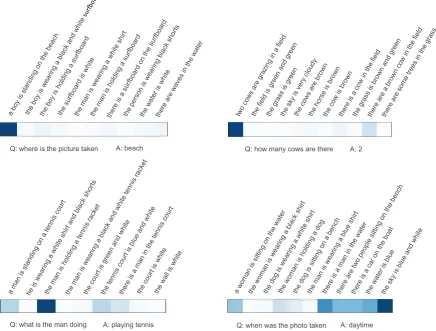
Attention Analysis Finally, we also visualize the attention over each sentence of an input para-graph caption w.r.t. a question. As shown in Fig-ure2, a sentence which has a direct clue for a ques-tion get much higher weights than others. This explicit textual information helps a VQA model handle what might be hard to reason about only-visually, e.g., ‘two (2) cows’. Please see Ap-pendix A for more attention visualization exam-ples.
6 Conclusion
We presented a VTQA model that combines visual and paragraph-captioning features to significantly improve visual question answering accuracy, via a model that performs early, late, and later fusion. While our model showed promising results, it still used a pre-trained paragraph captioning model to
2
We also ran our full VTQA model with the ground truth (GT) paragraph captions and got an accuracy value of 48.04% on the validation dataset (we ran the model five times with different seeds and average the scores), whereas the VTQA result from generated paragraph captions was 47.43%. This again implies that our current VTQA model is not able to ex-tract all the information enough from GT paragraph captions for answering questions, and hence improving the model to better capture clues from GT captions is useful future work.
Q: where is the picture taken A: beach Q: how many cows are there A: 2
Q: what is the man doing A: playing tennis Q: when was the photo taken A: daytime
Figure 2: Attention Visualization for an example an-swered correctly by our model.
obtain the textual symbolic information. In fu-ture work, we are investigating whether the VTQA model can be jointly trained with the paragraph captioning model.
Acknowledgments
We thank the reviewers for their helpful com-ments. This work was supported by NSF Award #1840131, ARO-YIP Award #W911NF-18-1-0336, and faculty awards from Google, Face-book, Bloomberg, and Salesforce. The views, opinions, and/or findings contained in this article are those of the authors and should not be inter-preted as representing the official views or poli-cies, either expressed or implied, of the funding agency.
References
Peter Anderson, Xiaodong He, Chris Buehler, Damien Teney, Mark Johnson, Stephen Gould, and Lei Zhang. 2018. Bottom-up and top-down attention for image captioning and visual question answering. In
CVPR.
Stanislaw Antol, Aishwarya Agrawal, Jiasen Lu, Mar-garet Mitchell, Dhruv Batra, C. Lawrence Zitnick, and Devi Parikh. 2015. VQA: Visual Question An-swering. InInternational Conference on Computer Vision (ICCV).
Kyunghyun Cho, Bart van Merrienboer, Caglar Gul-cehre, Dzmitry Bahdanau, Fethi Bougares, Holger Schwenk, and Yoshua Bengio. 2014. Learning phrase representations using rnn encoder–decoder for statistical machine translation. InProceedings of the 2014 Conference on Empirical Methods in Nat-ural Language Processing (EMNLP), pages 1724– 1734.
[image:5.595.115.250.149.182.2]Proceedings of the 2016 Conference on Empirical Methods in Natural Language Processing, pages 457–468.
Yash Goyal, Tejas Khot, Douglas Summers-Stay, Dhruv Batra, and Devi Parikh. 2017. Making the V in VQA matter: Elevating the role of image un-derstanding in Visual Question Answering. In Con-ference on Computer Vision and Pattern Recognition (CVPR).
Justin Johnson, Andrej Karpathy, and Li Fei-Fei. 2016. Densecap: Fully convolutional localization net-works for dense captioning. InProceedings of the IEEE Conference on Computer Vision and Pattern Recognition.
Andrej Karpathy and Li Fei-Fei. 2015. Deep visual-semantic alignments for generating image descrip-tions. In Proceedings of the IEEE conference on computer vision and pattern recognition, pages 3128–3137.
Diederik P Kingma and Jimmy Ba. 2014. Adam: A method for stochastic optimization. arXiv preprint arXiv:1412.6980.
Jonathan Krause, Justin Johnson, Ranjay Krishna, and Li Fei-Fei. 2017. A hierarchical approach for gen-erating descriptive image paragraphs. InComputer Vision and Pattern Recognition (CVPR), 2017 IEEE Conference on, pages 3337–3345. IEEE.
Ranjay Krishna, Yuke Zhu, Oliver Groth, Justin John-son, Kenji Hata, Joshua Kravitz, Stephanie Chen, Yannis Kalantidis, Li-Jia Li, David A Shamma, et al. 2017. Visual genome: Connecting language and vision using crowdsourced dense image anno-tations. International Journal of Computer Vision, 123(1):32–73.
Xiaodan Liang, Zhiting Hu, Hao Zhang, Chuang Gan, and Eric P Xing. 2017. Recurrent topic-transition gan for visual paragraph generation. arXiv preprint arXiv:1703.07022.
Jiasen Lu, Jianwei Yang, Dhruv Batra, and Devi Parikh. 2016. Hierarchical question-image co-attention for visual question answering. InAdvances In Neural Information Processing Systems, pages 289–297.
Mateusz Malinowski and Mario Fritz. 2014. A multi-world approach to question answering about real-world scenes based on uncertain input. In Ad-vances in neural information processing systems, pages 1682–1690.
Luke Melas-Kyriazi, Alexander Rush, and George Han. 2018. Training for diversity in image para-graph captioning.EMNLP.
Jeffrey Pennington, Richard Socher, and Christo-pher D. Manning. 2014. Glove: Global vectors for word representation. InEmpirical Methods in Nat-ural Language Processing (EMNLP), pages 1532– 1543.
Shaoqing Ren, Kaiming He, Ross Girshick, and Jian Sun. 2015. Faster r-cnn: Towards real-time ob-ject detection with region proposal networks. In
Advances in neural information processing systems, pages 91–99.
Steven J Rennie, Etienne Marcheret, Youssef Mroueh, Jerret Ross, and Vaibhava Goel. 2017. Self-critical sequence training for image captioning. In Proceed-ings of the IEEE Conference on Computer Vision and Pattern Recognition, pages 7008–7024.
Minjoon Seo, Aniruddha Kembhavi, Ali Farhadi, and Hannaneh Hajishirzi. 2016. Bidirectional attention flow for machine comprehension. arXiv preprint arXiv:1611.01603.
Kewei Tu, Meng Meng, Mun Wai Lee, Tae Eun Choe, and Song-Chun Zhu. 2014. Joint video and text parsing for understanding events and answering queries. IEEE MultiMedia, 21(2):42–70.
Ramakrishna Vedantam, C Lawrence Zitnick, and Devi Parikh. 2015. Cider: Consensus-based image de-scription evaluation. In Proceedings of the IEEE conference on computer vision and pattern recog-nition, pages 4566–4575.
Limin Wang, Yuanjun Xiong, Zhe Wang, Yu Qiao, Dahua Lin, Xiaoou Tang, and Luc Van Gool. 2016. Temporal segment networks: Towards good prac-tices for deep action recognition. InEuropean Con-ference on Computer Vision, pages 20–36. Springer.
Huijuan Xu and Kate Saenko. 2016. Ask, attend and answer: Exploring question-guided spatial attention for visual question answering. InEuropean Confer-ence on Computer Vision, pages 451–466. Springer.
Zichao Yang, Xiaodong He, Jianfeng Gao, Li Deng, and Alex Smola. 2016. Stacked attention networks for image question answering. InProceedings of the IEEE Conference on Computer Vision and Pattern Recognition, pages 21–29.
Zhou Yu, Jun Yu, Jianping Fan, and Dacheng Tao. 2017. Multi-modal factorized bilinear pooling with co-attention learning for visual question answering. InProceedings of the IEEE international conference on computer vision, pages 1821–1830.
Yuke Zhu, Oliver Groth, Michael Bernstein, and Li Fei-Fei. 2016. Visual7w: Grounded question answering in images. InProceedings of the IEEE Conference on Computer Vision and Pattern Recognition, pages 4995–5004.
Appendices
A Attention Visualization
Q: where is the picture taken A: beach Q: how many cows are there A: 2
[image:7.595.82.519.79.410.2]Q: what is the man doing A: playing tennis Q: when was the photo taken A: daytime
Figure 3: Attention Visualization: For all examples, our model answers correctly.
The upper left figure This is the case that a sen-tence in the paragraph caption can give obvious clue for answering the given question. By looking at the sentence “a boy is standing on the beach”, this question can be answered correctly.
The upper right figure The sentence “two cows are grazing in a field ” gives the correct answer “2” directly.
The bottom left figure There is no direct clue like “he is playing tennis”, but the correct an-swer can be inferred by integrating the informa-tion from different sentences such as “the man is holding a tennis racket” and “a man is standing on a tennis court”.