c
VISUAL QUESTION ANSWERING USING EXTERNAL KNOWLEDGE
BY
MEDHINI GULGANJALLI NARASIMHAN
THESIS
Submitted in partial fulfillment of the requirements for the degree of Master of Science in Computer Science
in the Graduate College of the
University of Illinois at Urbana-Champaign, 2019
Urbana, Illinois Advisers:
Professor Alexander Schwing Professor Svetlana Lazebnik
ABSTRACT
Accurately answering a question about a given image requires combining observations with general knowledge. While this is effortless for humans, reasoning with general knowledge remains an algorithmic challenge. To advance research in this direction, a novel ‘fact-based’ visual question answering (FVQA) task has been introduced recently along with a large set of curated facts which link two entities, i.e., two possible answers, via a relation. Given a question-image pair, keyword matching techniques have been employed to successively reduce the large set of facts and were shown to yield compelling results despite being vulnerable to misconceptions due to synonyms and homographs.
To overcome these shortcomings, we introduce two new approaches in this work. We develop a learning-based approach which goes straight to the facts via a learned embedding space. We demonstrate state-of-the-art results on the challenging recently introduced fact-based visual question answering dataset, outperforming competing methods by more than 5%. Upon further analysis, we observe that a successive process which considers one fact at a time to form a local decision is sub-optimal. To counter this, in our second approach we develop an entity graph and use a graph convolutional network to ‘reason’ about the correct answer by jointly considering all entities. We show on the FVQA dataset that this leads to an improvement in accuracy of around 7% compared to the state-of-the-art.
ACKNOWLEDGMENTS
I owe this thesis to my advisors, Professor Alexander Schwing and Professor Svetlana Lazebnik. I’d like to thank them for all the time they invested in me, teaching me how to do good research and helping me build my career. Their support and encouragement has played a vital role in my growth over the past two years. I could only dream of doing a Ph.D. before I set out on my Master’s, and today this is a reality thanks to their help.
I’d like to thank my Grandfather and Mom for helping me through good and bad and for their unconditional love.
I received a great deal of help and support from my peers in the vision lab. I’d like to thank Arun Mallya for the insightful conversations that sparked research ideas and for the much needed help when I first started working on research. I will cherish the fun times spent with my lab mates, who helped me let off steam when work got too stressful.
I would like to thank NVIDIA for providing the GPUs used for this research. This material is based upon work supported in part by the National Science Foundation under Grant No. 1718221 and Grant No. 1563727, Samsung, 3M, IBM-ILLINOIS Center for Cognitive Computing Systems Research (C3SR), Amazon Research Award, and AWS Machine Learning Research Award.
TABLE OF CONTENTS
CHAPTER 1 INTRODUCTION . . . 1
1.1 Learning Knowledge Base Retrieval . . . 2
1.2 Reasoning with Graph Convolution Networks. . . 2
CHAPTER 2 RELATED WORK. . . 4
2.1 Visual Question Answering . . . 4
2.2 Fact-based Visual Question Answering . . . 4
2.3 Graph Convolutional Networks . . . 5
CHAPTER 3 LEARNING KNOWLEDGE BASE RETRIEVAL . . . 7
3.1 Approach. . . 7
3.2 Learning . . . 11
3.3 Experiments . . . 12
CHAPTER 4 KNOWLEDGE BASE REASONING WITH GRAPH CON-VOLUTIONAL NETWORKS. . . 29 4.1 Approach. . . 29 4.2 Learning . . . 33 4.3 Experiments . . . 33 CHAPTER 5 CONCLUSIONS . . . 44 REFERENCES . . . 45
CHAPTER 1: INTRODUCTION
When answering questions about images, we easily combine the visualized situation with general knowledge that is available to us. However, for algorithms, an effortless combination of general knowledge with observations remains challenging, despite significant work which aims to leverage these mechanisms for autonomous agents and virtual assistants. If successful, participation of agents and virtual assistants in our day to day endeavors seems within reach. In recent years, a significant amount of research has investigated algorithms for visual question answering (VQA) [1–6], visual question generation (VQG) [7–10], and visual di-alog [11–13], paving the way to autonomy for artificial agents operating in the real world. Images and questions in these datasets cover a wide range of perceptual abilities such as counting, object recognition, object localization, and even logical reasoning. However, for many of these datasets the questions can be answered solely based on the visualized content, i.e., no general knowledge is required. Therefore, numerous approaches address VQA, VQG and dialog tasks by extracting visual cues using deep network architectures [1–5,14–29], while general knowledge remains unavailable.
To bridge this discrepancy between human behavior and present day algorithmic design, Wang et al. [30] introduced a novel ‘fact-based’ VQA (FVQA) task, and an accompanying dataset containing images, questions with corresponding answers and a knowledge base (KB) of facts extracted from three different sources: WebChild [31], DBPedia [32] and ConceptNet [33]. Unlike classical VQA datasets, a question in the FVQA dataset is answered by a collective analysis of the information in the image and the KB of facts. Each question is mapped to a single supporting fact which contains the answer to the question. Thus, answering a question requires analyzing the image and choosing the right supporting fact, for which Wang et al. [30] propose a keyword-matching technique. The method presented in FVQA [30] produces a query as an output of an LSTM which is fed the question as an input. Facts in the knowledge base are filtered on the basis of visual concepts such as objects, scenes, and actions extracted from the input image. The predicted query is then applied on the filtered database, resulting in a set of retrieved facts. A matching score is subsequently computed between the retrieved facts and the question to determine the most relevant fact. The most correct fact forms the basis of the answer for the question. This approach suffers when the question doesn’t focus on the most obvious visual concept and when there are synonyms and homographs. Moreover, special information about the visual concept type and the answer source make it hard to generalize their approach to other datasets.
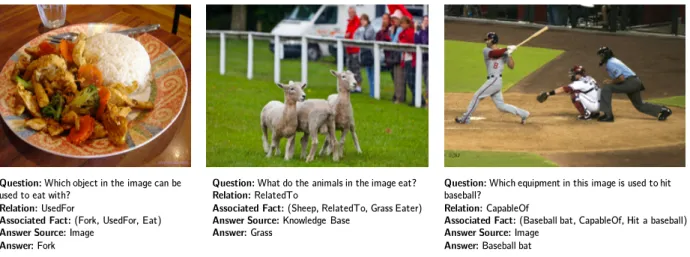
Question:Which object in the image can be used to eat with?
Relation:UsedFor
Associated Fact:(Fork, UsedFor, Eat)
Answer Source: Image
Answer:Fork
Question:Which equipment in this image is used to hit baseball?
Relation:CapableOf
Associated Fact:(Baseball bat, CapableOf, Hit a baseball)
Answer Source: Image
Answer:Baseball bat
Question:What do the animals in the image eat?
Relation:RelatedTo
Associated Fact:(Sheep, RelatedTo, Grass Eater)
Answer Source: Knowledge Base
Answer:Grass
Figure 1.1: Results of our graph convolutional net based approach on the recently introduced FVQA dataset.
which are described in the following sections.
1.1 LEARNING KNOWLEDGE BASE RETRIEVAL
In [34], we develop a learning based retrieval method. More specifically, our approach learns a parametric mapping of facts and question-image pairs to an embedding space. To answer a question, we use the fact that is most aligned with the provided question-image pair. As illustrated in Fig. 1.1, our approach is able to accurately answer both more visual questions as well as more fact based questions. For instance, given the image illustrated on the left hand side along with the question, “Which object in the image can be used to eat with?”, we are able to predict the correct answer, “fork.” Similarly, the proposed approach is able to predict the correct answer for the other two examples. Quantitatively we demonstrate the efficacy of the proposed approach on the recently introduced FVQA dataset, outperforming state-of-the-art by more than 5% on the top-1 accuracy metric.
1.2 REASONING WITH GRAPH CONVOLUTION NETWORKS
In [35], our main motivation is to develop a technique which uses the information from multiple facts before arriving at an answer. This technique relies less on retrieving the single ‘correct’ fact needed to answer a question. To this end, we develop a model which ‘thinks out of the box,’ i.e., it ‘reasons’ about the right answer by taking into account a list of facts via a Graph Convolution Network (GCN) [36]. The GCN enablesjoint selection of the answer
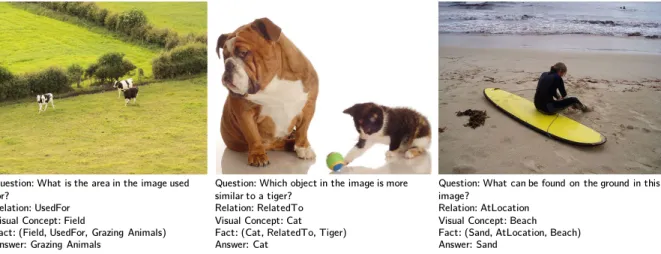
Question: What is the area in the image used for?
Relation: UsedFor Visual Concept: Field
Fact: (Field, UsedFor, Grazing Animals) Answer: Grazing Animals
Question: Which object in the image is more similar to a tiger?
Relation: RelatedTo Visual Concept: Cat Fact: (Cat, RelatedTo, Tiger) Answer: Cat
Question: What can be found on the ground in this image?
Relation: AtLocation Visual Concept: Beach Fact: (Sand, AtLocation, Beach) Answer: Sand
Figure 1.2: Results of our graph convolutional net based approach on the recently introduced FVQA dataset.
that assess one fact at a time. Moreover, we select a list of supporting facts in the KB by ranking GloVe embeddings. This handles challenges due to synonyms and homographs and also works well with questions that don’t focus on the main object.
We demonstrate the proposed algorithm on the FVQA dataset [30], outperforming the state of the art by around 7%. Fig. 1.2 shows results obtained by our model. Unlike the models proposed in [30], our method does not require any information about the ground truth fact (visual concept type and answer source). In contrast to our approach in [34], which focuses on learning a joint image-question-fact embedding for retrieving the right fact, this latest work uses a simpler method for retrieving multiple candidate facts (while still ensuring that the recall of the ground truth fact is high), followed by a novel GCN inference step that collectively assesses all the relevant facts before arriving at an answer. Using an ablation analysis we find improvements due to the GCN component, which exploits the graphical structure of the knowledge base and allows for sharing of information between possible answers, thus improving the explainability of our model.
CHAPTER 2: RELATED WORK
We develop two frameworks for visual question answering that benefit from a rich knowledge base. In the following, we first review classical visual question answering tasks before discussing visual question answering methods that take advantage of knowledge bases. Our second approach [35], is based on graph convolutional nets which benefits from general knowledge encoded in the form of a knowledge base. We therefore briefly review existing work in graph convolutional networks as well.
2.1 VISUAL QUESTION ANSWERING
Recently, there has been significant progress in creating large VQA datasets [1,14,16,37–39] and deep network models which correctly answer a question about an image. The initial VQA models [1–3,5,15,16,18–28,38,40] combined the LSTM encoding of the question and the CNN encoding of the image using a deep network which finally predicted the answer. Results can be improved with attention-based multi-modal networks [2,3,6,18–20,23,24] and dynamic memory networks [17,41]. All of these methods were tested on standard VQA datasets where the questions can solely be answered by observing the image. No out of the box thinking was required. For example, given an image of a cat, and the question, “Can the animal in the image be domesticated?,” we want our method to combine features from the image with common sense knowledge (a cat can be domesticated). This calls for the development of a model which leverages external knowledge.
2.2 FACT-BASED VISUAL QUESTION ANSWERING
Recent research in using external knowledge for natural language comprehension led to the development of semantic parsing [34,42–53] and information retrieval [54–60] methods. However, knowledge based visual question answering is fairly new. Notable examples in this direction are works by Zhuet al. [61], Wuet al. [62], Wanget al. [63], Narasimhan et al. [64], Krishnamurthy and Kollar [65], and our previous work, Narasimhan and Schwing [34].
Ask Me Anything (AMA) by Wu et al. [62], AHAB by Wang et al. [63], and FVQA by Wang et al. [30] are closely related to our work. In AMA, attribute information extracted from the image is used to query the external knowledge base DBpedia [32], to retrieve paragraphs which are summarized to form a knowledge vector. The knowledge vector is combined with the attribute vector and multiple captions generated for the image, before
being passed as input to an LSTM which predicts the answer. The main drawback of AMA is that it does not perform any explicit reasoning and ignores the possible structure in the KB. To address this, AHAB and FVQA attempt to perform explicit reasoning. In AHAB, the question is converted to a database query via a multistep process, and the response to the query is processed to obtain the final answer. FVQA also learns a mapping from questions to database queries through classifying questions into categories and extracting parts from the question deemed to be important. A matching score is computed between the facts retrieved from the database and the question, to determine the most relevant fact which forms the basis of the answer for the question. Both these methods use databases with a particular structure: facts are represented as tuples, for example, (Apple, IsA, Fruit), and (Cheetah, FasterThan, Lion).
The present work follows up on our earlier method, Straight to the Facts (STTF) [34]. STTF uses object, scene, and action predictors to represent an image and an LSTM to represent a question and combines the two using a deep network. The facts are scored based on the cosine similarity of the image-question embedding and fact embedding. The answer is extracted from the highest scoring fact.
We evaluate our method on the dataset released as part of the FVQA work, referred to as the FVQA dataset [30], which is a subset of three structured databases – DBpedia [32], ConceptNet [33], and WebChild [31].
2.3 GRAPH CONVOLUTIONAL NETWORKS
Kipf and Welling [36] introduced Graph Convolutional Networks (GCN) to extend Conv nets (CNNs) [66] to arbitrarily connected undirected graphs. GCNs learn representations for every node in the graph that encodes both the local structure of the graph surrounding the node of interest, as well as the features of the node itself. At a graph convolutional layer, features are aggregated from neighboring nodes and the node itself to produce new output features. By stacking multiple layers, we are able to gather information from nodes further away. GCNs have been applied successfully for graph node classification [36], graph link prediction [67], and zero-shot prediction [68]. Knowledge graphs naturally lend themselves to applications of GCNs owing to the underlying structured interactions between nodes connected by relationships of various types. In this work, given an image and a question about the image, we first identify useful sub-graphs of a large knowledge graph such as DBpedia [32] and then use GCNs to produce representations encoding node and neighborhood features that can be used for answering the question.
question-answer pair based on GloVe features. The sub-graph of facts is passed through a graph convolution network which predicts an answer from these facts. Our approach has the following advantages: 1) Unlike FVQA and AHAB, we avoid the step of query construction and do not use the ground truth visual concept or answer type information which makes it possible to incorporate any fact space into our model. 2) We use GloVe embeddings for retrieving and representing facts which works well with synonyms and homographs. 3) In contrast to STTF, which uses a deep network to arrive at the right fact, we use a GCN which operates on a subgraph of relevant facts while retaining the graphical structure of the knowledge base which allows for reasoning using message passing. 4) Unlike previous works, we have reduced the reliance on the knowledge of the ground truth fact at training time.
CHAPTER 3: LEARNING KNOWLEDGE BASE RETRIEVAL
In the following, we first provide an overview of the proposed approach for knowledge based visual question answering before discussing our embedding space and learning formulation.
3.1 APPROACH
Our developed approach is outlined in Fig.3.1. The task at hand is to predict an answer y
for a questionQgiven an image xby using an external knowledge base KB, which consists of a set of factsfi, i.e., KB =
f1, . . . , f|KB| . Each fact fi in the knowledge base is represented
as a Resource Description Framework (RDF) triplet of the formfi = (ai, ri, bi), where ai is a
visual concept in the image, bi is an attribute or phrase associated with the visual entity ai,
and ri ∈ R is a relation between the two entities. The dataset contains|R|= 13 relations r∈ R={Category, Comparative, HasA,IsA,HasProperty, CapableOf, Desires, RelatedTo, AtLocation, PartOf, ReceivesAction, UsedFor,CreatedBy}. Example triples of the knowledge base in our dataset are (Umbrella, UsedFor, Shade), (Beach,HasProperty,Sandy), (Elephant, Comparative-LargerThan, Ant).
To answer a questionQcorrectly given an imagex, we need to retrieve the right supporting fact and choose the correct entity, i.e., either a or b. Importantly, entitya is always derived from the image and entity b is derived from the fact base. Consequently we refer to this choice as the answer source s ∈ {Image,KnowledgeBase}. Using this formulation, we can extract the answer yfrom a predicted fact ˆf = (ˆa,r,ˆ ˆb) and a predicted answer source ˆs using
y= ˆ a, from ˆf if ˆs= Image ˆb, from ˆf if ˆs= KnowledgeBase. (3.1) It remains to answer, how to predict a fact ˆf and how to infer the answer source ˆs. The latter is a binary prediction task and we describe our approach below. For the former, we note that the knowledge base contains a large number of facts. We therefore consider it infeasible to search through all the factsfi ∀i∈ {1, . . . ,|KB|} using an expensive evaluation
based on a deep net. We therefore split this task into two parts: (1) Given a question, we train a network to predict the relation ˆr, that the question focuses on. (2) Using the predicted relation, ˆr, we reduce the fact space to those containing only the predicted relation.
Subsequently, to answer the question Q given image x, we only assess the suitability of the facts which contain the predicted relation ˆr. To assess the suitability, we design a score
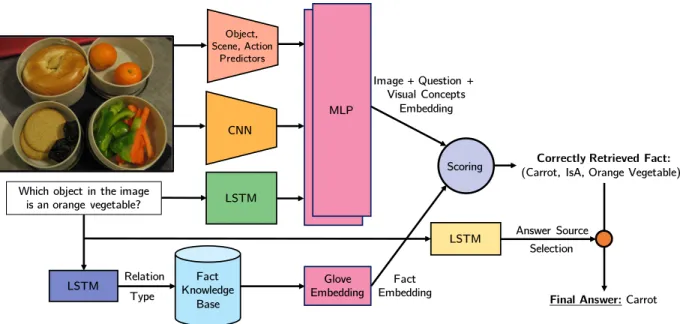
Which object in the image is an orange vegetable? Fact Knowledge Base LSTM Relation
(Visual Concept, Relation, Attribute) CNN LSTM Type MLP Glove Embedding Scoring Image + Question + Visual Concepts Embedding Fact Embedding MLP
Correctly Retrieved Fact: (Carrot, IsA, Orange Vegetable)
Final Answer:Carrot Object,
Scene, Action Predictors
LSTM Answer Source
Selection
Figure 3.1: Overview of the proposed approach. Given an image and a question about the image, we obtain an Image + Question Embedding through the use of a CNN on the image, an LSTM on the question, and a Multi Layer Perceptron (MLP) for combining the two modalities. In order to filter relevant facts from the Knowledge Base (KB), we use another LSTM to predict the fact relation type from the question. The retrieved structured facts are encoded using GloVe embeddings. The retrieved facts are ranked through a dot product between the embedding vectors and the top-ranked fact is returned to answer the question. functionS(gF(fi), gNN(x, Q)) which measures the compatibility of a fact representationgF(fi)
and an image-question representation gNN(x, Q). Intuitively, the higher the score, the more suitable the fact fi for answering question Q given imagex.
Formally, we hence obtain the predicted fact ˆf via ˆ
f = arg max
i∈{j:rel(fj)=ˆr}
S(gF(fi), gNN(x, Q)), (3.2)
where we search for the fact ˆf maximizing the score S among all facts fi which contain
relation ˆr, i.e., among allfi with i∈ {j : rel(fj) = ˆr}. Hereby we use the operator rel(fi) to
indicate the relation of the fact triplet fi. Given the predicted fact using Eq. (3.2) we obtain
the answery from Eq. (3.1) after predicting the answer source ˆs.
This approach is outlined in Fig. 3.1. Pictorially, we illustrate the construction of an image-question embedding gNN(x, Q), via LSTM and CNN net representations that are
combined via an MLP. We also illustrate the fact embedding gF(f
i). Both of them are
answer as described in Eq. (3.1).
In the following, we first provide details about the score function S, before discussing prediction of the relation ˆr and prediction of the answer source ˆs.
3.1.1 Scoring the facts
Fig.3.1 illustrates our approach to score the facts in the knowledge base, i.e., to compute
S(gF(fi), gNN(x, Q)). We obtain the score in three steps: (1) computing of a fact representation gF(f
i); (2) computing of an image-question representation gNN(x, Q); (3) combination of the
fact and image-question representation to obtain the final score S. We discuss each of those steps in the following.
(1) Computing a fact representation
To obtain the fact representationgF(fi), we concatenate two vectors, the averaged
GloVe-100 [69] representation of the words of entity ai and the averaged GloVe-100 representation
of the words of entity bi. Note that this fact representation is non-parametric, i.e., there are
no trainable parameters.
(2) Computing an image-question representation
We compute the image-question representationgNN(x, Q), by combining a visual represen-tationgV
w(x), obtained from a standard deep net,e.g., ResNet or VGG, with a visual concept
representation gC
w(x), and a sentence representation gwQ(Q), of the question Q, obtained
using a trainable recurrent net. For notational convenience we concatenate all trainable parameters into one vector w. Making the dependence on the parameters explicit, we obtain the image-question representation via gNN
w (x, Q) =gNNw (gwV(x), gQw(Q), gwC(x)).
More specifically, for the question embeddinggQ
w(Q), we use an LSTM model [70]. For the
image embedding gwV(x), we extract image features using ResNet-152 [71] pre-trained on the ImageNet dataset [72]. In addition, we also extract a visual concept representation gwC(x), which is a multi-hot vector of size 1176 indicating the visual concepts which are grounded in the image. The visual concepts detected in the images are objects, scenes, and actions. For objects, we use the detections from two Faster-RCNN [73] models that are trained on the Microsoft COCO 80-object [74] and the ImageNet 200-object [75] datasets. In total, there are 234 distinct object classes, from which we use that subset of labels that coincides with the FVQA dataset. The scene information (such as pasture, beach, bedroom) is extracted by the
VGG-16 model [?] trained on the MIT Places 365-class dataset [76]. Again, we use a subset of Places to construct the 1176-dimensional multi-hot vector gC
w(x). For detecting actions,
we use the CNN model proposed in [77] which is trained on the HICO [78] and MPII [79] datasets. The HICO dataset contains labels for 600 human-object interaction activities while the MPII dataset contains labels for 393 actions. We use a subset of actions, namely those which coincide with the ones in the FVQA dataset.
All the three vectorsgVw(x), gwQ(Q), gCw(x) are concatenated and passed to the multi-layer perceptron gNNw (·,·,·).
(3) Combination of fact and image-question representation For each fact representation gF(f
i), we compute a score Sw(gF(fi), gwNN(x, Q)) = cos(g F(f i), gNNw (x, Q)) = gF(f i)·gNNw (x, Q) ||gF(f i)|| · ||gNNw (x, Q)|| , where gNN
w (x, Q) is the image question representation. Hence, the score S is the cosine
similarity between the two normalized representations and represents the fit of fact fi to the
image-question pair (x, Q).
3.1.2 Predicting the relation To predict the relation ˆr∈ R=hr
w1(Q), from the obtained question Q, we use an LSTM
net. More specifically, we first embed and then encode the words of the question Q, one at a time, and linearly transform the final hidden representation of the LSTM to predict ˆr, from |R| possibilities using a standard multinomial classification. For the results presented in this work, we trained the relation prediction parameters w1 independently of the score function.
We leave a joint formulation to future work.
3.1.3 Predicting the answer source Prediction of the answer source ˆs =hs
w2(Q) from a given questionQis similar to relation
pre-diction. Again, we use an LSTM net to embed and encode the words of the questionQbefore linearly transforming the final hidden representation to predict ˆs∈ {Image,KnowledgeBase}. Analogous to relation prediction, we train this LSTM net’s parameters w2 separately and
Algorithm 3.1 Training with hard negative mining Input: (x, Q, f∗),KB
Output: parameters w 1: for t = 0, . . . , T do
2: Create dataset D(t) by sampling negative facts randomly (if t = 0) or by retrieving
facts predicted wrongly with w(t−1) (if t >0)
3: Use D(t) to obtain w(t) by optimizing the program given in Eq. (3.7) 4: end for
5: return w(T)
3.2 LEARNING
As mentioned before, we train the parameters w (score function),w1 (relation prediction),
andw2 (answer source prediction) separately. To train w1, we use a datasetD1 ={(Q, r)}
containing pairs of question and the corresponding relation which was used to obtain the answer. To learn w2, we use a dataset D2 ={(Q, s)}, containing pairs of question and the
corresponding answer source. For both classifiers we use stochastic gradient descent on the classical cross-entropy and binary cross-entropy loss respectively. Note that both the datasets are readily available from [30].
To train the parameters of the score function we adopt a successive approach operating in time steps t= {1, . . . , T}. In each time step, we gradually increase the difficulty of the dataset D(t) by mining hard negatives. More specifically, for every question Q, and image x,
D(0) contains the ‘groundtruth’ fact f∗
as well as 99 randomly sampled ‘non-groundtruth’ facts. After having trained the score function on this dataset we use it to predict facts for image-question pairs and create a new dataset D(1) which now contains, along with the
groundtruth fact, another 99 non-groundtruth facts that the score function assigned a high score to.
Given a dataset D(t), we train the parameters w of the representations involved in the
score function Sw(gF(fi), gwNN(x, Q)), and its image, question, and concept embeddings by
encouraging that the score of the groundtruth fact f∗ is larger than the score of any other fact. More formally, we aim for parameters w which ensure the classical margin, i.e., an SVM-like loss for deep nets:
Sw(f∗, x, Q)≥L(f∗, f) +Sw(f, x, Q) ∀(f, x, Q)∈ D(t), (3.3)
where L(f∗, f) is the task loss (aka margin) comparing the groundtruth fact f∗ to other facts f. In our case L ≡ 1. Since we may not find parameters w which ensure feasibility
∀(f, x, Q)∈ D(t), we introduce slack variables ξ
(f,x,Q) ≥0 to obtain after reformulation:
ξ(f,x,Q)≥L(f∗, f) +Sw(f, x, Q)−Sw(f∗, x, Q) ∀(f, x, Q)∈ D(t). (3.4)
Instead of enforcing the constraint∀(f, x, Q) in the datasetD(t), it is equivalent to require [80]
ξ(x,Q) ≥max
f {L(f ∗
, f) +Sw(f, x, Q)} −Sw(f∗, x, Q) ∀(x, Q)∈ D(t). (3.5)
Using this constraint, we find the parameters w by solving min w,ξ(x,Q)≥0 C 2kwk 2 2+ X (x,Q)∈D(t) ξ(x,Q) s.t. Constraints in Eq. (3.5). (3.6)
For applicability of the standard sub-gradient descent techniques, we reformulate the program given in Eq. (3.6) to read as
min w C 2kwk 2 2+ X (x,Q)∈D(t) max f {L(f ∗ , f) +Sw(f, x, Q)} −Sw(f∗, x, Q) , (3.7)
which can be optimized using standard deep net packages. The proposed approach for learning the parametersw is summarized in Alg. 3.1.
3.3 EXPERIMENTS
In the following, we assess the proposed approach. We first provide details about the proposed dataset before presenting quantitative results for prediction of relations from questions, prediction of answer-source from questions, and prediction of the answer and the supporting fact. We also discuss mining of hard negatives. Finally, we show qualitative results.
3.3.1 Dataset and Knowledge Base
We use the publicly available FVQA dataset [30] and its knowledge base to evaluate our model. This dataset consists of 2,190 images, 5,286 questions, and 4,126 unique facts corresponding to the questions. The knowledge base, consisting of 193,449 facts, were constructed by extracting the top visual concepts for all the images in the dataset and querying for those concepts in the three knowledge bases, WebChild [31], ConceptNet [33],
Method Accuracy
@1 @3
FVQA [30] 64.94 82.42
Ours 75.4 91.97
Table 3.1: Accuracy of predicting relations given the question.
Method Accuracy
@1 @3
Ours 97.3 100.00
Table 3.2: Accuracy of predicting answer source from a given question.
and DBPedia [32]. The dataset consists of 5 train-test folds, and all the scores we report are averaged across all splits.
3.3.2 Predicting Relations from Questions
We use an LSTM architecture as discussed in Sec. 3to predict the relation r∈ R given a question Q. The standard train-test split of the FVQA dataset is used to evaluate our model. Batch gradient descent with Adam optimizer was used on batches of size 100 and the model was trained over 50 epochs. LSTM embedding and word embeddings are of size 128 each. The learning rate is set to 1e−3 and a dropout of 0.7 is applied after the word embeddings as well as the LSTM embedding. Table 3.1 provides a comparison of our model to the FVQA baseline [30] using top-1 and top-3 prediction accuracy. We observe our results to improve the baseline by more than 10% on top-1 accuracy and by more than 9% when using the top-3 accuracy metric.
3.3.3 Predicting Answer Source from Questions
We assess the accuracy of predicting the answer sources given a question Q. To predict the source of the answer, we use an LSTM architecture as discussed in detail in Sec. 3. Note that for predicting the answer source, the size of the LSTM embedding and word embeddings was set to 64 each. Table 3.2 summarizes the accuracy of the prediction results of our model. We observe the prediction accuracy of the proposed approach to be close to perfect.
3.3.4 Predicting the Correct Answer
Our score function based model to retrieve the supporting fact is described in detail in Sec. 3. For the image embedding, we pass the 2048 dimensional feature vector returned by ResNet through a fully-connected layer and reduce it to a 64 dimensional vector. For the
question embedding, we use an LSTM with a hidden layer of size 128. The two are then concatenated into a vector of size 192 and passed through a two layer perceptron with 256 and 128 nodes respectively. Note that the baseline doesn’t use image features apart from the detected visual concepts.
The multi-hot visual concept embedding is passed through a fully-connected layer to form a 128 dimensional vector. This is then concatenated with the output of the perceptron and passed through another layer with 200 output nodes. We found a late fusion of the visual concepts to results in a better model as the facts explicitly contain these terms.
Fact embeddings are constructed using GloVe-100 vectors each, for entitiesa and b. If a
or b contain multiple words, an average of all the embeddings is computed. We use cosine distance between the MLP and the fact embeddings to score the facts. The highest scoring fact is chosen as the answer. Ties are broken randomly.
Based on the answer source prediction which is computed using the aforementioned LSTM model, we choose either entity a or b of the fact to be the answer. See Eq. (3.1) for the formal description. Accuracy is computed based on exact match between the chosen entity and the groundtruth answer.
To assess the importance of particular features we investigate 5 variants of our model with varying features: two oracle approaches ‘gt Question + Image + Visual Concepts’ and ‘gt
Question + Visual Concepts’ which make use of groundtruth relation type and answer type data. More specifically, ‘gt Question + Image + Visual Concepts’ and ‘gt Question + Visual Concepts’ use the groundtruth relations and answer sources respectively. We have three approaches using a variety of features as follows: ‘Question + Image + Visual Concepts,’ ‘Question + Visual Concepts,’ and ‘Question + Image.’ We drop either the Image embeddings
from ResNet or the Visual Concept embeddings to obtain two other models, ‘Question + Visual Concepts’ and ‘Question + Image.’
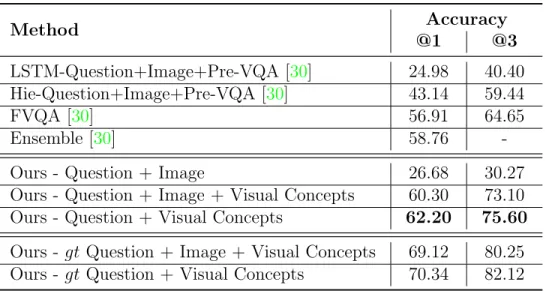
Table 3.3 shows the accuracy of our model in predicting an answer and compares our results to other FVQA baselines. We observe the proposed approach to outperform the state-of-the-art ensemble technique by more than 3% and the strongest baseline without ensemble by over 5% on the top-1 accuracy metric. Moreover we note the importance of visual concepts to accurately predict the answer. By including groundtruth information we assess the maximally possible top-1 and top-3 accuracy. We observe the difference to be around 8%, suggesting that there is some room for improvement.
3.3.5 Question to Supporting Fact
To provide a complete assessment of the proposed approach we illustrate in Table 3.4 the top-1 and top-3 accuracy scores in retrieving the supporting facts of our model compared to other FVQA baselines. We observe the proposed approach to improve significantly both the top-1 and top-3 accuracy by more than 20%. We think this is a significant improvement towards efficiently including knowledge bases into visual question answering.
Method Accuracy @1 @3 LSTM-Question+Image+Pre-VQA [30] 24.98 40.40 Hie-Question+Image+Pre-VQA [30] 43.14 59.44 FVQA [30] 56.91 64.65 Ensemble [30] 58.76
-Ours - Question + Image 26.68 30.27
Ours - Question + Image + Visual Concepts 60.30 73.10 Ours - Question + Visual Concepts 62.20 75.60 Ours -gt Question + Image + Visual Concepts 69.12 80.25 Ours -gt Question + Visual Concepts 70.34 82.12
Table 3.3: Answer accuracy over the FVQA dataset.
Method Accuracy
@1 @3
FVQA-top-1 [30] 38.76 42.96
FVQA-top-3 [30] 41.12 45.49
Ours - Question + Image 28.98 32.34
Ours - Question + Image + Visual Concepts 62.30 74.90 Ours - Question + Visual Concepts 64.50 76.20 Table 3.4: Correct fact prediction precision over the FVQA dataset.
3.3.6 Mining Hard Negatives
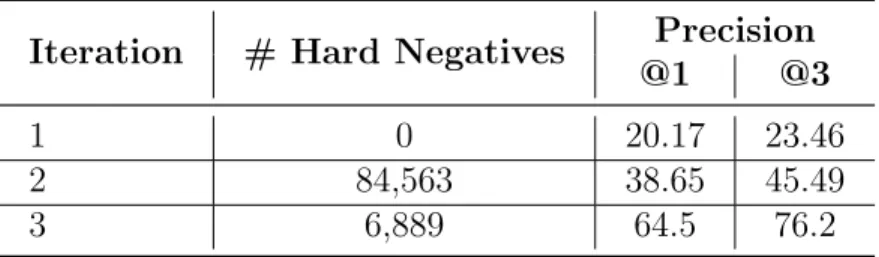
We trained our model over three iterations of hard negative mining,i.e.,T = 2. In iteration 1 (t = 0), all the 193,449 facts were used to sample the 99 negative facts during train. At every 10th epoch of training, negative facts which received high scores were saved. In the
Iteration # Hard Negatives Precision
@1 @3
1 0 20.17 23.46
2 84,563 38.65 45.49
3 6,889 64.5 76.2
Table 3.5: Correct fact prediction precision with hard negative mining.
next iteration, the trained model along with the negative facts is loaded and we ensure that the 99 negative facts are now sampled from the hard negatives. Table 3.5shows the Top-1 and Top-3 accuracy for predicting the supporting facts over each of the three iterations. We observe significant improvements due to the proposed hard negative mining strategy. While na¨ıve training of the proposed approach yields only 20.17% top-1 accuracy, two iterations improve the performance to 64.5%.
3.3.7 Synonyms and Homographs
Here we show the improvements of our model compared to the baseline with respect to synonyms and homographs. To this end, we run additional tests using Wordnet to determine the number of question-fact pairs which contain synonyms. The test data contains 1105 such pairs out of which our model predicts 91.6% (1012) correctly, whereas the FVQA model predicts 78.0% (862) correctly. In addition, we manually generated 100 synonymous questions by replacing words in the questions with synonyms (e.g., “What in the bowl can you eat?” is rephrased to “What in the bowl is edible?”). Tests on these 100 new samples find that our model predicts 89 of these correctly, whereas the key-word matching FVQA technique [30] gets 61 of these right. With regards to homographs, the test set has 998 questions which contain words that have multiple meanings across facts. Our model predicts correct answers for 79.4% (792), whereas the FVQA model gets 66.3% (662) correct.
Table3.6 shows the top-10 accuracy in predicting the answers, averaged across all the test splits of the FVQA dataset. Our model shows an improvement of nearly 11% compared to the strongest baseline, Hie-Question+Image+Pre-VQA [30]. Our models also outperforms by approx. 10% the FVQA gt-QQmapping [30] method, which is the FVQA baseline using the ground truth question queries.
Method Accuracy @10 LSTM-Question+Image+Pre-VQA [30] 57.27 FVQA, top-1 [30] 60.58 FVQA, top-3 [30] 65.54 Hie-Question+Image+Pre-VQA [30] 72.20 FVQA, gt-QQmapping [30] 72.55
Ours - Image + Question 58.96
Ours - Question + Visual Concepts 81.30
Ours - Image + Question + Visual Concepts 83.92
Ours - gt Question + Visual Concepts 90.45 Ours - gt Image + Question + Visual Concepts 92.93
Table 3.6: Accuracy at Top-10 in predicting the answer on the FVQA test splits. The best model is indicated in bold.
Method
KB-Source Accuracy
DBpedia ConceptNet WebChild Top-1 Top-3 Top-10 Top-1 Top-3 Top-10 Top-1 Top-3 Top-10
LSTM-Question+Image+Pre-VQA [30] 15.38 32.64 51.80 25.97 41.02 57.35 34.42 50.27 68.56 Hie-Question+Image+Pre-VQA [30] 38.39 56.07 71.60 43.23 59.47 72.21 52.85 66.49 73.40 FVQA, top-1 [30] 51.25 63.07 63.13 53.50 60.16 61.20 43.54 46.58 47.03 FVQA, top-3 [30] 56.67 69.31 69.36 57.60 64.70 65.77 48.74 53.45 53.90 Ensemble [30] 57.08 - - 58.98 - - 59.77 - -FVQA, gt-QQmapping [30] 65.96 78.80 79.43 64.62 71.75 73.17 45.55 48.29 48.86
Ours - Image + Question 25.29 41.46 62.98 34.12 54.17 66.83 42.12 56.76 70.43
Ours - Image + Question + Visual Concepts 69.17 81.24 86.34 67.32 74.29 79.46 53.45 66.08 75.89 Ours - Question + Visual Concepts 70.29 82.46 84.58 68.12 75.67 77.86 54.97 67.18 74.25
Human 74.41 - - 78.32 - - 81.95 -
-Table 3.7: Accuracy in predicting the correct answer based on the knowledge base(KB). Best model is shown in bold.
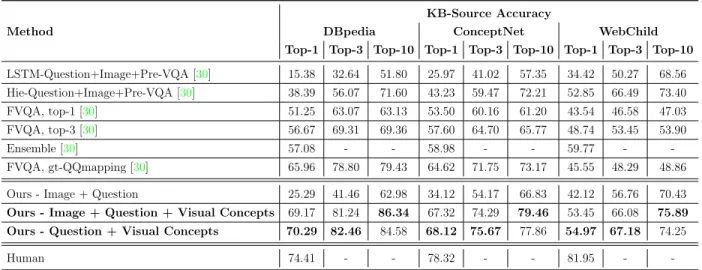
Table3.7shows the top-1, top-3, and top-10 accuracy in predicting the answers on different knowledge bases. Facts from DBpedia have the relation “Category.” For example, “Lemon belongs to the category of citric fruits.” This is easy to identify in a question and our model can predict the right supporting fact 70.29% of the time. ConceptNet consists of the 11 relations excluding “Category” and “Comparative.” Identifying these relations from the
question is pretty straightforward and we achieve an accuracy of 68.12% in predicting the answer on questions that use ConceptNet. The errors in both ConceptNet and DBpedia is mainly due to some visual concepts going undetected. WebChild consists of facts with the relation “Comparative,” such as “Elephants are stronger than humans.” These relations are easy to identify in a question due to the presence of comparative words. However, the overall accuracy in predicting an answer from WebChild is still lower compared to the other KBs. This is because the visual concept and attribute are sometimes reversed in the fact. For example, in the failure cases shown in Fig. 4 of the main submission, the middle example shows a case where the terms are reordered and this causes the answer to be predicted incorrectly.
Overall, our model performs better than the baseline (FVQA top-1), by about 10% to 15%. This steep increase in accuracy is mainly because our model works well with questions containing synonyms and homographs, as we learn the right facts using embeddings and not keyword matching. We provide the synonymous questions in the Sec. 5. We illustrate qualitative results below.
Method
Answer Source Accuracy
Image Knowledge Base
Top-1 Top-3 Top-10 Top-1 Top-3 Top-10
LSTM-Question+Image+Pre-VQA [30] 28.97 46.62 65.83 6.13 10.94 16.73 Hie-Question+Image+Pre-VQA [30] 49.93 68.21 82.08 11.61 18.69 26.25 FVQA, top-1 [30] 61.11 68.31 68.34 12.12 19.13 23.91 FVQA, top-3 [30] 66.32 74.11 74.15 12.39 19.87 24.81 Ensemble [30] 68.15 - - 15.18 - -FVQA, gt-QQmapping [30] 73.69 81.04 81.04 15.95 25.17 32.39
Ours - Image + Question 31.38 47.52 67.80 10.42 14.67 20.20
Ours - Image + Question + Visual Concepts 75.68 83.14 86.03 28.75 38.99 48.40
Ours - Question + Visual Concepts 76.32 84.48 85.94 29.40 39.62 47.81
Human 82.97 - - 54.47 -
-Table 3.8: Accuracy in predicting the correct answer based on the answer source. Best model is shown in bold.
Table3.8shows the top-1, top-3, and top-10 accuracy for different methods according to the two different answer sources: Image and Knowledge Base (KB). The answer source is “Image” when the answer is a visual concept, and “KB” when the answer is from the fact.
keyword search, we are able to outperform the state-of-the-art model by approx. 15% on “KB” answers and approx. 10% on “Image” answers.
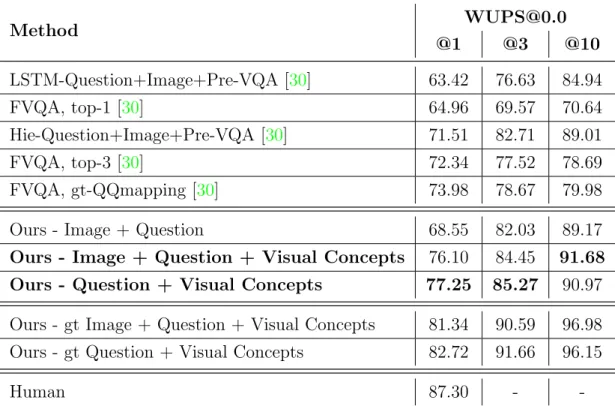
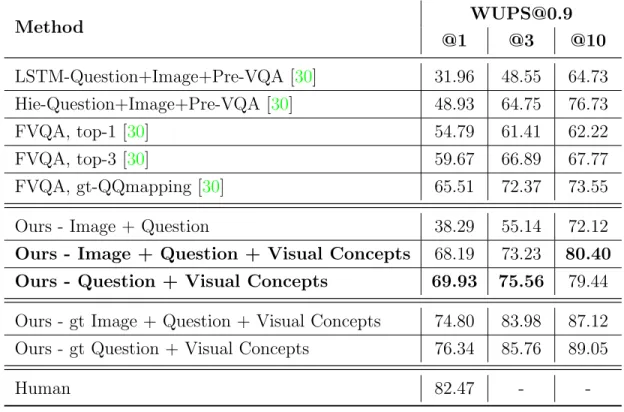
We also report the Wu-Palmer Similarity (WUPS) scores [81] in Tables4.5and4.6. WUPS computes the similarity between two words based on their common subsequence in the taxonomy tree. The predicted answer is considered to be correct if the similarity is greater than a certain threshold. Here we report the WUPS at thresholds 0.9 and 0.0. Our model performs better than the state-of-the-art models at both thresholds.
Method [email protected] @1 @3 @10 LSTM-Question+Image+Pre-VQA [30] 63.42 76.63 84.94 FVQA, top-1 [30] 64.96 69.57 70.64 Hie-Question+Image+Pre-VQA [30] 71.51 82.71 89.01 FVQA, top-3 [30] 72.34 77.52 78.69 FVQA, gt-QQmapping [30] 73.98 78.67 79.98
Ours - Image + Question 68.55 82.03 89.17
Ours - Image + Question + Visual Concepts 76.10 84.45 91.68
Ours - Question + Visual Concepts 77.25 85.27 90.97
Ours - gt Image + Question + Visual Concepts 81.34 90.59 96.98 Ours - gt Question + Visual Concepts 82.72 91.66 96.15
Human 87.30 -
Method [email protected] @1 @3 @10 LSTM-Question+Image+Pre-VQA [30] 31.96 48.55 64.73 Hie-Question+Image+Pre-VQA [30] 48.93 64.75 76.73 FVQA, top-1 [30] 54.79 61.41 62.22 FVQA, top-3 [30] 59.67 66.89 67.77 FVQA, gt-QQmapping [30] 65.51 72.37 73.55
Ours - Image + Question 38.29 55.14 72.12
Ours - Image + Question + Visual Concepts 68.19 73.23 80.40
Ours - Question + Visual Concepts 69.93 75.56 79.44
Ours - gt Image + Question + Visual Concepts 74.80 83.98 87.12 Ours - gt Question + Visual Concepts 76.34 85.76 89.05
Human 82.47 -
-Table 3.10: [email protected] over the FVQA dataset.
Question:Which object in this image is considered to be a shelter? Scenes Detected:
Alley, Residential Neighborhood, Street, House, Motel
Predicted Relation:IsA Top-3 Retrieved Facts: (House, IsA, Shelter) (Car, IsA, Heavier Than Horse) (Car, IsA, Motorvehicle) Predicted Answer:House Question:Which object in this image moves slower than a horse?
Objects Detected:
Elephant
Predicted Relation:Comparative Top-3 Retrieved Facts:
(Elephant, Comparative-is slower than, Horse) (Elephant, Comparative-is larger than, Mouse) (Elephant, Comparative-is larger than, Human) Predicted Answer:Elephant
Figure 3.2: Examples of Visual Concepts (VCs) detected by our framework. Here, we show examples of detected objects, scenes, and actions predicted by the various networks used in our pipeline. There is a clear alignment between useful facts, and the predicted VCs. As a result, including VCs in our scoring method helps improve performance.
Question:What is a bookshelf used for? Predicted Relation:UsedFor Predicted Supporting Fact: (Bookshelf, UsedFor, Carrying Books) Predicted Answer Source:KB Predicted Answer:Carrying books
GT Answer: Carrying books
Question:Which property does the place in the image have?
Predicted Relation:HasProperty Predicted Supporting Fact: (Beach, HasProperty, Sandy) Predicted Answer Source:KB Predicted Answer:Sandy
GT Answer: Sandy Question:What object in this image is
capable of flying?
Predicted Relation:CapableOf Predicted Supporting Fact: (Frisbee, CapableOf, Flying) Predicted Answer Source:Image Predicted Answer:Frisbee
GT Answer: Frisbee
Question:What object in this image is cheaper than a taxi?
Predicted Relation:Comparative Predicted Supporting Fact: (Bus, Comparative-cheaper, Taxi) Predicted Answer Source:Image Predicted Answer:Bus GT Answer: Bus
Question:What is an item of office equipment in this image?
Predicted Relation:Category Predicted Supporting Fact: (Monitor, Category, Office Equipment) Predicted Answer Source:Image Predicted Answer:Monitor GT Answer: Monitor Question:Which kind of food is sweet in this
image?
Predicted Relation:HasProperty Predicted Supporting Fact: (Cake, HasProperty, Sweet) Predicted Answer Source:Image Predicted Answer:Cake GT Answer: Cake
Question:What object in this image is round?
Predicted Relation:HasProperty
Predicted Supporting Fact:
(Person, HasProperty, Alive)
GT Supporting Fact:
(TennisBall, HasProperty, Round)
Predicted Answer Source:Image
GT Answer Source:Image
Predicted Answer:Person
GT Answer: TennisBall
Question:Which action is less strenuous than the action in the image?
Predicted Relation:Comparative
Predicted Supporting Fact:
(Jumping, Comparative-more strenuous, Dressage)
Predicted Answer Source:Image
GT Answer Source:KB
Predicted Answer:Jumping
GT Answer: Dressage
Question:What sort of food can you see in the image?
Predicted Relation:IsA
GT Relation:Category
Predicted Supporting Fact:(Lemon, isA, Fruit)
GT Supporting Fact:(Fruits, Category, Food)
Predicted Answer Source:Image
Predicted Answer:Lemon
GT Answer: Fruits
Figure 3.3: Success and failure cases of our method. In the top two rows, our method correctly predicts the relation, the supporting fact, and the answer source to produce the correct answer for
Question(Original): Which object in the image is capable of floating on water?
Question(Synonymous):Which vehicle shown here can sail?
Predicted Relation:CapableOf Predicted Supporting Fact: (Boats, CapableOf, Floating on water) Predicted Answer Source:Image Predicted Answer:Boat GT Answer: Boat
Question(Original):Which object in this image is used to measure the passage of time?
Question(Synonymous):What in this image can tell time?
Predicted Relation:UsedFor Predicted Supporting Fact: (Clock, UsedFor, measure the passage of time)
Predicted Answer Source:Image Predicted Answer:Clock GT Answer: Clock
Question(Original):Which object in this image is related to wool?
Question(Synonymous):Which object in this image is the source of a woolen sweater? Predicted Relation:RelatedTo Predicted Supporting Fact: (Sheep, RelatedTo, Wool) Predicted Answer Source:Image Predicted Answer:Sheep GT Answer: Sheep
Question(Original):What animal in this image can pull a carriage?
Question(Synonymous):What animal in this image is drawing the carriage?
Predicted Relation:CapableOf
Predicted Supporting Fact:
(Horse, CapableOf, pulling a carriage)
Predicted Answer Source:Image
Predicted Answer:Horse GT Answer: Horse
Question(Original):What object in this image is helpful at a romantic dinner?
Question(Synonymous):What object in this image might be found at a dinner occasion?
Predicted Relation:HasProperty
Predicted Supporting Fact:
(Wine, HasProperty, Romantic dinner)
Predicted Answer Source:Image
Predicted Answer:Wine GT Answer: Wine
Question(Original):What animal in the right part of the image have as a body part?
Question(Synonymous):What is the hard covering on the animal shown here?
Predicted Relation:PartOf
Predicted Supporting Fact:
(Snail, PartOf, Shell)
Predicted Answer Source:KB
Predicted Answer:Shell GT Answer: Shell
Question(Original):Which instrument in this image is common in jazz?
Question(Synonymous):Which musical instrument is shown here?
Predicted Relation:IsA Predicted Supporting Fact: (Saxophone, IsA, Jazz instrument) Predicted Answer Source:Image Predicted Answer:Saxophone GT Answer: Saxophone
Question(Original):What in this image is capable of hunting a mouse?
Question(Synonymous):What in this image preys on a mouse?
Predicted Relation:CapableOf Predicted Supporting Fact: (Cat, CapableOf, Killing a mouse) Predicted Answer Source:Image Predicted Answer:Cat GT Answer: Cat Question(Original): Which object in this image is
used for lighting?
Question(Synonymous):Which object in this image do you need in a dark room? Predicted Relation:UsedFor Predicted Supporting Fact: (Lamp, UsedFor, Lighting) Predicted Answer Source:Image Predicted Answer:Lamp GT Answer: Lamp
Question:What kind of sport do people usually practice in this place?
Predicted Relation:AtLocation Predicted Supporting Fact: (Skiing, AtLocation, Ski-slope) Predicted Answer Source:KB Predicted Answer:Skiing GT Answer: Skiing
Question:Which object in the image is used to make a cake?
Predicted Relation:UsedFor Predicted Supporting Fact: (Oven, UsedFor, Baking) Predicted Answer Source:Image Predicted Answer:Oven GT Answer: Oven
Question(Original):Which object in this image is related to sailing? Predicted Relation:RelatedTo Predicted Supporting Fact: (Boat, RelatedTo, Sail) Predicted Answer Source:Image Predicted Answer:Boat GT Answer: Boat
Figure 3.5: Questions in test which were predicted incorrectly by the baseline but correctly by our model.
Question: Which object are you likely to find in a monkey's hand? Objects Detected:
Banana, Bowl, Cup, Bottle, Laptop, Keyboard, Dining Table. Book, Orange
Predicted Relation:AtLocation Top Retrieved Facts:
(Bananas, AtLocation, monkey's hand) (Banana's, AtLocation, Grocery store) (Cup, AtLocation, Kitchen)
Predicted Answer:Monkey’s Hand
Question:Which object here is rich in Vitamin C? Objects Detected:
Dining Table, Bowl, Bottle, Cup, Sandwich, Fork, Orange Predicted Relation:HasA
Top Retrieved Facts:
(Orange, HasA, High Vitamin C content) (Orange juice, HasA, High Vitamin C content) (Lemon, HasA, Vitamin C)
Predicted Answer:Orange
Question:Which action here is longer than another action here? Actions Detected:
Ride-bicycle, Straddle-Bicycle, Hold-Bicycle Predicted Relation:Comparative
Top Retrieved Facts:
(Cycling, Comparative-longer than, Driving) Predicted Answer:Cycling
Question:What are the greens shown in this image? Objects Detected:
Broccoli, Bowl, Dining Table Predicted Relation:IsA Top Retrieved Facts: (Broccoli, IsA, Green Vegetable) Predicted Answer:Broccoli
Question:What are the different colors of the fruit shown? Objects Detected:
Apples
Predicted Relation:HasProperty Top Retrieved Facts:
(Apples, HasProperty, Red) (Apples, HasProperty, Green) (Apples, HasProperty, Orange)
Predicted Answer:Red, Green, Orange
Question:What utensil here can hold water? Objects Detected:
Wine Glass, Dining Table, Car, Person, Pizza Predicted Relation:UsedFor
Top Retrieved Facts:
(Glass, UsedFor, DrinkingVessel)
Predicted Answer:Glass
Question:What can this place be used for? Scenes Detected:
Bathroom, Locker-room, Utility-room, Kitchen Predicted Relation:UsedFor
Top Retrieved Facts:
(Bathroom, UsedFor, Washing Hands) (Bathroom, UsedFor, Using The Toilet) (Toilet, UsedFor, Depositing Human Waste) Predicted Answer:Washing Hands
Question:Which object in this image can warm food? Objects Detected:
Over, TV, Clock, Person Predicted Relation:CapableOf Top Retrieved Facts: (Stove, CapableOf, Heating) Predicted Answer:Stove
Question:What can I do using this place? Scenes Detected:
Kitchen, Utility Room, Galley, Restaurant-Kitchen, Wet-Bar Predicted Relation:UsedFor
Top Retrieved Facts:
(Kitchenette, UsedFor, Preparing Food) (Kitchenette, UsedFor, Cooking) (Kitchenette, UsedFor, Preparing Lunch) Predicted Answer:Preparing Food
Question:What animal in this image can sleep while standing? Objects Detected:
Horse, Person, Chair Predicted Relation:Capable Of Top Retrieved Facts:
(Horse, CapableOf, Rest while standing up) (People, CapableOf, Standing up) (Horse, CapableOf, Carrying people) Predicted Answer:Horses
Question:Which object in the image is utilized to cool food? Objects Detected:
Oven, Refrigerator Predicted Relation:UsedFor Top Retrieved Facts:
(Refrigerator, UsedFor, Chilling the food) (Refrigerator, UsedFor, Cold food storage) (Refrigerator, UsedFor, Freezing the food) Predicted Answer:Refrigerator
Question:Which object in this is used to check the time? Objects Detected:
Clock, Car, Truck Predicted Relation:UsedFor Top Retrieved Facts:
(Clock, UsedFor, Seeing the hour) Predicted Answer:Clock
Figure 3.9: Correct predictions with detected visual concepts and top retrieved facts.
3.3.8 Qualitative Results.
Fig. 3.2shows the Visual Concepts (VCs) detected for a few samples along with the top 3 facts retrieved by our model. Providing these predicted VCs as input to our fact-scoring MLP helps improve supporting fact retrieval as well as answer accuracy by a large margin of over 30% as seen in Tables 3.3and 3.4. As can be seen in Fig.3.2, there is a close alignment between relevant facts and predicted VCs, as VCs provide a high-level overview of the salient content in the images.
In Fig.3.3, we show success and failure cases of our method. There are 3 steps to producing the correct answer using our method: (1) correctly predicting the relation, (2) retrieving supporting facts containing the predicted relation, and relevant to the image, and (3) choosing the answer from the predicted answer source (Image/Knowledge Base). The top two rows of images show cases where all the 3 steps were correctly executed by our proposed method. Note that our method works for a variety of relations, objects, answer sources, and varying difficulty. It is correctly able to identify the object of interest, even when it is not the most prominent object in the image. For example, in the middle image of the first row, the
frisbee is smaller than the dog in the image. However, we were correctly able to retrieve the supporting fact about the frisbee using information from the question, such as ‘capable of’ and ‘flying.’
A mistake in any of the 3 steps can cause our method to produce an incorrect answer. The bottom row of images in Fig. 3.3 displays prototypical failure modes. In the leftmost image, we miss cues from the question such as ‘round,’ and instead retrieve a fact about the person. In the middle image, our method makes a mistake at the final step and uses information from the wrong answer source. This is a very rare source of errors overall, as we are over 97% accurate in predicting the answer source, as shown in Table 3.2. In the rightmost image, our method makes a mistake at the first step of predicting the relation, making the remaining steps incorrect. Our relation prediction is around 75%, and 92% accurate by the top-1 and top-3 metrics, as shown in Table 3.1, and has some scope for improvement. For qualitative results regarding synonyms and homographs we refer the interested reader to the supplementary material.
Correctly predicted answers
In this section, we show examples which were correctly predicted by our model but incorrectly predicted by the FVQA baseline model [30].
Fig.3.5shows three examples where the baseline model failed to predict the correct answer, but ours succeeded. In the first example, we were able to correctly identify the ski-slope which the baseline couldn’t identify. In the second example, the baseline fails as they use keyword matching to retrieve the fact and “make a cake” doesn’t equate to the synonym “baking.” In the third, the baseline method predicted the relation incorrectly.
In Fig.3.4, we generated questions synonymous to the ones present in the test set, such that the relation, answer source and the answer are no longer obvious. Our model was able to successfully predict the correct answer for these newly generated complex questions whereas the baseline model was challenged.
In the first two examples, we merely replaced phrases such as “floating on water” and “measure the passage of time” with synonymous phrases “sail” and “tell time” respectively.
Our model, capable of handling synonyms, produced the right results on both sets of questions whereas the baseline model which is susceptible to keyword changes suffered.
In the fourth example, we change the phrase “pull a carriage” to “draw a carriage” and our model is able to correctly map the homograph “draw” to “pull.” In the sixth example, we remove the term Jazz instrument and replace it with musical instrument. Similarly, in the other examples we replace specific keywords and catchphrases with analogous terms and
this causes the baseline model to predict incorrectly, while our model produced the correct results.
Predicted visual concepts and retrieved facts
Figures 3.6to 3.9 show the Visual Concepts detected for each image along with the top retrieved facts. In all these examples, our simpler model assigns the highest score to the ground truth fact and predicts the answer correctly, whereas the FVQA baseline method [30] produced wrong answers. The FVQA method predicted wrongly in all these cases either because certain visual concepts go undetected or the wrong fact is matched in the keyword matching step. For example, in the second example in Fig. 3.6, the answer predicted by the baseline is Lemon as it wrongly predicts Orange as Lemon and assigns a higher similarity score to the third fact based on the matched words. Our method detects Orange as a visual concept and retrieves the right supporting fact.
In example 2 of Fig.3.7, our model correctly maps “greens” to “green vegetables” and in example 3 it correctly associates “red, green and yellow” with colors of the fruit. In example 4 of Fig.3.7, our model is able to interpret the term, “utensil” and match it to the fact about a drinking vessel. Similarly, in Fig.3.8example 1, the baseline model fails to detect the scene “bathroom” and wrongly predicts it as “kitchen.” In example 2 and 4 of Fig.3.8, the baseline predicts a wrong fact as it cannot match the keywords “warm” to “heat” or “sleep” to “rest.”
CHAPTER 4: KNOWLEDGE BASE REASONING WITH GRAPH CONVOLUTIONAL NETWORKS
To jointly ‘reason’ about a set of answers for a given question-image pair, we develop a graph convolution net (GCN) based approach for visual question answering with knowledge bases. In the following we first provide an overview of the proposed approach before delving into details of the individual components.
4.1 APPROACH
Our proposed approach is outlined in Fig. 4.1. Given an image I and a corresponding question Q, the task is to predict an answer A while using an external knowledge base KB which consists of facts, fi, i.e., KB = {f1, f2, . . . , f|KB|}. A fact is represented as a
Resource Distribution Framework (RDF) triplet of the form f = (x, r, y), where x is a visual concept grounded in the image, y is an attribute or phrase, and r ∈ R is a relation between the two entities, xandy. The relations in the knowledge base are part of a set of 13 possible relations R= {Category, Comparative, HasA,IsA,HasProperty, CapableOf, Desires, RelatedTo, AtLocation,PartOf,ReceivesAction, UsedFor, CreatedBy}. Subsequently we use
x(f), y(f), or rel(f) to extract the visual concept x, the attribute phrase y, or the relationr
in fact f = (x, r, y) respectively.
Every questionQis associated with a single fact, f∗, that helps answer the question. More specifically, the answer A is one of the two entities of that fact, i.e., either A =x∗ or A=y∗, both of which can be extracted from f∗ = (x∗, r∗, y∗).
Wanget al. [30] formulate the task as prediction of a fact ˆf = (ˆx,r,ˆ yˆ) for a given question-image pair, and subsequently extract either ˆx or ˆy, depending on the result of an answer source classifier. As there are over 190,000 facts, retrieving the correct supporting fact f∗ is challenging and computationally inefficient. Usage of question properties like ‘visual concept type’ makes the proposed approach hard to extend.
Guided by the observation that the correct supporting factf∗ is within the top-100 of a retrieval model 84.8% of the time, we develop a two step solution: (1) retrieving the most relevant facts for a given question-image pair. To do this, we extract the top-100 facts,i.e.,
f100 based on word similarity between the question and the fact. Further, we obtain the set of
relevant facts frel by reducing f100 based on consistency of the fact relationr with a predicted
relation ˆr. (2) predicting the answer as one of the entities in this reduced fact space frel. To
predict the answer we use a GCN to compute representations of nodes in a graph, where the nodes correspond to the unique entities e ∈ E = {x(f) :f ∈frel} ∪ {y(f) : f ∈ frel}, i.e.,
Object, Scene, Action Predictions LSTM Question Emb. LSTM Question: Which object is a citric fruit?
Top 100 Facts Relevant Entities Relation: IsA LSTM Entity Emb. 1 Filter Fact Space 2 3 5 4 Graph Node Node Embedding 6
Sec 3.2: Answer Prediction Sec 3.1: Fact Retrieval
0 0 1 0 hidden layers Outputs Input Graph 7 H(0)1 H(0)3 H(0)2 H(0)4 fruit orange Citric fruit apple H(L)1 H(L)3 H(L)2 H(L)4 Answer: orange Graph Conv Layer MLP
Figure 4.1: Outline of the proposed approach: Given an image and a question, we use a similarity scoring technique (1) to obtain relevant facts from the fact space. An LSTM (2) predicts the relation from the question to further reduce the set of relevant facts and its entities. An entity embedding is obtained by concatenating the visual concepts embedding of the image (3), the LSTM embedding of the question (4), and the LSTM embedding of the entity (5). Each entity forms a single node in the graph and the relations constitute the edges (6). A GCN followed by an MLP performs joint assessment (7) to predict the answer. Our approach is trained end-to-end.
either x ory in the fact space frel. Two entities in the graph are connected if a fact relates
the two. Using a GCN permits to jointly assess the suitability of all entities which makes our proposed approach different from classification based techniques.
For example, consider the image and the question shown in Fig. 4.1. The relation for this question is “IsA” and the fact associated with this question-image pair is (Orange, IsA, Citric). The answer is Orange. In the following we first discuss retrieval of the most relevant facts for a given question-image pair before detailing our GCN approach for extracting the answer from this reduced fact space.
4.1.1 Retrieval of Relevant Facts
To retrieve a set of relevant factsfrel for a given question-image pair, we pursue a score
based approach. We first compute the cosine similarity of the GloVe embeddings of the words in the fact with the words in the question and the words of the visual concepts detected in the image. Because some words may differ between question and fact, we obtain a fact score
by averaging the Top-K word similarity scores. We rank the facts based on their similarity and retrieve the top-100 facts for each question, which we denote f100. We chose 100 facts as
this gives the best downstream accuracy as shown in Tab. 4.1. As indicated in Tab. 4.1, we observe a high recall of the ground truth fact in the retrieved facts while using this technique. This motivates us to avoid a complex model which finds the right fact, as used in [30] and [34], and instead use the retrieved facts to directly predict the answer.
We further reduce this set of 100 facts by assessing their relation attribute. To predict the relation from a given question, we use the approach described in [34]. We retain the facts among the top-100 only if their relation agrees with the predicted relation ˆr, i.e.,
frel ={f ∈f100 : rel(f) = ˆr}.
For every question, unique entities in the facts frel are grouped into a set of candidate
entities,E ={x(f) : f ∈frel} ∪ {y(f) :f ∈frel}, with|E| ≤200 (2 entities/fact and at most
100 facts).
Currently, we train the relation predictor’s parameters independently of the remaining model. In future work we aim for an end-to-end model which includes this step.
4.1.2 Answer Prediction
Given the set of candidate entities E, we want to ‘reason’ about the answer, i.e., we want to predict an entity ˆe ∈E. To jointly assess the suitability of all candidate entities in
E, we develop a Graph-Convolution Net (GCN) based approach which is augmented by a multi-layer perceptron (MLP). The nodes in the employed graph correspond to the available entities e ∈ E and their node representation is given as an input to the GCN. The GCN combines entity representations in multiple iterative steps. The final transformed entity representations learned by the GCN are then used as input in an MLP which predicts a binary label,i.e.,{1,0}, for each entity e∈E, indicating if e is or isn’t the answer.
More formally, the goal of the GCN is to learn how to combine representations for the nodes
e∈E of a graph, G = (E,E). Its output feature representations depend on: (1) learnable weights; (2) an adjacency matrix Aadj describing the graph structure E. We consider two
entities to be connected if they belong to the same fact; (3) a parametric input representation
gw(e) for every node e∈E of the graph. We subsume the original feature representations of
all nodes in an|E| ×D-dimensional feature matrix H(0) ∈
R|E|×D, where Dis the number
of features. In our case, each node e ∈ E is represented by the concatenation of the corresponding image, question and entity representation, i.e., gw(e) = (gwV(I), gQw(Q), gCw(e)).
Combining the three representations ensures that each node/entity depends on the image and the question. The node representation is discussed in detail below.
@1 @50 @100 @150 @200 @500
Fact Recall 22.6 76.5 84.8 88.4 91.6 93.1
Downstream Accuracy 22.6 58.93 69.35 68.23 65.61 60.22 Table 4.1: Recall and downstream accuracy for different number of facts.
The GCN consists of L hidden layers where each layer is a non-linear function f(·,·). Specifically,
H(l)=f(H(l−1), A) = σ( ˜D−1/2A˜D˜−1/2H(l−1)W(l−1)) ∀l∈ {1, . . . , L}, (4.1) where the input to the GCN is H(0), ˜A = A
adj +I (I is an identity matrix), ˜D is the
diagonal node degree matrix of ˜A, W(l) is the matrix of trainable weights at the l-th layer
of the GCN, and σ(·) is a non-linear activation function. We let the K-dimensional vector ˆ
g(e)∈RK refer to the output of the GCN, extracted from H(L) ∈
R|E|×K. Hereby, K is the
number of output features.
The output of the GCN, ˆg(e) is passed through an MLP to obtain the probabilitypNNw (ˆg(e)) that e∈E is the answer for the given question-image pair. We obtain our predicted answer
ˆ A via ˆ A = arg max e∈E p NN w (ˆg(e)). (4.2)
As mentioned before, each nodee∈Eis represented by the concatenation of the corresponding image, question and entity representation, i.e., gw(e) = (gwV(I), gwQ(Q), gCw(e)). We discuss
those three representations subsequently.
1. Image Representation: The image representation,gV
w(I)∈ {0,1}1176 is a multi-hot
vector of size 1176, indicating the visual concepts which are grounded in the image. Three types of visual concepts are detected in the image: actions, scenes and objects. These are detected using the same pre-trained networks described in [34].
2. Question Representation: An LSTM net is used to encode each question into the representation gQ
w(Q)∈R128. The LSTM is initialized with GloVe embeddings [?] for each
word in the question, which is fine-tuned during training. The hidden representation of the LSTM constitutes the question encoding.
3. Entity Representation: For each question, the entity encoding gC
w(e) is computed
for every entitye in the entity setE. Note that an entity e is generally composed of multiple words. Therefore, similar to the question encoding, the hidden representation of an LSTM net is used. It is also initialized with the GloVe embeddings [?] of each word in the entity, which is fine-tuned during training.
The answer prediction model parameters consists of weights from the question embedding, entity embedding, GCN, and MLP. These are trained end-to-end.
4.2 LEARNING
We note that the answer prediction and relation prediction model parameters are trained separately. The dataset, D = {(I, Q, f∗, A∗)}, to train both these parameters is obtained from [30]. It contains tuples (I, Q, f∗, A∗) each composed of an image I, a question Q, as well as the ground-truth fact f∗ and answer A∗.
To train the relation predictor’s parameters we use the