American
Jeurnal
of
Computational Linguistics
NEWSLETTER
O FTHE ASSOCIATION FOR COMPUTATIONPEC
LINGUIStICS
VOLUME 14
-
NUMBER
1
FEBRUARY
1977
NEW
MANAGING EDITOR
Donald
E
Walker has
accepted the responsibilities of Managing Editor
of AJCL along with those of Secretary-Treasurer
of the Association
He needs time to obtain and
sort the records and stocks formerly held by the
Center for Applied Linguistics, but will soon be
ready to provide prompt service to members and
institutional subscribers
EDITORIAL BOARD CHANGES Five new members have
joined the Board
Jonathan Allen, Gary
GHendrux,
CRaymond Perreault, Jane Robinson, and William
CRounds
See frames
3-5of this fiche
FORMAT SHIFT To conserve production money, AJCL
now
usesblank frames following the text of some
contributions for news and other material formerly
collected
inThe Finite String
AMERICAN
JOURNAL OF COMPUTATIONAL LINGUISTICS is published
by
theAssociation
forComputational Linguistics
EDITOR
David
G
Hays, Professor
ofLinguistics and of
Computer Science, State University of
New
York, Buffalo
EDITORIAL ASSISTANT William Benzon
EDITORIAL ADDRESS
5048~ a k e
Shore Rbad, Hamburg, New York
14075TECHNICAL ADVISOR Martin Kay, Xerox Palo Alto Research
Center
MANAGING
EDITOR
Donald
E
Walker
PRODUCTION
AND
SUBSCRIPTION ADDRESS. Artificial Intelligence
Center, Stanford Research Institute, Menlo Park, California
94025CONTENTS
EDITORIAL
BOARD:
Three-year termsinaugurated
EULOGY
af
A
Ljudskanov by G Rondeau
LETTERS concerning Igor Mel'chuk
IFIF C(YNGEESS
7 7Invited speakers, etc
COMPCON Spring 1977
Program exeerpts
COLING
76
Invited papers published in SMIL
SMIL
Journal of Linguistic Calculus (new policy)
RESEARCH
IN PROGRESF; SSIE
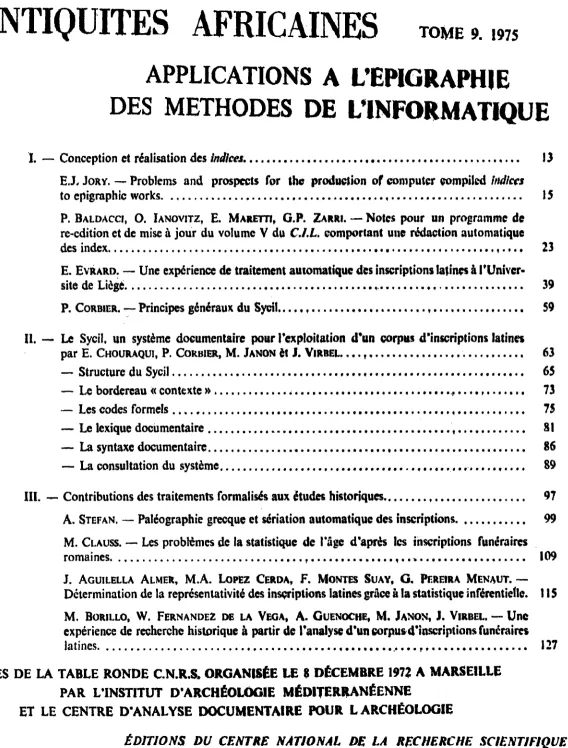
search serviceEPIGRAPHY
Informatic methods
-
papers publishedLINGUISTICS
AND PHILOSOPHY (new journal)
CANADIAN LINGUISTIC INSTITUTE
PATENT INFORMATION AND DOCUMENTATION
Symposium, Munich
LACUS Forum
IFIP
on-Selection
and acquisition
ofData Base Systems
National Computer Conference
1 9 7 7Major Bpeakers, etc
INFORMATION INDUSTRY ASSOCIATION
ConEerenceASIS Officers for 1977
TAXONOMY
of computer science
MEETINGS
ACM, Computer plrformance modeling,
Data com-
munications, ASIS midyear, ACII New York regional, Paral-
lel
anddistributed processing, Cbmputing in
Humanities
AFIPS
seminar for
F C Con data communications
NOTICE TO
AJCLCONTRIBUTORS
Short-paper format
REVIEW
Dynamic Information
and LibraryProcessing,
byGerard Salton,
reviewedby Ronald
E Wyllys
American Journal
of
Computational
Linguistics
E D I T O R I A L
B O A R D
In accordance with
a
new policy adopted
by
the
ExecutiveCommittee of ACL at its 1976 meeting, members of
theEditorial
Board are to serve three-year terms
The Editor,
whose
t e qis
certainly limited but not to three years, thanks the
members
whose terms
expired at t h e end of 1976,and
welcomesthose who
now
jointhe Board
Terms expire December 31,
1976
Joseph Grimes
Martin Kay, who continues as technical advisor
Ignatius
G
Mattingly
William
A
Woods, Jr
Terms expire December 31,
1977
Joyce
Friedman
Winfred P.
LehmaqnChristine
A
Montgomery
Donald E Walker, who continues as Managing Editor
Terry
WinogradTerms
expire
December 31, 1978
Robert Barnes
Fred
JDamerau
Gary R.
Martins
John Olney
Naomi
Sager
Ed1 t o n a l Board
Jonathan Allen
Dr Allen is Professor in the Departmenf of Eledtrical
Engineering and Computer Science and
the.
Research Laboratoryof
Electronicsof the
Massachusetts Institute of Technology,Cambridge. He took his doctorate at MIT in
1968,
f ~ r a thesison specification of prosodic features o f speech from grammatical
analysis of text, after studying at Cambridge University on a
Henry Fellowship and at Dartmouth College and the Thayer School
of
Engineering.He
has also worked at the Bell TelephoneLaboratories
Dr
Allen's main fields are man-computer interaction andcomputer architecture for digital signal processing He is
concerned with speech synthesis
and
recognition, naturallanguage processing, discourse structure, and generally in the
relation of speech to linguistic structures
He
has publisheda number of papers in these fields, and edited a book, Scken-
tists, Students, and Society
(MIT
Press, 1970)Dr.
Allen
is Vice-presidentof
ACL
for1977.
Gary
G
HendrixA
research engineer in the Artificial Intelligence Centerof the Stanford Research Institute, Dr, Hendrix
was
educated atthe University of Texas. His doctorate,
1975,
was in computerscience, following a master's degree in the same field and a
baccaulaureate in mathematics
Dr Hendrix's fields are natural language semantics, the
architecture of semantic networks, robot problem solving,
continuous process modeling, and temporal semantics Outside
these fields, he has worked and published in anthropology,
E d 1 torla1 Board
C
Raymond a PerreaultDr. Perfault took
his
doctorate at Michigan in 1975 for athesis on augmented transition network parsers and their relation
to tree-manipulating systems.
His
undergraduate work was inmathematics at McGi11 University. Dr Perrault is now Assistant
Professor of Computer Science a t the University of Toronto.
Dr. Perrault is a specialist in artificial intelligence and
the theory of computation, and in particular in
(computational)
linguistics, logic, and the theory of automata and formal
languages
A
senior research linguist at Scanford Research Institute,Dr.
Robinson was trained at the University of California, LosAngeles, where she took
her
doctorate in1946
She has taughtas visiting professor at Harvard and Michigan, and conducted
research at the University of Michigan, the
IBM
Research Ceuterin Yorktown Heights, and The
RAND
CorporationDr.
Robinson, amember
of Phi Beta Kappa, publishes onpure and computational linguistics. She specializes in syntax,
semantics, and discourse, with a taste for case and performance
gr amar s ,
William. C. Rounds
Dr. Rounds is Assoclate Professor of Computer and Communi-
cation Sciences in the University of Michigan, Ann Arbor
He
took a doctorate in mathematics at Stanford University fn 1968
for a thesis on trees, transducers, and transformations. His
undergraduate work was taken at Bowdoin College He taught at
Case Western Reserve University before going to Michigan in
1973
Dr. Rounds's fields of interest are formal languages,
automata theory, linguistic applications, logic, and programming
language semantics.
Dr
Rounds, amember
ofPhi
BetaKappa,
has been a memberof the Mathematical Social Science Board and a guest editor of
American
Journal
of
Computational
Linguistics
A L E X A N D R E L J U D S K A N O V
Alexandre Ljudskanov n'est plus L'Academie des Sciences
Bulgare nous apprenait recement son deces, survenu le 2 novembre
1976.
Chercheur infatigable, il aura ete actif jusqu'a l'extr$me
limite de ses forces, car encore en juillet dernier, apres avoir
participe A COLING 76, puis a la reunion du Comite international
de l'AILA, il consacrait deux jours a des seances de travall au
1
Secretariat &$tat avant de quitter le Canada Dlun courage
indomptable devant la maladie, 11 n'aura permis qu'l la mort de
mettre un terme a ses travaux
Son depart premature prive la linguistlque computationnelle
d'un de ses chefs de file internationaux Le message qu'A.
Ljudskanov avait commenc6
2
nous livrer, suite6
ses riflexionssur la traduction automatique, demeurera inachevi I1 en est
ainsi de ses rdflexions sur les problgmes linguistiques que pose
au
monde moderne la terminologieSur le plan international,
A
Ljudskanov avait a u s'assurerdes amities durables et le respect de tous, grace
2
son sens aigude l'analyse critique,
2
sa profonde hbnnsteti lntellectuelle et$ ses qualites d'entregent
Le curripulum vitae d'A Ljudskanov est trop long pour qu'on
puisse en faire ici une mention complgte, qu'il nous suffise d'en
reproduire les extraits suivants
Professeur titulaire de la chaire de linguistique ggnerale
a
la Faculto de Philologie de l1Uoiversit8 de Sofia etdirecteur du groupe dt6tudes pour la Linguistique mathha-
A l e x a n d r e Ljudskanov 7
14ath6matiques
d el'Acad6mi.e des sclences Bulgare, vice-
president de l'bssociatlon lnternatlonale de Semlotique
et de 1'Association internatlonale de lingulstique
appliquee, membre du Cornit6 lnternatlonal de llngulstlque
computatlonnelle
A
Ljudskanov est egalement l'auteur
d enombreux textes
scientiflques portant sur la llngulstlque, la traductlon
humaine, la traductlon avtomatlque et la linguist~que
computatlonnelle, publies en francals, en anglals,
enbulgare, en
r u s eou
en allemand
A Madame Ljudskanova et
ti
la famille de notre regrettd
collegue, je desire transmettre nos condoldances les plus
slnceres
L e president
de l'AILA,
American Journal of Computational Linguistics
Microfiche 59 8I G O R
M E L
C H U K
On 14 July 1976, T received "An
open
L e t t e r t o Colleagues" f r a n D r .lgot A. Mel'cuk, e praninent -let c a n p u t a t l o n a l l ~ ~ u i s t . He had sent
i t to me on 16 May, but it reachcd m e only through an ~ndirect routing.
The c o n t e n t s irdlc?t,e t h a t D r . Mel'cuk h a s been fired f r u n hls p o s l t i o n a s Senlor Research Wllow o f t h e Tnst itutie vf L i n g u i s t i c s of t h e ,%v~et Academy o f Sciences. The m o t i v s t i o n f o r t h i s a c t i o n I S sscribcd to a
l e t t e r , published in t h e N e w York Times on 26 January 1976, i n whlch he c r j t l c l z e d Foviet a c t i o n s a g a l n s t Pndrci Sakharov am$ ,-rgei Kovalev.
Dr. Mel'cuk asked me t o make the information about hls d i l m l s s a l a v a i l a b l e t o American s c i e n t i s t s . On h i s behalf, I have mitten to a
numbr of r e l e v a n t periodicals asking them to publ l s h h i s l e t t e r : The Executive Canrmttee of t h e Associst Ion for Canpitat ioncll Linguist lcs
considered t h i s request and decided t h a t the l e t t e r should be publ i s h e d ,
slong wjth o t h e r r e l e v a n t m a t e r i s l , in me F i n l t e String. Fccordingly,
'I am attaching, i n order, a copy o f t h e l e t t e r he t r a n s m i t t e d t o me,
dated 16 May 3976: t h e o r i g i n a l hWw Y o r k Times l e t t e r of 26 January 1976: a short item i n t h e Mzrch 27 New York Times d e s c r i b i n g h l c firinq:
a l e t t e r t o t h e e d i t o r i n t h e 10 F p r i l New York Times f r a n Chomsky and
Evers expressing t h e i r concern; two a r t i c l e s , one by Fbbcrt 7'0th
pub1 i s h d i n t h e 2 June 1976 Los Fngeles Times and one by Christopher Wren published i n the 36 June 3976 New York Tlmes; and a letter t o t h e editor by Igor Troyanovsky, a S o w e t journal ist, published i n t h e Los
Fngeles Times on 7 Fugust 1916, which p r e s e n t s the ,Soviet vlew o f t h e
a c t ion taken against Me1 'cuk.
The letter Dr. Mel'cuk sent m c also h a s appeared or w i l l appear, w ~ t h v a r i o u s amounts of e d i t i n g , i n t h e B u l l e t i n of t h e L i n g u i s t i c
Society of Pmerica, i n the Los Pngelcs ~ ~ m e s , In t h e New York Wview of
Books, i n t h e P u l l e t i n of t h e m e r l c a n ~ \ s s o c i a t i o n of U n l v e r s ~ t y P r o f e s s o r s , 2nd possibly i n o t h e r publ lcat ~ o n s .
C o r d i a l l y ,
Donald F. Walker
P r t i f i c i a l I n t e l l i g e n c e renter
Stanford M e a r c h Jnst j t ute
Letters concerning Xgor Melrchuk
AN OPEN LETTFR TO COLLEAGUES Dear Colleague :
(X1 March 25, 1976, at a session of t h e Faculty Board (or, p r h a p s ,
the bScientific Council: Ucenn L%vet) of the Tnstitute of ~inguistics, &%vjet Academy of Sciences, Moscow, f was not re-elected senior research
fellow, t h e p o s i t i o n 1 had
b ~ e n
holding up t o the said date.( I n
accordance with regulations any research fellow of any Soviet Acadanyi n s t i t u t i o n i s supposed t o be re-elected by the respective Faculty Board every t h r e e years--for junior fellows o r eveEy five years----for senior fellows, which happens to be my cPse. Tt is o r d i n a r i l y q u i t e a routine procedure which a s a r u l e should not even be attended by t h e person concerned. Tn case he is not re-elected t h e researcher
is
t o be firedby the administration In no more than a year a f t e r the declsion by t h e Faculty Board took place)
.
The Faculty Board met 24 members being present: Victorla M.
Yartseva ( t h e d i r e c t o r of t h e Institute of Linguistics)
,
Yurij S.Fl iseev (the a s s i s t a n t d i r e c t o r )
,
Valent in F. Pf imov (the s c i e n t i f i csecretary)
,
Vladimlr D. Arakin, Nikolaj A. Baskakov, Trofim A. Bertagaev, Nikolaj S. Cemodanov, Yunus D. Deserlev, Nlnel Z. Gadzleva, Myrrha M. Guxman, Georgij A. Kllmov, Renat G. Rotov, Gemadij V.Kolsanskij, Muxmed A. K ~ ~ x w , Mara E. Majtinskaga, SeLgej A.
Mironov, Kenesbaj M. Musaev, Vera S. Fastorgueva, Natalja F. Pl]usareva,
Aleksandr Dm S v e j t s e r , Edgem R. l k n i s e v , Oleg N. Trubacev, Said M.
kajdakov, and Jgor' F. Vardul'
.
Here a r e the r e s u l t s of the secret b a l l o t : 19 votes against my re-election, 2, for, and 3 have beenconsidered not valid (which e s s e n t i a l l y meahs abstention)
.
view ofsuch s decision of the Faculty Board, April 8 t h e assistant director of
the Tnstitute, Yuri3 S. Fliseev informed me that 1 am fired beginning
from May 18 t h i s year.
'i have been with the Tnstltute of L i n g u i s t i c s since 1956, During this period f have authored and published more than 150 linguistic works, including several t q k s : many of my papers are t r s n s l a t e d and
published in the US& France, West Germany, Poland, Hungary, and
East Germany. Many tmes I was invited t o take p a r t i n i n t e r n a t i o n a l l i n g u i s t i c conventions, t o present lectures, t o serve on e d i t o r i a l boards of some Western l i n g u i s t i c p e r i o d i c a l s , etc.
Yet the Faculty Board d i d not judge m e worth holding my job. The
only reason expl i c i t l y stated was my letter published i n ?he New York
Tlmes on Janw 26, 1976. The letter expressed my disagreement with
the carnpalgn waged against findrej D. Saxarov by t h e Soviet press as well a s my protest against t h e arrest and t h e t r i a l of t h e emanent Soviet scientist
,
b i o p h y s i c i s t Sergej Koyaljovd m
has been sentenced t o 7years i n prison and 3 more years i n exile (under purely p o l i t i c a l
Letters concerning Igor Me1
'
chuk 10Yet t h e Soviet Union ratffied t h e I n t e r n a t i o n a l Pact on Civil and
Palitical Rights (adopted December 16, 1966, by t h e X X I Session of the
ceneral Assembly of t h e united Nations) which--in accordance with t h e
Soviet legislation (see Art. 569 of t h e C i v i l Code o f t h e Russian
Soviet Fpderative S o c i a l i s t k p u b l i c ) -has becane eo ipso a S w l e t law. Art. 19 of t h e said Pact gives me "a full rlght to f r e e l y express my opinions including t h e freedan of disseminatmg any k i n d of information and ideas independently. of national borders--orally, i n writing or by
means of t h e press." Consequently, addressing my letter to. The New York
Times f have by no means v i o l a t e d the laws o f my country. (Even i f it were not the case f should have been persecuted by the .Soviet justice
and not, f o r t h a t m a t t e r , by t h e Faculty Board of an academic institution! )
Contrary t o what has been presented i n t h e preceding paragraph, those taking t h e floor a t t h e Faculty B a r d meeting said: the letter by T o Mel'cuk "besmirches our country and covers with shame any research worker,.
. .
such an a c t jan is inadmissib&e not only i n t h e s c i e n t i f i c community of the I n s t i t u t e , but i n the community o f a l l Soviet people a s well" (V. Yartseva, the director) ;*
"slandering against our country1.A. Mel'cuk does s e r i o u s harm n o t only t o it but also t o a l l progressive mankind..
.
so t h a t h i s h o s t i l e a c t i o n makes impossible f u r t h e r presence of I. Mel'cuk i n t h e I n s t i t ' u t e o f LAnguistics8'(M. Guxman) : "it is in vain t h a t I . E . Mel'cuk r e f e r s to sane obscure [sic!] p a c t s and t r i e s to a r t i f i c i a l l y l i m i t t h e range o f criticisms
aimed a t the 'moral-polit i c a l
'
image (moral 'no-politiceski j oblik) of h ~ m s e l f a s a Soviet scholar" (Yu. Elisekv, the a s s i s t a n t director') ; "the position of T. Me1 'cuk borders on war propaganda,..
.
a M a l l h i s behavior produces a very bail impression: we hopedto
hear words o frepent but what we a c t u a l l y heard is a firm conviction (N. Gadzleva),
etc. 'Ihose speeches were s m e d up i n t h e second address by
V. Yartseva: "The world is split i n two, and I. F. Mel'cuk. t u r n s for help to
our
enemies!It should be emphasized t h a t i n the I n s t i t u t e where I have worked for almost 20 years and where X thought I had enough friends since 1 maintained w l t h many not only professional but a l s o warm human r e l a t i o n s
for a long tlme, there was no one who w a d slde w ~ t h me or a t least say
a few words i n my favor. More than t h a t : as far as I know, no one of t h e Soviet s c i e n t i s t s (my p e r m d l f r i e n d s excluded) found it possible or necessary t o defend m e i n some form they would consider appropriate.
The purely p o l i t i c a l character of my firrng makes it practically
impossible for me
to
f i d another job anywhere i n the USSR--the more sofor even before t h e above-ment ioned d e c j s i o n by tfie Faculty Board my
position
i n
t h e Swiet science was a very d i f f i c u l t and precarious one. For several years J have had p r a c t i c a l l y no p o s s i b i l i t y t o publish ny--
-I--....Letters concerrung I g m Me1 'chuk 11
papers i n leading Swiet l i n g u i s t i c journals. (Tbe appearance of each of my papers required no less than a heroic deed on the part of m e
member of editorial board)
.
The second vollme of my mnogiaph Toward a 7heory of ~ ~ n g u i s t i c Models of the Meaning<=>Text ?ype (the ptoduct ofmrny years of painstaking work) waited for publication mor,e than 8 years
and failed to be, a f t e t a l l , published. T was and am forbidden to
teach, to take part i n many scientific conventtons, to go abroad for
contacts with Western colleagues. ImRedlately after the appearance of
my letter in 'Ihe New York Times Soviet l i n g u i s t i c periodicals and publishing houses began suppressing references to my n o r ks, ackncwledgements by other authors mentioping my name ( e . g . Serge] Ya. Fokin, head of the editorial staff of ~ u c n o t e x n i c e s k a j a
i n f o m a c i j a
,
PJational Tnst itute of Technological Informat ion--VINITI,Moscow) and even my name a s the editor or translator ( a s did Prof.
~ i k o l a j S. Cemodanov and Klavdiga T. Bogdanwa of the Progress pub1 isher s)
.
Under such conditions and havjng no permanent job I am left without the least p s s i b i l i t y for normal continuation of my l i n g u i s t i c research.
which amounts to putting m e before a tragic choice: either a meaningless
existence i n my country, which needs not my work and e f f o r t , or emigration meaning the lifelong separation (such is the S v i e t law) fran
my natlve land 8s well a s £ran my relatives, friends, and colleagues.
1 understand quite c l e a r l y that my s i t u a t i o n cannot even be
compared with the t e r r i b l e l o t of those people who, deprived of t h e i r freedan, are ~ e r v i n g t h e i r terms i n Wviet prisons and lebor camps for
mitical reasons and whose health and perhaps life are
i n
dsslger. But still T feel 1 have the moral right to address t h e public oplnion since it is not my personality that i s of importance here. M y case i s but ama3est yet very vivid ill'ustratron of the moral l i f e of the top layer of Soviet intellectual society-of what used to be known as t h e famous Russian i n t e l l i g e n t s i a . It is an additional touch to the monstrous
chronicle of felonies and base toadyism which were and are so easlly practiced in the WSR by many persons holdlng scientific degrees and
often posts
of
responsibility i n the Swiet science hierarchy.The aim of t h l g l e t t e r is too make its readers seriously ponder
once again over the fate of Soviet scholars and s c i e n t ~ t s forced to
choose between low-down behavior and emigratmn. (Bright tunes now!
not so long ago thFJg had to choose between felony and a b u l l e t or, in the best case, years behind the barbed dire)
.
Do not forget, please, that- each of rilein with the exclusion of a few active militants l i k ePndrey Dw Saxarw or Igor Rw Safarevic is e i t h e r a victim, or a hangman, o r 4 i c h is perhaps the most dangerous thinq--a tacjt accamlice of
hangmen.
1.A. MeL'cuk
40/17, Bajkal's~a~a Str., f l a t 113, Ploecow 107207, USSR
(Formerly Senior Research Fellow, J n s t i t u t e ' o f Linguistics,
Letters CbnCernlng Igor M e 1 chuk
(New York Times, January 25, 1976, Part W , page 16) Sakharovz World Symbol of Redemption
m
the mitor:I am w r i t i n g t h i s letter to a Western newspaper because I am not 211- to express'my o p i n i b n s i n t h e U.S.S. R. My subject is t h e g r e a t Soviet p h y s i c i s t and Nobel Prize winner Andrei Sakharw.
Except f o r party- o r government-lnspired press a t t a c k s on h m , i n my country t h e s i l e n c e over Sakharov is complete. But t h e West should
know t h a t t h e r e a r e many people here--and I am one of them-who s t r o n g l y disapprove of the d i r t y campaign waged agalnst t h e man who is perhaps
t h e o n l y a b s o l u t e l y honest person among our eminent s c s i e n t i s t s ,
The most a b s o l u t e lack o f evert support f o r Sakharov among h i g h l y
placed Soviet s c i e n t i s t s and scholars d l e a r l y demonstrates t h a t there is no such t h i n g
a s
t h e Russian i n t e l l i g e n t s i a any more. 'If Sakharov'scolleagues and former f r i e n d s , such a s Khariton and Zee'dovic
(wt
tospeak o f t h e s i x t y o t h e r academicians and professors) signed t h e "lettern denouncing Sakharov, it can mean only t h a t moral c o n s i d e r a t i o n s are f u l l y excluded frm the mentality o f t h o s e who should base t h e whole
of t h e i r activities and l i v e s on moral p r i n c i p l e s .
I t is d i f f i c u l t to compare d i f f e r e n t o r d e a l s , but l a s t month a t r i b u n a l i n V i l n i u s sentenced to seven y e a r s ' imprisorment p l u s t h r e e years of exile t h e b i o p h y s i c i s t Serge1 Kovalev, a member of Sakharov's
Cdmmittee for Human R i g h t s , For a scientwt of more than f o r t y years o f
age t h i s means d e a t h - s p i r i t u a l l y and mentally, if not l i t e r a l l y . Not
one Soviet scientist protested. The members of the B v i e t Academy o f Sciences have became soulless ~uppets, devoid of c o n v i c t i o n s and consc i ence
.
As f o r t h e West, I c a n m t understand t h e a t t i t u d e of your s c i e n t i s t s and scholars. Perhaps they d o not fully r e a l ~ z e t h a t a powerful n a t i o n of 25Q m i l l i o n . guided by t h e unscrupulous and having a t
its d i s p o s a l f i r s t - c l a s s brams N t h no h e a r t s and souls, may prove h i g h l y dangerous.
The examples of Cuba, Czechoslchvakia, Laos, Cambodia, and Angola show the imptence of t h e West In the face of the C m u n i s t machine,
And real freedom and human r i g h t s i n t h e Soviet V i o n a r e as' important ( ~ f not more important) to the
worlh
a s they are t o ys.Please do not f o r g e t t h a t t h e r e a r e many h e r e kept i n jqils, labor
camps and prison p s y c h i a t r i c h o s p i t a l s who a r e s u f f e r i n g also f o r your
freedm. Sakharw is f o r us--and should be f o r the world--a symbol o f redemption.
mtters concernln y Igor Me1 ' &uk
(New York Times, March 27, 3976, page 6)
Soviet Lingulst Ts Ousted For a Letter to The ~imes
MOSKW, March 26(AP)--Igor A. Melchuk, a dissident Soviet l i n g u i s t ,
s a i d today that he had lost his job because of a l e t t e r he wrote to The New York Times defending Andrr~ D. Sakharov, the Soviet physicist and human rlghts activist.
Mr. Melchuk said he appeared yesterday before bhe f a c u l t y board of the the Tnstitute of Linguistics to answer for himself and his "moral
pol it i c a l image.
"
I h e board members charged that his letter, prlntcd J P ~ . 25,
"besmirched our country" and carmnitted "a slander against our way of l i f e , " Mr. Nlchuk said. He was ousted fran his post a s a senior
research fellow by a secret ballot, 19 to 2, with three abstentions.
The vote does hot automatically remwe him frun t h e i n s t i t u t e ,
F r . Melchuk said, but he doubts that he will be offered a new position.
(New York ~ i m e s , Aprll 10, 1976, page 26)
Moscow vs. a Linguist
the Efiitor:
According to a March 27 news story, the well-known Russian l i n g u i s t
Tgor A. Mel'cuk has been dismissed from h i s posjtion a t t h e Linguistic
Institute i n Moscow, where he has wrked for the past twenty years. This represents a severe intensification in the harassment of Wl'cuk, who has been attacked i n the past for h i s defense of other Sovlet
ci'tizens, including Daniel and Sinyavsky.
me latest act of repression follows Meltcuk's outspoken support
for Sakharov and Kovolev, both members of the Russian Cdmnittee for the Rights of Man, and may have been
a
d i r e c t result of a letter of Me1'
cuk'
s pub1 ished in The Tlmes [Jan. 251.
'Ihe loss of employment
is
serious indeed, and may be a prelude towrse. Fs members of the international camunity of 1 inguists we feel canpelled to express our great concern.
Nom Chmsky, Arnold Evers Cambridge, Mass., March 30, 3976
The writers are, respectively, prafessor of linguistics a t M. 1.T. and
Letters c u n c e r n r n g Igor M e 1 chuk
(Los Angeles Times, June 2 , 1976, Part I, pages 1 & 7 )
Soviet Lingui st Fired for fdeological Mistakes'
KWCCW---Ch the face of i t , t h e s c l e n t l f i c council of t h e Tnstitute
of Linguistics of t h e Sovlet Academy of Scjence was mectlng t o review
t h e work of a senior researcher before h i s recertification t o his post. Normally i t muld be a matter of form.
But i n r e a l i t y , t h e senlor scientist-Tgor Alexandrovlch Melchuk,
said by U S . and Soviet linguists t o be the best in hls f~cldL-Iwas b e ~ n g t r i e d behlnd closed doors for politics1 nonconfofmity.
The s e c r e t l y taped proceedings of March 25 show what c r i t e r l a his
judges used. A transcript of t h e tape h a s been obtained by I h e LQS
Ang-eles Times and its a u t h e n t i c i t y has been v e r i f i e d .
"It doesn't mattel: i f your [sclentlflc] theorles a r e successful or not," declared one council member. " S c i e n t i f i c and p o l l t i c a l positions
are not of t h e same ~mportance."
"Mistakes i n s c i e n t i f i c mrk are one t h i n g , but ldeoloqical mistakes," i n s i s t e d another, "sre quite another thlng. They s r e smply
awful... and must be judged most harshly."
"Fvaluating the w r k of a Sovlet scientist cannot be nzrrowly
academic," said
a
t h i r d , citing o f f i c l a l r u l e s f o r certifying scientistst h a t requlre " d e f i n i t e p o l i t i c a l and moral standards a s well."
"Tgor. Alexandrovich 1s t r y l n g to c l a m t h a t it is a personal
matter, t h l r 3tatement against Sovlet ~ d e o l q y , " said a fourth. " m a t is impermissible."
And so i t went, focuslm on h ~ s p o l l t i c a l f a u l t s and virtually
ignoring h i s s c i e n t i f i c c a p b i l i t i e s . Melchuk, 43, who h a s beep
compard t o t h e outstanding U.S. ljnguist Noam Chomsky, was f i r e d from the institute. H i s books were to be withdrawn frm libraries. Other
books footnoting h l s works must be revised,
Melchuk knew we11 t h e l m l t s o f the nonconformity permitted In the F s v i e t system and he stepped beyond them.
H i s career has been marked both by academic b r i l l l a n c e and
difficulties i n his personal r e l a t i o n s h i p s . "Outspoken
,"
admitted ?friend: "impudent
,"
c u n p l a i n d a jodge.He had trouble entering graduate school d e s p i t e a straight-F
Letters concern1 ng Igor MF? Z
'
chuk 15 s u t h o r , and Melchuk wrote a letter t o the higher education rnlnistrydeferding the professor.
He then left graduate study to work on language translation by
machine. P series of articles on the sub'lect earned him a candidate
degree (ktween masters and doctors) In an unprecedented reoognition of
h i s abilities.
But he was not permitted t o defend h i s d o c t o r a t e t h e s ~ s , for by
t h a t tlme he had signed o t h e r letters. One had asked "understanding" for d ~ s s i d e n t s Y u l l Daniel and Andre1 Sinyavski in 1966; another
protested t h e 1968 Soviet invasion of Czechoslovakia.
men h e recsnted.
"Yes," Melchuk acknowledged durlng the March t r i a l
.
" I expressedmy regret f o r p e t statements. Frankly, I d i d so o n l y because 1 was
afrald. T acted cowardly. But I'm tired of fear. I have no more fear
."
me
recanting had done him l i t t l e good. P t l e a s t seven timesbetween 1971 and 1975, the transcript shows, he was n o t allowed to t r a v e l abr aad t o sc i e n t i f ic conferences, even when t h e conference o f f e r e d to pdy his way.
"We d i d n o t send Tgor Alexandrovich abroad
,"
said V i c t o r i a N.Yartseva
,
institute d i r e c t o r , "because every Soviet s c i e n t i s t s r e p r e s e n t s our system and our Saviet ideology abroad, and IgorAlexandrovlch always emphasl zes: 'It's mine, ~t i s my personal opinlon
'...
Either Igor Alexandrovich is with u s or he is with them."Professionally, Melchuk had more than 150 publications to h i s credit in 20 years. A West German plblishlng house offered i n 1971 to
p u b l i s h his major work, "Sense:Text," but t h e Swiet l i n g u i s t i c I n s t i t u t e refused p e r m i s s ~ o n . 'Ihe f i r s t volune o f t h a t work appeared
here i n 3974 but t h e second h a l f , which should have appeared
simtdtaneously, still has not come out and is now badly o u t d a t a .
Linguistics ranges fran the study of gramar and language or i q i n s
to information and conanmication t h e o r y and learning. Melchuk's book, said an American linguist tho read it a l l , "is a masterpiece o f
organization and canprehensiveness.
"Had it been pub1 ished prmptly when writ t e n
.
. .
the result wouldLetters concerning Igor Me1 'chuk 16
Another Pmerican linguist s a i d , "He has not blazed new f r o n t i e r s i n t h e sense t h a t Qxlmsky has. On t h e other hand Melchuk is by f a r the best Soviet 1 i n g u i s t
."
Melchuk abandoned h i s several-@ar public siknce with a l e t t e r to
t h e Ww York Times defending Nobel &ace Rize winner Andrei D.
Sakharov. It appeared January 25.
*I am not allowed to express my opinions
i n
t h e U.S.S.R.," hewrote. Many Soviets 'lstrongly d i s a p p r w e t h e d i r t y cmpaignW against Sakharov who is "perhaps t h e l a s t bonest s c i e n t i s t " here, he continued.
Wmbers of t h e science academ)r were "soulless puppets," he wrote.
"A powerful nation of 250 million, guided by t h e unscrupulous and having a t its disposal first-class brains with no h e a r t s , may prove highly
dangerous," he warned. Cuba, Czechoslovakia, Vietnam and A n g o l ~ show
Western imptence, he concluded.
Whatever its m e r i t s , t h a t l e t t e r apparently had not been read by
any of Melchuk's judges. A voice fran the audience, fran which "outsiders" wre barred, asked t o know its contents. ?he i n s t i t u t e ' s deputy d i r e c t o r replied t h a t he had not seen it. "but so f a r a s 1 Know it i s w r i t t e n i n support of Sakharov and reduces t o t h r e e points," which
he recounted accurately. Melchuk then offered t o r e d and discuss the letter w i t h anyone, but o n l y a f t e r t h e c ~ u n c i l ~ s decision on h i s future.
consider it impermissible t o mix the question of my r e c e r t i f i c a t i o n
w i t h my l e t t e r .
H e c i t e d a United Nations resolution of 1966, r a t i f i e d by the
Soviet Union and incorporated i n t o Soviet law, t h a t guarantees the
freedan of expression, within a s t a t e or across borders.
But i n s t i t u t e deputy dlrector Yuri S. Eliscev countered t h a t t h e
c e r t i f y i n g r u l e s far Soviet s c i e n t i s t s set p o l i t i c a l a s well as s c i e n t i f i c standards, and h e brushed o f t the i n t e r n a t i o n a l t r e a t y .
Criticism of Melchuk rose i n p i t c h toward t h e end of t h e session. Ideological mistakes, said M. Khaidw, trade union member of the
s c i e n t i f i c council, "must be judged most harshly
.
.
.
IgorAlexandrwich, you stand on the c l i f f . We wanted to p u l l you (sway."
"You become t h e ~ ~ l p p e t i n somebody's d i r t y hands!" shouted i n s t i t u t e d i r e c t o r Yartseva.
"I had hoped to hear mrds of repentance but 1 heard only deep convict ion," said Nine1 2. Gadrieva, the Rople m n t r o l Ccnnnission's representative on t h e s c i e n t i f i c council: "Your a c t i o n borders on the
propaganda war and under t h e Swiet c o n s t i t u t i o n , that's a crime. It
Letters concernnng Igor Me1
'
chuk 17"If you tried o u t there i n the West, i n the FFG [West Germany], for
example, t o stand up with Oarrnmist propaganda," said a pensioned professor on the corncil
,
"they wouldn't keep you on t h e s t a t e payrollfor one day."
"For
many years we tried t o save u , Igor Alexandrovich,"concluded Yartseva, "but ybu treated us badly. You don't respect our collective. We could help you remain with us but you don1 t want it
. .
.
W e know very well t h a t world is divided i n t o two parts, and you appealto our enemies. H
*I think t h a t this open discussion has been useful," she then said
abruptly.
Melchuk asked for a f i n a l word. Yartseva refused. "Everything is clear
,"
she said.(New York Times, June 16, 1976, page 16)
Disnissal of-.Soviet Linguist Exemplifies
Moscow's P o l i t i c a l Curbs on Science
By Christopher S. Wren
Special t o The New York Times
m,
June 13--"Errors of a scientific character a r e one thlng,but ideological e r r o r s are e n t i r e l y another--these are absolQtely
terrible," declared an o f f i c i a l a t t h e I n s t i t u t e of Lingustics of t h e
Soviet Acadany o f Sciences.
'Ihe occasion was a meeting reviewing the a c t i v i t i e s of Igor A.
Melchuk, a praninent Soviet linguist, for a nominally r o u t i n e reappointment to the i n s t i t u t e s t a f f . The outcane was t h a t Mr, Melchuk
was ousted fran his post as senior research fellow.
H i s s c i e n t i f i c c r e d e n t i a l s were not criticized--professionally he
has been campared with the Prmer ican 1 inguistic - scholar Noam Chomsky-but
h i s ideological errors included writing a letter t o The New Yark T ~ m e s last January i n defense o f another dissident s c i e n t i s t , t h e Nobel peace laureate Andre D. Sakharov,
Consequently, Mr. Melchuk was discharged. "The whole session was a monstrous farce," the 43-year old l i n g u i s t related. "I worked at the
i n s t i t u t e for 20 years and w i s h e d 150 books and papers. And no one
Letters concerning Igor Me1
'
chuk 18F o l i t i c a l R e l i a b i l i t y
me
case h i g h l i g h t s the priorities set by t h e Soviet s c i e n t i f i c establishment, which t h e Soviet Union says, h a s aouarter
of t h e world's s c i e n t j s t s .%eir advancement depends on p l i t i c a l r e l i a b i l i t y as well as
s c i e n t i f i c cur i o u s i t y . The price for running against, t h e p o l i t i c a l g r a i n is st j f f. Scientists showing s i g n s
of
dissidence are pranptly shorn of prestige and p o s i t i o n ; their work, perhaps based on years o f research, is removed fran l i b r a r i e s o r is published w i t h t h e i r names expunged.
Men t h e physical chemists Veniamin G. Levicn, a c o r r e s p n d i n g m b e r of t h e Academy of Sciences, applied to emigrate to I s r a e l i n 1972, he was not merely remwed f r a n his i n s t i t u t e p o s t , f i v e s c i e n t i f i c caranittees and two e d i t o r i a l boards; t h e c h a i r he held a t Moscow S t a t e University was abolished.
Moreover, i n v i r t u a l l y every s u n i l a r case, t h e response o f
colleagues h a s been s i l e n c e . F nunber of scientists interviewed a t t r i b u t e t h i s more t o t h e p r e v a i l i n g system of rewards than t o f e a r s of repression. Orthodox s c i e n t i s t s r e a p e s c a l a t i n g benefits t h a t p l a c e them m n g t h e e l i t e m a t e r i a l l y a s w e l l a s i n t e l l e c t u a l l y , and these and
their c a r e e r s could be threatened i f they go't involved
.
"Under S t a l i n it was a question o f life or death," s a i d Dr. I;evichls wife, Tsnya. "Now it has becme a question o f being
allowed to go abroad f o r a longer period."
The Sovlet Communist P a r t y chief, Ikonid' 1. Brezhnev, defined t h e
code of behavior a t t h e Fcadeny of ,Sciences1 250th anniversary
c e l e b r a t i o n l a s t October: " m a t e v e r t h e field i n which Soviet s c i e n t i s t s are working, they are elways d i s t ~ n g u i s h e d by one characteristic--a high standard of Casrvnunist consciousness and Sovlet p a t r
iotisn."
LESS Than Factory Wage
?he primary i n c e n t i v e is b u i l t i n t o a pay scale t h a t rises s h a r p l y with promotions. A Soviet physicist outlineb it t h i s way: While a junior s c i e n t i s t f r e s h fran the u n i v e r s i t y e a r n s o n l y 100 r u b l e s a month-- about $130--or 40 rubles less than t h e average i n d u s t r i a l wage, the s a l a r y of a senior s c i e n t i s t junps to 300 r u b l e s a month, and a l a b o r a t o r y c h i e f or f u l l professor e a r n s 500, plus t h e opportunity t o draw
more
by teaclilng orwritlw
on
the mde.Upon e l e c t i o n to the Mademy o f Sciences, t h e r e is a n a d d i t i o n a l
Letters concerning Igor Me1 'chuk 1 9
me
pranotians do not involve s c i e n t i f i c a b i l i t y alone. Also involved i s "obshchestvennaya akt ivnost,
"
ich translates-somewhat mislewingly-as " s o c i a l a c t i v i t y , " that is, a c t i v i t y on behalf of p a r t yand s t a t e .
Ihe assesbnrent w i n s i n t h e u n i v e r s i t y , where Young Caranmist
League activists are e n t i t l e d to higher r ~ b o l a r s h i p stipends. 'Ihe same
c r i t e r i o n is applied to admission t o work toward advanced degrees. "If
you want a doctorate you could be I s a ~ c Newton himself, but i f you don't have F u r plitlcal a c t i v i t y , you w i l l never get a doctorate," said Valentin F. Turchin, a physicist who earned his before beaming a d i s s i d e n t .
Similar evaluations are made for job assigments. Dr. k v i c h recalls t h a t when he visited h i s i n s t i t u t e ' s p a r t y organizations w i t h recamendations for pranotions among h i s s t a f f , "the f i r s t auestion was
t h e i r social behavior and whether they were party members."
Travel Most Valued
'Ihe most valued privilege is the opportunity to t r a v e l abroad,
where a s c i e n t i s t can l e a r n f i r s t h a n d what f o r e i g n e r s are doing i n his f i e l d . 'Ihe right to t r a v e l is dispensed only to those who are examined
and found trustworthy. Eel itical and social nonconformity, even contact
with d i s s i d e n t s
on or
o f f t h e job, is reason enough for t h e r e f u s a l .According to one Soviet s c i e n t i s t who has traveled abroad, the
crucial docunent is a k h a r a k t e r i s t i k a , or character reference, fran
one's i n s t i t u t e . While the applicant may be questioned by the regional party caranittee; it is the obscure "departure canmission" of t h e Central
Canmittee that dispenses final approval.
Eefore a s c i e n t i s t l e a v e s he is instructed by party officials how
to behave. Upon his r e t u r n , he
must
prepare a written r e p o r t on what h ed i d and whm he saw. Eventually, he is considered cleared for repeated trips abroad
or
as Russian sleng puts it, "in t h e c l i p n l i k e a pistolbullet.
If doubts arise, the travel privilege can be revoked. A s c i e n t i s t
who v i s i t e d Czechoslovakia i n the l a t e 1960's said that he was forbidden
to go &road for several years after a colleague reported t h a t he had
becane too f r i e n d l y with t h e i r hosts.
S c i e n t i s t s who get
i n
trouble politicallycan
a l s o cast a shadowon
superi~rs and cbworkers. I n s t i t u t e s with nonconformists on their staffs
may find it harder to compete f o r project
funds
or foreign-madelaboratory equipnent. Since administrators have a vested i n t e r e s t
i n
maintaining ideological respectabil ity, r e t a l i a t i o n a g a i n s t someoneLetters concerning Igor Me1 'chuk 20
Professjonal Setbacks
Dissident s c i e n t i s t s s a y they have suffered p r o f e s s i o n a l l y under
such
p o l i t i c a lconstraints.
Dr. Turchin believes t h a t t h e system's i n f l e x i b i l i t y e x p l a i n s a t least i n part why t h e M v l e t Union still l a g sbehind the West technologically. Others have noted t h a t Soviet science excels In abstract f i e l d s like pure mathematics and astronomybut becanes weaker i n appljed f i e l d s , p a r t i c u l a r l y if they touch upon
ideology, a s t h e social sciences do.
A Western s c i e n t i s t famil i a r with the Soviet scene believes t h a t
Moscow has compensated by drawing on v a s t nunbers of a p p l i c a n t s and is f i l l i n g g a p through s c i e n t i f i c exchange with the West. Moreover, h e ca~mented, Western s c i e n t i s t s have not been s i g n i f i c a n t l y bolder i n jeopardizing their careers.
Same Soviet s c i e n t i s t s , like t h e p h y s i c i s t Pyotr L, Kapitsa, have
becane so internationally respected a s to stay aloof fran p o l i t i c a l
pressures. Dr. Kapitsa declined t o join the denunciation campaign against Dr. Sakharov, a l s o a p h y s i c i s t , w i t l i no apparent ill effect. A
few others, Dr. Sakharov among them, have brokers with t h e system, but
most s c i e n t i s t s prefer t o go along.
" P lot of them may have sympathy for t h e d i s s i d e n t s , " t h e Western
scientific observer said, "but they wouldn't do anything to support them
because ~t m u l d r l s k a comfortable l i f e . "
(Las
Fngeles Times, Pugust 7, 1976, Part IT, page 4 ) LETJ'ERS 'IO TEV TIMES---I---
Soviet Dismissal of Igar Melchuk
Your Moscow correspondent, Robert n t h , a t t h e beginning of June reported t h a t fgor Melchuk, " t h e most outstanding ,Soviet l i n g u i s t , " had
been dismissed f r a n the I n s t i t u t e of L i n g u i s t i c s of the U.S.8.R.
Fcademy o f Sciences. ne had f a i l e d to pass a r e c e r t i f i c a t i o n (which is
held once
i n
f i v e years) and lost his p o s i t i o n a s senior research a s s o c i a t e for h i s p o l i t i c a l ,so
Tbth a s s e r t s , "nonconformism."Letters concerning Zgor Mel'chuk 21
How is it that Melchuk was able to work a t the institute for as
many as 20 years? Why were dozens of h i s books and articles published
in the U.S.S.R.,
and
whywas
the s c i e n t i f i c degree of candidate of science conferred On him? Whywas
Melchuk not dismissedmuch
earlier-- f i v e or 10 wars ago?Here is cment by Dr. Victoria Yartseva, director of the
i n s t i t u t e : "We had always condemned the a c t i o n s o f Igor Melchuk, but
never raised the question of his leaving the i n s t i t u t e . We considered
Melchuk to be
an
able s c i e n t i s t . He was given a concrete sector ofresearch-the development of an Anglo-Russian machine translat ion
system. The project is of enormous impartance. Nowver, his investigations throughout these years did not lead to practical results.
me
project is very far fran mp1.etion."The learned corncil of the I n s t i t u t e of Linguistics, by a majority
of votes (the voting was secret) did not re-elect Melchuk far a new
f ive-year per id.
It is known that
in
the West applied research is conducted withinthe frmework of f a i r l y r i g i d progr'ms, the fidancing of which depends
on the r e s u l t s obt~jined. Clearly, there they would not have kept for so
many years s man v i ~ l a t i n g the terms of a contract.
Igor Melchuk was dismissed fran his position not because of h i s views, but because of the neglect of the job entrusted to him.
I r n R TROYANOVSKY
Moscow
M i t o r ' s Note: Troyanovsky is a Soviet journalist. H i s letter was
forwarded to 'Ihe Times by the informat ion officer of the Soviet Ebbssy
American
Journal
of Computational
Linguistics
Microfiche 59 : 22qri
lFlP CONGRESS
77
u
International Fuderation for Information Processing
Au~ust
8-12
Toronto
Canada
I N V I T E D
S P E A K E R S
PROF. ALGIRDAS A V I Z I E N I S ,
University
o fCalifornia,
U.S.A."FAULT-TOLERANT
COMPUTING"
PROF.
3 .WeDE
BAKKER, MathematischCentrum,
TheNether1
ands"SEMANTICS AND
THEFOUNDATIONS OF PROGRAM PROVING"
MR. PAUL BARAN,
Cabledata
Associated, U .S .A."PERSPECTIVES ON NETWORKS:
PAST,PRESENT
AND FUTURE"PROF.
F. P
.
BROOKS,
University
o f North Carol ina
,
U.
S .A,"MOLECULAR GRAPHICS
-
THE COMPUTER "SCIENTIST"
AS"TOOLSMITH"
DR.
J.C. EMERY,Educom
Inc., U.S.A."ECONOMICS OF INFORMATION PROCESSING IN
DISTRIBUTED
SYSTEMS"PROF.
M.A. GAVRILOV,
Instituteof Problems
ofControl, U*S.SmRD
"COMPUTER-AIDED CIRCUIT DESIGN
-
ANOVERVIEW"
MR.
J.A.
GOSDEN, The
EquitableLife
Assurance Society,U.S.A.
ClCI
"IMPACT OF' DATA BASE TECHNOLOGY ON
BUSINESS SYSTEM
DESIGN"
DR. J
.
HATVANY,Hungarian
Academy o fSciences
,
Hungary"TRENDS AND DEVELOPMENTS IN CAD"
PROF. J
.
HEBENSTREIT, kc01
e Superi
eure
d'Electrici
te,France
-
"TRENDS IN COMPUTERIZED
EDUCATIONSYSTEMS"
PROF.
3 .N .P.
HUME,
Universi
t y o f Toronto, Canada"EDU-CATION I N
COMPUTING
VERSUS USER NEEDS"PROF.
N.N.
KRASSOVSKY,
I n s t i t u t e o fMathematics
and Mechanics,U.S.S.R.
"PROCESS CONTROL WITH FAULTY INFORMATION"
PROF.
€3. LEVRAT, Uni versi t e cle Geneve, SwitzerlandIFIP CONGRESS 77
PROF. J.L. LIONS, D o m a i n e de Voluceau, F r a n c e
"NUMERICAL METHODS FOR VARIATIONAL I N E O U A L I T I E S
-
APPLICATIONS I N PHYSICS AND I N CONTROL THEORY"PROF. D.C. LUCKHAM, S t a n f o r d U n i v e r s i t y , U.S.A.
I'PROGRAM VERIFICATION AND VERIFICATION ORIENTED PROGRAMMING"
PROF. D. MORRIS, U n i v e r s i t y o f M a n c h e s t e r , England "A PORTABLE OPERATING SYSTEM"
PROF. N. NEGROPONTE, S c h o o l o f A r c h i t e c t u r e and P l a n n i n g (MIT)
,
U.S .A."ON BEING CREATIVE I N CAD"
MR. G.M. NIJSSEN, C o n t r o l Data E u r o p e , B e l g i u m
"ARCHITECTURE OF NEXT GENERATION +OF DATA MANAGEMENT SYSTEMS"
PROF. TOSHIO NISHIMURA, Tsukuba U n i v e r s i t y , Japan "FORMALIZATION OF CONCURRENT PROCESSES"
PROF. D. PARNAS, Techni sche H o c h s c h u l e, Germany
"USING PRECISE SPECIFICATIONS I N THE DEVELOPMENT OF SOFTWARE"
DR. L. POUZIN, I R I A
-
D o m a i n e de Voluceau, F r a n c e "PACKET NETWORKS: ISSUES AND CHOICES"DR. L
.
ROBERTS,Tel
enet C o r p o r a t ion,
U.
S .A."THE FUTURE POTENTIALS OF PACKET SWITCHING"
MR. MAYFORD ROARK, Ford M o t o r C o r p o r a t i o n , U .S .A.
"SUCCESSFUL APPROACH TO THE MANAGEMENT OF CHANGE"
DR. R . I . TRICKER, O x f o r d C e n t r e f o r Management Studies, U.K. "IMPACT OF INFORMATION SYSTEMS ON ORGANIZATIONAL THINKING" PROF. M.V. WILKES, U n i v e r s i t y o f C a m b r i d g e , U.K.
"BEYOND TODAYS COMPUTERS"
Registration fees Untll A p r l l 30, 1 9 7 7 $125, thereafter $145
Address Canadian Information Processing Society
212 King Street West, Sulte 214