Proceedings of the Shared Task on Cross-Framework Meaning Representation Parsing at the 2019 CoNLL, pages 104–113 104
CUHK at MRP 2019: Transition-Based Parser
with Cross-Framework Variable-Arity Resolve Action
Sunny Lai1,4, Chun Hei Lo2, Kwong Sak Leung1,4and Yee Leung3,4
1Department of Computer Science and Engineering 2Department of Systems Engineering and Engineering 3Department of Geography and Resource Management
4Institute of Future Cities
The Chinese University of Hong Kong, Shatin, N.T., Hong Kong {slai, ksleung}@cse.cuhk.edu.hk,
[email protected], [email protected]
Abstract
This paper describes our system (RE-SOLVER) submitted to the CoNLL 2019 shared task on Cross-Framework Meaning Representation Parsing (MRP). Our system implements a transition-based parser with a directed acyclic graph (DAG) to tree preprocessor and a novel cross-framework variable-arity resolve action that generalizes over five different representations. Although we ranked low in the competition, we have shown the current limitations and potentials of including variable-arity action in MRP and concluded with directions for improvements in the future.
1 Introduction
This paper describes our submission1 to the CoNLL 2019 shared task on Cross-Framework Meaning Representation Parsing (Oepen et al., 2019). The task requires participants to de-velop a unified system for parsing sentences un-der five different meaning representation frame-works, which are DELPH-IN MRS (DM; (Ivanova et al., 2012)), Prague Semantic Dependencies (PSD; (Hajic et al., 2012; Miyao et al., 2014)), Elementary Dependency Structures (EDS; (Oepen and Lønning, 2006)), Universal Conceptual Cog-nitive Annotation (UCCA; (Abend and Rap-poport, 2013)) and Abstract Meaning Represen-tation (AMR; (Banarescu et al., 2013)). Given a sentence together with its companion data (e.g. morpho-syntactic parse results) as input, the parser system should generate five graphs accord-ing to each frameworks’ rules.
Transition-based approaches have been shown useful in parsing a spectrum of semantic graphs, including bi-lexical dependency graphs (flavor 0,
1Our submission is open-sourced in GitHub:
https://github.com/Yermouth/mrp2019
e.g. DM, PSD), general anchored semantic graphs (flavor 1, e.g. EDS, UCCA), and unanchored se-mantic graphs (flavor 2, e.g. AMR). Previous transition-based parsing systems define a set of constant-arity transition actions2 and these sys-tems learn to select the best action at each state. Constant-arity parser actions work well for tack-ling individual tasks, but may not generalize well across representations because:
• The graph representation details are differ-ent across frameworks. i.e. the edge direc-tions and labels are different when compar-ing figure 2a and 2c but they describe the same dependency in terms of semantics. The parser will have to learn two actions sepa-rately (LEFT-EDGEand RIGHT-EDGE) as the actions have different semantics depending on the framework used.
• Parsing actions can be unique for specific frameworks defined by different authors (Ta-ble1). i.e. Action NODE(X) in UCCA cre-ates a new node without node label, which may not be a suitable action for other frame-works.
As the primary focus of the task is about de-veloping a robust model that unifies the learn-ing process across different semantic graph banks, we develop our system following the tradi-tional transition-based approach, while adding a DAG-to-Tree preprocessor and a set of cross-representation variable-arity actions in an attempt to tackle these two generalization problems. By converting graphs of all five frameworks to a com-mon tree structure using the DAG-to-Tree
prepro-2
For instance, in basic arc-standard transition system (Nivre,2008), SHIFTtakes one node as argument and RE
MRP F Actions Author
PSD 0 LEFT-REDUCE(L), RIGHT-SHIFT(L), NO-SHIFT,
NO-REDUCE, LEFT-PASS(L), RIGHT-PASS(L), NO-PASS (Wang et al.,2018)
UCCA 1 SHIFT, REDUCE,NODE(X), LEFT-EDGE(X), RIGHT-EDGE(X),
LEFT-REMOTE(X), RIGHT-REMOTE(X), SWAP, FINISH (Hershcovich et al.,2017)
AMR 2 SHIFT, REDUCE, RIGHT-LABEL(R), LEFT-LABEL(R),
SWAP, MERGE, PRED(N),ENTITY(L), GEN(N) (Guo and Lu,2018)
[image:2.595.98.504.62.149.2]* * SHIFT, IGNORE, RESOLVE This paper
Table 1: Transition-based parsing actions defined by different authors.
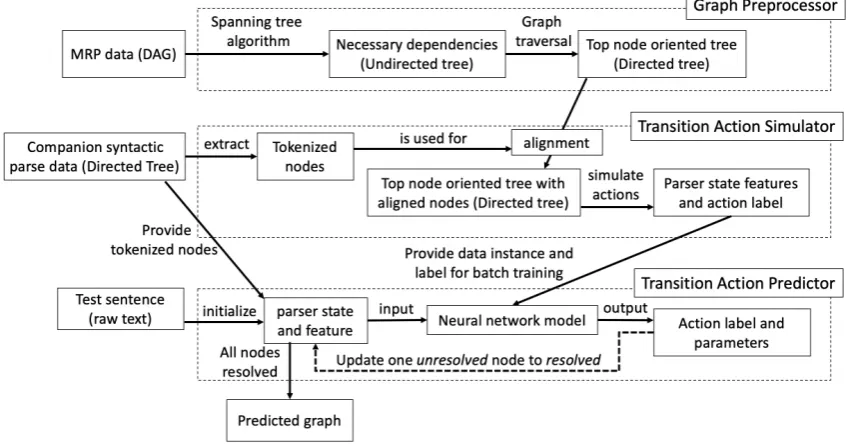
Figure 1: System pipeline diagram.
cessor, we can describe the tree generation process using three common high-level actions — SHIFT,
IGNOREand RESOLVE.
The three actions in our system are most similar to the actions defined in the non-binary bottom-up shift-reduce constituent pars-ing strategy of Fern´andez-Gonz´alez and G´omez-Rodr´ıguez(2018). SHIFTand IGNOREboth have an arity of one. Unlike standard binary RE -DUCE action which handles the relationship be-tween two nodes at a time, RESOLVE is a cross-framework variable-arity action that can reduce multiple nodes and resolve their dependency si-multaneously. We introduce the RESOLVE ac-tion so that there is no need to include addiac-tional binarization of the dependencies and reduce the number of transitions as mentioned by Fern´andez-Gonz´alez and G´omez-Rodr´ıguez. It is also more natural to consider the dependency of multiple nodes jointly as meaning representations like se-mantic frames usually involve multiple arguments.
The main difference between RESOLVER and
the strategy of Fern´andez-Gonz´alez and G´omez-Rodr´ıguezis that their strategy handles only con-stituent parsing problem while RESOLVER can handle cross-framework parsing problem. Our cross-framework RESOLVE action can be
cus-tomized by generating framework-specific sub-graphs.
Our submission ranked 13th overall in the post-evaluation period of the shared task. Although we ranked low in the task, we have experimented with adding variable-arity actions to the transition-based parsing approach and investigated its down-sides. We studied why variable-arity transition ac-tions are hard to learn and propose future direc-tions for improving the system to predict variable-arity transition actions more accurately.
[image:2.595.87.512.194.418.2]2 System Architecture
Our system pipeline (Figure 1) is divided into three main components — DAG-to-Tree prepro-cessor, transition action simulator, and transition action predictor. First, we preprocess the mean-ing representation data and align it with the com-panion syntactic parse data to generate a top-node oriented tree structure. Then, we generate the tran-sition actions required to reproduce the tree struc-ture and extract the feastruc-tures involved in each ac-tion state. Finally, we train the neural network model to predict the correct actions.
2.1 DAG-to-Tree Preprocessor
Although the five frameworks differ in terms of the nodes and edges used, they are essentially convey-ing similar semantic messages. In an attempt to tackle the first generalization problem, our DAG-to-Tree preprocessor focuses on transforming the five frameworks into a common tree representa-tion.
Our preprocessor converts directed acyclic graphs (DAGs) to top-node oriented tree struc-tures. As the top-node of a sentence represents the most important message or word, they are similar amongst the five representations for the same sen-tence. Therefore, we can transform the five rep-resentations to a similar tree structure, where the root of the tree is the top-node.
As there are mature and standardized systems and algorithms for tackling tree-structured syntac-tic parsing, tree approximations schemes for trans-forming semantic dependency graphs to trees have been proposed (Schluter et al.,2014;Agi´c et al., 2015). While most of the proposed schemes are lossy, heuristics are applied to reduce informa-tion loss. For instance, the graphpackingscheme (Schluter et al.,2014) use a set of 99.6%-reversible graph transformations to secure graph informa-tion, and the graph deletionscheme (Agi´c et al., 2015) remove minimum number of edges (worst case 5.7%) from undirected cycles in digraph to generate tree approximation.
2.1.1 Tree Approximation
Following the deletion scheme, we run an algo-rithm based on Kruskal’s spanning tree algoalgo-rithm (Kruskal,1956) to select the edges for forming an undirected tree, and determine the edge direction of the edges in the tree by traversing the graph from top-node to every child recursively. The
lat-ter part is intuitive as the edge direction is unique (anti-arborescence) once the root of the undirected tree is fixed. As for graphs with more than one top node, we find the common ancestor of these top nodes and keep the graph if the ancestor is the root of the tree.
As for the undirected tree generation process, we first sort the nodes according to their appear-ance in the sentence, and assign the nodes with its appearance index in ascending order (i.e. Node anchored to the first word in the sentence have ap-pearance index1).
Then we extract the appearance index of the source node and the target node for each edge, and sort the edge in ascending order first by the max-imum appearance index involved, and then by the minimum appearance index regardless of the edge direction (i.e. An edge with appearance indexes1
and3 will be placed in front of an edge with in-dexes1and5).
Finally, we initialize meaning representation nodes as forest in a graph, and add the sorted edge one by one to the graph if the edge connects to two different trees. After traversing the resulting graph from top-node, a set of edges accompanied with its direction is obtained and we refer to these edges as major edges (e.g. primary edges in UCCA). Other edges not in the major edge set are con-sidered as minor edges. Minor edges can exist in PSD and UCCA, where one node can have mul-tiple parents. For instance, nodes in UCCA can have a non-remote edge (major edge) with label “C” and a remote edge with label “A”. For EDS specifically, edges that involve quantifiers are con-sidered as minor edges at the moment to facilitate alignment.
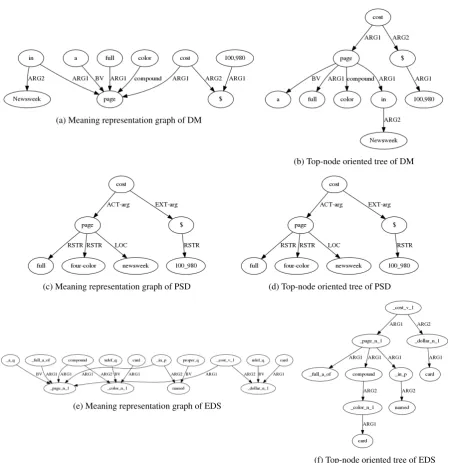
In figure2,2a,2cand2eare the original mean-ing representation graphs and 2b, 2d, 2f are the top-node oriented trees created by using only the major edges after preprocessing. All three frame-works have the same top-node“ cost v 1”.
Edge directions between the node“page” and its children are changed in figure2b as“cost”is the top-node and traverse to node“page” before reaching nodes“a”,“full”,“color”and“in”.
Figure2dis the same as2cas the original graph is a tree and the edges’ direction follow the traver-sal order from top-node.
prepro-(a) Meaning representation graph of DM
(b) Top-node oriented tree of DM
(c) Meaning representation graph of PSD (d) Top-node oriented tree of PSD
(e) Meaning representation graph of EDS
[image:4.595.75.527.56.520.2](f) Top-node oriented tree of EDS
Figure 2: Meaning representation graphs of DM, PSD and EDS frameworks, accompanied with their top-node oriented tree after applying the DAG-to-Tree preprocessor for the sentence“A full, four-color page in Newsweek will cost$100,980.”.
cessing procedures.
After these conversions, by comparing figure 2a, 2c,2e with2b,2d, 2f, we can easily observe that the dependencies for the top-node oriented trees for are more unified as they are aligned with the top-node and its dependencies from the tree root. Despite the difference between DM, PSD and EDS in handling specific words (i.e. “a” is kept in DM and dropped in PSD), the general de-pendency structure is now more similar (i.e. all framework express that node“page”and“$”are necessary for resolving the complete semantics of
the top-node“cost”).
2.1.2 Limitation
2.2 Transition Action Simulator
To solve the second generalization problem, we define three actions: SHIFT, IGNORE and RE -SOLVE as the high-level actions in our action set which is common amongst the five frameworks. The tokenized nodes provided by the morpho-syntactic parse tree are the basic units for apply-ing the actions. We initialize the parser state with a queue that stores all the tokenized nodes and an empty stack that stores the processed tokenized nodes.
2.2.1 Shift and Ignore
SHIFTand IGNOREare two constant-arity actions
identical for all representations, and both apply di-rectly to the first tokenized nodes in the queue. While both actions pop the first tokenized node from the token queue, SHIFT pushes the popped node to the stack and sets its state to unresolved, while IGNORE omits the popped node and move
on to the next tokenized node in the queue. This action is required as the tokenization method of the syntactic parse is different from that of the MRP. Tokenized nodes in the syntactic parse can be ig-nored by the representation, for instance, verbs like “is” are omitted by DM, while it is preserved in PSD. From our observation, whether the word is ignored or not depends on only itself but not its neighbor nodes, so we can apply the action di-rectly to the queue without considering the state of the stack.
2.2.2 Resolve
RESOLVE is a variable-arity and
representation-customizable action. This action is similar to LEFT-REDUCEand RIGHT-REDUCE, but instead of reducing only 2 nodes at each time, RESOLVE
can reduce an arbitrary number of nodes in one single action. We required our system to learn the dependencies of multiple nodes jointly in order to determine frame information in a holistic manner. This action is mainly parameterized by n (ar-ity), the number of nodes from the top of the stack to be reduced (nis a strictly positive integer). The first n nodes must include one and only one un-resolved node (i.e. the most recently pushed un-resolved node in the stack). After anunresolved node is resolved, it is pushed into the stack. As we have obtained a top-node oriented tree repre-sentation from the DAG-to-Tree preprocessor, the dependencies of each node of the tree are defined explicitly and RESOLVE is applied when an
un-resolvednode’s children are all resolved. For in-stance, in Figure 2(b), the top-node of the graph is“cost”and its dependencies is“page”and“$”. To RESOLVEthe node“cost”, we need to first RE
-SOLVE both “page” and “$”, which further de-pends on their own children. The number of re-duced nodenin this case is 3 (2 resolved nodes “page”and“$”plus 1 unresolved node“cost”).3 If a node is a leaf node,nin this case would be 1 as only one node is involved.
After selectingnnodes from the stack, the RE
-SOLVEaction build the edges between theresolved nodes and theunresolvedones, and give node label and properties for the unresolved node. Finally, the resolved node is pushed back to the stack.
2.3 Alignment
Aligning a sentenceS to a graphG = hV, Ei of meaning representation gives a mapping between the tokens of S and V. Formally, given a parse tree ofS with tokenized nodeshN0, N1, . . . , Nni,
with each Ni containing hastart, aendi ofS: pair
of from-to sub-string indices,pos: part of speech tag, and lemma: lemmatized form, we aim to produce an alignment V = hM0, M1, . . . , Mmi,
where each node objectMicontainshastart, aendi:
pair of from-to sub-string indices toS, pos: part of speech tag,f rame: semantic frame (optional) andlabel: node label (Figure3).
As the alignment of the tokenized nodes in the companion parse to the nodes in the meaning rep-resentation graph is not given, we devised align-ment strategies for the respective framework us-ing anchors and parse information. For DM and PSD, an oracle look-ahead algorithm is designed, where the alignment is conducted as guided by a set of heuristic rules manually derived from the train data. For each sentence, the alignment pro-cess proceeds by scanning tokenized nodes of the parse tree from left to right, one at a time. Each node is either ignored or aligned to one node of the meaning representations.
For DM, as white-listed resources are provided, we allow more aggressive grouping and predic-tion on semantic frames. Generally,Mj.pos and
Mj.label will be copied directly from the
cor-responding Ni.pos and Ni.lemma respectively,
with a few exceptions handled the other ways; and Mj.f rame are predicted using a simple
count-based approach with train data. Multi-word
ex-3This corresponds to the last R
Action n Stack Tokenized Node Queue RESOLVEDetails [] [A, full, ...]
SHIFT [A] [full,,...]
RESOLVE 1 [a] [full,,...] Leaf node
SHIFT [a, full] [,, four-color, ...]
RESOLVE 1 [a,full] [,, four-color, ...] Leaf node
IGNORE [a, full] [four-color, page, ...]
SHIFT [a, full, four-color] [page, in, ...]
RESOLVE 1 [a, full,color] [page, in, ...] Leaf node
SHIFT [a, full, color, page] [in, Newsweek, ...] SHIFT [a, full, color, page, in] [Newsweek,will, ...] SHIFT [a, full, color, page, in, Newsweek] [will, cost, ...]
RESOLVE 1 [a, full, color, page, in,Newsweek] [will, cost, ...] Leaf node
RESOLVE 2 [a, full, color, page,in] [will, cost, ...] in−−−→ARG2 Newsweek RESOLVE 5 [page] [will, cost, ...] page−→BV a,page−−−→ARG1 full
page−−−−−→compound color,page−−−→ARG1 in
IGNORE [page] [cost, $, ...]
SHIFT [page, cost] [$, 100,980] SHIFT [page, cost, $] [100,980] SHIFT [page, cost, $, 100,980] []
RESOLVE 1 [page, cost, $,100,980] [] Leaf node
RESOLVE 2 [page, cost,$] [] $−−−→ARG1 100,980
RESOLVE 3 [cost] [] cost−−−→ARG1 page,cost−−−→ARG2 $
[image:6.595.81.511.58.320.2]Initial tokenized nodes queue: [A, full,,, four-color, page, in, Newsweek,will, cost, $, 100,980]
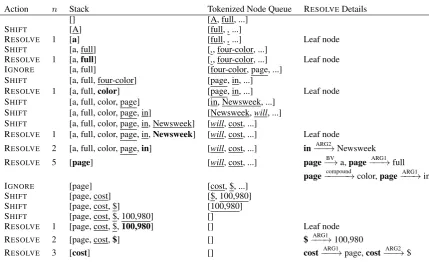
Table 2: Actions required to generate the Figure2(b) graph for the sentence“A full, four-color page in Newsweek will cost$100,980.”. The columnnindicates the number of nodes to be resolved. Whenn = 1, the resolved node is a leaf node. Whenn >1, the column RESOLVEdetails shows the edge involved in the RESOLVEprocess. Resolved nodes are in normal font. Unresolved nodes are underlined, and the nodes to be resolved in each action are denoted in boldface. The number of RESOLVEin the actions is the same as the number of nodes in the top-node oriented tree. The two IGNOREactions ignore the tokenized nodes“,”and“will”respectively.
Figure 3: Example of alignment of nodes of DM meaning representation.
pressions (MWE) are also accounted for during the alignment through a greedy look-ahead mech-anism, i.e. searching for MWE inS that appeared in train data or the SDP 2016 data (Oepen et al., 2016), which is one of the white-listed resources for the task. Figure 3 illustrates the alignment process from tokenized nodes to nodes of DM representation: MWE “such as” is handled with heuristics to produce two nodes; “crops” is lem-matized as the label of the produced node; Frames are copied except for punctuation “,”, which is ig-nored. Details of the alignment process are pro-vided in the supplementary material.
For PSD, only frames that appeared in train data were inferred. Similar to the approach for DM, alignment is generally done by copying Mj.pos
andMj.labelfrom the correspondingNi.posand
Ni.lemmarespectively; andMj.f rameare
pre-dicted only for verbs using the same count-based approach as for DM. Multi-word expressions are also accounted for during the alignment process through a greedy look-ahead mechanism. PSD also includes the use of non-lexical nodes for ab-stract concepts (e.g. #perspron for personal pro-noun), and they are aligned toNifirst, if possible,
[image:6.595.77.526.435.546.2](a) Original sentence with current node, nodes before the current node (previous) and nodes after the current node (Next) annotated.
[image:7.595.75.514.59.102.2](b) Node prediction.
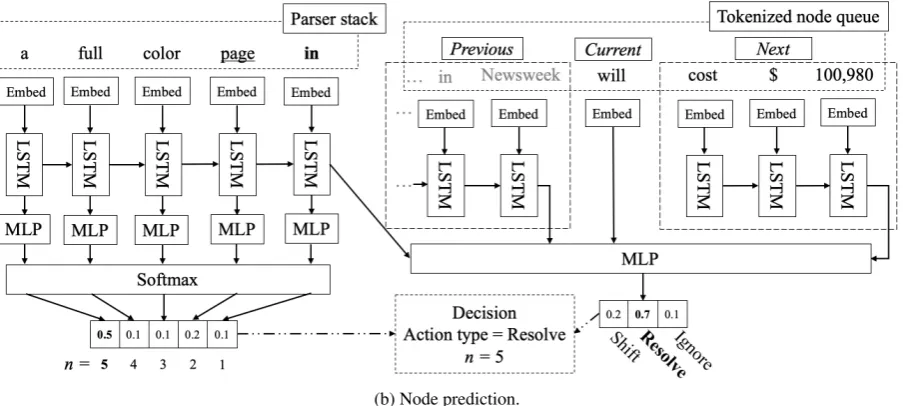
Figure 4: Neural network architecture diagram of Action type prediction.
For both DM and PSD, given the tokens, frame predictions are done by a simple count-based method, i.e. we choose the most-occurred frame as in the train data given each token; if no such token is found in train data, we choose the first frame from the frame inventories of DM and PSD (white-listed resources) for the corresponding to-ken or lemma. More robust statistical methods for frame prediction are left for future work.
For EDS and UCCA, we use exact matching policy to match the anchors of the tokenized with the graph nodes. If one tokenized node is mapped to multiple graph nodes, we drop the whole graph in the current system. For AMR, we use the JAMR (Flanigan et al., 2014) alignment provided in the companion data to align the unanchored nodes to the tokenized nodes.
2.4 Neural Network Model
To determine the correct action for a particular parser state, we use two neural network models to first decide what action should be taken, and de-termine the framework details if the action is RE
-SOLVE.
2.4.1 Action Type Prediction
Figure 4 describes the neural network architec-ture for predicting the actions. The nodes in the
[image:7.595.75.527.134.337.2](a) Edge predictions whenn >1.
[image:8.595.71.276.61.346.2](b) Node prediction.
Figure 5: Neural network architecture diagram of RE-SOLVEprediction.
2.4.2 Resolve Prediction
Figure5 pictures the neural network architecture for predicting the label and properties of the nodes and edges in the RESOLVEprocess. If a leaf node
is to be resolved (n = 1), then no edge is in-volved. we use the feature embedding of the unre-solved node as input, and pass it to feature specific MLP for predicting the node label and properties. If more than one node is involved (n > 1), then we, in addition, predict the edge information by passing the feature embedding to an LSTM layer, followed by feature-specific MLPs for predicting edge label and directions.
2.4.3 Multi-Task Learning
To enable multi-task learning, we use the same neural network model for parsing all five frame-works. We shared the parameters of word embed-dings and LSTM layers across frameworks, and separate the MLP parameters for each framework.
3 Training
3.1 Data
We use the official dataset as the development set to train our system. We use the DAG-to-Tree pre-processor and action simulator to generate action
snapshots of the parser state features (parser stack and tokenized node queue) and action labels for each action applied, acting as the data instances for training the neural network model. A total of 169,780 MRP-parse data pairs are given, for which we generate 2,434,026 action snapshots as training data instances. Our system is required to predict the MRP graphs for 13,206 unseen sen-tences.
3.2 Implementation Details
Our system is packaged as an AllenNLP library (Gardner et al.,2017), which comprises DAG-to-Tree preprocessors, dataset readers, training in-stance iterators, neural network models and MRP graph predictors. The neural network model is im-plemented using Pytorch and support training with either CPU or single GPU setting. Time required for each procedure is summarized in table3.
Procedures Required Time
(hour)
Run DAG-to-Tree preprocessor and action simulator using training data 10 Use AllenNLP data reader to read
data instances 1.5 Train the neural network model
(single GPU setting)
30 in total (2 per epoch) Predict the MRP graph of testing data 8
[image:8.595.307.525.332.437.2]Total 49.5
Table 3: Running time for each procedure.
3.3 Batch training
As each graph is broken down into training in-stances for each action and the size of the inin-stances is large, batch training is necessary to speed up the training process. We group the data instance into mini-batch of size 100 by their prediction type (whether it is action type prediction or resolve pre-diction), meaning representation framework, and the length of the stack and queue to facilitate batch training. Both training batches and training in-stances in the same framework batch are shuffled in each epoch.
4 Results and Discussion
4.1 Official Results
Submissions P topsR F P labelsR F P propertiesR F P anchorsR F P edgesR F
TUPA(multi) 0.67 0.57 0.616 0.40 0.55 0.457 0.29 0.42 0.327 0.68 0.60 0.626 0.30 0.45 0.347 RESOLVER 0.51 0.50 0.502 0.34 0.40 0.365 0.29 0.35 0.317 0.55 0.59 0.568 0.10 0.10 0.095
Submissions attributes all
P R F P R F
[image:9.595.74.528.62.147.2]TUPA(multi) 0.06 0.03 0.037 0.39 0.57 0.453 RESOLVER 0.00 0.00 0.00 0.36 0.41 0.378
Table 4: Final results of our system compared with the transition based parser TUPA. All scores are calculated according to the MRP metric.
system performs slightly worse than TUPA in gen-eral, while we performed much worse in the edges component.
4.2 Discussion
We analyze our system and investigate three rea-sons for causing the low performance.
• Variable-arity actions are hard to learn. Our system predicts the action type with accu-racy around 0.8 across frameworks, but can-not predict the number of nodes, i.e. n, to be reduced well (less than 0.35). As the num-ber of training instances withn= 1is much larger than that of n > 1, we believe the unbalanced number of training examples can be a hindrance for learning to predictn cor-rectly.
• Information loss happens when converting graphs to tree structures. As we are using the DAG-to-Tree preprocessor to convert graphs to top-node oriented trees using major edges, we ignore minor edges in the current model and loss features for predicting the action and chances for predicting them. Moreover, we cannot find direct and empirical proof of why this top-node oriented tree conversion can help the parsing process.
• Model design can still be improved. There are numerous variations including neural net-work architecture, hyperparameters, action set, feature set, etc, that our team can exper-iment with under the variable-arity transition action and top-node oriented tree paradigm. More time is required to test if this is a valid approach to tackle the parsing problem in general.
5 Conclusion
We present RESOLVER, the first transition-based parser with top-node oriented DAG-to-Tree
pre-processor and variable-arity actions to the best of our knowledge. We aim to create a general-ized representation and parsing steps of the five graphs. We discuss the benefits and limitations of adding variable-arity actions, and we will continue to work on our system to show the practical useful-ness of allowing variable-arity transition actions in transition-based meaning representation parsers.
References
Omri Abend and Ari Rappoport. 2013. Universal con-ceptual cognitive annotation (ucca). In Proceed-ings of the 51st Annual Meeting of the Association for Computational Linguistics (Volume 1: Long Pa-pers), pages 228–238.
ˇ
Zeljko Agi´c, Alexander Koller, and Stephan Oepen. 2015. Semantic dependency graph parsing using tree approximations. In Proceedings of the 11th International Conference on Computational Seman-tics, pages 217–227.
Laura Banarescu, Claire Bonial, Shu Cai, Madalina Georgescu, Kira Griffitt, Ulf Hermjakob, Kevin Knight, Philipp Koehn, Martha Palmer, and Nathan Schneider. 2013. Abstract meaning representation for sembanking. InProceedings of the 7th Linguis-tic Annotation Workshop and Interoperability with Discourse, pages 178–186.
Daniel Fern´andez-Gonz´alez and Carlos G´omez-Rodr´ıguez. 2018. Faster shift-reduce constituent parsing with a non-binary, bottom-up strategy.
arXiv preprint arXiv:1804.07961.
Jeffrey Flanigan, Sam Thomson, Jaime Carbonell, Chris Dyer, and Noah A Smith. 2014. A discrim-inative graph-based parser for the abstract mean-ing representation. InProceedings of the 52nd An-nual Meeting of the Association for Computational Linguistics (Volume 1: Long Papers), pages 1426– 1436.
Zhijiang Guo and Wei Lu. 2018. Better transition-based amr parsing with a refined search space. In
Proceedings of the 2018 Conference on Empirical Methods in Natural Language Processing, pages 1712–1722.
Jan Hajic, Eva Hajicov´a, Jarmila Panevov´a, Petr Sgall, Ondrej Bojar, Silvie Cinkov´a, Eva Fuc´ıkov´a, Marie Mikulov´a, Petr Pajas, Jan Popelka, et al. 2012. Announcing prague czech-english dependency tree-bank 2.0. InLREC, pages 3153–3160.
Daniel Hershcovich, Omri Abend, and Ari Rappoport. 2017. A transition-based directed acyclic graph parser for ucca.arXiv preprint arXiv:1704.00552.
Daniel Hershcovich and Ofir Arviv. 2019. TUPA at MRP 2019: A multi-task baseline system. In Pro-ceedings of the Shared Task on Cross-Framework Meaning Representation Parsing at the 2019 Con-ference on Natural Language Learning, pages 28 – 39, Hong Kong, China.
Sepp Hochreiter and J¨urgen Schmidhuber. 1997. Long short-term memory. Neural computation, 9(8):1735–1780.
Angelina Ivanova, Stephan Oepen, Lilja Øvrelid, and Dan Flickinger. 2012. Who did what to whom?: A contrastive study of syntacto-semantic dependen-cies. InProceedings of the sixth linguistic annota-tion workshop, pages 2–11. Association for Compu-tational Linguistics.
Joseph B Kruskal. 1956. On the shortest spanning sub-tree of a graph and the traveling salesman problem.
Proceedings of the American Mathematical society, 7(1):48–50.
Yusuke Miyao, Stephan Oepen, and Daniel Zeman. 2014. In-house: An ensemble of pre-existing off-the-shelf parsers. InProceedings of the 8th Interna-tional Workshop on Semantic Evaluation (SemEval 2014), pages 335–340.
Joakim Nivre. 2008. Algorithms for deterministic in-cremental dependency parsing. Computational Lin-guistics, 34(4):513–553.
Stephan Oepen, Omri Abend, Jan Hajiˇc, Daniel Her-shcovich, Marco Kuhlmann, Tim O’Gorman, Nian-wen Xue, Jayeol Chun, Milan Straka, and Zdeˇnka Ureˇsov´a. 2019. MRP 2019: Cross-framework Meaning Representation Parsing. InProceedings of the Shared Task on Cross-Framework Meaning Rep-resentation Parsing at the 2019 Conference on Nat-ural Language Learning, pages 1 – 27, Hong Kong, China.
Stephan Oepen, Marco Kuhlmann, Yusuke Miyao, Daniel Zeman, Silvie Cinkov´a, Dan Flickinger, Jan Hajic, Angelina Ivanova, and Zdenka Uresova. 2016. Towards comparability of linguistic graph banks for semantic parsing. In Proceedings of the Tenth International Conference on Language Re-sources and Evaluation (LREC 2016), pages 3991– 3995.
Stephan Oepen and Jan Tore Lønning. 2006. Discriminant-based mrs banking. In LREC, pages 1250–1255.
Jeffrey Pennington, Richard Socher, and Christopher Manning. 2014. Glove: Global vectors for word representation. InProceedings of the 2014 confer-ence on empirical methods in natural language pro-cessing (EMNLP), pages 1532–1543.
Natalie Schluter, Anders Søgaard, Jakob Elming, Dirk Hovy, Barbara Plank, Hector Martinez Alonso, Anders Johanssen, and Sigrid Klerke. 2014. Copenhagen-malm¨o: Tree approximations of se-mantic parsing problems. In Proceedings of the 8th International Workshop on Semantic Evaluation (SemEval 2014), pages 213–217.