Knowledge-Based and Statistical Techniques
Dina Demner-Fushman
∗University of Maryland, College Park
Jimmy Lin
†University of Maryland, College Park
The combination of recent developments in question-answering research and the availability of unparalleled resources developed specifically for automatic semantic processing of text in the medical domain provides a unique opportunity to explore complex question answering in the domain of clinical medicine. This article presents a system designed to satisfy the information needs of physicians practicing evidence-based medicine. We have developed a series of knowl-edge extractors, which employ a combination of knowlknowl-edge-based and statistical techniques, for automatically identifying clinically relevant aspects of MEDLINE abstracts. These extracted elements serve as the input to an algorithm that scores the relevance of citations with respect to structured representations of information needs, in accordance with the principles of evidence-based medicine. Starting with an initial list of citations retrieved by PubMed, our system can bring relevant abstracts into higher ranking positions, and from these abstracts generate responses that directly answer physicians’ questions. We describe three separate evaluations: one focused on the accuracy of the knowledge extractors, one conceptualized as a document reranking task, and finally, an evaluation of answers by two physicians. Experiments on a collection of real-world clinical questions show that our approach significantly outperforms the already competitive PubMed baseline.
1. Introduction
Recently, the focus of question-answering research has shifted away from simple fact-based questions that can be answered with relatively little linguistic knowledge to “harder” questions that require fine-grained text analysis, reasoning capabilities, and the ability to synthesize information from multiple sources. General purpose reasoning on anything other than superficial lexical relations is exceedingly difficult because there is a vast amount of world knowledge that must be encoded, either manually or auto-matically, to overcome the brittleness often associated with long chains of evidence. This situation poses a serious bottleneck to “advanced” question-answering systems. How-ever, the availability of existing knowledge sources and ontologies in certain domains provides exciting opportunities to experiment with knowledge-rich approaches. How might one go about leveraging these resources effectively? How might one integrate
∗Department of Computer Science and Institute for Advanced Computer Studies. E-mail: [email protected].
†College of Information Studies, Department of Computer Science, and Institute for Advanced Computer Studies. E-mail: [email protected].
statistical techniques to overcome the brittleness often associated with knowledge-based approaches?
We explore these interesting research questions in the domain of medicine, fo-cusing on the information needs of physicians in clinical settings. This domain is well-suited for exploring the posed research questions for several reasons. First, substantial understanding of the domain has already been codified in the Unified Medical Language System (UMLS) (Lindberg, Humphreys, and McCray 1993). Sec-ond, software for utilizing this ontology already exists: MetaMap (Aronson 2001) identifies concepts in free text, and SemRep (Rindflesch and Fiszman 2003) extracts relations between the concepts. Both systems utilize and propagate semantic infor-mation from UMLS knowledge sources: the Metathesaurus, the Semantic Network, and the SPECIALIST lexicon. The 2004 version of the UMLS Metathesaurus (used in this work) contains information about over 1 million biomedical concepts and 5 million concept names from more than 100 controlled vocabularies. The Seman-tic Network provides a consistent categorization of all concepts represented in the UMLS Metathesaurus. Third, the paradigm of evidence-based medicine (Sackett et al. 2000) provides a task-based model of the clinical information-seeking process. The PICO framework (Richardson et al. 1995) for capturing well-formulated clinical queries (described in Section 2) can serve as the basis of a knowledge representation that bridges the needs of clinicians and analytical capabilities of a system. The conflu-ence of these many factors makes clinical question answering a very exciting area of research.
Furthermore, the need to answer questions related to patient care at the point of service has been well studied and documented (Covell, Uman, and Manning 1985; Gorman, Ash, and Wykoff 1994; Ely et al. 1999, 2005). MEDLINE, the authoritative repository of abstracts from the medical and biomedical primary literature maintained by the National Library of Medicine, provides the clinically relevant sources for answer-ing physicians’ questions, and is commonly used in that capacity (Cogdill and Moore 1997; De Groote and Dorsch 2003). However, studies have shown that existing systems for searching MEDLINE (such as PubMed, the search service provided by the National Library of Medicine) are often inadequate and unable to supply clinically relevant answers in a timely manner (Gorman, Ash, and Wykoff 1994; Chambliss and Conley 1996). Furthermore, it is clear that traditional document retrieval technology applied to MEDLINE abstracts is insufficient for satisfactory information access; research and experience point to the need for systems that automatically analyze text and return only the relevant information, appropriately summarizing and fusing segments from multiple texts. Not only is clinical question answering interesting from a research perspective, it also represents a potentially high-impact, real-world application of lan-guage processing and information retrieval technology—better information systems to provide decision support for physicians have the potential to improve the quality of health care.
of MEDLINE citations in accordance with the principles of EBM. Our scorer is em-ployed to rerank citations retrieved by the PubMed search engine, with the goal of bringing as many topically relevant abstracts to higher ranking positions as possible. From this reranked list of citations, our system is then able to generate textual re-sponses that directly address physicians’ information needs. We evaluated our system with a collection of real-world clinical questions and demonstrate that our combined knowledge-based and statistical approach delivers significantly better document re-trieval and question-answering performance, compared to systems used by physicians today.
This article is organized in the following manner: We start in the next section with an overview of evidence-based medicine and its basic principles. Section 3 provides an overview of MEDLINE, the bibliographic database used by our system, and PubMed, the public gateway for accessing this database. Section 4 describes our system architec-ture and outlines our conception of clinical question answering as “semantic unifica-tion” between query frames and knowledge frames derived from MEDLINE citations. The knowledge extractors that underlie our approach are described in Section 5, along with intrinsic evaluations of each component. In Section 6, we detail an algorithm for scoring the relevance of MEDLINE citations with respect to structured query represen-tations. This scoring algorithm captures the principles of EBM and uses the results of the knowledge extractors as basic features. To evaluate the performance of this citation scoring algorithm, we have gathered a corpus of real-world clinical questions. Section 7 presents results from a document reranking experiment where our EBM scores were used to rerank citations retrieved by PubMed. Section 8 provides additional details on attempts to optimize the performance of our EBM citation scoring algorithm. Answer generation, based on reranked results, is described in Section 9. Answers from our system were manually assessed by two physicians; results are presented in Section 10. Related work is discussed in Section 11, followed by future work in Section 12. Finally, we conclude in Section 13.
2. The Framework of Evidence-Based Medicine
Evidence-based medicine (EBM) is a widely accepted paradigm for medical practice that involves the explicit use of current best evidence, that is, high-quality patient-centered clinical research such as reports from randomized controlled trials, in mak-ing decisions about patient care. Naturally, such evidence, as reported in the primary medical literature, must be suitably integrated with the physician’s own expertise and patient-specific factors. It is argued by many that practicing medicine in this manner leads to better patient outcomes and higher quality health care. The goal of our work is to develop question-answering techniques that complement this paradigm of medical practice.
EBM offers three orthogonal facets that, when taken together, provide a framework for codifying the knowledge involved in answering clinical questions. These three complementary facets are outlined below.
The first facet describes the four main clinical tasks that physicians engage in (arranged roughly in order of prevalence):
Diagnosis: This encompasses two primary types:
Differential diagnosis: Identifying and ranking by likelihood potential diseases based on findings observed in a patient.
Diagnostic test: Selecting and interpreting diagnostic tests for a patient, consid-ering their precision, accuracy, acceptability, cost, and safety.
Etiology/Harm: Identifying factors that cause a disease or condition in a patient. Prognosis: Estimating a patient’s likely course over time and anticipating likely
complications.
These activities represent what Ingwersen (1999) calls “work tasks.” It is important to note that they exist independently of information needs, namely, searching is not necessarily implicated in any of these activities. We are, however, interested in situations where questions arise during one of these clinical tasks—only then does the physician engage in information-seeking behavior. These activities translate into natural “search tasks.” For therapy, the search task is usuallytherapy selection(for example, determining which course of action is the best treatment for a disease) orprevention (for example, selecting preemptive measures with respect to a particular disease). For diagnosis, there are two different possibilities: in differential diagnosis, a physician is consider-ing multiple hypotheses regardconsider-ing what disease a patient has; in diagnostic methods selection, the clinician is attempting to ascertain the relative utility of different tests. For etiology, cause determination is the search task, and for prognosis, patient outcome prediction.
Terms and the types of studies relevant to each of the four tasks have been exten-sively studied by the Hedges Project at the McMaster University (Haynes et al. 1994; Wilczynski, McKibbon, and Haynes 2001). The results of this research are implemented in the PubMed Clinical Queries tools, which can be used to retrieve task-specific cita-tions (more about this in the next section).
The second facet is independent of the clinical task and pertains to the struc-ture of a well-built clinical question. The following four components have been iden-tified as the key elements of a question related to patient care (Richardson et al. 1995):
r
What is the primary problem or disease? What are the characteristics of the patient (e.g., age, gender, or co-existing conditions)?r
What is the main intervention (e.g., a diagnostic test, medication, or therapeutic procedure)?r
What is the main intervention compared to (e.g., no intervention, another drug, another therapeutic procedure, or a placebo)?r
What is the desired effect of the intervention (e.g., cure a disease, relieve or eliminate symptoms, reduce side effects, or lower cost)?These four elements are often referenced with the mnemonic PICO, which stands for Patient/Problem, Intervention, Comparison, and Outcome.
quality of evidence, due to its emphasis on the use of patient-oriented outcomes and its attempt to unify other existing taxonomies (Ebell et al. 2004). There are three levels of recommendations according to SORT:
r
A-level evidenceis based on consistent, good-quality patientoutcome-oriented evidence presented in systematic reviews, randomized controlled clinical trials, cohort studies, and meta-analyses.
r
B-level evidenceis inconsistent, limited-quality, patient-oriented evidence in the same types of studies.r
C-level evidenceis based on disease-oriented evidence or studies less rigorous than randomized controlled clinical trials, cohort studies, systematic reviews, and meta-analyses.A question-answering system designed to support the practice of evidence-based medicine must be sensitive to the multifaceted considerations that go into evaluating an abstract’s relevance to a clinical information need. It is exactly these three comple-mentary facets that we attempt to encode in a question-answering system for clinical decision support.
3. MEDLINE and PubMed
MEDLINE is a large bibliographic database maintained by the U.S. National Library of Medicine (NLM). This database is viewed by medical professionals, biomedical researchers, and many other users as the authoritative source of clinical evidence, and hence we have adopted it as the target corpus for our clinical question-answering sys-tem. MEDLINE contains over 15 million references to articles from approximately 4,800 journals in 30 languages, dating back to the 1960s. In 2004, over 571,000 new citations were added to the database, and it continues to grow at a steady pace. The subject scope of MEDLINE is biomedicine and health, broadly defined to encompass those areas of the life sciences, behavioral sciences, chemical sciences, and bioengineering needed by health professionals and others engaged in basic research and clinical care, public health, health policy development, or related educational activities. MEDLINE also covers life sciences vital to biomedical practitioners, researchers, and educators, including aspects of biology, environmental science, marine biology, plant and animal science, as well as biophysics and chemistry.1
Each MEDLINE citation includes basic information such as the title of the article, name of the authors, name of the publication, publication type, date of publication, language, and so on. Of the entries added over the last decade or so, approximately 76% have English abstracts written by the authors of the articles—these texts provide the source for answers extracted by our system.
Additional metadata are associated with each MEDLINE citation. The most impor-tant of these is the controlled vocabulary terms assigned by human indexers. NLM’s controlled vocabulary thesaurus, Medical Subject Headings (MeSH),2contains approx-imately 23,000 descriptors arranged in a hierarchical structure and more than 151,000 Supplementary Concept Records (additional chemical substance names) within a
1http://www.nlm.nih.gov/pubs/factsheets/medline.html
separate thesaurus. Indexing is performed by approximately 100 indexers with at least bachelor’s degrees in life sciences and formal training in indexing provided by NLM. Since mid-2002, the Library has been employing software that automatically suggests MeSH headings based on content (Aronson et al. 2004). Nevertheless, the indexing process remains firmly human-centered.
As a concrete example, an abstract titled “Antipyretic efficacy of ibuprofen vs. acetaminophen” might have the following MeSH headings associated with it:
MH - Acetaminophen/*therapeutic use MH - Child
MH - Comparative Study MH - Fever/*drug therapy MH - Ibuprofen/*therapeutic use
To represent different aspects of the topic described by a particular MeSH heading, up to three subheadings may be assigned, as indicated by the slash notation. In this example, a trained user could interpret from the MeSH terms that the article is about drug therapy for fever and the therapeutic use of ibuprofen and acetaminophen. An asterisk placed next to a MeSH heading indicates that the human indexer interprets the term to be the main focus of the article. Multiple MeSH terms can be notated in this manner.
MEDLINE is publicly accessible on the World Wide Web through PubMed, the Na-tional Library of Medicine’s gateway, or through third-party organizations that license MEDLINE from NLM. PubMed is a sophisticated boolean search engine that allows users to query not only on abstract text, but also on metadata fields such as MeSH terms. In addition, PubMed provides a number of pre-defined “search templates” called Clin-ical Queries (Haynes et al. 1994; Wilczynski, McKibbon, and Haynes 2001) that allow users to narrow the scope of retrieved articles. These filters are implemented as fixed boolean query fragments (containing restrictions on MeSH terms, for example) that are appended to the original user query. Our experiments involve the use of PubMed to retrieve an initial set of candidate citations for subsequent processing.
4. System Architecture
We view clinical question answering as “semantic unification” between information needs expressed in a PICO-based frame and corresponding structures automatically extracted from MEDLINE citations. In accordance with the principles of EBM, this matching process should be sensitive to the nature of the clinical task and the strength of evidence of retrieved abstracts.
As a concrete example, consider the following clinical question:
In children with an acute febrile illness, what is the efficacy of single-medication therapy with acetaminophen or ibuprofen in reducing fever?
The information need might be formally encoded in the following manner:
Search Task:therapy selection
Problem/Population:acute febrile illness/in children
Intervention:acetaminophen
Comparison:ibuprofen
This query representation explicitly encodes the search task and the PICO structure of the clinical question. After processing MEDLINE citations, automatically extracting PICO elements from the abstracts, and semantically matching these elements with the query, a system might produce the following answer:
Ibuprofen provided greater temperature decrement and longer duration of antipyresis than acetaminophen when the two drugs were administered in approximately equal doses.
PMID: 1621668
Strength of Evidence: grade A
Physicians are usually most interested in outcome statements that assert a patient-oriented clinical finding—for example, the relative efficacy of two drugs. Thus, out-comes can serve as the basis for good answers and an entry point into the full text. The system should automatically evaluate the strength of evidence of the citations supplying the answer, but the decision to adopt the recommendations as suggested ultimately rests with the physician.
What is the best input to a clinical question-answering system? Two possibilities include a natural language question or a structured PICO query frame. We advocate the latter. With a frame-based query interface, the physician shoulders the burden of translating an information need into a frame-based representation, but this provides several advantages. Most importantly, formal representations force physicians to “think through” their questions, ensuring that relevant elements are captured. Poorly formu-lated queries have been identified by Ely et al. (2005) as one of the obstacles to finding answers to clinical questions. Because well-formed questions should have concretely instantiated PICO slots, a frame representation clearly lets the physician see missing elements. In addition, a structured query representation obviates the need for linguistic analysis of a natural language question, where ambiguities may negatively impact overall performance. We discuss alternative interfaces in Section 12.
Ideally, we would like to match structured representations derived from the ques-tion with those derived from MEDLINE citaques-tions (taking into consideraques-tion other EBM-relevant factors). However, we do not have access to the computational resources nec-essary to apply knowledge extractors to the 15 million plus citations in the MEDLINE database and directly index their results. As an alternative, we rely on PubMed to retrieve an initial set of hits that we then postprocess in greater detail—this is the standard pipeline architecture commonly employed in other question-answering sys-tems (Voorhees and Tice 1999; Hirschman and Gaizauskas 2001).
The architecture of our system is shown in Figure 1. The query formulator is respon-sible for converting a clinical question (in the form of a query frame) into a PubMed search query. Presently, these queries are already encoded in our test collection (see Section 6). PubMed returns an initial list of MEDLINE citations, which is then analyzed by our knowledge extractors (see Section 5). The input to the semantic matcher, which implements our EBM citation scoring algorithm, is the query frame and annotated MEDLINE citations. The module outputs a ranked list of citations that have been scored in accordance with the principles of EBM (see Section 6). Finally, the answer generator takes these citations and extracts appropriate answers (see Section 9).
Figure 1
Architecture of our clinical question-answering system.
citations, and answer generation. We have realized all three capabilities in an imple-mented clinical question-answering system and conducted three separate evaluations to assess the effectiveness of our developed capabilities. We do not tackle the query formulator, although see discussion in Section 12. Overall, results indicate that our implemented system significantly outperforms the PubMed baseline.
5. Knowledge Extraction for Evidence-Based Medicine
The automatic extraction of PICO elements from MEDLINE citations represents a key capability integral to clinical question answering. This section, which elaborates on preliminary results reported in Demner-Fushman and Lin (2005), describes extraction algorithms for population, problems, interventions, outcomes, and the strength of evi-dence. For an example of a completely annotated abstract, see Figure 2. Each individual PICO extractor takes as input the abstract text of a MEDLINE citation and identifies the relevant elements: Outcomes are complete sentences, while population, problems, and interventions are short noun phrases.
Our knowledge extractors rely extensively on MetaMap (Aronson 2001), a system for identifying segments of text that correspond to concepts in the UMLS Metathe-saurus. Many of our algorithms operate at the level of coarser-grained semantic types called Semantic Groups (McCray, Burgun, and Bodenreider 2001), which capture higher-level generalizations about entities (e.g., CHEMICALS& DRUGS). An additional feature we take advantage of (when present) is explicit section markers present in some abstracts. These so-called structured abstracts were recommended by the Ad Hoc Work-ing Group for Critical Appraisal of the Medical Literature (1987) to help humans assess the reliability and content of a publication and to facilitate the indexing and retrieval processes. These abstracts loosely adhere to the introduction, methods, results, and conclusions format common in scientific writing, and delineate a study using explicitly marked sections with variations of the above headings. Although many core clinical journals require structured abstracts, there is a great deal of variation in the actual headings. Even when present, the headings are not organized in a manner focused on patient care. In addition, abstracts of much high-quality work remain unstructured. For these reasons, explicit section markers are not entirely reliable indicators for the various semantic elements we seek to extract, but must be considered along with other sources of evidence.
extrac-tor, in contrast, is implemented as an ensemble of classifiers trained using supervised machine learning techniques (Demner-Fushman et al. 2006). These two very different approaches can be attributed to differences in the nature of the frame elements: Whereas problems and interventions can be directly mapped to UMLS concepts, and populations easily mapped to patterns that include UMLS concepts, outcome statements follow no predictable pattern. The initial goal of the annotation effort was to identify outcome statements in abstract text. A physician, two registered nurses, and an engineering researcher manually identified sentences that describe outcomes in 633 MEDLINE abstracts; a post hoc analysis demonstrates good agreement (κ=0.77). The annotated abstracts were retrieved using PubMed and attempted to model different user behaviors ranging from naive to expert (where advanced search features were employed). With the exception of 50 citations retrieved to answer a question about childhood immunization, the rest of the results were retrieved by querying on a disease, for example, diabetes. Of the 633 citations, 100 abstracts were also fully annotated with population, problems, and interventions. These 100 abstracts were set aside as a held-out test set. Of the remaining citations, 275 were used for training and rule derivation, as described in the following sections.
After much exploration, Demner-Fushman et al. (2006) discovered that it was not practical to annotate PICO entities at the phrase level due to significant unresolvable disagreement and interannotator reliability issues. Consider the following segment:
This double-blind, placebo-controlled, randomized, 3-period, complete block, 6-week crossover study examined the efficacy of simvastatin in adult men and women (N = 151) with stable type 2 DM, low density lipoprotein-cholesterol 100 mg/dL, HDL-C<
40 mg/dL, and fasting triglyceride level>150 and<700 mg/dL.
All annotators agreed that the sentence contained the problem, population, and intervention. However, they could not agree on the exact phrasal boundaries of each element, and more importantly, general guidelines for ensuring consistent annotations. For example, should the whole clause starting withadult men and womenbe marked as population, or should type 2 Diabetes Mellitus (type 2 DM) be marked up only as the problem? How should we indicate that the cholesterol levels description belongs to 151 subjects of the study, and so forth? This issue becomes important for evaluation because there is a mismatch between annotated ground truth and the output of our knowledge extractors, as we will discuss.
In what follows, we describe each of the individual PICO extractors and a series of component evaluations that assess their accuracy. This section is organized such that the description of each extractor and its evaluation are paired together. Results are reported in terms of the percentage of correctly identified instances, percentage of instances for which the extractor had no answer, and percentage of incorrectly identified instances. The baselines and gold standards for each extractor vary, and will be described in-dividually. The goal of these component evaluations is a general characterization of performance, as we focused the majority of our efforts on the two other evaluations.
5.1 Population Extractor
the population (of which a particular patient can be viewed as a sample therefrom) and the problem, we chose to separate the extraction of the two elements because they are not always specified together in abstracts (issues with respect to exact boundaries men-tioned previously notwithstanding). Furthermore, many clinical questions ask about a particular problem without specifying a population.
Population elements, which are typically noun phrases, are identified using a series of manually crafted rules that codify the following assumptions:
r
The concept describing the population belongs to the semantic type GROUPor any of its children. In addition, certain nouns are often used todescribe study participants in medical texts; for example, an often observed pattern is “subjects” or “cases” followed by a concept from the semantic group DISORDER.
r
The number of subjects that participated in the study often precedes or follows a concept identified as a GROUP. In the latter case, the number is sometimes given in parentheses using a common pattern n =number, where “n = ” is a shorthand for the number of subjects, andnumber provides the actual number of study participants.r
The confidence that a clause with an identified number and GROUP contains information about the population is inversely proportional to the distance between the two entities.r
The confidence that a clause contains the population is influenced by the position of the clause, with respect to headings in the case of structured abstracts and with respect to the beginning of the abstract in the case of unstructured abstracts.Given these assumptions, the population extractor searches for the following patterns:
r
GROUP([Nn]=[0–9]+)for example,in 5–6-year-old French children (n=234), Subjects (n=54)
r
number* GROUPfor example,forty-nine infants
r
number* DISORDER* GROUP?for example,44 HIV-infected children
The confidence score assigned to a particular pattern match is a function of both its position in the abstract and its position in the clause from which it was extracted. If a number is followed by a measure, for example,yearorpercent, the number is discarded, and pattern matching continues. After the entire abstract is processed in this manner, the match with the highest confidence value is retained as the population description.
5.2 Evaluation of Population Extractor
popu-Table 1
Evaluation of the population extractor.
Correct (%) Unknown (%) Wrong (%)
Baseline 53 – 47
Extractor 80 10 10
lation extractor was judged to be correct if it occurred in a sentence that was annotated as containing the population in the gold standard. Note that this evaluation presents an upper bound on the performance of the population extractor, whose outputs are noun phrases. We adopted such a lenient evaluation setup because of the boundary issues previously discussed, and also to forestall potential difficulties with scoring partially overlapping string matches.
For comparison, our baseline simply returned the first three sentences of the ab-stract. We considered the baseline correct if any one of the sentences were annotated as containing the population in the gold standard (an even more lenient criterion). This baseline was motivated by the observation that the aim and methods sections of structured abstracts are likely to contain the population information—for structured ab-stracts, explicit headings provide structural cues; for unstructured abab-stracts, positional information serves as a surrogate.
The performance of the population extractor is shown in Table 1. A manual error analysis revealed three sources of error: First, not all population descriptions contain a number explicitly, for example, The medical charts of all patients who were treated with etanercept for back or neck pain at a single private medical clinic in 2003.Second, not all study populations are population groups, as for example inAll primary care trusts in England. Finally, tagging and chunking errors propagate to the semantic type assignment level and affect the quality of MetaMap output. For example, consider the following sentence:
We have compared the LD and recombination patterns defined by single-nucleotide polymorphisms in ENCODE region ENm010, chromosome 7p15 2, in Korean, Japanese, and Chinese samples.
Both Korean and Japanese were mistagged as nouns, which lead to the following erroneous chunking:
[We] [have] [compared] [the LD] [and] [recombination patterns] [defined] [by single-nucleotide polymorphisms] [in] [ENCODE] [region ENm010,] [chromosome 7p15 2,] [in Korean,] [Japanese,] [and] [Chinese samples.]
This resulted in the tagging of Japanese as a population. Errors of this type affect other extractors as well. For example, lead was mistagged as a noun in the phrase Echocardiographic findings lead to the right diagnosis,which caused MetaMap to identify the word as a PHARMACOLOGICAL SUBSTANCE(lead is sometimes used as a homeo-pathic preparation).
5.3 Problem Extractor
The problem extractor relies on the recognition of concepts belonging to the UMLS semantic group DISORDER. In short, it returns a ranked list of all such concepts within
[image:11.486.53.445.89.134.2]Table 2
Evaluation of the problem extractor.
Correct (%) Unknown (%) Wrong (%)
Abstract title 85 10 5
Title + 1st two sentences 90 5 5
Entire abstract 86 2 12
of the abstract varying in length: abstract title only, abstract title and first two sentences, and entire abstract text. Concepts in the title, in the introduction section of structured abstracts, or in the first two sentences in unstructured abstracts, are given higher confi-dence values due to their discourse prominence. Finally, the highest-scoring problem is designated as the primary problem in order to differentiate it from co-occurring conditions identified in the abstract.
5.4 Evaluation of Problem Extractor
Although our problem extractor returns a list of clinical problems, we only evalu-ate performance on identification of the primary problem. For some abstracts, MeSH headings can be used as ground truth, because one of the human indexers’ tasks in assigning terms is to identify the main topic of the article (sometimes a disorder). For this evaluation, we randomly selected 50 abstracts with disorders indexed as the main topic from abstracts retrieved using PubMed on the five clinical questions described in Sneiderman et al. (2005).
We applied our problem extractor on different segments of the abstract: the title only, the title and first two sentences, and the entire abstract. These results are shown in Table 2. Here, a problem was considered correctly identified only if it shared the same concept ID as the ground truth problem (from the MeSH heading). The performance of our best variant (abstract title and first two sentences) approaches the upper bound on MetaMap performance—which is limited by human agreement on the identification of semantic concepts in medical texts, as established in Pratt and Yetisgen-Yildiz (2003).
Although problem extraction largely depends on disease coverage in UMLS and MetaMap performance, the error rate could be further reduced by more sophisticated recognition of implicitly stated problems. For example, with respect to a question about immunization in children, an abstract about the measles-mumps-rubella vaccination never mentioned the disease without the word vaccination; hence, no concept of the type DISEASE ORSYNDROMEwas identified.
5.5 Intervention Extractor
The intervention extractor identifies both the intervention and comparison elements in a PICO frame; processing of these two frame elements can be collapsed because they belong to the same semantic group. In many abstracts, it is unclear which intervention is the primary one and which are the comparisons, and hence our extractor simply returns a list of all interventions under study.
Table 3
Evaluation of the intervention extractor.
Correct (%) Unknown (%) Wrong (%)
Baseline 60 – 40
Extractor 80 – 20
for diagnosis;causesandresult offor etiology; andpreventsfor prognosis. At present, the identification of nine semantic types, for example, DIAGNOSTICPROCEDURE, CLINICAL
DRUG, and HEALTH CARE ACTIVITY, serves as the foundation for our intervention
extraction algorithm.
Candidate scores are further adjusted to reflect a few different factors. In structured abstracts, concepts of the relevant semantic type are given additional weight if they appear in the title, aims, and methods sections. In unstructured abstracts, concepts towards the beginning of the abstract text are favored. Finally, the intervention extractor takes into account the presence of certain cue phrases that describe the aim and/or methods of the study, such asThis study examinesorThis paper describes.
5.6 Evaluation of Intervention Extractor
The intervention extractor was evaluated in the same manner as the population extrac-tor and compared to the same baseline. To iterate, 90 held-out clinical abstracts that contained human-annotated interventions served as ground truth. The output of our intervention extractor was judged to be correct if it occurred in a sentence that was annotated as containing the intervention in the gold standard. As with the evaluation of the population extractor, this represents an upper bound on performance. Results are shown in Table 3.
Some of the errors were caused by ambiguity of terms. For example, in the clause serum levels of anti-HBsAg and presence of autoantibodies (ANA, ENA) were evaluated, serumis recognized as a TISSUE,levelsas INTELLECTUALPRODUCT, andautoantibodies and ANA as IMMUNOLOGIC FACTORS. In this case, however, autoantibodies should be considered a LABORATORY OR TEST RESULT.3 In other cases, extraction errors were caused by summary sentences that were very similar to intervention statements, for example, This study compared the effects of 52 weeks’ treatment with pioglitazone, a thiazolidinedione that reduces insulin resistance, and glibenclamide, on insulin sensitivity, glycaemic control, and lipids in patients with Type 2 diabetes. For this particular abstract, the correct interventions are contained in the sentence Patients with Type 2 diabetes were randomized to receive either pioglitazone (initially 30 mg QD, n = 91) or micronized glibenclamide (initially 1.75 mg QD, n=109) as monotherapy.
5.7 Outcome Extractor
We approached outcome extraction as a classification problem at the sentence level, that is, the outcome extractor assigns a probability of being an outcome to each sentence in an abstract. Our preliminary work has led to a strategy based on an ensemble of classifiers, which includes a rule-based classifier, a unigram “bag of words” classifier,
an n-gram classifier, a position classifier, an abstract length classifier, and a semantic classifier. With the exception of the rule-based classifier, all classifiers were trained on the 275 citations from the annotated collection of abstracts described previously.
Knowledge for the rule-based classifier was hand-coded, prior to the annotation effort, by a registered nurse with 20 years of clinical experience. This classifier estimates the likelihood that a sentence states an outcome based on cue phrases such as signif-icantly greater, well tolerated, and adverse events. The likelihood of a sentence being an outcome as indicated by cue phrases is the ratio of the cumulative score for recognized phrases to the maximum possible score. For example, the sentenceThe dropout rate due to adverse events was 12.4% in the moxonidine and 9.8% in the nitrendipine groupis segmented into eight phrases by MetaMap, which sets the maximum score to 8. The two phrases dropout rateandadverse eventscontribute one point each to the cumulative score, which results in a likelihood estimate of 0.25 for this sentence.
The unigram “bag of words” classifier is a naive Bayes classifier implemented with the API provided by the MALLET toolkit.4 This classifier outputs the probability of a class assignment.
Then-gram based classifier is also a naive Bayes classifier, but it operates on a differ-ent set of features. We first iddiffer-entified the most informative unigrams and bigrams using the information gain measure (Yang and Pedersen 1997), and then selected only the positive outcome predictors using odds ratio (Mladenic and Grobelnik 1999). Disease-specific terms, such as rheumatoid arthritis, were then manually removed. Finally, the list of features was revised by the registered nurse who participated in the annotation effort. This classifier also outputs the probability of a class assignment.
The position classifier returns the maximum likelihood estimate that a sentence is an outcome based on its position in the abstract (for structured abstracts, with respect to the results or conclusions sections; for unstructured abstracts, with respect to the end of the abstract).
The abstract length classifier returns a smoothed (add one smoothing) probability that an abstract of a given length (in the number of sentences) contains an outcome statement. For example, the probability that an abstract four sentences long contains an outcome statement is 0.25, and the probability of finding an outcome in a ten sentence– long abstract is 0.92. This feature turns out to be useful because the average length of abstracts with and without outcome statements differs: 11.7 sentences for the former, 7.95 sentences for the latter.
The semantic classifier assigns to a sentence an ad hoc score based on the presence of UMLS concepts belonging to semantic groups highly associated with outcomes such as THERAPEUTICPROCEDURE or PHARMACOLOGICAL SUBSTANCE. The score is given a boost if the concept has already been identified as the primary problem or an intervention.
The outputs of our basic classifiers are combined using a simple weighted linear interpolation scheme:
Soutcome=λ1Scues+λ2Sunigram+λ3Sn-gram+λ4Sposition+λ5Slength+λ6Ssemantic type (1)
We attempted two approaches for assigning these weights. The first method relied on ad hoc weight selection based on intuition. The second involved a more principled method using confidence values generated by the base classifiers and least squares
ear regression adapted for classification (Ting and Witten 1999), which can be described by the following equation:
LR(x)=
N
k=1
αkPk(X) (2)
Pkis the probability that a sentence specifies an outcome, as determined by classifier
k(for classifiers that do not return actual probabilities, we normalized the scores and treated them as such). To predict the class of a sentence, the probabilities generated by n classifiers are combined using the coefficients (α0,...,αn). These values are de-termined in the training stage as follows: Probabilities predicted by base classifiers for each sentence are represented in an N×M matrix A, where M is the number of sentences in the training set, and N is the number of classifiers. The gold standard class assignments for each sentence is stored in a vector b, and weights are found by computing the vector α that minimizes ||Aα−b||. The solution can be found using singular value decomposition, as provided in the JAMA basic linear algebra package released by NIST.5
5.8 Evaluation of Outcome Extractor
Because outcome statements were annotated in each of the 633 citations in our collec-tion, it was possible to evaluate the outcome extractor on a broader set of abstracts. From those not used in training the outcome classifiers, 153 citations pertaining to therapy were selected. Of these, 143 contained outcome statements and were used as the blind held-out test set. In addition, outcome statements in abstracts pertaining to diagnosis (57), prognosis (111), and etiology (37) were also used.
The output of our outcome extractor is a ranked list of sentences sorted by con-fidence. Based on the observation that human annotators typically mark two to three sentences in each abstract as outcomes, we evaluated the performance of our extractor at cutoffs of two and three sentences. These results are shown in Table 4: The columns marked AH2 and AH3 show performance of the weighted linear interpolation approach with ad hoc weight assignment at two- and three-sentence cutoffs, respectively; the columns marked LR2 and LR3 show performance of the least squares linear regression model at the same cutoffs. In the evaluation, our outcome extractor was considered correct if the returned sentences intersected with sentences judged as outcomes by our human annotators. Although this is a lenient criterion, it does roughly capture the performance of our knowledge extractor. Because outcome statements are typically found in the conclusion of a structured abstract (or near the end of the abstract in the case of unstructured abstracts), we compared our answer extractor to the baseline of returning either the final two or final three sentences in the abstract (B2 and B3 in Table 4).
As can be seen, variants of our outcome extractor performed better than the baseline at the two-sentence cutoff, for the most part. Bigger improvements, however, can be seen at the three-sentence cutoff level. It is evident that the assignment of weights in our ad hoc model is primarily geared towards therapy questions, perhaps overly so. Better overall performance is obtained with the least squares linear regression model.
Table 4
Evaluation of the outcome extractor. B = baseline, returns last sentences in abstract; AH = ad hoc weight assignment; LR = least squares linear regression. Statistically significant improvement over the baseline at the 1% level is indicated by.
2-sentence cutoff (%) 3-sentence cutoff (%)
B2 AH2 LR2 B3 AH3 LR3
Therapy 74 75 77 75 95 93
Diagnosis 72 70 78 75 78 89
Prognosis 73 76 79 85 87 89
[image:16.486.49.409.260.330.2]Etiology 64 68 74 78 83 88
Table 5
Examples of strength of evidence categories based on Publication Type and MeSH headings.
Strength of Evidence Publication Type/MeSH
Level A(1) Meta-analysis, randomized controlled trials, cohort study, follow-up study
Level B(2) Case-control study, case series
Level C(3) Case report, in vitro, animal and animal testing, alternatives studies
The majority of errors made by the outcome extractor were related to inaccurate sentence boundary identification, chunking errors, and word sense ambiguity in the Metathesaurus.
5.9 Determining the Strength of Evidence
The strength of evidence is a classification scheme that helps physicians assess the quality of a particular citation for clinical purposes. Metadata associated with most MEDLINE citations (MeSH terms) are extensively used to determine the strength of evidence and in our EBM citation scoring algorithm (Section 6).
The potential highest level of the strength of evidence for a given citation can be identified using the Publication Type (a metadata field) and MeSH terms pertaining to the type of the clinical study. Table 5 shows our mapping from publication type and MeSH headings to evidence grades based on principles defined in the Strength of Recommendations Taxonomy (Ebell et al. 2004).
5.10 Sample Output
Antipyretic efficacy of ibuprofen vs acetaminophen Kauffman RE, Sawyer LA, Scheinbaum ML
Am J Dis Child. 1992 May;146(5):622-5
OBJECTIVE–To compare the antipyretic efficacy of ibuprofen, placebo, and acetaminophen. DESIGN–Double-dummy, double-blind, randomized, placebo-controlled trial. SETTING–Emergency department and inpatient units of a large, metropolitan, university-based, children’s hospital in Michigan. PARTICIPANTS–
✿✿
37✿✿✿✿✿✿✿✿✿✿✿otherwise✿✿✿✿✿✿✿✿healthy✿✿✿✿✿✿✿✿✿children✿✿✿✿✿aged✿✿2✿✿✿to✿✿✿12✿✿✿✿✿✿yearsPopulation with ✿✿✿✿✿✿acute,✿✿✿✿✿✿✿✿✿✿✿✿✿intercurrent,
✿✿✿✿✿✿
febrile✿✿✿✿✿✿✿illnessProblem. INTERVENTIONS–Each child was randomly assigned to receive a single dose of✿✿✿✿✿✿✿✿✿✿✿✿✿✿✿acetaminophenIntervention(10 mg/kg),✿✿✿✿✿✿✿✿✿✿ibuprofenIntervention(10 mg/kg) (7.5 or 10 mg/kg), or✿✿✿✿✿✿✿✿placeboIntervention(10 mg/kg). MEASUREMENTS/MAIN RESULTS– Oral temperature was measured before dosing, 30 minutes after dosing, and hourly thereafter for 8 hours after the dose. Patients were monitored for ad-verse effects during the study and 24 hours after administration of the as-signed drug.All✿✿✿✿✿✿✿✿three✿✿✿✿✿✿active✿✿✿✿✿✿✿✿✿✿✿treatments✿✿✿✿✿✿✿✿✿✿produced✿✿✿✿✿✿✿✿✿✿significant✿✿✿✿✿✿✿✿✿✿✿antipyresis✿✿✿✿✿✿✿✿✿✿✿compared
✿✿✿✿
with✿✿✿✿✿✿✿✿✿placebo.Outcome✿✿✿✿✿✿✿✿✿✿Ibuprofen✿✿✿✿✿✿✿✿✿✿provided✿✿✿✿✿✿✿greater✿✿✿✿✿✿✿✿✿✿✿✿✿temperature✿✿✿✿✿✿✿✿✿✿decrement✿✿✿✿✿and✿✿✿✿✿✿✿longer
✿✿✿✿✿✿✿✿
duration✿✿✿of✿✿✿✿✿✿✿✿✿✿✿antipyresis✿✿✿✿✿than✿✿✿✿✿✿✿✿✿✿✿✿✿✿✿acetaminophen✿✿✿✿✿✿when✿✿✿the✿✿✿✿two✿✿✿✿✿✿drugs✿✿✿✿✿were✿✿✿✿✿✿✿✿✿✿✿✿✿✿administered
✿✿
in✿✿✿✿✿✿✿✿✿✿✿✿✿✿✿approximately✿✿✿✿✿✿equal✿✿✿✿✿✿doses.OutcomeNo adverse effects were observed in any treat-ment group. CONCLUSION–Ibuprofen✿✿✿✿✿✿✿✿✿✿✿✿is✿✿a✿✿✿✿✿✿✿✿potent✿✿✿✿✿✿✿✿✿✿✿antipyretic✿✿✿✿✿✿✿agent✿✿✿✿✿and✿✿is✿✿✿a
✿✿✿✿
safe✿✿✿✿✿✿✿✿✿✿✿alternative✿✿✿✿for✿✿✿✿the✿✿✿✿✿✿✿✿✿selected✿✿✿✿✿✿✿febrile✿✿✿✿✿✿child✿✿✿✿✿who✿✿✿✿✿may✿✿✿✿✿✿✿✿benefit✿✿✿✿✿from✿✿✿✿✿✿✿✿✿✿✿✿antipyretic
✿✿✿✿✿✿✿✿✿✿✿
medication✿✿✿✿but✿✿✿✿✿who✿✿✿✿✿✿either✿✿✿✿✿✿✿cannot✿✿✿✿take✿✿✿or✿✿✿✿✿does✿✿✿✿not✿✿✿✿✿✿✿✿achieve✿✿✿✿✿✿✿✿✿✿✿satisfactory✿✿✿✿✿✿✿✿✿✿✿✿antipyresis
✿✿✿✿
with✿✿✿✿✿✿✿✿✿✿✿✿✿✿✿✿acetaminophen.Outcome
Publication Type: Clinical Trial, Randomized Controlled Trial PMID: 1621668
Strength of Evidence: grade A
Figure 2
Sample output from our PICO extractors.
extracted as the interventions under study. The three outcome sentences are correctly classified; the short sentence concerning adverse effects was ranked lower than the other three sentences and hence below the cutoff. The study design, from metadata associated with the citation, allows our strength of evidence extractor to classify this article as grade A.
6. Operationalizing Evidence-Based Medicine
In our view of clinical question answering, the knowledge extractors just described sup-ply the features on which semantic matching occurs. This section describes an algorithm that, when presented with a structured representation of an information need and a MEDLINE citation, automatically computes a topical relevance score in accordance with the principles of EBM.
Table 6
Composition of our clinical questions collection.
Therapy Diagnosis Prognosis Etiology Total
Development 10 6 3 5 24
Test 12 6 3 5 26
available on-line. From two sources, the Journal of Family Practice6 and the Parkhurst
Exchange,7we gathered 50 clinical questions, which capture a realistic sampling of the
scenarios that a clinical question-answering system would be confronted with. These questions were minimally modified from their original form as downloaded from the World Wide Web. In a few cases, a single question actually consisted of several smaller questions; such clusters were simplified by removing questions more peripheral to the central clinical problem. All questions were manually classified into one of the four clinical tasks; the distribution of the questions roughly follows the prevalence of each task type as observed in natural settings, noted by Ely et al. (1999). The final step in the preparation process was manual translation of the natural language questions into PICO query frames.
Our collection was divided into a development set and a blind held-out test set for verification purposes. The breakdown of these questions into the four clinical tasks and the development/test split is shown in Table 6. An example of each question type from our development set is presented here, along with its query frame:
Does quinine reduce leg cramps for young athletes? (Therapy) search task:therapy selection
primary problem:leg cramps
co-occurring problems:muscle cramps, cramps
population:young adult
intervention:quinine
How often is coughing the presenting complaint in patients with gastroesophageal reflux disease? (Diagnosis)
search task:differential diagnosis
primary problem:gastroesophageal reflux disease
co-occurring problems:cough
What’s the prognosis of lupoid sclerosis? (Prognosis) search task:patient outcome prediction
primary problem:lupus erythematosus
co-occurring problems:multiple sclerosis
What are the causes of hypomagnesemia? (Etiology) search task:cause determination
primary problem:hypomagnesemia
6http://www.jfponline.com/
As discussed earlier, we do not believe that natural language text is the best input for a question-answering system. Instead, a structured PICO-based representation cap-tures physicians’ information needs in a more perspicuous manner—primarily because clinicians are trained to analyze clinical situations with this framework.
Mirroring the organization of our knowledge extractors, we broke up the P in PICO into population, primary problem, and co-occurring problems in the query representa-tion. The justification for this will become apparent when we present our algorithm for scoring MEDLINE citations, as each of these three facets must be treated differently. Note that many elements are specified only to the extent that they were explicit in the original natural language question; for example, if the clinician does not specify a population, that element will be empty. Finally, outcomes are not directly encoded in the query representation because they are implicit most of the time; for example, inDoes quinine reduce leg cramps for young athletes?,the desired outcome, naturally, is to reduce the occurrence and severity of leg cramps. Nevertheless, outcome identification is an important component of the citation scoring algorithm, as we shall see later.
What is the relevance of an abstract with respect to a particular clinical question? Evidence-based medicine outlines the need to consider three different facets (see Sec-tion 2), which we operaSec-tionalize in the following manner:
SEBM=SPICO+SSoE+Stask (3)
The relevance of a particular citation, with respect to a structured query, includes contributions from matching PICO structures, the strength of evidence of the citation, and factors specifically associated with the search tasks (and indirectly, the clinical tasks). In what follows, we describe each of these contributions in detail.
Viewed as a whole, each score component is a heuristic reflection of the factors that enter into consideration when a physician examines a MEDLINE citation. Although the assignment of numeric scores is based on intuition and may seem ad hoc in many cases, evaluation results in the next section demonstrate the effectiveness of our algorithm. This issue will be taken up further in Section 8.
6.1 Scores Based on PICO Elements
The score of an abstract based on extracted PICO elements,SPICO, is broken into
individ-ual components according to the following formula:
SPICO=Sproblem+Spopulation+Sintervention+Soutcome (4)
The first component in the equation,Sproblem, reflects a match between the primary
problem in the query frame and the primary problem in the abstract (i.e., the highest-scoring problem identified by the problem extractor). A score of 1 is given if the prob-lems match exactly based on their unique UMLS concept ID as provided by MetaMap. Matching based on concept IDs has the advantage that it abstracts away from termino-logical variation; in essence, MetaMap performs terminotermino-logical normalization. Failing an exact match of concept IDs, a partial string match is given a score of 0.5. If the primary problem in the query has no overlap with the primary problem from the abstract, a score of −1 is given. Finally, if our problem extractor could not identify a problem (but the query frame does contain a problem), a score of−0.5 is given.
incomplete in these scenarios. Therefore, physicians would normally be interested in any problems mentioned in the abstracts in addition to the primary problem specified in the query frame. As an example, consider the questionWhat is the differential diagnosis of chronic diarrhea in immunocompetent patients?Although chronic diarrhea is the primary problem, citations that discuss additional related disorders should be favored over those that don’t. In terms of actual scoring, disorders mentioned in the title receive three points, and disorders mentioned anywhere else receive one point (in addition to the match score based on the primary problem, as discussed).
Scores based on population and intervention,SpopulationandSinterventionrespectively,
mea-sure the overlap between query frame elements and corresponding elements extracted from abstracts. A point is given to each matching intervention and matching population. For example, finding the population groupchildrenfrom a query frame in the abstract increments the match score; the remaining words in the abstract population are ignored. Thus, if the query frame contains a population element and an intervention element, the score for an abstract that contains the same UMLS concepts in the corresponding slots is incremented by two.
The outcome-based score,Soutcome, is simply the value assigned to the highest-scoring
outcome sentence (we employed the outcome extractor based on the linear regression model for our experiments). As outcomes are rarely explicitly specified in the original question, we decided to omit them in the query representation. Our citation scoring algorithm simply considers the inherent quality of the outcome statements in an ab-stract, independent of the query. This is justified because, given a match on the primary problem, all clinical outcomes are likely to be of interest to the physician.
6.2 Scores Based on Strength of Evidence
The relevance score component based on the strength of evidence is calculated in the following manner:
SSoE=Sjournal+Sstudy+Sdate (5)
Citations published in core and high-impact journals such asJournal of the American Medical Association(JAMA) get a score of 0.6 forSjournal, and 0 otherwise. In terms of the
study type,Sstudy, clinical trials, such as randomized controlled trials, receive a score of
0.5; observational studies, for example, case reports, 0.3; all non-clinical publications, −1.5; and 0 otherwise. The study type is directly encoded in the Publication Type field of a MEDLINE citation.
Finally, recency factors into the strength of evidence score according to the formula:
Sdate=(yearpublication−yearcurrent)/100 (6)
A mild penalty decreases the score of a citation proportionally to the time difference between the date of the search and the date of publication.
6.3 Scores Based on Specific Tasks
The task score,Stask, is given by:
Stask=
t∈MeSH
α(t) (7)
The functionα(t) maps a MeSH term to a positive score if the term is a positive indicator for that particular task type, or a negative score if the term is a negative indi-cator for the clinical task. Note that although our current system uses MeSH headings assigned by human indexers, manually assigned terms can be replaced with automatic processing if needed (Aronson et al. 2004).
Below, we enumerate the relevant indicator terms by clinical task. However, there is a set of negative indicators common to all tasks; these were extracted from the set of genomics articles provided for the secondary task in the TREC 2004 genomics track evaluation (Hersh, Bhupatiraju, and Corley 2004); examples include genetics and cell physiology.The positive and negative weights assigned to each term heuristically encode the relative importance of different MeSH headings and are derived from the Clinical Queries filters in PubMed, from the JAMA EBM tutorial series on critical appraisal of medical literature, from MeSH scope notes, and based on a physician’s understanding of the domain (the first author).
Indicators for Therapy Tasks. Positive indicators for therapy were derived from the PubMed’s Clinical Queries filters; examples include drug administration routesand any of its children in the MeSH hierarchy. A score of ±1 is given if the MeSH descriptor or qualifier is marked as the main theme of the article (indicated via the star notation by human indexers), and a score of ±0.5 otherwise. If the question pertains to the search task of prevention, three additional headings are considered positive indicators: prevention and control, prevention measures,andprophylaxis.
Indicators for Diagnosis Tasks.Positive indicators for therapy are also used as negative indicators for diagnosis because the relevant studies are usually disjoint; it is highly unlikely that the same clinical trial will study both diagnostic methods and treatment methods. The MeSH term diagnosis and any of its children are considered positive indicators. As with therapy questions, terms marked as the major theme get a score of ±1.0, and±0.5 otherwise. This general assignment of indicator terms allows a system to differentiate between questions such as Does a Short Symptom Checklist accurately diagnose ADHD? andWhat is the most effective treatment for ADHD in children?,which might retrieve very similar sets of citations.
Indicators for Prognosis Tasks. Positive indicators for prognosis include the following MeSH terms:survival analysis, disease-free survival, treatment outcome, health status, preva-lence, risk factors, disability evaluation, quality of life, and recovery of function.For terms marked as the major theme, a score of+2 is given;+1 otherwise. There are no negative indicators, other than those common to all tasks previously described.
Indicators for Etiology Tasks. Negative indicators for etiology include therapy-oriented MeSH terms; these terms are given a score of −0.3. Positive indicators for the diag-nosis task are weak positive indicators for etiology, and receive a positive score of
one of these terms is marked as the major theme, a score of+2 is given; otherwise, a score of+1 is given.
7. Evaluation of Citation Scoring
The previous section describes a relevance-scoring algorithm for MEDLINE citations that attempts to capture the principles of EBM. In this section, we present an evaluation of this algorithm.
Ideally, questions should be answered by directly comparing queries to knowl-edge structures derived from MEDLINE citations. However, knowlknowl-edge extraction on such large scales is impractical given our computational resources, so we opted for an IR-based pipeline approach. Under this strategy, an existing search engine would be employed to generate a candidate list of citations to be rescored, according to our algorithm. PubMed is a logical choice for gathering this initial list of citations because it represents one of the most widely used tools employed by physicians and other health professionals today. The system supports boolean operators and sorts results chronologically, most recent citations first.
This two-stage retrieval process immediately suggests an evaluation methodology for our citation scoring algorithm—as a document reranking task. Given an initial hit list, can our algorithm automatically re-sort the results such that relevant documents are brought to higher ranks? Not only is such a task intuitive to understand, this conceptualization also lends itself to an evaluation based on widely accepted practices in information retrieval.
For each question in our test collection, PubMed queries were manually crafted to fetch an initial set of hits. These queries took advantage of existing advanced search features to simulate the types of results that would be currently available to a knowl-edgeable physician. Specifically, widely accepted tools for narrowing down PubMed search results such as Clinical Queries were employed whenever appropriate.
As a concrete example, consider the following question:What is the best treatment for analgesic rebound headaches?The search started with the initial terms “analgesic rebound headache” with a “narrow therapy filter.” In PubMed, this query is:
((“headache disorders”[TIAB] NOT Medline[SB]) OR “headache disorders”[MeSH Terms] OR analgesic rebound headache[Text Word]) AND (randomized controlled trial[Publication Type] OR (randomized[Title/Abstract] AND
controlled[Title/Abstract] AND trial[Title/Abstract])) AND hasabstract[text] AND English[Lang] AND “humans”[MeSH Terms]
Note that PubMed automatically identifies concepts and attempts matching both in abstract text and MeSH headings. We always restrict searches to articles that have abstracts, are published in English, and are assigned the MeSH termhumans(as opposed to say, experiments on animals)—these are all strategies commonly used by clinicians.
In this case, because none of the top 20 results were relevant, the query was ex-panded with the termside effectsto emphasize the aspect of the problem requiring an intervention. The final query for the question became:
The first author, who is a medical doctor, performed the query formulation process manually for every question in our collection; she verified that each hit list contained at least some relevant documents and that the results were as good as could be reasonably achieved. The process of generating queries averaged about 40 minutes per question. The top 50 results for each query were retained for our experiments. In total, 2,309 citations were gathered because some queries returned fewer than 50 hits. The process of generating a “good” PubMed query is not a trivial task, which we have side-stepped in this work by placing a human in the loop. We return to this issue in Section 12.
All abstracts gathered by this process were exhaustively examined for relevance by the first author. It is important to note that relevance assessment in the clinical domain requires significant medical knowledge (in short, a medical degree). After careful con-sideration, we decided to assess only topical relevance, with the understanding that the applicability of information from a specific citation in real-world settings depends on a variety of other factors (see Section 10 for further discussion). Each citation was assigned one of four labels:
r
Contains answer:The citation directly contains information that answers the question.r
Relevant:The citation does not directly answer the question, but provides topically relevant information.r
Partially relevant:The citation provides information that is marginally relevant.r
Not relevant:The citation does not provide any topically relevant information.Because all abstracts were judged, we did not have to worry about impartiality issues when comparing different systems. In total, the relevance assessment process took approximately 100 hours, or about an average of 2 hours per question.
Our reranking experiment compared four different systems:
r
The baseline PubMed results.r
A term-based reranker that computes term overlap between the natural language question and the citation (i.e., counted words shared between the two strings). Each term match was weighted by the outcome score of the sentence from which it came (see Section 5.7). This simple algorithm favors term matches that occur in sentences recognized as outcome statements.r
A reranker based on the EBM scorer described in the previous section.r
A reranker that combines normalized scores from the term-based rerankerand the EBM-based reranker (weighted linear interpolation).
development phase and served as a blind held-out test set for assessing the generality of our algorithm.
In our experiment, we collected the following metrics, all computed automatically using our relevance judgments:
r
Precision at ten retrieved documents (P10)measures the fraction of relevant documents in the top ten results.r
Mean Average Precision (MAP)is the average of precision values after each relevant document is retrieved (Baeza-Yates and Ribeiro-Neto 1999). It is the most widely accepted single-value metric in information retrieval, and is seen to balance the need for both precision and recall.r
Mean Reciprocal Rank (MRR)is a measure of how far down a hit list the user must browse before encountering the first relevant result. The score is equal to the reciprocal of the rank, that is, a relevant document at rank 1 gets a score of 1, 1/2 at rank 2, 1/3 at rank 3, and so on. Note that this measure only captures the appearance of thefirstrelevant document. Furthermore, due to its discretization, MRR values are noisy on small collections.r
Total Document Reciprocal Rank (TDRR)is the sum of the reciprocal ranks of all relevant documents. For example, if relevant documents were found at ranks 2 and 5, the TDRR would be 1/2+1/5=0.7. TDRR provides an advantage over MRR in that it captures the ranks of all relevant documents—emphasizing their appearance at higher ranks. The downside, however, is that TDRR does not have an intuitive interpretation.For our reranking experiment, we applied the Wilcoxon signed-rank test to deter-mine the statistical significance of the results. This test is commonly used in information retrieval research because it makes minimal assumptions about the underlying distrib-ution of differences. For each evaluation metric, significance at the 1% level is indicated by either or , depending on the direction of change; significance at the 5% level is indicated by or, depending on the direction of change. Differences that are not statistically significant are marked with the symbol◦.
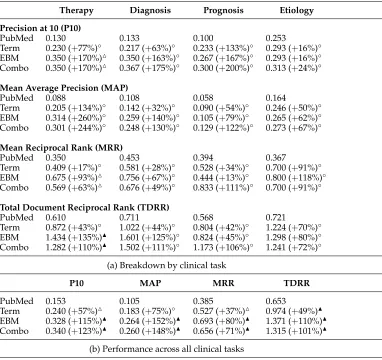
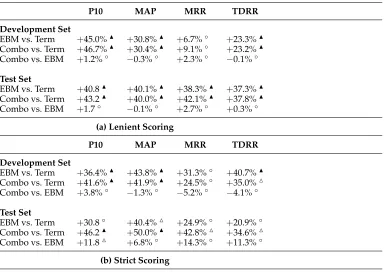
We report results under two different scoring criteria. Under the lenient condition, documents marked “contains answer” and “relevant” were given credit; these results are shown in Table 7 (for the development set) and Table 8 (for the blind held-out test set). Across all questions, both the EBM-based reranker and combination reranker sig-nificantly outperform the PubMed baseline on all metrics. In many cases, the differences are particularly noteworthy—for example, our EBM citation scoring algorithm more than doubles the baseline in terms of MAP and P10 on the test set. There are enough therapy questions to achieve statistical significance in the task-specific results; however, due to the smaller number of questions for the other clinical tasks, those results are not statistically significant. Results also show that the simple term-based reranker out-performs the PubMed baseline, demonstrating the importance of recognizing outcome statements in MEDLINE abstracts.