Security System using Raspberry Pi
Dr. Deepak B. Kadam1, Dr. Madhukar S. Chavan2, Mr. Shital A. Patil3
1, 2, 3
Department of Electronics and Telecommunication Engineering, P.V.P.T. Institute of Technology Budhgaon ,Sangli, India.
Abstract: In recent times we tend to use a number of surveillance systems for monitoring the targeted area. This requires an enormous amount of storage space along with a lot of human power in order to implement and monitor the area under surveillance. This is supposed to be costly and not a reliable process .In this paper we propose an intelligent surveillance system that continuously monitors the targeted area and detects motion in each and every frame. If the system detects motion in the targeted area then a notification is automatically sent to the user by sms and the video starts getting recorded till the motion is stopped. Using this method the required memory space for storing the video is reduced since it doesn’t store the entire video but stores the video only when a motion is detected. This is achieved by using real time video processing using open CV (computer vision / machine vision) technology and raspberry pi system.
Keywords: Raspberry pi; Open CV; embedded system; webcam; surveillance
I. INTRODUCTION
Every individual dreams to have a Safe and cheap security system. A security progression over a highly arcane area at a very low cost and which can it provide a security is appreciable. This project serves to be beneficial to any person who can incur a secure and cheap product which could provide alert features to any device that carries an active SIM (Subscribers Information Module).
Developments in information technology have made automation very easy in many applications like biometrics. Recent
technologies have made the concepts of smart homes very popular. Home security systems are becoming popular along with prominent features on mobile devices .
Closed- Circuit Television (CCTV) requires a lot of storage spaces for saving the surveillance information. Automation of electronic appliances has been made possible globally. Rather than wasting human resource and money for surveillance of video, one can automatically receive notification in the presence of an intruder. This device eliminates the wastage of memory wherever the video is stored without any movement or intrusion. It also allows easy organization and access of recordings whenever it is required for reference purpose. Since only a small amount of memory usage is needed, it can be stored for a definite period for future reference also.
II. RASPBERRY PI SECURITY SYSTEMS
It’s become mandatory for everyone to safeguard their property documents, currency and jewellery for which theyuse locker but the
current security systems are open to attack. Alarm systems using Raspberry Pi have been implemented using recorded sounds also. To overcome the above said barrier we go for an embedded security system which also uses low power supply. Here the embedded system used is Raspberry Pi which is operated by an Open CV. The locker room is continuously monitored through a webcam, which starts recording when it senses change in motion. This system aims to reduce the unwanted storage hence it records when there is motion detected in the image. It works by comparing the image frame that is captured onto a webcam following which it relates the previous frame with current frame and the same procedure is repeated as a loop. If there is an intruder in the surveillance area the Raspberry Pi sends alert information to the authority by mail along with the intruder image which is obtained by the video that captures the image continuously. Even simulations can be executed using Raspberry Pi boards.
III. PROPOSED SYSTEM
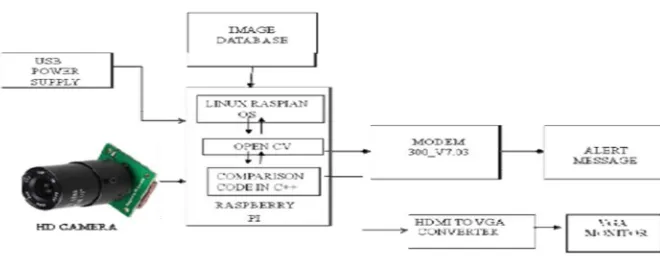
Fig. 1 General Block Diagram
A. Hardware Implementation
The system consist of a monitor, raspberry pi, GSM MODEM, HD camera, VGA converter, connectors, key board, mouse and connectors. Initially the entire setup of the project is connected . Then the camera is connected to the location where the monitoring has to be done. Following which the raspberry pi is switched ON , which starts recording 16 frames per second. It works on the principle by which it compare’s the previous frame and present frame . A threshold value is set and if any pixel changes occur in the frame higher than the threshold value, it identifies the interrupt and continuously records the interrupt identified and a message is sent to the authorised person.
1) Raspberry Pi Model B : Raspberry Pi model B consists of512Mb RAM, 2 USB ports and an Ethernet port. It has a Broadcom
BCM2835 system which encompasses an ARM1176JZF-S 700MHz processor, Video Core IV GPU, and an SD card. It has a
swift 3D core which can be accessedusing the OpenGL ES2.0 and open VG libraries. The chip particularly provides HDMI
without VGA support. The foundation provides Debian and Arch Linux ARM distributions along with Python as the main programming language, which supports BBC BASIC, C and Perl. The Raspberry Pi Model B+ includes a number of enhancements and latest features. Enhanced power consumption, increased connectivity and greater IO are among the enhancements to this powerful, small as well as lightweight ARM based computer. It consists of a standard VGA webcam that uses low power supply and is powerful in image capturing, and is dynamic in detecting the motion change using differential comparison method.
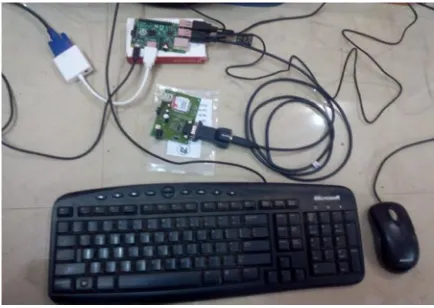
2) GSM Modem: The GSM modem is connected to the system by means of a USB port present in the Raspberry Pi .The USB port acts as our alert system , which immediately call the sms function , once the motion is detected. GSM modem contains all the authentication details and the list of phone numbers to which the alert message needs to be sent. Once the GSM modem gets the trigger to send the sms , it will login into the server and send that message to the recipients. The entire process takes place in the manner in which it has been programmed to act. Fig..2 shows the Raspberry Pi connected to the GSM MODEM.
Fig. 2 GSM Modem B. Configuring the Firmware
downloaded from python-open cv. All the files downloaded are required to be updated to the newest available version for valuable outcomes. Next phase is to convert the TV into a computer, since our concept is to use the TV screen as the display unit for the Raspberry pi board . The TV screen is connected directly to the board by using a RCA connector which is based on PAL and NTSC standard. In order to connect the board to a HD TV, there is a HDMI connector output but there is no VGA connector. There are cases in which the person using the Raspberry pi has a PC screen but not a HD display device. In such situations with the help of remote login one can access the Raspberry pi and view the TUI (Text User Interface) on the PC screen. The camera is a useful component for the Pi. By controlling the HD Camera, one can learn how to control it. Before using the camera, you need to use the Enable Camera option, in order to enable the camera. Add Your Pi to Rastrack. Rastrack3 is an online service that shows the locations of thousands of Pison in a map. If we choose the Add to Rastrack menu option, it enables the Pi to show up on the map as well,. One can access the Pi from other computers, since we are going to connect our Pi to a network and vice versa. One of the best
ways for secure communication between two computers is via Secure Shell (SSH), which is a network protocol for secure data
communication. The latest version of Raspbian includes all the camera drivers.
C. Object Detection In Real Time Using Open CV
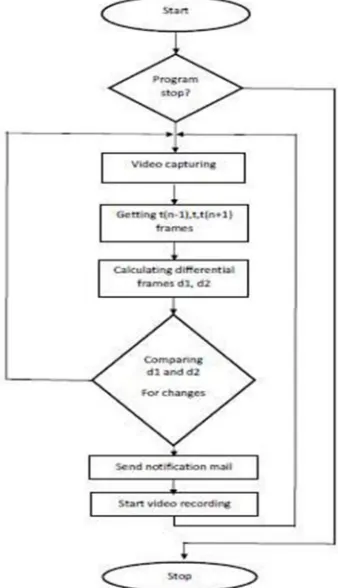
[image:3.612.209.378.420.714.2]Open Computer Vision is a tool that allows the webcam surveillance through Raspberry Pi. It is a library function that enables all real time video and image processing i.e., enabling the computer to see. All the real time video processing systems were operated with the help of this library. It will consider all the images as a 3 dimensional matrix which will have the different colour intensities in red, green, blue. Real time processing is done using the programming languages such as C, C++, Python and java. Here we are using the python scripting since the hardware plot form is Raspberry pi. This will provide the better support for python scripting. Once the module is started , the program will start capturing the video. Motion detection process will be initiated ,once it gets three continuous frames . If it detects any motion it will at once send the notification mail to the authorized person and starts video recording until it reads the motion in captured video frame and store it in an internal SD card of RPI. This process will continue until program reset button was pressed. Open CV library provides enormous amount of video processing commands. Once the program is started without any interrupts , it will start video capturing from the selected video source which we programmed. The entire process of video capturing and recording is shown in the flowchart in Fig.3
D. Object Detection In Real Time Using Open CV
Local Binary Patterns (LBP) is a kind of feature used for classification purpose in computer vision. LBP is a elementary yet very efficient texture operator which labels the image pixels by threshold of the neighbourhood of each pixel and the result obtained is a binary number. It is powerful enough to analyse images in challenging real-time settings due to its discriminative power and computational simplicity . Initially, a classifier (namely a cascade of boosted classifiers working with LBP-like features) is trained with some hundred sample views of a specific object called positive examples, which are scaled to the same size (approximately, 20x20), and arbitrary images which are the negative examples of the same size. After the training phase the classifier can be applied to a region of interest (of the same size as used while training) in an input image. The output of the classifier is a “1” if the region shows the object and “0” otherwise. One can move the search window across the image and check each location using the classifier , to search for an object in the whole image. The classifier is designed to be flexible enough so that it can be easily “resized” in order to be able to find the objects of interest at varied sizes, which is more capable than image resizing itself. So, to detect an object whose size is not known, the scan procedure should be done iteratively at distinct scales. The drawback of using this haar-like features is that the training time is long , in the range of two to three weeks. In order to overcome these complexities we follow LBP based feature extraction.
1) Spatial Domain LBP: The fundamental idea for developing the LBP operator was that two-dimensional surface textures can be
explained by two complementary measures: local spatial patterns and gray scale contrast. The original LBP operator labels the image pixels by thresholding the 3 x 3 neighbourhood of each pixel with the centre value and the result is a binary number.
Texture descriptors can be taken from the histogram of 28 = 256 different labels. This operator combined with a simple local
contrast measure provided very good performance in unsupervised texture segmentation. Beyond this, many related approaches have been developed for texture and colour texture segmentation.
2) Spatio Temporal LBP: The original LBP operator could deal only with spatial information. After which, it was extended to a
spatiotemporal representation for dynamic texture analysis. For which an operator called Volume Local Binary Pattern (VLBP) was proposed. The concept of VLBP deals with looking at dynamic texture as a set of volumes in (X,Y,T) space where X and Y denote the spatial coordinates and T denotes the frame index (time). The neighbouring pixels are defined in three dimensional space. Volume textons can be defined and extracted into histograms , similar to LBP in spatial domain. Hence, VLBP is a combination of motion and appearance in order to describe dynamic textures.
IV. EXPERIMENTAL SETUP
[image:4.612.293.571.490.668.2]The following Fig. 4 shows all components integrated with raspberry pi and the raspberry pi output connected to the GSM MODEM.
[image:4.612.40.257.537.691.2]A. Motion Detection
This is implemented using a differential comparison method which works on the principal of image comparison. Three frames are taken from the video capturing unit which are continuous frames used for the detection and are named as past, present and next frames. These frames are passed through a pre processing system that converts the captured RGB fames into gray scale frames. Then we calculate the difference between the past and present frame and also between the present and next frames which are named as comparisons d1 and d2. In order to detect the motion in the current frame we need to compare the two difference values. If there is a difference between the values it means that a motion is detected. If all the difference values were equal, it means there is no motion in the captured frames , after which it will again start capturing the video and redo the same procedure in an iterative manner.
B. Video Recording
At the instance when motion is detected , video recording has to be done for the analysis of the source that caused that motion in the frame. In this picture, the video was taken by the video capturing unit and is automatically stored inside the SD card placed inside the RPI system. If we need to gain access to the particular confidential area , we can press the reset button continuously to sack the entire program flow. In this block a soft reset module is created , once we press the ‘Esc’ button in the authorized system, then it will automatically exit all loops and terminate the program. Authorized personalities should monitor this process , so that nobody can access it effortlessly. The following Fig. 5 shows the capturing image of HD video and conversion to the Gray Scale video
V. CONCLUSION
By using this intelligent surveillance system we can reduce the video storage system for a huge extent since it will store the video only if it detects any motion and also it reduces the cost of the entire system. It does not need any manpower to monitor the entire video continuously and hence it also reduces the man power required for surveillance system. We can apply this to all the secured places such as bank lockers, ATM centres, etc., It’s a progress of realizing embedded image capturing system and experimental prototype of the embedded image capturing system with Raspberry Pi system.
This system is smaller, lighter and with lower power consumption. Because of the open source code, it is easier to do software development on Linux. Experimental results show that it’s an effective method of using Raspberry Pi board to actualize embedded image capturing system. Since it is not connected to internet , hacking and other security risks will not affect the system.We can enhance this project to the next level by using high end SOCs to improve the speed of the video processing unit and compiling. Instead of detecting motion in gray scale video we can improve it to do the detection in colour image matching.
REFERENCES
[1] Dhvani Shah ,Vinayak haradi,“IoT Based Biometrics Implementation on Raspberry Pi”, Elsevier Procedia Computer Science Volume 79, 2016, Pages 328–336
[2] Khushbu H Mehta, Niti P Gupta, “Vision Based – Real Time Monitoring Security System for Smart Home” IOSR Journal of Electronics and Communication Engineering, Volume 9, Issue 5, Ver. V (Sep - Oct. 2014), PP 46-53
[3] Akash V. Bhatkule, Ulhas B. Shinde, Shrinivas R. Zanwar,” Home Based Security Control System using Raspberry Pi and GSM”,International Journal of Innovative Research in Computer and Communication Engineering (An ISO 3297: 2007 Certified Organization) Vol. 4, Issue 9, September 2016, pp. 16259- 16264
[4] S. Khedkar and G. M. Malwatkar, "Using raspberry Pi and GSM survey on home automation," 2016 International Conference onElectrical, Electronics, and Optimization Techniques (ICEEOT),Chennai, 2016, pp. 758-761.
[5] Huu-Quoc Nguyen, Ton Thi Kim Loan, Bui Dinh Mao and Eui -Nam Huh, "Low cost real-time system monitoring using Raspberry Pi," 2015Seventh International Conference on Ubiquitous and Future Networks, Sapporo, 2015, pp. 857-859.
[6] V. Sandeep, K. L. Gopal, S. Naveen, A. Amudhan and L. S. Kumar, "Globally accessible machine automation using Raspberry pi based on Internet of Things,"
2015 International Conference on Advances inComputing, Communications and Informatics (ICACCI), Kochi,2015, pp. 1144-1147.
[7] V. Menezes, V. Patchava and M. S. D. Gupta, "Surveillance and monitoring system using Raspberry Pi and SimpleCV," 2015International Conference on Green Computing and Internet of Things (ICGCIoT), Noida, 2015, pp. 1276-1278.
[8] W. F. Abaya, J. Basa, M. Sy, A. C. Abad and E. P. Dadios, "Low cost smart security camera with night vision capability using Raspberry Pi and OpenCV,"
2014 International Conference on Humanoid,Nanotechnology, Information Technology, Communication and Control, Environment and Management (HNICEM), Palawan,2014, pp. 1-6.