
Which Concepts Are Worth Extracting?
Arash Termehchy
Oregon State University
[email protected]
Ali Vakilian
MIT
[email protected]
Yodsawalai
Chodpathumwan,
Marianne Winslett
University of Illinois
ychodpa2,[email protected]
ABSTRACT
It is well established that extracting and annotating occurrences of entities in a collection of unstructured text documents with their concepts improve the effectiveness of answering queries over the collection. However, it is very resource intensive to create and maintain large annotated collections. Since the available resources of an enterprise are limited and/or its users may have urgent infor-mation needs, it may have to select only a subset of relevant con-cepts for extraction and annotation. We call this subset a concep-tual designfor the annotated collection. In this paper, we introduce the problem ofcost effective conceptual design, where given a col-lection, a set of relevant concepts, and a fixed budget, one likes to find a conceptual design that improves the effectiveness of answer-ing queries over the collection the most. We prove that the problem is generally NP-hard in the number of relevant concepts and pro-pose two efficient approximation algorithms to solve the problem: Approximate Popularity Maximization (APMfor short) and Ap-proximate Annotation-benefit Maximization (AAMfor short). We show that if there is not any constraints regrading the overlap of concepts, APM is a fully polynomial time approximation scheme. We also prove that if the relevant concepts are mutually exclusive, APM has a constant approximation ratio and AAM is a fully poly-nomial time approximation scheme. Our empirical results using Wikipedia collection and a search engine query log validate the proposed formalization of the problem and show that APM and AAM efficiently compute conceptual designs. They also indicate that in general APM delivers the optimal conceptual designs if the relevant concepts are not mutually exclusive. Also, if the relevant concepts are mutually exclusive, the conceptual designs delivered by AAM improve the effectiveness of answering queries over the collection more than the solutions provided by APM.
Categories and Subject Descriptors
H.2.1 [Logical Design]: Schema and subschemaKeywords
Conceptual design; concept extraction; effective query answering Permission to make digital or hard copies of all or part of this work for personal or classroom use is granted without fee provided that copies are not made or distributed for profit or commercial advantage and that copies bear this notice and the full cita-tion on the first page. Copyrights for components of this work owned by others than ACM must be honored. Abstracting with credit is permitted. To copy otherwise, or re-publish, to post on servers or to redistribute to lists, requires prior specific permission and/or a fee. Request permissions from [email protected].
SIGMOD’14,June 22–27, 2014, Snowbird, UT, USA. Copyright 2014 ACM 978-1-4503-2376-5/14/06 ...$15.00. http://dx.doi.org/10.1145/2588555.2610496 .
<article>
... Michael Jeffrey Jordan is a former American professional basketball player ...
</article> <article>
... Michael Jordan is a full professor at the University of California, Berkeley ... </article>
<article>
... All six championship teams of Chicago Bulls were led by Michael Jordan and Scottie Pippen ...
</article>
Figure 1: Wikipedia article excerpts
1.
INTRODUCTION
Discovering structured data from large unstructured or semi-structured document collections is an active research area in data manage-ment [6]. A popular method of discovering structured data from unstructured or semi-structured documents issemantic annotation: extracting the mentions of named entities in a collection and an-notating these mentions by their concepts [5, 7, 8, 23]. It is well established that semantically annotating a collection improves the effectiveness of answering queries over the collection [7]. Fig-ure 2 depicts excerpts of semantically annotated Wikipedia arti-cles (www.wikipedia.org) whose original and unannotated versions are shown in Figure 1. Since the mentions to the entities named
Michael Jordanare disambiguated by their concepts, a query inter-face can deliver more effective results for the queries aboutMichael Jordan, the scientist, over the semantically annotated collection than the unannotated one. We call the set of all concepts that have <article>
... <athlete> Michael Jeffrey Jordan</athlete>is a former
<nationality> American</nationality>professional basketball player ...
</article> <article>
... <scientist> Michael I. Jordan </scientist>is a full professor at the
<organization>
University of California, Berkeley
</organization> ... </article>
<article>
... All six championship teams of
<organization>Chicago Bulls </organization> were led by
<athlete> Michael Jordan</athlete>and
<athlete> Scottie Pippen</athlete>... </article>
at least one entity in the collection aconceptual domain(domain
for short). A possible domain for the articles shown in Figure 1 is the set of concepts {athlete,scientist,position,organization,sport,
nationality}.
Intuitively, annotating all concepts in a domain will provide more effective results for the input queries. Recent studies, however, in-dicate that accurately annotating the entities of a concept in a large collection requires developing, deploying, and maintaining com-plex pieces of software, manual labor, and/or collecting training data, which may take a long time and substantial amount of compu-tational and financial resources [6, 2]. Given a concept, developers have to design and write a program called anannotatororextractor
that finds and annotates all instances of the concept in the collec-tion. One may write hand-tuned programming rules, such as reg-ular expressions, that leverage formatting or language patterns in the text to identify and extract instances of some concepts, such as
Email[6, 20]. However, formatting and language patterns for most concepts, such aspersonorprotein, are subtle and involve many exceptions. In these cases, it is not unusual to have thousands of rules to extract concepts [20]. Hence, developing and maintaining annotating programs becomes extremely time-consuming [6].
One may also use machine learning methods for concept extrac-tion [20, 6, 2]. Nevertheless, studies of several recent concept ex-traction systems show that using and deploying machine learning methods for concept extraction are also very time-consuming and labor-intensive [2, 6]. In order to extract the instances of a con-cept, developers have to first inspect the data set and identify a set of clues, calledfeatures, which indicate if some terms in a dument refer to an instance of the concept. For instance, the oc-currence of wordsaidin a sentence may suggest that the subject of the sentence refers to an instance of conceptperson. Then, de-velopers have to write programs to extract these features from the documents. Each concept extractor may use hundreds of features [2, 20]. These efforts are more costly for concepts that are defined in specific domains, such as geology and medicine, as they require extensive collaborations between developers and scarce domain ex-perts. As communication between developers and domain experts is often ineffective, developers may have to spend a great deal of time and sift through the data to find the relevant features [2].
After finding candidate features, developers have to perform fea-ture selection: they have to analyze available features, remove some of them, e.g., those that are highly correlated, and select a subset of features that predict the instances of the concept accurately [2, 20]. Developers iterate the steps of finding, extracting, and revising features and testing the annotation program several times in order to create an annotation program with a reasonable accuracy [2]. Fi-nally, since annotation modules need to perform complex text anal-ysis, it may take days or weeks, plus a great deal of computational resources, to execute them over a large collection [15, 24]. Thus, users have to wait a long time for the development and execution of extraction programs before they have a fully annotated collection.
Since the structure and content of documents in many domains evolve over time, the annotation programs should be regularly rewrit-ten and rerun to create an updated annotated collection [12]. Hence, users have to wait a long time for annotation programs to be rewrit-ten and rerun in order to pose their queries over an updated and fully annotated collection [24].
The long delays to create and update fully annotated collections are well recognized as an issue in concept extraction [24, 12]. They are particularly problematic in domains withurgent information needs [15, 24]. For example, an FBI agent who needs to query the evolving content of Web sites and social media pages to find and respond to new activities in human trafficking; a stock analyst who
has to respond to the changes in stock market in a timely fashion, or an epidemiologist who must act quickly to control the spread of an infectious disease cannot afford to wait for all annotation programs to be (re-)written and (re-)executed [24].
Therefore, an enterprise may decide to select only a subset of the concepts in the domain for annotation or re-annotation, to provide a partially annotated collection relatively quickly. Users can pose their queries over the partially annotated collection and get reason-ably effective answers. Moreover, since the available financial or computational resources of most enterprises are limited, they may not be able to hire sufficient number of machine learning experts and acquire computational resources to (re-)write and (re-)execute the annotation programs for all concepts in their domains and se-lect subsets of these domains for annotation. We call this subset of concepts aconceptual design(designfor short) for the annotated collection.
Clearly, an enterprise wants to find a design whose required time (or resources) for annotation does not exceed its limit on turnaround time (or budget) and most improves the effectiveness of answering queries over the annotated collection. Each concept may require different amounts of time and resources for annotating its enti-ties in a collection. For instance, an enterprise may use a freely available and relatively simple annotation program from OpenNLP (opennlp.apache.org) to discover the entities of conceptEmail, pur-chase and deploy a more sophisticated annotation programs from companies, such asontotext.com, to annotated instances of concept
position, or develop and deploy in-house annotators to identify en-tities of more domain specific concepts, such asathlete. The latter annotators may require more financial resources and/or time to de-velop and execute than the former one. This scenario suggests a novel conceptual design problem: given a domain and a document collection, we want to find a design for the collection that improves the overall effectiveness of answers to input queries the most, while its annotation costs do not exceed a given budget.
To the best of our knowledge, the choice of a cost effective de-sign for a collection is generally guided only by intuition and has not been studied before. In this paper, we introduce and formalize the problem ofcost effective conceptual designfor semantic anno-tation. Our formal treatment paves the way for systematic analysis of the problem and shows that intuitively appealing heuristics such as choosing the relatively less costly concepts and/or the ones that appear most often in queries are not generally optimal, even for the cases where all annotators have equal costs. In summary, we make the following contributions:
• We formally analyze the impact of possibly inaccurate annota-tion of a concept in a collecannota-tion on the effectiveness of answer-ing queries over the collection. We quantify this impact usanswer-ing a function called Annotation Benefit for two categories of real-world domains: the ones with mutually exclusive concepts and the ones that do not have any constraints regrading the overlap of concepts.
• We introduce and formally define the problem of cost effective conceptual design for semantic annotation as maximizing the value of the Annotation Benefit function over a set of concepts in a domain given a limited time or budget. We prove that the problem over both categories of domains is generally NP-hard in the number of concepts in the domain.
• We propose two efficient approximation algorithms for the prob-lem: Approximate Popularity Maximization (APMfor short) algorithm and and Approximate Annotation Benefit Maximiza-tion (AAMfor short) algorithm. We prove that the designs re-turned by APM improve the effectiveness of answering queries
by at most a constant factor less than the optimal design over the domains with mutually exclusive concepts and AAM algorithm is a fully polynomial time approximation scheme in these do-mains: the effectiveness improvement achieved by its designs will get sufficiently close to the improvement achieved by op-timal designs given sufficient running time. We also show that APM is a fully polynomial time approximation scheme for the domains without any constraint regarding the overlap of con-cepts.
• Our extensive experiments over the collection of Wikipedia ar-ticles, concepts from YAGO ontology [23], and queries from the MSN query log [9] show that the Annotation Benefit for-mula accurately quantifies the impact of a design on the amount of improvement in the effectiveness of answering queries over the annotated collection for both categories of domains.
• Our empirical results indicate that APM finds the optimal de-signs for most cases where the domain does not have any con-straint regrading the overlap of its concepts. They also show that the designs delivered by the AAM algorithm improve the effectiveness of answering queries more than the APM algo-rithm across domains with mutually exclusive concepts. We also show that both algorithms find these designs in reasonable amounts of times for a preprocessing task.
• Because the complete information about the values of input pa-rameters for AAM may not be available at design time, we ex-plore the sensitivity of this algorithm to the errors in estimating its input parameters and show that when using the input pa-rameters computed over a small sample of the collection, AAM still returns designs that are generally more effective than the ones returned by APM over domains with mutually exclusive concepts.
This paper is organized as follows. Section 2 describes the ba-sic definitions and related works. Section 3 quantifies the impact of a design on the improvement in the effectiveness of answering queries over a collection annotated by the design. Section 4 intro-duces the problem of cost effective conceptual design and explores its hardness. Section 5 proposes efficient approximation algorithms for the problem and explores their worst-case approximation ratios. Section 6 contains the empirical results about the accuracy of the Annotation Benefit function and the average approximation ratios of the algorithms and Section 7 concludes the paper. A full ver-sion of this paper containing proofs and more detailed description of empirical studies can be found at [25].
2.
BACKGROUND & BASIC DEFINITIONS
2.1
Related Work
Conceptual design is a topic of research in data management [10]. Our work extends this line of research by introducing and exploring the ability of a conceptual design in effectively answer-ing input queries and its cost-effectiveness.
There is a large body of work on building and optimizing pro-grams that extract entities of a given concept, and systems that manage annotated collections [7, 6, 8, 5, 24, 2]. We build on this work by offering a new pre-processing design phase that can be followed by and coupled with any of these previously proposed ap-proaches. Researchers have proposed several techniques to reduce the execution time of SQL queries over existing databases whose information comes from concept and relation extraction programs [13, 15]. Similar systems optimize the use of information extrac-tion programs to add missing data values to an existing database [16]. These techniques generally improve execution time or
stor-age capacity by processing only the “promising” documents in the collection that contain the information about the database relations, instead of the whole collection. Our work differs in addressing the issues raised at design time rather than query time. We also con-sider ranking queries as opposed to SQL queries. Our model covers other types of costs in annotation in addition to running-time and storage space. Moreover, we explore using both structured data (i.e. annotated documents) and unstructured data (i.e. unannotated documents) in effectively answering queries.
The authors in [18] have proposed a cost effective methodology for semi-automatic and concurrent construction of ontologies and annotated XML schemas in Web service interfaces. Our work dif-fers in studying the problem of automatically choosing a cost ef-fective set of concepts from a domain for automatic annotation of a collection.
2.2
Basic Definitions
Each concept is a set of named entities (entities for short). Some examples of concepts areperson,location, andorganization. Abra-ham Lincolnis an entity of conceptpersonandLincoln Squareis an entity of conceptlocation. There may be several mentions of an entity in a collection. For example,Michael Jeffrey Jordanand
Michael Jordanrefer to the famous athlete in the collection shown in Figure 2. We call these mentions,instancesof the entity and for brevity also the instances of its concept (athlete).
A domain may contain some constraints on the relationship be-tween its concepts [1]. ConceptsC1andC2aremutually exclusive
if and only if no entity belongs to bothC1 andC2. For instance,
conceptspersonandlocationaremutually exclusive, as no entity is both a person and a location. Our study of real world ontolo-gies, such as DBPedia (wiki.dbpedia.org/Ontology), Schema.org (schema.org), and YAGO indicates that mutually exclusive con-cepts appear frequently in these ontologies. For example, in Schema.org each entity should belong to only one of the concepts ofAction,
BroadcastService, Class, CreativeWork, Event, Intangible, Med-icalEntity, Organization, Person, Place, Product, and Property, which are mutually exclusive. As another example, in DBPedia different types of organizations, places, events, devices, and cre-ative works are described by mutually exclusive concepts. Mu-tually exclusive concepts are also easier to annotate via learning based methods, as one can use the positive training examples of one concept as negative training examples for other concepts [21]. When this constraint is available in the domain, we exploit it to find the cost effective conceptual designs. Concepts in a domain may have other types of relationships such as a subclass/superclass relationship (e.g. person and scientist). Analyzing and solving the problem of cost-effective conceptual design for concepts with other types of relations is a larger undertaking and provides interesting subjects for future work.
The functionwCOmaps each concept to a real number that re-flects the amount of resources used to annotate instances of con-ceptCover collectionCO. When the collection is clear from the context, we simply denote the cost function asw. The resources required for concept annotation may include the amount of time, money, or manual labor spent on developing, training, or maintain-ing an annotator forC, or the computational resources and time to run the annotator over the collection. For example, an enterprise may use the amount of money need to purchase annotators from other companies (e.g.ontotext.com) as a cost function. It may also predict the cost of annotator programs that are developed in house using current techniques for predicting costs of software develop-ment and maintenance [4]. Researchers have developed effective methods to estimate the execution times of concept extractors [15]
In the absence of any evidence, one may assume that all concepts require equal amount of resources for annotation. As shown in the full version of this paper, it is still challenging to find cost effective designs in this setting [25].
We assume that annotating certain concepts does not impact the cost and accuracies of other concepts in the collection. The costs of (re-)writing, (re-)running, and maintaining an extractor for a con-cept are still considerable in most cases after coupling its extrac-tion with other related concepts. For example, programmers have to find, extract, and select a great deal of the relevant features for each concept separately.
In this paper, we consider queries that seek information about named entities [7]. Each queryQ: (C, T)consists of the concept of the referred-to entityCand a set of keywordsT, which describe the referred entity. Some examples of queries are(person, { Jor-dan })or(location, { Jordan attractions }). This type of query has been widely used to search annotated collections [7, 11]. Empirical studies on real world query logs indicate that the majority of entity centric queries refer to a single entity [22]. Since this paper is the starting effort to address the problem of cost effective conceptual design, it is reasonable to start with the aforementioned class of queries. Considering more complex queries that seek information about relationships between several entities requires more sophisti-cated models and algorithms, and therefore, it will require a series of papers and is an interesting topic for future work.
3.
THE BENEFIT OF A CONCEPTUAL
DE-SIGN
3.1
Objective Function
LetSbe the design of annotated collectionCOandQbe a set of queries overCO. We would like to quantify the degree by which
Simproves the effectiveness of answering queries inQoverCO. The value of this function should be larger for the designs that help the query interface to answer a larger number of queries inQmore effectively. It has been shown that most information needs over an-notated collections are precision-oriented [8, 7]. Thus, we choose the standard metric ofprecision atk (p@kfor short) to measure the effectiveness of answering queries over an annotated collection [19]. The value ofp@kfor a query is the ratio of the number of rel-evant answers in the topkreturned answers for the query, divided byk. Precision atkhas also a simpler form than other precision oriented metrics, such as Mean Reciprocal Rank (MRR) or Nor-malized Discounted Cumulative Gain (NDCG), thus, it is easier to optimize [19]. We average the values ofp@kover queries inQto measure the amount of effectiveness in answering queries inQ.
3.2
Effectiveness Improvement for Queries of
Annotated Concepts
LetQ: (C, T)be a query inQ. IfCis annotated, i.e.C ∈ S, the query interface will find and return only the documents that contain information about entities inC. It will then rank them according to its ranking function, such as the traditional TF-IDF scoring methods or learning to rank techniques [19]. Our model is orthogonal to the method used to rank the candidate answers. An-notatingCinCOwill help the query interface avoid non-relevant results that otherwise may have been placed in the topkanswers forQ. We call the fraction of queries inQwhose concept isCthe
popularityofCinQ. LetuQbe the function that maps conceptC
to its popularity inQ. WhenQis clear from the context, we sim-ply useuinstead ofuQ. The portion of queries for which the query
interface returns only the documents about entities in their desired
concepts isP
C∈Su(C). Given all other conditions are the same,
the larger the value ofP
C∈Su(C)is, the more likely it is that
the query interface will achieve a largerp@kvalue over queries in
Q. Hence, we may useP
C∈Su(C)to compare the degrees of
improvement in the value ofp@kover queries inQachieved by various designs.
Annotators, however, may make mistakes in identifying the cor-rect concepts for occurrences of entities in a collection [7]. An an-notator may annotate some appearances of entities from concepts other thanCas the occurrences of entities inC. For instance, the annotator of conceptperson may annotateLincoln Building as a person. The accuracyof annotating concept C over CO is the number of correct annotations ofC divided by the number of all annotations ofCinCO. We denote the accuracy of annotatingC
overCO asprCO(C). WhenCO is clear from the context, we showprCO(C)aspr(C). Given queryQ: (C, T)andC ∈ S, it is reasonable to assume that1−pr(C)of the topkresults may contain information about entities that do not belong toC. Hence, we should refine our estimate to:
X
C∈S
u(C)pr(C) (1) in order to reward the designs whose concepts are annotated more accurately.
3.3
Effectiveness Improvement for Queries of
Unannotated Concepts
Given queryQ : (C, T)∈ Q, ifC /∈ S, there is insufficient meta-data information in the collection for the query interface to identify the occurrences of the entities in C. Therefore, it may view the concept nameCand the keywords inTas a bag of words and use some document ranking function to return the topk an-swers forQ. We like to estimate the fraction of the results forQ
that contain a matching entity in conceptC. Given all other con-ditions are the same, the larger this fraction is, the more likely it is that the query interface delivers more relevant answers, and there-fore, a largerp@kvalue forQ. Based on the available constraints on the relations between concepts in the domain, we provide two different estimations of the fraction of the results forQthat contain a matching entity in conceptC.
Domains with mutually exclusive concepts: If the concepts in the domain are mutually exclusive, the annotated concepts may help the query interface to eliminate some non-relevant answers from its results forQ. For example, assume that the instances of conceptlocationare annotated and the instances of conceptperson
are not annotated in the collection. As these concepts are mutu-ally exclusive, given query (person, { Jordan }), query interface can ignore matching instances likeJordan Riverfor this query. Be-cause text documents are coherent, they do not usually contain in-formation about entities with similar or the same name but from mutually exclusive concepts. For instance, it is unlikely to find a document that contains information about bothJaguar, the vehicle, andJaguar, the animal. Hence, the query interface can eliminate the candidate answers forQwhose matched terms are annotated by concepts other than the concept ofQ. By removing these non-relevant answers from its ranked list, the query interface may im-prove the value ofp@kforQ.
In order to compute the fraction of candidate answers forQ
whose matching instances belong toC, we have to first calculate the fraction of candidate answers that survive the elimination. This ratio, however, may vary across different queries in Q as some queries may have more candidate answers with matched annotated instances from concepts inSthan others. Estimating this ratio per
query is generally hard as it may require estimating and comput-ing model parameters per query. Particularly, detailed information about queries in a query workload such as their candidate answers may not be always available. Hence, in order to have an estima-tion which can be efficiently and effectively computed over a large number of queries, we assume that all queries inQhave equal ra-tios of candidate answers that contain matched instances of a cer-tain concept in the domain. We, further, estimate this ratio for the concept by the fraction of documents in the collection that contain instances of the concept. Our empirical results using queries from a real world search engine query log and collection, which are re-ported in Section 6, show that in spite of these simplifying assump-tions, our model effectively estimates the degrees of improvement achieved by various designs for a collection.
LetdCO(E)denote the fraction of documents that contain in-stances of conceptE in collectionCO. These instances may or may not be annotated depending on whetherE ∈ S. We call
dCO(E)the frequencyofE overCO. WhenCOis clear from the context, we denote the frequency ofE as d(E). Given de-signS for collectionCO, we want to compute the fraction of the candidate answers for queryQ : (C, T) that contain a matching instance of conceptsE /∈ S. In order to simplify our model, we estimate this fraction asP
E /∈Sd(E). Our experimental results in
Section 6.2 indicate that in spite of this simplification, our objective function effectively captures the degree of improvement delivered by a conceptual design over a collection. This portion of answers will stay in the list of results forQafter the query interface elimi-nates all candidate answers with matching instances from concepts inS. Hence, the fraction of the candidate answers that contain a matching instance of conceptCin the list of answers for a query in
QisP d(C)
E /∈Sd(E). Using this estimation and equation 1, we formally
define the function that estimates the likelihood of improvement for the value ofp@kfor both queries that belong and queries that do not belong to the conceptual design in a query workload over a collection that is annotated by concepts in designS.
DEFINITION 3.1. Given domainCwith mutually exclusive con-cepts, query workloadQ, and conceptual designS ⊆ C, the anno-tation benefit ofSis:
AB(S) =X C∈S
u(C)pr(C) +X C /∈S
u(C)P d(C) E /∈Sd(E)
. (2)
Overall, the annotation benefit estimates the likelihood in improv-ing users’ satisfaction by answerimprov-ing queries more precisely. The larger the value of the annotation benefit is for designSover col-lectionCO, the more likely it is thatQwill have a larger average
p@kover the version ofCOannotated by concepts inS.
The first term of the annotation benefit in equation 3.1 reflects the portion of queries for which the query interface returns only the candidate answers with instances matching to the concept of the query. It is larger for the concepts that are more frequently used in queries. For example, let a domain contain conceptsC1,C2, and
C3where the instances ofC1appear in 90% of queries and 1% of
documents, the instances ofC2 occur in 1% of queries and 90%
of documents, and the instances ofC3 appear in 9% of queries
and 9% of documents. If all annotators have perfect accuracies (i.e. pr(C)= 1, C ∈ {C1, C2, C3}), we havePC∈{C1}u(C)
> P
C∈{C2}u(C). Although C1 appears in only 1% of
docu-ments, it is used in 90% of queries. Hence, it is more likely that the query interface will answer the input queries more effectively if we annotate the instances ofC1rather thanC2in the collection.
The second term represents the impact of annotating the con-cepts inSon the likelihood of improving the precision of answer-ing queries whose concepts are not inS. Given that the concept of a query does not belong toS, the more frequent the concepts inSin the collection are, the more non-relevant answers the query interface can eliminate.
Domains without constraints regarding the overlap of con-cepts:If there is not any constraint on the relations between con-cepts in the domain, e.g. whether they are mutually exclusive or su-perclass/subclass, the query interface has to examine all documents in the collection to answerQ. For example, assume that a domain contains conceptsactressanddirectorand the entities ofactress
are annotated in the collection. Given query(director, { Rossellini }), the query interface cannot filter out its matching instances from conceptactresslikeIsabella Rossellinibecause conceptsactress
anddirectorare not mutually exclusive. Thus, if the instances of conceptCare not annotated,C /∈ S, the fraction of candidate an-swers ofQ: (C, T)that contain a matching instance of concepts
Cisd(C). Using equation 1, we formally define the function that estimates the likelihood of improvement for the value ofp@kfor all queries in a query workload over a collection that is annotated by concepts in designSover domains without any constraint.
DEFINITION 3.2. Given domainCwithout any constraint, query workloadQ, and conceptual designS ⊆ C, the annotation benefit ofSis:
AB(S) = X C∈S
u(C)pr(C) +X C /∈S
u(C)d(C). (3)
Similar to the formula for annotation benefit in equation 2, the first term of the annotation benefit in equation 3 reflects the group of queries for which the query interface returns only the candidate an-swers with instances matching to their concepts. The second term of the annotation benefit in equation 3, however, is different from the second term in equation 2 and represents the impact of the fre-quency of a concept that is not inSon the likelihood of the preci-sions of its queries.
Some domains may contain a mix of mutually exclusive and overlapping concepts. Analyzing and solving the problem of cost-effective conceptual design for such domains is a larger undertak-ing, which requires more space than one paper and provides an interesting subject for future work.
3.4
Estimating Input Parameters
According to Definitions 3.1 and 3, we need popularities, fre-quencies, and accuracies of annotation for each concept in a do-main, in order to compute the Annotation Benefit of a design over the domain. These values, however, are not usually available be-fore annotating the instances of concepts in the collection. Similar issues arise in database query optimization, where the complete in-formation about running times of operators in a query are not avail-able before running the query [10].
Our empirical results indicate that it is sufficient to compute pop-ularities, frequencies, and accuracies of annotating concepts over only a sample of query workload or collection (e.g. 384 out of about 1 million documents) in order to effectively estimate the val-ues of Annotation Benefit function for designs in a domain. The enterprise may use methods such as crowd sourcing to compute the popularities and frequencies of concepts over such small samples. These annotated documents may be also used as training data for the annotation program of the concept if it is selected for anno-tation. In some settings, a sample workload of queries with their
concepts is not available, i.e. we may have access only to pure key-word queries. The enterprise can use the click-through information of sample queries to effectively find their associated concepts [3].
An enterprise may use the Annotation Benefit function to choose the concepts for which it should develop annotation programs, there-fore, it may not know the accuracies of the annotation programs in design time. Because one has to spend more time and resources to develop a more accurate annotator, the accuracy of annotating a concept somewhat represents the cost of developing its annotation program. Hence, the enterprise may set the accuracy of annotating a concept to a reasonable value that can be achieved using its asso-ciated cost. It may also compute and compare the values of Anno-tation Benefit for designs across multiple assignments of costs and accuracies of annotating concepts in the domain.
4.
THE COST EFFECTIVE CONCEPTUAL
DESIGN PROBLEM
Since the resources available to develop, maintain, and execute concept annotators are limited, our goal is to find a conceptual design S such that annotating the concepts in S in the queries and collection maximizes the annotation benefit. For each con-ceptC∈ C, we define the cost of annotation to reflect the amount of resources required to annotate instances of the conceptCin the collection. LetBdenote the amount of resources available to per-form the annotation. Annotating a set of conceptsS is feasible ifP
C∈Sw(C) ≤ B. We formally define the annotation benefit
problem as follows.
PROBLEM 4.1. Given a domainC, the goal of theCOST EF-FECTIVE CONCEPTUALDESIGNproblem is to construct a con-ceptual designSthat maximizes the annotation benefit (AB) while satisfying the constraintw(S)≤B.
In the case of domains with no constraints, we can rewrite the an-notation benefit function as follows.
AB(S) =X C∈S
u(C)pr(C) +X C /∈S
u(C)d(C)
=X
C∈S
u(C)(pr(C)−d(C))
+X
C∈C
u(C)d(C).
where the termP
C∈Cu(C)d(C)is independent ofS. Since
cept annotation is an informative process, i.e. it annotates con-cepts more effectively than a random algorithm, we havepr(C)−
d(C)>0. Thus, the optimization problem in this setting is follow-ing.
max X
C∈S
u(C)(pr(C)−d(C)),s.t.X C∈S
w(C)≤B
Provided that we havenconcepts in our domain, the COST EF-FECTIVE CONCEPTUAL DESIGN problem over domains with no constraints is essentially the same as the0-1KNAPSACKproblem withnobjects, where the value of each objectOCisu(C)(pr(C)−
d(C))and its weight isw(C). Since0-1KNAPSACKproblem is NP-hard, the the COSTEFFECTIVECONCEPTUALDESIGN prob-lem over domains with no constraints is also NP-hard.
We prove that the COST EFFECTIVE CONCEPTUAL DESIGN problem is NP-hard for domains with mutually exclusive concepts by a reduction from the following NP-complete variant of the PAR-TITIONproblem [17].
PROBLEM 4.2. LetA={a1, . . . , a2m}be a set of2mpositive
integers that sum up to2A, such that for eacha ∈ A, A m+1 <
a < A
m−1. The goal of this problem is to decide whether there exists a setI ⊂ Asuch thatP
a∈Ia=A.
THEOREM 4.3. TheCOSTEFFECTIVECONCEPTUALDESIGN
problem over a domain with mutually exclusive concepts is NP-hard.
In the following section, we design efficient approximation algo-rithms for the COSTEFFECTIVECONCEPTUALDESIGNproblem.
5.
APPROXIMATION ALGORITHMS
A brute force algorithm for the COSTEFFECTIVECONCEPTUAL DESIGNproblem may take several days or weeks of computation even if the domain contains only 50 concepts. In this section, we design some efficient approximation algorithms for the COST EFFECTIVE CONCEPTUAL DESIGN problem. Consider a maxi-mization problemM. A polynomial time algorithmAis anα -approximation toMif SOLA ≥ α1OPTM, where SOLAis the
value of the solution returned byAand OPTMis the value of the
optimal solution toM.
5.1
Approximate Popularity Maximization
Al-gorithm (APM)
We can use available efficient algorithms with bounded approx-imation ratios for the0-1KNAPSACKproblem to solve the COST EFFECTIVECONCEPTUALDESIGNproblem over domains without any constraint with the same approximation ratios. This algorithm will solve a0-1KNAPSACKproblem for concepts in the domain, where the value of each concept isu(C)(pr(C)−d(C))and its weight isw(C). An algorithm for a maximization problem is a
Fully polynomial time approximation scheme (FPTAS)if its run-ning time is polynomial in the size of the input and(1/ε)and its approximation ratio is(1 +ε)for a given0< . Since0-1 KNAP-SACKproblem is NP-hard, FPTAS is the best possible approxima-tion for the problem, unlessP = N P [14]. In our experiments, we consider an FPTAS algorithm of0-1KNAPSACKproblem de-scribed in [14] that uses a dynamic programming approach. Thus there is an FPTAS algorithm for COSTEFFECTIVECONCEPTUAL DESIGNproblem over domains with no constraint.
Moreover, we use the idea behind FPTAS algorithms of0-1 KANP-SACKproblem to devise an algorithm for the COSTEFFECTIVE CONCEPTUALDESIGNproblem over domains with mutually ex-clusive concepts. This algorithm ignores the improvement in ef-fectiveness of answering the queries whose concepts are not in the design of a collection. As discussed in Section 3, this improve-ment is achieved by eliminating the non-relevant answers whose concepts are in the design of the collection from the list of can-didate answers for these queries. This degree of improvement is represented by the second term of the annotation benefit function. Hence, this algorithm picks a conceptual designSwith maximum value ofP
C∈Su(C)pr(C). We call this modified problem the
POPULARITYMAXIMIZATIONproblem. More formally, given a domainC, the POPULARITYMAXIMIZATIONproblem maximizes P
C∈Su(C)pr(C)subject to
P
C∈Sw(C)≤B.
The following lemma shows that we can design a constant factor approximation algorithm for the COSTEFFECTIVECONCEPTUAL DESIGNproblem by applying an algorithm with bounded approxi-mation ratio for the POPULARITYMAXIMIZATIONproblem.
LEMMA 5.1. Aρ-approximation algorithm for the POPULAR-ITYMAXIMIZATIONproblem is a(ρ+ 1/prmin)-approximation
for theCOST EFFECTIVE CONCEPTUAL DESIGN problem over domains with mutually exclusive concepts, whereprmin= minC∈Cpr(C).
In particular, ifpr(C) = 1for allC∈ C, aρ-approximation of the POPULARITYMAXIMIZATIONproblem is a(ρ+1)-approximation for the COSTEFFECTIVECONCEPTUALDESIGNproblem.
The POPULARITYMAXIMIZATIONproblem is also a version of 0-1KNAPSACKproblem withnobjects, if we choose the value of each objectOCto beu(C)pr(C)and its weight to bew(C). Thus, in our experiments we use the FPTAS algorithm for Knapsack [14] to solve this problem.
COROLLARY 5.2. An FPTAS algorithm that returns a(1 +ε) -approximate solution to thePOPULARITYMAXIMIZATION prob-lem is a(1 +ε+ 1/prmin)-approximation algorithm for theCOST EFFECTIVE CONCEPTUAL DESIGN problem over domains with mutually exclusive concepts whose running time is polynomial in 1
εand the number of concepts.
We call this algorithm the Approximate Popularity Maximiza-tion (APM) algorithm.
5.2
Approximate Annotation Benefit
Maximiza-tion Algorithm (AAM)
In this section we present an FPTAS algorithm for the COST EF-FECTIVECONCEPTUALDESIGNproblem over the domains with mutually exclusive concepts. Since in Theorem 4.3 we proved that the problem is NP-hard, FPTAS is the optimal approximation guar-antee for the problem unlessP =N P. The algorithm is based on the dynamic programing method of the0-1KNAPSACK problem in addition to some scaling techniques. For simplicity in exposi-tion of the algorithm, we assume thatpr(C) = 1for eachC∈ C. However, in Remark 5.7 we state that our approach works for an ar-bitraryprfunction, given an additional property that usually holds in practice.
Given a fixed constantN, we define the BOUNDEDCOST EF-FECTIVE(N)problem as follows.
max
S f(N, S) = 1
N(N
X
C∈S
u(C) + X C∈C−S
u(C)d(C)) (4) s.t. X
C∈C−S
d(C)≤N
X
C∈C−S
w(C)≤B
In addition to the cost constraint that we had previously, BOUNDED COSTEFFECTIVE(N) has a constraint over frequency of docu-ments. LethC, B, d, u, wibe an instance of the COSTEFFECTIVE CONCEPTUALDESIGNproblem. For any value ofN, the value of the optimal solution of the BOUNDEDCOSTEFFECTIVE(N) on
hC, B, d, u, wi is not more than the optimal solution of the an-notation benefit of COSTEFFECTIVECONCEPTUALDESIGNon
hC, B, d, u, wi. Moreover, for a fixedN, the objective function of the COSTEFFECTIVECONCEPTUALDESIGNis a separable func-tion. Thus it is easier to find the maximum value of BOUNDED COSTEFFECTIVE(N) for a fixedN rather than finding the op-timal conceptual design of the COST EFFECTIVE CONCEPTUAL DESIGNproblem.
LEMMA 5.3. LetOPTbe the value of the optimal solution of theCOSTEFFECTIVECONCEPTUALDESIGNproblem and letOPTbd be the maximum value of an optimal solution of BOUNDEDCOST EFFECTIVE(N)over different values ofN. ThenOPT=OPTbd.
Moreover, the same set of concepts (conceptual design) obtains the optimal value in both functions.
Lemma 5.3 implies that in order to find a set with the maximum annotation benefit we can instead solve BOUNDEDCOST EFFEC-TIVE(N)for all different values ofN and return the set that ob-tains the maximum value. In other words, first we give an FPTAS for BOUNDEDCOSTEFFECTIVE(N), whereN is a given fixed value. The first step is to check whether for the givenNthere ex-ists a feasible solution to BOUNDEDCOSTEFFECTIVE(N). For the givenN, a feasible solution has to contain all conceptsCthat
d(C)> N. LetSrem ={C|d(C)> N}andCrem=C − Srem.
Ifw(Srem)> B, there is no feasible solution for BOUNDEDCOST
EFFECTIVE(N). Otherwise; we select all concepts inSremand we
setBrem=B−w(Srem)to be the leftover budget. The problem is
equivalent to optimize the bounded problem onCrem, BremandN.
Now, for eachC∈ Cremwe haved(C)≤N. To solve BOUNDED
COST EFFECTIVE(N)optimally for the given N, we can apply dynamic programming. LetVinit(N) =PC∈Cremu(C)d(C)/N.
We can rewrite the objective function of BOUNDEDCOST EFFEC-TIVE(N)as follows:
X
C∈S
v(C) +Vinit(N)
wherev(C) =u(C)(1−d(C)/N)for eachC∈ Crem
LetCrem = {C1,· · ·, Cn}. We define Q[i, P, X]to be the minimum required cost that we must pay to obtain a solution of BOUNDEDCOSTEFFECTIVE(N)of value at leastP−Vinitif we
are only allowed to annotate concepts from the firsticoncepts of
Crem. We can state the recursive relation ofQ[i, P, X]as follows:
1. Q[0,0, X] = 0for all0≤X≤N
2. Q[0, P, X] =∞for allP >0and0≤X ≤N
3. Q[i, P, X] = min(Q[i−1, P, X−d(Ci)],
Q[i−1,min{P−v(Ci),0}, X] +w(Ci))
To find the optimal solution of BOUNDEDCOSTEFFECTIVE(N), we need to find the maximum value ofV such thatQ[n, V, N]≤
Brem. The running time of the described dynamic programming
isO(nV N) whereV is the value of the optimal solution of the bounded problem for the givenN. The described dynamic pro-gramming is pseudo-polynomial and we can convert it to an FPTAS via scaling techniques.
LEMMA 5.4. There exists a(1 +ε)-approximation algorithm toBOUNDEDCOSTEFFECTIVE(N)which runs inO(N n3/ε)
.
Although we need to satisfy the document frequency constraint of BOUNDEDCOSTEFFECTIVE(N),P
C∈Crem−Sd(C)≤N, for a
givenN we can allowS to violate the document frequency con-straint byε; our ultimate goal is to maximize the annotation benefit of COSTEFFECTIVECONCEPTUALDESIGNproblem. Later we show that the value ofABfor a(1 +ε)-approximate solution of BOUNDEDCOSTEFFECTIVE(N), S, that violates the document frequency constraint by at mostεis comparable to the optimal so-lution of BOUNDEDCOSTEFFECTIVEfor the givenN.
LEMMA 5.5. There is a(1 +ε)approximation algorithm for
BOUNDEDCOSTEFFECTIVE(N)that violatesP
C∈Crem−Sd(C)≤
(1 +ε)N, and its running time isO(n4/ε2).
By Lemma 5.5, we have an algorithm that finds a solutionCswith value at least(1+ε)times the optimal solution of BOUNDEDCOST
EFFECTIVE(N). However,Csmay violate the document frequency constraint byε. Suppose thatCsis the set returned by the algorithm after performing the described scaling. LetNr = PC∈Csd(C) and letNsbe the value ofNfor whichCsis returned in our algo-rithm (since we allow the algoalgo-rithm to violate the constraint byε,
Nr≤(1 +ε)Ns). Suppose thatCois the set with optimal value of
AB. Lemma 5.3 and 5.5 imply thatAB(Co)≤(1 +ε)f(Ns,Cs). ThusAB(Cs) = f(Nr,Cs) ≥ f(Ns,Cs)/(1 +ε) ≥ (1/(1 +
ε)2)AB(Co) ≥ (1−2ε)AB(Co) ≥ (1+21ε)AB(Co)wherefis the objective function of the BOUNDEDCOSTEFFECTIVEproblem. By maximizing BOUNDEDCOSTEFFECTIVE(N)over all possible values ofN(0< N ≤Dtotal =PC∈Cremd(C)), we can find
a(1 +ε)-approximation1of the COSTEFFECTIVECONCEPTUAL DESIGNproblem inO(Dtotaln
4
ε2).
THEOREM 5.6. TheCOSTEFFECTIVECONCEPTUALDESIGN
problem admits an FPTAS algorithm.
Instead of checking all possible values ofNwhich lead to a pseudo-polynomial algorithm, we can instead solve the relaxed version of BOUNDEDCOSTEFFECTIVEfor some specific values ofN(which is polynomial in the size of input) and still guarantees a(1−ε) -approximation (in the relaxed version we allow the solution to vio-late the document frequency constraint by a factor ofε). Consider the setN = {N1,· · ·, Np}such thatNi = Dmin(1/(1−ε))i
whereDmin=minC∈Cremd(C)andNp−1≤Dtotal≤Np. This
implies thatp <log(1−ε)−1(Dtotal/Dmin) + 1 = (logDtotal−
logDmin)/(−log(1−ε))+1< O((logDtotal)/ε), where the last
inequality comes from−log(1−ε) =−ln(1−ε)/ln 2> ε/ln 2. Thus the number of different values ofN we need to examine is polynomial inlogDtotaland 1/ε. Suppose that(No,Co)is the pair that maximizesf, i.e, OPT = f(No,Co). Let Ng be the smallest member ofN that is greater thanNo. Note that(Ng,Co) is a feasible solution tof and sinceNg > No,Ngf(Ng,Co) >
Nof(No,Co). Thusf(Ng,Co)> (No/Ng)OPT. The solution returned by our algorithm is at least(1−ε)times the maximum off forNg. SinceNo > Ng−1,No/Ng ≥Ng−1/Ng and thus
f(Ng,Co) ≥(Ng−1/Ng)OPT≥(1−ε)OPT. This implies the value the maximum value of on Ng is at least(1−ε)OPT ≥
1
(1+ε)OPT. This fact along with Lemma 5.5 lead us to obtain an
FPTAS algorithm with runtimeO((n4logDtotal)/ε3). Note that
logDtotal ≤ log(nDmax) ≤ logn+ logDmaxwhereDmax =
maxC∈Cpd(C)and is polynomial in the size of input. Hence the running time is bounded byO(n5/ε3).
REMARK 5.7. We assumed thatpr(C) = 1for allC ∈ C. However, our approach also works for a realistic functionpr. For a givenN, we definev(C) =u(C)(pr(C)−d(C)
N )and the proof
holds as long asv(C)is a positive value for all concepts.
Table 1 summarizes the time complexities and approximation ra-tios of the approximation algorithms over domains with mutually exclusive concepts.
6.
EXPERIMENTS
6.1
Experiment Setting
Domains: To validate the accuracy of the annotation benefit func-tion and the effectiveness of our conceptual design algorithms, we use concepts from YAGO ontology version 2008-w40-2 [23]. YAGO organizes its concepts using IS-A (i.e. parent-child) relationships
1
We letε0= 2ε.
Algorithm Approximation ratio Running time APM 2 +ε O(n3/ε)
AAM 1 +ε O(n5/ε3)
Table 1: Approximation ratios and time complexities of approxi-mation algorithms over domains with mutually exclusive concepts.
in a DAG with a single root. We define alevelas a set of concepts that have the same distance (in terms of the number of edges) from the root of the ontology. Most levels in the DAG generally con-tain a set of mutually exclusive concepts. We select three domains from this ontology for our experiments. All concepts in each do-main are mutually exclusive and have at least one instance in our dataset. Domain M1consists of 7 concepts from the third level of the ontology. We further select two larger domains from the YAGO ontology to evaluate the average-case performance ratios and effi-ciency of our approximation algorithms.Domain M2consists of 76 mutually exclusive concepts from the fourth level of the ontology, such aslocationand event. Since we would like to evaluate our algorithms over domains with more concrete concepts, we expand some relatively abstract concepts such as wholeto their descen-dants on the sixth level of the ontology and created a third domain, calleddomain M3. This domain consists of 87 concepts such as
person andanimal. We also select an additional domain, called
N1, from the fifth level of YAGO with 10 concepts whose concepts are not guaranteed to be mutually exclusive. We use this domain to validate the annotation benefit formula for the domains with no constraint and measure the empirical approximation ratio of APM over these domains.
Dataset: We use a semantically annotated version of the Wikipedia collection that is created from the October 8, 2008 dump of En-glish Wikipedia articles [23]. This collection uses concepts from the YAGO ontology. It contains 2,666,190 Wikipedia articles, of which 1,470,661 are annotated. For each domain, we have selected all documents that contains an annotation of a concept in the main and created a dataset for that domain. The datasets for do-main M1, M2, M3 and N1 contain 525,703, 399,792, 927,848 and 186,952 documents respectively. Each annotation contains a confi-dence value that indicates the accuracy of the annotation. We have used the average confidence values over all annotations of a concept to compute its annotation accuracy. The accuracies of annotations are between 0.75 and 0.95 for concepts in the selected domains.
Query Workload: We use a subset of the MSN query log whose target URLs are Wikipedia articles [9]. Each query contains be-tween 2 to 6 keywords and has one to two relevant answers. Be-cause the query log does not list the concept behind each query, we adopt an automatic approach to find the concepts associated with the query. Given a domain, for each query we find the con-cept from the domain whose instance(s) match the query terms in its relevant answers. We ignore the queries that match instances from multiple concepts in their relevant answers as these queries do not comply with our query model. The effectiveness of answer-ing some queries may not be improved from semantically anno-tating the collection [7].For instance, all candidate answers for a query may contain matched instances of the same concept. In or-der to reasonably evaluate our algorithms, we have not consior-dered the queries whose rankings are the same over the unannotated ver-sion and the fully annotated verver-sion (i.e. annotating all concepts in the domain) of the collection. This method leads to collecting 98 (98 unique), 187 (118 unique), 1737 (972 unique), and 199 (138 unique) queries for domain M1, M2, M3, and N1 respectively. We use two-fold cross validation to train theuvalues for concepts in
Frequency-based Cost Random Cost Budget Oracle PM AM Oracle PM AM
0.1 0.146 0.146 0.146 0.190 0.188 0.190
0.2 0.207 0.207 0.207 0.208 0.205 0.208
0.3 0.218 0.218 0.218 0.216 0.216 0.216 0.4 0.218 0.218 0.218 0.218 0.218 0.218
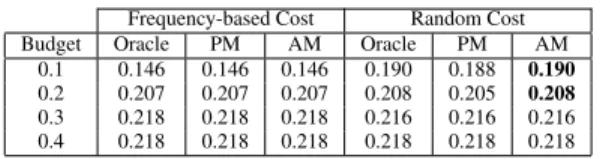
Table 2: Averagep@3for Oracle, PM, and AM over domain M1.
each domain. Because some concepts may not appear in the query workload, we smooth theuvalues using the Bayesian m-estimate method with smoothing parameter 1 and uniform priors [19].
Retrieval System: We index the datasets using Lucene (lucene.apache.org
) and use BM25 as the underlying retrieval algorithm [19]. Given a query, we first rank its candidate answers using BM25. Then, we apply the information about the concepts in the query and docu-ments to return the docudocu-ments whose matching instances have the same concept as the concept of the query or to filter out the non-relevant candidate answers for the query if using domain M1, M2 and M3, as explained in Section 3. We performed our experiments on a Linux server with 250 GB of main memory and two quad core processors. We implemented our retrieval system and optimization algorithms using JAVA 1.7.0_51.
Effectiveness Metric: Most queries in our query workloads have one relevant answer. Hence, we measure the effectiveness of an-swering queries over the dataset using precision at 3 (p@3). We measures the statistical significance of our results using the
paired-t-test at a significant level of 0.05. The statistically significant im-provements are marked in bold in the reported results.
Cost Metrics: We use two types of costs for concept annotation development and maintenance in our experiments. We hypothesize that the cost of building, running, and maintaining an annotator for a concept may be proportional to its frequency as its instances may appear in more diverse contexts in a collection, which may lead to a larger number of rules/features for an annotator and longer running time. We call this type of cost assignmentfrequency-based cost. We also evaluate our algorithms by assigning randomly generated costs to the concepts in a domain. We call this type of cost as-signmentrandom cost. We report the averagep@3over 40 sets of random costs for each budget. We use a range of budgets between 0 and 1 with step size of 0.1, where 1 means sufficient budget to annotate all concepts in a domain.
6.2
Model Validation
In this section, we investigate whether the Annotation Benefit function accurately estimates the likelihood of improvement in ef-fectiveness of answering queries over annotated collections.
Domain with mutually exclusive concepts: We use three algo-rithms in this set of experiments. Given complete information about the relevant answers of queries,Oraclechecks all possible designs in a domain whose costs do not exceed a fixed budget and deliv-ers the design with maximump@3over all queries. Because the designs returned by Oracle deliver the maximum possible effec-tiveness for answering queries, we use its results to measure how accurately practical methods predict the amount of improvement in effectiveness of answering queries achieved by a design. AMis a brute force algorithm that picks the design with maximum Anno-tation Benefit over a domain given a fixed budget. An intuitively appealing heuristic for finding a design is to select the concepts that are most queried by users. ThePMalgorithm implements this heuristic. PM is a brute force algorithm that finds the design with the maximum value ofP
C∈Su(C)pr(C) over a domain given
a fixed budget. Since all these algorithms use exhaustive search
methods, running them over a domain with a large number of con-cepts is not practical. Thus, we evaluate these algorithms only over domain M1. In order to precisely evaluate the estimation accuracy of the Annotation Benefit function, we assume that AM has the exact values of concept frequencies. We will explain how to esti-mate the frequencies of concepts without fully annotating them in Section 6.3.
Table 2 shows the values ofp@3over domain M1 delivered by AM and PM using frequency-based and random costs. We have omitted the results of Oracle, AM, and PM for budgets from0.5 -0.9in table 2, because their results are the same as the ones for budget0.4. Since the number of concepts in domain 1 is rather small, there are few feasible solutions that can exhaust the budget, given a modest or large budget. Hence, all algorithms find the same or very similar designs for these budgets over domain M1. The designs returned by Oracle, AM, and PM deliver the same values ofp@3for answering queries over all budgets for frequency-based cost. In this setting, AM and PM pick the same designs for all budgets between 0.1and0.8. The designs selected by AM and PM are different for budget0.9. Nonetheless, both designs contain 6 out of 7 available concepts in the domain. Answering queries over an annotated collection that contains annotation for all but one of the concepts in the domain will be as effective as answering queries over the fully annotated collection. Therefore, they both achieve the same values ofp@3. Further, the cost distribution in the frequency based cost setting is very skewed in domain M1. Since the number of concepts is rather small in domain M1 and the cost distribution is skewed, there are very few feasible solutions that can maximize the objective functions of either AM or PM given a small budget. For example, with budget equal to0.2, there are only two feasible designs that exhaust the budget and one of them maximizes the objective functions of both AM and PM.
Table 2 shows that the designs produced by AM deliver more effective results for queries than the ones generated by PM for bud-gets0.1-0.2using random costs. Since the cost distribution of ran-dom costs is not as skewed as the cost distribution for frequency-based costs, there are more feasible solutions for both objective functions than the frequency-based cost setting for small budgets. For example, PM and AM includecausal agentandpsychological feature, respectively, in their designs for budget equal to0.1. These designs are not feasible in the frequency-based cost setting. Since
causal agentis quite frequent in the collection, the matching in-stances of this concept appear in most of the top candidate answers for queries with this concept. Hence, AM does only slightly worse than PM in returning answers whose matching instances belong to
causal agentfor queries with this concept. Because AM picks psy-chological featurein its design, it is able to effectively answer the queries from this concept. PM, however, does not pick this concept in its design. Because this concept is not very frequent in the collec-tion, the matching instances of most candidate answers for queries with this concept belong to other concepts. Hence, the PM design returns considerably less effective results for these queries than the AM design. AM returns the same designs as Oracle for budgets0.1 and0.2in the random cost setting. As the budget becomes larger, both algorithms pick almost all useful (relatively popular and/or relatively frequent) concepts. Thus, the ranking qualities provided by the designs from these methods are almost the same for larger budgets.
Domains without constraints regrading the overlap of con-cepts: We use two algorithms in this set of experiments. Oracle
is the same algorithm used in validation experiments for domains with mutually exclusive concepts.AM-Nis a brute force algorithm that picks the design with maximum Annotation Benefit over a
do-Frequency-based Cost Random Cost Budget Oracle AM-N APM Oracle AM-N APM
0.1 0.191 0.191 0.191 0.173 0.173 0.160 0.2 0.229 0.229 0.229 0.205 0.205 0.196 0.3 0.238 0.238 0.238 0.230 0.230 0.230 0.4 0.238 0.238 0.238 0.235 0.235 0.235 0.5 0.238 0.238 0.238 0.237 0.237 0.237 0.6 0.238 0.238 0.238 0.238 0.238 0.238
Table 3: Averagep@3for Oracle, AM-N, and APM (= 0.001) over Domain N1.
Domain Domain M1 Domain M2 Domain M3
APM AAM APM AAM APM AAM
0.1 0.146 0.146 0.196 0.230 0.145 0.145 0.2 0.177 0.207 0.203 0.237 0.164 0.165 0.3 0.218 0.218 0.205 0.239 0.175 0.176 0.4 0.218 0.218 0.203 0.241 0.183 0.196
0.5 0.218 0.218 0.237 0.241 0.175 0.198
0.6 0.218 0.218 0.239 0.241 0.202 0.202 0.7 0.218 0.218 0.241 0.241 0.202 0.202 0.8 0.211 0.218 0.235 0.241 0.202 0.202 0.9 0.218 0.218 0.241 0.241 0.202 0.202
Table 4: Averagep@3for AAM (with = 0.1) and APM (with
= 0.001) using frequency-based costs.
main with no constraint given a fixed budget. SincePMheuristic is very similar toAM-N, we do not report its results in this sec-tion. Table 3 shows the values ofp@3over domain N1 delivered by Oracle and AM-N using frequency-based and random costs. All results for budget 0.7-0.9 are omitted as they are the same as the results over budget 0.6. Note that since the number of concepts in domain N1 is larger than domain M1, this increases the running time of Oracle. Due to limited amount of time, we perform the experiment over domain N1 using 20 sets of random costs.
Overall, ranking quality delivered by AM-N is the same as Or-acle. AM-N and Oracle pick the same design for all budgets for frequency-based cost. Intuitively, more popular and accurately an-notated concepts should deliver a better ranking quality for domains without any constraint because query interface can use only the annotations for the concept of each query to improve the ranking quality of its answers. As opposed to the domain with mutually exclusive concepts, query interface cannot use annotations of con-cepts other that the concept in the query to filter non-relevant an-swers. AM-N generally picks the same designs as Oracle for runs of random costs. AM-N chooses different designs from Oracle in a few runs, but the both designs lead to almost the same amount of improvement in ranking qualities for queries. These results con-firms our assumption that Annotation Benefit formula is suited as an objective function for domains with not constraint.
6.3
Effectiveness of Approximation Algorithms
Parameters Estimation: In addition to the popularities (u) of con-cepts in the query workload, AAM requires the value of the fre-quency (d) for each concept in the collection. The exact frequency of a concept, however, cannot be determined before annotating all its instances. We estimate the frequencies of concepts using a small sample of randomly selected documents from the collection. For each domain, we calculate the frequency of each concept over a random sample of 384 documents from the collection which corre-sponds to an estimation error rate of 5% under the 95% confidence level. Similar to computing concepts’ popularities, we smoothed the value ofdusing Bayesianm-estimates with smoothing param-eter of 1 and uniform priors.
Domain Domain M1 Domain M2 Domain M3
APM AAM APM AAM APM AAM
0.1 0.179 0.189 0.221 0.240 0.192 0.202
0.2 0.201 0.207 0.223 0.240 0.193 0.202
0.3 0.215 0.214 0.226 0.240 0.194 0.202
0.4 0.218 0.217 0.227 0.240 0.195 0.202
0.5 0.218 0.218 0.229 0.241 0.197 0.202
0.6 0.218 0.218 0.231 0.241 0.197 0.202
0.7 0.218 0.218 0.232 0.241 0.198 0.202
0.8 0.218 0.218 0.234 0.241 0.199 0.202
0.9 0.218 0.218 0.237 0.241 0.202 0.202
Table 5: Averagep@3of AAM (with = 0.3) and APM (with
= 0.001) using random costs.
Domains with mutually exclusive concepts: Tables 4 and 5 show the values ofp@3for the APM and AAM algorithms for all mu-tually exclusive domains using frequency-based and random costs, respectively. Generally, the designs generated by AAM improve the values ofp@3significantly more than the designs produced by APM, over all domains and both types of cost metrics. As dis-cussed in Section 3, the optimal design should balance three types of impacts. First, it should contain the most popular concepts so the query interface can return potentially relevant answers to as many queries as possible. Second, if a concept is very frequent, most candidate answers for queries with this concept contain matching instances of this concept. Hence, if the concept is relatively costly, the optimal design should not include these concepts as they may not worth annotating. Third, it should contain relatively frequent and relatively cheap concepts so that the query interface can elim-inate many non-relevant answers from the list of results for the queries whose concepts are not in the design.
In our experiments, the designs produced by APM have larger overall popularities (uvalues) than the designs selected by AAM, across all domains and cost metrics. We have observed that in gen-eral the most popular concepts in users’ queries may not be the most frequent ones in the collection. The designs picked by AAM do not normally include the most popular concepts. Instead, they contain a larger number of relatively popular concepts than the de-signs selected by APM over all domains and cost metrics. Gener-ally, relatively popular concepts are also rather frequent. Since the overall frequencies of the designs produced by AAM are generally larger than the ones selected by APM, they help the query inter-face to eliminate more non-relevant answers from the results of the queries whose concepts are not included in these designs. Because these designs include relatively popular concepts, they also help the query interface to return the relevant answers to a relatively large number of queries.
In a small number of cases, the designs generated by APM de-liver a largerp@3than the ones produced by AAM. Although the differences between AAM and APM in these cases are not statisti-cally significant, it is interesting to explore the reasons behind these improvements. The designs generated by APM for budget 0.3 and 0.4 over domain M1 using random costs deliver larger values of
p@3than the designs of AAM. In both budgets, the relative effec-tiveness improvement of APM over AAM in each budget is due to a single run where APM selects a design with larger value of An-notation Benefit than the design picked by AAM. This illustrates the fact that both methods are approximation algorithms and some-times they may return quite different answers from their optimal solutions.
Generally, the differences between the values ofp@3achieved by the designs of AAM and APM are smaller for larger budgets across all domains and cost metrics. This is mainly due to the
fact that AAM and APM can afford to include most of the popular and frequent concepts in their designs for medium or large bud-gets. Adding the concepts that are rare in the collection or query workload does not improve the effectiveness of answering queries considerably. Because domain M1 has a relatively small number of concepts, both algorithms pick similar designs given a smaller amount of budget for this domain than other domains.
In some cases, the designs generated by APM deliver smaller values ofp@3for larger budgets. For instance, the design for bud-get0.8delivers a smaller value ofp@3than the one for budget0.7 over domain M1 when frequency-based cost is used. Given suffi-cient budget, APM may replace reasonably popular and frequent concepts with more popular and less frequent concepts. As dis-cussed in Section 3 and the beginning of this section, this may have a negative impact onp@3for answering queries over the annotated collection.
The values ofp@3for the designs generated by AAM over do-main M2 and dodo-main M3 when random costs are used are almost the same over all budgets greater than0.1. The distribution of fre-quencies and popularities of concepts are very skewed in these do-mains, where relatively small number of concepts (e.g. 10 concepts in domain M2) have a large portion of the total frequency and pop-ularity in the domain. Since the costs are assigned randomly, in most runs AAM is able to pick these concepts using a relatively small budget. AAM adds new concepts to this set given larger bud-gets. The new concepts, however, do not improve the effectiveness of answering queries over the annotated collection.
APM cannot find the set of more popular concepts given a small or moderate budget. The algorithm used in APM has two main steps [17]. It separates concepts into two sets, popular and un-popular. It then uses a dynamic programming method to find the optimal solution from the set of popular concepts. If there are still some budget left, it greedily picks concepts from the set of unpop-ular concepts until the budget is exhausted. The decision of how to partition concepts into these two sets is based on an approximation, which is not accurate in many cases. Hence, in some cases the con-cepts that belong to the optimal design may placed in the set of un-popular concepts. The greedy algorithm used to pick the concepts in the unpopular set sorts them based on the ratio ofu(Cw)×(Cpr)(C), whereuis the popularity,pris the accuracy, andwis the cost of conceptC, and select the top concepts. This method leaves out some desired concepts that are relatively popular but expensive.
Domains without constraints regrading the overlap of concepts:
We investigate the effectiveness of the version of APM algorithm introduced in Section 5.1 for domains without any constraint. Ta-ble 3 shows the values ofp@3over domain N1 delivered by Oracle, AM-N and APM using frequency-based and random costs. Over-all, the results delivered by APM are the same as that of Oracle and AM-N except at budget 0.1 and 0.2 of random cost. APM generally selects the same designs as that of PM. Hence, it delivers the same ranking qualities as the optimal solutions. Since APM is an approx-imation algorithm, it cannot find solutions that maximizes concept popularity in some runs of random cost. For example, APM picks the design consists ofliterary compositionwhere AM-N picks the design withseriesand dramatic compositionin one of the runs. The overall popularity of the latter design is larger than the former one. Thus, APM cannot answer queries as effectively as AM-N does. As the costs are quite skewed in frequency-based runs, APM almost always picks the same designs as AM-N in these runs.
6.4
Efficiency of Approximation Algorithms
This section studies the efficiency and scalability of our approx-imation algorithms. Due to limited space, we show the efficiency
0.5 0.3 0.1 0.01 0.001
Domain M1 1 2 2 -
-AAM Domain M2 1 5 102 - -Domain M3 4 15 128 -
-Domain M1 1 2 2 2 5
APM Domain M2 1 2 2 3 12 Domain M3 4 14 15 15 23
Table 6: Average running times of AAM and APM (in minutes)
0.5 0.3 0.1 0.01 0.001 Domain M1 348 492 635 - -AAM Domain M2 1667 6498 84139 - -Domain M3 1326 5608 63466 - -Domain M1 184 184 184 215 1976 APM Domain M2 184 184 184 215 4933 Domain M3 184 184 184 471 7732
Table 7: Average memory usages of AAM and APM (in MB)
and scalability of AAM and APM using only frequency-based costs over domains M1, M2 and M3. Our experiments over the ran-dom based costs show similar results for the scalability of the algo-rithms. Since the running time and memory consumption of APM is similar over the domains with mutually exclusive concepts and the domains without any constraints, we report the scalability re-sults for APM only over the domains with mutually exclusive con-cepts.
Efficiency: Table 6 shows the average running time of APM and AAM algorithms over domain M1, M2, and M3 with budget 0.1 to 0.9 using various several values between 0.5 - 0.001 for. As we expect, the smaller the value ofis, the longer the running times of both algorithms are. APM is generally more efficient than AAM, particularly for smaller values of. This observation confirms our comparative analysis of the time complexities of these algorithms in Section 5. We set the value ofto0.1for AAM and0.001 for APM in our experiments to evaluate the improvement in effec-tiveness of answering queries achieved by the designs produced by AAM and APM for frequency-based cost, reported in Section 6.3, we set the value ofto0.1and0.001, respectively. According to Table 6, the running times of the algorithms for these values of
are reasonable for a design-time task. As we have to run AAM 40 times per budget in the experiments using random costs, reported in Section 6.3, we set the value ofto0.3in AAM for these exper-iments. Table 6 indicates that the running time of AAM with this value ofis reasonable for a design time task.
Both APM and AAM use dynamic programming method and keep a table in the main memory to maintain the solutions of their subproblems. Table 7 shows the average memory usage of APM and AAM algorithms over domains M1, M2, and M3 using values from0.5-0.001for. Similar to running time, the smaller the value ofis, the larger the memory AAM and APM need.
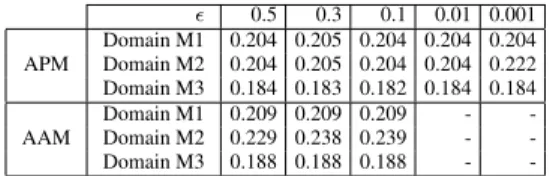
0.5 0.3 0.1 0.01 0.001 Domain M1 0.204 0.205 0.204 0.204 0.204 APM Domain M2 0.204 0.205 0.204 0.204 0.222 Domain M3 0.184 0.183 0.182 0.184 0.184 Domain M1 0.209 0.209 0.209 - -AAM Domain M2 0.229 0.238 0.239 - -Domain M3 0.188 0.188 0.188 -
-Table 8: Averagep@3over all budgets for AAM and APM using different values of


![Bis(μ pyridinium 2 carboxylato κ2O:O′)bis[triaqua(sulfato κO)manganese(II)]](data:image/gif;base64,R0lGODlhAQABAIAAAP///wAAACH5BAEAAAAALAAAAAABAAEAAAICRAEAOw==)