Hungarian Association of Agricultural Informatics European Federation for Information Technology in Agriculture, Food and the Environment
Journal of Agricultural Informatics. Vol. 7, No. 1 journal.magisz.org
Impacts of Temporal and Spatial Climatic Changes on Annual Generations of
Rhopalosiphum maidis
and
R. padi
(Hemiptera: Aphididae) in Egypt, Using
Geographical Information System (GIS)
Reda M. M. Tabikha1
I N F O
Received 15 Oct. 2015 Accepted 16 Apr. 2016 Available on-line 30 Apr. 2016 Responsible Editor: M. Herdon
Keywords: Aphid, generations, degree-days, Egypt, GIS.
A B S T R A C T
Corn leaf aphid Rhopalosiphum maidis and bird cherry-oat aphid R. padi, attacking many host plants, which be recorded not only in most localities of Egypt but also along a year. So, numbers of generations could be calculated and predicted in all localities by employing Geographical Information System (GIS) and by exploiting calculated values of daily degree units and thresholds of development for them, with current and future thermal climatic conditions. Biannually generations' numbers of them differ from region to another, that numbers of wintery and summery generations of R. maidis ranged between 1-29 and 12-50 generations, respectively under current conditions. Expected generations numbers will changed with rates ranged between -4: 14 and -24:16 generations, respectively in 2050, and with rates ranged -3: 15 generation and -42: 17 generation, respectively in 2070. On other hand, Numbers of wintery and summery generations of R. padi ranged between 1–27 and 11-42 generations, respectively under current conditions. Finally expected numbers of wintery and summery generation in 2070 will be nearly similar to 2050, that its changing rates ranged between -3: 14 generation and -36: 16 generation, respectively. Temporal spatial distributions and variations of generation numbers in different regions and governorates of Egypt were discussed under current and future conditions. Moreover future of growing cereal crops was also discussed especially in southern reclaimed regions.
1.
Introduction
Spatial analysis by Geographical Information System (GIS), a computer program for analyzing and mapping geographical datasets, is availability methods to research spatial distribution of insect pests by analysis the relationship between geographic conditions, climate resources and occurrence of insect pests (Schell et al., 1997). So the GIS could be employed to predict effect of climatic changes on insect, that effect on geographical distribution, Behavior and physiology of insects (Parmesan 2007 and Merrill et al. 2008). Temperature has a direct influence on insect activity and rate of development (Zalom and Wilson, 1982). The assessment report from the Intergovernmental Panel on Climate Change (IPCC) predicts an increment in mean temperature from 1.1 to 5.4o C toward the year 2100
(Meehl et al. 2007). The thermal unit provides a valuable tool for insect pest control; in forecasting infestations monitoring and timing of insecticide applications (Zalom et al., 1983). Moreover estimation of generations number of insects relying on current and expected future climatic factors such as maximum, minimum and mean temperature (Abolmaaty et al., 2010). In addition, such changes in climatic conditions could profoundly affect the population dynamics and the status of insect pests of crops (Woiwod, 1997). Development of aphid is faster in warmer temperature (Kuo, et al., 2006; Park and Obrycki, 2004; Razmjou and Golizadeh, 2010; Sharma and Bhatnagar, 2002).
Corn leaf aphid Rhopalosiphum maidis (Fitch, 1856) and bird cherry-oat Aphid R. padi
(Linnaeus, 1758)), attacking many host plants, including corn, sorghum, barley, oats, and wheat, as well as weeds and plants of the families Gramineae, Cyperaceae, and Typhaceae, have spread almost worldwide, including the Nearctic, Ethiopian, Australian, and Neotropical regions, as well as some Oceanic islands, including Hawaii. They are widespread across the United States, Mexico, the Middle East, and Europe, as well as the southern half of Canada and Asia, and parts of Africa. (Helmi, 2011; Jarasova, et al., 2013; Messing, et al., 2007; Mushtaq, et al., 2013; Parry, et al., 2012; Razmjou and Golizadeh, 2010; Van Emden and Harrington, 2007).
Rhopalosiphum maidis and R. padi were recorded on wheat, barley and corn in different sites in Upper, Middle and lower Egypt, On other hand, both species were observed on summer, winter and perennial cereal weeds in different localities of Egypt such as Kharga and Dakhla Oases, Giza, Zagazig Governorate (Delta), Kafer El-Sheikh (Delta); and on beard grass and wild oats in North Sinai Governorate (El-Heneidy, and Adly, 2012). R. maidis was the most abundant aphid species in Northern and Western coast of Egypt (Noaman et al., 1992). R. maidis is ongoing migration from one host to another throughout the year that migrated from summer weeds to early grown barley and wheat and the infestation remained until March or April then moved again to gramineous weeds for a short time then migrated during May and early June to the sorghum and summer maize plantations and the weeds grew on the sides of canals (Hassan, 1957).
As result of presence of different host plants of R. maidis and R. padi not only in most localities of Egypt but also along a year, Number of annual and seasonal generation could be calculated in all locality by employing calculated values of Daily Degree units (DDU) (k) and lower threshold of development (zero of development) (t0) (Jasic, 1975) which estimated by many authors
for R. padi (Abdel-Rahman, et al., 2002; Auad et al. 2009; Campbell, et al. 1974; Kuroli, 1984; El-Heneidy, et al., 2003; Elliott and Kieckhefer 1989) and for R.maidis (El-Ibrashy et al., 1972; El-Sheikh et al., 2009; Kuo et al., 2006; Singh et al.,1996), in addition upper threshold temperature could be also concerned which estimated by (Auad et al., 2009; Debarro and Maelzer, 1993) for R. padi or (El-Ibrashy et al., 1972) for R. maidis.
So previously calculated thermal constant value, upper and lower threshold temperature of development for both aphid species could be exploited with recorded current and expected maximum, minimum and mean temperature of future in different locality to predict numbers of annual generation in different locality of Egypt by using GIS, which good ability to analyze different datasets and to present the results on maps with geographical nature.
2.
Material and Methods
Current study aimed to employ monthly mean values of current and future maximum, minimum and mean temperature; estimated temperature of development thresholds and thermal constants for R. maidis and R. padi to calculate number of current and predicted generation of both species in future under impact climatic change in all over Egypt, along a year by using Geographical information system (GIS). So ArcGIS 10 computer system was used to perform spatial analysis for all obtained and necessary data then spatial estimation of generation numbers could be achieved.
2.1.
Location
Current study was performed on Arab Republic of Egypt region that has an area of about 1,01,408 square kilometers (390,000 square miles), which located in northeast corner of Africa and southwest corner of Asia between latitudes of 22° and 32°N and longitudes 25°E and 35°E. It has 27 administrative regions.
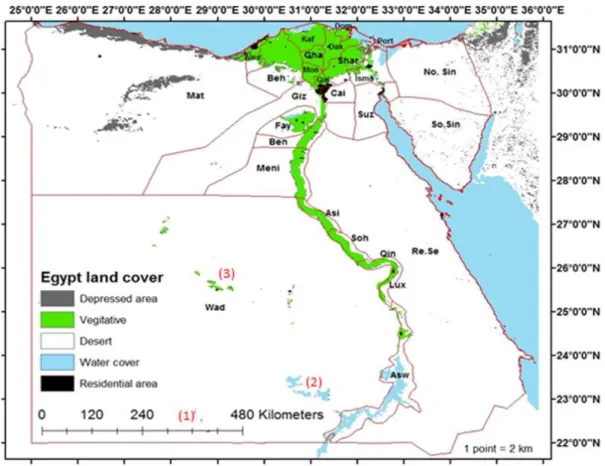
Egypt, as a country, can be divided to four different agro-ecosystem regions as shown in Figure (1); Lower Egypt which contains Delta Governorates [Kafr El-Sheikh (Kaf), Dakhalia (Dak), Behera (Beh), Domiata (Dom), Gharbia (Gha), Monoufia (Mon), Sharkia (Sha) and Qaluobia (Qal) Governorates]; Canal Governorates [ Port said (Port), Ismalia (Ism) Suez (Suz)] and west north coast governorates such as Alexanderia (Alex) and Matrouh (Mat). Middle-Egypt which contains Giza (Giz), Fayoum (Fay) and Beni-Suef (Ben) Governorates. Upper-Egypt which contains Menia (Meni), Assuit (Asu), Sohag (Soh), Qina (Qin), Luxor (Lux) Aswan (Asw), Red Sea (Red) and New Valley (Wad) Governorates. Finally, Sinai contains South Sinai (So.Si.) and North Sinai (No.Si.) governorates. Most of Egyptian Agro-ecosystem lies along the Nile valley. Agro-ecosystems for newly reclaimed land, in Toshka (1), west and east of Owinat (2), and Kharga and Dakhla Oases (3), lied on Upper Egypt, and considered as main land reclamation projects in Egypt.
2.2.
Required Data
temperature were downloaded under current conditions (interpolations of observed data, representative of 1950-2000) with highest resolution (30 arc-seconds (~1 km)) and under future conditions of 2050 (average for 2041-2060) and 2070 (average for 2061-2080) with spatial resolutions 2.5 minutes (this is about 4.5 km at the equator), which were obtained from global climate models MIROC5 (Model for Interdisciplinary Research on Climate) and using representative concentration pathways 45 (rcp). In addition, boundary map of administrative areas of Egypt is also downloaded as shape layer.
Biological aspects for survivor of R. maidis and R. padi were obtained from almost latest biological studied conducted in Egypt as possible. Each of lower threshold temperature (t0), and thermal
requirements (k) as Day-degree units (DDU) and upper threshold temperature are most concerned value. So during current study, estimated values of lower threshold temperature (t0) (8.38oC) and
thermal requirements (k) (88.11 degree-days) for generation time of R. maidis by El-Sheikh et al., 2009, are used and employed to calculate number of generations. On the other hand, estimated values of lower threshold temperature (t0) (8.89oC) and thermal requirements (k) (92.32 degree-days) for
generation timeof R. padi by Abdel-Rahman, et al., 2002, are used and employed to calculate number of generations. In addition, upper threshold temperature (35oC) for R. maidis, estimated by El-Ibrashy
et al., 1972, and (32oC) for R. pad, estimated by Auad et al., 2009 are also used as highest inhabiting
temperature for generation formation in some months of summer.
Figure 1. Land cover and boundary distributions of Agro-ecosystem and governorates of Egypt, obtained from DIVA-GIS.com.
2.3.
Input and Processing Data
Global layers of current and future monthly average of maximum, minimum and mean temperature, lower threshold temperature (t0), and thermal requirements (k), upper threshold
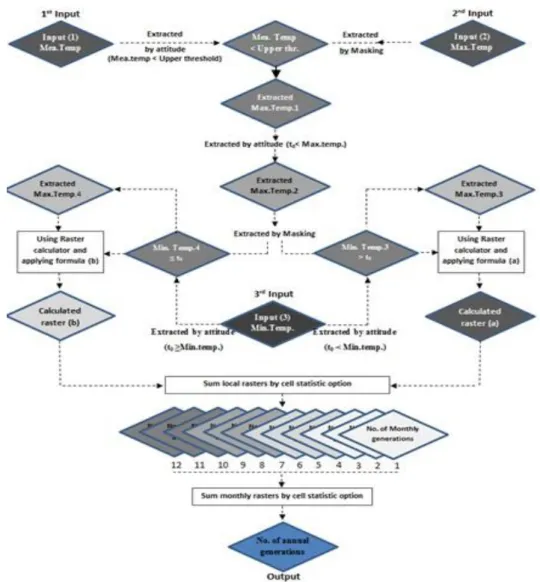
1- Layer of monthly mean temperature for Egypt (first input) is extracted with attitude of values that less than upper threshold temperature.
2- Last extracted raster layer of mean temperature used in masking extraction for monthly maximum temperature layer(second input) to give raster layer for maximum temperature (1).
3- Extracted layer of maximum temperature (1) is subjected to another attitude extraction for
values that less than lower threshold temperature (t0) to give Extracted layer of maximum
temperature (2).
4- Layer of monthly minimum temperature (third input) is subjected to attitude extraction for extract values less than or equal lower threshold temperature (t0) and value more than lower
threshold temperature (t0) to give two raster one for minimum temperature values less than or
equal (t0) (4) and the other for values more than (t0) (3).
5- Recent extracted layers of minimum temperature(3)(4) are used in masking extraction for
Extracted layer of maximum temperature(2) to output two parallel raster layer for them
(extracted layers of maximum temperature(3)(4)).
6- Generated and extracted layers of maximum temperature(3)(4) and minimum temperature(3)(4) are
subjected to Map Algebra tools for raster calculation by applying following formulas according to Jasic, 1975:
- No. Gen.(Raster a) = [(max3+min3)/2)- t0] ]* D /K In case of Max. t < Min. t < to
- No. Gen.(Raster b) = [(max4- t0)2 /2(max4-min4) ]* D /K In case of Max. t < to < Min. t
- No. Gen. = Zero In case of to < Max. t < Min. t D: Number of Days for each month K: Thermal requirements
to: Lower threshold of temperature No. Gen: Monthly generation numbers.
max or min: Layers of extracted maximum or minimum temperature.
7- The last two generated raster maps for numbers of monthly generations (Raster a and raster b, respectively) are joined together by local cell statistics of spatial analysis tools to generate raster map for monthly generations numbers of all Egypt regions.
8- Sum of monthly raster maps of generations' numbers could be calculated easily by applying also local cell statistics tools to generate biannually maps [for cold (October to March on wintery hosts) or hot (April to September on summery hosts) months] for number of generation under current and future thermal climatic conditions, which could be discussed.
3.
Results and Discussion
To simplify results of obtained generation numbers in different regions of Egypt under current and future conditions of 2050 and 2070, in addition to clarify impact of increasing temperature, that higher than upper threshold temperature of each species on generations numbers under climatic changes in future, number of generations calculated biannually on summery (from April to September) and wintery (from October to March) hosts separately.
3.1. Numbers of biannual generations of R. maidis
Numbers of wintery and summery generations differ from region to another as illustrated in Figure (3) that ranged between 1 - 29 generations on wintery hosts while it was higher on summery hosts that harbored 12-50 generation, under current conditions. Expected numbers of R. maidis
generations numbers in 2050 will changed with rates ranged between -4 : 14 and -24 :16 generations on wintery and summery host plants, respectively, to give spatial distribution of generations reach 4-35 generations on wintery hosts, and 22-51 generations on summery hosts. Finally Expected numbers of generation in 2070 will be 5-36 generation on wintery hosts and 7-52 on summery hosts, with numbers changing rates ranged -3: 15 generation and -42 : 17 generation, respectively. Temporal impact of climatic changes on current and forecasting generation numbers in future isn't obvious without combining it with spatial effect, which will be obvious through following discussions.
3.1.1. Spatial distribution of wintery R. maidis generations numbers under current and future conditions
Numbers of wintery generations under current conditions, graphically illustrated in Figure (3W1), reflect that dominate and moderated numbers of wintery generations was about 13-20
which observed in most regions and governorate of Egypt, 13-16 generation noticed in middle of delta and western regions of each of Alexandria, Behera, Giza, Fayoum, Beni-Suef and Menia in addition all regions of north Sinai and Matrouh. On contrary canal governorates, north delta and regions located on border of river Nile had 17-20 generation except Qina, Luxor and north Aswan had 21-24 generation. Lowest generation numbers were observed in most south Sini (9-12 generation) while highest one observed in south Aswan (25-29 generation). Those numbers will increased with nearly stable number, not more three generation, under future conditions of 2050 in all region, as shown in Figure (3W2) that will reach to 19-23 generations in Delta, North coast,
Canal governorates, middle Egypt and Minia, while it reach to 24-28 generations in upper Egypt governorates (from Asuit to north Aswan) in addition numbers of generation will also increase to 35 generations in south Aswan. Generations of R. maidis will increase in most Sinai governorates to reach 14-23 generation. Numbers of generations in all later mention regions will increase with stable and low rates (not more than one generation) under climatic conditions of 2070.
3.1.2. Spatial distribution of Summery R. maidis generations numbers under current and future conditions
W1 S1
W2 S2
W3 S3
reached 42-46 generations in Qina, Luxor, southeast of New Valley and north of Aswan, while it increased to 47-50 generation in south Aswan (around Nasser lake). Most of Sinai regions and northwest coastal regions had moderated numbers of generations (27-31generation).
In future conditions of 2050 numbers of generations, as shown in Figure (3S2), will increased with nearly constant rates (5-6 generations) in Lower Egypt and (5-10 generations) in most Middle Egypt, Minia, Sohag and Asuit. While generation numbers will decreased with rates 1-14 generation in Qina and Luxor and more than 14 generation (15-24 generation) in Aswan as a result of increasing mean temperature above 35oC (upper threshold temperature of development
of R. maidis ), which inhibit generation formation during summer of 2050 El-Ibrashy et al., 1972. Same observations will also be noticed in 2070 as shown in Figure (3S3), that generation will decrease with rates 20-27 generation in most of Luxor and Aswan and southeast of new valley regions, while decreasing rates will be less in most of Qina Governorates (not more than 12 generation) than in current conditions.
Figure 3.Maps of regional biannual distribution of R. maidis generation numbers on wintery (W) and summery (S) hosts in Egypt, under current (W1 and S1) and future conditions of 2050 (W2 and
So expected generation numbers in most regions of Lower Egypt will reach 38-41 and 37-42 generation under 2050 and 2070 conditions, respectively except in Kafr El-Sheikh, along west north coast in addition most Sini that will have 34-37 generations and less (31-36 generation) under 2050 and 2070 conditions, respectively. In most regions of middle Egypt and Minia and northwest new valley will have 42-45 generation and will increase to 46-49 generation in Asuit, Sohag and middle of new valley under 2050 conditions, while those previous region will be have nearly stable generation numbers that will be 43-48 generations under 2070 conditions. On contrary numbers of R. maidis is expected that will decrease from Qina and Luxor (30-33 generation) and less toward southern regions to reach 22-25 generation in most regions, under 2050 condition, and will decrease to 25-30 generation in Qina and Luxor and less in most southern regions to reach 19-24 generations under 2070 conditions. So cultivation of summery cereal crops in this area, that has main land reclamation projects in Egypt, will be more convenient than other region because of absence or decreasing generation numbers of R. maidis, which attack and transmit viral diseases to plants.
3.2.
Numbers of biannual generations of R. padi
Numbers of wintery and summery generations differ also from region to another as illustrated in Figure (4) that ranged between 1 - 27 generations on wintery hosts while it was higher on summery hosts that harbored 11-42 generation, under current conditions. In prospect, numbers of wintery generations in 2050 will changed with rates ranged between -3 : 13 generations to give spatial distribution of generations, may be range 4-32 generations on wintery hosts allover Egypt. Under summery conditions of 2050, despite the increase in the number of generations for rates up 16 generation, will be observed in some areas, but the generations numbers will decline at rates up to 36 generation in other areas. Same rates of generation numbers changes (-36: 16) will be also observed on summery hosts of 2070 as a result of the higher temperatures degrees than upper threshold temperature of R. padi generation forming (32oC) Auad et al., 2009, so numbers of
generations will ranged between 5-41 generation allover Egypt on summery host plants in both 2050 and 2070. Finally expected numbers of wintery generation in 2070 will be nearly similar to 2050, that its changing rates ranged between -3: 14 generation on wintery hosts to format 4 -33 wintery generation and rates of changes. For more explanation of spatial and temporal impact of climatic changes on current and forecasting R. padi generation numbers in future, biannually discussion for generations numbers could be conducted as flow:-
3.2.1. Spatial distribution of wintery R. padi generations numbers under current and future conditions
Numbers of R. padi wintery generations under current conditions, graphically illustrated in Figure (4W1), reflect that dominate and moderated numbers of wintery generations was about 13-16 which observed in most regions and governorates of Egypt, especially in Lower, Middle Egypt, and north areas of Upper Egypt (Minia, north of Red sea and north of New Valley Governorates), and less than 13 generation in north Matrouh, most of Sinai Governorates. In contrary, numbers of generation was higher than 16 (17-20) in Sohag, Asuit, Qina, Luxor, middle of each of New Valley and Red sea and parts of canal Governorates. Finally the highest values will be observed (21-27) in Aswan and south of each of New valley and Red sea Governorates. In 2050 and 2070 as graphically illustrated in Figures (4W2) and (4W3), respectively, it expected that those generations' numbers will increase nearly with constant increasing rate (3 generations) in most of previously discussed regions of Egypt in both of them, with little exception in 2070, that generation numbers of R. padi in governorates that located along river Nile and canal governorates, will be higher (20-23) than other Governorates (16-19) of lower and middle Egypt.
3.2.2.
Spatial distribution of Summery R. padi generations numbers under current
and future conditions
Numbers of R. padi generations on summery hosts under current conditions, graphically illustrated in Figure (4S1), that shown numbers of summery generation are also more than wintery
W1 S1
W2 S2
W3 S3
increased gradually toward southern Governorates of Egypt till Luxor Governorate, that are 31-34 generation in South of Behera, Dakhalia, Monoufia, Sharkia, Qaluobia, Minia, Middle Egypt and canal Governorates, then increased to 35 generation in Sohag, Asuit, north New valley and Red sea governorates, and more to 42 generation in Qina, Luxor and middle of new valley. On contrary, numbers of generation decreased to reach 19-22 generation in Aswan and South of New valley Governorates.
From obtained and illustrated data in Figures (4S2) and (4S3) reflected that expected summery
generation numbers in 2050 and 2070 will increase to reach 35-39 in most Lower and Middle Egypt, Red sea governorates till Minia Governorate, with little exception in north coast and Sinai governorates that have less generation numbers (30-34 generation). On contrary, expected Figure (4): Maps of regional biannual distribution of R. padi generation numbers on wintery (W)
and summery (S) hosts in Egypt, under current (W1 and S1) and future conditions of 2050
numbers of generation will decline in Upper Egypt governorates comparing with current generation numbers that will be 15-24 generation in Sohag, Asuit, north Qina and north of New valley and west of Red sea Governorates. Least generations' numbers (5-9 generations) will notice in south Qina, Luxor, Aswan and south new valley governorates, so in prospect cultivation of summery cereal crops in this area will be also more protected of R. padi attacking and viral diseases transmission.
Cultivation of cereal crops in newly reclaimed land in Toshka, west and east of Owinat and Kharga and Dakhla Oases (New valley Governorate) in Upper Egypt will be more convenient because of reduction or absence generations of R. maidis and R. padi under future conditions of 2050 and 2070. Those pests were recorded by Hassan, 1957 and Mannaa, 2000 in this area.
References
Abdel-Rahman, M. A. A.; A. M. Ali and A. G. Ali (2002) Reproductive potential of the oat bird cherry aphid,
Rhopalosiphum padi L. (Homoptera: Aphididae) at constant temperature. 2nd International Conference, Plant
Protection Research Institute, Cairo, Egypt, 21-24 December.
Abolmaaty S.M; M.K. Hassanein; A.A. Khalil and A.F Abou-Hadid (2010 ) Impact of Climatic Changes in Egypt on Degree Day’s Units and Generation Number for Tomato Leaf miner Moth Tuta absoluta, (Meyrick) (Lepidoptera gelechiidae). Nature and Science 8(11):122-129.
Auad, A. M.; S. O. Alves; C. A. Carvalho; D. M. Silva; T. T. Resende and B. A. Veríssimo (2009) The Impact of Temperature on Biological Aspects and Life Table of Rhopalosiphum padi (Hemiptera: Aphididae) Fed with Signal Grass .Florida Entomologist 92(4):569-577
doi:10.1653/024.092.0406
Campbell, A.; B. D. Frazer; N. Gilbert; A. P. Gutierrez and M. Mackauer (1974). Temperature requirements of some aphids and their parasites. J. Appl. Ecol. 11, 431-438.
Debarro, P.J. and D.A. Maelzer (1993) Influence of High-Temperatures on the Survival of Rhopalosiphum padi (L) (Hemiptera, Aphididae) in Irrigated Perennial Grass Pastures in South-Australia .Australian Journal of Zoology. 41(2) 123 – 132 doi: 10.1071/zo9930123
El-Heneidy, A. H. and D. Adly (2012) Cereal Aphids and their Biological Control Agents in Egypt. Egyptian Journal of Biological Pest Control, 22(2), 227-244.
El-Heneidy, A. H.; M. M. El-Husseini; E. A. Agamy and D. Adly (2003) Thermal Constants for Development of the Cereal Aphid, Rhopalosiphum padi (Homoptera: Aphididae) and its Parasitoid, Aphidius matricariae (Hymenoptera: Aphidiidae). Egypt .J. Biol. Pest Cont. 13 (1):13-18.
El-Ibrashy, M.T.; S. El- Ziady and A.A. Riad (1972) Laboratory studies on the biology of the corn leaf aphid,
Rhopalosiphum maidis (Homoptera: Aphididae). Entomologia experimentalis et Applicata. 15(2): 166-174. doi:
10.1111/j.1570-7458.1972.tb00192.x
Elliott, N.C. and R.W. Kieckhefer (1989) Effects of constant and fluctuated temperature on immature development and age-spacific life tables of Rhopalosiphum padi (L) (Hemiptera, Aphididae). The Canadian Entomologist, 121 (2)131-140. doi: 10.4039/ent121131-2
El-Sheikh, M. A. K.; S. Elnagar; M. A. El-Hariry and M. M. El-Fatih. (2009) Life Table- parameters and heat units for the corn leaf aphid , Rhopalosiphum maidis (Fitch), reared on barely host plant.4 th Conference on Recent Technologies in Agriculture,(101-109)
Hassan, M. S. (1957) Studies on the damage and control of Aphis maidis Fitchin Egypt. Bull. Soc. ent. Egypte, 41: 213-230.
Helmi, A. (2011) Identification of apterous viviparous of cereal aphids in Egypt (Hemiptera: Sternorrhyncha: Aphididae). Munis Entomology & Zoology, 6/1: 346-357.
Jarasova, J., J. Chrpova, V. Sip and J. Kundu (2013) A comparative study of the Barley yellow dwarf virus species PAV and PAS: distribution, accumulation and host resistance. Plant Pathology, 62/2: 436-443. doi:
10.1111/j.1365-3059.2012.02644.x
Jasic, J.(1975) On the life cycle of Perillus bioculatus (Heteroptera:Pentatomidae) in Slovakia. Acta entomol. Bohemoslov, 72:383-390.
Kurol, G. (1984) Laboratory investigation of the ontogenesis of oat aphis (Rhopalosiphum padi L.). Zeitschrift für Angewandte Entomologie. 97, Issue 1-5, (71–76).
doi: 10.1111/j.1439-0418.1984.tb03716.x
Mannaa, S. H. (2000) Cereal aphids on wheat in New Valley: natural enemies, seasonal activity of alate forms and susceptibility of certain varieties to natural infestation. Assiut J. Agric. Sci., 31(2): 287-297.
Meehl, G.; T. Stocker; W. Collins; P. Friedlingstein; A. Gaye; S. Solomon; D. Qin; M. Manning; Z. Chen and M. Marquis (2007). Climate Change, 2007: The Physical Science Basis. Contribution of Working group I to the Fourth Assessment Report of the Intergovernmental Panel on Climate Change. Cambridge University Press, Cambridge, UK and New York, NY, USA.
Merrill; R; D. Gutie´rrez,; O. Lewis; J. Gutie´rrez; S. Diez, and Wilson,R. (2008). Combined effects of climate and biotic interactions on the elevational range of a phytophagous insect. J. Anim. Ecol. 77, 145–155. doi:
10.1111/j.1365-2656.2007.01303.x
Messing, R.; M. Tremblay; E. Mondor; R. Foottit and K. Pike. (2007) Invasive aphids attack native Hawaiian plants. Biological Invasions, 9(5): 601-607. doi: 10.1007/s10530-006-9045-1
Mushtaq, S.; S. Rana; H. Khan and M. Ashfaq (2013) Diversity and abundance of Family Aphididae from selected crops of Faisalabad, Pakistan. Pakistan Journal of Agricultural Sciences, 50(1): 103-109.
Noaman, M. M.; S. I.Bishara; A.A. El-Sayed; M. A. El-Hariry and R. H. Miller. (1992) A field survey of aphids infesting barley in Egypt with results of field and laboratory screening for aphid resistance. Assiut J. Agric. Sci., 23 (1): 303-309.
Park, Y. and J. Obrycki (2004) Spatio-temporal distribution of corn leaf Aphids (Homoptera : Aphididae) and lady beetles (Coleoptera : Coccinellidae) in Iowa cornfields. Biological Control, 31/2: 210-217. doi:
10.1016/j.biocontrol.2004.06.008
Parmesan, C. (2007). Influences of species, latitudes and methodologies on estimates of phenological response to global warming. Glob. Chang. Biol. 13, 1860–1872.
doi: 10.1111/j.1365-2486.2007.01404.x
Parry, H.; S. Macfadyen and D. Kriticos (2012) The geographical distribution of Yellow dwarf viruses and their aphid vectors in Australian grasslands and wheat. Australasian Plant Pathology, 41/4: 375-387. doi:
dx.doi.org/10.1007/s13313-012-0133-7
Razmjou, J. and A. Golizadeh (2010) Performance of corn leaf aphid, Rhopalosiphum maidis (Fitch) (Homoptera: Aphididae) on selected maize hybrids under laboratory conditions. Applied Entomology and Zoology, 45/2: 267-274. doi: 10.1303/aez.2010.267
Schell S. P. and J.A. Lockwood. (1997) Spatial analysis of ecological factors related to rangeland grasshopper (Orthoptera: Acrididae) outbreaks in Wyoming. Enbiron Entomol, 26(6):1443:1353. doi: 10.1093/ee/26.6.1343
Sharma, H. and A. Bhatnagar (2002) Biology of the maize aphid, Rhopalosiphum maidis (Fitch) on barley. Pest Management and Economic Zoology, 10(2): 111-114.
Singh, R.; B.S. Upadhyay and P.N. Srivastava (1996) Effect of temperature on the development and life-table of Rhopalosiphum maidis (Fitch), (Homoptera: Aphididae) on three food plants. J. Aphidol. 10: 19-29.
Van Emden, H. and R. Harrington (2007) Aphids as Crop Pests. Trowbridge, United Kingdom: CABI. doi:
10.1079/9780851998190.0000
Zalom, F. and T. Wilson (1982). Degree days in relation to an integrated pest management program. Division of Agricultural Sciences, University of California, Davis, CA, USA. 2 pp.