www.ijper.org
Formulation and Evaluation of Fast Dissolving
Tablets of Ondansetron by Solid Dispersion in
Superdisintegrants
Rajnikant M. Suthar1, Narendra P. Chotai*1 and Digesh D. Shah2
1A. R. College of Pharmacy and G. H. Patel Institute of Pharmacy, PO Box No.19 Motabazar, Vallabh Vidyanagar-388120, Anand, Gujarat, India.
2Sanofi Aventis Pharmaceuticals Ltd. Ankleshwar, Gujarat, India.
ABSTRACT
Ondansetron Hydrochloride (OSH) is a sparingly water-soluble drug. The aim of the present investigation was to prepare solid dispersion (SD) of OSH using superdisintegrants as carrier and formulate it as fast dissolving tablets (FDTs) with an objective to improve solubility and enhance dissolution of drug. SD of drug using superdisintegrants like croscarmellose sodium (CCS), crospovidone (CP), sodium starch glycolate (SSG), and low substituted hydroxy propyl cellulose (L-HPC) respectively as carriers was prepared by solvent evaporation method. The prepared SD formulations were characterized by equilibrium solubility, fourier transform infrared spectroscopy (FTIR), X-ray powder diffraction (XRPD), differential scanning calorimetry (DSC) and dissolution study. FTIR spectra revealed no chemical interaction between the drug and superdisintegrants. XRPD and DSC data indicated that OSH was in the amorphous form, which explains the better dissolution rate of the drug from its solid dispersions. Various batches of FDTs (F1-F10) were prepared using selected SD formulation of drug and carrier (1:3 ratio) and evaluated for various physical parameters and drug release study. The batch containing SD formulation in CP (F3) showed fastest disintegration (3.22s), least wetting time (10.5s) and higher dissolution (97.98% drug release in 30 min). In conclusion, FDTs of OSH prepared using SD with CP seems to be promising formulations.
Keywords: OSH, Superdisintegrants, Solid dispersions, Fast dissolving tablets.
INTRODUCTION
OSH is an effective and well-tolerated anti-emetic, which is used for the prevention of both chemotherapy and radiotherapy-induced emesis and nausea. It is sparingly soluble in water and well absorbed from the gastrointestinal tract and undergoes some first-pass metabolism.1 Mean bioavailability
in healthy subjects, following oral adminis-tration of a single 8-mg tablet, is approxi-mately 56%.
In case of poorly water soluble drugs, dissolution is the rate-limiting step in the process of drug absorption. Various techniques, such as self emulsifying drug delivery system2, solid dispersions3,
crys-tal engineering4, complexation5, freeze
drying6, orodispersible tablet7, reduction
of particle size, supercritical fluid meth-ods8, solid dispersion granules using hot
melt granulation technique9 were reported
previously.
Tablet is the most popular among all dos-age forms existing today because of its convenience of self administration, com-pactness and easy manufacturing; however hand tremors, dysphagia in case of geriat-ric patients, the underdeveloped muscular and nervous systems in young individuals and in case of uncooperative patients, the problem of swallowing is common phe-nomenon which leads to poor patient com-pliance.10
To overcome these drawbacks, FDTs has emerged as an alternative oral dosage forms. The basic approach used in development
DOI: 10.5530/ijper.47.3.8
Address for correspondence
Narendra Chotai A. R. College of Pharmacy and G. H. Patel Institute of Pharmacy, PO Box No.19 Motabazar, Vallabh Vidyanagar-388120, Anand, Gujarat, India. E-Mail:
of FDTs is the use of superdisintegrants which provide instantaneous disintegration of tablet after placing on tongue, thereby releasing the drug in saliva.11–13
A “Superdisintegrants” is an excipient, which is added to tablet to aid in the breakup of the compacted mass, when put into a fluid environment. This is especially important for immediate release product where rapid release of the product is required. These newer sub-stances are more effective at lower concentrations with greater disintegrating efficiency and mechanical strength. The use of superdisintegrants is the basic approach in the development of fast disintegrating tablets (FDTs). Superdisintegrants plays a major role in the dissolution and disintegration of the tablets.14
Another approach used in developing such tablets is maximizing pore structure of the tablets by incorporat-ing sublimincorporat-ing agent. Sublimation technique was adopted after addition of a subliming agent like camphor to increase porosity of the tablets. It is likely that a porous hydrophilic matrix may easily pick up the disintegrat-ing medium and break quickly. Therefore, it was decided to adopt the direct compression and sublimation tech-niques in the present investigation.15,16
The aim of the present study was to prepare SD of OSH using superdisintegrants (CCS, CP, SSG, and L-HPC) as carrier by solvent evaporation method with an objective to improve solubility and enhance disso-lution of drug. Water dispersible superdisintegrants, a new class of tablet excipients were evaluated as carriers for enhancing the dissolution rate and bioavailability of drug was reported.17–19
In order to characterize the prepared dispersions, solu-bility study, FTIR, DSC, XRPD, as well as dissolution study were performed. FDTs were formulated from SD by direct compression and sublimation method using selected SD formulations and evaluated for various physical parameters and in vitro drug release study. The mechanisms by which drug dissolution enhance-ment occurs by superdisinegrants are numerous and not yet well understood; however, factors such as improved wettability, increased effective surface area, loss of drug crystallinity, and solubilization effects associated with the carrier are probably responsible for their effect.20
MATERIALS AND METHODS Materials
OSH, mannitol, aspartame, CCS, CP, SSG, and L-HPC were received from Zydus Cadila Ltd., Ahmedabad. Microcrystalline cellulose PH-101 was received from Relax Pharmaceuticals Ltd., Baroda. Camphor, magnesium
stearate and talc were supplied from Molychem Ltd., Samir Tech Chem Pvt. Ltd., and Allied Chemical Corporation Ltd., Baroda respectively. Other reagents and chemicals used were of analytical reagent grade.
Preparation of solid dispersion and physical mixture
SD of OSH:superdisintegrants (CP, L-HPC, CCS, and SSG) were prepared by solvent evaporation method in the ratio of 1:1, 1:2, and 1:3. OSH and carrier (CP, L-HPC, CCS and SSG) were weighed accurately and triturated in a mortar and pestle for 5 min. The physical mixture was then dissolved in alcohol with constant stir-ring. The solvent was evaporated at 60°C for 4 h in vac-cum oven (Cintex Industries, India). The co-precipitate obtained was powdered in a mortar and passed through a 80 mesh sieve and stored in a desiccator at room tem-perature for 24 h. Physical mixtures (PM) were also pre-pared in the ratio of 1:1, 1:2, and 1:3 of OSH:Carrier and mixed well in a mortar and sifted through 80 mesh.20
Characterization of solid dispersion
Equilibrium solubility studies21
The equilibrium solubility of pure OSH powder, prepared SD and PM was determined. The known excess amount (approximately 10 mg) of OSH and SD and PM (eqiuva-lent to 10 mg of OSH) was placed in a sealed glass con-tainer containing 20 mL of distilled water. Samples were stirred at 37 ± 0.5ºC on a magnetic stirrer for 48 h. After attainment of equilibrium, the samples were then filtered through a 0.45 micron filter. The filtrate was diluted and assayed spectrophotometrically (UV-1601, Shimadzu Cor-poration, Japan) for OSH content at 310 nm. All solubility measurements were performed in triplicate.
Fourier transform infrared spectroscopy
FTIR spectra of the pure drug, excipients and prepared SD were obtained on a Perkin-Elmer 1600 FTIR spectrometer (Perkin elmer, spectrum GX FTIR system USA). Samples were prepared in KBr disks (2 mg sample in 200 mg KBr). The scanning range was 400 to 4000 cm–1 and the resolution was 1 cm−1.
X-ray powder diffraction
XRPD patterns of pure drug, superdisintegrants and prepared SD were taken using a powder diffractometer (X’pert, MP. Philips) with CuKα radiation. Powedered samples were studied by placing a thin layer of powder in conventional cavity mounts.
Differential scanning calorimetry
weighed and heated in hermetically sealed aluminium pans over a temperature range of 50ºC to 300ºC. The system was purged with nitrogen gas at a flow rate of 80 ml/min.
Dissolution studies
The quantity of SD powder equivalent to 8 mg OSH was used for dissolution studies. Dissolution was performed in triplicate using the USP type II apparatus (Scientific USP Standards DA-60) in distilled water at 37 ± 0.5°C at 50 rpm and study was conducted for 30 min. 5 mL sample was collected at 5, 10, 15 and 30 min time intervals and volume of dissolution fluid was adjusted to 500 mL, by replacing each 5 mL aliquot withdrawn with 5 mL of distilled water. Samples withdrawn were filtered through whatmann filter paper (0.45 micron), suitably diluted and assayed for OSH by measuring absorbance at 310 nm using UV-Visible double beam spectrophotometer.22
Preparation of fast dissolving tablets
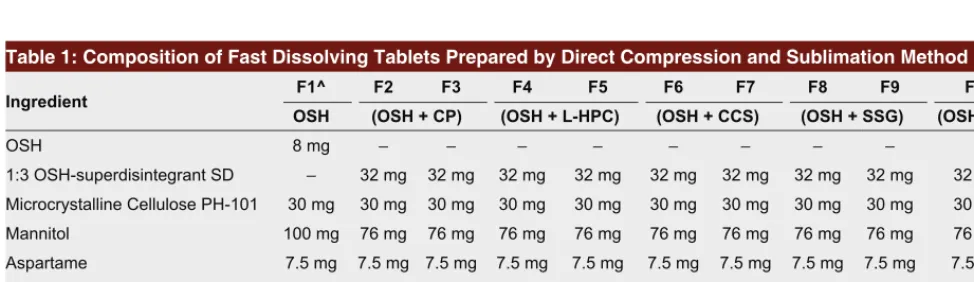
Ten batches of FDTs were prepared by direct compres-sion (6 batches) and sublimation technique (4 batches) as per composition shown in Table 1. Mannitol, micro-crystalline cellulose PH101, camphor (in case of subli-mation technique) and aspartame were passed through 60 mesh before use. The drug as such, 1:3 SD or in 1:3 PM with CP and excipeints were blended together by tumbling for 10 min. The blend was lubricated with 1% magnesium stearate and 2% talc. The resulting blend was directly compressed in to tablets using a rotary tablet machine. (RSB-4 mini press, Rimek, India). Compressed tablets containing camphor were subjected to the pro-cess of sublimation in vaccum oven at 60ºC for 6 h.
Evaluation of tablets23 The Weight variation
Twenty tablets were weighed individually and the aver-age weight was determined. The percentaver-age deviation was calculated and evaluated for weight variation.
Thickness
The thickness of five tablets was measured using a Vernier caliper.
Hardness
Tablet hardness (tablet crushing strength), the force required for breaking a tablet in a diametric compres-sion of five tablets was measured using monsanto hard-ness tester (Dolphin, Mumbai).
Friability
Pre-weighed sample of ten tablets was placed in the Roche friabilator (Erection and Instrumentation Engi-neers, Ahmedabad) and were subjected to 100 revolu-tions. Tablets were dedusted using a soft muslin cloth and reweighed. The percentage friability is calculated.
In vitro disintegration time
The disintegration time of five tablets was measured using modified disintegration method. For this purpose, a petridish (10 cm diameter) was filled with 10 mL dis-tilled water. The tablet was carefully put in the center of the petridish and the time for the tablet to disintegrate completely in to fine particles was noted as disintegra-tion time.24
Wetting time
The wetting time of five tablets was measured by plac-ing 5 circular tissue papers to simulate the tongue con-ditions in a petridish with a 10 cm diameter. 10 mL of water containing methylene blue, a water-soluble dye, was added to the petri dish. A tablet was carefully placed on the surface of the tissue paper. The time required for water to reach the upper surface of the tablets was noted as the wetting time.25
Drug content
Five tablets were crushed in mortar and powder equiva-lent to 8 mg OSH was dissolved in sufficient quantity of distilled water and make up volume in 100 mL volumetric
Table 1: Composition of Fast Dissolving Tablets Prepared by Direct Compression and Sublimation Method
Ingredient F1^ F2 F3 F4 F5 F6 F7 F8 F9 F10*
OSH (OSH + CP) (OSH + L-HPC) (OSH + CCS) (OSH + SSG) (OSH + CP)
OSH 8 mg – – – – – – – –
1:3 OSH-superdisintegrant SD – 32 mg 32 mg 32 mg 32 mg 32 mg 32 mg 32 mg 32 mg 32 mg Microcrystalline Cellulose PH-101 30 mg 30 mg 30 mg 30 mg 30 mg 30 mg 30 mg 30 mg 30 mg 30 mg
Mannitol 100 mg 76 mg 76 mg 76 mg 76 mg 76 mg 76 mg 76 mg 76 mg 76 mg
Aspartame 7.5 mg 7.5 mg 7.5 mg 7.5 mg 7.5 mg 7.5 mg 7.5 mg 7.5 mg 7.5 mg 7.5 mg Magnesium Stearate 1.5 mg 1.5 mg 1.5 mg 1.5 mg 1.5 mg 1.5 mg 1.5 mg 1.5 mg 1.5 mg 1.5 mg Talc 3 mg 3 mg 3 mg 3 mg 3 mg 3 mg 3 mg 3 mg 3 mg 3 mg
Camphor – – 20 mg – 20 mg – 20 mg – 20 mg –
flask. The solution was filtered through whatmann filter paper (0.45 micron), suitably diluted with distilled water, and analyzed at 310 nm, using a UV-Visible double beam spectrophotometer. Each sample was analyzed in triplicate.
In vitro dissolution studyof fast dissolving tablets USP type II apparatus was used for dissolution of FDTs. Three tablets from each batch were used to determine the dissolution of drug. The dissolu-tion media was 500 mL distilled water, maintained at 37 ± 0.5ºC to permit the sink condition.26 The rotation
speed is 50 rpm. Aliquots were withdrawn at 5, 10, 15 and 30 min time intervals and replenished immediately with same volume of fresh dissolution media. Ali-quots were analyzed spectrophotometrically at 310 nm, using UV-Visible double beam spectrophotometer. The release profile of promising batches which showed higher drug release was compared with marketed prod-uct of mouth dissolving tablets of OSH.
RESULTS AND DISCUSSION Solubility measurement
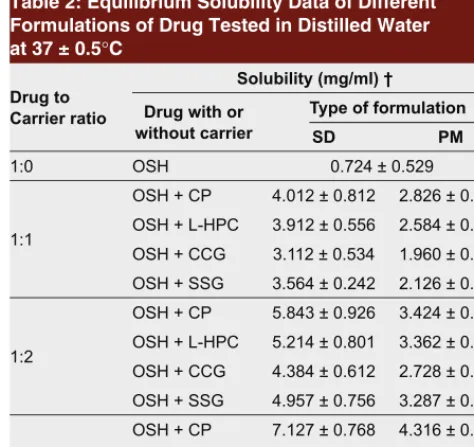
The equilibrium solubility data are shown in Table 2. The solubility of OSH powder in distilled water at 37 ± 0.5°C was 0.724 mg/ml whereas solubility of SD and PM in the range of 3.112–7.124 mg/ml and 1.960–4.316 mg/ml respectively. These findings suggest that SD had much more enhanced equilibrium solubility (5–10 folds) as compared to pure drug powder and physical mixtures
(2–6 folds). The solubility of drug was increased by increasing the proportion of superdisintegrants from 1:1 to 1:3 in SD and PM. Therefore 1:3 SD formula-tions were selected for preparation of FDTs. It may be noted that the equilibrium solubility of SD was increased which may be probably due to decrease in crystallinity or conversion from crystalline to amorphous form.27
Fourier transform infrared spectroscopy
The I.R. spectroscopy of OSH powder, superdisin-tegrants and some selected samples of SD (1:3) was carried out in order to get evidence on the possible interaction of the drug with the superdisintegrants and solid state characterization of SD (Fig. 1). Pure OSH displays a peak characteristic of the N-H bending vibra-tion at 1638.1 cm–1 and a band with main strong peak at
1280.62 cm–1 and 760.1 cm–1 indicative of C-N
stretch-ing and ortho-substitution phenyl C-H bendstretch-ing respre-ctively. It is evident that peaks of different functional groups of OSH in various solid dispersions were not much deviated from peaks of pure drug. In other words IR spectra of SD were identical to those of the cor-responding pure drug and superdisintegrants. Conse-quently, the FTIR SD seemed to be only a combination of drug and superdisintegrant spectra. This result sug-gested that there was no interaction between drug and excipient in their combinations.
X-ray powder diffraction
The diffraction pattern of pure OSH, superdisinte-grants and selected SD (1:3) is shown in Figure 2. The powder diffraction patterns of pure OSH exhibited characteristic high-intensity diffraction peaks. The pow-dered superdisintegrant was amorphous where it had only few peaks with very weak intensities. The crystal-line structure of OSH was destroyed in SD which was evident from decrease in number and intensity of peaks. In other words these findings suggest that the OSH crystals might have converted to amorphous form in SD which was considered to be mainly responsible for the dissolution enhancement.
Table 2: Equilibrium Solubility Data of Different Formulations of Drug Tested in Distilled Water at 37 ± 0.5°C
Drug to Carrier ratio
Solubility (mg/ml) † Drug with or
without carrier
Type of formulation
SD PM
1:0 OSH 0.724 ± 0.529
1:1
OSH + CP 4.012 ± 0.812 2.826 ± 0.314 OSH + L-HPC 3.912 ± 0.556 2.584 ± 0.286 OSH + CCG 3.112 ± 0.534 1.960 ± 0.413 OSH + SSG 3.564 ± 0.242 2.126 ± 0.297
1:2
OSH + CP 5.843 ± 0.926 3.424 ± 0.527 OSH + L-HPC 5.214 ± 0.801 3.362 ± 0.713 OSH + CCG 4.384 ± 0.612 2.728 ± 0.628 OSH + SSG 4.957 ± 0.756 3.287 ± 0.345
1:3
OSH + CP 7.127 ± 0.768 4.316 ± 0.387 OSH + L-HPC 6.646 ± 0.996 4.125 ± 0.811 OSH + CCG 5.815 ± 0.769 3.816 ± 0.765 OSH + SSG 6.185 ± 0.212 4.016 ± 0.714 SD, solid dispersion; PM, physical mixture.
Differential scanning calorimetry
The DSC thermogram of OSH exhibited an endother-mal peak at 186.707°C corresponding to its melting point. SD of OSH in various superdisintegrants also gave a melting peak but at slightly lower temperature in the range of 174–185°C (Fig. 3) with decrease in intensity of peak as compared to pure OSH which indi-cate the weak endothermic reaction between OSH and superdisintegrants. The decrease in intensity and broad-ening of peak indicate amorphous nature of drug which ultimately leads to dissolution enhancement.
Dissolution study
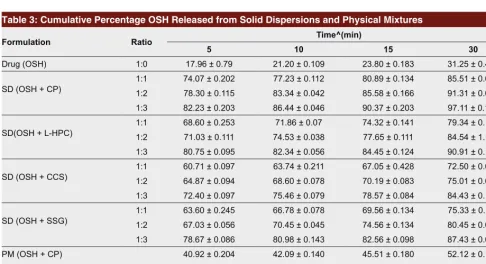
The results of dissolution studies of pure drug, differ-ent SD and PM are shown in Table 3. It can be seen from the results that the percentage drug release from SD was 98% compared to only 30% for the pure drug and 74% for PM. It is evident from the results that solid dispersions exhibited about 3.5 fold increased dissolu-tion compared to that of pure drug. The dissoludissolu-tion rate was increased by increasing the proportion of disintegrants from 1:1 to 1:3. The order for the super-disintegrants to enhance the dissolution rate could be Figure 2: XRD patterns of pure OSH, CP and 1:3 SD of OSH:CP. Figure 3: DSC thermogram of 1:3 SD of OSH: CP.
Table 3: Cumulative Percentage OSH Released from Solid Dispersions and Physical Mixtures
Formulation Ratio Time^(min)
5 10 15 30
Drug (OSH) 1:0 17.96 ± 0.79 21.20 ± 0.109 23.80 ± 0.183 31.25 ± 0.424
SD (OSH + CP) 1:11:2 74.07 ± 0.20278.30 ± 0.115 83.34 ± 0.04277.23 ± 0.112 80.89 ± 0.13485.58 ± 0.166 85.51 ± 0.09791.31 ± 0.053
1:3 82.23 ± 0.203 86.44 ± 0.046 90.37 ± 0.203 97.11 ± 0.126
SD(OSH + L-HPC) 1:11:2 68.60 ± 0.25371.03 ± 0.111 74.53 ± 0.03871.86 ± 0.07 74.32 ± 0.14177.65 ± 0.111 79.34 ± 0.13984.54 ± 1.136 1:3 80.75 ± 0.095 82.34 ± 0.056 84.45 ± 0.124 90.91 ± 0.175
SD (OSH + CCS) 1:11:2 60.71 ± 0.09764.87 ± 0.094 68.60 ± 0.07863.74 ± 0.211 67.05 ± 0.42870.19 ± 0.083 72.50 ± 0.09375.01 ± 0.036 1:3 72.40 ± 0.097 75.46 ± 0.079 78.57 ± 0.084 84.43 ± 0.131
SD (OSH + SSG) 1:11:2 63.60 ± 0.24567.03 ± 0.056 66.78 ± 0.07870.45 ± 0.045 69.56 ± 0.13474.56 ± 0.134 75.33 ± 0.11480.45 ± 0.067
1:3 78.67 ± 0.086 80.98 ± 0.143 82.56 ± 0.098 87.43 ± 0.026 PM (OSH + CP)
1:3
40.92 ± 0.204 42.09 ± 0.140 45.51 ± 0.180 52.12 ± 0.145 PM (OSH + L-HPC) 38.22 ± 0.102 41.50 ± 0.139 46.33 ± 0.090 50.05 ± 0.170 PM (OSH + CCS) 34.40 ± 0.155 40.20 ± 0.146 43.50 ± 0.040 46.69 ± 0.098 PM (OSH + SSG) 37.13 ± 0.247 42.00 ± 0.132 44.41 ± 0.221 49.13 ± 0.167 OSH, OSH; PM, physical mixture; SD, solid dispersion.
ranked as CP > L-HPC > SSG > CCS (Fig. 4). The mechanisms by which drug dissolution enhancement occurs from solid dispersions are numerous and not yet well understood; however, factors such as improved wettability, increased effective surface area, loss of drug crystallinity, and solubilization effects associated with the carrier are probably responsible for their effect.20
Evaluation of fast dissolving tablets
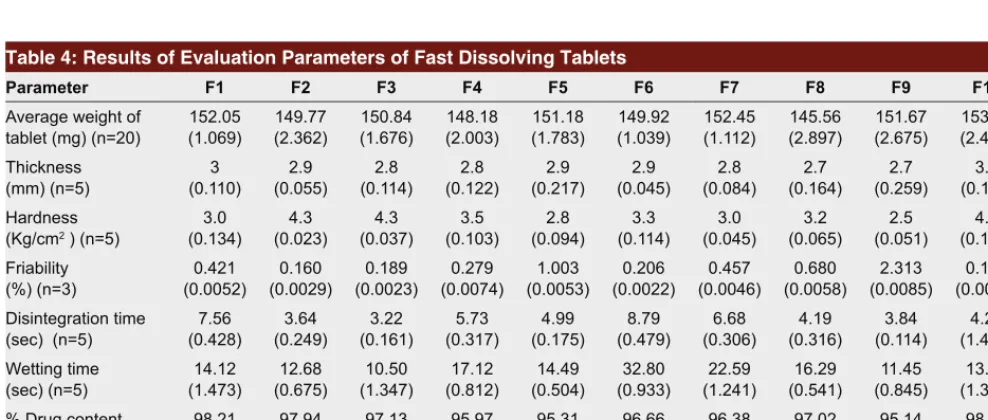
Tablets were prepared using direct compression and sublimation technique. Since the powder blends were free flowing, tablets were obtained of uniform weight due to uniform die fill, with acceptable weight variations as per pharmacopoeial specifications. The thickness of all batches was found in the range of 2.7–3.0 mm which indicates that tablet prepared were of uniform thickness (Table 4).The hardness of tablets was found between 2.5 to 4.3 Kg/cm2. Friability of the tablets was
found below 1% (Table 4) indicating good mechanical resistance of tablets. The drug content was found in the range of 95.14–98.52% (Table 4).
The disintegration time of all the formulations was found in the range of 3.22–8.79s (Table 4) which was within official requirements that are less than 30 s. Wetting time was used as a parameter to cor-relate with disintegration time in oral cavity. This is an important criterion for understanding the capacity of disintegrants to swell in presence of little amount of water. Since the dissolution process of a tablet depends upon the wetting followed by disintegra-tion of the tablet, the measurement of wetting time may be used as another confirmative test for evalu-ation of fast dissolving tablets. The wetting time of formulated tablets was found to be in the range of 10.5–22.59s (Table 4).
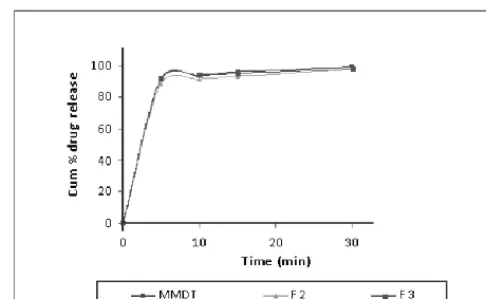
Dissolution results shows that more than 85% drug released after 30 min (Table 4) from all SD batches (F2–F9) as compared to batch F1 without SD (49% release) and batch F10 containing PM (75% release). It can be inferred from the results that batch containing CP (F2 and F3) exhibited higher dissolution rate (97% release after 30 min) as compared to that of batch containing CCS, L-HPC, and SSG (F4–F9). F3 batch was selected as promising formula-tion because of higher drug release, fastest disintegraformula-tion time (3.22 s) and least wetting time (10.5 s).
Comparison of release profile with marketed product
The results revealed that promising batch exhibited
comparable release profile with marketed mouth dis
-solving tablet (MMDT) as shown in Figure 5.
Figure 4: Comparative release profiles of pure OSH and SD for -mulations in a 1:3 ratio.
Table 4: Results of Evaluation Parameters of Fast Dissolving Tablets
Parameter F1 F2 F3 F4 F5 F6 F7 F8 F9 F10
Average weight of
tablet (mg) (n=20) (1.069)152.05 149.77(2.362) (1.676)150.84 (2.003)148.18 (1.783)151.18 (1.039)149.92 152.45(1.112) 145.56(2.897) (2.675)151.67 (2.456)153.75 Thickness
(mm) (n=5) (0.110)3 (0.055)2.9 (0.114)2.8 (0.122)2.8 (0.217)2.9 (0.045)2.9 (0.084)2.8 (0.164)2.7 (0.259)2.7 (0.110)3.0 Hardness
(Kg/cm2 ) (n=5) (0.134)3.0 (0.023)4.3 (0.037)4.3 (0.103)3.5 (0.094)2.8 (0.114)3.3 (0.045)3.0 (0.065)3.2 (0.051)2.5 (0.141)4.1 Friability
(%) (n=3) (0.0052)0.421 (0.0029)0.160 (0.0023)0.189 (0.0074)0.279 (0.0053)1.003 (0.0022)0.206 (0.0046)0.457 (0.0058)0.680 (0.0085)2.313 (0.0012)0.196 Disintegration time
(sec) (n=5) (0.428)7.56 (0.249)3.64 (0.161)3.22 (0.317)5.73 (0.175)4.99 (0.479)8.79 (0.306)6.68 (0.316)4.19 (0.114)3.84 (1.403)4.23 Wetting time
(sec) (n=5) (1.473)14.12 (0.675)12.68 (1.347)10.50 (0.812)17.12 (0.504)14.49 (0.933)32.80 (1.241)22.59 (0.541)16.29 (0.845)11.45 (1.364)13.22 % Drug content
(n=10) (1.551)98.21 (1.262)97.94 (1.126)97.13 (0.970)95.97 (1.511)95.31 (1.173)96.66 (1.683)96.38 (1.626)97.02 (1.311)95.14 (0.935)98.52 % Drug release after
CONCLUSION
In conclusion, fast dissolving tablets of Ondansetron prepared using solid dispersion with crospovidone seems to be promising formulations and further in vivo
study may be carried out.
ACKNOWLEDGEMENT
The authors take this opportunity to thank Zydus Cadila Ltd., Ahmedabad, Relax Pharmaceuticals Ltd., Baroda for providing gratis sample of drug and excipients. The authors would like to thank Principal, A. R. College of Pharmacy and G. H. Patel Institute of Pharmacy, Vallabh Vidyanagar, Gujarat for providing facilities for conducting research work and Director, Sophisticated Instrumentation Center for Applied Research & Testing (SICART), Vallabh Vidyanagar, Gujarat for providing facilities for sample analysis.
REFERENCES
1. Salem I, Lopez K, Galan A, Florey K. Profiles of Drug substances and Excipients 27th Edition., California, USA Academic Press, 2000; pp. 304–16. 2. Dixit AR, Rajput SJ, Patel SG. Preparation and bioavailability assessment of
SMEDDS containing valsartan, AAPS Pharm SciTech 2010; 11:314–21. 3. Raja RK, Abbulu K, Sudhakar M. Development, characterization and solubility
study of solid dispersion of valsartan. J Chem Pharm Res 2011; 3:180–7. 4. Blagden N, Matas M, Gavan P, York P. Crystal engineering of active
pharmaceutical ingredients to improve solubility and dissolution rates. Adv Drug Deliv Rev 2007; 59:617–30.
5. Jin X, Zhang Z, Sun E, Li S, Jia X. Statistically designed enzymatic hydrolysis of an icariin/b-cyclodextrin inclusion complex optimized for production of icaritin. Acta Pharma 2012; 2:83–9.
6. Cappello B, Maio DC, Iervolino M, Miro A. Improvement of solubility and stability of valsartan by hydroxypropyl - bcyclodextrin. J Inclusion Phenomena Macrocyclic Chem 2005; 54:289–94.
7. Ibrahim HK, El-Setouhy DA. Valsartan orodispersible tablets: formulation, in vitro/in Vivo characterization. AAPS PharmSciTech 2010; 11:89–96. 8. Abbas KA, Mohamed A, Abdulamir AS, Abas HA. A review on supercritical
fluid extraction as new analysis method. American J. Biochem Biotech 2008; 4:345–53.
9. Agnivesh R, Shrivastava, Bhalchandra, Ursekar, Chhanda J, Kapadia. Design, optimization, preparation and evaluation of dispersion granules of valsartan and formulation into tablets. Current Drug Del 2009; 6:28–37.
10. Habib W, Khankari R, Hontz J. Fast-dissolving drug delivery systems. Crit Re Ther Drug Carrier Systems 2000; 17:61–72.
11. Deepak S, Dinesh K, Mankaran S, Gurmeet S, Rathore MS. Fast disintegrating tablets: A new era in novel drug delivery system and new market opportunities. J Drug Deliv Ther 2012; 2(3):74–86.
12. Dobetti L. Fast-melting tablets: Developments and technologies. Pharm Tech 2001; 6:44–50.
13. Kuchekar BS, Atul Badhan C, Mahajan H S. Mouth dissolving tablets: A Novel drug delivery system. Pharma Times 2003; 35:7–9.
14. Allen LV, Wang B. Particulate support matrix for making a rapidly dissolving tablet. US Patent 5595761 1997.
15. Sastry SV, Nyshadham JR, Fix JA. Recent technological advances in oral drug delivery. Pharm Sci Tech Today 2000; 3:138–45.
16. Chang R, Guo X, Burnside B A, Couch R. Fast dissolving tablets. Pharm Tech 2000; 24:52–8.
17. Chaulang G, Patil K, Ghodke D, Khan S. Preparation and characterization of solid dispersion tablet of furosemide with crospovidone. Research J Pharm Tech 2008; 1(4):367–9.
18. Nagabhushanam MV. Formulation studies on solid dispersions of celecoxib in superdisintegrants alone and with PVP. Rasayan J Chem 2009; 2(3):691–8.
19. Nagabhushanam MV, Sudha Rani A. Dissolution enhancement of mefenamic acid using solid dispersions in crospovidone. Int J Pharm Pharm Sci 2011; 3(1):16–9.
20. Sammour OA, Hammad MA, Megrab NA, Zidan AS. Formulation and optimization of mouth dissolve tablets containing rofecoxib solid dispersion. AAPS PharmSciTech 2006; 7(2):345–52.
21. Chowdary KPR, Rao SK. Investigation of dissolution enhancement of itraconazole by solid dispersion in superdisintegrants. Drug Dev Ind Pharm 2000; 26(11):1207–11.
22. Valleri M, Mura P, Maestrelli F, Ballerini R. Development and evaluation of glyburide fast dissolving tablets using solid dispersion technique. Drug Dev Ind Pharm 2004; 30(5):525–34.
23. Liberman HA, Lachman L. Pharmaceutical Dosage Form: Tablets. 2nd Edition Inc. New York Marcel Dekker, 2005; pp. 332–5.
24. Gohel M, Patel M, Amin A, Agrawal R, Dave R, Bariya N. Formulation design and optimization of mouth dissolve tablets of nimesulide using vaccum drying technique. AAPS PharmSciTech 2004; 5:212–8.
25. Shoukri R.A., Ahmed I.S., Shamma R.N. In vitro and in vivo evaluation of nimesulide lyophilized orally disintegrating tablets. Eur. J. Pharm. Sci. 2009; 73(1):162–71.
26. United States Pharmacopoeia, National Formulary, 30th Edition. Rockville, United State Pharmacopeial Convection, 2007; pp. 2149–52.
27. Newa M, Bhandari KH, Kim JO et al. Enhancement of solubility, dissolution and bioavailability of ibuprofen in solid dispersion systems. Chem Pharm Bull 2008; 56(4):569–74.