Comparative Study of Tripartite Identity-Based Authenticated Key Agreement
Protocols
Marko Hölbl, Tatjana Welzer and Boštjan Brumen
Faculty of Electrical Engineering and Computer Science, University of Maribor, Smetanova ulica 17, 2000 Maribor, Slovenia
Keywords:authentication, identity-based, key agreement, pairing, security Received:April 8, 2008
Key agreement protocols are used to exchange keys between two or multiple entities. The exchanged key can be later used to assure confidentiality through encryption. Additionally authenticated key agreement protocols offer implicit authentication. In this paper we conduct a security and efficiency comparison of tri-partite authenticated identity-based key agreement protocols and review all of the protocols from the group. From the security perspective the protocols are compared with respect to the level to which they comply with defined security properties for authenticated key agreement protocols and the number of known at-tacks, whereas from the efficiency perspective the protocols are compared regarding computational effort. The comparative study enables in-depth analysis of existing protocols and the development of new ones. Povzetek: Podana je primerjava protokolov za izmenjavo kljuˇcev.
1 Introduction
In key agreement protocols two or more entities agree upon a session key to be used for assuring a confidentiality or similar cryptographic goals. In 1976, Diffie and Hellman proposed the first key agreement protocol [13]. However, the basic Diffie-Hellman protocol does not authenticate the two communication entities, thus is susceptible to the man-in-the-middle attack. Later, different approaches and pro-tocols have been developed to solve the problem [20, 12].
A research direction in the field of key agreement pro-tocols are key agreement propro-tocols for multi-party settings. A special case of multi-party key agreement protocols are tripartite (or three-party) protocols, which are of special in-terest as they are applicable to many practical scenarios such as e-commerce (two users and a merchant). More-over, they implementation is easier and often more efficient than in case of multi-party protocols which are often very complex. The pioneer work by Joux [17] has shown how to implement a tripartite key agreement protocol employ-ing pairemploy-ings. In the protocol only one broadcast is required for each entity. However, just like the basic Diffie-Hellman protocol, Joux’s protocol does not provide authentication of the three communicating entities and thus is vulnera-ble to the man-in-the-middle attack. To solve the provulnera-blem with Joux’s protocol, Al-Riyami et al. presented several protocols [1] which assure authenticity through use of cer-tificates issued by a Certificate Authority (CA). The session keys are generated by both ephemeral (short-term) keys and static (long-term) keys. The signature of the CA assures that only the entities who possess the static keys are able to compute the session keys. However, in a certificate system, before using the public key of a user, the participants must
first verify the certificates which requires a large amount of computing time and storage. The set of key pairs, cer-tificates and certification authorities is referred to as public key infrastructure (PKI).
As an alternative to certificate-based PKIs, Shamir intro-duced the concept of an identity-based cryptosystem [24] in which the user’s public key is an easily calculated func-tion of her identity (e.g. social security number), while the user’s private key is calculated by a trusted authority referred to as Key Generation Center (KGC). Shamir pro-vided the first identity-based key construction based on the RSA problem, and presented an identity-based signature scheme [24]. The identity-based public key cryptosystem simplifies the process of key management, therefore can be an alternative for certificate-based public key infrastructure (PKI). In such cryptosystems, entityAcan send encrypted messages to entityBby using her identity information even before B obtains her private key from the KGC. Hence, the idea also provides a way to construct authenticated key agreement protocols.
Recently, bilinear pairings have found positive applica-tion in cryptography [3, 6, 17, 29]. They can also be applied for constructing identity-based cryptographic protocols. Many identity-based cryptographic protocols for two and three-party setting have been proposed using the bilinear pairings. Some examples are Boneh-Franklin’s identity-based encryption scheme [3], identity-identity-based authentica-tion key agreement protocol by Smart [28], McCullagh-Barreto [18] and several identity-based signatures schemes [29, 23, 9].
pairing operations for three-party settings. As far as we are aware, no tripartite identity-based authenticated key agree-ment protocol without pairings were proposed and that is why the comparative study includes only protocols em-ploying pairing operations. In addition, we review all the protocols. The comparative study of the protocols is con-ducted as to security and efficiency. Both comparisons will be conducted using defined criteria. Thus the security cri-teria is defined by the fulfillment of security properties as described in [4, 7] and existence of attacks on the protocols. The efficiency comparison is realized using efficiency cri-teria; i.e., the number of computational operations required by a protocol. Even if a protocol fulfills all the security properties, its usage is questionable in case attacks for the protocol were published.
The rest of the paper is organized as follows: the next section briefly explains the identity-based public key in-frastructure and the corresponding concepts (bilinear maps, the Weil pairing and the associated computational prob-lems). Section 3 gives details on the security properties de-sired for a sound authenticated key agreement protocol. In Section 4, tripartite identity-based authenticated key agree-ment protocols using pairing operations are reviewed. For every protocol a description of the phases, security and ef-ficiency discussion are given. A comparative study of the reviewed protocols regarding security and efficiency is con-ducted in section 5. Finally, a conclusion is made in sec-tion 6.
2 Identity-based Public Key
Infrastructure employing pairing
In this section, we briefly describe the basic definition and properties of the bilinear pairing, the Weil pairing and the computational problems which form the basis for identity-based public key infrastructure employing pairings.
Traditional PKI (public key infrastructure) is expensive mainly because of the infrastructure needed to manage and authenticate public keys, and the difficulty in managing multiple communities. It is not believed that identity-based public key cryptography would replace the conventional PKIs, but can be rather seen as an alternative solution. In identity-based public key cryptography, one’s public key is predetermined by information that uniquely identifies them. The idea of this concept, that was first proposed by Shamir [24], was to simplify certificate management in e-mail systems. When A sends e-mail to B, she encrypts the message using the public key string ofB’s e-mail (e.g. [email protected]). No public key certificate forB has to be obtained by A. WhenB receives the encrypted mail she contacts the key generation center (KGC), authenti-cates herself and thus can obtain the private key from the KGC, which enables her to decrypt the e-mail. In contrast to existing PKI,Ais able to send encrypted mail toBeven if B has not setup her public key certificate yet. A spe-cial case of identity-based public key cryptography (PKC)
can be implemented using bilinear pairings, which will be described next.
2.1 Bilinear Maps
In this section we describe bilinear maps, pairings and their properties. More details can be found in Joux [17] and Boneh-Franklin [3].
LetG1andG2denote two groups of prime orderq. G1
is an additive group andG2a multiplicative group. LetP
be a generator ofG1. A pairing is a computable bilinear
map between these two groups. Two pairings have been studied for cryptographic use, namely the Weil pairing [19, 27, 31, 3] and the Tate pairing [14, 15, 16].
For our purpose, let eˆ denote a general bilinear map ˆ
e : G1×G1 → G2, which satisfies the following three
properties:
1. Bilinear: If P, Q ∈ G1 and a, b ∈ Z∗q, then
ˆ
e(aP, bQ) =e(P, Q)ab.
2. Non-degenerative: There exist non-trivial points
P, Q∈G1both of orderqsuch thateˆ(P, Q)6= 1.
3. Computable: IfP, Q ∈ G1,eˆ(P, Q) ∈ G2 is
effi-ciently computable (in polynomial time).
We say that G1 is a bilinear group if the group action in
G1can be computed efficiently and there exists a groupG2
and an efficiently computable bilinear mapˆe:G1×G1→
G2as above. Weil and Tate pairings associated with super
singular elliptic curves or Abelian varieties can be modified in order to create such bilinear maps. Concrete examples and details are given in [3], [17], [5].
2.2 The Weil Pairing
LetG1 be a subgroup of the group of points on the
Ellip-tic curveEover the finite fieldFq. Let the order ofG1be
denoted byl, and definekto be the smallest integer such thatl/qk−1. In practical implementations we will require kto be small and so we will usually takeE to be a super singular curve overFq. The Weil pairing [31, 3] is a map ˆ
e:G1×G1 →G2which satisfies the properties given in
section 2.1 (bilinearity, non-degeneration and computabil-ity).
2.3 Computational Problems
Many pairing-based cryptographic protocols are based on the hardness of the BDHP (Bilinear Diffie-Hellman Prob-lem) for their security [3, 10]. Some computational prob-lems related to the elliptic curve cryptography:
– Bilinear Diffie-Hellman Problem (BDHP)
Let G1 and G2 be two groups of prime order q.
Let ˆe : G1 ×G1 → G2, be a bilinear map and
let P be a generator of G1. The BDH problem in
G1for somex, y, zchosen at random fromZ∗q,
com-puteˆe(P, P)xyz∈G
2.
– Discrete Logarithm Problem (DLP)
GivenP, Q ∈ G1, find an integernsuch that P =
nQ.
– Computational Diffie-Hellman Problem (CDHP)
Given a tuple(P, aP, bP) ∈ G1 for a, b ∈ Z∗q, find
the elementabP.
3 Security properties
In order to get a sound key agreement protocol, we need to define properties, which are described in detail in [4]. Here we assumeA,B andCare three honest entities. It is de-sired for authenticated key agreement protocols to possess the following security attributes [4, 7, 10, 22]:
– Implicit Key Authentication. A key agreement
pro-tocol providesimplicit key authenticationif each en-tityAis assured that no other entity besides entitiesB
andC can determine the value of a particular secret key. A protocol which provides implicit key authenti-cation for entitiesA,B, andCis called an authenti-cated key agreement protocol (AK).
– Known-Key Security. In each round of a key
agree-ment protocol,A,BandCshould generate a unique secret key. Each key generated in one protocol round is independent and should not be exposed if other se-cret keys are compromised, i.e. the compromise of one session key should not compromise other session keys.
– Forward Secrecy.If the long-term private keys of one
or more of the entities are compromised, the secrecy of previously established session keys should not be affected. We say that a system has partial forward secrecyif some but not all of the entities’ long-term keys can be corrupted without compromising previ-ously established session keys, and we say that a sys-tem hasperfect forward secrecyif the long-term keys of all the entities involved may be corrupted without compromising any session key previously established by these entities.
– Unknown Key-Share resilience. After the protocol
run, entityAbelieves she shares a key withBandC, whereasB andC mistakenly believe that the key is instead shared with an adversary. Therefore, a sound authenticated key agreement protocol should prevent the unknown key-share situation.
– Key-Compromise Impersonation. Assume thatA,
BandCare three principals. SupposeA’s secret key is disclosed. Obviously, an adversary who knows this secret key can impersonateAtoB andC. However,
it is desired that this disclosure does not allow the ad-versary to impersonate other entities (e.g. B andC) to the realA.
– Key Control. The key should be determined jointly
by allA,B andC. NeitherA,B norCcan control the key alone.
4 Review of tripartite identity-based
authenticated key agreement
protocols employing pairings
In this section we will review tripartite identity-based au-thenticated key agreement protocol employing pairings. Some protocol derive multiple keys for later encryption, like [32], [30], whereas other compute just one key [21], [21], [26] and simplified variant of [32]. All protocols con-sist of three phases, namely thesystem setup,private key extraction andkey agreement phase. Furthermore, each protocol requires three entities (e.g.A,BandC) and a key generation center (KGC) that is relied upon to create and deliver private keys to entities and to not abuse its knowl-edge of those keys.
When describing thekey agreementphase we will give only examples of computations performed by entity A. Observe that entities B and C perform almost identical computational operations in the particular key agreement phases of the reviewed protocols, except for the change of indexes in the equations.
All key agreement scheme feature a key derivation func-tionskdfdefined askdf =F∗
q → {0,1}∗. The key
deriva-tion funcderiva-tion is needed in every scheme because the ses-sion keys are subsequentially used for encrypting data with it usually realized using block ciphers. These require bit strings as keys.
All of the reviewed protocols features the samesystem setup and private key extraction phases. Therefore the first two phases will be reviewed here, whereas the key agreement phase will be described for every protocol separately.
System Setup. The Key Generation Center (KGC) constructs two groups G1 and G2 and a map
ˆ
e : G1×G1 → G2. Next it computes a cryptographic
hash function H:Z∗
q →G1, a generator (primitive root)
P ∈ G1, a random integers ∈ Z∗q as KGC’s private key
and KGC’s public key asPKGC =sP. All elements are of orderq. Finally, the following parameters are published:
hG1,G2,e, P, PKGC, Hiˆ and the master key iss.
Private Key Extraction. For user with identity IDi
4.1 Zhang-Liu-Kim’s Protocol
In 2002, Zhang, Liu and Kim proposed the first tripartite identity-based authenticated key agreement protocol [32]. Each instance of the protocol results in multiple session keys. The way the session key is produced makes use of the Weil pairing and the identity-based static public keys.
Key Agreement. To establish a session key, the three communication entities, A, B and C must proceed as follows.
1. A → B, C: PA = aP, PA0 = a0P, TA =
H(PA, PA0)SA+aPA0.
2. B → A, C: PB = bP, P 0 B = b
0
P, TB = H(PB, PB0)SB+bPB0.
3. C → A, B: PC = cP, PC0 = c0P, TC =
H(PC, PC0)SC+cP 0 C.
A verifies: eˆ(TB + TC, P) = ˆe(H(PB, PB0)QB + H(PC, PC0)QC, PKGC)·eˆ(PB, PB0)·eˆ(PC, PC0). If the above equation holds, thenAcomputes the 8 session keys:
KA(1) = ˆe(PB, PC)a, K(2)
A = ˆe(PB, P 0 C)a, K
(3)
A =
ˆ
e(PB0, PC)a,K(4) A = ˆe(P
0 B, P
0 C)a,K
(5)
A = ˆe(PB, PC)a 0
,
KA(6) = ˆe(PB, PC0)a0, K(7)
A = ˆe(P 0 B, PC)a
0
, KA(8) = ˆ
e(PB0, PC0)a0.
Each entity takes the eight valuesKID(i),i= 1,2, . . .8, as the final session keys. The correctness of the protocol can be easily checked by the bilinear property of the pairing:
KA(1) = ˆe(PB, PC)a = ˆe(abP, cP) = ˆe(aP, cP)b =
ˆ
e(PA, PC)b = K(1)
B = ˆe(bP, aP)c = ˆe(PB, PA)c = KC(1). Similarly, we get K(i) = K(i)
A = K
(i)
B = K
(i)
C , i= 2,3, . . .8.
Security and attacks. From the security point of view the protocol has the following security properties: known key security, perfect forward secrecy, key control, key-compromise impersonation and unknown key-share.
Shim and Woo developed an attack on Zhang-Liu-Kim’s protocol [30]. They showed that the protocol is insecure against an unknown key-share (UK-S) which enables the adversary to make entityabelieve she shares a key withB
andC, whereasBandCmistakenly believe that the key is instead shared with an adversary.
In the UK-S attack scenario B and C compute the same8session keys, whileAcomputes his session keys, from which 4 of 8 keys are equal. Thus A, B and C
share the first four session keys and A thinks that the session keys are shared withBandC, whileB (resp. C) mistakenly believes that she shares the keys with E and
C (resp. E andB). Moreover, both A andB come to share the same eight session keys. The weakness of the protocol against the unknown-key share attack is due to the fact that anyone who does not know an ephemeral private key a corresponding to PA = aP can generate
her own signature on PA and the lack of explicitness in cryptographic messages, i.e., the signed messages of the protocol do not include some information to confirm that the sender is identical to a genuine communicating entity.
Efficiency. In the protocol each entity uses 4 pair-ings for verification of the broadcast messages from the other two entities, and4pairings to computes the8session keys. Additionally, each entity has to compute 6 scalar multiplication and 8 exponentiations. Because there are 8 keys derived, the computational overhead per derived key for each entity is 1 pairing operation, 0,75 scalar multiplication and1exponentiations.
4.2 Simplified Zhang-Liu-Kim’s Protocol
In the same paper [32], Zhang-Liu-Kim also published a simplified version of identity-based tripartite authenticated key agreement, i.e., the 3 entities agree to 1 session key instead of 8 keys.
Key Agreement. A, B and C compute and broadcast the following:
1. A→B, C:PA=aP,TA=H(PA)SA+aPA.
2. B→A, C:PB =bP,TB=H(PB)SB+bPC.
3. B→A, B:PC=cP,TC=H(PC)SC+cPC. A verifies: eˆ(TB + TC, P) = ˆe(H(PB)QB +
H(PC)QC, PKGC)ˆe(PB, PB)ˆe(PC, PC).
If the above equation holds, then A computes: KA = ˆ
e(PB, PC)a.
Then the session key isKA=KB=KC= ˆe(P, P)abc.
Security and Attacks. The authors claim that their protocol has the following security properties: known key security, perfect forward secrecy, key control, key-compromise impersonation and unknown key-share. No attacks on the protocols are known so far.
Efficiency. With the simplified version of the pro-tocol, an entity needs to compute 5 pairings, 4 for verification and1for the generation of the session key.
4.3 Nalla-Reddy’s Protocol
Nalla and Reddy proposed their identity-based tripartite au-thenticated key agreement protocol employing pairings in 2003 [22]. They employ ideas by Shim two-party identity-base authenticated key agreement protocol employing pair-ings [25] and Joux’s tripartite identity-based authenticated key agreement protocol [17].
The authors present 3 protocols: ID-AK-1 (Identity-based Authenticated Key Agreement Protocol 1), ID-AK-2 and ID-AK-3, which will be reviewed separately.
Key Agreement
c. The ephemeral (or short term) public keys would beaP,
bP andcP, and the ephemeral or short term private keys would bea,bandc.
1. A→B, C:aP.
2. B→A, C:bP.
3. B→A, B:cP.
User A computes KA = ˆe(bP, cP)a · eˆ(QB, PKGC) ·
ˆ
e(QC, PKGC) · ˆe(SA, P) = ˆe(P, P)abc · ˆe(QA, P)s ·
ˆ
e(QB, P)s·eˆ(QC, P)s.
The session key is computed as KABC = ˆ
e(P, P)abc · ˆe(QA, P)s · eˆ(QB, P)s · ˆe(QC, P)s =
ˆ
e(P, P)abc · eˆ((QA + QB + QC), PKGC) and hence
depends on the identities of the three entities QA, QB,
QC, and the three ephemeral private keysa,bandc.
ID-AK-2. Similarly as in ID-AK-1, each user gener-ates a random numbera,bandc. The ephemeral (or short term) public keys would beaPKGC,bPKGCandcPKGC, and the ephemeral or short term private keys would bea,b
andc.
1. A→B, C:aPKGC.
2. B→A, C:bPKGC.
3. B→A, B:cPKGC.
User A computes KA = ˆe(aSA, P)· eˆ(QB, bPKGC)·
ˆ
e(QC, cPKGC) = eˆ(aQA + bQB + cQC, sP) and user B computes KB = ˆe(QA, aPKGC) ·eˆ(bQB, P)·
ˆ
e(QC, cPKGC) = ˆe(aQA + bQB + cQC, sP) Simi-larly C computes KC = ˆe(QA, aPKGC)·eˆ(QB, bP)·
ˆ
e(cSC, PKGC) = ˆe(aQA+bQB+cQC, sP).
Hence the session key is computed asKABC =KA =
KB=KC= ˆe(aQA+bQB+cQC, sP).
ID-AK-3. Each user generates random a, b, c ∈ Z∗
q,
which are the ephemeral private keys ofA,B andC. The data flows of the protocol are as follows.
1. A→B:aP,aQC;A→C:aP,aQB;
2. B→A:bP,bQC;B→C:bP,bQA;
3. C→A:cP,cQB;C→B:cP,cQA;
A computes the key KA = ˆe(a(QB +QC), PKGC) ·
ˆ
e(SA,(bP +cP))·eˆ(bQC, PKGC)·eˆ(cQB, PKGC).
Hence the session key is derived as KABC = KA =
KB =KC = ˆe(a(QB+QC) +b(QA+QC) +c(QA+
QB), sP).
Security and Attacks. The authors claim different security properties fulfillment for each of the three protocols. ID-AK-1 complies to forward secrecy, key control and unknown key-share. The ID-AK-2 protocol conforms to the properties of forward secrecy, key control, key-compromise impersonation and unknown key-share. The third protocol,ID-AK-3, fulfills the following security properties: known key security, forward secrecy, key control, key-compromise impersonation and unknown key-share.
However, passive attacks on ID-AK-2 and ID-AK-3 pro-tocols were published by Chen [8] in 2003. In a passive attack, the adversary is able to derive the session keys just eavesdropping on the communication line and use the in-tercepted data to compute the key.
The passive attack on ID-AK-2 is carried out as fol-lows: since in the ID-AK-2 protocol the key is computed asKABC = ˆe(aQA+bQB+cQC, sP) = ˆe(QA, aPpub)·
ˆ
e(QB, bPpub)·ˆe(QC, cPpub)andQA,QB,QCandPKGC
are publicly known, a passive attacker can eavesdrop
aPpub,bPpubandcPpub, and is able to computeKABC. Additionally to the presented attack on ID-AK-2, Chen also demonstrated attack on ID-AK-3 [8]. In the protocol the key is computed asKABC = ˆe(a(QB+QC)+b(QA+
QC) +c(QA+QB), sP). QA,QB,QC andPKGC are publicly known, and a passive attacker can know them. In a protocol run, the passive attacker can eavesdropaQb,aQC,
bQC,bQA,cQA, andcQBand is able to computeKABC. Additionally, Shim published a man-in-the-middle attack on Nalla-Reddy’s ID-AK-1 protocol [26]. In the attack the adversary is able to compute and share session keys with all three entities by intercepting the original messages aP, bP, cP and inserting her own messages
a0P,b0P,c0P. At the endEis can computeKA,KBand
KCand therefore shares a key withA,BandC.
Efficiency. Because of the different computational task performed by each of the protocol (1, ID-AK-2 and ID-AK-3), we will discuss efficiency of each of them separately.
In theID-AK-1 protocol each user needs to compute4 Weil pairings and1scalar multiplication. However,3of the Weil pairings can be precomputed and only1pairing needs to be computed for each session. To sum up, each entity has to perform:5pairing operation and5scalar multiplication. In the second protocol,ID-AK-2, each user is required to compute2scalar multiplications and3Weil pairings.
The last of the three presented protocols (ID-AK-3) is role symmetric since each participant executes the same number of operations. It requires each participant to com-pute2additions,4scalar multiplications, and4Weil pair-ings.
4.4 Nalla’s Protocol with Signatures
Nalla, proposed another tripartite key agreement protocol for identity-based systems employing identity-based signatures in 2003 [21]. Because some identity-based tri-partite key agreement protocols proposed in Nalla-Reddy’s previous work [22] suffered passive attacks, and Joux’ s protocol [17] suffered man-in-the-middle attack, Nalla proposed a new protocol including signature in Joux’s protocol. It resulted in much simpler identity-based key agreement protocols.
random numbera,bandc∈Z∗
qand perform the following
actions:
1. A→B, C:PA=aP,TA=a−1(H(PA)SA)
2. B→A, C:PB =bP,TB=b−1(H(PB)SB)
3. C→A, B:PC =cP,TC=c−1(H(PC)SC)
A verifies: ˆe(PB, TB) · ˆe(PC, TC) = ˆ
e(PKGC, H(PB)QB + H(PC)QC) and computes KA= ˆe(PB, PC)a = ˆe(P, P)abc.
This verification ensures the authenticity of the senders. The session key is the value KABC = KA = KB =
KC= ˆe(P, P)abc.
Security and Attacks. The author claims that his protocol has the following security properties: known key security, perfect forward secrecy, key control, key-compromise impersonation and unknown key-share.
In 2003, Shim published an impersonation attack on the Nalla’s protocol with signatures [26]. According to [26], the adversary is able to broadcast such messages with help of which she can impersonate an entity (in the paper an example for entityAis given). The messages sent by the adversaryEimpersonatingAare successfully verified by
B andC. Additionally, E can compute the session key
KAand finally succeed to impersonateAtoB andCand compute the session key.
Shim claims [26] that Nalla’s protocol is insecure against the man-in-the-middle attack because of the impersonation attack. She further claims that the weakness of the protocol against the attack is due to the fact that anyone who does not know each otherŠs private key (SID) can generate a valid pair (PID,TID).
Efficiency. Regarding efficiency, in each protocol run the following operations have to be computed: 4 pairing operation,5scalar multiplication and1exponentiations.
4.5 Shim’s Protocol with Signatures
Due to the flaws in Nalla-Reddy’s and Nalla’s protocols, Shim proposed a modified identity-based tripartite key agreement protocol with signatures [26].
Key Agreement. Let A, B and C be the three parties wishing to compute a session key. A,BandCselect ran-dom numbera,bandc ∈Z∗
q and exchange the following
messages:
1. A→B, C:PA=aP,TA=H(PA)SA+aPKGC 2. B→A, C:PB =bP,TB=H(PB)SB+bPKGC 3. C→A, B:PC =cP,TC=H(PC)SC+cPKGC A verifies: ˆe(TB +TC, P) = ˆe(PKGC, H(PB)QB +
H(PC)QC+PB+PC).
If the equation holds, then A computes KA = ˆ
e(PB, PC)a= ˆe(P, P)abc.
This verification ensures the authenticity of the senders. The session key is the value KABC = KA = KB =
KC= ˆe(P, P)abc.
Security and Attacks. From the security perspective the protocol features known key security, perfect forward secrecy, key control, key-compromise impersonation and unknown key-share. No attacks on the protocols are known so far.
Efficiency. In the reviewed protocol the computation effort includes 3 pairing operations, 5 scalar multiplica-tions and1exponentiation.
4.6 Shim-Woo’s Protocol
Recently, Shim and Woo proposed a more efficient identity-based tripartite multiple-key agreement protocol which satisfies all the required security attributes and does not use any one-way hash functions.
Key Agreement. Suppose three communication enti-ties,A,BandCwant to establish a secret session key. To achieve this, they perform:
1. A→B, C:PA=aP,PA0 =a0P,TA=SA+a2P+
a0PKGC.
2. B→A, C:PB =bP,PB0 =b0P,TB =SB+b2P+
b0PKGC.
3. B→A, B:PC=cP,P 0 C=c
0
P,TC =SC+c2P+ c0PKGC.
A verifies eˆ(TB + TC, P) = ˆe(QB + QC + PB0 +
PC0, PKGC)·ˆe(PB, PB)·ˆe(PC, PC).
If the above equation holds, thenAcomputes the 8 session keys:
KA(1) = ˆe(PB, PC)a, K(2)
A = ˆe(PB, P 0 C)a, K
(3)
A =
ˆ
e(PB0, PC)a,KA(4) = ˆe(P 0 B, P
0
C)a,KA(5) = ˆe(PB, PC)a 0
,
KA(6) = ˆe(PB, PC0)a 0
, KA(7) = ˆe(PB0, PC)a 0
, KA(8) = ˆ
e(PB0, P 0 C)a
0
.
Each entity takes the eight valuesKID(i),i = 1,2, . . .8, as the final session keys. The correctness of the protocol can be easily checked by the bilinear property of the pairing:
KA(1) = ˆe(PB, PC)a = ˆe(abP, cP) = ˆe(aP, cP)b =
ˆ
e(PA, PC)b = K(1)
B = ˆe(bP, aP)c = ˆe(PB, PA)c = KC(1). Similarly, we get K(i) = K(i)
A = K
(i)
B = K
(i)
C , i= 2,3, . . .8.
Security and Attacks. From the security point of view, the protocol features known key security, perfect for-ward secrecy, key control, key-compromise impersonation and unknown key-share.
However, Chou-Lin-Shiu published an impersonation attack on Shim-Woo’s protocol [11] in 2005. As a result, the adversary can share the 4 keys K(1) , K(2) , K(5) ,
K(6)of the 8 session keys. Under this situation, two of the
these 4 session keys are shared the third entity (e.g.B), but indeed, they are shared with the adversary. Besides, both
A andC come to share the same 8 session keys. Thus, the impersonation attack on 4 of the 8 session keys can be successfully mounted. More precisely, the adversary can use the 4 session keys to communicate with A and
C, and he can have one half of the probability to real-ize what the communication contents are betweenAandC.
Efficiency. According to the authors, their protocol requires the following computational operations:8pairing operation, 4 scalar multiplication, 8 exponentiations. Additionally, since8key are derived, the effort per key for each entity is1pairing operation,0,5scalar multiplication, 1exponentiations.
5 Comparative study
In the following section we compare the reviewed proto-cols with respect to security and performance. From the security point of view the criteria to compare security of the protocols is given by the extent to which a specific protocol fulfills the security properties as discusses in sec-tion 3. Addisec-tionally, attacks for each protocol are analyzed and included in the criteria for comparing security. From the performance point of view the criteria for comparing efficiency is defined as the number of computational oper-ations required per protocol run.
In general authenticated key agreement protocols have to be secure and at the same time as efficient as possible. Therefore the security factor is more important when as-sessing and comparing the reviewed protocols.
5.1 Security Comparison
The security comparison of the reviewed protocols is con-ducted as to two criteria: the fulfillment of security prop-erties as defined in section 3 and the existence of attacks due to errors in the design of the protocols. Often, an at-tack on a protocol results in the not-fulfillment of specific security properties, but please observe that this is not al-ways the case, since ID-AK-1 and ID-AK-2 are susceptible to passive attack and yet this does not violate any security property.
Further please notice that Nalla-Reddy’s AK-1, ID-AK-2 and ID-AK-3 were broken due to various attacks (please refer to section 4), but are included in the compari-son for completeness.
5.1.1 Security Properties
Table 1 summarizes the fulfillment of security properties for each of the reviewed protocols. For definition and de-tails regarding the security properties the reader is referred to section 3.
The majority of protocols do not fulfill the security prop-erties, with exception simplified ZLK and Shim’s
proto-Table 1: Security properties
Protocol KKS FS KCI UKS KC
ZLK + +* + −a +
simplified ZLK
+ +∗ + + +
ID-AK-1 - + - + +
ID-AK-2 - + + + +
ID-AK-3 + + + + +
Nalla + + −b + +
Shim + + + + +
Shim-Woo
+ +∗ −c + +
KKS - Known-Key Secrecy FS - Forward Secrecy * - perfect forward secrecy
KCI - Key-Compromise Impersonation UKS - Unknown Key-Share
KC - Key Control
a - as to Shim-Woo’s unknown key-share attack [30] b - Shim’s Impersonation attack [26]
c - Chou-Lin-Chiu’s Impersonation attack [11]
col. Additionally, ZLK’s, the simplified ZLK and Shim-Woo’s protocols offer prefect forward secrecy, whereas the rest has the property of partial forward secrecy. Nalla’s and Shim-Woo’s protocols do not fulfill particular security properties because of attacks (please refer to section 4 for further details).
5.1.2 Known Attacks
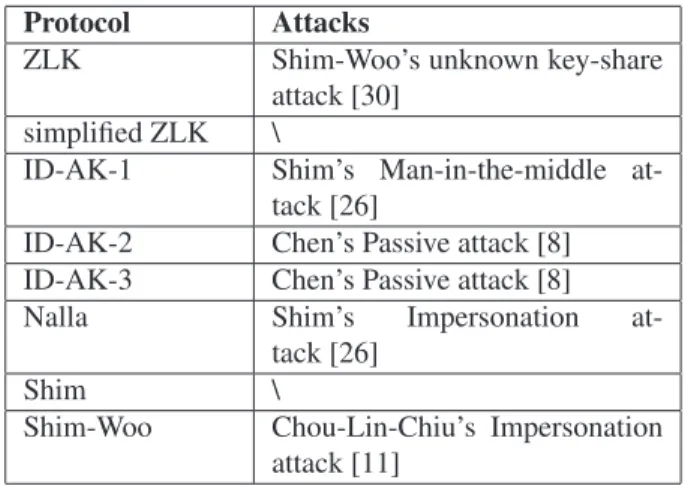
Some of the reviewed protocols have been shown to have weaknesses, which were exploited for attacks. Table 2 sums up attack for the reviewed protocols. For two of the reviewed protocols (i.e., ZLK’s and Shim’s protocol) there are no known attacks. When a protocol suffers from attacks
Table 2: Known attacks Protocol Attacks
ZLK Shim-Woo’s unknown key-share attack [30]
simplified ZLK \
ID-AK-1 Shim’s Man-in-the-middle at-tack [26]
ID-AK-2 Chen’s Passive attack [8] ID-AK-3 Chen’s Passive attack [8]
Nalla Shim’s Impersonation
at-tack [26]
Shim \
Shim-Woo Chou-Lin-Chiu’s Impersonation attack [11]
fulfill a defined security property (see section 3).
5.2 Efficiency Comparison
The computations effort per user (number of computations performed) of the reviewed protocols is given in table 3. We compare operations which are expensive from the com-putational point of view - pairing operations, scalar scalar multiplications and exponentiation. Additions and hash operations are ignored since they are much less computa-tionally expensive. As precomputing pairing operations in-creases the performance and lowers the computational ef-fort, we also give data regarding precomputation. A pre-computed pairing operations must only be carried out when the three entities conduct a key agreement for the first time and can be later omitted.
Table 3: Computation effort per user. Protocol PairOp ScMul Exp PP
ZLK 8 6 8 0
simplified ZLK
5 5 1 0
ID-AK-1 4 1 0 3
ID-AK-2 3 2 0 0
ID-AK-3 4 4 0 0
Nalla 4 5 1 0
Shim 3 5 1 0
Shim-Woo
8 4 8 0
PairOp - pairing operations ScMul - scalar multiplications inG1
Exp - exponentiation inG2
PP - pairings that can be pre-computed
Before discussing the efficiency of the reviewed proto-cols, it should be noted that according to [2], the effort to evaluate one pairing operation is approximately equal to the effort of computing three scalar multiplications. As can bee seen from table 3 the most efficient protocol is Nalla-Reddy’s ID-AK-2, followed by Shim’s protocol. In con-trary, the least efficient protocol is the ZLK protocol resp. the simplified ZLK protocol.
The most robust and most efficient protocol from both the security and efficiency point of view is not straight-forward. Due to the discussed attacks, we have to rule out all the protocols susceptible to attacks and not fulfill-ing all security requirements. This leaves us with only two protocols, namely the simplified ZLK protocol and Shim’s protocol. When taking the results of the efficiency analy-sis into account Shim’s protocols prevails as it offers best performance while fulfilling the desired security properties and immune to attacks.
6 Conclusion
Identity-based authenticated key agreement protocols can be an alternative for certificate-based protocols. This is true, especially when efficient key management and mod-erate security are required. In the paper we have made a review and comparative study of tripartite authenticated identity-based key agreement protocols using pairings. We have presented the state of the art in attacks on the viewed protocols and conducted a comparative study re-garding the fulfillment of security properties, attacks pub-lished and the computational effort required by each proto-col. The prevailing protocol considering security and effi-ciency is Shim’s protocol as it is efficient and at the same time offers all security properties. Future development of protocols must take the analysis results and attacks into ac-count when developing new protocols.
References
[1] S. Al-Riyami, and K. Paterson (2002) Authenticated three party key agreement protocols from pairings,
Cryptology ePrint Archive, Report 2002/035.
[2] P.S.L.M. Barreto, H.Y. Kim, B. Lynn, M. Scott (2002) Efficient algorithms for pairing-based cryptosystems,
Advances in Cryptology - Crypto’02, LNCS Vol. 2139, Springer, UK, pp. 213 - 229 .
[3] D. Boneh, and M. Franklin (2003) Identity-based en-cryption from the Weil pairing,Advances in Cryptol-ogy - Crypto’01, LNCS Vol. 2442, Springer, UK, pp. 354-368.
[4] S. Blake-Wilson, D. Johnson, and A. Menezes (1992) Key agreement protocols and their security analysis (Extended abstract), 6th IMA International Confer-ence on Cryptography and Coding, LNCS Vol. 1355, Springer, UK, pp. 30-45.
[5] D. Boneh, B. Lynn, and H. Shacham (2002) Short sig-natures from the Weil pairing,Advances in Cryptol-ogy - AsiacryptŠ01, LNCS 2248, Springer, UK, pp. 514-532.
[6] D. Boneh, B. Lynn, and H. Shacham (2001) Short signatures from the Weil pairing, Advances in Cryptology-Asiacrypt 2001, LNCS 2248, Springer, UK, pp. 514-532.
[7] Bellare, M., Rogaway, P. (1993) Entity Authentica-tion and Key DistribuAuthentica-tion,Advances in Cryptology -CRYPTO ’93, Springer, UK, pp. 232-249.
[9] J.C. Cha, and J.H. Cheon (2002) An identity-based signature from gap Diffie-Hellman groups, Cryptol-ogy ePrint Archive, Report 2002/018.
[10] L. Chen, C. Kudla (2003) Identity Based Authenti-cated Key Agreement Protocols from Pairings,16th IEEE Computer Security Foundations Workshop, IEEE Press, USA, pp. 219-233.
[11] J.S. Chou, C.H. Lin, C.H. Chiu (2005) Weakness of Shim’s New ID-based tripartite multiple-key agree-ment protocol, Cryptology ePrint Archive, Report 2005/457.
[12] R. Dutta, R. Barua (2005) Overview of Key Agree-ment Protocols, Cryptology ePrint Archive, Report 2005/289.
[13] W. Diffie, M. Hellman (1976) New directions in cryp-tography,IEEE Transactions on Information Theory, vol.22, no.6, IEEE Press, USA, pp. 644-654.
[14] G. Frey, M. Mller and H. Rock (1999) The Tate pairing and the discrete logarithm applied to ellip-tic curve cryptosystems,IEEE Transactions on Infor-mation Theory, vol. 45, no.5, IEEE Press, USA, pp. 1717-1719.
[15] S. Galbraith (2001) Supersingular curves in cryptog-raphy,Advances in Cryptology - Asiacrypt’ 01, LNCS Vol. 2248, Springer, UK, pp. 495-513.
[16] S.D. Galbraith, K. Harrison, and D. Soldera (2002) Implementing the Tate Pairing, 5th International Symposium on Algorithmic Number Theory, LNCS Vol. 2369, Springer, UK, pp. 324-337.
[17] A. Joux (2000) A one round protocol for tripartite Diffie-Hellman,4th International Symposium on Al-gorithmic Number Theory, LNCS Vol. 1838, Springer, UK, pp. 385-393.
[18] N. McCullagh, and P.S.L.M. Barreto (2005) A new two-party identity-based authenticated key agree-ment, Topics in Cryptology - CT-RSA 2005, LNCS Vol. 3376, Springer, UK, pp. 262-274.
[19] A. Menezes, T. Okamoto, and S. Vanstone (1993) Re-ducing elliptic curve logarithms to logarithms in a fi-nite field,IEEE Transactions on Information Theory Vol. 39, IEEE Press, USA, pp. 1639-1646.
[20] A. Menezes, P.C. Van Oorschot, and S. Vanstone (1997) Handbook of Applied Cryptography, CRC Press, USA.
[21] Nalla, D. (2003) ID-based tripartite key agreement with signatures, Cryptology ePrint Archive, Report 2003/144.
[22] D. Nalla, K.C. Reddy (2003) ID-based tripartite key agreement with signatures, Cryptology ePrint Archive, Report 2003/004.
[23] K.G. Paterson (2002) ID-based signatures from pair-ings on elliptic curves, Cryptology ePrint Archive, Report 2002/004.
[24] A. Shamir (1985) Identity-Based Cryptosystems and Signature Schemes, Advances in Cryptology -CRYPTO 84, pp. 47-53 .
[25] K. Shim (2003) Efficient ID-based authenticated key agreement protocol based on Weil pairing, Electron-ics Letters, Vol. 39, No. 8, IEEE Press, USA, pp. 653-654.
[26] K. Shim (2003) Cryptanalysis of ID-based Tripartite Authenticated Key Agreement Protocols,Cryptology ePrint Archive, Report 2003/115.
[27] J.H. Silverman (1994) Advanced topics in the arith-metic of elliptic curves,Graduate Texts in Mathemat-ics Vol. 151, Springer, UK.
[28] N.P. Smart (2002) Identity-based authenticated key agreement protocol based on Weil pairing, Electron-ics Letters, Vol. 38, No. 13, IEEE Press, USA, pp. 630-632.
[29] R. Sakai, K. Ohgishi, M. Kasahara (2000) Cryptosys-tems based on pairing,Symposium on Cryptography and Information Security (SCIS2000), Japan.
[30] K. Shim, S. Woo (2005) Weakness in ID-based one round authenticated tripartite multiple-key agreement protocol with pairings, Applied Mathematics and Computation, Vol. 166, No. 3, Elsevier, USA, pp. 523-530.
[31] E. Verheul (2001) Evidence that XTR is more secure than supersingular elliptic curve systems, Advances in Cryptology - EUROCRYPT 2001, LNCS Vol. 2045, Springer, UK, pp. 195-210.