An international registry for primary
ciliary dyskinesia
Claudius Werner
1, Martin Lablans
2, Maximilian Ataian
2, Johanna Raidt
1,
Julia Wallmeier
1, Jörg Große-Onnebrink
1, Claudia E. Kuehni
3,
Eric G. Haarman
4, Margaret W. Leigh
5, Alexandra L. Quittner
6, Jane S. Lucas
7,
Claire Hogg
8, Michal Witt
9, Kostas N. Priftis
10, Panayiotis Yiallouros
11,
Kim G. Nielsen
12, Francesca Santamaria
13, Frank Ückert
2and Heymut Omran
1Affiliations:1Dept of General Paediatrics, Paediatric Pulmonology Unit, University Children’s Hospital Muenster, Münster, Germany.2Institute of Medical Biostatistics, Epidemiology and Informatics, University Medical Center of Johannes Gutenberg University Mainz, Mainz, Germany.3Institute of Social and Preventive Medicine (ISPM), Paediatric Respiratory Epidemiology, University of Bern, Bern, Switzerland.4Dept of Paediatric Pulmonology, VU University Medical Center, Amsterdam, The Netherlands.5Dept of Pediatrics, University of North Carolina at Chapel Hill School of Medicine, Chapel Hill, NC, USA. 6Dept of Psychology, University of Miami, Coral Gables, FL, USA. 7University of Southampton Faculty of Medicine and University Hospital Southampton NHS Foundation Trust, Southampton, UK.8Dept of Respiratory Paediatrics, Royal Brompton Hospital, London, UK. 9Dept of Molecular and Clinical Genetics, Institute of Human Genetics, Polish Academy of Sciences, Poznan and International Institute of Molecular and Cell Biology, Warsaw, Poland.10Paediatric Pulmonology, 3rd Dept of Paediatrics, National and Kapodistrian University of Athens, School of Medicine, Attikon University Hospital, Athens, Greece. 11Cyprus International Institute for Environmental & Public Health in Association with Harvard School of Public Health, Cyprus University of Technology, Limassol, Cyprus. 12Danish PCD Centre, Paediatric Pulmonary Service, Dept of Paediatrics and Adolescent Medicine, Copenhagen University Hospital, Copenhagen, Denmark.13Dept of Medical Translational Sciences, Federico II University, Naples, Italy. Correspondence: Claudius Werner, Dept of General Paediatrics, University Children’s Hospital Muenster, Albert-Schweitzer-Campus 1, Geb. A1, 48149 Münster, Germany. E-mail: [email protected]
ABSTRACT Primary ciliary dyskinesia (PCD) is a rare autosomal recessive disorder leading to chronic upper and lower airway disease. Fundamental data on epidemiology, clinical presentation, course and treatment strategies are lacking in PCD. We have established an international PCD registry to realise an unmet need for an international platform to systematically collect data on incidence, clinical presentation, treatment and disease course.
The registry was launched in January 2014. We used internet technology to ensure easy online access using a web browser under www.pcdregistry.eu. Data from 201 patients have been collected so far. The database is comprised of a basic data form including demographic and diagnostic information, and visit forms designed to monitor the disease course.
To establish a definite PCD diagnosis, we used strict diagnostic criteria, which required two to three diagnostic methods in addition to classical clinical symptoms. Preliminary analysis of lung function data demonstrated a mean annual decline of percentage predicted forced expiratory volume in 1 s of 0.59% (95% CI 0.98–0.22).
Here, we present the development of an international PCD registry as a new promising tool to advance the understanding of this rare disorder, to recruit candidates for research studies and ultimately to improve PCD care.
@ERSpublications
A registry to systematically collect data on clinical presentation, disease course and treatment of PCDhttp://ow.ly/TtGAR
Copyright ©ERS 2016
A press release for this article is available from erj.ersjournals.com/press
Received: May 18 2015 | Accepted after revision: Oct 07 2015 | First published online: Dec 09 2015
Clinical trial: This study is registered at www.clinicaltrials.gov with identifier number NCT02419365.
Support statement: This work was supported by European Commission FP7 grant no. 305404 (BESTCILIA). Funding information for this article has been deposited with FundRef.
Introduction
Primary ciliary dyskinesia (PCD (Online Mendelian Inheritance in Man: 244400)) is a rare autosomal recessive disorder of ciliary motility resulting in chronic upper- and lower-airway disease. Organ laterality defects occur in ∼40–50% of cases, usually situs inversus totalis (the condition is then known as Kartagener’s syndrome). PCD affects∼1:20 000 individuals with a reported prevalence of 1:4000 to <1:50 000 [1]. PCD is genetically heterogeneous. So far, mutations in 31 different genes have been identified to be causative for this disorder [2–6] accounting for ∼60–70% of cases. Due to biological and phenotypical heterogeneities, different diagnostic tests have to be combined to confirm a PCD diagnosis [5–7]. As access to diagnostic facilities is scarce in many countries, PCD is under-diagnosed and diagnosed too late [1]. While tremendous progress has been made in recent years in unveiling the molecular mechanisms of the disease [2, 3, 8–19], PCD management is still hampered by a lack of fundamental data on epidemiology, clinical presentation, disease course and effects of different treatment strategies [4–6]. Patient registries are well-known tools to assemble sufficient numbers of individuals with a rare disease to assess and monitor patient data in a standardised and longitudinal way, and to recruit candidates for clinical research studies [20, 21]. Patient data have been collected by PCD centres on national or regional levels,e.g.in Denmark, UK, Switzerland, USA and Germany. These databases have proved indispensable in facilitating research aimed at the identification of novel PCD variants. By contrast, epidemiological and clinical research requires larger datasets of items collected in a highly standardised way. In order to better characterise the clinical course, and improve the diagnosis and treatment of PCD patients, we have established an internet-based, international PCD registry for systematic and longitudinal data collection. The goal of the registry is to collect data on a large number of individuals to advance our understanding of the range of conditions associated with PCD and the factors that contribute to health outcomes. The objectives of the present article are to: 1) detail the scientific rationale used to implement the registry, 2) describe the methodological details of registry design, patient recruitment, data collection and data management, 3) raise awareness of this novel tool, and 4) report first data on lung function and methods used for establishing a PCD diagnosis.
Methods
Rationale and requirements for the PCD registry
The international PCD registry was established to realise a previously unmet research need as there was no international platform to systematically collect data from PCD individuals on the incidence, clinical presentation, treatment and course of the disease. Importantly, the registry does not only serve clinicians and researchers, but also provides the opportunity for individuals to participate in research who have been under-represented previously.
The aims of the PCD registry include specifically the collection of data about diagnostic certainty, health status at time of diagnosis, progression of disease (including influence of specific management plans), severe infections, colonisation with problem microbes, life expectancy, sex-specific differences (e.g.fertility), subtypes with unique clinical course as well as quality of life.
To achieve high acceptance of the registry, the registry was designed in close collaboration with lead clinicians and researchers in Europe and North America as well as European and North American PCD support groups. As legal, data protection and ethical requirements vary widely within different countries, electronic data collection is restricted to anonymised data.
Eligibility criteria and recruitment
The PCD patient registry is a longitudinal study. It recruits all prevalent diagnosed subjects with PCD and all subsequent incident cases. Both children and adults with PCD are eligible. Patients who fulfil the following diagnostic criteria are considered to have a definite PCD diagnosis: 1) clinical presentation consistent with PCD and 2) consistent findings specific for PCD by at least two methods (high-frequency video microscopy analysis (HVMA), transmission electron microscopy (TEM), immunofluorescence microscopy (IF), low nasal nitric oxide concentration/production (nNO) or bi-allelic disease-causing mutations by genotyping).
Patients are recruited by their medical care-givers who are assigned as a referring centre. Becoming a referring centre involves meeting all necessary legal and ethical requirements, a process guided by the registry management team. Entering individual patient data is possible after written informed consent has been obtained by the patient or his/her legal guardians. Informed consent forms are kept by the referring centre to ensure complete anonymity of data collected in the electronic registry. No information is retained from participants who do not consent. Participants can withdraw their authorisation for participation in the study at any time.
All protocols for data collection and informed consent have been approved by the Ethical Review Committees of the Medical Council Westfalen-Lippe and the Medical Faculty of the Westphalian Wilhelms University Münster.
Item generation, programming of the registry database and data protection
Agreement on the items collected in the registry has been achieved by integrating input from representatives of the US and several European PCD support groups. An internet-based data entry system has been developed that provides plausibility checks. Furthermore, the system has been prepared to integrate data from already existing local databases using suitable computer interfaces, thus avoiding the need to enter similar data in two different databases. The database is securely located at the Institute of Medical Biostatistics, Epidemiology and Informatics, Mainz (IMBEI), University Medical Centre Mainz, Germany. This institute is responsible for maintenance, technical support and data protection of the registry. Backup of data takes place daily using multiple servers. The registry is protected against misuse by various security measures, such as firewall protection, encrypted data transfer and password-protected access to the database. Except for the administration team, each contributor only has direct access to his/ her own data. A master list containing information that links the subject ID to identifying patient data is not collected in the PCD registry. Such a list is kept peripherally by the referring centres.
Quality assurance
To ensure a high level of data quality, a three-step quality assurance process is employed that complements plausibility checks provided by the registry software with two steps of manual control. 1) Data entry performed by each centre’s operators is supported by the registry’s automatic validation routines. 2) All nine forms that constitute a questionnaire are reviewed and explicitly finalised (“signed”) by the operator. 3) These finalised forms are reviewed again by the registry administrator team. Only forms that have passed all three checks are considered valid and included in subsequent evaluations.
Data utilisation and sharing plan
Annual registry reports will be prepared using standard statistical software. A detailed description of all relevant outcome parameters will be given applying descriptive statistical methods, i.e.frequency tables, location and scale statistics and graphical presentations. Investigators interested in accessing registry data or in recruiting registry participants for research studies are invited to contact the registry’s steering committee. Short concept proposals can be submitted which will be discussed for feasibility and scientific impact by the registry steering committee. Importantly, utilisation of patient data always requires explicit written approval by the referring centres who have provided data and, if not covered by the signed informed consent for the registry, by the affected PCD subjects.
Statistical analysis
SPSS 22 (www.ibm.com) and Prism 6 (www.graphpad.com) were employed to calculate all statistics and to summarise the demographic characteristics of participants.
Results
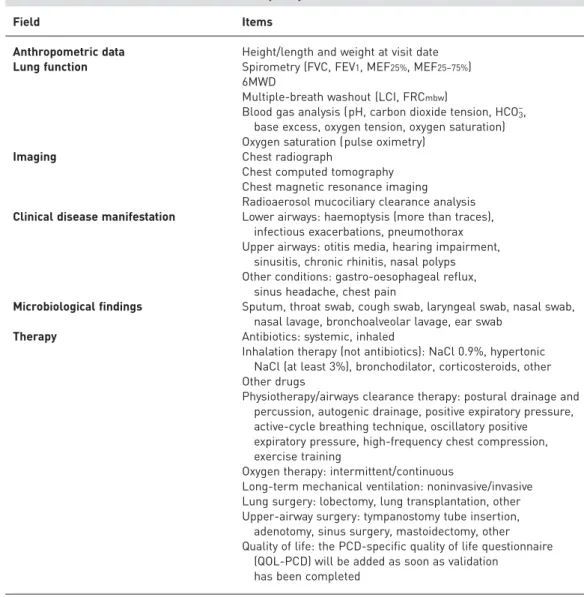
Registry itemsThe database is comprised of a basic data form (table 1) including demographic and diagnostic information, and seven visit forms (table 2) covering items to monitor the disease course. While basic data are changed only when applicable, visit data are updated regularly (visit data can be entered at every visit; yearly updates are requested). A diagram of the registry design is given in figure 1.
work package (www.bestcilia.eu), will be incorporated in the database as soon as validation in different languages is completed.
Enrolment and demographic characteristics
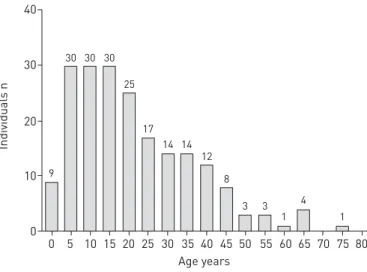
The registry was launched in January 2014 (www.clinicaltrials.gov: NCT02419365). It is accessible via a web browser under www.pcdregistry.eu. So far, data from 201 patients from five referring centres have been collected in the database. Recruitment rates increased gradually from one patient in the first month to a maximum of 46 patients in January 2015 (figure 2). As it is also possible to enter retrospective data, data for more than one visit have been provided for 36/201 individuals. Gender distribution was 110 (54.7%) females and 91 (45.3%) males. Out of the 201 individuals, 98 (48.8%) were under 18 years old and 103 (51.3%) were adults. The median age of participants was 18 years with a range from 1 month to 76 years. The age distribution is shown in figure 3.
Establishment of PCD diagnosis
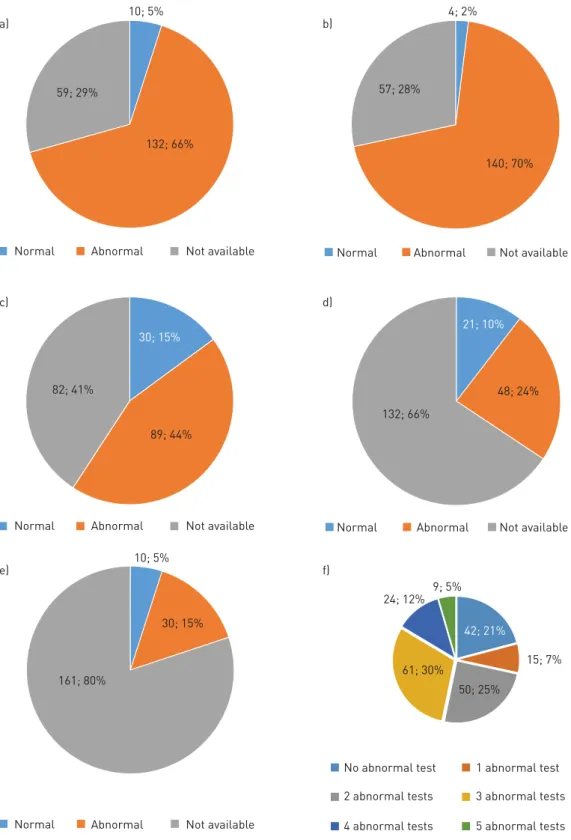
Individuals were classified as having a definite, probable or possible PCD diagnosis as described in the eligibility criteria in the Methods section. Out of 201 individuals, 123 had a definite diagnosis, 33 were graded as subjects with a probable PCD diagnosis and 45 were assigned to have a possible PCD diagnosis (figure 4). Diagnostic tests used for PCD work-up included nNO, HVMA, TEM, IF and genetic analysis (figure 5). HVMA was most commonly used (144 individuals, 70%) and was abnormal in 140 individuals. HVMA
TABLE 1 Basic registry data: items collected at baseline; new information is added when appropriate
Field Items
Administrative data Written informed consent
Patient identification; centre identification Birth month, birth year
Gender Ethnic origin
Socioeconomic background: level of education (parents and patient)
Family history Parental consanguinity
Affected siblings
Other affected family members
Symptoms leading to diagnosis History of neonatal respiratory distress syndrome Situs inversus totalis
Chronic rhinitis/rhinosinusitis Chronic/recurrent otitis media Chronic wet cough
Chronic/recurrent lower airways infection Chronic atelectasis
Heterotaxia
Congenital heart defect Cystic kidney disease Hearing loss Male infertility Hydrocephalus internus Retinitis pigmentosa
Male fertility Number of children, semen analysis, use of assisted reproductive technologies
Female fertility Number of pregnancies, number of miscarriages, number of ectopic pregnancies, number of children, use of assisted reproductive technologies
Primary ciliary dyskinesia diagnostics Age, length/height and weight at diagnosis Nasal nitric oxide measurement
High-frequency video microscopy findings Transmission electron microscopy analysis High-resolution immunofluorescence findings Genetic results
was scored normal only in four individuals (2%). All these four individuals fell into the category of possible PCD diagnosis. Among the 142 subjects with nNO testing, 10 individuals (5%) exhibited normal results. Three of these subjects with normal nNO values were rated as having a definitive PCD diagnosis based on other tests. TEM showed normal results in 30 out of 119 tested individuals (25.2%). IF was performed in 69 individuals. In 48 patients, IF showed clearly abnormal findings, whereas IF staining was normal in 21 individuals. Of note, the number of antibodies, which correlates with the sensitivity of the method, used for IF varied from two to six. Genetic results were available in a subset of 40 individuals, 30 of which displayed bi-allelic disease-causing mutations.
The number of diagnostic tests used in each patient is given in figure 5f. The majority of individuals had two (n=50; 25%) or three (n=61; 30%) tests.
Lung function in PCD
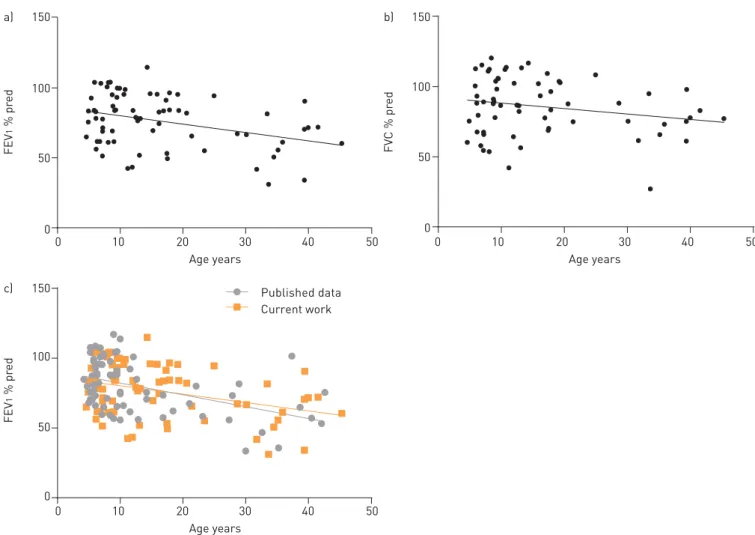
In a subset of 71 individuals with definite PCD, lung function data have already been cleared (figure 6). Linear regression of percentage predicted forced expiratory volume in 1 s (FEV1% pred) valuesversusage exhibited a mean annual decline of 0.59% ( p=0.0025; 95% CI 0.98–0.22). Mean percentage predicted forced vital capacity (FVC % pred) decline was 0.39% per year, which was not statistically significantly
TABLE 2Visit data items collected at least yearly
Field Items
Anthropometric data Height/length and weight at visit date Lung function Spirometry (FVC, FEV1, MEF25%, MEF25–75%)
6MWD
Multiple-breath washout (LCI, FRCmbw)
Blood gas analysis (pH, carbon dioxide tension, HCO3–, base excess, oxygen tension, oxygen saturation) Oxygen saturation (pulse oximetry)
Imaging Chest radiograph
Chest computed tomography Chest magnetic resonance imaging Radioaerosol mucociliary clearance analysis Clinical disease manifestation Lower airways: haemoptysis (more than traces),
infectious exacerbations, pneumothorax Upper airways: otitis media, hearing impairment,
sinusitis, chronic rhinitis, nasal polyps Other conditions: gastro-oesophageal reflux,
sinus headache, chest pain
Microbiological findings Sputum, throat swab, cough swab, laryngeal swab, nasal swab, nasal lavage, bronchoalveolar lavage, ear swab
Therapy Antibiotics: systemic, inhaled
Inhalation therapy (not antibiotics): NaCl 0.9%, hypertonic NaCl (at least 3%), bronchodilator, corticosteroids, other Other drugs
Physiotherapy/airways clearance therapy: postural drainage and percussion, autogenic drainage, positive expiratory pressure, active-cycle breathing technique, oscillatory positive expiratory pressure, high-frequency chest compression, exercise training
Oxygen therapy: intermittent/continuous
Long-term mechanical ventilation: noninvasive/invasive Lung surgery: lobectomy, lung transplantation, other Upper-airway surgery: tympanostomy tube insertion, adenotomy, sinus surgery, mastoidectomy, other Quality of life: the PCD-specific quality of life questionnaire
(QOL-PCD) will be added as soon as validation has been completed
different from zero ( p=0.0851; 95% CI 0.83–0.06). Compared with published data [22], our cohort showed a similar decline of FEV1% pred. As our FEV1 % pred data did not differ significantly from MARTHIN et al. [22] (Mann–Whitney test, p=0.3570), we pooled data from both studies and calculated a yearly decline of FEV1% pred of 0.72% in this cohort of 142 individuals ( p<0.0001; 95% CI 0.98–0.46).
PCD REGISTRY Data entry initially,
update when applicable
Update yearly
Month/year of birth Basic data
Symptoms leading to diagnosis
PCD diagnostics
Fertility Sex
Ethnic origin
Education
Family history
TEM
IF
Genetics nNO
HVMA
Anthropometry Visit data
Therapy
Quality of life Lung function
Imaging
Clinical symptoms
Microbiology
FIGURE 1Primary ciliary dyskinesia (PCD) registry design. The database is comprised of a basic data form that is completed at recruitment and changed only when applicable. Visit data are updated at least once a year. nNO: nasal nitric oxide production rate/concentration; HVMA: high-frequency video microscopy analysis; TEM: transmission electron microscopy; IF: immunofluorescence microscopy.
45 50
20 17
2 24
46
9
13
4 17
2 13
11
3 14
3 2
0 0
1 40
35
25 30
20
15
5 10
0
Individuals n
Month
04/2014 05/2014
03/2014
02/2014
01/2014 06/2014 07/2014 08/2014 09/2014 10/2014 11/2014 12/2014 01/2015 02/2015 03/2015 04/2015 05/2015 06/2015 07/2015
Discussion
PCD is a rare congenital respiratory disorder presenting to clinicians and patients with numerous uncertainties. As robust data describing disease severity and course are largely lacking, management has to rely on small retrospective, cross-sectional case series and experiences in disorders such as cystic fibrosis or non-cystic fibrosis bronchiectasis. This approach, however, is unsafe, because it neglects differences in the pathophysiology of these diseases. Therefore, we have established an international PCD registry to address the urgent need to systematically assess epidemiological, clinical and psychological parameters associated with PCD and its management in a sufficient number of individuals. This will not only give a detailed picture of the current disease status, but will also identify effects of changes in PCD diagnostics and treatment. Furthermore, the registry will facilitate the interconnection of PCD centres, and will serve as a tool to identify and recruit suitable individuals for research studies.
A main strength of the registry is its collaborative development. Selection of registry items has not only been agreed on among participating centres, but has also been harmonised with patient organisations, including the North American PCD Foundation. Therefore, it is guaranteed that information collected in the registry will be highly relevant and that the patient’s perspective is appropriately represented.
In order to achieve the highest possible acceptance, we took particular care to create a user-friendly environment. Data entry is possible via a standard web browser. Thus, there is no need to install additional software. As part of the data security plan, access to the database is providedvia user-specific accounts that allow tracking back any change in the database to the responsible person. Users of a given centre only have access to patient data of their own centre.
A unique feature of the registry is the assessment of quality of life as an important patient reported outcome measure. Currently, PCD-specific quality-of-life questionnaires (QOL-PCD) in different languages FIGURE 3 Age distribution of
individuals. Total participants n=201.
40
80 75 70 65 60 55 50 45 40 35 30 25 20 15 10 5 0 30
20
10
0
Individuals n
Age years 30
30 30
25
8 12 14 14 17
9
3 3
1 1
4
FIGURE 4 Level of diagnostic certainty was definite in 123 (61%), probable in 33 (17%) and possible in 45 (22%) individuals.
123; 61% 45; 22%
33; 17%
are being validated [23]. As soon as this process is completed in the different languages represented in the registry, these questionnaires will be incorporated in the registry. Therefore, we will include a sensitive tool to measure symptoms, functioning and quality of life on a routine basis [24].
a) b)
c) d)
e) f)
Normal Abnormal Not available Normal Abnormal Not available
Normal Abnormal Not available
Normal Abnormal Not available
No abnormal test
2 abnormal tests
4 abnormal tests
1 abnormal test
3 abnormal tests
5 abnormal tests Normal Abnormal Not available
15; 7% 48; 24% 140; 70% 57; 28%
4; 2% 10; 5%
59; 29%
132; 66%
42; 21% 21; 10% 30; 15%
50; 25% 61; 30%
24; 12% 9; 5% 10; 5%
30; 15% 89; 44% 82; 41%
132; 66%
161; 80%
A potential concern for patient self-reported registries is inaccuracy of data. Therefore, we have chosen a clinician-driven data entry system. Confirmation of diagnosis is particularly difficult in PCD because of the high number of genetic and phenotypic subtypes requiring different combinations of methods to establish a diagnosis coupled with limited access to diagnostic services in many countries. In order to reach a high level of diagnostic certainty, we have included all different methods currently used for PCD work-up and established an algorithm to classify cases as confirmed, probable or possible. Furthermore, collaboration of centres within the network will result in a transition of probable or possible to confirmed cases in many instances where limited diagnostic facilities are the main obstacle.
As a limitation, the registry design does not enable patients to directly enter data and therefore a number of patients might not be recruited because they are not cared for by a registry centre. Equally, we cannot approach patients directly who qualify for participation in clinical trials because only strictly anonymised data are stored in the registry database. However, we strongly believe that these limitations are outweighed by the high level of data security that we have achieved in our registry and we ensure patient participation by closely cooperating with patient support groups.
Another reason for a clinician-driven registry is that the data entry system is in the English language. As clinicians and scientists are used to English as the language of medicine, we decided against different language versions. Only QOL-PCD questionnaires will be provided in different languages because these questions will be answered by the patients directly.
Data collection in the registry is not population-based and therefore data might not be representative. However, an international population-based registry for such a rare disorder cannot aim to assemble a high number of individuals internationally.
FEV
1
% pr
ed
0
Age years
10 20 30 40 50
0
Age years
10 20 30 40 50
0
Age years
10 20 30 40 50
0 50 100 150 a)
FEV
1
% pr
ed
0 50 100 150 c)
FV
C % pr
ed
0 50 100 150 b)
Published data Current work
Clearing of data entered into the registry is currently under way. We report which methods were used for establishing a PCD diagnosis in figure 4. nNO testing and HVMA were performed most frequently. Both methods exhibited a very low proportion of false-negative test results. nNO was normal in three individuals with a definite PCD diagnosis, a fact that underlines that PCD cannot be ruled out by demonstration of normal nNO values alone [25, 26]. HVMA was only normal in individuals who fell into the category of having a possible PCD diagnosis, i.e. some of these four subjects might in fact not be affected by PCD. Of note, we do not have information about the number of individuals 1) with abnormal HVMA findings due to secondary ciliary dyskinesia who were not enrolled into the registry because PCD was excluded by other means or 2) who were not enrolled because of false-normal HVMA findings in phenotypic variants known to be difficult to diagnose by HVMA [2, 3, 7, 11, 12, 27]. Thus, it is not possible to deduce the true sensitivity or specificity of HVMA based on our findings. However, the high proportion of normal TEM findings clearly demonstrates the limited sensitivity of that method in diagnosing the whole spectrum of PCD variants [11, 12, 19, 27, 28]. Identification of ciliary protein mislocalisation by IF requires the use of several antibodies targeting different ciliary components [2, 3, 12, 15, 19, 29]. In the registry, IF data were available for a subset of patients. The number of antibodies used in individual patients ranged from two to six. Therefore, the sensitivity of IF might have been higher in subjects with normal IF testing if additional antibodies would have been used for analysis. Bi-allelic disease-causing mutations have been identified in 30 subjects, a number we expect to grow quickly as a result of the increasing use of high-throughput sequencing techniques.
Diagnostic tests recommended for PCD work-up include nNO, HVMA, TEM, IF and genetic analysis [30]. In the majority of subjects, two to three methods were sufficient for a definite PCD diagnosis. 57 individuals had only one or no abnormal test result. These individuals require additional diagnostic efforts to further clarify their disease status, a process now facilitated by the network of different centres collaborating in the registry.
Lung function parameters are key outcome determinants in PCD. Here, we report a decline of FEV1 % pred with age that is similar to previous reports [22, 31]. Pooling our registry data with those published by MARTHIN et al.[22] yielded a mean annual FEV1 % pred decline of 0.72% based on a relatively large cohort of 142 PCD patients. FVC % pred values exhibited a slight annual decline that did not reach statistical significance. Possibly, this is related to the small sample size and will change in the future after incorporation of additional data. Nevertheless, our data support that, in general, PCD lung disease follows more an obstructive than a restrictive pattern.
During the first months of operation, the registry recruited a considerable number of PCD individuals. Of course, we aim to incorporate a much larger number of individuals, not only from BESTCILIA consortium members, but also from other countries. Therefore, we strongly encourage PCD centres worldwide to participate. While the registry is currently run by BESTCILIA members, we are already working on its future structural reorganisation: with an increasing number of participants, it will become impracticable for a single registry administration to monitor all data entered into the registry. Therefore, regional or national subdivisions will be defined that nominate delegates as data administrators and members of the registry steering committee. Naturally, these subdivisions will not be static,i.e.centres from new regions will have the opportunity to designate their own administrators.
In summary, we report the establishment of a comprehensive international registry for PCD as a new promising tool to better understand this rare disorder. Active participation in this registry is highly welcome. For further details and contact information, please refer to the registry homepage www.pcdregistry.eu.
Acknowledgements
We are grateful to PCD-affected individuals and their families for their participation, and acknowledge continuous support by patient support groups, notably Kartagener Syndrom und Primaere Ciliaere Dyskinesie e.V., North American PCD Foundation, and PCD Family Support Group UK. We thank S. Helms, M. Tekaat and K. Vorspohl for excellent technical assistance.
References
1 Kuehni CE, Frischer T, Strippoli M-PF,et al.Factors influencing age at diagnosis of primary ciliary dyskinesia in European children.Eur Respir J2010; 36: 1248–1258.
2 Boon M, Wallmeier J, Ma L,et al. MCIDAS mutations result in a mucociliary clearance disorder with reduced generation of multiple motile cilia.Nat Commun2014; 5: 4418.
3 Wallmeier J, Al-Mutairi DA, Chen C-T, et al. Mutations in CCNOresult in congenital mucociliary clearance disorder with reduced generation of multiple motile cilia.Nat Genet2014; 46: 646–651.
4 Knowles MR, Daniels LA, Davis SD,et al.Primary ciliary dyskinesia. Recent advances in diagnostics, genetics, and characterization of clinical disease.Am J Respir Crit Care Med2013; 188: 913–922.
6 Werner C, Große Onnebrink J, Omran H. Diagnosis and management of primary ciliary dyskinesia.Cilia2015; 4: 1–9.
7 Raidt J, Wallmeier J, Hjeij R,et al. Ciliary beat pattern and frequency in genetic variants of primary ciliary dyskinesia.Eur Respir J2014; 44: 1579–1588.
8 Kott E, Legendre M, Copin B,et al.Loss-of-function mutations inRSPH1cause primary ciliary dyskinesia with central-complex and radial-spoke defects.Am J Hum Genet2013; 93: 561–570.
9 Castleman VH, Romio L, Chodhari R,et al.Mutations in radial spoke head protein genesRSPH9andRSPH4A
cause primary ciliary dyskinesia with central-microtubular-pair abnormalities. Am J Hum Genet 2009; 84: 197–209.
10 Olbrich H, Häffner K, Kispert A,et al.Mutations inDNAH5cause primary ciliary dyskinesia and randomization of left-right asymmetry.Nat Genet2002; 30: 143–144.
11 Olbrich H, Schmidts M, Werner C,et al.RecessiveHYDINmutations cause primary ciliary dyskinesia without randomization of left-right body asymmetry.Am J Hum Genet2012; 91: 672–684.
12 Wirschell M, Olbrich H, Werner C,et al.The nexin–dynein regulatory complex subunit DRC1 is essential for motile cilia function in algae and humans.Nat Genet2013; 45: 262–268.
13 Becker-Heck A, Zohn IE, Okabe N,et al.The coiled-coil domain containing protein CCDC40 is essential for motile cilia function and left-right axis formation.Nat Genet2011; 43: 79–84.
14 Antony D, Becker-Heck A, Zariwala MA,et al.Mutations in CCDC39 and CCDC40 are the major cause of primary ciliary dyskinesia with axonemal disorganization and absent inner dynein arms.Hum Mutat2013; 34: 462–472.
15 Merveille A-C, Davis EE, Becker-Heck A,et al.CCDC39 is required for assembly of inner dynein arms and the dynein regulatory complex and for normal ciliary motility in humans and dogs.Nat Genet2011; 43: 72–78.
16 Hjeij R, Onoufriadis A, Watson CM,et al. CCDC151mutations cause primary ciliary dyskinesia by disruption of the outer dynein arm docking complex formation.Am J Hum Genet2014; 95: 257–274.
17 Hjeij R, Lindstrand A, Francis R,et al. ARMC4mutations cause primary ciliary dyskinesia with randomization of left/right body asymmetry.Am J Hum Genet2013; 93: 357–367.
18 Omran H, Kobayashi D, Olbrich H,et al.Ktu/PF13 is required for cytoplasmic pre-assembly of axonemal dyneins.
Nature2008; 456: 611–616.
19 Frommer A, Hjeij R, Loges NT,et al.Immunofluorescence analysis and diagnosis of primary ciliary dyskinesia with radial spoke defects.Am J Respir Cell Mol Biol2015; 53: 563–573.
20 Gliklich RE, Dreyer NA, Leavy MB, eds. Registries for evaluating patient outcomes: a user’s guide. 3rd Edn. Rockville, Agency for Healthcare Research and Quality; 2014.
21 Taruscio D, Mollo E, Gainotti S,et al.The EPIRARE proposal of a set of indicators and common data elements for the European platform for rare disease registration.Arch Public Health2014; 72: 35.
22 Marthin JK, Petersen N, Skovgaard LT, et al. Lung function in patients with primary ciliary dyskinesia: a cross-sectional and 3-decade longitudinal study.Am J Respir Crit Care Med2010; 181: 1262–1268.
23 Lucas JS, Behan L, Dunn Galvin A,et al. A quality-of-life measure for adults with primary ciliary dyskinesia: QOL–PCD.Eur Respir J2015; 46: 375–383.
24 Quittner AL, O’Donnell AE, Salathe MA,et al.Quality of Life Questionnaire-Bronchiectasis: final psychometric analyses and determination of minimal important difference scores.Thorax2015; 70: 12–20.
25 Marthin JK, Nielsen KG. Choice of nasal nitric oxide technique as first-line test for primary ciliary dyskinesia.
Eur Respir J2011; 37: 559–565.
26 Walker WT, Jackson CL, Lackie PM, et al.Nitric oxide in primary ciliary dyskinesia.Eur Respir J 2012; 40: 1024–1032.
27 Horani A, Brody SL, Ferkol TW, et al. CCDC65 mutation causes primary ciliary dyskinesia with normal ultrastructure and hyperkinetic cilia.PLoS One2013; 8: e72299.
28 Knowles MR, Leigh MW, Carson JL,et al.Mutations ofDNAH11in patients with primary ciliary dyskinesia with normal ciliary ultrastructure.Thorax2012; 67: 433–441.
29 Fliegauf M, Omran H. Novel tools to unravel molecular mechanisms in cilia-related disorders.Trends Genet2006; 22: 241–245.
30 Barbato A, Frischer T, Kuehni CE,et al. Primary ciliary dyskinesia: a consensus statement on diagnostic and treatment approaches in children.Eur Respir J2009; 34: 1264–1276.
31 Noone PG, Leigh MW, Sannuti A,et al. Primary ciliary dyskinesia: diagnostic and phenotypic features.Am J Respir Crit Care Med2004; 169: 459–467.