CONTESTING THE FUTURE OF THE CAMPO MEXICANO:
FOOD SOVEREIGNTY AND THE CULTURAL POLITICS OF TRANSGENIC CORN
Alice Brooke Wilson
A dissertation submitted to the faculty of the University of North Carolina at Chapel Hill in partial fulfillment of the requirements for the degree of Doctor of Philosophy in the Department of Anthropology.
Chapel Hill 2015
Approved by:
Rudi Colloredo-Mansfeld
Arturo Escobar
Dorothy Holland
Charles Price
©2015
ABSTRACT
ALICE BROOKE WILSON: Contesting the Future of the Campo Mexicano: Food Sovereignty and the Cultural Politics of Transgenic Corn
(Under the direction of Dorothy Holland)
This dissertation analyzes the social-spatial knowledge practices that have emerged in the controversy over genetically modified (GM) transgenic corn in Mexico. This controversy is embedded within a broader struggle over the future of global food production and consumption, as the idea of agrobiotechnology as a techno-fix to global climate change and hunger
increasingly takes over the popular imagination. The concept of food sovereignty, as developed within the Vía Campesina social movement, has emerged as a powerful discursive alternative on this terrain. Mexico is one of the most active sites of dispute over the future and meaning of maize and small-scale farming in North America.
Through ethnographic and discursive engagement with the key social movement network that has emerged "in defense of maize" in Mexico, this dissertation analyzes the practices that have worked to generate autonomy and alternative geographies of territory and justice in the struggle over transgenic maize between the years 2009 and 2014. The complexity of intertwined cultural and biological processes that give rise to agrobiodiversity make studying the cultural politics of maize and the rearticulation of agrarian progress particularly relevant in maize’s "center of origin."
moments of crisis—of contamination, of defining the centers of origin of maize, and of state impunity—within the larger discourse of crisis that frames rural Mexico as under "attack" by the Mexican government, starting with the neoliberal reforms of the 1980s. Each site of struggle and cultural politics has changed the terms of resistance through multiple experimentations,
ACKNOWLEDGEMENTS
The thread of this project started with the bonds of friendship and trust formed between the
Social Movements Working Group at UNC-CH and the ETC Group in North Carolina—many
thanks to Hope Shand, Silvia Ribeiro, and Verónica Villa at ETC Group, and Ramón Vera of
Ojarasca. They connected me with the world-makers who continually generate and regenerate
La Red en Defensa del Maíz/The Maize Defense Network, to whom this project is dedicated.
Many thanks go to Annette Desmarais. Thanks also to the IDIEZ in Zacatecas, especially John
Sullivan, Manuel de la Cruz, and León García Garagarza.
My deepest gratitude goes to all the people who have welcomed me into their lives during
these years. The abundance of generosity, curiosity, and optimism has been stunning. My
colleagues at the Ceccam, especially Iván Hernández Baltazar, Roberto Muciño Cervantes, and
Daniel Sandoval, and the ever-inspiring Ana de Ita, welcomed me with great warmth, opening
the archives and including me in everything. The Ceccam will forever be one of my favorite
places in the world. Luis Hernández Navarro—your intellectual and political support has been
invaluable, and your faith in this project has been sustaining.
In Mexico City, thanks to my friend of nearly 20 years Carina Islandia Guzmán Bullock, who
shared her home and family and opened the door to the night of Mexico City, welcoming me into
Machistán. Much love and gratitude goes to my friend and occasional research assistant Fabiola
Martínez, as well as Itzayana Gutiérrez, Artemisa Téllez, Teresa Chang, and Mónica Coria. José
Luis Hernández Azpeitia, my dear Pepe, thank you for welcoming me into your family and all
I’m very grateful for my UNC-CH writing group, Joe Wiltberger and Holly Worthen, for the
incredibly valuable feedback and support. Thanks to everyone in the UNC Social Movements
Working Group for providing an intellectual home from my first day in Chapel Hill, and
especially Michal Osterweil—so many amazing meals and hilarious moments. Thanks also to the
others who have made Carrboro a home: Sammy Slade, everyone at the BOG, Vimala Rajendran
and Rush Greenslade, Vinci Daro, and Kim Calandra. Aniruddhan Vasudevan’s clever kindness
helped immensely in Austin.
I have deep gratitude to the many people who worked at Maverick Farms in Valle Crucis,
NC, over the past years, especially Sara Safransky, Leo Gaev, and Christof den Biggelaar.
Many thanks to my incredibly encouraging committee: Dorothy Holland, Arturo Escobar,
Charles Price, Rudi Colloredo-Mansfeld, and Wendy Wolford. Each of you approaches your
work with deep care and commitment to the possibilities of other worlds. Putting your
intellectual work into conversation with this project has been an inspiration. And Suphronia
Cheek made sure it all happened, and with such kindness.
My parents and their partners have all been wonderfully supportive—much love and
gratitude to each of you. My sister, Hillary, and her partner Worth Kimmel have been there at
every step—thank you for taking over all the farm chores and caring for my beloved cat Tuta,
may she rest in peace. Tom Philpott—you are part of everything. Thank you.
Additional thanks for research funding provided by: the Social Science Research Council’s Dissertation Proposal Development Fellowship Program, the Tinker Summer Field Research Grant, Foreign Language Area Studies Fellowship, UNC-Chapel Hill Off-Campus Research Dissertation Fellowship, and the Inter-American Foundation Grassroots Development
TABLE OF CONTENTS
LIST OF FIGURES ...viii
LIST OF ABBREVIATIONS ...ix
INTRODUCTION ...1
Part I: LAYERS OF STRUGGLE CHAPTER 1 SOCIAL MOVEMENT LANDSCAPES...22
CHAPTER 2 MEXICO: CONSTRUCTING AN HISTORICAL NARRATIVE...61
CHAPTER 3 MAIZE POLITICS, ECONOMICS AND BIOLOGY...94
CHAPTER 4 ANTHROPOLOGY AND RURAL MEXICO...109
Part II: AUTONOMY PRACTICES CHAPTER 5 TESTING: MILPA, CONTAMINATION AND AUTONOMY PRACTICES....129
CHAPTER 6 MAPPING: COUNTER-MAPPING THE CENTERS OF ORIGIN...148
CHAPTER 7 TRIBUNAL: CARTOGRAPHY OF JUSTICE...176
CHAPTER 8 CONCLUSIONS ...188
APPENDIX A ...193
APPENDIX B ...196
LIST OF FIGURES
Figure 1.1: Distribution of native maize in Mexico (CONABIO 2011)……….……….8
Figure 2.1 Alter created at the Permanent People’s Tribunal hearing in Oaxaca……..…………27
Figure 2.2 Zapatista march ………..……….45
Figure 2.3 Vía Campesina March………. 48
Figure 2.4 Corn people………...……….. 50
Figure 2.5 Student marcher………..………..50
Figure 5.1 Nixtamalized maize……..……….……….140
Figure 6.1 Territory outside the centers of origin………163
Figure 6.2 Close up of map………...……….. 163
Figure 6.3 The Ceccam’s first map………..………167
LIST OF ABBREVIATIONS
CECCAM Centro de Estudios para el Cambio en el Campo Mexicano
CENAMI Centro Nacional de Ayuda a las Misiones Indígenas/National Support
Center for Indigenous Missions
CONABIO Comisión Nacional para el Conocimiento y Uso de la
Biodiversidad/National Commission for Knowledge and Use of Biodiversity
CONASUPO Compañía Nacional de Subsistencias Populares/National Company of
Popular Subsistence
CIMMYT Centro Internacional de Mejoramiento de Maíz y Trigo/International
Maize and Wheat Improvement Center
CNC Confederación Nacional Campesina
EZLN Ejército Zapatista de Liberación Nacional/Zapatista Army of National
Liberation
GATT General Agreement on Tariffs and Trade
LBOGM Ley de Bioseguridad de Organismos Genéticamente
Modificados/Biosafety Law for Genetically Modified Organisms
LVC La Vía Campesina
NAFTA North American Free Trade Association
PAN Partido Acción Nacional/National Action Party
PRD Partido de la Revolución Democrática/Party of the Democratic Revolution
PRI Partido Revolucionario Institucional/Institutional Revolutionary Party
PROCAMPO Programa de Apoyos Directos al Campo/Program of Direct Payments to
the Countryside
PROCEDE Program of Certification of Rights to Ejido Land
SAGARPA Secretaría de Agricultura, Ganadería, Desarrollo Rural, Pesca y
SEMARNAT Secretaría del Medio Ambiente y Recursos Naturales/Secretariat of the Environment and Natural Resources
TPP Tribunal Permanente de los Pueblos/Permanent People’s Tribunal
UNAM Universidad Nacional Autónoma de México/National Autonomous
University of Mexico
UNORCA Unión Nacional de Organizaciones Regionales Campesinas
Autónomas/National Union of Autonomous Regional Peasant Organizations
UNOSJO Unión de Organizaciones de la Sierra Juárez de Oaxaca
INTRODUCTION
This project started with an overarching set of questions about competing worldviews—
agrobiodiversity versus agrobiotechnology—in the debate over transgenic corn in Mexico. I
wanted to understand the practices that made these categories and conflicts meaningful, and how
they are lived. I predicted that the differing conceptions of progress and the future that inform the
practices of everyday life would be a key analytic realm. From the start, I aimed to explore why
and how certain agrifood practices come to be desired, or valued as more “sustainable,” through
being embedded in landscapes of human and non-human actors linked through relationships of
food and care.
Understanding the complexity and values of small-scale production, which are
considered from a “modern” viewpoint to be outdated, challenges a linear model of the future of agriculture characterized by ever-increasing agribusiness and integrated world food systems. This approach instead opens up other ways of being-becoming and new potentialities. The fight against transgenic corn in Mexico is embedded within the emerging struggle over the future of global food production and consumption. But it is also taking place on the cultural terrain of
Mexico’s post-colonial history and specifically in terms of milpa,1 a complex set of
human/non-human relationships that depends for its meaning on cycles of planting and eating maize.
One thread of Mexican social movement discourse frames transgenic corn as the latest,
and highly symbolic, threat in 500 years of colonial attack against campesinos and the milpa2—
attacks which the milpa has survived. Crucial to this approach, and an argument that will be
made over the course of the dissertation, is an understanding of the milpa as a figured world,
fundamental to the conditions of possibility for autonomy.
Maize is the traditional symbol of Mexico, linked to its place as the crop’s center of
diversity and domestication. At the same time, growing corn has long been associated with
poverty and indigenousness in Mexico. Recently, however, and especially since the 2001
discovery of transgenes in traditional maize in rural fields in Southern Mexico,growing locally
adapted landrace varieties of corn has also come to be seen as a political act, preserving diversity
and representing a holdout against neoliberal globalization. The rural economic crisis and
massive urban migration mean that what was previously seen as a marker of cultural identity and
a self-evident truth—that “campesinos grow maize”—has been thrown into question, along with
the value and meaning of corn.3
Struggles over corn in Mexico embody both the historical and current contradictions of
industrial agriculture. The earliest experiments of the Green Revolution started in Mexico in the
early 1940s, and the country was the testing ground for economic structural adjustment and free
trade policies starting in the early 1980s. The recent history of Mexican agriculture mirrors the
2 Following the Chicago Manual of Style, 16th edition, frequently used non-English words will
not be italicized after their initial introduction, unless necessary for clarity.
3 The historical construction of the category of “campesino” will be analyzed in greater detail in
history of globalized industrial agriculture in general, which could be described as “agriculture
without campesinos,” as machines and agrichemicals take the place of human labor and farmer knowledge. But 29 million Mexican campesinos (in 2015) still depend on the land for their livelihood. The complexity of intertwined cultural and biological processes that give rise to agrobiodiversity make studying the cultural politics of maize and the rearticulation of agrarian
progress particularly relevant in maize’s "center of origin" (a problematic term I will examine in
Chapter 6). Mexico today is one of the most active sites of dispute over the future and meaning
of corn and small-scale farming in North America.
This analysis is taking place at a time of intense debate in the global north, guided by
conventional understandings of development, about how to “feed the world.” This debate is often
really about “feeding the global south,” amid concerns over population growth, climate change,
and resource scarcity. People in the global south are at best objects in the debate, and at worst
they are invisible, extraneous abstractions. This dissertation engages these crucial debates about
the future of agriculture in part through the lens of food sovereignty, which provides a tactical
way of talking about the struggle in Mexico and linking it with other unique place-based food
and agriculture struggles around the world, acknowledging both the analytic potential and limits
of the concept.
Fundamentally, this study illuminates social practices of multiplicity that generate
autonomy and alternative geographies of territory and justice. These practices challenge the
reductionist techno-fixes offered by dominant approaches to agricultural development, and create
alternatives to the uni-dimensional future implied by contemporary agro-biotechnology, that is,
the industrial monocultural practices and herbicide use that come along with planting transgenic
METHODS AND FIELDWORK
Andábamos sin buscarnos pero sabiendo que andábamos para encontrarnos.
We travelled without seeking each other,
but knowing that we travelled in order to find each other.
Julio Cortázar, Rayuela 1963 Motto of the Tribunal Permanente de los Pueblos, Mexico Chapter, 2014
Like many feminist and minority scholars, my project emerged from an attempt to come
to terms with dynamics affecting my own life, specifically my experiences as an activist and
small-scale vegetable farmer in the United States, heavily involved with the local food
movement for the decade of 1998-2008 (Sparke 1996, Rose 1997). My Master’s thesis (2006)
focused on a small organic farm in North Carolina that depended on undocumented Mexican
labor, highlighting questions about class and race in the local food movement, as well as the
dynamics that brought people from farms in Mexico to work on farms in North Carolina.
After a decade of food activism in the United States, and frustrated by the uncritical
embrace of a de-politicized spatial logic around the concept of “local” (Wilson 2008, 2009;
Allen and Wilson 2008), I focused my dissertation research on a social movement in Mexico that
was taking a different social-spatial approach—within the same North American food system
dynamics—to challenging the problems of industrial agriculture.
In Mexico, I found a complex set of social movement practices that generate a critique of
industrial agriculture that refuses a separation between the political, social, economic, and
cultural realms. These practices enact a politics of place centered around a defense of diversity
and difference, in contrast to the U.S. local food movement’s tendency to focus on geographical
boundaries and consumption practices.
knowledge-practices work, using a “relational mode of engagement” and a dialogic approach to
work alongside movement actors (Casas-Cortés, Osterweil and Powell 2008, 27). Based on the
social movement network’s main activities and narratives about themselves and others, my main
focus became documenting and analyzing the spatial and temporal practices, which (in their
words), fundamentally revolve around generating and maintaining the interdependent notions of
“autonomy” and “territory,” with the corollary of “justice.” These embodied notions are the
horizons of meaning against which people act, and as such they represent frameworks of
understanding which people are struggling to create and maintain—what Holland et al. (1998,
2008) have called "figured worlds," which can be defined as “collectively imagined worlds in
which people and groups ‘do’ movement action….Collective identities form in relation to a
figured world” (Holland, Fox and Daro 2008, 101). In this sense, I have framed the project in
response to the priorities of the stories I have heard people tell about themselves and the social
movement. This project—from the discussion of agro-biotechnology to Mexican history and
economics—reflects the ways in which this particular social movement actor has constructed a
deeply place-based discourse to make sense to itself.
I have taken a “topological approach” to my position as an activist-researcher, embracing
my ever-changing positionality and the obvious contingency of my own experience, with
corresponding implications for the situated, partial, embodied nature of knowledge generally
(Braidotti 1994). Movements also generate knowledge that is concrete and embodied in practice,
and thus situated (Casas-Cortés, Osterweil and Powell 2008, 45). My experiences with shifting
positionality resonate with Rose’s (1997) argument that transparent reflexivity requires
inherently problematic assumptions and demands too much analytical certainty that “self” and
A focus on practices allowed for “the field” to be outlined in terms of specific objectives
and a politics of location, and not in terms of naturalized people or places (Sparke 1996). This
also emerges from the assumption that “sites” do not pre-exist ethnographic investigations
(Marston et al. 2005, Latour 2005).4 Nor does a “struggle” exist in terms of hegemony and
resistance between pre-categorized “powerful” and “oppressed” groups of people—instead,
participants may be seen to be configured and redefined in terms of the characteristics of the
struggle (Holland and Lave 2001, 23).
My fieldwork can thus be described as an attempt to engage in the coproduction of
knowledge at the contested site of transgenic corn in Mexico. The investigation focuses on the
social-spatial practices that coalesce into possibilities for difference and multiplicity; crucially,
many of these are already in existence, emerging dynamically between traditions and collective
memory and emergent possibilities. One key part of the contest over GM corn is a process of
contesting and redefining the meanings of progress and agricultural development. In the rupture
created by the crisis of transgenic maize in Mexico, the social-movement actor is not calling for
a return to an idealized past or essentializing tradition, but instead is working dialogically
between the past and the future to generate spaces of emancipatory possibility.
The opening quote by Cortazar speaks to these practices of possibility, “We travelled
without seeking each other, but knowing that we travelled in order to find each other.” The line
describes a methodological approach rooted in contingency, possibility, the unexpected, and
transformation. It also may be seen to provide an escape route from the circularity of knowledge:
4 “Sites thus require a rigorous particularism with regard to how they assemble precisely because
by not looking in a specific place, or fixing specific questions, one may get more than just the
answers to the questions that are asked.
Basic research path: My research took place over the course of five extended research
trips between 2008 and 2014, with an 18-month period of field research between 2011-2013 that
bridged the sexenio, the six-year term, of Mexican presidents Felipe Calderón and Enrique Peña
Nieto. This time period provided a specific focus on the process and contestations over the
legalization of transgenic corn: the 5-year period starting when GM corn first was approved for
experimental release in 2009, through 2013, when a judge imposed a new, albeit temporary,
moratorium on planting. My preliminary research started in the summer of 2008, when I
interviewed a dozen people involved in the movement against transgenic maize, in Guadalajara
and Mexico City. In summer 2009, after an intensive study of Nahuatl, I stayed with a family in
the rural Huasteca region of Veracruz, hours from the nearest main road, becoming immersed in
the rhythms of rural life in that region.
I returned to Mexico in January 2010 for 18 months of fieldwork as a
participant-observer in La Red en Defensa del Maíz (The Maize Defense Network, hereafter generally
referred to as La Red). La Red was the first national network to organize around the issue of
transgenic maize in Mexico, and has been active ever since; as such, it has fundamentally helped
shape the social movement. La Red directly links together base communities in rural, mostly
indigenous areas all across the country. In 2014, it was active in 23 (out of 31) states and the
federal district of the capital, uniting over 1,000 indigenous and campesino communities, and
connecting these communities with urban-based activists, students, teachers, and union members
across Mexico (see Works Cited for complete list of member groups). Since its inception, the
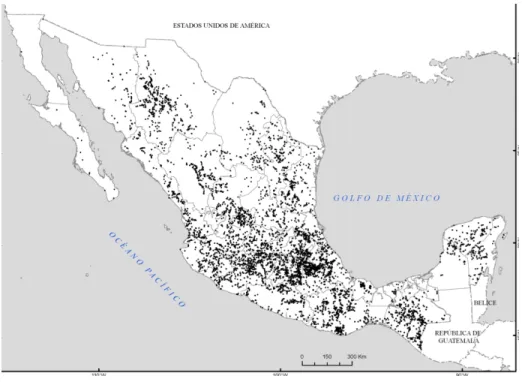
peasants dedicated to food sovereignty, which will be discussed in detail in the next chapter. The
membership is clustered in areas that mirror the distribution of landrace maize varieties in the
map below.
Figure 1.1: Distribution of native maize in Mexico (CONABIO 2011).
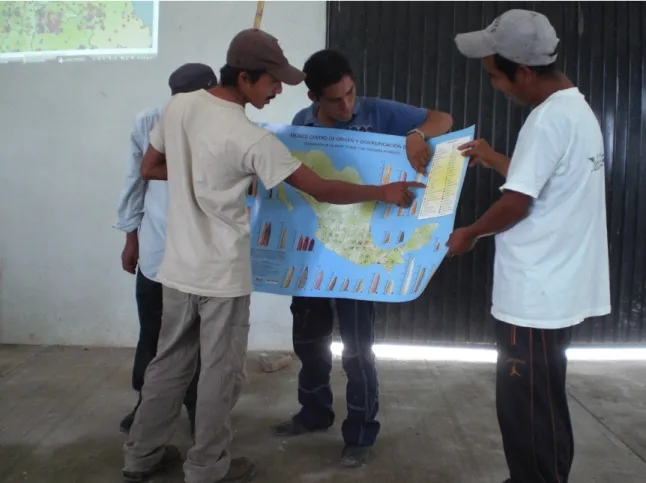
In the years since its founding in 2002, La Red has organized or collaborated on hundreds
of workshops and dozens of national and international marches and public fora, and has been
part of spreading information about transgenic corn in a variety of ways, including books,
pamphlets, maps, talks, workshops, and marches. From the beginning, it has articulated a critical
link between GM corn technology and the privatization and corporatization that characterize
neoliberal globalism and its approach to intellectual property rights.
I affiliated with one of the founding members of La Red, the independent think-tank
Centro de Estudios para el Cambio en el Campo Mexicano (Ceccam/Center for Studies of Rural
Change in Mexico), based in Mexico City. The Ceccam formed in 1992 to work with grassroots
agreements and the land redistribution. A model of ethical research work, the group describes
itself in this way (my translation):
• The Ceccam is a point for linking and exchanging experiences and research in the
service of campesino and indigenous organizations in Mexico and other countries, which, despite cultural and geographical differences and different economic and political systems, share and face the same challenges that modernization poses to rural society.
• The Ceccam is linked to the needs of the organizations and emerged in response
to their need to be able to depend on a center specialized in the problems of the campo, from a campesino perspective. The Ceccam was conceived as a think-tank for campesino organizations. Rural, peasant and indigenous social organizations are its scope of action and influence.
• It is also an area of convergence for different actors in the rural world, with the
capacity for advocacy. Since 1992, the year of its formation, the Center has produced materials for reflection and analysis and has led meetings and seminars—national and international—in which experts, representatives of farmers' organizations and scholars bring together their experiences. The Ceccam supports collective intellectual production and linked actions, seeking to produce
approaches and strategies for the benefit of the rural sector.5
Six people work in the office, located in the Colonia Florida, in the south of Mexico City, not far
from the university. I joined in the daily activities of the small office over the course of 18
months. I started out mapping the nodes of the network, attending public meetings, and working
in the archives. I set out to understand the national movement against GM corn, and how the
Ceccam works with La Red, to horizontally link grassroots communities, and, in its own words,
“build a social response to the contamination of the DNA of native corn and prevent the advance
of experimental and commercial planting of GM corn” (ibid.).
My qualitative data are drawn from traditional ethnographic methods: participant
observation at dozens of meetings, workshops, forums, and marches; semi-structured and
in-depth interviews; and discursive analysis of maps, archival documents, campaign material,
newspapers, and video. I went on eight research trips to different parts of the country, attended
four network workshops, participated in 13 international forums, three mega-marches and two
smaller ones, and helped support the process of the International People's Tribunal, through the
pre-trial meetings in the capital and the penultimate hearing in Oaxaca in April 2013. Over this
time, I gathered interview data from over 30 individual social movement actors, meeting with a
core of around ten people multiple times.
At the same time, my focus on social-spatial knowledge-practices defied a neatly planned
research agenda. Instead, I found myself trying to understand, and theorize, a constantly
unfolding series of not-knowing and things-that-didn’t-happen.6
KNOWLEDGE-PRACTICES
This project called for analyzing the concrete practices that give rise to new
political-cultural identities and new ways of relating within the social-movement space of the anti-GM
corn movement in Mexico. In this way, the project builds on the significant theoretical work on
knowledge practices and social movements, much of it articulated by the University of North
Carolina at Chapel Hill Social Movements Working Group (SMWG), that approaches social
movements as knowledge-producers and world-makers. To analyze the spatial component of
these autonomy practices (a part that has been less well developed within SMWG), I draw on
Wendy Wolford’s (2004) “spatial imaginaries,” a notion that exemplifies using the spatial
constitution of the social to analyze how particular understandings of space influence the
formation of social movements, in this case the MST in Brazil. Wolford defines spatial
imaginaries as the “cognitive frameworks, both collective and individual, constituted through the
lived experiences, perceptions, and conceptions of space itself.”7 The center-of-origin spatial
imaginary is fundamental to the social movements in Mexico.
Casas-Cortés, Osterweil and Powell (2008) make a compelling argument for approaching
social movements as subjects or actors that are knowledge-producers in their own right, from the
stance that “knowledge” is embodied, concrete, lived, and situated (ibid., 20). In this way, social
movements can be seen as “spaces and processes in which knowledge is generated, modified and
mobilized by diverse actors,” (ibid., 45). They propose a methodology that starts by analyzing a
movement’s own narrative explanations and knowledges, from stories, songs, and ideas to
theories and analysis. The “creation, modification and diverse enactments” of these narratives are
what they identify as “knowledge-practices” (ibid., 21).
More than twenty years ago, Arturo Escobar and Sonia Alvarez posed a series of
fundamental questions about the category of “social movement” that are still relevant. They
suggested that studies of social movements involve a complex epistemological process that starts
with identifying an agreed-upon frame of reference for what counts as the “social” or “political”
(Escobar and Alvarez 1992, 6). The essential part of a social movement is that “actors recognize
the stakes in terms of a cultural project; in other words, what is at stake for a social movement is
itself, not merely organizational forms, services, means of production and the like” (Escobar
1992, 71). A corollary of this approach, relevant for this project, is the shift to approach social
movements in terms of movement networks or areas, instead of movements per se, from the
understanding that “social movements bring about social practices that operate, in part, through
the creation of spaces for the production of meaning” (ibid.,73).
Holland, Fox and Daro (2008) develop the concept of collective identity in social
7 Wolford found that people in the north and south of Brazil joined the MST based on different
movements, specifically in terms of collective action. They take a dialogic approach to collective
identity formation, understanding it as an always-changing cultural production that is continually
“emerging, forming, and reforming between people and groups in multiple sites and places of
contentious practice” (ibid., 99). They call for a decentered (following Wolford 2009), dialogic
approach to the study of emerging collective movement identities in particular places, and they
define the collective identity of a social movement as “participants’ shared sense of the
movement as a collective actor—as a dynamic force for change—that they identify with and are
inspired to support in their own actions,” (ibid., 97). Collective identities develop within
imagined or figured worlds, the “realm of interpretation and action” in which the shared
activities and commitments of movement actors outline a terrain of struggle, including the
powers of the opposition and the possibilities for remaking the world (ibid.). Through this
analytic lens, movements are better seen as multiple sources of cultural discourses competing to
inform the everyday actions of movement participants, not as relatively unified actors (ibid.).
MILPA AS FIGURED WORLD
The complex material-symbolic ways that “milpa” is brought to life by social movement
actors makes approaching it as a figured world a particularly useful approach. The figured world
of the milpa can be seen as an arena of meaning-making through improvisation and action
around sites of conflict, from long-term clashes with the Mexican government over land rights to
the newer terrain of conflict over transgenic corn. The new practices that come to life through
these conflicts, and even more vividly the practices that emerge through the transforming conflict
into affirmations of diversity and difference, generate new kinds of situated, embodied
knowledge. This approach builds on the theoretical tools developed by Holland and Lave (2001)
change becomes embodied and practiced. I approach the milpa as a figured world where
collective social movement identities in the fight against transgenic maize in Mexico take shape.
Crucial to this approach is an understanding of the milpa as a component of, and arena for,
working out contestations over the conditions of possibility for autonomy. As such, the milpa can
be seen as a figured world in which autonomy and territory are key features of the landscape.
SHIFTING POSITIONALITY
While presenting my project to people in Mexico, I often explained it in terms of trying
to understand knowledge-production practices and the collective identity within the social
movements against transgenic corn. This explanation—which intentionally puts social movement
knowledge on equal ground with academic knowledge, following Casas-Cortés et al. 2008—
resonated with many different kinds of people who had no interest in non-committed academics
trying to do “objective” research. I made clear that I see GM corn as representing a
fundamentally different worldview (modern, “progress” driven), and, from my position as
someone from the country dominated by GM corn, I wanted to try to weave together an
understanding of the movement’s epistemic project, that is, their contestations over what maize
could and should mean in the world. I also drew upon Sarah Whatmore’s (2002) work on
geographical practices of hybridity, and her understanding of the knowledge practices of
everyday life as performative, not cognitive, what she calls “thinking through the body.”
Important challenges to “knowledge production” as a way of organizing understandings
of the emergence of new ways of being and alternative worlds include Marisol de la Cadena’s
(2007) critique that the categories of both “knowledge” and “production” are modern
conceptions—and I would add “imagination,” born during the Enlightenment, to this list of risky
legitimacy within spaces where they do not necessarily belong; that is to say, modern worlds
produce modern knowledges, eliding complexity and multiplicity.
However, the social movement actors themselves have identified (embodied, situated)
"knowledge" and knowledge practices as a key terrain on which the struggle over transgenic
maize in Mexico is taking place, as the practices that will be analyzed in Chapters 5-7 clearly
demonstrate. La Red did not choose the fight or the terrain; the arrival of transgenic maize
brought with it an epistemic engagement over the meaning of maize and the shape and future of
rural life in Mexico. As Escobar (2008) emphasizes, looking at the articulation between
knowledge and resistance that movements themselves identify provides a critical way to develop
understandings of how new ways of living in the world come into being, particularly through the
production of collective identities.
Thus, in addition to analyzing knowledge production and what knowledge-practices
reveal about this particular movement, I also aimed to examine what the movement’s practices
say about patterns of social transformation more broadly. “Autonomy” quickly became apparent
as a vital horizon of meaning. I have found a distinctively post-dialectic pattern: in each of the
three case studies that will be analyzed (testing, mapping, tribunal), movement practices revolve
around generating new, autonomous ways of being, frequently drawing on collective memory.
These practices are not framed solely in terms of being anti-transgenic corn, or against neoliberal
economic policies (although they also do those things), but instead they work to generate, and
establish through creative experimentation and repetition, new ideas and new types of
relationships. Transgenic corn represents a new organizing logic for these practices; that is,
transgenic corn is fundamental to understanding how and why new collective identities and
RETHINKING THE SPACE OF THE CAMPO
Approaching social movements as knowledge-producers and world-makers allows for
new ways of thinking about both the particular struggle against transgenic corn in Mexico and
struggle in general, particularly in terms of the relationality of social and spatial practices. The
co-constitutive dynamics of the past and future in the present, the global in the local, and the
presence of the rural in the urban are key examples of this (non-binary) relationality. I have
found, and found myself engaged in, a brisk debate over whether the Mexican campo is weighted
down by the past, or is instead a kind of "reserve" or "preserve" for the future, a place where
different ways of being, knowledges, and social relations are practiced that will become
necessary in a future already characterized by conjoined social-economic-ecological crises and
climate instability.
In Mexico, increased rural narco-violence since 2006 has greatly intensified the
urban-rural dynamics. In Mexico City today, one in three people was born in the campo, and another
one in three has a parent who was born in rural Mexico (TPP 2013). Significant empirical and
theoretical work has been done to break down the urban-rural dichotomy, notably from the
perspective of critical globalization studies and recent work on transnational peasant organizing
(Borras 2008, Edelman 2008, Desmarais 2008). Anthropologists and geographers working in
Mexico have amply documented the complex linkages that make urban-rural distinctions
increasingly difficult to draw, particularly given large-scale migration. More fundamental
challenges to the urban-rural dichotomy come from theoretical work in feminist critical
geography and network ontologies, all of which challenge a priori categorizations of localities
(Massey 1994, Rocheleau 2007, Latour 2005). An additional challenge emerges from the broader
the development of capitalism as a linear process. For many on the left as well as the liberal
right, dispossession from the land is an inevitable part of the creation of an urban, industrial
working class” (Hart and Sitas 2004, 35).
Clearly, agrarian issues are not contained within rural areas—everyday experiences have
different patterns in urban and rural areas, but the dynamics are inseparable. And these dynamics
have diverse, uncharted effects. One relevant example is the emergence of comunalidad as a key
way to understand the dynamics within the social movement against transgenic maize. As a
leader of the Movimiento Urbano Popular/Urban Popular Movement in Mexico City described,8
“With the migration from the campo to the city, the cities started to get full and people started to
organize to defend their space and territory. Much of the organizational question in this process,
what gave it the flavor it has, comes from the fact that the people who came from [outside the
city] brought a communitarian experience with them into their new territories. They brought
comunalidad with them to the city (Rello, pers. comm., 2013).9
Comunalidad has been described as the set of logics and collective practices that guide
the reproduction of rural and indigenous communal life in Mexico, rooted in collective labor and
8 By their own request, most people are identified by their real names, and statements made in
public are attributed by name. Conversations that took place in workshops with multiple participants, or when anonymity was requested, are cited by date and location (workshop
participants are identified in the interview list, see Works Cited). Place names are also real. This transparency aims to make the project a relevant contribution to the on-going contestations over transgenic corn in Mexico. Moreover, many people I consulted with are public figures,
intellectuals and movement leaders, and easily identifiable to people familiar with the movement landscape; their unique contributions to this disputed field are recognized accordingly. All photos are my own, unless otherwise attributed.
9 “Con migración del campo a la ciudad, las ciudades empiezan a llenarse y la gente se organiza
land. The concept has come to be seen as an “alternative model of political practice and
co-existence with the natural and social worlds” (Martínez Luna 2010, cited by Worthen 2012).
Communally held land and the practices of collective labor (tequios and cargos), communal
governance (assemblies), and celebrations (fiestas) are the key elements of comunalidad (for
additional discussion, see Worthen 2012).
TRANSGENIC MAIZE AND SOCIAL MOVEMENTS IN MEXICO
GM corn in Mexico is a well-documented controversy. Much research has focused on
questions about the presence and movement of transgenic corn germoplasm around the Mexican
countryside.10 There has also been a good deal of attention to social movements and the politics
of science by English-language researchers (Otero McAfee 2008, Wainwright and Mercer 2009,
Bingham 2008), including three recent full-length ethnographies. Abby Kinchy’s science and
technology studies (STS) approach in Seeds, Science, and Struggle: The Global Politics of
Transgenic Crops (2012) analyzes the way Mexican social movements use scientific discourses
and have made a social critique of science, arguing that the rule of experts and scienticization is a
major barrier to “democratizing agricultural governance.” Lauren Baker’s case studies of
alternative consumption networks generated in response to GM corn in Corn Meets Maize: Food
Movements and Markets in Mexico (2012) develops an argument for looking at the global food
system in terms of “biocultural agrifood relations” in order to see the interrelationships between
ecology, culture, and politics. And anthropologist Elizabeth Fitting’s The Struggle for Maize:
10 Key texts include: Quist and Chapela (2001) showed evidence of transgenes fragmenting and
becoming redistributed in landrace varieties of maize in Oaxaca; Alvarez Buylla (2004)
Campesinos, Workers, and Transgenic Corn in the Mexican Countryside (2010), based on
research in a maquiladora (industrial factory) and farming community in the state of Puebla,
takes on the effects of migration and the intergenerational transfer of farming knowledge. Fitting
develops an argument for the “neoliberal corn regime,” in which Mexican policies have
dismantled support for smallholders in order to promote export-oriented fruit and vegetable
production, with the effect that Mexico’s main rural export is labor. As Mexican analyst Ramon
Vera put it, “The principle export from rural Mexico, the most profitable, bringing back the most
returns to the country, is the only one that was not negotiated in NAFTA: the migrant labor
force,” (Vera Herrera, pers. comm., 2012).
My project builds upon this strong base of prior work, bringing together concerns that
emerge in work in both Spanish and English. I turn the focus specifically to social movement
knowledge-practices. While these previous studies effectively mapped out the landscape on
which the anti-GM corn social movement in Mexico takes place—the scientism and the
pro-expert, anti-peasant policy regime—my project analyzes the way social movement actors are
generating practices of autonomy, territory and justice, in an affirmation of diversity and
difference (see Zibechi 2012). The following chapters will analyze three specific examples of
social movement knowledge-practices and the new kinds of relationships that are emerging from
these practices.
TRANSGENIC CONTEXT: CURRENT LEGAL STATUS OF GM CORN IN MEXICO
From 1998-2009, there was a de facto moratorium on planting transgenic corn in Mexico,
on the grounds that more research was necessary to ensure the absence of harmful effects. The
framework for legalizing GM corn was established in 2005 with the Law on the Biosafety of
Modificados, LBOGM by its Spanish acronym), popularly known as Ley Monsanto (Monsanto’s
Law) because it created a process for legalizing transgenic corn. Most crucially, the law required
an official designation of the centers of origin, which did not yet exist at that time. Beginning in
2009, limited permits were approved for pilot and experimental planting, and on November 17,
2011, the government agencies responsible for agriculture (SAGARPA11) and the environment
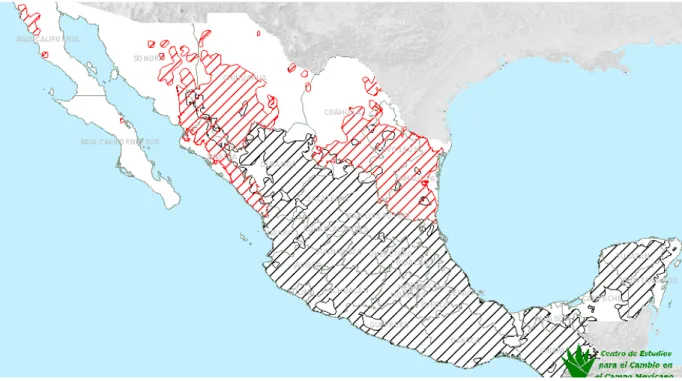
and natural resources (SEMARNAT12) released the first official map of maize’s centers of
origin. Approximately 40 percent of the country was not included in the designation, meaning
GM corn could (potentially) be legally cultivated in those areas. Activists against transgenic
maize have led a discursive push to define all of Mexico as the center of origin—pointing out
that even places where corn cannot be grown (that are too steep or too wet, or where the
elevation is too high), are vitally important to the crop’s diversity (see Chapter 6 for expanded
discussion).
Catching nearly everyone by surprise, even the people who filed the lawsuit, in October
2013, a federal judge reinstated the moratorium against issuing permits for pilot and
experimental plantings of GM corn. Mexico-City based activist and agroecology expert Adelita
San Vicente, who leads the Semillas de Vida (Seeds of Life) non-profit organization,13 was the
first named plaintiff in the lawsuit, filed in the name of 20 organizations and over 50 individuals,
including famous artists like Francisco Toledo and Jesusa Rodriguez, and international activists
11 Secretaría de Agricultura, Ganadería, Desarrollo Rural, Pesca y Alimentación/Secretariat of
Agriculture, Livestock, Rural Development, Fisheries and Food; roughly equivalent to the U.S. Department of Agriculture (USDA).
12 Secretaría del Medio Ambiente y Recursos Naturales/Secretariat of the Environment and
Natural Resources; roughly equivalent to the U.S. Environmental Protection Agency (EPA).
13 She is also a member of the Union of Concerned Scientists in Mexico (UCCS), and one of the
like Vandana Shiva, who wanted to lend their name-recognition to the case. It is the latest
lawsuit in a legal strategy going back to 2005 that was quietly winding its way through various
courts. The lawsuits were largely designed to establish a record and demonstrate the
government’s lack of support for civil society’s demands. Instead, this time, Judge Jaime Manuel
Marroquín, of the Civil Division of District Court 12 in the Federal District of Mexico City,
reinstated the moratorium that is still in place at the time of this writing (spring 2015). It is a
temporary and limited restriction, pending further proof that harm from contamination can be
avoided, but it is still a great social movement success. Moreover, the underlying dynamics that
make up the bulk of the research for this dissertation have not been altered—all the elements are
still in place, just on hold, and this research remains relevant to understanding what will happen
after this moratorium has been lifted.
CHAPTER OVERVIEW
The first four chapters of this dissertation provide an overview of a different layer of
complexity that intersects in the struggle over transgenic corn in Mexico: the contemporary
social movements, Mexico's history and economics, the issue of transgenic corn, and
anthropological history. Each of these chapters can be approached metaphorically as separate
layers of geographic information system (GIS) data, which, when overlaid, provide an integrated
literature review. Chapter 1 traces the contours of the contemporary social movement landscape
in Mexico, highlighting ways the Zapatista uprising in 1994 is fundamental. This chapter focuses
on The Maize Defense Network/La Red, and ethnographically analyzes the intersections between
La Red and its important dialogic interlocutor, La Vía Campesina. I also turn to the
disappearance of 43 students from Ayotzinapa, Guerrero on September 26, 2014, showing how
campo, and the future.
A chronological Mexican history section (Chapter 2) comes next, arranged around
various key junctures, and told through the lens of how these events have been deployed by
social movement actors to construct a movement logic, from the Mexican Revolution of 1910, to
the Green Revolution, the Mexican peso crisis of 1982, GATT, and the implementation of the
North American Free Trade Agreement. Next comes a brief overview of the issue of transgenic
corn, the politics and history, and the policies affecting corn in Mexico (Chapter 3). The
following section (Chapter 4) brings together additional background theory, specifically the role
of Mexico in the birth of contemporary North American anthropology and the context of the
“peasant question.” As such, Chapters 2-4 can be read straight through, or in bits and pieces, as
background linked to specific ethnographic chapters. This section aims to outline the multiple
ways dialogic encounters with historical circumstances have shaped what social movement
actors see as the range of possibilities, and show ways that “history” is lived through practices.
The second half of this dissertation consists of ethnographic chapters corresponding to
specific practices tied to three key ways social movement actors involved in the movements
around maize in Mexico have organized the discursive terrain of struggle: autonomy, territory,
and justice. I will examine the intersections around the following knowledge-practices:
a) Testing: milpa practices and campesino diagnostics are foundational for generating
autonomy (Chapter 5);
b) Mapping: alternative mapping practices generate complex understandings of territory,
making abstractions visible and experienced, e.g. the location of GM corn planting permits made visible on the map (Chapter 6); and,
c) Tribunal: the Permanent People’s Tribunal transforms abstract notions of justice into
embodied social practices, specifically around the concept of “desviación de poder” (abuse of power) (Chapter 7).
A series of final thoughts and conclusions makes up Chapter 8, specifically analyzing the
CHAPTER 1
SOCIAL MOVEMENT LANDSCAPES
LA RED EN DEFENSA DEL MAÍZ
While the size, shape, and structure of this network is interesting and important to this
project, I have struggled against the oversimplification necessary to create a narrative base for
understanding its organizing practices. Objectifying the network risks fixing it at a certain
time/place, assuming its goals, or opening it up to judgment as a success or failure—reducing its
complexity, and the surprise, disruption, and emergence inherent to that complexity (Price 2009).
Moreover, it makes it seem like something to be understood—not one of its goals. I cannot
over-emphasize the complexity and contingency, the individual personalities, conflicts, random
events, hidden things, and feelings that are vital to this story. But here’s one version, a part of the
narrative.
In response to the sense of emergency generated by the clear evidence14 of transgenic
corn in fields grown by smallholder farmers in remote areas of Oaxaca (Quist and Chapela
2001), a group of urban activists, environmentalists, and campesino farmers organized the First
Forum in Defense of Maize in Mexico City in early 2002. The organizational support came from
environmental groups (like Greenpeace Mexico) and groups like the Ceccam, long active in rural
and campesino issues. Approximately 300 people attended, and one outcome was the formation
14 The evidence was clear, and has been repeatedly confirmed. But that did not stop an all-out
of La Red en Defensa del Maíz (as noted in Chapter 1, The Maize Defense Network, referred to
as La Red).
In addition to La Red, the anti-GM corn movement also began coalescing around the
non-profit-led “campaign” Sin Maíz No Hay Pais (No Country without Corn), which was
especially active in the years after it started in 2007. Despite philosophical tensions and differing
approaches to organization and leadership, together the “network space” and the “campaign”
created a strong national front against transgenic maize in the 2000s.
There are two key elements to understanding the uniqueness of La Red: it was built on
already existing networks of trust and direct relationships (not membership in an organizational
structure), and it works through an indigenous-campesino assembly logic of cooperation,
solidarity, and mutual assistance. Trust is crucial—though the individuals involved at any given
time may vary, each person can generally be directly tied to someone else who is known to be
trusted. People from professionalized non-profits, governmental, or development organizations
are not included, nor are academics, with the exception of a few who are known for their
commitment, who come to teach workshops or give reports. There is no strategic plan, campaign,
or political agenda. Membership is not something that is earned, given or taken away. It is not
recognizable as a social movement in a conventional or centered sense. Participants describe it as
a network, or a process, not a movement.
In a reflection workshop on La Red, one participant said, “La Red is not like old forms of
relations and organizations, where there is a secretary of the organization—here we have lots of
chances for people who know different places to get together, we know a mountain of things and
themselves.”15 During the same roundtable, another person made the wry observation that “this
is one of the only free spaces in the country, no one is a dirigente! [leader/union boss].”
Someone else said, “this is not something organized around financing for a project—this is about
communication in our language and communities,” (pers. comm., CENAMI 2010).
The relationships throughout the country between campesino and indigenous farmers
that built La Red have roots in the rural struggles of the late 1970s and 1980s. The fight for fair
grain prices in that decade became one of the principle axes for rural movements in Mexico. The
fights went beyond grain prices, however, and changed the terrain of organizing, to include the
fight for land and community control over production, in the analysis of a producers’ union
organizer during those years (de Ita 1994).
To understand this terrain, I was told, one has to understand the power imbalances
between campesinos and coyotes, the local intermediary traders who buy and sell corn and other
agricultural goods (for example, coffee) directly from small-scale producers in remote rural
areas. These traders had (and in some areas continue to have) tremendous power to set prices,
since they provided the only marketing and crop transportation option for the majority of
campesinos during that time.16 One of the main explanations I was given for the creative strength
of La Red is that it connects groups that, since the 1970s, self-organized into independent
producers unions to break the market monopoly held by coyotes.17
15 “[L]os pueblos saben que hacen, como defender,” (pers. comm., CENAMI workshop 2010).
16 See Fox 1993 for analysis about the design of CONASUPO in response to these dynamics.
17 Campesino market dynamics are complex, with prices fluctuating widely based on supply and
The heart of La Red’s work (during the period of my participation) took place when a
few representatives from nodes in each region gathered at least once a year for closed-door
workshops, lasting at least two days, at the Centro Nacional de Ayuda a las Misiones Indígenas
(CENAMI), the National Support Center for Indigenous Missions in Mexico City. The CENAMI
has supported the “integral autonomous life projects of indigenous peoples” in Mexico, from the
pastoral indígena (indigenous ministry) movement within the Catholic Church, for the nearly 30
years of its existence. The CENAMI keeps a low profile, rarely mentioned in the media or
involved in public pronouncements. Instead, it plays the crucial role of a highly trusted facilitator
of long-term connections within and among indigenous communities throughout the country.
The CENAMI center sits behind an anonymous metal gate, like every other one in the
industrial working-class neighborhood where it is located near the northernmost metro stop in
Mexico City, close to the shrine to the Virgen de Guadalupe. The mission is a three-story
structure built in the 1990s, approximately 50,000 square-foot, nicely designed on the model of a
residential school. The structure is organized around a large covered patio that extends the length
of the main floor, with a kitchen and dining hall on the left side of the ground floor,
approximately 20 shared dormitory rooms separated by gender on opposite halls, a handful of
shared bathrooms, a dozen small classrooms, and a larger assembly room with chairs for about
100 people.
Attendance of La Red assemblies at CENAMI ranges between 50-80 people, the majority
indigenous campesinos, about 75 percent men and 25 percent women, mostly middle aged,
though with a handful of youth and elders present. There is a mix between people returning to
the meeting and people attending for first time; the loose model is that attending the meeting is a
rotating job in the communities that form nodes. People go to meetings for the first time with
someone who has been before, to learn where it is and how to get there, and then they bring
someone new to the next gathering. People who attend spread the information from the gathering
within their communities. Through a grant from a foreign foundation, the Ceccam reimburses
people for their travel on public buses to get to the city and to the CENAMI (the travel time,
even for people from adjacent states, is often more than 12 hours, considering the distance to get
to the nearest bus station. People from states farther away may have travelled for 2 days). The
CENAMI provides room and board, simple meals, and beds in shared rooms. The systems for
cooperating to do the chores at the CENAMI are well established, as the center, run by a handful
of people, regularly hosts gatherings and provides lodging for people within the indigenous
liberation theology network, at times hosting several hundred people (sleeping on the floor in the
halls and classrooms; there are beds only for around 40) in the case of large gatherings or
marches. Upon arrival, people are registered at the front office and given name tags18 distributed
evenly on different colored paper (pink, yellow, blue); each color corresponds to a permanent
work rotation assignment, posted in the main hall, for meals and dishes (e.g., blue tag means
your team serves lunch on Monday and cleans up after breakfast on Tuesday, etc.). Sharing work
is a fundamental part of the CENAMI, and creates a dynamic of care between people and for the
place.
These assemblies play the key role of bringing people together in person. I observed how
people told stories about what was happening in their communities, saw patterns in these stories,
and connected these patterns with information provided in educational workshops from
think-tank activists and intellectuals. People organized and synthesized ideas in the assembly, and used
the gathering to generate an analysis and shared framework for identifying and confronting the
issues surrounding transgenics and maize. The network then generates a statement during the
final part of the meeting, highlighting the key information and the agenda until the next
gathering, in a written document for people to take home and spread. Knowledge-practices are
explicit: “guardando y cuidando el conocimiento,” keeping and taking care of knowledge.
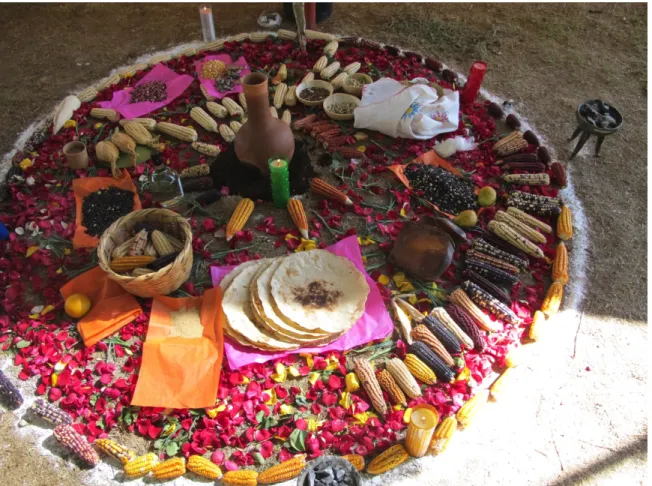
The gatherings have a spiritual texture—the first task, before the sessions start, is to build
an altar in the central patio from the many varieties of maize and other symbolic items (beans,
squash seeds, acorns and other wild foods, mezcal, copal) people bring. The gatherings open and
close with mystic ceremonies. The meetings are crucial for activating new people in the network,
through education, support, and connections of friendship with others across the country.
WHAT IS LA RED EN DEFENSA DEL MAÍZ?
While built on shared experiences and a shared history of organizing, La Red is different
from previously existing network. Its newness can be attributed to the crisis that transgenic
technology kicked into action, forcing new ways of analyzing science, technology, patents, free
trade, and governmental policies. In addition to these new analyses, La Red is also organizing
new, non-conventional ways of interacting, an “alternative model of being and relating” that has
gained traction by challenging fundamental modern assumptions about the political, economic,
social, and spiritual role of food and agriculture, and what role the campo will play in Mexico’s
future (Price 2009, c.f. Piven 2006). Small-scale farmers who were previously connected with
each other as a “class,” demanding fair market prices for their goods and fighting corrupt grain
traders, have reorganized to articulate a defense of a way of life built on the milpa.
Movement actors describe the milpa as having withstood decades of assault in the 20th
century. Beginning around 1970, the rural credit bank (BANRURAL) started to condition credit
access on the utilization of technological packets to increase yields. These packets required the
use of modern hybrid seeds, fertilizer, agrochemicals—all of which favor monocrops and thus
threaten the milpa, a fundamentally diversified farming system. But despite the technology and
all the many other attacks, the milpa still exists. The milpa is “una realidad, es un hecho,” (it is a
reality, a fact), not a movement.
Observing the development of the network’s understanding of itself over the years,
beginning with the first event I attended in July 2008 through the dozens of gatherings I
participated in through 2014, the following points become clear:
• Maize is the core symbol, the organizing principle for the set of relationships
the fight for the autonomy, territory, and justice that depends upon maize. Milpa/maize is a collective identity (not individual);
• the movement very firmly maintains that maize is not a thing, “no es una cosa,” it
is a set of relationships; and
• People explain their motivations for action with an unwavering sense of
responsibility to humanity in general to defend maize, based on an expansive, global logic.
At several gatherings, self-analysis of La Red came up, and I observed one extended
workshop on the topic (CENAMI, June 15-16, 2010). The agenda topics demonstrate the
approach to the question: analysis of reality; the processes of La Red in relation to the different
regional social actions against transgenics; experiences of the regional and territorial defense of
the pueblos of maize; and perspectives on the future of La Red (what needs to be reinforced,
what needs to be done). Some key patterns that emerged in this discussion included the fact that
the network process started before contamination was apparent, through connecting the existing
networks of indigenous and campesinos that already existed. La Red exists as part of a long-term
process, it can even be thought of as a permanent process.19 La Red is the “response of the
pueblos to transgenics,” and it exists to diagnose and spread awareness about the problems of
GM corn. The characteristics of the network were described as deepening the understanding of
transgenics and giving recognition to the rights of indigenous people. Perhaps most significantly,
the community’s authority was repeatedly invoked and strengthened—“there is nothing from
outside [no resources or experts] that is needed to fix the problems [of GM corn], but instead, in
the assembly, a collective understanding can be reached to resolve the problems.”
La Red is one of the key member organizations of La Vía Campesina in Mexico, and the
following section will provide a discussion of the network and analysis of an interaction
involving gender.
19 “[L]arga plaza, un proceso permanente,” this quote and the others in this section from
HISTORY OF LA VÍA CAMPESINA
Despite the regular death knell of the “peasantry,” coming equally from the left and the
right sides of the political spectrum, people with land-based livelihoods persist all over the
world. My framework for thinking through the situation of campesinos in Mexico, and the social
movements they have launched to defend themselves, have been shaped by the rise of La Vía
Campesina (LVC or La Vía), a transnational movement that:
brings together millions of peasants, small and medium-size farmers, landless people, women farmers, indigenous people, migrants and agricultural workers from around the world. It defends small-scale sustainable agriculture as a way to promote social justice and dignity. It strongly opposes corporate driven agriculture and transnational companies that are destroying people and nature. (Vía Campesina 2011)
Emerging in 1993 during the golden age of Washington Consensus neoliberalism, when
global-south nations were busily withdrawing state resources from agriculture and subjecting
farmers to the creed of comparative advantage, La Vía Campesina rescued the "peasant" concept
from the mire of the Lenin-Chayanov debate (see discussion of the "peasant question" in Chapter
4). Decades-old Russian polemics never fit comfortably in post-colonial Latin America. La Vía
Campesina reconstituted the terms of debate and reclaimed the “peasant” identity, in the context
of the challenges posed by free trade agreements to small-holder farmers all over the world, with
special focus on indigenous people. The influential role of the Zapatista movement during the
early stages of LVC is credited with helping frame the importance of seeing distinctions between
and among indigenous and peasant peoples, not lumping everyone together (Gómez Flores, pers.
comm., 2012).
My understanding of La Vía Campesina's history is informed by conversations with
Desmarais and her 2007 book, as well as interviews with LVC leaders and members in Mexico.