HOW TEACHER EVALUATION SHAPES CONCEPTIONS OF GOOD PRACTICE: POLICY INTENTION, IMPLEMENTATION & INTERPRETATION
Laura Gutmann
A dissertation submitted to the faculty of the University of North Carolina at Chapel Hill in partial fulfillment of the requirements for the degree of Doctorate of Education in the School
of Education.
Chapel Hill 2014
ABSTRACT
Laura Gutmann: How Teacher Evaluation Shapes Conceptions Of Good Practice: Policy Intention, Implementation & Interpretation
(Under the direction of Jocelyn Glazier)
During the 2010 Race to the Top (RttT) grant competition, the U.S. Department of Education encouraged states to link teacher performance ratings to evidence of student achievement and hold teachers accountable for meeting performance standards. As a result, winning RttT states like North Carolina implemented more rigorous teacher evaluation policies that emphasize documenting proof of instructional effectiveness. Although prior research has focused on the efficacy of particular evaluation mechanisms, there is less information about how evaluation impacts teachers on the ground level. This study asked, “How, and to what extent, does teacher evaluation policy influence teachers’ conceptions of good practice and professional identity development?”
Professional identity development is complex and multi-faceted. Teachers’
conceptions of their role are influenced by factors like prior schooling experiences, personal beliefs, and teacher education. Contextual factors within schools, such as leadership and collaboration with colleagues, also play a role in shaping teachers’ approaches to the classroom. As a result, the effects of implementing policies like teacher evaluation must be understood in relation to other key drivers of practice.
this rhetoric was compared to narrative accounts of evaluation experiences from North Carolina PreK-3 teachers. Overall, evaluation only somewhat mattered to them, as it often failed to live up to its full potential. Flaws in implementation and little sustained connection between evaluation ratings and improvement strategies contributed to evaluation’s lack of influence. In addition, aspects of their teaching that had greater value to teachers were largely based on sustained, meaningful relationships with other members of their educational community. If performance feedback was not based on a foundation of trust and respect, teachers found it to be less effective.
These findings point towards considering how evaluation is actually being carried out in schools. In addition, they highlight the importance of developing relationships with
ACKNOWLEDGEMENTS
Thank you to my patient and dedicated advisor, Jocelyn Glazier. Thank you to the faculty who guided me along the way, especially my committee members Kevin Bastian, Julie Justice, George Noblit, and Sharon Ritchie. Thank you to colleagues and mentors who allowed me to be part of their work. Thank you to my fellow graduate students for their encouragement and inspiration.
Thank you to the teachers who participated in this study for sharing their story with such insight and thoughtfulness. I admire what you do each day and feel truly fortunate to have gotten a glimpse into your professional lives.
TABLE OF CONTENTS
Page
LIST OF FIGURES……….…...…………..……ix
Chapter 1 TRACKING THE TRAJECTORY OF TEACHER EVALUATION POLICY………..………...…1
Framing an Approach to Examining Evaluation Practices………....…1
What Does Teacher Evaluation Look Like?...4
Major Types of Evaluation Structures………...5
How Did More Rigorous Evaluation Become Popularized?...12
Early Evaluation Practices………...12
Growing Demands to Measure Teacher Quality………..…...19
Recent Policy Trends that Shaped Evaluation Efforts……...23
From Local to National: The Effects of Increased Federal Influence………...………..………25
Studying Teachers’ Evaluation Experiences and Analyzing Evaluation’s Relative Influence………...…………29
2 UNDERSTANDING THE ROLE OF POLICY WITHIN THE BROADER SCOPE OF TEACHERS’ PROFESSIONAL IDENTITY DEVELOPMENT………..………..32
How Professional Identities Are Formed………...……..33
What Specifically Contributes to a Teacher’s
Professional Identity Development?...37 Teacher Evaluation Policy’s Place in Teachers’
Lives………..………...58 3 A TWO-PART QUALITATIVE EXPLORATION OF THE EFFECTS
OF TEACHER EVALUATION ON TEACHERS’ CONCEPTIONS OF GOOD PRACTICE AND PROFESSIONAL IDENTITY
DEVELOPMENT………..……..64 The Need for Additional Qualitative Research About Evaluation Policy………..…….64
Analysis of State and Federal Policy Documents……….…...66 Teacher Case Studies………..……….67 Research Methodology: Discourse Analysis.………..…68 Details About Part One: Documentation of Policy
Environments That Define Teaching Roles………….………73 Details About Part Two: Building Rich Case Examples to Illuminate Evaluation Experiences………..…………78 4 PART ONE: TRACING THE PATH OF TEACHER EVALUATION
DISCOURSE AND EXAMINING POLICY RHETORIC ABOUT
EVALUATION’S INTENDED PURPOSE………98 Federal and State-Level Policy Makers Assign High Importance to Rigorous Evaluation of Teacher Performance………..………...…98
Setting the Stage on the Federal Level………...….98 Federal Messages About Role of Teaching During RttT
Competition……….………..…….101 North Carolina’s Response to Feedback About Their
Evaluation Plan………..111 The Further Development of North Carolina’s Current
5 PART TWO: ANALYZING TRENDS WITHIN TEACHER
EVALUATION EXPERIENCES………..…………129
“Who Has a Relationship with a Rubric”? : Current Teacher Evaluation Policy Does Not “Really” Matter to Teachers……...…..129
Teachers’ Impressions of the Official North Carolina Teacher Evaluation Process………..….129
6 IT’S ALL RELATIONAL: IMPLICATIONS FOR THE FIELD………….192
Teachers’ Overall Impressions of Evaluation’s Influence…...……..193
Major Themes From Across Teachers’ Evaluation Experiences………..………..………195
The Overarching Importance of Relationships……….…….196
Evidence from Prior Research that Relationships Influence Teaching Practice and Policy Implementation…..201
Evaluation as Filtered Through School Context………203
Evidence from Prior Research that Context Influences Teaching Practice and Policy Implementation……..…..…..205
Comparing Major Trends in Teachers’ Experiences to Evaluation Rhetoric…….………..……206
Considerations for Policymakers and Practitioners…..…….211
Limitations to the Findings………..………..220
Future Directions for Research………...……….221
APPENDICES………..……….226
LIST OF FIGURES
Figure Page
1.1 Examples of factors that may contribute to a teacher's professional identity
development……….………...2 1.2 Sample evaluation metrics……….………. 15 2.1 Examples of factors that may contribute to a teacher's professional identity
CHAPTER ONE
TRACKING THE TRAJECTORY OF EVALUATION POLICY
Although the forces that shape teachers’ views of their job responsibilities and drive their instructional goals are varied and complex, evaluation policies that define teaching success have emerged as potential influences on pedagogical behavior (Berryhill, Linney & Fromewick, 2009; Olsen & Sexton, 2009; Day, Flores & Viana, 2007; Lasky, 2005). The advent of dramatically more explicit and rigorous performance guidelines provides a distinct opportunity to examine, “How, and to what extent, does teacher evaluation policy influence teachers’ conceptions of good practice and professional identity development?” As
policymakers weigh the efficacy of policies and procedures that seek to produce data on teacher effectiveness, information about their role in teachers’ lives can demonstrate how the standard expectations outlined within evaluation metrics have translated into the workplace.
Framing an Approach to Examining Evaluation Practices
improvement, an administrative requirement with limited true impact on practice, or overly prescriptive and punitive. Regardless, the climate within local schools can contribute to how evaluation policies are presented, executed, and interpreted.
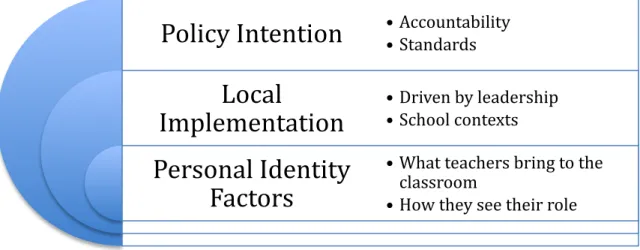
The following graphic captures this relationship between self, school, and state, which, in turn, characterizes major components of evaluation interactions for teachers. In combination, these factors can determine what evaluation will look like and what its
implementation will mean for teachers who interpret and then, to varying degrees, internalize its influence (Figure 1.1):
Figure 1.1. Examples of factors that may contribute to a teacher's professional identity development, in this case, in response to evaluation policy guidelines.
-‐
These major categories of influence contain sub factors like the relative importance of evaluation compared to other mandates, the nature of evaluation training provided to schools, the utility of evaluation tools, and the consequences or rewards attached to performance (Spillane, Reiser & Reimer, 2002; Cohen & Spillane, 1992). Similarly, school leadership, observation consistency, the availability of mentoring, student population, grade level, and school setting can each shape the nature of evaluation practices in the field (Ingersoll & Strong, 2011; Hope & Pigford, 2002; Leithwood, Steinback & Jantzi, 2002; Fullan, 2001;
Policy Intention
Local
Implementation
Personal Identity
Factors
• Accountability
• Standards
• Driven by leadership
• School contexts
• What teachers bring to the
classroom
Leithwood & Montgomery, 1982). Components of teachers’ own identities, which include person-based characteristics such as prior preparation and experience, further determine teachers’ outlook towards pedagogical success and subsequent practice decisions. These individualized factors can impact the relative influence of evaluation policy on practice, as evaluation enters a crowded marketplace of previously established ideas about teaching (Beijaard, Verloop, & Vermunt, 2000; Gee, 2000; Zeichner & Gore, 1990; Feiman-Nemser, 1983; Lortie, 1975).
While the increased standardization of evaluation seeks to create common messages about expected performance, the elements that shape teachers’ behavior go beyond a straightforward response to policy inputs (Zembylas, 2003; Holland, Lachicotte, Skinner & Cain, 1998). As a result, while the potential for assessments of teachers’ performance to affect their beliefs, practices, and interpretations of good teaching is worth investigating further, it needs to be explored within the framework of the broader educational ecosystem. Because teaching is situated within particular reform climates, school communities, and personal views of practice, new inputs must get filtered through those contexts (see Figure 1.1). The array of factors that contribute to teaching and learning environments add several layers of complexity that often prevent policies like evaluation from making a distinct impact on schools.
experiences informed current evaluation practices? This background information will set the scene for later analysis of key performance management standards and procedures that have evolved on the federal, state, and district level.
What Does Teacher Evaluation Look Like?
While various iterations of teacher evaluation based on performance standards have been attempted over the decades, members of the public education system continue to debate what teacher evaluation should be used for, as well as what implementation should look like on the ground level. Evaluation “involves collecting and using information to judge the worth of something” (Darling-Hammond, Wise & Pearce, 1983, p. 290). Teacher evaluation is a tool for examining several different aspects of a teacher’s performance. Its structure therefore depends on its objectives, which may include documenting teaching quality and “helping teachers improve their performance as well as holding them accountable for their work” (Stronge, 2006, p. 1). If it is meant to identify the key components of a teacher’s practice, it may include a rubric designed to rate demonstrated mastery of central teaching behaviors on a developmental continuum. This type of evaluation is focused on real-time educator efforts and driven by observational data, as well as continual follow-up
holding teachers responsible for student learning. Today’s evaluations typically include some combination of management objectives and relate instructional inputs to achievement outputs in increasingly complex ways (The New Teacher Project, 2010).
Major Types of Evaluation Structures
Value-added models. Value-added models (VAM) that measure gains in
achievement while taking students’ prior performance into account have become one of the most popular evaluation tools for tracking a teacher’s effect on student growth, especially among states that have begun connecting performance ratings to proof of learning gains. By analyzing predicted achievement scores that also incorporate average grade-level
performance within a particular school, VAM can provide more precise data about expected academic progress. However, even as researchers continue to tinker with VAM to improve their capabilities, views about their widespread utility are mixed.
and steadfastly argues that a “rigorous value-added approach is the fairest, most objective way to hold districts and schools accountable” (p. 335), as well as provide useful diagnostic information. Tapping into test data helps the school system align measures of student learning with grade level standards, and provides a relatively efficient way to calculate progress for thousands of classrooms.
Meanwhile, detractors of VAM worry that highlighting end results, especially given flaws within VAM metrics, creates an unfair focus on achievement scores that may
ultimately fail to capture the entirety of a teacher’s efforts. They point out that evidence supporting their utility still includes several caveats, since VAM “are usually based on student outcomes over a very narrow set of domains; they have substantial measurement error; and they are usually only available for a small subset of teachers” (Glazerman, et al, 2011, p. 11). Fears about the growing overuse of VAM led a high-profile group of
researchers to co-sign a brief arguing that, “although standardized test scores of students are one piece of information for school leaders to use to make judgments about teacher
Since VAM narrowly define what teachers should be held responsible for, programs that tie their results to merit pay, promotion, or tenure are particularly contentious (Darling-Hammond, 2012; Ravitch, 2012; Baker et al., 2010; Ekert & Dabrowski, 2010; Kortez, 2002). One common claim is that, “Accountability policies that rely on measures of short-term value added would do an extremely poor job of rewarding the teachers who are best for students' longer-run outcomes” (Rothstein, 2010, p. 177). In part, these challenges are due to differences in classroom composition from year-to-year and the difficulty in accounting for the non-random assignment of students to teachers. According to some, this causes
evaluation plans that attach significant consequences to limited data from VAM to have validity issues (Kane & Staiger, 2008). It is also complicated to isolate a teacher’s effect on students from other factors like personal motivation and ability, family influence and prior learning experiences that may play a role in current learning outcomes. If, “Growth measures implicitly assume, without justification, that students who begin at different achievement levels should be expected to gain at the same rate, and that all gains are due solely to the individual teacher to whom scores are attached” (Baker et al., 2010, p. 9), they may be perpetuating an overly narrow sense of who should be held responsible for student progress, as well as the notion that all students should progress equally within the same time period. In classrooms with struggling students, teachers may become especially discouraged by needing to produce scores at the same level as colleagues who have fewer challenges to overcome in order to demonstrate adequate progress (Clotfelter, Ladd & Vigdor, 2010; Baker et al., 2010; Finnegan & Gross, 2007).
with administrators over the course of the year and connect their behavior to pedagogical standards. One of the most prominent voices in this type of evaluation reform is Danielson (2001, 2007, 2010), who provides schools with a framework for providing ongoing feedback about a teacher’s performance within areas like professionalism, preparation, instructional ability and classroom environment. These contextual factors provide a starting point for capturing detailed information about a specific teacher and the type of experience they are providing for their students.
Since this approach is more broadly conceived than models based only on achievement outcomes, it provides teachers with a greater voice in the process through mechanisms like discussing observations or documenting professional accomplishments in portfolios based on standards for their grade level. As such, it may do a better job of capturing the entirety of a teacher’s efforts and increase buy-in to the system (Adams & Holland, 2002). Danielson (2001) explains if evaluation is instead “conducted in a highly negative environment with low levels of trust” (p. 15), it will be difficult to produce accurate and detailed data that can help teachers identify their specific strengths and weaknesses. After Cincinnati employed an evaluation system based on her recommendations, Milanowski (2004) examined whether or not the resulting observation ratings were in alignment with test score outcomes, and found that they could, in fact, predict future achievement on some level and provide schools with a valid way to gauge performance. Because this type of system allows for on-going discussion between principals and teachers connected to targeted
teacher practice versus reducing class size or improving principal leadership” (p. 49-50). By driving continual conversation about how to help teachers improve their practice and meet standards, these evaluation metrics provide a more holistic sense of how to move teaching forward over time.
Case examples of comprehensive systems. One well-known approach that tries to integrate observation data with test scores is known as the TAP model, or the Teacher Advancement Program. It aims to create cohesion around a series of measures that
intertwine evaluation with coaching and post-observation professional development. TAP has also tried to provide performance incentives like opportunities for teacher leadership roles or additional compensation and bonuses. In this model, value-added measures of student achievement are used to supplement formative components like the feedback
received during the series of observations held over the course of each semester. As a result, this model provides us with a strong example of how to effectively blend data and engage whole school communities in the evaluation process. In fact, researchers have found that the highest-performing TAP campuses show school-level effects that highlight the importance of coming together to, “more successfully carry out the site-based collaborative approach to growth and accountability” (Daley & Kim, 2010, p. 39). Across all TAP schools, the blended use of different types of data fosters an environment where standardized test scores and rubric-based information can complement and provide “parallel validation for the other as an accurate measure of a teacher‘s instructional quality” (p. 39). A study of a similarly blended model in New York also revealed that subjective evaluations by mentors provided “meaningful information about a teacher’s future success in raising achievement” (Rockoff & Speroni, 2010, p. 249). This data compared favorably with the objective measures that solely aimed to capture test score gains, while enhancing teachers’ ability to use such information to make instructional improvements.
measuring educators, while paying too little attention to the implementation drivers like leadership style and school culture that make these standards meaningful (Darling-Hammond, 2012; Derrington, 2011). This is a major concern for those who believe that evaluations emphasizing teacher outputs and requiring extensive documentation of practice will, “profoundly demoralize teachers, as they realize that they have lost their professional autonomy and will be measured according to precise behaviors and actions that have nothing to do with their own definition of good teaching. Evaluators will come armed with elaborate rubrics identifying precisely what teachers must do and how they must act, if they want to be successful” (Ravitch, 2012, p. 1). The publication of ratings in mainstream media outlets has only amplified the sense of mounting pressure to adhere to a set of expectations that may not be appropriately conceptualized or accurately applied by administrators charged with rating teacher performance. Consequently, the current ethos around evaluation is being perceived as focused on delivering summative ratings rather than fostering ongoing professional development (Danielson & McGreal, 2000; Stronge, 2006).
Given the potential for varied evaluation implementation and interpretations of its purpose to present challenges for both administrators and teachers, states and districts should consider what they could learn from our nation’s prior experiences with performance
How Did More Rigorous Evaluation Become Popularized?
To describe the major shifts in evaluation strategy that created the context for current performance management practices, in this section, I compare widespread efforts to
standardize personal accountability for student learning to prior attempts to measure progress that were historically rooted in each community. Tracing the path of management practices within the profession reveals how and why these changes occurred within the policy
environment surrounding school systems. Early Evaluation Practices
Making in-person observations of teachers has been common practice since the late 1800’s, when town officials like selectmen and ministers took on the task of inspecting teachers and visiting their classrooms (Borthwick, et. al, 2010; Hazi & Rucinski, 2009). Oversight of school management was highly localized, allowing communities to maintain tight control over personnel decisions. Hiring was often driven by personal relationships with prospective teachers who embodied prevailing ideologies about the type of character that educators should possess. Teachers were expected to serve as role models for students by displaying a proper commitment to their faith and adhering to conservative behavior (Ellett & Teddlie, 2003; Peterson, 1982). In addition, although an inspector could judge the quality of recitations and expect students to display their knowledge, standards for judging these accomplishments were more flexible than today.
Because teachers during this era typically had nothing more than a high school-level education, towns did not expect them to display exceptional content knowledge. Most did not have the benefit of specific teacher training or experience learning pedagogical
to be considered for the job. “Thus, teachers were largely evaluated on their personal characteristics rather than evaluation procedures informed by a knowledge base about effective teaching and learning” (Ellett & Teddlie, 2003, p. 103). Each town’s selectmen “laid down prescriptions regarding methods and materials” (Peterson, 1982, p. 30). While the advent of superintendent positions helped make the educational system more autocratic, supervisors still operated within the boundaries designated by local control structures.
The growth of supervision. After the school system grew past the point of having only one teacher per school, administrative roles were quickly established to manage staff and maintain school culture, beginning in the early 1900’s (Borthwick, et al., 2010; Peterson, 1982). At the turn of the century, schools were poised to follow the industrial model of organization, taking the principles of an era of increasing efficiency and transferring them to educational settings. Heads of schools or districts were seen primarily as business managers rather than instructional leaders. While some leaders wanted to create a cooperative
relationship with teachers, others promoted a more authoritarian approach to utilizing
process, “the right to control teaching was, therefore, fought out at the supervisory level, where the rigor of science was seen as being preferable to the imposition of idiosyncratic views of constituted improved teaching” (Gitlin & Smyth, 1989, p. 11). Within this model, feedback about teaching was not designed to foster dialogue between administrators and teachers or collaborative problem solving. Rather, it was meant to identify specific elements of instructional efficiency that teachers could then be directed to incorporate into their
practice. By depicting teaching as a scientific endeavor, measures of good practice were then seen as best understood by expert supervisors within the field, rather than teachers
themselves, who could only speak from their ground-level experience with children. This diminished teachers’ ideas and gave disproportionate power to those above them within the educational hierarchy. Consequently, it was less likely for evaluations of practice to provide teachers with feedback to enhance their professional growth, since assessments of their efforts were primarily seen as a way for supervisors to manage personnel and make decisions about retention (Gitlin & Smyth, 1989; Stronge & Tucker, 2003).
This scientific, research-based approach to evaluating teaching was further inspired by thinkers like Junius L. Meriam, who wrote Normal School Education and Efficiency in Teaching in 1905 as he tried to link professional scholarship about ideal pedagogical behaviors to perceived teaching ability. Despite its lack of reliable information, due to variation in school environments and imprecise measures of what strong teaching ability might look like, his work spurred future exploration in this area:
Evaluation prior to 1905 received scant attention as a field for study and
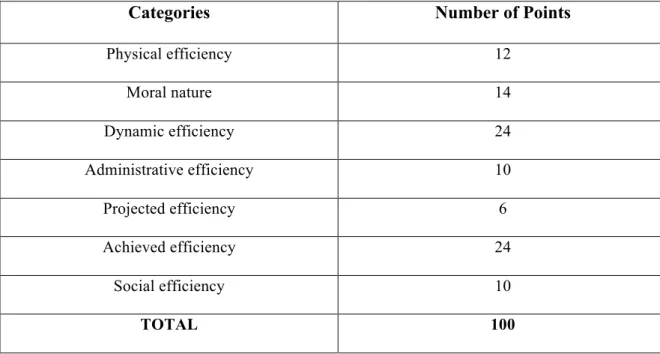
During this time, there were several attempts made to hone in on the traits that characterized good teaching, which now went beyond personal attributes to include physical, moral, dynamic, administrative, social, projected and achieved efficiencies (see Figure 1.2).
Evaluation of these traits was based on observed assessments of how well teachers were able to execute each prescribed aspect of teaching performance (Liu, 2011; Stronge & Tucker, 2003). For example, rating administrative efficiency required evaluating how well teachers were able to tackle the organization-, planning-, and documentation-based components of their responsibilities, such as maintaining student records. However, while such rating scales tried to assign a numerical point value to achievement of required tasks and behaviors, they still left of room for administrator subjectivity and interpretation.
Categories Number of Points
Physical efficiency 12
Moral nature 14
Dynamic efficiency 24
Administrative efficiency 10
Projected efficiency 6
Achieved efficiency 24
Social efficiency 10
TOTAL 100
Figure 1.2. Sample evaluation metrics adapted from “A Tentative Scheme for the Measurement of Teaching Efficiency” by Edward C. Elliott, originally published in 1910 (Peterson, 1982, p. 13).
precise and technical. For example, Frederick Taylor contributed to the use of scales to rate teacher effectiveness “based on the assumption that if scientists could study the most
effective teachers, descriptors of their behaviors could, in turn, be used to rate, then
transform, the ineffective and inefficient ones” (Hazi & Rucinski, 2009, p. 32). During this period, “along with the origin of the standardized testing movement, the teacher-rating instrument (i.e., check sheet, score card, and the like) also grew and became quite popular among administrators” (p. 32). As a result, supervisors tried to employ checklists that would allow them to rate a teacher based on a single visit and then make summative determinations of his or her success in the classroom (Danielson & McGreal, 2000). Unfortunately, the problems that Meriam and Taylor encountered in determining appropriate measures for assessing teaching have not disappeared in today’s schools, as the standardization of teacher evaluation is still challenged by vast differences between both school settings and individual classrooms.
Early resistance to evaluation. From the start, weaknesses within evaluation
to set evaluation standards that will satisfy both educators who see teaching as a fluidly constructed and responsive endeavor and reformers that believe stricter measures are
necessary, given dismal inequities in student achievement that point to, among other things, a lack of consistent teacher quality.
Initial attempts to refine evaluation methods. While professional associations argued that teaching is inherently ill suited for rigid bottom line expectations (Rowan, 1994), social scientists claimed that schools simply needed a better way to measure teaching efforts and resulting educational outcomes. In the 1920’s-1940’s, the testing movement began to gain additional ground, as teachers were asked to give out pre- and post-assessments to track student progress over the course of the year. “Researchers were trying to measure the different processes, the products of the schools, and by these measurements not only to standardize, but also to rationalize every step in the procedure” (Peterson, 1982, p. 53). The science of evaluation led to the development of more complex teacher rating systems, despite ongoing debate about how these mechanisms should be used. (Marzano, Frontier, &
Livingston, 2011). A central question was: Should teachers be held accountable for producing proof of student learning, or were they merely responsible for the delivery of information?
possessed these traits were more likely to perform effectively, so they became the centerpiece items in the local teacher evaluation criteria” (Liu, 2011, p. 41). However, there were some practical difficulties in implementing these evaluation systems smoothly, even as the study of supervision and information about student achievement became more common (Danielson & McGreal, 2000; Liu, 2011). Supervisors and researchers were not sure if, “the teacher as a person or his teacher performance should be the focal point of evaluation” (Peterson, 1982, p. 47). These types of ratings continued to contribute to feelings of insecurity among teachers, who worried that the “general impression” method would make observations a highly political endeavor, with favoritism and personal preferences eclipsing recognition of their hard work and numerous struggles.
In addition, even as educators resisted the subjectivity of ad hoc judgments, they remained resistant to their work being reduced to a number on a scale. As principles of scientific management drove an expanded list of expected competencies, quantifying teaching efforts ran counter to the notion that teaching should be more responsive and fluid than a series of precisely calibrated behaviors (Ellett & Teddlie, 2003; Gage, 1972). “Because teaching viewed as an art encompasses elements of personal insight (as well as theoretically grounded professional insight), the teacher as artist is expected to exercise considerable autonomy in the performance of his or her work” (Darling-Hammond, Wise & Pease, 1983, p. 292), flexibly crafting approaches to fit each classroom’s composition. How, then, could evaluations value teachers’ own discretion, yet hold them accountable for certain expected behaviors?
with teachers to foster collegial relationships and build a shared desire to make the entire school successful. Simultaneously, the continued rise of unions led to more explicit
parameters for observations, reached during collective bargaining agreements that sought to limit some of evaluation’s more problematic features (Borthwick, et al., 2010). However, since teachers were ultimately responsible for their own performance, this created a dilemma for advocates of a more community-minded process, especially given the inevitable variation among staff members in terms of their teaching style and success with their students. Even though teachers were encouraged to be active members of cooperative work environments, there was also a greater demand for excellence that made it difficult to avoid focusing on individual assessments. Amid concerns about declining school systems, by the 1970’s and 1980’s, accountability advocates had begun to shift their focus “from broad issues of finance and program management to specific concerns about the quality of classroom teaching and teachers” (Darling-Hammond, Wise & Pease, 1983), which prompted local education authorities to consider how to enforce more stringent standards. Although there was not widespread use of set evaluation mechanisms, reformers had a renewed interest in developing them.
Growing Demands to Measure Teacher Quality
to media allowed for widespread discussion of related educational issues such as lags in student performance, which also created new pressures for teachers.
Continued attempts to create evaluation objectivity. Because different iterations of the “science of evaluation” had been complicated to employ on the ground level, the 1960’s and 1970’s brought renewed interest in refining evaluation methods to make them more reliable. Even though it was difficult to evaluate teaching, schools felt that they needed tools that could provide fair assessments of performance while helping strengthen
insufficient instructional practices (Marzano, Frontier, & Livingston, 2011). They were also trying to address growing concerns among citizens who wanted better proof of their return on investment in education. Popham (2003) explains that:
The chief reason for what seems to be an explosion of educational testing is that U.S. educational policymakers, bent on making the nation’s educators more accountable, want hard evidence regarding how well public schools are performing. These policymakers, and most of our citizens as well, believe that student test performance should be the ultimate yardstick by which we measure a school’s effectiveness. Naturally, then, teachers are under pressure to raise their students’ test scores. You know the logic: high test scores signify good schooling and low test scores signify bad schooling (p. 4).
Although Popham emphasized the need to create mutual satisfaction with evaluation, this was not always easy to accomplish. His work around the validity of different types of assessment continues to spark debate about the value of summative versus formative
measures and how their results can be utilized to provide feedback while reinforcing bottom line expectations.
As taxpayers clamored for ways to ensure that their support of the school system was funding adequate educational conditions, administrators were forced to address their
specific areas in need of improvement and then utilize this knowledge to promote targeted growth for each teacher. He envisioned administrators collaborating with staff throughout the school year and allowing the teacher to, “set specific goals toward which he will work” (p. 85). At the same time, numerous researchers also tried to satisfy the demand to know more about the habits of excellent teachers by looking at patterns of behavior and
formulating a better understanding of what their practice looked like, eventually considering what other teachers might be asked to emulate within performance standards.
State-level changes. By the 1980’s, the fear of keeping incompetent teachers in the classroom had led to several state programs and initiatives intended to keep teachers in check while encouraging them to work harder to meet standards. In the wake of the warnings about American schools’ weaknesses presented in A Nation at Risk, “renewed and more
sophisticated efforts to evaluate teachers were viewed by many politicians and education policy makers as the bottom line in efforts to improve education in the USA” (Ellett & Teddlie, 2003, p. 106). The major problem, however, was that no clear path had been set forward, leaving each state agency to grapple with exactly how to organize productive evaluation systems. Some policymakers and administrators wanted to keep concentrating on identifying visible markers of good teaching that included performance, classroom behavior and learning gains. However, Medley, Coker, and Soar (1984) warned that while
information about student experiences in classrooms could be useful, taking the next step towards focusing on final learning outcomes was less reliable. They believed that in order for teachers to be make sure that teachers were, “evaluated as professionals, not as
help practitioners develop their pedagogical knowledge without becoming overly demoralized.
Furthermore, because the “desire for accountability does not always match the capacity to collect the information necessary to reach judgments” (Duke, 1995, p. 5), it seemed as if the work administrators had put into testing varied methods of performance management was headed towards being largely ineffective. Even if teachers could be identified as sub-par, union pressures and the potential for litigation made their dismissal complicated. Innovations like pay-for-performance measures were generally opposed by teacher organizations that wanted the focus to be on professional development. “Among their stated concerns are the qualifications of those charged with making judgments about merit, and the instruments used to collect the data upon which such judgments are placed” (Duke, 1995, p. 7). These types of programs got the most pushback and were the hardest to implement. “While A Nation at Risk and other national commission reports called for programs that would pay bonuses or promote teachers whose performance and productivity were clearly outstanding, these turned out to be the programs most strongly resisted in the educational community” (Brandt, 1995, p. 30). As a result, the struggle to strike a balance between motivating teachers to meet rigorous individual expectations and collectively fostering their development continued.
outcomes still mirror the efficiency-minded values and standardized operating procedures that marked the factory-approach to production (White & Lowenthal, 2009). Reformers who take a hard stance towards teacher expectations, insisting that poverty or other contextual considerations cannot be a justification for poor performance in the classroom, have looked to the business world to provide examples of appraisal systems (Ravitch, 2012). The ideology behind this approach is closely related to a belief in the power of free enterprise and the need for competitive pressures to push underperforming schools beyond the status quo of stagnancy and failure. Desired shifts in school culture therefore include more rigorous tenure and performance requirements, tighter organizational structures, increased
management of human resources, and the ability to link rewards and consequences to student results (Ravitch, 2012; White & Lowenthal, 2009). Within this model, evaluation serves as a means for gathering data that carefully tracks progress over time, combined with real
incentives to increase instructional capacity. While questions about how to measure a teacher’s work create challenges much like those raised during the time of rudimentary efficiency ratings, the use of such metrics is rapidly spreading and evolving.
Recent Policy Trends that Shaped Evaluation Efforts
The magnitude of more recent trends towards uniform conversation around set measures of teacher effectiveness follows groundbreaking federal legislation like No Child Left Behind (NCLB), which ushered in an era of accountability that broadly applied
desire to use it to inform human capital decisions became a natural next step for those who believe that the teacher is the major driver in the classroom, and the primary source of school-based influences on learning (The New Teacher Project, 2010; Goldhaber, 2009; Rivkin, Hanushek & Kain, 2005; Hanushek, 1992). This emphasis on the role of teachers in student success brings us from wanting to ensure that teachers are “highly-qualified” to enter the classroom to demanding that they are also “highly-effective” after being placed there. Because “the difference in student performance in a single academic year from having a good as opposed to a bad teacher can be more than one full year of standardized achievement” (Hanushek, 1992, p. 113), the effects of ongoing exposure to low-quality instruction are seen as exponentially disadvantageous over the course of a student’s schooling (Gordon, Kane & Staiger, 2006). In fact, the impact of teacher quality on academic performance is currently believed to significantly supersede other factors like class size or teacher certification credentials (Rivkin, Hanushek & Kain, 2005).
From Local to National: The Effects of Increased Federal Influence
Widespread local adaptation of more rigorous and precise teacher evaluation would not have been possible without the federal government creating conditions tailored to motivate change. During the Obama administration, teacher evaluation measures made a rapid ascent to the top of the education reform agenda, as isolated pilot programs became models for states scrambling to retool rudimentary performance management systems, scale up district innovations, and align themselves with federal priorities. Much of the impetus to make policy changes could be linked to a lagging economy that prompted fierce jockeying for extra dollars from the Department of Education (DOE). Major initiatives like the Department’s Race to the Top (RttT) grant competition were explicit about the need to link teachers’ jobs to student achievement and make better use of classroom data, while
incentivizing action with the appeal of additional funding (U.S. Department of Education, 2010a). Other funding sources, such as foundations that have embraced business-minded approaches to evaluation reform, followed suit, contributing to the buzz around increased teacher accountability and corporate-style review mechanisms.
(Alternative Salary Plans/Charlotte-Mecklenburg Schools, 2011; Charlotte-Mecklenburg Schools, 2009). The main difference is that today’s reform leaders have moved towards participating in a national conversation, rather than working in isolation to try out state-specific innovations. For teachers, this means that their role and responsibilities are
becoming further standardized as performance incentive programs are no longer confined to meeting niche needs like solving teacher shortages in particular content areas or boosting staff quality in underserved communities. As achievement scores increasingly shape salary structures and staffing decisions across entire states and districts, placing a literal value on effectiveness is the new normal.
Support from powerful national organizations. Although we can still see that “differences in process, standards, instruments, and stakes are the result of local history and the context in which the model evolves” (Borthwick et al., 2010, p. 2), updated evaluation practices have now spread across geographic boundaries. Advocacy groups such as
Responses from teacher organizations. As increased evaluation measures seem inevitable, fears about instructional impacts (Darling-Hammond, 2012) have done little to sway a renewed federal influence over state policy decisions. In addition, while unions and teacher associations have long resisted evaluation that seeks to individualize performance or threaten equal distribution of benefits, the traditions of tenure, seniority-based advancement, and limited appraisal are fading (Duncan, 2010). Although teacher associations may still protect rating systems from being unfairly administered, fear of losing a seat at the table has prompted some naysayers to concede to pressure to remain aligned with power players, jump onto the federal funding bandwagon, and at least try to influence the nature of performance management proceedings. Union leaders in New York explained the compromises made during evaluation agreements as, “good for students and fair for teachers,” since they were able to negotiate provisions that supplemented test scores to include additional performance information (NYSUT, 2012). In non-union states such as North Carolina, while teachers have rallied against measures like Charlotte-Mecklenberg’s attempts to enforce universal participation in pay-for-performance plans (Charlotte Observer, 2011), the structure of the profession is even more likely to change, as policymakers are already positioned to take advantage of a rising tide in support of increasing teacher effectiveness.
Education, 2010a). This required strong partnerships between local entities that forced them to commit to shared goals around performance management. As the Secretary of Education during the U.S. Department of Education’s inaugural promotion of the RttT competition, Arne Duncan was so pleased with the effort made by applicants to create new policies that matched his recommendations that he claimed, “Race to the Top has helped advance reform more in the past eighteen months than any other program in the history of the Department of Education” (Johnson, 2010, para. 1). One of his biggest successes was spurring 17 states, including North Carolina, to change “their laws around teacher evaluation to include student achievement” (Duncan, 2010j, p. 5) over the course of just a few short rounds of competition. Because of this, RttT sped up the policy making timeline, simultaneously managing to
encourage both innovation and compliance with federal priorities. In addition to highlighting promising pilot programs, it took advantage of the increased control over schools gained since No Child Left Behind (NCLB), which had already primed states to making decisions based on federal stipulations. The increase in student achievement data made available through NCLB also contributed to the possibility of linking teachers to test results, at least on the school-wide level (Podgursky & Springer, 2007).
However, despite the DOE’s work to create the conditions necessary for the widespread adaptation of upgraded performance management systems, linking teachers to student achievement has been one of the boldest and trickiest changes for states to execute, even with the help of RttT dollars. This study uses North Carolina as a case example of how federal pressures to make evaluation more rigorous have played out on the state and local level, presenting both implementation challenges and opportunities for professional
filtered through contexts for instruction and individual perceptions of their value. While the route that policy priorities have taken from the DOE to state legislatures has been marked by a remarkable alignment with the evaluation expectations and definitions of teaching success outlined in RttT, the translation of those guidelines may vary on the district and school level.
The current body of research on varied evaluation measures has already helped states like North Carolina determine which type of performance management system might best meet their objectives (Glazerman, et al., 2011; Ekert & Dabrowski, 2010; Harris, Sass & Semykina, 2010; Rothstein, 2010; Koedel & Betts, 2009). Evidence about the most reliable evaluation tools has factored into policymaker decisions, along with input from special interest groups, cost, human resource needs, administrative capacity and community-based preferences. However, there is more work to be done when it comes to examining the effects of new evaluation policies and procedures on teachers’ views of the classroom. In the
coming years, states like North Carolina will be making unprecedented links between individual teacher effectiveness and student achievement scores – and so it is important to consider if such measures are having the desired level of influence on teachers’ perceptions of successful pedagogical behavior. We need more information about what evaluation means to teachers to better understand how teachers interpret policy guidelines and apply them to their daily lives.
Studying Teachers’ Evaluation Experiences and Analyzing Evaluation’s Relative Influence
more rigorous evaluation measures and placed North Carolina, as this study’s case example, within that context.
In Chapter Two, I outline what research already suggests about how teachers’ professional identities are formed, including how prominent accountability policies might affect teachers’ sense of ideal classroom practice. Questions explored through the review of literature include: What are some common influences on teachers’ professional identity development and conceptions of good practice? How does the role of evaluation policy compare to the role of other prominent influences on teachers? What factors might make policy implementation more or less effective?
In Chapter Three, I outline the methodology I used to (1) conduct critical discourse analysis of broader teacher evaluation policy themes and to (2) develop narrative case study examples that capture the specifics of local evaluation experiences. First, data analysis of key evaluation policy documents serves to highlight the messages about why evaluation is
important, how teachers will be rated, and what good teaching looks like. Second, data analysis of teachers’ first-hand experiences serves to identify common interpretations of evaluation’s significance, meaning, and influence within schools. This structure also
provides an opportunity to compare participants’ perceptions of their key job responsibilities with the messages that teachers receive about what they will be held accountable for.
performance management directions within local North Carolina contexts? What do North Carolina’s evaluation policies currently tell us about expectations for teacher performance? I then illuminate the intersection between evaluation policy intention, the range of potential influences on a teacher’s professional identity and practice, and the contextual variation caused by implementing evaluation across different school settings.
In Chapter Five, participants’ responses to evaluation implementation, as well as their own interpretations of what it means to be a good teacher, provided me with a ground level perspective of the policy-to-practice relationship. Questions examined in this section include: How have these evaluation expectations affected teachers’ lives? What is evaluation’s relative influence on these teachers’ practice? How do the realities of school contexts contribute to the relative importance of evaluation implementation? How do teachers define good practice, as compared to evaluation standards? How do North Carolina’s evaluation policy expectations compare to a teacher’s own ideal practices?
The concluding chapter draws across the findings to identify key themes that reoccurred throughout the data. Chapter Six further compares policy intention to teachers’ own views towards their evaluation experiences. It also links findings to relevant
CHAPTER TWO
UNDERSTANDING THE ROLE OF POLICY WITHIN THE BROADER SCOPE OF TEACHERS’ PROFESSIONAL IDENTITY DEVELOPMENT
Because teacher evaluation policy includes performance standards, it provides a unique basis for comparison with a teacher’s own beliefs about ideal instructional practices and outcomes. Administrators providing teachers with evaluation feedback have the
How Professional Identities Are Formed
The concept of professional identity development is often described within research about factors that can drive pedagogical choices and influence how teachers see their role. Beijaard, Verloop, and Vermunt (2000) note that within the field of education, there are mixed definitions of this term, which range from attaining a certain level of professional expertise to acquiring “personal practical knowledge” that becomes part of each teacher’s “story” and shapes beliefs about what teachers “personally desire and experience as good” (p. 109) within their classrooms. This study is conceptualizing professional identity
development as the process that teachers engage in as they determine what kind of teacher to be. By “interpreting oneself as a certain kind of person and being recognized as such in a given context” (p. 108) for teaching and learning, teachers synthesize the myriad
contributions to their identity to form a sense of their role within their school setting. As teacher identities shift, change, and expand throughout one’s career, they also become
influenced by, “the workings of historical, institutional, and sociocultural forces” (Gee, 2000, p. 100).
Identity as a Socially Constructed Concept
how ‘purposes’ are socially constructed through principles generated to enable teacher and students to participate and act in school” (p. 83). Shared beliefs about the purpose of teaching are the accumulated result of living within an entrenched system of societal standards that determines what public schooling is supposed to look like. These universal beliefs explain many commonalities in classroom practice that surface across schools, such as the way the school day is typically designed, dominant styles of transmitting information, and approaches to managing behavior. While different teachers see variations of these norms as they develop within the profession, they still internalize some basic notions of typical classroom structures that carry throughout their career.
Because the teaching role is affected by instructional settings, “these social spaces or ‘fields’ both enable and are characterized by particular types of practices” (Hardy & Lingard, 2008, p. 64), that educators recognize as familiar markers of appropriate behavior and
pedagogical skill. Similarly, Berger and Luckmann (1966) emphasized the impact of “group think” as nested within related societal structures, positing that, “man’s self-production is always, and of necessity, a social enterprise. Men together produce a human environment, with the totality of its socio-cultural and psychological formations” (p. 51). By extension, teachers are operating within a larger context for determining appropriate behavior within their profession, structured by the affinities, institutions, and groups that they associate themselves with (Gee, 2000).
‘compassionate’)” (Zembylas, 2003, p. 109). Within typical settings for teaching and
learning, “The language practices that teachers use in talking about the profession of teaching both hold the acceptable identities for teachers and carry the important knowledge, skills, practices, and values for teaching” (Battey & Franke, 2008, p. 129). As such, descriptions of optimal teacher characteristics and behaviors, such as independently managing a classroom or cheerfully serving the community, may contain both implicit and explicit messages about what it takes to adequately fulfill the requirements of the teaching position.
Bourdieu (1990) portrays these myriad influences on identity as inherent to our composition in ways that we might not even realize:
The conditionings associated with a particular class of conditions of existence produce habitus, systems of durable, transposable dispositions, structured structures predisposed to functioning as structuring structures, that is, as principles which generate and organize practices that can be objectively adapted to their outcomes without presupposing a conscious aiming at ends or an express mastery of the operations necessary in order to attain them. (p. 53)
Although educators may not be able to pull apart each of the threads that make up the knot that comprises their own sense of “teacherness”, they will likely have some sense of what appealed to them about their chosen profession and what they hope to accomplish on the job. As they carry those conceptions of ideal practice to their classrooms, their response to their school environment is driven and organized by those habitus components. Likewise, since habitus is evolving, new experiences in school, such as the introduction of a new policy or program, will become incorporated into previously established notions of what their job should entail.
class, and gender mediate the socialization process and establish socialization patterns for particular groups of individuals who teach in particular kinds of schools” (Zeichner & Gore, 1990, p. 26). Similarly, Gee (2000) envisions standards for practice as being determined by a combination of personal characteristics, prior experiences, and institutional expectations that drive each teacher’s vision of classroom life. By building bridges between these various inputs and engaging in dialogue about their profession with other members of the educational community, teachers can form a sense of their identity within their workplace. While
identities created through societal discourses, “are ultimately rooted in recognition
processes” (p. 111) that acknowledge set understandings of how institutions like schools are supposed to work, personal interpretations of these norms ultimately “interrelate in complex and important ways” (p. 101). Wortham (2005) notes that variation is possible even within structures that promote uniform “group think”, since social identification is still “constructed in particular events and local contexts ” (p. 40). From his standpoint, even established groups are flexible enough to allow for unique responses to new situations.
“who they are…in relation to the social types…and in social relationships” (Urrieta, 2007, p. 108) with the other people within their school building. The mutually dependent quality of a teacher’s relationship with her school context leads to this sort of co-constructed reality, where the outcomes of interactions between individuals and their environment cannot be fully explained by institutional norms and traditions. From this perspective, policies like teacher evaluation are but one factor that colors multifaceted layers of influence on a teacher’s sense of self and professional trajectory.
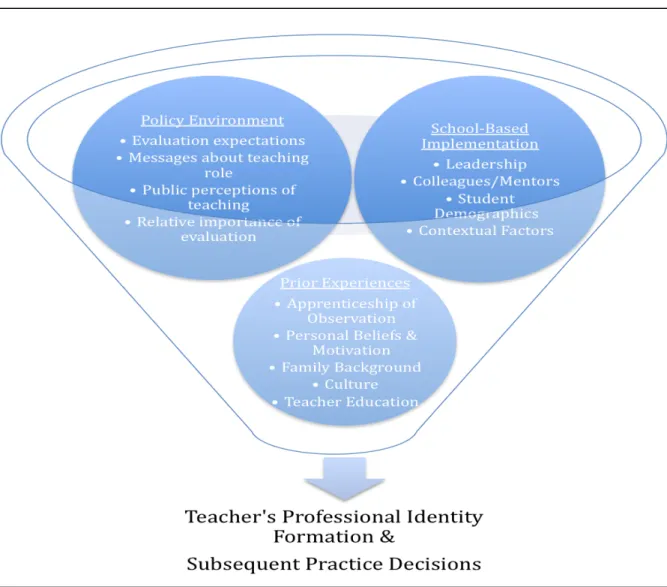
What Specifically Contributes to a Teacher’s Professional Identity Development? Since the factors that affect teachers’ lives are intertwined, it is difficult to tease out which components most significantly contribute to a teacher’s sense of self, or “teacherness”, and subsequent instructional actions. As policy-driven efforts like performance management standards interact with other major influences on practice, educators may struggle to make sense of a crowded marketplace of competing ideas and mandates (Feiman-Nemser, 1983). The following section outlines major categories of both person- and school-based influences that are likely to work in combination to shape professional identity development and affect policy’s relative impact on teachers (see Figure 2.1).
demographics of the students they serve have the potential to affect their conceptions of good practice. Lastly, I will explain how educational policies might drive teaching behaviors and professional identity development as they interact with person- and school-based influences on teachers’ lives. As part of this section, common implementation factors, as well as the particular role of accountability-focused policy measures, will be discussed in more detail.
Figure 2. 1. Examples of factors that may contribute to a teacher's professional identity development.
schooling structures as a child, and more intrinsic qualities, influenced by such things as cultural background, social class, and ethnicity. These contributions to a teacher’s identity are often deeply rooted, suggesting that other influences could merely become another layer on top of a well-established core. Before new teachers even have the chance to formally construct a formal repertoire of “knowledge about practice” (Cochran-Smith & Lytle, 1990), they have already accumulated a vast amount of experience in school, largely from their time spent as a student (Lortie, 1975). Their instructional ideals may stem from memories of a favorite educator who now serves as a role model, or organizational norms such as typical lesson structures, behaviors, and social dynamics that privileged their own learning. In addition, broader life experiences that go beyond educational background, such as membership in class, gender, ethnic, or other affinity groups, can provide teachers with a basis for shaping their views towards institutional structures like schools (Gee, 2000; Goodson, 1992). Lastly, if teachers participate in pre-service training before entering the classroom, their educational studies may also help form their early views towards curriculum and instruction (Darling-Hammond, 2000).
Effects of prior schooling. The perceived effect of factors like the “apprenticeship of observation” (Lortie, 1975) provides evidence that years of prior schooling, along with family-based views of educational values and norms, are stronger influences on teachers than any other pre-service experience (Feiman-Nemser, 1983). Feiman-Nemser (2001) sees the initial process of learning to teach as characterized by a desire to form “a coherent sense of themselves as professionals by combining parts of their past - including their own
accumulated impressions of teaching from when they were a student still tend to factor heavily into their visions for classroom success. These deeply ingrained norms are typically long-held, “personal values that the person regards as inextricably bound up with her or her existence” (Korthagen, 2004, p. 85). As such, they remain central to navigating daily responsibilities and instructional tasks once teachers are in charge of managing their own classrooms.
Effects of personal values and beliefs. A teacher’s personal values and convictions also have the potential to affect pedagogical choices, even if they are part of a broader belief system that was not originally applied to ideal teaching and learning behaviors. For instance, teachers may have particular convictions about work ethic, opportunity, key knowledge, and the purpose of education. Aguirre and Speer (2000) argue that these “beliefs play a central role in a teacher’s selection and prioritization of goals and actions” (p. 327), and become an apparent feature when teachers consider proposed shifts in pedagogy. Through their
examination of changes in teaching approaches, they conclude that beliefs about practice also “shape how teachers perceive and interpret classroom interactions” (p. 330), causing teachers to steer students towards alignment with their own learning objectives and significantly affecting how children experience school. “School systems consist not only in rules and formal structures, but also in beliefs about authority, habits of deference and resistance, and knowledge about how things work. Cultural and social organization intertwine in these systems” (Cohen & Spillane, 1992, p. 31). As a result, underlying views of how schools and classrooms should function often affect teachers’ perspectives towards their practice.
behavior. It also involves changing the person the teacher is” (p. 7). At times, this has required teachers to reconcile preconceived notions of what school should look like with the individual preferences and learning styles of the diverse range of students in their classroom. As Delpit (2006) points out, teachers’ belief systems may not always match student needs, since “We all carry worlds in our heads, and those worlds are decidedly different. We educators set out to teach, but how can we reach the worlds of others when we don’t even know they exist? ” (p. xxiv). In some cases, teachers who view struggling students from a deficit perspective may even be allowing their preconceived ideas about these students’ abilities to obscure these students’ strengths (Gorski, 2010; Singleton & Linton, 2005; Valencia, 1997). However, in other instances, teachers’ personal inclinations can be a positive force for ensuring that they fully support children’s development. For example, Lasky (2005) studied teachers who felt strongly about maintaining a holistic approach to meeting student needs, because they “all held the belief that their core purpose as a teacher was to teach academic content while also attending to social and emotional elements of their students’ development” (p. 909). As a result, sometimes teachers’ personal inclinations and values can be an important motivational tool, even if they otherwise present challenges to shifting teachers’ established attitudes towards their role.
Effects of teacher education. As pre-service teachers prepare to bring their personal views of teaching – and the world – into varied school contexts, teacher education programs provide another way to foster the advancement of professional knowledge and build
professional identity in ways that cannot simply be attributed to individual motivation, beliefs or prior talents. Within these training opportunities, pre-service candidates receive key information that makes explicit contributions to the construction of an agreed-upon “set of skills that are fundamental to safe and responsible teaching” (Ball, 2011, para. 6). Gaining subject-matter expertise is one important part of an educator’s professional development, as “the myriad tasks of teaching, such as selecting worthwhile activities, giving helpful
explanations, asking productive questions, and evaluating students’ learning, all depend on the teacher’s understanding of what it is that student are to learn” (Ball & McDiarmid, 1990, p. 1). Developing these fundamental attributes of high-quality instruction subsequently enhances decision-making about how to execute the teacher role once in the field.
In addition, preparation to enter the classroom typically includes content that goes beyond subject area or pedagogical mastery. For example, teacher education courses that focus on topics like culture, race, class, special education needs, or social justice issues may allow pre-service candidates to reflect on how their own background might skew their approach to teaching, and subsequently bring greater awareness to their practice. Zeichner, et al. (1998) tell us that such courses, “can help teachers overcome a ‘blame the victim’ and a ‘cultural deficit’ orientation towards students and their families so that they can restructure schooling and classroom processes to be more responsive to a culturally diverse student population” (p. 166). Although teacher education programs may not always do enough to support diverse cultures and viewpoints (Ladson-Billings, 2005), there are models of
preparation with a focus on incorporating biographical exploration, discussion of equity, and social justice themes that have succeeded in expanding teachers’ perspectives (Ray,
education program with teachers’ prior experiences and beliefs can then provide teachers with a more informed understanding of their role that they can take with them into the classroom.
Common school-based factors. Once teachers enter the field, knowledge from their previous experiences and training is applied to their particular instructional environments and their daily work with students in their schools. Although traditional teacher education
programs have the potential to add value beyond what can be gained by learning on the job (Darling-Hammond, 2000), there is some evidence that classroom experience is a key driver of teachers’ educational productivity and the subsequent academic progress of their students (Harris & Sass, 2011; Kane, Rockoff & Staiger, 2006). This implies that being within school contexts and interacting with children gives teachers a substantial opportunity to develop their practice, as their school environment significantly shapes the nature of their instruction and their disposition towards their profession (Klassen & Chiu, 2010; Rice, 2010). However, merely being within a school does not guarantee positive effects on teaching that move instructional techniques forward and result in meaningful professional growth. In fact, research has shown that teachers can interpret the same standards for teaching and learning in vastly divergent ways, depending on the preferred strategies for meeting instructional
expectations promoted within their school setting (Acheinstein, Ogawa, & Speiglman, 2004). Given how different schools can be from each other, the nature of their influence on a