Health Literacy Centered Interventions in
Glaucoma Medication Adherence
By
Anna Berry
A Master’s Paper submitted to the faculty of
the University of North Carolina at Chapel Hill
in partial fulfillment of the requirements for
the degree of Master of Public Health in
the Public Health Leadership Program.
Chapel Hill
2011
__________________________
First reader:
____________________________________
Date
_________________________________
Second Reader:
_________________________________
Table of Contents
Paper Abstract 2
Systematic Review Abstract 3
Systematic Review 4
References 19
Tables 21
Figures 23
Appendices 24
Study Abstract 26
Study 27
References 34
Tables 36
Master’s Paper Abstract
The influence of a patient’s health literacy on his/her health has become a topic of increasing
interest over the past decade. Many studies have examined the effect of health literacy on disease
understanding and health outcomes in multiple chronic diseases. However, there is scarce literature
exploring the role of health literacy in the field of ophthalmology, specifically glaucoma.
This paper includes systematic review of the current literature examining the effect of provider
communication interventions on the rate of glaucoma medication adherence in patients with low health
literacy. Of 89 titles identified for review, 86 were excluded based on population, intervention,
outcome, or study design. The three included studies were assessed for study design, potential for
selection bias, measurement bias, and confounding. All three studies were assigned an overall quality
rating of fair based on these criteria. Comparison of results was difficult due to varying definitions of
compliance and the use of multifaceted educational programs. However, the overall conclusion is that
multifaceted interventions with both educational and behavioral aspects can improve glaucoma
medication adherence by 9 to 19 percent. While statistically significant, the clinical importance of this
improvement is still unclear.
Based on the above results, a preliminary qualitative study using focus groups was designed to
explore provider communications with low health literacy African American patients with glaucoma.
The goal of the study is to attempt to understand how African Americans perceive medical information
related to their glaucoma care and to then use that information to develop a tool for improving provider
Systematic Review Abstract
Purpose: This review was designed to synthesize the published studies that examine provider patient
communication interventions designed to decrease the rate of non-adherence in glaucoma patients.
Methods: A systematic review of relevant qualitative and quantitative studies was conducted.
Medline, Cochrane databases, CINAHL, EMBASE, and ISI health were searched from inception to March
2011 using MeSH and keyword terms. The search was restricted to the English language. Articles were
selected based on the following criteria: glaucoma population, individual level educational intervention,
and medication adherence outcome. Editorial and personal opinion articles were excluded. Studies were
assigned a quality rating of poor, fair, or good. Data was abstracted by a single author based on criteria
developed by the United States Preventive Services Task Force (USPSTF).
Results: Three studies, two randomized controlled trials (RCTs) and one survey, met the inclusion
criteria. There was substantial heterogeneity of reported outcome analysis. Both RCTs showed an
improvement in medication adherence in groups that received a multifaceted intervention. The survey
found specific educational items but not total glaucoma knowledge to be associated with improved
anti-glaucoma medication adherence. The authors concluded that multifaceted programs are likely to be
more successful at improving adherence than education only interventions.
Conclusion: Although difficult to compare due to varied definitions of adherence, all three studies
showed that multifaceted interventions at the provider patient level can improve adherence to topical
Introduction
The effects of health literacy on disease management and outcomes have been the focus of
study for over a decade. Health literacy centered interventions have been studied in multiple chronic
diseases such as diabetes and human immunodeficiency virus (HIV) (1-4). However, interventions for
people with low health literacy have been slow to permeate the field of ophthalmology, and the effects
of health literacy centered interventions have not been well studied in ophthalmologic diseases. Primary
open angle glaucoma (POAG) is a chronic disease that relies on patient understanding of the disease
process for compliance to lifelong anti-glaucoma drop instillation. However, we lack literacy aids for
glaucoma patients who have poor literacy skills and we lack tools to improve ophthalmologists’ ability to
communicate effectively with low health literacy patients. Additionally, the principles of chronic disease
management that are important in the treatment of POAG are not widespread in the field of
ophthalmology.
Similar trends with low treatment adherence rates have been found in ophthalmology as in
other fields of medicine (5). The Glaucoma Adherence and Persistency Study (GAPS) examined
medication adherence from the perspective of patient beliefs and experiences (5). GAPS identified
several modifiable barriers at the provider-patient level including lack of concern over disease
progression and passive dependence on the provider. Both of these barriers can be addressed by
improving provider-patient communication.
The American Medical Association (AMA) defines functional health literacy as the ability to read
and understand written health information, oral health information, and the ability to act on such
information (6). Paasche-Orlow and Wolf proposed a basic conceptual model to describe the pathway
between health literacy and health outcomes (7). This model incorporates both patient and system
at the patient-provider level. Modifiable patient factors include knowledge and participation in decision
making, while the provider factors are communication skills, teaching ability, time, and patient-centered
care.
Patients with low health literacy have been shown to be less likely to ask their provider
questions and seek additional services or information. In addition, patients with low health literacy are
less likely to use preventive health services, more likely to have less knowledge about their chronic
disease and have worse health outcomes (8). Hironaka and Paasche-Orlow offer strategies to improve
provider-patient communication by improving the decision making process (8). These strategies,
focused on improving the provider’s communication and teaching skills, instructed providers to use
multiple forms of communication, such as written, graphic and oral; helped their patients ask questions;
and confirmed that the patient actually understood the message (8).
While many studies have examined the rate and potential causes of medication non-adherence,
very little is known about how to actually improve patient understanding and adherence in
ophthalmological diseases such as glaucoma. Many of the current recommendations are based on other
chronic diseases, such as diabetes or hypertension, but their effect on glaucoma is unknown. The aim of
this systematic review is to identify provider communication interventions to mitigate poor glaucoma
medication adherence in patients with low health literacy.
Methods
Search Strategy
In collaboration with a medical librarian, Medline, Cochrane databases, CINAHL, EMBASE, and ISI
Health were searched for relevant articles from inception through March 2011. Both MeSH and
PubMed search was conducted using the limits Humans, Clinical Trial, Meta-Analysis, Randomized
Controlled Trial, Review, Case Reports, Classical Article, Clinical Trial, Phase I, Clinical Trial, Phase II,
Clinical Trial, Phase III, Clinical Trial, Phase IV, Comparative Study, Controlled Clinical Trial, Evaluation
Studies, and English. The reference lists of identified articles were searched for additional citations of
interest.
Study Selection and Data Extraction
Title and abstracts of all papers identified by electronic and hand searches were assessed for
inclusion criteria. Full reports were obtained and assessed for all potentially eligible studies identified by
title and abstract review. The reviewer was not masked to the names of the investigators or journal of
publication during assessment. Results were evaluated for duplication from multiple databases. Papers
were examined for education based interventions for glaucoma patients at the individual level. Studies
were excluded based on population, intervention, outcome, or design. Studies were also excluded if the
intervention was at the population instead of individual level. Papers that did not report on original
research, such as editorials and reviews were excluded. Outcomes of interest were patient
understanding of disease and medication adherence. Data were extracted from each paper by a single
author (AB) onto data extraction forms.
Study quality assessment
A form modified from the US Preventive Services Task Force guidelines for critical analysis was
used for assessment (Appendix 2). A single author (AB) evaluated each included paper for study design,
sample size and outcomes. Studies were assessed for the potential for selection bias, measurement
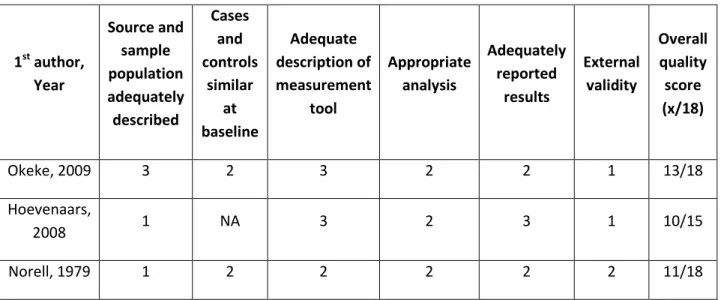
bias, and confounding. Study quality was assessed on the following criteria: adequacy of source and
sample population description, similarity of cases and controls at baseline, adequacy of measurement
criterion was given a score of 1 for poor, 2 for fair, or 3 for good. Overall study validity was rated as
good, fair, or poor based on these criteria. Poor was defined as overall score of 6-10, fair as 11-14, and
good as 15-18.
Results
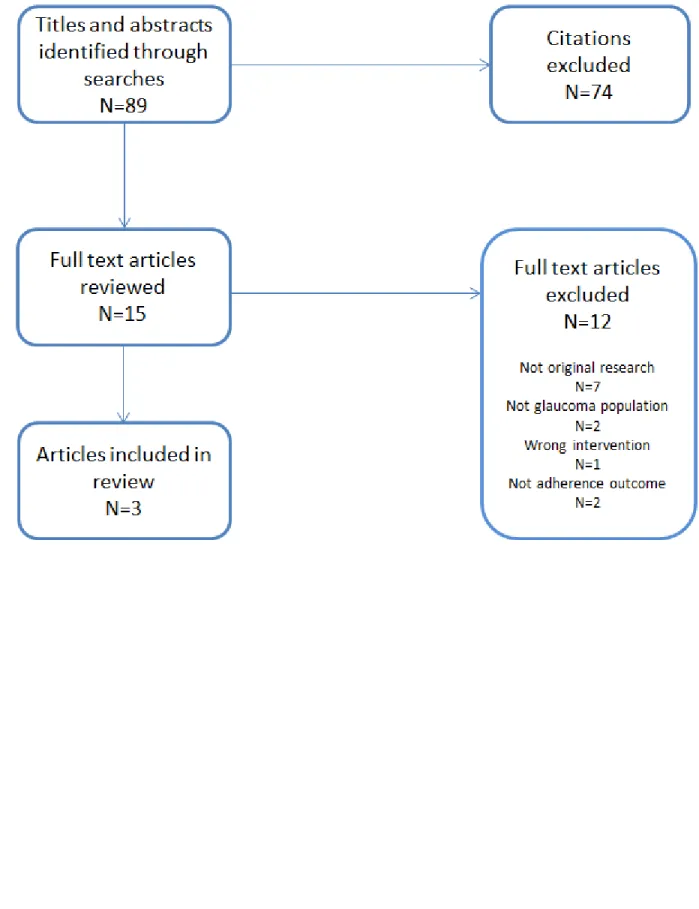
The search identified eighty-nine titles for review (Figure 1). Using the selection criteria stated
above seventy-four articles were excluded by citation and abstract review. Of the fifteen articles
selected for full-text review, twelve were excluded. Seven papers, three reviews (9-11) and four
editorials (12-15) were excluded on the basis of not reporting on original research. Two studies were
excluded because they did not examine a population with glaucoma (16, 17), one did not contain a
health literacy intervention (18), and two did not examine the effect on treatment adherence (19, 20).
This resulted in three studies that examined the relationship between individual level education and
compliance to glaucoma medication (21-23). Two RCTs (21, 22) and one survey (23) were included in
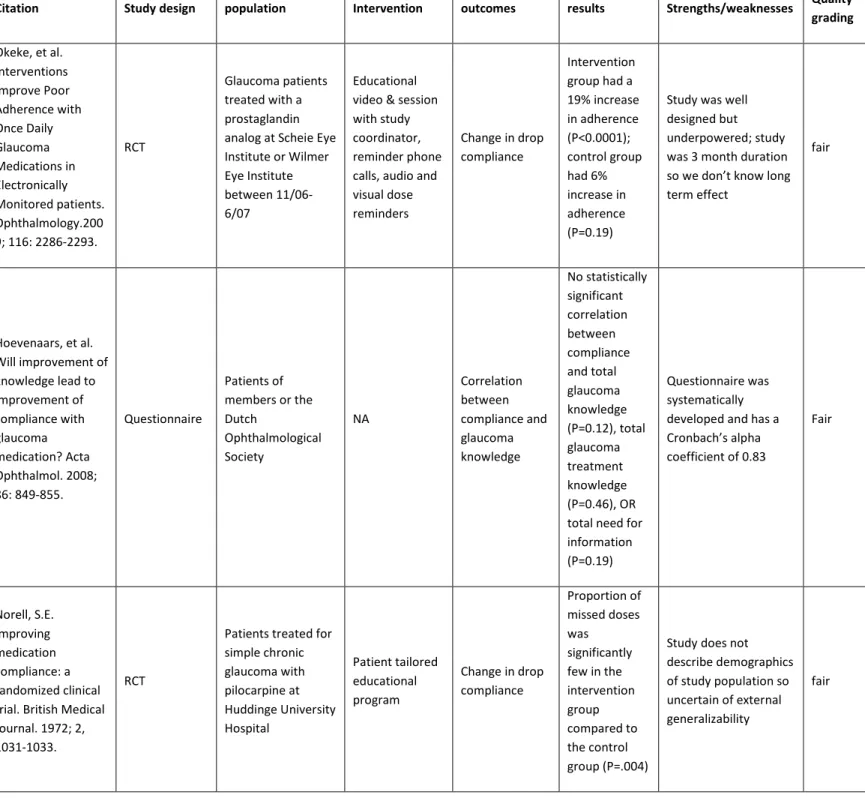
this review (Table 1). All three studies were determined to be of fair quality (Table 2).
Okeke Study
Okeke et al performed a two phase randomized controlled trial to examine the effect of a
multifaceted educational intervention on compliance to glaucoma medications (21). Glaucoma patients
seen at the Scheie Eye Institute and the Wilmer Eye Institute between November 2006 and June 2007
were recruited to participate in the study. Phase one of the study consisted of a prospective cohort
study of patient compliance to glaucoma medication for three months. After three months, patients
with 75% compliance or less were included in phase two and randomized to the intervention or control
group. Medication adherence was measured by a previously validated Dosing Aid. The intervention
consisted of four parts: a ten minute educational video, an organized strategy discussion with the study
Baseline adherence was similar between the intervention and control groups (54% in the
intervention group versus 45% in the control group, P=0.10). While the two groups were similar in most
demographic and ocular aspects, the control group was significantly more likely have used ocular drops
for less than a year (5.71% of the intervention group versus 29.0% of the control group, P<0.01). The
mean adherence rate significantly increased from 54% to 73% (P<0.01) for the intervention group while
the change in mean adherence for the control group was not statistically significant (46% to 51%,
P=0.19).
Study Design
This study was a two phase randomized controlled trial (RCT). External generalizability, often a
limitation of RCTs due to the typical complexity of design and rigid exclusion criteria, was not an issue
with this study which had a relatively pragmatic behavioral intervention. In addition, there were
relatively few exclusion criteria, related primarily to the participant’s ability to understand and use the
Dosing Aid. Criteria for phase two was a baseline adherence rate of 75% or less during phase one. This
design was used to maximize the chance of finding significant results.
Selection of Study Population
Patients were selected from major academic centers which are likely a different population from
the general population in which there is a higher percentage of patients with more advanced disease
than in the general population. Researchers specifically recruited patients shown to be of lower
compliance for phase two of the study as that population is more likely to benefit from intervention.
Although the authors state that participants were recruited from the Wilmer Eye Institute and the
Scheie Eye Institute, they do not specify how the patients were recruited. It is possible that there was
patients who were lost to follow up during phase two. Overall, there was a moderate potential for
selection bias.
Measurements
The Dosing Aid is a valid measuring device that was used in a consistent fashion between the
intervention and control groups. However, the participants were aware of the purpose of the Dosing
Aid during the study which could have created a non-differential bias, artificially inflated the rate of
compliance in both groups. This bias towards the null could have decreased the magnitude of effect
between the two groups. In addition, it was determined that some patients actually took their drops
without using the Dosing Aid but the study did not report the number of participants or which arm they
were in. Overall, there was a moderately low potential that measurement bias threatens the study’s
validity.
Confounding
Several factors are potential confounders in this study. Factors such as education level, age,
disease duration and severity, race, family history of glaucoma, and general health are all potential
confounders. However, multivariate analysis showed only the intervention, a baseline compliance rate
less than 50%, and white race to be associated with increased compliance. Overall, there is a low
potential for confounding.
Statistical Analysis
Okeke et al was the only study in this review to clearly describe the process for sample size
estimation. Based on an 80% power with 0.05 alpha to determine a 20% improvement in compliance
rate they determined a sample size of forty-nine participants per arm for phase two (the intervention
the control arm. Although underpowered they still found a statistically significant increase in adherence
in the treatment as compared to control group. Under sampling causes inherent difficulties in
determining the reliability of the results. The sixty-six patients included in the phase two study might
not adequately reflect the source population. It is also possible that the researchers would have found
an even larger improvement in compliance if the study was fully powered. They did perform a
univariate and multivariate analysis to determine factors associated with compliance rate. The
intervention, low baseline compliance rate, and white race were all associated with increased
compliance.
Overall Quality
Overall quality rating was determined to be fair. Although the study was well designed and
conducted, the potential for sampling error limited its internal validity. Good internal validity is a
prerequisite for external validity. The poor internal validity limits the ability to extrapolate the results to
external populations. This study can be generalized with moderate confidence to glaucoma patients
with a low baseline adherence rate. The conclusions are congruent with the other RCT included in the
review which increases the validity of the results.
Norell Study
Norell completed a randomized controlled trial of the effect of a tailored patient educational
program on glaucoma drop compliance (22). Eighty-two patients with glaucomatous changes who were
prescribed pilocarpine for chronic open angle glaucoma were recruited from Huddinge University
Hospital Ophthalmology department between March 1977 and November 1978. Medication adherence
was measured for both control and intervention groups using an electronic monitor connected to the
handout of glaucoma and treatment information followed by a session with an ophthalmic assistant to
tailor drop schedule to daily routines.
The duration of dose intervals and proportion of missed doses were similar between both
groups at baseline. There was a significant difference in change of missed doses after the intervention
between the two groups (t=2.89, P=0.004). The percent of missed doses decreased from 10% to 6% in
the intervention group, while it increased from 10% to 15% in the control group. The difference in the
change of dose intervals between the two groups was also significant after the intervention (t=4.60,
P≈0). The percent of time exceeding the 8 hour dosing period decreased from 22% to 13% in the
intervention group and increased from 21% to 24% in the control group.
Study Design
This RCT examined the short term effect of a tailored educational intervention on the rate of
glaucoma mediation adherence. The follow up period after the intervention in this study only lasted 20
days. Thus, while the study shows that education can improve compliance in the short term, the effect
may not last over extended periods. Randomization of participants to intervention or control is
mentioned but not described. One cannot assess the quality of the randomization but because the
research occurred in 1977, it is safe to assume that it was not a computer generated randomization
process.
Selection of Study Population
The participants were recruited from the Huddinge University Hospital Ophthalmology Clinic.
The study population consisted of men and women age 56-90 with chronic simple glaucoma. The
authors do not give any additional demographic information. However, the baseline compliance rate is
between them. Nine patients were lost to follow-up after the intervention period. The authors did
describe the reasons for loss to follow-up (six of which were due to equipment malfunction and three to
unrelated health complications), but did not list which arm the patients were lost from. It is unlikely
that patients lost to follow-up because of equipment malfunction raises concern for selection bias.
However, the hospitalized patients could all have come from the same arm, indicating that the general
health of one group is different from the other. Overall, there is a moderate to high potential for
selection bias based on the minimal information provided by the authors.
Measurements
Compliance was measured by an electronic monitoring device. The participants were blinded to
the purpose of the monitoring device until the conclusion of the study, and it was used in the same
manner in the both the intervention and control groups. The patient education was performed in a
consistent fashion. An ophthalmology assistant assessed patient knowledge and performed individual
patient tailoring. Patient tailoring involved the discussion of individual habits, the inclusion of drop
instillation in habits, and a written list of medication instillation times. Neither the number of assistants
used nor their training was described in the article. Overall, there was a relatively low potential for
measurement bias.
Confounding
Patients were stratified by age before randomized to either intervention or control group. The
authors did not mention controlling for any other potential confounders. In particular, the issues of
gender, race, education level, disease duration, nor disease severity were controlled for in the analysis.
Statistical Analysis
A t test was used to examine the difference in frequency distribution of missed doses between
the two groups. However, as stated above, potential confounders were not taken into account in the
analysis.
Overall Quality
The overall quality rating of the study was determined to be fair. The article did not state the
sample size estimate or give demographic information about the study participants. While the
researchers may have addressed some of the issues that would make this study good instead of fair
quality, the absence of this information in the methods section prevents me from designating a higher
rating.
Hoevenaars Study
Hoevenaars et al created a questionnaire to examine the correlation between glaucoma disease
and treatment knowledge and medication compliance (23). Sixty ophthalmologists identified by their
membership in the Dutch Ophthalmological Society were randomly selected to participate in the study.
Each ophthalmologist administered the questionnaire to four consecutive patients. Information about
age, gender, duration of glaucoma, and socioeconomic status was collected for all of the participants
(24).
There was not a statistically significant correlation between compliance and total level of
glaucoma knowledge (P=0.12) or total level of knowledge of glaucoma treatment (P=0.46) or total level
of need for information (P=0.19). There was a statistically significant negative correlation between the
statement “a patient should always tell the ophthalmologist which other medications (s)he is using”
actually less compliant, which is surprising. There was also a statistically significant positive correlation
(OR 3.3) between a correct answer to the statement “eye drops can repair the damage caused by
glaucoma” and compliance, indicating that participants who answer correctly (No) are more compliant.
Three “need for information” statements had a statistically significant positive correlation with
compliance, indicating that more compliant patients felt they did not need additional information on
those items. These items include “how to function better with glaucoma” (OR 3.1), “experiences of
other glaucoma patients” (OR 3.3) and “heredity of glaucoma” (OR 4.1).
Study Design
The validity of questionnaire based studies is strongly related to the reliability and validity of the
questionnaire used. One of the strengths of this study is the systematic development of the
questionnaire. Formative research included focus groups, expert opinion and pilot testing. However,
even if the questionnaire used is valid, non-response rates and missing data can decrease the internal
validity of the study. Hoevenaars, et al. had a physician response rate of 73%. Response rates of at least
40-70% do not challenge a study’s internal validity (25).
Selection of Study Population
Sixty ophthalmologists were randomly selected from the Dutch Ophthalmology Society. It is
unclear if other ophthalmological societies exist in the Netherlands or if all certified ophthalmologist are
members of this society. Selection bias could be present both in the form of the selection of the
ophthalmologists included in the study and in their selection of the patient participants which were
selected in a consecutive fashion. Of the sixty ophthalmologists who were recruited, 73% responded to
the invitation for a total of 166 patients completing the questionnaire. The demographics of neither the
ophthalmologists nor the patients were described in the article, however it was stated that both
populations of the specialists and general ophthalmologists were very different. The overall potential
for selection bias was high.
Measurements
The questionnaire was systematically developed using focus groups, expert opinion and pilot
tests. Cronbach’s alpha was 0.83 which indicated good internal consistency of the questionnaire.
Compliance was self-reported on the questionnaire. Researchers minimized recall bias by limiting the
compliance time period to the previous four weeks. Potential reporting bias of compliance rates was
minimized by using a strict noncompliance definition of missing one or more drops in the previous four
weeks. The overall potential for measurement bias was low to moderate.
Confounding
The authors calculated adjusted odds ratios (OR) taking age, gender, duration of disease,
educational level, glaucoma medications and history of prior glaucoma surgical treatment into
consideration. However, disease severity, race, nor family history of glaucoma was explicitly controlled
for in the analysis. Overall, the potential for confounding bias was low to moderate.
Statistical Analysis
Significance was appropriately tested for using a Pearson chi-squared test. Logistic regression
was performed for each item on the questionnaire to calculate the OR for being compliant. Due to the
high number of testing (fifty-nine total items on the questionnaire), it is highly likely that some of their
results are due to chance.
Any missing data were categorized as “don’t know/no opinion.” However, the researchers do
who did not answer how often they had missed their eye drops, the researchers classified the
participant as noncompliant or compliant based on their answers to other questions.
Overall Quality
The Hoevenaars study received an overall quality grading of fair. The potential biases in the
selection of both ophthalmologist and participants strongly affect its internal validity. Although the
questionnaire itself appears to be reliable, the overall conclusions of the study do not agree with the
conclusions of other studies, calling their results in question. The Netherlands are very ethnically
homogenous which limits this study’s applicability to the very heterogeneous US population.
Discussion
Both RCTs found an educational intervention to statistically improve compliance to medications
in glaucoma patients. Although the results were statistically significant, the clinical significance remains
unclear. Additionally, both trials involved multifaceted educational programs. It is difficult to determine
the extent to which each component contributed to the increased compliance. Each study defined
compliance differently, making it challenging to compare them directly. All studies received an overall
quality grading of fair due to multiple potentials biases and limitations of external validity.
Despite these limitations both RCTs found the intervention to improve compliance. The
interventions in the two trials included both knowledge and behavioral modifications. Hoevenaars et al
conclude that education only based programs are unlikely to improve compliance, but that more
complex interventions combining patient education, behavior modification, and patient belief systems
would be more effective (23).
Both RCTs examined the effect of the intervention in the short term, from twenty days (22) to
unanswered questions about long term effect. Both the frequency and composition of the intervention
are important factors to consider and may change throughout the duration of disease management.
This is especially important in regards to glaucoma which is a chronic disease often requiring lifelong
medical therapy.
Additionally, all three studies used medication adherence to measure intervention success.
However, adherence is an intermediate outcome and may not accurately reflect patient centered health
outcomes such as vision and quality of life (QoL). Glaucoma progression is correlated with a decrease in
both disease specific and general QoL (26). Future research should focus on the long term effects of
multifaceted behavioral and education based interventions on the prevention of glaucomatous visual
field loss and preservation of QoL. No published studies to date have examined the effect of this type of
intervention on long term disease progression or QoL.
Although this was a systematic and fairly thorough review, it was not completely
comprehensive. Thus, it is possible that literature on this topic was not captured in this search. The
review was limited to studies in the English language but there may be studies published in other
languages that address the topic of this review. Additionally the review was limited to published
literature. Ongoing studies and unpublished articles were not included which limited the completeness
of the review.
Conclusion
Although a few studies have examined the effect of education on glaucoma medication
compliance, many of the recommendations are extrapolated from other chronic diseases such as
hypertension and diabetes. While it is likely that many of the concepts are also applicable to glaucoma
patients, the use of eye drops as opposed to oral medications could create different issues not
behavioral/educational interventions listed on the National Institutes of Health (NIH) website (27).
Although it is most likely that a multifaceted approach will be the most efficacious, it would be
References
1. Houts PS, Doak CC, Doak LG, Loscalzo MJ. The role of pictures in improving health communication: A review of research on attention, comprehension, recall, and adherence. Patient Educ Couns. 2006 May;61(2):173-90.
2. Long AF, Gambling A. Enhancing health literacy and behavioural change within a tele-care education and support intervention for people with type 2 diabetes. Health expectations: an international journal of public participation in health care and policy. 2011 4/27/11.
3. Rosal MC, Ockene IS, Restrepo A, White MJ, Borg A, Olendzki B, et al. Randomized trial of a literacy-sensitive, culturally tailored diabetes self-management intervention for low-income latinos: Latinos en control. Diabetes Care. 2011 Apr;34(4):838-44.
4. Schillinger D, Piette J, Grumbach K, Wang F, Wilson C, Daher C, et al. Closing the loop: Physician communication with diabetic patients who have low health literacy. Arch Intern Med. 2003 Jan 13;163(1):83-90.
5. Friedman DS, Hahn SR, Gelb L, Tan J, Shah SN, Kim EE, et al. Doctor-patient communication, health-related beliefs, and adherence in glaucoma results from the glaucoma adherence and persistency study. Ophthalmology (Rochester, Minn.). 2008 -08;115(8):1320,7, 1327.e1-3.
6. Health literacy: Report of the council on scientific affairs. ad hoc committee on health literacy for the council on scientific affairs, american medical association. JAMA. 1999 Feb 10;281(6):552-7.
7. Paasche-Orlow MK, Wolf MS. The causal pathways linking health literacy to health outcomes. Am J Health Behav. 2007 Sep-Oct;31 Suppl 1:S19-26.
8. Hironaka LK, Paasche-Orlow MK. The implications of health literacy on patient-provider communication. Arch Dis Child. 2008 May;93(5):428-32.
9. Wadhwa SD, Higginbotham EJ. Ethnic differences in glaucoma: Prevalence, management, and outcome. Curr Opin Ophthalmol. 2005 Apr;16(2):101-6.
10. Budenz DL. A clinician's guide to the assessment and management of nonadherence in glaucoma. Ophthalmology. 2009 Nov;116(11 Suppl):S43-7.
11. Hahn SR. Patient-centered communication to assess and enhance patient adherence to glaucoma medication. Ophthalmology. 2009 Nov;116(11 Suppl):S37-42.
12. Kong X, Chen X, Sun X, Xiao M, Zuo L, Guo W. Glaucoma club: A successful model to educate glaucoma patients. Clin Experiment Ophthalmol. 2009 Aug;37(6):634-6.
14. Mansukani SS. Improving adherence to drug-treatment regimens for glaucoma. Manag Care. 2002 Nov;11(11 Suppl):49-53.
15. Tsai JC. Medication adherence in glaucoma: Approaches for optimizing patient compliance. Curr Opin Ophthalmol. 2006 Apr;17(2):190-5.
16. Heneghan CJ, Glasziou P, Perera R. Reminder packaging for improving adherence to self-administered long-term medications. Cochrane Database Syst Rev. 2006 Jan 25;(1)(1):CD005025.
17. Haynes RB, Ackloo E, Sahota N, McDonald HP, Yao X. Interventions for enhancing medication adherence. Cochrane Database Syst Rev. 2008 Apr 16;(2)(2):CD000011.
18. Paula JS, Ramos Filho JA, Cecchetti DF, Nagatsuyu DT, Rodrigues Mde L, Rocha EM. Medical decision, persistence of initial treatment, and glaucoma progression in a brazilian reference hospital. Arq Bras Oftalmol. 2010 Apr;73(2):141-5.
19. Gray TA, Fenerty C, Harper R, Lee A, Spencer AF, Campbell M, et al. Preliminary survey of educational support for patients prescribed ocular hypotensive therapy. Eye (Lond). 2010 Dec;24(12):1777-86.
20. Gray TA, Orton LC, Henson D, Harper R, Waterman H. Interventions for improving adherence to ocular hypotensive therapy. Cochrane Database Syst Rev. 2009 Apr 15;(2)(2):CD006132.
21. Okeke CO, Quigley HA, Jampel HD, Ying GS, Plyler RJ, Jiang Y, et al. Interventions improve poor adherence with once daily glaucoma medications in electronically monitored patients. Ophthalmology. 2009 Dec;116(12):2286-93.
22. Norell SE. Improving medication compliance: A randomised clinical trial. Br Med J. 1979 -10-27;2(6197):1031-3.
23. Hoevenaars JG, Schouten JS, van den Borne B, Beckers HJ, Webers CA. Will improvement of knowledge lead to improvement of compliance with glaucoma medication? Acta Ophthalmol. 2008 Dec;86(8):849-55.
24. Hoevenaars JG, Schouten JS, van den Borne B, Beckers HJ, Webers CA. Socioeconomic differences in glaucoma patients' knowledge, need for information and expectations of treatments. Acta Ophthalmol Scand. 2006 Feb;84(1):84-91.
25. Encyclopedia of survey research methods. Lavrakas PJ, editor. Thousand Oaks, Calif.: SAGE Publications; 2008.
26. van der Valk R, Webers CA, Schouten JS, Zeegers MP, Hendrikse F, Prins MH. Intraocular pressure-lowering effects of all commonly used glaucoma drugs: A meta-analysis of randomized clinical trials. Ophthalmology. 2005 Jul;112(7):1177-85.
27. ClinicalTrials.gov [Internet].; 2011. Available from:
Table 1. Evidence Summary Table
Citation Study design population Intervention outcomes results Strengths/weaknesses Quality grading
Okeke, et al. Interventions Improve Poor Adherence with Once Daily Glaucoma Medications in Electronically Monitored patients. Ophthalmology.200 9; 116: 2286-2293.
RCT
Glaucoma patients treated with a prostaglandin analog at Scheie Eye Institute or Wilmer Eye Institute between 11/06-6/07
Educational video & session with study coordinator, reminder phone calls, audio and visual dose reminders
Change in drop compliance
Intervention group had a 19% increase in adherence (P<0.0001); control group had 6% increase in adherence (P=0.19)
Study was well designed but underpowered; study was 3 month duration so we don’t know long term effect
fair
Hoevenaars, et al. Will improvement of knowledge lead to improvement of compliance with glaucoma medication? Acta Ophthalmol. 2008; 86: 849-855. Questionnaire Patients of members or the Dutch Ophthalmological Society NA Correlation between compliance and glaucoma knowledge No statistically significant correlation between compliance and total glaucoma knowledge (P=0.12), total glaucoma treatment knowledge (P=0.46), OR total need for information (P=0.19)
Questionnaire was systematically developed and has a Cronbach’s alpha coefficient of 0.83
Fair Norell, S.E. Improving medication compliance: a randomized clinical trial. British Medical Journal. 1972; 2, 1031-1033.
RCT
Patients treated for simple chronic glaucoma with pilocarpine at Huddinge University Hospital Patient tailored educational program
Change in drop compliance
Proportion of missed doses was
significantly few in the intervention group compared to the control group (P=.004)
Study does not describe demographics of study population so uncertain of external generalizability
Table 2. Quality Scoring
1st author, Year
Source and sample population adequately described
Cases and controls
similar at baseline
Adequate description of measurement
tool
Appropriate analysis
Adequately reported
results
External validity
Overall quality score (x/18)
Okeke, 2009 3 2 3 2 2 1 13/18
Hoevenaars,
2008 1 NA 3 2 3 1 10/15
Norell, 1979 1 2 2 2 2 2 11/18
Appendix 1: Search Strategy
PubMed:
1. Communications
2. Health education
3. Health status
4. Patient compliance
5. Physician patient relations
6. Patient compliance AND physician patient relations AND glaucoma
7. Communications OR health education AND physician patient relations AND patient compliance AND glaucoma
CINAHL:
1. Patient compliance AND health education AND physician patient relations
EMBASE:
1. Communications OR health education AND physician patient relations AND patient compliance AND glaucoma
ISI:
1. Communication AND patient compliance AND physician patient relations
Cochrane:
1. Patient provider communication
2. Health literacy
3. Adherence AND intervention
Appendix 2: Critical Appraisal Form
Citation (JAMA style)
Study Question and Research Design Source Population
Study Population (descriptive: demographics, eligibility criteria) and how chosen (volunteers, recruitment, tertiary care clinics, population-based, etc.)
Initial Comparability of groups (i.e., randomization or group composition; concealment of allocation)
Drop outs (no endpoint data), adherence, crossovers (attrition, loss to follow up)
Potential for selection bias (+ to +++) and explain
Measurement of exposure, intervention, potential confounders, and outcomes; reliability and validity of measurement; how performed, blinding
Potential for measurement bias (+ to +++)
Potential confounders (name and describe how each was controlled for)
Potential for confounding (+ to +++)
Analysis (intention to treat or other adjustment)
Results: magnitude and direction (point estimate; random error or precision (confidence interval); statistical
significance
Clinical and Public Health importance for the source population; for a wider population
Overall judgment of internal validity (good, fair, poor) External validity: applicability to other populations
Study Abstract
Purpose: Glaucoma, a chronic progressive disease is initially asymptomatic. Vision loss, which typically
begins in the periphery of the visual field, is irreversible once it has occurred. Adherence to ocular
anti-glaucoma drops is important to prevent the progression of vision loss and ultimately blindness. The
purpose of the described study is to examine how African Americans perceive medical information
related to glaucoma care from their providers. The ultimate goal is to use this information to develop a
tool for improving provider patient communication about glaucoma and its treatment.
Methods: A qualitative study using focus groups was designed to explore the interactions between
provider and patient used to impart disease related information. Low health literacy African American
patients recruited from the eye clinic at UNC Chapel Hill will attend one of three focus groups of six to
eight individuals each. Qualitative and quantitative data will be analyzed using Atlas.ti.60 and STATA
10.1, respectively.
Anticipated Results: Several major themes are expected to emerge from the focus groups. The first is
education using multiple media formats (verbal, written, and graphic) appropriate to health literacy
level. It is expected that provider patient relationship can be improved through the exploration of
patient beliefs and attitudes towards disease. Multiple communication skills such as motivational
interviewing, ask-tell-ask dialogue, and assessing readiness for change, likely can be used to identify and
address patient adherence.
Conclusion: Improving patient adherence is likely to need a multifaceted, individualized approach.
However, the identification of patient beliefs, values and learning style are an important first step in
Introduction
Primary open-angle glaucoma (POAG), a chronic progressive optic neuropathy, affects
approximately 2.22 million adults in the United States (1). POAG affects a disproportionally higher
percentage of African-Americans with as much as a six fold increase in prevalence in some age groups
when compared to their White counterparts (2, 3). The onset of POAG occurs on average ten years
earlier and progresses more rapidly in African Americans than other races (2).
In one study, lack of knowledge about glaucoma was found to be the most important barrier to
care in predominately African American populations (4). Lack of knowledge about one’s medical
condition has been linked to lower health literacy. Health literacy is the ability to read and understand
written health information, oral health information, and the ability to act on such information (5). The
concept of health literacy in disease management is beginning to permeate the field of ophthalmology.
Not only is low health literacy correlated with poorer understanding of disease, but it is also associated
with lower compliance to medical treatment and worse health outcomes (6-10).
A cross-sectional patient survey of 197 patients with open angle glaucoma found that 52% read
at or below eighth grade level and 11.7% were at or below third grade reading skills (11). In addition,
the researchers found a correlation between poorer literacy skills and lower medication adherence,
measured by the number of prescription refills (11). Lower health literacy is more prevalent among the
lower socioeconomic urban population, which is predominately African-American (11). A review of
educational material produced by the American Academy of Ophthalmology (AAO) in 1997 found that
only 32% of the material was written at or below an eighth grade reading level (12). The overall mean
Flesch-Kincaid score of the material was 9.6 (12). In contrast, AAO educational material published in
Barriers to effective patient care can be grouped into four basic categories: medication regimen,
patient factors, provider factors, and situational factors (14) (15). While multiple studies have
addressed the issue from the perspective of medication adherence, additional studies are needed to
explore these basic categories in order to tailor interventions to patients’ needs. Specifically, tools to
improve ophthalmologists’ ability to communicate effectively with low literacy patients are lacking.
Although it is unknown whether poor health literacy is a causal mechanism for worse disease
outcomes or a marker for presently unknown factors, the provider-patient interaction has been
identified as a modifiable step along the causal pathway to improved disease outcomes (10). Therefore,
the goals of the planned study are to understand how African Americans perceive medical information
related to glaucoma care. The information will then be used to develop a tool for improving
provider-patient communication about glaucoma.
Methods
Approach
This qualitative study will use grounded theory to explore provider and patient interactions that
are used to impart disease information. Focus groups will be used to extract patient perspectives on
the form and content of information their ophthalmologists could better provide to help them
understand glaucoma and their role in glaucoma management. There will be a series of three focus
groups consisting of six to eight participants with a goal of twenty-four total participants. All three
groups will be asked a series of scripted questions, including several open ended questions (Appendix 1).
The moderator can use probe questions at his/her discretion to explore participant responses. Probe
questions are expected to vary across the groups, according to individual situations. A retrospective
chart review will be used to determine disease severity and demographic information of each
to the focus group will be used to collect data on perceived glaucoma education and compliance
(Appendix 2). The study will be approved by the Institutional Review Board prior to study initiation and
informed consent will be obtained from all participants.
Setting
The participants will consist of African Americans previously seen at the glaucoma or resident
clinic at Kittner Eye Center of UNC Chapel Hill. Clinic schedules will be reviewed daily to identify
potential participants by age and disease status. Participants will be recruited and screened by UNC
School of Medicine (SOM) medical students at the time of their regularly scheduled glaucoma
appointment using a predetermined script (Appendix 3). It is estimated to take approximately two
weeks per focus group to enroll the six to eight participants. Participants will be told that researchers
seek to hear from patients on “physician-patient communication issues.” Due to the sensitive nature of
the term “low literacy,” participants will not be explicitly told about the literacy component of the study.
One African American trained focus group moderator will facilitate open and interactive dialogue
amongst the group members and monitor the participation of each group member. One trained
medical student will serve as note taker for each focus group to capture major themes and group
dynamic information. The groups will be held in a neutral location on the campus of UNC-Chapel Hill.
Sampling
Convenience sampling will be used to identify potential participants who receive care at UNC
Kittner Eye Center. Ophthalmology clinic schedulers will be blinded to the nature of the study to
decrease bias in scheduling patients for their regular clinic appointments. Patients will be eligible if they
are age 18 years or older, have a diagnosis of primary open angle glaucoma for at least six months, or
have inadequate or marginal level functional health literacy. Functional health literacy will be
reliable measure of health literacy. Patients will be excluded if their best corrected vision is worse than
20/50 in their better eye, a Mini Mental Status Exam (MMSE) worse than 25 or a documented
psychiatric disorder, or a significant hearing disability. Decreased vision, low level score on MMSE ,
psychiatric disorders or hearing disabilities could interfere with a person’s ability to complete the
literacy test or to interact with participants during the focus groups. Interested participants will be seen
by a researcher to screen for eligibility criteria. The general consensus in qualitative research is that
expected information saturation occurs by the third focus group. This theory was used as the rationale
for a sample size of three focus groups.
Information Collection and Analysis
Data will be collected from chart reviews, a questionnaire administered via mail prior to the
focus group, field notes collected by the assistant moderator, and transcription from the group audio
recording. Quantitative data collected from the chart review and questionnaire will be analyzed using
STATA 10.1. Qualitative data collected from the field notes and audio transcription is to be analyzed
using Atlas.ti 6.0 for emerging themes used to describe and explore provider and patient interactions.
Computer assisted analysis is used to increase standardization and efficiency of analysis. Dependability
of data will be established by the use of transcribed audio recordings of focus group sessions.
Interobserver reliability will be established through the use of a debriefing session at the end of each
focus group between the moderator and assistant moderator. This debriefing session will be audio
recorded and included in data analysis. Data will be coded based on the identified themes and ideas.
Data sets will be coded independently by two different analysts and resultant codes compared. After
completing analysis, the two coders will meet to discuss the results and address any discrepancies which
Expected Results
Although scarce literature exists examining the effects of patient education on adherence in
glaucoma, several ophthalmologists have written editorials presenting guidelines for both the detection
and management of adherence issues based on researched gathered from other chronic diseases such
as hypertension and diabetes (17, 18) . The use of verbal, written and graphic instructions can enhance
understanding (19)(20). Health literacy should be a major consideration while constructing the written
information as over ninety million Americans have limited literacy skills (5). The reading grade level of
current American Academy of Ophthalmology (AAO) patient education material ranges from 4.9 to 11.1
with a mean of 8.0 (13) but 44 million American read at only the 5th grade level (21).
Provider patient relationship is an important part of the path to adherence (22). Motivational
interviewing has been used successfully in other fields of medicine and has been suggested to be useful
in nonadherent glaucoma patients. Although physicians assess for nonadherence, many factors cause
patients to underreport medication adherence (23). Reported education centered barriers to
adherence include insufficient understanding of drop installation, drop regimen, the consequences of
poor drop adherence and inadequate education (24-26).
Several communication based strategies have been suggested, such as using an “Ask-Tell-Ask”
dialog (13, 23, 27, 28), motivational interviewing (28), assessing for readiness for change (28), and “Ask
Me 3” (27). More passive learners are less likely to ask questions (15), so a communication strategy
forcing patients to interact with their physicians such as “Ask Me 3” or “Ask-Tell-Ask” could encourage
greater disease comprehension and more open dialogue between the physician and patient.
In addition, valuable information can be gathered from examining the health beliefs and values
of African Americans concerning other diseases. Lack of concern over vision loss is associated with
patients (15). African American patients state that trust, empathy, and good communication is
important in their interactions with physicians (22).
Potential Difficulties
Targeting recruitment to low literacy patients could cause enrollment to be slower than initially
estimated. Unfortunately, a stigma still exists around the issue of low literacy. Patients with low literacy
might be less willing to participate due to embarrassment of literacy skills. The presentation of the study
will be very important to avoid a negative depiction of the low literacy demographic we are seeking to
enroll. If slow enrollment continues to be a problem, we can choose to also include patients at Duke
Ophthalmology Clinic or private practices in the area.
Although we plan to send out a confirmation letter with directions and a reminder phone call,
committed participants may not actually show up for the focus group. This can be due to a number of
factors and is a known phenomenon. Over recruitment is a common solution to this problem. We aim
to have six to eight participants for each focus group so we will enroll ten participants to ensure that we
have enough participants to run the focus group. We will offer monetary incentive of fifteen dollars per
participant to encourage confirmed individuals to attend the session. In addition, we will be sure to
hold the focus group in a location that is convenient to most participants and near a form of public
transportation.
Discussion
Improving patient adherence is likely to need a multifaceted approach, with patient centered
education as only one part of the puzzle. Additional approaches, such as lowering costs and simplifying
treatment regimens are also important. The Glaucoma Adherence and Persistency Study (GAPS)
collaborative, who learn most of their information from physicians; and doctor independent, who learn
very little from his/her doctor. These three types of learners report their physician encounters
differently, with doctor dependent learners less likely to report their physicians confirming their
understanding (15). In addition, doctor dependent learners had lower adherence rates. These patients
would likely benefit from a more aggressive approach to patient education from their physicians.
Findings from GAPS support the theoretical models of adherence behaviors showing
doctor-patient communications, doctor-doctor-patient relationship, and health related beliefs to be important
predictors of adherence (15). Identifying patient beliefs and attitudes along with their style of learning
is an important first step in the patient encounters. Physicians must also be appropriately trained to
modify their interactions depending on patient preference. This individualized approach makes one
uniform communication tool difficult to construct. A potentially more useful tool would be a general
References
1. Friedman DS, Wolfs RC, O'Colmain BJ, Klein BE, Taylor HR, West S, et al. Prevalence of open-angle glaucoma among adults in the united states. Arch Ophthalmol. 2004 Apr;122(4):532-8.
2. Racette L, Wilson MR, Zangwill LM, Weinreb RN, Sample PA. Primary open-angle glaucoma in blacks: A review. Surv Ophthalmol. 2003 May-Jun;48(3):295-313.
3. Tielsch JM, Sommer A, Katz J, Royall RM, Quigley HA, Javitt J. Racial variations in the prevalence of primary open-angle glaucoma. the baltimore eye survey. JAMA. 1991 Jul 17;266(3):369-74.
4. Altangerel U, Nallamshetty HS, Uhler T, Fontanarosa J, Steinmann WC, Almodin JM, et al. Knowledge about glaucoma and barriers to follow-up care in a community glaucoma screening program. Can J Ophthalmol. 2009;44(1):66.
5. Health literacy : A prescription to end confusion. Panzer AM, editor. Washington, D.C.: National Academies Press; 2004.
6. Easton P, Entwistle VA, Williams B. Health in the 'hidden population' of people with low literacy. A systematic review of the literature. BMC Public Health. 2010 Aug 5;10:459.
7. Evangelista LS, Rasmusson KD, Laramee AS, Barr J, Ammon SE, Dunbar S, et al. Health literacy and the patient with heart failure--implications for patient care and research: A consensus statement of the heart failure society of america. J Card Fail. 2010 Jan;16(1):9-16.
8. Amalraj S, Starkweather C, Nguyen C, Naeim A. Health literacy, communication, and treatment decision-making in older cancer patients. Oncology (Williston Park). 2009 Apr 15;23(4):369-75.
9. Dewalt DA, Berkman ND, Sheridan S, Lohr KN, Pignone MP. Literacy and health outcomes: A systematic review of the literature. J Gen Intern Med. 2004 Dec;19(12):1228-39.
10. Paasche-Orlow MK, Wolf MS. The causal pathways linking health literacy to health outcomes. Am J Health Behav. 2007 Sep-Oct;31 Suppl 1:S19-26.
11. Juzych MS, Randhawa S, Shukairy A, Kaushal P, Gupta A, Shalauta N.
Functional health literacy in patients with glaucoma in urban settings. Arch Ophthalmol. 2008;126(5):718.
12. Ebrahimzadeh H, Davalos R, Lee PP. Literacy levels of ophthalmic patient education materials. Surv Ophthalmol. 1997 Sep-Oct;42(2):152-6.
13. Muir KW, Lee PP. Health literacy and ophthalmic patient education. Surv Ophthalmol. 2010 Sep 10;55(5):454-9.
15. Friedman DS, Hahn SR, Gelb L, Tan J, Shah SN, Kim EE, et al. Doctor-patient communication, health-related beliefs, and adherence in glaucoma results from the glaucoma adherence and persistency study. Ophthalmology. 2008 Aug;115(8):1320,7, 1327.e1-3.
16. Danesh-Meyer HV, Deva NC, Slight C, Tan YW, Tarr K, Carroll SC, et al. What do people with
glaucoma know about their condition? A comparative cross-sectional incidence and prevalence survey. Clin Experiment Ophthalmol. 2008 Jan-Feb;36(1):13-8.
17. Mansukani SS. Improving adherence to drug-treatment regimens for glaucoma. Manag Care. 2002 Nov;11(11 Suppl):49-53.
18. Friedman DS, Cramer J, Quigley H. A more proactive approach is needed in glaucoma care. Arch Ophthalmol. 2005 Aug;123(8):1134-5.
19. Mayeaux EJ,Jr, Murphy PW, Arnold C, Davis TC, Jackson RH, Sentell T. Improving patient education for patients with low literacy skills. Am Fam Physician. 1996 Jan;53(1):205-11.
20. Doak CC, Doak LG, Friedell GH, Meade CD. Improving comprehension for cancer patients with low literacy skills: Strategies for clinicians. CA Cancer J Clin. 1998 May-Jun;48(3):151-62.
21. Kutner M, Greenberg E, Jin Y, Paulsen C. The health literacy of America’s adults results from the 2003 national assessment of adult literacy (NCES 2006–483). .U.S.Department of Education.Washington,DC: National Center for Education Statistics. 2006.
22. Ellish NJ, Royak-Schaler R, Passmore SR, Higginbotham EJ. Knowledge, attitudes, and beliefs about dilated eye examinations among african-americans. Invest Ophthalmol Vis Sci. 2007 May;48(5):1989-94.
23. Hahn SR. Patient-centered communication to assess and enhance patient adherence to glaucoma medication. Ophthalmology. 2009 Nov;116(11 Suppl):S37-42.
24. Lacey J, Cate H, Broadway DC. Barriers to adherence with glaucoma medications: A qualitative research study. Eye (Lond). 2009 Apr;23(4):924-32.
25. Taylor SA, Galbraith SM, Mills RP. Causes of non-compliance with drug regimens in glaucoma patients: A qualitative study. J Ocul Pharmacol Ther. 2002 Oct;18(5):401-9.
26. Tsai JC, McClure CA, Ramos SE, Schlundt DG, Pichert JW. Compliance barriers in glaucoma: A systematic classification. J Glaucoma. 2003 Oct;12(5):393-8.
27. Hironaka LK, Paasche-Orlow MK. The implications of health literacy on patient-provider communication. Arch Dis Child. 2008 May;93(5):428-32.
Table1: Participant Demographics
Demographic Group 1 Group 2 Group 3
Age
Gender Female Male
Educational Attainment High School or less Some College College Graduate
Duration of Disease
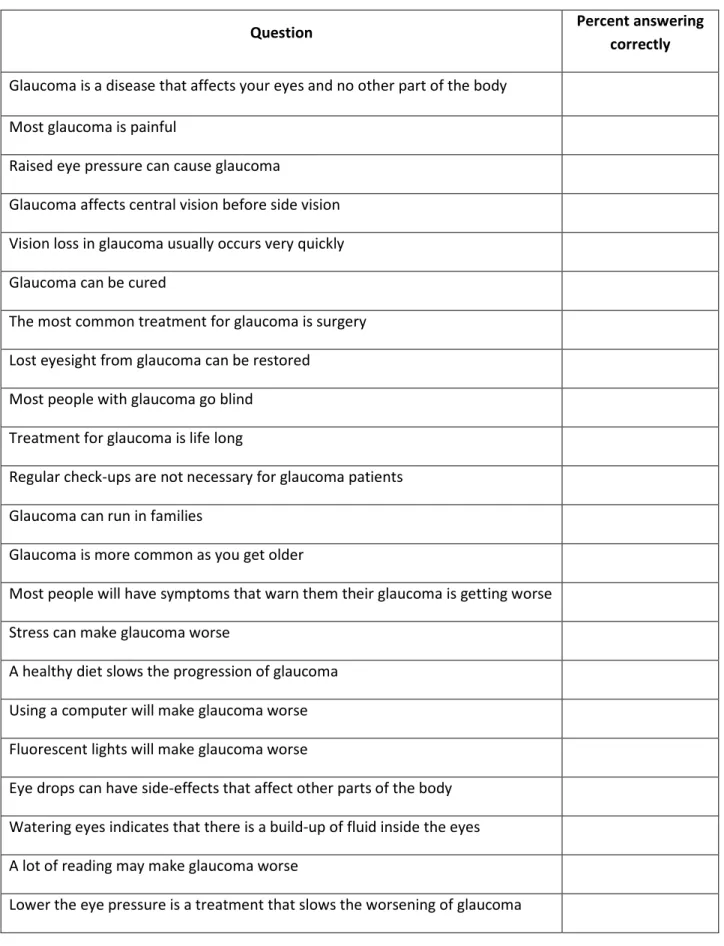
Table 2: Questionnaire Results
Question Percent answering
correctly
Glaucoma is a disease that affects your eyes and no other part of the body
Most glaucoma is painful
Raised eye pressure can cause glaucoma
Glaucoma affects central vision before side vision
Vision loss in glaucoma usually occurs very quickly
Glaucoma can be cured
The most common treatment for glaucoma is surgery
Lost eyesight from glaucoma can be restored
Most people with glaucoma go blind
Treatment for glaucoma is life long
Regular check-ups are not necessary for glaucoma patients
Glaucoma can run in families
Glaucoma is more common as you get older
Most people will have symptoms that warn them their glaucoma is getting worse
Stress can make glaucoma worse
A healthy diet slows the progression of glaucoma
Using a computer will make glaucoma worse
Fluorescent lights will make glaucoma worse
Eye drops can have side-effects that affect other parts of the body
Watering eyes indicates that there is a build-up of fluid inside the eyes
A lot of reading may make glaucoma worse
Appendix 1: Focus Group Question Guide
1. Opening question/icebreaker
2. Where have you learned the most about glaucoma?
3. What is it like when you ask your glaucoma doctor questions about your medical care?
4. What questions do you have about your care after you leave your doctor’s office?
5. What would help you follow the doctor’s directions after you leave the office?
6. How do you learn best? Think of hearing versus reading versus seeing a picture.
7. What is the most important thing you learned about your disease from your doctor?
Appendix 3: Recruitment Script
Eligibility Criteria:
• ICD-9 diagnosis of primary open angle glaucoma for ≥6 months • ≥18 years old
• Gender balance (no fewer than 3 men or women in each group)
• Inadequate or marginal functional health literacy as determined by the Short Test of Functional Literacy in Adults (STOFHLA)
Exclusion Criteria:
• Adequate functional health literacy as determined by STOFHLA • Best corrected vision worse than 20/50 in better eye
• Mini Mental Status Exam (MMSE) worse than 25 • Documented psychiatric disorder
• Significant hearing disability
Script:
Hello Mr./Mrs. _____. My name is [your full name] and I am working on a research project here at UNC. We are holding focus groups to talk about issues in physician patient communication in patients with glaucoma and would like you to be a part of that. This is a group interview that would last about two hours, and we would pay you $25 for your time.
You would get together with other African American patients with glaucoma to talk together and answer some questions for us. There will be just this one meeting.
Is this something that interests you?
The session we are trying to set up is one [day] at [time]. Is this something that could fit into your schedule?
If the participant is available, continue with background information:
We are putting together a group of people who are willing to discuss their opinions and experiences with physician communication. We are especially interested in finding what people in the African American community think about the topic. Does this sound like something that would work for you?
Scheduling:
The session would be at [location] on [date]. We will start at [time] and end by [time]. It is very important that everyone that signs up actually shows up. Do you think that you can come? It is also important that you will be there by [start time]. Will you have any trouble getting there on time?
make sure that we have a good idea of what was said. The recording and all that was is said during the session will be kept confidential. Attending this session is completely voluntary and you will be free to leave at any time for any reason.
I’d like to mail you a letter confirming your participation in this focus group, along with a map to the group location, and a survey to complete and bring along with you to the focus group session. What is the best address to send that to?
We will be starting the session right on time at [time] on [date]. If you get to the session late we may not be able to include you. So, it is very important that you get there on time.
So that everyone remembers, we will be calling you the evening before the group session to remind you about it. What is the best number to call you at?
Thank you very much. We are looking forward to seeing you on [date].
If the patient is unsure whether to participate: